www.etwinning.net
UNHCR: TEACHING ABOUT REFUGEES
ONLINE SEMINAR WITH FREDERIK SMETS
UNHCR ASSOCIATE EDUCATION AND
ADVOCACY OFFICER
On-line seminar:
Wednesday 20 May 2020, 16:00 - 17:00 CET
20-05-20 1
www.etwinning.net
INTRODUCTION
ALEXANDRA LICHT
ETWINNING PEDAGOGICAL AND
MONITORING OFFICER
On-line seminar:
Wednesday 20 May 2020, 16:00 - 17:00 CET
20-05-20 2
WHO ARE WE?
UNHCR
UNHCR
Office of the
United Nations High Commissioner for Refugees
UNHCR
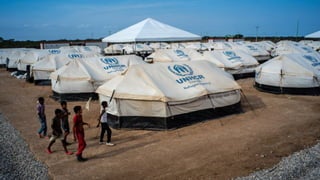
United Nations agency for refugees
Our primary purpose at UNHCR is to safeguard the rights and well-being of people who have been forced to
flee.

Together with partners and communities, we work to ensure that everybody has the right to seek asylum and
find safe refuge in another country. We also strive to secure lasting solutions.
For over half a century, UNHCR has helped millions of people to restart their lives. They include refugees,
returnees, stateless people, the internally displaced and asylum-seekers. 
Our protection, shelter, health and education has been crucial, healing broken pasts and building brighter
futures.
UNHCR
United Nations agency for refugees
As of 31 May 2019, we employ 16,803 people, of whom around nearly 90 per cent are based in the field.
We work in 134 countries, with personnel based in a mixture of regional and branch offices and sub and
field offices.
Our teams work hard to help the displaced, specializing in a wide range of disciplines, including legal
protection, administration, community services, public affairs and health.
WHY IS SCHOOL IMPORTANT?
School is a safe place, protects refugee children from dangers they face when out of school
(exploitation, irregular labour, crime, drugs).
School is essential for integration in host community (language learning, parent contacts, psycho-social
support, friends and family).
School is a conduit to a sustainable futures.
SEMINAR OBJECTIVES
In this on-line UNHCR Teaching About Refugees seminar we will discuss basic concepts on refugees,
asylum, migration and statelessness and provide guidance for primary and secondary school teachers
on including refugee children in their classes.
We will discuss where refugees come from, where they go, and what motivates them to leave their
country and find safety elsewhere. We will also discuss some challenges refugee children are faced with,
such as learning a new language and coping wit stress and trauma which may result from their
experiences.
1 - LEARN AND TEACH ABOUT REFUGEES
2 - TEACH REFUGEES AND HOST COMMUNITIES
Teaching About Refugees philosophy
STEPS
Step 1: Teach basic terminology
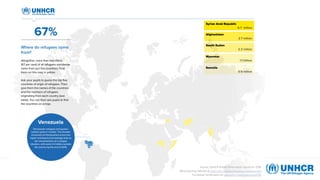
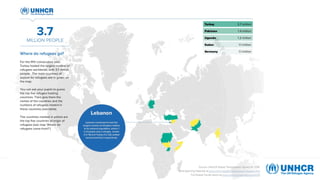
Step 2: Teach facts & figures
Step 3: Teach in an age-appropriate manner about refugees
Step 4: Humanize and storify
Step 5: Learn how to teach with refugees in your classroom
BASIC TERMINOLOGY:
1 - TEACH THE BASICS
2 - START FROM THE BEGINNING
Step one
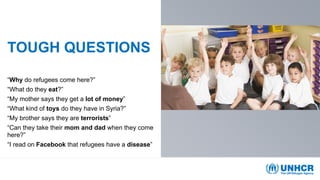
TOUGH QUESTIONS
“Why do refugees come here?”
“What do they eat?”
“My mother says they get a lot of money”
“What kind of toys do they have in Syria?”
“My brother says they are terrorists”
“Can they take their mom and dad when they come
here?”
“I read on Facebook that refugees have a disease”
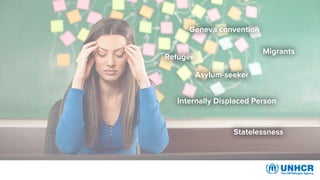
Geneva convention
Refugee
Asylum-seeker
Internally Displaced Person
Statelessness
Migrants
Who is a refugee?
1.
2.
3.
https://www.youtube.com/watch?v=GvzZGplGbL8
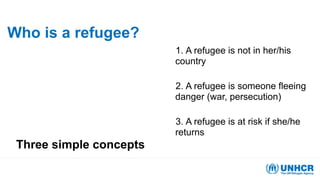
Who is a refugee?
Three simple concepts
1. A refugee is not in her/his
country
2. A refugee is someone fleeing
danger (war, persecution)
3. A refugee is at risk if she/he
returns
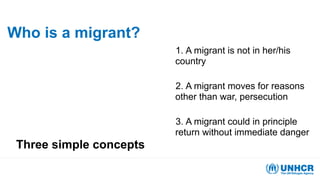
Who is a migrant?
Three simple concepts
1. A migrant is not in her/his
country
2. A migrant moves for reasons
other than war, persecution
3. A migrant could in principle
return without immediate danger
https://www.youtube.com/watch?v=yRPfM5Oj-QA
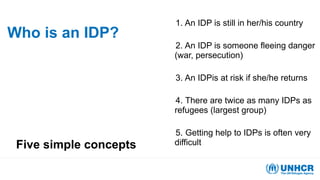
Who is an IDP?
Five simple concepts
1. An IDP is still in her/his country
2. An IDP is someone fleeing danger
(war, persecution)
3. An IDPis at risk if she/he returns
4. There are twice as many IDPs as
refugees (largest group)
5. Getting help to IDPs is often very
difficult
https://www.youtube.com/watch?v=DCzpVQkencw
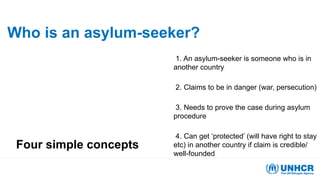
Who is an asylum-seeker?
Four simple concepts
1. An asylum-seeker is someone who is in
another country
2. Claims to be in danger (war, persecution)
3. Needs to prove the case during asylum
procedure
4. Can get ‘protected’ (will have right to stay
etc) in another country if claim is credible/
well-founded
https://www.youtube.com/watch?v=E1E_tiagn8Q
TEACH FACTS AND FIGURES ON REFUGEES
Step two
www.unhcr.org/teaching-about-refugees.html
https://www.youtube.com/watch?v=LrR5hwp45mc
www.unhcr.org/teaching-about-refugees.html
https://www.youtube.com/watch?v=NM3n3dZzw_w
www.unhcr.org/teaching-about-refugees.html
AGE-APPROPRIATE TEACHING ABOUT REFUGEES,
ASYLUM AND MIGRATION
Step three
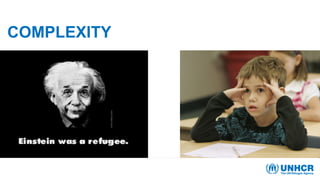
COMPLEXITY
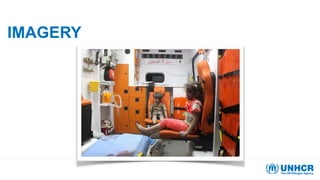
IMAGERY
HUMANIZE AND STORIFY
Step four
LEARN HOW TO TEACH WITH REFUGEES IN YOUR
CLASSROOM
Step five
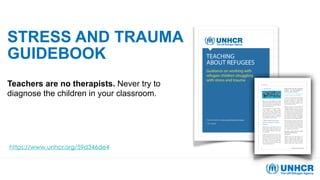
STRESS AND TRAUMA
GUIDEBOOK
Teachers are no therapists. Never try to
diagnose the children in your classroom.
https://www.unhcr.org/59d346de4
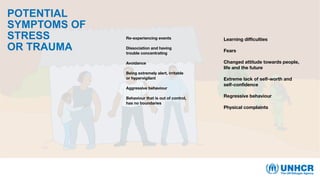
POTENTIAL
SYMPTOMS OF
STRESS
OR TRAUMA
Re-experiencing events
Dissociation and having
trouble concentrating
Avoidance
Being extremely alert, irritable
or hypervigilant
Aggressive behaviour
Behaviour that is out of control,
has no boundaries
Learning difficulties
Fears
Changed attitude towards people,
life and the future
Extreme lack of self-worth and
self-confidence
Regressive behaviour
Physical complaints
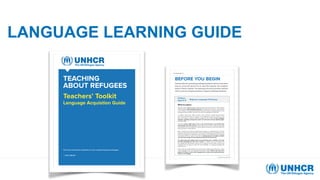
LANGUAGE LEARNING GUIDE
UNHCR
Teaching About Refugees website
• www.unhcr.org/teaching-about-refugees.html
www.etwinning.net
QUESTIONS???
CONTACT: SMETS@UNHCR.ORG
On-line seminar:
Wednesday 20 May 2020, 16:00 - 17:00 CET
20-05-20 44

UNHCR teaching about refugees