Understanding Stress and Its Sources
• Learning Competency: Discuss that
understanding stress and its sources during
adolescence may help in identifying ways to
cope and have a healthful life (EsP-
PD11/12CS-If-5.1).
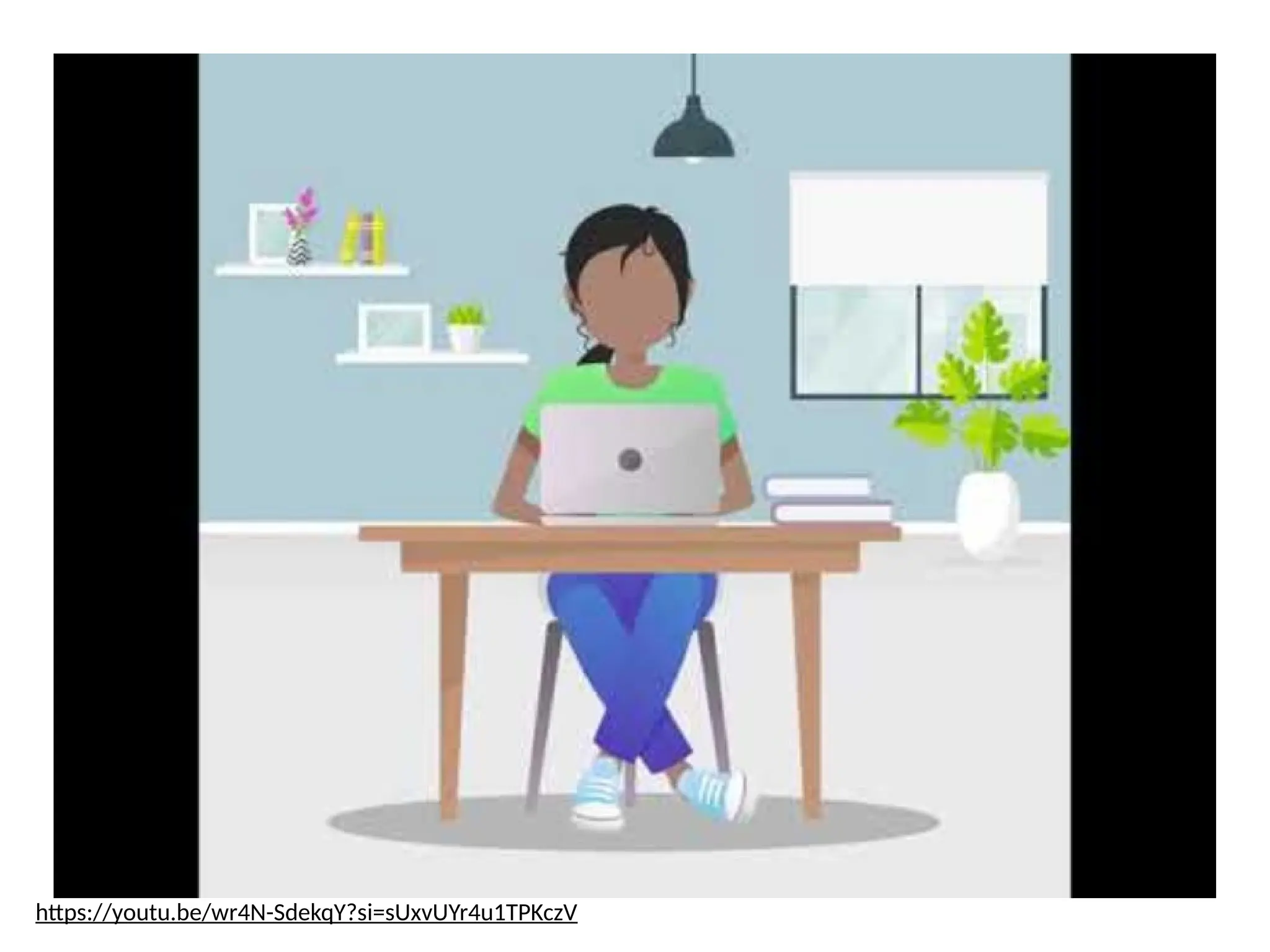
https://youtu.be/wr4N-SdekqY?si=sUxvUYr4u1TPKczV
Guide discussion afterward:
1. What kinds of stress did
the character experience?
2. Can you relate?
What is Stress?
Stress is your body's response to any demand or
challenge.
✅ Eustress (Positive Stress): Motivates you to
perform well.
❌ Distress (Negative Stress): Makes you feel
overwhelmed or anxious.
Types of Stress
💪 Physical Stress – fatigue, headaches, sleep
changes
💓 Emotional Stress – mood swings, sadness,
irritability
🧠 Mental Stress – overthinking, anxiety, lack of
focus
Common Stressors for Teens
🏫 School/Academic Pressure – grades, deadlines
👩‍
👧
‍
‍
‍
‍‍
‍
‍
‍
‍
‍
‍
‍
‍
‍
‍
‍
‍
‍
‍
‍
‍
‍
‍
‍
‍
‍
‍
‍
‍
‍ Family Expectations – rules, standards
🧍 Peer Pressure – fitting in, rejection
💬 Social Media – comparisons, appearance
issues
❓ Identity Confusion – self-doubt, feeling
misunderstood
Why Understanding Stress Matters
• ✔ Helps identify stress triggers
• ✔ Encourages healthy coping strategies
• ✔ Reduces long-term mental and physical
health problems
• 🎯 Know your stress, take control of your well-
being!
🧩 Group Activity: Stress Source Sort
Instructions:
1. Divide the class into small groups (4–6 members each).
2. Each group receives a set of flashcards containing various stress
scenarios.
3. Students discuss and sort each card into one of the four
categories:
Family – stress from relationships at home
Academic – school-related stress
Social – peer pressure, friends, or online stress
Personal – stress involving self-image, goals, or emotions
4. For each category, students list at least one healthy coping
strategy.
5. Groups present their sorted cards and suggested strategies to
the class.
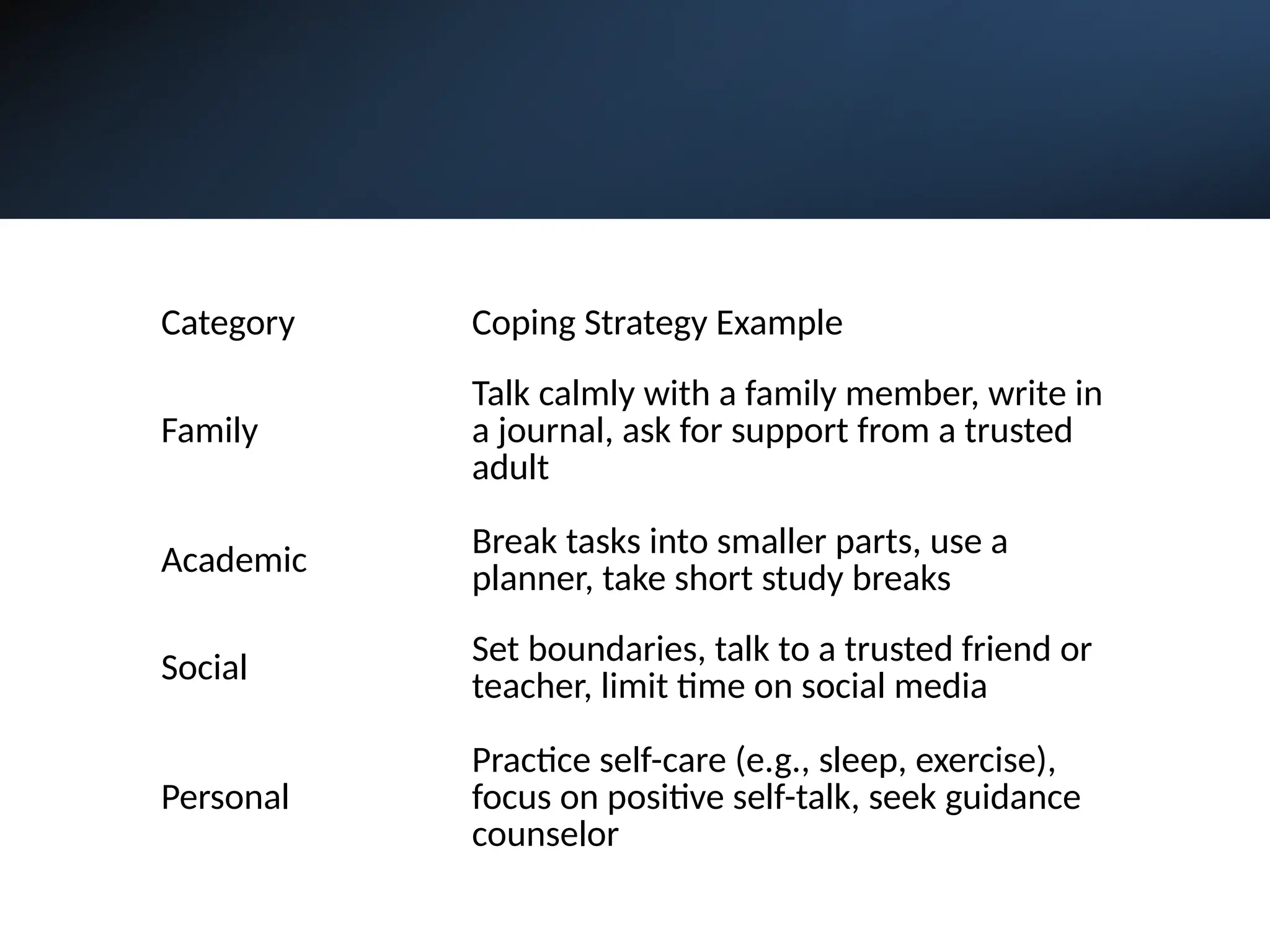
Category Coping Strategy Example
Family
Talk calmly with a family member, write in
a journal, ask for support from a trusted
adult
Academic
Break tasks into smaller parts, use a
planner, take short study breaks
Social
Set boundaries, talk to a trusted friend or
teacher, limit time on social media
Personal
Practice self-care (e.g., sleep, exercise),
focus on positive self-talk, seek guidance
counselor
Worksheet:
Part 1: Identify stressors from a list
Part 2: Match each with an appropriate coping
mechanism
Part 3: Personal Reflection: “One way I cope
healthfully with stress is…”
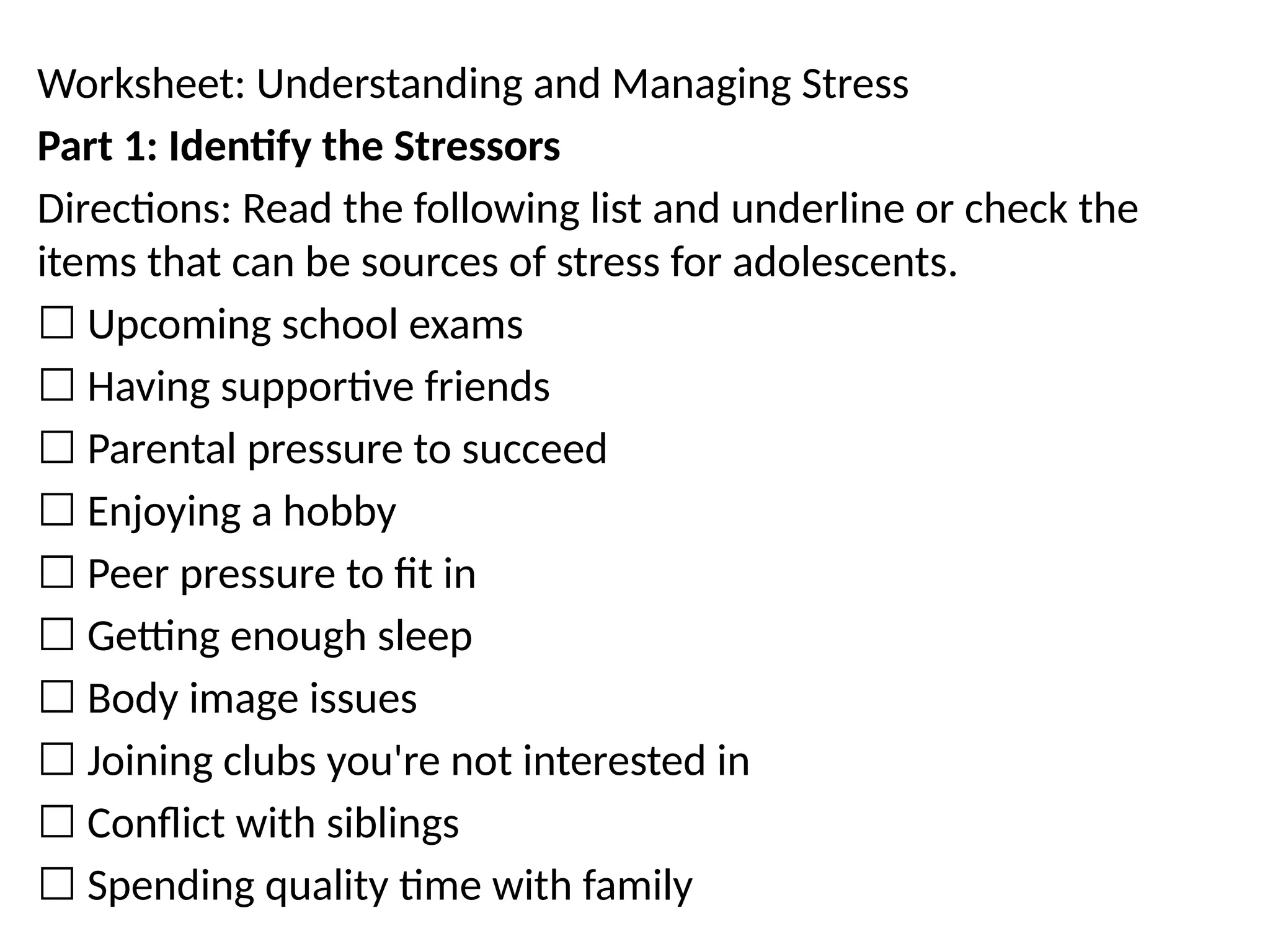
Worksheet: Understanding and Managing Stress
Part 1: Identify the Stressors
Directions: Read the following list and underline or check the
items that can be sources of stress for adolescents.
☐ Upcoming school exams
☐ Having supportive friends
☐ Parental pressure to succeed
☐ Enjoying a hobby
☐ Peer pressure to fit in
☐ Getting enough sleep
☐ Body image issues
☐ Joining clubs you're not interested in
☐ Conflict with siblings
☐ Spending quality time with family
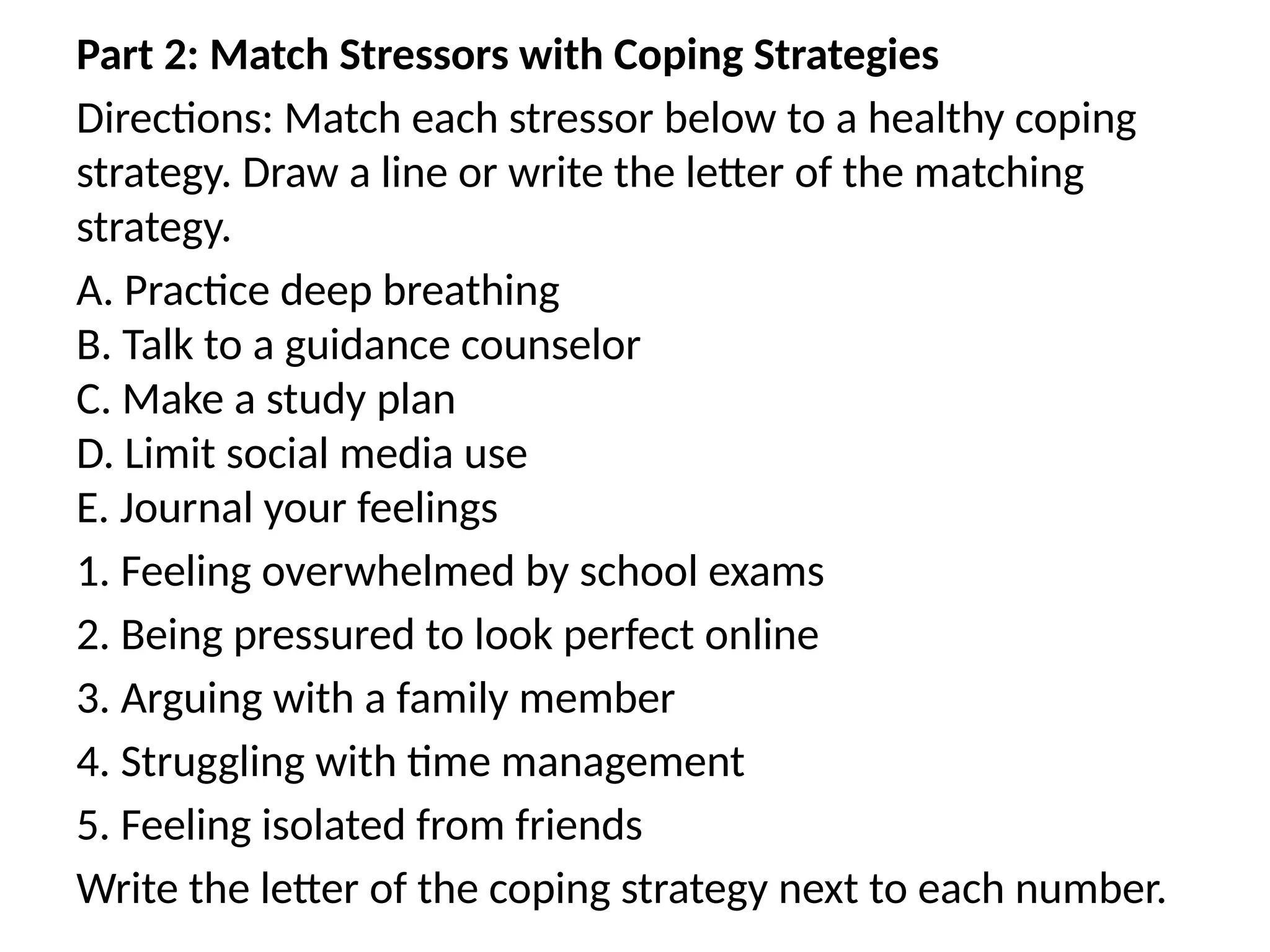
Part 2: Match Stressors with Coping Strategies
Directions: Match each stressor below to a healthy coping
strategy. Draw a line or write the letter of the matching
strategy.
A. Practice deep breathing
B. Talk to a guidance counselor
C. Make a study plan
D. Limit social media use
E. Journal your feelings
1. Feeling overwhelmed by school exams
2. Being pressured to look perfect online
3. Arguing with a family member
4. Struggling with time management
5. Feeling isolated from friends
Write the letter of the coping strategy next to each number.
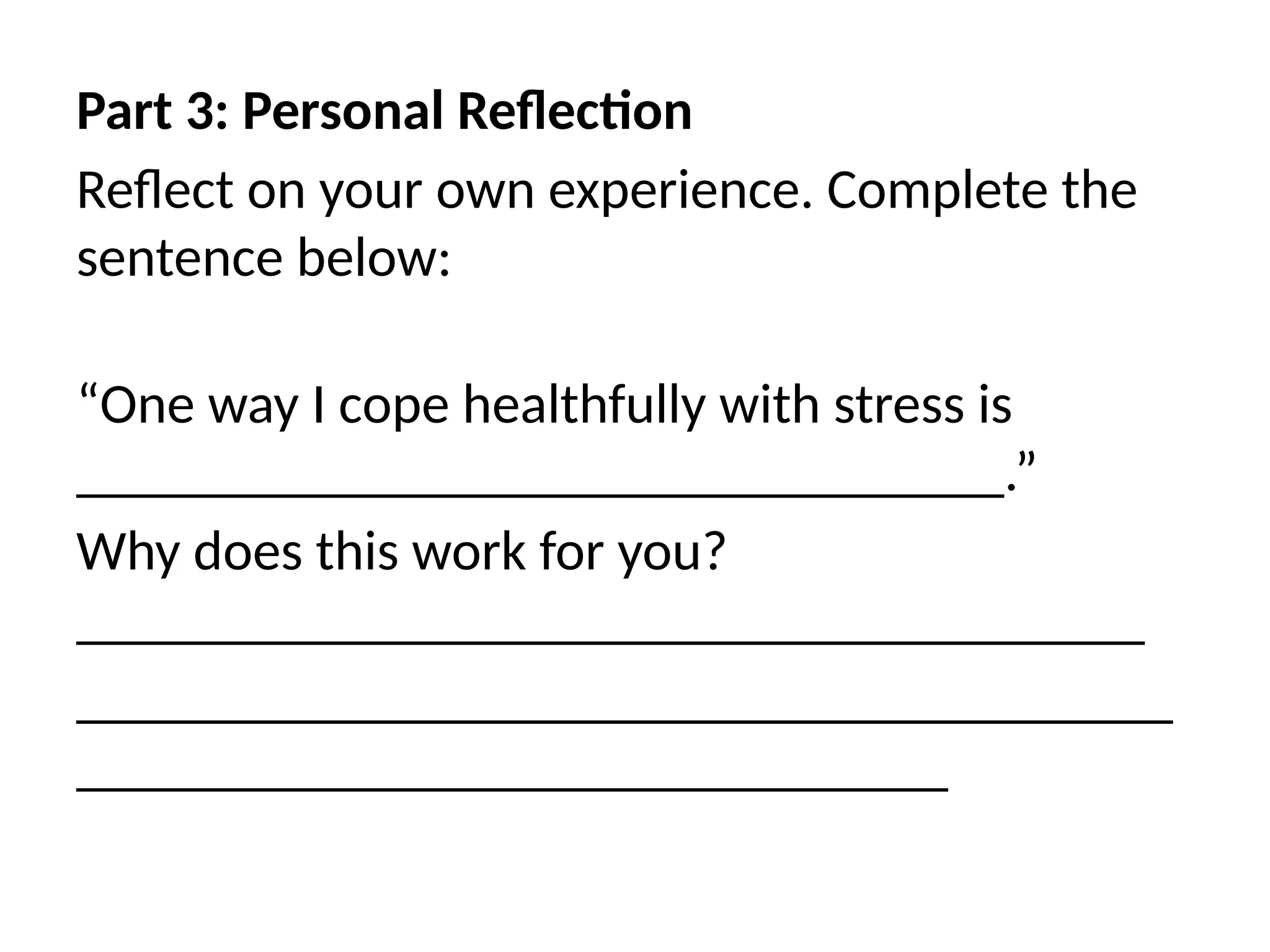
Part 3: Personal Reflection
Reflect on your own experience. Complete the
sentence below:
“One way I cope healthfully with stress is
_________________________________.”
Why does this work for you?
______________________________________
_______________________________________
_______________________________
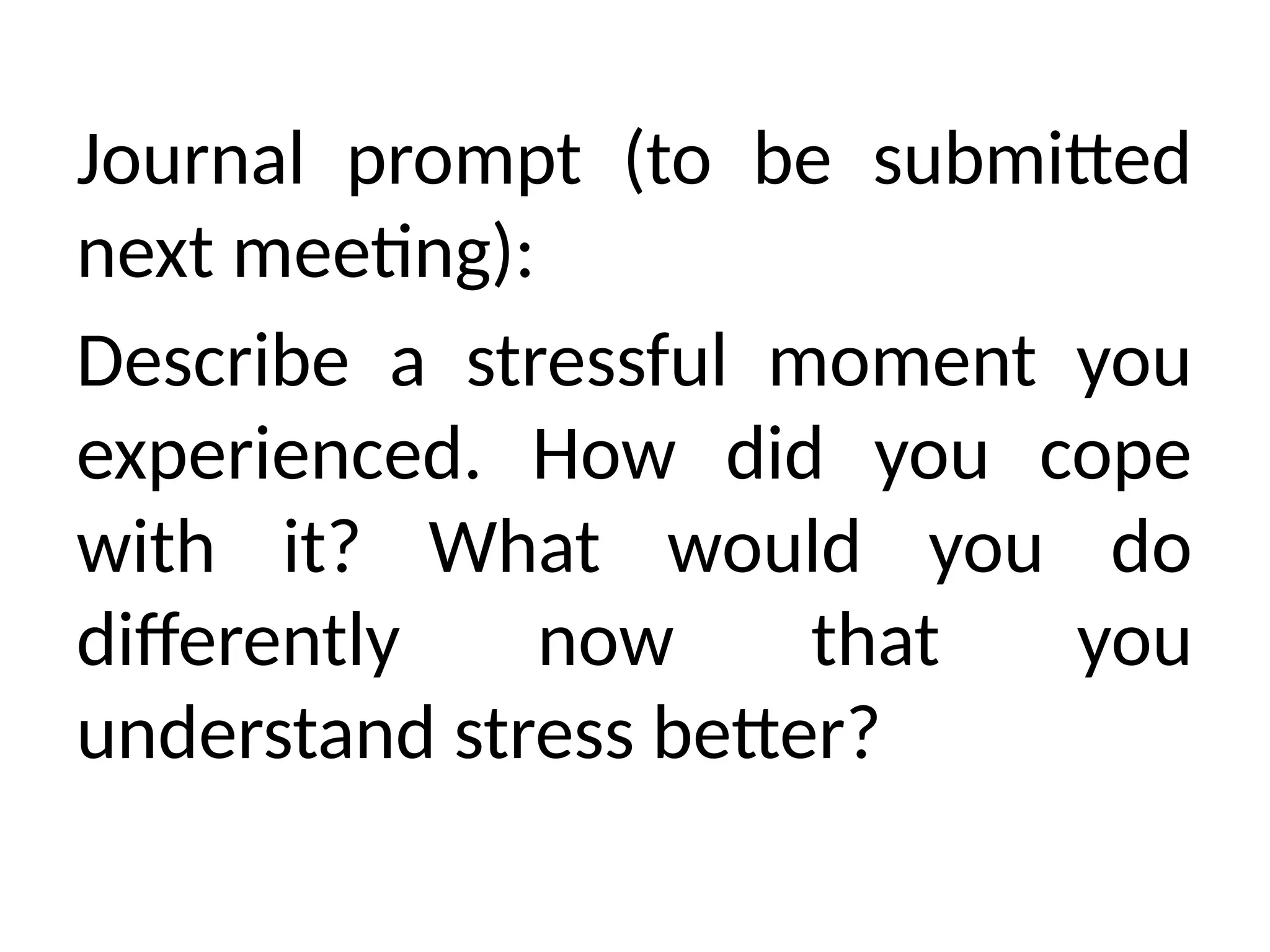
Journal prompt (to be submitted
next meeting):
Describe a stressful moment you
experienced. How did you cope
with it? What would you do
differently now that you
understand stress better?
Short Quiz: Understanding Stress and Its Sources
1. What is stress?
A. A permanent mental illness
B. A positive emotion that always leads to happiness
C. A physical and emotional response to demands or
challenges
D. A condition that only adults experience
2. Which is a common stressor for teens?
A. Retirement
B. Parenting
C. Schoolwork and academic pressure
D. Paying utility bills
3. What is a healthy coping strategy?
A. Ignoring the problem completely
B. Talking to a trusted friend or adult
C. Taking drugs to escape stress
D. Blaming others for your stress
4. Identify the type of stress in the following scenario:
"Maria feels nervous and cannot sleep because of an
upcoming math exam."
A. Physical stress
B. Emotional stress
C. Social stress
D. Environmental stress
5. Fill in the blank:
Understanding stress can help us live a
__________ life.
Understanding_Stress_Presentation. GRADE 11

  • 1.
    Understanding Stress andIts Sources • Learning Competency: Discuss that understanding stress and its sources during adolescence may help in identifying ways to cope and have a healthful life (EsP- PD11/12CS-If-5.1).
  • 2.
  • 3.
    Guide discussion afterward: 1.What kinds of stress did the character experience? 2. Can you relate?
  • 4.
    What is Stress? Stressis your body's response to any demand or challenge. ✅ Eustress (Positive Stress): Motivates you to perform well. ❌ Distress (Negative Stress): Makes you feel overwhelmed or anxious.
  • 5.
    Types of Stress 💪Physical Stress – fatigue, headaches, sleep changes 💓 Emotional Stress – mood swings, sadness, irritability 🧠 Mental Stress – overthinking, anxiety, lack of focus
  • 6.
    Common Stressors forTeens 🏫 School/Academic Pressure – grades, deadlines 👩‍ 👧 ‍ ‍ ‍ ‍‍ ‍ ‍ ‍ ‍ ‍ ‍ ‍ ‍ ‍ ‍ ‍ ‍ ‍ ‍ ‍ ‍ ‍ ‍ ‍ ‍ ‍ ‍ ‍ ‍ ‍ Family Expectations – rules, standards 🧍 Peer Pressure – fitting in, rejection 💬 Social Media – comparisons, appearance issues ❓ Identity Confusion – self-doubt, feeling misunderstood
  • 7.
    Why Understanding StressMatters • ✔ Helps identify stress triggers • ✔ Encourages healthy coping strategies • ✔ Reduces long-term mental and physical health problems • 🎯 Know your stress, take control of your well- being!
  • 8.
    🧩 Group Activity:Stress Source Sort Instructions: 1. Divide the class into small groups (4–6 members each). 2. Each group receives a set of flashcards containing various stress scenarios. 3. Students discuss and sort each card into one of the four categories: Family – stress from relationships at home Academic – school-related stress Social – peer pressure, friends, or online stress Personal – stress involving self-image, goals, or emotions 4. For each category, students list at least one healthy coping strategy. 5. Groups present their sorted cards and suggested strategies to the class.
  • 9.
    Category Coping StrategyExample Family Talk calmly with a family member, write in a journal, ask for support from a trusted adult Academic Break tasks into smaller parts, use a planner, take short study breaks Social Set boundaries, talk to a trusted friend or teacher, limit time on social media Personal Practice self-care (e.g., sleep, exercise), focus on positive self-talk, seek guidance counselor
  • 10.
    Worksheet: Part 1: Identifystressors from a list Part 2: Match each with an appropriate coping mechanism Part 3: Personal Reflection: “One way I cope healthfully with stress is…”
  • 11.
    Worksheet: Understanding andManaging Stress Part 1: Identify the Stressors Directions: Read the following list and underline or check the items that can be sources of stress for adolescents. ☐ Upcoming school exams ☐ Having supportive friends ☐ Parental pressure to succeed ☐ Enjoying a hobby ☐ Peer pressure to fit in ☐ Getting enough sleep ☐ Body image issues ☐ Joining clubs you're not interested in ☐ Conflict with siblings ☐ Spending quality time with family
  • 12.
    Part 2: MatchStressors with Coping Strategies Directions: Match each stressor below to a healthy coping strategy. Draw a line or write the letter of the matching strategy. A. Practice deep breathing B. Talk to a guidance counselor C. Make a study plan D. Limit social media use E. Journal your feelings 1. Feeling overwhelmed by school exams 2. Being pressured to look perfect online 3. Arguing with a family member 4. Struggling with time management 5. Feeling isolated from friends Write the letter of the coping strategy next to each number.
  • 13.
    Part 3: PersonalReflection Reflect on your own experience. Complete the sentence below: “One way I cope healthfully with stress is _________________________________.” Why does this work for you? ______________________________________ _______________________________________ _______________________________
  • 14.
    Journal prompt (tobe submitted next meeting): Describe a stressful moment you experienced. How did you cope with it? What would you do differently now that you understand stress better?
  • 15.
    Short Quiz: UnderstandingStress and Its Sources 1. What is stress? A. A permanent mental illness B. A positive emotion that always leads to happiness C. A physical and emotional response to demands or challenges D. A condition that only adults experience 2. Which is a common stressor for teens? A. Retirement B. Parenting C. Schoolwork and academic pressure D. Paying utility bills
  • 16.
    3. What isa healthy coping strategy? A. Ignoring the problem completely B. Talking to a trusted friend or adult C. Taking drugs to escape stress D. Blaming others for your stress 4. Identify the type of stress in the following scenario: "Maria feels nervous and cannot sleep because of an upcoming math exam." A. Physical stress B. Emotional stress C. Social stress D. Environmental stress
  • 17.
    5. Fill inthe blank: Understanding stress can help us live a __________ life.
Editor's Notes