Conditional Statements inLisp
&
Scoping
An in-depth exploration of conditional statements and scoping mechanisms.
2.
Introduction
What are ConditionalStatements?
Control the flow of execution based on conditions.
Essential for decision-making in programs.
Why Learn This?
Fundamental to all programming.
Lisp's approach is unique and insightful.
---------------------------------------------------------------------------------------
---------------------------------------------------------------------------------------
The if Statement
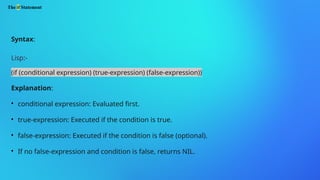
Syntax:
Lisp:-
(if(conditional expression) (true-expression) (false-expression))
Explanation:
conditional expression: Evaluated first.
true-expression: Executed if the condition is true.
false-expression: Executed if the condition is false (optional).
If no false-expression and condition is false, returns NIL.
5.
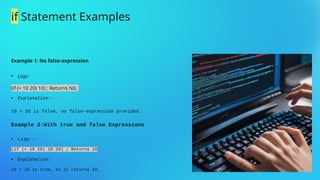
Example 1: Nofalse-expression
Lisp:-
(if (> 10 20) 10) ; Returns NIL
Explanation:-
10 > 20 is false, no false-expression provided.
Example 2:With true and false Expressions
Lisp:-
(if (< 10 20) 10 20) ; Returns 10
Explanation:
10 < 20 is true, so it returns 10.
if Statement Examples
6.
Nested if Statements
Example:
Lisp:
(if(= 10 10) (if (> 5 1) 5 1)) ; Returns 5
Explanation:
The outer if checks if 10 = 10 (true).
The inner if checks if 5 > 1 (true), so it returns 5.
7.
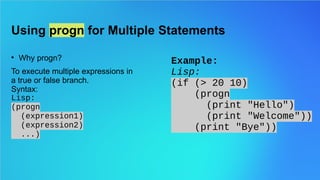
Why progn?
To executemultiple expressions in
a true or false branch.
Syntax:
Lisp:
(progn
(expression1)
(expression2)
...)
Using progn for Multiple Statements
Example:
Lisp:
(if (> 20 10)
(progn
(print "Hello")
(print "Welcome"))
(print "Bye"))
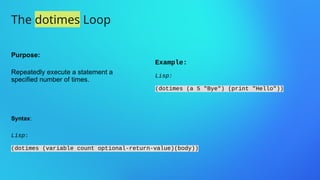
The dotimes Loop
Purpose:
Repeatedlyexecute a statement a
specified number of times.
Example:
Lisp:
(dotimes (a 5 "Bye") (print "Hello"))
Syntax:
Lisp:
(dotimes (variable count optional-return-value)(body))
10.
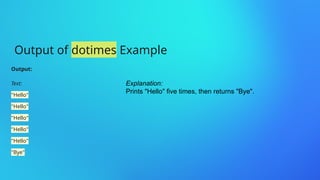
Output of dotimesExample
Output:
Text:
"Hello"
"Hello"
"Hello"
"Hello"
"Hello"
"Bye"
Explanation:
Prints "Hello" five times, then returns "Bye".
11.
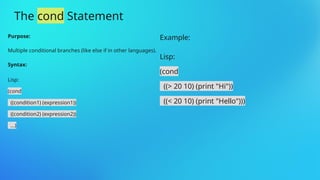
Purpose:
Multiple conditional branches(like else if in other languages).
Syntax:
Lisp:
(cond
((condition1) (expression1))
((condition2) (expression2))
...)
The cond Statement
Example:
Lisp:
(cond
((> 20 10) (print "Hi"))
((< 20 10) (print "Hello")))
Scoping refers tothe visibility and lifetime of variables
within your code. It determines where a variable can be
accessed and modified, helping prevent naming conflicts
and unintended behaviors. Proper scoping is critical for
maintaining clean and efficient code, as it confines
variables to the context in which they are relevant and
ensures that they do not interfere with one another.
Definition and significance
15.
Scope types
Scoping definesthe visibility and lifetime of variables in a program.
Two key types of variables:
Bound Variable: Assigned a value within a specific expression.
Free Variable: Not assigned a value within the expression; gets value from the
outer scope.
16.
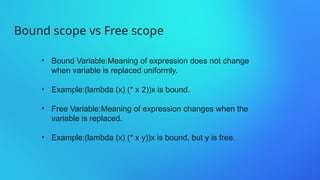
Bound scope vsFree scope
• Bound Variable:Meaning of expression does not change
when variable is replaced uniformly.
• Example:(lambda (x) (* x 2))x is bound.
• Free Variable:Meaning of expression changes when the
variable is replaced.
• Example:(lambda (x) (* x y))x is bound, but y is free.
17.
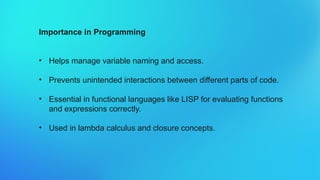
Importance in Programming
•Helps manage variable naming and access.
• Prevents unintended interactions between different parts of code.
• Essential in functional languages like LISP for evaluating functions
and expressions correctly.
• Used in lambda calculus and closure concepts.
18.
Understanding conditional statementsand scoping is
essential for effective programming in Java. Mastery
of these concepts enables developers to write clean,
maintainable, and error-free code, ensuring that
programs can handle complex decision-making logic
while maintaining clarity and organization.
Conclusions
19.
Key Takeaways:
if, cond,progn, and dotimes are essential for control flow in
Lisp.
Understand the syntax and usage of each.
Practice with examples to master these concepts.
Conclusion








![[DSC Europe 25] Elena Menshikova - AI-Powered Operational Excellence: Revolut...](https://cdn.slidesharecdn.com/ss_thumbnails/es6nholbqy3zaao2c2yd-2-elena-menshikova-data-ai-in-decision-making-260115093812-4fba8b38-thumbnail.jpg?width=640&height=640&fit=bounds)


![[DSC Europe 25] Ivan Lukovic & Marija Djukic - From Data to Value: Why Maturi...](https://cdn.slidesharecdn.com/ss_thumbnails/ahrfps8xr6knowwhacxh-1-ivan-marija-dsc-2025-ld-v1-presentation-260115093812-be21adfc-thumbnail.jpg?width=640&height=640&fit=bounds)


