Understanding Touch Screens: Technology
at Your Fingertips
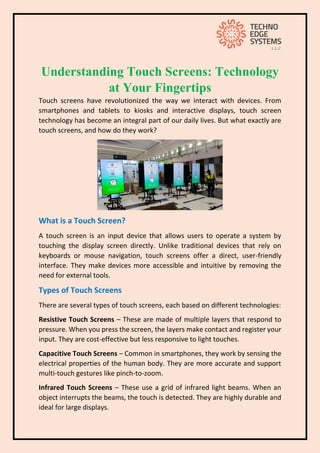
Touch screens have revolutionized the way we interact with devices. From
smartphones and tablets to kiosks and interactive displays, touch screen
technology has become an integral part of our daily lives. But what exactly are
touch screens, and how do they work?
What is a Touch Screen?
A touch screen is an input device that allows users to operate a system by
touching the display screen directly. Unlike traditional devices that rely on
keyboards or mouse navigation, touch screens offer a direct, user-friendly
interface. They make devices more accessible and intuitive by removing the
need for external tools.
Types of Touch Screens
There are several types of touch screens, each based on different technologies:
Resistive Touch Screens – These are made of multiple layers that respond to
pressure. When you press the screen, the layers make contact and register your
input. They are cost-effective but less responsive to light touches.
Capacitive Touch Screens – Common in smartphones, they work by sensing the
electrical properties of the human body. They are more accurate and support
multi-touch gestures like pinch-to-zoom.
Infrared Touch Screens – These use a grid of infrared light beams. When an
object interrupts the beams, the touch is detected. They are highly durable and
ideal for large displays.
Surface Acoustic Wave (SAW) – This technology uses ultrasonic waves across
the screen surface. When the screen is touched, some of the waves are
absorbed, allowing the touch to be located precisely.
Applications of Touch Screens
Touch screens are used across various industries due to their ease of use and
versatility:
 Retail: Self-service kiosks, POS systems
 Healthcare: Medical displays, patient check-in systems
 Education: Interactive whiteboards, learning tablets
 Hospitality: Hotel check-in screens, restaurant menus
 Events and Exhibitions: Interactive product demos, visitor guides
Benefits of Touch Screen Technology
 User-Friendly: Easy to learn and use for people of all ages.
 Faster Navigation: Speeds up operations with direct interaction.
 Space-Saving: No need for extra peripherals like keyboards or mice.
 Enhanced Engagement: Ideal for interactive displays and presentations.
The Future of Touch Screens
As technology advances, touch screens are becoming more sophisticated.
Features like haptic feedback, flexible screens, and gesture recognition are
pushing boundaries. With innovations in AI and machine learning, touch
interactions will likely become even more natural and adaptive.
In Conclusion, touch screens have changed how we use technology—making it
more interactive, accessible, and efficient. Whether in daily use or business
applications, they continue to be a key interface in the digital age.
Techno Edge Systems LLC provides Touch Screen Rental Dubai at affordable
prices. For more info, contact us at +971-54-4653108.
Visit our Website: www.laptoprentaluae.com

Understanding Touch Screens: Technology at Your Fingertips

  • 1.
    Understanding Touch Screens:Technology at Your Fingertips Touch screens have revolutionized the way we interact with devices. From smartphones and tablets to kiosks and interactive displays, touch screen technology has become an integral part of our daily lives. But what exactly are touch screens, and how do they work? What is a Touch Screen? A touch screen is an input device that allows users to operate a system by touching the display screen directly. Unlike traditional devices that rely on keyboards or mouse navigation, touch screens offer a direct, user-friendly interface. They make devices more accessible and intuitive by removing the need for external tools. Types of Touch Screens There are several types of touch screens, each based on different technologies: Resistive Touch Screens – These are made of multiple layers that respond to pressure. When you press the screen, the layers make contact and register your input. They are cost-effective but less responsive to light touches. Capacitive Touch Screens – Common in smartphones, they work by sensing the electrical properties of the human body. They are more accurate and support multi-touch gestures like pinch-to-zoom. Infrared Touch Screens – These use a grid of infrared light beams. When an object interrupts the beams, the touch is detected. They are highly durable and ideal for large displays.
  • 2.
    Surface Acoustic Wave(SAW) – This technology uses ultrasonic waves across the screen surface. When the screen is touched, some of the waves are absorbed, allowing the touch to be located precisely. Applications of Touch Screens Touch screens are used across various industries due to their ease of use and versatility:  Retail: Self-service kiosks, POS systems  Healthcare: Medical displays, patient check-in systems  Education: Interactive whiteboards, learning tablets  Hospitality: Hotel check-in screens, restaurant menus  Events and Exhibitions: Interactive product demos, visitor guides Benefits of Touch Screen Technology  User-Friendly: Easy to learn and use for people of all ages.  Faster Navigation: Speeds up operations with direct interaction.  Space-Saving: No need for extra peripherals like keyboards or mice.  Enhanced Engagement: Ideal for interactive displays and presentations. The Future of Touch Screens As technology advances, touch screens are becoming more sophisticated. Features like haptic feedback, flexible screens, and gesture recognition are pushing boundaries. With innovations in AI and machine learning, touch interactions will likely become even more natural and adaptive. In Conclusion, touch screens have changed how we use technology—making it more interactive, accessible, and efficient. Whether in daily use or business applications, they continue to be a key interface in the digital age. Techno Edge Systems LLC provides Touch Screen Rental Dubai at affordable prices. For more info, contact us at +971-54-4653108. Visit our Website: www.laptoprentaluae.com