1
Chapter 1
The Self from the Different
Perspectives
Unit 1: The Philosophical Self
Angelyn B. Machate, RPm
Instructor
2
At the end of the unit, the students are expected to:
❑ Describe the different notions of the self from the points- of-
view of the various philosophers across time and place.
❑ Compare how the self has been represented in different
philosophical schools.
❑ Examine one’s self against the different views of self that
were discussed in class and integrate these concepts to create
one’s philosophical perspective of the self.
3
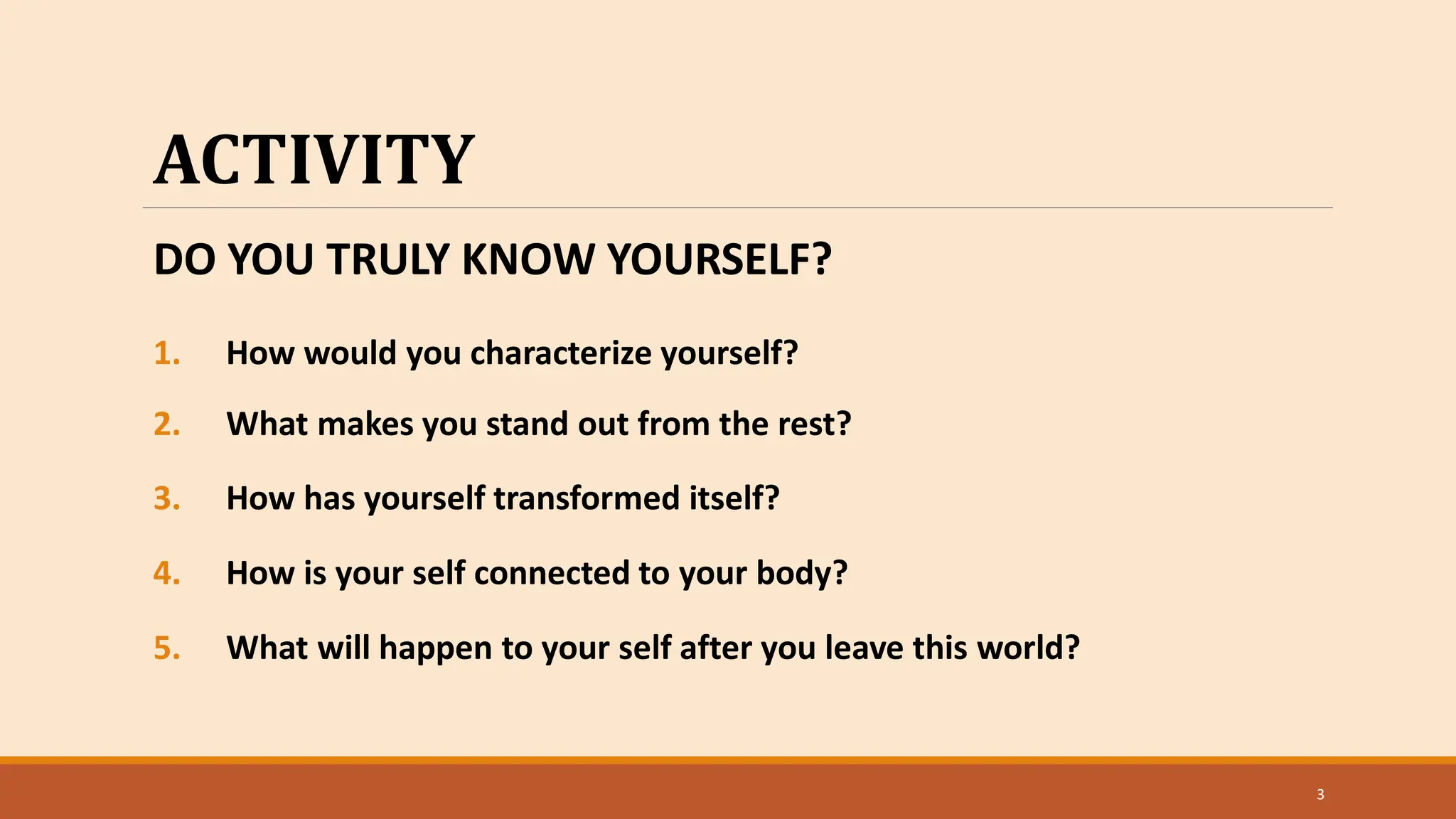
ACTIVITY
DO YOU TRULY KNOW YOURSELF?
1. How would you characterize yourself?
2. What makes you stand out from the rest?
3. How has yourself transformed itself?
4. How is your self connected to your body?
5. What will happen to your self after you leave this world?
4
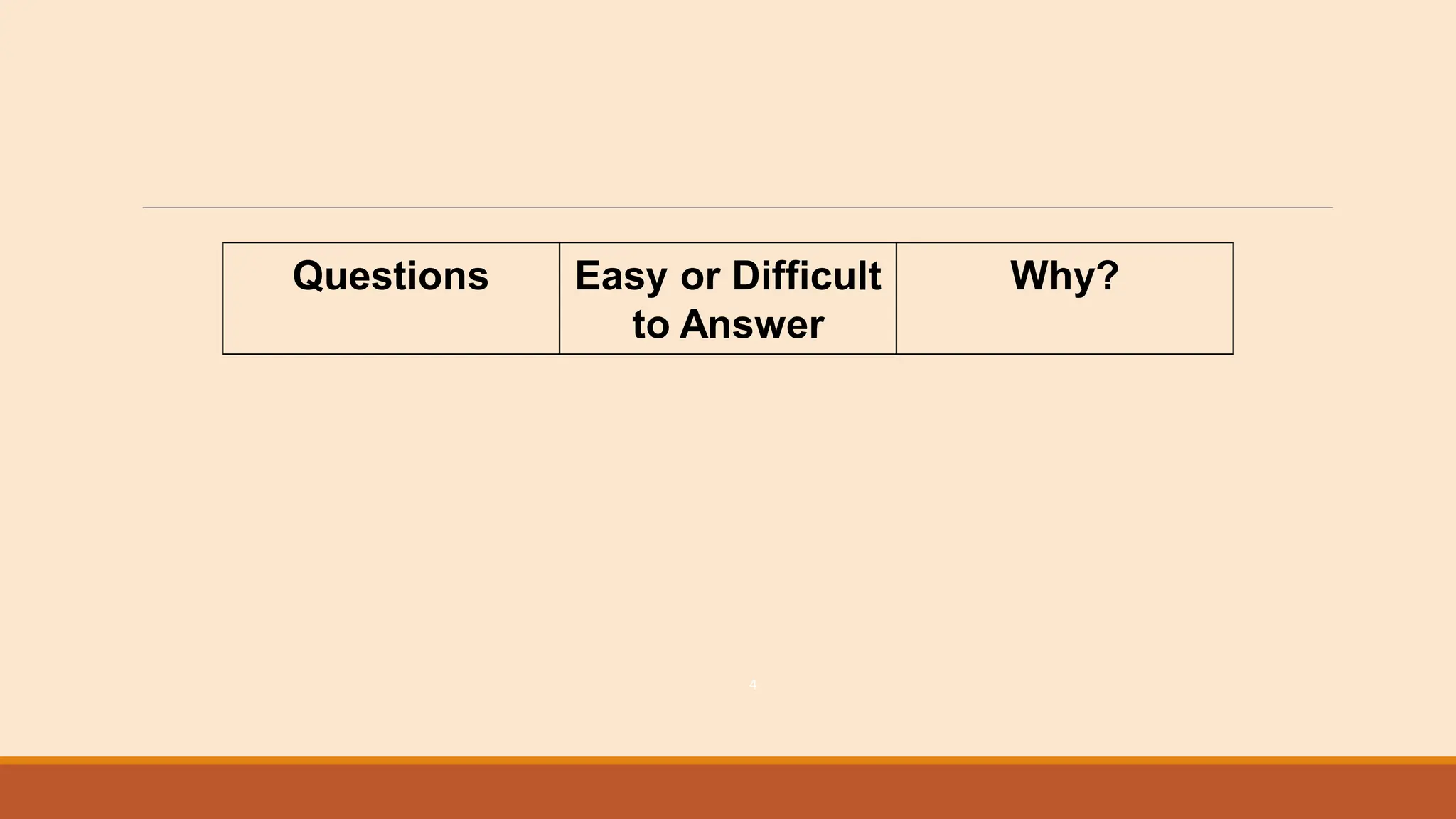
Questions Easy or Difficult
to Answer
Why?
Greeks
◉ Knowing oneself is an imperative and a
requirement.
◉ It is imperative to know the limits of self so
that one knows what one is capable of doing
and what one is not.
◉ Knowing oneself is a requirement for self-
moderation, prudence, good judgment and
excellence of the soul.
5
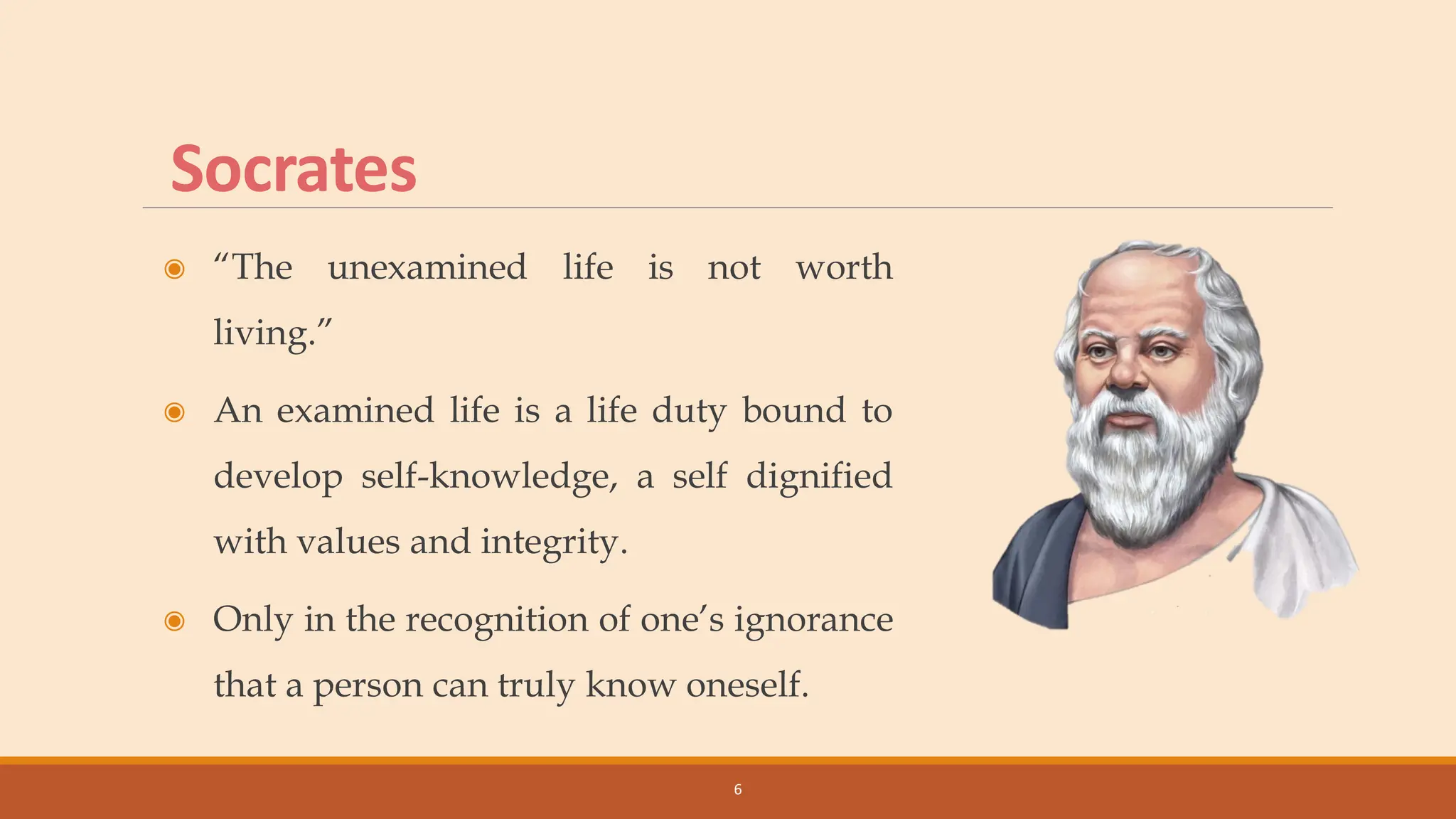
Socrates
◉ “The unexamined life is not worth
living.”
◉ An examined life is a life duty bound to
develop self-knowledge, a self dignified
with values and integrity.
◉ Only in the recognition of one’s ignorance
that a person can truly know oneself.
6
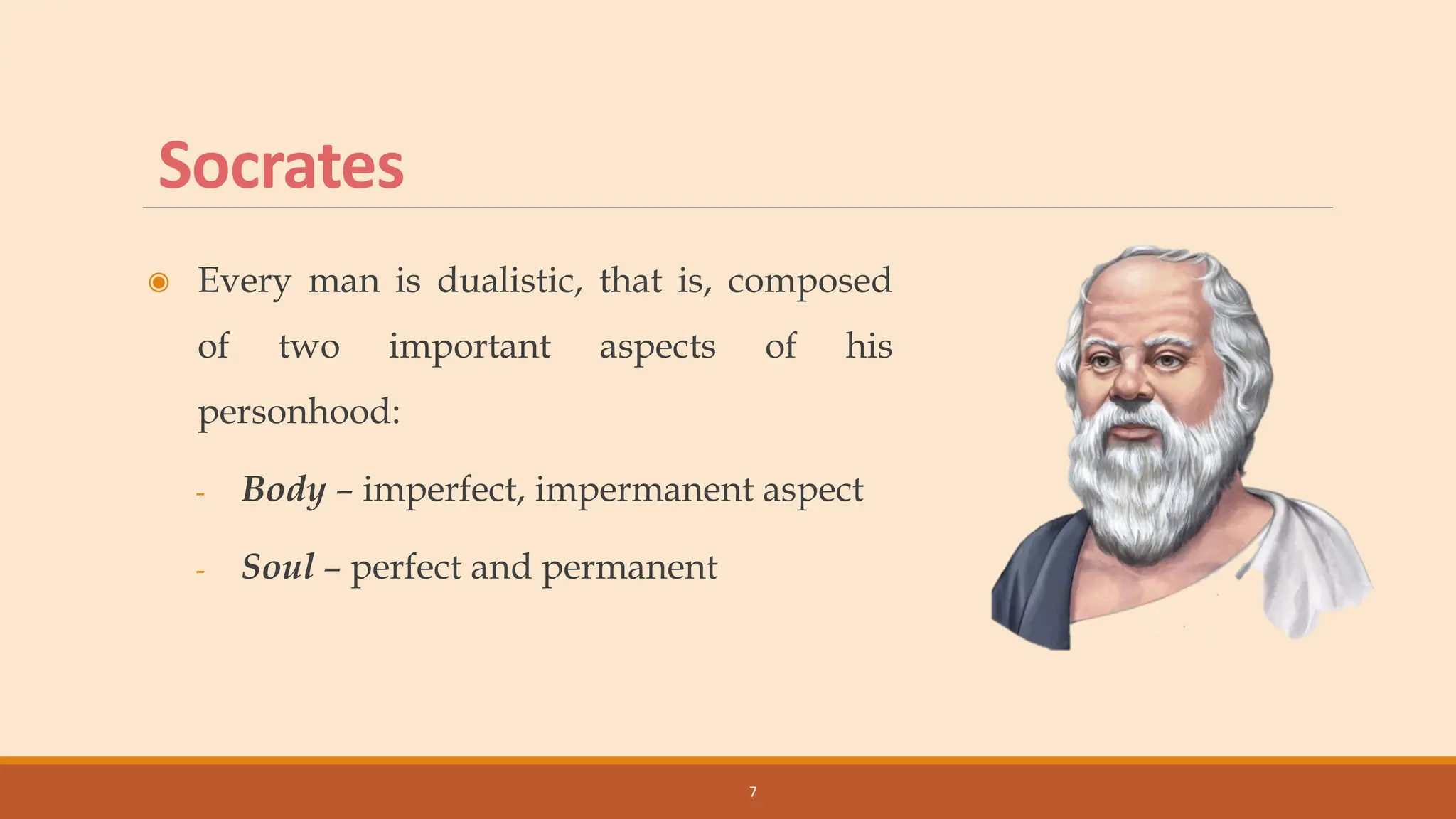
Socrates
◉ Every man is dualistic, that is, composed
of two important aspects of his
personhood:
- Body – imperfect, impermanent aspect
- Soul – perfect and permanent
7
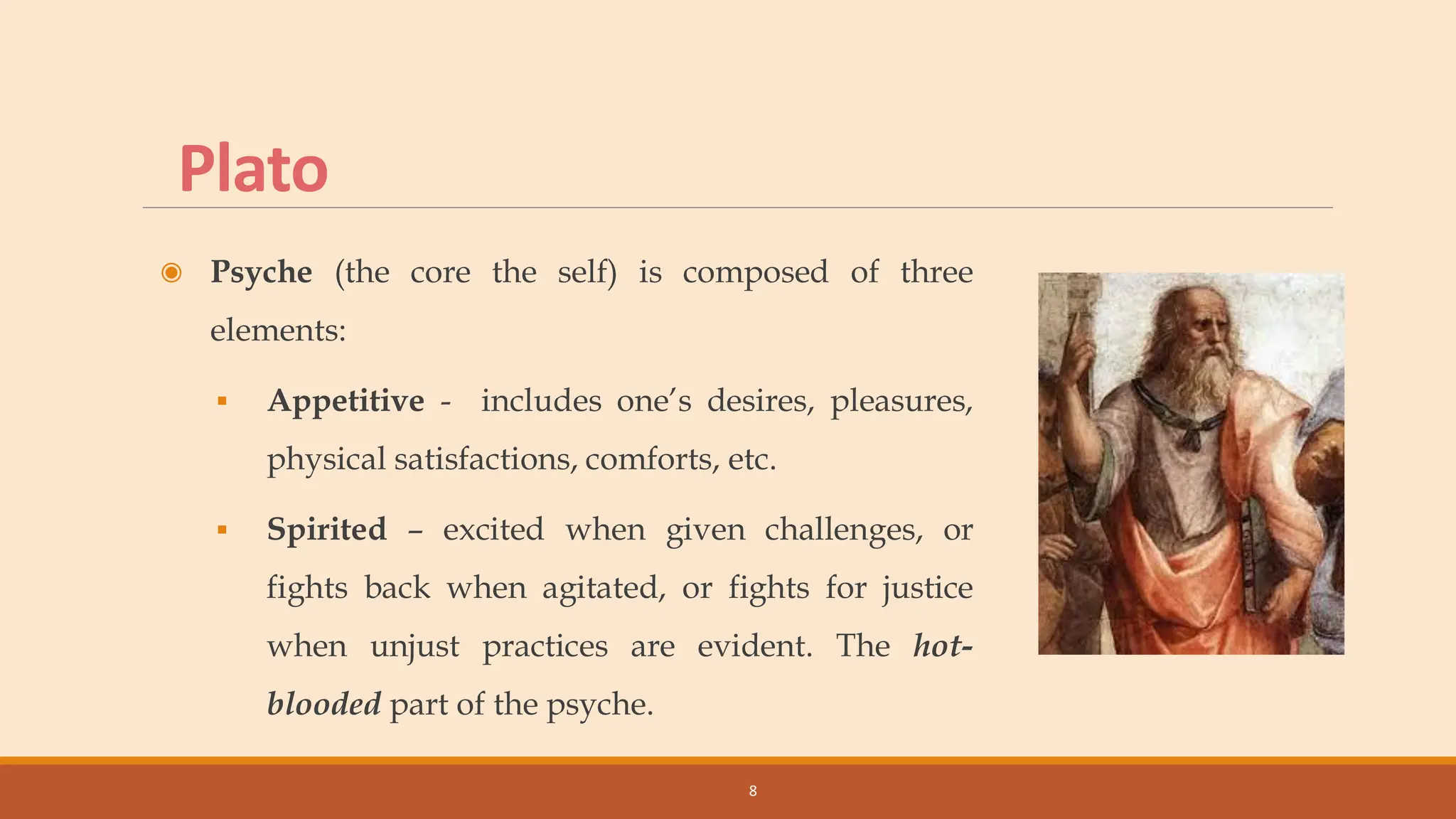
Plato
◉ Psyche (the core the self) is composed of three
elements:
▪ Appetitive - includes one’s desires, pleasures,
physical satisfactions, comforts, etc.
▪ Spirited – excited when given challenges, or
fights back when agitated, or fights for justice
when unjust practices are evident. The hot-
blooded part of the psyche.
8
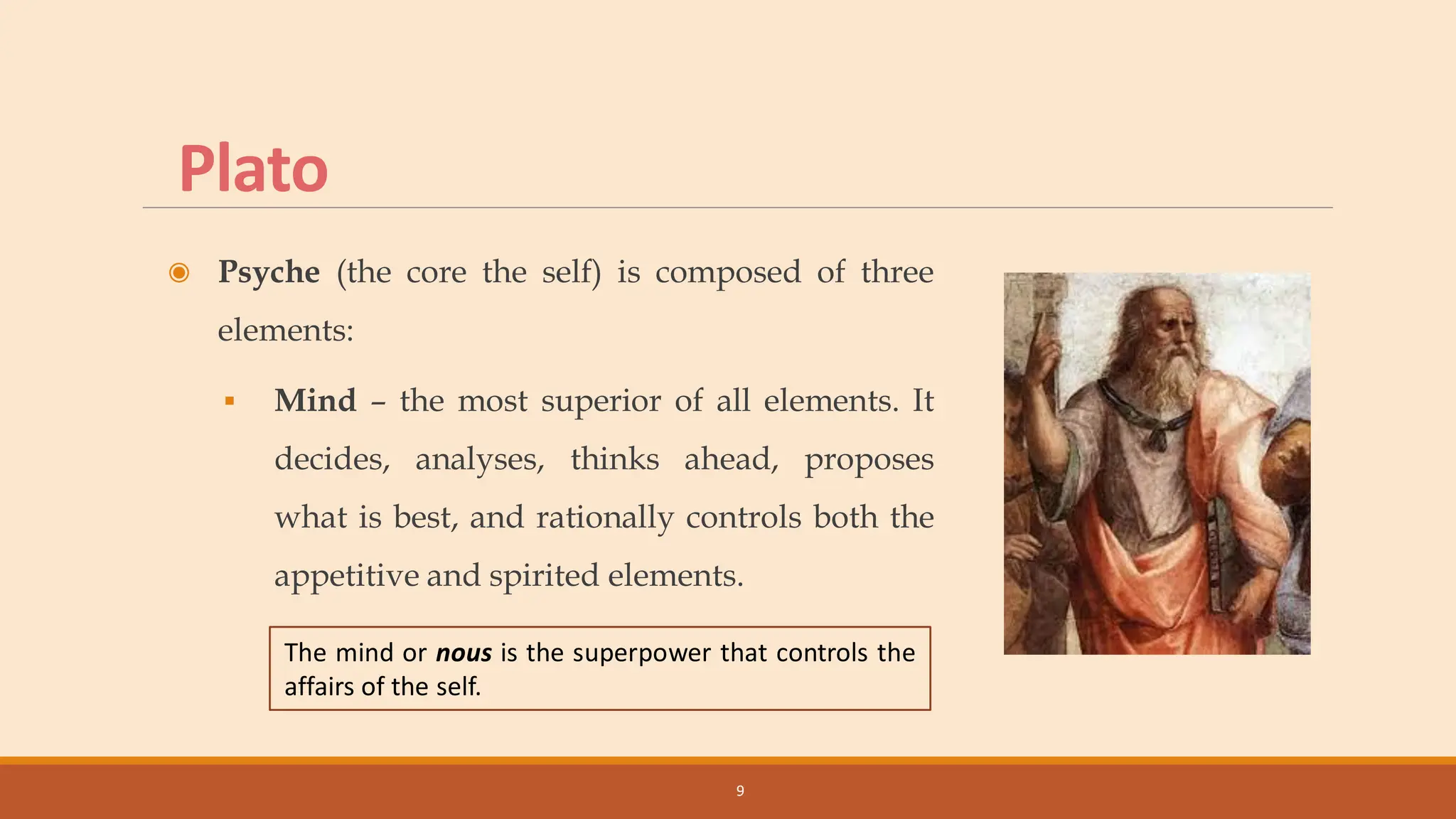
Plato
◉ Psyche (the core the self) is composed of three
elements:
▪ Mind – the most superior of all elements. It
decides, analyses, thinks ahead, proposes
what is best, and rationally controls both the
appetitive and spirited elements.
9
The mind or nous is the superpower that controls the
affairs of the self.
Plato
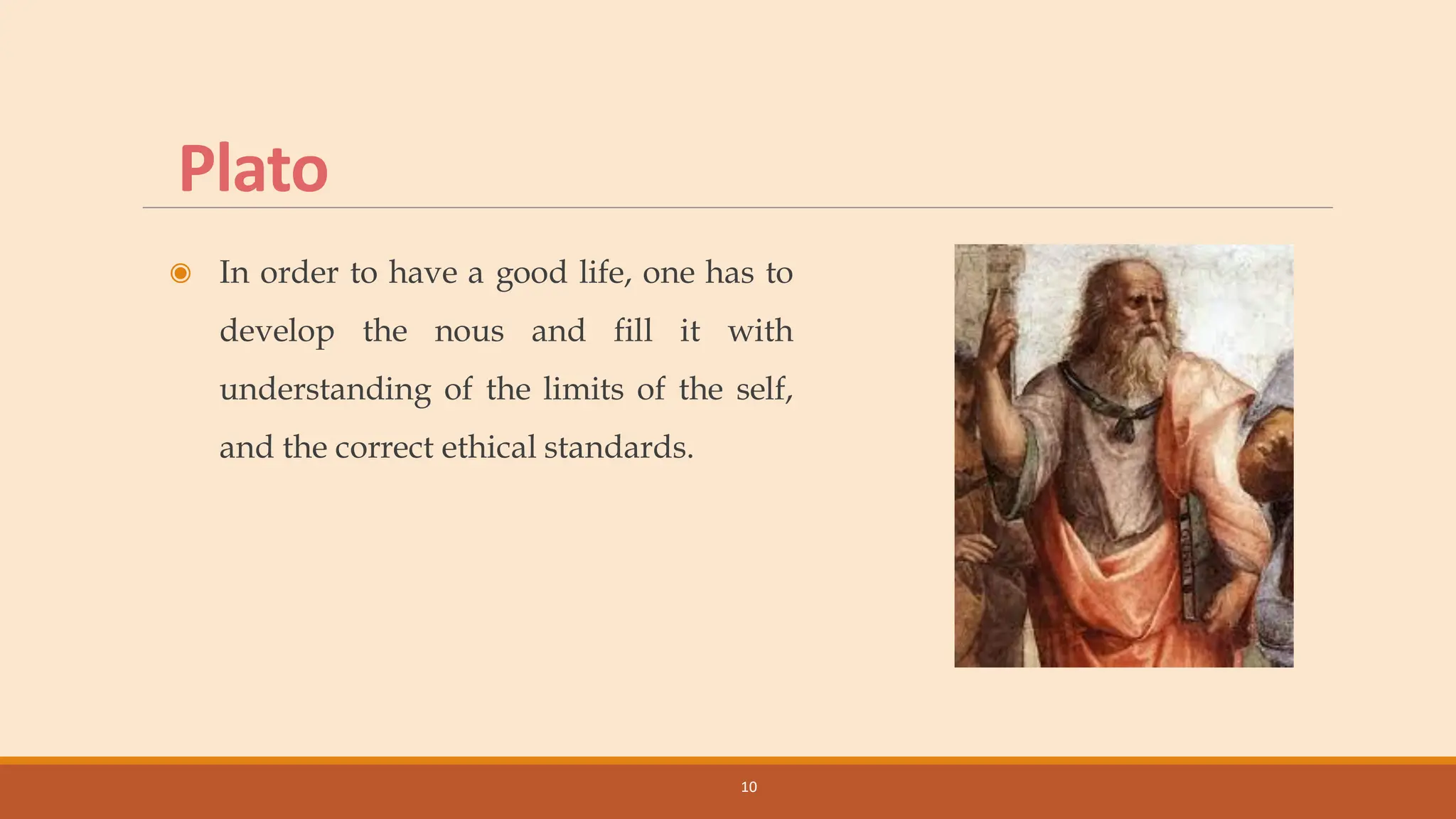
◉ In order to have a good life, one has to
develop the nous and fill it with
understanding of the limits of the self,
and the correct ethical standards.
10
St. Augustine
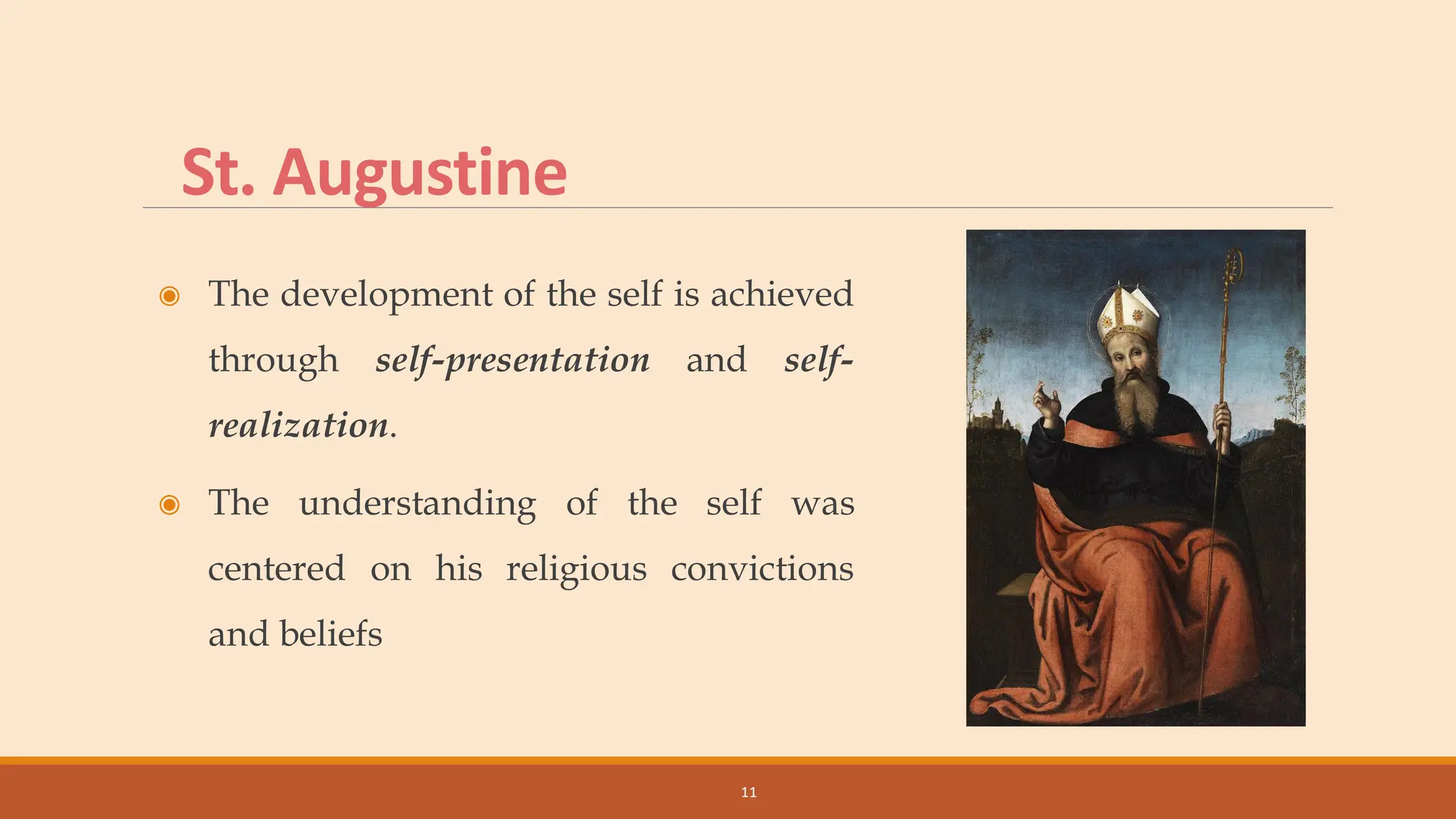
◉ The development of the self is achieved
through self-presentation and self-
realization.
◉ The understanding of the self was
centered on his religious convictions
and beliefs
11
St. Augustine
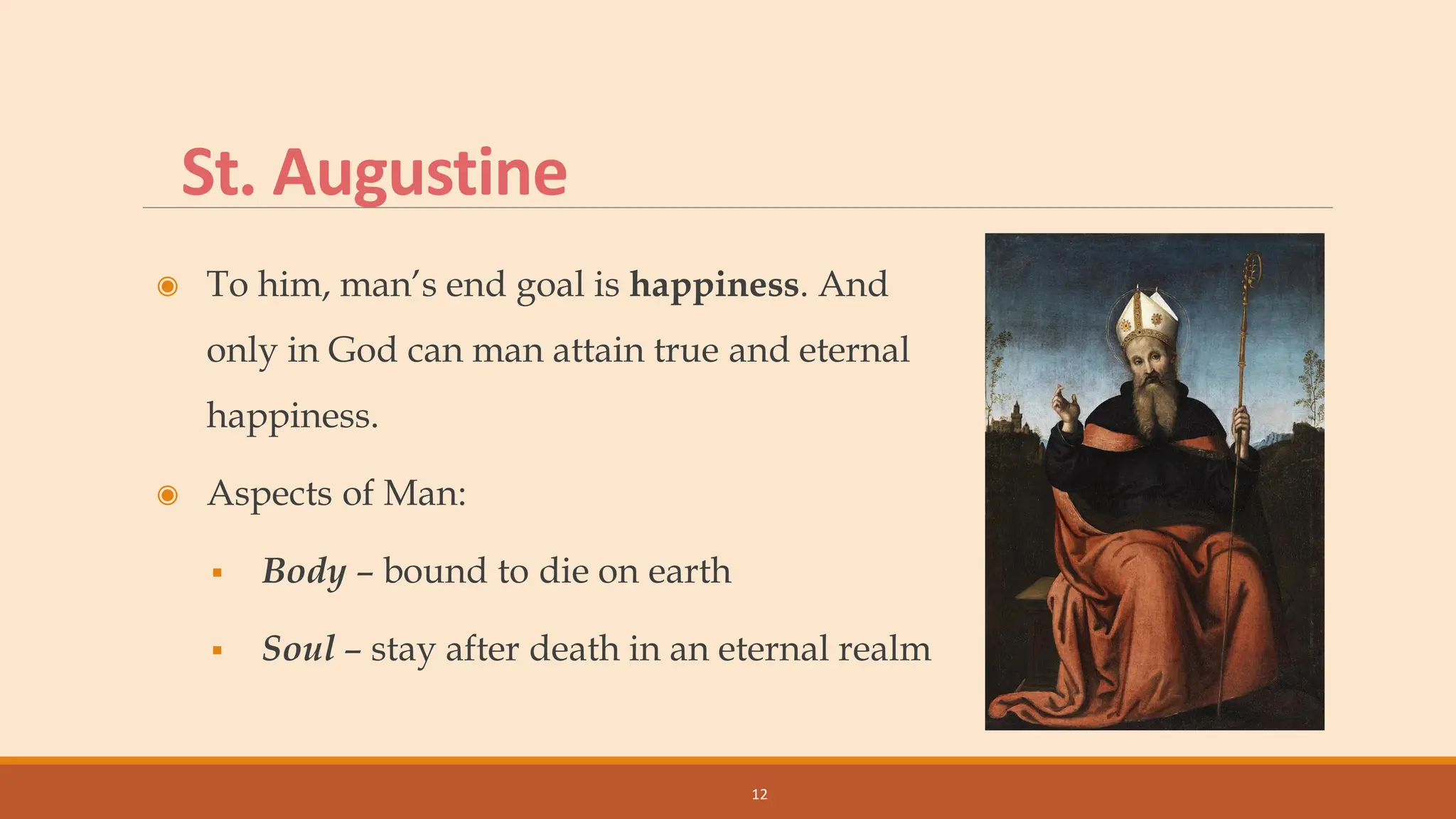
◉ To him, man’s end goal is happiness. And
only in God can man attain true and eternal
happiness.
◉ Aspects of Man:
▪ Body – bound to die on earth
▪ Soul – stay after death in an eternal realm
12
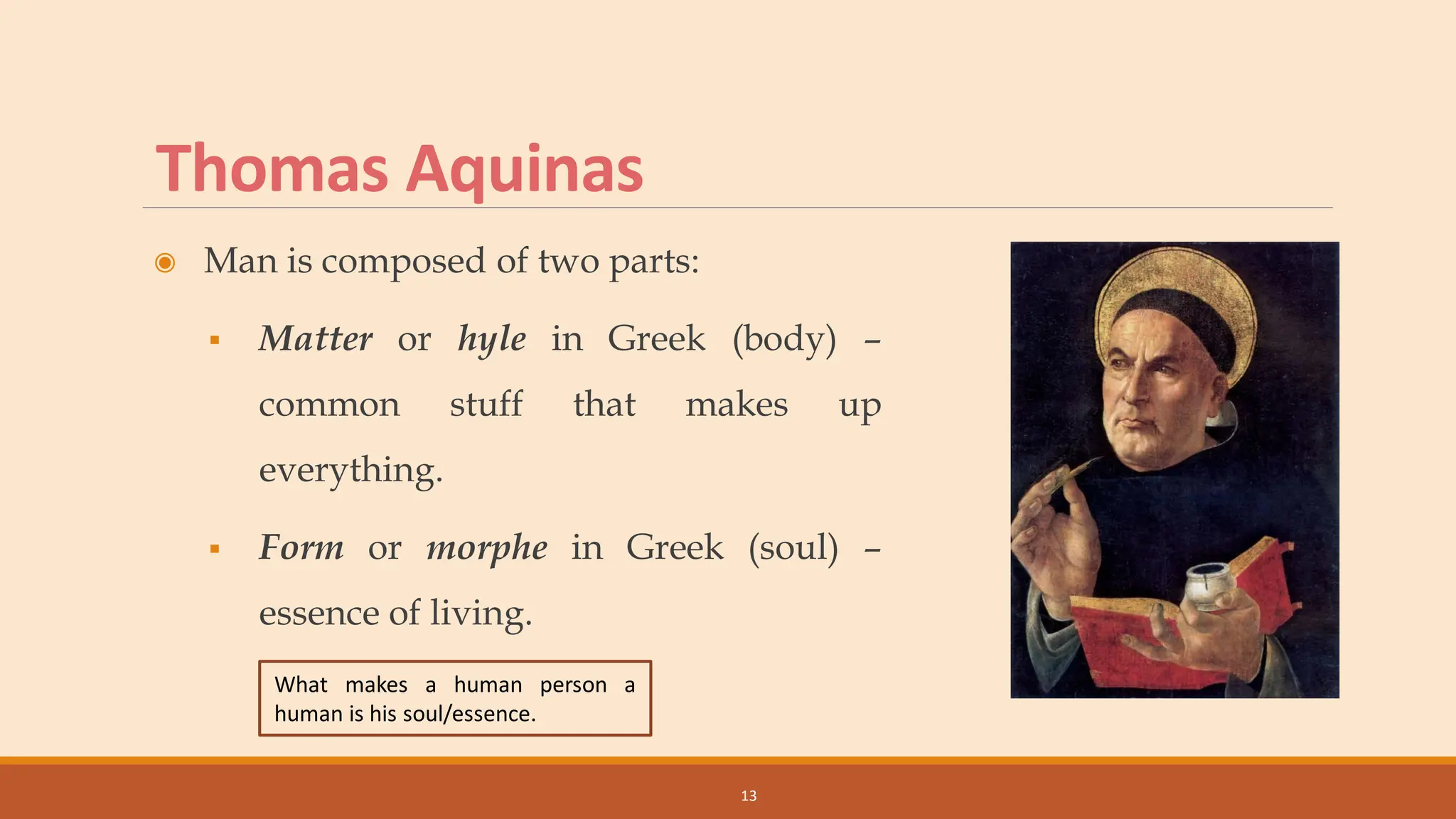
Thomas Aquinas
◉ Man is composed of two parts:
▪ Matter or hyle in Greek (body) –
common stuff that makes up
everything.
▪ Form or morphe in Greek (soul) –
essence of living.
13
What makes a human person a
human is his soul/essence.
Rene Descartes
◉ Father of Modern Philosophy.
◉ Doubts the existence of his own physical
body.
◉ We cannot really rely on our senses
because our sense perceptions can often
deceive us
◉ Everything must be doubted! 14
Rene Descartes
◉ The self is a combination of two distinct
entities:
▪ Cogito (mind) – the thing that thinks.
▪ Extenza (body) – extension of the
mind.
◉ “Cogito, ergo Sum,” “I think therefore I
am” or “I doubt therefore I exist.”
15
Rene Descartes
◉ Human rationality – the primary
condition of the existence of the self.
◉ We need reason in order to evaluate our
thoughts and actions.
16
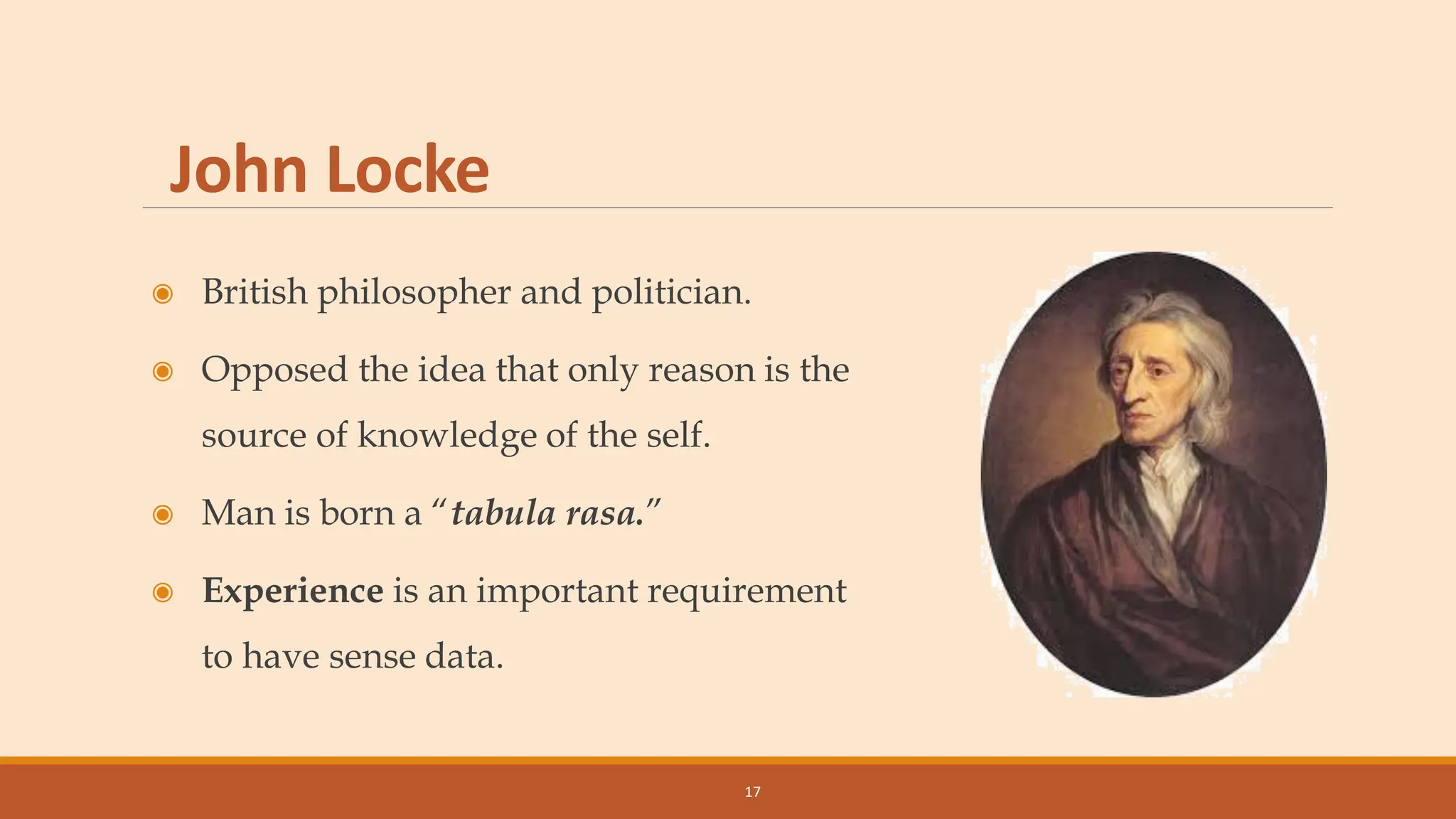
John Locke
◉ British philosopher and politician.
◉ Opposed the idea that only reason is the
source of knowledge of the self.
◉ Man is born a “tabula rasa.”
◉ Experience is an important requirement
to have sense data.
17
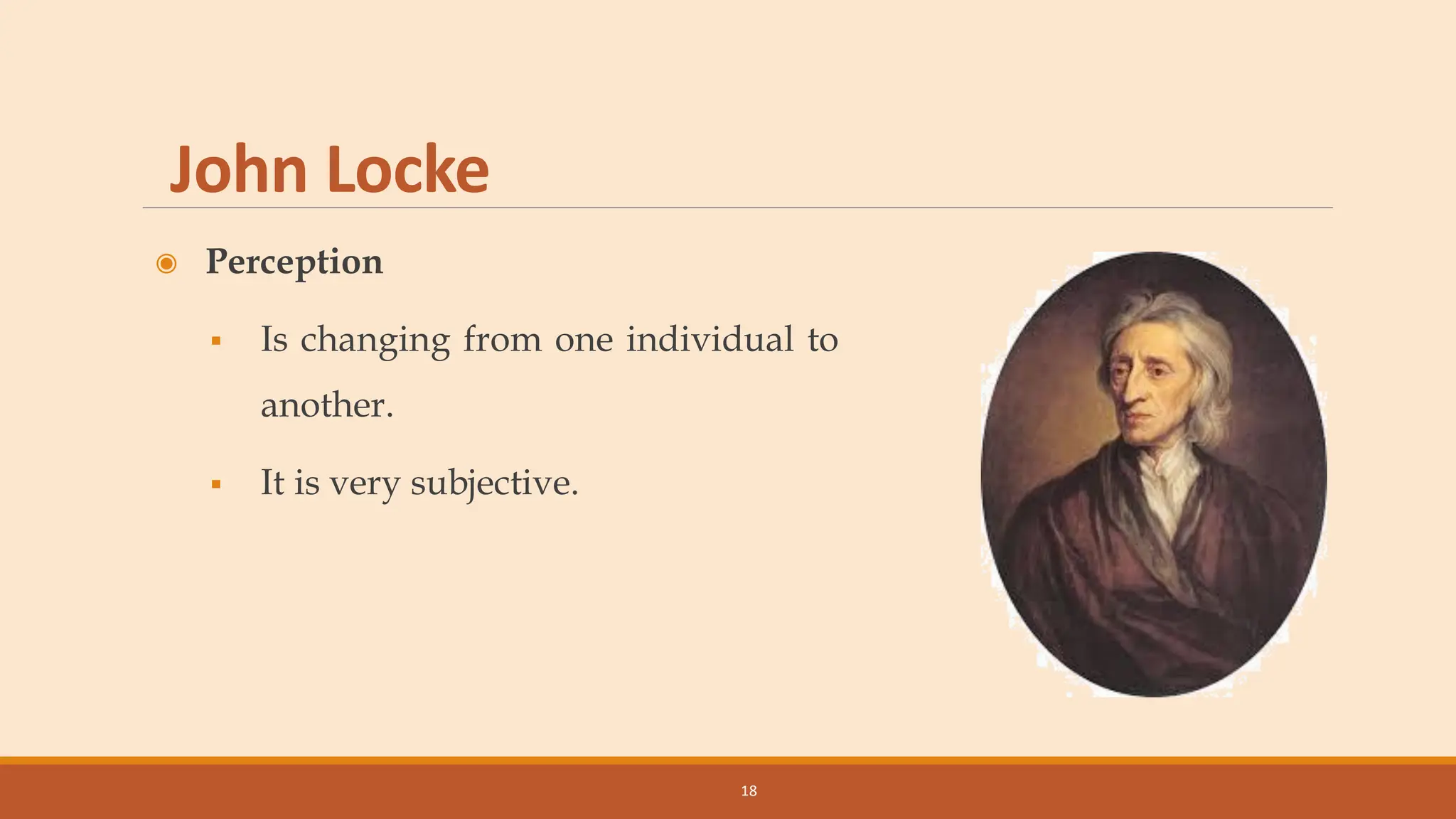
John Locke
◉ Perception
▪ Is changing from one individual to
another.
▪ It is very subjective.
18
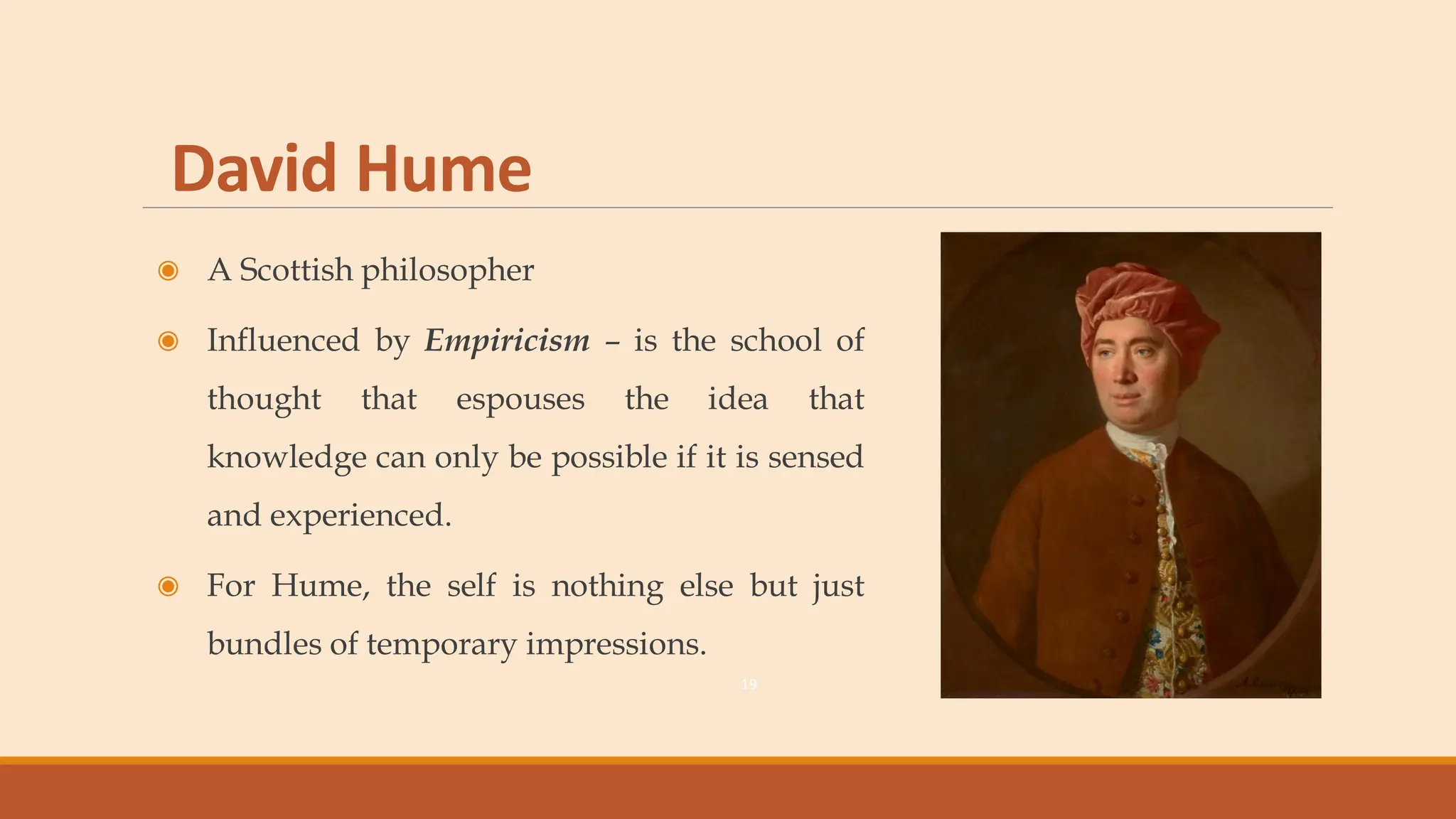
David Hume
◉ A Scottish philosopher
◉ Influenced by Empiricism – is the school of
thought that espouses the idea that
knowledge can only be possible if it is sensed
and experienced.
◉ For Hume, the self is nothing else but just
bundles of temporary impressions.
19
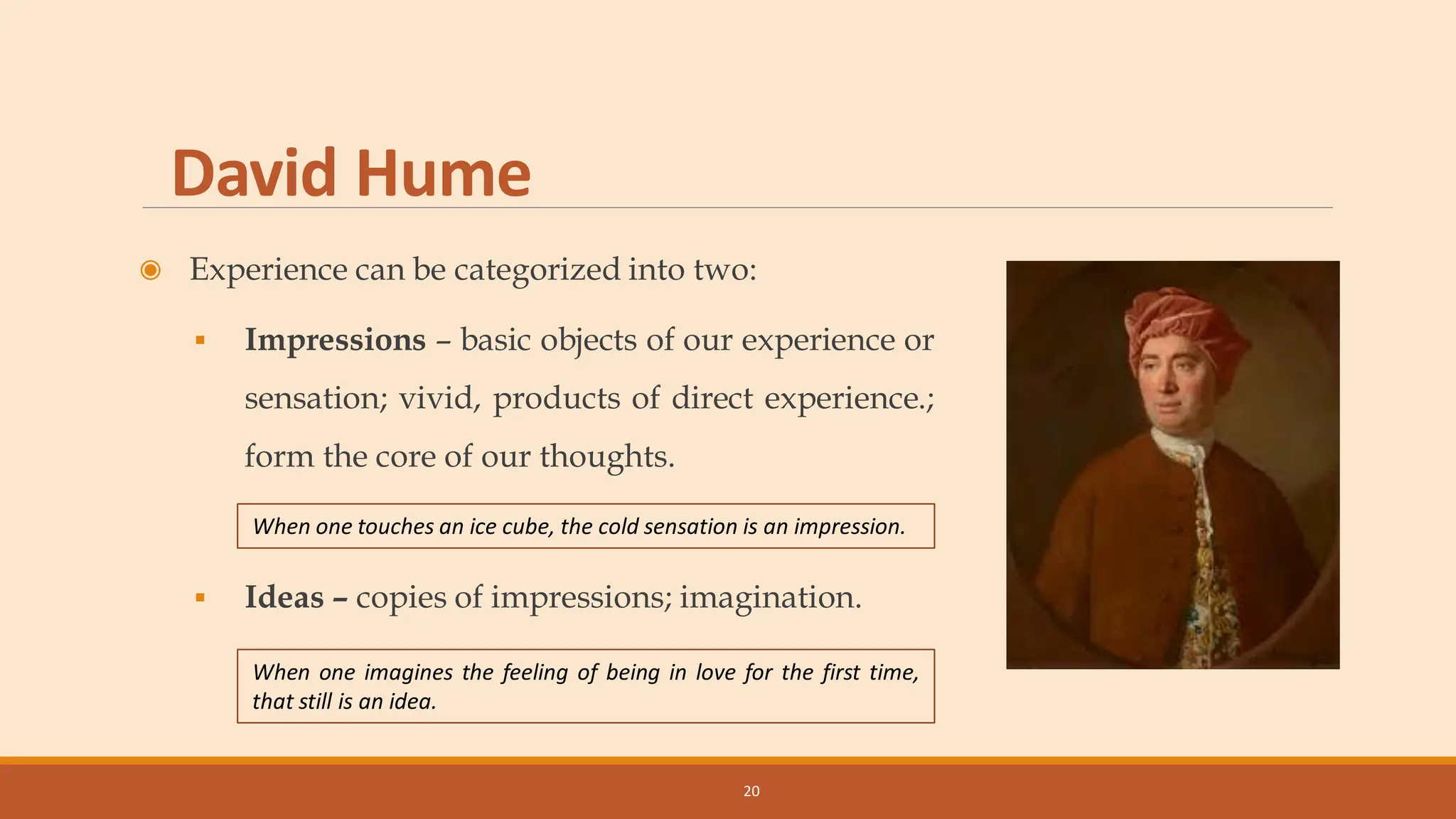
David Hume
◉ Experience can be categorized into two:
▪ Impressions – basic objects of our experience or
sensation; vivid, products of direct experience.;
form the core of our thoughts.
▪ Ideas – copies of impressions; imagination.
20
When one imagines the feeling of being in love for the first time,
that still is an idea.
When one touches an ice cube, the cold sensation is an impression.
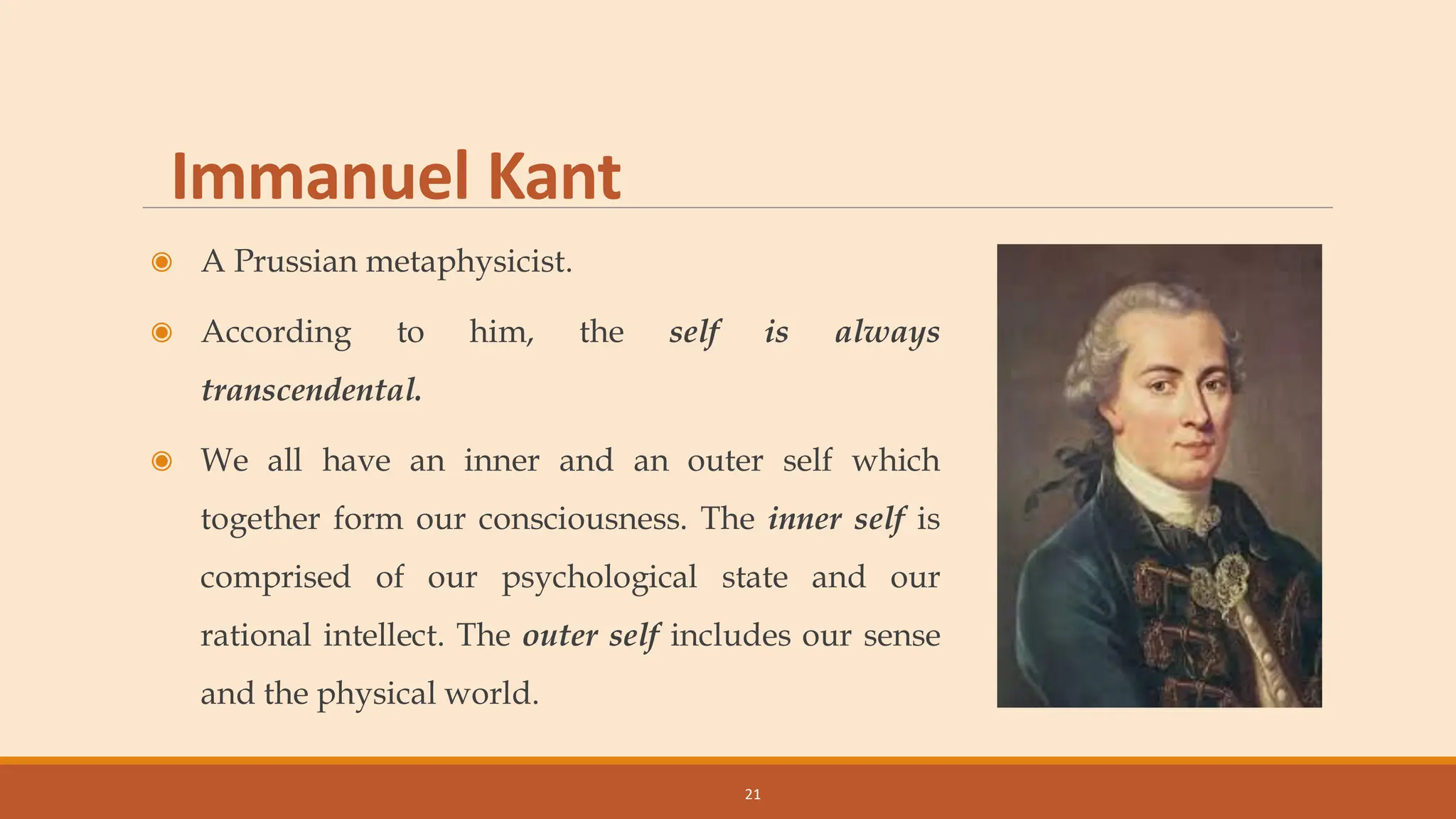
Immanuel Kant
◉ A Prussian metaphysicist.
◉ According to him, the self is always
transcendental.
◉ We all have an inner and an outer self which
together form our consciousness. The inner self is
comprised of our psychological state and our
rational intellect. The outer self includes our sense
and the physical world.
21
Immanuel Kant
◉ There is also a mind that organizes the
impressions that men get from the external
world.
◉ Without the self, one cannot organize the
different impressions that one gets in relation to
his own existence.
◉ The self is the seat of knowledge acquisition for
all human persons.
22
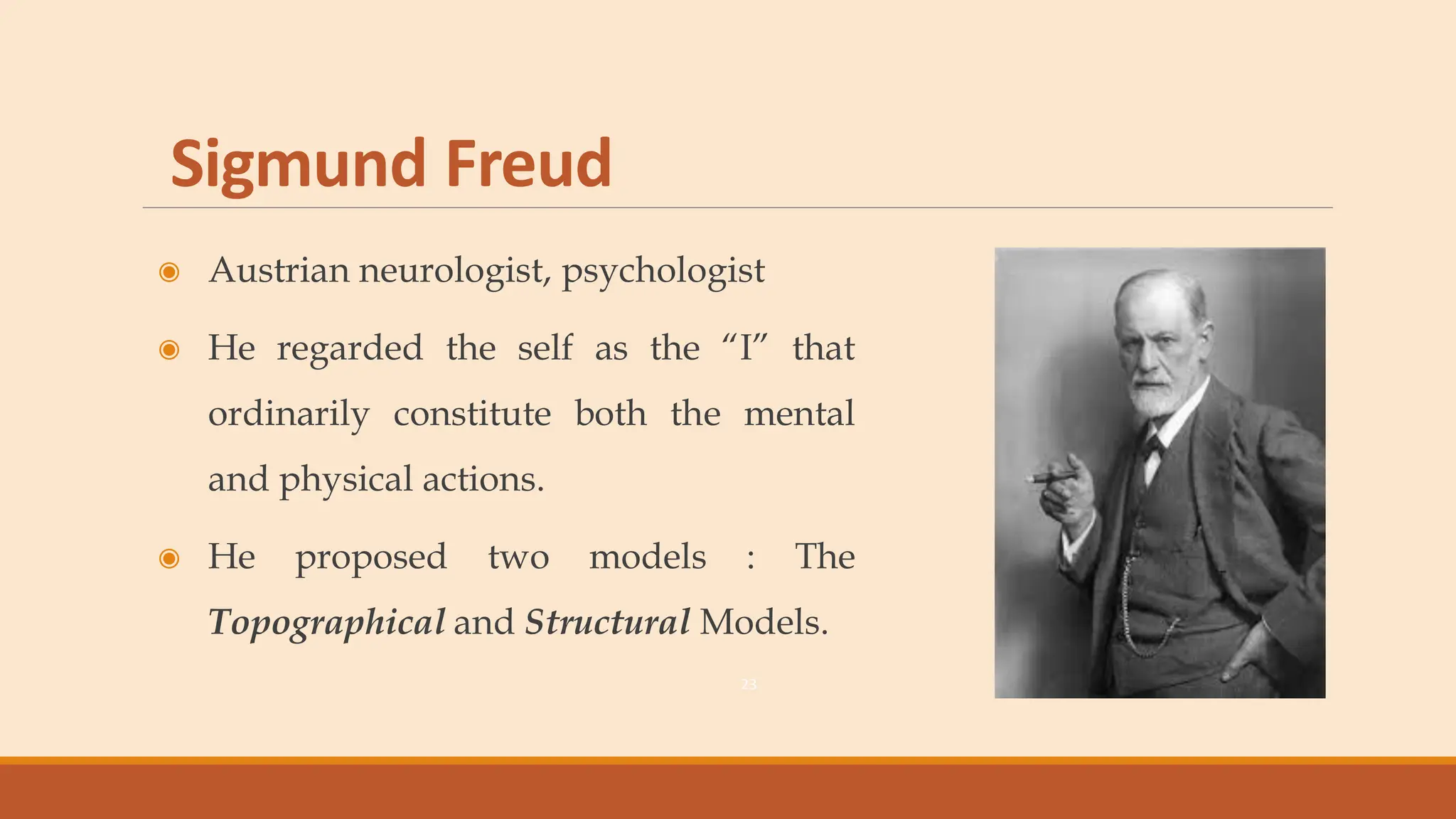
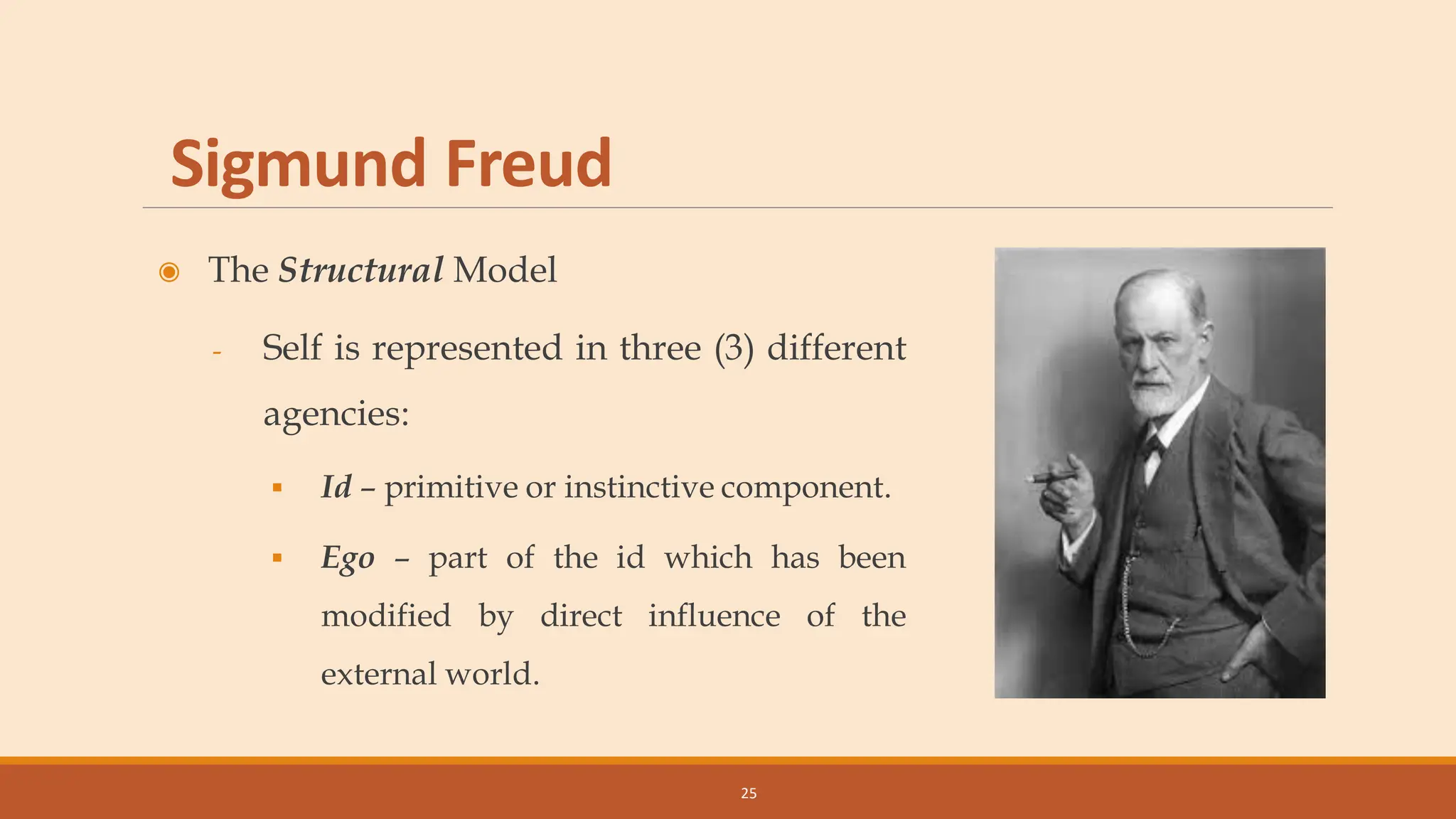
Sigmund Freud
◉ Austrian neurologist, psychologist
◉ He regarded the self as the “I” that
ordinarily constitute both the mental
and physical actions.
◉ He proposed two models : The
Topographical and Structural Models.
23
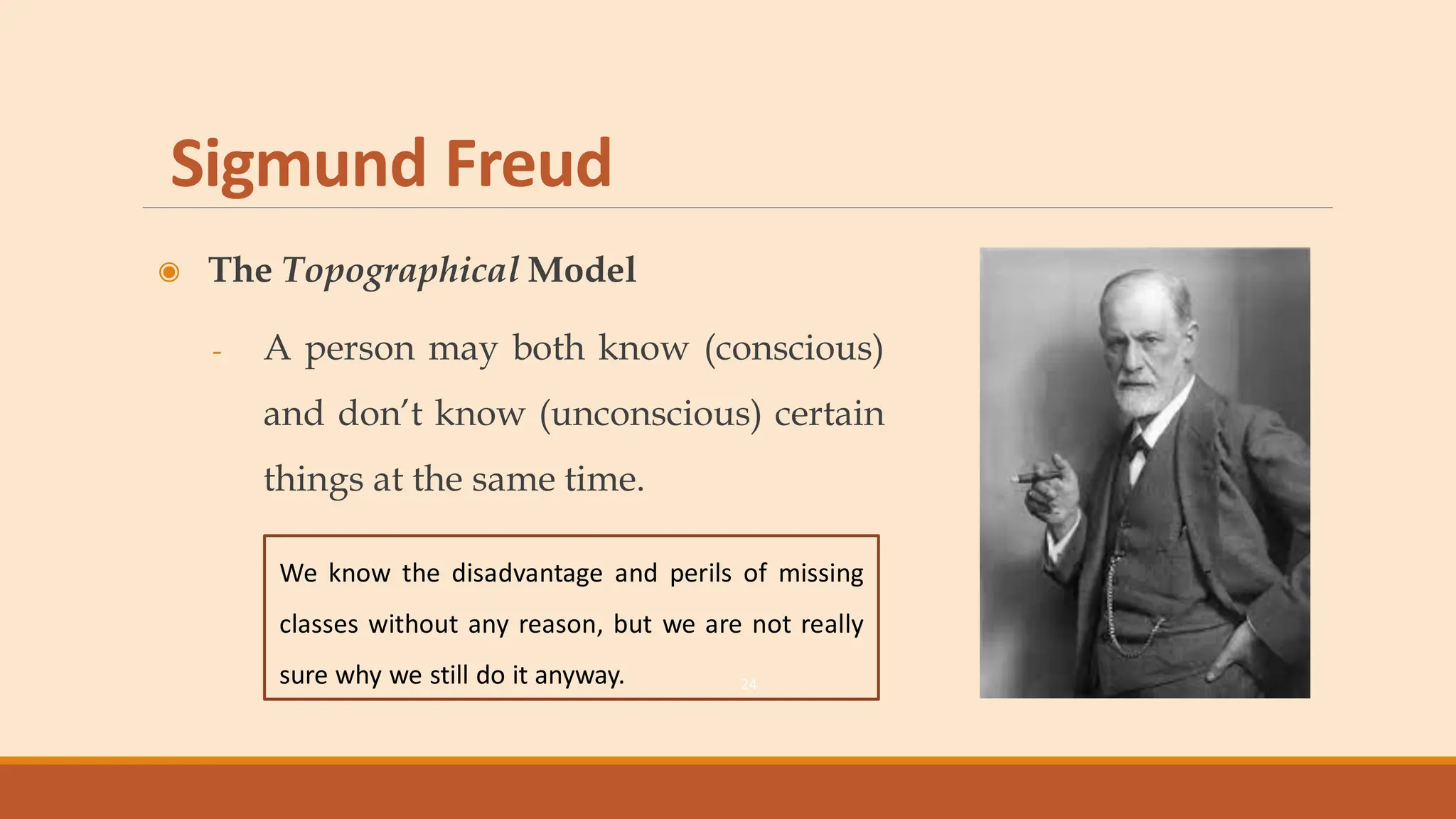
Sigmund Freud
◉ The Topographical Model
- A person may both know (conscious)
and don’t know (unconscious) certain
things at the same time.
24
We know the disadvantage and perils of missing
classes without any reason, but we are not really
sure why we still do it anyway.
Sigmund Freud
◉ The Structural Model
- Self is represented in three (3) different
agencies:
▪ Id – primitive or instinctive component.
▪ Ego – part of the id which has been
modified by direct influence of the
external world.
25
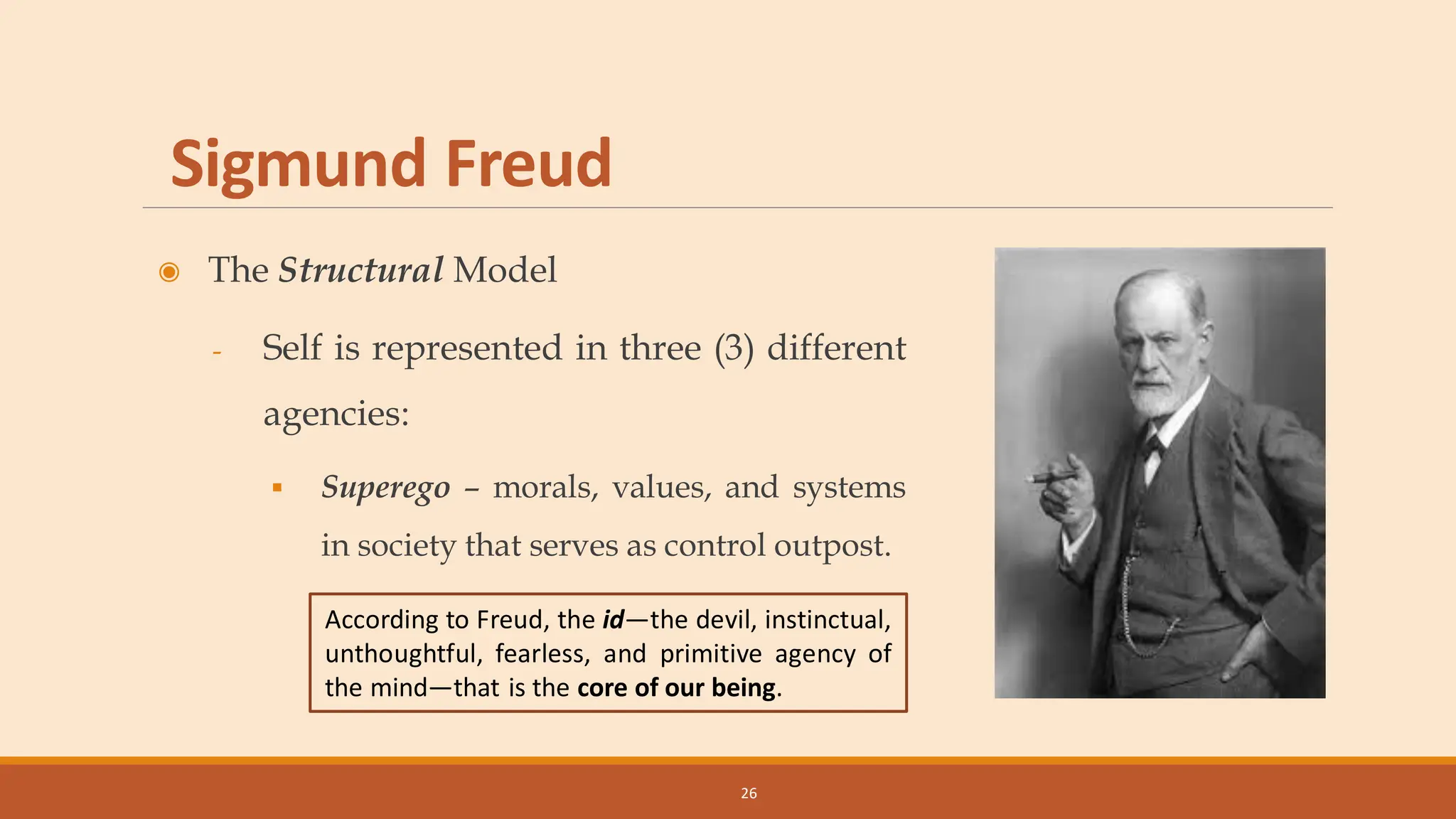
Sigmund Freud
◉ The Structural Model
- Self is represented in three (3) different
agencies:
▪ Superego – morals, values, and systems
in society that serves as control outpost.
26
According to Freud, the id—the devil, instinctual,
unthoughtful, fearless, and primitive agency of
the mind—that is the core of our being.
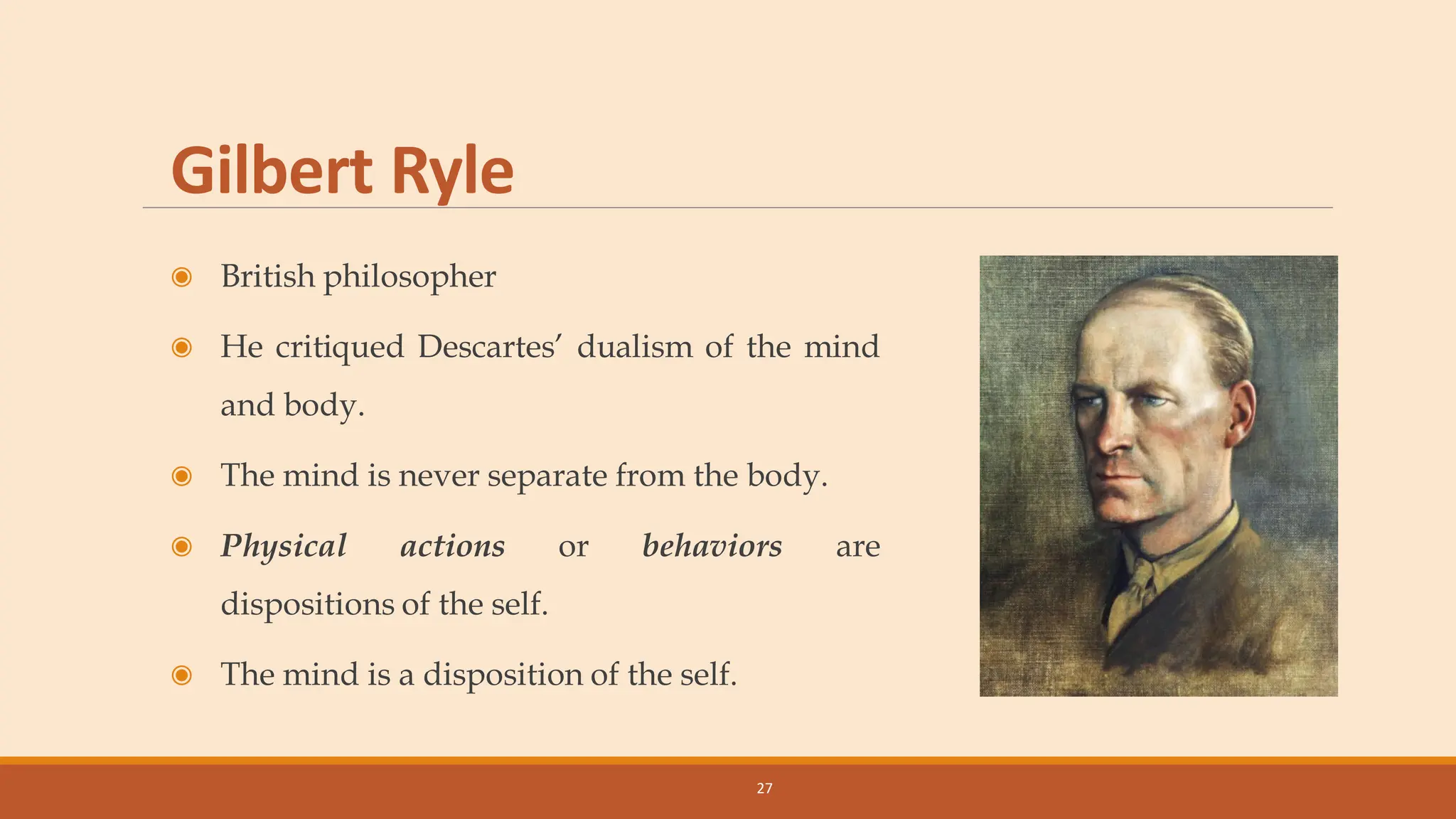
Gilbert Ryle
◉ British philosopher
◉ He critiqued Descartes’ dualism of the mind
and body.
◉ The mind is never separate from the body.
◉ Physical actions or behaviors are
dispositions of the self.
◉ The mind is a disposition of the self.
27
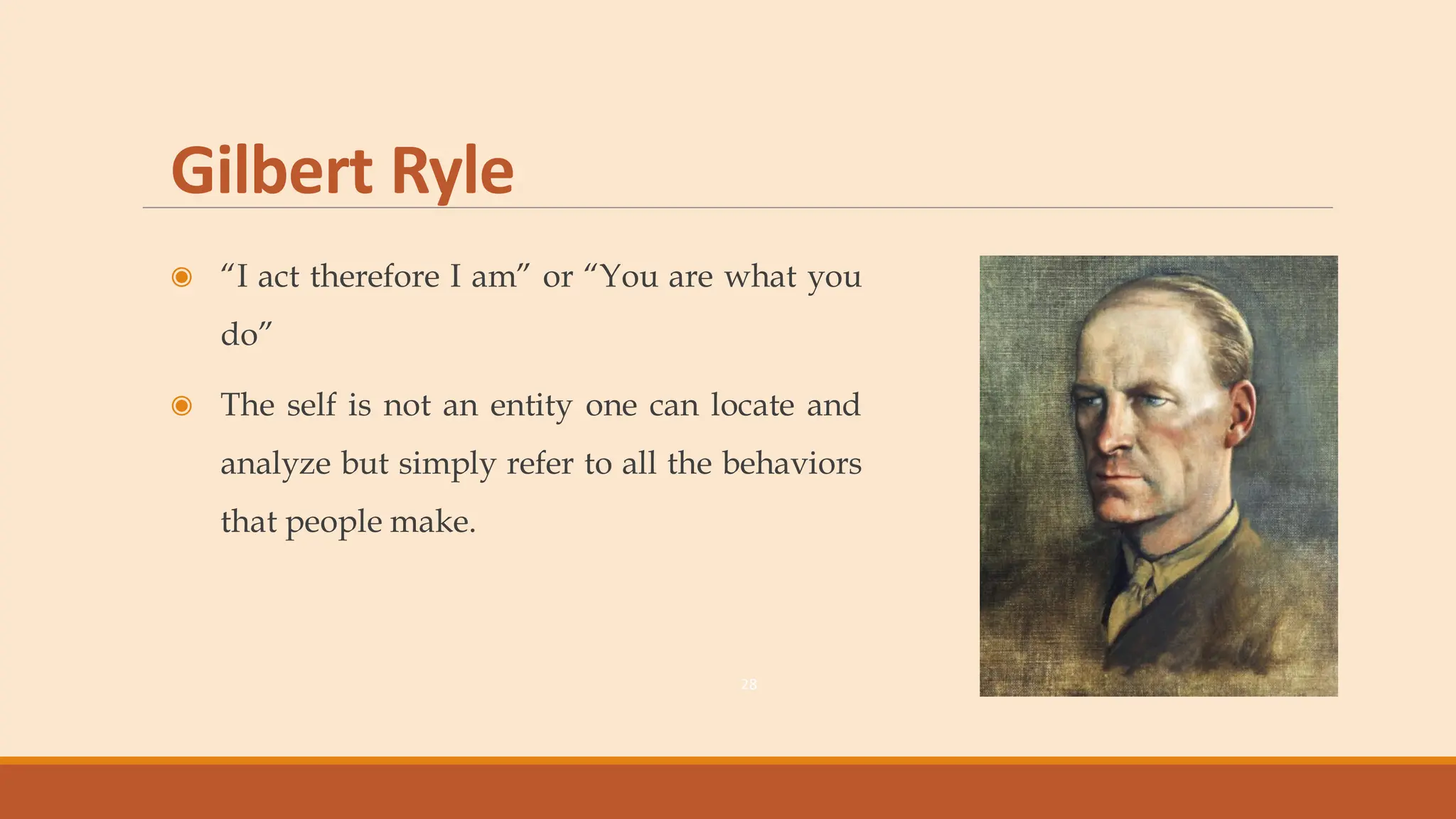
Gilbert Ryle
◉ “I act therefore I am” or “You are what you
do”
◉ The self is not an entity one can locate and
analyze but simply refer to all the behaviors
that people make.
28
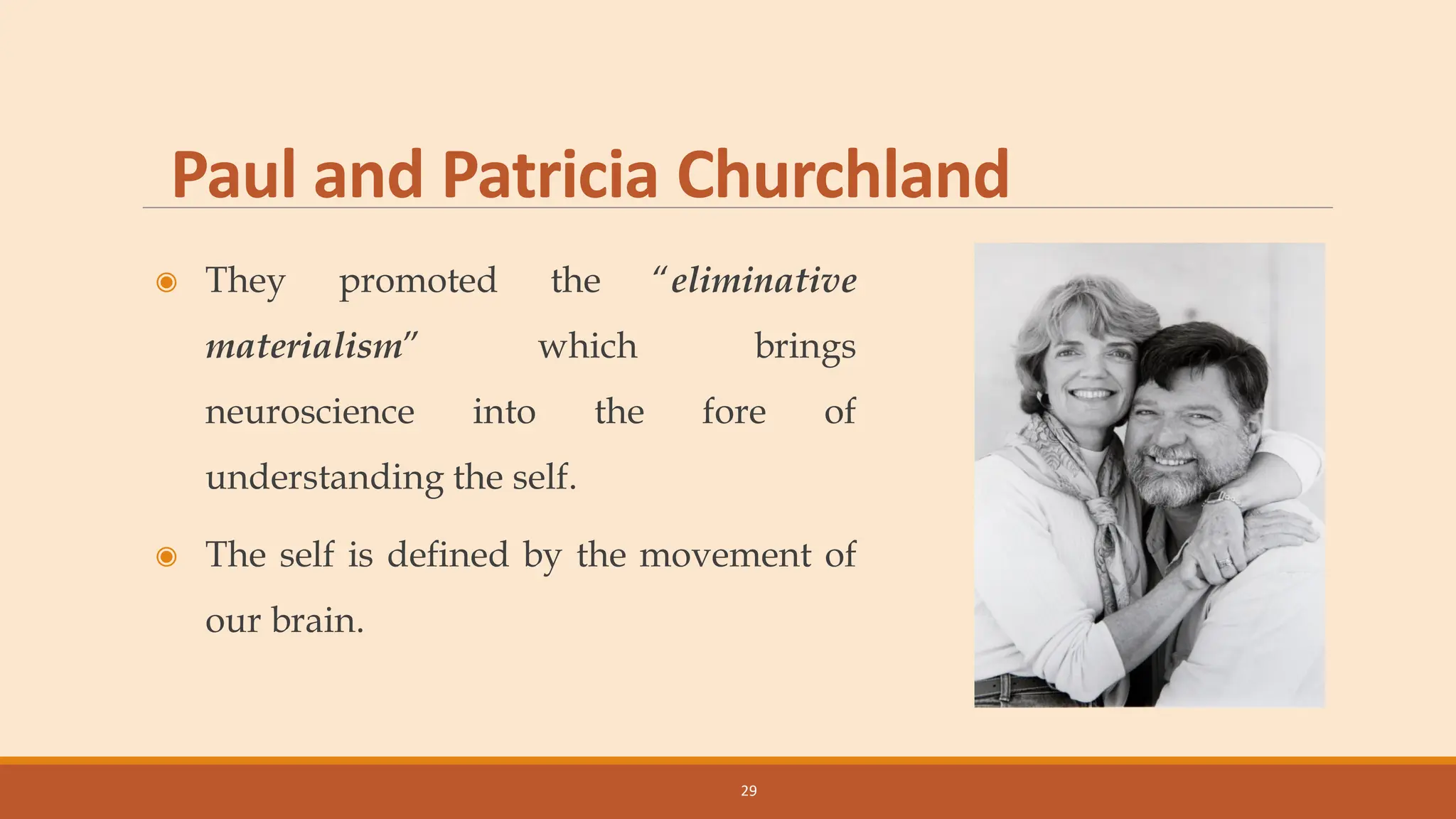
Paul and Patricia Churchland
◉ They promoted the “eliminative
materialism” which brings
neuroscience into the fore of
understanding the self.
◉ The self is defined by the movement of
our brain.
29
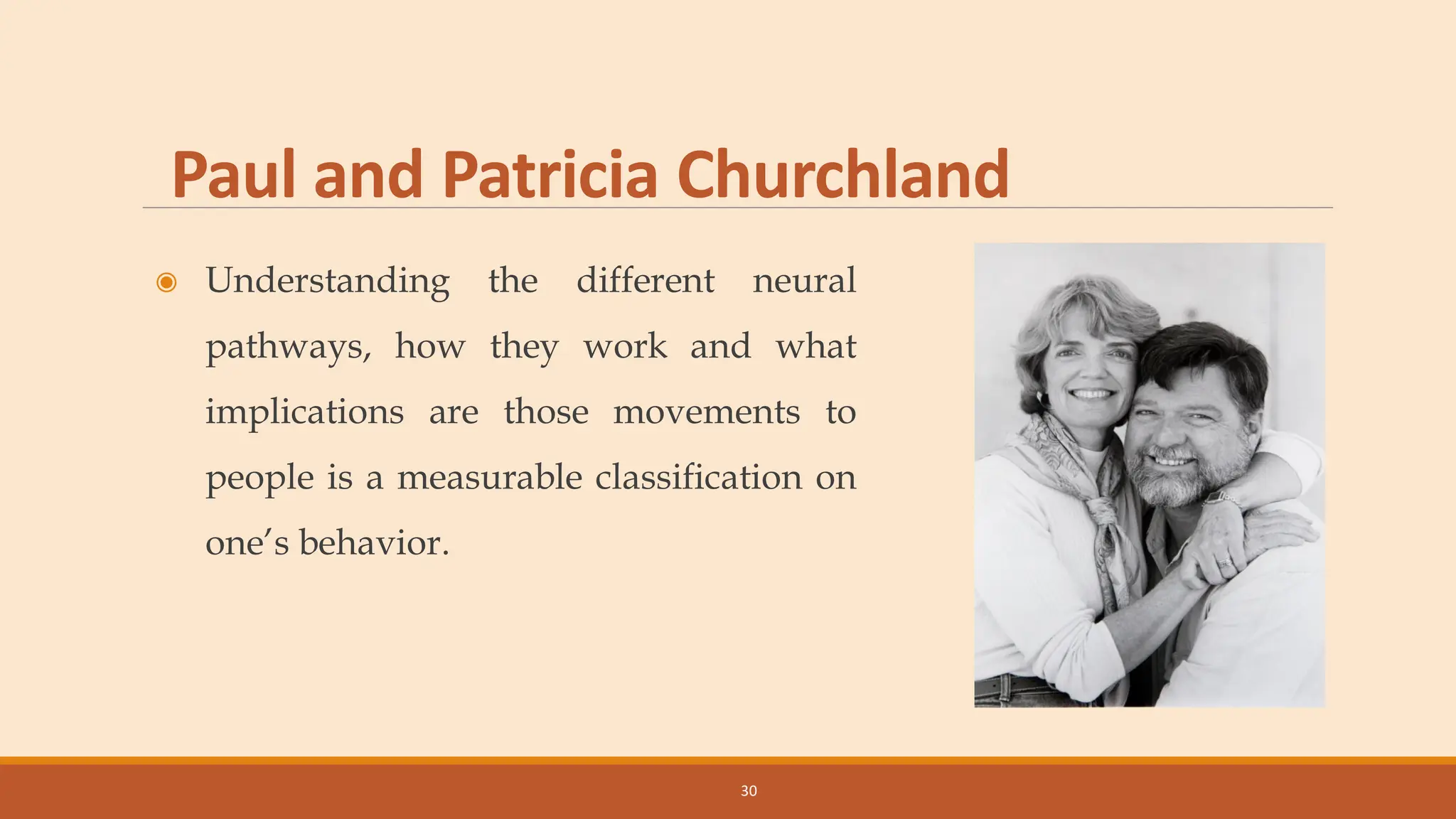
Paul and Patricia Churchland
◉ Understanding the different neural
pathways, how they work and what
implications are those movements to
people is a measurable classification on
one’s behavior.
30
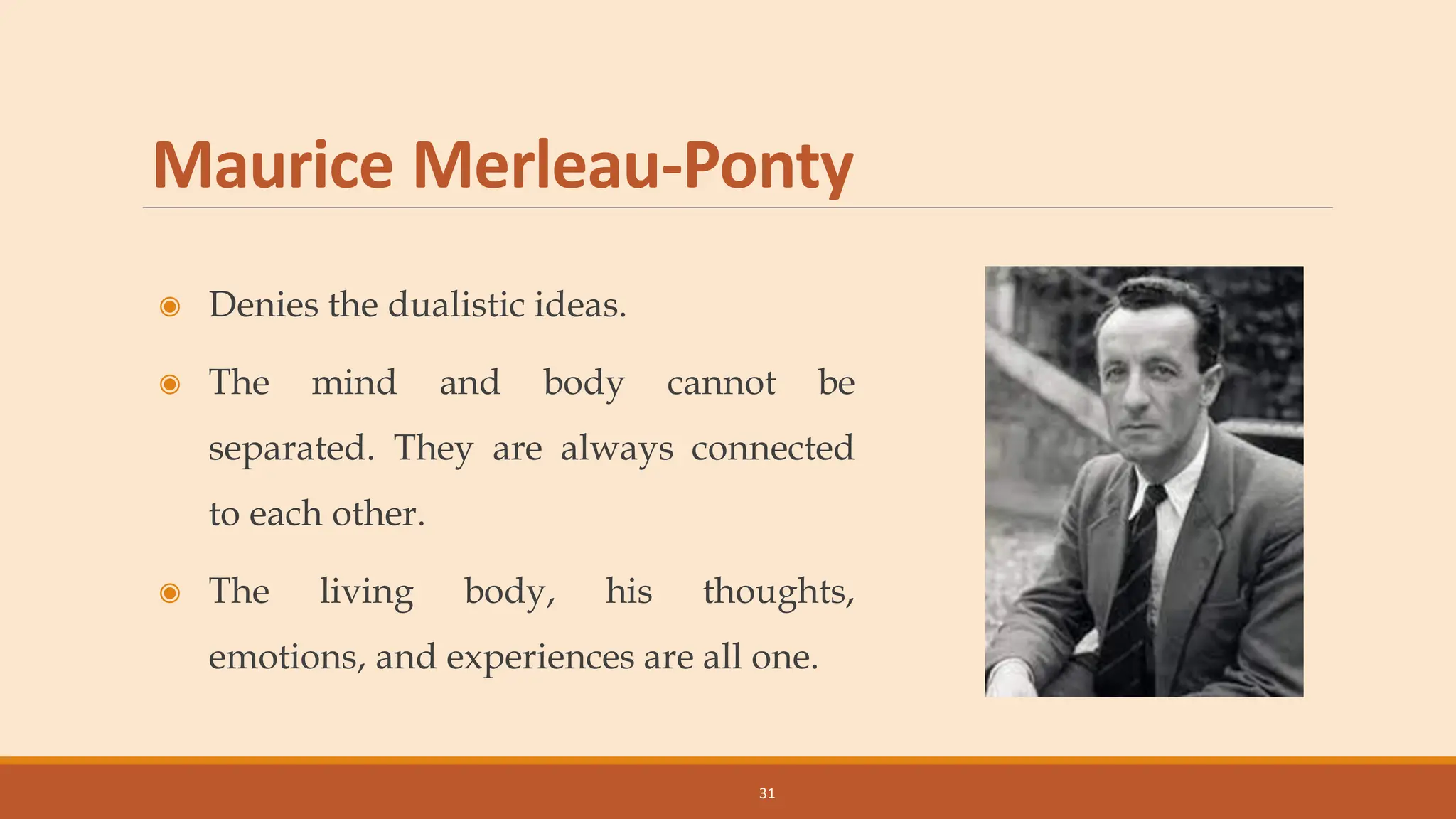
Maurice Merleau-Ponty
◉ Denies the dualistic ideas.
◉ The mind and body cannot be
separated. They are always connected
to each other.
◉ The living body, his thoughts,
emotions, and experiences are all one.
31
Thank you!
32

understanding the self Unit 1 Philosophical SELF

  • 1.
    1 Chapter 1 The Selffrom the Different Perspectives Unit 1: The Philosophical Self Angelyn B. Machate, RPm Instructor
  • 2.
    2 At the endof the unit, the students are expected to: ❑ Describe the different notions of the self from the points- of- view of the various philosophers across time and place. ❑ Compare how the self has been represented in different philosophical schools. ❑ Examine one’s self against the different views of self that were discussed in class and integrate these concepts to create one’s philosophical perspective of the self.
  • 3.
    3 ACTIVITY DO YOU TRULYKNOW YOURSELF? 1. How would you characterize yourself? 2. What makes you stand out from the rest? 3. How has yourself transformed itself? 4. How is your self connected to your body? 5. What will happen to your self after you leave this world?
  • 4.
    4 Questions Easy orDifficult to Answer Why?
  • 5.
    Greeks ◉ Knowing oneselfis an imperative and a requirement. ◉ It is imperative to know the limits of self so that one knows what one is capable of doing and what one is not. ◉ Knowing oneself is a requirement for self- moderation, prudence, good judgment and excellence of the soul. 5
  • 6.
    Socrates ◉ “The unexaminedlife is not worth living.” ◉ An examined life is a life duty bound to develop self-knowledge, a self dignified with values and integrity. ◉ Only in the recognition of one’s ignorance that a person can truly know oneself. 6
  • 7.
    Socrates ◉ Every manis dualistic, that is, composed of two important aspects of his personhood: - Body – imperfect, impermanent aspect - Soul – perfect and permanent 7
  • 8.
    Plato ◉ Psyche (thecore the self) is composed of three elements: ▪ Appetitive - includes one’s desires, pleasures, physical satisfactions, comforts, etc. ▪ Spirited – excited when given challenges, or fights back when agitated, or fights for justice when unjust practices are evident. The hot- blooded part of the psyche. 8
  • 9.
    Plato ◉ Psyche (thecore the self) is composed of three elements: ▪ Mind – the most superior of all elements. It decides, analyses, thinks ahead, proposes what is best, and rationally controls both the appetitive and spirited elements. 9 The mind or nous is the superpower that controls the affairs of the self.
  • 10.
    Plato ◉ In orderto have a good life, one has to develop the nous and fill it with understanding of the limits of the self, and the correct ethical standards. 10
  • 11.
    St. Augustine ◉ Thedevelopment of the self is achieved through self-presentation and self- realization. ◉ The understanding of the self was centered on his religious convictions and beliefs 11
  • 12.
    St. Augustine ◉ Tohim, man’s end goal is happiness. And only in God can man attain true and eternal happiness. ◉ Aspects of Man: ▪ Body – bound to die on earth ▪ Soul – stay after death in an eternal realm 12
  • 13.
    Thomas Aquinas ◉ Manis composed of two parts: ▪ Matter or hyle in Greek (body) – common stuff that makes up everything. ▪ Form or morphe in Greek (soul) – essence of living. 13 What makes a human person a human is his soul/essence.
  • 14.
    Rene Descartes ◉ Fatherof Modern Philosophy. ◉ Doubts the existence of his own physical body. ◉ We cannot really rely on our senses because our sense perceptions can often deceive us ◉ Everything must be doubted! 14
  • 15.
    Rene Descartes ◉ Theself is a combination of two distinct entities: ▪ Cogito (mind) – the thing that thinks. ▪ Extenza (body) – extension of the mind. ◉ “Cogito, ergo Sum,” “I think therefore I am” or “I doubt therefore I exist.” 15
  • 16.
    Rene Descartes ◉ Humanrationality – the primary condition of the existence of the self. ◉ We need reason in order to evaluate our thoughts and actions. 16
  • 17.
    John Locke ◉ Britishphilosopher and politician. ◉ Opposed the idea that only reason is the source of knowledge of the self. ◉ Man is born a “tabula rasa.” ◉ Experience is an important requirement to have sense data. 17
  • 18.
    John Locke ◉ Perception ▪Is changing from one individual to another. ▪ It is very subjective. 18
  • 19.
    David Hume ◉ AScottish philosopher ◉ Influenced by Empiricism – is the school of thought that espouses the idea that knowledge can only be possible if it is sensed and experienced. ◉ For Hume, the self is nothing else but just bundles of temporary impressions. 19
  • 20.
    David Hume ◉ Experiencecan be categorized into two: ▪ Impressions – basic objects of our experience or sensation; vivid, products of direct experience.; form the core of our thoughts. ▪ Ideas – copies of impressions; imagination. 20 When one imagines the feeling of being in love for the first time, that still is an idea. When one touches an ice cube, the cold sensation is an impression.
  • 21.
    Immanuel Kant ◉ APrussian metaphysicist. ◉ According to him, the self is always transcendental. ◉ We all have an inner and an outer self which together form our consciousness. The inner self is comprised of our psychological state and our rational intellect. The outer self includes our sense and the physical world. 21
  • 22.
    Immanuel Kant ◉ Thereis also a mind that organizes the impressions that men get from the external world. ◉ Without the self, one cannot organize the different impressions that one gets in relation to his own existence. ◉ The self is the seat of knowledge acquisition for all human persons. 22
  • 23.
    Sigmund Freud ◉ Austrianneurologist, psychologist ◉ He regarded the self as the “I” that ordinarily constitute both the mental and physical actions. ◉ He proposed two models : The Topographical and Structural Models. 23
  • 24.
    Sigmund Freud ◉ TheTopographical Model - A person may both know (conscious) and don’t know (unconscious) certain things at the same time. 24 We know the disadvantage and perils of missing classes without any reason, but we are not really sure why we still do it anyway.
  • 25.
    Sigmund Freud ◉ TheStructural Model - Self is represented in three (3) different agencies: ▪ Id – primitive or instinctive component. ▪ Ego – part of the id which has been modified by direct influence of the external world. 25
  • 26.
    Sigmund Freud ◉ TheStructural Model - Self is represented in three (3) different agencies: ▪ Superego – morals, values, and systems in society that serves as control outpost. 26 According to Freud, the id—the devil, instinctual, unthoughtful, fearless, and primitive agency of the mind—that is the core of our being.
  • 27.
    Gilbert Ryle ◉ Britishphilosopher ◉ He critiqued Descartes’ dualism of the mind and body. ◉ The mind is never separate from the body. ◉ Physical actions or behaviors are dispositions of the self. ◉ The mind is a disposition of the self. 27
  • 28.
    Gilbert Ryle ◉ “Iact therefore I am” or “You are what you do” ◉ The self is not an entity one can locate and analyze but simply refer to all the behaviors that people make. 28
  • 29.
    Paul and PatriciaChurchland ◉ They promoted the “eliminative materialism” which brings neuroscience into the fore of understanding the self. ◉ The self is defined by the movement of our brain. 29
  • 30.
    Paul and PatriciaChurchland ◉ Understanding the different neural pathways, how they work and what implications are those movements to people is a measurable classification on one’s behavior. 30
  • 31.
    Maurice Merleau-Ponty ◉ Deniesthe dualistic ideas. ◉ The mind and body cannot be separated. They are always connected to each other. ◉ The living body, his thoughts, emotions, and experiences are all one. 31
  • 32.