The IP building blocks
Understanding the IP Protocol
husseinnasser
1.2.3.4
IP Address
● Layer 3 property
● Can be set automatically or statically
● Network and Host portion
● 4 bytes in IPv4 - 32 bits
husseinnasser
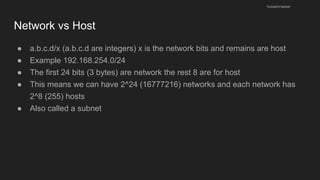
Network vs Host
● a.b.c.d/x (a.b.c.d are integers) x is the network bits and remains are host
● Example 192.168.254.0/24
● The first 24 bits (3 bytes) are network the rest 8 are for host
● This means we can have 2^24 (16777216) networks and each network has
2^8 (255) hosts
● Also called a subnet
husseinnasser
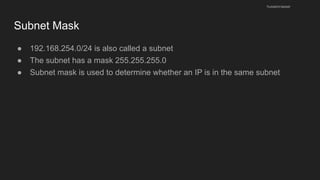
Subnet Mask
● 192.168.254.0/24 is also called a subnet
● The subnet has a mask 255.255.255.0
● Subnet mask is used to determine whether an IP is in the same subnet
husseinnasser
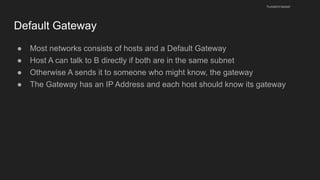
Default Gateway
● Most networks consists of hosts and a Default Gateway
● Host A can talk to B directly if both are in the same subnet
● Otherwise A sends it to someone who might know, the gateway
● The Gateway has an IP Address and each host should know its gateway
husseinnasser
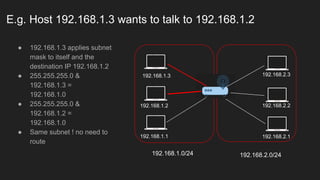
E.g. Host 192.168.1.3 wants to talk to 192.168.1.2
192.168.1.0/24 192.168.2.0/24
192.168.1.3
192.168.1.2
192.168.1.1
192.168.2.3
192.168.2.2
192.168.2.1
● 192.168.1.3 applies subnet
mask to itself and the
destination IP 192.168.1.2
● 255.255.255.0 &
192.168.1.3 =
192.168.1.0
● 255.255.255.0 &
192.168.1.2 =
192.168.1.0
● Same subnet ! no need to
route
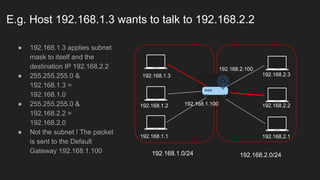
E.g. Host 192.168.1.3 wants to talk to 192.168.2.2
192.168.1.0/24 192.168.2.0/24
192.168.1.3
192.168.1.2
192.168.1.1
192.168.2.3
192.168.2.2
192.168.2.1
● 192.168.1.3 applies subnet
mask to itself and the
destination IP 192.168.2.2
● 255.255.255.0 &
192.168.1.3 =
192.168.1.0
● 255.255.255.0 &
192.168.2.2 =
192.168.2.0
● Not the subnet ! The packet
is sent to the Default
Gateway 192.168.1.100
192.168.2.100
192.168.1.100
Summary
● IP Address
● Network vs Host
● Subnet and subnet mask
● Default Gateway
husseinnasser
The IP Packet
Anatomy of the IP Packet
husseinnasser
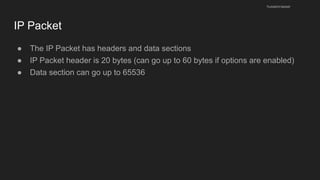
IP Packet
● The IP Packet has headers and data sections
● IP Packet header is 20 bytes (can go up to 60 bytes if options are enabled)
● Data section can go up to 65536
husseinnasser
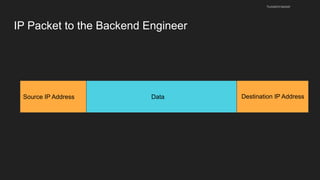
IP Packet to the Backend Engineer
husseinnasser
Source IP Address Data Destination IP Address
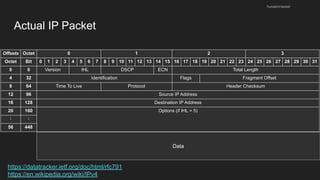
Actual IP Packet
husseinnasser
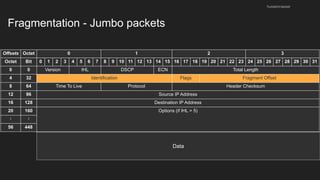
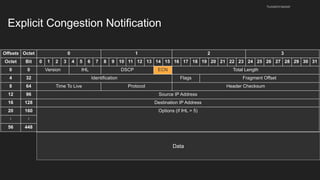
Offsets Octet 0 1 2 3
Octet Bit 0 1 2 3 4 5 6 7 8 9 10 11 12 13 14 15 16 17 18 19 20 21 22 23 24 25 26 27 28 29 30 31
0 0 Version IHL DSCP ECN Total Length
4 32 Identification Flags Fragment Offset
8 64 Time To Live Protocol Header Checksum
12 96 Source IP Address
16 128 Destination IP Address
20 160 Options (if IHL > 5)
⋮ ⋮
56 448
Data
https://datatracker.ietf.org/doc/html/rfc791
https://en.wikipedia.org/wiki/IPv4
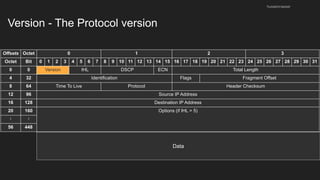
Version - The Protocol version
husseinnasser
Offsets Octet 0 1 2 3
Octet Bit 0 1 2 3 4 5 6 7 8 9 10 11 12 13 14 15 16 17 18 19 20 21 22 23 24 25 26 27 28 29 30 31
0 0 Version IHL DSCP ECN Total Length
4 32 Identification Flags Fragment Offset
8 64 Time To Live Protocol Header Checksum
12 96 Source IP Address
16 128 Destination IP Address
20 160 Options (if IHL > 5)
⋮ ⋮
56 448
Data
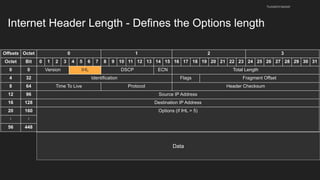
Internet Header Length - Defines the Options length
husseinnasser
Offsets Octet 0 1 2 3
Octet Bit 0 1 2 3 4 5 6 7 8 9 10 11 12 13 14 15 16 17 18 19 20 21 22 23 24 25 26 27 28 29 30 31
0 0 Version IHL DSCP ECN Total Length
4 32 Identification Flags Fragment Offset
8 64 Time To Live Protocol Header Checksum
12 96 Source IP Address
16 128 Destination IP Address
20 160 Options (if IHL > 5)
⋮ ⋮
56 448
Data
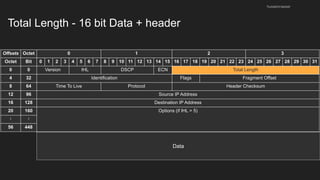
Total Length - 16 bit Data + header
husseinnasser
Offsets Octet 0 1 2 3
Octet Bit 0 1 2 3 4 5 6 7 8 9 10 11 12 13 14 15 16 17 18 19 20 21 22 23 24 25 26 27 28 29 30 31
0 0 Version IHL DSCP ECN Total Length
4 32 Identification Flags Fragment Offset
8 64 Time To Live Protocol Header Checksum
12 96 Source IP Address
16 128 Destination IP Address
20 160 Options (if IHL > 5)
⋮ ⋮
56 448
Data
Fragmentation - Jumbo packets
husseinnasser
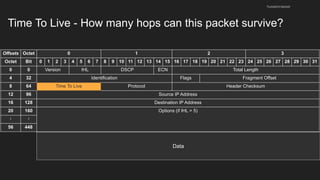
Offsets Octet 0 1 2 3
Octet Bit 0 1 2 3 4 5 6 7 8 9 10 11 12 13 14 15 16 17 18 19 20 21 22 23 24 25 26 27 28 29 30 31
0 0 Version IHL DSCP ECN Total Length
4 32 Identification Flags Fragment Offset
8 64 Time To Live Protocol Header Checksum
12 96 Source IP Address
16 128 Destination IP Address
20 160 Options (if IHL > 5)
⋮ ⋮
56 448
Data
Time To Live - How many hops can this packet survive?
husseinnasser
Offsets Octet 0 1 2 3
Octet Bit 0 1 2 3 4 5 6 7 8 9 10 11 12 13 14 15 16 17 18 19 20 21 22 23 24 25 26 27 28 29 30 31
0 0 Version IHL DSCP ECN Total Length
4 32 Identification Flags Fragment Offset
8 64 Time To Live Protocol Header Checksum
12 96 Source IP Address
16 128 Destination IP Address
20 160 Options (if IHL > 5)
⋮ ⋮
56 448
Data
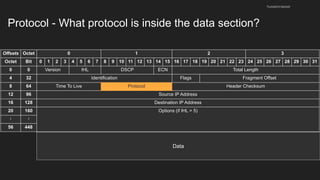
Protocol - What protocol is inside the data section?
husseinnasser
Offsets Octet 0 1 2 3
Octet Bit 0 1 2 3 4 5 6 7 8 9 10 11 12 13 14 15 16 17 18 19 20 21 22 23 24 25 26 27 28 29 30 31
0 0 Version IHL DSCP ECN Total Length
4 32 Identification Flags Fragment Offset
8 64 Time To Live Protocol Header Checksum
12 96 Source IP Address
16 128 Destination IP Address
20 160 Options (if IHL > 5)
⋮ ⋮
56 448
Data
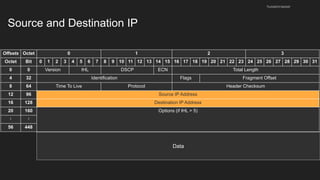
Source and Destination IP
husseinnasser
Offsets Octet 0 1 2 3
Octet Bit 0 1 2 3 4 5 6 7 8 9 10 11 12 13 14 15 16 17 18 19 20 21 22 23 24 25 26 27 28 29 30 31
0 0 Version IHL DSCP ECN Total Length
4 32 Identification Flags Fragment Offset
8 64 Time To Live Protocol Header Checksum
12 96 Source IP Address
16 128 Destination IP Address
20 160 Options (if IHL > 5)
⋮ ⋮
56 448
Data
Explicit Congestion Notification
husseinnasser
Offsets Octet 0 1 2 3
Octet Bit 0 1 2 3 4 5 6 7 8 9 10 11 12 13 14 15 16 17 18 19 20 21 22 23 24 25 26 27 28 29 30 31
0 0 Version IHL DSCP ECN Total Length
4 32 Identification Flags Fragment Offset
8 64 Time To Live Protocol Header Checksum
12 96 Source IP Address
16 128 Destination IP Address
20 160 Options (if IHL > 5)
⋮ ⋮
56 448
Data
Summary
● The IP Packet has headers and data sections
● IP Packet header is 20 bytes (can go up to 60 bytes if options are enabled)
● Data section can go up to 65536
● Packets need to get fragmented if it doesn’t fit in a frame
husseinnasser
ICMP
Internet Control Message Protocol
husseinnasser
ICMP
● Stands for Internet Control Message Protocol
● Designed for informational messages
○ Host unreachable, port unreachable, fragmentation needed
○ Packet expired (infinite loop in routers)
● Uses IP directly
● PING and traceroute use it
● Doesn’t require listeners or ports to be opened
husseinnasser
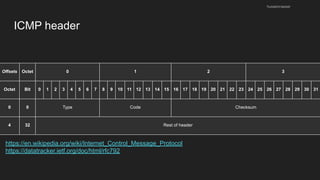
ICMP header
husseinnasser
Offsets Octet 0 1 2 3
Octet Bit 0 1 2 3 4 5 6 7 8 9 10 11 12 13 14 15 16 17 18 19 20 21 22 23 24 25 26 27 28 29 30 31
0 0 Type Code Checksum
4 32 Rest of header
https://en.wikipedia.org/wiki/Internet_Control_Message_Protocol
https://datatracker.ietf.org/doc/html/rfc792
ICMP
● Some firewalls block ICMP for security reasons
● That is why PING might not work in those cases
● Disabling ICMP also can cause real damage with connection establishment
○ Fragmentation needed
● PING demo
husseinnasser
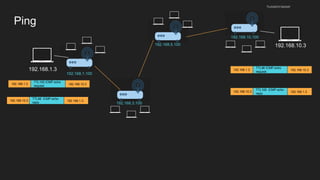
Ping
husseinnasser
192.168.1.3
192.168.10.3
192.168.1.3
TTL100 ICMP echo
request
192.168.10.3
192.168.10.100
192.168.5.100
192.168.3.100
192.168.1.100
192.168.1.3
TTL96 ICMP echo
request
192.168.10.3
192.168.10.3
TTL100 ICMP echo
reply
192.168.1.3
192.168.10.3
TTL96 ICMP echo
reply
192.168.1.3
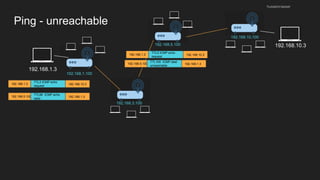
Ping - unreachable
husseinnasser
192.168.1.3
192.168.10.3
192.168.1.3
TTL3 ICMP echo
request
192.168.10.3
192.168.10.100
192.168.5.100
192.168.3.100
192.168.1.100
192.168.1.3
TTL0 ICMP echo
request
192.168.10.3
192.168.5.100
TTL100 ICMP dest
unreachable
192.168.1.3
192.168.5.100
TTL96 ICMP echo
reply
192.168.1.3
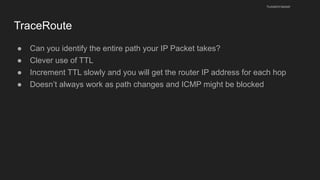
TraceRoute
● Can you identify the entire path your IP Packet takes?
● Clever use of TTL
● Increment TTL slowly and you will get the router IP address for each hop
● Doesn’t always work as path changes and ICMP might be blocked
husseinnasser
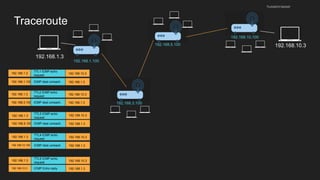
Traceroute
husseinnasser
192.168.1.3
192.168.10.3
192.168.1.3
TTL1 ICMP echo
request
192.168.10.3
192.168.10.100
192.168.5.100
192.168.3.100
192.168.1.100
192.168.1.100 ICMP dest unreach. 192.168.1.3
192.168.1.3
TTL2 ICMP echo
request
192.168.10.3
192.168.3.100 ICMP dest unreach. 192.168.1.3
192.168.1.3
TTL3 ICMP echo
request
192.168.10.3
192.168.5.100 ICMP dest unreach. 192.168.1.3
192.168.1.3
TTL4 ICMP echo
request
192.168.10.3
192.168.10.100 ICMP dest unreach 192.168.1.3
192.168.1.3
TTL5 ICMP echo
request
192.168.10.3
192.168.10.3 ICMP Echo reply 192.168.1.3
Summary
● ICMP is an IP level protocol used for information messages
● Critical to know if the host is available or port is opened
● Used for PING and TraceRoute
● Can be blocked which can cause problems
husseinnasser
ARP
Address Resolution Protocol
husseinnasser
Why ARP?
● We need the MAC address to send frames (layer 2)
● Most of the time we know the IP address but not the MAC
● ARP Table is cached IP->Mac mapping
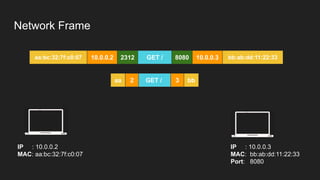
Network Frame
aa:bc:32:7f:c0:07 GET / bb:ab:dd:11:22:33
10.0.0.3
10.0.0.2
IP : 10.0.0.3
MAC: bb:ab:dd:11:22:33
Port: 8080
IP : 10.0.0.2
MAC: aa:bc:32:7f:c0:07
8080
2312
aa GET / 3 bb
2
IP : 2
GW : 1
MAC: aa
EXIP : 122.1.2.4
IP : 10.0.0.1 (1)
MAC: ff
IP : 3
GW : 1
MAC: bb
IP : 4
GW : 1
MAC: cc
IP : 5
GW : 1
MAC: dd
ip mc
2 aa
ip mc
3 bb
ip mc
4 cc
ip mc
5 dd
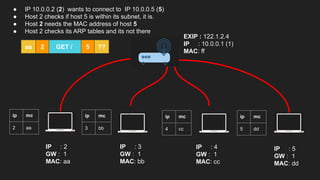
● IP 10.0.0.2 (2) wants to connect to IP 10.0.0.5 (5)
● Host 2 checks if host 5 is within its subnet, it is.
● Host 2 needs the MAC address of host 5
● Host 2 checks its ARP tables and its not there
aa GET / 5 ??
2
IP : 2
GW : 1
MAC: aa
EXIP : 122.1.2.4
IP : 10.0.0.1 (1)
MAC: ff
IP : 3
GW : 1
MAC: bb
IP : 4
GW : 1
MAC: cc
IP : 5
GW : 1
MAC: dd
ip mc
2 aa
5 dd
ip mc
3 bb
ip mc
4 cc
ip mc
5 dd
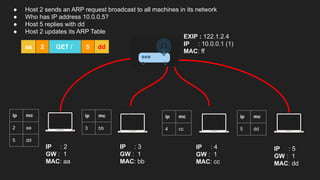
● Host 2 sends an ARP request broadcast to all machines in its network
● Who has IP address 10.0.0.5?
● Host 5 replies with dd
● Host 2 updates its ARP Table
aa GET / 5 dd
2
IP : 2
GW : 1
MAC: aa
EXIP : 122.1.2.4
IP : 10.0.0.1 (1)
MAC: ff
IP : 3
GW : 1
MAC: bb
IP : 4
GW : 1
MAC: cc
IP : 5
GW : 1
MAC: dd
ip mc
2 aa
5 dd
ip mc
3 bb
ip mc
4 cc
ip mc
5 dd
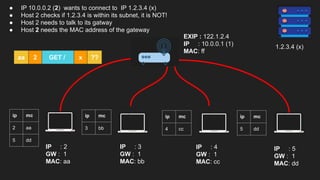
● IP 10.0.0.2 (2) wants to connect to IP 1.2.3.4 (x)
● Host 2 checks if 1.2.3.4 is within its subnet, it is NOT!
● Host 2 needs to talk to its gatway
● Host 2 needs the MAC address of the gateway
aa GET / x ??
2
1.2.3.4 (x)
IP : 2
GW : 1
MAC: aa
EXIP : 122.1.2.4
IP : 10.0.0.1 (1)
MAC: ff
IP : 3
GW : 1
MAC: bb
IP : 4
GW : 1
MAC: cc
IP : 5
GW : 1
MAC: dd
ip mc
2 aa
5 dd
1 ff
ip mc
3 bb
ip mc
4 cc
ip mc
5 dd
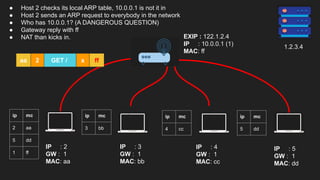
● Host 2 checks its local ARP table, 10.0.0.1 is not it in
● Host 2 sends an ARP request to everybody in the network
● Who has 10.0.0.1? (A DANGEROUS QUESTION)
● Gateway reply with ff
● NAT than kicks in.
aa GET / x ff
2
1.2.3.4
Summary
● ARP stands for Address resolution protocol
● We need MAC address to send frames between machines
● Almost always we have the IP address but not the MAC
● Need a lookup protocol that give us the MAC from IP address
● Attacks can be performed on ARP (ARP poisoning)
husseinnasser
Routing Example
How IP Packets are routed in Switches and Routers
husseinnasser
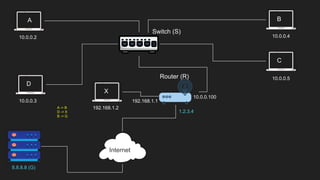
A
D
B
C
Switch (S)
Router (R)
Internet
10.0.0.2
10.0.0.3
10.0.0.5
10.0.0.4
10.0.0.100
8.8.8.8 (G)
1.2.3.4
192.168.1.2
X
192.168.1.1
A -> B
D -> X
B -> G
UDP
User Datagram Protocol
husseinnasser
UDP
● Stands for User Datagram Protocol
● Layer 4 protocol
● Ability to address processes in a host using ports
● Simple protocol to send and receive data
● Prior communication not required (double edge sword)
● Stateless no knowledge is stored on the host
● 8 byte header Datagram
husseinnasser
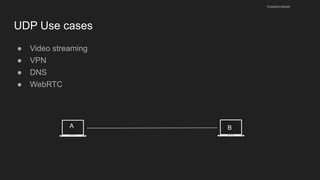
UDP Use cases
● Video streaming
● VPN
● DNS
● WebRTC
husseinnasser
B
A
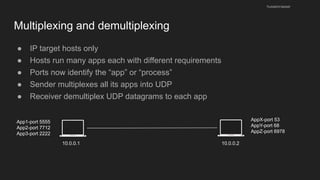
Multiplexing and demultiplexing
● IP target hosts only
● Hosts run many apps each with different requirements
● Ports now identify the “app” or “process”
● Sender multiplexes all its apps into UDP
● Receiver demultiplex UDP datagrams to each app
husseinnasser
10.0.0.1 10.0.0.2
App1-port 5555
App2-port 7712
App3-port 2222
AppX-port 53
AppY-port 68
AppZ-port 6978
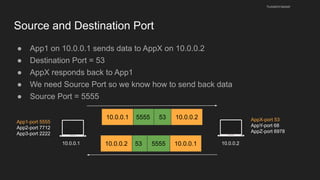
Source and Destination Port
● App1 on 10.0.0.1 sends data to AppX on 10.0.0.2
● Destination Port = 53
● AppX responds back to App1
● We need Source Port so we know how to send back data
● Source Port = 5555
husseinnasser
10.0.0.1 10.0.0.2
App1-port 5555
App2-port 7712
App3-port 2222
AppX-port 53
AppY-port 68
AppZ-port 6978
10.0.0.1 53 10.0.0.2
5555
10.0.0.2 5555 10.0.0.1
53
Summary
● UDP is a simple layer 4 protocol
● Uses ports to address processes
● Stateless
husseinnasser
UDP Datagram
The anatomy of the UDP datagram
husseinnasser
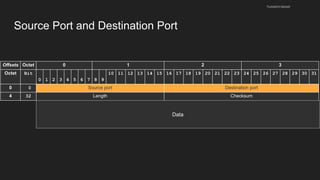
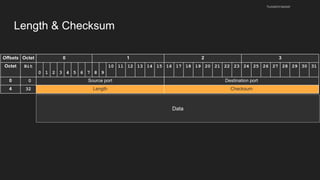
UDP Datagram
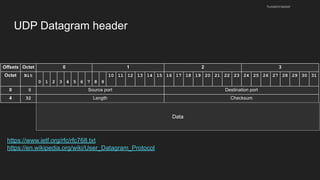
● UDP Header is 8 bytes only (IPv4)
● Datagram slides into an IP packet as “data”
● Port are 16 bit (0 to 65535)
husseinnasser
husseinnasser
Offsets Octet 0 1 2 3
Octet Bit
0 1 2 3 4 5 6 7 8 9
10 11 12 13 14 15 16 17 18 19 20 21 22 23 24 25 26 27 28 29 30 31
0 0 Source port Destination port
4 32 Length Checksum
UDP Datagram header
https://www.ietf.org/rfc/rfc768.txt
https://en.wikipedia.org/wiki/User_Datagram_Protocol
Data
husseinnasser
Offsets Octet 0 1 2 3
Octet Bit
0 1 2 3 4 5 6 7 8 9
10 11 12 13 14 15 16 17 18 19 20 21 22 23 24 25 26 27 28 29 30 31
0 0 Source port Destination port
4 32 Length Checksum
Source Port and Destination Port
Data
husseinnasser
Offsets Octet 0 1 2 3
Octet Bit
0 1 2 3 4 5 6 7 8 9
10 11 12 13 14 15 16 17 18 19 20 21 22 23 24 25 26 27 28 29 30 31
0 0 Source port Destination port
4 32 Length Checksum
Length & Checksum
Data
UDP Pros and Cons
The power and drawbacks of UDP
husseinnasser
UDP Pros
● Simple protocol
● Header size is small so datagrams are small
● Uses less bandwidth
● Stateless
● Consumes less memory (no state stored in the server/client)
● Low latency - no handshake , order, retransmission or guaranteed delivery
husseinnasser
UDP Cons
● No acknowledgement
● No guarantee delivery
● Connection-less - anyone can send data without prior knowledge
● No flow control
● No congestion control
● No ordered packets
● Security - can be easily spoofed
husseinnasser
TCP
Transmission Control Protocol
husseinnasser
TCP
● Stands for Transmission Control Protocol
● Layer 4 protocol
● Ability to address processes in a host using ports
● “Controls” the transmission unlike UDP which is a firehose
● Connection
● Requires handshake
● 20 bytes headers Segment (can go to 60)
● Stateful
husseinnasser
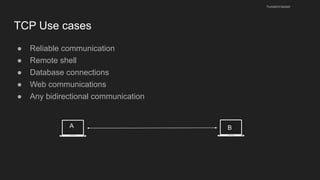
TCP Use cases
● Reliable communication
● Remote shell
● Database connections
● Web communications
● Any bidirectional communication
husseinnasser
B
A
TCP Connection
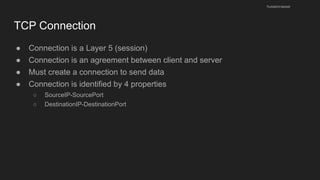
● Connection is a Layer 5 (session)
● Connection is an agreement between client and server
● Must create a connection to send data
● Connection is identified by 4 properties
○ SourceIP-SourcePort
○ DestinationIP-DestinationPort
husseinnasser
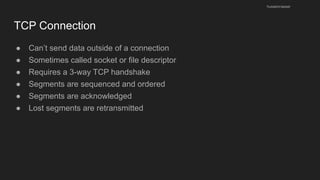
TCP Connection
● Can’t send data outside of a connection
● Sometimes called socket or file descriptor
● Requires a 3-way TCP handshake
● Segments are sequenced and ordered
● Segments are acknowledged
● Lost segments are retransmitted
husseinnasser
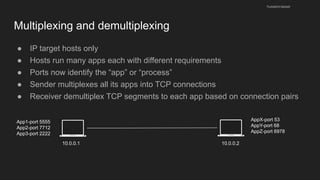
Multiplexing and demultiplexing
● IP target hosts only
● Hosts run many apps each with different requirements
● Ports now identify the “app” or “process”
● Sender multiplexes all its apps into TCP connections
● Receiver demultiplex TCP segments to each app based on connection pairs
husseinnasser
10.0.0.1 10.0.0.2
App1-port 5555
App2-port 7712
App3-port 2222
AppX-port 53
AppY-port 68
AppZ-port 6978
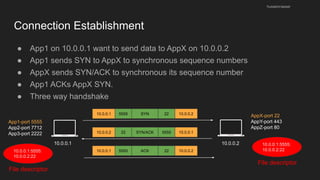
Connection Establishment
● App1 on 10.0.0.1 want to send data to AppX on 10.0.0.2
● App1 sends SYN to AppX to synchronous sequence numbers
● AppX sends SYN/ACK to synchronous its sequence number
● App1 ACKs AppX SYN.
● Three way handshake
husseinnasser
10.0.0.1 10.0.0.2
App1-port 5555
App2-port 7712
App3-port 2222
AppX-port 22
AppY-port 443
AppZ-port 80
10.0.0.1 5555 10.0.0.2
22
SYN
10.0.0.2 22 10.0.0.1
5555
SYN/ACK
10.0.0.1 5555 10.0.0.2
22
ACK
10.0.0.1:5555:
10.0.0.2:22
File descriptor
10.0.0.1:5555:
10.0.0.2:22
File descriptor
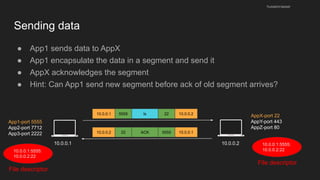
Sending data
● App1 sends data to AppX
● App1 encapsulate the data in a segment and send it
● AppX acknowledges the segment
● Hint: Can App1 send new segment before ack of old segment arrives?
husseinnasser
10.0.0.1 10.0.0.2
App1-port 5555
App2-port 7712
App3-port 2222
AppX-port 22
AppY-port 443
AppZ-port 80
10.0.0.1 5555 10.0.0.2
22
ls
10.0.0.2 22 10.0.0.1
5555
ACK
10.0.0.1:5555:
10.0.0.2:22
File descriptor
10.0.0.1:5555:
10.0.0.2:22
File descriptor
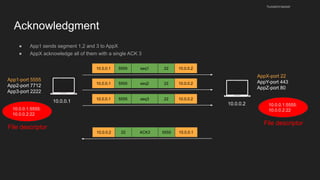
Acknowledgment
● App1 sends segment 1,2 and 3 to AppX
● AppX acknowledge all of them with a single ACK 3
husseinnasser
10.0.0.1
10.0.0.2
App1-port 5555
App2-port 7712
App3-port 2222
AppX-port 22
AppY-port 443
AppZ-port 80
10.0.0.1 5555 10.0.0.2
22
seq1
10.0.0.2 22 10.0.0.1
5555
ACK3
10.0.0.1:5555:
10.0.0.2:22
File descriptor
10.0.0.1:5555:
10.0.0.2:22
File descriptor
10.0.0.1 5555 10.0.0.2
22
seq2
10.0.0.1 5555 10.0.0.2
22
seq3
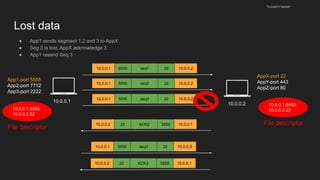
Lost data
● App1 sends segment 1,2 and 3 to AppX
● Seg 3 is lost, AppX acknowledge 3
● App1 resend Seq 3
husseinnasser
10.0.0.1
10.0.0.2
App1-port 5555
App2-port 7712
App3-port 2222
AppX-port 22
AppY-port 443
AppZ-port 80
10.0.0.1 5555 10.0.0.2
22
seq1
10.0.0.2 22 10.0.0.1
5555
ACK2
10.0.0.1:5555:
10.0.0.2:22
File descriptor
10.0.0.1:5555:
10.0.0.2:22
File descriptor
10.0.0.1 5555 10.0.0.2
22
seq2
10.0.0.1 5555 10.0.0.2
22
seq3
10.0.0.1 5555 10.0.0.2
22
seq3
10.0.0.2 22 10.0.0.1
5555
ACK3
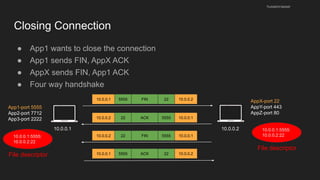
Closing Connection
● App1 wants to close the connection
● App1 sends FIN, AppX ACK
● AppX sends FIN, App1 ACK
● Four way handshake
husseinnasser
10.0.0.1 10.0.0.2
App1-port 5555
App2-port 7712
App3-port 2222
AppX-port 22
AppY-port 443
AppZ-port 80
10.0.0.1 5555 10.0.0.2
22
FIN
10.0.0.2 22 10.0.0.1
5555
ACK
10.0.0.1 5555 10.0.0.2
22
ACK
10.0.0.1:5555:
10.0.0.2:22
File descriptor
10.0.0.1:5555:
10.0.0.2:22
File descriptor
10.0.0.2 22 10.0.0.1
5555
FIN
Summary
● Stands for Transmission Control Protocol
● Layer 4 protocol
● “Controls” the transmission unlike UDP which is a firehose
● Introduces Connection concept
● Retransmission, acknowledgement, guaranteed delivery
● Stateful, connection has a state
husseinnasser
TCP Segment
The anatomy of the TCP Segment
husseinnasser
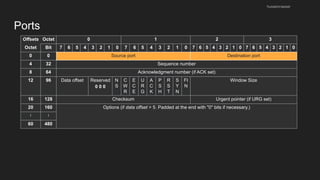
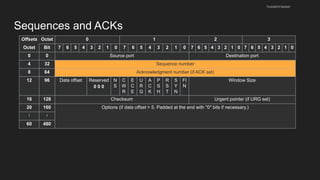
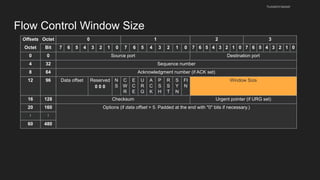
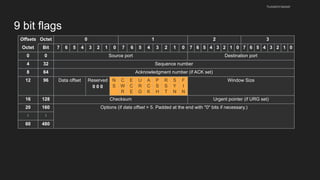
TCP Segment
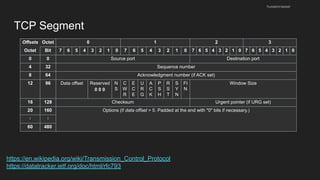
● TCP segment Header is 20 bytes and can go up to 60 bytes
● TCP segments slides into an IP packet as “data”
● Port are 16 bit (0 to 65535)
● Sequences, Acknowledgment, flow control and more
husseinnasser
TCP Segment
husseinnasser
Offsets Octet 0 1 2 3
Octet Bit 7 6 5 4 3 2 1 0 7 6 5 4 3 2 1 0 7 6 5 4 3 2 1 0 7 6 5 4 3 2 1 0
0 0 Source port Destination port
4 32 Sequence number
8 64 Acknowledgment number (if ACK set)
12 96 Data offset Reserved
0 0 0
N
S
C
W
R
E
C
E
U
R
G
A
C
K
P
S
H
R
S
T
S
Y
N
FI
N
Window Size
16 128 Checksum Urgent pointer (if URG set)
20 160 Options (if data offset > 5. Padded at the end with "0" bits if necessary.)
⋮ ⋮
60 480
https://en.wikipedia.org/wiki/Transmission_Control_Protocol
https://datatracker.ietf.org/doc/html/rfc793
Ports
husseinnasser
Offsets Octet 0 1 2 3
Octet Bit 7 6 5 4 3 2 1 0 7 6 5 4 3 2 1 0 7 6 5 4 3 2 1 0 7 6 5 4 3 2 1 0
0 0 Source port Destination port
4 32 Sequence number
8 64 Acknowledgment number (if ACK set)
12 96 Data offset Reserved
0 0 0
N
S
C
W
R
E
C
E
U
R
G
A
C
K
P
S
H
R
S
T
S
Y
N
FI
N
Window Size
16 128 Checksum Urgent pointer (if URG set)
20 160 Options (if data offset > 5. Padded at the end with "0" bits if necessary.)
⋮ ⋮
60 480
Sequences and ACKs
husseinnasser
Offsets Octet 0 1 2 3
Octet Bit 7 6 5 4 3 2 1 0 7 6 5 4 3 2 1 0 7 6 5 4 3 2 1 0 7 6 5 4 3 2 1 0
0 0 Source port Destination port
4 32 Sequence number
8 64 Acknowledgment number (if ACK set)
12 96 Data offset Reserved
0 0 0
N
S
C
W
R
E
C
E
U
R
G
A
C
K
P
S
H
R
S
T
S
Y
N
FI
N
Window Size
16 128 Checksum Urgent pointer (if URG set)
20 160 Options (if data offset > 5. Padded at the end with "0" bits if necessary.)
⋮ ⋮
60 480
Flow Control Window Size
husseinnasser
Offsets Octet 0 1 2 3
Octet Bit 7 6 5 4 3 2 1 0 7 6 5 4 3 2 1 0 7 6 5 4 3 2 1 0 7 6 5 4 3 2 1 0
0 0 Source port Destination port
4 32 Sequence number
8 64 Acknowledgment number (if ACK set)
12 96 Data offset Reserved
0 0 0
N
S
C
W
R
E
C
E
U
R
G
A
C
K
P
S
H
R
S
T
S
Y
N
FI
N
Window Size
16 128 Checksum Urgent pointer (if URG set)
20 160 Options (if data offset > 5. Padded at the end with "0" bits if necessary.)
⋮ ⋮
60 480
9 bit flags
husseinnasser
Offsets Octet 0 1 2 3
Octet Bit 7 6 5 4 3 2 1 0 7 6 5 4 3 2 1 0 7 6 5 4 3 2 1 0 7 6 5 4 3 2 1 0
0 0 Source port Destination port
4 32 Sequence number
8 64 Acknowledgment number (if ACK set)
12 96 Data offset Reserved
0 0 0
N
S
C
W
R
E
C
E
U
R
G
A
C
K
P
S
H
R
S
T
S
Y
N
F
I
N
Window Size
16 128 Checksum Urgent pointer (if URG set)
20 160 Options (if data offset > 5. Padded at the end with "0" bits if necessary.)
⋮ ⋮
60 480
Maximum Segment Size
● Segment Size depends the MTU of the network
● Usually 512 bytes can go up to 1460
● Default MTU in the Internet is 1500 (results in MSS 1460)
● Jumbo frames MTU goes to 9000 or more
● MSS can be larger in jumbo frames cases
husseinnasser
TCP Pros and Cons
The power and drawbacks of TCP
husseinnasser
TCP Pros
● Guarantee delivery
● No one can send data without prior knowledge
● Flow Control and Congestion Control
● Ordered Packets no corruption or app level work
● Secure and can’t be easily spoofed
husseinnasser
TCP Cons
● Large header overhead compared to UDP
● More bandwidth
● Stateful - consumes memory on server and client
● Considered high latency for certain workloads (Slow start/ congestion/ acks)
● Does too much at a low level (hence QUIC)
○ Single connection to send multiple streams of data (HTTP requests)
○ Stream 1 has nothing to do with Stream 2
○ Both Stream 1 and Stream 2 packets must arrive
● TCP Meltdown
○ Not a good candidate for VPN
husseinnasser
Overview of Popular Networking Protocols
TLS
Transport Layer Security
husseinnasser
TLS
● Vanilla HTTP
● HTTPS
● TLS 1.2 Handshake
● Diffie Hellman
● TLS 1.3 Improvements
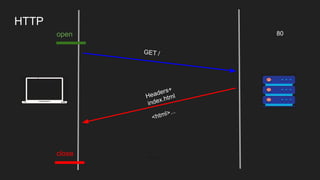
HTTP
GET /
Headers+
index.html
<html>...
open
close ….
80
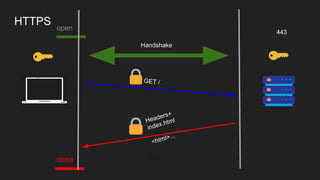
HTTPS open
close
Handshake
….
Headers+
index.html
<html>...
443
GET /
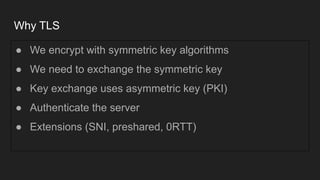
Why TLS
● We encrypt with symmetric key algorithms
● We need to exchange the symmetric key
● Key exchange uses asymmetric key (PKI)
● Authenticate the server
● Extensions (SNI, preshared, 0RTT)
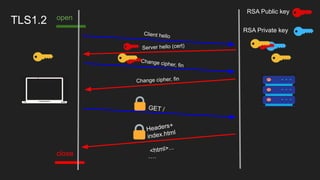
TLS1.2 open
close ….
Client hello
Server hello (cert)
Change cipher, fin
GET /
Headers+
index.html
<html>...
Change cipher, fin
RSA Public key
RSA Private key
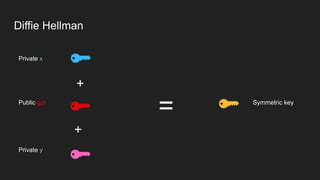
Diffie Hellman
+
+
=
Private x
Public g,n
Private y
Symmetric key
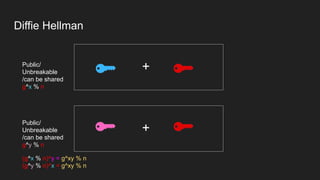
Diffie Hellman
+
Public/
Unbreakable
/can be shared
g^x % n
+
Public/
Unbreakable
/can be shared
g^y % n
(g^x % n)^y = g^xy % n
(g^y % n)^x = g^xy % n
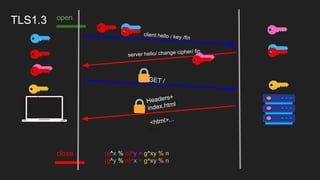
TLS1.3 open
close
….
GET /
Headers+
index.html
<html>...
server hello/ change cipher/ fin
client hello / key /fin
(g^x % n)^y = g^xy % n
(g^y % n)^x = g^xy % n
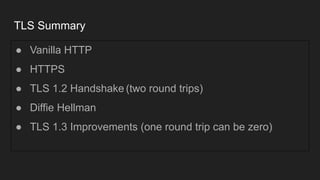
TLS Summary
● Vanilla HTTP
● HTTPS
● TLS 1.2 Handshake (two round trips)
● Diffie Hellman
● TLS 1.3 Improvements (one round trip can be zero)

Understanding the IP Protocol.pdf

  • 1.
    The IP buildingblocks Understanding the IP Protocol husseinnasser 1.2.3.4
  • 2.
    IP Address ● Layer3 property ● Can be set automatically or statically ● Network and Host portion ● 4 bytes in IPv4 - 32 bits husseinnasser
  • 3.
    Network vs Host ●a.b.c.d/x (a.b.c.d are integers) x is the network bits and remains are host ● Example 192.168.254.0/24 ● The first 24 bits (3 bytes) are network the rest 8 are for host ● This means we can have 2^24 (16777216) networks and each network has 2^8 (255) hosts ● Also called a subnet husseinnasser
  • 4.
    Subnet Mask ● 192.168.254.0/24is also called a subnet ● The subnet has a mask 255.255.255.0 ● Subnet mask is used to determine whether an IP is in the same subnet husseinnasser
  • 5.
    Default Gateway ● Mostnetworks consists of hosts and a Default Gateway ● Host A can talk to B directly if both are in the same subnet ● Otherwise A sends it to someone who might know, the gateway ● The Gateway has an IP Address and each host should know its gateway husseinnasser
  • 6.
    E.g. Host 192.168.1.3wants to talk to 192.168.1.2 192.168.1.0/24 192.168.2.0/24 192.168.1.3 192.168.1.2 192.168.1.1 192.168.2.3 192.168.2.2 192.168.2.1 ● 192.168.1.3 applies subnet mask to itself and the destination IP 192.168.1.2 ● 255.255.255.0 & 192.168.1.3 = 192.168.1.0 ● 255.255.255.0 & 192.168.1.2 = 192.168.1.0 ● Same subnet ! no need to route
  • 7.
    E.g. Host 192.168.1.3wants to talk to 192.168.2.2 192.168.1.0/24 192.168.2.0/24 192.168.1.3 192.168.1.2 192.168.1.1 192.168.2.3 192.168.2.2 192.168.2.1 ● 192.168.1.3 applies subnet mask to itself and the destination IP 192.168.2.2 ● 255.255.255.0 & 192.168.1.3 = 192.168.1.0 ● 255.255.255.0 & 192.168.2.2 = 192.168.2.0 ● Not the subnet ! The packet is sent to the Default Gateway 192.168.1.100 192.168.2.100 192.168.1.100
  • 8.
    Summary ● IP Address ●Network vs Host ● Subnet and subnet mask ● Default Gateway husseinnasser
  • 9.
    The IP Packet Anatomyof the IP Packet husseinnasser
  • 10.
    IP Packet ● TheIP Packet has headers and data sections ● IP Packet header is 20 bytes (can go up to 60 bytes if options are enabled) ● Data section can go up to 65536 husseinnasser
  • 11.
    IP Packet tothe Backend Engineer husseinnasser Source IP Address Data Destination IP Address
  • 12.
    Actual IP Packet husseinnasser OffsetsOctet 0 1 2 3 Octet Bit 0 1 2 3 4 5 6 7 8 9 10 11 12 13 14 15 16 17 18 19 20 21 22 23 24 25 26 27 28 29 30 31 0 0 Version IHL DSCP ECN Total Length 4 32 Identification Flags Fragment Offset 8 64 Time To Live Protocol Header Checksum 12 96 Source IP Address 16 128 Destination IP Address 20 160 Options (if IHL > 5) ⋮ ⋮ 56 448 Data https://datatracker.ietf.org/doc/html/rfc791 https://en.wikipedia.org/wiki/IPv4
  • 13.
    Version - TheProtocol version husseinnasser Offsets Octet 0 1 2 3 Octet Bit 0 1 2 3 4 5 6 7 8 9 10 11 12 13 14 15 16 17 18 19 20 21 22 23 24 25 26 27 28 29 30 31 0 0 Version IHL DSCP ECN Total Length 4 32 Identification Flags Fragment Offset 8 64 Time To Live Protocol Header Checksum 12 96 Source IP Address 16 128 Destination IP Address 20 160 Options (if IHL > 5) ⋮ ⋮ 56 448 Data
  • 14.
    Internet Header Length- Defines the Options length husseinnasser Offsets Octet 0 1 2 3 Octet Bit 0 1 2 3 4 5 6 7 8 9 10 11 12 13 14 15 16 17 18 19 20 21 22 23 24 25 26 27 28 29 30 31 0 0 Version IHL DSCP ECN Total Length 4 32 Identification Flags Fragment Offset 8 64 Time To Live Protocol Header Checksum 12 96 Source IP Address 16 128 Destination IP Address 20 160 Options (if IHL > 5) ⋮ ⋮ 56 448 Data
  • 15.
    Total Length -16 bit Data + header husseinnasser Offsets Octet 0 1 2 3 Octet Bit 0 1 2 3 4 5 6 7 8 9 10 11 12 13 14 15 16 17 18 19 20 21 22 23 24 25 26 27 28 29 30 31 0 0 Version IHL DSCP ECN Total Length 4 32 Identification Flags Fragment Offset 8 64 Time To Live Protocol Header Checksum 12 96 Source IP Address 16 128 Destination IP Address 20 160 Options (if IHL > 5) ⋮ ⋮ 56 448 Data
  • 16.
    Fragmentation - Jumbopackets husseinnasser Offsets Octet 0 1 2 3 Octet Bit 0 1 2 3 4 5 6 7 8 9 10 11 12 13 14 15 16 17 18 19 20 21 22 23 24 25 26 27 28 29 30 31 0 0 Version IHL DSCP ECN Total Length 4 32 Identification Flags Fragment Offset 8 64 Time To Live Protocol Header Checksum 12 96 Source IP Address 16 128 Destination IP Address 20 160 Options (if IHL > 5) ⋮ ⋮ 56 448 Data
  • 17.
    Time To Live- How many hops can this packet survive? husseinnasser Offsets Octet 0 1 2 3 Octet Bit 0 1 2 3 4 5 6 7 8 9 10 11 12 13 14 15 16 17 18 19 20 21 22 23 24 25 26 27 28 29 30 31 0 0 Version IHL DSCP ECN Total Length 4 32 Identification Flags Fragment Offset 8 64 Time To Live Protocol Header Checksum 12 96 Source IP Address 16 128 Destination IP Address 20 160 Options (if IHL > 5) ⋮ ⋮ 56 448 Data
  • 18.
    Protocol - Whatprotocol is inside the data section? husseinnasser Offsets Octet 0 1 2 3 Octet Bit 0 1 2 3 4 5 6 7 8 9 10 11 12 13 14 15 16 17 18 19 20 21 22 23 24 25 26 27 28 29 30 31 0 0 Version IHL DSCP ECN Total Length 4 32 Identification Flags Fragment Offset 8 64 Time To Live Protocol Header Checksum 12 96 Source IP Address 16 128 Destination IP Address 20 160 Options (if IHL > 5) ⋮ ⋮ 56 448 Data
  • 19.
    Source and DestinationIP husseinnasser Offsets Octet 0 1 2 3 Octet Bit 0 1 2 3 4 5 6 7 8 9 10 11 12 13 14 15 16 17 18 19 20 21 22 23 24 25 26 27 28 29 30 31 0 0 Version IHL DSCP ECN Total Length 4 32 Identification Flags Fragment Offset 8 64 Time To Live Protocol Header Checksum 12 96 Source IP Address 16 128 Destination IP Address 20 160 Options (if IHL > 5) ⋮ ⋮ 56 448 Data
  • 20.
    Explicit Congestion Notification husseinnasser OffsetsOctet 0 1 2 3 Octet Bit 0 1 2 3 4 5 6 7 8 9 10 11 12 13 14 15 16 17 18 19 20 21 22 23 24 25 26 27 28 29 30 31 0 0 Version IHL DSCP ECN Total Length 4 32 Identification Flags Fragment Offset 8 64 Time To Live Protocol Header Checksum 12 96 Source IP Address 16 128 Destination IP Address 20 160 Options (if IHL > 5) ⋮ ⋮ 56 448 Data
  • 21.
    Summary ● The IPPacket has headers and data sections ● IP Packet header is 20 bytes (can go up to 60 bytes if options are enabled) ● Data section can go up to 65536 ● Packets need to get fragmented if it doesn’t fit in a frame husseinnasser
  • 22.
    ICMP Internet Control MessageProtocol husseinnasser
  • 23.
    ICMP ● Stands forInternet Control Message Protocol ● Designed for informational messages ○ Host unreachable, port unreachable, fragmentation needed ○ Packet expired (infinite loop in routers) ● Uses IP directly ● PING and traceroute use it ● Doesn’t require listeners or ports to be opened husseinnasser
  • 24.
    ICMP header husseinnasser Offsets Octet0 1 2 3 Octet Bit 0 1 2 3 4 5 6 7 8 9 10 11 12 13 14 15 16 17 18 19 20 21 22 23 24 25 26 27 28 29 30 31 0 0 Type Code Checksum 4 32 Rest of header https://en.wikipedia.org/wiki/Internet_Control_Message_Protocol https://datatracker.ietf.org/doc/html/rfc792
  • 25.
    ICMP ● Some firewallsblock ICMP for security reasons ● That is why PING might not work in those cases ● Disabling ICMP also can cause real damage with connection establishment ○ Fragmentation needed ● PING demo husseinnasser
  • 26.
    Ping husseinnasser 192.168.1.3 192.168.10.3 192.168.1.3 TTL100 ICMP echo request 192.168.10.3 192.168.10.100 192.168.5.100 192.168.3.100 192.168.1.100 192.168.1.3 TTL96ICMP echo request 192.168.10.3 192.168.10.3 TTL100 ICMP echo reply 192.168.1.3 192.168.10.3 TTL96 ICMP echo reply 192.168.1.3
  • 27.
    Ping - unreachable husseinnasser 192.168.1.3 192.168.10.3 192.168.1.3 TTL3ICMP echo request 192.168.10.3 192.168.10.100 192.168.5.100 192.168.3.100 192.168.1.100 192.168.1.3 TTL0 ICMP echo request 192.168.10.3 192.168.5.100 TTL100 ICMP dest unreachable 192.168.1.3 192.168.5.100 TTL96 ICMP echo reply 192.168.1.3
  • 28.
    TraceRoute ● Can youidentify the entire path your IP Packet takes? ● Clever use of TTL ● Increment TTL slowly and you will get the router IP address for each hop ● Doesn’t always work as path changes and ICMP might be blocked husseinnasser
  • 29.
    Traceroute husseinnasser 192.168.1.3 192.168.10.3 192.168.1.3 TTL1 ICMP echo request 192.168.10.3 192.168.10.100 192.168.5.100 192.168.3.100 192.168.1.100 192.168.1.100ICMP dest unreach. 192.168.1.3 192.168.1.3 TTL2 ICMP echo request 192.168.10.3 192.168.3.100 ICMP dest unreach. 192.168.1.3 192.168.1.3 TTL3 ICMP echo request 192.168.10.3 192.168.5.100 ICMP dest unreach. 192.168.1.3 192.168.1.3 TTL4 ICMP echo request 192.168.10.3 192.168.10.100 ICMP dest unreach 192.168.1.3 192.168.1.3 TTL5 ICMP echo request 192.168.10.3 192.168.10.3 ICMP Echo reply 192.168.1.3
  • 30.
    Summary ● ICMP isan IP level protocol used for information messages ● Critical to know if the host is available or port is opened ● Used for PING and TraceRoute ● Can be blocked which can cause problems husseinnasser
  • 31.
  • 32.
    Why ARP? ● Weneed the MAC address to send frames (layer 2) ● Most of the time we know the IP address but not the MAC ● ARP Table is cached IP->Mac mapping
  • 33.
    Network Frame aa:bc:32:7f:c0:07 GET/ bb:ab:dd:11:22:33 10.0.0.3 10.0.0.2 IP : 10.0.0.3 MAC: bb:ab:dd:11:22:33 Port: 8080 IP : 10.0.0.2 MAC: aa:bc:32:7f:c0:07 8080 2312 aa GET / 3 bb 2
  • 34.
    IP : 2 GW: 1 MAC: aa EXIP : 122.1.2.4 IP : 10.0.0.1 (1) MAC: ff IP : 3 GW : 1 MAC: bb IP : 4 GW : 1 MAC: cc IP : 5 GW : 1 MAC: dd ip mc 2 aa ip mc 3 bb ip mc 4 cc ip mc 5 dd ● IP 10.0.0.2 (2) wants to connect to IP 10.0.0.5 (5) ● Host 2 checks if host 5 is within its subnet, it is. ● Host 2 needs the MAC address of host 5 ● Host 2 checks its ARP tables and its not there aa GET / 5 ?? 2
  • 35.
    IP : 2 GW: 1 MAC: aa EXIP : 122.1.2.4 IP : 10.0.0.1 (1) MAC: ff IP : 3 GW : 1 MAC: bb IP : 4 GW : 1 MAC: cc IP : 5 GW : 1 MAC: dd ip mc 2 aa 5 dd ip mc 3 bb ip mc 4 cc ip mc 5 dd ● Host 2 sends an ARP request broadcast to all machines in its network ● Who has IP address 10.0.0.5? ● Host 5 replies with dd ● Host 2 updates its ARP Table aa GET / 5 dd 2
  • 36.
    IP : 2 GW: 1 MAC: aa EXIP : 122.1.2.4 IP : 10.0.0.1 (1) MAC: ff IP : 3 GW : 1 MAC: bb IP : 4 GW : 1 MAC: cc IP : 5 GW : 1 MAC: dd ip mc 2 aa 5 dd ip mc 3 bb ip mc 4 cc ip mc 5 dd ● IP 10.0.0.2 (2) wants to connect to IP 1.2.3.4 (x) ● Host 2 checks if 1.2.3.4 is within its subnet, it is NOT! ● Host 2 needs to talk to its gatway ● Host 2 needs the MAC address of the gateway aa GET / x ?? 2 1.2.3.4 (x)
  • 37.
    IP : 2 GW: 1 MAC: aa EXIP : 122.1.2.4 IP : 10.0.0.1 (1) MAC: ff IP : 3 GW : 1 MAC: bb IP : 4 GW : 1 MAC: cc IP : 5 GW : 1 MAC: dd ip mc 2 aa 5 dd 1 ff ip mc 3 bb ip mc 4 cc ip mc 5 dd ● Host 2 checks its local ARP table, 10.0.0.1 is not it in ● Host 2 sends an ARP request to everybody in the network ● Who has 10.0.0.1? (A DANGEROUS QUESTION) ● Gateway reply with ff ● NAT than kicks in. aa GET / x ff 2 1.2.3.4
  • 38.
    Summary ● ARP standsfor Address resolution protocol ● We need MAC address to send frames between machines ● Almost always we have the IP address but not the MAC ● Need a lookup protocol that give us the MAC from IP address ● Attacks can be performed on ARP (ARP poisoning) husseinnasser
  • 39.
    Routing Example How IPPackets are routed in Switches and Routers husseinnasser
  • 40.
  • 41.
  • 42.
    UDP ● Stands forUser Datagram Protocol ● Layer 4 protocol ● Ability to address processes in a host using ports ● Simple protocol to send and receive data ● Prior communication not required (double edge sword) ● Stateless no knowledge is stored on the host ● 8 byte header Datagram husseinnasser
  • 43.
    UDP Use cases ●Video streaming ● VPN ● DNS ● WebRTC husseinnasser B A
  • 44.
    Multiplexing and demultiplexing ●IP target hosts only ● Hosts run many apps each with different requirements ● Ports now identify the “app” or “process” ● Sender multiplexes all its apps into UDP ● Receiver demultiplex UDP datagrams to each app husseinnasser 10.0.0.1 10.0.0.2 App1-port 5555 App2-port 7712 App3-port 2222 AppX-port 53 AppY-port 68 AppZ-port 6978
  • 45.
    Source and DestinationPort ● App1 on 10.0.0.1 sends data to AppX on 10.0.0.2 ● Destination Port = 53 ● AppX responds back to App1 ● We need Source Port so we know how to send back data ● Source Port = 5555 husseinnasser 10.0.0.1 10.0.0.2 App1-port 5555 App2-port 7712 App3-port 2222 AppX-port 53 AppY-port 68 AppZ-port 6978 10.0.0.1 53 10.0.0.2 5555 10.0.0.2 5555 10.0.0.1 53
  • 46.
    Summary ● UDP isa simple layer 4 protocol ● Uses ports to address processes ● Stateless husseinnasser
  • 47.
    UDP Datagram The anatomyof the UDP datagram husseinnasser
  • 48.
    UDP Datagram ● UDPHeader is 8 bytes only (IPv4) ● Datagram slides into an IP packet as “data” ● Port are 16 bit (0 to 65535) husseinnasser
  • 49.
    husseinnasser Offsets Octet 01 2 3 Octet Bit 0 1 2 3 4 5 6 7 8 9 10 11 12 13 14 15 16 17 18 19 20 21 22 23 24 25 26 27 28 29 30 31 0 0 Source port Destination port 4 32 Length Checksum UDP Datagram header https://www.ietf.org/rfc/rfc768.txt https://en.wikipedia.org/wiki/User_Datagram_Protocol Data
  • 50.
    husseinnasser Offsets Octet 01 2 3 Octet Bit 0 1 2 3 4 5 6 7 8 9 10 11 12 13 14 15 16 17 18 19 20 21 22 23 24 25 26 27 28 29 30 31 0 0 Source port Destination port 4 32 Length Checksum Source Port and Destination Port Data
  • 51.
    husseinnasser Offsets Octet 01 2 3 Octet Bit 0 1 2 3 4 5 6 7 8 9 10 11 12 13 14 15 16 17 18 19 20 21 22 23 24 25 26 27 28 29 30 31 0 0 Source port Destination port 4 32 Length Checksum Length & Checksum Data
  • 52.
    UDP Pros andCons The power and drawbacks of UDP husseinnasser
  • 53.
    UDP Pros ● Simpleprotocol ● Header size is small so datagrams are small ● Uses less bandwidth ● Stateless ● Consumes less memory (no state stored in the server/client) ● Low latency - no handshake , order, retransmission or guaranteed delivery husseinnasser
  • 54.
    UDP Cons ● Noacknowledgement ● No guarantee delivery ● Connection-less - anyone can send data without prior knowledge ● No flow control ● No congestion control ● No ordered packets ● Security - can be easily spoofed husseinnasser
  • 55.
  • 56.
    TCP ● Stands forTransmission Control Protocol ● Layer 4 protocol ● Ability to address processes in a host using ports ● “Controls” the transmission unlike UDP which is a firehose ● Connection ● Requires handshake ● 20 bytes headers Segment (can go to 60) ● Stateful husseinnasser
  • 57.
    TCP Use cases ●Reliable communication ● Remote shell ● Database connections ● Web communications ● Any bidirectional communication husseinnasser B A
  • 58.
    TCP Connection ● Connectionis a Layer 5 (session) ● Connection is an agreement between client and server ● Must create a connection to send data ● Connection is identified by 4 properties ○ SourceIP-SourcePort ○ DestinationIP-DestinationPort husseinnasser
  • 59.
    TCP Connection ● Can’tsend data outside of a connection ● Sometimes called socket or file descriptor ● Requires a 3-way TCP handshake ● Segments are sequenced and ordered ● Segments are acknowledged ● Lost segments are retransmitted husseinnasser
  • 60.
    Multiplexing and demultiplexing ●IP target hosts only ● Hosts run many apps each with different requirements ● Ports now identify the “app” or “process” ● Sender multiplexes all its apps into TCP connections ● Receiver demultiplex TCP segments to each app based on connection pairs husseinnasser 10.0.0.1 10.0.0.2 App1-port 5555 App2-port 7712 App3-port 2222 AppX-port 53 AppY-port 68 AppZ-port 6978
  • 61.
    Connection Establishment ● App1on 10.0.0.1 want to send data to AppX on 10.0.0.2 ● App1 sends SYN to AppX to synchronous sequence numbers ● AppX sends SYN/ACK to synchronous its sequence number ● App1 ACKs AppX SYN. ● Three way handshake husseinnasser 10.0.0.1 10.0.0.2 App1-port 5555 App2-port 7712 App3-port 2222 AppX-port 22 AppY-port 443 AppZ-port 80 10.0.0.1 5555 10.0.0.2 22 SYN 10.0.0.2 22 10.0.0.1 5555 SYN/ACK 10.0.0.1 5555 10.0.0.2 22 ACK 10.0.0.1:5555: 10.0.0.2:22 File descriptor 10.0.0.1:5555: 10.0.0.2:22 File descriptor
  • 62.
    Sending data ● App1sends data to AppX ● App1 encapsulate the data in a segment and send it ● AppX acknowledges the segment ● Hint: Can App1 send new segment before ack of old segment arrives? husseinnasser 10.0.0.1 10.0.0.2 App1-port 5555 App2-port 7712 App3-port 2222 AppX-port 22 AppY-port 443 AppZ-port 80 10.0.0.1 5555 10.0.0.2 22 ls 10.0.0.2 22 10.0.0.1 5555 ACK 10.0.0.1:5555: 10.0.0.2:22 File descriptor 10.0.0.1:5555: 10.0.0.2:22 File descriptor
  • 63.
    Acknowledgment ● App1 sendssegment 1,2 and 3 to AppX ● AppX acknowledge all of them with a single ACK 3 husseinnasser 10.0.0.1 10.0.0.2 App1-port 5555 App2-port 7712 App3-port 2222 AppX-port 22 AppY-port 443 AppZ-port 80 10.0.0.1 5555 10.0.0.2 22 seq1 10.0.0.2 22 10.0.0.1 5555 ACK3 10.0.0.1:5555: 10.0.0.2:22 File descriptor 10.0.0.1:5555: 10.0.0.2:22 File descriptor 10.0.0.1 5555 10.0.0.2 22 seq2 10.0.0.1 5555 10.0.0.2 22 seq3
  • 64.
    Lost data ● App1sends segment 1,2 and 3 to AppX ● Seg 3 is lost, AppX acknowledge 3 ● App1 resend Seq 3 husseinnasser 10.0.0.1 10.0.0.2 App1-port 5555 App2-port 7712 App3-port 2222 AppX-port 22 AppY-port 443 AppZ-port 80 10.0.0.1 5555 10.0.0.2 22 seq1 10.0.0.2 22 10.0.0.1 5555 ACK2 10.0.0.1:5555: 10.0.0.2:22 File descriptor 10.0.0.1:5555: 10.0.0.2:22 File descriptor 10.0.0.1 5555 10.0.0.2 22 seq2 10.0.0.1 5555 10.0.0.2 22 seq3 10.0.0.1 5555 10.0.0.2 22 seq3 10.0.0.2 22 10.0.0.1 5555 ACK3
  • 65.
    Closing Connection ● App1wants to close the connection ● App1 sends FIN, AppX ACK ● AppX sends FIN, App1 ACK ● Four way handshake husseinnasser 10.0.0.1 10.0.0.2 App1-port 5555 App2-port 7712 App3-port 2222 AppX-port 22 AppY-port 443 AppZ-port 80 10.0.0.1 5555 10.0.0.2 22 FIN 10.0.0.2 22 10.0.0.1 5555 ACK 10.0.0.1 5555 10.0.0.2 22 ACK 10.0.0.1:5555: 10.0.0.2:22 File descriptor 10.0.0.1:5555: 10.0.0.2:22 File descriptor 10.0.0.2 22 10.0.0.1 5555 FIN
  • 66.
    Summary ● Stands forTransmission Control Protocol ● Layer 4 protocol ● “Controls” the transmission unlike UDP which is a firehose ● Introduces Connection concept ● Retransmission, acknowledgement, guaranteed delivery ● Stateful, connection has a state husseinnasser
  • 67.
    TCP Segment The anatomyof the TCP Segment husseinnasser
  • 68.
    TCP Segment ● TCPsegment Header is 20 bytes and can go up to 60 bytes ● TCP segments slides into an IP packet as “data” ● Port are 16 bit (0 to 65535) ● Sequences, Acknowledgment, flow control and more husseinnasser
  • 69.
    TCP Segment husseinnasser Offsets Octet0 1 2 3 Octet Bit 7 6 5 4 3 2 1 0 7 6 5 4 3 2 1 0 7 6 5 4 3 2 1 0 7 6 5 4 3 2 1 0 0 0 Source port Destination port 4 32 Sequence number 8 64 Acknowledgment number (if ACK set) 12 96 Data offset Reserved 0 0 0 N S C W R E C E U R G A C K P S H R S T S Y N FI N Window Size 16 128 Checksum Urgent pointer (if URG set) 20 160 Options (if data offset > 5. Padded at the end with "0" bits if necessary.) ⋮ ⋮ 60 480 https://en.wikipedia.org/wiki/Transmission_Control_Protocol https://datatracker.ietf.org/doc/html/rfc793
  • 70.
    Ports husseinnasser Offsets Octet 01 2 3 Octet Bit 7 6 5 4 3 2 1 0 7 6 5 4 3 2 1 0 7 6 5 4 3 2 1 0 7 6 5 4 3 2 1 0 0 0 Source port Destination port 4 32 Sequence number 8 64 Acknowledgment number (if ACK set) 12 96 Data offset Reserved 0 0 0 N S C W R E C E U R G A C K P S H R S T S Y N FI N Window Size 16 128 Checksum Urgent pointer (if URG set) 20 160 Options (if data offset > 5. Padded at the end with "0" bits if necessary.) ⋮ ⋮ 60 480
  • 71.
    Sequences and ACKs husseinnasser OffsetsOctet 0 1 2 3 Octet Bit 7 6 5 4 3 2 1 0 7 6 5 4 3 2 1 0 7 6 5 4 3 2 1 0 7 6 5 4 3 2 1 0 0 0 Source port Destination port 4 32 Sequence number 8 64 Acknowledgment number (if ACK set) 12 96 Data offset Reserved 0 0 0 N S C W R E C E U R G A C K P S H R S T S Y N FI N Window Size 16 128 Checksum Urgent pointer (if URG set) 20 160 Options (if data offset > 5. Padded at the end with "0" bits if necessary.) ⋮ ⋮ 60 480
  • 72.
    Flow Control WindowSize husseinnasser Offsets Octet 0 1 2 3 Octet Bit 7 6 5 4 3 2 1 0 7 6 5 4 3 2 1 0 7 6 5 4 3 2 1 0 7 6 5 4 3 2 1 0 0 0 Source port Destination port 4 32 Sequence number 8 64 Acknowledgment number (if ACK set) 12 96 Data offset Reserved 0 0 0 N S C W R E C E U R G A C K P S H R S T S Y N FI N Window Size 16 128 Checksum Urgent pointer (if URG set) 20 160 Options (if data offset > 5. Padded at the end with "0" bits if necessary.) ⋮ ⋮ 60 480
  • 73.
    9 bit flags husseinnasser OffsetsOctet 0 1 2 3 Octet Bit 7 6 5 4 3 2 1 0 7 6 5 4 3 2 1 0 7 6 5 4 3 2 1 0 7 6 5 4 3 2 1 0 0 0 Source port Destination port 4 32 Sequence number 8 64 Acknowledgment number (if ACK set) 12 96 Data offset Reserved 0 0 0 N S C W R E C E U R G A C K P S H R S T S Y N F I N Window Size 16 128 Checksum Urgent pointer (if URG set) 20 160 Options (if data offset > 5. Padded at the end with "0" bits if necessary.) ⋮ ⋮ 60 480
  • 74.
    Maximum Segment Size ●Segment Size depends the MTU of the network ● Usually 512 bytes can go up to 1460 ● Default MTU in the Internet is 1500 (results in MSS 1460) ● Jumbo frames MTU goes to 9000 or more ● MSS can be larger in jumbo frames cases husseinnasser
  • 75.
    TCP Pros andCons The power and drawbacks of TCP husseinnasser
  • 76.
    TCP Pros ● Guaranteedelivery ● No one can send data without prior knowledge ● Flow Control and Congestion Control ● Ordered Packets no corruption or app level work ● Secure and can’t be easily spoofed husseinnasser
  • 77.
    TCP Cons ● Largeheader overhead compared to UDP ● More bandwidth ● Stateful - consumes memory on server and client ● Considered high latency for certain workloads (Slow start/ congestion/ acks) ● Does too much at a low level (hence QUIC) ○ Single connection to send multiple streams of data (HTTP requests) ○ Stream 1 has nothing to do with Stream 2 ○ Both Stream 1 and Stream 2 packets must arrive ● TCP Meltdown ○ Not a good candidate for VPN husseinnasser
  • 78.
    Overview of PopularNetworking Protocols
  • 79.
  • 80.
    TLS ● Vanilla HTTP ●HTTPS ● TLS 1.2 Handshake ● Diffie Hellman ● TLS 1.3 Improvements
  • 81.
  • 82.
  • 83.
    Why TLS ● Weencrypt with symmetric key algorithms ● We need to exchange the symmetric key ● Key exchange uses asymmetric key (PKI) ● Authenticate the server ● Extensions (SNI, preshared, 0RTT)
  • 84.
    TLS1.2 open close …. Clienthello Server hello (cert) Change cipher, fin GET / Headers+ index.html <html>... Change cipher, fin RSA Public key RSA Private key
  • 85.
    Diffie Hellman + + = Private x Publicg,n Private y Symmetric key
  • 86.
    Diffie Hellman + Public/ Unbreakable /can beshared g^x % n + Public/ Unbreakable /can be shared g^y % n (g^x % n)^y = g^xy % n (g^y % n)^x = g^xy % n
  • 87.
    TLS1.3 open close …. GET / Headers+ index.html <html>... serverhello/ change cipher/ fin client hello / key /fin (g^x % n)^y = g^xy % n (g^y % n)^x = g^xy % n
  • 88.
    TLS Summary ● VanillaHTTP ● HTTPS ● TLS 1.2 Handshake (two round trips) ● Diffie Hellman ● TLS 1.3 Improvements (one round trip can be zero)