EGINO M. SANTOS
Realizing Realities
Unpacking literary texts to understand
individual and communal values.
01
02
03
04
Table of Contents
05
Introduction
Elements of a plot
Types of Plot
Types of Conflict
Character and
Characterization
01
PREVIOUS topic
Appreciate the importance
of organization and
structure in stories and
connect this to the need
for order and clarity in real-
life situations.
01 02 03
Analyze Literary Texts
Identify Meaning & Purpose
Collaborate Effectively
• Identify and
describe the five
elements of plot in a
short story.
LESSON 1
Learning Objectives
• Arrange sequenced
events of a story to
demonstrate
understanding of plot
structure
Elements of a story
02
- The sequence of events that make up a
story, including exposition, rising action,
climax, falling action, and resolution.
The exposition
introduces the
characters, setting,
and initial situation,
providing necessary
context.
Introduction
Characters: Who are
the main players?
Setting: Where and
when does the story
take place? Initial
Situation: What is the
background or status
quo?
Key Components
In "Cinderella," the
exposition introduces
Cinderella, her cruel
stepfamily, and her life
of servitude.
Example
01
02
03
Exposition: Setting the Stage
Rising Action: Building Tension
The rising action is where conflicts arise and
tension builds, pushing the story towards the
climax.
Definition of Rising Action
Series of events: A sequence of actions that
escalate the stakes; Increasing conflict:
Challenges and obstacles faced by the
characters; Suspense: Keeping the audience
engaged and wondering what will happen next.
Characteristics
In "Cinderella," the rising action includes the
announcement of the royal ball and Cinderella’s
desire to attend.
Example
The climax is the peak of
tension, where the central
conflict is confronted
directly.
01
Nature of the Climax
High tension: The most
exciting or intense
moment; Turning point: A
decisive moment where
the protagonist faces
their biggest challenge;
Revelation: Often involves
a significant discovery or
realization.
02
Characteristics Example
In "Cinderella," the climax
is when Cinderella attends
the ball, the Prince falls in
love with her, and she
must flee before the spell
breaks.
03
Climax: The Turning Point
About Falling
Action
The falling action
includes events that
occur after the
climax, leading to the
resolution.
Key Aspects
Consequences: The
immediate aftermath
of the climax; Loose
ends: Tying up
subplots or
unresolved issues;
Decreasing tension:
Moving towards a
sense of closure.
Example
In "Cinderella," the
falling action is the
Prince searching for
the mysterious girl
who fits the glass
slipper.
Falling Action: Winding Down
The resolution is the end
of the story, where
conflicts are resolved
and the narrative
concludes.
Definition of Resolution
Conflict resolution: The main
problem is solved or
addressed; Character
outcomes: What happens to
the main characters? Theme
reinforcement: The underlying
message of the story is clarified.
Elements of Resolution
In "Cinderella," the
resolution is when
Cinderella is found to fit the
slipper, marries the Prince,
and lives happily ever after.
Example
Resolution: Finding Closure
The sequence of events that make up a story, including exposition,
rising action, climax, falling action, and resolution.
Linear Plot
• Events unfold chronologically from
beginning to end.
• Follows traditional story structure.
• Easy to follow cause-and-effect
relationships.
Non-linear Plots
• Events presented out of chronological order.
• May include flashbacks, flash-forwards,
or parallel timelines.
• Requires active reader engagement to
piece together the story.
Types of plot
03
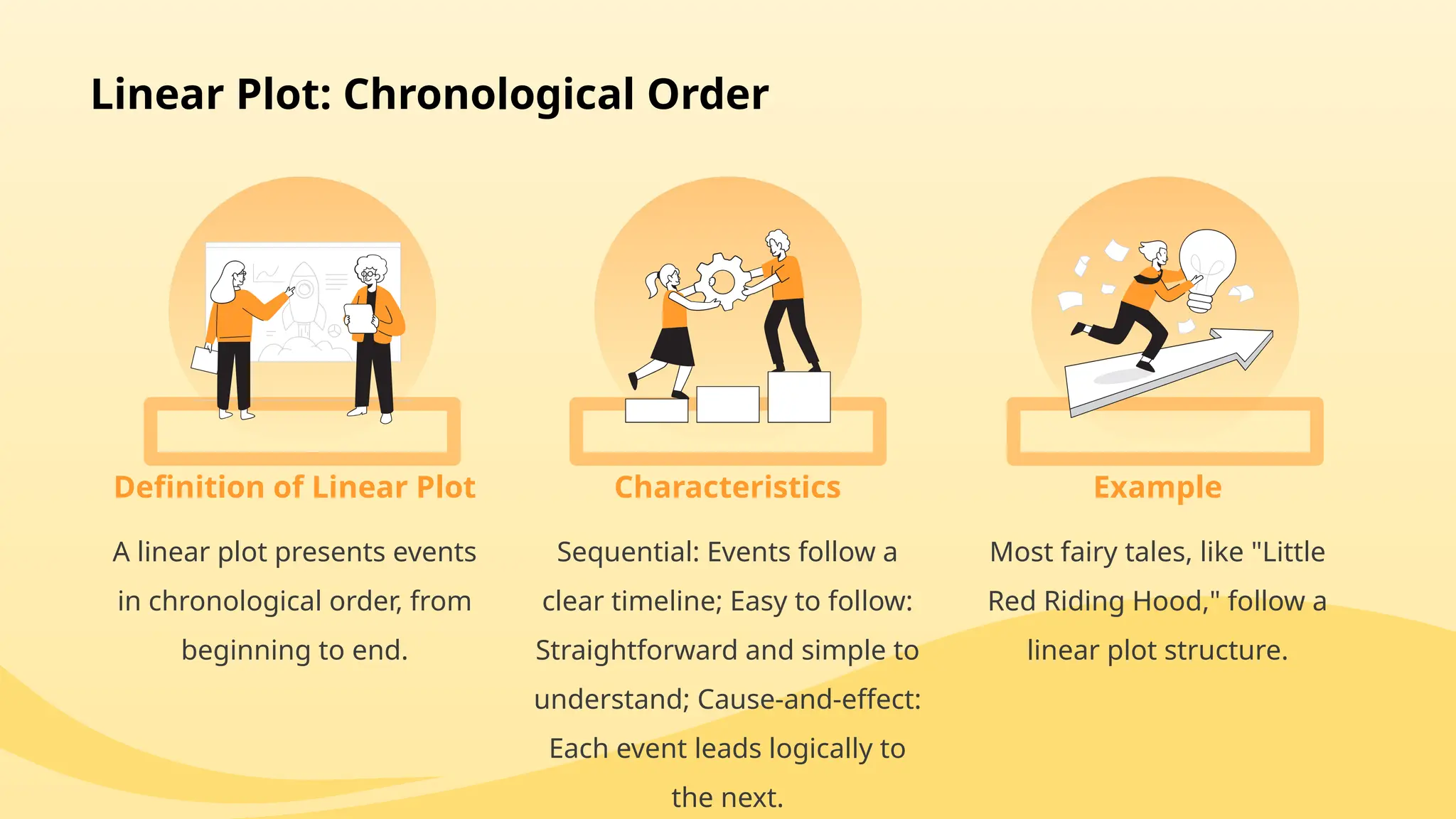
Linear Plot: Chronological Order
Definition of Linear Plot Characteristics Example
A linear plot presents events
in chronological order, from
beginning to end.
Sequential: Events follow a
clear timeline; Easy to follow:
Straightforward and simple to
understand; Cause-and-effect:
Each event leads logically to
the next.
Most fairy tales, like "Little
Red Riding Hood," follow a
linear plot structure.
Non-Linear Plot: Out of Order
Definition of Non-Linear Plot
A non-linear plot presents events out of chronological
order, often using flashbacks or flash-forwards.
Characteristics
Flashbacks: Returning to past events to provide context; Flash-
forwards: Previewing future events; Complex structure:
Requires the audience to piece together the timeline.
Example
AVENGERS, is an example of a non-linear plot, the
concept of multiverse, time skip, and lots of parts.
Types of Conflict
04
- The struggle or tension that drives the narrative forward.
Internal Conflict
• Character vs. Self (psychological, moral, emotional struggles).
External Conflict
• Character vs. Character (interpersonal conflicts).
• Character vs. Society (social, cultural, or political struggles).
• Character vs. Nature (environmental challenges).
• Character vs. Technology/Supernatural
(modern or fantastical elements).
Internal conflict
involves a character’s
struggle with their
own thoughts,
emotions, or beliefs.
Understanding Internal
Conflict
Moral dilemmas: Making
difficult choices between
right and wrong;
Psychological battles:
Overcoming fears, doubts,
or mental health issues;
Self-acceptance: Coming
to terms with one's
identity or past.
Key Aspects
Internal Conflict: Character vs. Self
Conflict between two or more
characters, often involving
opposing goals or values.
Conflict between a character
and the norms, laws, or
expectations of society.
Conflict between a character
and natural elements, such as
weather, geography, or
wildlife.
Conflict between a character
and technological
advancements or machines.
Conflict between a character
and supernatural forces, such
as ghosts, deities, or magic.
Character vs. Character Character vs. Society Character vs. Nature
Character vs. Technology Character vs. Supernatural
External Conflicts
Character and Characterization
05
- The individuals who populate the story.
Characterization: Methods authors use to develop and
reveal character traits.
The main character who drives
the plot forward; they often
undergo significant change.
Protagonist
The character or force that opposes the
protagonist, creating conflict.
Antagonist
Characters who aid or hinder the
protagonist, adding depth and
complexity to the story.
Supporting Characters
Character Types
Characterization Methods
Indirect
Characterization
Character traits are
revealed through
actions, dialogue,
thoughts,
appearance, and
others’ reactions.
02
Direct
Characterizatio
n
The author directly
describes a
character’s traits,
personality, and
background.
01
Thank you.

Understanding Plot-2.pptxjsjshshjjjjjjjj

  • 1.
    EGINO M. SANTOS RealizingRealities Unpacking literary texts to understand individual and communal values.
  • 2.
    01 02 03 04 Table of Contents 05 Introduction Elementsof a plot Types of Plot Types of Conflict Character and Characterization
  • 3.
  • 4.
    Appreciate the importance oforganization and structure in stories and connect this to the need for order and clarity in real- life situations. 01 02 03 Analyze Literary Texts Identify Meaning & Purpose Collaborate Effectively • Identify and describe the five elements of plot in a short story. LESSON 1 Learning Objectives • Arrange sequenced events of a story to demonstrate understanding of plot structure
  • 5.
    Elements of astory 02 - The sequence of events that make up a story, including exposition, rising action, climax, falling action, and resolution.
  • 6.
    The exposition introduces the characters,setting, and initial situation, providing necessary context. Introduction Characters: Who are the main players? Setting: Where and when does the story take place? Initial Situation: What is the background or status quo? Key Components In "Cinderella," the exposition introduces Cinderella, her cruel stepfamily, and her life of servitude. Example 01 02 03 Exposition: Setting the Stage
  • 7.
    Rising Action: BuildingTension The rising action is where conflicts arise and tension builds, pushing the story towards the climax. Definition of Rising Action Series of events: A sequence of actions that escalate the stakes; Increasing conflict: Challenges and obstacles faced by the characters; Suspense: Keeping the audience engaged and wondering what will happen next. Characteristics In "Cinderella," the rising action includes the announcement of the royal ball and Cinderella’s desire to attend. Example
  • 8.
    The climax isthe peak of tension, where the central conflict is confronted directly. 01 Nature of the Climax High tension: The most exciting or intense moment; Turning point: A decisive moment where the protagonist faces their biggest challenge; Revelation: Often involves a significant discovery or realization. 02 Characteristics Example In "Cinderella," the climax is when Cinderella attends the ball, the Prince falls in love with her, and she must flee before the spell breaks. 03 Climax: The Turning Point
  • 9.
    About Falling Action The fallingaction includes events that occur after the climax, leading to the resolution. Key Aspects Consequences: The immediate aftermath of the climax; Loose ends: Tying up subplots or unresolved issues; Decreasing tension: Moving towards a sense of closure. Example In "Cinderella," the falling action is the Prince searching for the mysterious girl who fits the glass slipper. Falling Action: Winding Down
  • 10.
    The resolution isthe end of the story, where conflicts are resolved and the narrative concludes. Definition of Resolution Conflict resolution: The main problem is solved or addressed; Character outcomes: What happens to the main characters? Theme reinforcement: The underlying message of the story is clarified. Elements of Resolution In "Cinderella," the resolution is when Cinderella is found to fit the slipper, marries the Prince, and lives happily ever after. Example Resolution: Finding Closure
  • 11.
    The sequence ofevents that make up a story, including exposition, rising action, climax, falling action, and resolution. Linear Plot • Events unfold chronologically from beginning to end. • Follows traditional story structure. • Easy to follow cause-and-effect relationships. Non-linear Plots • Events presented out of chronological order. • May include flashbacks, flash-forwards, or parallel timelines. • Requires active reader engagement to piece together the story. Types of plot 03
  • 12.
    Linear Plot: ChronologicalOrder Definition of Linear Plot Characteristics Example A linear plot presents events in chronological order, from beginning to end. Sequential: Events follow a clear timeline; Easy to follow: Straightforward and simple to understand; Cause-and-effect: Each event leads logically to the next. Most fairy tales, like "Little Red Riding Hood," follow a linear plot structure.
  • 13.
    Non-Linear Plot: Outof Order Definition of Non-Linear Plot A non-linear plot presents events out of chronological order, often using flashbacks or flash-forwards. Characteristics Flashbacks: Returning to past events to provide context; Flash- forwards: Previewing future events; Complex structure: Requires the audience to piece together the timeline. Example AVENGERS, is an example of a non-linear plot, the concept of multiverse, time skip, and lots of parts.
  • 14.
    Types of Conflict 04 -The struggle or tension that drives the narrative forward. Internal Conflict • Character vs. Self (psychological, moral, emotional struggles). External Conflict • Character vs. Character (interpersonal conflicts). • Character vs. Society (social, cultural, or political struggles). • Character vs. Nature (environmental challenges). • Character vs. Technology/Supernatural (modern or fantastical elements).
  • 15.
    Internal conflict involves acharacter’s struggle with their own thoughts, emotions, or beliefs. Understanding Internal Conflict Moral dilemmas: Making difficult choices between right and wrong; Psychological battles: Overcoming fears, doubts, or mental health issues; Self-acceptance: Coming to terms with one's identity or past. Key Aspects Internal Conflict: Character vs. Self
  • 16.
    Conflict between twoor more characters, often involving opposing goals or values. Conflict between a character and the norms, laws, or expectations of society. Conflict between a character and natural elements, such as weather, geography, or wildlife. Conflict between a character and technological advancements or machines. Conflict between a character and supernatural forces, such as ghosts, deities, or magic. Character vs. Character Character vs. Society Character vs. Nature Character vs. Technology Character vs. Supernatural External Conflicts
  • 17.
    Character and Characterization 05 -The individuals who populate the story. Characterization: Methods authors use to develop and reveal character traits.
  • 18.
    The main characterwho drives the plot forward; they often undergo significant change. Protagonist The character or force that opposes the protagonist, creating conflict. Antagonist Characters who aid or hinder the protagonist, adding depth and complexity to the story. Supporting Characters Character Types
  • 19.
    Characterization Methods Indirect Characterization Character traitsare revealed through actions, dialogue, thoughts, appearance, and others’ reactions. 02 Direct Characterizatio n The author directly describes a character’s traits, personality, and background. 01
  • 20.