Understanding Plone Security
Plone Conference 2013
Brasília/Brasil
Fabiano Weimar dos Santos [Xiru]
xiru@xiru.org
12/24/13 Understanding Plone Security 2
Understanding Plone Security
Plone is a CMS known for being quite safe. However,
there are few people that know the reasons that make
it safer than other solutions.
12/24/13 Understanding Plone Security 3
A Common Argument
Some people say that Plone is less used and tested
than other platforms, arguing something similar to the
Linus's Law formulated by Eric Raymond in his essay
and book "The Cathedral and the Bazaar" (1999).
12/24/13 Understanding Plone Security 4
Linus' Law
"Given enough eyeballs, all bugs are shallow."
12/24/13 Understanding Plone Security 5
or more formally...
"Given a large enough beta-tester and co-developer
base, almost every problem will be characterized
quickly and the fix will be obvious to someone."
12/24/13 Understanding Plone Security 6
In fact, software reviewing until reaching
consensus about its acceptance is an efficient
approach (even on security issues).
However...
12/24/13 Understanding Plone Security 7
However...
In "Facts and Fallacies about Software Engineering",
Robert Glass refers to the law as a "mantra" of the
open source movement, but calls it a fallacy.
Really?
12/24/13 Understanding Plone Security 8
Numbers
● On plone.org homepage we read: 340 core
developers and more than 300 solution providers in
57 countries.
● The best security track record of any major CMS.
– But for some people, Plone could be "full of
unknown bugs".
● Let's try to show that Plone security is not based on
obscurity.
12/24/13 Understanding Plone Security 9
Plone Source Code is
Developed to be Secure
Plone security comes from Python and Zope
communities wisdom.
and Python is AWESOME!
12/24/13 Understanding Plone Security 10
Secure Code Development
● Secure code development is an art, but there is no
secret.
● Open Web Application Security Project (OWASP)
publish valuable documentation about Secure
Development.
12/24/13 Understanding Plone Security 11
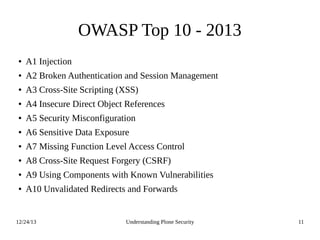
OWASP Top 10 - 2013
● A1 Injection
● A2 Broken Authentication and Session Management
● A3 Cross-Site Scripting (XSS)
● A4 Insecure Direct Object References
● A5 Security Misconfiguration
● A6 Sensitive Data Exposure
● A7 Missing Function Level Access Control
● A8 Cross-Site Request Forgery (CSRF)
● A9 Using Components with Known Vulnerabilities
● A10 Unvalidated Redirects and Forwards
12/24/13 Understanding Plone Security 12
OWASP Top 10 x Plone: A1 Injection
● By default, Plone does not use relational databases.
So, it is impossible to inject SQL on Plone.
● Even very old solutions that integrate Zope with
relational databases (ZSQL) are planned to avoid
SQL injection.
● The vast majority of security issues of PHP based
CMS are usually SQL injection.
12/24/13 Understanding Plone Security 13
OWASP Top 10 x Plone: A2 Broken
Authentication and Session
Management
Problems usually happen when the integrator has the
responsibility of session verification.
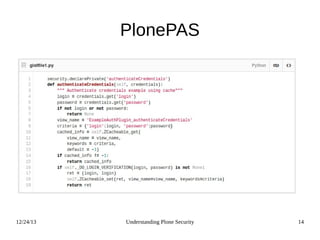
On Plone, integrators use PlonePAS.
12/24/13 Understanding Plone Security 14
PlonePAS
12/24/13 Understanding Plone Security 15
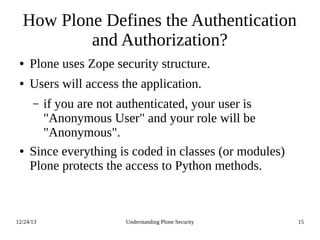
How Plone Defines the Authentication
and Authorization?
● Plone uses Zope security structure.
● Users will access the application.
– if you are not authenticated, your user is
"Anonymous User" and your role will be
"Anonymous".
● Since everything is coded in classes (or modules)
Plone protects the access to Python methods.
12/24/13 Understanding Plone Security 16
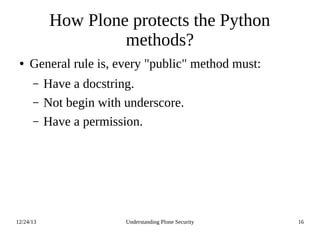
How Plone protects the Python
methods?
● General rule is, every "public" method must:
– Have a docstring.
– Not begin with underscore.
– Have a permission.
12/24/13 Understanding Plone Security 17
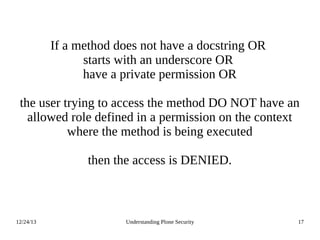
If a method does not have a docstring OR
starts with an underscore OR
have a private permission OR
the user trying to access the method DO NOT have an
allowed role defined in a permission on the context
where the method is being executed
then the access is DENIED.
12/24/13 Understanding Plone Security 18
Complex?
● Rights are always granted by roles (not by users).
● Users will receive roles in contexts.
– It could be done during authentication or manually.
● Plone defines the concept of groups: a set of users.
– When a group receive roles in a context, all its group
members receive these roles.
– Groups is an abstraction to make privileges
management easier.
12/24/13 Understanding Plone Security 19
But who manages the roles allowed on
permissions?
● It needs to be done on every object.
● Solution: Workflows!
– A workflow definition will change the allowed
roles for a set of permissions when a transition
happens.
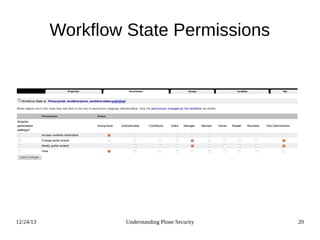
– Example: when a private document is published,
the "View" permission is changed to allow the
access of role “Anonymous”.
12/24/13 Understanding Plone Security 20
Workflow State Permissions
12/24/13 Understanding Plone Security 21
The Permissions Model
● It is complex to understand by new developers.
– But it is easy to understand with proper training.
● It is very flexible.
● It is secure!
– Why? Because all security verifications are
automatically made by Zope. The application security
management is not responsibility of the end user or the
sysadmin. Even the developer has little code to write
(and it helps to avoid security issues).
12/24/13 Understanding Plone Security 22
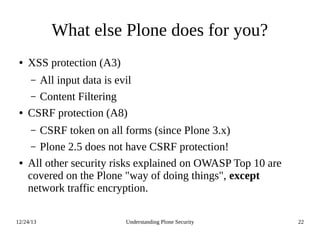
What else Plone does for you?
● XSS protection (A3)
– All input data is evil
– Content Filtering
● CSRF protection (A8)
– CSRF token on all forms (since Plone 3.x)
– Plone 2.5 does not have CSRF protection!
● All other security risks explained on OWASP Top 10 are
covered on the Plone "way of doing things", except
network traffic encryption.
12/24/13 Understanding Plone Security 23
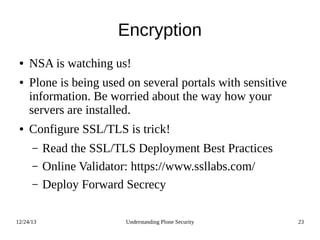
Encryption
● NSA is watching us!
● Plone is being used on several portals with sensitive
information. Be worried about the way how your
servers are installed.
● Configure SSL/TLS is trick!
– Read the SSL/TLS Deployment Best Practices
– Online Validator: https://www.ssllabs.com/
– Deploy Forward Secrecy
12/24/13 Understanding Plone Security 24
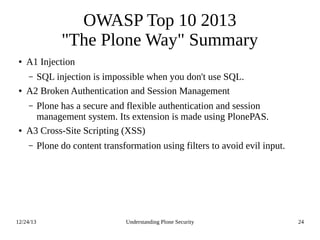
OWASP Top 10 2013
"The Plone Way" Summary
● A1 Injection
– SQL injection is impossible when you don't use SQL.
● A2 Broken Authentication and Session Management
– Plone has a secure and flexible authentication and session
management system. Its extension is made using PlonePAS.
● A3 Cross-Site Scripting (XSS)
– Plone do content transformation using filters to avoid evil input.
12/24/13 Understanding Plone Security 25
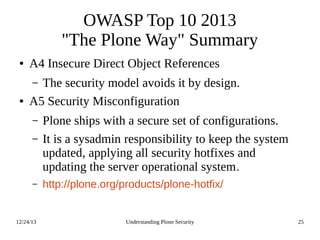
OWASP Top 10 2013
"The Plone Way" Summary
● A4 Insecure Direct Object References
– The security model avoids it by design.
● A5 Security Misconfiguration
– Plone ships with a secure set of configurations.
– It is a sysadmin responsibility to keep the system
updated, applying all security hotfixes and
updating the server operational system.
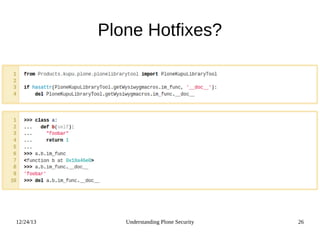
– http://plone.org/products/plone-hotfix/
12/24/13 Understanding Plone Security 26
Plone Hotfixes?
12/24/13 Understanding Plone Security 27
OWASP Top 10 2013
"The Plone Way" Summary
● A6 Sensitive Data Exposure
– Default Plone sensitive data (like user
passwords) are difficult to expose.
– Cryptography must be used to protect the
authenticated access on Plone. It is a sysadmin
responsibility.
● A7 Missing Function Level Access Control
– The security model avoids it by design.
12/24/13 Understanding Plone Security 28
OWASP Top 10 2013
"The Plone Way" Summary
● A8 Cross-Site Request Forgery (CSRF)
– All forms are protected by a CSRF token
● A9 Using Components with Known Vulnerabilities
– Plone has security fixes releases.
– Don't be lazy: install the hotfixes!
– Read the security announcements of: Linux kernel,
apache, nginx, squid, etc. There is really nasty stuff
in the wild.
12/24/13 Understanding Plone Security 29
OWASP Top 10 2013
"The Plone Way" Summary
● A10 Unvalidated Redirects and Forwards
– Plone avoids to use redirects (the example
scenario used on OWASP is uncommon).
12/24/13 Understanding Plone Security 30
First Conclusions
● Why Plone is Secure?
– Mostly because of design decisions.
– No SQL injection.
– All evil input is filtered to avoid XSS.
– All forms use CSRF tokens.
– Zope security machinery avoids "gambiarras".
12/24/13 Understanding Plone Security 31
First Conclusions
● Sometimes we find security vulnerabilities
(nobody is perfect). But when it happens, Plone
security team releases the Plone Hotfixes.
● Plone is secure because Python has a high quality
code (aka no JVM updates every week or 0-day
vulnerabilities luckily fixed someday).
12/24/13 Understanding Plone Security 32
Tips and Tricks
12/24/13 Understanding Plone Security 33
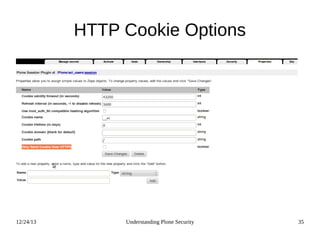
HTTP Cookie Options
● HttpOnly Cookie
– An HttpOnly session cookie will be used only
when transmitting HTTP or HTTPS requests
– Restrict access from non-HTTP APIs, such as
JavaScript
– Zope support added on 2.12.0b1
https://bugs.launchpad.net/zope2/+bug/367393
– Enabled by default on Plone (plone.session 3.0b4)
12/24/13 Understanding Plone Security 34
HTTP Cookie Options
● Secure Cookie
– Only used via HTTPS
– Makes the cookie less likely to be exposed to
cookie theft
– http://plone.org/documentation/kb/securing-plone
12/24/13 Understanding Plone Security 35
HTTP Cookie Options
12/24/13 Understanding Plone Security 36
What Plone could do better?
12/24/13 Understanding Plone Security 37
Useful HTTP headers
● X-Frame-Options, Frame-Options
– Example: X-Frame-Options: deny
– Provides Clickjacking protection.
● deny - no rendering within a frame
● sameorigin - no rendering if origin mismatch
● allow-from: DOMAIN - allow rendering if framed by
frame loaded from DOMAIN
– On nginx, use:
● add_header X-Frame-Options SAMEORIGIN;
12/24/13 Understanding Plone Security 38
Clickjacking
● Term to describe the attack that is "hijacking"
clicks.
● Uses multiple transparent layers to trick the
user to click a button or link on another page.
● Can be used to steal likes on Facebook,
followers on Twitter or much more dangerous
things.
12/24/13 Understanding Plone Security 39
Useful HTTP headers
● X-XSS-Protection
– Example: X-XSS-Protection: 1; mode=block
– Enables the Cross-site scripting (XSS) filter built
into most recent web browsers.
– It's usually enabled by default.
● Re-enable the filter if it was disabled by the user.
12/24/13 Understanding Plone Security 40
Useful HTTP headers
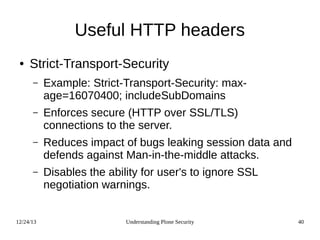
● Strict-Transport-Security
– Example: Strict-Transport-Security: max-
age=16070400; includeSubDomains
– Enforces secure (HTTP over SSL/TLS)
connections to the server.
– Reduces impact of bugs leaking session data and
defends against Man-in-the-middle attacks.
– Disables the ability for user's to ignore SSL
negotiation warnings.
12/24/13 Understanding Plone Security 41
Useful HTTP headers
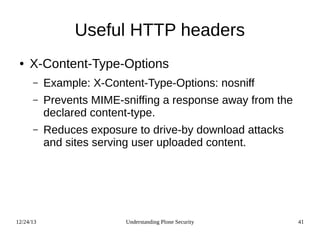
● X-Content-Type-Options
– Example: X-Content-Type-Options: nosniff
– Prevents MIME-sniffing a response away from the
declared content-type.
– Reduces exposure to drive-by download attacks
and sites serving user uploaded content.
12/24/13 Understanding Plone Security 42
Useful HTTP headers
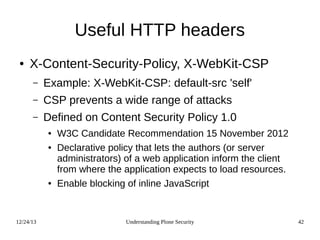
● X-Content-Security-Policy, X-WebKit-CSP
– Example: X-WebKit-CSP: default-src 'self'
– CSP prevents a wide range of attacks
– Defined on Content Security Policy 1.0
● W3C Candidate Recommendation 15 November 2012
● Declarative policy that lets the authors (or server
administrators) of a web application inform the client
from where the application expects to load resources.
● Enable blocking of inline JavaScript
12/24/13 Understanding Plone Security 43
Useful HTTP headers
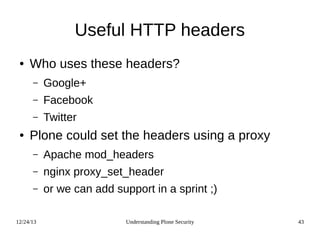
● Who uses these headers?
– Google+
– Facebook
– Twitter
● Plone could set the headers using a proxy
– Apache mod_headers
– nginx proxy_set_header
– or we can add support in a sprint ;)
12/24/13 Understanding Plone Security 44
Thank You
Fabiano Weimar dos Santos [Xiru]
xiru@xiru.org
Twitter: @xiru
Got interested? Talk with me :)
yes, I'm looking for a new job

Understanding Plone Security

  • 1.
    Understanding Plone Security PloneConference 2013 Brasília/Brasil Fabiano Weimar dos Santos [Xiru] xiru@xiru.org
  • 2.
    12/24/13 Understanding PloneSecurity 2 Understanding Plone Security Plone is a CMS known for being quite safe. However, there are few people that know the reasons that make it safer than other solutions.
  • 3.
    12/24/13 Understanding PloneSecurity 3 A Common Argument Some people say that Plone is less used and tested than other platforms, arguing something similar to the Linus's Law formulated by Eric Raymond in his essay and book "The Cathedral and the Bazaar" (1999).
  • 4.
    12/24/13 Understanding PloneSecurity 4 Linus' Law "Given enough eyeballs, all bugs are shallow."
  • 5.
    12/24/13 Understanding PloneSecurity 5 or more formally... "Given a large enough beta-tester and co-developer base, almost every problem will be characterized quickly and the fix will be obvious to someone."
  • 6.
    12/24/13 Understanding PloneSecurity 6 In fact, software reviewing until reaching consensus about its acceptance is an efficient approach (even on security issues). However...
  • 7.
    12/24/13 Understanding PloneSecurity 7 However... In "Facts and Fallacies about Software Engineering", Robert Glass refers to the law as a "mantra" of the open source movement, but calls it a fallacy. Really?
  • 8.
    12/24/13 Understanding PloneSecurity 8 Numbers ● On plone.org homepage we read: 340 core developers and more than 300 solution providers in 57 countries. ● The best security track record of any major CMS. – But for some people, Plone could be "full of unknown bugs". ● Let's try to show that Plone security is not based on obscurity.
  • 9.
    12/24/13 Understanding PloneSecurity 9 Plone Source Code is Developed to be Secure Plone security comes from Python and Zope communities wisdom. and Python is AWESOME!
  • 10.
    12/24/13 Understanding PloneSecurity 10 Secure Code Development ● Secure code development is an art, but there is no secret. ● Open Web Application Security Project (OWASP) publish valuable documentation about Secure Development.
  • 11.
    12/24/13 Understanding PloneSecurity 11 OWASP Top 10 - 2013 ● A1 Injection ● A2 Broken Authentication and Session Management ● A3 Cross-Site Scripting (XSS) ● A4 Insecure Direct Object References ● A5 Security Misconfiguration ● A6 Sensitive Data Exposure ● A7 Missing Function Level Access Control ● A8 Cross-Site Request Forgery (CSRF) ● A9 Using Components with Known Vulnerabilities ● A10 Unvalidated Redirects and Forwards
  • 12.
    12/24/13 Understanding PloneSecurity 12 OWASP Top 10 x Plone: A1 Injection ● By default, Plone does not use relational databases. So, it is impossible to inject SQL on Plone. ● Even very old solutions that integrate Zope with relational databases (ZSQL) are planned to avoid SQL injection. ● The vast majority of security issues of PHP based CMS are usually SQL injection.
  • 13.
    12/24/13 Understanding PloneSecurity 13 OWASP Top 10 x Plone: A2 Broken Authentication and Session Management Problems usually happen when the integrator has the responsibility of session verification. On Plone, integrators use PlonePAS.
  • 14.
    12/24/13 Understanding PloneSecurity 14 PlonePAS
  • 15.
    12/24/13 Understanding PloneSecurity 15 How Plone Defines the Authentication and Authorization? ● Plone uses Zope security structure. ● Users will access the application. – if you are not authenticated, your user is "Anonymous User" and your role will be "Anonymous". ● Since everything is coded in classes (or modules) Plone protects the access to Python methods.
  • 16.
    12/24/13 Understanding PloneSecurity 16 How Plone protects the Python methods? ● General rule is, every "public" method must: – Have a docstring. – Not begin with underscore. – Have a permission.
  • 17.
    12/24/13 Understanding PloneSecurity 17 If a method does not have a docstring OR starts with an underscore OR have a private permission OR the user trying to access the method DO NOT have an allowed role defined in a permission on the context where the method is being executed then the access is DENIED.
  • 18.
    12/24/13 Understanding PloneSecurity 18 Complex? ● Rights are always granted by roles (not by users). ● Users will receive roles in contexts. – It could be done during authentication or manually. ● Plone defines the concept of groups: a set of users. – When a group receive roles in a context, all its group members receive these roles. – Groups is an abstraction to make privileges management easier.
  • 19.
    12/24/13 Understanding PloneSecurity 19 But who manages the roles allowed on permissions? ● It needs to be done on every object. ● Solution: Workflows! – A workflow definition will change the allowed roles for a set of permissions when a transition happens. – Example: when a private document is published, the "View" permission is changed to allow the access of role “Anonymous”.
  • 20.
    12/24/13 Understanding PloneSecurity 20 Workflow State Permissions
  • 21.
    12/24/13 Understanding PloneSecurity 21 The Permissions Model ● It is complex to understand by new developers. – But it is easy to understand with proper training. ● It is very flexible. ● It is secure! – Why? Because all security verifications are automatically made by Zope. The application security management is not responsibility of the end user or the sysadmin. Even the developer has little code to write (and it helps to avoid security issues).
  • 22.
    12/24/13 Understanding PloneSecurity 22 What else Plone does for you? ● XSS protection (A3) – All input data is evil – Content Filtering ● CSRF protection (A8) – CSRF token on all forms (since Plone 3.x) – Plone 2.5 does not have CSRF protection! ● All other security risks explained on OWASP Top 10 are covered on the Plone "way of doing things", except network traffic encryption.
  • 23.
    12/24/13 Understanding PloneSecurity 23 Encryption ● NSA is watching us! ● Plone is being used on several portals with sensitive information. Be worried about the way how your servers are installed. ● Configure SSL/TLS is trick! – Read the SSL/TLS Deployment Best Practices – Online Validator: https://www.ssllabs.com/ – Deploy Forward Secrecy
  • 24.
    12/24/13 Understanding PloneSecurity 24 OWASP Top 10 2013 "The Plone Way" Summary ● A1 Injection – SQL injection is impossible when you don't use SQL. ● A2 Broken Authentication and Session Management – Plone has a secure and flexible authentication and session management system. Its extension is made using PlonePAS. ● A3 Cross-Site Scripting (XSS) – Plone do content transformation using filters to avoid evil input.
  • 25.
    12/24/13 Understanding PloneSecurity 25 OWASP Top 10 2013 "The Plone Way" Summary ● A4 Insecure Direct Object References – The security model avoids it by design. ● A5 Security Misconfiguration – Plone ships with a secure set of configurations. – It is a sysadmin responsibility to keep the system updated, applying all security hotfixes and updating the server operational system. – http://plone.org/products/plone-hotfix/
  • 26.
    12/24/13 Understanding PloneSecurity 26 Plone Hotfixes?
  • 27.
    12/24/13 Understanding PloneSecurity 27 OWASP Top 10 2013 "The Plone Way" Summary ● A6 Sensitive Data Exposure – Default Plone sensitive data (like user passwords) are difficult to expose. – Cryptography must be used to protect the authenticated access on Plone. It is a sysadmin responsibility. ● A7 Missing Function Level Access Control – The security model avoids it by design.
  • 28.
    12/24/13 Understanding PloneSecurity 28 OWASP Top 10 2013 "The Plone Way" Summary ● A8 Cross-Site Request Forgery (CSRF) – All forms are protected by a CSRF token ● A9 Using Components with Known Vulnerabilities – Plone has security fixes releases. – Don't be lazy: install the hotfixes! – Read the security announcements of: Linux kernel, apache, nginx, squid, etc. There is really nasty stuff in the wild.
  • 29.
    12/24/13 Understanding PloneSecurity 29 OWASP Top 10 2013 "The Plone Way" Summary ● A10 Unvalidated Redirects and Forwards – Plone avoids to use redirects (the example scenario used on OWASP is uncommon).
  • 30.
    12/24/13 Understanding PloneSecurity 30 First Conclusions ● Why Plone is Secure? – Mostly because of design decisions. – No SQL injection. – All evil input is filtered to avoid XSS. – All forms use CSRF tokens. – Zope security machinery avoids "gambiarras".
  • 31.
    12/24/13 Understanding PloneSecurity 31 First Conclusions ● Sometimes we find security vulnerabilities (nobody is perfect). But when it happens, Plone security team releases the Plone Hotfixes. ● Plone is secure because Python has a high quality code (aka no JVM updates every week or 0-day vulnerabilities luckily fixed someday).
  • 32.
    12/24/13 Understanding PloneSecurity 32 Tips and Tricks
  • 33.
    12/24/13 Understanding PloneSecurity 33 HTTP Cookie Options ● HttpOnly Cookie – An HttpOnly session cookie will be used only when transmitting HTTP or HTTPS requests – Restrict access from non-HTTP APIs, such as JavaScript – Zope support added on 2.12.0b1 https://bugs.launchpad.net/zope2/+bug/367393 – Enabled by default on Plone (plone.session 3.0b4)
  • 34.
    12/24/13 Understanding PloneSecurity 34 HTTP Cookie Options ● Secure Cookie – Only used via HTTPS – Makes the cookie less likely to be exposed to cookie theft – http://plone.org/documentation/kb/securing-plone
  • 35.
    12/24/13 Understanding PloneSecurity 35 HTTP Cookie Options
  • 36.
    12/24/13 Understanding PloneSecurity 36 What Plone could do better?
  • 37.
    12/24/13 Understanding PloneSecurity 37 Useful HTTP headers ● X-Frame-Options, Frame-Options – Example: X-Frame-Options: deny – Provides Clickjacking protection. ● deny - no rendering within a frame ● sameorigin - no rendering if origin mismatch ● allow-from: DOMAIN - allow rendering if framed by frame loaded from DOMAIN – On nginx, use: ● add_header X-Frame-Options SAMEORIGIN;
  • 38.
    12/24/13 Understanding PloneSecurity 38 Clickjacking ● Term to describe the attack that is "hijacking" clicks. ● Uses multiple transparent layers to trick the user to click a button or link on another page. ● Can be used to steal likes on Facebook, followers on Twitter or much more dangerous things.
  • 39.
    12/24/13 Understanding PloneSecurity 39 Useful HTTP headers ● X-XSS-Protection – Example: X-XSS-Protection: 1; mode=block – Enables the Cross-site scripting (XSS) filter built into most recent web browsers. – It's usually enabled by default. ● Re-enable the filter if it was disabled by the user.
  • 40.
    12/24/13 Understanding PloneSecurity 40 Useful HTTP headers ● Strict-Transport-Security – Example: Strict-Transport-Security: max- age=16070400; includeSubDomains – Enforces secure (HTTP over SSL/TLS) connections to the server. – Reduces impact of bugs leaking session data and defends against Man-in-the-middle attacks. – Disables the ability for user's to ignore SSL negotiation warnings.
  • 41.
    12/24/13 Understanding PloneSecurity 41 Useful HTTP headers ● X-Content-Type-Options – Example: X-Content-Type-Options: nosniff – Prevents MIME-sniffing a response away from the declared content-type. – Reduces exposure to drive-by download attacks and sites serving user uploaded content.
  • 42.
    12/24/13 Understanding PloneSecurity 42 Useful HTTP headers ● X-Content-Security-Policy, X-WebKit-CSP – Example: X-WebKit-CSP: default-src 'self' – CSP prevents a wide range of attacks – Defined on Content Security Policy 1.0 ● W3C Candidate Recommendation 15 November 2012 ● Declarative policy that lets the authors (or server administrators) of a web application inform the client from where the application expects to load resources. ● Enable blocking of inline JavaScript
  • 43.
    12/24/13 Understanding PloneSecurity 43 Useful HTTP headers ● Who uses these headers? – Google+ – Facebook – Twitter ● Plone could set the headers using a proxy – Apache mod_headers – nginx proxy_set_header – or we can add support in a sprint ;)
  • 44.
    12/24/13 Understanding PloneSecurity 44 Thank You Fabiano Weimar dos Santos [Xiru] xiru@xiru.org Twitter: @xiru Got interested? Talk with me :) yes, I'm looking for a new job