Understanding
Financial Accounting
Third Canadian Edition
By Christopher D. Burnley
Prepared by Debbie Musil, FCPA, FCMA
Chapter 7
Inventory
This slide deck contains animations. Please disable animations if they cause issues with your device.
Copyright ©2022 John Wiley & Sons, Canada, Ltd.
Copyright ©2022 John Wiley & Sons, Canada, Ltd. 2
Learning Objectives (1 of 4)
LO1 – Discuss the importance of inventory to a
company’s overall success.
LO2 – Distinguish between the different inventory
classifications and determine which goods should
be included in a company’s inventory.
LO3 – Explain the differences between perpetual
inventory systems and periodic inventory systems
Copyright ©2022 John Wiley & Sons, Canada, Ltd. 3
Learning Objectives (2 of 4)
LO4 – Explain why cost formulas are necessary and
calculate the cost of goods sold and ending
inventory under the specific identification,
weighted-average, and first-in, first-out cost
formulas under a perpetual inventory system.
LO5 – Explain the value at which inventory is carried on
the statement of financial position and determine
the impact of inventory valuation errors.
Copyright ©2022 John Wiley & Sons, Canada, Ltd. 4
Learning Objectives (3 of 4)
LO6 – Explain how a company’s gross margin is
determined and why it is an important measure.
LO7 – Describe management’s responsibility for internal
control measures related to inventory.
Copyright ©2022 John Wiley & Sons, Canada, Ltd. 5
Learning Objectives (4 of 4)
LO8 – Calculate the inventory turnover ratio and the
days to sell inventory ratio and explain how they
can be interpreted by users.
LO9 – Calculate the cost of goods sold and ending
inventory under the specific identification,
weighted-average and first-in, first-out cost
formulas under a periodic system.
Copyright ©2022 John Wiley & Sons, Canada, Ltd. 6
Inventory
• Any item purchased by a company for:
o Resale to customers, or
o Use in the manufacture of a product to be sold to
customers
• Companies that sell finished goods inventory are
known as merchandisers or retailers
• Companies that make products are known as
manufacturers
Copyright ©2022 John Wiley & Sons, Canada, Ltd. 7
Significance of Inventory
• For retailers and manufacturers, inventory is a
significant current asset and the largest asset to be
converted into cash within the next year
Copyright ©2022 John Wiley & Sons, Canada, Ltd. 8
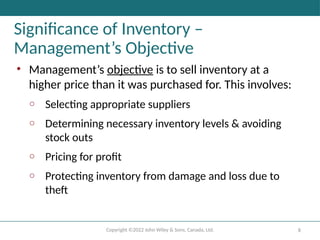
Significance of Inventory –
Management’s Objective
• Management’s objective is to sell inventory at a
higher price than it was purchased for. This involves:
o Selecting appropriate suppliers
o Determining necessary inventory levels & avoiding
stock outs
o Pricing for profit
o Protecting inventory from damage and loss due to
theft
Copyright ©2022 John Wiley & Sons, Canada, Ltd. 9
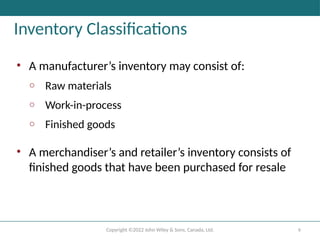
Inventory Classifications
• A manufacturer’s inventory may consist of:
o Raw materials
o Work-in-process
o Finished goods
• A merchandiser’s and retailer’s inventory consists of
finished goods that have been purchased for resale
Copyright ©2022 John Wiley & Sons, Canada, Ltd. 10
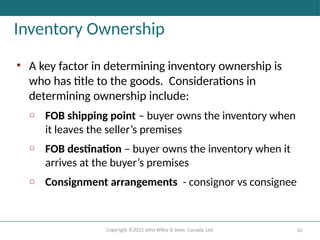
Inventory Ownership
• A key factor in determining inventory ownership is
who has title to the goods. Considerations in
determining ownership include:
o FOB shipping point – buyer owns the inventory when
it leaves the seller’s premises
o FOB destination – buyer owns the inventory when it
arrives at the buyer’s premises
o Consignment arrangements - consignor vs consignee
Copyright ©2022 John Wiley & Sons, Canada, Ltd. 11
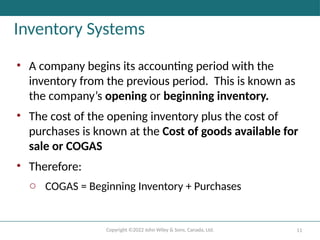
Inventory Systems
• A company begins its accounting period with the
inventory from the previous period. This is known as
the company’s opening or beginning inventory.
• The cost of the opening inventory plus the cost of
purchases is known at the Cost of goods available for
sale or COGAS
• Therefore:
o COGAS = Beginning Inventory + Purchases
Copyright ©2022 John Wiley & Sons, Canada, Ltd. 12
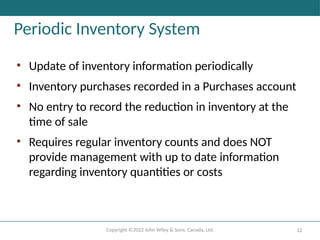
Periodic Inventory System
• Update of inventory information periodically
• Inventory purchases recorded in a Purchases account
• No entry to record the reduction in inventory at the
time of sale
• Requires regular inventory counts and does NOT
provide management with up to date information
regarding inventory quantities or costs
Copyright ©2022 John Wiley & Sons, Canada, Ltd. 13
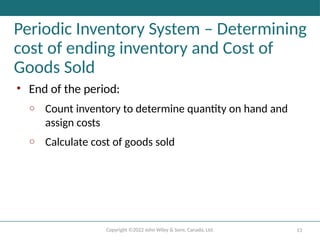
Periodic Inventory System – Determining
cost of ending inventory and Cost of
Goods Sold
• End of the period:
o Count inventory to determine quantity on hand and
assign costs
o Calculate cost of goods sold
Copyright ©2022 John Wiley & Sons, Canada, Ltd. 14
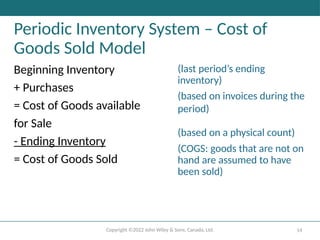
Periodic Inventory System – Cost of
Goods Sold Model
Beginning Inventory
+ Purchases
= Cost of Goods available
for Sale
- Ending Inventory
= Cost of Goods Sold
(last period’s ending
inventory)
(based on invoices during the
period)
(based on a physical count)
(COGS: goods that are not on
hand are assumed to have
been sold)
Copyright ©2022 John Wiley & Sons, Canada, Ltd. 15
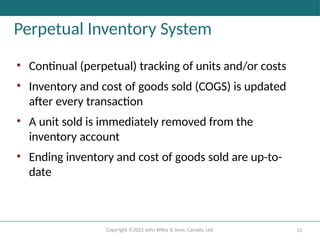
Perpetual Inventory System
• Continual (perpetual) tracking of units and/or costs
• Inventory and cost of goods sold (COGS) is updated
after every transaction
• A unit sold is immediately removed from the
inventory account
• Ending inventory and cost of goods sold are up-to-
date
Copyright ©2022 John Wiley & Sons, Canada, Ltd. 16
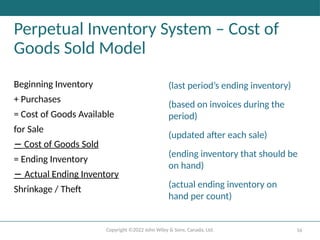
Perpetual Inventory System – Cost of
Goods Sold Model
Beginning Inventory
+ Purchases
= Cost of Goods Available
for Sale
− Cost of Goods Sold
= Ending Inventory
− Actual Ending Inventory
Shrinkage / Theft
(last period’s ending inventory)
(based on invoices during the
period)
(updated after each sale)
(ending inventory that should be
on hand)
(actual ending inventory on
hand per count)
Copyright ©2022 John Wiley & Sons, Canada, Ltd. 17
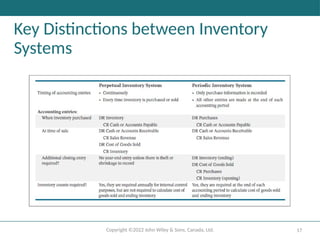
Key Distinctions between Inventory
Systems
Copyright ©2022 John Wiley & Sons, Canada, Ltd. 18
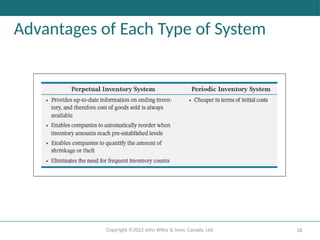
Advantages of Each Type of System
Copyright ©2022 John Wiley & Sons, Canada, Ltd. 19
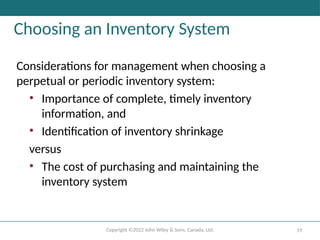
Choosing an Inventory System
Considerations for management when choosing a
perpetual or periodic inventory system:
• Importance of complete, timely inventory
information, and
• Identification of inventory shrinkage
versus
• The cost of purchasing and maintaining the
inventory system
Copyright ©2022 John Wiley & Sons, Canada, Ltd. 20
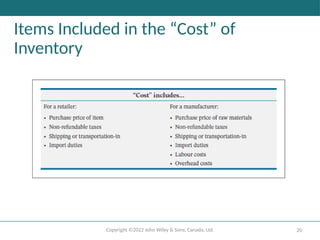
Items Included in the “Cost” of
Inventory
Copyright ©2022 John Wiley & Sons, Canada, Ltd. 21
Cost Formulas
• Cost formulas are necessary because inventory
purchase costs change
• COGAS is the same regardless of cost formula used
• The three cost formulas result in different allocations
of COGAS between ending inventory and COGS
Copyright ©2022 John Wiley & Sons, Canada, Ltd. 22
Cost Formula Mechanics
• Specific Identification
o Specific costs are allocated to the cost of good sold
• Weighted average
o The cost of the items is determined using a weighted
average of the cost of the items purchased
• First-in, first-out (FIFO)
o The first item purchased is the first item sold
Copyright ©2022 John Wiley & Sons, Canada, Ltd. 23
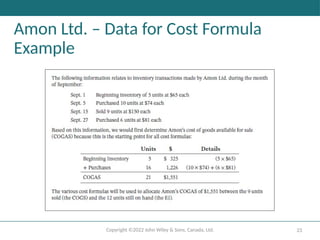
Amon Ltd. – Data for Cost Formula
Example
Copyright ©2022 John Wiley & Sons, Canada, Ltd. 24
Specific Identification Cost Formula
Illustration
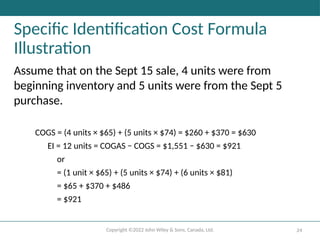
Assume that on the Sept 15 sale, 4 units were from
beginning inventory and 5 units were from the Sept 5
purchase.
COGS = (4 units × $65) + (5 units × $74) = $260 + $370 = $630
EI = 12 units = COGAS − COGS = $1,551 − $630 = $921
or
= (1 unit × $65) + (5 units × $74) + (6 units × $81)
= $65 + $370 + $486
= $921
Copyright ©2022 John Wiley & Sons, Canada, Ltd. 25
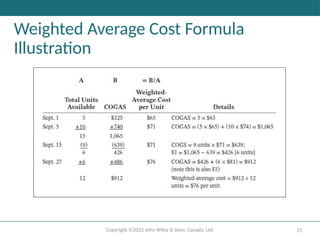
Weighted Average Cost Formula
Illustration
Copyright ©2022 John Wiley & Sons, Canada, Ltd. 26
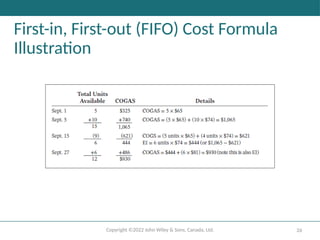
First-in, First-out (FIFO) Cost Formula
Illustration
Copyright ©2022 John Wiley & Sons, Canada, Ltd. 27
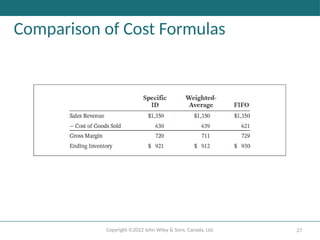
Comparison of Cost Formulas
Copyright ©2022 John Wiley & Sons, Canada, Ltd. 28
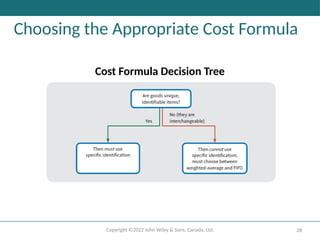
Choosing the Appropriate Cost Formula
Cost Formula Decision Tree
Copyright ©2022 John Wiley & Sons, Canada, Ltd. 29
Inventory Valuation
• Inventory is recorded at its cost on the date of
acquisition
• Inventory is carried on the statement of financial
position at lower of cost and net realizable value
(NRV)
o Inventory should reflect a value that is not more than
the economic benefits management expected to flow
from it
Copyright ©2022 John Wiley & Sons, Canada, Ltd. 30
Inventory Valuation Writedown
• Net Realizable Value (NRV) = Expected Selling Price –
Estimated Costs to Make Sale
• If the NRV is lower than the inventory’s cost, the
inventory must be written down, the entry is:
Dr. Cost of Goods Sold
Cr. Inventory
Copyright ©2022 John Wiley & Sons, Canada, Ltd. 31
Application of the Lower of Cost and
NRV
Note that the historical costs of Products B and C are less than the net realizable value, so
no adjustment is required. However, the historical cost of Product A is higher than its net
realizable value. Therefore, we need to make an entry as follows:
DR Cost of Goods Sold [4,550 − 4,050] 500
CR Inventory 500
This entry has the effect of immediately reducing net income by the amount of the
inventory writedown even though the inventory has yet to be sold. In other words, the loss
in the value of the inventory is included in the cost of goods sold in the period in which it is
realized rather than when the product is subsequently sold.
Copyright ©2022 John Wiley & Sons, Canada, Ltd. 32
Inventory Valuation Errors
• Inventory valuation errors can result for a variety of
reasons; some are:
o Errors during inventory count
o Inclusion/exclusion of items that should be
excluded/included (goods on consignment; FOB
terms)
Copyright ©2022 John Wiley & Sons, Canada, Ltd. 33
Effect of Inventory Valuation Errors
• Will result in misstatement of both statement of
financial position and income statement
• If not corrected will also affect statements of the
subsequent period
• Errors offset over a two-year period
Copyright ©2022 John Wiley & Sons, Canada, Ltd. 34
Determining Gross Margin
• Gross Margin = Sales Revenue – COGS
• Gross Margin Ratio= Gross Margin / Sales Revenue
• Used to analyze a company’s performance over time
• Also used as a comparative against other companies
or industry standards
Copyright ©2022 John Wiley & Sons, Canada, Ltd. 35
Internal Controls & Inventory
• Safekeeping the inventory
o Management is responsible for ensuring that internal
controls are in place to safeguard the inventory
• Physical controls
• Separation of duties
• Regular inventory counts
Copyright ©2022 John Wiley & Sons, Canada, Ltd. 36
Internal Controls & Inventory
Management
• Cost of inventory storage and insurance
• Cost of handling
• Risk of Obsolescence
• Auditors play an important role
Copyright ©2022 John Wiley & Sons, Canada, Ltd. 37
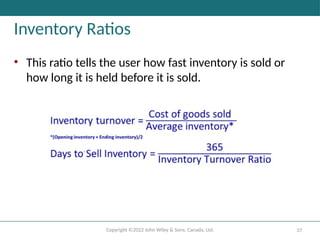
Inventory Ratios
• This ratio tells the user how fast inventory is sold or
how long it is held before it is sold.
Copyright ©2022 John Wiley & Sons, Canada, Ltd. 38
Estimating Inventory
• Sometimes necessary to estimate inventory levels
during the year
• Several techniques, but focus is on gross margin
estimation method
Copyright ©2022 John Wiley & Sons, Canada, Ltd. 39
Estimating Inventory – Gross Margin
Method
• Gross Margin Estimation Method
o Calculated as follows:
Sales revenue × Normal cost-to-sales ratio = Cost of
goods sold
o Beginning inventory + Purchases** – COGS = Ending
Inventory
(**from accounting records)
Copyright ©2022 John Wiley & Sons, Canada, Ltd. 40
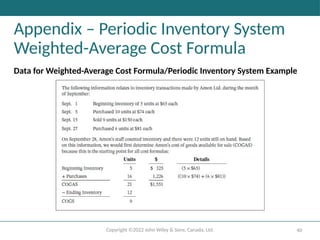
Appendix – Periodic Inventory System
Weighted-Average Cost Formula
Data for Weighted-Average Cost Formula/Periodic Inventory System Example
Copyright ©2022 John Wiley & Sons, Canada, Ltd. 41
Appendix – Periodic Inventory System
FIFO Cost Formula
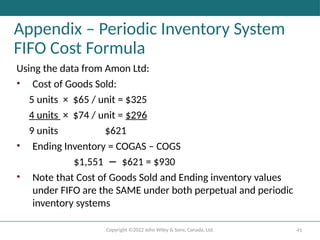
Using the data from Amon Ltd:
• Cost of Goods Sold:
5 units × $65 / unit = $325
4 units × $74 / unit = $296
9 units $621
• Ending Inventory = COGAS – COGS
$1,551 − $621 = $930
• Note that Cost of Goods Sold and Ending inventory values
under FIFO are the SAME under both perpetual and periodic
inventory systems
Copyright ©2022 John Wiley & Sons, Canada, Ltd. 42
Copyright
Copyright © 2022 John Wiley & Sons Canada, Ltd. or the author, All rights reserved.
Students and instructors who are authorized users of this course are permitted to
download these materials and use them in connection with the course. No part of
these materials should be reproduced, stored in a retrieval system, or transmitted, in
any form or by any means, electronic, mechanical, photocopying, recording or
otherwise, except as permitted by law. Advice on how to obtain permission to reuse
this material is available at http://www.wiley.com/go/permissions.

understanding financial accounting by absxc

  • 1.
    Understanding Financial Accounting Third CanadianEdition By Christopher D. Burnley Prepared by Debbie Musil, FCPA, FCMA Chapter 7 Inventory This slide deck contains animations. Please disable animations if they cause issues with your device. Copyright ©2022 John Wiley & Sons, Canada, Ltd.
  • 2.
    Copyright ©2022 JohnWiley & Sons, Canada, Ltd. 2 Learning Objectives (1 of 4) LO1 – Discuss the importance of inventory to a company’s overall success. LO2 – Distinguish between the different inventory classifications and determine which goods should be included in a company’s inventory. LO3 – Explain the differences between perpetual inventory systems and periodic inventory systems
  • 3.
    Copyright ©2022 JohnWiley & Sons, Canada, Ltd. 3 Learning Objectives (2 of 4) LO4 – Explain why cost formulas are necessary and calculate the cost of goods sold and ending inventory under the specific identification, weighted-average, and first-in, first-out cost formulas under a perpetual inventory system. LO5 – Explain the value at which inventory is carried on the statement of financial position and determine the impact of inventory valuation errors.
  • 4.
    Copyright ©2022 JohnWiley & Sons, Canada, Ltd. 4 Learning Objectives (3 of 4) LO6 – Explain how a company’s gross margin is determined and why it is an important measure. LO7 – Describe management’s responsibility for internal control measures related to inventory.
  • 5.
    Copyright ©2022 JohnWiley & Sons, Canada, Ltd. 5 Learning Objectives (4 of 4) LO8 – Calculate the inventory turnover ratio and the days to sell inventory ratio and explain how they can be interpreted by users. LO9 – Calculate the cost of goods sold and ending inventory under the specific identification, weighted-average and first-in, first-out cost formulas under a periodic system.
  • 6.
    Copyright ©2022 JohnWiley & Sons, Canada, Ltd. 6 Inventory • Any item purchased by a company for: o Resale to customers, or o Use in the manufacture of a product to be sold to customers • Companies that sell finished goods inventory are known as merchandisers or retailers • Companies that make products are known as manufacturers
  • 7.
    Copyright ©2022 JohnWiley & Sons, Canada, Ltd. 7 Significance of Inventory • For retailers and manufacturers, inventory is a significant current asset and the largest asset to be converted into cash within the next year
  • 8.
    Copyright ©2022 JohnWiley & Sons, Canada, Ltd. 8 Significance of Inventory – Management’s Objective • Management’s objective is to sell inventory at a higher price than it was purchased for. This involves: o Selecting appropriate suppliers o Determining necessary inventory levels & avoiding stock outs o Pricing for profit o Protecting inventory from damage and loss due to theft
  • 9.
    Copyright ©2022 JohnWiley & Sons, Canada, Ltd. 9 Inventory Classifications • A manufacturer’s inventory may consist of: o Raw materials o Work-in-process o Finished goods • A merchandiser’s and retailer’s inventory consists of finished goods that have been purchased for resale
  • 10.
    Copyright ©2022 JohnWiley & Sons, Canada, Ltd. 10 Inventory Ownership • A key factor in determining inventory ownership is who has title to the goods. Considerations in determining ownership include: o FOB shipping point – buyer owns the inventory when it leaves the seller’s premises o FOB destination – buyer owns the inventory when it arrives at the buyer’s premises o Consignment arrangements - consignor vs consignee
  • 11.
    Copyright ©2022 JohnWiley & Sons, Canada, Ltd. 11 Inventory Systems • A company begins its accounting period with the inventory from the previous period. This is known as the company’s opening or beginning inventory. • The cost of the opening inventory plus the cost of purchases is known at the Cost of goods available for sale or COGAS • Therefore: o COGAS = Beginning Inventory + Purchases
  • 12.
    Copyright ©2022 JohnWiley & Sons, Canada, Ltd. 12 Periodic Inventory System • Update of inventory information periodically • Inventory purchases recorded in a Purchases account • No entry to record the reduction in inventory at the time of sale • Requires regular inventory counts and does NOT provide management with up to date information regarding inventory quantities or costs
  • 13.
    Copyright ©2022 JohnWiley & Sons, Canada, Ltd. 13 Periodic Inventory System – Determining cost of ending inventory and Cost of Goods Sold • End of the period: o Count inventory to determine quantity on hand and assign costs o Calculate cost of goods sold
  • 14.
    Copyright ©2022 JohnWiley & Sons, Canada, Ltd. 14 Periodic Inventory System – Cost of Goods Sold Model Beginning Inventory + Purchases = Cost of Goods available for Sale - Ending Inventory = Cost of Goods Sold (last period’s ending inventory) (based on invoices during the period) (based on a physical count) (COGS: goods that are not on hand are assumed to have been sold)
  • 15.
    Copyright ©2022 JohnWiley & Sons, Canada, Ltd. 15 Perpetual Inventory System • Continual (perpetual) tracking of units and/or costs • Inventory and cost of goods sold (COGS) is updated after every transaction • A unit sold is immediately removed from the inventory account • Ending inventory and cost of goods sold are up-to- date
  • 16.
    Copyright ©2022 JohnWiley & Sons, Canada, Ltd. 16 Perpetual Inventory System – Cost of Goods Sold Model Beginning Inventory + Purchases = Cost of Goods Available for Sale − Cost of Goods Sold = Ending Inventory − Actual Ending Inventory Shrinkage / Theft (last period’s ending inventory) (based on invoices during the period) (updated after each sale) (ending inventory that should be on hand) (actual ending inventory on hand per count)
  • 17.
    Copyright ©2022 JohnWiley & Sons, Canada, Ltd. 17 Key Distinctions between Inventory Systems
  • 18.
    Copyright ©2022 JohnWiley & Sons, Canada, Ltd. 18 Advantages of Each Type of System
  • 19.
    Copyright ©2022 JohnWiley & Sons, Canada, Ltd. 19 Choosing an Inventory System Considerations for management when choosing a perpetual or periodic inventory system: • Importance of complete, timely inventory information, and • Identification of inventory shrinkage versus • The cost of purchasing and maintaining the inventory system
  • 20.
    Copyright ©2022 JohnWiley & Sons, Canada, Ltd. 20 Items Included in the “Cost” of Inventory
  • 21.
    Copyright ©2022 JohnWiley & Sons, Canada, Ltd. 21 Cost Formulas • Cost formulas are necessary because inventory purchase costs change • COGAS is the same regardless of cost formula used • The three cost formulas result in different allocations of COGAS between ending inventory and COGS
  • 22.
    Copyright ©2022 JohnWiley & Sons, Canada, Ltd. 22 Cost Formula Mechanics • Specific Identification o Specific costs are allocated to the cost of good sold • Weighted average o The cost of the items is determined using a weighted average of the cost of the items purchased • First-in, first-out (FIFO) o The first item purchased is the first item sold
  • 23.
    Copyright ©2022 JohnWiley & Sons, Canada, Ltd. 23 Amon Ltd. – Data for Cost Formula Example
  • 24.
    Copyright ©2022 JohnWiley & Sons, Canada, Ltd. 24 Specific Identification Cost Formula Illustration Assume that on the Sept 15 sale, 4 units were from beginning inventory and 5 units were from the Sept 5 purchase. COGS = (4 units × $65) + (5 units × $74) = $260 + $370 = $630 EI = 12 units = COGAS − COGS = $1,551 − $630 = $921 or = (1 unit × $65) + (5 units × $74) + (6 units × $81) = $65 + $370 + $486 = $921
  • 25.
    Copyright ©2022 JohnWiley & Sons, Canada, Ltd. 25 Weighted Average Cost Formula Illustration
  • 26.
    Copyright ©2022 JohnWiley & Sons, Canada, Ltd. 26 First-in, First-out (FIFO) Cost Formula Illustration
  • 27.
    Copyright ©2022 JohnWiley & Sons, Canada, Ltd. 27 Comparison of Cost Formulas
  • 28.
    Copyright ©2022 JohnWiley & Sons, Canada, Ltd. 28 Choosing the Appropriate Cost Formula Cost Formula Decision Tree
  • 29.
    Copyright ©2022 JohnWiley & Sons, Canada, Ltd. 29 Inventory Valuation • Inventory is recorded at its cost on the date of acquisition • Inventory is carried on the statement of financial position at lower of cost and net realizable value (NRV) o Inventory should reflect a value that is not more than the economic benefits management expected to flow from it
  • 30.
    Copyright ©2022 JohnWiley & Sons, Canada, Ltd. 30 Inventory Valuation Writedown • Net Realizable Value (NRV) = Expected Selling Price – Estimated Costs to Make Sale • If the NRV is lower than the inventory’s cost, the inventory must be written down, the entry is: Dr. Cost of Goods Sold Cr. Inventory
  • 31.
    Copyright ©2022 JohnWiley & Sons, Canada, Ltd. 31 Application of the Lower of Cost and NRV Note that the historical costs of Products B and C are less than the net realizable value, so no adjustment is required. However, the historical cost of Product A is higher than its net realizable value. Therefore, we need to make an entry as follows: DR Cost of Goods Sold [4,550 − 4,050] 500 CR Inventory 500 This entry has the effect of immediately reducing net income by the amount of the inventory writedown even though the inventory has yet to be sold. In other words, the loss in the value of the inventory is included in the cost of goods sold in the period in which it is realized rather than when the product is subsequently sold.
  • 32.
    Copyright ©2022 JohnWiley & Sons, Canada, Ltd. 32 Inventory Valuation Errors • Inventory valuation errors can result for a variety of reasons; some are: o Errors during inventory count o Inclusion/exclusion of items that should be excluded/included (goods on consignment; FOB terms)
  • 33.
    Copyright ©2022 JohnWiley & Sons, Canada, Ltd. 33 Effect of Inventory Valuation Errors • Will result in misstatement of both statement of financial position and income statement • If not corrected will also affect statements of the subsequent period • Errors offset over a two-year period
  • 34.
    Copyright ©2022 JohnWiley & Sons, Canada, Ltd. 34 Determining Gross Margin • Gross Margin = Sales Revenue – COGS • Gross Margin Ratio= Gross Margin / Sales Revenue • Used to analyze a company’s performance over time • Also used as a comparative against other companies or industry standards
  • 35.
    Copyright ©2022 JohnWiley & Sons, Canada, Ltd. 35 Internal Controls & Inventory • Safekeeping the inventory o Management is responsible for ensuring that internal controls are in place to safeguard the inventory • Physical controls • Separation of duties • Regular inventory counts
  • 36.
    Copyright ©2022 JohnWiley & Sons, Canada, Ltd. 36 Internal Controls & Inventory Management • Cost of inventory storage and insurance • Cost of handling • Risk of Obsolescence • Auditors play an important role
  • 37.
    Copyright ©2022 JohnWiley & Sons, Canada, Ltd. 37 Inventory Ratios • This ratio tells the user how fast inventory is sold or how long it is held before it is sold.
  • 38.
    Copyright ©2022 JohnWiley & Sons, Canada, Ltd. 38 Estimating Inventory • Sometimes necessary to estimate inventory levels during the year • Several techniques, but focus is on gross margin estimation method
  • 39.
    Copyright ©2022 JohnWiley & Sons, Canada, Ltd. 39 Estimating Inventory – Gross Margin Method • Gross Margin Estimation Method o Calculated as follows: Sales revenue × Normal cost-to-sales ratio = Cost of goods sold o Beginning inventory + Purchases** – COGS = Ending Inventory (**from accounting records)
  • 40.
    Copyright ©2022 JohnWiley & Sons, Canada, Ltd. 40 Appendix – Periodic Inventory System Weighted-Average Cost Formula Data for Weighted-Average Cost Formula/Periodic Inventory System Example
  • 41.
    Copyright ©2022 JohnWiley & Sons, Canada, Ltd. 41 Appendix – Periodic Inventory System FIFO Cost Formula Using the data from Amon Ltd: • Cost of Goods Sold: 5 units × $65 / unit = $325 4 units × $74 / unit = $296 9 units $621 • Ending Inventory = COGAS – COGS $1,551 − $621 = $930 • Note that Cost of Goods Sold and Ending inventory values under FIFO are the SAME under both perpetual and periodic inventory systems
  • 42.
    Copyright ©2022 JohnWiley & Sons, Canada, Ltd. 42 Copyright Copyright © 2022 John Wiley & Sons Canada, Ltd. or the author, All rights reserved. Students and instructors who are authorized users of this course are permitted to download these materials and use them in connection with the course. No part of these materials should be reproduced, stored in a retrieval system, or transmitted, in any form or by any means, electronic, mechanical, photocopying, recording or otherwise, except as permitted by law. Advice on how to obtain permission to reuse this material is available at http://www.wiley.com/go/permissions.