Understanding Environmental Policy Second Edition Steven Cohen
Understanding Environmental Policy Second Edition Steven Cohen
Understanding Environmental Policy Second Edition Steven Cohen
Understanding Environmental Policy Second Edition Steven Cohen
Understanding Environmental Policy Second Edition Steven Cohen
1.
Understanding Environmental PolicySecond
Edition Steven Cohen download
https://ebookbell.com/product/understanding-environmental-policy-
second-edition-steven-cohen-51909250
Explore and download more ebooks at ebookbell.com
2.
Here are somerecommended products that we believe you will be
interested in. You can click the link to download.
Understanding Environmental Policy Steven Cohen
https://ebookbell.com/product/understanding-environmental-policy-
steven-cohen-4962802
Understanding Environmental Policy Convergence The Power Of Words
Rules And Money Helge Jrgens
https://ebookbell.com/product/understanding-environmental-policy-
convergence-the-power-of-words-rules-and-money-helge-jrgens-6974032
Understanding Environmental Policy Steven Cohen
https://ebookbell.com/product/understanding-environmental-policy-
steven-cohen-1383576
Environmental Law From The Policy Perspective Understanding How Legal
Frameworks Influence Environmental Problem Solving 1st Edition Chad J
Mcguire
https://ebookbell.com/product/environmental-law-from-the-policy-
perspective-understanding-how-legal-frameworks-influence-
environmental-problem-solving-1st-edition-chad-j-mcguire-4747786
3.
Understanding The EnvironmentAnd Social Policy Tony Fitzpatrick
Editor
https://ebookbell.com/product/understanding-the-environment-and-
social-policy-tony-fitzpatrick-editor-51810914
Understanding The Environment And Social Policy Tony Fitzpatrick
Editor
https://ebookbell.com/product/understanding-the-environment-and-
social-policy-tony-fitzpatrick-editor-43334226
Understanding Environmental Issues Susan Buckingham Mike Turner
https://ebookbell.com/product/understanding-environmental-issues-
susan-buckingham-mike-turner-2379194
Understanding Environmental Pollution A Primer 2nd Ed Marquita K Hill
https://ebookbell.com/product/understanding-environmental-pollution-a-
primer-2nd-ed-marquita-k-hill-4109346
Understanding Environmental Philosophy Hardcover Andrew Brennan Ys Lo
https://ebookbell.com/product/understanding-environmental-philosophy-
hardcover-andrew-brennan-ys-lo-7144332
Preface to theSecond Edition ix
Acknowledgments xiii
PART I. DEVELOPING A FRAMEWORK
1. UNDERSTANDING ENVIRONMENTAL POLICY 3
Differing Perspectives on Environmental Policy 3
Developing a Framework to Help Understand Environmental Issues 4
Applying the Framework to a Set of Environmental Issues 5
Toward an Interdisciplinary Understanding
of Environmental and Sustainability Policy 10
2. A FRAMEWORK FOR UNDERSTANDING
THE ENVIRONMENTAL POLICY ISSUE 11
Values 14
Environmental Politics 18
Science,Technology, and the Environment 32
Environmental Policy Design and Economic Factors as an
Influence on Damaging Corporate and Private Behaviors 36
Environmental and Sustainability Management 48
Next Steps 53
CONTENTS
C6459.indb v 3/14/14 10:34 AM
10.
vi
C O NT E N T S
PART II. APPLYING THE FRAMEWORK
3. WHY CAN’ T NYC GET A CONGESTION CHARGE? 57
The Nature of the Problem: Traffic Gridlock
and Congestion Pricing in New York City 57
Congestion Pricing as an Issue of Values 75
Congestion Pricing as a Political Issue 76
Congestion Pricing as an Issue of Science and Technology 78
Congestion Pricing as a Public Policy Design Issue 78
Congestion Pricing as a Management Issue 80
Summary of the Multiple Dimensions of Congestion Pricing 80
Conclusions 81
4. WHO IS RESPONSIBLE FOR E-WASTE
AND HOW CAN WE ENSURE ITS SAFE DISPOSAL? 82
The Nature of the Problem: The Case of Electronic Waste 82
E-Waste Disposal as an Issue of Values 90
E-Waste Disposal as a Political Issue 94
E-Waste Disposal as an Issue of Science and Technology 98
E-Waste Disposal as a Public Policy Design Issue 100
E-Waste Disposal as a Management Issue 102
Summary of the Multiple Dimensions of
Electronic Waste 103
Conclusions 105
5. WHY IS HYDROFRACKING CONTENTIOUS? 106
The Nature of the Problem: Hydraulic Fracturing 106
Hydrofracking as an Issue of Values 118
Hydrofracking as a Political Issue 120
Hydrofracking as a Public Policy Design Issue 123
Hydrofracking as a Management Issue 125
Hydrofracking as an Issue of Science and Technology 125
Summary of the Multiple Dimensions of Hydrofracking 126
Conclusions 127
C6459.indb vi 3/14/14 10:34 AM
11.
vii
C O NT E N T S
6. HOW CAN WE ASSESS THE RISKS OF, PREPARE FOR,
AND SLOW CLIMATE CHANGE? 128
The Nature of the Problem of Global Climate Change 128
Global Climate Change as an Issue of Values 138
Global Climate Change as a Political Issue 140
Global Climate Change as an Issue of Science and Technology 145
Global Climate Change as an Issue of Policy Design 148
Global Climate Change as a Management Issue 150
Global Climate Change: A Summary of Its Multiple Dimensions 151
Conclusions 153
PART III. UNDERSTANDING, DEVELOPING, AND
IMPLEMENTING ENVIRONMENTAL POLICY
7. WHAT HAS THE FRAMEWORK TAUGHT US ABOUT
THESE ENVIRONMENTAL SUSTAINABILITY PROBLEMS
AND WHAT ELSE DO WE NEED TO KNOW? 159
A Summary of the Framework 159
Applying the Framework: What Did It Tell Us? 160
Values and Environmental Policy 163
Politics and Environmental Policy 166
Science,Technology, and Environmental Policy 168
The Design of Environmental Policy and the Impact
of Economics on Environmental Policy 169
Implementing Environmental Sustainability Policy 170
Limitations to the Framework and Possible Modifications 172
8. CONCLUSIONS: IMPROVING ENVIRONMENTAL POLICY 174
Accomplishments of Environmental Governance 175
Improvements Needed 181
Next Steps 189
References 193
Notes 205
Index 207
C6459.indb vii 3/14/14 10:34 AM
T
HIS VOLUME REPRESENTSmy effort to revisit the primer that I wrote
about environmental policy nearly a decade ago.I thought it was time
to reexamine the framework I developed for understanding environ-
mental policy and to apply it to some newer,more contemporary cases,to see if
the analytic framework remains useful. While I am biased, I think it still pro-
vides a useful way to explore this complex policy arena. I think it makes sense
to understand environmental sustainability issues by examining them as issues
of values, politics, policy design, science and technology, management capacity,
and as a combination of several of these factors.
In the first edition I applied the framework to the following cases:
• New York City’s waste management system
• the Superfund toxic waste cleanup program
• America’s leaking underground storage tanks
• global climate change
In this edition I update the climate case and apply the framework to:
• congestion pricing in New York City
• hydraulic fracturing for natural gas, and
• electronic waste
PREFACE TO THE SECOND EDITION
C6459.indb ix 3/14/14 10:34 AM
14.
x
P R EFAC E TO T H E S EC O N D E D I T I O N
I’ve now applied this framework to seven cases and have found it a useful
way to understand the causes and effects of these sustainability problems
and their proposed solutions.
Public policy and sustainability management analysts know that one can-
not begin to solve a problem until it is understood. This includes measure-
ment of the problem’s dimensions and proposed solutions.One cannot man-
age something without measurement. Without measures, one cannot tell if
the management actions taken are making matters better or worse.Without
a deep conceptual understanding of the problem, the process of develop-
ing measures of its elements cannot begin. Think of the modern economy.
We collect, analyze, and report a vast array of indicators, ranging from em-
ployment to consumer confidence to gross domestic product.Even then,our
management of the economy is far from 100 percent successful.The economy
is the collective actions of human beings within a system designed by human
beings. The environment is exponentially more complex than the economy.
We have the collective actions of humans in a system bounded by rules of
ecology, physics, chemistry, and biology. This integration of human-made
systems within natural systems is extraordinarily intricate,and we are only at
the beginning of our understanding of its dimensions. Hopefully the frame-
work offered in this study will help policymakers and analysts to navigate
through this intricate mesh of natural,political,social,and scientific systems.
In our very human arrogance, we somehow think that we are further
along in understanding environmental problems than we actually are. The
framework proposed here is not intended as the last word on the subject—
far from it. It is only a small step in a conversation that has begun in earnest
over the last half century. For me, it started in 1975, in Lester Milbrath’s
seminar in environmental politics at the State University of New York at
Buffalo. With his teaching assistant, Shel Kamieniecki, providing much-
needed additional guidance, Milbrath introduced me to such pivotal works
as the Club of Rome’s The Limits to Growth, by Donella H. Meadows, Den-
nis L. Meadows, Jørgen Randers, and William W. Behrens II, and its less
pessimistic successor Mankind at the Turning Point, by Mihajlo Mesarovic
and Eduard Pestel. At that time, the issue of the planet’s health was new to
me and seemed incredibly important. I was also exposed in that seminar to
C6459.indb x 3/14/14 10:34 AM
15.
xi
P R EFAC E TO T H E S EC O N D E D I T I O N
scholars who explored the deeper meaning of the environmental issue, such
as Robert Heilbroner, author of An Inquiry Into the Human Prospect and its
postscript,“What Has Posterity Ever Done for Me?”
I began to explore the environment as a policy issue nearly four decades
ago. In almost forty years of studying, teaching, and working in and around
government, I still feel incredibly ignorant about environmental policy. De-
spite my sense of inadequacy in the face of this enormous issue, I think that
time is running short. We must begin to codify what we know and develop
a true profession of environmental management. Since 2001, I have helped
build graduate programs at Columbia University in environmental science,
policy and management, climate and society, sustainability management,
and sustainable development. Perhaps this new academic arena provides
some evidence that our exploration of and base of knowledge about envi-
ronment issues are expanding.
However, I once read a story that makes for an interesting analogy to
our present position. There came a point at the start of the twentieth cen-
tury when a visit to a physician’s office actually increased rather than de-
creased the probability of recovery and cure. Prior to that point, one was
better off without treatment. In this field, I have days when I don’t think
we’ve even opened up our office for professional practice. We may not even
be at the stage of bleeding our patients to effect a cure.We have managed to
reduce pollution, but are we introducing more toxics than we are cleaning?
We have created more wealth and material consumption than our ancestors
could have imagined, but is it sustainable? And what of the billion people
on the planet who are living in dire and abject poverty?
Still, what choice do we have but to try to address the issue of protecting
the environment? Hope for the future is hardwired into the culture I was
raised in, and I believe that some knowledge and understanding is better
than none. A little knowledge may be a dangerous thing, but no knowledge
at all is far worse. The environment may be a complicated policy issue, but
let’s do what we can to increase our understanding of it and improve its
current condition.This book represents my best thinking on its dimensions.
This second edition revisits a work I wrote in 2005. Please, feel free to tear it
apart and improve it. I know it needs work, and I invite you to help.
C6459.indb xi 3/14/14 10:34 AM
16.
xii
P R EFAC E TO T H E S EC O N D E D I T I O N
Though I have been interested in many other issues professionally, such
as public management, organizational innovation, homelessness, welfare-
to-work, and public ethics, I find myself constantly returning to issues of
environmental policy. Meeting the basic human biological necessities of
breathing, drinking, and eating somehow always transcends other issues in
importance. In one of President Kennedy’s most enlightened speeches, he
declared that the danger of nuclear war, at its most fundamental level, is
an environmental issue. More than fifty years later, I still find his thoughts
moving and an appropriate coda to this preface:
For, in the final analysis, our most basic common link is that we all in-
habit this small planet. We all breathe the same air. We all cherish our
children’s future. And we are all mortal.
JOHN KENNEDY, AMERICAN UNIVERSITY, JUNE 10, 1963
C6459.indb xii 3/14/14 10:34 AM
17.
ACKNOWLEDGMENTS
T
HIS BOOK REPRESENTSa journey from Brooklyn, New York, where I
was raised, to Buffalo, New York, where I first learned about envi-
ronmental policy, to Washington, D.C., where I worked for the
U.S.Environmental Protection Agency (EPA) as an employee and as a con-
sultant,to Morningside Heights in New York City,where I have worked for
Columbia University’s School of International and Public Affairs (SIPA)
since 1981 and for the Earth Institute since 2002. It is a journey of excit-
ing ideas, new policy and management concepts, some amazing people and
wonderful work, and four decades of learning.
Along the way I have worked with and for some wonderful people and
learned about public policy, politics, public management, and environ-
mental policy. In Buffalo, my teachers included Lester Milbrath, Sheldon
Kamieniecki, Harry Klodowski, Jon Czarnecki, Richard Tobin, Frank De
Giovanni, Marilyn Hoskin,Tony Khater, Fred Snell, and the incomparable
Marc Tipermas. In Washington, I learned from a great number of people,
among them Alan Altshuler, Ronald Brand,Bonnie Casper, Michael Cook,
Michael Farber, Mary Ann Froelich, Thomas Ingersoll, James Janis, Tony
Khater (again), Paul Light, Sylvia Lowrance, Andrew Mank, Sammy Ng,
Robert O’Connor,Charles Smith,and once again as my boss in D.C.,Marc
C6459.indb xiii 3/14/14 10:34 AM
18.
xiv
AC K NOW L E D G M E N T S
Tipermas.This essay grew out of a lecture I gave at the Universidad Exter-
nado de Colombia in 1998, and I thank my good friend Professor Mauricio
Perez Salazar for his encouragement and hospitality.
Here in New York City, the number of people I’ve learned from is too
large to list, but I’ll try to acknowledge some.They include my coauthor on
most of my work in public management, and my very close friend, William
Eimicke; Demetrios (Jim) Caraley, the longtime editor of Political Science
Quarterly, founding director of Columbia’s MPA program, and profes-
sor of political science; and Michael Crow, now the president of Arizona
State University, founder of the Earth Institute and the person who chal-
lenged me to get back into environmental policy. I wish to thank a few bril-
liant senior staff who did such a good job of running things and telling me
what to do that I was actually able to think and write: Dorothy Chambers,
Nancy Degnan, Barbara Gombach, Yasmin Williams, Alison Miller, Lou-
ise Rosen, and Courtney Small. I am grateful for the support and advice
I have received from the SIPA deans I’ve worked for: Harvey Picker, Al
Stepan, John Ruggie, Lisa Anderson, John Coatsworth, and Merit Janow.
I also wish to thank my inspirational and brilliant boss at the Earth In-
stitute, Jeffrey Sachs, and my colleagues on the management team at the
Earth Institute: David Dvorak, Carol Pooser, George Sarrinikolaou, and
Sean Solomon.
I owe a great debt to the public policy faculty I’ve worked with over the
years, including Howard Apsan, the late Robert W. Bailey, Tom Banker,
Satyajit Bose, Larry Brown, Kathleen Callahan, Steve Cameron, Robert
Cook, Mayor David Dinkins, David Downie, Mel Dubnick, Ester Fuchs,
Michael Gelobter, Lewis Gilbert, Adela Gondek, Mark Gordon, Tanya
Heikkila,Robert Lieberman,David Maurrasse,Eileen McGinnis,Kathleen
Molz, Richard Nelson, Ralph Nunez, Dan O’Flaherty, Alex Pfaff, Anne
Reisinger, Elliot Sclar, Andrea Schmitz, Glenn Sheriff, Sara Tjossem, Fred
Thompson, Jacob Ukeles, Harold Watts, Gary Weiskopf, and Paula Wilson.
I wish to thank several environmental scientists I have worked closely with
and learned from: Mark Cane, Ruth DeFries, Klaus Lackner, Upmanu Lall,
Shahid Naeem, Matthew Palmer, Stephanie Pfirman, Peter Schlosser, and
Jason Smerdon.
C6459.indb xiv 3/14/14 10:34 AM
19.
xv
AC K NOW L E D G M E N T S
I would like to thank my research assistants:Madeline Silva,Ivett Ortega,
London Hammar, Liza Faber, Shayna Orens, and Valerie Giapoutzis.
I continue to be grateful for the love and support of my family: my
wonderful wife, Donna Fishman; my daughters, Gabriella Rose and Ariel
Mariah; my parents, Marvin and Shirley; my brother, Robby; and my sis-
ters, Judith and Myra.
Steven Cohen
New York City
C6459.indb xv 3/14/14 10:34 AM
DIFFERING PERSPECTIVES
ON ENVIRONMENTALPOLICY
Environmental and sustainability policy is a complex and multidimensional
issue. As Harold Seidman observed in Politics, Position, and Power: The Dy-
namics of Federal Organization, “Where you stand depends on where you
sit.” That is, one’s position in an organization influences one’s stance and
perspective on the issues encountered. Similarly, one’s take on an environ-
mental issue or the overall issue of environmental protection and sustain-
able economic development varies according to one’s place in society and
the nature of one’s professional training.
For example, to a business manager, the environmental issue is a set of
rules one needs to understand in order to stay out of trouble. For the most
part, environmental policy is a nuisance, or at least an impediment to profit.
It is true that the development of the field and practice of sustainability man-
agement is changing corporate understanding of environmental resources;
however,many business managers still see environmental stewardship as a set
of conditions that impede, rather than facilitate, the accumulation of wealth.
For now, most business practitioners see a conflict between environmental
protection and economic development,though this view of a trade-off is false.
To an engineer,the environmental problem is essentially physical and subject
1
UNDERSTANDING
ENVIRONMENTAL POLICY
C6459.indb 3 3/14/14 10:34 AM
26.
D E VE LO P I N G A F R A M E WO R K
4
to solution through the application of technology. Engineers tend to focus
on pollution control, pollution prevention (through changes in manufactur-
ing processes or end-of-pipeline controls), energy efficiency, closed-system
production, and other technological fixes. Lawyers view the environment as
an issue of property rights, contracts, and the regulations that are needed to
protect them. Economists perceive the environment as a set of market fail-
ures resulting from problems of consumption or production.They search for
market-driven alternatives to regulation. Some understand the importance
of protecting natural resources to maintain wealth,but many do not.Political
scientists see environmental policy and sustainability as a political concern.
To them, it is a problem generated by conflicting interests. Finally, for phi-
losophers,the environment is an issue of values and differing worldviews.
The environment is subject to explanation and understanding through
all of these disciplines and approaches. It is, in fact, a composite of the ele-
ments identified by the various disciplines and societal positions, and has
dimensions that exist at the intersection points of the disciplines and social
perspectives. The difficulty is that each view tends to oversimplify environ-
mental problems,contending with only one facet of the situation.Although
such problems are multidimensional, different types of environmental is-
sues are weighted toward different conceptual orientations. One view may
explain a greater or lesser share of the problem than another. For example,
the problem of electronic waste is not a technical issue, because we know
how to safely remove toxics from discarded electronics; the technology need
not be developed anew. Neither is it a problem of economics, for many of
the parts of discarded electronics can be recycled for continued use. Rather,
the fact that e-waste leaks into the environment is primarily a management
problem: we have not developed the standard operating procedures needed
in order to collect and safely recycle or dispose of this waste.
DEVELOPING A FRAMEWORK TO HELP
UNDERSTAND ENVIRONMENTAL ISSUES
The following chapters are intended to contribute to a conversation about
the problem of environmental sustainability in general, as well as some spe-
C6459.indb 4 3/14/14 10:34 AM
27.
U N DE R S TA N D I N G E N V I RO N M E N TA L P O L I C Y
5
cific areas in greater detail.The environmental problem can be defined as the
set of interconnected issues that determine the sustainability of the planet
Earth for continued human habitation under conditions that promote our
material, social, political, and spiritual well-being. In chapter 2, I develop a
framework for understanding the dimensions of the environmental prob-
lem and solutions proposed to address the problem. The framework allows
us to deconstruct particular environmental issues and programs to increase
our understanding of the causes and effects of these issues and programs.
The framework examines environmental issues as a multifaceted equation
encompassing a variety of factors, including values, politics, technology and
science, public policy design, economics, and organizational management.
Each aspect of the framework illuminates a specific feature of the environ-
mental issue and at the same time clarifies all the environmental issues ex-
amined here. Each separate issue, however, tends to find its main source of
explanation in a single factor.
APPLYING THE FRAMEWORK TO A SET
OF ENVIRONMENTAL ISSUES
With this rough framework on the table, I’ll apply it to a set of environ-
mental policy issues.While any number of issues could have been selected,I
tried to choose issues of policy import, which varied by the level of govern-
ment most involved. I also tried to select issues I had experience in analyz-
ing. In chapter 3 we will review an environmental issue that is driven by
politics: New York City’s effort to enact a congestion pricing fee. In ex-
amining congestion pricing in New York City, I will be analyzing a policy
with proven success elsewhere and comparing the experience in New York
City to the successful implementation of congestion pricing in London,
noting the differences and the lessons learned. Chapter 4 focuses on the
emerging issue of e-waste, or electronic waste: the toxics from discarded
computers and cell phones. E-waste is a global issue, yet local actors across
many jurisdictions affect the outcome of e-waste. In the United States, no
federal regulations exist to recycle e-waste, though a number of states have
passed rules regulating it. Electronic waste is a multidimensional problem
C6459.indb 5 3/14/14 10:34 AM
28.
D E VE LO P I N G A F R A M E WO R K
6
of management,science and technology,values,and politics.We will look at
emerging strategies, including producer responsibility policies and corpo-
rate recycling programs.In chapter 5 we apply the framework to the issue of
hydraulic fracturing of natural gas,commonly known as hydrofracking.Un-
der the George W. Bush administration, this practice was exempted from
prevailing federal regulation, requiring states to reluctantly and slowly step
into the regulatory vacuum that resulted.In chapter 6,we present the book’s
final case study as we apply the framework to climate change, an impact
that is more difficult to project than many other environmental issues. The
complexity in addressing this issue is due to the fact that the causes are
global and the impacts are mostly in the future, making it challenging to
address the issue politically.
In chapter 7, I compare the issues and discuss the strengths and limita-
tions of the framework, as well as identify some possible modifications. In
chapter 8, I present some suggestions for improving environmental policy
and moving toward sustainability.
The issue of electronic waste management is an indicator of the increas-
ing toxicity of the waste stream. In some cases, toxic substances are used in
technological devices out of habit, and little or no effort has been made to
produce the electronic device without these toxic components. Waste man-
agement in the United States is mainly an issue handled by local govern-
ments.While the U.S. government does regulate solid waste and hazardous
waste management at the federal level, for the most part, municipal solid
waste is considered an issue of local politics and policy.In the United States,
hydraulic fracturing is an issue that involves all levels of government. How-
ever, because the federal government has been hesitant to take on the issue,
state and local governments have assumed regulation. Similarly, when deal-
ing with the issue of congestion pricing, New York City cannot regulate its
own highways, as they are regulated by New York State. The problem then
becomes one of charging people to drive their cars into a part of the state,
which creates political issues when trying to get this pricing mechanism
passed at the state level.
With the same impulse that drove us to landfill our garbage, we as-
sumed that once we buried old computers and cell phones underground,
C6459.indb 6 3/14/14 10:34 AM
29.
U N DE R S TA N D I N G E N V I RO N M E N TA L P O L I C Y
7
they were gone forever. Few of us knew how toxic this waste was, and even
fewer understood how the toxics in electronic waste materials were trans-
ported through the ground, water, and air.Today, engineers have developed
a field called industrial ecology, which has the goal of creating products
without generating waste. In the early days of the era of mass production
of laptops and cell phones, engineers paid almost no attention to the use
of toxics when they designed production processes—“You can’t make an
omelet without breaking some eggs.” The rush to production and to new
features could not be delayed by concern about the toxicity of the product
once it was discarded as waste. In fact, until Deming demonstrated that
higher-quality products were made with less waste of time, materials, and
labor, most operations engineers and managers spent little time or effort
attempting to reduce waste or pay attention to the toxicity of its content
(Deming 1986).
When we learned about toxic waste contamination in the late 1970s and
early 1980s, we wanted to clean up the places that had been damaged, and
prevent new waste sites from being created. When we learned about elec-
tronic waste in the past decade, we had to face up to the fact that some of
the products that were most important to us contained toxics. We had no
idea how much damage had already been done or how expensive and diffi-
cult,if not impossible,it would be to detoxify future cell phones and laptops.
How did we create such a lethal technology? How did this issue reach the
policy agenda? How was it defined? What did the electronic waste issue
teach us about environmental problem solving?
In many respects,electronic waste is simply a continuation of the general
issue of toxic waste, which three decades ago led us to define environmental
protection as a policy area concerned with human health. Environmental
policy no longer focused exclusively on preserving mountain streams and
protecting wildlife,but was also concerned about keeping poisons out of our
land and water. What was the social, political, and economic impact of this
change? How did it come about? In chapter 4 we will attempt to decon-
struct the electronic waste problem into its component parts.
It is not difficult to understand why “fracking” became a political issue.
The hunger for energy in the United States is difficult to satisfy, and much
C6459.indb 7 3/14/14 10:34 AM
30.
D E VE LO P I N G A F R A M E WO R K
8
of the natural gas in the Northeast’s Marcellus Shale sits beneath the prop-
erty of people of modest means. Some property owners are eager to lease
their land for drilling operations,while some of their neighbors worry about
the potential for accidents and damage to the environment and their ru-
ral lifestyle. Meanwhile, the Bush administration encouraged unregulated
hydraulic fracturing by allowing corporations to keep the chemical com-
position of their fracking fluid secret. How did this problem emerge as an
environmental problem and as a public policy issue? Why does this problem
persist? What can be done to address and solve the problem? Can this gas
be extracted without damaging the environment?
Problems like hydraulic fracturing remind us of the fragility of some
ecosystems, and the ability that humans have to cause inadvertent damage
to nature. While some environmental damage is a direct and unavoidable
by-product of a production process, leaking gas wells and transportation
accidents are caused by human and organizational management errors. Of
course,it is possible to probe further and find deeper causes of damage from
fracking. These are the value choices involved in our energy-dependent
lifestyles.
If we ask why we need so much energy in the first place, then we need
to look into the factors that generated suburban sprawl, large living spaces,
and energy-intensive home and transportation technologies.These relate to
our values and preferences, and are influenced by culture, history, politics,
technology, and economics.
The final issue we will examine is the issue of global climate change. In
many respects this is the most complex environmental problem ever faced.
Earth’s biosphere is an extremely complicated system that science does not
fully understand. We know that the planet has experienced non-human-
induced climate changes throughout time. We do not fully understand
those natural cycles, and so in the 1970s and 1980s we were not certain if
some of the changes we were noticing were human-made changes or natural
ones. By the turn of the twenty-first century, scientific uncertainty was fad-
ing, and it was clear that the carbon dioxide emissions from fossil fuels and
other gases such as methane from landfills were causing global warming.
We know that pollution in one part of the planet can have an impact on
another place far away. Some of the air pollution from power plants in the
C6459.indb 8 3/14/14 10:34 AM
31.
U N DE R S TA N D I N G E N V I RO N M E N TA L P O L I C Y
9
Midwest impairs the air quality in New York City. Still, there are clear lim-
its to the degree of global impact from air pollution. My home city doesn’t
appear to get air pollution from Mexico City or Hong Kong, but some of
our pollution originates in Ohio, Pennsylvania, New Jersey, and parts of Il-
linois. Climate change is the first environmental issue that we know about
that is truly global in character. Carbon dioxide emitted from an SUV in
suburban Houston contributes to raising temperatures planet-wide. This is
not to say that greenhouse gas is our only global environmental problem; it
is simply the first one that scientists have managed to bring to widespread
public attention.
While toxic waste is an issue that can be addressed at the local level,
a local approach to climate change can work only if it is part of an effort
coordinated throughout the world. The need for action on a global scale
presents a challenge to our international system of diplomacy. Upon reflec-
tion,it appears that technology has posed at least three threats to the viabil-
ity of the nation-state. The historic origin of the nation-state derives from
the need for security and the ability of this form of governance to provide
that security.Threat number one came with the development of the atomic
bomb. Nuclear proliferation challenges the nation state’s capacity to pro-
vide security.Threat number two came from the development of the Inter-
net, containerized and air shipping, bar codes, microcomputers and satellite
communication. The technology that has made the global economy pos-
sible has had the effect of impairing national economic self-determination.
Threat number three comes from the way we generate energy for electricity,
climate control, and transport.That technology has resulted in excessive re-
leases of carbon dioxide,may cause other forms of global ecological damage,
and has reduced the effectiveness of national environmental policy.
In chapter 6,we will analyze the origin and impact of the climate change
issue. We will attempt to characterize the issue and identify its key ele-
ments.The impact of climate change is more difficult to project than is the
impact of many other environmental issues.The introduction of a chemical
pollutant into the environment can be tracked and its effects on human
and ecological health can be measured. Climate change will cause a set of
changes that are difficult to predict. Some areas may actually benefit from
improved agricultural productivity that results from warmer weather and
C6459.indb 9 3/14/14 10:34 AM
32.
D E VE LO P I N G A F R A M E WO R K
10
increased rainfall. Other areas could suffer from sea level rise, and still oth-
ers could be damaged by drought.The impacts will vary in ways that are dif-
ficult to predict, and will not resemble the patterns we have seen with other
environmental issues.
TOWARD AN INTERDISCIPLINARY UNDERSTANDING OF
ENVIRONMENTAL AND SUSTAINABILITY POLICY
The goal of the framework presented here is to engage in a conversation
across disciplines.Anyone who seriously seeks to understand environmental
policy must learn a modest amount of science,engineering,political science,
economics, organizational management, and some things about a variety of
other fields as well. Unfortunately, the power and dominance of individual
academic disciplines make it difficult for these conversations to take place
with the rigor and intensity that we see within disciplines. The explicitly
interdisciplinary framework I propose in this book should be seen as an
invitation for those with particular disciplinary expertise to critique the
framework and improve it. The goal is to develop a more powerful set of
tools for understanding this complex issue.This is a theme I will return to in
the concluding chapter of the book.
C6459.indb 10 3/14/14 10:34 AM
33.
E
NVIRONMENTAL PROBLEMS CROSSthe boundaries of sovereign states and,
in the case of global climate change, affect natural systems that are
worldwide in scope.The environmental problem has a great number
of dimensions, all linked to the inescapable fact that human beings are bio-
logical entities, dependent on a limited number of resources for survival. As
Earth’s population continues to grow, so too does the stress on finite natural
systems and resources. Yet our ability to use information and technology to
expand the planet’s carrying capacity also continues to grow.
This book is a brief exploration into the fundamental issues of environ-
mental policy. It presents and applies a preliminary or rough framework
for a multidimensional analysis of environmental sustainability issues. The
cases analyzed range from the issue of hydrofracking to the complex sci-
entific controversy of global climate change. The cases vary by technical
complexity,level of government involvement,and scope of potential impact.
They are selected to illustrate the usefulness of examining them from these
vantage points. Other cases could easily be selected. In this book’s first edi-
tion, I presented three other cases: underground tanks, toxic waste cleanup,
and New York City’s garbage problem. The framework itself is a work in
progress. It provides a method for looking at environmental issues from
more than one perspective. By applying the framework to specific cases, a
2
A FRAMEWORK FOR
UNDERSTANDING THE
ENVIRONMENTAL POLICY ISSUE
C6459.indb 11 3/14/14 10:34 AM
34.
D E VE LO P I N G A F R A M E WO R K
12
practitioner, student, or analyst is able to observe aspects of the issue that
might otherwise be easily ignored.
For purposes of this analysis, an environmental sustainability problem is
conceptualized as:
• A values issue: In what type of ecosphere do we wish to live, and how does
our lifestyle affect that ecosphere? To what extent do environmental prob-
lems and the policy approaches we take reflect the way in which we value
ecosystems and the value we place on material consumption?
• A political issue: Which political processes can best maintain environmen-
tal quality and the economic sustainability of the planet’s resources, and
what are the political dimensions of this environmental problem? How
has the political system defined this problem and set the boundaries for its
potential solution?
• A technology and science issue: Can science and technology solve environ-
mental problems as quickly as it creates them? Do we have the science
in place to truly understand the causes and effects of this environmental
problem? Does the technology exist to solve the environmental problem
and/or mitigate its impacts?
• A policy design and economic issue: What public policies are needed to reduce
environmentally damaging behaviors? How can corporate and private
behavior be influenced? What mix of incentives and disincentives seems
most effective? What economic factors have caused environmental dam-
age and stimulated particular forms of environmental policy? Economic
forces are one of the major influences on the development of environmen-
tal problems and the shape of environmental policy. In this framework,
we view these economic forces as part of the more general issue of policy
design. While most of the causes and effects of policy are economic, some
relate to other factors, such as security and political power.
• A management issue: Which administrative and organizational arrange-
ments have proven most effective at protecting the environment and pro-
moting sustainable economic production? Do we have the organizational
capacity in place to solve the environmental problem and develop a sus-
tainable high throughput economy?
C6459.indb 12 3/14/14 10:34 AM
35.
U N DE R S TA N D I N G T H E E N V I RO N M E N TA L P O L I C Y I S S U E
13
This multifaceted framework is delineated as an explicit corrective to
analysts who narrowly focus on one or two dimensions of an environmental
problem. Next, there is a discussion of policy and management approaches
typically used to “solve” environmental problems. The proposed framework
is then applied to a set of environmental problems and solutions that dem-
onstrate specific issues of values, politics, science and technology, policy de-
sign, economics, and organizational management.
This approach owes its origin to Graham Allison’s classic work The Es-
sence of Decision (Allison 1971; Allison and Zelikow 1999). Allison posits
three models, or ways, of examining the events of the Cuban missile cri-
sis: the rational actor, organizational process, and governmental politics. He
provides different explanations for the events of the crisis depending upon
which model he applies to interpret events.1
He provides an image of an
analytic method that I have always found useful, that of “snapping in” an
analytic lens in front of our eyes to enable us to interpret events or “facts”
through the vantage point offered by that lens.In the case of the missile cri-
sis, the “rational actor”model explains the placement of missiles in Cuba as
an act of a rational,goal-seeking decision maker.The “governmental politics”
model focuses on the political competition among stakeholders for power,
thus explaining the placement of missiles and the U.S. response in terms
of the competition for political power. Finally, the “organizational process”
model highlights the impact of organizational routine and standard operat-
ing procedures in constraining the rationality of decision making.
Similar to the concepts applied by Allison, the framework I propose here
also calls for the application of different vantage points when assessing envi-
ronmental problems,policies,and programs in order to shed light on their dif-
ferent dimensions.The image of snapping a lens into place, like the apparatus
used by an optician to test improvements in vision gained by particular lens
prescriptions,is what I borrow from Allison’s classic work and in a preliminary
fashion apply to a set of environmental issues.The power of this approach is
that the same facts are reinterpreted from several perspectives and different
facts are brought to light by the different dimensions of the framework.
One purpose of this framework is to counter analytic bias deep within
the way we understand environmental problems. Economists frequently
C6459.indb 13 3/14/14 10:34 AM
36.
D E VE LO P I N G A F R A M E WO R K
14
misunderstand the issues of environmental science, ecology, and technol-
ogy; engineers often ignore the political factors affecting environmental
policy; and just about everyone forgets about issues of ethics and values.Lip
service to the notion that environmental problems are inherently interdis-
ciplinary does little to amend the tendency to assume that one’s own disci-
pline is the central one. When analyzing an environmental issue, ignoring
other fields is an obstacle to improved solutions.
The strength of this proposed framework is that it can be used to under-
stand the causes of environmental problems and the way they are defined
on our society’s systemic and institutional policy agenda, as well as their
evolution over time. Each dimension of the framework illuminates a dif-
ferent aspect of the problem, and as will be demonstrated through the case
studies used in later sections, the nature of each problem is weighted more
toward certain dimensions than others.
VALUES
Environmental ethics is the most important of the five dimensions we will
examine. Ideas about our relationship to the ecological environment derive
from our concept of property and a definition of nature as a resource to
be used for human material well-being. The domination or taming of the
environment has long been a theme in the development of Western poli-
tics, economics, society, and religion. In fact, it is central to the definition
of what we have termed “civilization.”Civilization involves human mastery
over the other species and the development of surplus wealth and leisure
time needed for thought,reflection,and the transmission of learning.To the
extent that we are successful, the natural environment is something that is
available for our use: a set of resources to be consumed.
We are more dependent on natural systems than we once thought. We
now know we do not have the ability to supplant resources and simultane-
ously maintain a high-quality existence, as that notion is currently defined.
We need ecological systems. Our technology is not sophisticated enough
to do without them. The pragmatic argument is compelling, but it is not
C6459.indb 14 3/14/14 10:34 AM
37.
U N DE R S TA N D I N G T H E E N V I RO N M E N TA L P O L I C Y I S S U E
15
the only line of reasoning. For instance, according to some environmental
philosophers, our very arrogance may be at the heart of the environmen-
tal problem. In order to address the root of our environmental problems,
they suggest, we must redefine our relationship with the environment and
stop looking at other species as resources (Leopold 1949). Although this
may be true, it is unlikely that the planet’s more than seven billion people
will seriously contemplate a return to nature. With more than 50 percent
of our population now urban, such a return to nature is no longer feasible.
Moreover, other values-based goals that we hope to achieve, such as equity,
justice,family,and education,preclude a radical redefinition of our relation-
ship to the biosphere.
Given the current worldwide disparity in wealth, it is difficult to halt
economic development and its associated environmental impacts. Instead,
some analysts forecast that economic development will result in demo-
graphic transitions that reduce population growth and increase the pub-
lic’s stake in protecting the environment (Cohen 1995:47). The idea is that
increasing levels of economic development lead to decreased demand and
supply of labor, and increased demand and supply of capital. Thus, while
in developing nations, children (who represent added labor capacity) are
perceived as essential for economic and old age survival, in developed na-
tions children are “decorative” and an economic liability; therefore, there is
less economic incentive to have children in developed nations. According
to this theory, only economic development can bring population stability to
the planet (Ophuls and Boyan 1992:46).The language of economic develop-
ment in recent years has incorporated the notion of sustainability, which is
another way of saying development with sensitivity to environmental im-
pacts. The hope of development advocates is that a fully developed world
with low population growth would prove less detrimental to environmental
quality than the partially developed world in which we now live.
The desire for economic development is an expression of values. A good
life, as we now understand it, includes a high level of resource consumption.
It is unrealistic to assume that this concept will change. Though the West-
ern pattern of consumption may disgust some in principle, its seductiveness
and appeal are demonstrated facts of modern life. What, then, is the goal
C6459.indb 15 3/14/14 10:34 AM
38.
D E VE LO P I N G A F R A M E WO R K
16
of environmental politics and policy? I would argue that it is one that has
evolved over time, since the U.S. Environmental Protection Agency (EPA)
was established in 1970 to deal with the problems of degradation of the
natural environment.
Environmentalism in the United States has roots in late-nineteenth-
century anti-urbanism, transcendentalism, and the desire to preserve the
productivity of the land for future generations (Rubin 2000:159). In the be-
ginning, concern for the environment was an aesthetic issue and an issue of
lifestyle. It included a preference for the virtues of an agrarian and/or rural
way of life. Some saw cities as corrupt and evil, in contrast to green open
spaces, which could cleanse the soul and stimulate virtuous living. When
the EPA was created, it was primarily an anti-air-and-water-pollution
agency. Nearly all of the staff in the newly created agency came from the
Department of Health, Education, and Welfare’s (HEW) air-and-water-
pollution-control units. Dirty air and water were regarded as vaguely un-
healthy, but decidedly unsightly. As the EPA’s mission expanded in the
1970s, it started to work on other issues, such as solid waste, that resulted
from urban environmental problems. With the passage of the toxic waste
cleanup Superfund program in 1980, the environmental issue began to be
defined as a public health issue. Pollution was not just ugly; it could make
you sick. This human health orientation continued throughout the 1980s.
In the early 1990s, we again saw a shift as the focus turned to international
environmental problems, especially global climate change. As holes in the
ozone and global warming were discovered, the definition of the envi-
ronmental problem expanded to include a concern for the viability of the
planet itself.In the past decade,the field has continued to evolve,embracing
a concern for sustainable economic growth. Environmental protection is no
longer concerned exclusively with pollution created at the “end of the pipe”;
it now also addresses production using renewable resources and production
processes that do not degrade the environment. This “sustainability” per-
spective is transforming the environmental issue into one that is centrally
related to economic development.
In each of these definitions of the agency’s mission,the concern has been,
and will remain, the protection and advancement of human well-being. We
C6459.indb 16 3/14/14 10:34 AM
39.
U N DE R S TA N D I N G T H E E N V I RO N M E N TA L P O L I C Y I S S U E
17
protect the environment in order to make sure we don’t kill the goose that
lays the golden eggs. Our taste for golden eggs—that is, for economic con-
sumption—continues to grow. The environmental ethic under which we
operate requires us to maintain the biosphere for our descendants, not be-
cause we care about them, but because environmental deterioration reduces
our ability to consume things we desire,such as wholesome,tasty food,fresh
air, clean water, and coastal cities that are not submerged because of global
warming.
Some have argued that the environmental problem requires a change
in the dominant social and political paradigms, and a fundamental change
in how we view politics, the environment, and one another. Such dramatic
shifts in paradigm are neither necessary nor feasible (Milbrath 1984:81).
Instead, environmental policy has focused and will continue to focus on
developing less-destructive methods of fulfilling the current consumer
ethic. Today’s environmentalism results in changed consumption pat-
terns, not a reduction of consumption. For example, compare Internet
surfing to cruising around in a gas-guzzling automobile. Ultimately, it
does not mean a reduction in economic consumption, and it certainly has
not resulted in a reduction in this nation’s waste stream. Total production
of solid waste in the United States has grown from 2.68 pounds per per-
son per day in 1960 to 4.43 pounds per person per day in 2010 (U.S. EPA
2010b). But during that same period of time, recycling grew from 5.6 mil-
lion tons per year, or less than 10 percent of total wastes, to approximately
80 million tons per year, or 34 percent of the waste stream (U.S. EPA
2010b). This is additional evidence of the changed nature of consump-
tion and waste management patterns, while consumption continued to
increase.
In sum, the environmental ethic that has had the greatest impact in the
last four decades, at least in the United States and other developed coun-
tries, has been a form of enlightened self-interest. In this value system,
environmental protection is not traded off against the value of economic
consumption. Though it is actually another form of consumerism and does
not signify a break in the culture of consumerism, it has resulted in greater
popular awareness of environmental issues in general.
C6459.indb 17 3/14/14 10:34 AM
40.
D E VE LO P I N G A F R A M E WO R K
18
APPLYING THE VALUES DIMENSION OF THE FRAMEWORK
When applying the framework to enhance your understanding of an en-
vironmental issue, you investigate the various dimensions in any order you
choose.I like to begin with values because they seem fundamental to me.To
apply this dimension,you would pose a number of questions.Some may not
be answerable, but some will always be of use:
• Does the issue stem from a behavior fundamental to our lifestyle?
• Are issues of right and wrong and/or justice raised by the creation of the
problem, or by particular proposed solutions?
• Does the problem or solution require a trade-off between ecological well-
being and human well-being?
• Does the process that created the problem, and/or the proposed solution
to the problem, cause conflicts with ethical and/or religious concepts or
precepts?
• Does the problem or its proposed solution raise fundamental issues of
conflicting values?
• Can the issue be addressed without facing its fundamental value conflict?
Can progress still be made?
Addressing some of these questions will illuminate the value dimension
of the issue. It will allow you to see this aspect of the problem and place
it in perspective. All policy issues have a values dimension. The analytic
task is to determine how fundamental the value is, how important it is, and
whether it conflicts with other closely held values.The purpose of applying
the framework is to understand the environmental problem as a policy is-
sue. The values lens can provide insight into the potential intensity of the
issue’s political conflict and its saliency and importance as a political issue.
ENVIRONMENTAL POLITICS
Although the environment as a political issue has not resulted in a major
shift in the dominant social and political paradigm, it has added a signifi-
C6459.indb 18 3/14/14 10:34 AM
41.
U N DE R S TA N D I N G T H E E N V I RO N M E N TA L P O L I C Y I S S U E
19
cant new set of considerations to the policy formulation process. The envi-
ronmental issue has made significant demands on our political processes
and institutions. Americans have called for political processes that develop
a consensus about the definition of environmental quality and make de-
cisions about methods for achieving environmental goals. In recent years,
we have seen an effort to combine economic development and environ-
mental protection under the broad rubric of sustainability management.
In the past forty years, this political process has facilitated a high degree
of social learning in the United States. The learning process will continue
because new information on human-induced change and ecological condi-
tions is continually becoming available. This information will need to be
summarized, disseminated, and understood by decision makers and the
broader public in order for policy to adapt to changing conditions.The issue
of environmental politics is closely connected to the issue of economic de-
velopment and worldwide income distribution.Environmental and sustain-
ability policy is about individual and collective patterns of resource deploy-
ment, consumption, and degradation. Put simply, we must learn enough
about the biosphere to make sure that in our use of it we do not irrevers-
ibly degrade or destroy it. Once we know the types of behaviors required
to sustain the environment, we must organize ourselves to perform those
behaviors.
This learning process creates winners and losers.The assignment and dis-
tribution of benefits and costs create political conflict that both impedes
and distorts social learning. People and interest groups sometimes present
environmental information that is partial or misleading to serve their own
particular interests (Sabatier and Jenkins-Smith 1993). Consequently, en-
vironmental and sustainability policy never appears as a seamless progres-
sion from scientific discovery to implemented public policy. Rather, it looks
like a meandering series of disjointed incremental steps, very much like the
type of policymaking described by David Braybrooke and Charles Lind-
blom (1963) in A Strategy of Decision. The decision-making strategy they
described is “remedial,”“serial,” and “exploratory.” Policymakers move away
from problems rather than toward solutions. Braybrooke and Lindblom
(1963:104) observed that “analysis and evaluation are socially fragmented,
that is they take place at a very large number of points in a society. Analysis
C6459.indb 19 3/14/14 10:34 AM
42.
D E VE LO P I N G A F R A M E WO R K
20
of any given problem area, and of possible policies for solving the problem,
are often conducted in a large number of centers.”
Many environmental scientists and advocates lament the messiness of
this type of policy process and believe it is inadequate to the task of ad-
dressing long-term, interconnected, large-scale problems such as protect-
ing the environment and making the transition to a renewable economy. In
this view, partial answers cannot address the root causes of environmental
and sustainability problems. Many environmental advocates criticize incre-
mental environmental policy and the pace of the transition to sustainability
management, but are unable to suggest truly viable alternatives. It is not
likely that people in developed nations will slow down the input of infor-
mation, reduce consumption, and get back to the land. It is not realistic to
eliminate pluralistic, interest-dominated politics. Certainly even a benign
environmental totalitarianism is not a viable alternative form of politics.
Mass participatory democracy seems equally unlikely— and might not
protect the environment. Meeting the short-term needs of the mass pub-
lic could pollute the planet, and as orderly as totalitarianism looks on the
surface, resistance to authoritarianism is a virtual certainty. In other words,
we are stuck with the messy, partial, and incremental politics that is char-
acteristic of Western democracy. We will need to work within the current
political framework if we are going to protect the environment and promote
sustainable development.
Even if we were able to achieve a perfect understanding of the environ-
ment and the effect of human interaction upon it, our social and politi-
cal processes cannot absorb and act on the volume and complexity of that
information. The exception would be a genuine crisis. Normal politics and
incremental policymaking can be suspended for a time during a crisis. In
the United States during World War II, for example, the government spent
nearly 46 percent of the gross national product (GNP) (U.S. Department of
Commerce 1994), and certain civil liberties were suspended. In the weeks
after the World Trade Center was destroyed, partisan politics was replaced
by an unusual degree of national unity and patriotism.However,crisis man-
agement politics and wartime mobilization cannot be sustained indefinitely.
Eventually, normal politics resume. Unfortunately, the difficulty with the
C6459.indb 20 3/14/14 10:34 AM
43.
U N DE R S TA N D I N G T H E E N V I RO N M E N TA L P O L I C Y I S S U E
21
environmental problem is that if we get to a crisis point, it may be too late
to solve the problem.
The answer, to the extent that there is an answer, is to organize politics
to accelerate the learning and decision-making process. We need a more
rapid incremental political process. Environmental and sustainability man-
agement issues must be raised and discussed through the electronic media,
public education programs, and active efforts to elicit citizen participation
in policymaking. Worldwide environmental education has grown exponen-
tially since 1970 (U.S. EPA 1996:3). In developed countries, young people
are raised to understand facts about the biosphere that were unknown when
today’s Baby Boomers were young. On the other hand, fear of environmen-
tal damage has resulted in the reflexive “not in my backyard” (NIMBY)
syndrome that sometimes produces greater total environmental impacts in
order to avoid lesser impacts to a more powerful or better organized local
constituency.
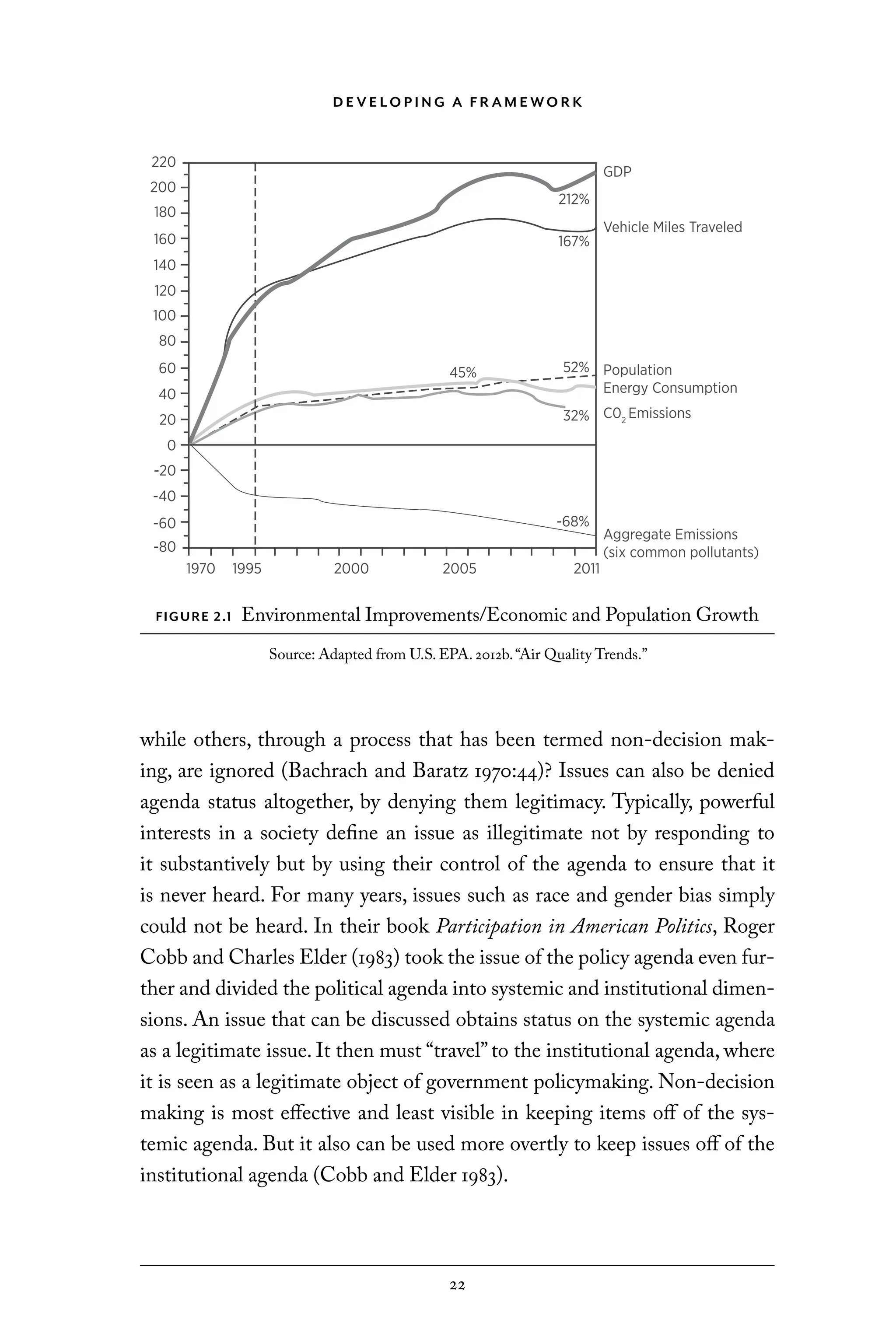
In the United States one result of increased levels of environmental
concern and literacy has been a series of successful efforts to protect the
environment. As EPA data indicate in figure 2.1, pollution in the United
States has decreased dramatically, while population and GDP growth have
continued.
The irrational, nonanalytic decision making and political process in the
United States has brought about a successful reduction in key pollutants.
This does not mean that the environmental problem is solved or has gone
away; rather it means that we are “moving away from the problem.” Al-
though I cannot state it definitively, I believe that the problems of environ-
mental degradation and solid-waste management in the United States are
slightly less severe in 2013 than in 1993. How did we make this progress?
In what type of political process did the United States engage? The envi-
ronment and sustainability management, over time, achieved status on the
political agenda. The definition of environmental politics has changed, but
it has resisted a number of concerted attacks on its legitimacy, and now ap-
pears to be a permanent fixture on the political agenda.
To understand environmental policy one must understand the agenda-
setting process. Why do some issues that reach the agenda get acted on
C6459.indb 21 3/14/14 10:34 AM
44.
D E VE LO P I N G A F R A M E WO R K
22
while others, through a process that has been termed non-decision mak-
ing, are ignored (Bachrach and Baratz 1970:44)? Issues can also be denied
agenda status altogether, by denying them legitimacy. Typically, powerful
interests in a society define an issue as illegitimate not by responding to
it substantively but by using their control of the agenda to ensure that it
is never heard. For many years, issues such as race and gender bias simply
could not be heard. In their book Participation in American Politics, Roger
Cobb and Charles Elder (1983) took the issue of the policy agenda even fur-
ther and divided the political agenda into systemic and institutional dimen-
sions. An issue that can be discussed obtains status on the systemic agenda
as a legitimate issue. It then must “travel”to the institutional agenda, where
it is seen as a legitimate object of government policymaking. Non-decision
making is most effective and least visible in keeping items off of the sys-
temic agenda. But it also can be used more overtly to keep issues off of the
institutional agenda (Cobb and Elder 1983).
FIGURE 2.1 Environmental Improvements/Economic and Population Growth
Source: Adapted from U.S. EPA. 2012b.“Air Quality Trends.”
220
200
180
160
140
120
100
80
60
40
20
0
-20
-40
-60
-80
1970 1995 2000 2005 2011
GDP
212%
167%
45% 52%
32%
-68%
Vehicle Miles Traveled
Population
Energy Consumption
C02
Emissions
Aggregate Emissions
(six common pollutants)
C6459.indb 22 3/14/14 10:34 AM
45.
U N DE R S TA N D I N G T H E E N V I RO N M E N TA L P O L I C Y I S S U E
23
The environment reached the national arena in the United States in sev-
eral stages. Rachel Carson’s Silent Spring (1962) and Barry Commoner’s The
Closing Circle (1971) popularized the concept of a global ecosphere threat-
ened by human economic activity such as the application of pesticides and
nuclear testing.After the 1968 presidential elections,the environment began
to enter the national political agenda in Washington, D.C.
During the 1968 campaign, Maine senator Edmund Muskie carried him-
self so well as a vice-presidential candidate that he was immediately considered
a front-runner for the 1972 presidential nomination of the Democratic Party.
Muskie’s major issue was protecting the environment,and in 1969 and 1970 he
pushed for the passage of an air pollution control act that would set national
standards for ambient air quality (Jones 1975:175–182). Though this idea was
initially opposed by industry, President Nixon came to support a national air
quality bill as a way of countering Muskie’s growing political strength. Nixon
and others also saw the environment as a safer, less contentious issue than the
war in Vietnam. Though some political analysts at the time viewed Nixon’s
support of the environment as a way to distract people from the Vietnam War,
it was an important step on the road to formalizing environmental policy and
one that was introduced through the American political machine.
The U.S. EPA was established during the Nixon administration through
executive order, not through an act of Congress.This, along with the enact-
ment of the 1969 National Environmental Policy Act (NEPA) and the 1970
Clean Air Act (CAA),provided President Nixon with an environmental re-
cord to counter Senator Muskie’s in the 1972 campaign. In the end, Muskie
failed as a presidential candidate, and with a weak challenge from George
McGovern in 1972, Nixon felt confident enough to veto the Federal Wa-
ter Pollution Control Act, which was subsequently enacted over his veto.
Despite Nixon’s action on the water bill, in the 1970s the environment was
typically seen as a foolproof, popular political issue. With the exception of
the early years of Ronald Reagan’s presidency,environmental protection has
continued to be seen as a straightforward issue for politicians. Nowadays,
no politico can afford to be perceived as anti-environmental.
In the late 1970s and early 1980s, conservative Republicans from the
western part of the United States developed an anti-environmental ideology
C6459.indb 23 3/14/14 10:34 AM
46.
D E VE LO P I N G A F R A M E WO R K
24
based on the issue of property rights (Layzer 2002:242). In exchange for
their support of Ronald Reagan’s presidential campaign, they were given
the Department of the Interior (James Watt) and the EPA (Anne Gor-
such, later Burford) to manage.To Reagan’s White House team, these were
relatively unimportant ministries, so they did not pay a great deal of atten-
tion to the selection of the secretary of the interior or the administrator of
the EPA. The appointments were used to repay political debts. Moreover,
Reagan’s senior advisors assumed that popular support for the environment
was diminishing.The environment was no longer appearing on the “top ten
list”of issues cited by the American public as “important”in public opinion
polling.Environmental interest groups recognized the threat to the gains of
the 1970s and organized a campaign of opposition that culminated in the
resignation of Anne Burford and her replacement by William Ruckelshaus,
the first administrator of the EPA (Kraft and Vig 1990:3).
It turned out that the Republican political leadership had misread the
polling data.The environment had become a less pressing issue among vot-
ers because average Americans thought that reasonable progress was being
made to clean up pollution, not because they had lost interest. When it be-
came clear that the leaders of the EPA and the Department of the Interior
were attacking some of the programs that had brought those gains, the en-
vironment’s importance rating in national polls rebounded to levels as high
or higher than in the early 1970s (Mitchell 1984:56). Recognizing that it had
landed on the wrong side of this issue, and with the 1984 presidential elec-
tion approaching, the Reagan administration moderated its views, forced
out some of the most visible right-wing environmental leaders, and allowed
gradual environmental progress to resume.
In the first decade of the twenty-first century,President George W.Bush
also struggled with his image on environmental issues. In early 2002, the
American public was not sure where President Bush stood on environmen-
tal issues. He wasn’t yet defined in the public mind as anti-environment.
Christine Todd Whitman, Bush’s first EPA administrator and former gov-
ernor of New Jersey, was a moderate with a reasonable environmental rec-
ord. Her appointment to the EPA was an indication that the lessons of the
mid-1980s had not been lost on President Bush and his political team. His
C6459.indb 24 3/14/14 10:34 AM
47.
U N DE R S TA N D I N G T H E E N V I RO N M E N TA L P O L I C Y I S S U E
25
second EPA administrator, former Utah governor Michael O. Leavitt, was
also an environmental moderate. His third administrator, Stephen John-
son, was an environmental scientist and a twenty-year veteran of the EPA.
However, by 2003 Bush began to slip into an anti-environmental position.
Indeed, by the end of 2003, George W. Bush had become the most anti-
environmental president since the creation of the EPA. At the start of his
second term, this pattern continued, though he made occasional efforts to
paint himself as an environmentalist. Although his administration came
into office determined to avoid the mistakes that the Reagan administra-
tion had made in environmental policy and politics, they were unable to do
so. From its Clear Skies legislation, which would slow down the national
air cleanup to its Healthy Forests initiative, which would damage the na-
tion’s wildlife and forest ecosystems, the Bush administration engaged in
a series of subtle attacks on the rules regulating protection of the environ-
ment. Congressman Tom Allen of Maine called Clear Skies “a classic case
of chutzpah, a triumph of marketing over substance, if I have ever heard of
one” (2004). Sierra Club president Carl Pope commented that the Healthy
Forests Restoration Act “will certainly succeed in propping up the timber
industry”(Jalonick 2003).The public relations terminology used to describe
these bills, coupled with revelations in 2003 of White House efforts to tone
down the EPA’s warnings about air pollution from the destruction of the
World Trade Center,were examples of the administration’s lack of fervor on
environmental issues.
Not only did the first term of President George W. Bush witness an
effort to reduce the scope of environmental law, it also reduced enforce-
ment of existing laws. On November 5, 2003, the Environmental Protection
Agency dropped investigations into fifty power plants for past violations of
the Clean Air Act, a scaling back that at the time was predicted to reduce
investment in cleanup equipment by between $10 billion and $20 billion.
In response, New York State attorney general Eliot Spitzer, along with a
number of his colleagues in other northeastern states, decided to continue
legal action (without the federal government) to push these utilities to clean
their emissions (Barcott 2004:38). Although most Americans favored the
Bush administration’s environmental stance in 2001 and 2002, support for
C6459.indb 25 3/14/14 10:34 AM
48.
D E VE LO P I N G A F R A M E WO R K
26
its environmental leadership fell to 44 percent in April of 2003 and contin-
ued to decline, to 41 percent in 2004 and 39 percent in 2005 (Gallup Orga-
nization 2005a, b, c).
The environment’s political power tends to lie dormant as long as the
public perceives that leaders are serious about promoting pro-environmen-
tal policies. However, once a leader is no longer credible on the environ-
ment, the issue gains in urgency and importance, and can rise in national
polls.The controversy over both Utah governor Michael Leavitt’s 2003 and
Stephen Johnson’s 2005 nominations as EPA administrator was a reflec-
tion of the president’s reduced credibility on the environment. Even though
Governor Leavitt was considered an environmental moderate, and Johnson
was a well-regarded environmental professional, Democrats and environ-
mentalists delayed their appointments as a way of focusing attention on the
administration’s weak environmental record (Stout 2005).
The Obama administration focused less on pure environmental protec-
tion regulation and more on the transition to a sustainable,renewable econ-
omy through vehicle emissions policy, climate regulation, and funding of
renewable energy projects. On January 27, 2009, President Obama directed
the Environmental Protection Agency to allow individual states to set
stricter tailpipe emissions regulations than the federal standard.The Obama
administration finalized standards in August 2012 that will increase fuel
economy to the equivalent of 54.5 miles per gallon for cars and light-duty
trucks by model year 2025. Previous standards set by the Obama adminis-
tration raised average fuel efficiency by 2016 to the equivalent of 35.5 miles
per gallon. Obama signed H.R. 1, the American Recovery and Reinvest-
ment Act (ARRA) of 2009, into law on February 17, 2009, which provided
$54 billion in funds to encourage domestic renewable energy production,
make federal buildings more energy-efficient, improve the electricity grid,
repair public housing, and weatherize modest-income homes.
Environmental issues do not typically decide elections because most
people assume that just as all elected leaders promote security and safety,
they also promote environmental protection. The need to breathe clean air
and drink safe water isn’t politically controversial. Political analysts often
confuse the lack of passion behind the issue with a lack of public interest
C6459.indb 26 3/14/14 10:34 AM
49.
U N DE R S TA N D I N G T H E E N V I RO N M E N TA L P O L I C Y I S S U E
27
or concern. That is a mistake. I find that more and more people born since
the mid-1980s have internalized aspects of an environmental ethos,and that
awareness will soon have a major impact on American politics. While Gal-
lup continues to poll on what I consider the false trade-off between eco-
nomic growth and environmental protection, even its data report growing
environmental awareness, especially among young people.
A recent Gallup poll reported: “For the fifth consecutive year, more
Americans are interested in protecting economic growth than in protect-
ing the environment when the two goals are at odds.This year’s 48% to 43%
split represents a relatively narrow advantage for the economy,similar to last
year’s reading. But the latest result contrasts with 2011, when a record-high
54% chose the economy as the higher priority.”
The item is based on a false premise, asking survey respondents to re-
act to this question: “With which one of the following statements do you
most agree? Protection of the environment should be given priority, even at
the risk of curbing economic growth; or, economic growth should be given
priority, even if the environment suffers to some extent.”The connection of
environmental quality to economic growth, a central tenet of the concept of
sustainability management, is ignored by this question. Environmental pro-
tection is not something you must sacrifice for economic growth; it is a key
source of economic growth. This is a lesson that China is rapidly learning,
and that some Americans learned when we spent hundreds of billions on
toxic waste cleanup.When the environment suffers,it costs money when we
eventually get around to cleaning up the damage. If we hadn’t damaged it
in the first place, the money devoted to cleanup could have been used to do
something else. Moreover, essential environmental resources such as air and
water cannot be used once they are poisoned. If these resources are dam-
aged, they must be filtered before they are used, and the cleansing process
requires a lot of energy and money.The Gallup poll question treats the “en-
vironment” as if it’s a visitor from outer space, instead of the air, water, and
soil that human beings require to remain alive. While short-run corporate
profits can be made by exploiting natural resources, real economic growth
requires high environmental quality to both attract investment and keep our
food and water prices affordable.
C6459.indb 27 3/14/14 10:34 AM
50.
D E VE LO P I N G A F R A M E WO R K
28
It is clear from the Gallup data that when the economy is doing well,
more people favor breathing healthy air and drinking clean water.When the
economy falters, people favor economic growth over just about anything.
Until the economic crash of 2008, Americans always favored “environment”
when asked this question.The trade-off choice was just as false then,but the
response to the poll is certainly statistically valid and is an accurate measure
of the public’s response to the question.
While Americans are willing to trade off the environment for economic
growth, the response to this flawed question varies significantly by age.
Young people, between the ages of eighteen and twenty-nine, favor the en-
vironment over economic growth by 49 percent to 45 percent.As Americans
age, they increasingly select the economy over the environment, with the
oldest Americans, those sixty-five and older, favoring economic growth by
53 percent to 37 percent.
Gallup has also polled about government’s role in protecting the envi-
ronment, and has found that “Americans tilt toward the view that the gov-
ernment is doing too little to protect the environment—at 47%—while 16%
say it is doing too much. Another 35% say the government’s efforts on the
environment are about right. These views have not changed much since
2010, although Americans in most years between 1992 and 2006 were more
likely than they are today to say the government was doing too little to pro-
tect the environment.”
While the responses still indicate that average Americans would like to
see a stronger government role in protecting the environment, it is not clear
if the question is measuring attitudes toward environmental protection or
attitudes toward government.The poll reports that 27 percent of all Repub-
licans believe that government is doing too much to protect the environ-
ment as compared to 2 percent of all Democrats. I suspect that this poll
would find a similar gap between the parties on the role of government in
many areas of public policy.
In my view, the questions posed by Gallup are not tapping into the
change that is under way. My sense is that many young people have a deep
fear that the planet they will inherit from the rest of us may be damaged
beyond repair. They do not necessarily see its repair as a function of gov-
C6459.indb 28 3/14/14 10:34 AM
51.
U N DE R S TA N D I N G T H E E N V I RO N M E N TA L P O L I C Y I S S U E
29
ernment, especially our national government. Instead, they are looking for
change at the community and municipal level. The fact that young people
are moving away from suburbs and back to cities is in part a rejection of a
lifestyle that they suspect may not be sustainable.The cars, lawns, and costs
of cooling and heating large suburban homes are replaced by biking, walk-
ing, mass transit, and smaller apartments where heating and cooling costs
tend to be lower.
This is not to say that young Americans are rejecting consumption—far
from it—but they are looking to consume in a different way. These emerg-
ing consumption patterns reflect their concerns about environmental sus-
tainability. The growing number of people biking to work and shopping
at local green markets is an indicator of this change. The number of cities,
nonprofits, and corporations engaged in sustainability initiatives is another
indicator. People and institutions are thinking about their use of natural re-
sources and energy and the impact of their consumption on the planet.That
trend is most pronounced among young people, and that social change will
gain momentum as they age.
The generation that grew up in the first part of the twenty-first century
will be coming to power in the coming decades.They have grown up with a
concern about the sustainability of our economy and the health of our eco-
system.The issue of environment and sustainability has already moved from
the fringe of political awareness and our policy agenda to its center. In the
next decade, this will only increase as the sustainability generation comes of
age. Public support for environmental protection runs deep in this country,
cutting across every demographic category (Gallup Organization 2005a,b,c).
Nevertheless,climate change as an issue was largely absent from the 2012
presidential election until Hurricane Sandy hit the Northeast. President
Obama stopped campaigning to head the federal emergency response, and
Romney halted his campaign shortly after and encouraged donors to do-
nate to the Red Cross. Though this may have become a last-minute issue
during the 2012 election, the focus was more on disaster response than on
environmental protection.
Nonetheless, as long as the public sees good-faith progress in environ-
mental protection, the issue does not generate much political heat beyond
C6459.indb 29 3/14/14 10:34 AM
52.
D E VE LO P I N G A F R A M E WO R K
30
the environmental community. Issues such as police protection and educa-
tion act in the same way. Key values such as education, police protection,
and environmental protection are nonissues until the public perceives that
they are threatened. When that happens, however, the political reaction is
rapid and sweeping.
An oddity of President Bush’s approach to environmental issues was that
it reflected an antiquated understanding of the environment. This is the
notion at the heart of the Gallup poll question trading off environmental
protection against economic growth. There is a relationship between envi-
ronmental quality and economic growth, but it is not a trade-off relation-
ship.We are learning that economic growth depends on environmental qual-
ity: the return on investments in environmental quality pays off. Sound and
sustainable economic development requires the maintenance or restoration
of environmental quality. A study published by the Office of Management
and Budget in 2012 estimated that from 2001 to 2011 we spent $23 billion to
$29 billion to clean up our air, resulting in net benefits valued at between
$85 billion and $565 billion for that investment (OMB 2012:12). Investments
in sewage treatment have increased the value of waterfront property all over
the United States. The funds given to upstate property owners to reduce
pollution near New York City’s reservoirs have saved the city $6–$10 billion
that it would have had to spend on a water filtration plant (Helhoski 2009).
Popular support for protecting environmental quality is the basis for the
issue’s political strength. The importance of environmental protection has
been the subject of massive educational and propaganda efforts by scientists,
advocates, the media, and professional educators. Though respect for prop-
erty rights remains strong in the American political culture,especially in the
western states, support for environmental protection frequently dominates
concern for property rights. Interestingly, one source of political strength
for environmental protection is the perception that pollution can diminish
the value of private property. In this respect, high environmental quality is a
form of property or wealth.This did not happen overnight and is arguably a
result of the high level of economic wealth in the United States.Our wealth
permits consumption of beach homes, country homes, suburban living and
vacations in national parks and rural areas—“goods” that would be dimin-
C6459.indb 30 3/14/14 10:34 AM
53.
U N DE R S TA N D I N G T H E E N V I RO N M E N TA L P O L I C Y I S S U E
31
ished by environmental degradation. Maintaining that level of consump-
tion requires the maintenance of environmental quality.
Despite support for curbing the pollution of others, not all consumption
patterns in the United States provide behavioral evidence of support for
protecting the environment.The increased average weight of the American
automobile is an example of behavior that does not promote environmental
protection. Nevertheless, the popular consensus for protecting the environ-
ment is strong across regional, racial, and socioeconomic categories (Mohai
and Bryant 1998:475). Clearly, this type of consensus facilitates social learn-
ing about the environment, eventually leading to effective policymaking.
An important dimension of the environmental problem is its status as a
political issue. This involves its presence on the political agenda as a prob-
lem appropriate to collective societal action.
APPLYING THE P OLITICAL DIMENSION OF THE FRAMEWORK
As the preceding discussion indicates,an issue becomes a public policy issue
only when it becomes part of a political process. How the issue is defined,
how it enters the political agenda, and the views of its key stakeholders de-
termine the issue’s definition. Once again, to apply this dimension, there
are a number of questions to pose, many of which are unanswerable but
essential:
• What is the agenda status of this issue?
• What is the issue’s degree of legitimacy?
• What role has the issue played in electoral politics?
• Who are the political stakeholders involved in this issue? What is the na-
ture and style of their participation? How important is the issue to these
stakeholders?
• Who are the potential winners and losers in the political competition
around this issue? Who have been the winners and losers to date, and how
are political victory and loss defined in this issue area?
• To what degree are stakeholders willing to discuss and compromise on this
issue?
C6459.indb 31 3/14/14 10:34 AM
54.
D E VE LO P I N G A F R A M E WO R K
32
• Does this issue act independently of other political issues or does it cluster
with other key issues?2
• In the U.S. context, what level of government is considered primarily re-
sponsible for addressing this issue (state, federal, or local)?
• What is the level of controversy and consensus around this issue? What
are the areas of agreement and disagreement?
• How does scientific certainty or uncertainty related to the definition of the
problem or its potential solution influence the politics of this issue?
The political definition of the issue is critical in shaping how the issue is
framed and ultimately addressed. For example, a nuclear power plant could
be seen as a source of vital electric energy, as a terrorist target, as a source
of potential contamination from a meltdown, or as a source of a difficult-
to-discard waste product. It could also be seen as a combination of some or
all of those factors.The early part of a political controversy is often a strug-
gle over the definition of the issue. That definition will shape the way the
problem is perceived and will set the boundaries for the problem’s solution.
This definition will persist, often in the face of new scientific information,
changed context, and changed behavior. Understanding an environmental
policy issue requires a careful and sophisticated analysis of the issue’s politi-
cal dimension.
SCIENCE, TECHNOLOGY, AND THE ENVIRONMENT
Much of the progress we have made in protecting the environment has
been the result of the development and implementation of technological
fixes to environmental problems.We reduce air pollution by utilizing newly
developed environmental controls such as catalytic converters on autos and
scrubbers on electrical power plants. We treat sewage before dumping it
into waterways. In sum, we use science to fix the mess that science helped
make. The question is can we solve problems as quickly as we create them?
Thus far, the answer to that question is no. The question then becomes can
we fix the most pressing problems fast enough to maintain a habitable en-
C6459.indb 32 3/14/14 10:34 AM
that her waywardboy, if he had started on a worthy road, should
manage at his very first step to get in her way.
Her will was strong and shrewd. When later that night she was alone
with her husband, she opened the subject.
"Kathleen tells me Edgar has taken up serious work with his voice."
"Kathleen is optimistic," was the laconic reply.
"I think, Henry, we ought to meet him half-way in any honourable
undertaking."
Mr. Fabian made an inarticulate exclamation. He was thinking of the
bill Kathleen had placed in his hands before she left him to-night.
"I can't think," proceeded Mrs. Fabian, "that anything but a high
sense of duty would induce anybody to make the blood-curdling
noises that I've heard lately from Edgar's room."
A short silence; then Mrs. Fabian spoke again. "It seems he cannot
go any longer to the place where he has done his practising. I'm
afraid if he should work evenings here, it might annoy you, Henry."
"I dare say it might," agreed the weary man, with an involuntary
sigh.
"I was thinking that if he is not very busy at the office—"
"Very busy!" The father threw back his head.
"You might give him a longer vacation"—
"Edgar's whole life is a vacation," said Mr. Fabian.
"And let him go with us to the island. If he is really going to make
music his lifework he could practise regularly there and be away
from temptations, and—"
Mr. Fabian slowly faced his wife with such attention that she paused
hopefully, then went on:—
"You know Philip Sidney is going with me, and his companionship
would be so good for Edgar."
57.
"It's a brightthought, my dear," said Mr. Fabian. "The office will be
able to struggle along without Edgar, and then we can close the
house and I can live at the club."
"Not too long," said his wife, so pleased at her sudden success that
she put her arms around his neck and kissed him. "Not too long,
Henry. You must take a long vacation this year."
He returned her caress. "One day at a time," he said briefly.
Mrs. Fabian sought her pillow, well-pleased; and contrary to her
habit, she was up betimes next morning, and hastened to her son's
room before he came down to breakfast.
"Can I come in?" she asked, knocking.
Edgar was in his shirt-sleeves adjusting his tie; and when he opened
the door and saw his mother, he gave an exclamation.
"What's the matter?" he asked. "Too hot to sleep?"
A cloudless sun was promising another day with a soaring
thermometer.
Mrs. Fabian noted the hard questioning in her boy's eyes. She knew
he considered her his father's aid in denying him the right to spend
as a millionaire's son should—knew that his attitude toward her had
long been defensive; and that her unusual visit to his room roused
only his suspicion of something disagreeable.
"Do you mind if I come in, dear?" she asked, her soft silks trailing
noiselessly as she moved across the room. "I am so interested in
what I hear about your music."
Edgar was silent, continuing to busy himself with his tie. He knew
his stepmother too well to believe that she had risen with the lark to
felicitate him on his last venture. He took up the ivory military
brushes she had given him and began to use them vigorously. He
was still smarting from the scene of the night before and he braced
himself for a homily on the subject of his music bill.
58.
"I've never believedin thwarting a child's bent," said Mrs. Fabian,
flicking the ashes from a chair to make it fit to sit upon. "I said to
Philip Sidney's mother, 'let him paint.' I said to your father last night
when I heard all this, 'let Edgar sing.'"
Mrs. Fabian paused to allow her breadth of view to sink in. Edgar
glanced around at her sulkily, from his mirror, and then looked back
again.
"Now, you have no taste for commercial life, dear, why waste more
time in it at present until you see what the artistic line holds for
you?"
Edgar glanced back at the speaker again quickly. What was the
"nigger in the fence"? Her face looked innocently out at him from a
becoming boudoir cap.
"And I suggested to your father that he let your vacation start earlier
and that you come with us to the island next Wednesday. You are
going to work for a time anyway without your teacher, and this hot
atmosphere must be so relaxing to the throat. There it is pure and
bracing and you can lay out your course of study and be
undisturbed."
Edgar regarded the speaker with some interest now, but still
questioning.
"Father thinks, then, we could close the house and he would live at
the club."
Edgar tossed his head, raised his eyebrows, and proceeded to put on
his coat.
"You want to close the house. That's it," he said.
"Don't you think it would be a good plan?" asked Mrs. Fabian
ingratiatingly.
All Edgar's cynicism was not proof against allowing some satisfaction
to appear in the prospect of leaving the office routine and pursuing
the line of work which had genuinely captured his interest.
59.
"Yes, I don'tmind," he answered. "Kath going with you?"
"Yes, and Philip Sidney,—just for a short visit."
Edgar shrugged his shoulders.
"You can imagine the heat of that stable room," suggested Mrs.
Fabian.
"Tophet, I suppose," agreed Edgar. "All right. I'll go." The even teeth
had been set many times since last evening in the prospect of a
tête-à-tête existence with his father.
"I wish we might go on all together, but, of course, not knowing, I
didn't engage a berth for you."
"I'll go on the day train," responded Edgar; adding with his
customary grace, "I never was keen for travelling in caravans
anyway."
Mrs. Fabian was not critical of his rudeness. She was too pleased at
having gained her end, and soon floated away to Kathleen's room,
her next strategic point.
She found her daughter propped up in bed with coffee and toast on
a table before her.
"Good morning, mother, you put me to shame," said the girl. "Didn't
you sleep either? This is early for you."
"Poor child," said Mrs. Fabian, seating herself on the foot of the bed
and observing the rings around the other's eyes. "Yes, I slept pretty
well, but not until after your father and I had had a long talk."
Kathleen scrutinized her mother's complacent countenance and
made up her mind that the talk could not have concerned business.
"I told him how sure I felt that Edgar was in earnest now, and we
both concluded it was time wasted to try any longer to fit a square
peg into a round hole, so your father is going to let the boy go to
the island at once with us and work at his voice there, away from
temptations."
60.
"Oh, how fine!"breathed Kathleen. "Then," she added aloud, "he
will entertain Mr. Sidney in my place, and I can stay with father."
"That's an absurd idea and you know it. Philip and Edgar would get
along like two tigers. You can see that I need you more than ever to
reconcile them."
Kathleen's face did not look encouraging. She longed to tell her
mother of her father's straits, but her lips were sealed.
"Besides," added Mrs. Fabian, with the conscious power of one who
plays the last trump, "one reason your father wishes to dispense
with Edgar is that he wants to close the house and live at the club."
Kathleen's face fell and her eyes looked away.
"You see he'll come to us all the sooner, dear," said her mother. "Men
talk about enjoying living at the club, but when they are happy
family men they tire of it very soon."
The girl smiled faintly. "We have been something of a 'happy family'
lately," she said; "but if Edgar really turns over a new leaf—"
"Oh, he has!" declared Mrs. Fabian. "I'm glad to remember that the
outdoors is large at Brewster's. I suspect he will nearly drive us
crazy, but one must exercise some self-sacrifice in this world." She
rose. "Take another nap if you can, Kathleen. I'm thankful the island
is so near for you. You're completely tired out."
But Kathleen did not take another nap. She dressed very soon, and,
pleading a desire for fresh air, left the house. She did not ask for the
machine lest her mother should offer to accompany her, but
descended in all her dainty whiteness into the subway and started
for Wall Street. Arrived at the labyrinth of offices where daily Mr.
Fabian struggled and Edgar endured, she dreaded meeting her
brother, but she saw nothing of him, and waited in an ante-room,
looking about her with a swelling heart. How little part she and her
mother had ever had in the heavy responsibilities of her father's life.
She doubted if her mother came here twice a year, and when she
did it was simply to obtain money.
61.
She had notlong to wait, for Mr. Fabian himself opened the door of
his private office, and the clerk passing out saw him stoop and kiss
the girl in the large hat strewn with lilacs.
"What brings you, my dear?" he asked, his brows knitting anxiously.
She smiled and clung to his hand as they moved inside. "You're pale,
Kathleen. Off to the island with you, child. Off to the island."
"That's just what I came about," she answered, taking the chair he
set for her, and the electric fan whirring above her head carried the
scent of orris to her father. "I would so much rather stay with you. I
came to urge you to let me."
He regarded her with eyes full of affection and gave a short laugh.
"I frightened you last night," he said. "Perhaps I did wrong."
"No, no, you didn't. Mother told me the plan to let Edgar go. That is
right. Edgar can't be a comfort to you; but I can, father. Don't shut
up the house. Let me stay with you till you are ready to go."
Mr. Fabian nodded, his eyes fixed upon the sensitive face with its
beseeching eyes.
"You're a good girl, Kathleen. You are a comfort to me, whether
we're together or not; and just now it will be an advantage to me to
live close to my associates at the club. Go without anxiety, child. I
promise to keep you advised of everything important."
The troubled eyes did not leave his face.
"Don't exaggerate what I said last night. I am not going to make any
spectacular failure, but I have my own ideas of equity and I'm not
going to wriggle out on a technicality. My course may lose me
friends as well as money; but I've got to live with myself, and there
are some memories I don't propose to entertain. Your mother has
always been moderate in her demands, she has never shared the
insane ambitions of some of her acquaintances; but her toys are
very dear to her and I hate to curtail them. It looks as if I might
have to."
62.
"It might bethe making of Edgar," said Kathleen.
Her father regarded her in silent admiration. It was evident that her
own part in the loss had not occurred to her.
"Your mother's unselfishness in keeping the island summer home,
because I like its simplicity, makes this season's problem easy. By
autumn I shall know the worst."
"How I would like to stay with you right along until everything is
settled," said Kathleen fervently. "I want to be sure that you know
how happy I should be in it. I keep so busy with my slides and
microscope, and then—there's something else I do." Kathleen
colored consciously. "I meant not to tell any one yet, but,—I write a
little!"
"Stories, you mean?"
The girl nodded. "It is nothing, it may never amount to anything; but
the microscope suggested it to me. There is such a great world that
we never enter or think about. So you can see how happy I should
be in our big, cool house, and not a bit lonely,—if you'll only have
me."
"I believe you, Kathleen, but it wouldn't work, dear. I could be at
home so little, and I'd like to cut off the expense of the house."
"Oh, oh! Is it so bad as that?"
"No, not nearly so bad; but in time of peace, prepare for war."
"Then mother had better not take her usual weeks at a resort."
Mr. Fabian raised his eyebrows. "How else is the dear lady to exhibit
her summer toilets? The fish at the island are so unappreciative."
"Don't keep things from mother," pleaded Kathleen.
"I promise not to when there is anything to tell. I was weak enough
to think out loud with you. Now, run along, my child."
"Oh, father, always be weak enough to think out loud with me. Will
you?" He had risen and she did so reluctantly.
63.
He crushed hertrim whiteness in his arms, and kissed her. "Don't
make me sorry, then. Don't cross any bridge until you come to it.
Promise."
She smiled up at him bravely. "I promise," she said, and left the
office with a wistful backward look at him standing there, his eyes
following her.
64.
CHAPTER XVIII
CASCO BAY
Pat'sbenevolent heart swelled with satisfaction when, a few
evenings later, Philip ran down the stable stairs, his packed suitcase
in hand.
"Wish you were going along," said the artist, meeting the Irishman's
approving gaze.
"I will as soon as ye need a valet," was the reply. "Ye think I can't
put on style!" Pat winked and shook his head knowingly. "Ye'd burst
wid pride if ye saw me fixed up and waitin' on ye."
"I haven't a doubt of it. Well, so long. It will be only a few nights
before I shall be back, sizzling with you again." And Phil gave the
man a smiling nod and went out of the door, almost running into the
arms of Mrs. Fabian, who, in the trimmest of cool grey travelling
gowns, was looking askance at a spring and mattress outside the
barn door.
Pat aghast, hastened to button the open throat of his shirt. "The
Queen o' Sheby," he muttered.
"Why, did I keep you waiting, Aunt Isabel?" asked Phil, with
contrition. "I was planning to be out in front in plenty of time."
"Yes, it is early, but I wanted to speak to your man a minute."
Pat bowed in the direction of the voluminous grey chiffon veil. "You
may go out and join Kathleen," Mrs. Fabian added.
"Dear me, nothing private, I hope," said Phil, vastly amused by the
conflicting emotions on the Irishman's face.
65.
"Have you seento putting your evening clothes away?" asked Mrs.
Fabian.
"Why—why, they're hanging up there in the closet."
"Just what I expected. Run along, and I'll tell this good man what to
do."
Phil gave Pat one humorous glance and obeyed, passing out toward
the street where he soon saw Kathleen in the waiting car, her hat
tied down by a roseate veil.
Mrs. Fabian at once accosted Pat. "Could you pack up Mr. Sidney's
belongings and send them after him, if we ask you?"
"I could, mum, but 'tis only a week he'll be away."
"He wouldn't want his evening clothes. Do you know what a moth-
bag is?"
"I do not, thin."
"Well, go to the store and ask, please. Brush Mr. Sidney's evening
clothes thoroughly and put them in the bag, seal it up tight, and
hang it in the closet. The careless boy. That's what comes of always
having had a mother."
"Lot's o' folks is jist that careless," remarked Pat. He was beginning
to feel that even a queen, if she invaded his own vine and fig tree,
might be a little less peremptory.
"You may send everything else, except of course his winter overcoat.
By the way, you may get another moth-bag for that, and treat it in
the same manner."
"He'll not be stayin', mum. He's all for work."
"Has he been sleeping out here on these hot stones?" demanded
Mrs. Fabian, with dilating nostrils, looking at the mattress.
"No, mum, he usually took the bed," responded the Irishman.
"Well, you've carried his upstairs, I see."
66.
"I'll have tobreak it to ye that he did it himself," said the man.
Mrs. Fabian ignored his manner. Her thought was filled with Philip's
situation.
"Well, here," she said, with a preoccupied air, and, taking a bill from
the fine-mesh purse which hung from her wrist, she held it out to
the Irishman. "Take this and do what I've asked you. You needn't
prepay the trunk if you send it. Keep the change, and I hope the
heat here won't grow any worse. Good-bye." And Mrs. Fabian turned
on her heel and the grey chiffon floated away up the alley.
Pat looked at the five-dollar bill he held and tossed his head. "Who is
that bye," he muttered, "and will he iver live in the stable ag'in?"
Suddenly, bethinking himself that he might see the grand departure
of his lodger, he hurried out to the street, and was in time to see
Phil's straw hat loom amid a confusion of grey and rosy streaming
veils.
"Sure, 'tis only the rich enjoys this life," he thought good-naturedly,
and unbuttoning his neckband again, he returned to his palm-leaf
fan.
As the motor flew breezily through the hot city streets, Philip gave
himself up to the pleasure of his outing. Mrs. Fabian regarded him
with supreme satisfaction, and Kathleen, though a little heartsore
from parting with her father, dared not indulge in a pensive moment,
knowing that her mother would pounce upon it alertly and later
reproach her.
They passed the evening in the stateroom of the flying train, and
Mrs. Fabian narrated with much dignity the tale of Edgar's retirement
from commercial life in favor of the arts. Philip pricked up his ears
when he learned that the heir of the house was expected at the
island at once.
Kathleen was not obliged to talk much, and at last they all ceased
fanning themselves and shouting remarks against the clatter of the
open windows, and retired.
67.
After breakfast thefollowing morning, as they entered a carriage to
cross Portland, Kathleen nodded at Philip.
"Say good-bye to heat," she remarked.
"Hard to believe," returned the Westerner, who had tried to refrain
from talking of his native mountains. His thoughts often travelled
back even to the stable studio where certain work begun stood
awaiting his return; but soon after they entered the boat for the
island, he began to see Kathleen's words fulfilled. The ladies
wrapped themselves in heavy coats and Mrs. Fabian begged Phil to
put on his sweater; but he held his hat in his hand and declared his
desire to be chilled to the bone.
As they pulled out past the near islands into wide spaces of sea,
interest slowly grew in Phil's eyes. His comments grew less frequent,
and finally stopped. The islands rose tree-crowned from the water,
casting deep green reflections at their feet. Phil took a notebook
from his pocket, and occasionally asking the name of an island, he
wrote it in the book. Kathleen, understanding his intent, and
knowing that he would not fulfil it because of greater satisfaction
further on, smiled at her mother.
"What did I tell you?" she asked.
"Well, what did you?"
"That he wouldn't know whether I was here or not."
"Sh—!"
"He can't hear me any more than if he were anæsthetized."
"Hush, Kathleen."
"I'll prove it." She raised her voice. "Mr. Sidney!"
Phil not only did not reply, but after a moment more he moved away
to another and more unobstructed spot.
Kathleen gave a low laugh and Mrs. Fabian looked pleased.
68.
"He is enjoyingit, isn't he?" she returned. "This day is a wonderful
bit of good fortune. First impressions are so important. What made
you expect him to behave like this?"
"I think I must have a groping, artistic sense myself. At any rate, I
knew what Casco Bay must do to an artist when he comes upon it
all unprepared."
Mrs. Fabian sighed. "Well, I'm glad our coming here does somebody
some good. Are you going on forever calling that boy 'Mr.'? Of
course, he can't be informal with you unless you will be so with
him."
"Mother dear, I tell you it doesn't matter," laughed the girl. "He has
gone into a trance and he probably won't come out of it till the first
fog. By that time, perhaps I shall feel entirely informal."
Captain James stood on the pier when the boat approached
Brewster's Island. Kathleen caught sight of him and waved her
handkerchief.
"Mother, it's time to go and make passes over Philip," she said. "He'll
have to wake up."
Mrs. Fabian went to the guest and touched him on the arm. For an
hour and a half he had not addressed them.
He started.
"We're there, Phil," she said.
He followed her, and glanced at Kathleen with a sensation of guilt.
He seized the bags with an alacrity intended to offset his
preoccupation.
"It's a wonderful bay," he said.
Kathleen was not regarding him. She was leaning over the rail,
waving again toward a tall lean man on the wharf, who smiled, well-
pleased, and jerked his head in her direction.
69.
Soon many passengerswere streaming up the gangplank, and in a
minute Kathleen was greeting the tall lean man with a gayety Phil
had never before seen in her demeanor.
Mrs. Fabian next shook hands with him, and introduced Phil, who, in
the confusion and limitations of the commonplace wharf, had quite
regained his normal alertness.
"You gave us a very nice day, Cap'n James," said Mrs. Fabian
graciously. "Where's the carriage?"
"Waitin'. Can't take you all, I'm afraid. Mrs. Frick from down-along
engaged me ahead."
"Ahead of us?" inquired Mrs. Fabian superbly.
"Got one seat," said Captain James. He was accustomed to Mrs.
Fabian's autocracy.
"That's all we want," said Kathleen. "Mr. Sidney and I will walk up."
So Mrs. Fabian and the bags were stowed in the carriage and the
young people were started on their walk before Tom had turned
heavily into the road.
"What air!" exclaimed Phil, as they struck into the deep grass.
"One can live on it," agreed the girl.
"Don't expect me to; I feel wonderful pangs already. Gramercy Park
had nearly cured me of eating."
He smiled down at his companion in the roseate veil tied under her
chin, and she glanced up at the city pallor of his face. "I should think
it might," she agreed. "Wait a week. We shall both look like
tomatoes and feel like disembodied spirits."
"I'm afraid I behaved like the latter, coming down the bay; but really
I forgot everything. I want to study the boat-tables and go back to
some of those wonderful shores."
Kathleen smiled demurely. "This doesn't cut much of a figure by
contrast, does it?" she said.
70.
They were crossingdiagonally through a green field which led gently
up to the island road.
"It's beautifully fresh here," replied Phil politely, looking about the
bare treeless expanse rolling up to a bluff against illimitable sky.
A village store upon the road, a little school-house and a cottage or
two, were all that was to be seen.
Above, on Mrs. Wright's doorstep, Eliza Brewster was standing,
opera glass in hand, watching the tall figure and the rosy veil coming
up through the field. She had restrained herself from running down
to the road, for she dreaded Mrs. Fabian, and Phil for the moment
had forgotten that Eliza might be in the neighborhood. His eyes
brightened as they reached the road. He had been privately
wondering why the Fabians had chosen this unpromising island as
their abiding place. Now he caught sight of the spreading cove, its
brilliant banks dark with evergreen trees, while in sheltered spots
maples and birches stood amid a riot of shrubs inviting the birds.
"That's a fine cove," he said, his eyes fixed on the far reaches of the
sea.
"So the yachtsmen think," returned Kathleen.
"Let's look at it a minute," said Phil.
The girl paused obediently and a smile touched the corners of her
lips. Phil's impersonality with regard to herself was novel; for
Kathleen had the intangible quality called charm to such a degree
that nothing masculine had ever before been able to approach so
near to her without striving to win her favor.
From that first Sunday in the stable studio she had perceived that if
she were going to see more of this new factor in the family circle
she must do the striving if she were to become a factor to him. A
dread that she might desire to do this had beset her ever since, and
warned her away from him with a sense of self-preservation.
He stood forgetful of her now, and narrowed his eyes to the picture.
71.
"Well, have youlooked enough?" she asked. "How are the pangs?"
"Yes, yes," he replied hurriedly. "I can come back."
"Certainly, we promise not to lock you up," she answered, half-
laughing. "We'll get better views of it, too, as we go on," she added,
and turned at a right angle into a green ribbon road leading up a
second incline.
Phil looked about vaguely, and followed her. He noticed on the crest
above them a cottage of boulders and shingles.
"Yours?" he asked.
"Home, sweet home," she answered.
Captain James passed them now with his load, and by the time they
reached the cottage, Mrs. Fabian was on the steps to welcome
them; but Philip was absorbed in the surprise which the summit of
that hill gave the newcomer. Before him, but a few rods away,
spread the Atlantic, foaming at the foot of the bluff. Distant islands
came near in the crystal air, their outline defined by rocks, which in
the distance seemed ribbons of sandy beach. The superb breadth of
view, ending either in the horizon or in the irregular skyline of the
mainland, took the breath of the unfamiliar.
Mrs. Fabian straightened with pleasure in the spellbound look of her
guest as, his hat dropped upon the grass, he gazed in silence. It was
her island and her view. She started to speak, but Kathleen touched
her finger to her lips with a suggestive smile; so the lady sank
instead into a hammock chair. Her maid Molly came out of the
house, greeted the ladies and carried in their bags, saying that
dinner would be served whenever they were ready.
Philip, from his stand below on the grass, turned and looked up at
them, his eyes dark with the blue of the sea.
"I understand now," he said, "why you haven't talked about it."
"Come in and have something to eat," suggested his exultant
hostess. "We have noon dinner. Kathleen simply refuses to shorten
72.
the day witha long evening meal."
Philip gave the girl a brilliant smile of appreciation.
"After dinner," went on Mrs. Fabian, "Kathleen will take you to walk
to some of our pretty places."
"No, indeed," said the girl hastily. "I understand just how Mr. Sidney
will love to explore for himself. I wouldn't spoil his surprises."
Philip said nothing to the contrary. His thoughts were absorbed
taking mental stock of the materials he had brought, and he
followed mechanically into the charming cottage whose every
window framed a water scene, waves creaming upon the rocks
which stretched granite fingers unceasingly to grasp them, while
unceasingly they slipped away.
As soon as Phil reached his room he threw open his suitcase with
feverish haste and examined all the sketching paraphernalia he had
packed so hastily.
The music box which called to meals played all its tunes, but the
guest did not appear. At last Mrs. Fabian sent Molly to knock on his
door.
"What a wonderful day," she said to Kathleen when they were alone,
"and in June one is so likely to strike fog and rain. Now let it come.
He has seen what Brewster's Island really is—or he will see when
you have taken him about this afternoon. The only drawback to the
whole trip so far has been your refusal to do that. How could you be
so abrupt, my dear?"
"Mother, don't try to manage an artist," replied the girl emphatically.
"He will want only to be let alone. Can't you see it? And so do I."
Kathleen looked remarkably defiant. "I want to be let alone. This is
my vacation, too, remember. I have worked as hard as he has."
Mrs. Fabian met her child's determined regard with surprise.
Kathleen did look pale and thin, now that she had time to observe it.
The heat of the train last night had not been conducive to sleep.
73.
"Very well, dear,"she acquiesced with meekness. "Perhaps you
ought to lie down this afternoon. I'm sure I shall. I'd like the very
waves to be still."
As she spoke the last word, Philip appeared and they sat down at
table. The combination of the air and the delicious fresh sea-food to
one long unaccustomed to home fare made the guest suspend all
artistic calculations and do such justice to the dinner that Mrs.
Fabian sighed.
"It is such a satisfaction to have a man's appetite at the table," she
said, when Phil made laughing apology and referred to the city
restaurants. "To-morrow we shall have two men."
"To be sure," thought Phil. These were Edgar's mother and sister
and home. Somehow he could not fit the blasé society man into this
Arcadia. He must make the most of to-day.
As his hunger wore away he looked more and more from the
windows. The dining-room might have been on a ship for the
freedom of its vast sea views. When they rose from the table, he
looked at Kathleen with boyish expectancy.
"Are we going to walk?" he asked.
Mrs. Fabian interposed with the best intentions. "I don't think
Kathleen had better go, after all, Phil," she said. "She is very tired.
She is going to lie down. You won't mind running about this first
afternoon by yourself, I'm sure."
Kathleen saw disappointment and then concern grow in the guest's
face, for he suddenly observed that she was pale.
"Nonsense, I wouldn't think of wasting time lying down," she said
cheerfully. "Wait a few minutes. I'll be downstairs in a jiffy."
Mrs. Fabian watched her as she ran lightly up the stairway.
"Do you think she ought to go?" asked Phil doubtfully.
"Philip," returned his hostess dryly, "don't ask me what I think. If
you ever have a daughter twenty years old and just out of college,
74.
you will findthe safest, wisest course is not to think at all." But she
smiled as she said it; for this time Kathleen's waywardness was not
displeasing.
75.
CHAPTER XIX
FLASHES OFBLUE
When Kathleen ran downstairs a little later, Phil looked at her in
smiling surprise. The elegant Miss Fabian had disappeared. In her
stead was a young girl, shorter by the height of a fashionable boot-
heel, and with braided hair wound around her head, fastened by a
broad bow of black ribbon. Her short, dark-blue skirt reached to her
ankles and a Tam o' Shanter crowned her head.
Phil turned to his hostess. "What a strong family resemblance your
youngest bears to Miss Fabian. I should know she was her sister if I
met her anywhere."
"Yes, this is Kathleen, not Miss Fabian. Don't forget it. When you
come back, I expect you to be treating each other as cousins should.
Don't let her walk too far, Phil." Mrs. Fabian stifled a yawn. "I think I
shall take a nap in the wind-break."
She watched the pair as they moved away from the house. The
breeze was tossing the short dark hair on Phil's uncovered head.
Kathleen, in her rubber-soled, heelless shoes, scarcely reached his
ear.
"I'm glad now," mused Mrs. Fabian, "that Kathleen is a Van Ruysler
iceberg. If she were a susceptible girl, I wouldn't wish her to be with
that man a minute. What matter if he is a high-minded, fine chap? If
he didn't care for her she'd suffer just the same." And Mrs. Fabian
gave a yawn mightier than its predecessors and sought her favorite
nook.
Meantime Eliza Brewster was making restless sallies from the kitchen
to the front room and gazing over toward the boulder cottage. She
76.
felt sure Philwould inquire about her, and not let too much time
pass before he ran across the field to Mrs. Wright's.
The dinner dishes were washed and cleared away and Eliza had on a
clean gingham dress and white apron. Mrs. Wright saw her
expectancy.
"Mr. Sidney is a stranger in a strange land," she said. "He will be
entirely dependent on his hosts this first day. Why shouldn't we run
over there?" she added with a bright thought. "That's only island
neighborliness."
But Eliza shook her head.
"It would be the very way to begin a new chapter," urged Mrs.
Wright.
Eliza gazed from the window by which she was sitting. In the
evolution to health and peace which the winter had brought, her
causes of offence had gradually retreated into greater perspective,
and the broad calm outlook which Mrs. Wright brought to bear on
the untoward as well as the agreeable events of life had affected the
narrow hardness of her own observations. Nevertheless, to beard
the lioness in her den on the very day of her arrival would be a feat
entirely beyond Eliza; so she only shook her head again, put on a
shade hat, turned up the skirt of her dress, and went out to weed
the sweet peas.
Thus it was that, with her back to the boulder cottage and her hands
busy with the earth she loved, she did not hear steps that
approached on the springy turf; and the first notice she had of the
arrival of callers was a man's voice speaking above her.
"Doing finely, aren't they?" was the remark.
Well she knew the voice. She stepped on her petticoat in her haste
to arise, and two strong hands went under her arms and lifted her to
her feet.
"Mr. Philip!" she said gladly.
77.
He was laughingdown at her, and Pluto was on his shoulder.
Kathleen Fabian stood a few feet away, and Eliza nodded a greeting
to her while she allowed Phil to shake both her hands, green stains
and all. Mrs. Wright, seeing them from a window, came out to
welcome Kathleen and meet Phil, and the usual felicitations on the
weather and first impressions followed.
"I can see," said Phil, "that I am going to be miserly of my days. I
was just asking Miss Kathleen if all this beauty is liable to vanish in a
fog-bank to-morrow."
"And she told you not at all liable, I'm sure," said Mrs. Wright; "but if
it does—that is the beauty of the island—you'll sit before a blazing
open fire and enjoy that quite as well." Phil shook his head. "The
mere amazement of enjoying a fire at the end of the past week
would, indeed, be absorbing for a while; but I want to try my hand
at this—this new world." He looked off at the blue of the crested
waves and the blue of the distant hills. "We are just on our way to
the boat now to send a night letter to Pat to get him to send on
some stuff. I'm glad you're such a near neighbor, Eliza. I shall be
seeing you often."
"I'll not waste your time now asking you into the house," said Mrs.
Wright, "but some wet day you must come in and try our fireplace.
When does your brother come, Miss Kathleen?"
"To-morrow; and your niece, Mrs. Wright?"
"In another week, I think. I long to get hold of the child."
After a few more amenities, in which Eliza took but little part, except
to gaze at Phil with wistful eyes, the young people started for the
wharf.
"What a bonny young man," said Mrs. Wright, looking after them.
"Ain't he just about right?" agreed Eliza proudly. "You see there ain't
any philanderin' there. He just wants to work and work. Here, Pluto!
Kitty, kitty," for the cat was running after the departing couple. He
78.
Welcome to ourwebsite – the perfect destination for book lovers and
knowledge seekers. We believe that every book holds a new world,
offering opportunities for learning, discovery, and personal growth.
That’s why we are dedicated to bringing you a diverse collection of
books, ranging from classic literature and specialized publications to
self-development guides and children's books.
More than just a book-buying platform, we strive to be a bridge
connecting you with timeless cultural and intellectual values. With an
elegant, user-friendly interface and a smart search system, you can
quickly find the books that best suit your interests. Additionally,
our special promotions and home delivery services help you save time
and fully enjoy the joy of reading.
Join us on a journey of knowledge exploration, passion nurturing, and
personal growth every day!
ebookbell.com