UNDERSTANDING DISABILITY:
Disability Inclusion Training
Toolkit for
Disability
Inclusion in
Care Reform
By the end of this workshop you
will be able to…
…define disability
…describe the relationship between poverty
and disability
…identify steps to take toward inclusion
…understand the basics of disability etiquette
…understand how disability impacts family
strengthening programming
…identify roles in mitigating barriers faced by
children with disabilities and their families
Reflection
What does the word disability mean to
you?
What is your reaction when you see a
person with a disability?
What personal experience do you have
with disability, either with your own lived
experience, within your family, or in your
community?
Defining Disability
Persons with disabilities have long-term physical, mental, intellectual
or sensory impairments which in interaction with various barriers may
hinder their full and effective participation in society on an equal basis
with others
• Limited Activity- difficulty encountered by an individual in executing a task or
action
• Restricted participation- problem experienced by an individual in
involvement in life situations
• Impairment- problem in body function or structure, with varying severity
Disability Models
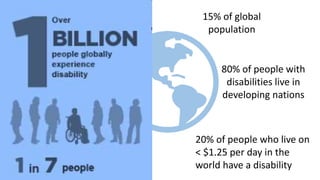
80% of people with
disabilities live in
developing nations
15% of global
population
20% of people who live on
< $1.25 per day in the
world have a disability
6
/ 7
/ 7
Cycles of Poverty & Disability
Disability
Poverty
Vulnerability to
poverty & ill
health
Social & cultural
exclusion & stigma
Reduced
participation in
decision making &
denial of civil &
political rights
Deficits in
economic, social &
cultural rights
Denial of
opportunities for
economic, social &
human
development
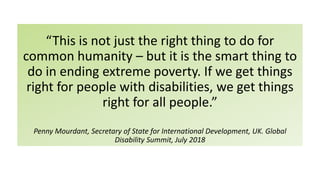
“This is not just the right thing to do for
common humanity – but it is the smart thing to
do in ending extreme poverty. If we get things
right for people with disabilities, we get things
right for all people.”
Penny Mourdant, Secretary of State for International Development, UK. Global
Disability Summit, July 2018
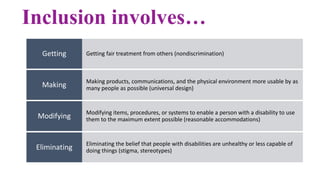
Inclusion involves…
Getting fair treatment from others (nondiscrimination)
Getting
Making products, communications, and the physical environment more usable by as
many people as possible (universal design)
Making
Modifying items, procedures, or systems to enable a person with a disability to use
them to the maximum extent possible (reasonable accommodations)
Modifying
Eliminating the belief that people with disabilities are unhealthy or less capable of
doing things (stigma, stereotypes)
Eliminating
Inclusion in Action
• Invite persons with disabilities to be part of the solution
• Include the voices and interests of people with disabilities in
project design, implementation, and evaluation
• Collect disability-disaggregated data
• Identify and address barriers to participation
• Use accessible information and communication
• Set aside a disability inclusion budget of 3-5%
• Hire staff with disabilities
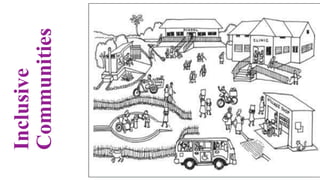
Inclusive
Communities
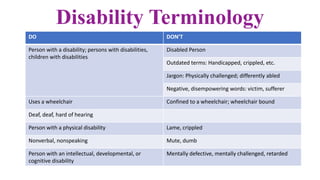
Disability Terminology
DO DON’T
Person with a disability; persons with disabilities,
children with disabilities
Disabled Person
Outdated terms: Handicapped, crippled, etc.
Jargon: Physically challenged; differently abled
Negative, disempowering words: victim, sufferer
Uses a wheelchair Confined to a wheelchair; wheelchair bound
Deaf, deaf, hard of hearing
Person with a physical disability Lame, crippled
Nonverbal, nonspeaking Mute, dumb
Person with an intellectual, developmental, or
cognitive disability
Mentally defective, mentally challenged, retarded
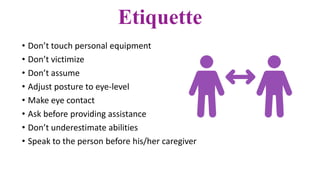
Etiquette
• Don’t touch personal equipment
• Don’t victimize
• Don’t assume
• Adjust posture to eye-level
• Make eye contact
• Ask before providing assistance
• Don’t underestimate abilities
• Speak to the person before his/her caregiver
Reflection
What questions do you have?
Rights Perspective
• UN Convention on the Rights of the Child
• UN Convention on the Rights of People with Disabilities
o Views persons with disabilities with rights,
capable of claiming rights & making decisions
based on free / informed consent
o Active members of society
o Human rights instrument with social
development dimension
o Broad categorization of persons with disabilities
Reflection
How do these rights play out in your
country or community?
How are they upheld?
What are the challenges to children
with disabilities (and their caregivers)
claiming those rights?
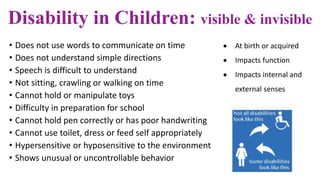
Disability in Children: visible & invisible
• Does not use words to communicate on time
• Does not understand simple directions
• Speech is difficult to understand
• Not sitting, crawling or walking on time
• Cannot hold or manipulate toys
• Difficulty in preparation for school
• Cannot hold pen correctly or has poor handwriting
• Cannot use toilet, dress or feed self appropriately
• Hypersensitive or hyposensitive to the environment
• Shows unusual or uncontrollable behavior
 At birth or acquired
 Impacts function
 Impacts internal and
external senses
Reflection
Not all disabilities are visible. What does this
mean for our work?
How does institutionalization or family separation
further impact a child with disability?
What are parents told by the community or
doctors about their child with disability? How
does that impact separation?
What community services could help parents keep
their children with disabilities with them?
What’s your role in addressing those service gaps?
Impact of Disability
The child, in the present and future
Siblings
Parents
Family
Services
Society
Why inclusion? Example of Kenya
o Disability is a key driver of child-family separation in
Kenya
o Children with disabilities are disproportionately
represented in institutional care and more at risk of
separation
o Due to their complex needs and social barriers to
inclusion, children with disabilities are often the first
to be placed in institutional care and the last to leave
o They can also be the hardest children to find in your
community, because they face stigma and
discrimination and thus can be kept hidden
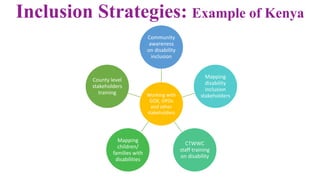
Working with
GOK, OPDs
and other
stakeholders
Community
awareness
on disability
inclusion
Mapping
disability
inclusion
stakeholders
CTWWC
staff training
on disability
Mapping
children/
families with
disabilities
County level
stakeholders
training
Inclusion Strategies: Example of Kenya
Reflection
Why is inclusion important in our
context?
How can we respond to the impact of
disability our programming?
What’s holding us back right now?
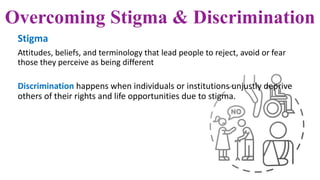
Overcoming Stigma & Discrimination
Stigma
Attitudes, beliefs, and terminology that lead people to reject, avoid or fear
those they perceive as being different
Discrimination happens when individuals or institutions unjustly deprive
others of their rights and life opportunities due to stigma.
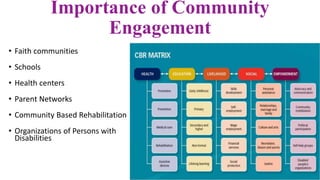
Importance of Community
Engagement
• Faith communities
• Schools
• Health centers
• Parent Networks
• Community Based Rehabilitation
• Organizations of Persons with
Disabilities
Reflection
What are the resources, services, and
capacities available in your country
context?
How can you engage these to build strong
community actions that support family-
based care?
Data
Global gaps in quality data on disability,
especially for children. Even bigger gaps at
country level.
Useful for informing program design,
adaptations mid-cycle, and advocacy
Consider what we collect, how we collect it,
and how it’s used
Disaggregation can help us see gaps
Reflection
What kinds of data are we collecting on
children with disabilities and their
families?
What more should we be collecting? How
would we use it to inform program design
and adaptations?
Key
Take
Away
Need to know more?
info@ctwwc.org or visit changingthewaywecare.org
©2021 Maestral International LLC. All Rights Reserved. This material may not be reproduced, displayed, modified or
distributed without the express prior written permission of copyright holder. For permission, write to info@ctwwc.org. The
photographs in this publication are used for illustrative purposes only; they do not imply any particular health, orphanhood,
or residential care status on the part of any person who appears in the photographs.

Understanding Disability Workshop_final.pptx

  • 1.
    UNDERSTANDING DISABILITY: Disability InclusionTraining Toolkit for Disability Inclusion in Care Reform
  • 2.
    By the endof this workshop you will be able to… …define disability …describe the relationship between poverty and disability …identify steps to take toward inclusion …understand the basics of disability etiquette …understand how disability impacts family strengthening programming …identify roles in mitigating barriers faced by children with disabilities and their families
  • 3.
    Reflection What does theword disability mean to you? What is your reaction when you see a person with a disability? What personal experience do you have with disability, either with your own lived experience, within your family, or in your community?
  • 4.
    Defining Disability Persons withdisabilities have long-term physical, mental, intellectual or sensory impairments which in interaction with various barriers may hinder their full and effective participation in society on an equal basis with others • Limited Activity- difficulty encountered by an individual in executing a task or action • Restricted participation- problem experienced by an individual in involvement in life situations • Impairment- problem in body function or structure, with varying severity
  • 5.
  • 6.
    80% of peoplewith disabilities live in developing nations 15% of global population 20% of people who live on < $1.25 per day in the world have a disability 6
  • 7.
  • 8.
    Cycles of Poverty& Disability Disability Poverty Vulnerability to poverty & ill health Social & cultural exclusion & stigma Reduced participation in decision making & denial of civil & political rights Deficits in economic, social & cultural rights Denial of opportunities for economic, social & human development
  • 9.
    “This is notjust the right thing to do for common humanity – but it is the smart thing to do in ending extreme poverty. If we get things right for people with disabilities, we get things right for all people.” Penny Mourdant, Secretary of State for International Development, UK. Global Disability Summit, July 2018
  • 10.
    Inclusion involves… Getting fairtreatment from others (nondiscrimination) Getting Making products, communications, and the physical environment more usable by as many people as possible (universal design) Making Modifying items, procedures, or systems to enable a person with a disability to use them to the maximum extent possible (reasonable accommodations) Modifying Eliminating the belief that people with disabilities are unhealthy or less capable of doing things (stigma, stereotypes) Eliminating
  • 11.
    Inclusion in Action •Invite persons with disabilities to be part of the solution • Include the voices and interests of people with disabilities in project design, implementation, and evaluation • Collect disability-disaggregated data • Identify and address barriers to participation • Use accessible information and communication • Set aside a disability inclusion budget of 3-5% • Hire staff with disabilities
  • 12.
  • 13.
    Disability Terminology DO DON’T Personwith a disability; persons with disabilities, children with disabilities Disabled Person Outdated terms: Handicapped, crippled, etc. Jargon: Physically challenged; differently abled Negative, disempowering words: victim, sufferer Uses a wheelchair Confined to a wheelchair; wheelchair bound Deaf, deaf, hard of hearing Person with a physical disability Lame, crippled Nonverbal, nonspeaking Mute, dumb Person with an intellectual, developmental, or cognitive disability Mentally defective, mentally challenged, retarded
  • 14.
    Etiquette • Don’t touchpersonal equipment • Don’t victimize • Don’t assume • Adjust posture to eye-level • Make eye contact • Ask before providing assistance • Don’t underestimate abilities • Speak to the person before his/her caregiver
  • 15.
  • 16.
    Rights Perspective • UNConvention on the Rights of the Child • UN Convention on the Rights of People with Disabilities o Views persons with disabilities with rights, capable of claiming rights & making decisions based on free / informed consent o Active members of society o Human rights instrument with social development dimension o Broad categorization of persons with disabilities
  • 17.
    Reflection How do theserights play out in your country or community? How are they upheld? What are the challenges to children with disabilities (and their caregivers) claiming those rights?
  • 18.
    Disability in Children:visible & invisible • Does not use words to communicate on time • Does not understand simple directions • Speech is difficult to understand • Not sitting, crawling or walking on time • Cannot hold or manipulate toys • Difficulty in preparation for school • Cannot hold pen correctly or has poor handwriting • Cannot use toilet, dress or feed self appropriately • Hypersensitive or hyposensitive to the environment • Shows unusual or uncontrollable behavior  At birth or acquired  Impacts function  Impacts internal and external senses
  • 19.
    Reflection Not all disabilitiesare visible. What does this mean for our work? How does institutionalization or family separation further impact a child with disability? What are parents told by the community or doctors about their child with disability? How does that impact separation? What community services could help parents keep their children with disabilities with them? What’s your role in addressing those service gaps?
  • 20.
    Impact of Disability Thechild, in the present and future Siblings Parents Family Services Society
  • 21.
    Why inclusion? Exampleof Kenya o Disability is a key driver of child-family separation in Kenya o Children with disabilities are disproportionately represented in institutional care and more at risk of separation o Due to their complex needs and social barriers to inclusion, children with disabilities are often the first to be placed in institutional care and the last to leave o They can also be the hardest children to find in your community, because they face stigma and discrimination and thus can be kept hidden
  • 22.
    Working with GOK, OPDs andother stakeholders Community awareness on disability inclusion Mapping disability inclusion stakeholders CTWWC staff training on disability Mapping children/ families with disabilities County level stakeholders training Inclusion Strategies: Example of Kenya
  • 23.
    Reflection Why is inclusionimportant in our context? How can we respond to the impact of disability our programming? What’s holding us back right now?
  • 24.
    Overcoming Stigma &Discrimination Stigma Attitudes, beliefs, and terminology that lead people to reject, avoid or fear those they perceive as being different Discrimination happens when individuals or institutions unjustly deprive others of their rights and life opportunities due to stigma.
  • 25.
    Importance of Community Engagement •Faith communities • Schools • Health centers • Parent Networks • Community Based Rehabilitation • Organizations of Persons with Disabilities
  • 26.
    Reflection What are theresources, services, and capacities available in your country context? How can you engage these to build strong community actions that support family- based care?
  • 27.
    Data Global gaps inquality data on disability, especially for children. Even bigger gaps at country level. Useful for informing program design, adaptations mid-cycle, and advocacy Consider what we collect, how we collect it, and how it’s used Disaggregation can help us see gaps
  • 28.
    Reflection What kinds ofdata are we collecting on children with disabilities and their families? What more should we be collecting? How would we use it to inform program design and adaptations?
  • 29.
  • 30.
    Need to knowmore? info@ctwwc.org or visit changingthewaywecare.org ©2021 Maestral International LLC. All Rights Reserved. This material may not be reproduced, displayed, modified or distributed without the express prior written permission of copyright holder. For permission, write to info@ctwwc.org. The photographs in this publication are used for illustrative purposes only; they do not imply any particular health, orphanhood, or residential care status on the part of any person who appears in the photographs.

Editor's Notes

  • #2 Acknowledgement The Toolkit for Disability Inclusion in Care Reform was produced by Changing the Way We CareSM (CTWWC), an initiative designed to promote safe, nurturing family care for children. It represents a collection of work developed from the experience of many practitioners. These slides for the Understanding Disability Training and the accompanying training facilitator’s guide were designed by disability and care reform practitioners and consultants for CTWWC with an aim is to build the capacity and confidence of those working in family strengthening and children’s care for work with children with disabilities and their families. We thank the following people and organizations: Elayn Sammon, Gwen Burchell, Leia Isanhart, Catholic Relief Services, and the CTWWC teams in Kenya and Guatemala for their input, feedback and pilot testing. As Changing the Way We Care and partners learn from and promote family care we commit to full and meaningful inclusion of children with disabilities and their families throughout the process of care reform and all of our work. Children with disabilities disproportionately live in residential care and are, too often, the last to be deinstitutionalized. We commit to putting them first.
  • #7 https://apps.who.int/mediacentre/infographic/dar/en/index.html
  • #8 Access the video: https://youtu.be/ca64-46rDm0
  • #9 Grills, Nathan & Singh, Lawrence & Pant, Hira & Varghese, Jubin & Gudlavalleti, Murthy & Hoq, Monsurul & Marella, Manjula. (2017). Access to Services and Barriers faced by People with Disabilities: A Quantitative Survey. Asia Pacific Disability Rehabilitation Journal. 28. 23-44. 10.5463/DCID.v28i2.615.
  • #14  https://www.usaid.gov/sites/default/files/documents/2496/Disability Communications Tips_508 %281%29.pdf
  • #15  https://disabilityin.org/resource/disability-etiquette/ https://www.vantagemobility.com/blog/disability-etiquette-dos-and-donts https://www.forbes.com/sites/andrewpulrang/2020/09/30/here-are-some-dos-and-donts-of-disability-language/?sh=2ea703cad170 https://www.youtube.com/watch?v=Gv1aDEFlXq8
  • #17 https://www.un.org/development/desa/disabilities/convention-on-the-rights-of-persons-with-disabilities.html
  • #22 Source: https://devinit.org/resources/status-disability-kenya-statistics-2019-census/ Kenya’s population may have lower than average rates of disability. Disability prevalence increases with age, and so countries with large aging populations will have higher prevalence rates. Kenya has a young population and so could have lower disability prevalence rates than some other countries. Statistics here are for ages 5 and up
  • #23 This graphic shows examples of inclusion from the Changing the Way We Care initiative in Kenya. Examples are from 2020/2021 Stakeholder training on disability identification and improved service provision Used maps of children/families with disabilities to improve referrals and service outreach With the stakeholder maps, developed stakeholder directory and conducted county level stakeholder forums Staff training touched on topics including: basics of inclusion, understanding disability and etiquette, local systems for early identification, and the role of various stakeholders in referrals.
  • #31 Changing The Way We Care℠ (CTWWC) is a global initiative funded by USAID, the MacArthur Foundation and the GHR Foundation, and implemented by Catholic Relief Services and Maestral International, along with other global, national and local partners working together to change the way we care for children around the world. Our principal global partners are Better Care Network, Lumos Foundation, and Faith to Action. CTWWC’s vision is to be a bold global initiative designed to promote safe, nurturing family care for children, including reforming national systems of care for children, strengthening families, family reunification and preventing child-family separation, which can have harmful, long-term consequences, development of alternative family-based care, and influencing others to build momentum towards a tipping point of change for children.