Understanding
Cryptocurrency
Welcome to the world of cryptocurrency. This
presentation is designed to help beginners
navigate the basics of digital currency,
blockchain, and the ecosystem that powers
them.
You’ll learn how cryptocurrencies work, why
they’re gaining popularity, and how they might
shape the future of finance.
By the end, you’ll be able to distinguish between
different types of cryptocurrencies, understand
how wallets and exchanges work, and explore
both opportunities and risks.
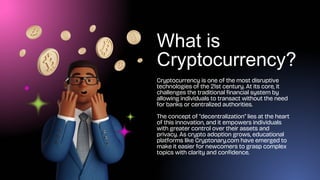
What is
Cryptocurrency?
Cryptocurrency is one of the most disruptive
technologies of the 21st century. At its core, it
challenges the traditional financial system by
allowing individuals to transact without the need
for banks or centralized authorities.
The concept of “decentralization” lies at the heart
of this innovation, and it empowers individuals
with greater control over their assets and
privacy. As crypto adoption grows, educational
platforms like Cryptonary.com have emerged to
make it easier for newcomers to grasp complex
topics with clarity and confidence.
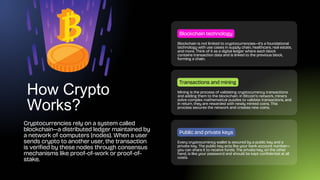
How Crypto
Works?
Cryptocurrencies rely on a system called
blockchain—a distributed ledger maintained by
a network of computers (nodes). When a user
sends crypto to another user, the transaction
is verified by these nodes through consensus
mechanisms like proof-of-work or proof-of-
stake.
Blockchain is not limited to cryptocurrencies—it’s a foundational
technology with use cases in supply chain, healthcare, real estate,
and more. Think of it as a digital ledger where each block
contains transaction data and is linked to the previous block,
forming a chain.
Blockchain technology
Mining is the process of validating cryptocurrency transactions
and adding them to the blockchain. In Bitcoin’s network, miners
solve complex mathematical puzzles to validate transactions, and
in return, they are rewarded with newly minted coins. This
process secures the network and creates new coins.
Transactions and mining
Every cryptocurrency wallet is secured by a public key and a
private key. The public key acts like your bank account number—
you can share it to receive funds. The private key, on the other
hand, is like your password and should be kept confidential at all
costs.
Public and private keys
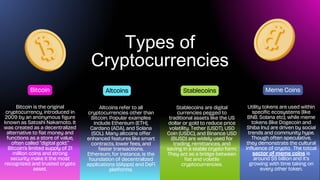
Types of
Cryptocurrencies
Bitcoin
Bitcoin is the original
cryptocurrency, introduced in
2009 by an anonymous figure
known as Satoshi Nakamoto. It
was created as a decentralized
alternative to fiat money and
functions as a store of value,
often called “digital gold.”
Bitcoin’s limited supply of 21
million coins and strong
security make it the most
recognized and trusted crypto
asset.
Altcoins
Altcoins refer to all
cryptocurrencies other than
Bitcoin. Popular examples
include Ethereum (ETH),
Cardano (ADA), and Solana
(SOL). Many altcoins offer
enhanced features like smart
contracts, lower fees, and
faster transactions.
Ethereum, for instance, is the
foundation of decentralized
applications (dApps) and DeFi
platforms.
Stablecoins
Stablecoins are digital
currencies pegged to
traditional assets like the US
dollar or gold to reduce price
volatility. Tether (USDT), USD
Coin (USDC), and Binance USD
(BUSD) are widely used for
trading, remittances, and
saving in a stable crypto form.
They act as a bridge between
fiat and volatile
cryptocurrencies.
Meme Coins
Utility tokens are used within
specific ecosystems (like
BNB. Solana etc), while meme
tokens (like Dogecoin and
Shiba Inu) are driven by social
trends and community hype.
Though often speculative,
they demonstrate the cultural
influence of crypto. The totcal
sector of meme coins is
around $5 billion and it’s
growing with time taking on
every other token.
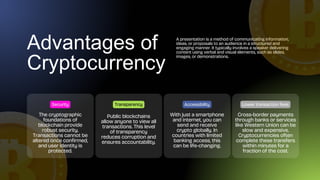
Advantages of
Cryptocurrency
A presentation is a method of communicating information,
ideas, or proposals to an audience in a structured and
engaging manner. It typically involves a speaker delivering
content using verbal and visual elements, such as slides,
images, or demonstrations.
The cryptographic
foundations of
blockchain provide
robust security.
Transactions cannot be
altered once confirmed,
and user identity is
protected.
Security
Public blockchains
allow anyone to view all
transactions. This level
of transparency
reduces corruption and
ensures accountability.
Transparency
With just a smartphone
and internet, you can
send and receive
crypto globally. In
countries with limited
banking access, this
can be life-changing.
Accessibility
Cross-border payments
through banks or services
like Western Union can be
slow and expensive.
Cryptocurrencies often
complete these transfers
within minutes for a
fraction of the cost.
Lower transaction fees
Challenges of
Cryptocurrency
Crypto markets are highly volatile. Prices can rise or fall
dramatically within hours due to market sentiment, regulatory
news, or whale trading (large holders moving assets). While
this creates opportunities for profit, it also introduces risk—
making it unsuitable for those seeking stable returns.
Volatility
The legal landscape around cryptocurrency is still evolving.
Some countries have embraced it, while others impose
restrictions or bans. Regulatory uncertainty affects
innovation, investor confidence, and the growth of new crypto
projects.
Regulatory concerns
Although blockchain is inherently secure, users remain
vulnerable to threats like: Exchange hacks, Phishing attacks,
Lost private keys. If your wallet or exchange gets
compromised, recovering lost crypto is nearly impossible. It's
critical to use secure wallets, 2FA, and reliable exchanges.
Security risks
Mass adoption is slowed by: Lack of user-friendly interfaces,
Limited understanding of blockchain, Scalability issues (e.g.,
network congestion), Energy consumption concerns. These
barriers are gradually being addressed, but education and
accessibility remain key factors.
Adoption barriers
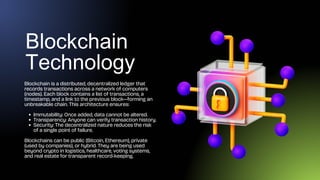
Blockchain
Technology
Blockchain is a distributed, decentralized ledger that
records transactions across a network of computers
(nodes). Each block contains a list of transactions, a
timestamp, and a link to the previous block—forming an
unbreakable chain. This architecture ensures:
Immutability: Once added, data cannot be altered.
Transparency: Anyone can verify transaction history.
Security: The decentralized nature reduces the risk
of a single point of failure.
Blockchains can be public (Bitcoin, Ethereum), private
(used by companies), or hybrid. They are being used
beyond crypto in logistics, healthcare, voting systems,
and real estate for transparent record-keeping.
Cryptocurrency
Mining
Mining is the process of verifying and adding transactions to a
blockchain. It serves two main purposes:
Securing the network
Releasing new coins into circulation
In Proof-of-Work (PoW) systems like Bitcoin, miners solve complex
mathematical puzzles to validate transactions. In return, they receive
block rewards in cryptocurrency.
With concerns over energy usage, many cryptocurrencies are
shifting to Proof-of-Stake (PoS), where users validate transactions
based on the number of coins they hold, not computing power.
Mining requires technical knowledge, specialized hardware, and
increasing energy resources—making it more competitive and less
accessible to average users.
Cryptocurrency
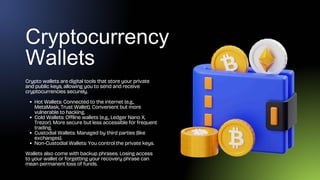
Wallets
Crypto wallets are digital tools that store your private
and public keys, allowing you to send and receive
cryptocurrencies securely.
Hot Wallets: Connected to the internet (e.g.,
MetaMask, Trust Wallet). Convenient but more
vulnerable to hacking.
Cold Wallets: Offline wallets (e.g., Ledger Nano X,
Trezor). More secure but less accessible for frequent
trading.
Custodial Wallets: Managed by third parties (like
exchanges).
Non-Custodial Wallets: You control the private keys.
Wallets also come with backup phrases. Losing access
to your wallet or forgetting your recovery phrase can
mean permanent loss of funds.
Cryptocurrency
Exchanges
Crypto exchanges are platforms where users can buy, sell, or trade
digital currencies. There are two main types:
Centralized Exchanges (CEX): Managed by a company. Offer high
liquidity and ease of use. Examples:
Binance – Global leader with a wide range of assets
Bybit – Popular for derivatives and futures
Decentralized Exchanges (DEX): Operate on smart contracts. Users
retain control of their funds. Examples: Uniswap, PancakeSwap.
When choosing an exchange, consider:
Security features
Supported coins
KYC requirements
Trading fees
Cryptonary provides side-by-side comparisons of top exchanges to
help new users choose wisely.
Use Cases of
Cryptocurrency
Investment
Many investors see
crypto—especially
Bitcoin and Ethereum—
as long-term stores of
value. Crypto portfolios
are part of diversified
wealth-building
strategies for individuals
and institutions alike.
Remittances
Sending money
internationally can be
expensive and slow.
Crypto allows real-time,
low-fee transfers
without banks.
Platforms like Stellar are
built specifically for
remittances.
Online
purchases
More merchants now
accept crypto for
everyday purchases—
electronics, travel, gift
cards, and even luxury
goods. It enables
frictionless, borderless
commerce.
Decentralized
finance (DeFi)
DeFi platforms use
crypto and smart
contracts to offer
banking services like
lending, borrowing, and
saving—without
intermediaries. This is
reshaping the future of
global finance.
Regulation and Legal
Considerations
Regulatory clarity is a double-edged sword in the crypto world. While
regulation can bring legitimacy, poor regulation can stifle innovation.
Key legal considerations include:
AML/KYC Compliance: Ensures prevention of money laundering
and illegal activities.
Taxation: Most countries now tax crypto gains, but rules vary.
Securities Classification: Some cryptos are being classified as
securities, affecting how they can be offered or traded.
Governments and international bodies like the SEC, EU (MiCA), and
FATF are shaping future frameworks. Staying compliant is crucial for
projects and investors alike.
Cryptocurrency
in the Future
Cryptocurrency is rapidly evolving from a niche financial tool to a foundational
technology shaping the future of global finance, digital ownership, and decentralized
systems. In the coming years, we expect cryptocurrency to move beyond speculation
and into everyday use cases.
One major area of growth is Central Bank Digital Currencies (CBDCs). Dozens of
countries are exploring blockchain-based versions of their national currencies. These
digital alternatives aim to modernize payment systems while preserving government
oversight.
Another transformative trend is the rise of Web3—a decentralized version of the
internet where users own their data, digital identity, and even assets through
blockchain-based applications. In this new ecosystem, cryptocurrencies fuel
everything from governance to gaming. Tokenization of real-world assets like real
estate, stocks, and collectibles is also breaking down barriers to global investment.
Environmental sustainability is also a future driver. With criticisms of Bitcoin’s energy
consumption, many cryptocurrencies are adopting eco-friendly alternatives like Proof-
of-Stake (PoS) consensus mechanisms, which drastically reduce energy usage.
Risks and
Considerations for
Investors
Cryptocurrencies are notorious
for their price swings. A coin
can double in value in days—or
lose half its value overnight.
This unpredictability is driven
by speculation, market
sentiment, and news events.
Investors should avoid
emotional trading and consider
long-term strategies backed by
research.
Market volatility
While blockchain technology
itself is secure, users are often
the weakest link. Common
threats include:
Phishing scams
Fake wallets and apps
Exchange hacks
Lost private keys
Lack of regulation
Crypto laws differ across
countries and are constantly
evolving. Some nations
embrace it; others restrict or
ban its use. Regulatory news
can heavily impact prices and
your ability to access certain
assets. Staying updated is
essential.
Security threats
The rise of new tokens and
DeFi projects has created
opportunities—but also opened
the door to fraudulent
schemes. Many “rug pulls”
(where developers disappear
with investor funds) occur in
projects with no real utility.
Always DYOR (Do Your Own
Research).
Due diligence and risk
management strategies
Ending Thoughts
Cryptocurrency represents more than just an investment trend—it’s
a revolution in how we store, transfer, and perceive value. It
challenges traditional institutions, gives power back to individuals,
and introduces new ways to interact with digital assets, data, and
communities.
For new users, the key is to start with education. The crypto space
can be intimidating, filled with jargon, fast-paced changes, and
occasional hype. But with a grounded approach, a long-term
mindset, and trusted resources, anyone can become part of this
transformative movement.
Don’t rush. Take your time to understand:
What makes a project valuable
How to store your assets securely
What risks you’re taking and how to mitigate them
Remember: Knowledge is your best investment.
Use platforms like Cryptonary.com to stay updated, learn at your
own pace, and build confidence as you step into the world of crypto.

Understanding Cryptocurrency Guide For Beginners (2025).pdf

  • 1.
    Understanding Cryptocurrency Welcome to theworld of cryptocurrency. This presentation is designed to help beginners navigate the basics of digital currency, blockchain, and the ecosystem that powers them. You’ll learn how cryptocurrencies work, why they’re gaining popularity, and how they might shape the future of finance. By the end, you’ll be able to distinguish between different types of cryptocurrencies, understand how wallets and exchanges work, and explore both opportunities and risks.
  • 2.
    What is Cryptocurrency? Cryptocurrency isone of the most disruptive technologies of the 21st century. At its core, it challenges the traditional financial system by allowing individuals to transact without the need for banks or centralized authorities. The concept of “decentralization” lies at the heart of this innovation, and it empowers individuals with greater control over their assets and privacy. As crypto adoption grows, educational platforms like Cryptonary.com have emerged to make it easier for newcomers to grasp complex topics with clarity and confidence.
  • 3.
    How Crypto Works? Cryptocurrencies relyon a system called blockchain—a distributed ledger maintained by a network of computers (nodes). When a user sends crypto to another user, the transaction is verified by these nodes through consensus mechanisms like proof-of-work or proof-of- stake. Blockchain is not limited to cryptocurrencies—it’s a foundational technology with use cases in supply chain, healthcare, real estate, and more. Think of it as a digital ledger where each block contains transaction data and is linked to the previous block, forming a chain. Blockchain technology Mining is the process of validating cryptocurrency transactions and adding them to the blockchain. In Bitcoin’s network, miners solve complex mathematical puzzles to validate transactions, and in return, they are rewarded with newly minted coins. This process secures the network and creates new coins. Transactions and mining Every cryptocurrency wallet is secured by a public key and a private key. The public key acts like your bank account number— you can share it to receive funds. The private key, on the other hand, is like your password and should be kept confidential at all costs. Public and private keys
  • 4.
    Types of Cryptocurrencies Bitcoin Bitcoin isthe original cryptocurrency, introduced in 2009 by an anonymous figure known as Satoshi Nakamoto. It was created as a decentralized alternative to fiat money and functions as a store of value, often called “digital gold.” Bitcoin’s limited supply of 21 million coins and strong security make it the most recognized and trusted crypto asset. Altcoins Altcoins refer to all cryptocurrencies other than Bitcoin. Popular examples include Ethereum (ETH), Cardano (ADA), and Solana (SOL). Many altcoins offer enhanced features like smart contracts, lower fees, and faster transactions. Ethereum, for instance, is the foundation of decentralized applications (dApps) and DeFi platforms. Stablecoins Stablecoins are digital currencies pegged to traditional assets like the US dollar or gold to reduce price volatility. Tether (USDT), USD Coin (USDC), and Binance USD (BUSD) are widely used for trading, remittances, and saving in a stable crypto form. They act as a bridge between fiat and volatile cryptocurrencies. Meme Coins Utility tokens are used within specific ecosystems (like BNB. Solana etc), while meme tokens (like Dogecoin and Shiba Inu) are driven by social trends and community hype. Though often speculative, they demonstrate the cultural influence of crypto. The totcal sector of meme coins is around $5 billion and it’s growing with time taking on every other token.
  • 5.
    Advantages of Cryptocurrency A presentationis a method of communicating information, ideas, or proposals to an audience in a structured and engaging manner. It typically involves a speaker delivering content using verbal and visual elements, such as slides, images, or demonstrations. The cryptographic foundations of blockchain provide robust security. Transactions cannot be altered once confirmed, and user identity is protected. Security Public blockchains allow anyone to view all transactions. This level of transparency reduces corruption and ensures accountability. Transparency With just a smartphone and internet, you can send and receive crypto globally. In countries with limited banking access, this can be life-changing. Accessibility Cross-border payments through banks or services like Western Union can be slow and expensive. Cryptocurrencies often complete these transfers within minutes for a fraction of the cost. Lower transaction fees
  • 6.
    Challenges of Cryptocurrency Crypto marketsare highly volatile. Prices can rise or fall dramatically within hours due to market sentiment, regulatory news, or whale trading (large holders moving assets). While this creates opportunities for profit, it also introduces risk— making it unsuitable for those seeking stable returns. Volatility The legal landscape around cryptocurrency is still evolving. Some countries have embraced it, while others impose restrictions or bans. Regulatory uncertainty affects innovation, investor confidence, and the growth of new crypto projects. Regulatory concerns Although blockchain is inherently secure, users remain vulnerable to threats like: Exchange hacks, Phishing attacks, Lost private keys. If your wallet or exchange gets compromised, recovering lost crypto is nearly impossible. It's critical to use secure wallets, 2FA, and reliable exchanges. Security risks Mass adoption is slowed by: Lack of user-friendly interfaces, Limited understanding of blockchain, Scalability issues (e.g., network congestion), Energy consumption concerns. These barriers are gradually being addressed, but education and accessibility remain key factors. Adoption barriers
  • 7.
    Blockchain Technology Blockchain is adistributed, decentralized ledger that records transactions across a network of computers (nodes). Each block contains a list of transactions, a timestamp, and a link to the previous block—forming an unbreakable chain. This architecture ensures: Immutability: Once added, data cannot be altered. Transparency: Anyone can verify transaction history. Security: The decentralized nature reduces the risk of a single point of failure. Blockchains can be public (Bitcoin, Ethereum), private (used by companies), or hybrid. They are being used beyond crypto in logistics, healthcare, voting systems, and real estate for transparent record-keeping.
  • 8.
    Cryptocurrency Mining Mining is theprocess of verifying and adding transactions to a blockchain. It serves two main purposes: Securing the network Releasing new coins into circulation In Proof-of-Work (PoW) systems like Bitcoin, miners solve complex mathematical puzzles to validate transactions. In return, they receive block rewards in cryptocurrency. With concerns over energy usage, many cryptocurrencies are shifting to Proof-of-Stake (PoS), where users validate transactions based on the number of coins they hold, not computing power. Mining requires technical knowledge, specialized hardware, and increasing energy resources—making it more competitive and less accessible to average users.
  • 9.
    Cryptocurrency Wallets Crypto wallets aredigital tools that store your private and public keys, allowing you to send and receive cryptocurrencies securely. Hot Wallets: Connected to the internet (e.g., MetaMask, Trust Wallet). Convenient but more vulnerable to hacking. Cold Wallets: Offline wallets (e.g., Ledger Nano X, Trezor). More secure but less accessible for frequent trading. Custodial Wallets: Managed by third parties (like exchanges). Non-Custodial Wallets: You control the private keys. Wallets also come with backup phrases. Losing access to your wallet or forgetting your recovery phrase can mean permanent loss of funds.
  • 10.
    Cryptocurrency Exchanges Crypto exchanges areplatforms where users can buy, sell, or trade digital currencies. There are two main types: Centralized Exchanges (CEX): Managed by a company. Offer high liquidity and ease of use. Examples: Binance – Global leader with a wide range of assets Bybit – Popular for derivatives and futures Decentralized Exchanges (DEX): Operate on smart contracts. Users retain control of their funds. Examples: Uniswap, PancakeSwap. When choosing an exchange, consider: Security features Supported coins KYC requirements Trading fees Cryptonary provides side-by-side comparisons of top exchanges to help new users choose wisely.
  • 11.
    Use Cases of Cryptocurrency Investment Manyinvestors see crypto—especially Bitcoin and Ethereum— as long-term stores of value. Crypto portfolios are part of diversified wealth-building strategies for individuals and institutions alike. Remittances Sending money internationally can be expensive and slow. Crypto allows real-time, low-fee transfers without banks. Platforms like Stellar are built specifically for remittances. Online purchases More merchants now accept crypto for everyday purchases— electronics, travel, gift cards, and even luxury goods. It enables frictionless, borderless commerce. Decentralized finance (DeFi) DeFi platforms use crypto and smart contracts to offer banking services like lending, borrowing, and saving—without intermediaries. This is reshaping the future of global finance.
  • 12.
    Regulation and Legal Considerations Regulatoryclarity is a double-edged sword in the crypto world. While regulation can bring legitimacy, poor regulation can stifle innovation. Key legal considerations include: AML/KYC Compliance: Ensures prevention of money laundering and illegal activities. Taxation: Most countries now tax crypto gains, but rules vary. Securities Classification: Some cryptos are being classified as securities, affecting how they can be offered or traded. Governments and international bodies like the SEC, EU (MiCA), and FATF are shaping future frameworks. Staying compliant is crucial for projects and investors alike.
  • 13.
    Cryptocurrency in the Future Cryptocurrencyis rapidly evolving from a niche financial tool to a foundational technology shaping the future of global finance, digital ownership, and decentralized systems. In the coming years, we expect cryptocurrency to move beyond speculation and into everyday use cases. One major area of growth is Central Bank Digital Currencies (CBDCs). Dozens of countries are exploring blockchain-based versions of their national currencies. These digital alternatives aim to modernize payment systems while preserving government oversight. Another transformative trend is the rise of Web3—a decentralized version of the internet where users own their data, digital identity, and even assets through blockchain-based applications. In this new ecosystem, cryptocurrencies fuel everything from governance to gaming. Tokenization of real-world assets like real estate, stocks, and collectibles is also breaking down barriers to global investment. Environmental sustainability is also a future driver. With criticisms of Bitcoin’s energy consumption, many cryptocurrencies are adopting eco-friendly alternatives like Proof- of-Stake (PoS) consensus mechanisms, which drastically reduce energy usage.
  • 14.
    Risks and Considerations for Investors Cryptocurrenciesare notorious for their price swings. A coin can double in value in days—or lose half its value overnight. This unpredictability is driven by speculation, market sentiment, and news events. Investors should avoid emotional trading and consider long-term strategies backed by research. Market volatility While blockchain technology itself is secure, users are often the weakest link. Common threats include: Phishing scams Fake wallets and apps Exchange hacks Lost private keys Lack of regulation Crypto laws differ across countries and are constantly evolving. Some nations embrace it; others restrict or ban its use. Regulatory news can heavily impact prices and your ability to access certain assets. Staying updated is essential. Security threats The rise of new tokens and DeFi projects has created opportunities—but also opened the door to fraudulent schemes. Many “rug pulls” (where developers disappear with investor funds) occur in projects with no real utility. Always DYOR (Do Your Own Research). Due diligence and risk management strategies
  • 15.
    Ending Thoughts Cryptocurrency representsmore than just an investment trend—it’s a revolution in how we store, transfer, and perceive value. It challenges traditional institutions, gives power back to individuals, and introduces new ways to interact with digital assets, data, and communities. For new users, the key is to start with education. The crypto space can be intimidating, filled with jargon, fast-paced changes, and occasional hype. But with a grounded approach, a long-term mindset, and trusted resources, anyone can become part of this transformative movement. Don’t rush. Take your time to understand: What makes a project valuable How to store your assets securely What risks you’re taking and how to mitigate them Remember: Knowledge is your best investment. Use platforms like Cryptonary.com to stay updated, learn at your own pace, and build confidence as you step into the world of crypto.