Evolution
What is “UI5 Evolution”?
It is “UI5’s innovation project” to solve today’s problems and to advance the
framework, tooling and controls! It is the successor of project “Cheetah” defining
the innovation key pillars.
Brief History of Time
2009
Project Phoenix was
started with the goal to
provide an open, flexible
and platform agnostic UI
layer.
2011
Strong momentum at
SAP, renamed to SAPUI5,
new Multi-Channel
Delivery to ABAP, Java,
Cloud.
2016
Fiori 2.0, Blackbird,
Project Cheetah initiated
to define the innovation
key pillars and roadmap.
2014
OpenUI5, Web IDE, Fiori,
SFIN support for SAPHIRE
(entry to S/4H), strong
growth (Sofia) …
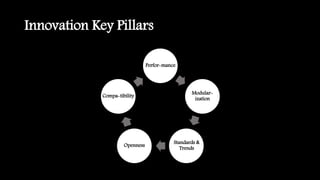
Innovation Key Pillars
Perfor-mance
Modular-
ization
Standards &
Trends
Openness
Compa-tibility
The Problem
“UI5 today is monolithic! Although it has been designed for modularization,
there is a tight coupling between and within Core, Rendering & Controls and
Programming Model!”
The Solution
“Split the different parts of UI5 into distinct yet modular layers: the Core, the
Rendering & Controls and the Programming Model and allow for an individual
and fine-modular consumption!”
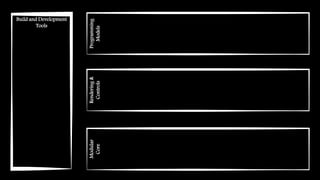
Modular
Core
Build and Development
Tools
Rendering&
Controls
Programming
Models
Modular Core
“Establish a future-proof foundation for code organization and dependency
management, enabling applications to run with just the minimum amount of
resources!”
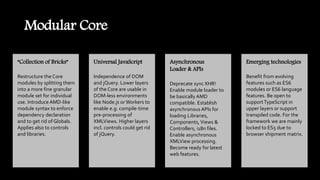
Universal JavaScript
Independence of DOM
and jQuery. Lower layers
of the Core are usable in
DOM-less environments
like Node.js or Workers to
enable e.g. compile-time
pre-processing of
XMLViews. Higher layers
incl. controls could get rid
of jQuery.
Modular Core
“Collection of Bricks”
Restructure the Core
modules by splitting them
into a more fine granular
module set for individual
use. Introduce AMD-like
module syntax to enforce
dependency declaration
and to get rid of Globals.
Applies also to controls
and libraries.
Emerging technologies
Benefit from evolving
features such as ES6
modules or ES6 language
features. Be open to
supportTypeScript in
upper layers or support
transpiled code. For the
framework we are mainly
locked to ES5 due to
browser shipment matrix.
Asynchronous
Loader & APIs
Deprecate sync XHR!
Enable module loader to
be basically AMD
compatible. Establish
asynchronous APIs for
loading Libraries,
Components, Views &
Controllers, i18n files.
Enable asynchronous
XMLView processing.
Become ready for latest
web features.
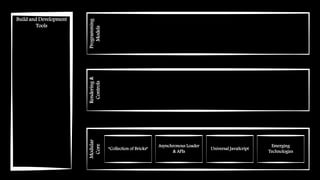
Modular
Core
Build and Development
Tools
Rendering&
Controls
Programming
Models
“Collection of Bricks”
Asynchronous Loader
& APIs
Universal JavaScript
Emerging
Technologies
Build & Development Tooling
“Create an open-source Node.js based build & development environment to
support both application developers and framework developers!”
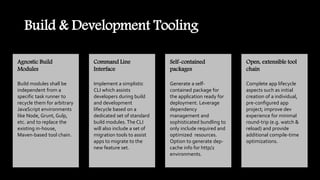
Build & Development Tooling
Agnostic Build
Modules
Build modules shall be
independent from a
specific task runner to
recycle them for arbitrary
JavaScript environments
like Node, Grunt, Gulp,
etc. and to replace the
existing in-house,
Maven-based tool chain.
Command Line
Interface
Implement a simplistic
CLI which assists
developers during build
and development
lifecycle based on a
dedicated set of standard
build modules.The CLI
will also include a set of
migration tools to assist
apps to migrate to the
new feature set.
Self-contained
packages
Generate a self-
contained package for
the application ready for
deployment. Leverage
dependency
management and
sophisticated bundling to
only include required and
optimized resources.
Option to generate dep-
cache info for http/2
environments.
Open, extensible tool
chain
Complete app lifecycle
aspects such as initial
creation of a individual,
pre-configured app
project; improve dev
experience for minimal
round-trip (e.g. watch &
reload) and provide
additional compile-time
optimizations.
Available as Open Source!!
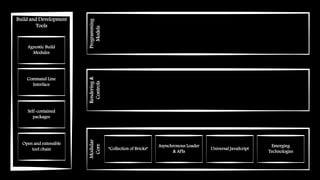
Modular
Core
Build and Development
Tools
Rendering&
Controls
Programming
Models
“Collection of Bricks”
Asynchronous Loader
& APIs
Universal JavaScript
Emerging
Technologies
Agnostic Build
Modules
Command Line
Interface
Self-contained
packages
Open and extensible
tool chain
Rendering & Controls
“Define a modern control framework which simplifies the creation of agnostic,
declarative, universal and themable controls which can be used with a
minimalistic footprint!”
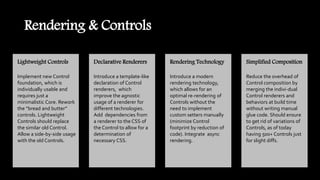
Rendering & Controls
Lightweight Controls
Implement new Control
foundation, which is
individually usable and
requires just a
minimalistic Core. Rework
the “bread and butter”
controls. Lightweight
Controls should replace
the similar old Control.
Allow a side-by-side usage
with the old Controls.
Declarative Renderers
Introduce a template-like
declaration of Control
renderers, which
improve the agnostic
usage of a renderer for
different technologies.
Add dependencies from
a renderer to the CSS of
the Control to allow for a
determination of
necessary CSS.
Rendering Technology
Introduce a modern
rendering technology,
which allows for an
optimal re-rendering of
Controls without the
need to implement
custom setters manually
(minimize Control
footprint by reduction of
code). Integrate async
rendering.
Simplified Composition
Reduce the overhead of
Control composition by
merging the indivi-dual
Control renderers and
behaviors at build time
without writing manual
glue code. Should ensure
to get rid of variations of
Controls, as of today
having 500+ Controls just
for slight diffs.
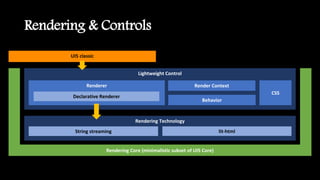
Rendering Core (minimalistic subset of UI5 Core)
Lightweight Control
Renderer
Rendering Technology
String streaming lit-html
Behavior
Declarative Renderer
Render Context
CSS
Rendering & Controls
UI5 classic
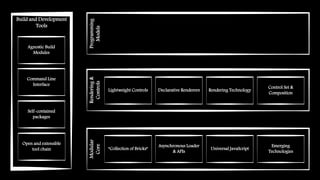
Modular
Core
Build and Development
Tools
Rendering&
Controls
Programming
Models
“Collection of Bricks”
Asynchronous Loader
& APIs
Universal JavaScript
Emerging
Technologies
Agnostic Build
Modules
Command Line
Interface
Self-contained
packages
Open and extensible
tool chain
Lightweight Controls Declarative Renderers Rendering Technology
Control Set &
Composition
Programming Models
“Continue support for existing UI5 programming model, but move closer to de-
facto standards and support trends to enable reuse of individual UI5 layers for
other programming models!”
Programming Models
UI5 classic
Continuous support, but
will also be affected by
new APIs. A compatibility
layer will ensure that
legacy applications
(being timeless) continue
to work with UI5
Evolution and can
partially benefit from
improvements made in
the Core and the
Rendering layer.
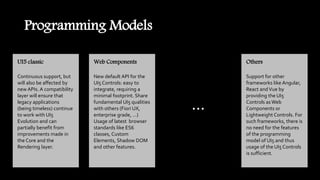
Web Components
New default API for the
UI5 Controls: easy to
integrate, requiring a
minimal footprint. Share
fundamental UI5 qualities
with others (Fiori UX,
enterprise grade, …)
Usage of latest browser
standards like ES6
classes, Custom
Elements, Shadow DOM
and other features.
Others
Support for other
frameworks like Angular,
React andVue by
providing the UI5
Controls as Web
Components or
Lightweight Controls. For
such frameworks, there is
no need for the features
of the programming
model of UI5 and thus
usage of the UI5 Controls
is sufficient.
…
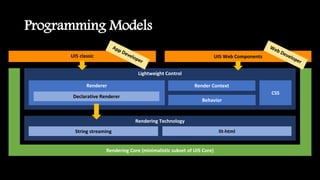
Rendering Core (minimalistic subset of UI5 Core)
Lightweight Control
Renderer
Rendering Technology
String streaming lit-html
Behavior
Declarative Renderer
Render Context
CSS
Programming Models
UI5 classic UI5 Web Components
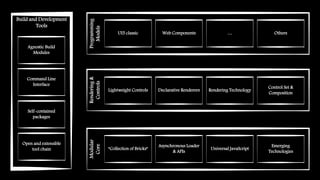
Modular
Core
Build and Development
Tools
Rendering&
Controls
Programming
Models
“Collection of Bricks”
Asynchronous Loader
& APIs
Universal JavaScript
Emerging
Technologies
Agnostic Build
Modules
Command Line
Interface
Self-contained
packages
Open and extensible
tool chain
Lightweight Controls Declarative Renderers Rendering Technology
Control Set &
Composition
UI5 classic Web Components … Others
But – there is one more thing!
“Humans are learning from Nature and implementing it’s solutions. The evolution is a
great concept of Nature and comes with an essential feature we yet miss! Curious??”
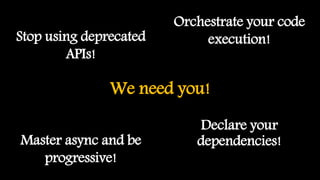
Declare your
dependencies!Master async and be
progressive!
Orchestrate your code
execution!Stop using deprecated
APIs!
We need you!
Thank You!
Contact Information:
Peter Muessig
Lead Architect UI5
peter.muessig@sap.com
@pmuessig
Andreas Ecker
Product Owner UI5 Core and Runtime
andreas.ecker@sap.com

UI5 Evolution Overview 2018

  • 1.
  • 2.
    What is “UI5Evolution”? It is “UI5’s innovation project” to solve today’s problems and to advance the framework, tooling and controls! It is the successor of project “Cheetah” defining the innovation key pillars.
  • 3.
    Brief History ofTime 2009 Project Phoenix was started with the goal to provide an open, flexible and platform agnostic UI layer. 2011 Strong momentum at SAP, renamed to SAPUI5, new Multi-Channel Delivery to ABAP, Java, Cloud. 2016 Fiori 2.0, Blackbird, Project Cheetah initiated to define the innovation key pillars and roadmap. 2014 OpenUI5, Web IDE, Fiori, SFIN support for SAPHIRE (entry to S/4H), strong growth (Sofia) …
  • 4.
  • 5.
    The Problem “UI5 todayis monolithic! Although it has been designed for modularization, there is a tight coupling between and within Core, Rendering & Controls and Programming Model!”
  • 6.
    The Solution “Split thedifferent parts of UI5 into distinct yet modular layers: the Core, the Rendering & Controls and the Programming Model and allow for an individual and fine-modular consumption!”
  • 7.
  • 8.
    Modular Core “Establish afuture-proof foundation for code organization and dependency management, enabling applications to run with just the minimum amount of resources!”
  • 9.
    Universal JavaScript Independence ofDOM and jQuery. Lower layers of the Core are usable in DOM-less environments like Node.js or Workers to enable e.g. compile-time pre-processing of XMLViews. Higher layers incl. controls could get rid of jQuery. Modular Core “Collection of Bricks” Restructure the Core modules by splitting them into a more fine granular module set for individual use. Introduce AMD-like module syntax to enforce dependency declaration and to get rid of Globals. Applies also to controls and libraries. Emerging technologies Benefit from evolving features such as ES6 modules or ES6 language features. Be open to supportTypeScript in upper layers or support transpiled code. For the framework we are mainly locked to ES5 due to browser shipment matrix. Asynchronous Loader & APIs Deprecate sync XHR! Enable module loader to be basically AMD compatible. Establish asynchronous APIs for loading Libraries, Components, Views & Controllers, i18n files. Enable asynchronous XMLView processing. Become ready for latest web features.
  • 10.
    Modular Core Build and Development Tools Rendering& Controls Programming Models “Collectionof Bricks” Asynchronous Loader & APIs Universal JavaScript Emerging Technologies
  • 11.
    Build & DevelopmentTooling “Create an open-source Node.js based build & development environment to support both application developers and framework developers!”
  • 12.
    Build & DevelopmentTooling Agnostic Build Modules Build modules shall be independent from a specific task runner to recycle them for arbitrary JavaScript environments like Node, Grunt, Gulp, etc. and to replace the existing in-house, Maven-based tool chain. Command Line Interface Implement a simplistic CLI which assists developers during build and development lifecycle based on a dedicated set of standard build modules.The CLI will also include a set of migration tools to assist apps to migrate to the new feature set. Self-contained packages Generate a self- contained package for the application ready for deployment. Leverage dependency management and sophisticated bundling to only include required and optimized resources. Option to generate dep- cache info for http/2 environments. Open, extensible tool chain Complete app lifecycle aspects such as initial creation of a individual, pre-configured app project; improve dev experience for minimal round-trip (e.g. watch & reload) and provide additional compile-time optimizations.
  • 13.
  • 14.
    Modular Core Build and Development Tools Rendering& Controls Programming Models “Collectionof Bricks” Asynchronous Loader & APIs Universal JavaScript Emerging Technologies Agnostic Build Modules Command Line Interface Self-contained packages Open and extensible tool chain
  • 15.
    Rendering & Controls “Definea modern control framework which simplifies the creation of agnostic, declarative, universal and themable controls which can be used with a minimalistic footprint!”
  • 16.
    Rendering & Controls LightweightControls Implement new Control foundation, which is individually usable and requires just a minimalistic Core. Rework the “bread and butter” controls. Lightweight Controls should replace the similar old Control. Allow a side-by-side usage with the old Controls. Declarative Renderers Introduce a template-like declaration of Control renderers, which improve the agnostic usage of a renderer for different technologies. Add dependencies from a renderer to the CSS of the Control to allow for a determination of necessary CSS. Rendering Technology Introduce a modern rendering technology, which allows for an optimal re-rendering of Controls without the need to implement custom setters manually (minimize Control footprint by reduction of code). Integrate async rendering. Simplified Composition Reduce the overhead of Control composition by merging the indivi-dual Control renderers and behaviors at build time without writing manual glue code. Should ensure to get rid of variations of Controls, as of today having 500+ Controls just for slight diffs.
  • 17.
    Rendering Core (minimalisticsubset of UI5 Core) Lightweight Control Renderer Rendering Technology String streaming lit-html Behavior Declarative Renderer Render Context CSS Rendering & Controls UI5 classic
  • 18.
    Modular Core Build and Development Tools Rendering& Controls Programming Models “Collectionof Bricks” Asynchronous Loader & APIs Universal JavaScript Emerging Technologies Agnostic Build Modules Command Line Interface Self-contained packages Open and extensible tool chain Lightweight Controls Declarative Renderers Rendering Technology Control Set & Composition
  • 19.
    Programming Models “Continue supportfor existing UI5 programming model, but move closer to de- facto standards and support trends to enable reuse of individual UI5 layers for other programming models!”
  • 20.
    Programming Models UI5 classic Continuoussupport, but will also be affected by new APIs. A compatibility layer will ensure that legacy applications (being timeless) continue to work with UI5 Evolution and can partially benefit from improvements made in the Core and the Rendering layer. Web Components New default API for the UI5 Controls: easy to integrate, requiring a minimal footprint. Share fundamental UI5 qualities with others (Fiori UX, enterprise grade, …) Usage of latest browser standards like ES6 classes, Custom Elements, Shadow DOM and other features. Others Support for other frameworks like Angular, React andVue by providing the UI5 Controls as Web Components or Lightweight Controls. For such frameworks, there is no need for the features of the programming model of UI5 and thus usage of the UI5 Controls is sufficient. …
  • 21.
    Rendering Core (minimalisticsubset of UI5 Core) Lightweight Control Renderer Rendering Technology String streaming lit-html Behavior Declarative Renderer Render Context CSS Programming Models UI5 classic UI5 Web Components
  • 22.
    Modular Core Build and Development Tools Rendering& Controls Programming Models “Collectionof Bricks” Asynchronous Loader & APIs Universal JavaScript Emerging Technologies Agnostic Build Modules Command Line Interface Self-contained packages Open and extensible tool chain Lightweight Controls Declarative Renderers Rendering Technology Control Set & Composition UI5 classic Web Components … Others
  • 23.
    But – thereis one more thing! “Humans are learning from Nature and implementing it’s solutions. The evolution is a great concept of Nature and comes with an essential feature we yet miss! Curious??”
  • 24.
    Declare your dependencies!Master asyncand be progressive! Orchestrate your code execution!Stop using deprecated APIs! We need you!
  • 25.
    Thank You! Contact Information: PeterMuessig Lead Architect UI5 peter.muessig@sap.com @pmuessig Andreas Ecker Product Owner UI5 Core and Runtime andreas.ecker@sap.com