MOBX	STATE	TREE
OPINIONATED	STATE
MANAGEMENT
DBS	Launch	Day	2018-01-30
joost@de-vries․name
codestar.nl
joost-de-vries
@jouke




UI	&	STATE	MANAGEMENT
WISHLIST
Keep	state	separate	from	UI	components
Keep	track	of	what	needs	to	be	updated	when
something	changes
Have	well	defined	unidirectional	data	flow
Easy	to	understand
Better	performance
Easy	to	test
Observables!?
Basically	the	benefits	of	Redux
MOBX
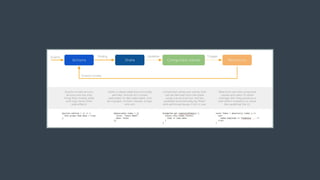
A	state	dependency	graph	
using	reactive	programming
Observables	
but	not	implemented	using	RxJs
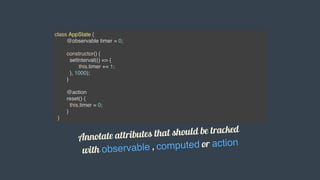
class AppState {
@observable timer = 0;
constructor() {
setInterval(() => {
this.timer += 1;
}, 1000);
}
@action
reset() {
this.timer = 0;
}
}
Annotate	attributes	that	should	be	tracked	
with	observable	,	computed	or	action
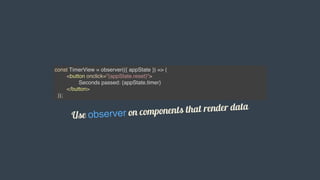
const TimerView = observer(({ appState }) => (
<button onclick="{appState.reset}">
Seconds passed: {appState.timer}
</button>
));
Use	observer	on	components	that	render	data
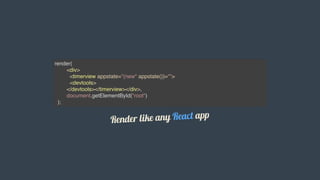
render(
<div>
<timerview appstate="{new" appstate()}="">
<devtools>
</devtools></timerview></div>,
document.getElementById("root")
);
Render	like	any	React	app
live	code	example
MOBX	CONCEPTS	&
PRINCIPLES
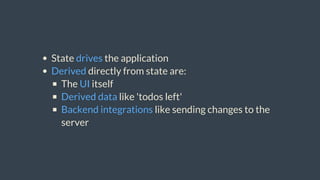
State	drives	the	application
Derived	directly	from	state	are:
The	UI	itself
Derived	data	like	'todos	left'
Backend	integrations	like	sending	changes	to	the
server
mobx	todo
MOBX
Easy	to	understand
Mutable	state
No	time	traveling	debugger
Hard	to	make	'middleware'	for
Lacks	the	immutable	objects	+	pure	functions
approach	of	Redux
“	Vies	maar	lekker”
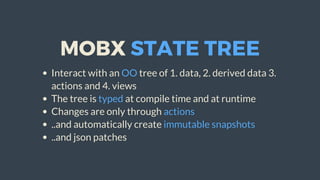
MOBX	STATE	TREE
Interact	with	an	OO	tree	of	1.	data,	2.	derived	data	3.
actions	and	4.	views
The	tree	is	typed	at	compile	time	and	at	runtime
Changes	are	only	through	actions
..and	automatically	create	immutable	snapshots
..and	json	patches
“Opinionated,	transactional,	MobX
powered	state	container	combining	the
best	features	of	the	immutable	and
mutable	world	for	an	optimal	DX”
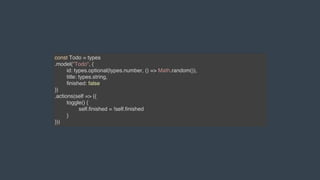
const Todo = types
.model("Todo", {
id: types.optional(types.number, () => Math.random()),
title: types.string,
finished: false
})
.actions(self => ({
toggle() {
self.finished = !self.finished
}
}))
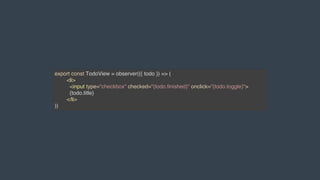
export const TodoView = observer(({ todo }) => (
<li>
<input type="checkbox" checked="{todo.finished}" onclick="{todo.toggle}">
{todo.title}
</li>
))
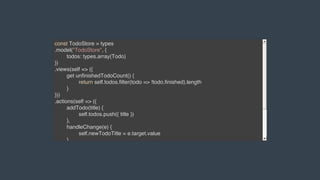
const TodoStore = types
.model("TodoStore", {
todos: types.array(Todo)
})
.views(self => ({
get unfinishedTodoCount() {
return self.todos.filter(todo => !todo.finished).length
}
}))
.actions(self => ({
addTodo(title) {
self.todos.push({ title })
},
handleChange(e) {
self.newTodoTitle = e.target.value
},
handleNewTodoClick(e) {
self.addTodo(self.newTodoTitle)
self.newTodoTitle = ""
}
}))
Code	example
Todo	with	time	travel
Static	typing	with	Typescript
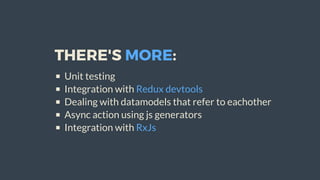
THERE'S	MORE:
Unit	testing
Integration	with	Redux	devtools
Dealing	with	datamodels	that	refer	to	eachother
Async	action	using	js	generators
Integration	with	RxJs
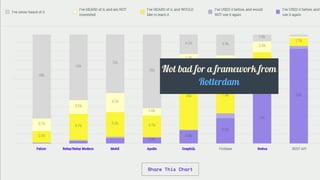
Not	bad	for	a	framework	from
Rotterdam
TO	SUMMARIZE
Seems	to	combine	the	good	parts	of	an	OO
discoverability	&	immutability
Opinionated	so	suitable	for	bigger	projects
Cohesion:	adding	a	feature	doesn't	involve	changes
in	lots	of	places
Typescript	support	is	somewhat	clunky
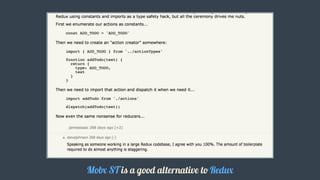
Mobx	ST	is	a	good	alternative	to	Redux
FURTHER
INFORMATION
M	Weststrate	-	
Fiddle	around	with	
The	websites	of	Mobx	and	Mobx	State	Tree	provide
a	lot	of	information
Becoming	fully	reactive:	how	mobx
works
live	code	examples

Mobx State Tree - Opinionated State Management