U
H ow can we follow
H“Go into all the worldthe command ofGospel


                                                      U-Can Evangelize Children
                                       Christ


                                                      U-Can Evangelize Children
                                                      U-Can Evangelize Children
to                      and preach the
 to every creature” when we work with
 children? What does it mean to evangelize? Is
 there a special Gospel for children? You will
 find answers to these and other questions in
 this important book. You will discover just how
 God works in the lives of the little ones as you
 take time to teach His Word faithfully. The
 guidelines given come from a careful study of
 the scriptures and many years experience in
 working among children.
 The evangelism of children is a serious work
 dependent on the Holy Spirit to illuminate the                                   Evangelize
 mind, convict the heart of sin and point to the
                                                                                  Children
                                                                                  ~
 all sufficient work of Christ. This book will help
 you engage in a careful biblical evangelism of
 children who are in urgent need of God’s great
 salvation.
 If you are involved in a training ministry what
                                                                                  Guidelines for
 better book to use than this one, to help
 challenge minds and hearts regarding the need                                    careful and biblical
 to evangelize children.                                                          evangelism of
                                                                                  children
                                                      Dr Sam Doherty
                                                      Dr Sam Doherty
                                                      Dr Sam Doherty


            Child Evangelism Fellowship Inc.
                Specialized Book Ministry
                                                                                  Dr Sam Doherty
        Assisting Children’s Evangelists Worldwide
                www.cefbookministry.com
U-can
Evangelize
Children

Guidelines for careful and
biblical evangelism of children


Dr Sam Doherty, BA, EdD.
A series of short ‘U-can’ training manuals for children’s
workers:

             U-can Know God’s Plan for Children
             U-can Evangelize children
             U-can Teach a Bible Lesson
             U-can Lead Children to Christ
             U-can Help Christian Children to Grow
             U-can Counsel a Christian Child


       This book is for free distribution only — and not to be sold.


  All scripture quotations, unless otherwise indicated, are taken from the
       New King James Version. Copyright © by Thomas Nelson, Inc.
                  Used by permission. All rights reserved.

           Revised and previously published under the title
             “How to Evangelize Children” in May 2003


                               Published by
                 Child Evangelism Fellowship Inc.     ®


                    Specialized Book Ministry
              Assisting Children’s Evangelists Worldwide
          PO Box 308, Lisburn, BT28 2YS, Northern Ireland, UK
                     © February 2011 All rights reserved
Table of Contents


Introduction ………...........................................…..……..………....... v
Chapter 1: The First Step ......................................…..          1
Chapter 2: Understand The Children…............... …...... 6
Chapter 3: Understand Evangelism ……....………....                              15
Chapter 4: Teach About God In Evangelism ….…. .                             25
Chapter 5: Teach About Sin In Evangelism ….….….                            35
Chapter 6: Teach About The Lord Jesus Christ In
Evangelism ................................................................. 40
Chapter 7: Invite The Children To Come To Christ ... 51
Chapter 8: The Children’s Response To The
Invitation Part I – Repentance …………...……….....                             60
Chapter 9: The Children’s Response To The
Invitation Part II – Faith ……………….….….…....… 68
Chapter 10: Teach The Children The Results Of
Saving Faith … .........................................................   73
Chapter 11: Teach That Salvation Is The Beginning
Of A Life Of Obedience ............................................... 80
Chapter 12: Make Yourself Available ……….………                                88
Chapter 13: Use Your Whole Programme
To Evangelize ……...................................................... 99
Chapter 14: The Manner Of Evangelism …....……….101
U-can Evangelize Children v


INTRODUCTION


Before the Lord Jesus Christ returned to Heaven, He gave to
His disciples and to His Church down through the ages a
command. That command was – to evangelize!
    “Go into all the world and preach the gospel to every creature”
       (Mark 16 v15).
    That command is still relevant for us today. The main reason
why the Lord Jesus has left us, as believers, here on the earth is
so that we might evangelize the lost. This is something we cannot
do in Heaven!
    A very large section of the world’s population consists of
children. In some countries almost one half of the total
population is under the age of fourteen. This command,
therefore, includes them, and gives to the Church of Jesus Christ
the responsibility to evangelize and preach the Gospel to millions
of boys and girls. This evangelistic outreach to the children needs
to be undertaken by individuals, by local churches, by missionary
societies, and also by organisations which specialize in the
evangelism of children. One organisation which makes the
evangelism of children their priority and their speciality is Child
Evangelism Fellowship, the Mission with which I worked for 57
years.
    Children need to be evangelized. Boys and girls without Jesus
Christ are spiritually dead, outside God’s kingdom, and lost as
far as their position is concerned. If they have reached the age
of understanding and accountability (which is much earlier than
most people think), and are not saved, they will, if they die, be
lost forever.
    But children can be saved – through the preaching of the
Gospel, and as the Holy Spirit works in their hearts. But how
can they be saved “without a preacher”? (Romans 10 v14). Many
of us have been given the responsibility, and the privilege, of
taking the Gospel to these children and of evangelizing them.
vi Introduction


May we not fail to do so.
   Unfortunately there are many who work with children and
who even teach them the Word of God – but don’t evangelize
them:
       Some of these teachers are themselves not saved. So it is
       obvious that they cannot, and will not, evangelize the
       children.
       Some of these teachers are saved, but they do not believe
       that children can be saved, and so they do not evangelize
       them.
       However there are other teachers who are saved, and who
       do believe that children can be saved, but they don’t
       evangelize them because they don’t know how to do so.
    This book will, I trust, be a special help to this third group,
although I pray it will also challenge the second group to start
evangelizing the children.
    I have written this book, therefore, to help those who want
to evangelize children. I trust it will help those especially who
are just beginning their ministry to children; but I pray that it
will also be a means of help and guidance to those who are
already evangelizing children. I hope that it will encourage and
enable each of us to examine our ministry to ensure that it is
completely biblical.
    My primary goal in writing this book is that children will
trust Jesus Christ as their Lord and Saviour, and I want to help
you, dear children’s worker, to be the channel which God uses
to evangelize the children and lead them to Jesus Christ.
      “Even so it is not the will of your Father who is in heaven that
      one of these little ones should perish” (Matthew 18 v14).
      “And He said to them, ‘Go into all the world and preach the
      gospel to every creature’” (Mark 16 v15).
U-can Evangelize Children 1


Chapter 1:
The First Step

In our examination of the evangelism of children we will need
to study two subjects:
       First of all, we will need to study the MESSAGE of salvation
       which we should teach to unsaved children when we are
       evangelizing them.
       Then, secondly, we will need to study the METHODS
       which we should use when we are teaching the message
       of salvation.
    In other words there are two main questions which we will
need to consider in this book:
      What is the message of salvation?
      What are the methods we should use in our evangelism?

               The Bible Gives Us the Answers
   But before answering those questions we need to ask, and
answer, one key question, or group of questions.
      Where do we find our guidelines for evangelism?
      Where is the only place where questions such as these
      can be answered?
      Where can we find the message of salvation?
      Where can we discover the methods we should use?
   The answers to all these questions, for every true believer,
can only be found in the Bible, God’s Word. God has given us
His Word to guide us in every aspect of our lives and service,
and that includes our evangelism. Therefore we need to read
and study the Bible to find the answers to these two key questions
concerning the message and methods in our evangelism. The
answers must come from the Word of God and not from the
words, or theories, of men .
2    Chapter 1


    But a further question comes automatically to our mind:
where in the Bible will we find the answers to these two
questions? Which part of the Bible will be our primary source
book, and guidebook, as far as the preaching of the Gospel is
concerned?
    There are several answers to that question – but we will see
later that there is one answer which is especially important.

                 Study the Old Testament
    There is much teaching in the Old Testament to help us to
understand the message of salvation. The power of God in
creation, His holiness, His justice, and His power to redeem His
people, are clearly revealed in the Old Testament, and all of
these factors occupy a vital part in the message of salvation.
There are also many descriptive accounts of men and women in
the Old Testament, who had a desire to turn from their sin, and
who were saved by faith in God, and in His promises. The Old
Testament, in addition, contains many pictures and types of the
Saviour Who was to come to save from sin.
    Consequently, a study of the Old Testament will be a
valuable and necessary task for those who want to understand
the message of salvation which they should teach the children.
    In addition, the teaching and “the atmosphere” of the Old
Testament will help us to see the importance of carefulness, and
reverence, in how we present that message, and will ensure that
the methods we use are in accordance with the message we
teach. The Old Testament (or the New Testament) has no place
for clowns, comedians or magicians!

                 Study the New Testament
    But it is in the New Testament where we find the full
revelation of the Gospel and the message of salvation. Therefore
the answers to our two main questions concerning the message
of salvation and the methods of evangelism can be primarily,
and more directly, found in the twenty-seven books of the New
Testament.
U-can Evangelize Children 3


   But this leads to a further question. The New Testament
consists of four sections. While all four sections will help us in
our search, which one will give us the fullest and clearest
answers, and will, indeed, provide us with a “primer on
evangelism”?
   The New Testament, then, consists of four sections:
      The four Gospels describe in much detail, the life, death,
      resurrection and ascension of the Lord Jesus Christ.
      The Acts of the Apostles give an account of the growth of
      the early Church – its ministry and its witness.
      The twenty-one letters, or epistles, are primarily addressed
      to believers, and give us instruction in doctrine and in
      practice.
      The book of Revelation is mainly a prophetical book.
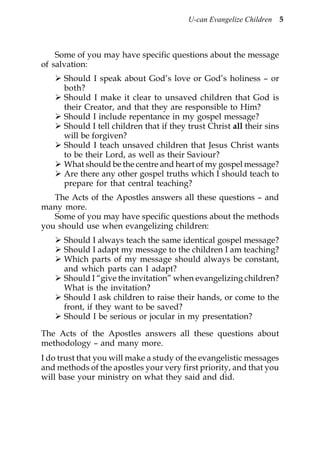
    All four of these sections of the New Testament are important
in our search for the message and methods of evangelism, and
all of them will help us to find, and understand, the answers to
our two key questions concerning the message of salvation and
the methods we should use to teach it. But there is one section
which will play the main part in our search and give us most
help for our answers.
      The four Gospels are very important because they describe
      for us the redemptive facts which provide the basis and
      heart of the gospel message, and they also give much help
      concerning how that message should be presented.
      The twenty-one epistles, or letters, give us many doctrinal
      outlines, and these include a number of important aspects
      of the message of salvation.
      The book of the Revelation also includes, and refers to,
      several important gospel truths.
      But it is the Acts of the Apostles which must be our
      main primer and guide book on the subject of
      evangelism. One of the main reasons it has been
      inspired by the Holy Spirit, and included in the Word
      of God, is to help us in our evangelism of the lost.
4    Chapter 1


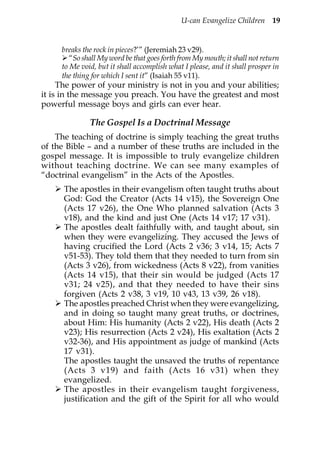
             THE MESSAGE AND METHODS OF EVANGELISM


                                            T HE GOSPEL S


                                           T H E A C T S O F T HE
                                                APOSTLES


                                                 THE
                                               EPISTL ES


                 Helpful       Important                    Very Important
                 Sources       Sources                      Sources


                  Study the Acts of the Apostles
    In the Acts of the Apostles we can see the first evangelists,
and the first preachers of the Gospel, at work. We can read in
that book the actual records of what they said when they were
evangelizing, and we can clearly see the methods they used
and what they did. So they are our inspired examples, and role
models, as far as evangelism is concerned:
      We should therefore study in great detail the evangelistic
      messages of the apostles, as recorded in the Acts of the
      Apostles, so that we can understand what we should say
      when we are evangelizing.
      We should also study, in great detail, the methods the
      apostles used in their evangelism, so that we can learn
      what we should do when we are evangelizing.
    Consequently, we will refer to the Acts of the Apostles
frequently throughout the pages which follow. This inspired
book written by Luke, as guided by the Holy Spirit, will be our
main primer and guidebook on the subject of the evangelism of
children. I trust that you yourself will take time, not just to read
my book (which I trust will be helpful), but to study in great
detail the inspired book, the Acts of the Apostles, which God
has provided to help and guide us in our evangelistic ministry.
U-can Evangelize Children 5


    Some of you may have specific questions about the message
of salvation:
      Should I speak about God’s love or God’s holiness – or
      both?
      Should I make it clear to unsaved children that God is
      their Creator, and that they are responsible to Him?
      Should I include repentance in my gospel message?
      Should I tell children that if they trust Christ all their sins
      will be forgiven?
      Should I teach unsaved children that Jesus Christ wants
      to be their Lord, as well as their Saviour?
      What should be the centre and heart of my gospel message?
      Are there any other gospel truths which I should teach to
      prepare for that central teaching?
   The Acts of the Apostles answers all these questions – and
many more.
   Some of you may have specific questions about the methods
you should use when evangelizing children:
      Should I always teach the same identical gospel message?
      Should I adapt my message to the children I am teaching?
      Which parts of my message should always be constant,
      and which parts can I adapt?
      Should I “give the invitation” when evangelizing children?
      What is the invitation?
      Should I ask children to raise their hands, or come to the
      front, if they want to be saved?
      Should I be serious or jocular in my presentation?

The Acts of the Apostles answers all these questions about
methodology – and many more.
I do trust that you will make a study of the evangelistic messages
and methods of the apostles your very first priority, and that you
will base your ministry on what they said and did.
6 Chapter 2


 Chapter 2:
Understand The Children

B efore studying the message of salvation, and the methods we
should use in teaching it, it is necessary for us to have a clear
understanding of what the Bible teaches concerning children,
their needs and their potential.
    There are many questions concerning children to which we
need the answers, before we can proceed any further:
      Are children lost? Do they need to be saved?
      Are babies and little children lost?
      Can children truly trust Jesus Christ as their Saviour?
      At what age can they do so?
      Should we speak to children about sin and God’s
      judgment?
      Are children more open to the Gospel than adults?
     The answers to these questions, and to many more, can be
found in God’s Word, the Bible. It is essential that we understand
what God tells us about children, and the evangelism of children,
and that we base our ministry on His Word – rather than listening
to, and basing our ministry on, the viewpoints and opinions of
fallible men.
     The Bible teaches us five main truths about children:

                    Children Need to be Saved
    God makes clear, in His Word, several key truths about the
spiritual condition and needs of children:
      All children are born into the world with a sinful nature,
      inherited from Adam, the federal head of the human race,
      and the representative of all men:
      “As it is written: ‘There is none righteous, no, not one’” (Romans 3 v10).
U-can Evangelize Children           7


“Behold, I was brought forth in iniquity, and in sin my mother conceived
me” (Psalm 51 v5).
“Therefore, just as through one man sin entered the world, and death
through sin, and thus death spread to all men, because all sinned”(Romans
5 v12).
This universal sinful nature shows itself in universal sinful
actions:
“For all have sinned and fall short of the glory of God” (Romans 3 v23).
“All we like sheep have gone astray; we have turned, every one, to his
own way” (Isaiah 53 v6a).
“The wicked are estranged from the womb; they go astray as soon as they
are born, speaking lies” (Psalm 58 v3).
The result of universal sin is universal death.
“For the wages of sin is death ……” (Romans 6 v23a).
       This includes physical death:
       “Therefore, just as through one man sin entered the world, and
       death through sin, and thus death spread to all men, because all
       sinned” (Romans 5 v12).
       It also includes spiritual death:
       “And you, being dead in your trespasses and the uncircumcision
       of your flesh, He has made alive together with Him, having forgiven
       you all trespasses” (Colossians 2 v13).
        “And you He made alive, who were dead in trespasses and sins”
       (Ephesians 2 v1).
All children are therefore spiritually dead, and they will
all die physically – as a result of sin.
Because all children are spiritually dead, they are outside
God’s kingdom, and they are all LOST as far as their
position is concerned:
“For the Son of Man has come to save that which was lost. What do you
think? If a man has a hundred sheep, and one of them goes astray, does he
not leave the ninety-nine and go to the mountains to seek the one that is
straying? And if he should find it, assuredly, I say to you, he rejoices more
over that sheep than over the ninety-nine that did not go astray” (Matthew
18 v11-13).
God is a holy and just God. Therefore He must punish sin:
 “Therefore, as through one man’s offense judgment came to all men,
resulting in condemnation, even so through one Man’s righteous act the
free gift came to all men, resulting in justification of life” (Romans 5 v18).
8 Chapter 2


       “Among whom also we all once conducted ourselves in the lusts of our
      flesh, fulfilling the desires of the flesh and of the mind, and were by nature
      children of wrath, just as the others” (Ephesians 2 v3).
      We have already seen that all children are lost, as far as
      their position is concerned. Those children who have
      reached an age of understanding, and accountability (and
      this age is much lower than many believe), and have not
      trusted Jesus Christ, are also lost as far as their condition
      is concerned, and are under the just condemnation of God.
      If they die in that condition, without trusting Jesus Christ,
      they will be lost forever.
      “He who believes in Him is not condemned; but he who does not believe is
      condemned already, because he has not believed in the name of the only
      begotten Son of God” (John 3 v18).
      Children therefore need to trust Jesus Christ as their
      Saviour. They are not saved by baptism, or any other
      church ceremonies; they are not saved because of their
      parents; they are not saved by “being good”. They are
      only saved through personal faith in Jesus Christ.
      “Therefore we conclude that a man is justified by faith apart from the
      deeds of the law” (Romans 3 v28).
      “But as many as received Him, to them He gave the right to become
      children of God, to those who believe in His name: who were born, not of
      blood, nor of the will of the flesh, nor of the will of man, but of God” (John
      1 v12 and 13).
      When they trust Jesus Christ there are two main results:
         They are justified. All their sin is forgiven, and God
         sees them as pure and as perfect as Jesus Christ.
      “And by Him everyone who believes is justified from all things from
      which you could not be justified by the law of Moses” (Acts 13 v39).
              They are regenerated. They are “new creatures” with
              a new nature. They are not perfect but they are changed:
      “Jesus answered and said to him, ‘Most assuredly, I say to you, unless one
      is born again, he cannot see the kingdom of God’” (John 3 v3).
      “Therefore, if anyone is in Christ, he is a new creation; old things have
      passed away; behold, all things have become new” (2 Corinthians 5 v17).
      In considering the spiritual condition and the needs of
children there must be no room for speculation, opinions or
mistaken ideas. We are dealing with the never-dying souls of
U-can Evangelize Children            9


boys and girls. If they are already in God’s kingdom, and are
not lost, they do not need to be evangelized. But if they are
spiritually dead (and we have seen that this is the clear teaching
of the Scriptures), outside God’s kingdom and under God’s just
condemnation (if they have reached the age of understanding)
– they need to be evangelized.
    It is when our eyes are opened to the true spiritual condition
of children, that we will begin to have a burden to evangelize
them.

                         Children Can be Saved
    True biblical conversion involves a turning from sin
(repentance) and a turning to Jesus Christ (faith). Salvation is
promised to all who repent and believe (Acts 3 v19; 16 v31). But
the question is — can a child turn from sin and have true saving
faith in Jesus Christ?
    Unfortunately many Christians believe that children are too
young to turn to Jesus Christ, and that they need to wait until
they are around twelve, thirteen or fourteen years old. But this
is not what the Bible teaches.

Can a child be saved?
     God tells us in His Word that a child can truly believe,
     and be saved:
      “And that their children, who have not known it, may hear and learn to
     fear the LORD your God as long as you live in the land which you cross the Jordan
     to possess” (Deuteronomy 31 v13).
      “That the generation to come might know them, the children who would
     be born, that they may arise and declare them to their children; that they
     may set their hope in God, and not forget the works of God, but keep His
     commandments” (Psalm 78 v6, 7).
      “But whoever causes one of these little ones who believe in Me to sin, it
     would be better for him if a millstone were hung around his neck, and he
     were drowned in the depth of the sea”(Matthew 18 v6).
      All the words used in these verses with regard to children
      – “fear”, “set their hope” and “believe in” (or trust) — make
      it clear that a child can have a personal relationship with
      God, and like Samuel can, respond to the voice of God
10 Chapter 2


      (1 Samuel 3 v10) – as God the Holy Spirit works in their
      hearts.
      Also the Bible teaches us, over and over again, that where
      there is true faith in Jesus Christ – at whatever age – there
      is salvation. Salvation is promised to “whoever believes”
      and there is no age limit:
      “For God so loved the world that He gave His only begotten Son, that whoever
     believes in Him should not perish but have everlasting life” (John 3 v16).
      Experience also shows us that children can trust Christ.
      Many Christians, including a good number of pastors,
      missionaries and well known Christians, date their
      conversion from childhood. While this has usually been
      followed by a deepening understanding, and a growth in
      faith and repentance, they themselves have no doubt that
      justification and regeneration took place at that moment
      when, as children, they truly believed and were saved.

At what age can a child trust Christ and be saved?
    We don’t know. The Bible does not give an age, and neither
should we. Children differ from each other. But the Lord Jesus
did speak about little ones trusting Him (Matthew 18 v6). So
the age when a child can trust Christ is generally much lower
than what many Christians believe. I have found, for example
in my evangelistic ministry, that many children between the ages
of 7 and 10 trusted Christ (plus, of course, some earlier, and
some later, than this age).
    This is the vision we need for our ministry to children. We
need to see that as God the Holy Spirit works in their hearts
they can trust Jesus Christ and be saved. And we need to make
this our goal at all times.

There are two kinds of children
   Therefore, and as a consequence of all we have outlined, we
need to understand that there are two kinds of children:
      Children who have trusted Jesus Christ as their Saviour,
      who have been born again, are spiritually alive and have
      eternal life, and who are in God’s kingdom. These children
U-can Evangelize Children 11


      need to be fed and built up in their faith.
      Children who have not trusted Jesus Christ. These children
      are spiritually dead, lost and outside God’s kingdom. They
      need to be evangelized.
   Every children’s worker has therefore two responsibilities:
      To feed saved children. I have written a book entitled
      “Ucan help Christian children to grow” which will help you
      with this ministry.
      To evangelize unsaved children. This present book has
      been written to help you do this.

                     God Loves Children
   The Bible makes it very clear that God loves children:
      God showed His love and deep concern for children by
      giving many instructions about teaching them in the Old
      Testament (Deuteronomy 4 v9, 10; 6 v5-7; 11 v18 and 19;
      Psalms 34 v11; 78 v1-8; Proverbs 22 v6; Joel 1 v3).
      The Lord Jesus showed His deep love and concern for boys
      and girls in a number of ways:
           He welcomed them (Mark 10 v13).
           He took them in His arms (Mark 10 v16).
           He accepted their praise (Matthew 21 v15, 16).
           He cared for their physical needs (John 4 v46-54;
           Mark 5 v38-43).
           He did not want them to be offended (Matthew 18
           v6), rejected (Matthew 18 v5) or despised (Matthew
           18 v10).
           He invited them to come to Him (Mark 10 v14).
           He wanted them to be saved (Matthew 18 v11).
           He did not want them to be lost (Matthew 18 v14).
    What assurance this gives us, as we teach God’s Word to
boys and girls, and as we evangelize them! Children are close to
the heart of God and of the Lord Jesus Christ, and so is your
work, as you minister to their needs.
12 Chapter 2


                 Children Are Open to the Gospel
   Children are open to anything and everything. They are
sensitive, vulnerable and very impressionable:
      The world knows this and tries to win the children.
      The advertisers develop special techniques to influence
      them.
      The cults and false religions take every opportunity to
      influence them.
      The communists have always made it their goal to
      indoctrinate children from an early age.
    Unfortunately the Church of Jesus Christ is not always so
alert, and very often misses opportunities to bring the Gospel to
children.
    You and I need to understand the following biblical facts
about children, and how they respond to the Gospel:
      Children are more open to the Gospel than adults. An
      adult must become like a child before he can be saved. A
      child already is a child, and God can use the childlike
      qualities he possesses (trustfulness, openness and humility)
      to lead him to Christ:
      “Assuredly, I say to you, unless you are converted and become as little
      children, you will by no means enter the kingdom of heaven’” (Matthew
      18 v3).
      “Assuredly, I say to you, whoever does not receive the kingdom of God as
      a little child will by no means enter it” (Mark 10 v15).
      The older a person is the harder he becomes, and the less
      likely he is to trust Jesus Christ:
      “Remember now your Creator in the days of your youth, before the
      difficult days come, and the years draw near when you say, “I have no
      pleasure in them” (Ecclesiastes 12 v1).
      “That they may set their hope in God, and not forget the works of God, but
      keep His commandments; and may not be like their fathers, a stubborn
      and rebellious generation, a generation that did not set its heart aright,
      and whose spirit was not faithful to God” (Psalm 78 v7, 8).
      The teaching of God’s Word can have a deep effect on
      children’s lives, and impressions and influences implanted
      in childhood are lasting. Win a child and you win an adult:
U-can Evangelize Children 13


      “And that from childhood you have known the Holy Scriptures, which
      are able to make you wise for salvation through faith which is in Christ
      Jesus”(2 Timothy 3 v15).
      “Train up a child in the way he should go, and when he is old he will not
      depart from it” (Proverbs 22 v6).
     These biblical facts show us how important it is to evangelize
the children. If they are open to the Gospel; if they are ready to
listen; if these are the years of opportunity when they are being
formed; if it will be harder to reach them in later years – then it
would be a tragedy, and very unwise, if we don’t evangelize
them – NOW.

                   A Child Saved Is a Life Saved
    When is the best age to trust Jesus Christ? The simple answer
is – the sooner the better. Is it not better to be saved at seven
years old rather than seventy? Common sense and experience
agree that it is better to come to Christ early in life. It is better to
know Christ as Saviour during the years when habits and
personality are being formed, rather than after they have been
formed. It is better to learn and absorb the Word of God when
the mind is open and learning is easy, rather than try to do so
afterwards.
    The children’s evangelist is not only interested in, and
labouring for, the souls of children, and not only praying that
they will be saved; his goal is also the salvation of lives – whole
lives to be lived for the glory of God. Many believers, who trusted
Jesus Christ in later years, have one regret – that they did not do
so earlier and as children. In this way they would have avoided
the waste of many precious years.
      “Remember now your Creator in the days of your youth, before the
      difficult days come, and the years draw near when you say, “I have no
      pleasure in them. While the sun and the light, the moon and the stars, are
      not darkened, and the clouds do not return after the rain” (Ecclesiastes
      12 v1, 2).
      “It is good for a man to bear the yoke in his youth” (Lamentations 3 v27).
   The Bible includes testimonies of those who started to walk
with God while they were young.
   David said:
      “You have taught me from my youth” (Psalm 71 v17).
14 Chapter 2


      “For You are my hope, O Lord GOD; You are my trust from my youth”
      (Psalm 71 v5).
    Obadiah declared:
      “ I your servant have feared the LORD from my youth” (1 Kings 18
      v12).
    Josiah first began to seek the Lord when he was eight years
old (2 Chronicles 34 v3) and Samuel first responded to the voice
of God when he was still very young (1 Samuel 3 v10), and the
Lord was with him from that time onwards (1 Samuel 3 v19).
Also a number of others, like Daniel, Joseph and Isaac, all seem
to have started walking with God when still young. Think of
the influence and value of such lives, and of many others who
were converted in childhood.
    Church history tells us that many spiritual giants were saved
as children.
U-can Evangelize Children 15


Chapter 3:
Understand Evangelism

W  orld evangelism is the task entrusted to the Church by the
Lord Jesus Christ.
“Go ye into all the world and preach the Gospel to every creature” (Mark 16
v15).
     Every believer must take this commission seriously and be
involved in fulfilling it.
     However, you and I cannot go into all the world, nor is it
possible for any of us to preach the Gospel to every creature.
Therefore, we need to ask God, the Lord of the Harvest, to show
us where we should evangelize, and whom we should
evangelize.
     World evangelism, or total evangelism, involves bringing the
gospel to every tribe and nation, and also to every age group –
including children. Children are included in the words “every
creature”. Indeed children make up one third of the total
population of the world, and in some countries one half!
Therefore, as we ask God to show us where to go and whom to
reach, it is clear that He will lead a substantial number of us
into a ministry to evangelize the children.
     Our purpose in this book is to study the evangelism of
children and, in particular, to find out what the Bible teaches us
about the message of salvation, and the methods we should use
in proclaiming and teaching that message.
     There are eleven basic principles concerning evangelism, and
especially the evangelism of children, which we must, first of
all, be aware of, and understand; and we will look at them in
this chapter.

                  The Bible Is Our Source Book
   We have already dealt with this point in the first chapter.
But it is so important that we need to come back to it and
16 Chapter 3


emphasize it again.
    The starting point in considering your message and methods
is not “What do children enjoy?” or “What can children
understand?” or “What will the children listen to?” or “What
do people tell us to teach and to do?” Your first consideration
must be “What does the Bible say concerning what you should
teach, and how you should teach?” What people say and what
you say is not what matters. You must find out what God says!
    The Word of God is your manual for evangelism and,
especially, the Acts of the Apostles, where you can find out what
the apostles taught when they were evangelizing and how they
did this. You need to learn about evangelism from them.

               There Is Only One Gospel Message
    The New Testament makes it clear, over and over again,
that there is only one gospel message, and only one message of
salvation:
      “He said to them, ‘Go into all the world and preach the gospel to every
      creature’” (Mark 16 v15).
      “But even if we, or an angel from heaven, preach any other gospel to you
      than what we have preached to you, let him be accursed. As we have said
      before, so now I say again, if anyone preaches any other gospel to you than
      what you have received, let him be accursed” (Galatians 1 v8, 9).
    The gospel message does not change according to the age
group being evangelized. There is not one message for one group
of people and another message for a different group. The gospel
message for children is the same as the gospel message for adults.
You do not have a short list of truths which are “suitable for
children”, a longer list for teenagers, and an even longer one for
adults.
    Of course the evangelist must always consider both the age
group and the background of those to whom he speaks, and
this will influence his presentation and application. The way
the message is presented, the methods used, and the emphasis given
to different aspects may vary, but the basic message must always
remain constant. The message must never be altered or diluted in
any way. When working with children you must be careful not to
sacrifice truth in the interests of so-called “simplicity”:
U-can Evangelize Children 17


            The Gospel Is an Extensive Message
    You have been entrusted with the Gospel, and it is your
responsibility to teach it to boys and girls. But you must know
what the Gospel is and that it consists of five main groups of
truths!
      Firstly, they need to be taught about Jesus Christ. The word
      “Gospel” means “Good News”. The Gospel is Good News
      about Jesus Christ – Who He is and what He has done. He
      must always be the central theme of our Gospel preaching,
      as He was in the Gospel preaching of the apostles.
      But if you begin to teach children who know nothing about
      the Bible, about the death of Jesus Christ, or the fact that
      He is our Saviour, you will find that they have great
      difficulty in understanding these truths. Other truths need
      to be taught as a foundation for the teaching of these
      truths.
      Secondly, they need to be taught about sin. They cannot
      understand salvation from sin if they don’t know what
      sin is. So teaching about the Saviour needs to be preceded
      by teaching about sin.
      Thirdly, they need to be taught about God. They cannot
      understand what sin is if they know nothing about God.
      Sin is rebellion against God and the breaking of His laws.
      Consequently, the proclamation and teaching of the Good
      News concerning Jesus Christ needs to be preceded by
      teaching concerning God, and teaching concerning sin.
      Fourthly, the children also need to be taught what they
      should do to be saved. Therefore the message of salvation
      should also include Jesus Christ’s invitation and command
      to come to Him, in repentance and faith.
      Fifthly, the children need to be taught the results of
      salvation and what God promises to do if they trust Christ.
      So, it is a help for the children to know what will happen
      if they do trust Jesus Christ – that all their sins will be
      forgiven, and that they will have a new nature.
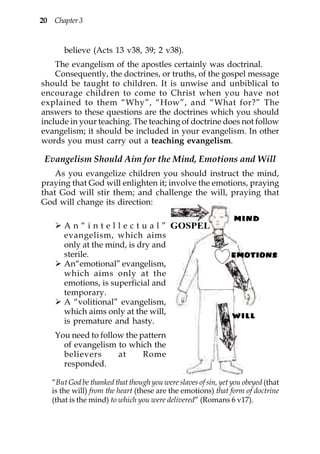
   Therefore, the message of salvation is an extensive message
18 Chapter 3


which includes teaching about five groups of truths – with a
number of truths in each group. These groups of truths, in their
logical order, are truths about God, truths about sin, truths about
Jesus Christ, truths about what children should do to be saved
and truths about the results of salvation.

                THE GOSPEL MESSAGE

         ITS                    ITS          ITS              ITS
     FOUNDATION                HEART         COM-          PR OM IS E
                                             MAND


                              JESUS            REPENT-       RESULTS
      GOD         SIN                          ANCE &           OF
                             CHRIST            FAITH          SALVA-
                                                               TION


               The Gospel Is a Powerful Message
    When God calls you and me to evangelize children, our first
reaction is usually “But what can I do to help children and to
lead them to Jesus Christ?” We have a feeling of complete
helplessness, and that is because we spend so little time with
them, and have little influence on them. At the same time the
children receive such massive influence and input from so many
other sources.
    But you need to remember what God tells you about the
Gospel in His Word:
         “For it is the power of God to salvation for everyone who believes”
      (Romans 1 v16).
         “For the message of the cross is foolishness to those who are
      perishing, but to us who are being saved it is the power of God”
      (1 Corinthians 1 v18).
         “For the word of God is living and powerful, and sharper than
      any two-edged sword” (Hebrews 4 v12).
         “’Is not My word like a fire?’ says the LORD, ‘and like a hammer that
U-can Evangelize Children 19


     breaks the rock in pieces?’” (Jeremiah 23 v29).
        “So shall My word be that goes forth from My mouth; it shall not return
     to Me void, but it shall accomplish what I please, and it shall prosper in
     the thing for which I sent it” (Isaiah 55 v11).
     The power of your ministry is not in you and your abilities;
it is in the message you preach. You have the greatest and most
powerful message boys and girls can ever hear.

              The Gospel Is a Doctrinal Message
    The teaching of doctrine is simply teaching the great truths
of the Bible – and a number of these truths are included in the
gospel message. It is impossible to truly evangelize children
without teaching doctrine. We can see many examples of
“doctrinal evangelism” in the Acts of the Apostles.
      The apostles in their evangelism often taught truths about
      God: God the Creator (Acts 14 v15), the Sovereign One
      (Acts 17 v26), the One Who planned salvation (Acts 3
      v18), and the kind and just One (Acts 14 v17; 17 v31).
      The apostles dealt faithfully with, and taught about, sin
      when they were evangelizing. They accused the Jews of
      having crucified the Lord (Acts 2 v36; 3 v14, 15; Acts 7
      v51-53). They told them that they needed to turn from sin
      (Acts 3 v26), from wickedness (Acts 8 v22), from vanities
      (Acts 14 v15), that their sin would be judged (Acts 17
      v31; 24 v25), and that they needed to have their sins
      forgiven (Acts 2 v38, 3 v19, 10 v43, 13 v39, 26 v18).
      The apostles preached Christ when they were evangelizing,
      and in doing so taught many great truths, or doctrines,
      about Him: His humanity (Acts 2 v22), His death (Acts 2
      v23); His resurrection (Acts 2 v24), His exaltation (Acts 2
      v32-36), and His appointment as judge of mankind (Acts
      17 v31).
      The apostles taught the unsaved the truths of repentance
      (Acts 3 v19) and faith (Acts 16 v31) when they
      evangelized.
      The apostles in their evangelism taught forgiveness,
      justification and the gift of the Spirit for all who would
20 Chapter 3


       believe (Acts 13 v38, 39; 2 v38).
    The evangelism of the apostles certainly was doctrinal.
    Consequently, the doctrines, or truths, of the gospel message
should be taught to children. It is unwise and unbiblical to
encourage children to come to Christ when you have not
explained to them “Why”, “How”, and “What for?” The
answers to these questions are the doctrines which you should
include in your teaching. The teaching of doctrine does not follow
evangelism; it should be included in your evangelism. In other
words you must carry out a teaching evangelism.

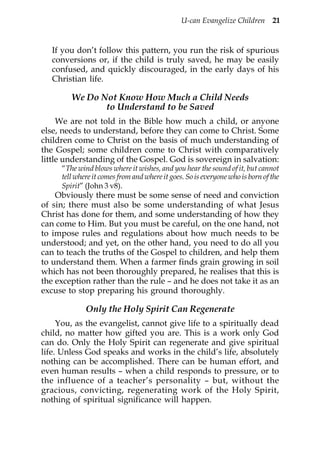
 Evangelism Should Aim for the Mind, Emotions and Will
    As you evangelize children you should instruct the mind,
praying that God will enlighten it; involve the emotions, praying
that God will stir them; and challenge the will, praying that
God will change its direction:

       A n “ i n t e l l e c t u a l ” GOSPEL
       evangelism, which aims
       only at the mind, is dry and
       sterile.
       An“emotional” evangelism,
       which aims only at the
       emotions, is superficial and
       temporary.
       A “volitional” evangelism,
       which aims only at the will,
       is premature and hasty.
    You need to follow the pattern
      of evangelism to which the
      believers      at     Rome
      responded.

   “But God be thanked that though you were slaves of sin, yet you obeyed (that
   is the will) from the heart (these are the emotions) that form of doctrine
   (that is the mind) to which you were delivered” (Romans 6 v17).
U-can Evangelize Children 21


   If you don’t follow this pattern, you run the risk of spurious
   conversions or, if the child is truly saved, he may be easily
   confused, and quickly discouraged, in the early days of his
   Christian life.

        We Do Not Know How Much a Child Needs
               to Understand to be Saved
     We are not told in the Bible how much a child, or anyone
else, needs to understand, before they can come to Christ. Some
children come to Christ on the basis of much understanding of
the Gospel; some children come to Christ with comparatively
little understanding of the Gospel. God is sovereign in salvation:
     “The wind blows where it wishes, and you hear the sound of it, but cannot
     tell where it comes from and where it goes. So is everyone who is born of the
     Spirit” (John 3 v8).
    Obviously there must be some sense of need and conviction
of sin; there must also be some understanding of what Jesus
Christ has done for them, and some understanding of how they
can come to Him. But you must be careful, on the one hand, not
to impose rules and regulations about how much needs to be
understood; and yet, on the other hand, you need to do all you
can to teach the truths of the Gospel to children, and help them
to understand them. When a farmer finds grain growing in soil
which has not been thoroughly prepared, he realises that this is
the exception rather than the rule – and he does not take it as an
excuse to stop preparing his ground thoroughly.

             Only the Holy Spirit Can Regenerate
     You, as the evangelist, cannot give life to a spiritually dead
child, no matter how gifted you are. This is a work only God
can do. Only the Holy Spirit can regenerate and give spiritual
life. Unless God speaks and works in the child’s life, absolutely
nothing can be accomplished. There can be human effort, and
even human results – when a child responds to pressure, or to
the influence of a teacher’s personality – but, without the
gracious, convicting, regenerating work of the Holy Spirit,
nothing of spiritual significance will happen.
22 Chapter 3


                  God Is Sovereign in Salvation
   It is often difficult, even impossible, to understand and
explain the results of our evangelism:
      One child can be deeply convicted of sin, and another
      remain totally unconcerned, after listening to the same
      message.
      One teacher may see several children come to Christ; and
      another teacher who is equally faithful may see none trust
      the Saviour.
      A children’s evangelist may hear that several children
      trusted Christ, after he brought a gospel message; and yet
      he could teach that same message on other occasions –
      without any obvious results.
    These are all evidences of God’s sovereignty in salvation.
Understanding this truth will save us from sinful pride when
children trust Christ; it will save us from despair, if we do not
see results; and it will, above all, keep us dependent upon our
sovereign God.

  God Has Committed the Ministry of Evangelism to You
                       and Me
   But the truth of God’s sovereignty should not make us
complacent in our evangelism. God does not work in a vacuum.
God uses people like you and me to accomplish His sovereign
purposes:
      “That is, that God was in Christ reconciling the world to Himself, not
      imputing their trespasses to them, and has committed to us the word of
      reconciliation. Now then, we are ambassadors for Christ, as though God
      were pleading through us: we implore you on Christ’s behalf, be reconciled
      to God” (2 Corinthians 5 v19, 20).
    God commands you to evangelize the children, and you must
obey that command with all your heart. A true belief in God’s
sovereignty will not keep you from evangelism. It will, instead,
encourage you to get involved in a ministry of evangelism –
trusting your Sovereign God to work according to His gracious
purpose.
U-can Evangelize Children 23


                             THE GOSPEL MESSAGE
                     n
              priatio

                           SALVATION                        RESULTS
                           Through                               Justification
                           Repentance and    JESUS                        and
         Appro


                           Faith                                Regeneration
                                            CHRIST
                                            His Person
                                            and Work
                         GOD                               SIN
       ation


                         His Holiness and                  Its Universality
                         Love                              and Results
  Found


                               We Need to Know the Message
    We have already seen that God uses the Gospel message to
speak to the hearts of unsaved children, to convict them of sin
and to regenerate them. It is therefore obvious that the messenger
must know, and understand, the message he is to preach.
    It will be our task in the chapters which follow to discover
and examine this message. But it can be summarized briefly as
follows:
          Teach the children about God – especially about His
          holiness and His love.
          Teach the children about sin – especially about its
          universality and its results.
          Teach the children about Jesus Christ – especially about
          His Person and His work.
          Teach the children what they need to do to be saved –
          especially about repentance and faith.
          Teach the children the results of salvation – especially about
          justification and regeneration.
    It is the Gospel, the message of salvation, which we are going
to examine together, and study, in this book. I would again
24 Chapter 3


encourage you to make it your goal to find out exactly what the
Bible teaches on the subject of evangelism and, as I have already
emphasized several times, I would encourage you, especially,
to study the Acts of the Apostles with this in mind. You need to
study the biblical message of salvation and the biblical methods
of evangelism for yourself. You need to think them through
carefully and prayerfully, and then come up with your own
conclusions from the Word of God. You and I need to follow in
the footsteps of the Berean believers of whom we read:
      “These were more fair-minded than those in Thessalonica, in that they
      received the word with all readiness, and searched the Scriptures daily to
      find out whether these things were so” (Acts 17 v11).
    I trust that my book, and the many chapters which follow
this one, will help you in your study.
U-can Evangelize Children 25


Chapter 4:
Teach About God In Evangelism

Many children, indeed the vast majority of children, have no
idea at all of Who God is and of what He is like, although this is
all clearly revealed in the Bible.

      Teaching About God Is the Basis of Evangelism
   While the Gospel message focuses on the Lord Jesus Christ –
Who He is and what He did – the foundation and basis of that
message is teaching about God:
      Teaching about God is essential in your evangelism because
      of what the Bible teaches about the purpose and goal of
      salvation:
           The primary purpose of the Gospel, and the work of
           Christ, is to bring people to God (1 Peter 3 v18).
           Salvation is turning to God from idols (1
           Thessalonians 1 v9).
           Salvation is knowing God (John 17 v3).
   The Gospel begins with God, and your evangelism should
begin there also.
     Teaching about God is essential in your evangelism, because
      the children need to know that the plan of salvation
      comes from Him:
           It was He Who planned our salvation (1 Peter 1 v20).
           It was He Who gave His Son (John 3 v16).
           It was He Who took the initiative in our salvation
           (John 3 v16; 1 John 4 v10).
      Teaching about God is essential in your evangelism,
      because the doctrine of God is the background and
      context of every other doctrine or truth in the gospel
      message.
26 Chapter 4


               An understanding of the character of God helps
               children to understand what sin is (Psalm 51 v4):
               An understanding of the character of God helps
               children to understand why Jesus Christ had to die
               (Romans 3 v25, 26).
               An understanding of the character of God encourages
               children to repent and believe (Romans 2 v4).


    The Apostles Taught About God When Evangelizing
    Teaching about God played a major part in the ministry of
the apostles when they were evangelizing.
       When the apostles preached to Jews, they assumed some
       basic knowledge of the Old Testament teaching about God
       – but they still included much teaching about God in their
       messages. They especially outlined, in their preaching,
       what God had foretold in His Word (Acts 2 v17-24; 3 v18),
       how He had performed miracles through His Son (Acts 2
       v22), how He had planned Christ’s sacrifice for sin (Acts
       2 v23), how He raised His Son from the dead (Acts 2 v24-
       32; 3 v15) and how He had exalted His Son (Acts 2 v33-
       36; 3 v13).
       When the apostles preached to Gentiles in Lystra and
       Athens, they found it necessary to teach them more basic
       doctrines about God – especially the truth that God is the
       Creator to Whom they were responsible (Acts 14 v15; Acts
       17 v24-26), that He is the living God (Acts 14 v15), that
       He is holy and righteous (Acts 17 v31), and that He will
       judge the world (Acts 17 v31).
    If you follow the example of these early (and inspired)
evangelists, your evangelism of children will include much
teaching about God.
    The four most important truths about God to include in
your evangelistic messages are:
       God has spoken to us through the Bible.
       God is Creator.
U-can Evangelize Children 27


      God is holy and just.
      God is love.

      THE GOSPEL STARTS WITH TEACHING
                 ABOUT GOD


                      HE HAS          HE IS
                      SPOKEN        CREATOR


          God Has Spoken to Us Through the Bible
    The first truth which children need to hear about God is
that He has spoken to us, and that He has revealed Himself to
us, in and through, the Bible.
    It is important for children to learn and understand that the
Bible is the Word of God, and that what you teach is from that
Word. You need, in this way, to establish the authority of your
message and to answer the question which children frequently
ask – “How do you know this?”
    Children need to see that the message you bring is not based
upon your ideas, or someone else’s ideas, but it is what God
says in His written Word.
    Consequently, you need to explain that the Bible is different
from any other book in that, while it was written by men, these
men were guided in what they wrote by God the Holy Spirit:
     “For prophecy never came by the will of man, but holy men of God spoke
     as they were moved by the Holy Spirit”(2 Peter 1 v21).
    We believe that the Bible is inspired, that it is absolutely true
and that it can be depended upon completely and without
reservation, and you need to teach this to the children.
28 Chapter 4


       “All Scripture is given by inspiration of God, and is profitable for doctrine,
       for reproof, for correction, for instruction inrighteousness, that the man of
       God may be complete, thoroughly equipped for every good work” (2
       Timothy 3 v16, 17).

 “Boys and girls:
 You need to realise that this Book is a special Book, because it comes from God. God used men
 to write it but He guided them in what they should write. Therefore it is absolutely true.
 You need to read it, believe it and do what it says.”


     (Here and on the pages which follow I have included a brief application
to the children of each of these truths.
     In each case I include the words “Boys and girls” not to indicate that
you should use these words – but to explain that these are applications
directed to THEM.)

                                   God Is Creator
    One of the greatest, and most fundamental, truths of
evangelism is the fact that God has created boys and girls, and
that they are therefore responsible to Him. This is a truth which
has often been neglected in present day evangelism; and you
need to be sure that you do not omit it.
        This is where the Bible begins:
       “In the beginning God created …..” (Genesis 1 v1).
        And as we read on through the Scriptures we find that
        the call of God to salvation comes from a position of
        strength. It comes from the Almighty Creator. God is our
        Maker and so He has a claim on our lives; and we are
        answerable to Him:
       “Remember now your Creator in the days of your youth, before the
       difficult days come, and the years draw near when you say, ‘I have no
       pleasure in them’” (Ecclesiastes 12 v1).
        This is what the apostle Paul taught the Gentiles.
        When Paul was evangelizing Gentiles in both Lystra and
        Athens, he started by teaching them that God was their
        Creator (Acts 14 v15, 17; Acts 17 v23, 24, 25, 28).They
        were ignorant of this vital gospel truth, and that was why
U-can Evangelize Children 29


        Paul started there. When Peter and Paul were evangelizing
        Jews who already knew that God was their Creator, they
        did not need to include this truth in their message to them.
        Most of the children you are evangelizing are similar in
        their background to the Gentiles in Lystra and Athens.
        God is to them, as to the Athenians, the “Unknown God”.
        Therefore you need to start your evangelism, like Paul,
        with the truth that God is the Creator.
        This is what today’s children need to know.
        Today’s children are taught the theory of evolution as
        historical fact (which of course it is not). This teaching is
        completely contrary to, and opposed to, biblical truth, and
        its main danger is that it eliminates responsibility to God.
        If God is not our Creator we are not accountable to Him –
        and this lack of accountability provides the basis for all
        humanistic philosophies and ways of life.
 “Boys and girls:
 The Bible teaches us that God made us. He used our fathers and mothers of course; but it was
 He Who gave us life. The Bible calls Him ‘our Creator’. But, remember, because He made us, we
 are responsible to Him, and He has the right to ask for our obedience and loyalty.
 The Bible says, ‘Remember your Creator in the days of your youth’ (Ecclesiastes12 v1).”


    It is important not just to teach the truth that God is Creator to children
but to apply it to them. There are several ways you can do this – both to
unsaved children and saved children:
     “Boys and girls:
 There are several things which you should understand.
      The God Who made everything must be very powerful. Therefore, if you are not a Christian,
 He is able to save you, no matter how bad you have been; and, if you are a Christian, He is able
 to help you overcome any problems you have – like, for example, a bad temper.
    God made you. You must answer to Him for everything you do. You will appear before Him one
 day.
    “God made you – as you are. Do not complain about how you look. That is how God made you.
    God made others as they are. Do not make fun of other children who are a different colour from
         you, or who are not as good at something as you are.”
30 Chapter 4


                        God Is Holy and Just
    God’s holiness means that He is completely pure and perfect.
God’s justice is His holiness in action. It means that everything
He does is right, and that He always rewards good and punishes
evil.
    These doctrines are vital in your evangelism of children, and
yet they are often neglected. There are a number of reasons why
you should teach them to our unsaved children.
       God’s holiness and justice are taught throughout the
       Bible:
           Over and over again God is called “The Holy One of
           Israel” and is described as holy:
      “And one cried to another and said: “Holy, holy, holy is the LORD of
      hosts; the whole earth is full of His glory!” (Isaiah 6 v3).
      “For thus says the High and Lofty One Who inhabits eternity, whose
      name is Holy: “I dwell in the high and holy place, with him who has a
      contrite and humble spirit, to revive the spirit of the humble, and to
      revive the heart of the contrite ones” (Isaiah 57 v15).
               The holiness of God will be the main theme of the
               redeemed throughout eternity:
      “Holy, holy, holy, Lord God Almighty, Who was and is and is to come!”
      (Revelation 4 v8b).
               The justice and judgment of God are included many
               times in the teaching of Scripture — both in the Old
               and New Testaments:
      “For He is coming, for He is coming to judge the earth. He shall judge the
      world with righteousness, and the peoples with His truth” (Psalm 96
      v13).
      “He who believes in the Son has everlasting life; and he who does not
      believe the Son shall not see life, but the wrath of God abides on him”
      (John 3 v36).
       God’s holiness and justice were preached by the
       apostles.
       When the apostles evangelized the Gentiles, they taught
       these truths as an essential part of their evangelism:
      “Truly, these times of ignorance God overlooked, but now commands all men
      everywhere to repent because He has appointed a day in which He will judge
      the world in righteousness by the Man whom He has ordained. He has given
      assurance of this to all by raising Him from the dead.” (Acts 17 v30, 31).
U-can Evangelize Children 31


      God’s holiness and justice show man his sin.
      When children learn something of the purity and holiness
      of God, they will see how impure they are, and they will
      see sin as something serious – and that it is rebellion against
      a holy God.
      “Against You, You only, have I sinned, and done this evil in Your sight”
      (Psalm 51 v4a).
      God’s holiness and justice explain the cross.
      God is holy and therefore a sinner cannot enter His
      presence, or go to Heaven, when he dies. But Jesus Christ
      became the sinner’s substitute, and God, in His justice,
      poured out His wrath and punishment for sin upon His
      Son. Therefore the death of Christ was necessary for our
      salvation. If God is not holy, there is no need for salvation.
      If God is not just, there is no need for the death of Christ:
     “Surely He has borne our griefs and carried our sorrows; yet we esteemed
     Him stricken, smitten by God, and afflicted. But He was wounded for our
     transgressions, He was bruised for our iniquities; the chastisement for our
     peace was upon Him, and by His stripes we are healed” (Isaiah 53 v4 and 5).
     “For Christ also suffered once for sins, the just for the unjust, that He
     might bring us to God, being put to death in the flesh but made alive by the
     Spirit” (1 Peter 3 v18).
      Today’s children do not understand about holiness and
      justice.
      Children are growing up in a world of low moral
      standards with rampant impurity, dishonesty and
      profanity. They need to learn what holiness is – as
      displayed in the character of God, and in the life of the
      Lord Jesus Christ.
      In addition, their concept of justice is warped by the
      injustices they see all around them – at home, at school
      and in the community.
      “Boys and girls:
      The Bible teaches us that God is completely pure, clean and holy. He never does anything
which is wrong. It is hard for us to imagine Someone Who is pure and without sin. But that is what
God is like.
      But God is also fair. This means that He will always reward purity; but it also means that
He will judge and punish sin. And that means that He must punish you and me because we are
      all sinners.”
32 Chapter 4


   It is important not just to teach the children the truth that
God is holy and just – but also to apply this truth and show
them what it means for them personally. This is a truth which is
necessary for both unsaved and saved children to understand.

   “Boys and girls:
 There are several important truths about God which you need to know:
     God is holy, therefore if you have not trusted Jesus Christ as your Saviour you will not be
 allowed to enter Heaven where God is. But if you trust Jesus Christ, His righteousness or
 goodness will be put in your account, and God will see you as pure and as holy as Jesus Christ
 is – and then you can enter Heaven when you die.
     Because God is fair He must punish sin. There are two possibilities:

        If you trust Jesus Christ you will not be punished for your sin, because that punishment has
        been taken for you by Jesus Christ.
        If you do not trust Jesus Christ, you yourself will bear your punishment.
        Because God is holy He wants children who have trusted Christ to be
         holy. He wants each of you to live a life which is pleasing to Him.”


                                       God Is Love
    It is important that children have a correct and biblical
picture of God. It is therefore essential that children learn that
God is, as we have seen, holy; but they also need to learn that
He is love. These two truths should be taught together, and in
balance. To teach or emphasize one of them at the expense of
the other will give a false, and unbiblical, picture of God.
        The holiness of God makes salvation necessary.
        The love of God, His mercy and His grace, make salvation
        possible.
        There are a number of very good reasons why you should
        teach the love of God to your children when you are
        evangelizing them:
        God’s love is taught throughout the Bible:
             In the Old Testament, the love of God is primarily
             seen in His relationship with His people, the Jews
             (Hosea 11 v8; Jeremiah 31 v3; Lamentations 3 v22).
             But it can also be seen in His attitudes towards the
U-can Evangelize Children 33


       heathen (Jonah 1 v2 and chapters 3 and 4).
       In the Old Testament, God’s love is seen in His
       gracious invitation to sinners:
“Come now, and let us reason together,” says the Lord, ‘Though your sins
are like scarlet, they shall be as white as snow; though they are red like
crimson, they shall be as wool’” (Isaiah 1 v18).
       In the New Testament, the love of God is seen
       primarily in His sending of Jesus Christ to die on the
       Cross as the sinner’s substitute:
“For God so loved the world that He gave His only begotten Son, that
whoever believes in Him should not perish but have everlasting life”
(John 3 v16).
God’s love and grace are seen in the salvation of those
who trust Christ:
God’s special love gift to those who trust Jesus Christ is
eternal life:
“He who does not love does not know God, for God is love. In this the love
of God was manifested toward us, that God has sent His only begotten Son
into the world, that we might live through Him. In this is love, not that
we loved God, but that He loved us and sent His Son to be the propitiation
for our sins”(1 John 4 v, 8, 9, 10).
God’s love is shown in His care as a heavenly Father
for those who are saved.
It is a love from which we can never be separated:
“Look at the birds of the air, for they neither sow nor reap nor gather into
barns; yet your heavenly Father feeds them. Are you not of more value
than they?”(Matthew 6 v26).
“For I am persuaded that neither death nor life, nor angels nor
principalities nor powers, nor things present nor things to come, nor height
nor depth, nor any other created thing, shall be able to separate us from the
love of God which is in Christ Jesus our       Lord” (Romans 8 v38, 39).
Many children do not know that God is a God of love.
They often have a concept of God as someone with a rod
ready to strike them, if they step out of line. You must
teach them that God is a personal God Who hates sin but
loves sinners.
Many children have no understanding of what love, true
love, is.
Today’s world, and especially today’s media, present
“love” as sexual interest and gratification, with the
34 Chapter 4


         continued emphasis upon self, rather than wanting the
         highest good for others. In addition, pop music usually
         conveys a perversion of love.
         Children need to hear and see what love really is – as
         portrayed in the biblical picture of God, and especially in
         the Person and work of Jesus Christ.
         All children need to know that, because of God’s love,
         they can be saved.
         Above all, children need to see that it is the love of God
         which makes it possible for anyone (even the worst and
         most wicked sinner) to be saved, to be forgiven and to be
         changed.
  “Boys and girls:
  Do you know that God really loves you – no matter how bad you have been? He loves you so
  much that He sent His Son to die for you, and take the punishment for your sins. Now He wants
  you to be saved and to live for ever.
  The greatest truth you will ever learn is:
  ‘Jesus loves me, this I know,
  For the Bible tells me so.’
  He loves you and He wants the very best for you.”


   It is important not just to teach this great truth of God’s love
– but to apply it to both unsaved and saved children, and show
them what it means for them personally:
  “Boys and girls:
     If you are not saved, the Bible says that God loves you so much that if you ask Jesus Christ
  to save you (and really mean it) you will receive eternal life, and all your sins will be forgiven for
  ever.
      If you are saved, God wants you to show your love for others (even if they don’t deserve it)
  just as He has shown His love to you.”
U-can Evangelize Children 35


Chapter 5:
Teach About Sin In Evangelism

We want children to trust Jesus Christ as their Lord and
Saviour, but, before they can do so, they must be aware of the
sin from which they need to be saved. Consequently, careful
and detailed biblical teaching about sin is an essential part of
the evangelist’s message.
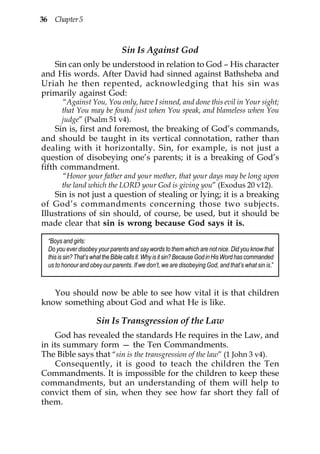
     There are six facts, or truths, about sin which you should
teach the children – not all at once of course, but over a period
of time, and as the exegesis, and explanation, of the Bible passage
you are teaching allows you to do so:
      Sin   is against God.
      Sin   is transgression of the law.
      Sin   must be punished.
      Sin   is universal.
      Sin   is an act.
      Sin   is a nature.

                         TRANSGRESSION
                            OF LAW


            AGAINST                             MUST BE
              GOD                               PUNISHED


        UNIVERSAL                               A NATURE
                             AN ACT
36 Chapter 5


                                 Sin Is Against God
   Sin can only be understood in relation to God – His character
and His words. After David had sinned against Bathsheba and
Uriah he then repented, acknowledging that his sin was
primarily against God:
       “Against You, You only, have I sinned, and done this evil in Your sight;
       that You may be found just when You speak, and blameless when You
       judge” (Psalm 51 v4).
     Sin is, first and foremost, the breaking of God’s commands,
and should be taught in its vertical connotation, rather than
dealing with it horizontally. Sin, for example, is not just a
question of disobeying one’s parents; it is a breaking of God’s
fifth commandment.
       “Honor your father and your mother, that your days may be long upon
       the land which the LORD your God is giving you” (Exodus 20 v12).
    Sin is not just a question of stealing or lying; it is a breaking
of God’s commandments concerning those two subjects.
Illustrations of sin should, of course, be used, but it should be
made clear that sin is wrong because God says it is.

  “Boys and girls:
  Do you ever disobey your parents and say words to them which are not nice. Did you know that
  this is sin? That’s what the Bible calls it. Why is it sin? Because God in His Word has commanded
  us to honour and obey our parents. If we don’t, we are disobeying God, and that’s what sin is.”


   You should now be able to see how vital it is that children
know something about God and what He is like.

                      Sin Is Transgression of the Law
    God has revealed the standards He requires in the Law, and
in its summary form — the Ten Commandments.
The Bible says that “sin is the transgression of the law” (1 John 3 v4).
    Consequently, it is good to teach the children the Ten
Commandments. It is impossible for the children to keep these
commandments, but an understanding of them will help to
convict them of sin, when they see how far short they fall of
them.
U-can Evangelize Children 37


Paul wrote, “I would not have known sin except through the law” (Romans 7 v7).
   Therefore the teaching, and understanding, of God’s
commandments and standards help to prepare the way for the
gospel message.
       “Therefore the law was our tutor to bring us to Christ, that we
       might be justified by faith” (Galatians 3 v24).

  “Boys and girls:
  Did you know that God has given us rules to obey and follow? There are ten main rules called the
  Ten Commandments and they tell us, for example, that we should not steal, or lie, or use God’s
  name lightly. Do you know why God gave these rules? He wanted us to know that we are sinners,
  and so when we break these rules (and we all do so from time to time) we begin to see that we
        need to be saved.”

                              Sin Must Be Punished
   The clear teaching of Scripture is that God is just, and that
He must therefore punish sin. Sin deserves punishment, and
separation from God:
        “ The soul who sins shall die” (Ezekiel 18 v4).
        “For the wages of sin is death, but the gift of God is eternal life in Christ
        Jesus our Lord” (Romans 6 v23).
    However, while you must not omit God’s judgment on sin
from your message, you should be wise in the way you teach
this solemn truth. It should always be done lovingly and tenderly
– and with no attempt to frighten or pressurize the children
into “making a decision”. Your responsibility is to warn – not to
frighten.
    Also, the fact that God must punish sin explains the death
of Jesus Christ on the cross – why He died, and what happened
during those hours on the cross, when God punished Him for
our sins.
  “Boys and girls:
  You need to understand that God is always fair. Do you know what that means? It means that He
  will always reward goodness. But it also means that He must punish sin. And you and I have
  sinned. So God will, and must, punish our sin – however there is someone else who willingly took
  that punishment. And that Someone is Jesus Christ.”
38 Chapter 5


                                    Sin Is Universal
     The Bible makes it clear (and experience backs this up) that
sin is absolutely universal, encompassing every nation, age group
and culture:
        “As it is written: “There is none righteous, no, not one” (Romans 3v10).
        “For all have sinned and fall short of the glory of God” (Romans 3 v23).
        “All we like sheep have gone astray; we have turned, every one, to his
       own way; and the Lord has laid on Him the iniquity of us all” (Isaiah 53 v6)
       .
    Children need to be taught, therefore, that they are included
in the universality of sin, and that their sins are not unimportant,
or a source of amusement. In God’s sight, they are all sinners –
and need to be saved.
   “Boys and girls:
  The Bible tells us that everybody has sinned. We all find ourselves doing things which are wrong.
  Old people and young people, boys and girls, those who go to church, and those who don’t.
  Everybody! And that includes me too. I have done, and said, and thought, many wrong things too,
  just like you. And because of all the wrong things we have done we all need the Lord Jesus Christ
  as our Saviour.”


                                      Sin Is an Act
    Sin is anything we do, say or think which displeases God.
So it is necessary to speak to children about specific sins, and
give illustrations and examples which are “true to life” and
which the children understand. This was what the Lord Jesus
Christ did, when He dealt with people like the rich young ruler
and the Samaritan woman.
You are not trying to be critical of the children. You are only
pointing out specific sins, so that the children will trust Christ,
and so that the precious remedy of the blood of Christ can be
applied. You are not leading the child to despair – but to Christ
and His forgiveness; you are not leaving the child under the
guilt of sin; you are pointing him to the “Lamb of God Who takes away
the sin of the world” (John 1 v29).
U-can Evangelize Children 39


  “Boys and girls:
  Do you ever feel guilty about the wrong things you have done? Perhaps it was an unkind word to your
  sister, or a lie to your mother. Perhaps you took something which did not belong to you. Or perhaps
  you remember bad thoughts you had about someone. These are all sins. But the good news is that
  God wants to forgive all your sins and take away your guilt – so that you can be happy and contented.
  He wants you to trust His Son Jesus Christ as your Saviour – and when you do that ‘the slate will
  be wiped clean’ – for ever.”

                                      Sin Is a Nature
    The children need to understand why they sin. It is because
they have a sinful nature, and what they do is simply the result
of what they are. Each child is born with a bias towards wrong:
    “The heart is deceitful above all things, and desperately wicked; who can
know it?” (Jeremiah 17 v9).
   Also, it is important for those children who are self-righteous,
and do not see themselves as guilty of sinful acts, to realise that
they are already guilty before God, because of the sinful nature
they possess.
    “Boys and girls:
  You need to remember that sin is not just what we do. It is what we are. Our hearts and our
  natures are sinful. We were born that way. And even babies and little children start doing and
  saying and thinking things which are wrong. Why? Because they are wrong – inside. We don’t
  have to be taught to do wrong things. We need to be taught, and to learn, the things which are
  right. We especially need to learn how to trust Jesus Christ as our Saviour, because He will not
  only forgive us our sins but He will also give us a new nature.”


    It is the evangelist’s responsibility therefore to teach children
about sin – but only as a preparation for what you are going to
teach them about Jesus Christ, and God’s remedy for sin. The
bad news needs to precede the good news – otherwise the good
news would not be understandable. But, at the same time, the
bad news should always be followed by the good news.
    As you teach about sin, you need to pray that the Holy Spirit
will work in the children’s hearts, and that He will use the Word
you teach to help the children understand what sin is, and to be
convicted of it.
40 Chapter 6


Chapter 6:
Teach About The Lord Jesus Christ In Evangelism

T he Gospel is, first and foremost, a message about a Person –
the Lord Jesus Christ. The good news is that this Person, the
Lord Jesus Christ, saves boys and girls, men and women:
     “And this is eternal life, that they may know You, the only true God, and
     Jesus Christ whom You have sent” (John 17 v3).
     “But we preach Christ crucified, to the Jews a stumbling block and to the
     Greeks foolishness” (1 Corinthians 1 v23).
    Apart from the Lord Jesus Christ there is no Gospel. So your
evangelism must always be Christ-centred. He is the central
theme of the Scriptures and the central theme of the gospel
message, and this should be reflected in your ministry to the
children.
    This does not mean that you leave out the doctrines about
God and sin which we have already discussed. These are the
foundational truths of the Gospel, just as the doctrines of Jesus
Christ are the heart of the Gospel – and these foundational truths
help prepare the way for the good news.

     The New Testament Evangelists Preached Christ
   We have already seen that the Acts of the Apostles is our
main primer, or teaching manual, on the subject of evangelism,
because in that book we see, and hear, those early apostolic
evangelists preach the Gospel. It is significant that, while they
do include the foundational doctrines of God and sin in their
evangelistic messages, their preaching always led to Jesus Christ.
     “Nor is there salvation in any other, for there is no other name under
     heaven given among men by which we must be saved”(Acts 4 v12).
     “Then Philip went down to the city of Samaria and preached Christ to
     them” (Acts 8 v5).
     “Then Philip opened his mouth, and beginning at this Scripture, preached
     Jesus to him” (Acts 8 v35).
     “Immediately he preached the Christ in the synagogues, that He is the Son
U-can Evangelize Children 41


     of God”(Acts 9 v20).
     “Explaining and demonstrating that the Christ had to suffer and rise
     again from the dead, and saying, “This Jesus whom I preach to you is the
     Christ”(Acts 17 v3).
    They had different approaches, and these approaches
depended upon the circumstances and the people to whom they
were speaking, but they always arrived at the same destination
– the great truths concerning Jesus Christ which we will study
in the remainder of this chapter.
    The preaching of Christ in the gospel message involves the
teaching of two main truths, or groups of truths, concerning
Him:
      Truths about the Person of Christ – Who He is.
          He is God the Son.
          He is perfect Man.
      Truths about the Work of Christ – what He did:
          His sinless life.
          His death.
          His resurrection.
          His exaltation.
    Both groups of truths should be taught to your children when
you are evangelizing them. You cannot, of course, do this all at
once! But you should aim to do so over a period of time as the
Bible passages, on which your lessons are based, allow you to
do so.
                 Truths About the Person of Christ
    It is essential to teach the children Who Jesus Christ is. It is
Jesus Christ Himself Who saves children. Salvation is a personal
relationship between the child and the Person of the Lord Jesus
Christ. Therefore the children need to know Who He is, and see
Him as He really is.
    There are two key truths about the Person of Jesus Christ,
which you should teach your children, when you are
evangelizing them.
42 Chapter 6


                  THE GOSPEL CENTRES ON
               TEACHING ABOUT JESUS CHRIST
                                                             HIS
                   HIS                             RESURRECTION
      IS O K


                   DEATH
     H WR


                  HIS
                SINLESS
                  LIFE                             HIS
                                                   EXALTATION
     IS R N
    H PE SO


                   HE IS                                  HE IS
                    GOD                                 PERFECT
                  THE SON                                 MAN


Jesus Christ is God the Son
    The Bible teaches clearly, over and over again, that Jesus
Christ is God. This is a vital truth for children to understand,
because it is only as God that He is able to save sinners.
         “And without controversy great is the mystery of godliness: God was
         manifested in the flesh, Justified in the Spirit, Seen by angels, Preached
         among the Gentiles, Believed on in the world, Received up in glory”
         (1 Timothy 3 v16).
  The apostles in their evangelistic preaching continually
emphasized His Lordship and Deity:
         “Immediately he preached the Christ in the synagogues, that He is the Son
         of God” (Acts 9 v20).
    The apostles often used the title “Son of God”, when they
were preaching about Him, and this was understood by them
(and by their listeners) to mean that He was truly God. But
because so many people and cults speak today of Jesus Christ as
the Son of God (without believing that He is divine), it is better
and wiser for you to use the title “God the Son”. And it is also
better to give Him His full name “the Lord Jesus Christ” or “the
Lord Jesus” or “Jesus Christ” rather than just call Him “Jesus”.
In this way you are once again emphasizing His deity.
    The truth of the deity of Jesus Christ is vital because it is as
God that He is able to forgive sins, and to change lives.
U-can Evangelize Children 43


       “Boys and girls:
 You need to remember that Jesus Christ is God. He is different from us. He can tell the wind to
 stop blowing, and the waves to stop roaring. He can give blind men their sight, and make it
 possible for lame men to walk. He can even raise people from the dead. He can do anything! This
 means that if you are not saved He can forgive all your sin – no matter how bad you have been.”


Jesus Christ is Perfect Man
    The clear teaching of the New Testament is that Jesus Christ
is completely, yet sinlessly, human.
       “By this you know the Spirit of God: Every spirit that confesses that Jesus
       Christ has come in the flesh is of God, and every spirit that does not
       confess that Jesus Christ has come in the flesh is not of God” (1 John 4 v2, 3).
       “For He made Him who knew no sin to be sin for us, that we might become the
       righteousness of God in Him” (2 Corinthians 5 v21).
    And the apostles, in their evangelistic preaching made it clear
that Jesus Christ was a man, and that He was human:
       “Therefore let it be known to you, brethren, that through this Man is
       preached to you the forgiveness of sins” (Acts 13 v38).
   God the Son, the Word of God, became flesh (John 1 v14)
and lived a perfect and sinless life – without, at any time, or in
any way, sacrificing His deity. And the children need to
understand that it was only as a man He could become a
substitute for men. A substitute has to be of the same nature as
those for whom He is the substitute. And He had to be a perfect
man because He could only take the place of sinners if He Himself
was without sin.

       “Boys and girls:
 Do you know what a substitute is? He is a person who takes the place of another person. A
 football team usually has substitutes who sit on the bench at the side of the football pitch. If a
 player is hurt, or is not playing well, a substitute is sent on to take his place. The substitute is also
 a football player – like the one whose place he takes. Jesus Christ became our substitute. He
 was human – just like us but one hundred per cent without sin because He is God; and He took
 our place when He died on the Cross. He took the punishment for sin so that we would not need
       to be punished.”
44 Chapter 6


Jesus Christ is Both God and Man – Our Mediator
    Consequently, you teach your children that Jesus Christ is
the God-man, but you need to emphasize that He is One Person
– not two! This may be difficult to understand, but it is a truth
which we need to accept and believe.
    Only as the God-man could He accomplish the work of
salvation, and, because He is both God and Man, He can be the
link or Mediator between God and man – and our great High
Priest.

               Truths About the Work of Christ
   There are four truths about the saving work of Jesus Christ,
which you need to teach your children, when you are
evangelizing them.

His Sinless Life
    We have already referred to this truth and its importance.
Only a sinless man could die for sin. So you need to show the
children that everyone who came into contact with Jesus Christ,
and knew Him during His 33 years of life here on this earth,
testified to His sinlessness:
      His Father said so (Hebrews 1 v8, 9).
      His friends said so (Acts 3 v14; 2 Corinthians 5 v21; 1
      Peter 2 v22; 1 John 3 v3, 5).
      His enemies said so (Matthew 27 v3, 4; Matthew 27 v19;
      Luke 23 v41; Luke 23 v47; John 18 v38).
      The demons said so (Mark 1 v23, 24).
    It is also important to realise, and explain, that all the
sacrifices of animals “without blemish” for sin in the Old
Testament pointed forward to the Sinless One, Who would be
the eternal sacrifice for sin.
U-can Evangelize Children 45


  “Boys and girls:
  You and I have sinned many times – and God must punish our sins, unless someone else takes
  our place, and bears our punishment for us. But that someone else must have no sin of his own
  if he is going to die for our sin. Otherwise he would have to be punished for his own sin. Is there
  Someone like this? Yes, there is! The Lord Jesus Christ never sinned. So He was able to die
  for our sin. And He loves you and me very much. So He was willing to die for our sin.”

His Death
    The death of Christ is the central theme of the whole Bible,
the central theme of the gospel message, and the central theme
of the doctrines of Jesus Christ:
        In the Old Testament it is foretold.
        In the four Gospels it is outlined.
        In the epistles it is explained.
        In the Acts of the Apostles it is preached.
    The death of Jesus Christ was preached in all the gospel
sermons in the Acts of the Apostles (Acts 3 v15; 3 v18) – and His
death should also be the focus of the gospel message which you
teach your children.
    There are several aspects of His death which you especially
need to teach, and explain, to your unsaved children:
        The purpose of His Death
            He died so that sinners could be saved from the
            consequences of their sin.
                “For Christ also suffered once for sins, the just for the unjust, that
                He might bring us to God”(1 Peter 3 v18a).
                He died so that sinners could be changed, and live a
                life pleasing to God:
                “Who gave Himself for us, that He might redeem us from every
                lawless deed and purify for Himself His own special people, zealous
                for good works” (Titus 2 v14).
        The nature of His Death
            It was substitutionary. He took our place.
                “But He was wounded for our transgressions, He was bruised for
                our iniquities; the chastisement for our peace was upon Him, and
                by His stripes we are healed” (Isaiah 53 v5).
46 Chapter 6


               It was sacrificial. God the Father punished His Son
               and poured out on Him His wrath for our sin.
               “And the Lord has laid on Him the iniquity of us all” (Isaiah 53
               v6b).
               “Yet it pleased the Lord to bruise Him; He has put Him to grief”
               (Isaiah 53 v10a).
               It was satisfactory. His work on the cross was a
               finished and completed work; and nothing needs to
               be added to it:
               “So when Jesus had received the sour wine, He said, ‘It is finished!’
               And bowing His head, He gave up His spirit” (John 19 v30).
               “But this Man, after He had offered one sacrifice for sins forever,
               sat down at the right hand of God” (Hebrews 10 v12).
       The results of His Death
       When a sinner (child or adult) turns from his sin, and
       trusts Jesus Christ, there are a number of consequences:
            He is justified (Romans 3 v24, 25). All his sin is
            forgiven.
            He is regenerated (Titus 3 v5, 6). He is a new person.
            He is adopted (Galatians 4 v3-5). He is a child of God.
            He is redeemed (1 Peter 1 v18, 19). He is free.
            He is indwelt by the Holy Spirit (1 Corinthians 6 v19,
            20). He is able to live in a new way.
            He has eternal life (John 3 v16). He will live forever.
    All of these results are because Jesus Christ died for us on
the Cross.

   “Boys and girls:
 Do you realise how much Jesus Christ must have loved you and me – even though we are
 sinners, and have done nothing to deserve His love! We were really His enemies and completely
 ignored Him. And yet He said to His Father, “I will take their sin upon Myself and I will take the
 punishment for all that sin – so that they don’t have to.”
 And that is what He did on the Cross. He took our place and our punishment so that we could be
 saved.”

His Resurrection
   In the Acts of the Apostles the resurrection of Jesus Christ
played a major part in their evangelistic sermons. His resurrection
U-can Evangelize Children 47


was the visible proof, and the evidence, that the message they
preached about Jesus Christ and His death on the Cross was
true. Indeed they never preached the cross, and the death of
Christ, without immediately including His resurrection.
     “Him, being delivered by the determined purpose and foreknowledge of
     God, you have taken by lawless hands, have crucified, and put to death;
     whom God raised up, having loosed the pains of death, because it was not
     possible that He should be held by it” (Acts 2 v23 and 24)
     “And killed the Prince of life, whom God raised from the dead, of which
     we are witnesses” (Acts 3 v15).
     “Let it be known to you all, and to all the people of Israel, that by the name
     of Jesus Christ of Nazareth, whom you crucified, whom God raised from
     the dead, by Him this man stands here before you whole” (Acts 4 v10).
     “Now when they had fulfilled all that was written concerning Him, they
     took Him down from the tree and laid Him in a tomb. But God raised Him
     from the dead”(Acts 13 v29, 30).
   Also the writers of the epistles make it very clear that the
resurrection is an important and essential part of the gospel
message:
     “Moreover, brethren, I declare to you the gospel which I preached to you,
     which also you received and in which you stand, by which also you are
     saved, if you hold fast that word which I preached to you; unless you
     believed in vain. For I delivered to you first of all that which I also received:
     that Christ died for our sins according to the Scriptures, and that He was
     buried, and that He rose again the third day according to the Scriptures”
     (1 Corinthians 15 v1- 4).
    Consequently, you should also be sure to include the great
truth of Christ’s resurrection in your gospel ministry to your
children.
    There are several aspects of this great truth which you should
teach the children:
      The meaning of the resurrection
      The dead body of the Lord Jesus was raised again to life.
      His Spirit did not die – only His body. When that body
      was brought back to life it was changed to become an
      immortal body, never to die again, and His Spirit was
      reunited with it.
      The fact of the resurrection
      As you teach the resurrection to the children you may
      need, from time to time, to outline the evidence for it, and
48 Chapter 6


        how we know it actually took place as recorded in the
        Bible:
             The empty tomb (Luke 24 v3) and the undisturbed
             grave clothes (John 20 v6, 7).
             The appearances of the risen Lord to so many people
             (e.g. John 20 v16; Luke 24 v34; John 20 v19; 1
             Corinthians 15 v6).
             The change in the disciples (compare Mark 14 v66-
             72 with Acts 2 v14-23).
        The results of the resurrection
             It shows beyond doubt that Jesus Christ is God
             (Romans 1 v4).
             It proves that His death was sufficient for our
             salvation (Romans 4 v25).
             It assures those who believe that they are fully justified
             (Romans 4 v23-25; 5 v1).
             It assures us of our own resurrection (1 Corinthians
             15 v18-20).
             It demonstrates the power of God (Ephesians 1 v19, 20).
   Above all, the resurrection shows that Jesus Christ is alive –
and that He is able to save all those who come to Him.
       “But He, because He continues forever, has an unchangeable priesthood.
       Therefore He is also able to save to the uttermost those who come to God
       through Him, since He always lives to make intercession for them”
       (Hebrews 7 v24, 25).

 “Boys and girls:
 You should always remember that the Lord Jesus Christ did not remain dead. Three days later He
 rose again from the dead and became alive for ever more. God the Father made Him alive again,
 to show us that His death on the Cross was successful, and that He had truly died for all our sins.
 This is also the proof that, if you trust Him, all your sins will be forgiven. And it means that He is
 alive today, that He is here in this room and that He is able to save you today – if you ask Him.”

His Exaltation
    Teaching the children that Jesus Christ is Lord, and that He
is exalted as the God-man to a place of complete power and
absolute authority, should be an essential part of your
evangelism. You are not presenting a weak Christ, Who is
U-can Evangelize Children 49


pleading with them to “please let Me come in”. You are
presenting a risen, exalted Christ, the King of Kings, before
Whom they should bow in obedience, and obey His command
to trust and follow Him.
    There was nothing apologetic or half-hearted about the
evangelism of the early church. They knew, and preached, that
Jesus Christ was the exalted One, and that He had been given a
position of absolute Lordship by the Father:
    It is not a matter of His being exalted, and becoming King,
at a later date. He is King of Kings NOW, and has the place of
honour and absolute authority at the right hand of His Father.
   “All power is given unto Me in Heaven and in earth” (Matthew 28 v18).
      The exaltation and Lordship of Jesus Christ was a truth
      the apostles preached with boldness to the unsaved:
      “Therefore being exalted to the right hand of God, and having received
      from the Father the promise of the Holy Spirit, He poured out this which
      you now see and hear” (Acts 2 v33).
      “Therefore let all the house of Israel know assuredly that God has made
      this Jesus, whom you crucified, both Lord and Christ” (Acts 2 v36).
      “Him God has exalted to His right hand to be Prince and Savior, to
      give repentance to Israel and forgiveness of sins” (Acts 5 v31).
      “The word which God sent to the children of Israel, preaching peace
      through Jesus Christ; He is Lord of all” (Acts 10 v36).
      This glorious theme continues throughout the epistles –
      both in relation to the Gospel, and to the instruction of
      believers:
      “That if you confess with your mouth the Lord Jesus and believe in your
      heart that God has raised Him from the dead, you will be saved” (Romans
      10 v9).
      “For there is no distinction between Jew and Greek, for the same Lord over
      all is rich to all who call upon Him. For ‘whoever calls on the name of the
      LORD shall be saved’” (Romans 10 v12, 13).
   Consequently, you need to teach unsaved children that Jesus
Christ is Lord, and that when they trust Him as their Saviour,
they will be taking the first step (and it is only the first step) of
submission to Him as Lord and King. They will then know that,
when they trust Him, He will take charge of their lives, and
make changes in their lives.
50 Chapter 6


 “Boys and girls:
 Did you know that Jesus Christ is the King of Kings and Lord of all this universe? It is He, the
 Lord, Who commands you to turn from your sin, and trust Him as your Saviour; and if you do,
 your life will be changed and He will become your Lord and King. Are you willing to obey Him
 today? Then trust Him and ask Him to be your Saviour and Lord – and start a new life today, living
 for Him.”

                                       Conclusion
     Teaching the children about the Person and work of Jesus
Christ is an essential part of your evangelistic ministry – indeed
it is the most important part.
     However, it must be made clear again, that it is not possible
to TEACH all the truths involved in this great doctrine at any
one time. You will teach the truth, or truths, about Jesus Christ,
which the passage on which your lesson is based teaches. But
you should, at the same time, feel free to mention other truths
(without teaching them), provided they help you to explain and
apply the gospel truth you have chosen as your central truth.
U-can Evangelize Children 51


Chapter 7:
Invite The Children To Come To Christ

Before proceeding any further, let us revise what we have
outlined so far concerning the gospel message:
      The gospel message is founded, first of all, upon teaching
      about God:
           That He has spoken in His Word.
           That He is the Creator.
           That He is holy.
           That He is love.
      The gospel message is founded, secondly, upon teaching
      about sin:
           That it is against God.
           That it is transgression of God’s law.
           That it must be punished.
           That it is universal.
           That it is an act.
           That it is a nature.
      The gospel message centres upon teaching about Jesus
      Christ:
           His Person
           • He is God.
           • He is perfect Man.
           His Work
           • His sinless life
           • His death
           • His resurrection
           • His exaltation

   Those are the FACTS of the gospel message. But it is not
enough just to present, and teach, facts and truths – important
and vital though they are. You need to challenge the children to
ACT on the basis of these truths. You need to show the children
52 Chapter 7


what RESPONSE God expects from them, because of the facts
and truths which they have heard and learned.
   You need to teach them the way of salvation and what they
need to do to be saved:
       They need to turn from their sin (repentance).
       They need to trust Jesus Christ (faith).
    So you need to show them their responsibility to repent and
believe.
    You also need to show them what God will do for them, if
they do repent and believe:
       All their sins will be forgiven. They will be justified.
       They will be new creatures. They will be regenerated.
    The way of salvation through repentance and faith, and the
blessings which result, are integral parts of the gospel message
which should not be omitted. To experience these two blessings
of salvation the child must obey God’s command, or invitation,
to turn from their sin, and come to Jesus Christ, and personally
trust Him as Lord and Saviour. Jesus Christ invites them to come
to Him in repentance and faith.
    It is therefore your responsibility not only to teach the gospel
facts or truths outlined on the previous pages, but also to give or
bring the gospel invitation to unsaved children, when you are
evangelizing them. To understand how you should do this you
need to ask and answer a number of questions about this
invitation:
       What is the invitation?
       Should I give this invitation?
       When should I give this invitation?
       How should I give this invitation?
       How does a child respond to this invitation?

                    What is the Invitation?
    To answer this question, we need to turn again to the pages
of the Acts of the Apostles, and watch those early apostolic
evangelists at work. What did they do? What did they not do?
U-can Evangelize Children 53


    Perhaps it is better to first answer the question, “What is not
the invitation ?” – keeping in mind the evangelism of the apostles:
      The invitation is not something to be added on after you
      have preached, and after you have taught the gospel
      message. It is part of that message.
      The invitation is not a request by the evangelist, to which
      the children should respond physically by raising their
      hand, coming to the front, or waiting behind.
    As you read the Acts of the Apostles, you will find that Paul,
Peter, Philip, and the other evangelists in the early church did
invite and challenge their hearers to repent and trust Christ.
But they did so as part of their message. It was not added on
afterwards. You will also find that they never asked for a physical
response.
    What, then, is the invitation?
    The invitation is a call from Jesus Christ to come to Him, in
repentance and faith, to receive forgiveness and a new nature.
    The invitation does not come from us. It comes from Jesus
Christ. He invites the children to come to Him. We are only the
bearers of that invitation to the children.
54 Chapter 7


     If I had a friend who was going to be married, and that
friend asked me to invite you to his wedding, I would be glad to
do so. I would therefore come to you and say, “My friend wants
you to come to his wedding. It will take place on June 6th in
Belfast. He asked me to give you his invitation to come to the
wedding.” I have fulfilled my responsibility; I have “given you
the invitation”. At the same time, I would give you clear
directions about how to get there (if you did not know the way),
and I would encourage you to accept the invitation – especially
if I knew that my friend really wanted you to come, and I knew
how pleased he would be if you did. But whether you go to the
wedding, or not, is now a matter between you and my friend. I
have fulfilled my responsibility.
     Therefore, your responsibility as a children’s evangelist is to
tell the children:
       That Jesus Christ wants them to come to Him. That is the
       invitation itself.
       How they can do this – by trusting Him as their Saviour –
       either now, immediately, or later. Those are the directions.
       What Jesus Christ will do for them if they come to Him
       and how pleased He will be to receive them. Outlining
       the blessings of coming to Jesus Christ will encourage the
       children to respond to His invitation.

                THE INVITATION


                   Y
                ALL
          SP ECI
                           1. Jesus Christ wants you to come
           FOR !
              U            2. This is how you can come
            YO
                           3. This is what He will do if
                                 you come
U-can Evangelize Children 55


   If you make these three facts clear to the children, you have
given them the invitation.
   Consequently, you can come to six conclusions (three
negative and three positive) about the invitation.
      This invitation is not something to be added on after the
      gospel message; it is an essential part of the gospel
      message.
      This invitation is not part of my methodology; it is part of
      my message.
      This invitation does not require a physical response (such
      as raising a hand, or coming to the front or waiting
      behind).
      The child’s response to the invitation is a matter between
      Jesus Christ and himself.
      The child responds to this invitation in his heart – now or
      later.
      If the child responds to this invitation, Jesus Christ will
      receive him – and save him.

                   What Does The Bible Teach?
   This invitation from God to man can be found throughout
the Bible:
      This invitation can be found in the Old Testament:
      “Come now, and let us reason together,” says the Lord, “Though your
      sins are like scarlet, they shall be as white as snow; though they are red
      like crimson, they shall be as wool” (Isaiah 1 v18).
      “Ho! Everyone who thirsts, come to the waters; and you who have no
      money, come, buy and eat. Yes, come, buy wine and milk without money
      and without price” (Isaiah 55 v1).
      The Lord Jesus Christ when He was here on earth invited
      sinners to come to Him.
      “Come to Me, all you who labor and are heavy laden, and I will give you
      rest” (Matthew 11 v28).
      “All that the Father gives Me will come to Me, and the one who comes to
      Me I will by no means cast out” (John 6 v37).
      The evangelists of the early apostolic church gave this
      invitation.
56 Chapter 7


       They invited, and challenged, their unsaved listeners to
       repent, to trust, to turn, to come or to call – and they made
       it clear what God would do for them if they did so. They
       invited them, they gave them the directions, and they
       outlined the results of their response, to encourage them
       to do so.
       “Then Peter said to them, ‘Repent, and let every one of you be baptized in
       the name of Jesus Christ for the remission of sins; and you shall receive
       the gift of the Holy Spirit.’ For the promise is to you and to your children,
       and to all who are afar off, as many as the Lord our God will call” (Acts
       2 v38, 39).
       “Repent therefore and be converted, that your sins may be blotted out,
       so that times of refreshing may come from the presence of the Lord” (Acts
       3 v19).
       “To Him all the prophets witness that, through His name, whoever
       believes in Him will receive remission of sins” (Acts 10 v43).
       “Therefore let it be known to you, brethren, that through this Man is
       preached to you the forgiveness of sins; and by Him everyone who believes
       is justified from all things from which you could not be justified by the
       law of Moses” (Acts 13 v38, 39).
       “So they said, “Believe on the Lord Jesus Christ, and you will be saved,
       you and your household” (Acts 16 v31).
       “But declared first to those in Damascus and in Jerusalem, and throughout
       all the region of Judea, and then to the Gentiles, that they should repent,
       turn to God, and do works befitting repentance” (Acts 26 v20).
       “For ‘whoever calls on the name of the Lord shall be saved’” (Romans
       10 v13).
       “Therefore He is also able to save to the uttermost those who come to God
       through Him, since He always lives to make intercession for them”
       (Hebrews 7 v25).
       Every time they preached and evangelized, they showed
       and taught their listeners what God wanted them to do,
       how to do it, and what He would do if they obeyed Him.
       When they had done this they had given the invitation.
       They did not ask their listeners to stand, come to the front
       or raise their hands. And yet God the Holy Spirit worked
       in the hearts of those listening, and many were saved.
       Giving the invitation to children involves therefore:
            Letting them know that Jesus Christ wants them to
            come to Him, in their hearts, for salvation.
U-can Evangelize Children 57


               Letting them know how to do this.

            Letting them know that Jesus Christ will receive them
           and will save them if they do so – to encourage them
           to do so.
      The evangelist who has fulfilled these three responsibilities
      has given the invitation.
      You might say something like this:

     “Boys and girls:
     Do you know that you are like this jailer? You have sinned and you have gone your own
     way. But if you, in your heart, want to have your sins forgiven, and if you want to be
     different, you can come to Jesus Christ today. Ask Him to forgive you and change you
     – and, when you do that, He will. He has promised to do so in His Word “Whosoever
     (and that includes you) shall call on the name of the Lord (if you call to Him and ask Him)
     shall be saved” (Romans 10 v13). Why not do so today? You can talk to Him in your
     heart and call on Him at any time, and the moment you do so, you will be saved.”


                  Should You Give This Invitation?
    It would be wrong not to give this wonderful invitation,
when you are evangelizing children. To tell children that they
need to be saved without showing them that it is possible for
them to be saved, what they need to do to be saved, and what
the results will be, would be a grave mistake. The invitation is a
vital part of your gospel message. It is impossible to evangelize
without giving this invitation.

            When Should You Give This Invitation?
    If you understand that the invitation is an essential part of
the gospel message, then the answer is obvious. You will invite
the children to come to Christ every time you preach and teach
them the Gospel. The children who are listening to you should
always know that Jesus Christ wants them to come to Him, to
trust Him, how they can do so, and what the results will be if
they come.
58 Chapter 7


            How Should You Give This Invitation?
   There are four words which can best describe how you
should give the gospel invitation to children:
        Authoritatively
     You should give the invitation on the authority of what
     God has said in His Word. It is His invitation – not yours.
     That means you should always use a Bible verse as the
     basis of the invitation you give.
     This verse should show the children what Jesus Christ
     wants or invites them to do, and it should also show them
     what He will do if they respond to Him.
     For example you could use ONE of the following Bible
     verses:
               “For ‘whoever calls on the name of the Lord shall be saved’ “
               (Romans 10 v13).
               The child should be invited to “call to Jesus Christ”;
               and if he does so God promises to “save” him.
               “Believe on (trust) the Lord Jesus Christ, and you will be saved”
               (Acts 16 v31).
               The child should be invited to “trust Jesus Christ”
               and if he does so God promises to “save” him.
               “But as many as received Him, to them He gave the right to become
               children of God” (John 1 v12).
            The child should be invited to “receive Christ”; and
            if he does so God promises he will “become a child of
            God”.
            Naturally
       The Bible verse you use in your invitation, and the
       challenge you present, should be based upon the Bible
       passage you have been teaching in your Bible lesson; and
       it should be the application of the great truth, or truths,
       which you have been teaching them from that passage.
       For example, if you are teaching a Bible lesson based upon
       the story of the prodigal son in Luke 15, the natural
       invitation would be to “come” (like the prodigal) and the
       Lord Jesus “will receive you” (as the prodigal’s father did)
       using John 6 v37b as your verse.
       “… and the one who comes to Me I will by no means cast out” (John 6 v37b).
U-can Evangelize Children 59


      Simply
      It is better to stick to one verse and to one concept. Do not
      speak about “coming”, “calling”, “receiving” and
      “trusting” in one lesson, or in one invitation. You know
      that these all describe the same act; but it is better to keep
      to one of these concepts, at any one time, to avoid
      confusion.
      Urgently
      The Bible uses several words to describe the evangelism of
      the apostles in the book of Acts, and these are words which
      should also describe your evangelism.
             They reasoned (Acts 17 v2; 17 v17; 18 v4; 18 v19).
             The same word is used in Acts 19 v8, and is translated
             in the NIV as “argued persuasively”. The word used
             here has the thought of thinking something through
             logically, and then presenting it in that way.
             They persuaded (Acts 18 v4; 19 v8). This word means
             to bring about a change of mind by the influence of
             reason.
             They beseeched (2 Corinthians 5 v20; 6 v1). This word
             means to encourage people to do something.
             They warned (Colossians 1 v28).The children need
             to know something about the consequences of not
             responding to Jesus Christ’s invitation.
      So there should be a note of earnestness, urgency and
      persuasion as you bring Jesus Christ’s invitation to the
      children.
      “Now then, we are ambassadors for Christ, as though God were pleading
      through us: we implore you on Christ’s behalf, be reconciled to God. For
      He made Him who knew no sin to be sin for us, that we might become the
      righteousness of God in Him” (2 Corinthians 5 v20, 21).
      “We then, as workers together with Him also plead with you not to receive
      the grace of God in vain” (2 Corinthians 6 v1).

    But, like the apostles, you should trust God the Holy Spirit
to work in the hearts of the children – and not put pressure of
any kind on them to respond to Christ’s invitation.
60 Chapter 8


 Chapter 8:
The Children’s Response To The Invitation
 Part I — Repentance


W   e have examined the message of salvation in detail, and we
have seen the gospel truths which we should teach the children
when evangelizing them.
    We have also seen our responsibility to challenge, and invite,
the children to respond to these gospel truths.
    It is now necessary to examine what that response should
be, so that you can know what you are aiming at, praying for,
and expecting to happen as the Holy Spirit works in the hearts
of the children; and also so that you can explain to the children
what their response should be.

                     The Meaning of Conversion
    The biblical response to the gospel message is two-fold. The
Bible often uses the word “converted” or “turned” with regard
to this two-fold response. The Greek word used to describe and
summarize the sinner’s response to the Gospel is sometimes
translated “converted” and sometimes “turned”:
    “Then I will teach transgressors Your ways, and sinners shall be converted
      to You” (Psalm 51 v13).
    “…… unless you are converted and become as little children, you will by no
      means enter the kingdom of heaven” (Matthew 18 v3).
    “For the hearts of this people have grown dull. Their ears are hard of hearing,
      and their eyes they have closed, lest they should see with their eyes and
      hear with their ears, lest they should understand with their hearts and be
      converted, so that I should heal them” (Matthew 13 v15).
    “Repent therefore and be converted” (Acts 3 v19).
    “A great number believed and turned to the Lord” (Acts 11 v21).
    “ ….. you should turn from these useless things to the living God” (Acts 14 v15).
    “To open their eyes, in order to turn them from darkness to light, and from
U-can Evangelize Children 61


      the power of Satan to God” (Acts 26 v18).
   “…… that they should repent, turn to God” (Acts 26 v20).
   “ ….. and how you turned to God from idols to serve the living and true
      God” (1 Thessalonians 1 v9).
   (Similar uses of this word are also found in Mark 4 v12; John 12 v40;
      Acts 28 v27; Isaiah 6 v10).
   The response of the child to the Gospel can therefore be
summarized by the words “turn” or “ be converted”.
   We can see from the verses quoted above that this “turning”
has two aspects and involves two actions:
      A turning from vanities, from darkness, from idols and
      from sin.
      A turning to God and to the Lord Jesus Christ.
    Common sense also shows us that a turning has two sides
or aspects. If I am walking and decide to turn, then I will, at the
same time, turn from the direction in which I was going and go
in a new direction. There is only one turning, but that turning
has two aspects, or sides, to it – what we turn from and what
we turn to.
    And so it is with the conversion of a child:
      He turns from his old way of life, and from sin. The Bible
      calls this repentance.
      He turns to Jesus Christ for salvation. The Bible calls this
      faith.
   The child is saved when he turns – that is, when he repents
and believes. Both of these occur at the same time and cannot
be separated from each other. They are like two sides of the
same coin. There is one coin but two sides.
   But I would like to emphasize two biblical truths:
      The child is saved by faith alone. The child is not saved by
      repentance.
      However, saving faith includes a measure of repentance.
      The child cannot turn to Christ, and to a new direction, if
      he does not want to turn from his sin, and the old direction.
62 Chapter 8


          RESPONSE TO THE INVITATION

                                          REPENTANCE


                                                                   S
                                                                   I
                                                      AND
                                                                   N
                                      FAITH


                   The Meaning of Repentance
   In this chapter we will study what the Bible teaches about
repentance. We need to understand what repentance is – and
what it is not.
   What repentance is not:
      Repentance is not tears, anguish, distress, loss of appetite
      or sleeplessness (although some of these may happen –
      especially with some adults).
      Repentance is not conviction of sin, or sorrow for sin –
      although without some measure of these, no matter how
      little, there can be no repentance.
      Repentance is not a work which a sinner does, or performs,
      on his own to be saved – because it is granted by God. He
      is responsible to repent, but he can only repent as God
      enables him to do so.
      “When they heard these things they became silent; and they glorified
      God, saying, ‘Then God has also granted to the Gentiles repentance to
      life’ “ (Acts 11 v18).
      “In humility correcting those who are in opposition, if God perhaps will
      grant them repentance, so that they may know the truth” (2 Timothy 2
      v25).
      Repentance is not another word for faith. The Lord Jesus
U-can Evangelize Children 63


      told the people to “repent and believe the Gospel” (Mark 1
      v15). Paul described the gospel ministry as “testifying both to
      the Jews and also to the Greeks repentance towards God and faith towards
      our Lord Jesus Christ” (Acts 20 v21).
    What repentance is:
    The word “repentance” means a change of mind; and the
context in which it is generally used in the Bible shows that it is
primarily a change of mind and attitude towards sin and
towards God – a change of mind which leads to a change of
direction and, eventually, a change of behaviour. A change of
mind which does not lead to a change of direction and behaviour
is not a genuine change of mind.
    True repentance involves all three parts of the sinner:
      His mind – he knows what sin is, and that he has sinned.
      His emotions – he is convicted of his sin, and is sorry for it.
      His will – he wants to turn from sin, and he wants to
      change the direction of his life.

                         REPENTANCE

                           MIND
                                             I know


                                             I am convicted       S
                       EMOTIONS                                   I
                                                                  N
                         WILL           I want to
                                                 turn


   However, two points should be emphasized:
      There are degrees of repentance. If a child wants to trust
      Christ there must be repentance, but it might be very small.
      He is not saved by repentance, but he cannot be saved
      without it. However, a fuller understanding of the
64 Chapter 8


      repentance which took place at conversion often occurs
      in the months and years which follow.
      Repentance does not end at conversion. It deepens as the
      believer makes progress in his Christian life.

               The Bible Teaching on Repentance
   The Word of God makes it clear that repentance is an essential
part of the gospel message:
      It was clearly taught and expected in the Old Testament:
      “Let the wicked forsake his way, and the unrighteous man his thoughts;
      let him return to the LORD, and He will have mercy on him; and to our
      God, for He will abundantly pardon” (Isaiah 55 v7).
      It played a major part in the earlier ministries of the New
      Testament:
            John the Baptist preached it:
            “In those days John the Baptist came preaching in the wilderness of
            Judea, and saying, ‘Repent, for the kingdom of heaven is at hand!’
            “ (Matthew 3 v1 and 2).
            The Lord Jesus preached it:
            “From that time Jesus began to preach and to say, ‘Repent, for the
            kingdom of heaven is at hand’ “ (Matthew 4 v17)
            The twelve disciples preached it:
            “So they went out and preached that people should repent” (Mark
            6 v12).
      The Lord Jesus told His disciples that it was an essential
      part of the gospel message:
      “And that repentance and remission of sins should be preached in His
      name to all nations, beginning at Jerusalem” (Luke 24 v47).
      It played a major part in the evangelistic messages of Peter:
      “Then Peter said to them, ‘Repent, and let every one of you be baptized in
      the name of Jesus Christ for the remission of sins; and you shall receive the
      gift of the Holy Spirit’ “ (Acts 2 v38)
      “Repent therefore and be converted, that your sins may be blotted out,
      so that times of refreshing may come from the presence of the Lord” (Acts
      3 v19)
      It played a major part in the evangelistic ministry of Paul:
      “And saying, ‘Men, why are you doing these things? We also are men
      with the same nature as you, and preach to you that you should turn from
U-can Evangelize Children 65


      these useless things to the living God, who made the heaven, the earth, the
      sea, and all things that are in them’ “ (Acts 14 v15)
      “Testifying to Jews, and also to Greeks, repentance toward God and faith
      toward our Lord Jesus Christ” (Acts 20 v21)
      “To open their eyes, in order to turn them from darkness to light, and
      from the power of Satan to God, that they may receive forgiveness of sins
      and an inheritance among those who are sanctified by faith in Me……
      But declared first to those in Damascus and in Jerusalem, and throughout
      all the region of Judea, and then to the Gentiles, that they should repent,
      turn to God, and do works befitting repentance” (Acts 26 v18, 20).
      It plays an essential part in man’s salvation:
      “I tell you, no; but unless you repent you will all likewise perish” (Luke
      13 v3).
      It is God’s desire and will for all men today:
      “The Lord is not slack concerning His promise, as some count slackness,
      but is longsuffering toward us, not willing that any should perish but
      that all should come to repentance” (2 Peter 3 v9).
      It is a basic and fundamental truth of Christianity:
      “Therefore, leaving the discussion of the elementary principles of Christ,
      let us go on to perfection, not laying again the foundation of repentance
      from dead works and of faith toward God” (Hebrews 6 v1).

                Teaching Repentance to Children
    It should, first of all, be recognized that repentance is an
essential part of the gospel message and that it should not be
omitted when we are evangelizing children. It is not, of course,
necessary to use the word “repentance”, but the concept should
be included in your teaching of the Gospel, and in your challenge
or invitation to the children.

Your Teaching
   The children should be taught at least three truths on this
subject:
      That sin is against God, and that they have turned to their
      own way, and away from God.
      That each of them is a sinner, and that they need to be
      saved.
66 Chapter 8


      That God wants them to turn from sin, and to change the
      direction of their lives.

      “Boys and girls:
      Do you know what it means to repent? Let me tell you about Philip.
      Philip walked slowly home from school. He wasn’t too happy with himself. He knew his
      life wasn’t right. He knew he didn’t please God. He really wanted to be different. He
      knew some of his friends would laugh if he stopped doing some of the wrong things they
      did together. But somehow to be living in a way that would please God seemed more
      important than anything. So on the way home Philip told God how sorry he was, and
      that he wanted to be different. What was Philip doing? He was repenting, he was
      turning from his sin. And, at the same time, he asked God to forgive him, to take over
      and be in charge of him. Now Philip was saved – for ever.”


Your Challenge
    It is not enough to teach the need for repentance to the
children. You also need to challenge them to repent.
    You could use words like these to challenge the children:

    “Do you want to be different? Do you want to please God?”
    or “Do you want your life to move in a different direction?”
    or “Are you sorry that you have sinned and displeased God?”
    or “Do you know that being a Christian will mean a new kind of
     life – and a new Master and King of your life – Jesus Christ?”

   There are three warnings to remember concerning your
challenge to the children on this subject of repentance:
      Your challenge and invitation to the children is not only
      “Do you want to have your sins forgiven?”, or “Do you
      want to receive eternal life?” That is only part of the gospel
      challenge and invitation. You also need to include the other
      part: “Do you want to be different? Do you want to turn
      from sin and please God?”
      Jesus Christ died not just to forgive sin and give eternal
      life, but also to regenerate and change sinners.
      Consequently, the children need this two-fold challenge.
      Unfortunately, many who evangelize children only present
      to them the need to have their sins forgiven, and to receive
U-can Evangelize Children 67


God’s gift of eternal life, and assure them that they will be
forgiven and live eternally if they trust Jesus Christ (which
is, of course, absolutely true). But the children who are
being evangelized also need to be taught that God wants
to see a change in their lives, and that, if they trust Jesus
Christ, He will expect to see that change.
You do not need to overemphasize the subject of
repentance. It should, of course, be included in your gospel
message, but your main emphasis should be on the
responsibility of the children to put their trust in Jesus
Christ – as outlined in the next chapter.
It is important always to be balanced in your presentation.
The vital fact to remember is that you should encourage
and invite the children to come to Christ – and you should
show them how to do so in the way which is appropriate
to, and fits in with, the passage of Scripture and the story
on which your lesson is based.
You should never give the children the impression that
they must reform their lives, perform good works, or make
promises, before they can come to Christ. The gospel
message is that they should come as they are, with their
sin, to be saved. But, having said that, it should be obvious
that there must, at the same time, be a desire to turn from
the wrong, and sin, in their lives – otherwise they do not
see what they need to be saved from.
68 Chapter 9


 Chapter 9:
 The Children’s Response To The Invitation
 Part II — Faith


R epentance and faith are two doctrines which cannot be
separated. They do not mean the same. Repentance is not faith,
faith is not repentance. The two words are not interchangeable.
The Lord Jesus made this clear when He preached “Repent, and
believe in the Gospel” (Mark 1 v15).
     Repentance and faith are, as I have already said, like two
sides of one coin. They both happen together at the moment of
conversion. When a person truly repents he will turn in faith to
God. When there is true faith there is also repentance, because
true faith includes repentance. Someone has well said, “We are
saved by faith alone, but the faith which saves is never alone.”
We are saved through faith alone in Christ alone. We are not
saved by repentance, but we cannot be saved without it.

                    The Meaning of Faith
   It is important that we understand the teaching of the Bible
concerning faith.
What is faith?
    True saving faith is that act by which a person is enabled, by
the Holy Spirit, to commit himself to Jesus Christ, and depend
on Him alone for salvation. Saving faith is not just “believing
something with the head” or “believing that the Lord Jesus died
for me”. It is, of course, both of those, but it is more. Faith is
personal trust in, and a commitment of oneself to, the Lord Jesus
Christ.
    Faith, like repentance, involves the mind, the emotions and
the will.
U-can Evangelize Children 69


Faith involves the mind
    Knowledge is necessary before faith can be exercised. Before
a child can have faith, or can trust in Jesus Christ, he must know
something about Jesus Christ, and what He has done.
    But head knowledge on its own cannot save. Even the
demons believe (James 2 v19). They have head knowledge about
Jesus Christ, but they are not saved.
Faith involves the emotions
    It is necessary that there should be an emotional assent, and
a heart conviction, that what God has said, and that which the
child has heard and learned, is true. So the child’s heart or
emotions are touched, and he is convinced that he needs to be
saved, and that Jesus Christ can save him.
    But this still falls short of saving faith. Not only do the demons
believe (they have knowledge) but James 2 v19 tells us that they
tremble (their emotions are affected). But they are not saved.
Faith involves the will
    On the basis of what the child knows about Jesus Christ
and what He has done, and the conviction or feeling in his
emotions that this is true, the child needs to put his TRUST in
Jesus Christ by an act of his will. This placing of trust in Christ is
called by John Calvin (the great French reformer and theologian)
“the crowning act of faith”; and it is this personal trust in Jesus
Christ which results in salvation.
                          FAITH

                                    MIND
          I know
          He can
                                                               S
           I believe
                                EMOTIONS
                                                               I
           He can
                                                               N
                                 WILL
           I trust
           Him
70 Chapter 9


    This three-fold response is only possible as the Holy Spirit
works in the children’s hearts. Faith is a gift of God (Ephesians
2 v8), and it is the Holy Spirit who helps and enables the children
to put their trust in Jesus Christ.

                     The Bible Teaching on Faith
   The Bible emphasizes, over and over again, how important
and fundamental faith is in the salvation of a sinner, and that it
should therefore be central in your evangelistic message,
challenge and invitation:
               It was always required by Jesus Christ in His dealings
               with people (Matthew 8 v5-10; Matthew 15 v21-28;
               Mark 2 v1-5; Mark 10 v46-52).
               It was an essential part of the great commission given
               to us by the Lord Jesus:
               “And He said to them, ‘Go into all the world and preach the gospel
               to every creature. He who believes and is baptized will be saved;
               but he who does not believe will be condemned’” (Mark 16 v15, 16).
               It was preached by the apostles as the way of
               salvation for sinners:
                  By Peter:
               “To Him all the prophets witness that, through His name, whoever
               believes in Him will receive remission of sins” (Acts 10 v43).
                  By Paul:
               “And by Him everyone who believes is justified from all things
               from which you could not be justified by the law of Moses” (Acts
               13 v39).
               “So they said, ‘Believe on the Lord Jesus Christ, and you will be
               saved, you and your household’” (Acts 16 v31).
               “Testifying to Jews, and also to Greeks, repentance toward
               God and faith toward our Lord Jesus Christ” (Acts 20 v21).
                  By the evangelists in the early church:
               “But when they believed Philip as he preached the things
               concerning the kingdom of God and the name of Jesus Christ, both
               men and women were baptized” (Acts 8 v12).
               “Now as they went down the road, they came to some water. And
               the eunuch said, ‘See, here is water. What hinders me from being
               baptized?’ Then Philip said,‘If you believe with all your heart,
               you may.’ And he answered and said, ‘I believe that Jesus Christ is
U-can Evangelize Children 71


            the Son of God’ “ (Acts 8 v36, 37).
            “And the hand of the Lord was with them, and a great number
            believed and turned to the Lord” (Acts 11 v21)
            It is the foundation of a right relationship with God
            “For in it the righteousness of God is revealed from faith to faith;
            as it is written, ‘The just shall live by faith’ “ (Romans 1 v17)
            It is essential for salvation (John 3 v36), the
            forgiveness of sin (Acts 10 v43), eternal life
            (John 20 v31), entrance into God’s family
            (John 1 v12), and all the other blessings salvation
            brings.
            The Bible makes it clear that salvation is by faith alone
            – and strongly refutes any argument, or teaching,
            that salvation is by works, or that salvation is by faith
            plus works:
            “Therefore, having been justified by faith, we have peace with God
            through our Lord Jesus Christ” (Romans 5 v1).
            “Knowing that a man is not justified by the works of the law but by
            faith in Jesus Christ, even we have believed in Christ Jesus, that
            we might be justified by faith in Christ and not by the works of the
            law; for by the works of the law no flesh shall be justified”
            (Galatians 2 v16).

                   Teaching Faith to Children

Your Teaching
   In your teaching of faith to unsaved children there are several
important principles to remember:
      You must be careful about the words you use. If you speak
      only about “believing” or “believing that Jesus Christ died
      for you”, you can give the impression that head
      knowledge is sufficient.
      It is better to use, in addition, words like trust, or rely on,
      or depend on, or receive. These make it clear what the
      child needs to do to be saved. The words “believe in” or
      “believe on” which are used frequently in the Acts of the
      Apostles by the early evangelists actually mean “trust”.
      This is also the word most frequently used in the New
      Testament to describe the sinner’s required response. This
72 Chapter 9


       word “trust” is therefore the best word to use when
       explaining to the children what they need to do to be
       saved.
       You need to explain carefully what it means to put one’s
       trust in Jesus Christ. You can do so by referring to stories
       in the Bible such as the Passover lamb (Exodus 12, 13),
       the brazen serpent (Numbers 21 v1-9 and John 3 v15) or
       the conversion of the Philippian jailer (Acts 16).
       You should use illustrations to help the children to
       understand what it means to trust.

      “Boys and girls:
      Please look at this chair. I am thinking about sitting down on it.
      I know it is a good strong chair. Others have sat on it.
      I know the shop in which it was bought, and I am sure they would not sell it if it was not
      strong and able to support me.
      (Just put your hand on the back of the chair, and ask the children if you are trusting it).
      But the chair is no use to me until I actually sit on it and trust myself to it (Sit on it).
      You may know that the Lord Jesus is the Saviour, and you may feel that He could save
      you, but it is only when you actually put your trust in Him, and when you ask Him to save
                 you that you will be saved.”


       You need to emphasize that putting your trust in Jesus
       Christ, as Saviour, is only the beginning of the Christian
       life, and that the saved children’s faith will deepen and
       grow as they understand more of God’s Word, and are
       obedient to it.
Your Challenge
   It is not enough to teach children what faith is. You need to
challenge them and invite them to put their trust in Jesus Christ
– without of course putting any pressure upon them.

      “Boys and girls:
      Jesus Christ wants you to trust Him as your Saviour. This means that in your heart you
      really want Him to save you, that you believe that He can save you – and that you ask
      Him to do so. The moment you ask Him, the moment you trust Him in this way, the
      Bible says you will be saved.”
      ‘Trust the Lord Jesus Christ and you will be saved’(Acts 16 v31).
      All your sins will be forgiven and you will be a new person.”
U-can Evangelize Children 73


Chapter 10:
Teach The Children The Results Of Saving Faith

W   hat happens in a child’s life when he trusts Jesus Christ?
What does God promise to do for all who come to Him through
Jesus Christ, in repentance and faith? What is salvation?

       The Child Needs to Know What Will Happen
   Children should be taught the answers to these questions,
even before they are saved – as part of our evangelism. This was
what the Apostles did when they evangelized:
      Peter taught the Jews what God would do for all who
      repented and believed. He told them their sins would be
      forgiven, and that they would receive the gift of the Holy
      Spirit:
      “Then Peter said to them, ‘Repent, and let every one of you be baptized in
      the name of Jesus Christ for the remission of sins; and you shall receive
      the gift of the Holy Spirit’” (Acts 2 v38).
      Peter told his listeners in Jerusalem that, if they repented,
      all their sins would be blotted out:
      “Repent therefore and be converted, that your sins may be blotted out”
      (Acts 3 v19).
      Peter, preaching to the Gentile Cornelius and his
      household, taught what God would do for them if they
      trusted Christ. He told them that all their sins would be
      remitted or forgiven:
      “Whoever believes in Him will receive remission of sins” (Acts 10
      v43).
      Paul taught the Jews in Antioch that if they trusted Christ
      they would be justified:
      “And by Him everyone who believes is justified from all things from
      which you could not be justified by the law of Moses” (Acts 13 v39).
74 Chapter 10


      Paul told the Philippian jailer that if he trusted Christ he
      would be saved:
      “So they said, ‘Believe on the Lord Jesus Christ, and you will be saved,
      you and your household’” (Acts 16 v31).
   The Bible teaches us that there are at least six results, or
consequences, when a child trusts Jesus Christ as His Lord and
Saviour.
      He   is justified.
      He   is regenerated.
      He   is saved.
      He   has eternal life.
      He   receives the Holy Spirit.
      He   is a child of God.

       THE RESULTS OF SAVING FAITH
       JUSTIFIED               REGENERATED                 SAVED

           S
           I
           N


     ETERNAL
                          FAITH                      ADOPTED
     LIFE


                          HOLY          SPIRIT


                             He is Justified
    Justification is a legal term, which deals with the child’s
standing before God the Judge, and it has two constituent parts:
      All the child’s sin is forgiven – past, present and future:
      “Repent therefore and be converted, that your sins may be blotted out, so
U-can Evangelize Children 75


      that times of refreshing may come from the presence of the Lord” (Acts 3
      v19).
      “And by Him everyone who believes is justified from all things from
      which you could not be justified by the law of Moses” (Acts 13 v39).
      The righteousness of Jesus Christ is credited to him (or
      put into his account), and God now sees him as pure and
      as holy as Jesus Christ is:
      “For He made Him who knew no sin to be sin for us, that we might become
      the righteousness of God in Him” (2 Corinthians 5 v21).
      “For as by one man’s disobedience many were made sinners, so also by
      one Man’s obedience many will be made righteous” (Romans 5 v19).
    If you want to understand the doctrine of justification by
faith alone more fully, write to the address given at the front of
this book and request my book “Saved by Faith Alone.”
    This doctrine is of vital importance to the children. It is
important for the children to understand that, if they trust the
Lord Jesus Christ as their Saviour, they will never be condemned
by God for their sin, and they will be saved forever.

     “Boys and girls:
     Do you understand that when you trust Jesus Christ as your Saviour, God will forgive
     all the sins you have ever committed, and even those you will commit in the future. And
     not only that, God will see you as pure and as clean as His Son, Jesus Christ. Isn’t that
     wonderful?”


                                He is Regenerated
   When God saves a child He gives him new life, and creates a
new person with a new nature:
   “And you He made alive, who were dead in trespasses and sins”
     (Ephesians 2 v1).
   “Therefore, if anyone is in Christ, he is a new creation; old things have
     passed away; behold, all things have become new” (2 Corinthians 5 v17).
   This work of God is called regeneration, or the new birth,
and without it no one can be saved:
   “Jesus answered and said to him, ‘Most assuredly, I say to you, unless one is
      born again, he cannot see the kingdom of God’” (John 3 v3).
    Children need to realise that, when they trust Christ, they
will be born again, and that God will change them from being
76 Chapter 10


those who wanted to go their own way, to those who want to
go God’s way – and that this change, be it ever so small, will be
evident in their lives.
    (Some Christians believe that regeneration precedes trusting in Christ,
that God first regenerates the sinner, and then he is able to repent and
believe. Others believe that the Holy Spirit first of all enables the sinner to
repent and believe and then when He does so He regenerates him.
    I am sure we all agree that a sinner cannot repent and believe and be
saved without, first of all, the work of the Holy Spirit in his heart. The
words of the theologian and evangelist John Stott are helpful here when
he writes:
    “I doubt if we need to lose sleep over the question as to whether regeneration
       or trusting Christ comes first. Scripture seems to accord the priority now
       to the one and now to the other. The really important truth is that they
       are inseparable.”)

       “Boys and girls:
       I want you to know, and God wants you to know, that when you ask Jesus Christ to be
       your Saviour, He will not only forgive your sin but also make you a new person. You will
       not be perfect. You will sin again – often. But you will be different. You will have a new
       nature that wants to please God. Just as you were born into this life as a baby, and
       started to grow, you will be born into this new life when you trust Christ and you will start
        to grow.”


    Justification and regeneration are two different acts of
God – one dealing with a sinner’s position and the other with
his person. But they both happen at the same time. No one
can be justified if he is not regenerated, and no one can be
regenerated if he is not justified.

                                        He is Saved
  “Saved” is a word which is often used in the Bible to explain
what happens to a sinner who puts his trust in Jesus Christ.
    “So they said, ‘Believe on the Lord Jesus Christ, and you will be saved, you
      and your household.’ “ (Acts 16 v31).
    “For by grace you have been saved through faith, and that not of yourselves;
      it is the gift of God” (Ephesians 2 v8).
    The word “saved” covers the whole work of God in delivering
U-can Evangelize Children 77


the child who trusts Christ from the penalty, power and,
eventually, the presence of sin. The word “salvation” therefore
includes both justification and regeneration, and also other
salvation truths.
    But the more specific meaning of the word “saved” is
“rescued” or “delivered”. The child who trusts Christ is rescued
from sin and its consequences. Jesus Christ reaches down and
saves him. This can be illustrated by a boy who is drowning
and calls for help. His father rushes into the water and saves
him:
    “For ‘whoever calls on the name of the Lord shall be saved’ ’”
      (Romans 10 v13).

      “Boys and girls:
      If you went for a swim and took a cramp, and found yourself beginning to sink, what
      would you do? You would call for help, and I am sure that someone would jump in and
      save you.
      So, when you know you have sinned, and that God will punish your sin, what should you
      do? You should ask Jesus Christ to save you, and He will do so. He will rescue you from
      the punishment for your sin.”


                              He Has Eternal Life
   The Bible teaches that the child who puts his trust in Jesus
Christ will live eternally.
    “For God so loved the world that He gave His only begottenSon,that
      whoever believes in Him should not perish but have everlasting life”
      (John 3 v16).
    “And this is the testimony: that God has given us eternal life, and this life
      is in His Son” (1 John 5 v11).
     It is also important to teach the children that eternal life is
life which cannot end. Therefore the child’s salvation is eternal
and cannot “be broken”.
     But it also means that he has life of a different quality, and is
now alive to God.
    “And this is eternal life, that they may know You, the only true God, and Jesus
      Christ whom You have sent” (John 17 v3).
78 Chapter 10


      “Boys and girls:
      Did you know that if you trust Jesus Christ as your Saviour you will live for ever? Your
      body will die, but the real you will go to Heaven to be there for ever more; and then your
      body will later be raised from the dead and reunited with the real you; and you will live
      like this in perfect happiness for ever and ever. So be sure that you trust the Lord Jesus
      as your Saviour.”


                           He Receives the Holy Spirit
    The clear teaching of God’s Word is that the sinner who
trusts Jesus Christ receives, at that moment, the gift of the Holy
Spirit:
    “But this He spoke concerning the Spirit, whom those believing in Him
      would receive; for the Holy Spirit was not yet given ….” (John 7 v39a).
    “Then Peter said to them, ‘Repent, and let every one of you be baptized in the
      name of Jesus Christ for the remission of sins; and you shall receive the gift
      of the Holy Spirit’” (Acts 2 v38).
    The unsaved children need to know this, and they need to
be aware that the Christian life cannot be lived in their own
strength. But they also need to be taught that God the Holy Spirit
will live in them, and will help them to be what He wants them
to be, and to do what He wants them to do.

     “Boys and girls:
     When you trust Jesus Christ as your Saviour God has two wonderful gifts for you. First
     of all He will give you the gift of everlasting life. This means that you will live for ever. But,
     secondly, God the Holy Spirit will come to live in you, and He will help you to live the way
     God wants you to live. You don’t have to live the Christian life on your own, or in your
     own strength. He will give you the strength you need to overcome sin.”


                                 He is a Child of God
    One of the most wonderful results of salvation is that the
child who trusts Jesus Christ is adopted into the family of God,
and that God becomes his Heavenly Father.
    “But as many as received Him, to them He gave the right to become children
      of God, to those who believe in His name” (John 1 v12).
    “For you did not receive the spirit of bondage again to fear, but you received
      the Spirit of adoption by whom we cry out, ‘Abba, Father’” (Romans 8v15).
U-can Evangelize Children 79


    This great truth brings countless blessings and privileges to
children who trust Jesus Christ, and they should be taught what
these blessings are. They will be able to share all their problems
and joys with their Heavenly Father, and will be able to experience
His love and care at all times.

      “Boys and girls:
      The Lord Jesus tells you in the Bible that when you receive Him as your Saviour you will
      become a member of a new family. You will have new brothers and sisters who are also
      believers. But you will especially have a new Father. God will be your Father and He will
      care for you, He will listen to you when you have problems and He will supply all your
      needs. Do you want to have a Heavenly Father like this? Then receive Jesus Christ into
      your life” (John 1 v12).


    We should teach all these results, and consequences, of faith in Christ
to our unsaved children, when we are evangelizing them. We should not,
of course, try to do so all at once. But we should try to teach them over
a period of time, and as they are found in the Bible passage on which our
lesson is based.
80 Chapter 11


 Chapter 11:
 Teach That Salvation Is The Beginning Of
 A Life Of Obedience

The Bible makes it clear that when a person, old or young,
becomes a Christian, there will be a change of direction in his
life. He will not be perfect; but he will be different. He will not
be all he should be, he will not be what he would like to be, but
he will not be what he used to be!
The children’s evangelist may ask questions like these:
    “Should I tell unsaved children that, if they trust Christ as
their Saviour, God will expect to see a change in their lives?”
    “Should I teach unsaved children that, while becoming a
Christian is the most wonderful thing which can happen to
them, living as a Christian will not be easy?”
    “Is the step of trusting Christ one that unsaved children
should be encouraged to think carefully about, and weigh
thoroughly, before taking it?”

    An examination of New Testament teaching on this subject
leads to the conclusion that the answer to all of these questions
is unreservedly “Yes.”
       The ministry of the Lord Jesus says “Yes”.
       The ministry of the apostles says “Yes”.
       The honesty of the evangelist demands “Yes”.

                The Ministry of the Lord Jesus
    When unsaved people came to the Lord Jesus and spoke
about starting to follow Him, He explained to them carefully all
that would be involved:
       In Mark chapter 10 v17, the rich young ruler came to the
U-can Evangelize Children 81


     Lord Jesus seeking eternal life. He was an earnest enquirer
     whom the Lord Jesus loved; but the Lord Jesus showed
     him clearly all that would be involved. He put His finger
     on the one thing in this young man’s life, which was more
     important to him than God, or eternal life.
     “Then Jesus, looking at him, loved him, and said to him, ‘One
     thing you lack: Go your way, sell whatever you have and give
     to the poor, and you will have treasure in heaven; and come,
     take up the cross, and follow Me’ “ (Mark 10 v21).
     He asked him if he would be willing to give Him first place
     in his life. The young man said, “No.”
     In John 4 v15 the Samaritan woman was very enthusiastic
     in asking for the “water of life” which Jesus Christ offered.
     But the Lord Jesus showed her something in her life which
     she would first of all have to be willing to deal with, when
     He told her: “Go, call your husband, and come here” (John 4
     v16). She had to realise that receiving this “water of life”
     had far-reaching implications.
     In Luke 9 v57-62, three different people spoke to the Lord
     Jesus about following Him. In all three cases He made it
     very clear to them that there would be sacrifices, if they
     were to take such a step (verses 58, 59, 62).
     In Luke 14 v25-33, the Lord Jesus emphasized to the
     multitudes who were listening to Him, how essential it
     was to weigh up carefully, and think clearly about all that
     would be involved in taking the step of following Him –
     before starting to do so.

               The Ministry of the Apostles
   There were a number of ways by which the apostles taught
unsaved people that the Christian life would be a life of
obedience.
     The apostles included teaching about baptism in their
     evangelistic ministry. When the apostles were
     evangelizing they often underlined the importance of
     baptism.
82 Chapter 11


       “Then Peter said to them, ‘Repent, and let every one of you be baptized in
       the name of Jesus Christ for the remission of sins; and you shall receive
       the gift of the Holy Spirit’ “ (Acts 2 v38).
       In response to this message, those who were saved were
       then baptized.
       (See also the following passages Acts 2 v41; 8 v6, 12, 36; 9
       v18; 10 v47; 16 v15, 33; 18 v8; 22 v16).
       The Apostles’ primary purpose, through the inclusion of
       baptism in their gospel message, was to show their
       listeners, beforehand, that if they trusted Christ He would
       expect them to confess Him publicly before others – no
       matter what it cost. They were letting them know that
       they were not being called to secret discipleship – but that
       they had to be prepared to be known as Christians. Those
       who listened to the early evangelists knew that believing
       in Christ would involve a stand to be taken, and a price to
       be paid.
       In their evangelism, the Apostles made no secret of the
       fact that those who trusted in Christ would, at the same
       time, “turn from these vanities” (Acts 14 v15), and that the
       Lord Jesus would “turn away every one of you from his
       iniquities” (Acts 3 v26). Those who listened to the early
       evangelists knew that believing in Christ would mean a
       change of direction, and a change of life.
       It is obvious also from what Paul wrote in his epistles,
       that he had warned his listeners concerning the possible
       sufferings involved in taking a stand as a Christian:
       “For, in fact, we told you before when we were with you that we would
       suffer tribulation, just as it happened, and you know” (1 Thessalonians
       3 v4).
       Those who listened to Paul knew that the Christian life
       could involve suffering and difficulties.
       The Lord Jesus and the apostles used the words “be
       converted,” or “turn”, in their evangelism.
           The Lord Jesus had said:
             “Assuredly, I say to you, unless you are converted and become as
             little children, you will by no means enter the kingdom of heaven”
             (Matthew 18 v3).
U-can Evangelize Children 83


     Becoming one of His followers and being able to enter
     Heaven, would be the result of a “conversion”.
     The apostles continued to use the word “converted”.
     “Repent therefore and be converted, that your sins may be blotted
     out, so that times of refreshing may come from the presence of the
     Lord” (Acts 3 v19).
     “So, being sent on their way by the church, they passed through
     Phoenicia and Samaria, describing the conversion of the Gentiles;
     and they caused great joy to all the brethren” (Acts 15 v3).
     “For they themselves declare concerning us what manner of entry
     we had to you, and how you turned to God from idols to serve the
     living and true God” (1 Thessalonians 1 v9).
     The word “conversion” means “to turn around”, “to
     go in the opposite direction”; and, when it was used
     in evangelism, it indicated clearly that trusting Christ
     would involve a complete turn around.
The apostles taught that becoming a Christian meant to
be obedient.
They clearly taught that coming to Christ would be a step
of obedience – the first step in a life of obedience; and that
those who come to Christ for salvation come on bended
knee. They made it clear that salvation would be the
beginning of a life of submission to Jesus Christ as Lord,
and that it would involve their first confession of Him as
Lord.
We can, therefore, see this frequently in the writing and
the preaching of the apostles:
     They taught that the Gospel, the truth, or the faith,
     demands obedience:
     “In flaming fire taking vengeance on them that know not God, and
     that obey not the Gospel of our Lord Jesus Christ” (2 Thessalonians
     1 v8).
     “For the time is come that judgement must begin at the house of
     God; and if it first begin at us, what shall the end be of them that
     obey not the Gospel of God?” (1 Peter 4 v17).
     “Through Him we have received grace and apostleship for
     obedience to the faith among all nations for His name” (Romans
     1 v5).
     “But now has been made manifest, and by the prophetic Scriptures
84 Chapter 11


             has been made known to all nations, according to the commandment
             of the everlasting God, for obedience to the faith” (Romans 16
             v26).
             “Since you have purified your souls in obeying the truth through
             the Spirit in sincere love of the brethren, love one another fervently
             with a pure heart” (1 Peter 1 v22).
             When they preached the Gospel to unsaved people
             they taught that He was not just a Saviour to trust,
             but a Lord to obey:
             “Therefore let all the house of Israel know assuredly that God has
             made this Jesus, whom you crucified, both Lord and Christ” (Acts
             2 v36).
             “Him God has exalted to His right hand to be Prince and Savior,
             to give repentance to Israel and forgiveness of sins” (Acts 5 v31).
             “The word which God sent to the children of Israel, preaching
             peace through Jesus Christ; He is Lord of all” (Acts 10 v36).
             “That if you confess with your mouth the Lord Jesus and believe in
             your heart that God has raised Him from the dead, you will be
             saved. For with the heart one believes unto righteousness, and with
             the mouth confession is made unto salvation. For there is no
             distinction between Jew and Greek, for the same Lord over all is
             rich to all who call upon Him. For ‘whoever calls on the name of the
             Lord shall be saved’ “ (Romans 10 v9, 10, 12, 13).
             “For we do not preach ourselves, but Christ Jesus the Lord, and
             ourselves your bondservants for Jesus’ sake” (2 Corinthians 4
             v5).
             “As you have therefore received Christ Jesus the Lord, so walk in
             Him” (Colossians 2 v6).
             “So they said, ‘Believe on the Lord Jesus Christ, and you will be
             saved, you and your household’ “ (Acts 16 v31).
       The Bible describes salvation as obedience to the truth
       which has been heard –
       “Do you not know that to whom you present yourselves slaves to obey,
       you are that one’s slaves whom you obey, whether of sin leading to death,
       or of obedience leading to righteousness? But God be thanked that though
       you were slaves of sin, yet you obeyed from the heart that form of doctrine
       to which you were delivered” (Romans 6 v16, 17).
       The Christian life is a life of increasing and progressive
       submission to Jesus Christ as Lord; but the first step in
       that submission, be it ever so small, is taken when the child
       obeys the command of Jesus Christ and trusts Him as
U-can Evangelize Children 85


      Saviour.
      The apostles understood the words “disciple” and
      “Christian” to mean the same. Becoming a Christian meant
      to become a disciple.
      The word “disciple” means a “learner” or “follower of
      another’s teaching” and that is what a Christian is.
      The word “disciple” is used interchangeably by Luke, in
      the Acts of the Apostles, with the word “Christian”. This
      can be clearly seen in Acts 11 v26:
      “The disciples were first called Christians in Antioch.”
      Consequently, a child who becomes a Christian becomes
      at the same time a disciple or follower of Jesus Christ: and
      the challenge to anyone who wants to become a disciple
      (or a Christian) is to put the Lord Jesus first in his life
      (Luke 14 v26), and to take up the cross and follow Him
      (Luke 14 v22).

               The Honesty of the Evangelist
    It is but fair and honest that the evangelist should make clear
to the child all that is involved in trusting Jesus Christ as His
Saviour, before he does so. The child who takes this step should
do so with his eyes open. You do not want children to be
disillusioned, disappointed or embittered when they realise there
are problems in the Christian life, and they have not been
prepared for them. It is obvious, from what has been outlined
above, that there is a cost involved in trusting Jesus Christ as
Lord and Saviour, and in following Him. In Luke 14 v25-33, the
Lord Jesus points out the problems of starting to follow Him
without first counting the cost, and without seeing clearly all
that is involved in taking such a step.

           What Does This Mean for a Child,
    and How Does it Affect Our Message of Salvation?
    Let us think back to the three questions asked at the beginning
of this chapter. In the light of what we have learned we can
come to three conclusions:
86 Chapter 11


       The unsaved child needs to know that God will expect to
       see a change in his life if he trusts Jesus Christ as his
       Saviour. If he is not willing for this change he is not ready
       to trust Christ. He needs to understand that trusting Christ
       is the first step in a life of obedience to the Lord Jesus.
       Getting up a few minutes early to talk to God, making an
       effort to be helpful at home, letting others choose a game
       rather than himself, could all be involved later in following
       the Lord.
      “Boys and girls:
      If you trust Jesus Christ as your Saviour He will expect to see a change in your life. He
      will become your King and will expect you to obey Him. Do you understand this? It will
      be the beginning of a new life for you.”


       The unsaved child needs to realise that the Christian life
       is not free from problems, and that it can involve
       difficulties.

      “Boys and girls:
      When you trust the Lord Jesus all your sins will be forgiven and you will begin a new life.
      But that does not mean that you will never have any difficulties or problems. I want you
      to know that, although it will be a wonderful life, it will not always be an easy one.”


       The unsaved child needs to consider carefully the step of
       trusting Christ before he takes it, so that he is fully aware
       of what he is doing. He will need to think about what the
       Lord Jesus would want him to do; he will need to be willing
       to obey Him; and he will need to be prepared to be known
       as a Christian.

       “Boys and girls:
       It might be that when your friends find out that you are a Christian they will say, ‘We’re
       not going to be your friends any more.’ “


    However, you must be balanced in your evangelism. You must be
careful, on the one hand, not to give the impression to the children that if
U-can Evangelize Children 87


they come to the Lord Jesus they will be ‘happy all the time’, or that
‘their problems will all be solved’. But you also need, on the other hand,
to tell children, with authority and confidence, what God will freely do for
them when they come to Him through Christ.
     The Holy Spirit will come to live in them, and He will give them joy,
and the strength necessary to take their stand, as well as the power to
live a life pleasing to God (Galatians 5 v16, 22, 23).
      “Boys and girls:
      When you trust the Lord Jesus your new Christian life will have difficulties and problems.
      But the wonderful truth is that you will have Someone to help you with all these
      difficulties. God the Holy Spirit will live in you and give you strength to deal with your
      problems, and He will also give you real deep joy and peace. So you do not need to be
      afraid of taking this great step and trusting Jesus Christ as your Saviour. It will be the
      most wonderful thing you have ever done.”


    THE TWO SIDES OF EVANGELISM
  1. OUTLINE BLESSINGS                                1. GOD WILL EXPECT TO SEE

       OF SALVATION                                   A CHANGE IN THEIR LIVES


  2. INVITE THEM TO                                                   2. THE CHRISTIAN

       COME TO CHRIST                                                  LIFE IS NOT

                                                                       ALWAYS EASY
  3. ENCOURAGE THEM

       TO COME - BUT DON’T                            3. THINK CAREFULLY ABOUT

       PRESSURISE THEM                                WHAT THEY SHOULD DO
88 Chapter 12


 Chapter 12:
Make Yourself Available


T  he main responsibility of the children’s evangelist is to teach
the message of salvation, as thoroughly as possible. This must
include, as we have seen, clear teaching about the facts of the
Gospel (truths about God, truths about sin, truths about Jesus
Christ and also truths about the way of salvation and the results
of salvation). Also, you must always be sure to include a clear
explanation of how the children can trust Christ, and you should
challenge and invite them to do so. Pray too that the Holy Spirit
will be working, and that, in the quietness of their hearts, children
will trust the Saviour.
    Children often do come to Christ in repentance and faith
while they sit in a meeting. Others have come to Him in their
own home. Yet others, having heard the message, were
apparently unmoved, but in later years came to trust Christ. All
of these underline the necessity of teaching children how they
can come to Christ and trust Him. This is an integral part of the
evangelist’s message.
    But there are some children who need personal help and
counselling and who, for one reason or another, do not feel able
to come to Jesus Christ “on their own”. So that brings us to a
new subject. We are going to consider how you as the teacher
can make yourself available to such concerned children. We will
do so by answering the following questions:
      Why you should make yourself available.
      What it means to make yourself available.
      How to make yourself available.
      When to make yourself available.
U-can Evangelize Children 89


         Why You Should Make Yourself Available
    When you have taught a Bible lesson and concluded the
meeting, do not assume that your ministry to the children is
finished for another week. Personal work and counselling are
an important part of the teacher’s ministry. Therefore you need
to be ready, at all times, to help concerned children on a personal
basis, after the meeting is over.
    There may be unsaved children listening who want and need
help and counsel. The teaching they have received has aroused
questions in their minds.
      Some of them may have individual, particular problems
      with which they need help.
      Sometimes children from another faith may want to talk
      on a one- to-one basis, once or many times, before they
      are ready to trust Christ.
      There may be children who are concerned about their sin,
      but have not grasped the way of salvation, and want to
      know more.
      In addition, some children are shy and would never take
      the initiative in talking about a spiritual problem.
   For the sake of all these children, it is good that you let them
know that you are willing to help them, and you also need to let
them know where, and when, they can speak with you if they
want this help.

        What it Means to Make Yourself Available
    Making yourself available to unsaved children simply means
that you let the children know that you are ready and willing to
speak with them personally, after the meeting is over – to show
them more clearly how they can be saved.
    When you make yourself available you need to make four
things clear to the children:
      That you are available to help them.
      Where you would be available.
      When you will be available.
90 Chapter 12


      What they should do if they want your help.
    We will deal with all of these in the pages which follow.
    Making yourself available is not part of the message of
salvation. This should be very clear in your mind, and it should
also be evident in what you say. You need to make sure that
there is no confusion in the minds of the children. They should
not think that ‘staying behind’ is a necessary step for salvation.
You must never give children the impression that they must come
to you if they want to be saved.
    A child can respond to the invitation from the Lord Jesus
without speaking to you. Conversely, waiting behind does not
mean that the child will be saved. When you let the children
know that they may come and talk with you, if they wish, you
are simply ‘opening the door’ for them to receive further help –
that’s all!

                How to Make Yourself Available
    There are several rules to understand and follow when you
are making yourself available to concerned children:
Be careful
    When you make yourself available, you are simply giving
information to the children. The passion and urgency, which
should be obvious as you give the invitation, will not be present
as you tell the children that they can come and talk with you if
they wish.
    Of course you will be kind and approachable in your manner,
but there should be no pressure, no playing on emotions, no use
of fear or man’s persuasive powers. Remember that children
are sensitive and vulnerable, and can be influenced against their
will. So you would never say, “I was really disappointed that no
one stayed behind last evening” or “Don’t go away until you’ve
talked to me about receiving the Lord Jesus. You don’t know what
will happen when you leave. You might get knocked down by a car
on the way home, and then it will be too late.” Do not pray, in your
closing prayer, that children will stay behind; rather, pray that
children will trust the Lord. Also, it is generally unwise to
U-can Evangelize Children 91


approach individual children and ask, “Did you think of staying
behind?”
     Also I would never ask children to raise their hands, or look
at me, or stand up, or come to the front if they want to be saved
– or if they want me to help them. This can easily result in a
quick and emotional response which has not been thought
through, or there might even be the possibility of “following the
leader”, when children do what they see others doing.
     I feel personally that it is better to suggest to the children
that if they want your help and counsel they come to you
personally after the meeting is over. This allows them time to
think about what they are doing, and to come on their own
initiative – rather than being influenced by others.
Be clear
    You need to specify when you will be available. The best
time is after the meeting. So you need to make this clear to the
children.
    You need to specify where you will be available. Name a
certain place where you will meet the concerned child after the
meeting.
    There are several ways you can do this:
      You could say that anyone who wants to talk further about
      how to be saved, should come after the meeting and sit
      on one of the seats at the front. If a child does this you will
      know that he wants to talk with you.
      You could say that those who want further help will find
      you, when the meeting is over, standing by the piano, or
      by the flannelgraph board. The child can come to you
      there, and say, “I want to know more about how to be
      saved.”
      In a large rally, or at children’s camp, you might find it
      useful to ask concerned children, who want to come and
      talk about salvation, to go to a particular room, when the
      other children are leaving. Make sure they know where
      the room is!
      If you are involved in open-air evangelism, you could tell
      the children that, after the meeting, you will be standing
92 Chapter 12


       by a certain tree, and that the children who want to talk
       to you should go there.
       In a small Sunday School class a child could simply stay
       in his seat when the others have gone.
    When you make yourself available, make sure that you go
to the place where you said you would be! It is easy to forget
this in the hustle and bustle of finishing a meeting and tidying
up afterwards. Also, make sure that other workers know not to
interrupt while you are counselling, although in the social climate
which exists in some of our countries today it might be good to
have a co-worker present during the counselling time.
    Also, it is good to explain clearly the purpose in coming to
speak to you. You need to make it clear that you are speaking to
unsaved children, and especially to those who are concerned
about salvation, and want help. You could say, for example:
      “Boys and girls:
      If you are not saved and really would like to be – but are still not sure how to be – and
      you would like me to explain it to you, then ….”

    You always need to emphasize that you cannot save, and
that just because a child speaks with you, it does not mean that
he is saved.
Be brief
    There is no need to labour the point. A few sentences are
sufficient to tell the children that you are ready and willing to
help. If you keep referring to this throughout the programme it
could well become pressure.
    Sometimes people feel that making yourself available is
putting pressure upon children. But if you are wise and sensitive
in how you do it, this will never be the case. You simply ‘open
the door’ for children to come for counselling; you never try to
push children through!
Be personal
   Use the word “you”, rather than “someone”, or “all of you”.
Each child should know that you are willing to help him. So
you would say,
U-can Evangelize Children 93


     “Boys and girls:
     Do you have questions that are bothering you about becoming a Christian ….?” Or
     “Would you like to talk more with me about how to be saved ….?”


Be varied
   Don’t always use the same words at the same time in your
programme, or it will get to the stage where the children will no
longer hear you.
   The following are examples of different ways in which you
might make yourself available to your children:

    “If you really want to be saved from sin, but aren’t sure how,
I will be glad to talk to you after the meeting and show you
from the Bible how you can be saved. I will be standing here
beside the piano when the meeting is finished. Come and say, ‘I
would like to talk about being a Christian.’ “
    Or “Do you have questions about what you have been
hearing here during these last weeks? Those questions are
bothering you, and you really want to know the answers. I will
be glad to answer your questions. If you want to come and talk,
just come and sit in one of the front seats when the meeting is
over. Then I’ll know you want to talk with me.”
    Or “Do you really want to live for the Lord Jesus, but you
don’t know how to come to Him? I will be glad to explain it
from the Bible; come and see me. I’ll be standing by that tree
when the meeting is over. Remember, I can’t take away your
sin. Only the Lord Jesus can do that. But I will be glad to help
you understand better how you can come to Him. Just come
and sit with me under the tree.”
Offer help to children who have trusted Christ
    Children who trust the Saviour on their own, without being
counselled, need your help and encouragement; and it is good
for them to let you know they have trusted Christ. From time to
time, therefore, you should say something like this:
94 Chapter 12


      “Boys and girls:
      If you have trusted the Lord Jesus as your Saviour and you have never told me about
      it, please let me know. I’ll be standing beside the piano after the meeting is finished. I
      would like to know that you too have trusted the Lord Jesus as your Lord and Saviour,
      so that I can pray for you and perhaps help you.”


   A talk with the teacher often helps clarify things in the child’s
mind. It also helps you to pray for children and follow them up.
Have a good relationship with the children
    Children will come and talk more readily if they regard you
as a friend whom they trust. So you need to build up a good
relationship with them by showing interest in each one. Chat
with them as they arrive. Have an approachable manner. It is
easier to have a good trusting relationship in a regular ministry,
but you should make this your aim in every ministry. In a
situation where you have the same small Sunday School class
every week, it is important that the children always know that
you are available. You do not need to formally say so in each
class. You will tell the children that you are available, and from
time to time you will remind the children about this. But, if you
build the kind of friendship which it is possible to have with
children in that situation, they will feel free to come and talk
with you whenever they need to. In a single, isolated meeting
where you do not have a regular ministry to the children, do
not assume that they know they can come and talk with you.
You need to tell them so.

                   When to Make Yourself Available
    There are several important points to remember, which will
help you know at what part of your teaching programme you
should make yourself available. Usually, when there is more
than one person involved, it is the person who teaches the Bible
lesson who makes himself available and counsels concerned
children. You may, of course, involve others in counselling, if
several children need help.
U-can Evangelize Children 95


During the programme
   You can make yourself available at any time during the
programme.
      You can make yourself available before or during your
      teaching of the Bible lesson. This is the usual place to make
      yourself available.
    If you were teaching the lesson on Nicodemus you might
include words like these:

     “Boys and girls:
     Nicodemus had many questions. Perhaps you are like him. You have been thinking about
     trusting the Lord Jesus as your Saviour. God has been speaking to your heart. But you
     have questions, or you’re not sure how you can become a true Christian. If you want to
     talk with me at the end of the meeting, just come and sit in the front row here. I’ll know
     why you are there and will be glad to talk with you.”


      Or you could make yourself available after teaching the
      memory verse. Perhaps the memory verse was Luke 19
      v10. After you have taught it you might add:

     “Boys and girls:
     Perhaps you know you are lost, and you are very concerned about this. If, at the end of
     the meeting, you are still not sure how you can be saved, don’t be afraid to come and
     speak to me, and I will explain it from the Bible. I’ll be standing beside the flannelgraph
     board.”


      Or you could make yourself available after you sing a
      chorus.
      Perhaps the children sang the chorus, “Love, Love, L-O-V-E”.
      When they sing the third verse (“Come, Come, C-O-M-E”) you
      might say,

     “Boys and girls:
     It may be that you really want to come to the Lord Jesus, but you don’t know how. At
     the end of the meeting you can come and talk with me about it. I’ll be glad to show you
     from the Bible how you can come to Him. I’ll know that you want to speak with me if you
     come and sit in a seat in the front row.”
96 Chapter 12


      Or it may be that you have a moment for important
      announcements during your programme, and you could
      let the children know you are available at that time.
Separate from the invitation
   It is essential to keep in mind the clear distinction between
two separate, and completely different, things:
    – Giving the children the invitation to come to Christ in
      repentance and faith. This is part of the gospel message.
      A child responds to this invitation in his heart when he
      obeys God. Nothing physical is involved in his response.
    – Making yourself available to help children who want to
      come to Christ, but who are not sure how to. This is not
      part of the gospel message, but part of your methodology.
      Making yourself available is only the communication of
      information to the children. It is not challenge or teaching
      – it is just letting the children know what they should do
      if they want help. This does involve physical movement
      of some kind if a child comes to speak with you.
    These two concepts should be completely separate in your
thinking, in your preparation and in your presentation, so that
the children also will see them as two completely separate things.
    So when you are urging children to trust the Saviour, do not
make yourself available at the same time. Children can be easily
confused, and you don’t ever want them to think that you have
a part in their salvation. You should never want the children to
feel that their coming to you was the same as coming to Jesus
Christ. So it is best not to make yourself available at the end
of your Bible lesson, if at that time you are inviting children
to come to Christ.
When you have taught something
   Normally you will not make yourself available until you have
done some teaching, which may have provoked concern and
questions.
Always
   You should always make yourself available when you
evangelize children who may not return, and you have only
U-can Evangelize Children 97


this opportunity to teach them the Gospel, and challenge them
to respond. This would apply to a one-off meeting, or a rally, or
a church service, or a 5-Day Club where children come and go,
and are not regular in their attendance.
    However, when you have a regular ministry to children, and
the same children listen to your teaching every week, you do
not need to make yourself available every time you teach. But
the children should know you are available, and you should
remind them frequently that you are.

                           Conclusion
     There are two extremes you must avoid when making
yourself available.
     Firstly, you must not be so zealous to see “results” that you
put too much emphasis on telling the children they may, or
should, come and talk with you. You should not get to the place
where you feel that children cannot be saved unless you have
counselled them. You should not, in any way, give the children
the impression, consciously or unconsciously, that this is so, nor
should you have the attitude that you would prefer that they
talked with you, and then trusted the Lord, rather than doing
so on their own.
     Secondly, you must not be so cautious that you never let the
children know that you are available to help them. So many
children live unnecessarily with burdens and questions which a
one-to-one conversation, centred on the Word of God, would
solve. Sometimes fear of not being able to cope with a counselling
situation can make you reluctant to offer this help to children.
You should do what you can to prepare yourself to counsel and
depend on the Holy Spirit.
     Children often need personal help. Part of your ministry is to
offer that help to them – and to be ready to give it to them when
they ask for it. An outline of how you can give this personal help
can be found in the book “U-can Lead Children to Christ” Or better
still, endeavour to receive some training where this is available.
98 Chapter 12


                                 Check List
         When you make yourself available, you need to make four
         things clear to the children:
            That you are available to help them
            Where you will be available.
            When you will be available.
            What they should do if they want this help.
         Now ask yourself these four questions:
            Does the concerned child know you are ready to help him?
            Yes ….. No …..
            Does he know exactly where he should go?
            Yes ….. No …..
            Does he know when you are available?
            Yes ….. No …..
            Does he know exactly what he needs to do if he wants
            your personal help and counsel? Yes ... No ...


      MAKE YOURSELF AVAILABLE
      WHY?                                        WHAT?
      PERSONAL                                      LET THEM
      HELP OFTEN                                    KNOW
      NEEDED                                        FOUR THINGS
                                                    (SEE PAGE   89)


      HOW?
            CAREFUL
            CLEAR                                   ALWAYS -
            BRIEF                                   IF NECESSARY
            VARIED
            PERSONAL
U-can Evangelize Children 99


Chapter 13:
Use Your Whole Programme To Evangelize


It is important that you make the most of every moment of the
teaching hour you spend with the children, and that you use
every part of your programme to teach and evangelize.

                             Songs
    Teach songs which have a clear, accurate and true teaching
of some aspect of the gospel message. A song might reinforce a
gospel truth you will be teaching in the Bible lesson; or it might
help to teach other gospel truths, which will supplement and
help explain the gospel truth taught in your Bible lesson.
    Do plan carefully the songs you sing, as they can be a real
help to unsaved children, and also, when they sing them
elsewhere, they can be a real help and blessing to others.

                        Memory Verses
    Memorizing Scripture is a very important part of the
evangelism of children. They may forget much of what is said,
but well taught Bible verses will remain with them forever.
    So you should select Bible verses which teach an important
gospel truth and help children understand the gospel message –
preferably the truth which you will teach throughout the Bible
lesson. Then you need to take time to explain the verse, and
encourage the children during your meeting to learn and
memorize it.

                            Review
   Review is an important part of teaching. You need to keep
coming back to the gospel truths you have previously taught to
100 Chapter 13


understand them and see how they all fit together. You can do
this by asking carefully chosen questions, or your review can
take the form of a quiz or competition. Children always enjoy
quizzes and can benefit greatly from them, but only if you choose
and ask good and relevant questions.

                        Doctrine Lessons
    You will find it helpful when evangelizing to include short
five-minute visualized presentations of Bible doctrines in your
programme. You could do this, in addition to your Bible lesson,
on a weekly basis, and your presentation should be systematic
and logical – each one following on from the previous week.
    Or you might want to teach a series of doctrinal lessons as
an alternative to your Bible lessons. This series could deal with
key subjects such as God, or the Lord Jesus Christ, or sin, or
God’s way of salvation. If you are evangelizing children, every
doctrinal lesson in each series should be evangelistic in its
emphasis.

                       Missionary Stories
   From time to time in a regular ministry it is good to relate
examples of how God saved, called and used missionaries. These
biographies can be very interesting for unsaved children, and
can help them come to a clearer understanding of salvation
through hearing of the missionary’s conversion, or of the
conversion of others through his ministry.

                          Bible Lessons
    The Bible lesson provides the opportunity to do the most
thorough teaching of the message of salvation.
    It is, of course, impossible to teach all the truths of salvation
in every Bible lesson. You should follow the system of teaching
one central truth in every Bible lesson, and applying that truth
to the unsaved children (in addition to the application you make
to the saved children) as is outlined and taught in detail in the
book, “U-can Teach a Bible Lesson to Children”..
U-can Evangelize Children 101


Chapter 14:
The Manner Of Evangelism

God has left us in no doubt about the message we must bring
to a lost world. The great source book on evangelism, the Bible,
makes the message very clear. It does not stop there, however,
for it also shows us how we should evangelize. The manner in
which New Testament evangelism was carried out is just as
striking as its bold, clear message. This is hardly surprising, as it
is a known fact that the way in which we present a message
conveys a lot about the message. This is true in everyday life. If,
for example, your neighbour knocked your door and placidly
said, “Excuse me, we think we have lost our little daughter.,
perhaps when it is convenient you would help us look for her,”
you would not be alarmed immediately and hurry to search! If,
on the other hand your neighbour entreated, “Our daughter is
lost! Come now and help us find her,” you would go at once. So
it is in evangelism; you communicate a lot by the way in which
you teach the message of salvation.
If you teach in a detached manner, with little enthusiasm,
apologetically, with little authority or in a light-hearted way, the
children will draw their own conclusions about the Gospel. Such
approaches are inconsistent with the message we are bringing.
What then should characterize the way in which we
evangelize?
                           Seriousness
   From beginning to end the Scriptures make it clear that when
a prophet, evangelist, or teacher brought a message, there was
always a solemn consciousness that it was a message from God.
Their approach was never light-hearted; their aim was never
entertainment. If there is continuous laughter when we are
evangelizing it is unlikely that there will be much conviction of
102 Chapter 14


sin. In evangelism the issues with which we deal are vital, serious
ones; we deal with the never-dying souls of boys and girls. There
is a place for humour and laughter, but they should never be
dominant. Let us always be careful to avoid an emphasis on
entertainment and fun, which will inadvertently convey to
children that the Gospel is not to be taken seriously.

       “Boys and girls:
       Did you know that everyone was drowned in the great flood except for Noah and his
       family. They believed God and they entered the ark, the only place of safety. The others
       laughed, made fun and mocked Noah. But Noah knew that what God promised would
       come to pass, and that the flood would come – and they wanted to be saved. So they
       did what God told them to do.”


                                   Persuasiveness
    As Paul preached he was often disputing, discussing and
reasoning with his hearers: “Therefore he reasoned in the synagogue with
the Jews and with the Gentile worshipers, and in the marketplace daily with those
who happened to be there” (Acts 17 v17).
    The same word is used in Acts 19 v9 and Acts 24 v25. It
means to present an argument, to present one case against
another. By doing so the evangelist is encouraging his unsaved
hearers to think for themselves, and to see that they are wrong.
Children’s evangelists should also be encouraging children to
think, obviously on their own level. As the Gospel is presented it
should be a simple, well reasoned case.
    But Paul’s evangelism went a step further. He sought to
persuade people. We read in Acts 18 v4 about Paul in Corinth:
“And he reasoned in the synagogue every Sabbath, and persuaded both Jews and
Greeks.”
    The thought here is that of winning over the hearers. It is
not only presenting a well reasoned case, it is more. It is asking
“Will you not trust Him:” “Why won’t you believe and be
saved?” This same word is translated “persuade” in Acts 26
v28; Acts 28 v23; and 2 Corinthians 5 v11.
    Perhaps you are teaching a lesson on the broad and narrow
way. There should be reasoning and persuasion as you teach:
U-can Evangelize Children 103


     “Boys and girls:
     You need to think of where the broad way is leading. Think of where you will go if you
     are on the narrow way. Is it not better to be on the narrow way? Which way are you on?
     If you are on the broad way, why should you stay on it? Listen to the words of the Lord
     Jesus “Enter in at the strait, or narrow gate … only a few find it.” What must you do?
     You must want to leave the broad way. You must trust the Lord Jesus to rescue you
     from it and bring you through the narrow gate. Oh, leave the broad way today. Won’t you
     come to the narrow gate, by trusting Jesus Christ?”


    We should ask searching questions as we evangelize. We
are not looking for a verbal response, but we do want the children
to think through the message and its implications. We are
endeavouring to convince them that they must be saved. Our
manner as well as our message should contribute to this
persuasion in our evangelism.
    There are other words used to describe apostolic preaching
which underline the fact that our approach as well as the content
of our message is very important. They warned (Colossians 1
v28); they beseeched (2 Corinthians 5 v20); they convinced (Acts
18 v28). They were not, of course, using human means to get a
decision. They were not manipulating the people to obtain an
outward response. But everything about New Testament
evangelism sought to convince the hearers of the truth of the
Gospel, of the utter foolishness of rejecting it, and to persuade
people to respond in their hearts to God’s invitation.
    THE MANNER OF EVANGELISM
                                              S
                                           IOU
                                        SER

                                              ASIVE
                                         PERSU


                                                WARM


                                               URGEN
                                                     T
104 Chapter 14


                              Warmth and Concern
    The evangelist does not present his message like a history or
geography lesson. The message has gripped him; it is part of
him and, in a sense, he is part of the message. As he evangelizes,
he is conscious that there are serious issues at stake. Richard
Baxter, an English puritan, had the heart of an evangelist. He
said that when he preached, he preached as one who would
not preach again; a dying man to dying men. Paul could say to
the believers in Ephesus:
    “Therefore watch, and remember that for three years I did not cease to warn
      everyone night and day with tears” (Acts 20 v31).
    We can see the same concern in Paul’s reply, when Agrippa
said that he was almost persuaded to be a Christian:
    “I would to God that not only you, but also all who hear me today, might
       become both almost and altogether such as I am, except for these chains.”
       (Acts 26 v29).
    The true children’s evangelist cannot bring the message in a
detached, matter-of-fact way. His Bible lesson will not be an
impersonal presentation. He loves the gospel message and this
is obvious as he teaches. He loves and is concerned for those
who listen. He longs that they would trust the Saviour. This too
is seen in his whole approach to children.
    This concern will keep harshness out of our evangelism. We
will not coldly announce, “If you go on in your sin, you will go
to hell.” Yes, we will warn the children concerning the results
of unbelief, but with tenderness and entreaty.
    Entreaty means “making earnest request”. We should
evangelize with a burdened, caring, warm heart.

      “Boys and girls:
      Do you understand that God loves each of you and that, if you are not saved, He wants
      you to trust Jesus Christ. The door is open and you just need to enter it. And the reason
      I am teaching you from the Bible is because I would dearly like to see each of you trust
      Christ. Why not trust Him today – and be saved?”
U-can Evangelize Children 105


                                          Urgency
    Urgency is that quality in our evangelism which conveys to
the children that they must consider the gospel invitation and
do so now. This was certainly evident in New Testament
evangelism. People were urged to turn to God at once:
   “Today, if you will hear His voice, do not harden your hearts as in the
     rebellion, in the day of trial in the wilderness” (Hebrews 3 v7, 8).
   “Now then, we are ambassadors for Christ, as though God were pleading
     through us: we implore you on Christ’s behalf, be reconciled to God”
      (2 Corinthians 5 v20).
   “Behold, now is the accepted time; behold, now is the day of salvation”
      (2 Corinthians 6 v2).
    Perhaps this is the aspect of evangelism which is in most
danger of being lost in work among the young. Children have
their whole lives ahead of them and, even subconsciously, we
can adopt the attitude: “They have plenty of time,” or “We’ll
sow the seed, there’ll be a harvest when they grow up.” The
Bible gives no ground for such complacency in any type of
evangelism. Realising these basic facts: the uncertainty of life;
the reality that people can come to Christ only when the Spirit
draws them; that God demands prompt obedience; we must
sound that note of urgency.
    This means that we will try to impress upon children that
now is the time to trust the Lord. We will show them their peril.
Words like “now” and “today” will be used in our teaching.
This will be especially true as we give the invitation, often towards
the end of the Bible lesson. The end of the Bible lesson should
not be merely the tying up of the loose ends of the story, but
should include a clear, urgent, concerned challenge to obey God
today and trust Jesus Christ now.

     “Boys and girls:
     Do you now see that if you are not saved God promises to save you now, if you trust the
     Lord Jesus? Is God speaking to you today? He does not promise to save you tomorrow.
     Don’t put it off. Today is the day of salvation – and you can be saved right now if you trust
     Him.”
Additional publications available for children’s workers who will
make good use of them in a Biblical ministry to children
  A series of devotional books for children’s workers:
  “The Problems of a Children’s Worker - and God’s Solution”
  “Obedience to the Heavenly Vision”
  “Smooth Sailing in Personal Relationships and Leadership”
  “A Life Worth Living” An Autobiography
  “Salvation by Faith Alone”
  “Truths for Teachers”
  “God’s Word for God’s Workers Vol 1”
  “God‘s Word for God’s Workers Vol 2”

  A series of training manuals for children’s workers:
  “First Steps”
  “How to Lead a Child to Christ”
  “How to Teach Bible Doctrines to Children”
  “Why Evangelize Children?”
  “The Principles of Teaching”
  “100 Questions and Answers Concerning a Ministry to Children”
  “How to Evangelize Children”
  “Bible Talks for Children Vol 1”
  “Bible Talks for Children Vol 2”
  “Now I See It”

  A series of visualized lessons to teach Bible doctrines to children:
  “Questions Children Ask” (5 lessons)
  “Who Is God? (10 lessons)
  “What Is God Like?” (10 lessons)
  “The Bible” (5 lessons)
  “The Lord Jesus Christ” (5 lessons)
  “What Is Wrong With the World?” (5 lessons)
  “Salvation – The Gift of God – Part I” (10 lessons)
  “Salvation – The Gift of God – Part II” (10 lessons)
  “Growth - The Plan of God” (20 lessons in two parts)
  “The Holy Spirit” (10 Lessons)
  “God Listens to His Children” (11 Lessons)
  “Creation & Evolution” (10 Lessons)


     For information on the availablity of these publications please contact -
                     CEF Specialized Book Ministry,
             PO Box 308, Lisburn, BT28 2YS, N Ireland, UK
                   or online www.cefbookministry.com

U CAN EVANGELIZE CHIILDREN

  • 1.
    U H ow canwe follow H“Go into all the worldthe command ofGospel U-Can Evangelize Children Christ U-Can Evangelize Children U-Can Evangelize Children to and preach the to every creature” when we work with children? What does it mean to evangelize? Is there a special Gospel for children? You will find answers to these and other questions in this important book. You will discover just how God works in the lives of the little ones as you take time to teach His Word faithfully. The guidelines given come from a careful study of the scriptures and many years experience in working among children. The evangelism of children is a serious work dependent on the Holy Spirit to illuminate the Evangelize mind, convict the heart of sin and point to the Children ~ all sufficient work of Christ. This book will help you engage in a careful biblical evangelism of children who are in urgent need of God’s great salvation. If you are involved in a training ministry what Guidelines for better book to use than this one, to help challenge minds and hearts regarding the need careful and biblical to evangelize children. evangelism of children Dr Sam Doherty Dr Sam Doherty Dr Sam Doherty Child Evangelism Fellowship Inc. Specialized Book Ministry Dr Sam Doherty Assisting Children’s Evangelists Worldwide www.cefbookministry.com
  • 2.
    U-can Evangelize Children Guidelines for carefuland biblical evangelism of children Dr Sam Doherty, BA, EdD.
  • 3.
    A series ofshort ‘U-can’ training manuals for children’s workers: U-can Know God’s Plan for Children U-can Evangelize children U-can Teach a Bible Lesson U-can Lead Children to Christ U-can Help Christian Children to Grow U-can Counsel a Christian Child This book is for free distribution only — and not to be sold. All scripture quotations, unless otherwise indicated, are taken from the New King James Version. Copyright © by Thomas Nelson, Inc. Used by permission. All rights reserved. Revised and previously published under the title “How to Evangelize Children” in May 2003 Published by Child Evangelism Fellowship Inc. ® Specialized Book Ministry Assisting Children’s Evangelists Worldwide PO Box 308, Lisburn, BT28 2YS, Northern Ireland, UK © February 2011 All rights reserved
  • 4.
    Table of Contents Introduction………...........................................…..……..………....... v Chapter 1: The First Step ......................................….. 1 Chapter 2: Understand The Children…............... …...... 6 Chapter 3: Understand Evangelism ……....……….... 15 Chapter 4: Teach About God In Evangelism ….…. . 25 Chapter 5: Teach About Sin In Evangelism ….….…. 35 Chapter 6: Teach About The Lord Jesus Christ In Evangelism ................................................................. 40 Chapter 7: Invite The Children To Come To Christ ... 51 Chapter 8: The Children’s Response To The Invitation Part I – Repentance …………...………..... 60 Chapter 9: The Children’s Response To The Invitation Part II – Faith ……………….….….…....… 68 Chapter 10: Teach The Children The Results Of Saving Faith … ......................................................... 73 Chapter 11: Teach That Salvation Is The Beginning Of A Life Of Obedience ............................................... 80 Chapter 12: Make Yourself Available ……….……… 88 Chapter 13: Use Your Whole Programme To Evangelize ……...................................................... 99 Chapter 14: The Manner Of Evangelism …....……….101
  • 6.
    U-can Evangelize Childrenv INTRODUCTION Before the Lord Jesus Christ returned to Heaven, He gave to His disciples and to His Church down through the ages a command. That command was – to evangelize! “Go into all the world and preach the gospel to every creature” (Mark 16 v15). That command is still relevant for us today. The main reason why the Lord Jesus has left us, as believers, here on the earth is so that we might evangelize the lost. This is something we cannot do in Heaven! A very large section of the world’s population consists of children. In some countries almost one half of the total population is under the age of fourteen. This command, therefore, includes them, and gives to the Church of Jesus Christ the responsibility to evangelize and preach the Gospel to millions of boys and girls. This evangelistic outreach to the children needs to be undertaken by individuals, by local churches, by missionary societies, and also by organisations which specialize in the evangelism of children. One organisation which makes the evangelism of children their priority and their speciality is Child Evangelism Fellowship, the Mission with which I worked for 57 years. Children need to be evangelized. Boys and girls without Jesus Christ are spiritually dead, outside God’s kingdom, and lost as far as their position is concerned. If they have reached the age of understanding and accountability (which is much earlier than most people think), and are not saved, they will, if they die, be lost forever. But children can be saved – through the preaching of the Gospel, and as the Holy Spirit works in their hearts. But how can they be saved “without a preacher”? (Romans 10 v14). Many of us have been given the responsibility, and the privilege, of taking the Gospel to these children and of evangelizing them.
  • 7.
    vi Introduction May wenot fail to do so. Unfortunately there are many who work with children and who even teach them the Word of God – but don’t evangelize them: Some of these teachers are themselves not saved. So it is obvious that they cannot, and will not, evangelize the children. Some of these teachers are saved, but they do not believe that children can be saved, and so they do not evangelize them. However there are other teachers who are saved, and who do believe that children can be saved, but they don’t evangelize them because they don’t know how to do so. This book will, I trust, be a special help to this third group, although I pray it will also challenge the second group to start evangelizing the children. I have written this book, therefore, to help those who want to evangelize children. I trust it will help those especially who are just beginning their ministry to children; but I pray that it will also be a means of help and guidance to those who are already evangelizing children. I hope that it will encourage and enable each of us to examine our ministry to ensure that it is completely biblical. My primary goal in writing this book is that children will trust Jesus Christ as their Lord and Saviour, and I want to help you, dear children’s worker, to be the channel which God uses to evangelize the children and lead them to Jesus Christ. “Even so it is not the will of your Father who is in heaven that one of these little ones should perish” (Matthew 18 v14). “And He said to them, ‘Go into all the world and preach the gospel to every creature’” (Mark 16 v15).
  • 8.
    U-can Evangelize Children1 Chapter 1: The First Step In our examination of the evangelism of children we will need to study two subjects: First of all, we will need to study the MESSAGE of salvation which we should teach to unsaved children when we are evangelizing them. Then, secondly, we will need to study the METHODS which we should use when we are teaching the message of salvation. In other words there are two main questions which we will need to consider in this book: What is the message of salvation? What are the methods we should use in our evangelism? The Bible Gives Us the Answers But before answering those questions we need to ask, and answer, one key question, or group of questions. Where do we find our guidelines for evangelism? Where is the only place where questions such as these can be answered? Where can we find the message of salvation? Where can we discover the methods we should use? The answers to all these questions, for every true believer, can only be found in the Bible, God’s Word. God has given us His Word to guide us in every aspect of our lives and service, and that includes our evangelism. Therefore we need to read and study the Bible to find the answers to these two key questions concerning the message and methods in our evangelism. The answers must come from the Word of God and not from the words, or theories, of men .
  • 9.
    2 Chapter 1 But a further question comes automatically to our mind: where in the Bible will we find the answers to these two questions? Which part of the Bible will be our primary source book, and guidebook, as far as the preaching of the Gospel is concerned? There are several answers to that question – but we will see later that there is one answer which is especially important. Study the Old Testament There is much teaching in the Old Testament to help us to understand the message of salvation. The power of God in creation, His holiness, His justice, and His power to redeem His people, are clearly revealed in the Old Testament, and all of these factors occupy a vital part in the message of salvation. There are also many descriptive accounts of men and women in the Old Testament, who had a desire to turn from their sin, and who were saved by faith in God, and in His promises. The Old Testament, in addition, contains many pictures and types of the Saviour Who was to come to save from sin. Consequently, a study of the Old Testament will be a valuable and necessary task for those who want to understand the message of salvation which they should teach the children. In addition, the teaching and “the atmosphere” of the Old Testament will help us to see the importance of carefulness, and reverence, in how we present that message, and will ensure that the methods we use are in accordance with the message we teach. The Old Testament (or the New Testament) has no place for clowns, comedians or magicians! Study the New Testament But it is in the New Testament where we find the full revelation of the Gospel and the message of salvation. Therefore the answers to our two main questions concerning the message of salvation and the methods of evangelism can be primarily, and more directly, found in the twenty-seven books of the New Testament.
  • 10.
    U-can Evangelize Children3 But this leads to a further question. The New Testament consists of four sections. While all four sections will help us in our search, which one will give us the fullest and clearest answers, and will, indeed, provide us with a “primer on evangelism”? The New Testament, then, consists of four sections: The four Gospels describe in much detail, the life, death, resurrection and ascension of the Lord Jesus Christ. The Acts of the Apostles give an account of the growth of the early Church – its ministry and its witness. The twenty-one letters, or epistles, are primarily addressed to believers, and give us instruction in doctrine and in practice. The book of Revelation is mainly a prophetical book. All four of these sections of the New Testament are important in our search for the message and methods of evangelism, and all of them will help us to find, and understand, the answers to our two key questions concerning the message of salvation and the methods we should use to teach it. But there is one section which will play the main part in our search and give us most help for our answers. The four Gospels are very important because they describe for us the redemptive facts which provide the basis and heart of the gospel message, and they also give much help concerning how that message should be presented. The twenty-one epistles, or letters, give us many doctrinal outlines, and these include a number of important aspects of the message of salvation. The book of the Revelation also includes, and refers to, several important gospel truths. But it is the Acts of the Apostles which must be our main primer and guide book on the subject of evangelism. One of the main reasons it has been inspired by the Holy Spirit, and included in the Word of God, is to help us in our evangelism of the lost.
  • 11.
    4 Chapter 1 THE MESSAGE AND METHODS OF EVANGELISM T HE GOSPEL S T H E A C T S O F T HE APOSTLES THE EPISTL ES Helpful Important Very Important Sources Sources Sources Study the Acts of the Apostles In the Acts of the Apostles we can see the first evangelists, and the first preachers of the Gospel, at work. We can read in that book the actual records of what they said when they were evangelizing, and we can clearly see the methods they used and what they did. So they are our inspired examples, and role models, as far as evangelism is concerned: We should therefore study in great detail the evangelistic messages of the apostles, as recorded in the Acts of the Apostles, so that we can understand what we should say when we are evangelizing. We should also study, in great detail, the methods the apostles used in their evangelism, so that we can learn what we should do when we are evangelizing. Consequently, we will refer to the Acts of the Apostles frequently throughout the pages which follow. This inspired book written by Luke, as guided by the Holy Spirit, will be our main primer and guidebook on the subject of the evangelism of children. I trust that you yourself will take time, not just to read my book (which I trust will be helpful), but to study in great detail the inspired book, the Acts of the Apostles, which God has provided to help and guide us in our evangelistic ministry.
  • 12.
    U-can Evangelize Children5 Some of you may have specific questions about the message of salvation: Should I speak about God’s love or God’s holiness – or both? Should I make it clear to unsaved children that God is their Creator, and that they are responsible to Him? Should I include repentance in my gospel message? Should I tell children that if they trust Christ all their sins will be forgiven? Should I teach unsaved children that Jesus Christ wants to be their Lord, as well as their Saviour? What should be the centre and heart of my gospel message? Are there any other gospel truths which I should teach to prepare for that central teaching? The Acts of the Apostles answers all these questions – and many more. Some of you may have specific questions about the methods you should use when evangelizing children: Should I always teach the same identical gospel message? Should I adapt my message to the children I am teaching? Which parts of my message should always be constant, and which parts can I adapt? Should I “give the invitation” when evangelizing children? What is the invitation? Should I ask children to raise their hands, or come to the front, if they want to be saved? Should I be serious or jocular in my presentation? The Acts of the Apostles answers all these questions about methodology – and many more. I do trust that you will make a study of the evangelistic messages and methods of the apostles your very first priority, and that you will base your ministry on what they said and did.
  • 13.
    6 Chapter 2 Chapter 2: Understand The Children B efore studying the message of salvation, and the methods we should use in teaching it, it is necessary for us to have a clear understanding of what the Bible teaches concerning children, their needs and their potential. There are many questions concerning children to which we need the answers, before we can proceed any further: Are children lost? Do they need to be saved? Are babies and little children lost? Can children truly trust Jesus Christ as their Saviour? At what age can they do so? Should we speak to children about sin and God’s judgment? Are children more open to the Gospel than adults? The answers to these questions, and to many more, can be found in God’s Word, the Bible. It is essential that we understand what God tells us about children, and the evangelism of children, and that we base our ministry on His Word – rather than listening to, and basing our ministry on, the viewpoints and opinions of fallible men. The Bible teaches us five main truths about children: Children Need to be Saved God makes clear, in His Word, several key truths about the spiritual condition and needs of children: All children are born into the world with a sinful nature, inherited from Adam, the federal head of the human race, and the representative of all men: “As it is written: ‘There is none righteous, no, not one’” (Romans 3 v10).
  • 14.
    U-can Evangelize Children 7 “Behold, I was brought forth in iniquity, and in sin my mother conceived me” (Psalm 51 v5). “Therefore, just as through one man sin entered the world, and death through sin, and thus death spread to all men, because all sinned”(Romans 5 v12). This universal sinful nature shows itself in universal sinful actions: “For all have sinned and fall short of the glory of God” (Romans 3 v23). “All we like sheep have gone astray; we have turned, every one, to his own way” (Isaiah 53 v6a). “The wicked are estranged from the womb; they go astray as soon as they are born, speaking lies” (Psalm 58 v3). The result of universal sin is universal death. “For the wages of sin is death ……” (Romans 6 v23a). This includes physical death: “Therefore, just as through one man sin entered the world, and death through sin, and thus death spread to all men, because all sinned” (Romans 5 v12). It also includes spiritual death: “And you, being dead in your trespasses and the uncircumcision of your flesh, He has made alive together with Him, having forgiven you all trespasses” (Colossians 2 v13). “And you He made alive, who were dead in trespasses and sins” (Ephesians 2 v1). All children are therefore spiritually dead, and they will all die physically – as a result of sin. Because all children are spiritually dead, they are outside God’s kingdom, and they are all LOST as far as their position is concerned: “For the Son of Man has come to save that which was lost. What do you think? If a man has a hundred sheep, and one of them goes astray, does he not leave the ninety-nine and go to the mountains to seek the one that is straying? And if he should find it, assuredly, I say to you, he rejoices more over that sheep than over the ninety-nine that did not go astray” (Matthew 18 v11-13). God is a holy and just God. Therefore He must punish sin: “Therefore, as through one man’s offense judgment came to all men, resulting in condemnation, even so through one Man’s righteous act the free gift came to all men, resulting in justification of life” (Romans 5 v18).
  • 15.
    8 Chapter 2 “Among whom also we all once conducted ourselves in the lusts of our flesh, fulfilling the desires of the flesh and of the mind, and were by nature children of wrath, just as the others” (Ephesians 2 v3). We have already seen that all children are lost, as far as their position is concerned. Those children who have reached an age of understanding, and accountability (and this age is much lower than many believe), and have not trusted Jesus Christ, are also lost as far as their condition is concerned, and are under the just condemnation of God. If they die in that condition, without trusting Jesus Christ, they will be lost forever. “He who believes in Him is not condemned; but he who does not believe is condemned already, because he has not believed in the name of the only begotten Son of God” (John 3 v18). Children therefore need to trust Jesus Christ as their Saviour. They are not saved by baptism, or any other church ceremonies; they are not saved because of their parents; they are not saved by “being good”. They are only saved through personal faith in Jesus Christ. “Therefore we conclude that a man is justified by faith apart from the deeds of the law” (Romans 3 v28). “But as many as received Him, to them He gave the right to become children of God, to those who believe in His name: who were born, not of blood, nor of the will of the flesh, nor of the will of man, but of God” (John 1 v12 and 13). When they trust Jesus Christ there are two main results: They are justified. All their sin is forgiven, and God sees them as pure and as perfect as Jesus Christ. “And by Him everyone who believes is justified from all things from which you could not be justified by the law of Moses” (Acts 13 v39). They are regenerated. They are “new creatures” with a new nature. They are not perfect but they are changed: “Jesus answered and said to him, ‘Most assuredly, I say to you, unless one is born again, he cannot see the kingdom of God’” (John 3 v3). “Therefore, if anyone is in Christ, he is a new creation; old things have passed away; behold, all things have become new” (2 Corinthians 5 v17). In considering the spiritual condition and the needs of children there must be no room for speculation, opinions or mistaken ideas. We are dealing with the never-dying souls of
  • 16.
    U-can Evangelize Children 9 boys and girls. If they are already in God’s kingdom, and are not lost, they do not need to be evangelized. But if they are spiritually dead (and we have seen that this is the clear teaching of the Scriptures), outside God’s kingdom and under God’s just condemnation (if they have reached the age of understanding) – they need to be evangelized. It is when our eyes are opened to the true spiritual condition of children, that we will begin to have a burden to evangelize them. Children Can be Saved True biblical conversion involves a turning from sin (repentance) and a turning to Jesus Christ (faith). Salvation is promised to all who repent and believe (Acts 3 v19; 16 v31). But the question is — can a child turn from sin and have true saving faith in Jesus Christ? Unfortunately many Christians believe that children are too young to turn to Jesus Christ, and that they need to wait until they are around twelve, thirteen or fourteen years old. But this is not what the Bible teaches. Can a child be saved? God tells us in His Word that a child can truly believe, and be saved: “And that their children, who have not known it, may hear and learn to fear the LORD your God as long as you live in the land which you cross the Jordan to possess” (Deuteronomy 31 v13). “That the generation to come might know them, the children who would be born, that they may arise and declare them to their children; that they may set their hope in God, and not forget the works of God, but keep His commandments” (Psalm 78 v6, 7). “But whoever causes one of these little ones who believe in Me to sin, it would be better for him if a millstone were hung around his neck, and he were drowned in the depth of the sea”(Matthew 18 v6). All the words used in these verses with regard to children – “fear”, “set their hope” and “believe in” (or trust) — make it clear that a child can have a personal relationship with God, and like Samuel can, respond to the voice of God
  • 17.
    10 Chapter 2 (1 Samuel 3 v10) – as God the Holy Spirit works in their hearts. Also the Bible teaches us, over and over again, that where there is true faith in Jesus Christ – at whatever age – there is salvation. Salvation is promised to “whoever believes” and there is no age limit: “For God so loved the world that He gave His only begotten Son, that whoever believes in Him should not perish but have everlasting life” (John 3 v16). Experience also shows us that children can trust Christ. Many Christians, including a good number of pastors, missionaries and well known Christians, date their conversion from childhood. While this has usually been followed by a deepening understanding, and a growth in faith and repentance, they themselves have no doubt that justification and regeneration took place at that moment when, as children, they truly believed and were saved. At what age can a child trust Christ and be saved? We don’t know. The Bible does not give an age, and neither should we. Children differ from each other. But the Lord Jesus did speak about little ones trusting Him (Matthew 18 v6). So the age when a child can trust Christ is generally much lower than what many Christians believe. I have found, for example in my evangelistic ministry, that many children between the ages of 7 and 10 trusted Christ (plus, of course, some earlier, and some later, than this age). This is the vision we need for our ministry to children. We need to see that as God the Holy Spirit works in their hearts they can trust Jesus Christ and be saved. And we need to make this our goal at all times. There are two kinds of children Therefore, and as a consequence of all we have outlined, we need to understand that there are two kinds of children: Children who have trusted Jesus Christ as their Saviour, who have been born again, are spiritually alive and have eternal life, and who are in God’s kingdom. These children
  • 18.
    U-can Evangelize Children11 need to be fed and built up in their faith. Children who have not trusted Jesus Christ. These children are spiritually dead, lost and outside God’s kingdom. They need to be evangelized. Every children’s worker has therefore two responsibilities: To feed saved children. I have written a book entitled “Ucan help Christian children to grow” which will help you with this ministry. To evangelize unsaved children. This present book has been written to help you do this. God Loves Children The Bible makes it very clear that God loves children: God showed His love and deep concern for children by giving many instructions about teaching them in the Old Testament (Deuteronomy 4 v9, 10; 6 v5-7; 11 v18 and 19; Psalms 34 v11; 78 v1-8; Proverbs 22 v6; Joel 1 v3). The Lord Jesus showed His deep love and concern for boys and girls in a number of ways: He welcomed them (Mark 10 v13). He took them in His arms (Mark 10 v16). He accepted their praise (Matthew 21 v15, 16). He cared for their physical needs (John 4 v46-54; Mark 5 v38-43). He did not want them to be offended (Matthew 18 v6), rejected (Matthew 18 v5) or despised (Matthew 18 v10). He invited them to come to Him (Mark 10 v14). He wanted them to be saved (Matthew 18 v11). He did not want them to be lost (Matthew 18 v14). What assurance this gives us, as we teach God’s Word to boys and girls, and as we evangelize them! Children are close to the heart of God and of the Lord Jesus Christ, and so is your work, as you minister to their needs.
  • 19.
    12 Chapter 2 Children Are Open to the Gospel Children are open to anything and everything. They are sensitive, vulnerable and very impressionable: The world knows this and tries to win the children. The advertisers develop special techniques to influence them. The cults and false religions take every opportunity to influence them. The communists have always made it their goal to indoctrinate children from an early age. Unfortunately the Church of Jesus Christ is not always so alert, and very often misses opportunities to bring the Gospel to children. You and I need to understand the following biblical facts about children, and how they respond to the Gospel: Children are more open to the Gospel than adults. An adult must become like a child before he can be saved. A child already is a child, and God can use the childlike qualities he possesses (trustfulness, openness and humility) to lead him to Christ: “Assuredly, I say to you, unless you are converted and become as little children, you will by no means enter the kingdom of heaven’” (Matthew 18 v3). “Assuredly, I say to you, whoever does not receive the kingdom of God as a little child will by no means enter it” (Mark 10 v15). The older a person is the harder he becomes, and the less likely he is to trust Jesus Christ: “Remember now your Creator in the days of your youth, before the difficult days come, and the years draw near when you say, “I have no pleasure in them” (Ecclesiastes 12 v1). “That they may set their hope in God, and not forget the works of God, but keep His commandments; and may not be like their fathers, a stubborn and rebellious generation, a generation that did not set its heart aright, and whose spirit was not faithful to God” (Psalm 78 v7, 8). The teaching of God’s Word can have a deep effect on children’s lives, and impressions and influences implanted in childhood are lasting. Win a child and you win an adult:
  • 20.
    U-can Evangelize Children13 “And that from childhood you have known the Holy Scriptures, which are able to make you wise for salvation through faith which is in Christ Jesus”(2 Timothy 3 v15). “Train up a child in the way he should go, and when he is old he will not depart from it” (Proverbs 22 v6). These biblical facts show us how important it is to evangelize the children. If they are open to the Gospel; if they are ready to listen; if these are the years of opportunity when they are being formed; if it will be harder to reach them in later years – then it would be a tragedy, and very unwise, if we don’t evangelize them – NOW. A Child Saved Is a Life Saved When is the best age to trust Jesus Christ? The simple answer is – the sooner the better. Is it not better to be saved at seven years old rather than seventy? Common sense and experience agree that it is better to come to Christ early in life. It is better to know Christ as Saviour during the years when habits and personality are being formed, rather than after they have been formed. It is better to learn and absorb the Word of God when the mind is open and learning is easy, rather than try to do so afterwards. The children’s evangelist is not only interested in, and labouring for, the souls of children, and not only praying that they will be saved; his goal is also the salvation of lives – whole lives to be lived for the glory of God. Many believers, who trusted Jesus Christ in later years, have one regret – that they did not do so earlier and as children. In this way they would have avoided the waste of many precious years. “Remember now your Creator in the days of your youth, before the difficult days come, and the years draw near when you say, “I have no pleasure in them. While the sun and the light, the moon and the stars, are not darkened, and the clouds do not return after the rain” (Ecclesiastes 12 v1, 2). “It is good for a man to bear the yoke in his youth” (Lamentations 3 v27). The Bible includes testimonies of those who started to walk with God while they were young. David said: “You have taught me from my youth” (Psalm 71 v17).
  • 21.
    14 Chapter 2 “For You are my hope, O Lord GOD; You are my trust from my youth” (Psalm 71 v5). Obadiah declared: “ I your servant have feared the LORD from my youth” (1 Kings 18 v12). Josiah first began to seek the Lord when he was eight years old (2 Chronicles 34 v3) and Samuel first responded to the voice of God when he was still very young (1 Samuel 3 v10), and the Lord was with him from that time onwards (1 Samuel 3 v19). Also a number of others, like Daniel, Joseph and Isaac, all seem to have started walking with God when still young. Think of the influence and value of such lives, and of many others who were converted in childhood. Church history tells us that many spiritual giants were saved as children.
  • 22.
    U-can Evangelize Children15 Chapter 3: Understand Evangelism W orld evangelism is the task entrusted to the Church by the Lord Jesus Christ. “Go ye into all the world and preach the Gospel to every creature” (Mark 16 v15). Every believer must take this commission seriously and be involved in fulfilling it. However, you and I cannot go into all the world, nor is it possible for any of us to preach the Gospel to every creature. Therefore, we need to ask God, the Lord of the Harvest, to show us where we should evangelize, and whom we should evangelize. World evangelism, or total evangelism, involves bringing the gospel to every tribe and nation, and also to every age group – including children. Children are included in the words “every creature”. Indeed children make up one third of the total population of the world, and in some countries one half! Therefore, as we ask God to show us where to go and whom to reach, it is clear that He will lead a substantial number of us into a ministry to evangelize the children. Our purpose in this book is to study the evangelism of children and, in particular, to find out what the Bible teaches us about the message of salvation, and the methods we should use in proclaiming and teaching that message. There are eleven basic principles concerning evangelism, and especially the evangelism of children, which we must, first of all, be aware of, and understand; and we will look at them in this chapter. The Bible Is Our Source Book We have already dealt with this point in the first chapter. But it is so important that we need to come back to it and
  • 23.
    16 Chapter 3 emphasizeit again. The starting point in considering your message and methods is not “What do children enjoy?” or “What can children understand?” or “What will the children listen to?” or “What do people tell us to teach and to do?” Your first consideration must be “What does the Bible say concerning what you should teach, and how you should teach?” What people say and what you say is not what matters. You must find out what God says! The Word of God is your manual for evangelism and, especially, the Acts of the Apostles, where you can find out what the apostles taught when they were evangelizing and how they did this. You need to learn about evangelism from them. There Is Only One Gospel Message The New Testament makes it clear, over and over again, that there is only one gospel message, and only one message of salvation: “He said to them, ‘Go into all the world and preach the gospel to every creature’” (Mark 16 v15). “But even if we, or an angel from heaven, preach any other gospel to you than what we have preached to you, let him be accursed. As we have said before, so now I say again, if anyone preaches any other gospel to you than what you have received, let him be accursed” (Galatians 1 v8, 9). The gospel message does not change according to the age group being evangelized. There is not one message for one group of people and another message for a different group. The gospel message for children is the same as the gospel message for adults. You do not have a short list of truths which are “suitable for children”, a longer list for teenagers, and an even longer one for adults. Of course the evangelist must always consider both the age group and the background of those to whom he speaks, and this will influence his presentation and application. The way the message is presented, the methods used, and the emphasis given to different aspects may vary, but the basic message must always remain constant. The message must never be altered or diluted in any way. When working with children you must be careful not to sacrifice truth in the interests of so-called “simplicity”:
  • 24.
    U-can Evangelize Children17 The Gospel Is an Extensive Message You have been entrusted with the Gospel, and it is your responsibility to teach it to boys and girls. But you must know what the Gospel is and that it consists of five main groups of truths! Firstly, they need to be taught about Jesus Christ. The word “Gospel” means “Good News”. The Gospel is Good News about Jesus Christ – Who He is and what He has done. He must always be the central theme of our Gospel preaching, as He was in the Gospel preaching of the apostles. But if you begin to teach children who know nothing about the Bible, about the death of Jesus Christ, or the fact that He is our Saviour, you will find that they have great difficulty in understanding these truths. Other truths need to be taught as a foundation for the teaching of these truths. Secondly, they need to be taught about sin. They cannot understand salvation from sin if they don’t know what sin is. So teaching about the Saviour needs to be preceded by teaching about sin. Thirdly, they need to be taught about God. They cannot understand what sin is if they know nothing about God. Sin is rebellion against God and the breaking of His laws. Consequently, the proclamation and teaching of the Good News concerning Jesus Christ needs to be preceded by teaching concerning God, and teaching concerning sin. Fourthly, the children also need to be taught what they should do to be saved. Therefore the message of salvation should also include Jesus Christ’s invitation and command to come to Him, in repentance and faith. Fifthly, the children need to be taught the results of salvation and what God promises to do if they trust Christ. So, it is a help for the children to know what will happen if they do trust Jesus Christ – that all their sins will be forgiven, and that they will have a new nature. Therefore, the message of salvation is an extensive message
  • 25.
    18 Chapter 3 whichincludes teaching about five groups of truths – with a number of truths in each group. These groups of truths, in their logical order, are truths about God, truths about sin, truths about Jesus Christ, truths about what children should do to be saved and truths about the results of salvation. THE GOSPEL MESSAGE ITS ITS ITS ITS FOUNDATION HEART COM- PR OM IS E MAND JESUS REPENT- RESULTS GOD SIN ANCE & OF CHRIST FAITH SALVA- TION The Gospel Is a Powerful Message When God calls you and me to evangelize children, our first reaction is usually “But what can I do to help children and to lead them to Jesus Christ?” We have a feeling of complete helplessness, and that is because we spend so little time with them, and have little influence on them. At the same time the children receive such massive influence and input from so many other sources. But you need to remember what God tells you about the Gospel in His Word: “For it is the power of God to salvation for everyone who believes” (Romans 1 v16). “For the message of the cross is foolishness to those who are perishing, but to us who are being saved it is the power of God” (1 Corinthians 1 v18). “For the word of God is living and powerful, and sharper than any two-edged sword” (Hebrews 4 v12). “’Is not My word like a fire?’ says the LORD, ‘and like a hammer that
  • 26.
    U-can Evangelize Children19 breaks the rock in pieces?’” (Jeremiah 23 v29). “So shall My word be that goes forth from My mouth; it shall not return to Me void, but it shall accomplish what I please, and it shall prosper in the thing for which I sent it” (Isaiah 55 v11). The power of your ministry is not in you and your abilities; it is in the message you preach. You have the greatest and most powerful message boys and girls can ever hear. The Gospel Is a Doctrinal Message The teaching of doctrine is simply teaching the great truths of the Bible – and a number of these truths are included in the gospel message. It is impossible to truly evangelize children without teaching doctrine. We can see many examples of “doctrinal evangelism” in the Acts of the Apostles. The apostles in their evangelism often taught truths about God: God the Creator (Acts 14 v15), the Sovereign One (Acts 17 v26), the One Who planned salvation (Acts 3 v18), and the kind and just One (Acts 14 v17; 17 v31). The apostles dealt faithfully with, and taught about, sin when they were evangelizing. They accused the Jews of having crucified the Lord (Acts 2 v36; 3 v14, 15; Acts 7 v51-53). They told them that they needed to turn from sin (Acts 3 v26), from wickedness (Acts 8 v22), from vanities (Acts 14 v15), that their sin would be judged (Acts 17 v31; 24 v25), and that they needed to have their sins forgiven (Acts 2 v38, 3 v19, 10 v43, 13 v39, 26 v18). The apostles preached Christ when they were evangelizing, and in doing so taught many great truths, or doctrines, about Him: His humanity (Acts 2 v22), His death (Acts 2 v23); His resurrection (Acts 2 v24), His exaltation (Acts 2 v32-36), and His appointment as judge of mankind (Acts 17 v31). The apostles taught the unsaved the truths of repentance (Acts 3 v19) and faith (Acts 16 v31) when they evangelized. The apostles in their evangelism taught forgiveness, justification and the gift of the Spirit for all who would
  • 27.
    20 Chapter 3 believe (Acts 13 v38, 39; 2 v38). The evangelism of the apostles certainly was doctrinal. Consequently, the doctrines, or truths, of the gospel message should be taught to children. It is unwise and unbiblical to encourage children to come to Christ when you have not explained to them “Why”, “How”, and “What for?” The answers to these questions are the doctrines which you should include in your teaching. The teaching of doctrine does not follow evangelism; it should be included in your evangelism. In other words you must carry out a teaching evangelism. Evangelism Should Aim for the Mind, Emotions and Will As you evangelize children you should instruct the mind, praying that God will enlighten it; involve the emotions, praying that God will stir them; and challenge the will, praying that God will change its direction: A n “ i n t e l l e c t u a l ” GOSPEL evangelism, which aims only at the mind, is dry and sterile. An“emotional” evangelism, which aims only at the emotions, is superficial and temporary. A “volitional” evangelism, which aims only at the will, is premature and hasty. You need to follow the pattern of evangelism to which the believers at Rome responded. “But God be thanked that though you were slaves of sin, yet you obeyed (that is the will) from the heart (these are the emotions) that form of doctrine (that is the mind) to which you were delivered” (Romans 6 v17).
  • 28.
    U-can Evangelize Children21 If you don’t follow this pattern, you run the risk of spurious conversions or, if the child is truly saved, he may be easily confused, and quickly discouraged, in the early days of his Christian life. We Do Not Know How Much a Child Needs to Understand to be Saved We are not told in the Bible how much a child, or anyone else, needs to understand, before they can come to Christ. Some children come to Christ on the basis of much understanding of the Gospel; some children come to Christ with comparatively little understanding of the Gospel. God is sovereign in salvation: “The wind blows where it wishes, and you hear the sound of it, but cannot tell where it comes from and where it goes. So is everyone who is born of the Spirit” (John 3 v8). Obviously there must be some sense of need and conviction of sin; there must also be some understanding of what Jesus Christ has done for them, and some understanding of how they can come to Him. But you must be careful, on the one hand, not to impose rules and regulations about how much needs to be understood; and yet, on the other hand, you need to do all you can to teach the truths of the Gospel to children, and help them to understand them. When a farmer finds grain growing in soil which has not been thoroughly prepared, he realises that this is the exception rather than the rule – and he does not take it as an excuse to stop preparing his ground thoroughly. Only the Holy Spirit Can Regenerate You, as the evangelist, cannot give life to a spiritually dead child, no matter how gifted you are. This is a work only God can do. Only the Holy Spirit can regenerate and give spiritual life. Unless God speaks and works in the child’s life, absolutely nothing can be accomplished. There can be human effort, and even human results – when a child responds to pressure, or to the influence of a teacher’s personality – but, without the gracious, convicting, regenerating work of the Holy Spirit, nothing of spiritual significance will happen.
  • 29.
    22 Chapter 3 God Is Sovereign in Salvation It is often difficult, even impossible, to understand and explain the results of our evangelism: One child can be deeply convicted of sin, and another remain totally unconcerned, after listening to the same message. One teacher may see several children come to Christ; and another teacher who is equally faithful may see none trust the Saviour. A children’s evangelist may hear that several children trusted Christ, after he brought a gospel message; and yet he could teach that same message on other occasions – without any obvious results. These are all evidences of God’s sovereignty in salvation. Understanding this truth will save us from sinful pride when children trust Christ; it will save us from despair, if we do not see results; and it will, above all, keep us dependent upon our sovereign God. God Has Committed the Ministry of Evangelism to You and Me But the truth of God’s sovereignty should not make us complacent in our evangelism. God does not work in a vacuum. God uses people like you and me to accomplish His sovereign purposes: “That is, that God was in Christ reconciling the world to Himself, not imputing their trespasses to them, and has committed to us the word of reconciliation. Now then, we are ambassadors for Christ, as though God were pleading through us: we implore you on Christ’s behalf, be reconciled to God” (2 Corinthians 5 v19, 20). God commands you to evangelize the children, and you must obey that command with all your heart. A true belief in God’s sovereignty will not keep you from evangelism. It will, instead, encourage you to get involved in a ministry of evangelism – trusting your Sovereign God to work according to His gracious purpose.
  • 30.
    U-can Evangelize Children23 THE GOSPEL MESSAGE n priatio SALVATION RESULTS Through Justification Repentance and JESUS and Appro Faith Regeneration CHRIST His Person and Work GOD SIN ation His Holiness and Its Universality Love and Results Found We Need to Know the Message We have already seen that God uses the Gospel message to speak to the hearts of unsaved children, to convict them of sin and to regenerate them. It is therefore obvious that the messenger must know, and understand, the message he is to preach. It will be our task in the chapters which follow to discover and examine this message. But it can be summarized briefly as follows: Teach the children about God – especially about His holiness and His love. Teach the children about sin – especially about its universality and its results. Teach the children about Jesus Christ – especially about His Person and His work. Teach the children what they need to do to be saved – especially about repentance and faith. Teach the children the results of salvation – especially about justification and regeneration. It is the Gospel, the message of salvation, which we are going to examine together, and study, in this book. I would again
  • 31.
    24 Chapter 3 encourageyou to make it your goal to find out exactly what the Bible teaches on the subject of evangelism and, as I have already emphasized several times, I would encourage you, especially, to study the Acts of the Apostles with this in mind. You need to study the biblical message of salvation and the biblical methods of evangelism for yourself. You need to think them through carefully and prayerfully, and then come up with your own conclusions from the Word of God. You and I need to follow in the footsteps of the Berean believers of whom we read: “These were more fair-minded than those in Thessalonica, in that they received the word with all readiness, and searched the Scriptures daily to find out whether these things were so” (Acts 17 v11). I trust that my book, and the many chapters which follow this one, will help you in your study.
  • 32.
    U-can Evangelize Children25 Chapter 4: Teach About God In Evangelism Many children, indeed the vast majority of children, have no idea at all of Who God is and of what He is like, although this is all clearly revealed in the Bible. Teaching About God Is the Basis of Evangelism While the Gospel message focuses on the Lord Jesus Christ – Who He is and what He did – the foundation and basis of that message is teaching about God: Teaching about God is essential in your evangelism because of what the Bible teaches about the purpose and goal of salvation: The primary purpose of the Gospel, and the work of Christ, is to bring people to God (1 Peter 3 v18). Salvation is turning to God from idols (1 Thessalonians 1 v9). Salvation is knowing God (John 17 v3). The Gospel begins with God, and your evangelism should begin there also. Teaching about God is essential in your evangelism, because the children need to know that the plan of salvation comes from Him: It was He Who planned our salvation (1 Peter 1 v20). It was He Who gave His Son (John 3 v16). It was He Who took the initiative in our salvation (John 3 v16; 1 John 4 v10). Teaching about God is essential in your evangelism, because the doctrine of God is the background and context of every other doctrine or truth in the gospel message.
  • 33.
    26 Chapter 4 An understanding of the character of God helps children to understand what sin is (Psalm 51 v4): An understanding of the character of God helps children to understand why Jesus Christ had to die (Romans 3 v25, 26). An understanding of the character of God encourages children to repent and believe (Romans 2 v4). The Apostles Taught About God When Evangelizing Teaching about God played a major part in the ministry of the apostles when they were evangelizing. When the apostles preached to Jews, they assumed some basic knowledge of the Old Testament teaching about God – but they still included much teaching about God in their messages. They especially outlined, in their preaching, what God had foretold in His Word (Acts 2 v17-24; 3 v18), how He had performed miracles through His Son (Acts 2 v22), how He had planned Christ’s sacrifice for sin (Acts 2 v23), how He raised His Son from the dead (Acts 2 v24- 32; 3 v15) and how He had exalted His Son (Acts 2 v33- 36; 3 v13). When the apostles preached to Gentiles in Lystra and Athens, they found it necessary to teach them more basic doctrines about God – especially the truth that God is the Creator to Whom they were responsible (Acts 14 v15; Acts 17 v24-26), that He is the living God (Acts 14 v15), that He is holy and righteous (Acts 17 v31), and that He will judge the world (Acts 17 v31). If you follow the example of these early (and inspired) evangelists, your evangelism of children will include much teaching about God. The four most important truths about God to include in your evangelistic messages are: God has spoken to us through the Bible. God is Creator.
  • 34.
    U-can Evangelize Children27 God is holy and just. God is love. THE GOSPEL STARTS WITH TEACHING ABOUT GOD HE HAS HE IS SPOKEN CREATOR God Has Spoken to Us Through the Bible The first truth which children need to hear about God is that He has spoken to us, and that He has revealed Himself to us, in and through, the Bible. It is important for children to learn and understand that the Bible is the Word of God, and that what you teach is from that Word. You need, in this way, to establish the authority of your message and to answer the question which children frequently ask – “How do you know this?” Children need to see that the message you bring is not based upon your ideas, or someone else’s ideas, but it is what God says in His written Word. Consequently, you need to explain that the Bible is different from any other book in that, while it was written by men, these men were guided in what they wrote by God the Holy Spirit: “For prophecy never came by the will of man, but holy men of God spoke as they were moved by the Holy Spirit”(2 Peter 1 v21). We believe that the Bible is inspired, that it is absolutely true and that it can be depended upon completely and without reservation, and you need to teach this to the children.
  • 35.
    28 Chapter 4 “All Scripture is given by inspiration of God, and is profitable for doctrine, for reproof, for correction, for instruction inrighteousness, that the man of God may be complete, thoroughly equipped for every good work” (2 Timothy 3 v16, 17). “Boys and girls: You need to realise that this Book is a special Book, because it comes from God. God used men to write it but He guided them in what they should write. Therefore it is absolutely true. You need to read it, believe it and do what it says.” (Here and on the pages which follow I have included a brief application to the children of each of these truths. In each case I include the words “Boys and girls” not to indicate that you should use these words – but to explain that these are applications directed to THEM.) God Is Creator One of the greatest, and most fundamental, truths of evangelism is the fact that God has created boys and girls, and that they are therefore responsible to Him. This is a truth which has often been neglected in present day evangelism; and you need to be sure that you do not omit it. This is where the Bible begins: “In the beginning God created …..” (Genesis 1 v1). And as we read on through the Scriptures we find that the call of God to salvation comes from a position of strength. It comes from the Almighty Creator. God is our Maker and so He has a claim on our lives; and we are answerable to Him: “Remember now your Creator in the days of your youth, before the difficult days come, and the years draw near when you say, ‘I have no pleasure in them’” (Ecclesiastes 12 v1). This is what the apostle Paul taught the Gentiles. When Paul was evangelizing Gentiles in both Lystra and Athens, he started by teaching them that God was their Creator (Acts 14 v15, 17; Acts 17 v23, 24, 25, 28).They were ignorant of this vital gospel truth, and that was why
  • 36.
    U-can Evangelize Children29 Paul started there. When Peter and Paul were evangelizing Jews who already knew that God was their Creator, they did not need to include this truth in their message to them. Most of the children you are evangelizing are similar in their background to the Gentiles in Lystra and Athens. God is to them, as to the Athenians, the “Unknown God”. Therefore you need to start your evangelism, like Paul, with the truth that God is the Creator. This is what today’s children need to know. Today’s children are taught the theory of evolution as historical fact (which of course it is not). This teaching is completely contrary to, and opposed to, biblical truth, and its main danger is that it eliminates responsibility to God. If God is not our Creator we are not accountable to Him – and this lack of accountability provides the basis for all humanistic philosophies and ways of life. “Boys and girls: The Bible teaches us that God made us. He used our fathers and mothers of course; but it was He Who gave us life. The Bible calls Him ‘our Creator’. But, remember, because He made us, we are responsible to Him, and He has the right to ask for our obedience and loyalty. The Bible says, ‘Remember your Creator in the days of your youth’ (Ecclesiastes12 v1).” It is important not just to teach the truth that God is Creator to children but to apply it to them. There are several ways you can do this – both to unsaved children and saved children: “Boys and girls: There are several things which you should understand. The God Who made everything must be very powerful. Therefore, if you are not a Christian, He is able to save you, no matter how bad you have been; and, if you are a Christian, He is able to help you overcome any problems you have – like, for example, a bad temper. God made you. You must answer to Him for everything you do. You will appear before Him one day. “God made you – as you are. Do not complain about how you look. That is how God made you. God made others as they are. Do not make fun of other children who are a different colour from you, or who are not as good at something as you are.”
  • 37.
    30 Chapter 4 God Is Holy and Just God’s holiness means that He is completely pure and perfect. God’s justice is His holiness in action. It means that everything He does is right, and that He always rewards good and punishes evil. These doctrines are vital in your evangelism of children, and yet they are often neglected. There are a number of reasons why you should teach them to our unsaved children. God’s holiness and justice are taught throughout the Bible: Over and over again God is called “The Holy One of Israel” and is described as holy: “And one cried to another and said: “Holy, holy, holy is the LORD of hosts; the whole earth is full of His glory!” (Isaiah 6 v3). “For thus says the High and Lofty One Who inhabits eternity, whose name is Holy: “I dwell in the high and holy place, with him who has a contrite and humble spirit, to revive the spirit of the humble, and to revive the heart of the contrite ones” (Isaiah 57 v15). The holiness of God will be the main theme of the redeemed throughout eternity: “Holy, holy, holy, Lord God Almighty, Who was and is and is to come!” (Revelation 4 v8b). The justice and judgment of God are included many times in the teaching of Scripture — both in the Old and New Testaments: “For He is coming, for He is coming to judge the earth. He shall judge the world with righteousness, and the peoples with His truth” (Psalm 96 v13). “He who believes in the Son has everlasting life; and he who does not believe the Son shall not see life, but the wrath of God abides on him” (John 3 v36). God’s holiness and justice were preached by the apostles. When the apostles evangelized the Gentiles, they taught these truths as an essential part of their evangelism: “Truly, these times of ignorance God overlooked, but now commands all men everywhere to repent because He has appointed a day in which He will judge the world in righteousness by the Man whom He has ordained. He has given assurance of this to all by raising Him from the dead.” (Acts 17 v30, 31).
  • 38.
    U-can Evangelize Children31 God’s holiness and justice show man his sin. When children learn something of the purity and holiness of God, they will see how impure they are, and they will see sin as something serious – and that it is rebellion against a holy God. “Against You, You only, have I sinned, and done this evil in Your sight” (Psalm 51 v4a). God’s holiness and justice explain the cross. God is holy and therefore a sinner cannot enter His presence, or go to Heaven, when he dies. But Jesus Christ became the sinner’s substitute, and God, in His justice, poured out His wrath and punishment for sin upon His Son. Therefore the death of Christ was necessary for our salvation. If God is not holy, there is no need for salvation. If God is not just, there is no need for the death of Christ: “Surely He has borne our griefs and carried our sorrows; yet we esteemed Him stricken, smitten by God, and afflicted. But He was wounded for our transgressions, He was bruised for our iniquities; the chastisement for our peace was upon Him, and by His stripes we are healed” (Isaiah 53 v4 and 5). “For Christ also suffered once for sins, the just for the unjust, that He might bring us to God, being put to death in the flesh but made alive by the Spirit” (1 Peter 3 v18). Today’s children do not understand about holiness and justice. Children are growing up in a world of low moral standards with rampant impurity, dishonesty and profanity. They need to learn what holiness is – as displayed in the character of God, and in the life of the Lord Jesus Christ. In addition, their concept of justice is warped by the injustices they see all around them – at home, at school and in the community. “Boys and girls: The Bible teaches us that God is completely pure, clean and holy. He never does anything which is wrong. It is hard for us to imagine Someone Who is pure and without sin. But that is what God is like. But God is also fair. This means that He will always reward purity; but it also means that He will judge and punish sin. And that means that He must punish you and me because we are all sinners.”
  • 39.
    32 Chapter 4 It is important not just to teach the children the truth that God is holy and just – but also to apply this truth and show them what it means for them personally. This is a truth which is necessary for both unsaved and saved children to understand. “Boys and girls: There are several important truths about God which you need to know: God is holy, therefore if you have not trusted Jesus Christ as your Saviour you will not be allowed to enter Heaven where God is. But if you trust Jesus Christ, His righteousness or goodness will be put in your account, and God will see you as pure and as holy as Jesus Christ is – and then you can enter Heaven when you die. Because God is fair He must punish sin. There are two possibilities: If you trust Jesus Christ you will not be punished for your sin, because that punishment has been taken for you by Jesus Christ. If you do not trust Jesus Christ, you yourself will bear your punishment. Because God is holy He wants children who have trusted Christ to be holy. He wants each of you to live a life which is pleasing to Him.” God Is Love It is important that children have a correct and biblical picture of God. It is therefore essential that children learn that God is, as we have seen, holy; but they also need to learn that He is love. These two truths should be taught together, and in balance. To teach or emphasize one of them at the expense of the other will give a false, and unbiblical, picture of God. The holiness of God makes salvation necessary. The love of God, His mercy and His grace, make salvation possible. There are a number of very good reasons why you should teach the love of God to your children when you are evangelizing them: God’s love is taught throughout the Bible: In the Old Testament, the love of God is primarily seen in His relationship with His people, the Jews (Hosea 11 v8; Jeremiah 31 v3; Lamentations 3 v22). But it can also be seen in His attitudes towards the
  • 40.
    U-can Evangelize Children33 heathen (Jonah 1 v2 and chapters 3 and 4). In the Old Testament, God’s love is seen in His gracious invitation to sinners: “Come now, and let us reason together,” says the Lord, ‘Though your sins are like scarlet, they shall be as white as snow; though they are red like crimson, they shall be as wool’” (Isaiah 1 v18). In the New Testament, the love of God is seen primarily in His sending of Jesus Christ to die on the Cross as the sinner’s substitute: “For God so loved the world that He gave His only begotten Son, that whoever believes in Him should not perish but have everlasting life” (John 3 v16). God’s love and grace are seen in the salvation of those who trust Christ: God’s special love gift to those who trust Jesus Christ is eternal life: “He who does not love does not know God, for God is love. In this the love of God was manifested toward us, that God has sent His only begotten Son into the world, that we might live through Him. In this is love, not that we loved God, but that He loved us and sent His Son to be the propitiation for our sins”(1 John 4 v, 8, 9, 10). God’s love is shown in His care as a heavenly Father for those who are saved. It is a love from which we can never be separated: “Look at the birds of the air, for they neither sow nor reap nor gather into barns; yet your heavenly Father feeds them. Are you not of more value than they?”(Matthew 6 v26). “For I am persuaded that neither death nor life, nor angels nor principalities nor powers, nor things present nor things to come, nor height nor depth, nor any other created thing, shall be able to separate us from the love of God which is in Christ Jesus our Lord” (Romans 8 v38, 39). Many children do not know that God is a God of love. They often have a concept of God as someone with a rod ready to strike them, if they step out of line. You must teach them that God is a personal God Who hates sin but loves sinners. Many children have no understanding of what love, true love, is. Today’s world, and especially today’s media, present “love” as sexual interest and gratification, with the
  • 41.
    34 Chapter 4 continued emphasis upon self, rather than wanting the highest good for others. In addition, pop music usually conveys a perversion of love. Children need to hear and see what love really is – as portrayed in the biblical picture of God, and especially in the Person and work of Jesus Christ. All children need to know that, because of God’s love, they can be saved. Above all, children need to see that it is the love of God which makes it possible for anyone (even the worst and most wicked sinner) to be saved, to be forgiven and to be changed. “Boys and girls: Do you know that God really loves you – no matter how bad you have been? He loves you so much that He sent His Son to die for you, and take the punishment for your sins. Now He wants you to be saved and to live for ever. The greatest truth you will ever learn is: ‘Jesus loves me, this I know, For the Bible tells me so.’ He loves you and He wants the very best for you.” It is important not just to teach this great truth of God’s love – but to apply it to both unsaved and saved children, and show them what it means for them personally: “Boys and girls: If you are not saved, the Bible says that God loves you so much that if you ask Jesus Christ to save you (and really mean it) you will receive eternal life, and all your sins will be forgiven for ever. If you are saved, God wants you to show your love for others (even if they don’t deserve it) just as He has shown His love to you.”
  • 42.
    U-can Evangelize Children35 Chapter 5: Teach About Sin In Evangelism We want children to trust Jesus Christ as their Lord and Saviour, but, before they can do so, they must be aware of the sin from which they need to be saved. Consequently, careful and detailed biblical teaching about sin is an essential part of the evangelist’s message. There are six facts, or truths, about sin which you should teach the children – not all at once of course, but over a period of time, and as the exegesis, and explanation, of the Bible passage you are teaching allows you to do so: Sin is against God. Sin is transgression of the law. Sin must be punished. Sin is universal. Sin is an act. Sin is a nature. TRANSGRESSION OF LAW AGAINST MUST BE GOD PUNISHED UNIVERSAL A NATURE AN ACT
  • 43.
    36 Chapter 5 Sin Is Against God Sin can only be understood in relation to God – His character and His words. After David had sinned against Bathsheba and Uriah he then repented, acknowledging that his sin was primarily against God: “Against You, You only, have I sinned, and done this evil in Your sight; that You may be found just when You speak, and blameless when You judge” (Psalm 51 v4). Sin is, first and foremost, the breaking of God’s commands, and should be taught in its vertical connotation, rather than dealing with it horizontally. Sin, for example, is not just a question of disobeying one’s parents; it is a breaking of God’s fifth commandment. “Honor your father and your mother, that your days may be long upon the land which the LORD your God is giving you” (Exodus 20 v12). Sin is not just a question of stealing or lying; it is a breaking of God’s commandments concerning those two subjects. Illustrations of sin should, of course, be used, but it should be made clear that sin is wrong because God says it is. “Boys and girls: Do you ever disobey your parents and say words to them which are not nice. Did you know that this is sin? That’s what the Bible calls it. Why is it sin? Because God in His Word has commanded us to honour and obey our parents. If we don’t, we are disobeying God, and that’s what sin is.” You should now be able to see how vital it is that children know something about God and what He is like. Sin Is Transgression of the Law God has revealed the standards He requires in the Law, and in its summary form — the Ten Commandments. The Bible says that “sin is the transgression of the law” (1 John 3 v4). Consequently, it is good to teach the children the Ten Commandments. It is impossible for the children to keep these commandments, but an understanding of them will help to convict them of sin, when they see how far short they fall of them.
  • 44.
    U-can Evangelize Children37 Paul wrote, “I would not have known sin except through the law” (Romans 7 v7). Therefore the teaching, and understanding, of God’s commandments and standards help to prepare the way for the gospel message. “Therefore the law was our tutor to bring us to Christ, that we might be justified by faith” (Galatians 3 v24). “Boys and girls: Did you know that God has given us rules to obey and follow? There are ten main rules called the Ten Commandments and they tell us, for example, that we should not steal, or lie, or use God’s name lightly. Do you know why God gave these rules? He wanted us to know that we are sinners, and so when we break these rules (and we all do so from time to time) we begin to see that we need to be saved.” Sin Must Be Punished The clear teaching of Scripture is that God is just, and that He must therefore punish sin. Sin deserves punishment, and separation from God: “ The soul who sins shall die” (Ezekiel 18 v4). “For the wages of sin is death, but the gift of God is eternal life in Christ Jesus our Lord” (Romans 6 v23). However, while you must not omit God’s judgment on sin from your message, you should be wise in the way you teach this solemn truth. It should always be done lovingly and tenderly – and with no attempt to frighten or pressurize the children into “making a decision”. Your responsibility is to warn – not to frighten. Also, the fact that God must punish sin explains the death of Jesus Christ on the cross – why He died, and what happened during those hours on the cross, when God punished Him for our sins. “Boys and girls: You need to understand that God is always fair. Do you know what that means? It means that He will always reward goodness. But it also means that He must punish sin. And you and I have sinned. So God will, and must, punish our sin – however there is someone else who willingly took that punishment. And that Someone is Jesus Christ.”
  • 45.
    38 Chapter 5 Sin Is Universal The Bible makes it clear (and experience backs this up) that sin is absolutely universal, encompassing every nation, age group and culture: “As it is written: “There is none righteous, no, not one” (Romans 3v10). “For all have sinned and fall short of the glory of God” (Romans 3 v23). “All we like sheep have gone astray; we have turned, every one, to his own way; and the Lord has laid on Him the iniquity of us all” (Isaiah 53 v6) . Children need to be taught, therefore, that they are included in the universality of sin, and that their sins are not unimportant, or a source of amusement. In God’s sight, they are all sinners – and need to be saved. “Boys and girls: The Bible tells us that everybody has sinned. We all find ourselves doing things which are wrong. Old people and young people, boys and girls, those who go to church, and those who don’t. Everybody! And that includes me too. I have done, and said, and thought, many wrong things too, just like you. And because of all the wrong things we have done we all need the Lord Jesus Christ as our Saviour.” Sin Is an Act Sin is anything we do, say or think which displeases God. So it is necessary to speak to children about specific sins, and give illustrations and examples which are “true to life” and which the children understand. This was what the Lord Jesus Christ did, when He dealt with people like the rich young ruler and the Samaritan woman. You are not trying to be critical of the children. You are only pointing out specific sins, so that the children will trust Christ, and so that the precious remedy of the blood of Christ can be applied. You are not leading the child to despair – but to Christ and His forgiveness; you are not leaving the child under the guilt of sin; you are pointing him to the “Lamb of God Who takes away the sin of the world” (John 1 v29).
  • 46.
    U-can Evangelize Children39 “Boys and girls: Do you ever feel guilty about the wrong things you have done? Perhaps it was an unkind word to your sister, or a lie to your mother. Perhaps you took something which did not belong to you. Or perhaps you remember bad thoughts you had about someone. These are all sins. But the good news is that God wants to forgive all your sins and take away your guilt – so that you can be happy and contented. He wants you to trust His Son Jesus Christ as your Saviour – and when you do that ‘the slate will be wiped clean’ – for ever.” Sin Is a Nature The children need to understand why they sin. It is because they have a sinful nature, and what they do is simply the result of what they are. Each child is born with a bias towards wrong: “The heart is deceitful above all things, and desperately wicked; who can know it?” (Jeremiah 17 v9). Also, it is important for those children who are self-righteous, and do not see themselves as guilty of sinful acts, to realise that they are already guilty before God, because of the sinful nature they possess. “Boys and girls: You need to remember that sin is not just what we do. It is what we are. Our hearts and our natures are sinful. We were born that way. And even babies and little children start doing and saying and thinking things which are wrong. Why? Because they are wrong – inside. We don’t have to be taught to do wrong things. We need to be taught, and to learn, the things which are right. We especially need to learn how to trust Jesus Christ as our Saviour, because He will not only forgive us our sins but He will also give us a new nature.” It is the evangelist’s responsibility therefore to teach children about sin – but only as a preparation for what you are going to teach them about Jesus Christ, and God’s remedy for sin. The bad news needs to precede the good news – otherwise the good news would not be understandable. But, at the same time, the bad news should always be followed by the good news. As you teach about sin, you need to pray that the Holy Spirit will work in the children’s hearts, and that He will use the Word you teach to help the children understand what sin is, and to be convicted of it.
  • 47.
    40 Chapter 6 Chapter6: Teach About The Lord Jesus Christ In Evangelism T he Gospel is, first and foremost, a message about a Person – the Lord Jesus Christ. The good news is that this Person, the Lord Jesus Christ, saves boys and girls, men and women: “And this is eternal life, that they may know You, the only true God, and Jesus Christ whom You have sent” (John 17 v3). “But we preach Christ crucified, to the Jews a stumbling block and to the Greeks foolishness” (1 Corinthians 1 v23). Apart from the Lord Jesus Christ there is no Gospel. So your evangelism must always be Christ-centred. He is the central theme of the Scriptures and the central theme of the gospel message, and this should be reflected in your ministry to the children. This does not mean that you leave out the doctrines about God and sin which we have already discussed. These are the foundational truths of the Gospel, just as the doctrines of Jesus Christ are the heart of the Gospel – and these foundational truths help prepare the way for the good news. The New Testament Evangelists Preached Christ We have already seen that the Acts of the Apostles is our main primer, or teaching manual, on the subject of evangelism, because in that book we see, and hear, those early apostolic evangelists preach the Gospel. It is significant that, while they do include the foundational doctrines of God and sin in their evangelistic messages, their preaching always led to Jesus Christ. “Nor is there salvation in any other, for there is no other name under heaven given among men by which we must be saved”(Acts 4 v12). “Then Philip went down to the city of Samaria and preached Christ to them” (Acts 8 v5). “Then Philip opened his mouth, and beginning at this Scripture, preached Jesus to him” (Acts 8 v35). “Immediately he preached the Christ in the synagogues, that He is the Son
  • 48.
    U-can Evangelize Children41 of God”(Acts 9 v20). “Explaining and demonstrating that the Christ had to suffer and rise again from the dead, and saying, “This Jesus whom I preach to you is the Christ”(Acts 17 v3). They had different approaches, and these approaches depended upon the circumstances and the people to whom they were speaking, but they always arrived at the same destination – the great truths concerning Jesus Christ which we will study in the remainder of this chapter. The preaching of Christ in the gospel message involves the teaching of two main truths, or groups of truths, concerning Him: Truths about the Person of Christ – Who He is. He is God the Son. He is perfect Man. Truths about the Work of Christ – what He did: His sinless life. His death. His resurrection. His exaltation. Both groups of truths should be taught to your children when you are evangelizing them. You cannot, of course, do this all at once! But you should aim to do so over a period of time as the Bible passages, on which your lessons are based, allow you to do so. Truths About the Person of Christ It is essential to teach the children Who Jesus Christ is. It is Jesus Christ Himself Who saves children. Salvation is a personal relationship between the child and the Person of the Lord Jesus Christ. Therefore the children need to know Who He is, and see Him as He really is. There are two key truths about the Person of Jesus Christ, which you should teach your children, when you are evangelizing them.
  • 49.
    42 Chapter 6 THE GOSPEL CENTRES ON TEACHING ABOUT JESUS CHRIST HIS HIS RESURRECTION IS O K DEATH H WR HIS SINLESS LIFE HIS EXALTATION IS R N H PE SO HE IS HE IS GOD PERFECT THE SON MAN Jesus Christ is God the Son The Bible teaches clearly, over and over again, that Jesus Christ is God. This is a vital truth for children to understand, because it is only as God that He is able to save sinners. “And without controversy great is the mystery of godliness: God was manifested in the flesh, Justified in the Spirit, Seen by angels, Preached among the Gentiles, Believed on in the world, Received up in glory” (1 Timothy 3 v16). The apostles in their evangelistic preaching continually emphasized His Lordship and Deity: “Immediately he preached the Christ in the synagogues, that He is the Son of God” (Acts 9 v20). The apostles often used the title “Son of God”, when they were preaching about Him, and this was understood by them (and by their listeners) to mean that He was truly God. But because so many people and cults speak today of Jesus Christ as the Son of God (without believing that He is divine), it is better and wiser for you to use the title “God the Son”. And it is also better to give Him His full name “the Lord Jesus Christ” or “the Lord Jesus” or “Jesus Christ” rather than just call Him “Jesus”. In this way you are once again emphasizing His deity. The truth of the deity of Jesus Christ is vital because it is as God that He is able to forgive sins, and to change lives.
  • 50.
    U-can Evangelize Children43 “Boys and girls: You need to remember that Jesus Christ is God. He is different from us. He can tell the wind to stop blowing, and the waves to stop roaring. He can give blind men their sight, and make it possible for lame men to walk. He can even raise people from the dead. He can do anything! This means that if you are not saved He can forgive all your sin – no matter how bad you have been.” Jesus Christ is Perfect Man The clear teaching of the New Testament is that Jesus Christ is completely, yet sinlessly, human. “By this you know the Spirit of God: Every spirit that confesses that Jesus Christ has come in the flesh is of God, and every spirit that does not confess that Jesus Christ has come in the flesh is not of God” (1 John 4 v2, 3). “For He made Him who knew no sin to be sin for us, that we might become the righteousness of God in Him” (2 Corinthians 5 v21). And the apostles, in their evangelistic preaching made it clear that Jesus Christ was a man, and that He was human: “Therefore let it be known to you, brethren, that through this Man is preached to you the forgiveness of sins” (Acts 13 v38). God the Son, the Word of God, became flesh (John 1 v14) and lived a perfect and sinless life – without, at any time, or in any way, sacrificing His deity. And the children need to understand that it was only as a man He could become a substitute for men. A substitute has to be of the same nature as those for whom He is the substitute. And He had to be a perfect man because He could only take the place of sinners if He Himself was without sin. “Boys and girls: Do you know what a substitute is? He is a person who takes the place of another person. A football team usually has substitutes who sit on the bench at the side of the football pitch. If a player is hurt, or is not playing well, a substitute is sent on to take his place. The substitute is also a football player – like the one whose place he takes. Jesus Christ became our substitute. He was human – just like us but one hundred per cent without sin because He is God; and He took our place when He died on the Cross. He took the punishment for sin so that we would not need to be punished.”
  • 51.
    44 Chapter 6 JesusChrist is Both God and Man – Our Mediator Consequently, you teach your children that Jesus Christ is the God-man, but you need to emphasize that He is One Person – not two! This may be difficult to understand, but it is a truth which we need to accept and believe. Only as the God-man could He accomplish the work of salvation, and, because He is both God and Man, He can be the link or Mediator between God and man – and our great High Priest. Truths About the Work of Christ There are four truths about the saving work of Jesus Christ, which you need to teach your children, when you are evangelizing them. His Sinless Life We have already referred to this truth and its importance. Only a sinless man could die for sin. So you need to show the children that everyone who came into contact with Jesus Christ, and knew Him during His 33 years of life here on this earth, testified to His sinlessness: His Father said so (Hebrews 1 v8, 9). His friends said so (Acts 3 v14; 2 Corinthians 5 v21; 1 Peter 2 v22; 1 John 3 v3, 5). His enemies said so (Matthew 27 v3, 4; Matthew 27 v19; Luke 23 v41; Luke 23 v47; John 18 v38). The demons said so (Mark 1 v23, 24). It is also important to realise, and explain, that all the sacrifices of animals “without blemish” for sin in the Old Testament pointed forward to the Sinless One, Who would be the eternal sacrifice for sin.
  • 52.
    U-can Evangelize Children45 “Boys and girls: You and I have sinned many times – and God must punish our sins, unless someone else takes our place, and bears our punishment for us. But that someone else must have no sin of his own if he is going to die for our sin. Otherwise he would have to be punished for his own sin. Is there Someone like this? Yes, there is! The Lord Jesus Christ never sinned. So He was able to die for our sin. And He loves you and me very much. So He was willing to die for our sin.” His Death The death of Christ is the central theme of the whole Bible, the central theme of the gospel message, and the central theme of the doctrines of Jesus Christ: In the Old Testament it is foretold. In the four Gospels it is outlined. In the epistles it is explained. In the Acts of the Apostles it is preached. The death of Jesus Christ was preached in all the gospel sermons in the Acts of the Apostles (Acts 3 v15; 3 v18) – and His death should also be the focus of the gospel message which you teach your children. There are several aspects of His death which you especially need to teach, and explain, to your unsaved children: The purpose of His Death He died so that sinners could be saved from the consequences of their sin. “For Christ also suffered once for sins, the just for the unjust, that He might bring us to God”(1 Peter 3 v18a). He died so that sinners could be changed, and live a life pleasing to God: “Who gave Himself for us, that He might redeem us from every lawless deed and purify for Himself His own special people, zealous for good works” (Titus 2 v14). The nature of His Death It was substitutionary. He took our place. “But He was wounded for our transgressions, He was bruised for our iniquities; the chastisement for our peace was upon Him, and by His stripes we are healed” (Isaiah 53 v5).
  • 53.
    46 Chapter 6 It was sacrificial. God the Father punished His Son and poured out on Him His wrath for our sin. “And the Lord has laid on Him the iniquity of us all” (Isaiah 53 v6b). “Yet it pleased the Lord to bruise Him; He has put Him to grief” (Isaiah 53 v10a). It was satisfactory. His work on the cross was a finished and completed work; and nothing needs to be added to it: “So when Jesus had received the sour wine, He said, ‘It is finished!’ And bowing His head, He gave up His spirit” (John 19 v30). “But this Man, after He had offered one sacrifice for sins forever, sat down at the right hand of God” (Hebrews 10 v12). The results of His Death When a sinner (child or adult) turns from his sin, and trusts Jesus Christ, there are a number of consequences: He is justified (Romans 3 v24, 25). All his sin is forgiven. He is regenerated (Titus 3 v5, 6). He is a new person. He is adopted (Galatians 4 v3-5). He is a child of God. He is redeemed (1 Peter 1 v18, 19). He is free. He is indwelt by the Holy Spirit (1 Corinthians 6 v19, 20). He is able to live in a new way. He has eternal life (John 3 v16). He will live forever. All of these results are because Jesus Christ died for us on the Cross. “Boys and girls: Do you realise how much Jesus Christ must have loved you and me – even though we are sinners, and have done nothing to deserve His love! We were really His enemies and completely ignored Him. And yet He said to His Father, “I will take their sin upon Myself and I will take the punishment for all that sin – so that they don’t have to.” And that is what He did on the Cross. He took our place and our punishment so that we could be saved.” His Resurrection In the Acts of the Apostles the resurrection of Jesus Christ played a major part in their evangelistic sermons. His resurrection
  • 54.
    U-can Evangelize Children47 was the visible proof, and the evidence, that the message they preached about Jesus Christ and His death on the Cross was true. Indeed they never preached the cross, and the death of Christ, without immediately including His resurrection. “Him, being delivered by the determined purpose and foreknowledge of God, you have taken by lawless hands, have crucified, and put to death; whom God raised up, having loosed the pains of death, because it was not possible that He should be held by it” (Acts 2 v23 and 24) “And killed the Prince of life, whom God raised from the dead, of which we are witnesses” (Acts 3 v15). “Let it be known to you all, and to all the people of Israel, that by the name of Jesus Christ of Nazareth, whom you crucified, whom God raised from the dead, by Him this man stands here before you whole” (Acts 4 v10). “Now when they had fulfilled all that was written concerning Him, they took Him down from the tree and laid Him in a tomb. But God raised Him from the dead”(Acts 13 v29, 30). Also the writers of the epistles make it very clear that the resurrection is an important and essential part of the gospel message: “Moreover, brethren, I declare to you the gospel which I preached to you, which also you received and in which you stand, by which also you are saved, if you hold fast that word which I preached to you; unless you believed in vain. For I delivered to you first of all that which I also received: that Christ died for our sins according to the Scriptures, and that He was buried, and that He rose again the third day according to the Scriptures” (1 Corinthians 15 v1- 4). Consequently, you should also be sure to include the great truth of Christ’s resurrection in your gospel ministry to your children. There are several aspects of this great truth which you should teach the children: The meaning of the resurrection The dead body of the Lord Jesus was raised again to life. His Spirit did not die – only His body. When that body was brought back to life it was changed to become an immortal body, never to die again, and His Spirit was reunited with it. The fact of the resurrection As you teach the resurrection to the children you may need, from time to time, to outline the evidence for it, and
  • 55.
    48 Chapter 6 how we know it actually took place as recorded in the Bible: The empty tomb (Luke 24 v3) and the undisturbed grave clothes (John 20 v6, 7). The appearances of the risen Lord to so many people (e.g. John 20 v16; Luke 24 v34; John 20 v19; 1 Corinthians 15 v6). The change in the disciples (compare Mark 14 v66- 72 with Acts 2 v14-23). The results of the resurrection It shows beyond doubt that Jesus Christ is God (Romans 1 v4). It proves that His death was sufficient for our salvation (Romans 4 v25). It assures those who believe that they are fully justified (Romans 4 v23-25; 5 v1). It assures us of our own resurrection (1 Corinthians 15 v18-20). It demonstrates the power of God (Ephesians 1 v19, 20). Above all, the resurrection shows that Jesus Christ is alive – and that He is able to save all those who come to Him. “But He, because He continues forever, has an unchangeable priesthood. Therefore He is also able to save to the uttermost those who come to God through Him, since He always lives to make intercession for them” (Hebrews 7 v24, 25). “Boys and girls: You should always remember that the Lord Jesus Christ did not remain dead. Three days later He rose again from the dead and became alive for ever more. God the Father made Him alive again, to show us that His death on the Cross was successful, and that He had truly died for all our sins. This is also the proof that, if you trust Him, all your sins will be forgiven. And it means that He is alive today, that He is here in this room and that He is able to save you today – if you ask Him.” His Exaltation Teaching the children that Jesus Christ is Lord, and that He is exalted as the God-man to a place of complete power and absolute authority, should be an essential part of your evangelism. You are not presenting a weak Christ, Who is
  • 56.
    U-can Evangelize Children49 pleading with them to “please let Me come in”. You are presenting a risen, exalted Christ, the King of Kings, before Whom they should bow in obedience, and obey His command to trust and follow Him. There was nothing apologetic or half-hearted about the evangelism of the early church. They knew, and preached, that Jesus Christ was the exalted One, and that He had been given a position of absolute Lordship by the Father: It is not a matter of His being exalted, and becoming King, at a later date. He is King of Kings NOW, and has the place of honour and absolute authority at the right hand of His Father. “All power is given unto Me in Heaven and in earth” (Matthew 28 v18). The exaltation and Lordship of Jesus Christ was a truth the apostles preached with boldness to the unsaved: “Therefore being exalted to the right hand of God, and having received from the Father the promise of the Holy Spirit, He poured out this which you now see and hear” (Acts 2 v33). “Therefore let all the house of Israel know assuredly that God has made this Jesus, whom you crucified, both Lord and Christ” (Acts 2 v36). “Him God has exalted to His right hand to be Prince and Savior, to give repentance to Israel and forgiveness of sins” (Acts 5 v31). “The word which God sent to the children of Israel, preaching peace through Jesus Christ; He is Lord of all” (Acts 10 v36). This glorious theme continues throughout the epistles – both in relation to the Gospel, and to the instruction of believers: “That if you confess with your mouth the Lord Jesus and believe in your heart that God has raised Him from the dead, you will be saved” (Romans 10 v9). “For there is no distinction between Jew and Greek, for the same Lord over all is rich to all who call upon Him. For ‘whoever calls on the name of the LORD shall be saved’” (Romans 10 v12, 13). Consequently, you need to teach unsaved children that Jesus Christ is Lord, and that when they trust Him as their Saviour, they will be taking the first step (and it is only the first step) of submission to Him as Lord and King. They will then know that, when they trust Him, He will take charge of their lives, and make changes in their lives.
  • 57.
    50 Chapter 6 “Boys and girls: Did you know that Jesus Christ is the King of Kings and Lord of all this universe? It is He, the Lord, Who commands you to turn from your sin, and trust Him as your Saviour; and if you do, your life will be changed and He will become your Lord and King. Are you willing to obey Him today? Then trust Him and ask Him to be your Saviour and Lord – and start a new life today, living for Him.” Conclusion Teaching the children about the Person and work of Jesus Christ is an essential part of your evangelistic ministry – indeed it is the most important part. However, it must be made clear again, that it is not possible to TEACH all the truths involved in this great doctrine at any one time. You will teach the truth, or truths, about Jesus Christ, which the passage on which your lesson is based teaches. But you should, at the same time, feel free to mention other truths (without teaching them), provided they help you to explain and apply the gospel truth you have chosen as your central truth.
  • 58.
    U-can Evangelize Children51 Chapter 7: Invite The Children To Come To Christ Before proceeding any further, let us revise what we have outlined so far concerning the gospel message: The gospel message is founded, first of all, upon teaching about God: That He has spoken in His Word. That He is the Creator. That He is holy. That He is love. The gospel message is founded, secondly, upon teaching about sin: That it is against God. That it is transgression of God’s law. That it must be punished. That it is universal. That it is an act. That it is a nature. The gospel message centres upon teaching about Jesus Christ: His Person • He is God. • He is perfect Man. His Work • His sinless life • His death • His resurrection • His exaltation Those are the FACTS of the gospel message. But it is not enough just to present, and teach, facts and truths – important and vital though they are. You need to challenge the children to ACT on the basis of these truths. You need to show the children
  • 59.
    52 Chapter 7 whatRESPONSE God expects from them, because of the facts and truths which they have heard and learned. You need to teach them the way of salvation and what they need to do to be saved: They need to turn from their sin (repentance). They need to trust Jesus Christ (faith). So you need to show them their responsibility to repent and believe. You also need to show them what God will do for them, if they do repent and believe: All their sins will be forgiven. They will be justified. They will be new creatures. They will be regenerated. The way of salvation through repentance and faith, and the blessings which result, are integral parts of the gospel message which should not be omitted. To experience these two blessings of salvation the child must obey God’s command, or invitation, to turn from their sin, and come to Jesus Christ, and personally trust Him as Lord and Saviour. Jesus Christ invites them to come to Him in repentance and faith. It is therefore your responsibility not only to teach the gospel facts or truths outlined on the previous pages, but also to give or bring the gospel invitation to unsaved children, when you are evangelizing them. To understand how you should do this you need to ask and answer a number of questions about this invitation: What is the invitation? Should I give this invitation? When should I give this invitation? How should I give this invitation? How does a child respond to this invitation? What is the Invitation? To answer this question, we need to turn again to the pages of the Acts of the Apostles, and watch those early apostolic evangelists at work. What did they do? What did they not do?
  • 60.
    U-can Evangelize Children53 Perhaps it is better to first answer the question, “What is not the invitation ?” – keeping in mind the evangelism of the apostles: The invitation is not something to be added on after you have preached, and after you have taught the gospel message. It is part of that message. The invitation is not a request by the evangelist, to which the children should respond physically by raising their hand, coming to the front, or waiting behind. As you read the Acts of the Apostles, you will find that Paul, Peter, Philip, and the other evangelists in the early church did invite and challenge their hearers to repent and trust Christ. But they did so as part of their message. It was not added on afterwards. You will also find that they never asked for a physical response. What, then, is the invitation? The invitation is a call from Jesus Christ to come to Him, in repentance and faith, to receive forgiveness and a new nature. The invitation does not come from us. It comes from Jesus Christ. He invites the children to come to Him. We are only the bearers of that invitation to the children.
  • 61.
    54 Chapter 7 If I had a friend who was going to be married, and that friend asked me to invite you to his wedding, I would be glad to do so. I would therefore come to you and say, “My friend wants you to come to his wedding. It will take place on June 6th in Belfast. He asked me to give you his invitation to come to the wedding.” I have fulfilled my responsibility; I have “given you the invitation”. At the same time, I would give you clear directions about how to get there (if you did not know the way), and I would encourage you to accept the invitation – especially if I knew that my friend really wanted you to come, and I knew how pleased he would be if you did. But whether you go to the wedding, or not, is now a matter between you and my friend. I have fulfilled my responsibility. Therefore, your responsibility as a children’s evangelist is to tell the children: That Jesus Christ wants them to come to Him. That is the invitation itself. How they can do this – by trusting Him as their Saviour – either now, immediately, or later. Those are the directions. What Jesus Christ will do for them if they come to Him and how pleased He will be to receive them. Outlining the blessings of coming to Jesus Christ will encourage the children to respond to His invitation. THE INVITATION Y ALL SP ECI 1. Jesus Christ wants you to come FOR ! U 2. This is how you can come YO 3. This is what He will do if you come
  • 62.
    U-can Evangelize Children55 If you make these three facts clear to the children, you have given them the invitation. Consequently, you can come to six conclusions (three negative and three positive) about the invitation. This invitation is not something to be added on after the gospel message; it is an essential part of the gospel message. This invitation is not part of my methodology; it is part of my message. This invitation does not require a physical response (such as raising a hand, or coming to the front or waiting behind). The child’s response to the invitation is a matter between Jesus Christ and himself. The child responds to this invitation in his heart – now or later. If the child responds to this invitation, Jesus Christ will receive him – and save him. What Does The Bible Teach? This invitation from God to man can be found throughout the Bible: This invitation can be found in the Old Testament: “Come now, and let us reason together,” says the Lord, “Though your sins are like scarlet, they shall be as white as snow; though they are red like crimson, they shall be as wool” (Isaiah 1 v18). “Ho! Everyone who thirsts, come to the waters; and you who have no money, come, buy and eat. Yes, come, buy wine and milk without money and without price” (Isaiah 55 v1). The Lord Jesus Christ when He was here on earth invited sinners to come to Him. “Come to Me, all you who labor and are heavy laden, and I will give you rest” (Matthew 11 v28). “All that the Father gives Me will come to Me, and the one who comes to Me I will by no means cast out” (John 6 v37). The evangelists of the early apostolic church gave this invitation.
  • 63.
    56 Chapter 7 They invited, and challenged, their unsaved listeners to repent, to trust, to turn, to come or to call – and they made it clear what God would do for them if they did so. They invited them, they gave them the directions, and they outlined the results of their response, to encourage them to do so. “Then Peter said to them, ‘Repent, and let every one of you be baptized in the name of Jesus Christ for the remission of sins; and you shall receive the gift of the Holy Spirit.’ For the promise is to you and to your children, and to all who are afar off, as many as the Lord our God will call” (Acts 2 v38, 39). “Repent therefore and be converted, that your sins may be blotted out, so that times of refreshing may come from the presence of the Lord” (Acts 3 v19). “To Him all the prophets witness that, through His name, whoever believes in Him will receive remission of sins” (Acts 10 v43). “Therefore let it be known to you, brethren, that through this Man is preached to you the forgiveness of sins; and by Him everyone who believes is justified from all things from which you could not be justified by the law of Moses” (Acts 13 v38, 39). “So they said, “Believe on the Lord Jesus Christ, and you will be saved, you and your household” (Acts 16 v31). “But declared first to those in Damascus and in Jerusalem, and throughout all the region of Judea, and then to the Gentiles, that they should repent, turn to God, and do works befitting repentance” (Acts 26 v20). “For ‘whoever calls on the name of the Lord shall be saved’” (Romans 10 v13). “Therefore He is also able to save to the uttermost those who come to God through Him, since He always lives to make intercession for them” (Hebrews 7 v25). Every time they preached and evangelized, they showed and taught their listeners what God wanted them to do, how to do it, and what He would do if they obeyed Him. When they had done this they had given the invitation. They did not ask their listeners to stand, come to the front or raise their hands. And yet God the Holy Spirit worked in the hearts of those listening, and many were saved. Giving the invitation to children involves therefore: Letting them know that Jesus Christ wants them to come to Him, in their hearts, for salvation.
  • 64.
    U-can Evangelize Children57 Letting them know how to do this. Letting them know that Jesus Christ will receive them and will save them if they do so – to encourage them to do so. The evangelist who has fulfilled these three responsibilities has given the invitation. You might say something like this: “Boys and girls: Do you know that you are like this jailer? You have sinned and you have gone your own way. But if you, in your heart, want to have your sins forgiven, and if you want to be different, you can come to Jesus Christ today. Ask Him to forgive you and change you – and, when you do that, He will. He has promised to do so in His Word “Whosoever (and that includes you) shall call on the name of the Lord (if you call to Him and ask Him) shall be saved” (Romans 10 v13). Why not do so today? You can talk to Him in your heart and call on Him at any time, and the moment you do so, you will be saved.” Should You Give This Invitation? It would be wrong not to give this wonderful invitation, when you are evangelizing children. To tell children that they need to be saved without showing them that it is possible for them to be saved, what they need to do to be saved, and what the results will be, would be a grave mistake. The invitation is a vital part of your gospel message. It is impossible to evangelize without giving this invitation. When Should You Give This Invitation? If you understand that the invitation is an essential part of the gospel message, then the answer is obvious. You will invite the children to come to Christ every time you preach and teach them the Gospel. The children who are listening to you should always know that Jesus Christ wants them to come to Him, to trust Him, how they can do so, and what the results will be if they come.
  • 65.
    58 Chapter 7 How Should You Give This Invitation? There are four words which can best describe how you should give the gospel invitation to children: Authoritatively You should give the invitation on the authority of what God has said in His Word. It is His invitation – not yours. That means you should always use a Bible verse as the basis of the invitation you give. This verse should show the children what Jesus Christ wants or invites them to do, and it should also show them what He will do if they respond to Him. For example you could use ONE of the following Bible verses: “For ‘whoever calls on the name of the Lord shall be saved’ “ (Romans 10 v13). The child should be invited to “call to Jesus Christ”; and if he does so God promises to “save” him. “Believe on (trust) the Lord Jesus Christ, and you will be saved” (Acts 16 v31). The child should be invited to “trust Jesus Christ” and if he does so God promises to “save” him. “But as many as received Him, to them He gave the right to become children of God” (John 1 v12). The child should be invited to “receive Christ”; and if he does so God promises he will “become a child of God”. Naturally The Bible verse you use in your invitation, and the challenge you present, should be based upon the Bible passage you have been teaching in your Bible lesson; and it should be the application of the great truth, or truths, which you have been teaching them from that passage. For example, if you are teaching a Bible lesson based upon the story of the prodigal son in Luke 15, the natural invitation would be to “come” (like the prodigal) and the Lord Jesus “will receive you” (as the prodigal’s father did) using John 6 v37b as your verse. “… and the one who comes to Me I will by no means cast out” (John 6 v37b).
  • 66.
    U-can Evangelize Children59 Simply It is better to stick to one verse and to one concept. Do not speak about “coming”, “calling”, “receiving” and “trusting” in one lesson, or in one invitation. You know that these all describe the same act; but it is better to keep to one of these concepts, at any one time, to avoid confusion. Urgently The Bible uses several words to describe the evangelism of the apostles in the book of Acts, and these are words which should also describe your evangelism. They reasoned (Acts 17 v2; 17 v17; 18 v4; 18 v19). The same word is used in Acts 19 v8, and is translated in the NIV as “argued persuasively”. The word used here has the thought of thinking something through logically, and then presenting it in that way. They persuaded (Acts 18 v4; 19 v8). This word means to bring about a change of mind by the influence of reason. They beseeched (2 Corinthians 5 v20; 6 v1). This word means to encourage people to do something. They warned (Colossians 1 v28).The children need to know something about the consequences of not responding to Jesus Christ’s invitation. So there should be a note of earnestness, urgency and persuasion as you bring Jesus Christ’s invitation to the children. “Now then, we are ambassadors for Christ, as though God were pleading through us: we implore you on Christ’s behalf, be reconciled to God. For He made Him who knew no sin to be sin for us, that we might become the righteousness of God in Him” (2 Corinthians 5 v20, 21). “We then, as workers together with Him also plead with you not to receive the grace of God in vain” (2 Corinthians 6 v1). But, like the apostles, you should trust God the Holy Spirit to work in the hearts of the children – and not put pressure of any kind on them to respond to Christ’s invitation.
  • 67.
    60 Chapter 8 Chapter 8: The Children’s Response To The Invitation Part I — Repentance W e have examined the message of salvation in detail, and we have seen the gospel truths which we should teach the children when evangelizing them. We have also seen our responsibility to challenge, and invite, the children to respond to these gospel truths. It is now necessary to examine what that response should be, so that you can know what you are aiming at, praying for, and expecting to happen as the Holy Spirit works in the hearts of the children; and also so that you can explain to the children what their response should be. The Meaning of Conversion The biblical response to the gospel message is two-fold. The Bible often uses the word “converted” or “turned” with regard to this two-fold response. The Greek word used to describe and summarize the sinner’s response to the Gospel is sometimes translated “converted” and sometimes “turned”: “Then I will teach transgressors Your ways, and sinners shall be converted to You” (Psalm 51 v13). “…… unless you are converted and become as little children, you will by no means enter the kingdom of heaven” (Matthew 18 v3). “For the hearts of this people have grown dull. Their ears are hard of hearing, and their eyes they have closed, lest they should see with their eyes and hear with their ears, lest they should understand with their hearts and be converted, so that I should heal them” (Matthew 13 v15). “Repent therefore and be converted” (Acts 3 v19). “A great number believed and turned to the Lord” (Acts 11 v21). “ ….. you should turn from these useless things to the living God” (Acts 14 v15). “To open their eyes, in order to turn them from darkness to light, and from
  • 68.
    U-can Evangelize Children61 the power of Satan to God” (Acts 26 v18). “…… that they should repent, turn to God” (Acts 26 v20). “ ….. and how you turned to God from idols to serve the living and true God” (1 Thessalonians 1 v9). (Similar uses of this word are also found in Mark 4 v12; John 12 v40; Acts 28 v27; Isaiah 6 v10). The response of the child to the Gospel can therefore be summarized by the words “turn” or “ be converted”. We can see from the verses quoted above that this “turning” has two aspects and involves two actions: A turning from vanities, from darkness, from idols and from sin. A turning to God and to the Lord Jesus Christ. Common sense also shows us that a turning has two sides or aspects. If I am walking and decide to turn, then I will, at the same time, turn from the direction in which I was going and go in a new direction. There is only one turning, but that turning has two aspects, or sides, to it – what we turn from and what we turn to. And so it is with the conversion of a child: He turns from his old way of life, and from sin. The Bible calls this repentance. He turns to Jesus Christ for salvation. The Bible calls this faith. The child is saved when he turns – that is, when he repents and believes. Both of these occur at the same time and cannot be separated from each other. They are like two sides of the same coin. There is one coin but two sides. But I would like to emphasize two biblical truths: The child is saved by faith alone. The child is not saved by repentance. However, saving faith includes a measure of repentance. The child cannot turn to Christ, and to a new direction, if he does not want to turn from his sin, and the old direction.
  • 69.
    62 Chapter 8 RESPONSE TO THE INVITATION REPENTANCE S I AND N FAITH The Meaning of Repentance In this chapter we will study what the Bible teaches about repentance. We need to understand what repentance is – and what it is not. What repentance is not: Repentance is not tears, anguish, distress, loss of appetite or sleeplessness (although some of these may happen – especially with some adults). Repentance is not conviction of sin, or sorrow for sin – although without some measure of these, no matter how little, there can be no repentance. Repentance is not a work which a sinner does, or performs, on his own to be saved – because it is granted by God. He is responsible to repent, but he can only repent as God enables him to do so. “When they heard these things they became silent; and they glorified God, saying, ‘Then God has also granted to the Gentiles repentance to life’ “ (Acts 11 v18). “In humility correcting those who are in opposition, if God perhaps will grant them repentance, so that they may know the truth” (2 Timothy 2 v25). Repentance is not another word for faith. The Lord Jesus
  • 70.
    U-can Evangelize Children63 told the people to “repent and believe the Gospel” (Mark 1 v15). Paul described the gospel ministry as “testifying both to the Jews and also to the Greeks repentance towards God and faith towards our Lord Jesus Christ” (Acts 20 v21). What repentance is: The word “repentance” means a change of mind; and the context in which it is generally used in the Bible shows that it is primarily a change of mind and attitude towards sin and towards God – a change of mind which leads to a change of direction and, eventually, a change of behaviour. A change of mind which does not lead to a change of direction and behaviour is not a genuine change of mind. True repentance involves all three parts of the sinner: His mind – he knows what sin is, and that he has sinned. His emotions – he is convicted of his sin, and is sorry for it. His will – he wants to turn from sin, and he wants to change the direction of his life. REPENTANCE MIND I know I am convicted S EMOTIONS I N WILL I want to turn However, two points should be emphasized: There are degrees of repentance. If a child wants to trust Christ there must be repentance, but it might be very small. He is not saved by repentance, but he cannot be saved without it. However, a fuller understanding of the
  • 71.
    64 Chapter 8 repentance which took place at conversion often occurs in the months and years which follow. Repentance does not end at conversion. It deepens as the believer makes progress in his Christian life. The Bible Teaching on Repentance The Word of God makes it clear that repentance is an essential part of the gospel message: It was clearly taught and expected in the Old Testament: “Let the wicked forsake his way, and the unrighteous man his thoughts; let him return to the LORD, and He will have mercy on him; and to our God, for He will abundantly pardon” (Isaiah 55 v7). It played a major part in the earlier ministries of the New Testament: John the Baptist preached it: “In those days John the Baptist came preaching in the wilderness of Judea, and saying, ‘Repent, for the kingdom of heaven is at hand!’ “ (Matthew 3 v1 and 2). The Lord Jesus preached it: “From that time Jesus began to preach and to say, ‘Repent, for the kingdom of heaven is at hand’ “ (Matthew 4 v17) The twelve disciples preached it: “So they went out and preached that people should repent” (Mark 6 v12). The Lord Jesus told His disciples that it was an essential part of the gospel message: “And that repentance and remission of sins should be preached in His name to all nations, beginning at Jerusalem” (Luke 24 v47). It played a major part in the evangelistic messages of Peter: “Then Peter said to them, ‘Repent, and let every one of you be baptized in the name of Jesus Christ for the remission of sins; and you shall receive the gift of the Holy Spirit’ “ (Acts 2 v38) “Repent therefore and be converted, that your sins may be blotted out, so that times of refreshing may come from the presence of the Lord” (Acts 3 v19) It played a major part in the evangelistic ministry of Paul: “And saying, ‘Men, why are you doing these things? We also are men with the same nature as you, and preach to you that you should turn from
  • 72.
    U-can Evangelize Children65 these useless things to the living God, who made the heaven, the earth, the sea, and all things that are in them’ “ (Acts 14 v15) “Testifying to Jews, and also to Greeks, repentance toward God and faith toward our Lord Jesus Christ” (Acts 20 v21) “To open their eyes, in order to turn them from darkness to light, and from the power of Satan to God, that they may receive forgiveness of sins and an inheritance among those who are sanctified by faith in Me…… But declared first to those in Damascus and in Jerusalem, and throughout all the region of Judea, and then to the Gentiles, that they should repent, turn to God, and do works befitting repentance” (Acts 26 v18, 20). It plays an essential part in man’s salvation: “I tell you, no; but unless you repent you will all likewise perish” (Luke 13 v3). It is God’s desire and will for all men today: “The Lord is not slack concerning His promise, as some count slackness, but is longsuffering toward us, not willing that any should perish but that all should come to repentance” (2 Peter 3 v9). It is a basic and fundamental truth of Christianity: “Therefore, leaving the discussion of the elementary principles of Christ, let us go on to perfection, not laying again the foundation of repentance from dead works and of faith toward God” (Hebrews 6 v1). Teaching Repentance to Children It should, first of all, be recognized that repentance is an essential part of the gospel message and that it should not be omitted when we are evangelizing children. It is not, of course, necessary to use the word “repentance”, but the concept should be included in your teaching of the Gospel, and in your challenge or invitation to the children. Your Teaching The children should be taught at least three truths on this subject: That sin is against God, and that they have turned to their own way, and away from God. That each of them is a sinner, and that they need to be saved.
  • 73.
    66 Chapter 8 That God wants them to turn from sin, and to change the direction of their lives. “Boys and girls: Do you know what it means to repent? Let me tell you about Philip. Philip walked slowly home from school. He wasn’t too happy with himself. He knew his life wasn’t right. He knew he didn’t please God. He really wanted to be different. He knew some of his friends would laugh if he stopped doing some of the wrong things they did together. But somehow to be living in a way that would please God seemed more important than anything. So on the way home Philip told God how sorry he was, and that he wanted to be different. What was Philip doing? He was repenting, he was turning from his sin. And, at the same time, he asked God to forgive him, to take over and be in charge of him. Now Philip was saved – for ever.” Your Challenge It is not enough to teach the need for repentance to the children. You also need to challenge them to repent. You could use words like these to challenge the children: “Do you want to be different? Do you want to please God?” or “Do you want your life to move in a different direction?” or “Are you sorry that you have sinned and displeased God?” or “Do you know that being a Christian will mean a new kind of life – and a new Master and King of your life – Jesus Christ?” There are three warnings to remember concerning your challenge to the children on this subject of repentance: Your challenge and invitation to the children is not only “Do you want to have your sins forgiven?”, or “Do you want to receive eternal life?” That is only part of the gospel challenge and invitation. You also need to include the other part: “Do you want to be different? Do you want to turn from sin and please God?” Jesus Christ died not just to forgive sin and give eternal life, but also to regenerate and change sinners. Consequently, the children need this two-fold challenge. Unfortunately, many who evangelize children only present to them the need to have their sins forgiven, and to receive
  • 74.
    U-can Evangelize Children67 God’s gift of eternal life, and assure them that they will be forgiven and live eternally if they trust Jesus Christ (which is, of course, absolutely true). But the children who are being evangelized also need to be taught that God wants to see a change in their lives, and that, if they trust Jesus Christ, He will expect to see that change. You do not need to overemphasize the subject of repentance. It should, of course, be included in your gospel message, but your main emphasis should be on the responsibility of the children to put their trust in Jesus Christ – as outlined in the next chapter. It is important always to be balanced in your presentation. The vital fact to remember is that you should encourage and invite the children to come to Christ – and you should show them how to do so in the way which is appropriate to, and fits in with, the passage of Scripture and the story on which your lesson is based. You should never give the children the impression that they must reform their lives, perform good works, or make promises, before they can come to Christ. The gospel message is that they should come as they are, with their sin, to be saved. But, having said that, it should be obvious that there must, at the same time, be a desire to turn from the wrong, and sin, in their lives – otherwise they do not see what they need to be saved from.
  • 75.
    68 Chapter 9 Chapter 9: The Children’s Response To The Invitation Part II — Faith R epentance and faith are two doctrines which cannot be separated. They do not mean the same. Repentance is not faith, faith is not repentance. The two words are not interchangeable. The Lord Jesus made this clear when He preached “Repent, and believe in the Gospel” (Mark 1 v15). Repentance and faith are, as I have already said, like two sides of one coin. They both happen together at the moment of conversion. When a person truly repents he will turn in faith to God. When there is true faith there is also repentance, because true faith includes repentance. Someone has well said, “We are saved by faith alone, but the faith which saves is never alone.” We are saved through faith alone in Christ alone. We are not saved by repentance, but we cannot be saved without it. The Meaning of Faith It is important that we understand the teaching of the Bible concerning faith. What is faith? True saving faith is that act by which a person is enabled, by the Holy Spirit, to commit himself to Jesus Christ, and depend on Him alone for salvation. Saving faith is not just “believing something with the head” or “believing that the Lord Jesus died for me”. It is, of course, both of those, but it is more. Faith is personal trust in, and a commitment of oneself to, the Lord Jesus Christ. Faith, like repentance, involves the mind, the emotions and the will.
  • 76.
    U-can Evangelize Children69 Faith involves the mind Knowledge is necessary before faith can be exercised. Before a child can have faith, or can trust in Jesus Christ, he must know something about Jesus Christ, and what He has done. But head knowledge on its own cannot save. Even the demons believe (James 2 v19). They have head knowledge about Jesus Christ, but they are not saved. Faith involves the emotions It is necessary that there should be an emotional assent, and a heart conviction, that what God has said, and that which the child has heard and learned, is true. So the child’s heart or emotions are touched, and he is convinced that he needs to be saved, and that Jesus Christ can save him. But this still falls short of saving faith. Not only do the demons believe (they have knowledge) but James 2 v19 tells us that they tremble (their emotions are affected). But they are not saved. Faith involves the will On the basis of what the child knows about Jesus Christ and what He has done, and the conviction or feeling in his emotions that this is true, the child needs to put his TRUST in Jesus Christ by an act of his will. This placing of trust in Christ is called by John Calvin (the great French reformer and theologian) “the crowning act of faith”; and it is this personal trust in Jesus Christ which results in salvation. FAITH MIND I know He can S I believe EMOTIONS I He can N WILL I trust Him
  • 77.
    70 Chapter 9 This three-fold response is only possible as the Holy Spirit works in the children’s hearts. Faith is a gift of God (Ephesians 2 v8), and it is the Holy Spirit who helps and enables the children to put their trust in Jesus Christ. The Bible Teaching on Faith The Bible emphasizes, over and over again, how important and fundamental faith is in the salvation of a sinner, and that it should therefore be central in your evangelistic message, challenge and invitation: It was always required by Jesus Christ in His dealings with people (Matthew 8 v5-10; Matthew 15 v21-28; Mark 2 v1-5; Mark 10 v46-52). It was an essential part of the great commission given to us by the Lord Jesus: “And He said to them, ‘Go into all the world and preach the gospel to every creature. He who believes and is baptized will be saved; but he who does not believe will be condemned’” (Mark 16 v15, 16). It was preached by the apostles as the way of salvation for sinners: By Peter: “To Him all the prophets witness that, through His name, whoever believes in Him will receive remission of sins” (Acts 10 v43). By Paul: “And by Him everyone who believes is justified from all things from which you could not be justified by the law of Moses” (Acts 13 v39). “So they said, ‘Believe on the Lord Jesus Christ, and you will be saved, you and your household’” (Acts 16 v31). “Testifying to Jews, and also to Greeks, repentance toward God and faith toward our Lord Jesus Christ” (Acts 20 v21). By the evangelists in the early church: “But when they believed Philip as he preached the things concerning the kingdom of God and the name of Jesus Christ, both men and women were baptized” (Acts 8 v12). “Now as they went down the road, they came to some water. And the eunuch said, ‘See, here is water. What hinders me from being baptized?’ Then Philip said,‘If you believe with all your heart, you may.’ And he answered and said, ‘I believe that Jesus Christ is
  • 78.
    U-can Evangelize Children71 the Son of God’ “ (Acts 8 v36, 37). “And the hand of the Lord was with them, and a great number believed and turned to the Lord” (Acts 11 v21) It is the foundation of a right relationship with God “For in it the righteousness of God is revealed from faith to faith; as it is written, ‘The just shall live by faith’ “ (Romans 1 v17) It is essential for salvation (John 3 v36), the forgiveness of sin (Acts 10 v43), eternal life (John 20 v31), entrance into God’s family (John 1 v12), and all the other blessings salvation brings. The Bible makes it clear that salvation is by faith alone – and strongly refutes any argument, or teaching, that salvation is by works, or that salvation is by faith plus works: “Therefore, having been justified by faith, we have peace with God through our Lord Jesus Christ” (Romans 5 v1). “Knowing that a man is not justified by the works of the law but by faith in Jesus Christ, even we have believed in Christ Jesus, that we might be justified by faith in Christ and not by the works of the law; for by the works of the law no flesh shall be justified” (Galatians 2 v16). Teaching Faith to Children Your Teaching In your teaching of faith to unsaved children there are several important principles to remember: You must be careful about the words you use. If you speak only about “believing” or “believing that Jesus Christ died for you”, you can give the impression that head knowledge is sufficient. It is better to use, in addition, words like trust, or rely on, or depend on, or receive. These make it clear what the child needs to do to be saved. The words “believe in” or “believe on” which are used frequently in the Acts of the Apostles by the early evangelists actually mean “trust”. This is also the word most frequently used in the New Testament to describe the sinner’s required response. This
  • 79.
    72 Chapter 9 word “trust” is therefore the best word to use when explaining to the children what they need to do to be saved. You need to explain carefully what it means to put one’s trust in Jesus Christ. You can do so by referring to stories in the Bible such as the Passover lamb (Exodus 12, 13), the brazen serpent (Numbers 21 v1-9 and John 3 v15) or the conversion of the Philippian jailer (Acts 16). You should use illustrations to help the children to understand what it means to trust. “Boys and girls: Please look at this chair. I am thinking about sitting down on it. I know it is a good strong chair. Others have sat on it. I know the shop in which it was bought, and I am sure they would not sell it if it was not strong and able to support me. (Just put your hand on the back of the chair, and ask the children if you are trusting it). But the chair is no use to me until I actually sit on it and trust myself to it (Sit on it). You may know that the Lord Jesus is the Saviour, and you may feel that He could save you, but it is only when you actually put your trust in Him, and when you ask Him to save you that you will be saved.” You need to emphasize that putting your trust in Jesus Christ, as Saviour, is only the beginning of the Christian life, and that the saved children’s faith will deepen and grow as they understand more of God’s Word, and are obedient to it. Your Challenge It is not enough to teach children what faith is. You need to challenge them and invite them to put their trust in Jesus Christ – without of course putting any pressure upon them. “Boys and girls: Jesus Christ wants you to trust Him as your Saviour. This means that in your heart you really want Him to save you, that you believe that He can save you – and that you ask Him to do so. The moment you ask Him, the moment you trust Him in this way, the Bible says you will be saved.” ‘Trust the Lord Jesus Christ and you will be saved’(Acts 16 v31). All your sins will be forgiven and you will be a new person.”
  • 80.
    U-can Evangelize Children73 Chapter 10: Teach The Children The Results Of Saving Faith W hat happens in a child’s life when he trusts Jesus Christ? What does God promise to do for all who come to Him through Jesus Christ, in repentance and faith? What is salvation? The Child Needs to Know What Will Happen Children should be taught the answers to these questions, even before they are saved – as part of our evangelism. This was what the Apostles did when they evangelized: Peter taught the Jews what God would do for all who repented and believed. He told them their sins would be forgiven, and that they would receive the gift of the Holy Spirit: “Then Peter said to them, ‘Repent, and let every one of you be baptized in the name of Jesus Christ for the remission of sins; and you shall receive the gift of the Holy Spirit’” (Acts 2 v38). Peter told his listeners in Jerusalem that, if they repented, all their sins would be blotted out: “Repent therefore and be converted, that your sins may be blotted out” (Acts 3 v19). Peter, preaching to the Gentile Cornelius and his household, taught what God would do for them if they trusted Christ. He told them that all their sins would be remitted or forgiven: “Whoever believes in Him will receive remission of sins” (Acts 10 v43). Paul taught the Jews in Antioch that if they trusted Christ they would be justified: “And by Him everyone who believes is justified from all things from which you could not be justified by the law of Moses” (Acts 13 v39).
  • 81.
    74 Chapter 10 Paul told the Philippian jailer that if he trusted Christ he would be saved: “So they said, ‘Believe on the Lord Jesus Christ, and you will be saved, you and your household’” (Acts 16 v31). The Bible teaches us that there are at least six results, or consequences, when a child trusts Jesus Christ as His Lord and Saviour. He is justified. He is regenerated. He is saved. He has eternal life. He receives the Holy Spirit. He is a child of God. THE RESULTS OF SAVING FAITH JUSTIFIED REGENERATED SAVED S I N ETERNAL FAITH ADOPTED LIFE HOLY SPIRIT He is Justified Justification is a legal term, which deals with the child’s standing before God the Judge, and it has two constituent parts: All the child’s sin is forgiven – past, present and future: “Repent therefore and be converted, that your sins may be blotted out, so
  • 82.
    U-can Evangelize Children75 that times of refreshing may come from the presence of the Lord” (Acts 3 v19). “And by Him everyone who believes is justified from all things from which you could not be justified by the law of Moses” (Acts 13 v39). The righteousness of Jesus Christ is credited to him (or put into his account), and God now sees him as pure and as holy as Jesus Christ is: “For He made Him who knew no sin to be sin for us, that we might become the righteousness of God in Him” (2 Corinthians 5 v21). “For as by one man’s disobedience many were made sinners, so also by one Man’s obedience many will be made righteous” (Romans 5 v19). If you want to understand the doctrine of justification by faith alone more fully, write to the address given at the front of this book and request my book “Saved by Faith Alone.” This doctrine is of vital importance to the children. It is important for the children to understand that, if they trust the Lord Jesus Christ as their Saviour, they will never be condemned by God for their sin, and they will be saved forever. “Boys and girls: Do you understand that when you trust Jesus Christ as your Saviour, God will forgive all the sins you have ever committed, and even those you will commit in the future. And not only that, God will see you as pure and as clean as His Son, Jesus Christ. Isn’t that wonderful?” He is Regenerated When God saves a child He gives him new life, and creates a new person with a new nature: “And you He made alive, who were dead in trespasses and sins” (Ephesians 2 v1). “Therefore, if anyone is in Christ, he is a new creation; old things have passed away; behold, all things have become new” (2 Corinthians 5 v17). This work of God is called regeneration, or the new birth, and without it no one can be saved: “Jesus answered and said to him, ‘Most assuredly, I say to you, unless one is born again, he cannot see the kingdom of God’” (John 3 v3). Children need to realise that, when they trust Christ, they will be born again, and that God will change them from being
  • 83.
    76 Chapter 10 thosewho wanted to go their own way, to those who want to go God’s way – and that this change, be it ever so small, will be evident in their lives. (Some Christians believe that regeneration precedes trusting in Christ, that God first regenerates the sinner, and then he is able to repent and believe. Others believe that the Holy Spirit first of all enables the sinner to repent and believe and then when He does so He regenerates him. I am sure we all agree that a sinner cannot repent and believe and be saved without, first of all, the work of the Holy Spirit in his heart. The words of the theologian and evangelist John Stott are helpful here when he writes: “I doubt if we need to lose sleep over the question as to whether regeneration or trusting Christ comes first. Scripture seems to accord the priority now to the one and now to the other. The really important truth is that they are inseparable.”) “Boys and girls: I want you to know, and God wants you to know, that when you ask Jesus Christ to be your Saviour, He will not only forgive your sin but also make you a new person. You will not be perfect. You will sin again – often. But you will be different. You will have a new nature that wants to please God. Just as you were born into this life as a baby, and started to grow, you will be born into this new life when you trust Christ and you will start to grow.” Justification and regeneration are two different acts of God – one dealing with a sinner’s position and the other with his person. But they both happen at the same time. No one can be justified if he is not regenerated, and no one can be regenerated if he is not justified. He is Saved “Saved” is a word which is often used in the Bible to explain what happens to a sinner who puts his trust in Jesus Christ. “So they said, ‘Believe on the Lord Jesus Christ, and you will be saved, you and your household.’ “ (Acts 16 v31). “For by grace you have been saved through faith, and that not of yourselves; it is the gift of God” (Ephesians 2 v8). The word “saved” covers the whole work of God in delivering
  • 84.
    U-can Evangelize Children77 the child who trusts Christ from the penalty, power and, eventually, the presence of sin. The word “salvation” therefore includes both justification and regeneration, and also other salvation truths. But the more specific meaning of the word “saved” is “rescued” or “delivered”. The child who trusts Christ is rescued from sin and its consequences. Jesus Christ reaches down and saves him. This can be illustrated by a boy who is drowning and calls for help. His father rushes into the water and saves him: “For ‘whoever calls on the name of the Lord shall be saved’ ’” (Romans 10 v13). “Boys and girls: If you went for a swim and took a cramp, and found yourself beginning to sink, what would you do? You would call for help, and I am sure that someone would jump in and save you. So, when you know you have sinned, and that God will punish your sin, what should you do? You should ask Jesus Christ to save you, and He will do so. He will rescue you from the punishment for your sin.” He Has Eternal Life The Bible teaches that the child who puts his trust in Jesus Christ will live eternally. “For God so loved the world that He gave His only begottenSon,that whoever believes in Him should not perish but have everlasting life” (John 3 v16). “And this is the testimony: that God has given us eternal life, and this life is in His Son” (1 John 5 v11). It is also important to teach the children that eternal life is life which cannot end. Therefore the child’s salvation is eternal and cannot “be broken”. But it also means that he has life of a different quality, and is now alive to God. “And this is eternal life, that they may know You, the only true God, and Jesus Christ whom You have sent” (John 17 v3).
  • 85.
    78 Chapter 10 “Boys and girls: Did you know that if you trust Jesus Christ as your Saviour you will live for ever? Your body will die, but the real you will go to Heaven to be there for ever more; and then your body will later be raised from the dead and reunited with the real you; and you will live like this in perfect happiness for ever and ever. So be sure that you trust the Lord Jesus as your Saviour.” He Receives the Holy Spirit The clear teaching of God’s Word is that the sinner who trusts Jesus Christ receives, at that moment, the gift of the Holy Spirit: “But this He spoke concerning the Spirit, whom those believing in Him would receive; for the Holy Spirit was not yet given ….” (John 7 v39a). “Then Peter said to them, ‘Repent, and let every one of you be baptized in the name of Jesus Christ for the remission of sins; and you shall receive the gift of the Holy Spirit’” (Acts 2 v38). The unsaved children need to know this, and they need to be aware that the Christian life cannot be lived in their own strength. But they also need to be taught that God the Holy Spirit will live in them, and will help them to be what He wants them to be, and to do what He wants them to do. “Boys and girls: When you trust Jesus Christ as your Saviour God has two wonderful gifts for you. First of all He will give you the gift of everlasting life. This means that you will live for ever. But, secondly, God the Holy Spirit will come to live in you, and He will help you to live the way God wants you to live. You don’t have to live the Christian life on your own, or in your own strength. He will give you the strength you need to overcome sin.” He is a Child of God One of the most wonderful results of salvation is that the child who trusts Jesus Christ is adopted into the family of God, and that God becomes his Heavenly Father. “But as many as received Him, to them He gave the right to become children of God, to those who believe in His name” (John 1 v12). “For you did not receive the spirit of bondage again to fear, but you received the Spirit of adoption by whom we cry out, ‘Abba, Father’” (Romans 8v15).
  • 86.
    U-can Evangelize Children79 This great truth brings countless blessings and privileges to children who trust Jesus Christ, and they should be taught what these blessings are. They will be able to share all their problems and joys with their Heavenly Father, and will be able to experience His love and care at all times. “Boys and girls: The Lord Jesus tells you in the Bible that when you receive Him as your Saviour you will become a member of a new family. You will have new brothers and sisters who are also believers. But you will especially have a new Father. God will be your Father and He will care for you, He will listen to you when you have problems and He will supply all your needs. Do you want to have a Heavenly Father like this? Then receive Jesus Christ into your life” (John 1 v12). We should teach all these results, and consequences, of faith in Christ to our unsaved children, when we are evangelizing them. We should not, of course, try to do so all at once. But we should try to teach them over a period of time, and as they are found in the Bible passage on which our lesson is based.
  • 87.
    80 Chapter 11 Chapter 11: Teach That Salvation Is The Beginning Of A Life Of Obedience The Bible makes it clear that when a person, old or young, becomes a Christian, there will be a change of direction in his life. He will not be perfect; but he will be different. He will not be all he should be, he will not be what he would like to be, but he will not be what he used to be! The children’s evangelist may ask questions like these: “Should I tell unsaved children that, if they trust Christ as their Saviour, God will expect to see a change in their lives?” “Should I teach unsaved children that, while becoming a Christian is the most wonderful thing which can happen to them, living as a Christian will not be easy?” “Is the step of trusting Christ one that unsaved children should be encouraged to think carefully about, and weigh thoroughly, before taking it?” An examination of New Testament teaching on this subject leads to the conclusion that the answer to all of these questions is unreservedly “Yes.” The ministry of the Lord Jesus says “Yes”. The ministry of the apostles says “Yes”. The honesty of the evangelist demands “Yes”. The Ministry of the Lord Jesus When unsaved people came to the Lord Jesus and spoke about starting to follow Him, He explained to them carefully all that would be involved: In Mark chapter 10 v17, the rich young ruler came to the
  • 88.
    U-can Evangelize Children81 Lord Jesus seeking eternal life. He was an earnest enquirer whom the Lord Jesus loved; but the Lord Jesus showed him clearly all that would be involved. He put His finger on the one thing in this young man’s life, which was more important to him than God, or eternal life. “Then Jesus, looking at him, loved him, and said to him, ‘One thing you lack: Go your way, sell whatever you have and give to the poor, and you will have treasure in heaven; and come, take up the cross, and follow Me’ “ (Mark 10 v21). He asked him if he would be willing to give Him first place in his life. The young man said, “No.” In John 4 v15 the Samaritan woman was very enthusiastic in asking for the “water of life” which Jesus Christ offered. But the Lord Jesus showed her something in her life which she would first of all have to be willing to deal with, when He told her: “Go, call your husband, and come here” (John 4 v16). She had to realise that receiving this “water of life” had far-reaching implications. In Luke 9 v57-62, three different people spoke to the Lord Jesus about following Him. In all three cases He made it very clear to them that there would be sacrifices, if they were to take such a step (verses 58, 59, 62). In Luke 14 v25-33, the Lord Jesus emphasized to the multitudes who were listening to Him, how essential it was to weigh up carefully, and think clearly about all that would be involved in taking the step of following Him – before starting to do so. The Ministry of the Apostles There were a number of ways by which the apostles taught unsaved people that the Christian life would be a life of obedience. The apostles included teaching about baptism in their evangelistic ministry. When the apostles were evangelizing they often underlined the importance of baptism.
  • 89.
    82 Chapter 11 “Then Peter said to them, ‘Repent, and let every one of you be baptized in the name of Jesus Christ for the remission of sins; and you shall receive the gift of the Holy Spirit’ “ (Acts 2 v38). In response to this message, those who were saved were then baptized. (See also the following passages Acts 2 v41; 8 v6, 12, 36; 9 v18; 10 v47; 16 v15, 33; 18 v8; 22 v16). The Apostles’ primary purpose, through the inclusion of baptism in their gospel message, was to show their listeners, beforehand, that if they trusted Christ He would expect them to confess Him publicly before others – no matter what it cost. They were letting them know that they were not being called to secret discipleship – but that they had to be prepared to be known as Christians. Those who listened to the early evangelists knew that believing in Christ would involve a stand to be taken, and a price to be paid. In their evangelism, the Apostles made no secret of the fact that those who trusted in Christ would, at the same time, “turn from these vanities” (Acts 14 v15), and that the Lord Jesus would “turn away every one of you from his iniquities” (Acts 3 v26). Those who listened to the early evangelists knew that believing in Christ would mean a change of direction, and a change of life. It is obvious also from what Paul wrote in his epistles, that he had warned his listeners concerning the possible sufferings involved in taking a stand as a Christian: “For, in fact, we told you before when we were with you that we would suffer tribulation, just as it happened, and you know” (1 Thessalonians 3 v4). Those who listened to Paul knew that the Christian life could involve suffering and difficulties. The Lord Jesus and the apostles used the words “be converted,” or “turn”, in their evangelism. The Lord Jesus had said: “Assuredly, I say to you, unless you are converted and become as little children, you will by no means enter the kingdom of heaven” (Matthew 18 v3).
  • 90.
    U-can Evangelize Children83 Becoming one of His followers and being able to enter Heaven, would be the result of a “conversion”. The apostles continued to use the word “converted”. “Repent therefore and be converted, that your sins may be blotted out, so that times of refreshing may come from the presence of the Lord” (Acts 3 v19). “So, being sent on their way by the church, they passed through Phoenicia and Samaria, describing the conversion of the Gentiles; and they caused great joy to all the brethren” (Acts 15 v3). “For they themselves declare concerning us what manner of entry we had to you, and how you turned to God from idols to serve the living and true God” (1 Thessalonians 1 v9). The word “conversion” means “to turn around”, “to go in the opposite direction”; and, when it was used in evangelism, it indicated clearly that trusting Christ would involve a complete turn around. The apostles taught that becoming a Christian meant to be obedient. They clearly taught that coming to Christ would be a step of obedience – the first step in a life of obedience; and that those who come to Christ for salvation come on bended knee. They made it clear that salvation would be the beginning of a life of submission to Jesus Christ as Lord, and that it would involve their first confession of Him as Lord. We can, therefore, see this frequently in the writing and the preaching of the apostles: They taught that the Gospel, the truth, or the faith, demands obedience: “In flaming fire taking vengeance on them that know not God, and that obey not the Gospel of our Lord Jesus Christ” (2 Thessalonians 1 v8). “For the time is come that judgement must begin at the house of God; and if it first begin at us, what shall the end be of them that obey not the Gospel of God?” (1 Peter 4 v17). “Through Him we have received grace and apostleship for obedience to the faith among all nations for His name” (Romans 1 v5). “But now has been made manifest, and by the prophetic Scriptures
  • 91.
    84 Chapter 11 has been made known to all nations, according to the commandment of the everlasting God, for obedience to the faith” (Romans 16 v26). “Since you have purified your souls in obeying the truth through the Spirit in sincere love of the brethren, love one another fervently with a pure heart” (1 Peter 1 v22). When they preached the Gospel to unsaved people they taught that He was not just a Saviour to trust, but a Lord to obey: “Therefore let all the house of Israel know assuredly that God has made this Jesus, whom you crucified, both Lord and Christ” (Acts 2 v36). “Him God has exalted to His right hand to be Prince and Savior, to give repentance to Israel and forgiveness of sins” (Acts 5 v31). “The word which God sent to the children of Israel, preaching peace through Jesus Christ; He is Lord of all” (Acts 10 v36). “That if you confess with your mouth the Lord Jesus and believe in your heart that God has raised Him from the dead, you will be saved. For with the heart one believes unto righteousness, and with the mouth confession is made unto salvation. For there is no distinction between Jew and Greek, for the same Lord over all is rich to all who call upon Him. For ‘whoever calls on the name of the Lord shall be saved’ “ (Romans 10 v9, 10, 12, 13). “For we do not preach ourselves, but Christ Jesus the Lord, and ourselves your bondservants for Jesus’ sake” (2 Corinthians 4 v5). “As you have therefore received Christ Jesus the Lord, so walk in Him” (Colossians 2 v6). “So they said, ‘Believe on the Lord Jesus Christ, and you will be saved, you and your household’ “ (Acts 16 v31). The Bible describes salvation as obedience to the truth which has been heard – “Do you not know that to whom you present yourselves slaves to obey, you are that one’s slaves whom you obey, whether of sin leading to death, or of obedience leading to righteousness? But God be thanked that though you were slaves of sin, yet you obeyed from the heart that form of doctrine to which you were delivered” (Romans 6 v16, 17). The Christian life is a life of increasing and progressive submission to Jesus Christ as Lord; but the first step in that submission, be it ever so small, is taken when the child obeys the command of Jesus Christ and trusts Him as
  • 92.
    U-can Evangelize Children85 Saviour. The apostles understood the words “disciple” and “Christian” to mean the same. Becoming a Christian meant to become a disciple. The word “disciple” means a “learner” or “follower of another’s teaching” and that is what a Christian is. The word “disciple” is used interchangeably by Luke, in the Acts of the Apostles, with the word “Christian”. This can be clearly seen in Acts 11 v26: “The disciples were first called Christians in Antioch.” Consequently, a child who becomes a Christian becomes at the same time a disciple or follower of Jesus Christ: and the challenge to anyone who wants to become a disciple (or a Christian) is to put the Lord Jesus first in his life (Luke 14 v26), and to take up the cross and follow Him (Luke 14 v22). The Honesty of the Evangelist It is but fair and honest that the evangelist should make clear to the child all that is involved in trusting Jesus Christ as His Saviour, before he does so. The child who takes this step should do so with his eyes open. You do not want children to be disillusioned, disappointed or embittered when they realise there are problems in the Christian life, and they have not been prepared for them. It is obvious, from what has been outlined above, that there is a cost involved in trusting Jesus Christ as Lord and Saviour, and in following Him. In Luke 14 v25-33, the Lord Jesus points out the problems of starting to follow Him without first counting the cost, and without seeing clearly all that is involved in taking such a step. What Does This Mean for a Child, and How Does it Affect Our Message of Salvation? Let us think back to the three questions asked at the beginning of this chapter. In the light of what we have learned we can come to three conclusions:
  • 93.
    86 Chapter 11 The unsaved child needs to know that God will expect to see a change in his life if he trusts Jesus Christ as his Saviour. If he is not willing for this change he is not ready to trust Christ. He needs to understand that trusting Christ is the first step in a life of obedience to the Lord Jesus. Getting up a few minutes early to talk to God, making an effort to be helpful at home, letting others choose a game rather than himself, could all be involved later in following the Lord. “Boys and girls: If you trust Jesus Christ as your Saviour He will expect to see a change in your life. He will become your King and will expect you to obey Him. Do you understand this? It will be the beginning of a new life for you.” The unsaved child needs to realise that the Christian life is not free from problems, and that it can involve difficulties. “Boys and girls: When you trust the Lord Jesus all your sins will be forgiven and you will begin a new life. But that does not mean that you will never have any difficulties or problems. I want you to know that, although it will be a wonderful life, it will not always be an easy one.” The unsaved child needs to consider carefully the step of trusting Christ before he takes it, so that he is fully aware of what he is doing. He will need to think about what the Lord Jesus would want him to do; he will need to be willing to obey Him; and he will need to be prepared to be known as a Christian. “Boys and girls: It might be that when your friends find out that you are a Christian they will say, ‘We’re not going to be your friends any more.’ “ However, you must be balanced in your evangelism. You must be careful, on the one hand, not to give the impression to the children that if
  • 94.
    U-can Evangelize Children87 they come to the Lord Jesus they will be ‘happy all the time’, or that ‘their problems will all be solved’. But you also need, on the other hand, to tell children, with authority and confidence, what God will freely do for them when they come to Him through Christ. The Holy Spirit will come to live in them, and He will give them joy, and the strength necessary to take their stand, as well as the power to live a life pleasing to God (Galatians 5 v16, 22, 23). “Boys and girls: When you trust the Lord Jesus your new Christian life will have difficulties and problems. But the wonderful truth is that you will have Someone to help you with all these difficulties. God the Holy Spirit will live in you and give you strength to deal with your problems, and He will also give you real deep joy and peace. So you do not need to be afraid of taking this great step and trusting Jesus Christ as your Saviour. It will be the most wonderful thing you have ever done.” THE TWO SIDES OF EVANGELISM 1. OUTLINE BLESSINGS 1. GOD WILL EXPECT TO SEE OF SALVATION A CHANGE IN THEIR LIVES 2. INVITE THEM TO 2. THE CHRISTIAN COME TO CHRIST LIFE IS NOT ALWAYS EASY 3. ENCOURAGE THEM TO COME - BUT DON’T 3. THINK CAREFULLY ABOUT PRESSURISE THEM WHAT THEY SHOULD DO
  • 95.
    88 Chapter 12 Chapter 12: Make Yourself Available T he main responsibility of the children’s evangelist is to teach the message of salvation, as thoroughly as possible. This must include, as we have seen, clear teaching about the facts of the Gospel (truths about God, truths about sin, truths about Jesus Christ and also truths about the way of salvation and the results of salvation). Also, you must always be sure to include a clear explanation of how the children can trust Christ, and you should challenge and invite them to do so. Pray too that the Holy Spirit will be working, and that, in the quietness of their hearts, children will trust the Saviour. Children often do come to Christ in repentance and faith while they sit in a meeting. Others have come to Him in their own home. Yet others, having heard the message, were apparently unmoved, but in later years came to trust Christ. All of these underline the necessity of teaching children how they can come to Christ and trust Him. This is an integral part of the evangelist’s message. But there are some children who need personal help and counselling and who, for one reason or another, do not feel able to come to Jesus Christ “on their own”. So that brings us to a new subject. We are going to consider how you as the teacher can make yourself available to such concerned children. We will do so by answering the following questions: Why you should make yourself available. What it means to make yourself available. How to make yourself available. When to make yourself available.
  • 96.
    U-can Evangelize Children89 Why You Should Make Yourself Available When you have taught a Bible lesson and concluded the meeting, do not assume that your ministry to the children is finished for another week. Personal work and counselling are an important part of the teacher’s ministry. Therefore you need to be ready, at all times, to help concerned children on a personal basis, after the meeting is over. There may be unsaved children listening who want and need help and counsel. The teaching they have received has aroused questions in their minds. Some of them may have individual, particular problems with which they need help. Sometimes children from another faith may want to talk on a one- to-one basis, once or many times, before they are ready to trust Christ. There may be children who are concerned about their sin, but have not grasped the way of salvation, and want to know more. In addition, some children are shy and would never take the initiative in talking about a spiritual problem. For the sake of all these children, it is good that you let them know that you are willing to help them, and you also need to let them know where, and when, they can speak with you if they want this help. What it Means to Make Yourself Available Making yourself available to unsaved children simply means that you let the children know that you are ready and willing to speak with them personally, after the meeting is over – to show them more clearly how they can be saved. When you make yourself available you need to make four things clear to the children: That you are available to help them. Where you would be available. When you will be available.
  • 97.
    90 Chapter 12 What they should do if they want your help. We will deal with all of these in the pages which follow. Making yourself available is not part of the message of salvation. This should be very clear in your mind, and it should also be evident in what you say. You need to make sure that there is no confusion in the minds of the children. They should not think that ‘staying behind’ is a necessary step for salvation. You must never give children the impression that they must come to you if they want to be saved. A child can respond to the invitation from the Lord Jesus without speaking to you. Conversely, waiting behind does not mean that the child will be saved. When you let the children know that they may come and talk with you, if they wish, you are simply ‘opening the door’ for them to receive further help – that’s all! How to Make Yourself Available There are several rules to understand and follow when you are making yourself available to concerned children: Be careful When you make yourself available, you are simply giving information to the children. The passion and urgency, which should be obvious as you give the invitation, will not be present as you tell the children that they can come and talk with you if they wish. Of course you will be kind and approachable in your manner, but there should be no pressure, no playing on emotions, no use of fear or man’s persuasive powers. Remember that children are sensitive and vulnerable, and can be influenced against their will. So you would never say, “I was really disappointed that no one stayed behind last evening” or “Don’t go away until you’ve talked to me about receiving the Lord Jesus. You don’t know what will happen when you leave. You might get knocked down by a car on the way home, and then it will be too late.” Do not pray, in your closing prayer, that children will stay behind; rather, pray that children will trust the Lord. Also, it is generally unwise to
  • 98.
    U-can Evangelize Children91 approach individual children and ask, “Did you think of staying behind?” Also I would never ask children to raise their hands, or look at me, or stand up, or come to the front if they want to be saved – or if they want me to help them. This can easily result in a quick and emotional response which has not been thought through, or there might even be the possibility of “following the leader”, when children do what they see others doing. I feel personally that it is better to suggest to the children that if they want your help and counsel they come to you personally after the meeting is over. This allows them time to think about what they are doing, and to come on their own initiative – rather than being influenced by others. Be clear You need to specify when you will be available. The best time is after the meeting. So you need to make this clear to the children. You need to specify where you will be available. Name a certain place where you will meet the concerned child after the meeting. There are several ways you can do this: You could say that anyone who wants to talk further about how to be saved, should come after the meeting and sit on one of the seats at the front. If a child does this you will know that he wants to talk with you. You could say that those who want further help will find you, when the meeting is over, standing by the piano, or by the flannelgraph board. The child can come to you there, and say, “I want to know more about how to be saved.” In a large rally, or at children’s camp, you might find it useful to ask concerned children, who want to come and talk about salvation, to go to a particular room, when the other children are leaving. Make sure they know where the room is! If you are involved in open-air evangelism, you could tell the children that, after the meeting, you will be standing
  • 99.
    92 Chapter 12 by a certain tree, and that the children who want to talk to you should go there. In a small Sunday School class a child could simply stay in his seat when the others have gone. When you make yourself available, make sure that you go to the place where you said you would be! It is easy to forget this in the hustle and bustle of finishing a meeting and tidying up afterwards. Also, make sure that other workers know not to interrupt while you are counselling, although in the social climate which exists in some of our countries today it might be good to have a co-worker present during the counselling time. Also, it is good to explain clearly the purpose in coming to speak to you. You need to make it clear that you are speaking to unsaved children, and especially to those who are concerned about salvation, and want help. You could say, for example: “Boys and girls: If you are not saved and really would like to be – but are still not sure how to be – and you would like me to explain it to you, then ….” You always need to emphasize that you cannot save, and that just because a child speaks with you, it does not mean that he is saved. Be brief There is no need to labour the point. A few sentences are sufficient to tell the children that you are ready and willing to help. If you keep referring to this throughout the programme it could well become pressure. Sometimes people feel that making yourself available is putting pressure upon children. But if you are wise and sensitive in how you do it, this will never be the case. You simply ‘open the door’ for children to come for counselling; you never try to push children through! Be personal Use the word “you”, rather than “someone”, or “all of you”. Each child should know that you are willing to help him. So you would say,
  • 100.
    U-can Evangelize Children93 “Boys and girls: Do you have questions that are bothering you about becoming a Christian ….?” Or “Would you like to talk more with me about how to be saved ….?” Be varied Don’t always use the same words at the same time in your programme, or it will get to the stage where the children will no longer hear you. The following are examples of different ways in which you might make yourself available to your children: “If you really want to be saved from sin, but aren’t sure how, I will be glad to talk to you after the meeting and show you from the Bible how you can be saved. I will be standing here beside the piano when the meeting is finished. Come and say, ‘I would like to talk about being a Christian.’ “ Or “Do you have questions about what you have been hearing here during these last weeks? Those questions are bothering you, and you really want to know the answers. I will be glad to answer your questions. If you want to come and talk, just come and sit in one of the front seats when the meeting is over. Then I’ll know you want to talk with me.” Or “Do you really want to live for the Lord Jesus, but you don’t know how to come to Him? I will be glad to explain it from the Bible; come and see me. I’ll be standing by that tree when the meeting is over. Remember, I can’t take away your sin. Only the Lord Jesus can do that. But I will be glad to help you understand better how you can come to Him. Just come and sit with me under the tree.” Offer help to children who have trusted Christ Children who trust the Saviour on their own, without being counselled, need your help and encouragement; and it is good for them to let you know they have trusted Christ. From time to time, therefore, you should say something like this:
  • 101.
    94 Chapter 12 “Boys and girls: If you have trusted the Lord Jesus as your Saviour and you have never told me about it, please let me know. I’ll be standing beside the piano after the meeting is finished. I would like to know that you too have trusted the Lord Jesus as your Lord and Saviour, so that I can pray for you and perhaps help you.” A talk with the teacher often helps clarify things in the child’s mind. It also helps you to pray for children and follow them up. Have a good relationship with the children Children will come and talk more readily if they regard you as a friend whom they trust. So you need to build up a good relationship with them by showing interest in each one. Chat with them as they arrive. Have an approachable manner. It is easier to have a good trusting relationship in a regular ministry, but you should make this your aim in every ministry. In a situation where you have the same small Sunday School class every week, it is important that the children always know that you are available. You do not need to formally say so in each class. You will tell the children that you are available, and from time to time you will remind the children about this. But, if you build the kind of friendship which it is possible to have with children in that situation, they will feel free to come and talk with you whenever they need to. In a single, isolated meeting where you do not have a regular ministry to the children, do not assume that they know they can come and talk with you. You need to tell them so. When to Make Yourself Available There are several important points to remember, which will help you know at what part of your teaching programme you should make yourself available. Usually, when there is more than one person involved, it is the person who teaches the Bible lesson who makes himself available and counsels concerned children. You may, of course, involve others in counselling, if several children need help.
  • 102.
    U-can Evangelize Children95 During the programme You can make yourself available at any time during the programme. You can make yourself available before or during your teaching of the Bible lesson. This is the usual place to make yourself available. If you were teaching the lesson on Nicodemus you might include words like these: “Boys and girls: Nicodemus had many questions. Perhaps you are like him. You have been thinking about trusting the Lord Jesus as your Saviour. God has been speaking to your heart. But you have questions, or you’re not sure how you can become a true Christian. If you want to talk with me at the end of the meeting, just come and sit in the front row here. I’ll know why you are there and will be glad to talk with you.” Or you could make yourself available after teaching the memory verse. Perhaps the memory verse was Luke 19 v10. After you have taught it you might add: “Boys and girls: Perhaps you know you are lost, and you are very concerned about this. If, at the end of the meeting, you are still not sure how you can be saved, don’t be afraid to come and speak to me, and I will explain it from the Bible. I’ll be standing beside the flannelgraph board.” Or you could make yourself available after you sing a chorus. Perhaps the children sang the chorus, “Love, Love, L-O-V-E”. When they sing the third verse (“Come, Come, C-O-M-E”) you might say, “Boys and girls: It may be that you really want to come to the Lord Jesus, but you don’t know how. At the end of the meeting you can come and talk with me about it. I’ll be glad to show you from the Bible how you can come to Him. I’ll know that you want to speak with me if you come and sit in a seat in the front row.”
  • 103.
    96 Chapter 12 Or it may be that you have a moment for important announcements during your programme, and you could let the children know you are available at that time. Separate from the invitation It is essential to keep in mind the clear distinction between two separate, and completely different, things: – Giving the children the invitation to come to Christ in repentance and faith. This is part of the gospel message. A child responds to this invitation in his heart when he obeys God. Nothing physical is involved in his response. – Making yourself available to help children who want to come to Christ, but who are not sure how to. This is not part of the gospel message, but part of your methodology. Making yourself available is only the communication of information to the children. It is not challenge or teaching – it is just letting the children know what they should do if they want help. This does involve physical movement of some kind if a child comes to speak with you. These two concepts should be completely separate in your thinking, in your preparation and in your presentation, so that the children also will see them as two completely separate things. So when you are urging children to trust the Saviour, do not make yourself available at the same time. Children can be easily confused, and you don’t ever want them to think that you have a part in their salvation. You should never want the children to feel that their coming to you was the same as coming to Jesus Christ. So it is best not to make yourself available at the end of your Bible lesson, if at that time you are inviting children to come to Christ. When you have taught something Normally you will not make yourself available until you have done some teaching, which may have provoked concern and questions. Always You should always make yourself available when you evangelize children who may not return, and you have only
  • 104.
    U-can Evangelize Children97 this opportunity to teach them the Gospel, and challenge them to respond. This would apply to a one-off meeting, or a rally, or a church service, or a 5-Day Club where children come and go, and are not regular in their attendance. However, when you have a regular ministry to children, and the same children listen to your teaching every week, you do not need to make yourself available every time you teach. But the children should know you are available, and you should remind them frequently that you are. Conclusion There are two extremes you must avoid when making yourself available. Firstly, you must not be so zealous to see “results” that you put too much emphasis on telling the children they may, or should, come and talk with you. You should not get to the place where you feel that children cannot be saved unless you have counselled them. You should not, in any way, give the children the impression, consciously or unconsciously, that this is so, nor should you have the attitude that you would prefer that they talked with you, and then trusted the Lord, rather than doing so on their own. Secondly, you must not be so cautious that you never let the children know that you are available to help them. So many children live unnecessarily with burdens and questions which a one-to-one conversation, centred on the Word of God, would solve. Sometimes fear of not being able to cope with a counselling situation can make you reluctant to offer this help to children. You should do what you can to prepare yourself to counsel and depend on the Holy Spirit. Children often need personal help. Part of your ministry is to offer that help to them – and to be ready to give it to them when they ask for it. An outline of how you can give this personal help can be found in the book “U-can Lead Children to Christ” Or better still, endeavour to receive some training where this is available.
  • 105.
    98 Chapter 12 Check List When you make yourself available, you need to make four things clear to the children: That you are available to help them Where you will be available. When you will be available. What they should do if they want this help. Now ask yourself these four questions: Does the concerned child know you are ready to help him? Yes ….. No ….. Does he know exactly where he should go? Yes ….. No ….. Does he know when you are available? Yes ….. No ….. Does he know exactly what he needs to do if he wants your personal help and counsel? Yes ... No ... MAKE YOURSELF AVAILABLE WHY? WHAT? PERSONAL LET THEM HELP OFTEN KNOW NEEDED FOUR THINGS (SEE PAGE 89) HOW? CAREFUL CLEAR ALWAYS - BRIEF IF NECESSARY VARIED PERSONAL
  • 106.
    U-can Evangelize Children99 Chapter 13: Use Your Whole Programme To Evangelize It is important that you make the most of every moment of the teaching hour you spend with the children, and that you use every part of your programme to teach and evangelize. Songs Teach songs which have a clear, accurate and true teaching of some aspect of the gospel message. A song might reinforce a gospel truth you will be teaching in the Bible lesson; or it might help to teach other gospel truths, which will supplement and help explain the gospel truth taught in your Bible lesson. Do plan carefully the songs you sing, as they can be a real help to unsaved children, and also, when they sing them elsewhere, they can be a real help and blessing to others. Memory Verses Memorizing Scripture is a very important part of the evangelism of children. They may forget much of what is said, but well taught Bible verses will remain with them forever. So you should select Bible verses which teach an important gospel truth and help children understand the gospel message – preferably the truth which you will teach throughout the Bible lesson. Then you need to take time to explain the verse, and encourage the children during your meeting to learn and memorize it. Review Review is an important part of teaching. You need to keep coming back to the gospel truths you have previously taught to
  • 107.
    100 Chapter 13 understandthem and see how they all fit together. You can do this by asking carefully chosen questions, or your review can take the form of a quiz or competition. Children always enjoy quizzes and can benefit greatly from them, but only if you choose and ask good and relevant questions. Doctrine Lessons You will find it helpful when evangelizing to include short five-minute visualized presentations of Bible doctrines in your programme. You could do this, in addition to your Bible lesson, on a weekly basis, and your presentation should be systematic and logical – each one following on from the previous week. Or you might want to teach a series of doctrinal lessons as an alternative to your Bible lessons. This series could deal with key subjects such as God, or the Lord Jesus Christ, or sin, or God’s way of salvation. If you are evangelizing children, every doctrinal lesson in each series should be evangelistic in its emphasis. Missionary Stories From time to time in a regular ministry it is good to relate examples of how God saved, called and used missionaries. These biographies can be very interesting for unsaved children, and can help them come to a clearer understanding of salvation through hearing of the missionary’s conversion, or of the conversion of others through his ministry. Bible Lessons The Bible lesson provides the opportunity to do the most thorough teaching of the message of salvation. It is, of course, impossible to teach all the truths of salvation in every Bible lesson. You should follow the system of teaching one central truth in every Bible lesson, and applying that truth to the unsaved children (in addition to the application you make to the saved children) as is outlined and taught in detail in the book, “U-can Teach a Bible Lesson to Children”..
  • 108.
    U-can Evangelize Children101 Chapter 14: The Manner Of Evangelism God has left us in no doubt about the message we must bring to a lost world. The great source book on evangelism, the Bible, makes the message very clear. It does not stop there, however, for it also shows us how we should evangelize. The manner in which New Testament evangelism was carried out is just as striking as its bold, clear message. This is hardly surprising, as it is a known fact that the way in which we present a message conveys a lot about the message. This is true in everyday life. If, for example, your neighbour knocked your door and placidly said, “Excuse me, we think we have lost our little daughter., perhaps when it is convenient you would help us look for her,” you would not be alarmed immediately and hurry to search! If, on the other hand your neighbour entreated, “Our daughter is lost! Come now and help us find her,” you would go at once. So it is in evangelism; you communicate a lot by the way in which you teach the message of salvation. If you teach in a detached manner, with little enthusiasm, apologetically, with little authority or in a light-hearted way, the children will draw their own conclusions about the Gospel. Such approaches are inconsistent with the message we are bringing. What then should characterize the way in which we evangelize? Seriousness From beginning to end the Scriptures make it clear that when a prophet, evangelist, or teacher brought a message, there was always a solemn consciousness that it was a message from God. Their approach was never light-hearted; their aim was never entertainment. If there is continuous laughter when we are evangelizing it is unlikely that there will be much conviction of
  • 109.
    102 Chapter 14 sin.In evangelism the issues with which we deal are vital, serious ones; we deal with the never-dying souls of boys and girls. There is a place for humour and laughter, but they should never be dominant. Let us always be careful to avoid an emphasis on entertainment and fun, which will inadvertently convey to children that the Gospel is not to be taken seriously. “Boys and girls: Did you know that everyone was drowned in the great flood except for Noah and his family. They believed God and they entered the ark, the only place of safety. The others laughed, made fun and mocked Noah. But Noah knew that what God promised would come to pass, and that the flood would come – and they wanted to be saved. So they did what God told them to do.” Persuasiveness As Paul preached he was often disputing, discussing and reasoning with his hearers: “Therefore he reasoned in the synagogue with the Jews and with the Gentile worshipers, and in the marketplace daily with those who happened to be there” (Acts 17 v17). The same word is used in Acts 19 v9 and Acts 24 v25. It means to present an argument, to present one case against another. By doing so the evangelist is encouraging his unsaved hearers to think for themselves, and to see that they are wrong. Children’s evangelists should also be encouraging children to think, obviously on their own level. As the Gospel is presented it should be a simple, well reasoned case. But Paul’s evangelism went a step further. He sought to persuade people. We read in Acts 18 v4 about Paul in Corinth: “And he reasoned in the synagogue every Sabbath, and persuaded both Jews and Greeks.” The thought here is that of winning over the hearers. It is not only presenting a well reasoned case, it is more. It is asking “Will you not trust Him:” “Why won’t you believe and be saved?” This same word is translated “persuade” in Acts 26 v28; Acts 28 v23; and 2 Corinthians 5 v11. Perhaps you are teaching a lesson on the broad and narrow way. There should be reasoning and persuasion as you teach:
  • 110.
    U-can Evangelize Children103 “Boys and girls: You need to think of where the broad way is leading. Think of where you will go if you are on the narrow way. Is it not better to be on the narrow way? Which way are you on? If you are on the broad way, why should you stay on it? Listen to the words of the Lord Jesus “Enter in at the strait, or narrow gate … only a few find it.” What must you do? You must want to leave the broad way. You must trust the Lord Jesus to rescue you from it and bring you through the narrow gate. Oh, leave the broad way today. Won’t you come to the narrow gate, by trusting Jesus Christ?” We should ask searching questions as we evangelize. We are not looking for a verbal response, but we do want the children to think through the message and its implications. We are endeavouring to convince them that they must be saved. Our manner as well as our message should contribute to this persuasion in our evangelism. There are other words used to describe apostolic preaching which underline the fact that our approach as well as the content of our message is very important. They warned (Colossians 1 v28); they beseeched (2 Corinthians 5 v20); they convinced (Acts 18 v28). They were not, of course, using human means to get a decision. They were not manipulating the people to obtain an outward response. But everything about New Testament evangelism sought to convince the hearers of the truth of the Gospel, of the utter foolishness of rejecting it, and to persuade people to respond in their hearts to God’s invitation. THE MANNER OF EVANGELISM S IOU SER ASIVE PERSU WARM URGEN T
  • 111.
    104 Chapter 14 Warmth and Concern The evangelist does not present his message like a history or geography lesson. The message has gripped him; it is part of him and, in a sense, he is part of the message. As he evangelizes, he is conscious that there are serious issues at stake. Richard Baxter, an English puritan, had the heart of an evangelist. He said that when he preached, he preached as one who would not preach again; a dying man to dying men. Paul could say to the believers in Ephesus: “Therefore watch, and remember that for three years I did not cease to warn everyone night and day with tears” (Acts 20 v31). We can see the same concern in Paul’s reply, when Agrippa said that he was almost persuaded to be a Christian: “I would to God that not only you, but also all who hear me today, might become both almost and altogether such as I am, except for these chains.” (Acts 26 v29). The true children’s evangelist cannot bring the message in a detached, matter-of-fact way. His Bible lesson will not be an impersonal presentation. He loves the gospel message and this is obvious as he teaches. He loves and is concerned for those who listen. He longs that they would trust the Saviour. This too is seen in his whole approach to children. This concern will keep harshness out of our evangelism. We will not coldly announce, “If you go on in your sin, you will go to hell.” Yes, we will warn the children concerning the results of unbelief, but with tenderness and entreaty. Entreaty means “making earnest request”. We should evangelize with a burdened, caring, warm heart. “Boys and girls: Do you understand that God loves each of you and that, if you are not saved, He wants you to trust Jesus Christ. The door is open and you just need to enter it. And the reason I am teaching you from the Bible is because I would dearly like to see each of you trust Christ. Why not trust Him today – and be saved?”
  • 112.
    U-can Evangelize Children105 Urgency Urgency is that quality in our evangelism which conveys to the children that they must consider the gospel invitation and do so now. This was certainly evident in New Testament evangelism. People were urged to turn to God at once: “Today, if you will hear His voice, do not harden your hearts as in the rebellion, in the day of trial in the wilderness” (Hebrews 3 v7, 8). “Now then, we are ambassadors for Christ, as though God were pleading through us: we implore you on Christ’s behalf, be reconciled to God” (2 Corinthians 5 v20). “Behold, now is the accepted time; behold, now is the day of salvation” (2 Corinthians 6 v2). Perhaps this is the aspect of evangelism which is in most danger of being lost in work among the young. Children have their whole lives ahead of them and, even subconsciously, we can adopt the attitude: “They have plenty of time,” or “We’ll sow the seed, there’ll be a harvest when they grow up.” The Bible gives no ground for such complacency in any type of evangelism. Realising these basic facts: the uncertainty of life; the reality that people can come to Christ only when the Spirit draws them; that God demands prompt obedience; we must sound that note of urgency. This means that we will try to impress upon children that now is the time to trust the Lord. We will show them their peril. Words like “now” and “today” will be used in our teaching. This will be especially true as we give the invitation, often towards the end of the Bible lesson. The end of the Bible lesson should not be merely the tying up of the loose ends of the story, but should include a clear, urgent, concerned challenge to obey God today and trust Jesus Christ now. “Boys and girls: Do you now see that if you are not saved God promises to save you now, if you trust the Lord Jesus? Is God speaking to you today? He does not promise to save you tomorrow. Don’t put it off. Today is the day of salvation – and you can be saved right now if you trust Him.”
  • 113.
    Additional publications availablefor children’s workers who will make good use of them in a Biblical ministry to children A series of devotional books for children’s workers: “The Problems of a Children’s Worker - and God’s Solution” “Obedience to the Heavenly Vision” “Smooth Sailing in Personal Relationships and Leadership” “A Life Worth Living” An Autobiography “Salvation by Faith Alone” “Truths for Teachers” “God’s Word for God’s Workers Vol 1” “God‘s Word for God’s Workers Vol 2” A series of training manuals for children’s workers: “First Steps” “How to Lead a Child to Christ” “How to Teach Bible Doctrines to Children” “Why Evangelize Children?” “The Principles of Teaching” “100 Questions and Answers Concerning a Ministry to Children” “How to Evangelize Children” “Bible Talks for Children Vol 1” “Bible Talks for Children Vol 2” “Now I See It” A series of visualized lessons to teach Bible doctrines to children: “Questions Children Ask” (5 lessons) “Who Is God? (10 lessons) “What Is God Like?” (10 lessons) “The Bible” (5 lessons) “The Lord Jesus Christ” (5 lessons) “What Is Wrong With the World?” (5 lessons) “Salvation – The Gift of God – Part I” (10 lessons) “Salvation – The Gift of God – Part II” (10 lessons) “Growth - The Plan of God” (20 lessons in two parts) “The Holy Spirit” (10 Lessons) “God Listens to His Children” (11 Lessons) “Creation & Evolution” (10 Lessons) For information on the availablity of these publications please contact - CEF Specialized Book Ministry, PO Box 308, Lisburn, BT28 2YS, N Ireland, UK or online www.cefbookministry.com