U
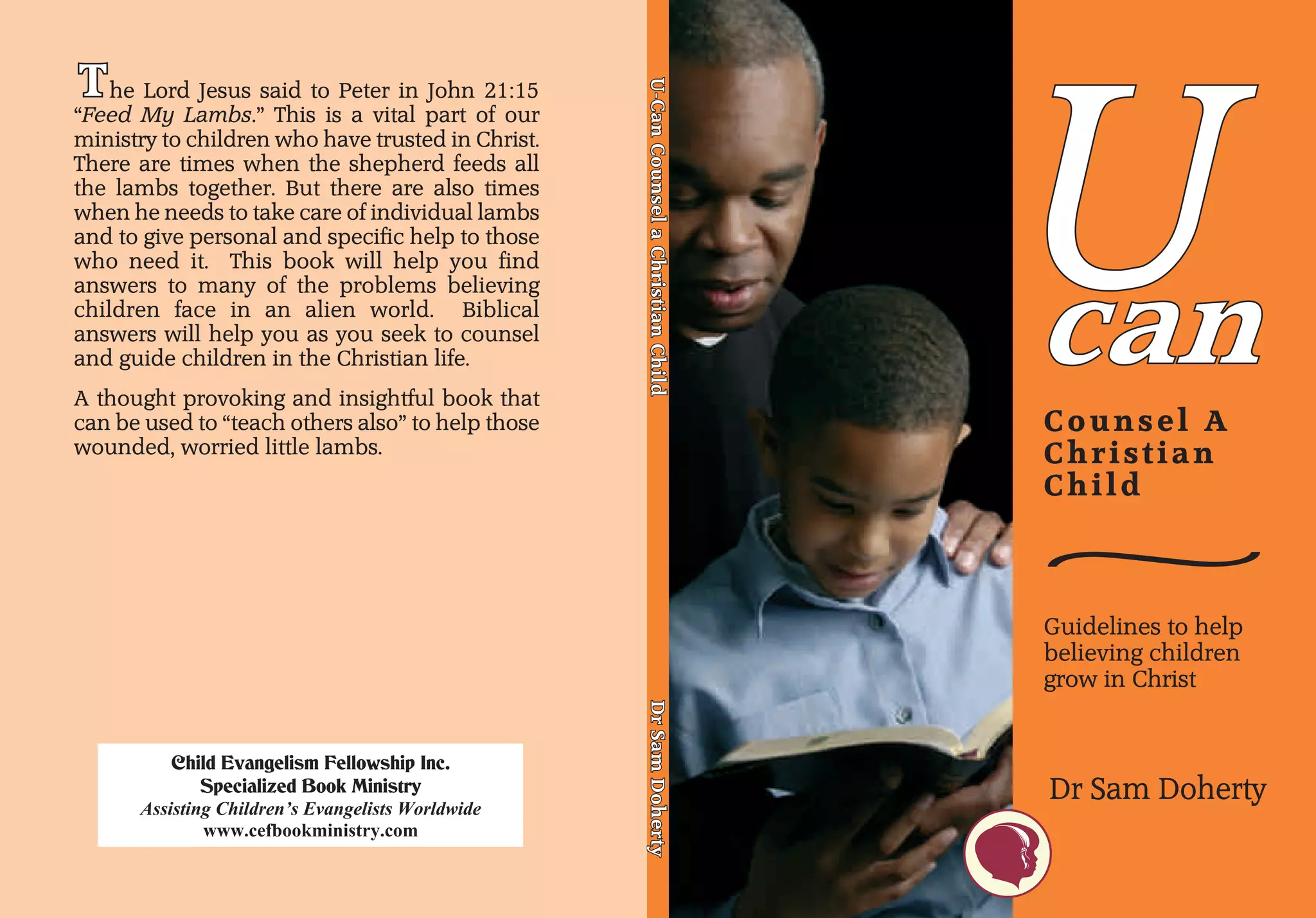
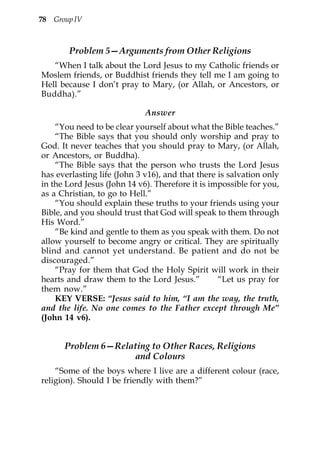
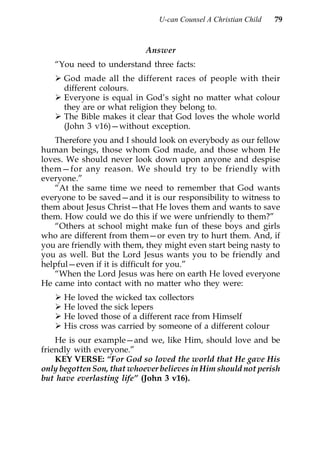
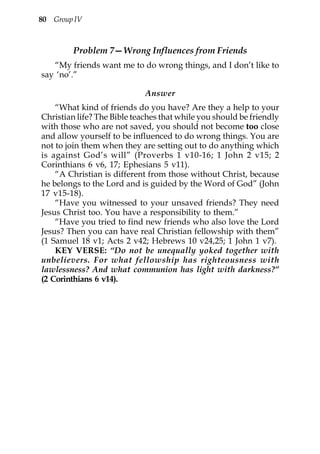
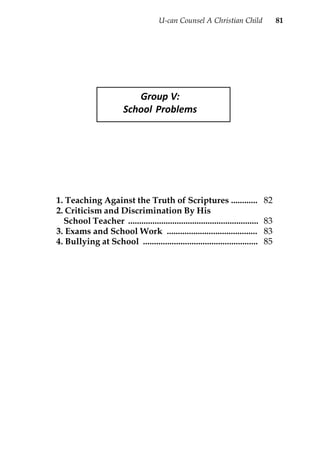
T he Lord Jesus said to Peter in John 21:15
 T


                                                   U-Can Counsel a Christian Child
                                                   U-Can Counsel a Christian Child
                                                   U-Can Counsel a Christian Child
“Feed My Lambs.” This is a vital part of our
ministry to children who have trusted in Christ.
There are times when the shepherd feeds all
the lambs together. But there are also times
when he needs to take care of individual lambs
and to give personal and specific help to those
who need it. This book will help you find
answers to many of the problems believing
children face in an alien world. Biblical
answers will help you as you seek to counsel
and guide children in the Christian life.
A thought provoking and insightful book that
can be used to “teach others also” to help those                                     Counsel A
wounded, worried little lambs.                                                       Christian
                                                                                     Child


                                                                                     ~
                                                                                     Guidelines to help
                                                                                     believing children
                                                                                     grow in Christ
                                                   Dr Sam Doherty
                                                   Dr Sam Doherty
                                                   Dr Sam Doherty


          Child Evangelism Fellowship Inc.
              Specialized Book Ministry                                              Dr Sam Doherty
      Assisting Children’s Evangelists Worldwide
              www.cefbookministry.com
U-can
Counsel A
Christian Child

Guidelines for wise counselling of
Christian children from the Bible


Dr Sam Doherty, BA, EdD.
A series of short ‘U-can’ training manuals for children’s
workers:

            U-can Know God’s Plan for Children
            U-can Evangelize children
            U-can Teach a Bible Lesson
            U-can Lead Children to Christ
            U-can Help Christian Children to Grow
            U-can Counsel a Christian Child


       This book is for free distribution only — and not to be sold.


   All scripture quotations, unless otherwise indicated, are taken
         from the New King James Version. Copyright © by
   Thomas Nelson, Inc. Used by permission. All rights reserved.


               This book is the second part of the book
                 previously published under the title
                      “Growing Up” in May 2000


                              Published by
                 Child Evangelism Fellowship Inc.   ®


                    Specialized Book Ministry
             Assisting Children’s Evangelists Worldwide
       PO Box 308, Lisburn, BT28 2YS, Northern Ireland, UK
                    © February 2011 All Rights Reserved
Table of Contents

 Introduction .................................................................. i

 Chapter 1: The Importance of Counselling
 Christian Children ......................................................                            1
  What is Counselling? ........ .....................................................                 1
  Saved Children Often Need Personal Help and
  Counsel .........................................................................................   2
  Counselling Is an Important Part of Your
  Ministry .....................................................................................      3
  Counsellors Are Needed .........................................................                    4
  The Holy Spirit Will Help You ...............................................                       4

 Chapter 2: Preparation for Counselling
 Christian Children ..................................................                                6
 You Need to Realise That These Children Do
 Have Problems ........................................................................... 6
 You Need to Know What the Possible Problems
 and Needs Are ........................................................................... 6
 You Need to Give Them Answers to Their
 Problems ...................................................................................... 7
 You Need to Allow Time for Counselling ............................. 9
 You Need to Watch for Opportunities to Counsel ............... 10

 Chapter 3: Principles to Follow When Counselling
 Christian Children ................................................. 11
 Draw From the Resources God Has Given You to
 Help This Child ..................................................... .............. . 11
 Identify His Need Before Giving Counsel
 and Help ..................................................................................... 12
Be Sure That the Child Is Truly Born Again.............................13
Treat Every Question As Being Important................................ 14
Help the Child to Think Through the Answer
for Himself................................................................................. 14
The Child Needs to Respond to What God Is Saying to
Him In His Word........................................................................ 15
Help The Child Afterwards Through Continued
Follow-Up Work......................................................................... 16

Chapter 4: A Simple Six-Step Counselling
Procedure to Follow ................................................ 17
Set the Child at Ease .................................................................    17
Identify His Problem ...................................................................   18
Ask Two Questions ...................................................................      18
Show a Bible Verse ....................................................................    19
Ask Him What He Wants to Do .............................................                  19
Follow-Up Help ....................................................................        20

Chapter 5: The Two Main Problems For
Christian Children ..................................................... 21
The Problem of Sin ................................................................        22
The Problem of Assurance ....................................................              23

Chapter 6: The Special Problems Which Christian
Children Face and How to Help .......................... 25
Group I – Spiritual Problems .................................................... 27
Group II – Ethical Problems .................................................. 47
Group III – Family Problems........ .......................................       61
Group IV – Problems With Other Children ........................ 73
Group V – School Problems ................................................ . 81

Chapter 7: Questions to Answer/Discuss on the
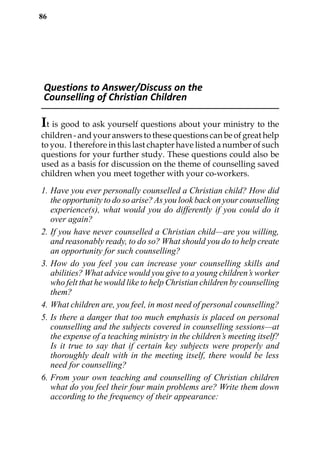
Counselling Of Christian Children ..................... 86
U-can Help Counsel A Christian Child   i


Introduction


Believing children have many questions and problems. It is our
responsibility, and also our privilege, to give them, as best we
can, the answers to their questions and the solutions to their
problems from the Word of God.
    The children’s worker can fulfil his responsibility and his
ministry to the saved children in two main ways.
      Firstly, he ministers to the group of children, for whom he
      is responsible. When doing so, he should teach and apply
      the Word of God to the saved children so that it will be
      the spiritual milk (1 Peter 2 v2) and the spiritual meat
      (Hebrews 5 v14) which they need to understand, and
      absorb, to help them grow. As he ministers to them in this
      way, he keeps in mind the problems which, he knows,
      the Christian children face in the world today, and he
      endeavours to give the solutions to these problems in his
      teaching.
      Secondly, and as an extension of his teaching ministry, he
      should make himself available to saved children who need
      personal help and counsel. Counselling saved children
      is not a substitute for teaching them. It gives, instead, an
      opportunity to expand upon, and go into more detail
      about, what we have been teaching—and to apply our
      teaching more personally to the individual child who
      comes to us for help.
    We want our Christian children to grow. But they must be
nursed and they must be fed. We can do this as we teach them
the Word of God in Good News Club and in Sunday School.
That is the best way to help them grow. But there are two
important factors we need always to keep in mind.
ii   Introduction


         We need, in our teaching, to deal specifically with the
         problems the children face.
         We need to be ready to counsel these Christian children
         on a personal level, and to give them clear and specific
         answers to the questions they are asking.
    I believe that there is a special need for children’s workers
to learn how they can be effective, and really helpful, in a
personal counselling situation. Much teaching and help have
been given on how to teach a Bible lesson, both in training
programmes, and in books which have been written on the
subject. And we are very thankful for all this help. We have
also received much teaching and help on how to counsel an
unsaved child, and lead him to Christ.
    But there has been comparatively little teaching given and
very few books written on the subject of how to counsel
Christian children. This book has been written to help make up
for this deficit. It is far from perfect and it is by no means the
last word on the subject. But I trust that it will be of some help
to you as you seek to engage in this all important counselling
ministry.
    The Lord Jesus said to Peter in John 21 v15 “Feed My lambs.”
That is a vital part of our ministry. There are times when the
shepherd feeds all the lambs together. But there are also times
when he needs to take care of individual lambs and to give
individual and specific help to those who need it.
    That is the subject of this book.
    May God help us better to fulfil our ministry and our
responsibility, to “shepherd the flock of God which is among you” (1 Peter
5 v2).
U-can Counsel A Christian Child               1


Chapter 1:
The Importance of Counselling Christian
Children

We need to understand, first of all, what counselling means and
then secondly how needful it is and the important place it should
have in your ministry.
                       What Is Counselling?
    Counselling simply means to give advice. It means to help,
guide and give directions to someone on a personal level.
    The goal of counselling is, first of all, that the one counselled
will see the answer to his problem, and what God wants him to
do. Then, secondly, that he will actually do it. The result of
counselling will therefore, ultimately, be a change of some kind
in the person counselled.
    Galatians 6 v1 reminds us:
    “Brethren, if a man is overtaken in any trespass, you who are spiritual
    restore such a one in a spirit of gentleness.”
    That involves counselling.
    Our objective in counselling a Christian child, who has
problems, is therefore to restore him to a place of communion
and fellowship with God, and to a place of usefulness to Christ in
his church. Whenever you counsel a child, you need to ask yourself
the question “How has his usefulness to Christ been diminished
by his problem?” and you must not rest until that usefulness is
restored. You do not counsel a child to punish him, or to expose
his failures. You counsel a child to help him, to guide him and to
restore him to usefulness.
    All of this must be done, we are told in Galatians 6 v1, in a
spirit of meekness. The counsellor needs to be humble and gentle.
He must not be proud, arrogant and critical. He should never
give the impression that he is superior. In fact he should do the
opposite and point out that he himself has had problems, perhaps
2      Chapter 1


of the same kind as the child he is counselling. He should then
show how God helped him with these problems.
    When counselling a Christian child the counsellor needs to
do three things:
       He needs to find out what the child’s problem is
       He needs to show him, from the Bible, God’s answer to
       that problem
       He needs to encourage him to take the step(s) necessary to
       solve the problem

    Saved Children Often Need Personal Help and Counsel
     Children usually need more spiritual help than adults do. They
are generally more limited in their experience and understanding.
Also they are less able to find things out for themselves—whether
through reading or by going to special conferences or meetings.
     For some children a “group teaching situation” is not enough.
It is sometimes difficult for the teacher to minister to the many
and varied needs of every child in the group. Also counselling
allows for a two way communication which is not possible when
teaching a group of children. When you speak to a group of
children you do most (if not all!) of the speaking; and they listen.
But in personal counselling you do much of the listening and you
encourage the child to talk. In this way he can express himself,
explain his problem and outline his questions. He can also clarify
his own thinking and be prepared to consider various solutions.
     Also the saved children you teach often have different
backgrounds, one from the other, which influence them
considerably. There are different problems for them to solve, and
different questions for them to answer. So it is therefore helpful,
even necessary, for your direct teaching ministry to the group to
be supplemented by individual counselling to help Christian
children with personal needs and specific problems.
       A child might have difficulties in understanding what is
       being taught, especially if the other children present are
       more advanced in their age, background and
       understanding.
U-can Counsel A Christian Child      3


      He might not have the ability to apply what you have been
      teaching to himself without some personal help in doing
      so.
      He might have specific questions and problems which need
      personal answers and solutions.
      He might come from a Christian home but for some reason
      finds it difficult to communicate with his parents. Children
      will often confide in a counsellor they know, love, and trust
      when they will not seek help from their own parents or
      pastor.
      He might come from an unsaved home where he gets no
      spiritual help whatsoever.
      He might come from a family which is involved with a false
      religion or sect.

    Counselling Is an Important Part of Your Ministry
    Counselling saved children personally is therefore a very
important part of your teaching ministry and you should be
looking for opportunities to help individual children in this way.
    Children who have trusted Christ often have questions about
their personal walk with the Lord even though they may be well
taught in Sunday School, Good News Club or even at home.
    A Christian child may have difficulties with such truths and
situations as:
      assurance of salvation and his position in Christ
      sin in the Christian life
      pressure and opposition from unsaved family members and
      friends
      the work of the Holy Spirit in the believer
      the second coming of Christ
      death
      standards of Christian conduct
      and many more
    Large numbers of adults who were saved as children testify
to the help they received on a personal basis from some friend,
teacher or parent in the early days of their Christian life. Most
saved children do have spiritual problems, of one kind or another.
4     Chapter 1


While it is the responsibility of the teacher to give the answers to
such problems in his general teaching of the Word of God, specific
and personal help is often needed by the individual child. This
can and should be provided by a counsellor.
    Remember that if you don’t give children the personal help
and counsel they need, and for which they are looking, they may
never get it from any other source. If you, as a counsellor, don’t
help them personally with their needs and problems (or at least
offer to do so) they may never find real solutions. Indeed their
difficulties may become worse. Problems don’t just solve
themselves. They usually become more exaggerated and more
serious; and later they will require a longer time to solve, if they
can be solved at all.

                       Counsellors Are Needed
    Do you feel that you would like to help Christian children by
having a counselling ministry to them?
    If you feel that God has laid this upon your heart, and you are
willing to learn how to do it, then He can, and will, use you to be
a spiritual guide for the Christian boys and girls with whom you
come into contact, and who need personal help.
    Even if you, yourself, are quite young you can still be greatly
used in this ministry. Indeed the children might find it easier to
speak with you than with a much older person. They might feel
that, because you are young, you will understand their problem
better, and be better able to identify with them (1 Timothy 4 v12).
Youthfulness can be an asset and not a liability.

                  The Holy Spirit Will Help You
    It is always important to remember that when you counsel a
child you are not alone. God is with you and is ready to help you.
James writes:
    “If any of you lacks wisdom, let him ask of God, who gives to all liberally and
    without reproach, and it will be given to him” (James 1 v5).
  You should also meditate on the promises given in God’s
Word:
    “Let us therefore come boldly to the throne of grace, that we may obtain
U-can Counsel A Christian Child           5


mercy and find grace to help in time of need” (Hebrews 4 v16).
“For I will give you a mouth and wisdom which all your adversaries will
not be able to contradict or resist” (Luke 21 v15).
Above all remember two great truths:
  In Isaiah 9 v6 the Lord Jesus Christ is called “Counsellor.”
  One of His main ministries was, and is, to counsel, guide,
  advise and direct His people on an individual, personal
  basis. He often uses people to do this, and you could be one
  of those people.
  In John 14 v16 and 17 the Lord Jesus promised His disciples
  that He would give them another Comforter or Counsellor.
  The Greek word used is “paraclete” which means “One who
  comes alongside to help”. The word “another” means
  “another of the same kind”. So the Holy Spirit has come in
  Christ’s place to counsel, advise, help and direct God’s
  people just as the Lord Jesus did when He was on earth.
  Consequently, counselling is the work of the Holy Spirit
  today. On the one hand, effective counselling cannot be
  done apart from Him. But, on the other hand, He is ready,
  willing and able to help you when you engage in a
  counselling ministry. He often works through people like
  you and me, and uses us to accomplish His purposes in the
  lives of others.
6    Chapter 2


    Chapter 2:
    Preparation for Counselling Christian Children

    As you think about a ministry of counselling Christian children,
    and as you plan for it and prepare for it, there are several
    necessary steps which you need to take.

                 You Need to Realise That These Children
                           Do Have Problems
        You need to understand that a child who has trusted Jesus
    Christ as his Lord and Saviour will not find that all his problems
    have ceased. In a real sense many of his problems have just
    begun. According to Galatians 5 v17 he has now become a
    battlefield—
        “For the flesh lusts against the Spirit, and the Spirit against the flesh; and
        these are contrary to one another, so that you do not do the things that you
        wish.”
        We can see this struggle and warfare in the Christian life
    when Paul speaks about his own experience as a Christian in
    Romans chapter 7 verses 14-25.
        It is therefore essential for the potential counsellor to
    recognise that saved children do have special needs and
    problems, and that it is part of his task to help them with these
    problems. This help can, and should, come from his teaching of
    the group to which the children belong. But it will also come, as
    we have already seen, through his personal counsel of individual
    children who need, and look for, help.

                  You Need to Know What the Possible
                       Problems and Needs Are
       There are several ways to get to know Christian children
    and to learn about their problems and needs.
U-can Counsel Christian A Child   7


      Listen to the children as they speak to you, or to others
      Find out from other Christian teachers and parents the
      problems they are encountering with their children
      Remember the problems you faced, if you were saved as
      a child
      Realise that some of their problems are similar to those
      you and other adults face
    There are several groups of problems which a Christian child
may be facing and a number of specific problems in each group
will be dealt with, later, in the book:
      Group   I—spiritual problems
      Group   II—ethical problems
      Group   III—family problems
      Group   IV—problems with other children
      Group   V—school problems

    You Need to Give Them Answers to Their Problems
   As you recognise the problems and needs of the children,
you should plan to help them with these problems. This can be
done in four ways:
      Through your regular Bible teaching
      One of the main reasons saved children come to teachers
      for help and counselling is because they have not received
      the answers to their problems through the teaching they
      have received in Good News Club or Sunday School. It is
      therefore important to use the Word of God during the
      teaching hour to give answers to the problems of Christian
      children in your class. One of the main ways to do this is
      to teach thoroughly to the Christian children the central
      truth of each Bible lesson, relating it and applying it to
      their everyday lives, with specific reference to possible
      problems.
      By making yourself available for counselling
      You need to make yourself available personally to Christian
      children who have problems or questions about the
      Christian life. It is important that, at some time in the
8   Chapter 2


        meeting, you let saved children know that you are willing
        and ready to help them. Inform them exactly as to where
        and how they can speak with you. Indicate a time and
        place for them to meet with you for counselling. In a
        regular ministry (e.g. a weekly Sunday School class or
        Good News Club) you will not do this every week. But
        the saved children should always know that you are
        available, and you need to remind them regularly that
        you are.
        Here is an example of how to make yourself available to
        saved children for counselling:
        “If you are saved, but you have a question or problem in
        your Christian life and you would like to speak with me
        about it, then you should come and say to me after the
        meeting: ‘I have a problem I want to share with you.’ I
        will be standing by the piano (indicate a specific place)
        afterwards, if you would like to speak with me.”
        You should then be prepared to take time to speak
        personally with saved children who come to you for
        counselling after a meeting.
        Through personal contact
        Get to know each saved child in your group personally.
        Find out about his home, his hobbies and his interests.
        Without showing undue favouritism, let him know that
        you are interested in him.
        This will often lead to opportunities to help saved children
        at other times apart from the Good News Club hour. Some
        of the best opportunities for personal counselling come
        through personal contacts and conversations during the
        week. The alert teacher will have established good
        relationships with saved children, paving the way for such
        opportunities.
        If you think that a saved child is having problems in his
        Christian life, or if there seems to be little evidence of fruit
        in his life, you should look for an opportunity to speak to
        him personally. You could suggest that he wait for a few
        minutes at the end of the meeting after the others leave.
        Or you could arrange to meet with him at another time
U-can Counsel Christian A Child       9


      during the week, to talk together about his progress in the
      Christian life.
      Christian parents will also be looking to see if they need
      to take the initiative to speak with their son or daughter
      (who has trusted Christ) about some need or problem,
      which is evident in their lives.
      Through prayer
      The saved children need your prayers more than anything
      else. Paul prayed for the converts in Thessalonica in three
      ways:
            He prayed personally.
           “We give thanks to God always for you all, making mention of you
           in our prayers” (1 Thessalonians 1 v2).
           He prayed specifically.
           “And may the Lord make you increase and abound in love to one
           another and to all, just as we do to you” (1 Thessalonians 3 v12).
           He prayed unceasingly.
           “Night and day praying exceedingly that we may see your face and
           perfect what is lacking in your faith” (1 Thessalonians 3 v10).

          You Need to Allow Time for Counselling
    Counselling should not be thought of simply as a personal
conversation with an unsaved child, who wants to trust Jesus
Christ as his Lord and Saviour. It is a much bigger and more
comprehensive activity than that. As we have seen, your
counselling time can also be used to lead a child further in his
walk with Christ, to answer his questions and solve his problems
and to show him how the Lord Jesus Christ can meet his every
need, and help him in every difficulty.
    Consequently, when you are planning your teaching
programme you need to ensure that you will also have time
after your meeting to help and counsel these saved children
who have questions and problems. Do not finish your meeting
and rush away; nor should you give the children the impression
that you are in a hurry to leave. It is essential for them to know
that you do have time for them.
10 Chapter 2


      You Need to Watch for Opportunities to Counsel
    The opportunity to counsel a Christian child can arise in
 one of several ways:
       Through his coming to you after a meeting, during which
       you had made it clear that you were available to help him
       with his questions and problems.
       Through a personal approach which you make to a child
       who you feel needs help in some area of his life. In this
       case it is you who takes the initiative and you open up a
       conversation with him on a subject which you feel is
       important for him. Then he, in turn, indicates that he wants
       your help and counsel.
       Through a good personal relationship with a child which
       you have developed over a period of time. This will often
       result naturally in conversations together about different
       problems—provided that the child has confidence in you
       and respect for you.
U-can Counsel A Christian Child         11


Chapter 3:
Principles to Follow When
Counselling Christian Children

W   hen counselling a Christian child, there are several basic
principles you need to understand and follow.
      Draw from the Resources God Has Given You
                  to Help This Child
    Counselling is basically sharing with the child what God
has taught you. God has provided tremendous resources for you
to draw from, in your task of counselling saved children. He
has not left you to do this work unaided.
    These resources include . . .
     The wisdom and guidance which God gives you as you
     counsel
     If you are living in close fellowship with the Lord, He will
     guide you with regard to what you should share with the
     child who wants help:
     “And a word spoken in due season, how good it is!” (Proverbs 15 v23b).
     Every born again Christian has available to him the
     wisdom and power of God for his counselling ministry.
     Those who do not know Christ cannot, of course, give
     spiritual advice to a Christian child. But you as a believer,
     when you counsel, can depend on your Lord and ask Him
     for the words you need, recognising that the wisdom you
     need is available.
     “If any of you lacks wisdom, let him ask of God, who gives to all liberally
     and without reproach, and it will be given to him” (James 1 v5).
     The Word of God
     God has given the answers to the child’s problems in His
     Word. Help him to see God’s answers by using the Bible
     and turning to appropriate verses in it. If you have made
12   Chapter 3


       time in your busy life to memorize and to study God’s
       Word you can expect that He will “bring to your remembrance
       all things” (John 14 v26) and that, at the time when you need them,
       the right words will come (Acts 1 v8; 1 Corinthians 2 v13).
       Your own past experience
       Every Christian is constantly adding to his store of
       knowledge of the ways and workings of God, as he allows
       God to work in his own life. Thus, as you counsel, you
       can testify, from your own experience, to the way God
       has helped you in situations similar to that of the child
       with whom you are speaking.
       Your personal testimony will help the Christian child
       greatly, and he will then see that his problem is not unique.
       He will understand that as God helped you, He will also
       help him. He will also realise that you do not condemn
       him for his failures and shortcomings, but rather that you
       are able to identify with him.
       The indwelling Holy Spirit
       The Spirit of God is the Counsellor, and He lives within
       both you and the Christian child to whom you are
       speaking. He will therefore empower you for this
       important part of your teaching ministry. He will also help
       the child to understand what you are saying and to obey
       God’s precepts. Quietly and confidently depend upon Him
       as you counsel. He will give wisdom to you, and
       enlightenment to the child.
    It is important to finish the counselling time with prayer,
committing the child and the problem to the Lord.
    We all need to continue to be learners. We can never know
enough about children’s problems and the answers to them. So
we should look for every opportunity to increase our experience
and to further our training, and to take advantage of the
resources God has given us.

      Identify His Need Before Giving Counsel and Help
     The saved child will often have problem areas in his life:
       Problems related to sin
U-can Counsel A Christian Child   13


      Problems related to relationships—in the family, at school,
      with friends
      Problems concerning the Christian life—how to witness,
      how to read the Bible, how to pray etc.
      Questions he wants to ask—about lack of assurance,
      doubts, confusion etc.
     You cannot help the Christian child with his problem, if you
do not know what that problem is. Sometimes the problem is
clear and the reason why he has come to speak with you is
obvious. But sometimes it is not clear, and you need to ask
questions to find out what the problem is. Ask him why he wants
to speak with you, and then listen carefully as he shares with
you. You must therefore be patient and find out what the problem
is, before giving the solution. Remember also that the “surface
problem” which you first encounter may not be the real
problem.
     The child may be nervous or embarrassed. He may be extra-
sensitive to your reactions, as he shares his problem with you.
This is especially so if it is a sin problem, about which he feels
ashamed. Be careful not to be judgmental, or to show a superior
attitude. Be friendly and approachable at all times. Love,
understanding and, above all, acceptance are important qualities
when counselling a Christian child.

          Be Sure That the Child Is Truly Born Again
    One of the greatest problems we face when dealing with
children who profess salvation is that they may have made a
superficial profession of faith under the influence and pressure
of an unwise evangelist. There are those who in their evangelism
of children use emotionalism, pleading and even fear, to get
children to make a decision for which they are not spiritually
ready. This can result in them not being saved at all. It is, of
course, impossible in this case to follow up or nurture such
children. They need, first of all, to be truly born again.
    So before launching into your counselling session, it is a wise
precaution to find out definitely if the child is born again. Ask
him to tell you about the time he trusted Christ. Ask Him how
14   Chapter 3


he knows for sure that he is saved. Ask him if he has seen any
change in his life, since he trusted Christ. You need to realize, of
course, that he might not be able to remember the exact time
when he trusted Christ—especially if it was early in life. Not
knowing when it happened does not necessarily mean that it
has not happened!
     So, the underlying cause of the child’s problem may be that
he is unsaved. That question needs therefore to be dealt with
first. Do not take it for granted that the child knows Christ. As
best you can, find out; then go on to discuss the questions or
problems he has.
     It may be that during the counselling time you realise that
he has made a false profession of faith. Perhaps there was no
genuine repentance and faith. Perhaps he was insincere or there
was a lack of understanding. If you doubt that he is saved, say
to him: “Are you truly trusting in Christ alone to save you, or
did you just say a little prayer which did not mean much?” Or
“Are you sure that Christ came into your life, and that you are
a child of God?”
     If his answers show that he was not truly born again, go
over the way of salvation with him. If the child now sincerely
wants to trust Christ, give him the opportunity to do so.

           Treat Every Question As Being Important
    Listen carefully to what the child is saying. Give him your
full attention. Do not dismiss his problem as being unimportant,
but take time to deal with it. It may be that behind the first
question of the child there is another more important question
which he may be concealing at first. If he sees that you are really
interested and if he has confidence in you, he will share more.
    Always give honest answers to honest questions. If you do
not know the answer, tell the child so, and let him know that
you will try to find out the answer for him.

     Help the Child to Think Through the Answer for Himself
    Very often your questions to him will help him discover the
correct answers for himself. This is the best way to proceed.
U-can Counsel A Christian Child   15


Rather than telling him directly what to do, establish biblical
principles, so that he will see for himself what is the right thing
to do.
    Avoid statements and commands such as:
   “Stop going to the cinema.” or
   “Don’t watch that kind of thing on TV.” or
   “Read your Bible for 10 minutes and then pray for 10 minutes
each morning.” or
   “Do your homework on Friday evening or Saturday, so that
you don’t have to do it on Sunday.”
    Teach the principles God gives us in His Word and help him
to discover for himself what he should do on the basis of these
principles.

    The Child Needs to Respond to What God Is Saying
                   to Him in His Word
    Help him to see that some response on his part is necessary,
if he is to overcome his difficulties or to solve his problems. Show
him from the Bible what God wants him to do. The final decision
to do something about this problem lies with the individual child,
but you can encourage him to respond.
      For example, if he has a sin problem, God wants him to
      confess that sin to Him, and He has promised to forgive
      him (1 John 1 v9).
      Or it may be a situation where God just wants the child to
      commit the situation to Him in prayer, and then to trust
      God to work it out.
      Or it may be that the child needs to ask God to help him
      take some action which will help him solve the problem
      he has. For example, he may need to get up earlier to have
      time for Bible-reading and prayer.
    So discuss with the child what possible action might be
needed. Then encourage the child to pray about it himself to
God. Pray with him and for him, asking God to help and bless
in the situation.
16   Chapter 3


                     Help the Child Afterwards
                 Through Continued Follow-up Work
    There are several positive steps you can take to help the child
follow through on any commitment he has made:
       Underline the verse, or verses, you used in his Bible; or
       write them out for him.
       Give him, now or later, some literature which could help
       him.
       Give extra teaching on this subject in the Good News Club
       or Sunday School class he attends.
       Talk with him from time to time to see how he is
       progressing. The interest you show will encourage him to
       follow the Lord more and more closely. Don’t be afraid to
       visit him in his home.
       If he lives some distance away write to him.
       Never share with others what he has told you in
       confidence. It would hurt him very much if he knew that
       his secrets were being told to other people unless it is a
       child protection issue.
       Above all pray for him personally and regularly and
       specifically. You should be able to say to the child that
       you will definitely pray for him and his problem until it is
       solved (Galatians 6 v2).
U-can Counsel A Christian Child   17


Chapter 4:
A Simple Six-step Counselling Procedure to
Follow

When counselling a child—whether he is unsaved or saved—
it can be a great help to have a counselling plan to follow. It
does not mean that you must stick to every detail of your plan.
Circumstances may arise, questions may be asked, or ideas may
come into your mind which would cause you to “stray from”
your plan. But it is still good to have a basic idea of what you
should do, and the steps you should follow, when you are
counselling a child.

                    Set the Child at Ease
    The child may be nervous or embarrassed. He might be
sensitive to, and even afraid of, your reaction to what he will
say. He is probably not sure what is going to happen:
      Smile and tell him you are glad that he came to speak
      with you.
      Ask a few introductory questions which are easy to
      answer and which enable the child to feel more
      comfortable:
           How are things at school?
           Are you still in the football team?
           Are you enjoying Good News Club?
      Be sure that right from the beginning of your counselling
      time you show acceptance of him, and, by the expression
      on your face, that you are eager to understand him and
      whatever problems he has.
      Never give him the feeling that you are superior or that
      you are judging him. Your attitude is very important.
18   Chapter 4


                     Identify His Problem
    The obvious way to do this is to ask him why he came, and
why he wants to speak with you.
    But be very sure to listen to his answer, and to listen very
carefully. Do not appear hurried and do not give the impression
that you do not have much time to speak with him. No-one
likes to share with someone who acts this way.
    It is important to be patient. The first answer the child gives
you may not identify the real problem. Continue talking and
listening; and it may be that the real problem will eventually
surface. If not, and you are satisfied that the first answer given
has identified the child’s problem, then go ahead and take the
next step.

                      Ask Two Questions
    There are two issues to be cleared up and two questions to
be asked, before you proceed with your counselling. The answers
to these two questions will help you better to understand the
child’s position and problems, and will also give you guidance
on how to proceed. So it is good to deal with these two issues
before you deal specifically with the problem or question which
the child has raised.
       You need to know if the child is truly saved
       Lack of salvation can be the underlying and basic cause
       of the child’s problem and this would need to be checked
       out first. Do not take it for granted that the child has
       trusted Christ. Ask him if he has. Ask him when he did
       so. Ask him what the results were. And listen carefully to
       his answers.
       You need to know if the child has assurance of salvation
       Lack of assurance can be an underlying reason for many
       problems in the life of a saved child; and it is helpful to
       have this matter cleared up before going any further. Ask
       him if he knows he is saved. If not, show him how he can
       have assurance. If he says “Yes,” ask him how he knows.
     When these two matters have been dealt with to your
U-can Counsel A Christian Child   19


satisfaction, you are ready to go on to the next step.

                      Show a Bible Verse
    You are now ready to deal with the specific problem the
child has spoken about. The key to solving his problem and
answering his question is to use the Bible to do so. You should
turn to a verse which gives the answer, and let the child read it.
Then discuss the problem with the child, in the light of that
verse, and explain the teaching of the verse to him. Try to help
him see the solution to his problem from the verse you are using
from God’s Word. It may be necessary, of course, to use more
than one verse. But try to keep it as simple as possible.
    You should also share from your own experience if you think
this would be relevant and helpful. Bible verses to use to deal
with different problems are outlined from page 23 onwards.

               Ask Him What He Wants to Do
    It is not enough for the child just to understand God’s answer
to his problem from the Bible verse you have used. He himself
needs to take action in some way, and respond to what he has
seen in God’s Word.
      Encourage the child to believe what God has said in His
      Word.
      Help him to see that some response is necessary on his
      part if he is to overcome his difficulty and solve his
      problem.
      Discuss the possible action he needs to take. Let him read
      the verse and let him suggest the response he needs to
      make.
      Let the child himself pray to the Lord concerning his
      problem and the response he has decided to make. If he
      does not want to make the response that is needed, pray
      with him, let him go and tell him you will always be
      available to help.
      Pray with him and for him, asking God to help him
      overcome the difficulty or problem.
20   Chapter 4


       Discuss with the child what he is going to do in the future
       with regard to this problem.

                        Follow-up Work
     There are several steps you can take to give him further help:
       Underline, in the child’s Bible, the verse you have used in
       your counselling and discussion. Suggest to him that he
       memorize it.
       Assure him of your prayers and continued interest.
       Let him know that he is free to come back at any time to
       speak more about this problem—or any other problem.
       Give extra teaching in your class which is related to the
       subject you have discussed—but without reference to him.
       Never share with others what a child has told you in
       confidence unless it is a child protection issue.
U-can Counsel A Christian Child   21


Chapter 5:
The Two Main Problems for Christian Children


In my experience of working with children who have trusted
Christ, and with young Christian teenagers, I have found that
they have two main problems.
      The problem of sin
          Am I really forgiven?
          What should I do when I sin?
          Can I have victory over sin?
      The problem of assurance
          Is it possible to be sure that I am saved? How can I
          be sure?
          What about tomorrow? Will I still be saved?
          Can one sin “break” my salvation?
    Consequently, we need to give much time in our teaching
to these two problems, mentioning the questions outlined above
and giving the answers to them. It is not enough to try to solve
the problem just in counselling sessions (although such sessions
can be a supplementary help). The best time is during the regular
teaching session.
    Many Christian children are confused about sin in their lives
because they have not received good systematic teaching on
the subject. Many children and young people lack assurance of
salvation because no one has ever taught them, from the Bible,
that they can have assurance and how they can have it.
    One of the top priorities for a teacher of children is to find
out the main problems of his children, and then give the detailed
answers to these problems in class. One of the main reasons
why counselling becomes necessary is because of inadequate
teaching.
22   Chapter 5


                      The Problem of Sin
    I would like to suggest a simple 5-point outline on this subject
which you could keep in mind while you are teaching a group
of Christian children and would like to help them see the solution
to this problem. You could also use it in the counselling of a
saved child whom you would like to help with this problem.

1. The Goal God sets before us
    God wants us to live holy lives (1 Peter 1 v16).

2. The Problem we have
    Within each Christian there are two natures at war
(Galatians 5 v16,17), and they are fighting against each other.
This is normal and can be seen in the life of the Apostle Paul
(Romans 7 v14-25). There are times when we allow our old sinful
nature to be in control of what we do and at that moment we
are carnal and under the control of the flesh (1 Corinthians 3
v3). There are times when we are spiritual and under the control
of the Holy Spirit (Galatians 5 v16).

3. The Results we experience
    There is one thing which sin in our Christian lives cannot
do: Sin can not cause us to lose our salvation (John 16 v28;
Romans 8 v33).
    There are three things which sin can do in our Christian
lives:
        Sin breaks our fellowship with God (1 John 1 v7, 9).
        Sin hinders our prayers (Psalm 66 v18).
        Sin can bring chastisement from God (Hebrews 12 v5-11).

4. The Resources God gives us
    God has given us two main resources to help us in our battle
with sin, and to assist us to overcome temptation.
        The Word of God (Psalm 119 v11; 1 Peter 2 v2). Read it.
        The Holy Spirit (Galatians 5 v16). Trust Him.
U-can Counsel A Christian Child       23


5. The Steps you need to take
      Confess your sin to God (1 John 1 v9).
      Desire to have victory over that specific sin (Psalm 39
      v1).
      Pray and ask God to help you conquer it (Psalm 141 v3).

                    The Problem of Assurance

     Being sure of God’s salvation is so important for the child
to know and a real basis for Christian growth.

What is assurance?
    Assurance of salvation is, simply and as the words indicate,
a sure knowledge and conviction that we are saved.
    Assurance is the work of the Holy Spirit (1 John 3 v24). It is
also called the witness of the Holy Spirit (Romans 8 v15-17; 1
John 5 v7-10). Assurance has four consequences:
      A knowledge that God is our Father and that we are in
      God’s family (Romans 8 v15-17; Galatians 4 v6),
      A sure understanding that the Holy Spirit lives in us (1
      John 3 v24; 1 John 4 v13),
      The certainty that we have eternal life (1 John 5 v13).
      The conviction that we can never lose the salvation and
      eternal life which God has given us (John 10 v28,29).

How can we have assurance?
   The primary means used by the Holy Spirit to give us
assurance is the Word of God. We read in 1 John 5 v13;
    “These things I have written to you who believe in the name of the Son of
    God, that you may know that you have eternal life.”
    God has promised in His Word to save those who trust Christ
(John 3 v16; Romans 10 v13). God is faithful and always keeps
His promises. Therefore the believer can know for sure, on the
basis of God’s Word and His promises, that he is saved.
    Secondly, the Holy Spirit helps us to know we are saved
when we observe the change which He has wrought in our lives
24   Chapter 5


(1 John 2 v3, 5, 29; 1 John 3 v6, 9, 14, 19; 1 John 4 v7, 12, 13, 15
and 16; 1 John 5 v2). As Christians we are far from perfect, but
there has been a change in the general direction of our lives,
and this change is also the evidence of regeneration and of a
new nature.

Can we lack, or lose, assurance of salvation?
    It is possible for a child of God not to have assurance. It is
also possible for him to lose the assurance he previously had:
        The main reason for not having assurance is because of a
        lack of teaching concerning this subject. In this case the
        child does not understand that such assurance is possible.
        Also the child may have even been taught that it is not
        possible to have assurance of salvation.
        The child who neglects to read and study the Word of
        God is in danger of not having—or of losing—assurance
        of salvation. If assurance comes through God’s Word, and
        that Word is not read, known and understood there is the
        possibility of not being sure of salvation.
        It is also very possible that if a Christian child is living in
        disobedience to the Holy Spirit, or is deliberately sinning,
        the Holy Spirit may withdraw from him the assurance he
        once had.

                             Conclusion
    In your regular teaching programme you need to deal with
these two major problems—simply, practically and biblically. If
you don’t give the children the answers they need, the results
will be confusion, uncertainty, doubts and defeat.
U-can Counsel A Christian Child   25


Chapter 6:
The Special Problems Which Saved Children
Face and How to Help

During one of my visits to Poland I conducted a survey among
a large group of young Christian teenagers with whom I had
been working for some time.
    I asked them what their main problems were. It was
interesting and challenging to me to learn from them that they
had two major problems:
      Problems at home with their parents. Sometimes the
      parents were Christians but mostly they were not.
      Problems with self-image. This problem was sometimes
      related to the first problem, and was caused by strong
      criticism from their parents.
   Being aware of these two major problems was a real help to
me as I sought to minister to them.
      I cannot give the solutions to problems if I don’t know
      what the problems are.
      I cannot give the answers if I don’t know what the
      questions are.
    Sometimes we are giving answers to non-existent questions,
or giving solutions to problems which are not relevant.
    There are many such problems and I can only deal with
some of them in this book. I have tried to outline a number of
problems which saved children have and my suggested response
to them. These responses are outlined mainly in simple and basic
conversational form because I felt that this was the most helpful
way to do it. In other words I have put the children’s problems
and the counsellor’s response in quotes—and in the words that
they might actually use. In addition, many of the counsellor’s
26 Chapter 6


responses are made in short and separate paragraphs. Each of
these would need to be expanded and explained, separately or
together, to the child in more detail. I have also, in a different type
from that used in the quotes, added here and there some advice and
comments.
U-Can Counsel A Christian Child                  27


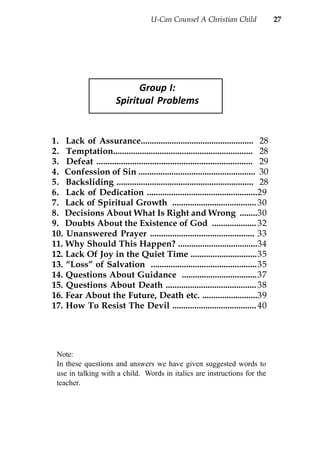
                              Group I:
                        Spiritual Problems


1. Lack of Assurance................................................... 28
2. Temptation............................................................... 28
3. Defeat ...................................................................... 29
4. Confession of Sin ..................................................... 30
5. Backsliding .............................................................. 28
6. Lack of Dedication ..................................................29
7. Lack of Spiritual Growth ...................................... 30
8. Decisions About What Is Right and Wrong ........30
9. Doubts About the Existence of God .................... 32
10. Unanswered Prayer ............................................... 33
11. Why Should This Happen? ....................................34
12. Lack Of Joy in the Quiet Time ..............................35
13. “Loss” of Salvation ................................................35
14. Questions About Guidance ..................................37
15. Questions About Death ......................................... 38
16. Fear About the Future, Death etc. .........................39
17. How To Resist The Devil ...................................... 40


 Note:
 In these questions and answers we have given suggested words to
 use in talking with a child. Words in italics are instructions for the
 teacher.
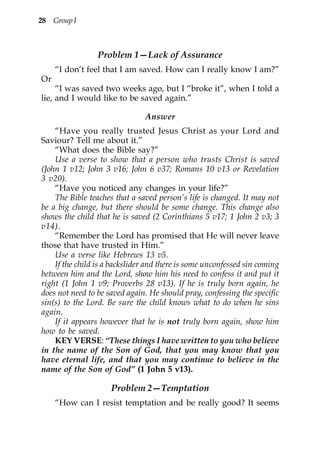
28 Group I


                 Problem 1—Lack of Assurance
     “I don’t feel that I am saved. How can I really know I am?”
Or
     “I was saved two weeks ago, but I “broke it”, when I told a
lie, and I would like to be saved again.”

                               Answer
    “Have you really trusted Jesus Christ as your Lord and
Saviour? Tell me about it.”
    “What does the Bible say?”
    Use a verse to show that a person who trusts Christ is saved
(John 1 v12; John 3 v16; John 6 v37; Romans 10 v13 or Revelation
3 v20).
    “Have you noticed any changes in your life?”
    The Bible teaches that a saved person’s life is changed. It may not
be a big change, but there should be some change. This change also
shows the child that he is saved (2 Corinthians 5 v17; 1 John 2 v3; 3
v14).
    “Remember the Lord has promised that He will never leave
those that have trusted in Him.”
    Use a verse like Hebrews 13 v5.
    If the child is a backslider and there is some unconfessed sin coming
between him and the Lord, show him his need to confess it and put it
right (1 John 1 v9; Proverbs 28 v13). If he is truly born again, he
does not need to be saved again. He should pray, confessing the specific
sin(s) to the Lord. Be sure the child knows what to do when he sins
again.
    If it appears however that he is not truly born again, show him
how to be saved.
    KEY VERSE: “These things I have written to you who believe
in the name of the Son of God, that you may know that you
have eternal life, and that you may continue to believe in the
name of the Son of God” (1 John 5 v13).

                     Problem 2—Temptation
     “How can I resist temptation and be really good? It seems
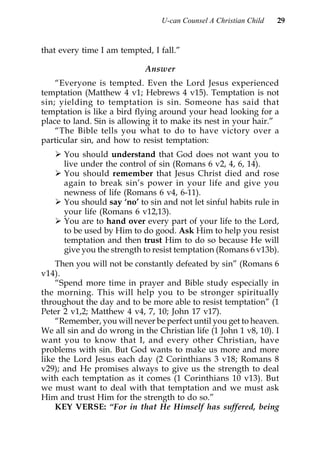
U-can Counsel A Christian Child   29


that every time I am tempted, I fall.”

                            Answer
    “Everyone is tempted. Even the Lord Jesus experienced
temptation (Matthew 4 v1; Hebrews 4 v15). Temptation is not
sin; yielding to temptation is sin. Someone has said that
temptation is like a bird flying around your head looking for a
place to land. Sin is allowing it to make its nest in your hair.”
    “The Bible tells you what to do to have victory over a
particular sin, and how to resist temptation:
      You should understand that God does not want you to
      live under the control of sin (Romans 6 v2, 4, 6, 14).
      You should remember that Jesus Christ died and rose
      again to break sin’s power in your life and give you
      newness of life (Romans 6 v4, 6-11).
      You should say ‘no’ to sin and not let sinful habits rule in
      your life (Romans 6 v12,13).
      You are to hand over every part of your life to the Lord,
      to be used by Him to do good. Ask Him to help you resist
      temptation and then trust Him to do so because He will
      give you the strength to resist temptation (Romans 6 v13b).
    Then you will not be constantly defeated by sin” (Romans 6
v14).
    “Spend more time in prayer and Bible study especially in
the morning. This will help you to be stronger spiritually
throughout the day and to be more able to resist temptation” (1
Peter 2 v1,2; Matthew 4 v4, 7, 10; John 17 v17).
    “Remember, you will never be perfect until you get to heaven.
We all sin and do wrong in the Christian life (1 John 1 v8, 10). I
want you to know that I, and every other Christian, have
problems with sin. But God wants to make us more and more
like the Lord Jesus each day (2 Corinthians 3 v18; Romans 8
v29); and He promises always to give us the strength to deal
with each temptation as it comes (1 Corinthians 10 v13). But
we must want to deal with that temptation and we must ask
Him and trust Him for the strength to do so.”
    KEY VERSE: “For in that He Himself has suffered, being
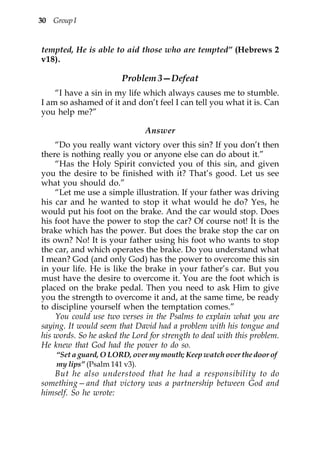
30 Group I


tempted, He is able to aid those who are tempted” (Hebrews 2
v18).

                        Problem 3—Defeat
    “I have a sin in my life which always causes me to stumble.
I am so ashamed of it and don’t feel I can tell you what it is. Can
you help me?”

                               Answer
    “Do you really want victory over this sin? If you don’t then
there is nothing really you or anyone else can do about it.”
    “Has the Holy Spirit convicted you of this sin, and given
you the desire to be finished with it? That’s good. Let us see
what you should do.”
    “Let me use a simple illustration. If your father was driving
his car and he wanted to stop it what would he do? Yes, he
would put his foot on the brake. And the car would stop. Does
his foot have the power to stop the car? Of course not! It is the
brake which has the power. But does the brake stop the car on
its own? No! It is your father using his foot who wants to stop
the car, and which operates the brake. Do you understand what
I mean? God (and only God) has the power to overcome this sin
in your life. He is like the brake in your father’s car. But you
must have the desire to overcome it. You are the foot which is
placed on the brake pedal. Then you need to ask Him to give
you the strength to overcome it and, at the same time, be ready
to discipline yourself when the temptation comes.”
    You could use two verses in the Psalms to explain what you are
saying. It would seem that David had a problem with his tongue and
his words. So he asked the Lord for strength to deal with this problem.
He knew that God had the power to do so.
    “Set a guard, O LORD, over my mouth; Keep watch over the door of
    my lips” (Psalm 141 v3).
   But he also understood that he had a responsibility to do
something—and that victory was a partnership between God and
himself. So he wrote:
U-can Counsel A Christian Child   31


    “I said, “I will guard my ways, Lest I sin with my tongue; I will
    restrain my mouth with a muzzle, While the wicked are before me”
    (Psalm 39 v1).
    KEY VERSE: “And He said to me, “My grace is sufficient
for you, for My strength is made perfect in weakness” (2
Corinthians 12 v9a).

                Problem 4—Confession of Sin
   “What should I do if I sin? Should I just forget about it?”

                              Answer
    “If you do sin, you need to confess it immediately or as soon
as possible, otherwise it will become a barrier between you and
God (Isaiah 59 v2). If you confess it you can be sure that God
will forgive you” (1 John 1 v9; Proverbs 28 v13).
    “Sin is a serious thing and, after you confess it, you need to
ask God to help you not to do it again” (Romans 6 v1, 2; Romans
6 v12, 13, 14).
    “You need to say ‘no’ to sin and Satan (James 4 v7) and turn
away from the wrong things which would drag you down into
sin (1 Timothy 6 v11; Romans 6 v12). Jesus Christ will give you
the strength to do so if you ask Him” (Hebrews 4 v16).
    “I can do all things through Christ who strengthens me”
    (Philippians 4 v13).
   KEY VERSE: “If we confess our sins, He is faithful and just
to forgive us our sins and to cleanse us from all
unrighteousness” (1 John 1 v9).

                    Problem 5—Backsliding
   “I have let God down completely. I have fallen away from
Him and turned my back on Him. He could never forgive me.”

                              Answer
    “What has happened to you is called ‘backsliding.’ You have
slid or slipped back from where you were. It does not mean you
have lost your salvation, (if you were truly saved) but you have
32 Group I


lost your joy and fellowship with God.”
    “Before I answer your question, I would like to share with
you what causes ‘backsliding’:
      People backslide who put some thing or person in the place
      of God.
      People backslide who allow unconfessed sin to remain in
      their lives.
      People backslide who do not take time each day to pray
      and read the Bible.
    Has any of these been your problem?”
    “The wonderful news I have for you, and it is right from the
Bible, is that God is always ready to forgive, no matter what
you have done, and to restore fellowship with you. If you really
want to make things right, there is no problem from God’s side.
    Listen to these verses from the Bible:
    “I, even I, am He who blots out your transgressions for My own sake;
    And I will not remember your sins” (Isaiah 43 v25).
    “Let the wicked forsake his way, And the unrighteous man his thoughts;
    Let him return to the LORD, And He will have mercy on him; And to
    our God, For He will abundantly pardon” (Isaiah 55 v7).
    “If we confess our sins, He is faithful and just to forgive us our sins and
    to cleanse us from all unrighteousness” (1 John 1 v9).
    But did you see that there are two conditions which God
includes in these verses. In other words there are two things
that you must do to receive this forgiveness?
      You need to be willing to turn from your sin (Isaiah 55 v7)
      or repent. Are you sorry for what you have done, and do
      you want to be different?
      You need to confess what you have done to God (1 John 1
      v9). If you do that, He promises that He will forgive you.
      It is His promise, and He always keeps His promises.
    Then you will be ready to make a new start; and as you do
so you should ask God to give you the power and strength not
to go back again into the world.”
    KEY VERSE: “Let us therefore come boldly to the throne of
grace, that we may obtain mercy and find grace to help in time
U-can Counsel A Christian Child   33


of need” (Hebrews 4 v16).

                Problem 6—Lack of Dedication
   “I know that I am not living for the Lord the way I should.”

                              Answer
     “Are you willing to give the Lord Jesus first place in your life
- before your friends and your games, everyone and everything?
You can only live the way you should, when Christ has His
way in every part of your life” (Luke 14 v25, 26; Matthew 6
v33).
     “Ask the Lord to forgive you for letting other things take
first place. Give yourself right now completely to the Lord. Ask
Him to take full control of your life and use you for His glory”
(Romans 12 v1, 2; 1 Corinthians 6 v19,20).
     KEY VERSE: “I beseech you therefore, brethren, by the
mercies of God, that you present your bodies a living sacrifice,
holy, acceptable to God, which is your reasonable service”
(Romans 12 v1).

            Problem 7—Lack of Spiritual Growth
   “How can I grow spiritually? I want to be a better Christian.”

                              Answer
    “The Holy Spirit lives within you to help you to grow (1
Corinthians 6 v19; Galatians 5 v22-25). You cannot grow in the
Christian life in your own strength (John 15 v5; Romans 7 v18,
19; 8 v13). But there are certain things which He wants you to
do:
      Read your Bible at least once every day—carefully and
      prayerfully (Psalm 119 v9, 11). As you read the Bible ask
      God to help you know more and more what He is like,
      and also ask Him to help you know Him better (Jeremiah 9
      v23, 24; Psalm 63 v1; Philippians 3 v8, 10; 2 Peter 3 v18).
      Talk to God for a time each day (preferably in the
      morning). At other times during the day you can also pray
34 Group I


     to Him silently in your heart (Matthew 6 v6; 1
     Thessalonians 5 v17).
     Meet together with other Christians (Hebrews 10 v25).
     Ask God to show you what kind of work He wants you to
     do for Him (Acts 9 v6; Ephesians 2 v10).
     Tell others about the Lord Jesus Christ” (Matthew 10 v32;
     Acts 1 v8).
    KEY VERSE: “As newborn babes, desire the pure milk of
the word, that you may grow thereby” (1 Peter 2 v2).

  Problem 8—Decisions About What Is Right and Wrong
    “How can I know if something is right or wrong? Is it right
to play football? To go the cinema? To watch television? To
smoke? To take drugs?”

                                  Answer
    Explain that there are several questions which he should ask
himself to help him make decisions on such matters. He may need to
ask a number, or even sometimes all, of the questions.
    It is important to get him to answer the questions for himself, to
think the issue through for himself, and to come to the right decision
for himself. Your responsibility in outlining the questions is to help
him to see the biblical principles on which he should base his decisions.
       “Is it against the teaching of the Word of God?”
       “In the Bible, God tells you what He wants you to do and
       not to do. For example, the Bible says:
       “You shall not steal” (Exodus 20 v15).
       “Do not love the world or the things in the world” (1 John 2 v15).
       “Would Jesus Christ do this (if He were here in the
       flesh)?”
       “The Bible teaches you over and over again that He is
       your example, and that you should always model yourself
       upon Him”:
       “For to this you were called, because Christ also suffered for us,
       leaving us an example, that you should follow His steps” (1 Peter 2 v21).
       “Do you have God’s peace about doing this?”
U-can Counsel A Christian Child       35


      “God has given you His peace to be a “referee” in your
      heart. The Bible says:
      “And let the peace of God rule (or referee) in your hearts” (Colossians
      3 v15).
      When you feel that the Lord Jesus would not be happy
      with you doing this, and you don’t have peace about it,
      then it must be wrong.”
      “Is it good for your body?”
      “The Bible says:
      “Your body is the temple of the Holy Spirit” (1 Corinthians 6 v19,
      20).
      You need to be careful that you don’t mar or spoil the
      temple of the Holy Spirit, which is your body, in any way.”
      “Is it for the glory of God?”
      “The Bible says:
      “Whatever you do, do all to the glory of God” (1 Corinthians 10
      v31).
      You need to consider if God will be honoured by you doing
      this.”
      “Is it a stumbling block for others?”
      “Some things may not seem wrong in themselves, but they
      can cause problems and doubts in the mind of others. The
      Bible says:
      “It is good neither to eat meat nor drink wine nor do anything by
      which your brother stumbles or is offended or is made weak”
      (Romans 14 v21).
      If the activity will hinder or offend some less mature
      Christian or if it will affect your testimony before others,
      then avoid it.”
      “Can you pray for God’s blessing upon you as you do
      it?”
      “If you do not have the conviction that you can ask God
      to bless you in it, and give you His strength to do it well,
      then the activity is wrong. The Bible says:
      “Whatever is not from faith is sin” (Romans 14 v23).
   KEY VERSE: “Or do you not know that your body is the
temple of the Holy Spirit who is in you, whom you have from
God, and you are not your own? For you were bought at a price;
36 Group I


therefore glorify God in your body and in your spirit, which are
God’s” (1 Corinthians 6 v19, 20).

      Problem 9—Doubts About the Existence of God
    “Sometimes I feel that God is far away and I wonder if He is
there at all.”
    “I am not sure what to believe.”

                             Answer
    “You need to understand that this is not unusual. Many of
us have doubts from time to time. Satan, our enemy and God’s
enemy, wants to discourage us and make us doubt” (Ephesians
6 v16).
    “Doubts are one of the signs that there is a devil. He wants
you to become mixed up.”
    “Study the Bible more and more. The more you know and
understand the truths of God’s Word the fewer doubts you will
have (Romans 10 v17). Set aside some time (at least 10-15
minutes) every day for prayer and Bible study. Read carefully
verses like Philippians 1 v6; Jude 24; Hebrews 11 v6.”
    “Please come to me and let me know any time you have
questions or doubts, I will try to show you the answers. Do not
try to understand everything. This is just not possible. Believe
what you cannot understand as well as what you do
understand.”
    KEY VERSE: “And the apostles said to the Lord, ‘Increase
our faith.’ ” (Luke 17 v5).

              Problem 10 —Unanswered Prayer
   “I have prayed every day for my mother and father to
become Christians, but they are still not interested.”

                             Answer
   Encourage him by saying:
   “God has promised to hear your prayers, so do not stop
praying. The Bible tells us to keep on asking” (Luke 11 v9; 18 v1).
U-can Counsel A Christian Child    37


     “Keep believing that God will answer your prayer.”
     “Sometimes God answers ‘yes’ (Hannah’s prayer for a son—
1 Samuel 1 v27). Sometimes God answers ‘no’ (Paul’s prayer in
2 Corinthians 12 v8,9). Sometimes God answers ‘wait’ (Mary
and Martha’s request to the Lord Jesus to come and heal their
brother—John 11 v6 and 30-44)”.
     “When you are praying for God to change another person,
remember that God may have many things to do in that person’s
life before they will be ready and willing to trust Christ. This
could be a time when God’s answer to you is ‘wait’. While you
wait, keep on praying for your family. You can also begin to
praise God for what He has already begun to do in their lives.”
     “Remember that one of the main reasons why God wants
you to pray, is so that He can change you. Examine yourself to
see if there is anything which needs to be changed—whether it
is sin in your life (Psalm 66 v18); lack of faith (James 1 v6, 7), or
selfish desires (James 4 v2).”
     “If there is something wrong in your life, confess it to the
Lord and He will forgive and cleanse you” (1 John 1 v9).
     KEY VERSE: “So I say to you, ask, and it will be given to
you; seek, and you will find; knock, and it will be opened to
you” (Luke 11 v9).

           Problem 11—Why Should This Happen?
   “I have a brother who is a Christian and who is crippled.
Why does God allow such things?”
   Or “Why does God allow my Mummy and Daddy to be
divorced?”
   Or “Why does God not save my Daddy who is an alcoholic?”

                               Answer
    These are some of the most difficult questions of all, and it is not
easy to give specific answers. One can only outline certain basic
principles the child should remember, and which should help give
him peace.
38 Group I


    “There are many things which happen which we cannot
understand. There are many times when we just don’t know
the answer.”
    “God is good and wise, and anything which happens He
allows to happen. He can see everything; He knows the end
from the beginning; He knows how to bring good out of what
seems to be evil (Romans 11 v33). He knows what is best. We
don’t.”
    “He promises to be with you in your trials and because of
this you can trust Him completely and leave any difficult situation
in His hands. He takes away all worry and fear” (Isaiah 12 v2;
Philippians 4 v6, 7).
    “Remember that all the sickness and suffering in the world
is the result of man’s sin. It was man who introduced sin into
the world, and all that results from it. One day the Lord will
take away all of His children’s suffering once and for all”
(Revelation 21 v4).
    “Suffering often brings patience, courage and maturity. These
are qualities which might not grow if the suffering was not there”
(2 Corinthians 12 v9).
    “God is able to give you peace in all circumstances” (1 Peter
5 v7; Isaiah 26 v3).
    “You have a responsibility to witness about Jesus Christ to
those who suffer. Your witness might help them to come to know
Him too.”
    KEY VERSE: “Oh, the depth of the riches both of the wisdom
and knowledge of God! How unsearchable are His judgments
and His ways past finding out!” (Romans 11 v33).


        Problem 12—Lack of Joy In His “Quiet Time”
   “I try to read the Bible, but I find it very dull, boring and
hard to understand.”

                               Answer
    Make sure he has his own Bible, encourage him to find a quiet
place where he can read it and help him to realise that the Bible is the
U-can Counsel A Christian Child    39


Word of God. It is God’s letter to us.
    “Keep on reading the Bible. Do not give up. The more you
read it, the more interested you will become. What part of the
Bible are you reading just now? You won’t understand
everything. Stick to what you can understand. Reading the Bible
will be a blessing and help to you” (Psalm 119 v24,111, 162).
    “The Christian life is like running a long distance race. It
starts when you trust Christ as your Saviour and goes on until
you go to Heaven. It doesn’t matter how quickly you run; the
important thing is to keep going and, one day, to finish. The
same applies to your ‘Quiet Time’. The important thing is to
keep having it and not to give up. With time there will be a
change.”
    KEY VERSE: “Be diligent to present yourself approved to
God, a worker who does not need to be ashamed, rightly dividing
the word of truth” (2 Timothy 2 v15).

               Problem 13—Loss of Salvation
   “I know that I was saved; but I have sinned and I am not
saved any more. How can I be saved again?”

                              Answer
    Before you can help him you need to find out the reason for his
problem—and you will need to ask questions to enable you to do this.
    There are several possible reasons:
      He may have backslidden and may have fallen into sin. If this
      is the case then he needs to be given the answers to the problems
      numbered 1 and 5.
      He may just want to repeat a happy experience. He was so
      happy when he trusted Christ, and he wants to be like that
      again. In this case you will show him how to have joy and
      happiness by serving Jesus Christ—for example in winning
      his friends to the Saviour.
      This might be the expression of a spiritual hunger, and a desire
      for a deeper experience with God. Show him how God will
      bless him, meet with him and satisfy his hunger if he will take
40 Group I


      time each day to read the Bible, worship God on the basis of
      what he has learned about Him, and pray for others.
      It may be that through inadequate teaching and explanation
      (at the time of his conversion, and since then) he does not
      understand that his salvation is eternal, and is not something
      to be repeated. Consequently, he needs teaching concerning
      what happened when he trusted Christ. He needs to know that
      he received eternal life, complete forgiveness of all sin, became
      a member of God’s family, and so on. He also needs to be assured
      that these cannot and do not need to be repeated (read John 10
      v28). Instead he needs to learn about confession as a means to
      restore him to fellowship with God. This is probably the main
      reason for children having this problem.
      It may be something inherent in the child himself—an inability
      to understand or believe. All you can do, in this case, is to
      explain everything as simply as possible, and pray that he
      will understand and believe.
      If he was counselled for salvation he may not have been properly
      and thoroughly dealt with by the counsellor. The counsellor
      may have been too brief, or too complicated—and the child
      may not be truly aware of what he has done and what is
      involved. Check carefully with him about what happened and
      what he did. It may be that you need to start the counselling
      all over again—and lead him to Christ.
      It is possible, therefore, that the child was not saved. He has
      not “broken anything”. For some reason, perhaps through a
      complete lack of understanding, or through pressure which
      was exerted on him, he may have made a profession of salvation
      which was not real.
      So you would in this case need to take him back to the beginning
      and counsel him as an unsaved child.
    KEY VERSE: “And I give them eternal life, and they shall
never perish; neither shall anyone snatch them out of My hand”
(John 10 v28).
U-can Counsel A Christian Child   41


         Problem 14—Questions About Guidance
    “I would like to be a missionary when I grow up. How can
I know what God wants me to do and where He wants me to
go?”

                            Answer
    “I am glad to hear about your desire to be a missionary and
that you really want to serve Jesus Christ.”
    “I assure you that God wants to guide you. He wants to
show you His will for your life. Indeed one of the ministries of
the Holy Spirit today is to guide believers like you” (John 16
v13).
    “The Holy Spirit guides Christians in four ways:
      He helps you to use your mind and to think clearly about
      what He wants you to do:
            what abilities do you have?
            what opportunities are there to serve Him?
            has He given you the desire to do something?
      He speaks to you through the Bible which is the Word of
      God. As you read it in your Quiet Time each morning
      God may use some verse or passage to help you to see His
      Will more clearly.
      He helps you to see His Will through the help and guidance
      of older Christians, through men and women who are
      filled with the Spirit, and are able to advise you when you
      ask them.
      He gives you peace concerning what you should do
      (Colossians 3 v15). Let that peace be “the referee.” If you
      don’t have peace about it don’t do it.”
    “There is one other point I would like to make. I am glad
that you want to be a missionary when you grow up; and I am
sure that God will guide you. But don’t forget that you can be a
missionary now! There are boys and girls in your school, or in
your street, who need to hear the Gospel; and this could be
something God wants you to do now! This will also prepare
you for your future ministry.”
42 Group I


   KEY VERSE: “In all your ways acknowledge Him, And He
shall direct your paths” (Proverbs 3 v6).

             Problem 15—Questions About Death
    “I don’t understand why God would allow my Mummy to
die.”
    Or “I am afraid to die.”

                               Answer
     Again this is a very real problem, and one that is difficult to
answer, but there are several basic principles which can help the child.
     Do tell the truth. Don’t speak about a dead friend having “gone
on a trip.” But explain the situation as clearly and as lovingly as
possible. Encourage him to put his feelings into words; and even to
let the tears flow. This will help. Assure him that the person who
loves the Lord Jesus is in heaven for evermore, when he dies (2
Corinthians 5 v8). This is much better and nicer than being here on
earth. So he himself has nothing to fear from death, if he loves the
Lord Jesus (Philippians 1 v23). Show him that one day we will all be
reunited with our loved ones who trusted in Christ (1 Thessalonians
4 v13-18).
     Emphasize how important it is to be ready to die, by trusting
Jesus Christ as Lord and Saviour; and to pray for those loved ones
and friends who are not saved. Also point out that we never know
what God has done in the hearts of our loved ones (even a few moments
before they die) in response to what they have learned from the witness
of ourselves and others. We can leave all of this safely in God’s hands.
     Take time just to love and comfort the child who is bereaved.
Also take every opportunity to try to fill the gap in his life, at least
for some time to come.
     KEY VERSE: “Precious in the sight of the LORD Is the
death of His saints” (Psalm 116 v15).

       Problem 16—Fear About the Future, Death etc.
    “I am afraid about the future (sickness, death). What should
I do?”
U-can Counsel A Christian Child   43


                        Answer
 “First of all I want to assure you that it is quite normal for
 many people to feel afraid about the future, and about
 the unknown, and to worry about it. So you are like other
 people who worry and are afraid. The future is unknown.
 It is like walking along a road in total darkness and we
 don’t know what lies ahead.”
 “But, secondly, I would like to tell you that God does not
 want you to be afraid—of anything. That is why, over
 and over in the Bible, we read the words “Fear not”. Many
 times in the Bible when men (and women) were facing
 problems God said to them, “Do not be afraid.” And God
 also speaks to you and me and says, “You shall not be
 afraid” (Psalm 91 v5; 1 Peter 3 v14). Even though you are
 walking along a road in darkness you should not be afraid
 of what lies ahead.”
 “Then, thirdly, you need to know the reason why you
 should not be afraid. God is walking with you along that
 road in the darkness. He holds your hand. He sees through
 the darkness and knows what lies ahead. He is in control
 of all that happens and He will be with you and guide
 you. That is why you should not be afraid.”
 “The Lord Jesus told His disciples not to worry about the
 future because their Heavenly Father knew about all their
 needs (Matthew 6 v32), and because He cared for them
 (Matthew 6 v26), and because He was in control of
 everyone and everything—the birds (Matthew 6 v26), the
 grass (Matthew 6 v30)—and He gives all good things to
 those who seek Him (Matthew 6 v33).
 Therefore you can trust God your Heavenly Father for
 everything in the future. The more you trust Him, the less
 you will worry and be afraid.
“Whenever I am afraid, I will trust in You” (Psalm 56 v3).
 “Christians do have times of sickness—and sometimes
 serious sickness. But He is with us all the time and will
 help us to bear it until we are well again, and if He chooses
 to do so He can and will heal us.”
44 Group I


      Christians should not be afraid to die. Firstly because God
      will be with them at every moment, and secondly because
      death means that they will be in heaven with Jesus
      Christ—and be happy for ever. It is only people who have
      not trusted Jesus Christ who need to be afraid of dying.”
   KEY VERSE: “Behold, God is my salvation, I will trust
and not be afraid; ‘For YAH (Jehovah), the LORD, is my strength
and song; He also has become my salvation.’” (Isaiah 12 v2).

             Problem 17—How to Resist the Devil
  “I believe there is a devil and that he attacks God’s people.
How can I defend myself against his attacks?”

                             Answer
    “I am glad to know that you believe that there is a devil.
Many people don’t—or even make fun of the idea. Knowing
that he exists and that he attacks God’s people is the first step.
You need to know about the enemy before you can resist him.”
      “First of all you need to realise that the devil is already a
      defeated enemy. The Lord Jesus defeated him once and
      for all on the Cross, and one day, because of that, he will
      be judged finally and for ever.
      In the meantime, secondly, you also need to realise that
      God is in control of everything and everyone—even of the
      devil. The devil cannot do what he wants—even though
      he has great power. He can only do what God allows him
      to do. So, while you want to be careful and you want to
      learn what to do with him, you do not need to be
      frightened of him.
      It is important, thirdly, to remember that we should not
      blame all the wrong things we do on the devil. It is true
      that he attacks us and that he tempts us to do wrong
      things. But some boys and girls blame these wrong things
      on the devil (“The devil made me do this”)—when it was
      they themselves (and their sinful nature which still exists)
      which did it.”
U-can Counsel A Christian Child   45


   “Now how can you defend yourself against the devil?
      Understand that sometimes the devil comes openly like a
      lion (1 Peter 5 v8) and, at other times, quietly and
      deceitfully as an angel of light (2 Corinthians 11 v14).
      Put on the armour God has given you each day (Ephesians
      6 v11-18).
      Stand up to him in God’s strength and with “your armour
      on”—and he will flee from you (James 4 v7; 1 Peter 5 v9;
      Ephesians 6 v11).
      Know and use the Word of God in dealing with him
      (Matthew 4 v1-11). It is the sword of the Spirit.”
   KEY VERSE: “Put on the whole armor of God, that you
may be able to stand against the wiles of the devil” (Ephesians
6 v11).
46 Group I
U-can Counsel A Christian Child                47


                             Group II:
                         Ethical Problems


1. Right and Wrong ......................................................         48
2. Drugs, Smoking and Alcohol ....................................                49
3. Gambling ...................................................................   51
4. Lies and Cheating .....................................................        53
5. Rock Music ..............................................................      54
6. TV and Videos .............................................................    55
7. The Other Sex ............................................................     56
8. Ouija Boards and Fortune Telling ............................                  58
9. A Bad Self-image ........................................................      60
48 Group II


                  Problem 1—Right and Wrong
    “How can I know what is right and what is wrong?”

                                Answer
     In today’s world convictions about what is right and what is
wrong have become muddled and confused by theories about
relativism (the theory that truth varies from one time, one place or
one person to another) and existentialism (the emphasis upon personal
experience and viewpoint as contrasted to belief in an objective system
and set of beliefs).
     These theories result in statements and philosophies like the
following:
       “It depends upon the situation whether or not it is right or
       wrong”
       “Whatever I feel to be right is right; whatever I feel to be wrong
       is wrong”
       “What you do is alright provided it doesn’t hurt anyone”
    Our children need to be taught that there is a fixed dogmatic
outline of what is right and wrong given by God in His Word; and
that this outline is objective (and not subjective); that it is eternal and
that it is not subject to change.
    “In olden days the captain steered his sailing vessel by keeping
his eye on the North Star—a light in the sky which never moved
and never changed.
    Today we need a light to steer by—a light which never
changes and which we can depend on. That light is the Bible
which is God’s Word; and in His Word God tells us clearly and
once for all what is right and what is wrong—and what He has
written never changes” (Psalm 119 v89).
    “We cannot get the answer to your question from what
people say or tell us, nor from what we say or feel. All of this
may change from time to time; but what God says doesn’t
change.”
    “God tells us what is right and wrong in two ways:
       By giving us direct commands:
       “Do not steal” (Exodus 20 v15).
U-can Counsel A Christian Child   49


      “Do not tell lies” (Exodus 20 v16).
      “Do not take God’s Name in vain” (Exodus 20 v7).
      “Obey your parents” (Exodus 20 v12).
      “Submit to authority” (Romans 13 v1).
      By giving us principles from which we can readily find
      out what is right and wrong:
      “Blessed are the meek” (Matthew 5 v5). Therefore it is
      wrong to fight or quarrel.
      “Be not conformed to this world” (Romans 12 v2).
      Therefore it is wrong to copy and do all the things which
      non-Christians do.
      “Your body is the temple of the Holy Spirit” (1
      Corinthians 6 v19). Therefore it is right to take good care
      of your body and avoid habits which will harm it.”
    “It is most important for you to read and study the Bible so
that you will know what is right and what is wrong. Also be
sure you go to church, Sunday School and Good News Club to
learn all you can about this subject from those who teach there.”
    “God has given you a little light inside to help you know
what is wrong. This little light is called your conscience. And
you also have someone who lives inside you Who will help you
to understand and make the right decisions. His Name is the
Holy Spirit.
    But remember it is the Bible which, first of all, gives you the
answers.”
    KEY VERSE: “Your word is a lamp to my feet And a light
to my path” (Psalm 119 v105).

          Problem 2—Drugs, Smoking and Alcohol
   “The boys in my class at school tell me that it is cool to sniff
drugs (to smoke, to drink alcohol). What should I do?”

                             Answer
    “Let me assure you that it is not cool to do these things.
Instead it is silly. I will give you three reasons for my answer in
a moment.
50 Group II


     But I would like to point out to you, first of all, that a Christian
is not just someone who doesn’t do this or doesn’t do that—but
someone who has trusted Jesus Christ for salvation and who
obeys Him as the Lord of his life. And He wants us to enjoy our
life and to be really happy.
     However, all these things do not really make us happy. They
are not cool. Why?
       Firstly, all of these will harm your body and affect your
       health.
             Every year two and a half million people die from
             illnesses caused by tobacco smoking. Smoking
             deposits tar in the lungs which leads to cancer—and
             this can also be very painful.
             In USA one hundred children die from the use of
             drugs every day. Some boys and girls and young
             people have died from their first experience in solvent
             or glue sniffing or after just one ecstasy tablet. The
             use of drugs can cause permanent brain damage and
             harm the nervous system.
             Alcohol causes thirty-three per cent of road accidents
             and fifty-five per cent of admissions to hospital for
             psychiatric treatment. It is also involved in the
             majority of divorces and crimes. It can cause disease
             of the liver. In France nineteen thousand people die
             each year because of this.
       Secondly, all three of these are addictive. That means they
       start to control the one who takes them, and he must keep
       on using them—usually in greater and greater quantities.
       So they cause us to become slaves and lose our freedom
       and anything that does that is not God’s Will.
       The Bible teaches us to be filled or controlled by the Holy
       Spirit (Ephesians 5 v18) and not to be controlled by
       tobacco, drugs or alcohol.
       Thirdly, all three of these require a lot of money—and this
       money could be spent in much better and more unselfish
       ways. Indeed because their use needs more and more
       money, those who use them (especially drugs) often
U-can Counsel A Christian Child   51


      become criminals (or go into debt) to get the money they
      need for their habit.”
    “God tells us in the Bible “Keep yourself pure” (1 Timothy
5 v22). If you do, you will never be sorry. My advice to you is to
stay well away from dangerous habits like these. Ask God to
help you say “No”—even if it means standing alone. In this way
you will keep a clean, healthy mind and body—and you will
please God who will give you lasting and pure joy.
    KEY VERSE: “And do not be drunk with wine, in which is
dissipation; but be filled with the Spirit” (Ephesians 5 v18).

                    Problem 3—Gambling
   “Do you think it is right to gamble? What is wrong with it?
What about the lottery? Many people do it—even some
Christians. What about scratch cards?”

                            Answer
    “I do not think that Christians should gamble for the
following reasons:
      Firstly, it is not wise to gamble. Gambling is a waste of
      money. The vast majority of people who gamble lose their
      money. Only a few people win. The money spent in
      gambling could be used in much better ways. There are
      many children today who are suffering because their
      fathers spend so much in gambling. God wants you to
      spend the money you have wisely and not waste it. He
      wants you to use it for your own needs, to help others in
      their needs and to give to His work.
      Secondly, it is not right to gamble:
       Gambling is based upon greed—a desire to have more
            and more money, and a belief that money brings
            happiness. Many of those who have won money from
            gambling are not happy (Luke 12 v15).
            Gambling is really an attempt to get other people’s
            money. When a person wins money in gambling
            where does it come from? It comes from other people
52 Group II


              who are also hoping and trying to get your money.
              Gambling is based upon luck and chance. There is
              no skill needed, and certainly no trust in God is
              involved. The gambler sets his trust and hope on luck
              and not on God.
              Gambling makes those who organise it rich. Why do
              these people start lotteries, bingo games, bookies
              shops and football pools? Because they make so much
              money from them. Where does this money come
              from? From people who gamble.
       Lotteries and scratch cards are one form of gambling and
       it is perhaps the most popular and most widespread form.
       What I have said also applies to lotteries—even if they are
       run by the government, and also to scratch cards. It would
       be a pity, I believe, if any Christians were involved in these.
       Their involvement would harm them and not help them—
       even if they did win some money. Also they would not be
       a good example for you.
       Lastly, I would like to point out that the Bible gives two
       commands with regard to money:
              Be content with what you have (1 Timothy 6 v6-8)
              and do not be jealous and want what others have
              (Hebrews 13 v5).
              Earn your money honestly through hard work (2
              Thessalonians 3 v10-12).
    And the Bible also tells us of one great danger “For the love of
money is a root of all kinds of evil” (1 Timothy 6 v10).
    KEY VERSE: “Let your conduct be without covetousness;
be content with such things as you have. For He Himself has
said, “I will never leave you nor forsake you” (Hebrews 13 v5).
U-can Counsel A Christian Child    53


                 Problem 4—Lies and Cheating
   “Is it right to tell lies (to cheat) when it will help me and/or
help others?”

                               Answer
     “There is really only one way to find out whether something
is right or wrong. We cannot always depend upon what others
say—or even how we ourselves feel. Different people say different
things and different people feel differently about matters such
as this.
     God has spoken to us in the Bible, once and for all, and He
tells us what is right and wrong – and that never changes. The
Bible tells us it is wrong to tell lies.
      “You shall not bear false witness against your neighbor”
      (Exodus 20 v16). This is one of the Ten Commandments
      which God gave us.
      “Do not lie to one another” (Colossians 3 v9).
      “A false witness will not go unpunished” (Proverbs 19 v9).
      “A faithful witness does not lie”(Proverbs 14 v5).
     Therefore it is never right to tell lies. There are not different
kinds of lies—some of which are right (called white lies), and
some of which are wrong. Lies are lies. The Bible puts them all
together and commands us never to tell lies.”
     “Telling a lie will never help you; it will harm you. It might
seem to help at the time but, because it is a sin, it will come
between you and your Saviour and will need to be confessed.
Also it is a help for others if you tell the truth. It is better to say
nothing than to tell a lie to them or about them.”
     “Ask God to help you tell the truth at all times—even if it
gets you into trouble with your parents, your teacher or your
friends at school. Tell the truth and if necessary ‘face the music’.”
     “It is most important that we as Christians always be honest
and that people can depend upon what we say, and know that
it is true.
    “Therefore, putting away lying, “Let each one of you speak truth with
    his neighbor”(Ephesians 4 v25).
54 Group II


    “Cheating or deceiving is really a form of lying. If you cheat
by copying someone else’s homework, or examination paper,
you are lying because you are pretending it is yours. You should
not cheat in school, at home or in sports. Do your best. You
cannot do any more than that.
    Also you should not encourage other people to cheat by, for
example, letting them copy your homework. It will not help them
in the long run. You could offer to help them and explain the
subject after school is over if you feel you have a real grasp of
the subject—but let them do their own work.”
    KEY VERSE: “Lying lips are an abomination to the LORD,
But those who deal truthfully are His delight.” (Proverbs 12
v22).

                   Problem 5—Rock Music
  “Someone told me that a Christian should not listen to rock
music. What do you think?”

                            Answer
    “Music is a wonderful gift from God which He wants us to
enjoy and to give us pleasure and happiness, and there are many
references to music in the Bible.
    Therefore I would encourage you to listen to music. The right
kind of music will be a help and blessing to you.
    But you need to be careful what kind of music you listen to.
Let me give you some suggestions:
      Don’t listen to music which has words which are not
      clean, pure or godly—or they can soil your mind.
      Don’t listen to music which drags you down, which stirs
      up bad thoughts of any kind, or which encourages
      rebellion or violence.
      Don’t listen to music which is played by individuals or
      groups who are mixed up in drugs, or immorality, or the
      occult, or violence.
      Listen to music which builds you up in your Christian
      life.
U-can Counsel A Christian Child   55


      Listen to music which helps you express how you feel as
      a Christian, and gives you real peace and joy. If it hinders
      your Christian life give it up—for good.
      Listen to music which you feel Jesus Christ would listen
      to, along with you, if He came into your room.
    You should apply these principles to all kinds of music
including rock music, and then decide what you should listen
to, and what you should not listen to.”
    KEY VERSE: “Finally, brethren, whatever things are true,
whatever things are noble, whatever things are just, whatever
things are pure, whatever things are lovely, whatever things
are of good report, if there is any virtue and if there is anything
praiseworthy; meditate on these things” (Philippians 4 v8).

                  Problem 6—TV and Videos
   “Someone told me that a Christian should not watch TV or
videos. What do you think?”

                             Answer
    “Watching TV or videos is certainly not wrong. Indeed it
can be very helpful, beneficial and enjoyable. They can help you
to learn, and also help you to relax. They are wonderful modern
inventions which can be used for good or bad purposes.
    But there are certain conditions which you, as a Christian,
should remember and put into practice if you want to grow
spiritually:
      Be careful about the TV programmes and videos which
      you watch.
      There are programmes and videos which can harm you,
      and which you therefore should not watch. If they come
      on, you need to discipline yourself and switch them off.
      These programmes are full of violence; and also give a
      wrong idea of sex and the relationship between men and
      women. Both of these encourage wrong thoughts and
      often lead to wrong actions; and it is better and healthier
      for you not to watch them. For example watching violent
56 Group II


      programmes can cause children to become violent.
      You should not watch programmes which use bad
      language and which are critical of God and Christianity.
      A Christian should not get pleasure or enjoyment from
      that which would displease God.
      Don’t be a couch potato and spend too much time
      watching TV and video. They can almost become a drug
      which eats up so much time which could be spent on
      reading, hobbies, recreation and school work. It can also
      cause you to neglect your Quiet Time, and time to be with
      your family and friends.
      Some children’s lives are controlled by television, and the
      Bible reminds us that we are only to be controlled by God
      (Ephesians 5 v18).
    Ask the Lord Jesus to give you wisdom to know what to do,
and also ask Him to help you discipline yourself.”
    KEY VERSE: “Turn away my eyes from looking at worthless
things” (Psalm 119 v37a).

                   Problem 7—The Other Sex
    “Do you think it is good for me to have a girlfriend (boyfriend)
when I get older? What age should I be? What should the two
of us do when we are together? What should we not do?”

                               Answer
    I would strongly advise you, to avoid embarrassment, only to
deal with this subject with a child or teenager of your own sex. If the
questioner is of the other sex, ask a counsellor of that same sex to
answer the questions and give advice.
    “This is not really something you should be thinking about
or worrying about just now. It is good for you now to be friendly
with everyone; and, at the same time, to have one or two special
friends. It is usually better and more usual for these special friends
to be the same sex as yourself because you have more in common
with them.
    While you should be friendly with everyone including those
U-can Counsel A Christian Child   57


who are not believers, it is good for your special friends to be
believers like yourself because you will able to help each other
to live for God.”
     “Later on you will find yourself more and more attracted to
the opposite sex, but you should still make it your goal to be
friendly with several of them, rather than one of them. You will
probably get to know several before you start a special
relationship with one of them.”
     “However, one day you may find that God will lead you
into a special friendship with someone of the opposite sex. It is
very important that this person is a believer like yourself. But I
feel you should be much older before this happens. I could not
possibly give you an age. But don’t be too quick to have a special
friendship. The key word is always—WAIT. You need to be sure
that you are doing the right thing. Moving too quickly and a
lack of patience can cause problems at a later date. Beginning a
special relationship with someone from the opposite sex is a
major decision. That is why you need to be careful.”
     “When you start this special friendship make sure you keep
it pure. There are several principles to remember:
      Keep your friendship open and clean.
      Try not to spend too much time alone with each other.
      Mix freely with other young people.
      There are certain things which are only suitable for
      marriage and when you do get married to this person, or
      to someone else, you will want your marriage to be pure
      (You could mention the things which you feel are appropriate
      and relevant for the one being counselled).
      Remember that there are lots of good and healthy things
      you can do together and with other young people:
           Walking
           Hobbies like bird watching, study of nature,
           collecting stamps or coins
           Video games
           Visits to McDonalds
           Games like tennis and volley ball
           Ten pin bowling
58 Group II


      And, above all, attendance at the youth group and Bible
      study in your church.
      You might be able to get involved in some form of Christian
      service together—like teaching a Good News Club.
      Have fun. Enjoy yourself. Be an interesting, thoughtful
      companion—and don’t become too serious about this one
      person.”
     “Still later on—perhaps in your twenties—you may feel that
God wants you to be married. But before you can even think of
such a step you need to be trained to do work that will help you
earn enough money to set up a home, and be able to look after
your wife, and any children who may come at a later date. You
also need to be mature, stable and well prepared emotionally
for such a step. That is why it is so important for you now, and
in these next years, to grow up, to find your feet, to be able to
choose your friends properly, to work hard at school, to seek
God’s will for your future, to enjoy freedom from too much
responsibility, to exercise and enjoy sport, to get involved in your
church and Christian service, to witness to others and, above
all, to get to know the Lord Jesus better through worship, prayer
and reading His Word.
     All of these will help you be a stable and happy teenager,
and a good friend to others—and will prepare you for your
future relationships.”
     KEY VERSE: “Let no one despise your youth, but be an
example to the believers in word, in conduct, in love, in spirit,
in faith, in purity” (1 Timothy 4 v12).

       Problem 8—Ouija Boards and Fortune-Telling
    “Several girls I know have invited me to share with them
when they play with Ouija boards and tarot cards. What should
I do?”

                             Answer
   “These are part of what is called the occult. The occult is an
unhealthy desire and curiosity to find out things which are
U-can Counsel A Christian Child        59


beyond our knowledge—especially concerning the future. God
has hidden these things from us purposely and has forbidden
them to us. The occult includes horoscopes (in our newspapers),
fortune-telling, palm-reading, witchcraft, charms, black magic,
ouija boards and tarot cards. Sometimes people start becoming
interested in such things just out of curiosity and, at first,
harmlessly, but then it gets more and more of a grip on them
and they become more and more involved.”
    “Some people who get involved with the occult also try to
make contact with what they call the ‘spirit world.’ This is very
dangerous because there is a devil and there are evil spirits and
those who dabble in such activities can be influenced and
harmed by them.”
    “The Bible warns us against all of these activities
(Deuteronomy 18 v10-12) and commands us to have nothing to
do with them—because God knows that they are dangerous
and can cause us harm, and that these are not just games and
playful hobbies.”
    “So you should keep away from these things, and refuse
any invitation from your friends to get involved with them. Tell
them nicely that you would prefer not to join them, and let them
know that God warns us against these things in the Bible. Then
pray for your friends—that they will stop tampering with them.”
    “Remember you and your future are in God’s hands. He
knows all about you and what you will do—and He will guide
you day by day according to His will.”
    “If you, yourself, have been involved in any way with the
occult you need to confess your sin of involvement to God and
renounce any contact with the occult.
    “If we confess our sins, He is faithful and just to forgive us our sins and
    to cleanse us from all unrighteousness” (1 John 1 v9).
    “And the blood of Jesus Christ His Son cleanses us from all sin” (1
    John 1 v7b).
   Then be sure to destroy any game, book, charm or other
material related to the occult.”
   KEY VERSE: “And many who had believed came confessing
and telling their deeds. Also, many of those who had practiced
magic brought their books together and burned them in the sight
60 Group II


of all. And they counted up the value of them, and it totaled
fifty thousand pieces of silver” (Acts 19 v18 and 19).

                 Problem 9—A Bad Self-Image
   “I am no good at anything and others keep telling me this. I
wish I was like someone else.”

                               Answer
   Use verses from the Bible to show him how precious he is in
God’s sight e.g. Isaiah 43 v1, 4 and 7.
   Follow this little outline to explain how important he is to God.
      “God loves you” (John 15 v9)
      “God chose you” (Ephesians 1 v4)
      “Christ died for you” (Romans 5 v8)
      “God saved you” ((Ephesians 2 v8, 9)
      “God made you as you are” (Psalm 139 v13-16, Job 33 v4;
      Romans 9 v20).”
    At the same time you need to emphasize three things:
      There are ways the child can improve himself, e.g. he will not
      be so fat if he eats less chocolate, or he will do better at school
      if he works harder at his homework. However you should only
      name specific problems if the child has referred to them.
      God does want to change him and make him more like the
      Lord Jesus as he grows spiritually (2 Corinthians 3 v18). But
      it is a long process.
      God is able to work in his life and change him, if he is willing
      to obey, and submit himself to Him.
    KEY VERSES: “But now, thus says the LORD, who created
you, O Jacob, And He who formed you, O Israel: “Fear not, for
I have redeemed you; I have called you by your name; You are
Mine. . . . Since you were precious in My sight, You have been
honored, And I have loved you” (Isaiah 43 v1 and 4a).
U-can Counsel A Christian Child                61


                            Group III:
                         Family Problems


1. The Salvation of Unsaved Parents ..........................                  62
2. Opposition from Unsaved Parents ..........................                   63
3. Relationship Problems with Parents ........................                  64
4. Bad Reactions to Parents ..........................................          65
5. Attendance at Church ..............................................          66
6. Parental Abuse ...........................................................   67
7. Divorce and Separation .........................................             68
8. One Parent Families ...............................................          70
62 Group III


       Problem 1—The Salvation of Unsaved Parents
    “How can I win my parents to Christ?”

                             Answer
    “There are five answers to this question, and you should ask
God to help you put each one into practice—at least to some
extent.
      You need to live obediently and lovingly at home.
          If you want to win your parents to Christ, you must
          live the Christian life daily at home.
          You must be obedient (Exodus 20 v12). As long as
          you do not violate your Christian principles by doing
          what your unsaved parents tell you, be obedient to
          them. This is a vital step in leading them to Christ.
          You must be loving. Test every work, every action by
          this question, ‘Did I do that in love?’
      You need to pray and witness.
          Ask God for guidance in saying the right word at the
          right time.
          Pray for opportunities to speak a word for Christ to
          your parents (e.g. when friends fail, you could
          mention that Jesus never fails).
          Look for every opportunity you can to reach your
          parents with the ‘greatest story ever told’. I am sure
          God will reward your efforts by convicting and
          converting the dearest ones on earth to you—your
          mother and father!
          Don’t preach at your parents or you will ‘turn them
          off’. Don’t be critical or proud. A few quiet and sincere
          words here and there will be much more effective,
          and better received.
      You need to take a kind but firm stand.
          Take your stand for the things of God.
          If your parents see that your faith is something you
          really live for, and would even die for, they will be
          interested in your belief.
U-can Counsel A Christian Child   63


     You need to invite your parents to Gospel services.
         Do your part, God will do His.
         The worst they can say is ‘No,’ but they may say one
         day, ‘Yes, we’ll go’ (for example to a musical
         evangelistic evening, or a Christmas carol service).
         Many people get religious at least twice a year, at
         Christmas and Easter. Therefore these times are
         perfect for you to throw out the Gospel net. Perhaps
         you will be able to catch two big fish!
         If you are away from home be faithful in writing to
         your parents regularly. Their hearts long to hear from
         you. Do not disappoint them!
         Do not make your letters ‘preachy’, rather let them
         have a warm, personal and regular touch, so that
         your parents will hear the Gospel ‘according to YOU.’
     You need to PRAY MUCH for their salvation!”
   KEY VERSE: “But He said, “The things which are impossible
with men are possible with God” (Luke 18 v27).

      Problem 2—Opposition from Unsaved Parents
    “My Mummy and Daddy don’t want me to be a Christian.
They don’t always let me do what the Lord Jesus wants me to
do. Sometimes they ask me to tell a lie. What should I do?”

                           Answer
    “Remember that the Lord Jesus must always come first in
your life” (Matthew 6 v33; Colossians 1 v18).
    “It’s important to respect and obey your parents, because
the Lord has placed them over you—no matter whether they
are saved or unsaved (Exodus 20 v12; Ephesians 6 v1-3).
However, if your parents ask you to do something which the
Bible definitely says is wrong—like stealing or lying—then you
should obey God, rather than your parents (Acts 5 v29). But
you should show love and respect to them when you explain
this to your parents.”
    “Of course, if your parents tell you to do something and
64 Group III


there is nothing in the Bible which forbids it, then do it joyfully.”
    “It is difficult to follow the Lord Jesus when your parents do
not; but the Lord tells you to expect this difficulty” (Matthew 10
v36-38).”
    “If your parents continue to make life difficult for you:
      love them and try to please them;
      show by your life that you truly are a Christian;
      pray for them.”
     “If you like, I will come and talk to your parents and help
them to see how good it is for you to be following the Lord.”
     Emphasize to the child that his parents do love him and want the
best for him although sometimes they just don’t understand. His
attitude towards them must be one of love, respect and obedience.
     KEY VERSE: “Children, obey your parents in the Lord, for
this is right” (Ephesians 6 v1).

     Problem 3—Relationship Problems With Parents
    “My mother has told me that Jesus does not love me because
I have disobeyed her.”

                                 Answer
    “He does love you, and always will; if you are a Christian,
He will never leave you” (John 3 v16; Hebrews 13 v5; Jeremiah
31 v3; 1 John 4 v19).
    “He always loves you, but He does not love your sin.”
    “Confess your sin of disobedience to God and He will forgive
you.”
    “If we confess our sins, He is faithful and just to forgive us our sins and
    to cleanse us from all unrighteousness” (1 John 1 v9).
    “Now go to your mother and apologize for disobeying her.
Show your mother you are a Christian by your life and your
obedience. Ask the Lord to help you be a good child. Tell your
mother about how the Lord Jesus is helping you”(Ephesians 6
v1).
    “Pray for your mother. Let’s pray for her now.”
U-can Counsel A Christian Child   65


    KEY VERSE: “Honor your father and your mother, that your
days may be long upon the land which the LORD your God is
giving you” (Exodus 20 v12).

           Problem 4—Bad Reaction to Parents
    “I know I should honour my father and mother. But I don’t
like them. They are bad to me. What should I do?”

                            Answer
   “Let me ask you three questions first of all.
     Are your parents saved?
     In what way are they bad to you?
     Is there anything that you do, or don’t do, to cause their
     anger?”
   “I would make four suggestions:
         Do all you can to lessen the possibility of their bad
         reaction:
         • Keep your room tidy
         • Do your school work better
         • Help with the housework
         • Obey them (unless they ask you to do something
             which is morally wrong)
         Ask God to give you love for them.
         No matter what they have done they are still your
         parents. They brought you into the world and have
         looked after you - even if they have done things to
         you which you feel are wrong.
         Think of God’s attitude and reaction to you even
         though you have offended and hurt Him at times.
         He still loves you.
         If you find it impossible to find love for your parents
         in your own heart ask God to give you His love for
         them through you (Romans 5 v5).
         Express this love to them.
         Tell them how much you appreciate all they have
         done for you since you were born. Put the negatives
66 Group III


               aside and express thanks for the positive.
               Pray for them.
               Pray that God will change them and remember that
               God might use you as the person to cause this
               change.”
    KEY VERSE: “Because the love of God has been poured out
in our hearts by the Holy Spirit who was given to us” (Romans
5 v5b).

                 Problem 5—Attendance at Church
    “My parents and I go to a church where I know the teaching
is wrong. I don’t want to go to it. But my parents insist I should.
What should I do?”

                              Answer
    “I am glad that the Holy Spirit has helped you to see that
some of the teaching in your church is not right; and therefore I
am glad also that He has given you the desire to leave it. I am
sure it would be better for you to go to another church which
would be true to the Bible.
    However, you are still a child and under the authority of
your parents. If they insist that you go to your present church
you should obey them. When you get older and are able to make
your own decisions on matters such as these, then you can do
something about it.
    In the meantime when you go to church think about God as
you know Him (and about the Lord Jesus your Saviour), and in
your heart speak to Him and worship Him. He will understand
your position.”
    “There is an example in the Bible of someone in almost the
same position as you are in. In 2 Kings 5 verses 17-19, a man
called Naaman who had come to know the God of Israel (verse
15) felt that he was obliged to go with his master into a heathen
place of worship. He asked his friend Elisha if it was alright for
him to do this and he was told that it was.”
    KEY VERSE: “God is Spirit, and those who worship Him
must worship in spirit and truth” (John 4 v24).
U-can Counsel A Christian Child     67


                   Problem 6—Parental Abuse
   My parents really hurt me, hit me and abuse me. What
should I do?”

                               Answer
    This is a very difficult subject and you will need much wisdom to
know what to say and what to do.
    You would need, first of all, to ask the child some questions, but it
is important to do this very carefully and gently. Let him do the
talking; and as he talks be sure to sympathize with him and show
him that you really care.
       Find out if the child’s parents are Christians or non-Christians.
       Try to determine the details of the abuse he has been
       experiencing:
       There are four kinds of parental abuse:
             Physical abuse
             Sexual abuse
             Emotional abuse
             Verbal abuse
       The first two are the most serious and obvious, and if they
       exist some action needs to be taken. You might feel that you
       need to inform someone in authority about this. But be careful.
       There is always the possibility that the child is fantasising.
       Tell him that sometimes parents need special help and that if a
       parent is abusing him or forcing him to do wrong things he
       should seek this special help for his parents’ sake as well as his
       own. Give him the telephone number to call if necessary.
     “You would really need to let someone know what your
parents have been doing to you—both for their good and your
own. Do you have a family member you could tell? (Be careful,
teacher. It is sometimes not wise to advise an approach to another
member of the family. Your advice should be determined by your
knowledge of the family situation—if you know them). Or you could
tell your school teacher or your minister. Or if none of these are
possible you could ring this number (a child protection helpline)
68 Group III


and let them know what is happening. They will help you.”
    “At the same time you do not want to become bitter towards
your parents. You should try to build a good relationship with
them, and be willing in your heart to forgive them. There are
ways you can show your love and honour for them—by helping
around the house, keeping your room tidy, going errands, and
showing understanding of their difficulties. Also you should obey
them—unless they are asking you to do things which are wrong.
In this case you should explain quietly why you cannot obey.”
    “You need to examine yourself to be sure that you have not,
in any way, been helping to cause this abuse by the things you
do or don’t do. If this is so, let your parents know you are sorry
and that you will try to be different in the future.”
    “You need to remember at all times that God is your Father
and that He will protect you, take care of you and help you.
Talk to Him in prayer, pray for your parents and ask Him to
give you His peace.”
    “I trust that what has happened will not leave its mark upon
your life. Ask God to help you forget it, and also (because you
have been so disappointed in your parents) ask Him to help you
trust people in the future.”
    KEY VERSE: “Casting all your care upon Him, for He cares
for you” (1 Peter 5 v7).

               Problem 7—Divorce and Separation
   “My parents are divorced (separated). I would love to have
them both together again. What should I do?”

                              Answer
    This is becoming a greater and greater problem in many of our
lands. In Great Britain one marriage in every three ends in divorce
and every year 160,000 British children experience their parents’
divorce or separation—and many of these children grow up to have
significant emotional problems because parents were the dual pillars
of their lives, and for the children divorce is a great loss. Also some
children feel guilty for the break-up, and then in addition find they
are torn between father and mother. The problem is sometimes
U-can Counsel A Christian Child   69


compounded if the parent the child lives with remarries—and he/she
can feel unwanted by his/her step parent.
    When you are speaking with children from a broken family let
him or her share their thoughts and feelings with you. Listen to him
carefully and sympathetically and try to understand what he is going
through.
    “I am sorry to hear about your parents being separated; and
I pray that God will give you real peace and healing. I know it
will be difficult for you, but God is ready and able to help you in
this situation. Do not feel guilty. Your parents’ separation is not
your fault. Also do not worry. The Bible says, “Cast all your
care or worries upon Him (the Lord) for He cares for you” (1
Peter 5 v7). Remember that God is your Heavenly Father, that
you have been brought into His family, and that He will always
look after you. He is with you and will especially help you
through difficult times” (Hebrews 13 v5).
    “There are several things you can do:
      Be friendly with and loving to both of your parents
      whenever you have the opportunity.
      Tell both of them how much you love them, how much
      you would like, and need, them to stay together, that God
      will help them if they try to do so—and that you are
      praying for them.
      Be especially helpful to whichever parent you live with
      and try to make up for the absence of the other parent.
      If the parent you live with marries again to someone else,
      respect, love and obey your step parent.”
    “Above all do not allow yourself to become angry and bitter
about what has happened. There is probably too much of that
already in your family. Do what you can—and leave everything
in God’s Hands.”
    KEY VERSE: “You will keep him in perfect peace, Whose
mind is stayed on You, Because he trusts in You” (Isaiah 26 v3).
70 Group III


               Problem 8—One Parent Families
    “I do not know who my father is. I live with my mother. I
feel different from other boys who live with their father and
mother. What can I do?”

                              Answer
    You need to realise that more and more children in our modern
day are living in one parent families. Some are doing so because of
divorce and they know who the other parent is; some have lost one
parent through death; and others have no idea who their father is.
This is a very sad situation and can result in emotional problems for
the children concerned.
    “God’s plan is that boys and girls should have both a father
and mother whom they know and live together with as a family.
He knows that they really do need both parents. But I realise
that not all families are the way God wants them to be. I am
sorry to know that you don’t live with both your father and
mother. You need to realise that there are also many other
children the same as you. And indeed there are some children
who are even worse off—because they have neither a father
nor a mother.”
    “Therefore be thankful that you have a mother, and that
you live with her. Please do love her, obey her, help her around
the house—and enjoy being together with her. She suffers too
from not having a husband with her—and your presence and
love can be a great help to her. Perhaps if she is not a Christian
your witness can help her to trust Jesus Christ.”
    “God has promised to be a Father to all those who have
trusted Jesus Christ to save them. So God is your Father, your
Heavenly Father. He loves you, and will care for you and look
after you. Some earthly fathers fail their children—but He will
never fail you nor will He ever leave you. You can talk to Him,
and you can trust Him for everything.”
    “Ask God to give you someone who can be a good friend to
you and with whom you could spend time—perhaps an uncle,
or grandfather—or the teacher of your Sunday School or Good
News Club.”
U-can Counsel A Christian Child   71


   “Don’t worry about what other boys might say. They usually
have problems of their own. And if any of them should say to
you ‘You don’t have a father’, tell them you do have one—the
most wonderful Father anyone can have.”
   KEY VERSE: “When my father and my mother forsake me,
Then the Lord will take care of me” (Psalm 27 v10).
72 Group III
U-can Counsel A Christian Child           73


                     Group IV:
            Problems With Other Children


1. Winning Friends for Christ ................................. 74
2. Difficulty in Witnessing ..................................... 75
3. Dealing With Criticism ........................................ 76
4. Facing Mockery ...................................................... 77
5. Arguments from Other Religions .......................... 78
6. Relating to Other Races, Religions and Colours . . 78
7. Wrong Influences from Friends ............................... 80
74 Group IV


           Problem 1—Winning Friends for Christ
    “How can I win my friends at school for Jesus Christ?”

                              Answer
    “I am glad that you realise that you should try to win your
friends for Jesus Christ—and that you want to do so.”
    “Let me remind you of three important facts:
      You do have a responsibility to do something (and I will
      explain that in a few moments).
      Only God the Holy Spirit can give your friends the desire
      and ability to trust Jesus Christ.
      You should not be discouraged if they don’t respond, or if
      they laugh at you. That is quite normal.”
    “You have three responsibilities to fulfil as far as your witness
is concerned:
      Firstly, you should witness by your life. Your friends
      should see a real and genuine difference in your life, both
      from what you were before, and also from their life style.
      This will include the way you speak, the way you react to
      difficulties and problems, the way you work at school,
      and the way you play football. Being a Christian does not
      necessarily mean that you will be very intelligent; but it
      does mean that you will listen well and work hard. It does
      not mean that you will be a brilliant footballer, but it does
      mean that you will play fairly and cleanly and be able to
      control your temper.
      Secondly, you should let them know that you are a
      Christian and what Jesus Christ has done for you. You
      should do this in a loving and humble way. You do not
      want to appear proud, arrogant and critical. Also, as you
      have opportunity, you should remind them that they need
      to trust Jesus Christ also, or you could invite them to come
      with you to listen to the Gospel in your church or
      elsewhere.
      Thirdly, you need to pray for them, each day if possible,
U-can Counsel A Christian Child   75


      that God the Holy Spirit will work in their hearts and lead
      them to put their trust in Jesus Christ.”
    KEY VERSE: “But you shall receive power when the Holy
Spirit has come upon you; and you shall be witnesses to Me in
Jerusalem, and in all Judea and Samaria, and to the end of the
earth” (Acts 1 v8).

             Problem 2—Difficulty in Witnessing
   “I find it very difficult to tell my friends that I am a Christian.
Every time I try, I forget what to say or I lose my nerve.”
   “When I talk about the Lord Jesus others laugh at me. Why
do they find it funny?”

                              Answer
    Discuss this problem with him along the following lines:
    “I am the same as you, and I have the same problem. I need
to pray and ask God to give me the courage to witness (2
Timothy 1 v7). This is a problem for most Christians.”
    “Remember that you are witnessing for Jesus Christ. Do
not be ashamed of Him. Aren’t you glad that He is not ashamed
of you?” (Matthew 10 v32,33).
    “You need to realise that your friends are blind (2 Corinthians
4 v4). They do not understand what sin is, who Jesus Christ is
and what He has done for them. Nor do they know what God
wants them to do. Be patient. Don’t give up. God can use what
you say to help them to see and understand the truth” (Acts 18
v9, 10).
    “The Bible makes it clear that the world will always think
that what you are saying about the Lord Jesus is foolish (1
Corinthians 1 v18-25). Don’t be surprised therefore if they laugh
at you.”
    “Pray before you speak, and ask God to help you. Try to be
natural. Do not preach. Just share in your own words who Jesus
Christ is and what He has done for you. God can bless and use
your stammering words” (1 Peter 3 v15).
76 Group IV


    It is good to pray together for the child’s friends, with both of
you participating (Philippians 4 v6), and to be able to share Paul’s
testimony in Philippians 4 v13 that he can do all things through
Christ.
    KEY VERSE: “I can do all things through Christ who
strengthens me” (Philippians 4 v13).


              Problem 3—Dealing With Criticism
    “My friends who belong to a completely different kind of
faith went to first communion in long white dresses followed by
a special party and presents. They wanted to know why I was
not going to first communion. Did I not want to receive the Lord
Jesus? They laughed at me and told me I belonged to a sect.”

                              Answer
    “Every Christian has problems like this. The Lord Jesus said
we would have such problems (Matthew 5 v11). He had the
same problem when He was here on earth. People laughed at
Him and criticized Him. The Bible teaches, over and over again,
that Christians should expect suffering, if they are faithful to
Jesus Christ” (Romans 8 v17; James 5 v10; 1 Peter 2 v20).
    “When they laugh at you, you are fellowshipping with the
Lord Jesus in His sufferings (Philippians 3 v9, 10) because you
love Him and want to honour Him more than anything or
anybody. He also understands completely what is happening.”
     “They don’t really know what they are doing. They do not
understand that Jesus Christ wants to be their personal Saviour,
and that He wants them to receive Him personally into their
hearts. They do not know that salvation is in Him, not in the
Mass or in any Church. Be kind to them and tell them that Jesus
Christ loves them and wants to save them.”
    “Emphasize to those who say you belong to a sect that you
are a Christian, according to what the Bible says and teaches,
like many many millions of other boys and girls, men and
women, all over the world, and down through the history of
the church during the last 2,000 years. You could ask them to
U-can Counsel A Christian Child   77


show you from the Bible where they feel you are wrong.”
    “Pray for them.”
    “Remember that God could be using this to test you and
your faith. He wants to see your reaction when things are
difficult. Such a test is more effective than when everything is
easy and nice.”
    “If you cast this burden upon Him in prayer and ask Him to
help you He will do so” (1 Peter 5 v7).
    “I will be praying for you and for your friends—that God
will help you, and that He will work through you.”
    KEY VERSE: “Who, when He was reviled, did not revile in
return; (when they hurled their insults at Him, He did not
retaliate NIV) when He suffered, He did not threaten, but
committed Himself to Him who judges righteously” (1 Peter 2
v23).

                Problem 4—Facing Mockery
   “The other children at school make fun of me because I am
a Christian.”

                            Answer
    “Remember that this is part of the price to be paid when we
are Christians. The Lord warned us about it” (Matthew 5 v11; 2
Timothy 3 v12).
    “Be friendly towards them, and try to play with them—
provided that what they are doing is not wrong. You always
need to distinguish between right things (football) and wrong
things (drugs).”
    “Don’t have a superior and critical attitude towards them.
Love them, even when they mock you”(Matthew 5 v44).
    “Witness to them when you have the chance. Pray for them,
and trust God to change them” (1 Timothy 2 v1; Romans 10
v1).
    “Remember that God is in control.”
    KEY VERSE: “But I say to you, love your enemies, bless those
who curse you, do good to those who hate you, and pray for those
who spitefully use you and persecute you” (Matthew 5 v44).
78 Group IV


       Problem 5—Arguments from Other Religions
   “When I talk about the Lord Jesus to my Catholic friends or
Moslem friends, or Buddhist friends they tell me I am going to
Hell because I don’t pray to Mary, (or Allah, or Ancestors, or
Buddha).”

                             Answer
    “You need to be clear yourself about what the Bible teaches.”
    “The Bible says that you should only worship and pray to
God. It never teaches that you should pray to Mary, (or Allah,
or Ancestors, or Buddha).
    “The Bible says that the person who trusts the Lord Jesus
has everlasting life (John 3 v16), and that there is salvation only
in the Lord Jesus (John 14 v6). Therefore it is impossible for you,
as a Christian, to go to Hell.”
    “You should explain these truths to your friends using your
Bible, and you should trust that God will speak to them through
His Word.”
    “Be kind and gentle to them as you speak with them. Do not
allow yourself to become angry or critical. They are spiritually
blind and cannot yet understand. Be patient and do not be
discouraged.”
    “Pray for them that God the Holy Spirit will work in their
hearts and draw them to the Lord Jesus.”          “Let us pray for
them now.”
    KEY VERSE: “Jesus said to him, “I am the way, the truth,
and the life. No one comes to the Father except through Me”
(John 14 v6).


      Problem 6—Relating to Other Races, Religions
                    and Colours
    “Some of the boys where I live are a different colour (race,
religion). Should I be friendly with them?”
U-can Counsel A Christian Child   79


                            Answer
   “You need to understand three facts:
      God made all the different races of people with their
      different colours.
      Everyone is equal in God’s sight no matter what colour
      they are or what religion they belong to.
      The Bible makes it clear that God loves the whole world
      (John 3 v16)—without exception.
   Therefore you and I should look on everybody as our fellow
human beings, those whom God made, and those whom He
loves. We should never look down upon anyone and despise
them—for any reason. We should try to be friendly with
everyone.”
   “At the same time we need to remember that God wants
everyone to be saved—and it is our responsibility to witness to
them about Jesus Christ—that He loves them and wants to save
them. How could we do this if we were unfriendly to them?”
   “Others at school might make fun of these boys and girls
who are different from them—or even try to hurt them. And, if
you are friendly with them, they might even start being nasty to
you as well. But the Lord Jesus wants you to be friendly and
helpful—even if it is difficult for you.”
   “When the Lord Jesus was here on earth He loved everyone
He came into contact with no matter who they were:
      He loved the wicked tax collectors
      He loved the sick lepers
      He loved those of a different race from Himself
      His cross was carried by someone of a different colour
    He is our example—and we, like Him, should love and be
friendly with everyone.”
    KEY VERSE: “For God so loved the world that He gave His
only begotten Son, that whoever believes in Him should not perish
but have everlasting life” (John 3 v16).
80 Group IV


        Problem 7—Wrong Influences from Friends
   “My friends want me to do wrong things, and I don’t like to
say ‘no’.”

                             Answer
    “What kind of friends do you have? Are they a help to your
Christian life? The Bible teaches that while you should be friendly
with those who are not saved, you should not become too close
and allow yourself to be influenced to do wrong things. You are
not to join them when they are setting out to do anything which
is against God’s will” (Proverbs 1 v10-16; 1 John 2 v15; 2
Corinthians 6 v6, 17; Ephesians 5 v11).
    “A Christian is different from those without Christ, because
he belongs to the Lord and is guided by the Word of God” (John
17 v15-18).
    “Have you witnessed to your unsaved friends? They need
Jesus Christ too. You have a responsibility to them.”
    “Have you tried to find new friends who also love the Lord
Jesus? Then you can have real Christian fellowship with them”
(1 Samuel 18 v1; Acts 2 v42; Hebrews 10 v24,25; 1 John 1 v7).
    KEY VERSE: “Do not be unequally yoked together with
unbelievers. For what fellowship has righteousness with
lawlessness? And what communion has light with darkness?”
(2 Corinthians 6 v14).
U-can Counsel A Christian Child               81


                            Group V:
                         School Problems


1. Teaching Against the Truth of Scriptures ............                       82
2. Criticism and Discrimination By His
  School Teacher ...........................................................   83
3. Exams and School Work .........................................             83
4. Bullying at School ....................................................     85
82 Group V


    Problem 1—Teaching Against the Truth of Scripture
    “Some of my friends in school have been telling me that some
things in the Bible are not true—and my school teacher seems to
agree with them.”

                                Answer
    Explain that there are at least 4 reasons why we believe that all
that the Bible says is absolutely true:
      “The Bible itself teaches that it is true:”
      “All Scripture is given by inspiration of God” (2 Timothy 3 v16; 2
      Peter 1 v21).
      “The Lord Jesus Christ said that the Bible is completely
      true:”
      “Your word is truth” (John 17 v17).
      “All the things the Bible said would happen, either have
      happened or will happen.
      “One jot or one tittle will by no means pass from the law till all is
      fulfilled” (Matthew 5 v18).
      For example, hundreds of years before the Lord Jesus came
      to earth, over 300 special things which were going to
      happen to Him, were written in the Bible. All of these
      things happened exactly as the Bible had said.”
      “The Bible has changed many lives in many countries.
      The Bible tells us how our sins can be forgiven and how
      our lives can be changed when we ask the Lord Jesus to
      be our Saviour. Every time someone turns to the Lord Jesus
      and truly trusts Him to forgive their sins, that person’s life
      becomes very different. This is another proof that the Bible
      is true.”
      “The Gospel is the power of God unto salvation” (Romans 1 v16).
   KEY VERSE: “Forever, O LORD, Your word is settled in
heaven” (Psalm 119 v89).
U-can Counsel A Christian Child    83


          Problem 2—Criticism and Discrimination
                   By His School Teacher
   “What should I do when my school teacher makes fun of
me for being a Christian and makes things difficult for me
because I do not believe in things like evolution?”

                               Answer
     “The Lord Jesus tells us we are to expect persecution, because
we belong to Him” (Matthew 5 v10-12; John 15 v20; 1 Peter 4
v14).
     Remind him that the Lord Jesus was mocked, criticized and made
fun of. Yet we read in 1 Peter 2 v23 “He reviled not again . . . He
threatened not.”
     Encourage him to show the teacher by his hard work, and good
attitudes, the difference that the Lord has made in his life. He should
not be angry or critical of his teacher in return (nor should he sulk),
but bear the mockery patiently (1 Peter 2 v20).
     Help him to see the absolute authority and trustworthiness of the
entire Word of God (Matthew 5 v18,19; 2 Timothy 3 v16). Assure
him of the truth that God created all things out of nothing (Genesis 1
v1; Hebrews 11 v3).
     KEY VERSE: “Blessed are you when they revile and
persecute you, and say all kinds of evil against you falsely for
My sake. Rejoice and be exceedingly glad, for great is your
reward in heaven, for so they persecuted the prophets who were
before you” (Matthew 5 v11 and 12).

             Problem 3—Exams and School Work
   “I am very worried about school and especially about the
exams I will soon be sitting. Could you help me?”

                               Answer
   “First of all, God does not want you to worry—about
anything, and that includes school and examination.”
   “How can you stop worrying?
84 Group V


      Talk to God and tell Him what you are worrying about
      and ask Him to help you not to worry.
      “Be anxious for nothing, but in everything by prayer and
      supplication, with thanksgiving, let your requests be made
      known to God; and the peace of God, which surpasses all
      understanding, will guard your hearts and minds through
      Christ Jesus” (Philippians 4 v6, 7).
      Trust Him to help you not to worry. When you are weak
      He makes you strong. He can give you the strength and
      ability to stop worrying.
      “I can do all things through Christ who strengthens me”
      (Philippians 4 v13).
      Work hard in school and in preparation for your
      examinations. Christian boys and girls are not necessarily
      clever—but it should always be clear that they work hard
      and do their best. You cannot do any more than that.
      If there are some things you did not understand when
      they were being taught, ask your teacher if he/she can
      explain them again in class – or personally to yourself.
      Before the examination revise everything carefully and
      thoroughly and ask God to help you remember.
      Don’t panic when the time comes for the examination.
      Remember Philippians 4 v6, 7 and Philippians 4 v13.
      Do your best during the examination. Divide out your time
      so as to cover all the questions.
      Leave the results in God’s Hands. He is in control and
      knows what is best for you. He will either open up doors
      (and you will pass the examination); or He will close doors
      (and you will fail). But even when God closes one door,
      He does so that He can open another door at a later date!”
    DO YOUR BEST—AND TRUST GOD.
    KEY VERSE: “Commit your way to the LORD, Trust also
in Him, And He shall bring it to pass” (Psalm 37 v5).
U-can Counsel A Christian Child     85


                Problem 4—Bullying at School
  “I am being bullied at school by a boy much bigger than
myself. What should I do?

                              Answer
    “Firstly, I would like to point out that sometimes those who
are being bullied are themselves partly to blame. Think about
this carefully and make sure that you are not at fault. Ask God
to show you if there is anything you are doing which encourages
other people like this person to bully you. For example—being
boastful, or a tell-tale, or being silly or annoying. If God shows
you anything then change it.”
    “There may be things which upset other people which you
cannot change. (For example being short or fat, tall or thin, red
haired, bad at games, dull or clever in class). Accept the way
God made you for His purposes—and be confident about
yourself.”
    “Now what should you do?
      Pray for the bully. Ask God to change him, and also ask
      Him to help you to forgive him in your heart and to love
      him with His love.
      Show, or even tell, the bully that you are not afraid of
      him. Bullies are often weak and fearful underneath and
      respect those who are brave.
      Never attack, but be ready to defend yourself. I realise
      that this might be difficult if he is much bigger than you.
      But you may have some friends who will help you. If you
      do nothing you will encourage him to keep bullying you—
      or even bully you more.
      If the bullying continues, and as a last resort, you should
      report the bullying to someone who is in authority for him
      to deal with it. This could firstly be to your parents and if
      they are not able to do anything you should inform your school
      teacher. This is a difficult thing to do because you will probably
      not want “to tell tales” on another boy—but for your own safety
      and health this should be done—if the situation continues.”
86


 Questions to Answer/Discuss on the
 Counselling of Christian Children

It is good to ask yourself questions about your ministry to the
children - and your answers to these questions can be of great help
to you. I therefore in this last chapter have listed a number of such
questions for your further study. These questions could also be
used as a basis for discussion on the theme of counselling saved
children when you meet together with your co-workers.

1. Have you ever personally counselled a Christian child? How did
   the opportunity to do so arise? As you look back on your counselling
   experience(s), what would you do differently if you could do it
   over again?
2. If you have never counselled a Christian child—are you willing,
   and reasonably ready, to do so? What should you do to help create
   an opportunity for such counselling?
3. How do you feel you can increase your counselling skills and
   abilities? What advice would you give to a young children’s worker
   who felt that he would like to help Christian children by counselling
   them?
4. What children are, you feel, in most need of personal counselling?
5. Is there a danger that too much emphasis is placed on personal
   counselling and the subjects covered in counselling sessions—at
   the expense of a teaching ministry in the children’s meeting itself?
   Is it true to say that if certain key subjects were properly and
   thoroughly dealt with in the meeting itself, there would be less
   need for counselling?
6. From your own teaching and counselling of Christian children
   what do you feel their four main problems are? Write them down
   according to the frequency of their appearance:
U-can Counsel A Christian Child          87


  a. __________________________________________________

  b.___________________________________________________

  c. __________________________________________________

  d. __________________________________________________

7. Were you saved as a child? What problems do you remember? Did
   anyone help you through personal counselling? How did that
   counselling situation arise? Did someone make himself available
   and you went to him, or did he approach you, or did you approach
   him completely by yourself?
8. How can you make yourself available to help and counsel saved
   children? Write out the actual words you would use.
9. What are the four resources available to the one who counsels
   children? How can you avail yourself of each of these resources?
10. How can you find out if the child who comes to you for counselling
    is truly saved?
11. Contrast the two ways of counselling a saved child.
    – Telling him what to do and what not to do
    – Outlining for him biblical principles and helping him to find
    out what he should do or not do, on the basis of those principles.
    Which method is better? Why?
    What are some of the biblical principles you could outline when
    the following questions are asked:
    – “Should I watch video nasties?”
    – “Is it right to smoke?”
    – “What should I do if I am offered drugs?”
12. How would you encourage a saved child you have counselled to
    respond in each of the following circumstances:
    – A child who has a sin problem?
    – A child who has problems with unsaved parents?
    – A child who has a problem with a bad temper?
88


13. Make an outline of the six simple basic steps you should take
    when counselling a saved child on a small piece of card which
    will fit comfortably inside your Bible. This will help you remember
    what to do when engaged in counselling.
14. Forty-five possible problems which you could encounter when
    counselling saved children are outlined on pages 28 to 85. Can
    you suggest other problems and how you would deal with them?
15. As you read through the answers given to each question given
    are there any which you feel need to be improved or enlarged?
    What changes would you make?
Additional publications available for children’s workers who will
make good use of them in a Biblical ministry to children
   A series of devotional books for children’s workers:
  “The Problems of a Children’s Worker - and God’s Solution”
  “Obedience to the Heavenly Vision”
  “Smooth Sailing in Personal Relationships and Leadership”
  “A Life Worth Living” An Autobiography
  “Salvation by Faith Alone”
  “Truths for Teachers”
  “God’s Word for God’s Workers Vol 1”
  “God‘s Word for God’s Workers Vol 2”

   A series of training manuals for children’s workers:
  “First Steps”
  “How to Lead a Child to Christ”
  “How to Teach Bible Doctrines to Children”
  “Why Evangelize Children?”
  “The Principles of Teaching”
  “100 Questions and Answers Concerning a Ministry to Children”
  “How to Evangelize Children”
  “Bible Talks for Children Vol 1”
  “Bible Talks for Children Vol 2”
  “Now I See It”

   A series of visualized lessons to teach Bible doctrines to children:
  “Questions Children Ask” (5 lessons)
  “Who Is God? (10 lessons)
  “What Is God Like?” (10 lessons)
  “The Bible” (5 lessons)
  “The Lord Jesus Christ” (5 lessons)
  “What Is Wrong With the World?” (5 lessons)
  “Salvation – The Gift of God – Part I” (10 lessons)
  “Salvation – The Gift of God – Part II” (10 lessons)
  “Growth - The Plan of God” (20 lessons in two parts)
  “The Holy Spirit” (10 Lessons)
  “God Listens to His Children” (11 Lessons)
  “Creation & Evolution” (10 Lessons)


   For information on the availablity of these publications please contact
                                      -
                   CEF Specialized Book Ministry,
             PO Box 308, Lisburn, BT28 2YS, N Ireland, UK
                  or online www.cefbookministry.com
Child Evangelism Fellowship®


The CEF Specialized Book Ministry is an integral part of the
worldwide ministry of Child Evangelism Fellowship. CEF is the
world’s largest mission dedicated to the evangelism of children.
CEF trained workers are to be found in over 165 countries and
each year over 10 million children are reached with the Gospel.
CEF workers provide training opportunities from a 1 hour course
to a three month institute. A full range of visualized Bible lessons
and additional tools for the evangelism of children are produced
in many languages.

For further information on CEF either contact your National
Office or write to

CEF Inc, PO Box 348, Warrenton, MO 63383 USA

www.cefonline.com

U CAN COUNSEL

  • 1.
    U T he LordJesus said to Peter in John 21:15 T U-Can Counsel a Christian Child U-Can Counsel a Christian Child U-Can Counsel a Christian Child “Feed My Lambs.” This is a vital part of our ministry to children who have trusted in Christ. There are times when the shepherd feeds all the lambs together. But there are also times when he needs to take care of individual lambs and to give personal and specific help to those who need it. This book will help you find answers to many of the problems believing children face in an alien world. Biblical answers will help you as you seek to counsel and guide children in the Christian life. A thought provoking and insightful book that can be used to “teach others also” to help those Counsel A wounded, worried little lambs. Christian Child ~ Guidelines to help believing children grow in Christ Dr Sam Doherty Dr Sam Doherty Dr Sam Doherty Child Evangelism Fellowship Inc. Specialized Book Ministry Dr Sam Doherty Assisting Children’s Evangelists Worldwide www.cefbookministry.com
  • 2.
    U-can Counsel A Christian Child Guidelinesfor wise counselling of Christian children from the Bible Dr Sam Doherty, BA, EdD.
  • 3.
    A series ofshort ‘U-can’ training manuals for children’s workers: U-can Know God’s Plan for Children U-can Evangelize children U-can Teach a Bible Lesson U-can Lead Children to Christ U-can Help Christian Children to Grow U-can Counsel a Christian Child This book is for free distribution only — and not to be sold. All scripture quotations, unless otherwise indicated, are taken from the New King James Version. Copyright © by Thomas Nelson, Inc. Used by permission. All rights reserved. This book is the second part of the book previously published under the title “Growing Up” in May 2000 Published by Child Evangelism Fellowship Inc. ® Specialized Book Ministry Assisting Children’s Evangelists Worldwide PO Box 308, Lisburn, BT28 2YS, Northern Ireland, UK © February 2011 All Rights Reserved
  • 4.
    Table of Contents Introduction .................................................................. i Chapter 1: The Importance of Counselling Christian Children ...................................................... 1 What is Counselling? ........ ..................................................... 1 Saved Children Often Need Personal Help and Counsel ......................................................................................... 2 Counselling Is an Important Part of Your Ministry ..................................................................................... 3 Counsellors Are Needed ......................................................... 4 The Holy Spirit Will Help You ............................................... 4 Chapter 2: Preparation for Counselling Christian Children .................................................. 6 You Need to Realise That These Children Do Have Problems ........................................................................... 6 You Need to Know What the Possible Problems and Needs Are ........................................................................... 6 You Need to Give Them Answers to Their Problems ...................................................................................... 7 You Need to Allow Time for Counselling ............................. 9 You Need to Watch for Opportunities to Counsel ............... 10 Chapter 3: Principles to Follow When Counselling Christian Children ................................................. 11 Draw From the Resources God Has Given You to Help This Child ..................................................... .............. . 11 Identify His Need Before Giving Counsel and Help ..................................................................................... 12
  • 5.
    Be Sure Thatthe Child Is Truly Born Again.............................13 Treat Every Question As Being Important................................ 14 Help the Child to Think Through the Answer for Himself................................................................................. 14 The Child Needs to Respond to What God Is Saying to Him In His Word........................................................................ 15 Help The Child Afterwards Through Continued Follow-Up Work......................................................................... 16 Chapter 4: A Simple Six-Step Counselling Procedure to Follow ................................................ 17 Set the Child at Ease ................................................................. 17 Identify His Problem ................................................................... 18 Ask Two Questions ................................................................... 18 Show a Bible Verse .................................................................... 19 Ask Him What He Wants to Do ............................................. 19 Follow-Up Help .................................................................... 20 Chapter 5: The Two Main Problems For Christian Children ..................................................... 21 The Problem of Sin ................................................................ 22 The Problem of Assurance .................................................... 23 Chapter 6: The Special Problems Which Christian Children Face and How to Help .......................... 25 Group I – Spiritual Problems .................................................... 27 Group II – Ethical Problems .................................................. 47 Group III – Family Problems........ ....................................... 61 Group IV – Problems With Other Children ........................ 73 Group V – School Problems ................................................ . 81 Chapter 7: Questions to Answer/Discuss on the Counselling Of Christian Children ..................... 86
  • 6.
    U-can Help CounselA Christian Child i Introduction Believing children have many questions and problems. It is our responsibility, and also our privilege, to give them, as best we can, the answers to their questions and the solutions to their problems from the Word of God. The children’s worker can fulfil his responsibility and his ministry to the saved children in two main ways. Firstly, he ministers to the group of children, for whom he is responsible. When doing so, he should teach and apply the Word of God to the saved children so that it will be the spiritual milk (1 Peter 2 v2) and the spiritual meat (Hebrews 5 v14) which they need to understand, and absorb, to help them grow. As he ministers to them in this way, he keeps in mind the problems which, he knows, the Christian children face in the world today, and he endeavours to give the solutions to these problems in his teaching. Secondly, and as an extension of his teaching ministry, he should make himself available to saved children who need personal help and counsel. Counselling saved children is not a substitute for teaching them. It gives, instead, an opportunity to expand upon, and go into more detail about, what we have been teaching—and to apply our teaching more personally to the individual child who comes to us for help. We want our Christian children to grow. But they must be nursed and they must be fed. We can do this as we teach them the Word of God in Good News Club and in Sunday School. That is the best way to help them grow. But there are two important factors we need always to keep in mind.
  • 7.
    ii Introduction We need, in our teaching, to deal specifically with the problems the children face. We need to be ready to counsel these Christian children on a personal level, and to give them clear and specific answers to the questions they are asking. I believe that there is a special need for children’s workers to learn how they can be effective, and really helpful, in a personal counselling situation. Much teaching and help have been given on how to teach a Bible lesson, both in training programmes, and in books which have been written on the subject. And we are very thankful for all this help. We have also received much teaching and help on how to counsel an unsaved child, and lead him to Christ. But there has been comparatively little teaching given and very few books written on the subject of how to counsel Christian children. This book has been written to help make up for this deficit. It is far from perfect and it is by no means the last word on the subject. But I trust that it will be of some help to you as you seek to engage in this all important counselling ministry. The Lord Jesus said to Peter in John 21 v15 “Feed My lambs.” That is a vital part of our ministry. There are times when the shepherd feeds all the lambs together. But there are also times when he needs to take care of individual lambs and to give individual and specific help to those who need it. That is the subject of this book. May God help us better to fulfil our ministry and our responsibility, to “shepherd the flock of God which is among you” (1 Peter 5 v2).
  • 8.
    U-can Counsel AChristian Child 1 Chapter 1: The Importance of Counselling Christian Children We need to understand, first of all, what counselling means and then secondly how needful it is and the important place it should have in your ministry. What Is Counselling? Counselling simply means to give advice. It means to help, guide and give directions to someone on a personal level. The goal of counselling is, first of all, that the one counselled will see the answer to his problem, and what God wants him to do. Then, secondly, that he will actually do it. The result of counselling will therefore, ultimately, be a change of some kind in the person counselled. Galatians 6 v1 reminds us: “Brethren, if a man is overtaken in any trespass, you who are spiritual restore such a one in a spirit of gentleness.” That involves counselling. Our objective in counselling a Christian child, who has problems, is therefore to restore him to a place of communion and fellowship with God, and to a place of usefulness to Christ in his church. Whenever you counsel a child, you need to ask yourself the question “How has his usefulness to Christ been diminished by his problem?” and you must not rest until that usefulness is restored. You do not counsel a child to punish him, or to expose his failures. You counsel a child to help him, to guide him and to restore him to usefulness. All of this must be done, we are told in Galatians 6 v1, in a spirit of meekness. The counsellor needs to be humble and gentle. He must not be proud, arrogant and critical. He should never give the impression that he is superior. In fact he should do the opposite and point out that he himself has had problems, perhaps
  • 9.
    2 Chapter 1 of the same kind as the child he is counselling. He should then show how God helped him with these problems. When counselling a Christian child the counsellor needs to do three things: He needs to find out what the child’s problem is He needs to show him, from the Bible, God’s answer to that problem He needs to encourage him to take the step(s) necessary to solve the problem Saved Children Often Need Personal Help and Counsel Children usually need more spiritual help than adults do. They are generally more limited in their experience and understanding. Also they are less able to find things out for themselves—whether through reading or by going to special conferences or meetings. For some children a “group teaching situation” is not enough. It is sometimes difficult for the teacher to minister to the many and varied needs of every child in the group. Also counselling allows for a two way communication which is not possible when teaching a group of children. When you speak to a group of children you do most (if not all!) of the speaking; and they listen. But in personal counselling you do much of the listening and you encourage the child to talk. In this way he can express himself, explain his problem and outline his questions. He can also clarify his own thinking and be prepared to consider various solutions. Also the saved children you teach often have different backgrounds, one from the other, which influence them considerably. There are different problems for them to solve, and different questions for them to answer. So it is therefore helpful, even necessary, for your direct teaching ministry to the group to be supplemented by individual counselling to help Christian children with personal needs and specific problems. A child might have difficulties in understanding what is being taught, especially if the other children present are more advanced in their age, background and understanding.
  • 10.
    U-can Counsel AChristian Child 3 He might not have the ability to apply what you have been teaching to himself without some personal help in doing so. He might have specific questions and problems which need personal answers and solutions. He might come from a Christian home but for some reason finds it difficult to communicate with his parents. Children will often confide in a counsellor they know, love, and trust when they will not seek help from their own parents or pastor. He might come from an unsaved home where he gets no spiritual help whatsoever. He might come from a family which is involved with a false religion or sect. Counselling Is an Important Part of Your Ministry Counselling saved children personally is therefore a very important part of your teaching ministry and you should be looking for opportunities to help individual children in this way. Children who have trusted Christ often have questions about their personal walk with the Lord even though they may be well taught in Sunday School, Good News Club or even at home. A Christian child may have difficulties with such truths and situations as: assurance of salvation and his position in Christ sin in the Christian life pressure and opposition from unsaved family members and friends the work of the Holy Spirit in the believer the second coming of Christ death standards of Christian conduct and many more Large numbers of adults who were saved as children testify to the help they received on a personal basis from some friend, teacher or parent in the early days of their Christian life. Most saved children do have spiritual problems, of one kind or another.
  • 11.
    4 Chapter 1 While it is the responsibility of the teacher to give the answers to such problems in his general teaching of the Word of God, specific and personal help is often needed by the individual child. This can and should be provided by a counsellor. Remember that if you don’t give children the personal help and counsel they need, and for which they are looking, they may never get it from any other source. If you, as a counsellor, don’t help them personally with their needs and problems (or at least offer to do so) they may never find real solutions. Indeed their difficulties may become worse. Problems don’t just solve themselves. They usually become more exaggerated and more serious; and later they will require a longer time to solve, if they can be solved at all. Counsellors Are Needed Do you feel that you would like to help Christian children by having a counselling ministry to them? If you feel that God has laid this upon your heart, and you are willing to learn how to do it, then He can, and will, use you to be a spiritual guide for the Christian boys and girls with whom you come into contact, and who need personal help. Even if you, yourself, are quite young you can still be greatly used in this ministry. Indeed the children might find it easier to speak with you than with a much older person. They might feel that, because you are young, you will understand their problem better, and be better able to identify with them (1 Timothy 4 v12). Youthfulness can be an asset and not a liability. The Holy Spirit Will Help You It is always important to remember that when you counsel a child you are not alone. God is with you and is ready to help you. James writes: “If any of you lacks wisdom, let him ask of God, who gives to all liberally and without reproach, and it will be given to him” (James 1 v5). You should also meditate on the promises given in God’s Word: “Let us therefore come boldly to the throne of grace, that we may obtain
  • 12.
    U-can Counsel AChristian Child 5 mercy and find grace to help in time of need” (Hebrews 4 v16). “For I will give you a mouth and wisdom which all your adversaries will not be able to contradict or resist” (Luke 21 v15). Above all remember two great truths: In Isaiah 9 v6 the Lord Jesus Christ is called “Counsellor.” One of His main ministries was, and is, to counsel, guide, advise and direct His people on an individual, personal basis. He often uses people to do this, and you could be one of those people. In John 14 v16 and 17 the Lord Jesus promised His disciples that He would give them another Comforter or Counsellor. The Greek word used is “paraclete” which means “One who comes alongside to help”. The word “another” means “another of the same kind”. So the Holy Spirit has come in Christ’s place to counsel, advise, help and direct God’s people just as the Lord Jesus did when He was on earth. Consequently, counselling is the work of the Holy Spirit today. On the one hand, effective counselling cannot be done apart from Him. But, on the other hand, He is ready, willing and able to help you when you engage in a counselling ministry. He often works through people like you and me, and uses us to accomplish His purposes in the lives of others.
  • 13.
    6 Chapter 2 Chapter 2: Preparation for Counselling Christian Children As you think about a ministry of counselling Christian children, and as you plan for it and prepare for it, there are several necessary steps which you need to take. You Need to Realise That These Children Do Have Problems You need to understand that a child who has trusted Jesus Christ as his Lord and Saviour will not find that all his problems have ceased. In a real sense many of his problems have just begun. According to Galatians 5 v17 he has now become a battlefield— “For the flesh lusts against the Spirit, and the Spirit against the flesh; and these are contrary to one another, so that you do not do the things that you wish.” We can see this struggle and warfare in the Christian life when Paul speaks about his own experience as a Christian in Romans chapter 7 verses 14-25. It is therefore essential for the potential counsellor to recognise that saved children do have special needs and problems, and that it is part of his task to help them with these problems. This help can, and should, come from his teaching of the group to which the children belong. But it will also come, as we have already seen, through his personal counsel of individual children who need, and look for, help. You Need to Know What the Possible Problems and Needs Are There are several ways to get to know Christian children and to learn about their problems and needs.
  • 14.
    U-can Counsel ChristianA Child 7 Listen to the children as they speak to you, or to others Find out from other Christian teachers and parents the problems they are encountering with their children Remember the problems you faced, if you were saved as a child Realise that some of their problems are similar to those you and other adults face There are several groups of problems which a Christian child may be facing and a number of specific problems in each group will be dealt with, later, in the book: Group I—spiritual problems Group II—ethical problems Group III—family problems Group IV—problems with other children Group V—school problems You Need to Give Them Answers to Their Problems As you recognise the problems and needs of the children, you should plan to help them with these problems. This can be done in four ways: Through your regular Bible teaching One of the main reasons saved children come to teachers for help and counselling is because they have not received the answers to their problems through the teaching they have received in Good News Club or Sunday School. It is therefore important to use the Word of God during the teaching hour to give answers to the problems of Christian children in your class. One of the main ways to do this is to teach thoroughly to the Christian children the central truth of each Bible lesson, relating it and applying it to their everyday lives, with specific reference to possible problems. By making yourself available for counselling You need to make yourself available personally to Christian children who have problems or questions about the Christian life. It is important that, at some time in the
  • 15.
    8 Chapter 2 meeting, you let saved children know that you are willing and ready to help them. Inform them exactly as to where and how they can speak with you. Indicate a time and place for them to meet with you for counselling. In a regular ministry (e.g. a weekly Sunday School class or Good News Club) you will not do this every week. But the saved children should always know that you are available, and you need to remind them regularly that you are. Here is an example of how to make yourself available to saved children for counselling: “If you are saved, but you have a question or problem in your Christian life and you would like to speak with me about it, then you should come and say to me after the meeting: ‘I have a problem I want to share with you.’ I will be standing by the piano (indicate a specific place) afterwards, if you would like to speak with me.” You should then be prepared to take time to speak personally with saved children who come to you for counselling after a meeting. Through personal contact Get to know each saved child in your group personally. Find out about his home, his hobbies and his interests. Without showing undue favouritism, let him know that you are interested in him. This will often lead to opportunities to help saved children at other times apart from the Good News Club hour. Some of the best opportunities for personal counselling come through personal contacts and conversations during the week. The alert teacher will have established good relationships with saved children, paving the way for such opportunities. If you think that a saved child is having problems in his Christian life, or if there seems to be little evidence of fruit in his life, you should look for an opportunity to speak to him personally. You could suggest that he wait for a few minutes at the end of the meeting after the others leave. Or you could arrange to meet with him at another time
  • 16.
    U-can Counsel ChristianA Child 9 during the week, to talk together about his progress in the Christian life. Christian parents will also be looking to see if they need to take the initiative to speak with their son or daughter (who has trusted Christ) about some need or problem, which is evident in their lives. Through prayer The saved children need your prayers more than anything else. Paul prayed for the converts in Thessalonica in three ways: He prayed personally. “We give thanks to God always for you all, making mention of you in our prayers” (1 Thessalonians 1 v2). He prayed specifically. “And may the Lord make you increase and abound in love to one another and to all, just as we do to you” (1 Thessalonians 3 v12). He prayed unceasingly. “Night and day praying exceedingly that we may see your face and perfect what is lacking in your faith” (1 Thessalonians 3 v10). You Need to Allow Time for Counselling Counselling should not be thought of simply as a personal conversation with an unsaved child, who wants to trust Jesus Christ as his Lord and Saviour. It is a much bigger and more comprehensive activity than that. As we have seen, your counselling time can also be used to lead a child further in his walk with Christ, to answer his questions and solve his problems and to show him how the Lord Jesus Christ can meet his every need, and help him in every difficulty. Consequently, when you are planning your teaching programme you need to ensure that you will also have time after your meeting to help and counsel these saved children who have questions and problems. Do not finish your meeting and rush away; nor should you give the children the impression that you are in a hurry to leave. It is essential for them to know that you do have time for them.
  • 17.
    10 Chapter 2 You Need to Watch for Opportunities to Counsel The opportunity to counsel a Christian child can arise in one of several ways: Through his coming to you after a meeting, during which you had made it clear that you were available to help him with his questions and problems. Through a personal approach which you make to a child who you feel needs help in some area of his life. In this case it is you who takes the initiative and you open up a conversation with him on a subject which you feel is important for him. Then he, in turn, indicates that he wants your help and counsel. Through a good personal relationship with a child which you have developed over a period of time. This will often result naturally in conversations together about different problems—provided that the child has confidence in you and respect for you.
  • 18.
    U-can Counsel AChristian Child 11 Chapter 3: Principles to Follow When Counselling Christian Children W hen counselling a Christian child, there are several basic principles you need to understand and follow. Draw from the Resources God Has Given You to Help This Child Counselling is basically sharing with the child what God has taught you. God has provided tremendous resources for you to draw from, in your task of counselling saved children. He has not left you to do this work unaided. These resources include . . . The wisdom and guidance which God gives you as you counsel If you are living in close fellowship with the Lord, He will guide you with regard to what you should share with the child who wants help: “And a word spoken in due season, how good it is!” (Proverbs 15 v23b). Every born again Christian has available to him the wisdom and power of God for his counselling ministry. Those who do not know Christ cannot, of course, give spiritual advice to a Christian child. But you as a believer, when you counsel, can depend on your Lord and ask Him for the words you need, recognising that the wisdom you need is available. “If any of you lacks wisdom, let him ask of God, who gives to all liberally and without reproach, and it will be given to him” (James 1 v5). The Word of God God has given the answers to the child’s problems in His Word. Help him to see God’s answers by using the Bible and turning to appropriate verses in it. If you have made
  • 19.
    12 Chapter 3 time in your busy life to memorize and to study God’s Word you can expect that He will “bring to your remembrance all things” (John 14 v26) and that, at the time when you need them, the right words will come (Acts 1 v8; 1 Corinthians 2 v13). Your own past experience Every Christian is constantly adding to his store of knowledge of the ways and workings of God, as he allows God to work in his own life. Thus, as you counsel, you can testify, from your own experience, to the way God has helped you in situations similar to that of the child with whom you are speaking. Your personal testimony will help the Christian child greatly, and he will then see that his problem is not unique. He will understand that as God helped you, He will also help him. He will also realise that you do not condemn him for his failures and shortcomings, but rather that you are able to identify with him. The indwelling Holy Spirit The Spirit of God is the Counsellor, and He lives within both you and the Christian child to whom you are speaking. He will therefore empower you for this important part of your teaching ministry. He will also help the child to understand what you are saying and to obey God’s precepts. Quietly and confidently depend upon Him as you counsel. He will give wisdom to you, and enlightenment to the child. It is important to finish the counselling time with prayer, committing the child and the problem to the Lord. We all need to continue to be learners. We can never know enough about children’s problems and the answers to them. So we should look for every opportunity to increase our experience and to further our training, and to take advantage of the resources God has given us. Identify His Need Before Giving Counsel and Help The saved child will often have problem areas in his life: Problems related to sin
  • 20.
    U-can Counsel AChristian Child 13 Problems related to relationships—in the family, at school, with friends Problems concerning the Christian life—how to witness, how to read the Bible, how to pray etc. Questions he wants to ask—about lack of assurance, doubts, confusion etc. You cannot help the Christian child with his problem, if you do not know what that problem is. Sometimes the problem is clear and the reason why he has come to speak with you is obvious. But sometimes it is not clear, and you need to ask questions to find out what the problem is. Ask him why he wants to speak with you, and then listen carefully as he shares with you. You must therefore be patient and find out what the problem is, before giving the solution. Remember also that the “surface problem” which you first encounter may not be the real problem. The child may be nervous or embarrassed. He may be extra- sensitive to your reactions, as he shares his problem with you. This is especially so if it is a sin problem, about which he feels ashamed. Be careful not to be judgmental, or to show a superior attitude. Be friendly and approachable at all times. Love, understanding and, above all, acceptance are important qualities when counselling a Christian child. Be Sure That the Child Is Truly Born Again One of the greatest problems we face when dealing with children who profess salvation is that they may have made a superficial profession of faith under the influence and pressure of an unwise evangelist. There are those who in their evangelism of children use emotionalism, pleading and even fear, to get children to make a decision for which they are not spiritually ready. This can result in them not being saved at all. It is, of course, impossible in this case to follow up or nurture such children. They need, first of all, to be truly born again. So before launching into your counselling session, it is a wise precaution to find out definitely if the child is born again. Ask him to tell you about the time he trusted Christ. Ask Him how
  • 21.
    14 Chapter 3 he knows for sure that he is saved. Ask him if he has seen any change in his life, since he trusted Christ. You need to realize, of course, that he might not be able to remember the exact time when he trusted Christ—especially if it was early in life. Not knowing when it happened does not necessarily mean that it has not happened! So, the underlying cause of the child’s problem may be that he is unsaved. That question needs therefore to be dealt with first. Do not take it for granted that the child knows Christ. As best you can, find out; then go on to discuss the questions or problems he has. It may be that during the counselling time you realise that he has made a false profession of faith. Perhaps there was no genuine repentance and faith. Perhaps he was insincere or there was a lack of understanding. If you doubt that he is saved, say to him: “Are you truly trusting in Christ alone to save you, or did you just say a little prayer which did not mean much?” Or “Are you sure that Christ came into your life, and that you are a child of God?” If his answers show that he was not truly born again, go over the way of salvation with him. If the child now sincerely wants to trust Christ, give him the opportunity to do so. Treat Every Question As Being Important Listen carefully to what the child is saying. Give him your full attention. Do not dismiss his problem as being unimportant, but take time to deal with it. It may be that behind the first question of the child there is another more important question which he may be concealing at first. If he sees that you are really interested and if he has confidence in you, he will share more. Always give honest answers to honest questions. If you do not know the answer, tell the child so, and let him know that you will try to find out the answer for him. Help the Child to Think Through the Answer for Himself Very often your questions to him will help him discover the correct answers for himself. This is the best way to proceed.
  • 22.
    U-can Counsel AChristian Child 15 Rather than telling him directly what to do, establish biblical principles, so that he will see for himself what is the right thing to do. Avoid statements and commands such as: “Stop going to the cinema.” or “Don’t watch that kind of thing on TV.” or “Read your Bible for 10 minutes and then pray for 10 minutes each morning.” or “Do your homework on Friday evening or Saturday, so that you don’t have to do it on Sunday.” Teach the principles God gives us in His Word and help him to discover for himself what he should do on the basis of these principles. The Child Needs to Respond to What God Is Saying to Him in His Word Help him to see that some response on his part is necessary, if he is to overcome his difficulties or to solve his problems. Show him from the Bible what God wants him to do. The final decision to do something about this problem lies with the individual child, but you can encourage him to respond. For example, if he has a sin problem, God wants him to confess that sin to Him, and He has promised to forgive him (1 John 1 v9). Or it may be a situation where God just wants the child to commit the situation to Him in prayer, and then to trust God to work it out. Or it may be that the child needs to ask God to help him take some action which will help him solve the problem he has. For example, he may need to get up earlier to have time for Bible-reading and prayer. So discuss with the child what possible action might be needed. Then encourage the child to pray about it himself to God. Pray with him and for him, asking God to help and bless in the situation.
  • 23.
    16 Chapter 3 Help the Child Afterwards Through Continued Follow-up Work There are several positive steps you can take to help the child follow through on any commitment he has made: Underline the verse, or verses, you used in his Bible; or write them out for him. Give him, now or later, some literature which could help him. Give extra teaching on this subject in the Good News Club or Sunday School class he attends. Talk with him from time to time to see how he is progressing. The interest you show will encourage him to follow the Lord more and more closely. Don’t be afraid to visit him in his home. If he lives some distance away write to him. Never share with others what he has told you in confidence. It would hurt him very much if he knew that his secrets were being told to other people unless it is a child protection issue. Above all pray for him personally and regularly and specifically. You should be able to say to the child that you will definitely pray for him and his problem until it is solved (Galatians 6 v2).
  • 24.
    U-can Counsel AChristian Child 17 Chapter 4: A Simple Six-step Counselling Procedure to Follow When counselling a child—whether he is unsaved or saved— it can be a great help to have a counselling plan to follow. It does not mean that you must stick to every detail of your plan. Circumstances may arise, questions may be asked, or ideas may come into your mind which would cause you to “stray from” your plan. But it is still good to have a basic idea of what you should do, and the steps you should follow, when you are counselling a child. Set the Child at Ease The child may be nervous or embarrassed. He might be sensitive to, and even afraid of, your reaction to what he will say. He is probably not sure what is going to happen: Smile and tell him you are glad that he came to speak with you. Ask a few introductory questions which are easy to answer and which enable the child to feel more comfortable: How are things at school? Are you still in the football team? Are you enjoying Good News Club? Be sure that right from the beginning of your counselling time you show acceptance of him, and, by the expression on your face, that you are eager to understand him and whatever problems he has. Never give him the feeling that you are superior or that you are judging him. Your attitude is very important.
  • 25.
    18 Chapter 4 Identify His Problem The obvious way to do this is to ask him why he came, and why he wants to speak with you. But be very sure to listen to his answer, and to listen very carefully. Do not appear hurried and do not give the impression that you do not have much time to speak with him. No-one likes to share with someone who acts this way. It is important to be patient. The first answer the child gives you may not identify the real problem. Continue talking and listening; and it may be that the real problem will eventually surface. If not, and you are satisfied that the first answer given has identified the child’s problem, then go ahead and take the next step. Ask Two Questions There are two issues to be cleared up and two questions to be asked, before you proceed with your counselling. The answers to these two questions will help you better to understand the child’s position and problems, and will also give you guidance on how to proceed. So it is good to deal with these two issues before you deal specifically with the problem or question which the child has raised. You need to know if the child is truly saved Lack of salvation can be the underlying and basic cause of the child’s problem and this would need to be checked out first. Do not take it for granted that the child has trusted Christ. Ask him if he has. Ask him when he did so. Ask him what the results were. And listen carefully to his answers. You need to know if the child has assurance of salvation Lack of assurance can be an underlying reason for many problems in the life of a saved child; and it is helpful to have this matter cleared up before going any further. Ask him if he knows he is saved. If not, show him how he can have assurance. If he says “Yes,” ask him how he knows. When these two matters have been dealt with to your
  • 26.
    U-can Counsel AChristian Child 19 satisfaction, you are ready to go on to the next step. Show a Bible Verse You are now ready to deal with the specific problem the child has spoken about. The key to solving his problem and answering his question is to use the Bible to do so. You should turn to a verse which gives the answer, and let the child read it. Then discuss the problem with the child, in the light of that verse, and explain the teaching of the verse to him. Try to help him see the solution to his problem from the verse you are using from God’s Word. It may be necessary, of course, to use more than one verse. But try to keep it as simple as possible. You should also share from your own experience if you think this would be relevant and helpful. Bible verses to use to deal with different problems are outlined from page 23 onwards. Ask Him What He Wants to Do It is not enough for the child just to understand God’s answer to his problem from the Bible verse you have used. He himself needs to take action in some way, and respond to what he has seen in God’s Word. Encourage the child to believe what God has said in His Word. Help him to see that some response is necessary on his part if he is to overcome his difficulty and solve his problem. Discuss the possible action he needs to take. Let him read the verse and let him suggest the response he needs to make. Let the child himself pray to the Lord concerning his problem and the response he has decided to make. If he does not want to make the response that is needed, pray with him, let him go and tell him you will always be available to help. Pray with him and for him, asking God to help him overcome the difficulty or problem.
  • 27.
    20 Chapter 4 Discuss with the child what he is going to do in the future with regard to this problem. Follow-up Work There are several steps you can take to give him further help: Underline, in the child’s Bible, the verse you have used in your counselling and discussion. Suggest to him that he memorize it. Assure him of your prayers and continued interest. Let him know that he is free to come back at any time to speak more about this problem—or any other problem. Give extra teaching in your class which is related to the subject you have discussed—but without reference to him. Never share with others what a child has told you in confidence unless it is a child protection issue.
  • 28.
    U-can Counsel AChristian Child 21 Chapter 5: The Two Main Problems for Christian Children In my experience of working with children who have trusted Christ, and with young Christian teenagers, I have found that they have two main problems. The problem of sin Am I really forgiven? What should I do when I sin? Can I have victory over sin? The problem of assurance Is it possible to be sure that I am saved? How can I be sure? What about tomorrow? Will I still be saved? Can one sin “break” my salvation? Consequently, we need to give much time in our teaching to these two problems, mentioning the questions outlined above and giving the answers to them. It is not enough to try to solve the problem just in counselling sessions (although such sessions can be a supplementary help). The best time is during the regular teaching session. Many Christian children are confused about sin in their lives because they have not received good systematic teaching on the subject. Many children and young people lack assurance of salvation because no one has ever taught them, from the Bible, that they can have assurance and how they can have it. One of the top priorities for a teacher of children is to find out the main problems of his children, and then give the detailed answers to these problems in class. One of the main reasons why counselling becomes necessary is because of inadequate teaching.
  • 29.
    22 Chapter 5 The Problem of Sin I would like to suggest a simple 5-point outline on this subject which you could keep in mind while you are teaching a group of Christian children and would like to help them see the solution to this problem. You could also use it in the counselling of a saved child whom you would like to help with this problem. 1. The Goal God sets before us God wants us to live holy lives (1 Peter 1 v16). 2. The Problem we have Within each Christian there are two natures at war (Galatians 5 v16,17), and they are fighting against each other. This is normal and can be seen in the life of the Apostle Paul (Romans 7 v14-25). There are times when we allow our old sinful nature to be in control of what we do and at that moment we are carnal and under the control of the flesh (1 Corinthians 3 v3). There are times when we are spiritual and under the control of the Holy Spirit (Galatians 5 v16). 3. The Results we experience There is one thing which sin in our Christian lives cannot do: Sin can not cause us to lose our salvation (John 16 v28; Romans 8 v33). There are three things which sin can do in our Christian lives: Sin breaks our fellowship with God (1 John 1 v7, 9). Sin hinders our prayers (Psalm 66 v18). Sin can bring chastisement from God (Hebrews 12 v5-11). 4. The Resources God gives us God has given us two main resources to help us in our battle with sin, and to assist us to overcome temptation. The Word of God (Psalm 119 v11; 1 Peter 2 v2). Read it. The Holy Spirit (Galatians 5 v16). Trust Him.
  • 30.
    U-can Counsel AChristian Child 23 5. The Steps you need to take Confess your sin to God (1 John 1 v9). Desire to have victory over that specific sin (Psalm 39 v1). Pray and ask God to help you conquer it (Psalm 141 v3). The Problem of Assurance Being sure of God’s salvation is so important for the child to know and a real basis for Christian growth. What is assurance? Assurance of salvation is, simply and as the words indicate, a sure knowledge and conviction that we are saved. Assurance is the work of the Holy Spirit (1 John 3 v24). It is also called the witness of the Holy Spirit (Romans 8 v15-17; 1 John 5 v7-10). Assurance has four consequences: A knowledge that God is our Father and that we are in God’s family (Romans 8 v15-17; Galatians 4 v6), A sure understanding that the Holy Spirit lives in us (1 John 3 v24; 1 John 4 v13), The certainty that we have eternal life (1 John 5 v13). The conviction that we can never lose the salvation and eternal life which God has given us (John 10 v28,29). How can we have assurance? The primary means used by the Holy Spirit to give us assurance is the Word of God. We read in 1 John 5 v13; “These things I have written to you who believe in the name of the Son of God, that you may know that you have eternal life.” God has promised in His Word to save those who trust Christ (John 3 v16; Romans 10 v13). God is faithful and always keeps His promises. Therefore the believer can know for sure, on the basis of God’s Word and His promises, that he is saved. Secondly, the Holy Spirit helps us to know we are saved when we observe the change which He has wrought in our lives
  • 31.
    24 Chapter 5 (1 John 2 v3, 5, 29; 1 John 3 v6, 9, 14, 19; 1 John 4 v7, 12, 13, 15 and 16; 1 John 5 v2). As Christians we are far from perfect, but there has been a change in the general direction of our lives, and this change is also the evidence of regeneration and of a new nature. Can we lack, or lose, assurance of salvation? It is possible for a child of God not to have assurance. It is also possible for him to lose the assurance he previously had: The main reason for not having assurance is because of a lack of teaching concerning this subject. In this case the child does not understand that such assurance is possible. Also the child may have even been taught that it is not possible to have assurance of salvation. The child who neglects to read and study the Word of God is in danger of not having—or of losing—assurance of salvation. If assurance comes through God’s Word, and that Word is not read, known and understood there is the possibility of not being sure of salvation. It is also very possible that if a Christian child is living in disobedience to the Holy Spirit, or is deliberately sinning, the Holy Spirit may withdraw from him the assurance he once had. Conclusion In your regular teaching programme you need to deal with these two major problems—simply, practically and biblically. If you don’t give the children the answers they need, the results will be confusion, uncertainty, doubts and defeat.
  • 32.
    U-can Counsel AChristian Child 25 Chapter 6: The Special Problems Which Saved Children Face and How to Help During one of my visits to Poland I conducted a survey among a large group of young Christian teenagers with whom I had been working for some time. I asked them what their main problems were. It was interesting and challenging to me to learn from them that they had two major problems: Problems at home with their parents. Sometimes the parents were Christians but mostly they were not. Problems with self-image. This problem was sometimes related to the first problem, and was caused by strong criticism from their parents. Being aware of these two major problems was a real help to me as I sought to minister to them. I cannot give the solutions to problems if I don’t know what the problems are. I cannot give the answers if I don’t know what the questions are. Sometimes we are giving answers to non-existent questions, or giving solutions to problems which are not relevant. There are many such problems and I can only deal with some of them in this book. I have tried to outline a number of problems which saved children have and my suggested response to them. These responses are outlined mainly in simple and basic conversational form because I felt that this was the most helpful way to do it. In other words I have put the children’s problems and the counsellor’s response in quotes—and in the words that they might actually use. In addition, many of the counsellor’s
  • 33.
    26 Chapter 6 responsesare made in short and separate paragraphs. Each of these would need to be expanded and explained, separately or together, to the child in more detail. I have also, in a different type from that used in the quotes, added here and there some advice and comments.
  • 34.
    U-Can Counsel AChristian Child 27 Group I: Spiritual Problems 1. Lack of Assurance................................................... 28 2. Temptation............................................................... 28 3. Defeat ...................................................................... 29 4. Confession of Sin ..................................................... 30 5. Backsliding .............................................................. 28 6. Lack of Dedication ..................................................29 7. Lack of Spiritual Growth ...................................... 30 8. Decisions About What Is Right and Wrong ........30 9. Doubts About the Existence of God .................... 32 10. Unanswered Prayer ............................................... 33 11. Why Should This Happen? ....................................34 12. Lack Of Joy in the Quiet Time ..............................35 13. “Loss” of Salvation ................................................35 14. Questions About Guidance ..................................37 15. Questions About Death ......................................... 38 16. Fear About the Future, Death etc. .........................39 17. How To Resist The Devil ...................................... 40 Note: In these questions and answers we have given suggested words to use in talking with a child. Words in italics are instructions for the teacher.
  • 35.
    28 Group I Problem 1—Lack of Assurance “I don’t feel that I am saved. How can I really know I am?” Or “I was saved two weeks ago, but I “broke it”, when I told a lie, and I would like to be saved again.” Answer “Have you really trusted Jesus Christ as your Lord and Saviour? Tell me about it.” “What does the Bible say?” Use a verse to show that a person who trusts Christ is saved (John 1 v12; John 3 v16; John 6 v37; Romans 10 v13 or Revelation 3 v20). “Have you noticed any changes in your life?” The Bible teaches that a saved person’s life is changed. It may not be a big change, but there should be some change. This change also shows the child that he is saved (2 Corinthians 5 v17; 1 John 2 v3; 3 v14). “Remember the Lord has promised that He will never leave those that have trusted in Him.” Use a verse like Hebrews 13 v5. If the child is a backslider and there is some unconfessed sin coming between him and the Lord, show him his need to confess it and put it right (1 John 1 v9; Proverbs 28 v13). If he is truly born again, he does not need to be saved again. He should pray, confessing the specific sin(s) to the Lord. Be sure the child knows what to do when he sins again. If it appears however that he is not truly born again, show him how to be saved. KEY VERSE: “These things I have written to you who believe in the name of the Son of God, that you may know that you have eternal life, and that you may continue to believe in the name of the Son of God” (1 John 5 v13). Problem 2—Temptation “How can I resist temptation and be really good? It seems
  • 36.
    U-can Counsel AChristian Child 29 that every time I am tempted, I fall.” Answer “Everyone is tempted. Even the Lord Jesus experienced temptation (Matthew 4 v1; Hebrews 4 v15). Temptation is not sin; yielding to temptation is sin. Someone has said that temptation is like a bird flying around your head looking for a place to land. Sin is allowing it to make its nest in your hair.” “The Bible tells you what to do to have victory over a particular sin, and how to resist temptation: You should understand that God does not want you to live under the control of sin (Romans 6 v2, 4, 6, 14). You should remember that Jesus Christ died and rose again to break sin’s power in your life and give you newness of life (Romans 6 v4, 6-11). You should say ‘no’ to sin and not let sinful habits rule in your life (Romans 6 v12,13). You are to hand over every part of your life to the Lord, to be used by Him to do good. Ask Him to help you resist temptation and then trust Him to do so because He will give you the strength to resist temptation (Romans 6 v13b). Then you will not be constantly defeated by sin” (Romans 6 v14). “Spend more time in prayer and Bible study especially in the morning. This will help you to be stronger spiritually throughout the day and to be more able to resist temptation” (1 Peter 2 v1,2; Matthew 4 v4, 7, 10; John 17 v17). “Remember, you will never be perfect until you get to heaven. We all sin and do wrong in the Christian life (1 John 1 v8, 10). I want you to know that I, and every other Christian, have problems with sin. But God wants to make us more and more like the Lord Jesus each day (2 Corinthians 3 v18; Romans 8 v29); and He promises always to give us the strength to deal with each temptation as it comes (1 Corinthians 10 v13). But we must want to deal with that temptation and we must ask Him and trust Him for the strength to do so.” KEY VERSE: “For in that He Himself has suffered, being
  • 37.
    30 Group I tempted,He is able to aid those who are tempted” (Hebrews 2 v18). Problem 3—Defeat “I have a sin in my life which always causes me to stumble. I am so ashamed of it and don’t feel I can tell you what it is. Can you help me?” Answer “Do you really want victory over this sin? If you don’t then there is nothing really you or anyone else can do about it.” “Has the Holy Spirit convicted you of this sin, and given you the desire to be finished with it? That’s good. Let us see what you should do.” “Let me use a simple illustration. If your father was driving his car and he wanted to stop it what would he do? Yes, he would put his foot on the brake. And the car would stop. Does his foot have the power to stop the car? Of course not! It is the brake which has the power. But does the brake stop the car on its own? No! It is your father using his foot who wants to stop the car, and which operates the brake. Do you understand what I mean? God (and only God) has the power to overcome this sin in your life. He is like the brake in your father’s car. But you must have the desire to overcome it. You are the foot which is placed on the brake pedal. Then you need to ask Him to give you the strength to overcome it and, at the same time, be ready to discipline yourself when the temptation comes.” You could use two verses in the Psalms to explain what you are saying. It would seem that David had a problem with his tongue and his words. So he asked the Lord for strength to deal with this problem. He knew that God had the power to do so. “Set a guard, O LORD, over my mouth; Keep watch over the door of my lips” (Psalm 141 v3). But he also understood that he had a responsibility to do something—and that victory was a partnership between God and himself. So he wrote:
  • 38.
    U-can Counsel AChristian Child 31 “I said, “I will guard my ways, Lest I sin with my tongue; I will restrain my mouth with a muzzle, While the wicked are before me” (Psalm 39 v1). KEY VERSE: “And He said to me, “My grace is sufficient for you, for My strength is made perfect in weakness” (2 Corinthians 12 v9a). Problem 4—Confession of Sin “What should I do if I sin? Should I just forget about it?” Answer “If you do sin, you need to confess it immediately or as soon as possible, otherwise it will become a barrier between you and God (Isaiah 59 v2). If you confess it you can be sure that God will forgive you” (1 John 1 v9; Proverbs 28 v13). “Sin is a serious thing and, after you confess it, you need to ask God to help you not to do it again” (Romans 6 v1, 2; Romans 6 v12, 13, 14). “You need to say ‘no’ to sin and Satan (James 4 v7) and turn away from the wrong things which would drag you down into sin (1 Timothy 6 v11; Romans 6 v12). Jesus Christ will give you the strength to do so if you ask Him” (Hebrews 4 v16). “I can do all things through Christ who strengthens me” (Philippians 4 v13). KEY VERSE: “If we confess our sins, He is faithful and just to forgive us our sins and to cleanse us from all unrighteousness” (1 John 1 v9). Problem 5—Backsliding “I have let God down completely. I have fallen away from Him and turned my back on Him. He could never forgive me.” Answer “What has happened to you is called ‘backsliding.’ You have slid or slipped back from where you were. It does not mean you have lost your salvation, (if you were truly saved) but you have
  • 39.
    32 Group I lostyour joy and fellowship with God.” “Before I answer your question, I would like to share with you what causes ‘backsliding’: People backslide who put some thing or person in the place of God. People backslide who allow unconfessed sin to remain in their lives. People backslide who do not take time each day to pray and read the Bible. Has any of these been your problem?” “The wonderful news I have for you, and it is right from the Bible, is that God is always ready to forgive, no matter what you have done, and to restore fellowship with you. If you really want to make things right, there is no problem from God’s side. Listen to these verses from the Bible: “I, even I, am He who blots out your transgressions for My own sake; And I will not remember your sins” (Isaiah 43 v25). “Let the wicked forsake his way, And the unrighteous man his thoughts; Let him return to the LORD, And He will have mercy on him; And to our God, For He will abundantly pardon” (Isaiah 55 v7). “If we confess our sins, He is faithful and just to forgive us our sins and to cleanse us from all unrighteousness” (1 John 1 v9). But did you see that there are two conditions which God includes in these verses. In other words there are two things that you must do to receive this forgiveness? You need to be willing to turn from your sin (Isaiah 55 v7) or repent. Are you sorry for what you have done, and do you want to be different? You need to confess what you have done to God (1 John 1 v9). If you do that, He promises that He will forgive you. It is His promise, and He always keeps His promises. Then you will be ready to make a new start; and as you do so you should ask God to give you the power and strength not to go back again into the world.” KEY VERSE: “Let us therefore come boldly to the throne of grace, that we may obtain mercy and find grace to help in time
  • 40.
    U-can Counsel AChristian Child 33 of need” (Hebrews 4 v16). Problem 6—Lack of Dedication “I know that I am not living for the Lord the way I should.” Answer “Are you willing to give the Lord Jesus first place in your life - before your friends and your games, everyone and everything? You can only live the way you should, when Christ has His way in every part of your life” (Luke 14 v25, 26; Matthew 6 v33). “Ask the Lord to forgive you for letting other things take first place. Give yourself right now completely to the Lord. Ask Him to take full control of your life and use you for His glory” (Romans 12 v1, 2; 1 Corinthians 6 v19,20). KEY VERSE: “I beseech you therefore, brethren, by the mercies of God, that you present your bodies a living sacrifice, holy, acceptable to God, which is your reasonable service” (Romans 12 v1). Problem 7—Lack of Spiritual Growth “How can I grow spiritually? I want to be a better Christian.” Answer “The Holy Spirit lives within you to help you to grow (1 Corinthians 6 v19; Galatians 5 v22-25). You cannot grow in the Christian life in your own strength (John 15 v5; Romans 7 v18, 19; 8 v13). But there are certain things which He wants you to do: Read your Bible at least once every day—carefully and prayerfully (Psalm 119 v9, 11). As you read the Bible ask God to help you know more and more what He is like, and also ask Him to help you know Him better (Jeremiah 9 v23, 24; Psalm 63 v1; Philippians 3 v8, 10; 2 Peter 3 v18). Talk to God for a time each day (preferably in the morning). At other times during the day you can also pray
  • 41.
    34 Group I to Him silently in your heart (Matthew 6 v6; 1 Thessalonians 5 v17). Meet together with other Christians (Hebrews 10 v25). Ask God to show you what kind of work He wants you to do for Him (Acts 9 v6; Ephesians 2 v10). Tell others about the Lord Jesus Christ” (Matthew 10 v32; Acts 1 v8). KEY VERSE: “As newborn babes, desire the pure milk of the word, that you may grow thereby” (1 Peter 2 v2). Problem 8—Decisions About What Is Right and Wrong “How can I know if something is right or wrong? Is it right to play football? To go the cinema? To watch television? To smoke? To take drugs?” Answer Explain that there are several questions which he should ask himself to help him make decisions on such matters. He may need to ask a number, or even sometimes all, of the questions. It is important to get him to answer the questions for himself, to think the issue through for himself, and to come to the right decision for himself. Your responsibility in outlining the questions is to help him to see the biblical principles on which he should base his decisions. “Is it against the teaching of the Word of God?” “In the Bible, God tells you what He wants you to do and not to do. For example, the Bible says: “You shall not steal” (Exodus 20 v15). “Do not love the world or the things in the world” (1 John 2 v15). “Would Jesus Christ do this (if He were here in the flesh)?” “The Bible teaches you over and over again that He is your example, and that you should always model yourself upon Him”: “For to this you were called, because Christ also suffered for us, leaving us an example, that you should follow His steps” (1 Peter 2 v21). “Do you have God’s peace about doing this?”
  • 42.
    U-can Counsel AChristian Child 35 “God has given you His peace to be a “referee” in your heart. The Bible says: “And let the peace of God rule (or referee) in your hearts” (Colossians 3 v15). When you feel that the Lord Jesus would not be happy with you doing this, and you don’t have peace about it, then it must be wrong.” “Is it good for your body?” “The Bible says: “Your body is the temple of the Holy Spirit” (1 Corinthians 6 v19, 20). You need to be careful that you don’t mar or spoil the temple of the Holy Spirit, which is your body, in any way.” “Is it for the glory of God?” “The Bible says: “Whatever you do, do all to the glory of God” (1 Corinthians 10 v31). You need to consider if God will be honoured by you doing this.” “Is it a stumbling block for others?” “Some things may not seem wrong in themselves, but they can cause problems and doubts in the mind of others. The Bible says: “It is good neither to eat meat nor drink wine nor do anything by which your brother stumbles or is offended or is made weak” (Romans 14 v21). If the activity will hinder or offend some less mature Christian or if it will affect your testimony before others, then avoid it.” “Can you pray for God’s blessing upon you as you do it?” “If you do not have the conviction that you can ask God to bless you in it, and give you His strength to do it well, then the activity is wrong. The Bible says: “Whatever is not from faith is sin” (Romans 14 v23). KEY VERSE: “Or do you not know that your body is the temple of the Holy Spirit who is in you, whom you have from God, and you are not your own? For you were bought at a price;
  • 43.
    36 Group I thereforeglorify God in your body and in your spirit, which are God’s” (1 Corinthians 6 v19, 20). Problem 9—Doubts About the Existence of God “Sometimes I feel that God is far away and I wonder if He is there at all.” “I am not sure what to believe.” Answer “You need to understand that this is not unusual. Many of us have doubts from time to time. Satan, our enemy and God’s enemy, wants to discourage us and make us doubt” (Ephesians 6 v16). “Doubts are one of the signs that there is a devil. He wants you to become mixed up.” “Study the Bible more and more. The more you know and understand the truths of God’s Word the fewer doubts you will have (Romans 10 v17). Set aside some time (at least 10-15 minutes) every day for prayer and Bible study. Read carefully verses like Philippians 1 v6; Jude 24; Hebrews 11 v6.” “Please come to me and let me know any time you have questions or doubts, I will try to show you the answers. Do not try to understand everything. This is just not possible. Believe what you cannot understand as well as what you do understand.” KEY VERSE: “And the apostles said to the Lord, ‘Increase our faith.’ ” (Luke 17 v5). Problem 10 —Unanswered Prayer “I have prayed every day for my mother and father to become Christians, but they are still not interested.” Answer Encourage him by saying: “God has promised to hear your prayers, so do not stop praying. The Bible tells us to keep on asking” (Luke 11 v9; 18 v1).
  • 44.
    U-can Counsel AChristian Child 37 “Keep believing that God will answer your prayer.” “Sometimes God answers ‘yes’ (Hannah’s prayer for a son— 1 Samuel 1 v27). Sometimes God answers ‘no’ (Paul’s prayer in 2 Corinthians 12 v8,9). Sometimes God answers ‘wait’ (Mary and Martha’s request to the Lord Jesus to come and heal their brother—John 11 v6 and 30-44)”. “When you are praying for God to change another person, remember that God may have many things to do in that person’s life before they will be ready and willing to trust Christ. This could be a time when God’s answer to you is ‘wait’. While you wait, keep on praying for your family. You can also begin to praise God for what He has already begun to do in their lives.” “Remember that one of the main reasons why God wants you to pray, is so that He can change you. Examine yourself to see if there is anything which needs to be changed—whether it is sin in your life (Psalm 66 v18); lack of faith (James 1 v6, 7), or selfish desires (James 4 v2).” “If there is something wrong in your life, confess it to the Lord and He will forgive and cleanse you” (1 John 1 v9). KEY VERSE: “So I say to you, ask, and it will be given to you; seek, and you will find; knock, and it will be opened to you” (Luke 11 v9). Problem 11—Why Should This Happen? “I have a brother who is a Christian and who is crippled. Why does God allow such things?” Or “Why does God allow my Mummy and Daddy to be divorced?” Or “Why does God not save my Daddy who is an alcoholic?” Answer These are some of the most difficult questions of all, and it is not easy to give specific answers. One can only outline certain basic principles the child should remember, and which should help give him peace.
  • 45.
    38 Group I “There are many things which happen which we cannot understand. There are many times when we just don’t know the answer.” “God is good and wise, and anything which happens He allows to happen. He can see everything; He knows the end from the beginning; He knows how to bring good out of what seems to be evil (Romans 11 v33). He knows what is best. We don’t.” “He promises to be with you in your trials and because of this you can trust Him completely and leave any difficult situation in His hands. He takes away all worry and fear” (Isaiah 12 v2; Philippians 4 v6, 7). “Remember that all the sickness and suffering in the world is the result of man’s sin. It was man who introduced sin into the world, and all that results from it. One day the Lord will take away all of His children’s suffering once and for all” (Revelation 21 v4). “Suffering often brings patience, courage and maturity. These are qualities which might not grow if the suffering was not there” (2 Corinthians 12 v9). “God is able to give you peace in all circumstances” (1 Peter 5 v7; Isaiah 26 v3). “You have a responsibility to witness about Jesus Christ to those who suffer. Your witness might help them to come to know Him too.” KEY VERSE: “Oh, the depth of the riches both of the wisdom and knowledge of God! How unsearchable are His judgments and His ways past finding out!” (Romans 11 v33). Problem 12—Lack of Joy In His “Quiet Time” “I try to read the Bible, but I find it very dull, boring and hard to understand.” Answer Make sure he has his own Bible, encourage him to find a quiet place where he can read it and help him to realise that the Bible is the
  • 46.
    U-can Counsel AChristian Child 39 Word of God. It is God’s letter to us. “Keep on reading the Bible. Do not give up. The more you read it, the more interested you will become. What part of the Bible are you reading just now? You won’t understand everything. Stick to what you can understand. Reading the Bible will be a blessing and help to you” (Psalm 119 v24,111, 162). “The Christian life is like running a long distance race. It starts when you trust Christ as your Saviour and goes on until you go to Heaven. It doesn’t matter how quickly you run; the important thing is to keep going and, one day, to finish. The same applies to your ‘Quiet Time’. The important thing is to keep having it and not to give up. With time there will be a change.” KEY VERSE: “Be diligent to present yourself approved to God, a worker who does not need to be ashamed, rightly dividing the word of truth” (2 Timothy 2 v15). Problem 13—Loss of Salvation “I know that I was saved; but I have sinned and I am not saved any more. How can I be saved again?” Answer Before you can help him you need to find out the reason for his problem—and you will need to ask questions to enable you to do this. There are several possible reasons: He may have backslidden and may have fallen into sin. If this is the case then he needs to be given the answers to the problems numbered 1 and 5. He may just want to repeat a happy experience. He was so happy when he trusted Christ, and he wants to be like that again. In this case you will show him how to have joy and happiness by serving Jesus Christ—for example in winning his friends to the Saviour. This might be the expression of a spiritual hunger, and a desire for a deeper experience with God. Show him how God will bless him, meet with him and satisfy his hunger if he will take
  • 47.
    40 Group I time each day to read the Bible, worship God on the basis of what he has learned about Him, and pray for others. It may be that through inadequate teaching and explanation (at the time of his conversion, and since then) he does not understand that his salvation is eternal, and is not something to be repeated. Consequently, he needs teaching concerning what happened when he trusted Christ. He needs to know that he received eternal life, complete forgiveness of all sin, became a member of God’s family, and so on. He also needs to be assured that these cannot and do not need to be repeated (read John 10 v28). Instead he needs to learn about confession as a means to restore him to fellowship with God. This is probably the main reason for children having this problem. It may be something inherent in the child himself—an inability to understand or believe. All you can do, in this case, is to explain everything as simply as possible, and pray that he will understand and believe. If he was counselled for salvation he may not have been properly and thoroughly dealt with by the counsellor. The counsellor may have been too brief, or too complicated—and the child may not be truly aware of what he has done and what is involved. Check carefully with him about what happened and what he did. It may be that you need to start the counselling all over again—and lead him to Christ. It is possible, therefore, that the child was not saved. He has not “broken anything”. For some reason, perhaps through a complete lack of understanding, or through pressure which was exerted on him, he may have made a profession of salvation which was not real. So you would in this case need to take him back to the beginning and counsel him as an unsaved child. KEY VERSE: “And I give them eternal life, and they shall never perish; neither shall anyone snatch them out of My hand” (John 10 v28).
  • 48.
    U-can Counsel AChristian Child 41 Problem 14—Questions About Guidance “I would like to be a missionary when I grow up. How can I know what God wants me to do and where He wants me to go?” Answer “I am glad to hear about your desire to be a missionary and that you really want to serve Jesus Christ.” “I assure you that God wants to guide you. He wants to show you His will for your life. Indeed one of the ministries of the Holy Spirit today is to guide believers like you” (John 16 v13). “The Holy Spirit guides Christians in four ways: He helps you to use your mind and to think clearly about what He wants you to do: what abilities do you have? what opportunities are there to serve Him? has He given you the desire to do something? He speaks to you through the Bible which is the Word of God. As you read it in your Quiet Time each morning God may use some verse or passage to help you to see His Will more clearly. He helps you to see His Will through the help and guidance of older Christians, through men and women who are filled with the Spirit, and are able to advise you when you ask them. He gives you peace concerning what you should do (Colossians 3 v15). Let that peace be “the referee.” If you don’t have peace about it don’t do it.” “There is one other point I would like to make. I am glad that you want to be a missionary when you grow up; and I am sure that God will guide you. But don’t forget that you can be a missionary now! There are boys and girls in your school, or in your street, who need to hear the Gospel; and this could be something God wants you to do now! This will also prepare you for your future ministry.”
  • 49.
    42 Group I KEY VERSE: “In all your ways acknowledge Him, And He shall direct your paths” (Proverbs 3 v6). Problem 15—Questions About Death “I don’t understand why God would allow my Mummy to die.” Or “I am afraid to die.” Answer Again this is a very real problem, and one that is difficult to answer, but there are several basic principles which can help the child. Do tell the truth. Don’t speak about a dead friend having “gone on a trip.” But explain the situation as clearly and as lovingly as possible. Encourage him to put his feelings into words; and even to let the tears flow. This will help. Assure him that the person who loves the Lord Jesus is in heaven for evermore, when he dies (2 Corinthians 5 v8). This is much better and nicer than being here on earth. So he himself has nothing to fear from death, if he loves the Lord Jesus (Philippians 1 v23). Show him that one day we will all be reunited with our loved ones who trusted in Christ (1 Thessalonians 4 v13-18). Emphasize how important it is to be ready to die, by trusting Jesus Christ as Lord and Saviour; and to pray for those loved ones and friends who are not saved. Also point out that we never know what God has done in the hearts of our loved ones (even a few moments before they die) in response to what they have learned from the witness of ourselves and others. We can leave all of this safely in God’s hands. Take time just to love and comfort the child who is bereaved. Also take every opportunity to try to fill the gap in his life, at least for some time to come. KEY VERSE: “Precious in the sight of the LORD Is the death of His saints” (Psalm 116 v15). Problem 16—Fear About the Future, Death etc. “I am afraid about the future (sickness, death). What should I do?”
  • 50.
    U-can Counsel AChristian Child 43 Answer “First of all I want to assure you that it is quite normal for many people to feel afraid about the future, and about the unknown, and to worry about it. So you are like other people who worry and are afraid. The future is unknown. It is like walking along a road in total darkness and we don’t know what lies ahead.” “But, secondly, I would like to tell you that God does not want you to be afraid—of anything. That is why, over and over in the Bible, we read the words “Fear not”. Many times in the Bible when men (and women) were facing problems God said to them, “Do not be afraid.” And God also speaks to you and me and says, “You shall not be afraid” (Psalm 91 v5; 1 Peter 3 v14). Even though you are walking along a road in darkness you should not be afraid of what lies ahead.” “Then, thirdly, you need to know the reason why you should not be afraid. God is walking with you along that road in the darkness. He holds your hand. He sees through the darkness and knows what lies ahead. He is in control of all that happens and He will be with you and guide you. That is why you should not be afraid.” “The Lord Jesus told His disciples not to worry about the future because their Heavenly Father knew about all their needs (Matthew 6 v32), and because He cared for them (Matthew 6 v26), and because He was in control of everyone and everything—the birds (Matthew 6 v26), the grass (Matthew 6 v30)—and He gives all good things to those who seek Him (Matthew 6 v33). Therefore you can trust God your Heavenly Father for everything in the future. The more you trust Him, the less you will worry and be afraid. “Whenever I am afraid, I will trust in You” (Psalm 56 v3). “Christians do have times of sickness—and sometimes serious sickness. But He is with us all the time and will help us to bear it until we are well again, and if He chooses to do so He can and will heal us.”
  • 51.
    44 Group I Christians should not be afraid to die. Firstly because God will be with them at every moment, and secondly because death means that they will be in heaven with Jesus Christ—and be happy for ever. It is only people who have not trusted Jesus Christ who need to be afraid of dying.” KEY VERSE: “Behold, God is my salvation, I will trust and not be afraid; ‘For YAH (Jehovah), the LORD, is my strength and song; He also has become my salvation.’” (Isaiah 12 v2). Problem 17—How to Resist the Devil “I believe there is a devil and that he attacks God’s people. How can I defend myself against his attacks?” Answer “I am glad to know that you believe that there is a devil. Many people don’t—or even make fun of the idea. Knowing that he exists and that he attacks God’s people is the first step. You need to know about the enemy before you can resist him.” “First of all you need to realise that the devil is already a defeated enemy. The Lord Jesus defeated him once and for all on the Cross, and one day, because of that, he will be judged finally and for ever. In the meantime, secondly, you also need to realise that God is in control of everything and everyone—even of the devil. The devil cannot do what he wants—even though he has great power. He can only do what God allows him to do. So, while you want to be careful and you want to learn what to do with him, you do not need to be frightened of him. It is important, thirdly, to remember that we should not blame all the wrong things we do on the devil. It is true that he attacks us and that he tempts us to do wrong things. But some boys and girls blame these wrong things on the devil (“The devil made me do this”)—when it was they themselves (and their sinful nature which still exists) which did it.”
  • 52.
    U-can Counsel AChristian Child 45 “Now how can you defend yourself against the devil? Understand that sometimes the devil comes openly like a lion (1 Peter 5 v8) and, at other times, quietly and deceitfully as an angel of light (2 Corinthians 11 v14). Put on the armour God has given you each day (Ephesians 6 v11-18). Stand up to him in God’s strength and with “your armour on”—and he will flee from you (James 4 v7; 1 Peter 5 v9; Ephesians 6 v11). Know and use the Word of God in dealing with him (Matthew 4 v1-11). It is the sword of the Spirit.” KEY VERSE: “Put on the whole armor of God, that you may be able to stand against the wiles of the devil” (Ephesians 6 v11).
  • 53.
  • 54.
    U-can Counsel AChristian Child 47 Group II: Ethical Problems 1. Right and Wrong ...................................................... 48 2. Drugs, Smoking and Alcohol .................................... 49 3. Gambling ................................................................... 51 4. Lies and Cheating ..................................................... 53 5. Rock Music .............................................................. 54 6. TV and Videos ............................................................. 55 7. The Other Sex ............................................................ 56 8. Ouija Boards and Fortune Telling ............................ 58 9. A Bad Self-image ........................................................ 60
  • 55.
    48 Group II Problem 1—Right and Wrong “How can I know what is right and what is wrong?” Answer In today’s world convictions about what is right and what is wrong have become muddled and confused by theories about relativism (the theory that truth varies from one time, one place or one person to another) and existentialism (the emphasis upon personal experience and viewpoint as contrasted to belief in an objective system and set of beliefs). These theories result in statements and philosophies like the following: “It depends upon the situation whether or not it is right or wrong” “Whatever I feel to be right is right; whatever I feel to be wrong is wrong” “What you do is alright provided it doesn’t hurt anyone” Our children need to be taught that there is a fixed dogmatic outline of what is right and wrong given by God in His Word; and that this outline is objective (and not subjective); that it is eternal and that it is not subject to change. “In olden days the captain steered his sailing vessel by keeping his eye on the North Star—a light in the sky which never moved and never changed. Today we need a light to steer by—a light which never changes and which we can depend on. That light is the Bible which is God’s Word; and in His Word God tells us clearly and once for all what is right and what is wrong—and what He has written never changes” (Psalm 119 v89). “We cannot get the answer to your question from what people say or tell us, nor from what we say or feel. All of this may change from time to time; but what God says doesn’t change.” “God tells us what is right and wrong in two ways: By giving us direct commands: “Do not steal” (Exodus 20 v15).
  • 56.
    U-can Counsel AChristian Child 49 “Do not tell lies” (Exodus 20 v16). “Do not take God’s Name in vain” (Exodus 20 v7). “Obey your parents” (Exodus 20 v12). “Submit to authority” (Romans 13 v1). By giving us principles from which we can readily find out what is right and wrong: “Blessed are the meek” (Matthew 5 v5). Therefore it is wrong to fight or quarrel. “Be not conformed to this world” (Romans 12 v2). Therefore it is wrong to copy and do all the things which non-Christians do. “Your body is the temple of the Holy Spirit” (1 Corinthians 6 v19). Therefore it is right to take good care of your body and avoid habits which will harm it.” “It is most important for you to read and study the Bible so that you will know what is right and what is wrong. Also be sure you go to church, Sunday School and Good News Club to learn all you can about this subject from those who teach there.” “God has given you a little light inside to help you know what is wrong. This little light is called your conscience. And you also have someone who lives inside you Who will help you to understand and make the right decisions. His Name is the Holy Spirit. But remember it is the Bible which, first of all, gives you the answers.” KEY VERSE: “Your word is a lamp to my feet And a light to my path” (Psalm 119 v105). Problem 2—Drugs, Smoking and Alcohol “The boys in my class at school tell me that it is cool to sniff drugs (to smoke, to drink alcohol). What should I do?” Answer “Let me assure you that it is not cool to do these things. Instead it is silly. I will give you three reasons for my answer in a moment.
  • 57.
    50 Group II But I would like to point out to you, first of all, that a Christian is not just someone who doesn’t do this or doesn’t do that—but someone who has trusted Jesus Christ for salvation and who obeys Him as the Lord of his life. And He wants us to enjoy our life and to be really happy. However, all these things do not really make us happy. They are not cool. Why? Firstly, all of these will harm your body and affect your health. Every year two and a half million people die from illnesses caused by tobacco smoking. Smoking deposits tar in the lungs which leads to cancer—and this can also be very painful. In USA one hundred children die from the use of drugs every day. Some boys and girls and young people have died from their first experience in solvent or glue sniffing or after just one ecstasy tablet. The use of drugs can cause permanent brain damage and harm the nervous system. Alcohol causes thirty-three per cent of road accidents and fifty-five per cent of admissions to hospital for psychiatric treatment. It is also involved in the majority of divorces and crimes. It can cause disease of the liver. In France nineteen thousand people die each year because of this. Secondly, all three of these are addictive. That means they start to control the one who takes them, and he must keep on using them—usually in greater and greater quantities. So they cause us to become slaves and lose our freedom and anything that does that is not God’s Will. The Bible teaches us to be filled or controlled by the Holy Spirit (Ephesians 5 v18) and not to be controlled by tobacco, drugs or alcohol. Thirdly, all three of these require a lot of money—and this money could be spent in much better and more unselfish ways. Indeed because their use needs more and more money, those who use them (especially drugs) often
  • 58.
    U-can Counsel AChristian Child 51 become criminals (or go into debt) to get the money they need for their habit.” “God tells us in the Bible “Keep yourself pure” (1 Timothy 5 v22). If you do, you will never be sorry. My advice to you is to stay well away from dangerous habits like these. Ask God to help you say “No”—even if it means standing alone. In this way you will keep a clean, healthy mind and body—and you will please God who will give you lasting and pure joy. KEY VERSE: “And do not be drunk with wine, in which is dissipation; but be filled with the Spirit” (Ephesians 5 v18). Problem 3—Gambling “Do you think it is right to gamble? What is wrong with it? What about the lottery? Many people do it—even some Christians. What about scratch cards?” Answer “I do not think that Christians should gamble for the following reasons: Firstly, it is not wise to gamble. Gambling is a waste of money. The vast majority of people who gamble lose their money. Only a few people win. The money spent in gambling could be used in much better ways. There are many children today who are suffering because their fathers spend so much in gambling. God wants you to spend the money you have wisely and not waste it. He wants you to use it for your own needs, to help others in their needs and to give to His work. Secondly, it is not right to gamble: Gambling is based upon greed—a desire to have more and more money, and a belief that money brings happiness. Many of those who have won money from gambling are not happy (Luke 12 v15). Gambling is really an attempt to get other people’s money. When a person wins money in gambling where does it come from? It comes from other people
  • 59.
    52 Group II who are also hoping and trying to get your money. Gambling is based upon luck and chance. There is no skill needed, and certainly no trust in God is involved. The gambler sets his trust and hope on luck and not on God. Gambling makes those who organise it rich. Why do these people start lotteries, bingo games, bookies shops and football pools? Because they make so much money from them. Where does this money come from? From people who gamble. Lotteries and scratch cards are one form of gambling and it is perhaps the most popular and most widespread form. What I have said also applies to lotteries—even if they are run by the government, and also to scratch cards. It would be a pity, I believe, if any Christians were involved in these. Their involvement would harm them and not help them— even if they did win some money. Also they would not be a good example for you. Lastly, I would like to point out that the Bible gives two commands with regard to money: Be content with what you have (1 Timothy 6 v6-8) and do not be jealous and want what others have (Hebrews 13 v5). Earn your money honestly through hard work (2 Thessalonians 3 v10-12). And the Bible also tells us of one great danger “For the love of money is a root of all kinds of evil” (1 Timothy 6 v10). KEY VERSE: “Let your conduct be without covetousness; be content with such things as you have. For He Himself has said, “I will never leave you nor forsake you” (Hebrews 13 v5).
  • 60.
    U-can Counsel AChristian Child 53 Problem 4—Lies and Cheating “Is it right to tell lies (to cheat) when it will help me and/or help others?” Answer “There is really only one way to find out whether something is right or wrong. We cannot always depend upon what others say—or even how we ourselves feel. Different people say different things and different people feel differently about matters such as this. God has spoken to us in the Bible, once and for all, and He tells us what is right and wrong – and that never changes. The Bible tells us it is wrong to tell lies. “You shall not bear false witness against your neighbor” (Exodus 20 v16). This is one of the Ten Commandments which God gave us. “Do not lie to one another” (Colossians 3 v9). “A false witness will not go unpunished” (Proverbs 19 v9). “A faithful witness does not lie”(Proverbs 14 v5). Therefore it is never right to tell lies. There are not different kinds of lies—some of which are right (called white lies), and some of which are wrong. Lies are lies. The Bible puts them all together and commands us never to tell lies.” “Telling a lie will never help you; it will harm you. It might seem to help at the time but, because it is a sin, it will come between you and your Saviour and will need to be confessed. Also it is a help for others if you tell the truth. It is better to say nothing than to tell a lie to them or about them.” “Ask God to help you tell the truth at all times—even if it gets you into trouble with your parents, your teacher or your friends at school. Tell the truth and if necessary ‘face the music’.” “It is most important that we as Christians always be honest and that people can depend upon what we say, and know that it is true. “Therefore, putting away lying, “Let each one of you speak truth with his neighbor”(Ephesians 4 v25).
  • 61.
    54 Group II “Cheating or deceiving is really a form of lying. If you cheat by copying someone else’s homework, or examination paper, you are lying because you are pretending it is yours. You should not cheat in school, at home or in sports. Do your best. You cannot do any more than that. Also you should not encourage other people to cheat by, for example, letting them copy your homework. It will not help them in the long run. You could offer to help them and explain the subject after school is over if you feel you have a real grasp of the subject—but let them do their own work.” KEY VERSE: “Lying lips are an abomination to the LORD, But those who deal truthfully are His delight.” (Proverbs 12 v22). Problem 5—Rock Music “Someone told me that a Christian should not listen to rock music. What do you think?” Answer “Music is a wonderful gift from God which He wants us to enjoy and to give us pleasure and happiness, and there are many references to music in the Bible. Therefore I would encourage you to listen to music. The right kind of music will be a help and blessing to you. But you need to be careful what kind of music you listen to. Let me give you some suggestions: Don’t listen to music which has words which are not clean, pure or godly—or they can soil your mind. Don’t listen to music which drags you down, which stirs up bad thoughts of any kind, or which encourages rebellion or violence. Don’t listen to music which is played by individuals or groups who are mixed up in drugs, or immorality, or the occult, or violence. Listen to music which builds you up in your Christian life.
  • 62.
    U-can Counsel AChristian Child 55 Listen to music which helps you express how you feel as a Christian, and gives you real peace and joy. If it hinders your Christian life give it up—for good. Listen to music which you feel Jesus Christ would listen to, along with you, if He came into your room. You should apply these principles to all kinds of music including rock music, and then decide what you should listen to, and what you should not listen to.” KEY VERSE: “Finally, brethren, whatever things are true, whatever things are noble, whatever things are just, whatever things are pure, whatever things are lovely, whatever things are of good report, if there is any virtue and if there is anything praiseworthy; meditate on these things” (Philippians 4 v8). Problem 6—TV and Videos “Someone told me that a Christian should not watch TV or videos. What do you think?” Answer “Watching TV or videos is certainly not wrong. Indeed it can be very helpful, beneficial and enjoyable. They can help you to learn, and also help you to relax. They are wonderful modern inventions which can be used for good or bad purposes. But there are certain conditions which you, as a Christian, should remember and put into practice if you want to grow spiritually: Be careful about the TV programmes and videos which you watch. There are programmes and videos which can harm you, and which you therefore should not watch. If they come on, you need to discipline yourself and switch them off. These programmes are full of violence; and also give a wrong idea of sex and the relationship between men and women. Both of these encourage wrong thoughts and often lead to wrong actions; and it is better and healthier for you not to watch them. For example watching violent
  • 63.
    56 Group II programmes can cause children to become violent. You should not watch programmes which use bad language and which are critical of God and Christianity. A Christian should not get pleasure or enjoyment from that which would displease God. Don’t be a couch potato and spend too much time watching TV and video. They can almost become a drug which eats up so much time which could be spent on reading, hobbies, recreation and school work. It can also cause you to neglect your Quiet Time, and time to be with your family and friends. Some children’s lives are controlled by television, and the Bible reminds us that we are only to be controlled by God (Ephesians 5 v18). Ask the Lord Jesus to give you wisdom to know what to do, and also ask Him to help you discipline yourself.” KEY VERSE: “Turn away my eyes from looking at worthless things” (Psalm 119 v37a). Problem 7—The Other Sex “Do you think it is good for me to have a girlfriend (boyfriend) when I get older? What age should I be? What should the two of us do when we are together? What should we not do?” Answer I would strongly advise you, to avoid embarrassment, only to deal with this subject with a child or teenager of your own sex. If the questioner is of the other sex, ask a counsellor of that same sex to answer the questions and give advice. “This is not really something you should be thinking about or worrying about just now. It is good for you now to be friendly with everyone; and, at the same time, to have one or two special friends. It is usually better and more usual for these special friends to be the same sex as yourself because you have more in common with them. While you should be friendly with everyone including those
  • 64.
    U-can Counsel AChristian Child 57 who are not believers, it is good for your special friends to be believers like yourself because you will able to help each other to live for God.” “Later on you will find yourself more and more attracted to the opposite sex, but you should still make it your goal to be friendly with several of them, rather than one of them. You will probably get to know several before you start a special relationship with one of them.” “However, one day you may find that God will lead you into a special friendship with someone of the opposite sex. It is very important that this person is a believer like yourself. But I feel you should be much older before this happens. I could not possibly give you an age. But don’t be too quick to have a special friendship. The key word is always—WAIT. You need to be sure that you are doing the right thing. Moving too quickly and a lack of patience can cause problems at a later date. Beginning a special relationship with someone from the opposite sex is a major decision. That is why you need to be careful.” “When you start this special friendship make sure you keep it pure. There are several principles to remember: Keep your friendship open and clean. Try not to spend too much time alone with each other. Mix freely with other young people. There are certain things which are only suitable for marriage and when you do get married to this person, or to someone else, you will want your marriage to be pure (You could mention the things which you feel are appropriate and relevant for the one being counselled). Remember that there are lots of good and healthy things you can do together and with other young people: Walking Hobbies like bird watching, study of nature, collecting stamps or coins Video games Visits to McDonalds Games like tennis and volley ball Ten pin bowling
  • 65.
    58 Group II And, above all, attendance at the youth group and Bible study in your church. You might be able to get involved in some form of Christian service together—like teaching a Good News Club. Have fun. Enjoy yourself. Be an interesting, thoughtful companion—and don’t become too serious about this one person.” “Still later on—perhaps in your twenties—you may feel that God wants you to be married. But before you can even think of such a step you need to be trained to do work that will help you earn enough money to set up a home, and be able to look after your wife, and any children who may come at a later date. You also need to be mature, stable and well prepared emotionally for such a step. That is why it is so important for you now, and in these next years, to grow up, to find your feet, to be able to choose your friends properly, to work hard at school, to seek God’s will for your future, to enjoy freedom from too much responsibility, to exercise and enjoy sport, to get involved in your church and Christian service, to witness to others and, above all, to get to know the Lord Jesus better through worship, prayer and reading His Word. All of these will help you be a stable and happy teenager, and a good friend to others—and will prepare you for your future relationships.” KEY VERSE: “Let no one despise your youth, but be an example to the believers in word, in conduct, in love, in spirit, in faith, in purity” (1 Timothy 4 v12). Problem 8—Ouija Boards and Fortune-Telling “Several girls I know have invited me to share with them when they play with Ouija boards and tarot cards. What should I do?” Answer “These are part of what is called the occult. The occult is an unhealthy desire and curiosity to find out things which are
  • 66.
    U-can Counsel AChristian Child 59 beyond our knowledge—especially concerning the future. God has hidden these things from us purposely and has forbidden them to us. The occult includes horoscopes (in our newspapers), fortune-telling, palm-reading, witchcraft, charms, black magic, ouija boards and tarot cards. Sometimes people start becoming interested in such things just out of curiosity and, at first, harmlessly, but then it gets more and more of a grip on them and they become more and more involved.” “Some people who get involved with the occult also try to make contact with what they call the ‘spirit world.’ This is very dangerous because there is a devil and there are evil spirits and those who dabble in such activities can be influenced and harmed by them.” “The Bible warns us against all of these activities (Deuteronomy 18 v10-12) and commands us to have nothing to do with them—because God knows that they are dangerous and can cause us harm, and that these are not just games and playful hobbies.” “So you should keep away from these things, and refuse any invitation from your friends to get involved with them. Tell them nicely that you would prefer not to join them, and let them know that God warns us against these things in the Bible. Then pray for your friends—that they will stop tampering with them.” “Remember you and your future are in God’s hands. He knows all about you and what you will do—and He will guide you day by day according to His will.” “If you, yourself, have been involved in any way with the occult you need to confess your sin of involvement to God and renounce any contact with the occult. “If we confess our sins, He is faithful and just to forgive us our sins and to cleanse us from all unrighteousness” (1 John 1 v9). “And the blood of Jesus Christ His Son cleanses us from all sin” (1 John 1 v7b). Then be sure to destroy any game, book, charm or other material related to the occult.” KEY VERSE: “And many who had believed came confessing and telling their deeds. Also, many of those who had practiced magic brought their books together and burned them in the sight
  • 67.
    60 Group II ofall. And they counted up the value of them, and it totaled fifty thousand pieces of silver” (Acts 19 v18 and 19). Problem 9—A Bad Self-Image “I am no good at anything and others keep telling me this. I wish I was like someone else.” Answer Use verses from the Bible to show him how precious he is in God’s sight e.g. Isaiah 43 v1, 4 and 7. Follow this little outline to explain how important he is to God. “God loves you” (John 15 v9) “God chose you” (Ephesians 1 v4) “Christ died for you” (Romans 5 v8) “God saved you” ((Ephesians 2 v8, 9) “God made you as you are” (Psalm 139 v13-16, Job 33 v4; Romans 9 v20).” At the same time you need to emphasize three things: There are ways the child can improve himself, e.g. he will not be so fat if he eats less chocolate, or he will do better at school if he works harder at his homework. However you should only name specific problems if the child has referred to them. God does want to change him and make him more like the Lord Jesus as he grows spiritually (2 Corinthians 3 v18). But it is a long process. God is able to work in his life and change him, if he is willing to obey, and submit himself to Him. KEY VERSES: “But now, thus says the LORD, who created you, O Jacob, And He who formed you, O Israel: “Fear not, for I have redeemed you; I have called you by your name; You are Mine. . . . Since you were precious in My sight, You have been honored, And I have loved you” (Isaiah 43 v1 and 4a).
  • 68.
    U-can Counsel AChristian Child 61 Group III: Family Problems 1. The Salvation of Unsaved Parents .......................... 62 2. Opposition from Unsaved Parents .......................... 63 3. Relationship Problems with Parents ........................ 64 4. Bad Reactions to Parents .......................................... 65 5. Attendance at Church .............................................. 66 6. Parental Abuse ........................................................... 67 7. Divorce and Separation ......................................... 68 8. One Parent Families ............................................... 70
  • 69.
    62 Group III Problem 1—The Salvation of Unsaved Parents “How can I win my parents to Christ?” Answer “There are five answers to this question, and you should ask God to help you put each one into practice—at least to some extent. You need to live obediently and lovingly at home. If you want to win your parents to Christ, you must live the Christian life daily at home. You must be obedient (Exodus 20 v12). As long as you do not violate your Christian principles by doing what your unsaved parents tell you, be obedient to them. This is a vital step in leading them to Christ. You must be loving. Test every work, every action by this question, ‘Did I do that in love?’ You need to pray and witness. Ask God for guidance in saying the right word at the right time. Pray for opportunities to speak a word for Christ to your parents (e.g. when friends fail, you could mention that Jesus never fails). Look for every opportunity you can to reach your parents with the ‘greatest story ever told’. I am sure God will reward your efforts by convicting and converting the dearest ones on earth to you—your mother and father! Don’t preach at your parents or you will ‘turn them off’. Don’t be critical or proud. A few quiet and sincere words here and there will be much more effective, and better received. You need to take a kind but firm stand. Take your stand for the things of God. If your parents see that your faith is something you really live for, and would even die for, they will be interested in your belief.
  • 70.
    U-can Counsel AChristian Child 63 You need to invite your parents to Gospel services. Do your part, God will do His. The worst they can say is ‘No,’ but they may say one day, ‘Yes, we’ll go’ (for example to a musical evangelistic evening, or a Christmas carol service). Many people get religious at least twice a year, at Christmas and Easter. Therefore these times are perfect for you to throw out the Gospel net. Perhaps you will be able to catch two big fish! If you are away from home be faithful in writing to your parents regularly. Their hearts long to hear from you. Do not disappoint them! Do not make your letters ‘preachy’, rather let them have a warm, personal and regular touch, so that your parents will hear the Gospel ‘according to YOU.’ You need to PRAY MUCH for their salvation!” KEY VERSE: “But He said, “The things which are impossible with men are possible with God” (Luke 18 v27). Problem 2—Opposition from Unsaved Parents “My Mummy and Daddy don’t want me to be a Christian. They don’t always let me do what the Lord Jesus wants me to do. Sometimes they ask me to tell a lie. What should I do?” Answer “Remember that the Lord Jesus must always come first in your life” (Matthew 6 v33; Colossians 1 v18). “It’s important to respect and obey your parents, because the Lord has placed them over you—no matter whether they are saved or unsaved (Exodus 20 v12; Ephesians 6 v1-3). However, if your parents ask you to do something which the Bible definitely says is wrong—like stealing or lying—then you should obey God, rather than your parents (Acts 5 v29). But you should show love and respect to them when you explain this to your parents.” “Of course, if your parents tell you to do something and
  • 71.
    64 Group III thereis nothing in the Bible which forbids it, then do it joyfully.” “It is difficult to follow the Lord Jesus when your parents do not; but the Lord tells you to expect this difficulty” (Matthew 10 v36-38).” “If your parents continue to make life difficult for you: love them and try to please them; show by your life that you truly are a Christian; pray for them.” “If you like, I will come and talk to your parents and help them to see how good it is for you to be following the Lord.” Emphasize to the child that his parents do love him and want the best for him although sometimes they just don’t understand. His attitude towards them must be one of love, respect and obedience. KEY VERSE: “Children, obey your parents in the Lord, for this is right” (Ephesians 6 v1). Problem 3—Relationship Problems With Parents “My mother has told me that Jesus does not love me because I have disobeyed her.” Answer “He does love you, and always will; if you are a Christian, He will never leave you” (John 3 v16; Hebrews 13 v5; Jeremiah 31 v3; 1 John 4 v19). “He always loves you, but He does not love your sin.” “Confess your sin of disobedience to God and He will forgive you.” “If we confess our sins, He is faithful and just to forgive us our sins and to cleanse us from all unrighteousness” (1 John 1 v9). “Now go to your mother and apologize for disobeying her. Show your mother you are a Christian by your life and your obedience. Ask the Lord to help you be a good child. Tell your mother about how the Lord Jesus is helping you”(Ephesians 6 v1). “Pray for your mother. Let’s pray for her now.”
  • 72.
    U-can Counsel AChristian Child 65 KEY VERSE: “Honor your father and your mother, that your days may be long upon the land which the LORD your God is giving you” (Exodus 20 v12). Problem 4—Bad Reaction to Parents “I know I should honour my father and mother. But I don’t like them. They are bad to me. What should I do?” Answer “Let me ask you three questions first of all. Are your parents saved? In what way are they bad to you? Is there anything that you do, or don’t do, to cause their anger?” “I would make four suggestions: Do all you can to lessen the possibility of their bad reaction: • Keep your room tidy • Do your school work better • Help with the housework • Obey them (unless they ask you to do something which is morally wrong) Ask God to give you love for them. No matter what they have done they are still your parents. They brought you into the world and have looked after you - even if they have done things to you which you feel are wrong. Think of God’s attitude and reaction to you even though you have offended and hurt Him at times. He still loves you. If you find it impossible to find love for your parents in your own heart ask God to give you His love for them through you (Romans 5 v5). Express this love to them. Tell them how much you appreciate all they have done for you since you were born. Put the negatives
  • 73.
    66 Group III aside and express thanks for the positive. Pray for them. Pray that God will change them and remember that God might use you as the person to cause this change.” KEY VERSE: “Because the love of God has been poured out in our hearts by the Holy Spirit who was given to us” (Romans 5 v5b). Problem 5—Attendance at Church “My parents and I go to a church where I know the teaching is wrong. I don’t want to go to it. But my parents insist I should. What should I do?” Answer “I am glad that the Holy Spirit has helped you to see that some of the teaching in your church is not right; and therefore I am glad also that He has given you the desire to leave it. I am sure it would be better for you to go to another church which would be true to the Bible. However, you are still a child and under the authority of your parents. If they insist that you go to your present church you should obey them. When you get older and are able to make your own decisions on matters such as these, then you can do something about it. In the meantime when you go to church think about God as you know Him (and about the Lord Jesus your Saviour), and in your heart speak to Him and worship Him. He will understand your position.” “There is an example in the Bible of someone in almost the same position as you are in. In 2 Kings 5 verses 17-19, a man called Naaman who had come to know the God of Israel (verse 15) felt that he was obliged to go with his master into a heathen place of worship. He asked his friend Elisha if it was alright for him to do this and he was told that it was.” KEY VERSE: “God is Spirit, and those who worship Him must worship in spirit and truth” (John 4 v24).
  • 74.
    U-can Counsel AChristian Child 67 Problem 6—Parental Abuse My parents really hurt me, hit me and abuse me. What should I do?” Answer This is a very difficult subject and you will need much wisdom to know what to say and what to do. You would need, first of all, to ask the child some questions, but it is important to do this very carefully and gently. Let him do the talking; and as he talks be sure to sympathize with him and show him that you really care. Find out if the child’s parents are Christians or non-Christians. Try to determine the details of the abuse he has been experiencing: There are four kinds of parental abuse: Physical abuse Sexual abuse Emotional abuse Verbal abuse The first two are the most serious and obvious, and if they exist some action needs to be taken. You might feel that you need to inform someone in authority about this. But be careful. There is always the possibility that the child is fantasising. Tell him that sometimes parents need special help and that if a parent is abusing him or forcing him to do wrong things he should seek this special help for his parents’ sake as well as his own. Give him the telephone number to call if necessary. “You would really need to let someone know what your parents have been doing to you—both for their good and your own. Do you have a family member you could tell? (Be careful, teacher. It is sometimes not wise to advise an approach to another member of the family. Your advice should be determined by your knowledge of the family situation—if you know them). Or you could tell your school teacher or your minister. Or if none of these are possible you could ring this number (a child protection helpline)
  • 75.
    68 Group III andlet them know what is happening. They will help you.” “At the same time you do not want to become bitter towards your parents. You should try to build a good relationship with them, and be willing in your heart to forgive them. There are ways you can show your love and honour for them—by helping around the house, keeping your room tidy, going errands, and showing understanding of their difficulties. Also you should obey them—unless they are asking you to do things which are wrong. In this case you should explain quietly why you cannot obey.” “You need to examine yourself to be sure that you have not, in any way, been helping to cause this abuse by the things you do or don’t do. If this is so, let your parents know you are sorry and that you will try to be different in the future.” “You need to remember at all times that God is your Father and that He will protect you, take care of you and help you. Talk to Him in prayer, pray for your parents and ask Him to give you His peace.” “I trust that what has happened will not leave its mark upon your life. Ask God to help you forget it, and also (because you have been so disappointed in your parents) ask Him to help you trust people in the future.” KEY VERSE: “Casting all your care upon Him, for He cares for you” (1 Peter 5 v7). Problem 7—Divorce and Separation “My parents are divorced (separated). I would love to have them both together again. What should I do?” Answer This is becoming a greater and greater problem in many of our lands. In Great Britain one marriage in every three ends in divorce and every year 160,000 British children experience their parents’ divorce or separation—and many of these children grow up to have significant emotional problems because parents were the dual pillars of their lives, and for the children divorce is a great loss. Also some children feel guilty for the break-up, and then in addition find they are torn between father and mother. The problem is sometimes
  • 76.
    U-can Counsel AChristian Child 69 compounded if the parent the child lives with remarries—and he/she can feel unwanted by his/her step parent. When you are speaking with children from a broken family let him or her share their thoughts and feelings with you. Listen to him carefully and sympathetically and try to understand what he is going through. “I am sorry to hear about your parents being separated; and I pray that God will give you real peace and healing. I know it will be difficult for you, but God is ready and able to help you in this situation. Do not feel guilty. Your parents’ separation is not your fault. Also do not worry. The Bible says, “Cast all your care or worries upon Him (the Lord) for He cares for you” (1 Peter 5 v7). Remember that God is your Heavenly Father, that you have been brought into His family, and that He will always look after you. He is with you and will especially help you through difficult times” (Hebrews 13 v5). “There are several things you can do: Be friendly with and loving to both of your parents whenever you have the opportunity. Tell both of them how much you love them, how much you would like, and need, them to stay together, that God will help them if they try to do so—and that you are praying for them. Be especially helpful to whichever parent you live with and try to make up for the absence of the other parent. If the parent you live with marries again to someone else, respect, love and obey your step parent.” “Above all do not allow yourself to become angry and bitter about what has happened. There is probably too much of that already in your family. Do what you can—and leave everything in God’s Hands.” KEY VERSE: “You will keep him in perfect peace, Whose mind is stayed on You, Because he trusts in You” (Isaiah 26 v3).
  • 77.
    70 Group III Problem 8—One Parent Families “I do not know who my father is. I live with my mother. I feel different from other boys who live with their father and mother. What can I do?” Answer You need to realise that more and more children in our modern day are living in one parent families. Some are doing so because of divorce and they know who the other parent is; some have lost one parent through death; and others have no idea who their father is. This is a very sad situation and can result in emotional problems for the children concerned. “God’s plan is that boys and girls should have both a father and mother whom they know and live together with as a family. He knows that they really do need both parents. But I realise that not all families are the way God wants them to be. I am sorry to know that you don’t live with both your father and mother. You need to realise that there are also many other children the same as you. And indeed there are some children who are even worse off—because they have neither a father nor a mother.” “Therefore be thankful that you have a mother, and that you live with her. Please do love her, obey her, help her around the house—and enjoy being together with her. She suffers too from not having a husband with her—and your presence and love can be a great help to her. Perhaps if she is not a Christian your witness can help her to trust Jesus Christ.” “God has promised to be a Father to all those who have trusted Jesus Christ to save them. So God is your Father, your Heavenly Father. He loves you, and will care for you and look after you. Some earthly fathers fail their children—but He will never fail you nor will He ever leave you. You can talk to Him, and you can trust Him for everything.” “Ask God to give you someone who can be a good friend to you and with whom you could spend time—perhaps an uncle, or grandfather—or the teacher of your Sunday School or Good News Club.”
  • 78.
    U-can Counsel AChristian Child 71 “Don’t worry about what other boys might say. They usually have problems of their own. And if any of them should say to you ‘You don’t have a father’, tell them you do have one—the most wonderful Father anyone can have.” KEY VERSE: “When my father and my mother forsake me, Then the Lord will take care of me” (Psalm 27 v10).
  • 79.
  • 80.
    U-can Counsel AChristian Child 73 Group IV: Problems With Other Children 1. Winning Friends for Christ ................................. 74 2. Difficulty in Witnessing ..................................... 75 3. Dealing With Criticism ........................................ 76 4. Facing Mockery ...................................................... 77 5. Arguments from Other Religions .......................... 78 6. Relating to Other Races, Religions and Colours . . 78 7. Wrong Influences from Friends ............................... 80
  • 81.
    74 Group IV Problem 1—Winning Friends for Christ “How can I win my friends at school for Jesus Christ?” Answer “I am glad that you realise that you should try to win your friends for Jesus Christ—and that you want to do so.” “Let me remind you of three important facts: You do have a responsibility to do something (and I will explain that in a few moments). Only God the Holy Spirit can give your friends the desire and ability to trust Jesus Christ. You should not be discouraged if they don’t respond, or if they laugh at you. That is quite normal.” “You have three responsibilities to fulfil as far as your witness is concerned: Firstly, you should witness by your life. Your friends should see a real and genuine difference in your life, both from what you were before, and also from their life style. This will include the way you speak, the way you react to difficulties and problems, the way you work at school, and the way you play football. Being a Christian does not necessarily mean that you will be very intelligent; but it does mean that you will listen well and work hard. It does not mean that you will be a brilliant footballer, but it does mean that you will play fairly and cleanly and be able to control your temper. Secondly, you should let them know that you are a Christian and what Jesus Christ has done for you. You should do this in a loving and humble way. You do not want to appear proud, arrogant and critical. Also, as you have opportunity, you should remind them that they need to trust Jesus Christ also, or you could invite them to come with you to listen to the Gospel in your church or elsewhere. Thirdly, you need to pray for them, each day if possible,
  • 82.
    U-can Counsel AChristian Child 75 that God the Holy Spirit will work in their hearts and lead them to put their trust in Jesus Christ.” KEY VERSE: “But you shall receive power when the Holy Spirit has come upon you; and you shall be witnesses to Me in Jerusalem, and in all Judea and Samaria, and to the end of the earth” (Acts 1 v8). Problem 2—Difficulty in Witnessing “I find it very difficult to tell my friends that I am a Christian. Every time I try, I forget what to say or I lose my nerve.” “When I talk about the Lord Jesus others laugh at me. Why do they find it funny?” Answer Discuss this problem with him along the following lines: “I am the same as you, and I have the same problem. I need to pray and ask God to give me the courage to witness (2 Timothy 1 v7). This is a problem for most Christians.” “Remember that you are witnessing for Jesus Christ. Do not be ashamed of Him. Aren’t you glad that He is not ashamed of you?” (Matthew 10 v32,33). “You need to realise that your friends are blind (2 Corinthians 4 v4). They do not understand what sin is, who Jesus Christ is and what He has done for them. Nor do they know what God wants them to do. Be patient. Don’t give up. God can use what you say to help them to see and understand the truth” (Acts 18 v9, 10). “The Bible makes it clear that the world will always think that what you are saying about the Lord Jesus is foolish (1 Corinthians 1 v18-25). Don’t be surprised therefore if they laugh at you.” “Pray before you speak, and ask God to help you. Try to be natural. Do not preach. Just share in your own words who Jesus Christ is and what He has done for you. God can bless and use your stammering words” (1 Peter 3 v15).
  • 83.
    76 Group IV It is good to pray together for the child’s friends, with both of you participating (Philippians 4 v6), and to be able to share Paul’s testimony in Philippians 4 v13 that he can do all things through Christ. KEY VERSE: “I can do all things through Christ who strengthens me” (Philippians 4 v13). Problem 3—Dealing With Criticism “My friends who belong to a completely different kind of faith went to first communion in long white dresses followed by a special party and presents. They wanted to know why I was not going to first communion. Did I not want to receive the Lord Jesus? They laughed at me and told me I belonged to a sect.” Answer “Every Christian has problems like this. The Lord Jesus said we would have such problems (Matthew 5 v11). He had the same problem when He was here on earth. People laughed at Him and criticized Him. The Bible teaches, over and over again, that Christians should expect suffering, if they are faithful to Jesus Christ” (Romans 8 v17; James 5 v10; 1 Peter 2 v20). “When they laugh at you, you are fellowshipping with the Lord Jesus in His sufferings (Philippians 3 v9, 10) because you love Him and want to honour Him more than anything or anybody. He also understands completely what is happening.” “They don’t really know what they are doing. They do not understand that Jesus Christ wants to be their personal Saviour, and that He wants them to receive Him personally into their hearts. They do not know that salvation is in Him, not in the Mass or in any Church. Be kind to them and tell them that Jesus Christ loves them and wants to save them.” “Emphasize to those who say you belong to a sect that you are a Christian, according to what the Bible says and teaches, like many many millions of other boys and girls, men and women, all over the world, and down through the history of the church during the last 2,000 years. You could ask them to
  • 84.
    U-can Counsel AChristian Child 77 show you from the Bible where they feel you are wrong.” “Pray for them.” “Remember that God could be using this to test you and your faith. He wants to see your reaction when things are difficult. Such a test is more effective than when everything is easy and nice.” “If you cast this burden upon Him in prayer and ask Him to help you He will do so” (1 Peter 5 v7). “I will be praying for you and for your friends—that God will help you, and that He will work through you.” KEY VERSE: “Who, when He was reviled, did not revile in return; (when they hurled their insults at Him, He did not retaliate NIV) when He suffered, He did not threaten, but committed Himself to Him who judges righteously” (1 Peter 2 v23). Problem 4—Facing Mockery “The other children at school make fun of me because I am a Christian.” Answer “Remember that this is part of the price to be paid when we are Christians. The Lord warned us about it” (Matthew 5 v11; 2 Timothy 3 v12). “Be friendly towards them, and try to play with them— provided that what they are doing is not wrong. You always need to distinguish between right things (football) and wrong things (drugs).” “Don’t have a superior and critical attitude towards them. Love them, even when they mock you”(Matthew 5 v44). “Witness to them when you have the chance. Pray for them, and trust God to change them” (1 Timothy 2 v1; Romans 10 v1). “Remember that God is in control.” KEY VERSE: “But I say to you, love your enemies, bless those who curse you, do good to those who hate you, and pray for those who spitefully use you and persecute you” (Matthew 5 v44).
  • 85.
    78 Group IV Problem 5—Arguments from Other Religions “When I talk about the Lord Jesus to my Catholic friends or Moslem friends, or Buddhist friends they tell me I am going to Hell because I don’t pray to Mary, (or Allah, or Ancestors, or Buddha).” Answer “You need to be clear yourself about what the Bible teaches.” “The Bible says that you should only worship and pray to God. It never teaches that you should pray to Mary, (or Allah, or Ancestors, or Buddha). “The Bible says that the person who trusts the Lord Jesus has everlasting life (John 3 v16), and that there is salvation only in the Lord Jesus (John 14 v6). Therefore it is impossible for you, as a Christian, to go to Hell.” “You should explain these truths to your friends using your Bible, and you should trust that God will speak to them through His Word.” “Be kind and gentle to them as you speak with them. Do not allow yourself to become angry or critical. They are spiritually blind and cannot yet understand. Be patient and do not be discouraged.” “Pray for them that God the Holy Spirit will work in their hearts and draw them to the Lord Jesus.” “Let us pray for them now.” KEY VERSE: “Jesus said to him, “I am the way, the truth, and the life. No one comes to the Father except through Me” (John 14 v6). Problem 6—Relating to Other Races, Religions and Colours “Some of the boys where I live are a different colour (race, religion). Should I be friendly with them?”
  • 86.
    U-can Counsel AChristian Child 79 Answer “You need to understand three facts: God made all the different races of people with their different colours. Everyone is equal in God’s sight no matter what colour they are or what religion they belong to. The Bible makes it clear that God loves the whole world (John 3 v16)—without exception. Therefore you and I should look on everybody as our fellow human beings, those whom God made, and those whom He loves. We should never look down upon anyone and despise them—for any reason. We should try to be friendly with everyone.” “At the same time we need to remember that God wants everyone to be saved—and it is our responsibility to witness to them about Jesus Christ—that He loves them and wants to save them. How could we do this if we were unfriendly to them?” “Others at school might make fun of these boys and girls who are different from them—or even try to hurt them. And, if you are friendly with them, they might even start being nasty to you as well. But the Lord Jesus wants you to be friendly and helpful—even if it is difficult for you.” “When the Lord Jesus was here on earth He loved everyone He came into contact with no matter who they were: He loved the wicked tax collectors He loved the sick lepers He loved those of a different race from Himself His cross was carried by someone of a different colour He is our example—and we, like Him, should love and be friendly with everyone.” KEY VERSE: “For God so loved the world that He gave His only begotten Son, that whoever believes in Him should not perish but have everlasting life” (John 3 v16).
  • 87.
    80 Group IV Problem 7—Wrong Influences from Friends “My friends want me to do wrong things, and I don’t like to say ‘no’.” Answer “What kind of friends do you have? Are they a help to your Christian life? The Bible teaches that while you should be friendly with those who are not saved, you should not become too close and allow yourself to be influenced to do wrong things. You are not to join them when they are setting out to do anything which is against God’s will” (Proverbs 1 v10-16; 1 John 2 v15; 2 Corinthians 6 v6, 17; Ephesians 5 v11). “A Christian is different from those without Christ, because he belongs to the Lord and is guided by the Word of God” (John 17 v15-18). “Have you witnessed to your unsaved friends? They need Jesus Christ too. You have a responsibility to them.” “Have you tried to find new friends who also love the Lord Jesus? Then you can have real Christian fellowship with them” (1 Samuel 18 v1; Acts 2 v42; Hebrews 10 v24,25; 1 John 1 v7). KEY VERSE: “Do not be unequally yoked together with unbelievers. For what fellowship has righteousness with lawlessness? And what communion has light with darkness?” (2 Corinthians 6 v14).
  • 88.
    U-can Counsel AChristian Child 81 Group V: School Problems 1. Teaching Against the Truth of Scriptures ............ 82 2. Criticism and Discrimination By His School Teacher ........................................................... 83 3. Exams and School Work ......................................... 83 4. Bullying at School .................................................... 85
  • 89.
    82 Group V Problem 1—Teaching Against the Truth of Scripture “Some of my friends in school have been telling me that some things in the Bible are not true—and my school teacher seems to agree with them.” Answer Explain that there are at least 4 reasons why we believe that all that the Bible says is absolutely true: “The Bible itself teaches that it is true:” “All Scripture is given by inspiration of God” (2 Timothy 3 v16; 2 Peter 1 v21). “The Lord Jesus Christ said that the Bible is completely true:” “Your word is truth” (John 17 v17). “All the things the Bible said would happen, either have happened or will happen. “One jot or one tittle will by no means pass from the law till all is fulfilled” (Matthew 5 v18). For example, hundreds of years before the Lord Jesus came to earth, over 300 special things which were going to happen to Him, were written in the Bible. All of these things happened exactly as the Bible had said.” “The Bible has changed many lives in many countries. The Bible tells us how our sins can be forgiven and how our lives can be changed when we ask the Lord Jesus to be our Saviour. Every time someone turns to the Lord Jesus and truly trusts Him to forgive their sins, that person’s life becomes very different. This is another proof that the Bible is true.” “The Gospel is the power of God unto salvation” (Romans 1 v16). KEY VERSE: “Forever, O LORD, Your word is settled in heaven” (Psalm 119 v89).
  • 90.
    U-can Counsel AChristian Child 83 Problem 2—Criticism and Discrimination By His School Teacher “What should I do when my school teacher makes fun of me for being a Christian and makes things difficult for me because I do not believe in things like evolution?” Answer “The Lord Jesus tells us we are to expect persecution, because we belong to Him” (Matthew 5 v10-12; John 15 v20; 1 Peter 4 v14). Remind him that the Lord Jesus was mocked, criticized and made fun of. Yet we read in 1 Peter 2 v23 “He reviled not again . . . He threatened not.” Encourage him to show the teacher by his hard work, and good attitudes, the difference that the Lord has made in his life. He should not be angry or critical of his teacher in return (nor should he sulk), but bear the mockery patiently (1 Peter 2 v20). Help him to see the absolute authority and trustworthiness of the entire Word of God (Matthew 5 v18,19; 2 Timothy 3 v16). Assure him of the truth that God created all things out of nothing (Genesis 1 v1; Hebrews 11 v3). KEY VERSE: “Blessed are you when they revile and persecute you, and say all kinds of evil against you falsely for My sake. Rejoice and be exceedingly glad, for great is your reward in heaven, for so they persecuted the prophets who were before you” (Matthew 5 v11 and 12). Problem 3—Exams and School Work “I am very worried about school and especially about the exams I will soon be sitting. Could you help me?” Answer “First of all, God does not want you to worry—about anything, and that includes school and examination.” “How can you stop worrying?
  • 91.
    84 Group V Talk to God and tell Him what you are worrying about and ask Him to help you not to worry. “Be anxious for nothing, but in everything by prayer and supplication, with thanksgiving, let your requests be made known to God; and the peace of God, which surpasses all understanding, will guard your hearts and minds through Christ Jesus” (Philippians 4 v6, 7). Trust Him to help you not to worry. When you are weak He makes you strong. He can give you the strength and ability to stop worrying. “I can do all things through Christ who strengthens me” (Philippians 4 v13). Work hard in school and in preparation for your examinations. Christian boys and girls are not necessarily clever—but it should always be clear that they work hard and do their best. You cannot do any more than that. If there are some things you did not understand when they were being taught, ask your teacher if he/she can explain them again in class – or personally to yourself. Before the examination revise everything carefully and thoroughly and ask God to help you remember. Don’t panic when the time comes for the examination. Remember Philippians 4 v6, 7 and Philippians 4 v13. Do your best during the examination. Divide out your time so as to cover all the questions. Leave the results in God’s Hands. He is in control and knows what is best for you. He will either open up doors (and you will pass the examination); or He will close doors (and you will fail). But even when God closes one door, He does so that He can open another door at a later date!” DO YOUR BEST—AND TRUST GOD. KEY VERSE: “Commit your way to the LORD, Trust also in Him, And He shall bring it to pass” (Psalm 37 v5).
  • 92.
    U-can Counsel AChristian Child 85 Problem 4—Bullying at School “I am being bullied at school by a boy much bigger than myself. What should I do? Answer “Firstly, I would like to point out that sometimes those who are being bullied are themselves partly to blame. Think about this carefully and make sure that you are not at fault. Ask God to show you if there is anything you are doing which encourages other people like this person to bully you. For example—being boastful, or a tell-tale, or being silly or annoying. If God shows you anything then change it.” “There may be things which upset other people which you cannot change. (For example being short or fat, tall or thin, red haired, bad at games, dull or clever in class). Accept the way God made you for His purposes—and be confident about yourself.” “Now what should you do? Pray for the bully. Ask God to change him, and also ask Him to help you to forgive him in your heart and to love him with His love. Show, or even tell, the bully that you are not afraid of him. Bullies are often weak and fearful underneath and respect those who are brave. Never attack, but be ready to defend yourself. I realise that this might be difficult if he is much bigger than you. But you may have some friends who will help you. If you do nothing you will encourage him to keep bullying you— or even bully you more. If the bullying continues, and as a last resort, you should report the bullying to someone who is in authority for him to deal with it. This could firstly be to your parents and if they are not able to do anything you should inform your school teacher. This is a difficult thing to do because you will probably not want “to tell tales” on another boy—but for your own safety and health this should be done—if the situation continues.”
  • 93.
    86 Questions toAnswer/Discuss on the Counselling of Christian Children It is good to ask yourself questions about your ministry to the children - and your answers to these questions can be of great help to you. I therefore in this last chapter have listed a number of such questions for your further study. These questions could also be used as a basis for discussion on the theme of counselling saved children when you meet together with your co-workers. 1. Have you ever personally counselled a Christian child? How did the opportunity to do so arise? As you look back on your counselling experience(s), what would you do differently if you could do it over again? 2. If you have never counselled a Christian child—are you willing, and reasonably ready, to do so? What should you do to help create an opportunity for such counselling? 3. How do you feel you can increase your counselling skills and abilities? What advice would you give to a young children’s worker who felt that he would like to help Christian children by counselling them? 4. What children are, you feel, in most need of personal counselling? 5. Is there a danger that too much emphasis is placed on personal counselling and the subjects covered in counselling sessions—at the expense of a teaching ministry in the children’s meeting itself? Is it true to say that if certain key subjects were properly and thoroughly dealt with in the meeting itself, there would be less need for counselling? 6. From your own teaching and counselling of Christian children what do you feel their four main problems are? Write them down according to the frequency of their appearance:
  • 94.
    U-can Counsel AChristian Child 87 a. __________________________________________________ b.___________________________________________________ c. __________________________________________________ d. __________________________________________________ 7. Were you saved as a child? What problems do you remember? Did anyone help you through personal counselling? How did that counselling situation arise? Did someone make himself available and you went to him, or did he approach you, or did you approach him completely by yourself? 8. How can you make yourself available to help and counsel saved children? Write out the actual words you would use. 9. What are the four resources available to the one who counsels children? How can you avail yourself of each of these resources? 10. How can you find out if the child who comes to you for counselling is truly saved? 11. Contrast the two ways of counselling a saved child. – Telling him what to do and what not to do – Outlining for him biblical principles and helping him to find out what he should do or not do, on the basis of those principles. Which method is better? Why? What are some of the biblical principles you could outline when the following questions are asked: – “Should I watch video nasties?” – “Is it right to smoke?” – “What should I do if I am offered drugs?” 12. How would you encourage a saved child you have counselled to respond in each of the following circumstances: – A child who has a sin problem? – A child who has problems with unsaved parents? – A child who has a problem with a bad temper?
  • 95.
    88 13. Make anoutline of the six simple basic steps you should take when counselling a saved child on a small piece of card which will fit comfortably inside your Bible. This will help you remember what to do when engaged in counselling. 14. Forty-five possible problems which you could encounter when counselling saved children are outlined on pages 28 to 85. Can you suggest other problems and how you would deal with them? 15. As you read through the answers given to each question given are there any which you feel need to be improved or enlarged? What changes would you make?
  • 96.
    Additional publications availablefor children’s workers who will make good use of them in a Biblical ministry to children A series of devotional books for children’s workers: “The Problems of a Children’s Worker - and God’s Solution” “Obedience to the Heavenly Vision” “Smooth Sailing in Personal Relationships and Leadership” “A Life Worth Living” An Autobiography “Salvation by Faith Alone” “Truths for Teachers” “God’s Word for God’s Workers Vol 1” “God‘s Word for God’s Workers Vol 2” A series of training manuals for children’s workers: “First Steps” “How to Lead a Child to Christ” “How to Teach Bible Doctrines to Children” “Why Evangelize Children?” “The Principles of Teaching” “100 Questions and Answers Concerning a Ministry to Children” “How to Evangelize Children” “Bible Talks for Children Vol 1” “Bible Talks for Children Vol 2” “Now I See It” A series of visualized lessons to teach Bible doctrines to children: “Questions Children Ask” (5 lessons) “Who Is God? (10 lessons) “What Is God Like?” (10 lessons) “The Bible” (5 lessons) “The Lord Jesus Christ” (5 lessons) “What Is Wrong With the World?” (5 lessons) “Salvation – The Gift of God – Part I” (10 lessons) “Salvation – The Gift of God – Part II” (10 lessons) “Growth - The Plan of God” (20 lessons in two parts) “The Holy Spirit” (10 Lessons) “God Listens to His Children” (11 Lessons) “Creation & Evolution” (10 Lessons) For information on the availablity of these publications please contact - CEF Specialized Book Ministry, PO Box 308, Lisburn, BT28 2YS, N Ireland, UK or online www.cefbookministry.com
  • 97.
    Child Evangelism Fellowship® TheCEF Specialized Book Ministry is an integral part of the worldwide ministry of Child Evangelism Fellowship. CEF is the world’s largest mission dedicated to the evangelism of children. CEF trained workers are to be found in over 165 countries and each year over 10 million children are reached with the Gospel. CEF workers provide training opportunities from a 1 hour course to a three month institute. A full range of visualized Bible lessons and additional tools for the evangelism of children are produced in many languages. For further information on CEF either contact your National Office or write to CEF Inc, PO Box 348, Warrenton, MO 63383 USA www.cefonline.com