TYPES OF
SPEECH
TYPES OF
SPEECH
 According to
Purpose
According to Purpose:
- Provides the audience with a clear
understanding of a concept or idea.
-A speech designed to convey
knowledge and understanding.
According to Purpose:
Purpose: to provide reliable
information to your reader on
any subject matter.
Main Elements in Writing
an
 Knowledge
 Key points
 Interest
Main Elements in Writing
an
 Knowledge
-Establish credibility by demonstrating
expertise and knowledge of the subject
-conveying information, presenting ideas,
facts, and statistics to adequately inform
the audience about the subject.
Main Elements in Writing
an
 Key points
-Repeat all the key points to ensure
maximum knowledge retention.
Main Elements in Writing
an
 Interest
-Conveying the subject with enthusiasm
and including unusual facts or anecdotes
about the subject.
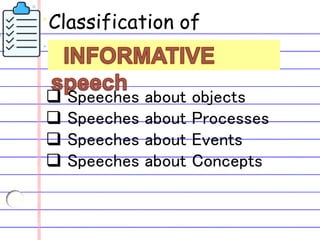
Classification of
 Speeches about objects
 Speeches about Processes
 Speeches about Events
 Speeches about Concepts
According to Purpose:
-A speech that creates, reinforces, changes
people’s beliefs or actions, make people to do
action.
-To persuade, or convince the listeners of the
validity of the speaker’s argument. This might
involve persuading someone to change their
opinion or at the very least take into account
some elements that have not really been
considered before.
According to Purpose:
Objective:
• to get listener’s to agree with you
• to defend an idea, to disprove an
opponent
• to sell a program/ something
• to inspire people to do action
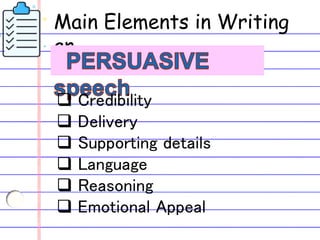
Main Elements in Writing
an
 Credibility
 Delivery
 Supporting details
 Language
 Reasoning
 Emotional Appeal
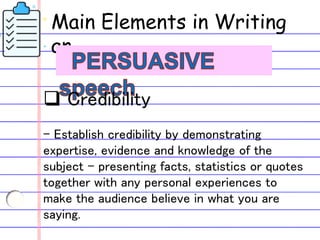
Main Elements in Writing
an
 Credibility
- Establish credibility by demonstrating
expertise, evidence and knowledge of the
subject – presenting facts, statistics or quotes
together with any personal experiences to
make the audience believe in what you are
saying.
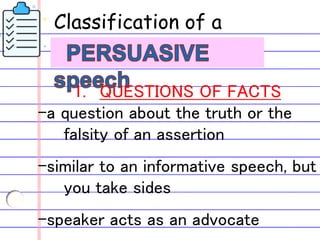
Classification of a
1. QUESTIONS OF FACTS
-a question about the truth or the
falsity of an assertion
-similar to an informative speech, but
you take sides
-speaker acts as an advocate
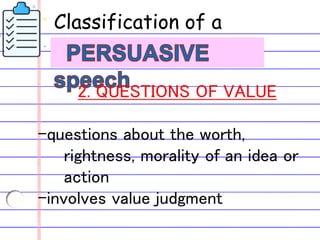
Classification of a
2. QUESTIONS OF VALUE
-questions about the worth,
rightness, morality of an idea or
action
-involves value judgment
Classification of a
3. QUESTIONS OF POLICY
-questions whether a specific course
of action should be taken or not
-goes beyond questions of fact and
value: to decide on the action
Classification of a
2 types of Question of Policy:
A. To gain passive agreement
B. To gain immediate action
According to Purpose:
-primary purpose of the speech is to
entertain, to have the audience relax,
smile and enjoy the occasion.
- Sole purpose is to have the audience
enjoy the presentation.
How do you make your speech
entertaining?
 Tell jokes
 Tell funny stories
 Dramatize an anecdote
 Tell a scary story
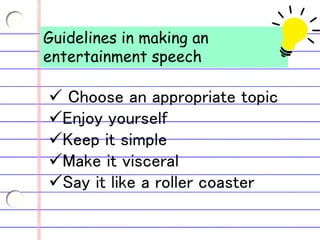
Guidelines in making an
entertainment speech
 Choose an appropriate topic
Enjoy yourself
Keep it simple
Make it visceral
Say it like a roller coaster
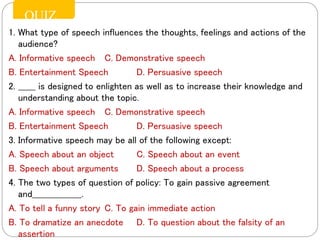
1. What type of speech influences the thoughts, feelings and actions of the
audience?
A. Informative speech C. Demonstrative speech
B. Entertainment Speech D. Persuasive speech
2. ______ is designed to enlighten as well as to increase their knowledge and
understanding about the topic.
A. Informative speech C. Demonstrative speech
B. Entertainment Speech D. Persuasive speech
3. Informative speech may be all of the following except:
A. Speech about an object C. Speech about an event
B. Speech about arguments D. Speech about a process
4. The two types of question of policy: To gain passive agreement
and_________________.
A. To tell a funny story C. To gain immediate action
B. To dramatize an anecdote D. To question about the falsity of an
assertion
QUIZ
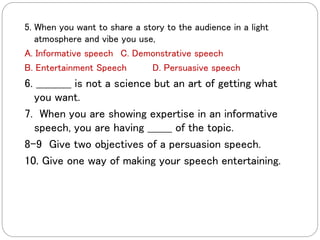
5. When you want to share a story to the audience in a light
atmosphere and vibe you use,
A. Informative speech C. Demonstrative speech
B. Entertainment Speech D. Persuasive speech
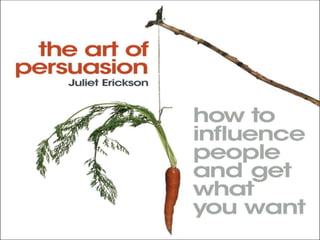
6. __________ is not a science but an art of getting what
you want.
7. When you are showing expertise in an informative
speech, you are having _______ of the topic.
8-9 Give two objectives of a persuasion speech.
10. Give one way of making your speech entertaining.

TYPES-OF-SPEECH.pptx

  • 2.
  • 3.
  • 4.
    According to Purpose: -Provides the audience with a clear understanding of a concept or idea. -A speech designed to convey knowledge and understanding.
  • 5.
    According to Purpose: Purpose:to provide reliable information to your reader on any subject matter.
  • 6.
    Main Elements inWriting an  Knowledge  Key points  Interest
  • 7.
    Main Elements inWriting an  Knowledge -Establish credibility by demonstrating expertise and knowledge of the subject -conveying information, presenting ideas, facts, and statistics to adequately inform the audience about the subject.
  • 8.
    Main Elements inWriting an  Key points -Repeat all the key points to ensure maximum knowledge retention.
  • 9.
    Main Elements inWriting an  Interest -Conveying the subject with enthusiasm and including unusual facts or anecdotes about the subject.
  • 10.
    Classification of  Speechesabout objects  Speeches about Processes  Speeches about Events  Speeches about Concepts
  • 12.
    According to Purpose: -Aspeech that creates, reinforces, changes people’s beliefs or actions, make people to do action. -To persuade, or convince the listeners of the validity of the speaker’s argument. This might involve persuading someone to change their opinion or at the very least take into account some elements that have not really been considered before.
  • 13.
    According to Purpose: Objective: •to get listener’s to agree with you • to defend an idea, to disprove an opponent • to sell a program/ something • to inspire people to do action
  • 14.
    Main Elements inWriting an  Credibility  Delivery  Supporting details  Language  Reasoning  Emotional Appeal
  • 15.
    Main Elements inWriting an  Credibility - Establish credibility by demonstrating expertise, evidence and knowledge of the subject – presenting facts, statistics or quotes together with any personal experiences to make the audience believe in what you are saying.
  • 16.
    Classification of a 1.QUESTIONS OF FACTS -a question about the truth or the falsity of an assertion -similar to an informative speech, but you take sides -speaker acts as an advocate
  • 17.
    Classification of a 2.QUESTIONS OF VALUE -questions about the worth, rightness, morality of an idea or action -involves value judgment
  • 18.
    Classification of a 3.QUESTIONS OF POLICY -questions whether a specific course of action should be taken or not -goes beyond questions of fact and value: to decide on the action
  • 19.
    Classification of a 2types of Question of Policy: A. To gain passive agreement B. To gain immediate action
  • 20.
    According to Purpose: -primarypurpose of the speech is to entertain, to have the audience relax, smile and enjoy the occasion. - Sole purpose is to have the audience enjoy the presentation.
  • 21.
    How do youmake your speech entertaining?  Tell jokes  Tell funny stories  Dramatize an anecdote  Tell a scary story
  • 22.
    Guidelines in makingan entertainment speech  Choose an appropriate topic Enjoy yourself Keep it simple Make it visceral Say it like a roller coaster
  • 24.
    1. What typeof speech influences the thoughts, feelings and actions of the audience? A. Informative speech C. Demonstrative speech B. Entertainment Speech D. Persuasive speech 2. ______ is designed to enlighten as well as to increase their knowledge and understanding about the topic. A. Informative speech C. Demonstrative speech B. Entertainment Speech D. Persuasive speech 3. Informative speech may be all of the following except: A. Speech about an object C. Speech about an event B. Speech about arguments D. Speech about a process 4. The two types of question of policy: To gain passive agreement and_________________. A. To tell a funny story C. To gain immediate action B. To dramatize an anecdote D. To question about the falsity of an assertion QUIZ
  • 25.
    5. When youwant to share a story to the audience in a light atmosphere and vibe you use, A. Informative speech C. Demonstrative speech B. Entertainment Speech D. Persuasive speech 6. __________ is not a science but an art of getting what you want. 7. When you are showing expertise in an informative speech, you are having _______ of the topic. 8-9 Give two objectives of a persuasion speech. 10. Give one way of making your speech entertaining.