FORCE
&
FORCE
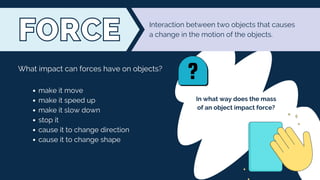
FORCE Interaction between two objects that causes
a change in the motion of the objects.
What impact can forces have on objects?
make it move
make it speed up
make it slow down
stop it
cause it to change direction
cause it to change shape
In what way does the mass
of an object impact force?
ISAAC NEWTON?
ISAAC NEWTON?
WHO WAS
A renowned physicist and mathematician from England who
discovered in 1687 the correlation between force and motion.
Today, his three laws of motion are instrumental in describing
the movement of any object in the universe.
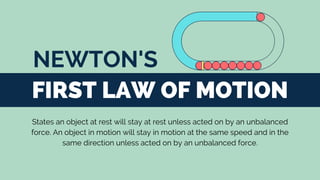
FIRST LAW OF MOTION
NEWTON'S
States an object at rest will stay at rest unless acted on by an unbalanced
force. An object in motion will stay in motion at the same speed and in the
same direction unless acted on by an unbalanced force.
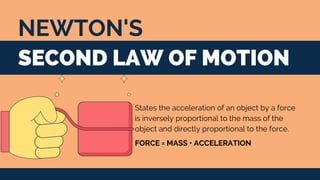
SECOND LAW OF MOTION
NEWTON'S
States the acceleration of an object by a force
is inversely proportional to the mass of the
object and directly proportional to the force.
FORCE = MASS • ACCELERATION
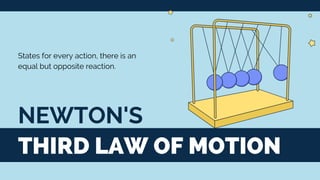
THIRD LAW OF MOTION
NEWTON'S
States for every action, there is an
equal but opposite reaction.
Can you think of scenarios
where Newton's Third Law
of Motion is relevant?
Name instances where
Newton's First Law of
Motion comes into play.
Provide examples of when
Newton's Second Law of
Motion is applied.
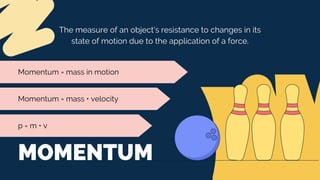
MOMENTUM
The measure of an object’s resistance to changes in its
state of motion due to the application of a force.
Momentum = mass • velocity
Momentum = mass in motion
p = m • v
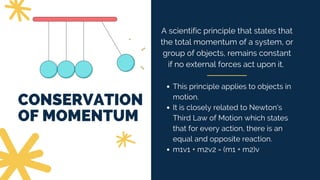
CONSERVATION
OF MOMENTUM
A scientific principle that states that
the total momentum of a system, or
group of objects, remains constant
if no external forces act upon it.
This principle applies to objects in
motion.
It is closely related to Newton's
Third Law of Motion which states
that for every action, there is an
equal and opposite reaction.
m1v1 + m2v2 = (m1 + m2)v
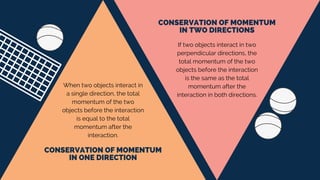
CONSERVATION OF MOMENTUM
IN ONE DIRECTION
CONSERVATION OF MOMENTUM
IN TWO DIRECTIONS
When two objects interact in
a single direction, the total
momentum of the two
objects before the interaction
is equal to the total
momentum after the
interaction.
If two objects interact in two
perpendicular directions, the
total momentum of the two
objects before the interaction
is the same as the total
momentum after the
interaction in both directions.
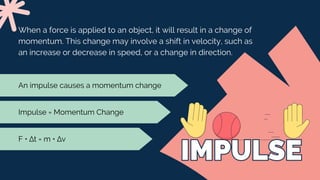
IMPULSE
IMPULSE
When a force is applied to an object, it will result in a change of
momentum. This change may involve a shift in velocity, such as
an increase or decrease in speed, or a change in direction.
Impulse = Momentum Change
An impulse causes a momentum change
F • ∆t = m • ∆v
INERTIA
ACCELERATION
The tendency of an object to resist a change in motion. This means
that an object will either stay at rest or continue moving in a straight
line at a constant speed.
The change in the speed or direction of an object’s movement.
Acceleration = Change in Velocity / Time
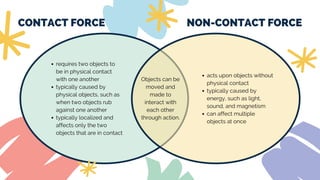
CONTACT FORCE NON-CONTACT FORCE
Objects can be
moved and
made to
interact with
each other
through action.
requires two objects to
be in physical contact
with one another
typically caused by
physical objects, such as
when two objects rub
against one another
typically localized and
affects only the two
objects that are in contact
acts upon objects without
physical contact
typically caused by
energy, such as light,
sound, and magnetism
can affect multiple
objects at once
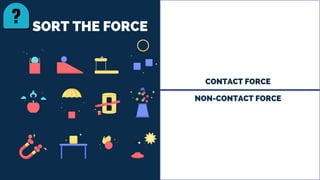
SORT THE FORCE
CONTACT FORCE
NON-CONTACT FORCE
Test Review
April 25th @ 2:45 pm
April 27th @ 2:45 pm
Schedule
April 3rd - Presentation
April 6th - Demo/Lab
April 12th - Science Stations
April 17th - Notes Check
April 20th - Review HW
April 28th - Unit Test

Force and Motion Presentation Colorful Illustration

  • 1.
  • 2.
    FORCE FORCE Interaction betweentwo objects that causes a change in the motion of the objects. What impact can forces have on objects? make it move make it speed up make it slow down stop it cause it to change direction cause it to change shape In what way does the mass of an object impact force?
  • 3.
    ISAAC NEWTON? ISAAC NEWTON? WHOWAS A renowned physicist and mathematician from England who discovered in 1687 the correlation between force and motion. Today, his three laws of motion are instrumental in describing the movement of any object in the universe.
  • 4.
    FIRST LAW OFMOTION NEWTON'S States an object at rest will stay at rest unless acted on by an unbalanced force. An object in motion will stay in motion at the same speed and in the same direction unless acted on by an unbalanced force.
  • 5.
    SECOND LAW OFMOTION NEWTON'S States the acceleration of an object by a force is inversely proportional to the mass of the object and directly proportional to the force. FORCE = MASS • ACCELERATION
  • 6.
    THIRD LAW OFMOTION NEWTON'S States for every action, there is an equal but opposite reaction.
  • 7.
    Can you thinkof scenarios where Newton's Third Law of Motion is relevant? Name instances where Newton's First Law of Motion comes into play. Provide examples of when Newton's Second Law of Motion is applied.
  • 8.
    MOMENTUM The measure ofan object’s resistance to changes in its state of motion due to the application of a force. Momentum = mass • velocity Momentum = mass in motion p = m • v
  • 9.
    CONSERVATION OF MOMENTUM A scientificprinciple that states that the total momentum of a system, or group of objects, remains constant if no external forces act upon it. This principle applies to objects in motion. It is closely related to Newton's Third Law of Motion which states that for every action, there is an equal and opposite reaction. m1v1 + m2v2 = (m1 + m2)v
  • 10.
    CONSERVATION OF MOMENTUM INONE DIRECTION CONSERVATION OF MOMENTUM IN TWO DIRECTIONS When two objects interact in a single direction, the total momentum of the two objects before the interaction is equal to the total momentum after the interaction. If two objects interact in two perpendicular directions, the total momentum of the two objects before the interaction is the same as the total momentum after the interaction in both directions.
  • 11.
    IMPULSE IMPULSE When a forceis applied to an object, it will result in a change of momentum. This change may involve a shift in velocity, such as an increase or decrease in speed, or a change in direction. Impulse = Momentum Change An impulse causes a momentum change F • ∆t = m • ∆v
  • 12.
    INERTIA ACCELERATION The tendency ofan object to resist a change in motion. This means that an object will either stay at rest or continue moving in a straight line at a constant speed. The change in the speed or direction of an object’s movement. Acceleration = Change in Velocity / Time
  • 13.
    CONTACT FORCE NON-CONTACTFORCE Objects can be moved and made to interact with each other through action. requires two objects to be in physical contact with one another typically caused by physical objects, such as when two objects rub against one another typically localized and affects only the two objects that are in contact acts upon objects without physical contact typically caused by energy, such as light, sound, and magnetism can affect multiple objects at once
  • 14.
    SORT THE FORCE CONTACTFORCE NON-CONTACT FORCE
  • 15.
    Test Review April 25th@ 2:45 pm April 27th @ 2:45 pm Schedule April 3rd - Presentation April 6th - Demo/Lab April 12th - Science Stations April 17th - Notes Check April 20th - Review HW April 28th - Unit Test