TYPES OF REPRODUCTION
Reproduction
 is the process by which living organisms like humans, animals and
plants form new individuals of the same kind.
 “ Reproduction is to make a new life”, the ability of an organism to
produce new individuals.
TWO TYPES OF REPRODUCTION
1. Asexual reproduction
2. Sexual Reproduction
Asexual reproduction
 is the creation of new organism from a single parent without the
combination of gametes.
Therefore, the parent and the resulting offspring have the same
genes and this is the reason why they have the same traits.
The genetic makeup of the offspring is the same as the parent.
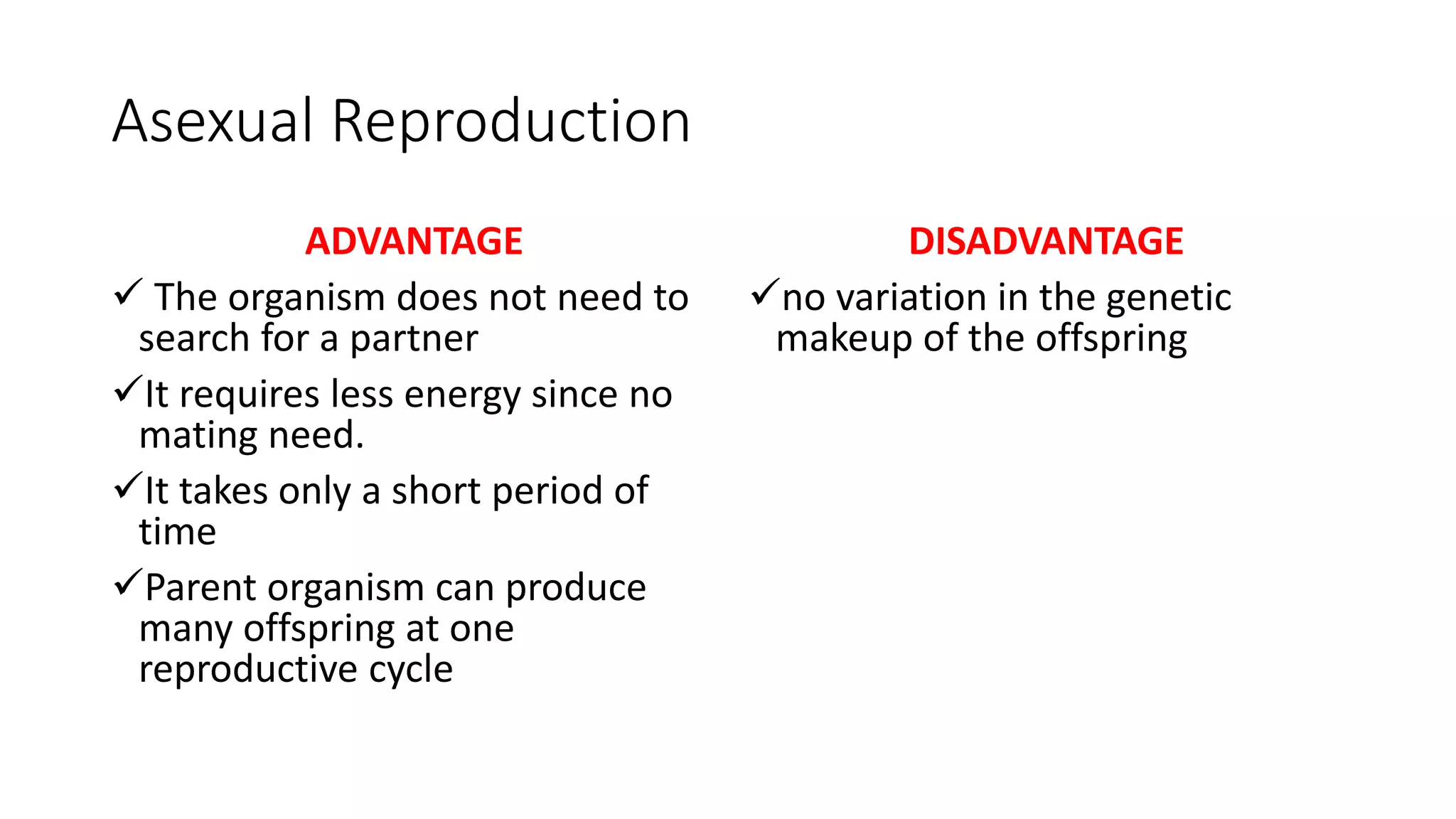
Asexual Reproduction
ADVANTAGE
 The organism does not need to
search for a partner
It requires less energy since no
mating need.
It takes only a short period of
time
Parent organism can produce
many offspring at one
reproductive cycle
DISADVANTAGE
no variation in the genetic
makeup of the offspring
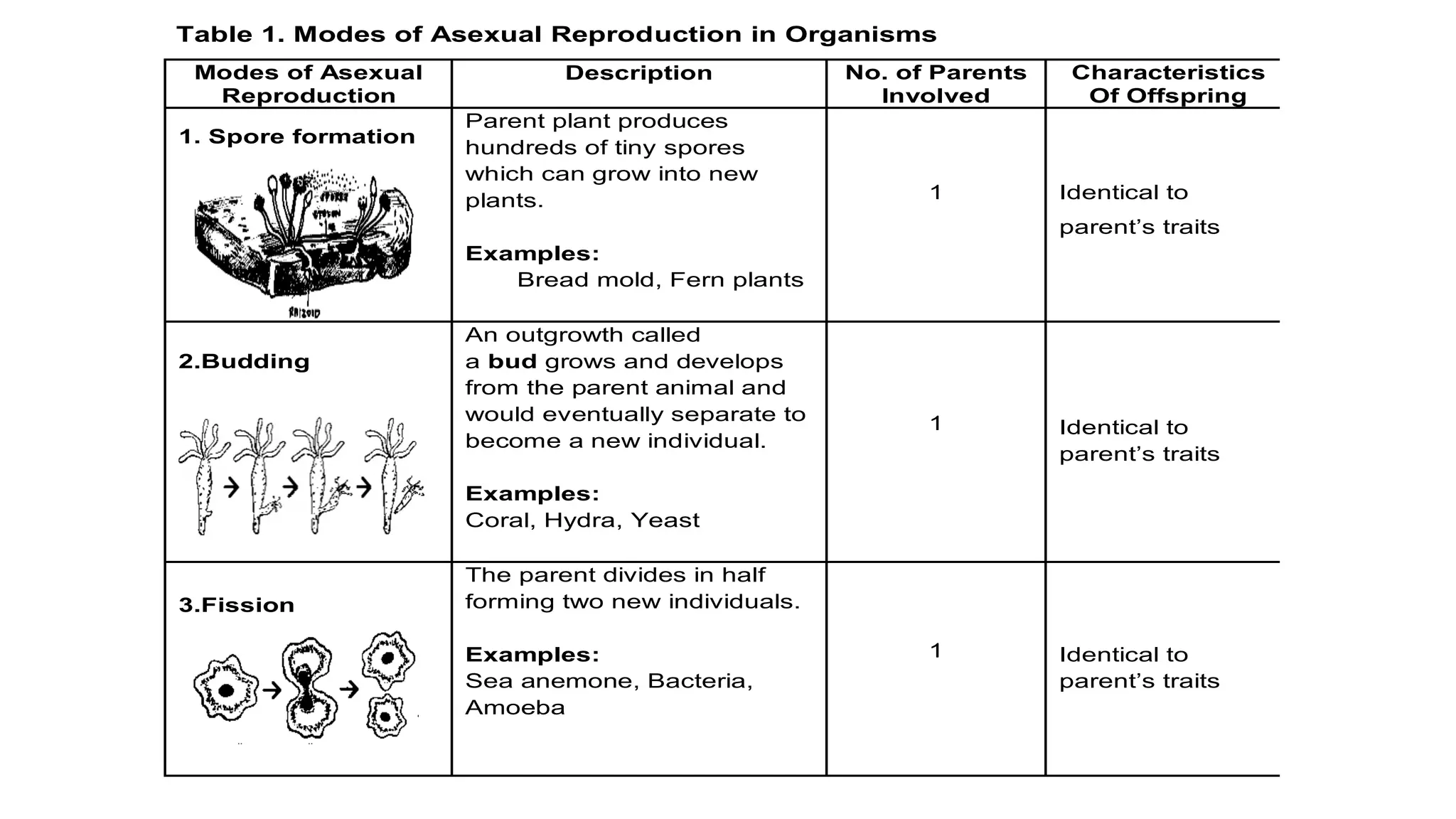
Table 1. Modes of Asexual Reproduction in Organisms
Modes of Asexual
Reproduction
Description No. of Parents
Involved
Characteristics
Of Offspring
1. Spore formation
Parent plant produces
hundreds of tiny spores
which can grow into new
plants.
Examples:
Bread mold, Fern plants
1 Identical to
parent’s traits
2.Budding
An outgrowth called
a bud grows and develops
from the parent animal and
would eventually separate to
become a new individual.
Examples:
Coral, Hydra, Yeast
1 Identical to
parent’s traits
3.Fission
The parent divides in half
forming two new individuals.
Examples:
Sea anemone, Bacteria,
Amoeba
1 Identical to
parent’s traits
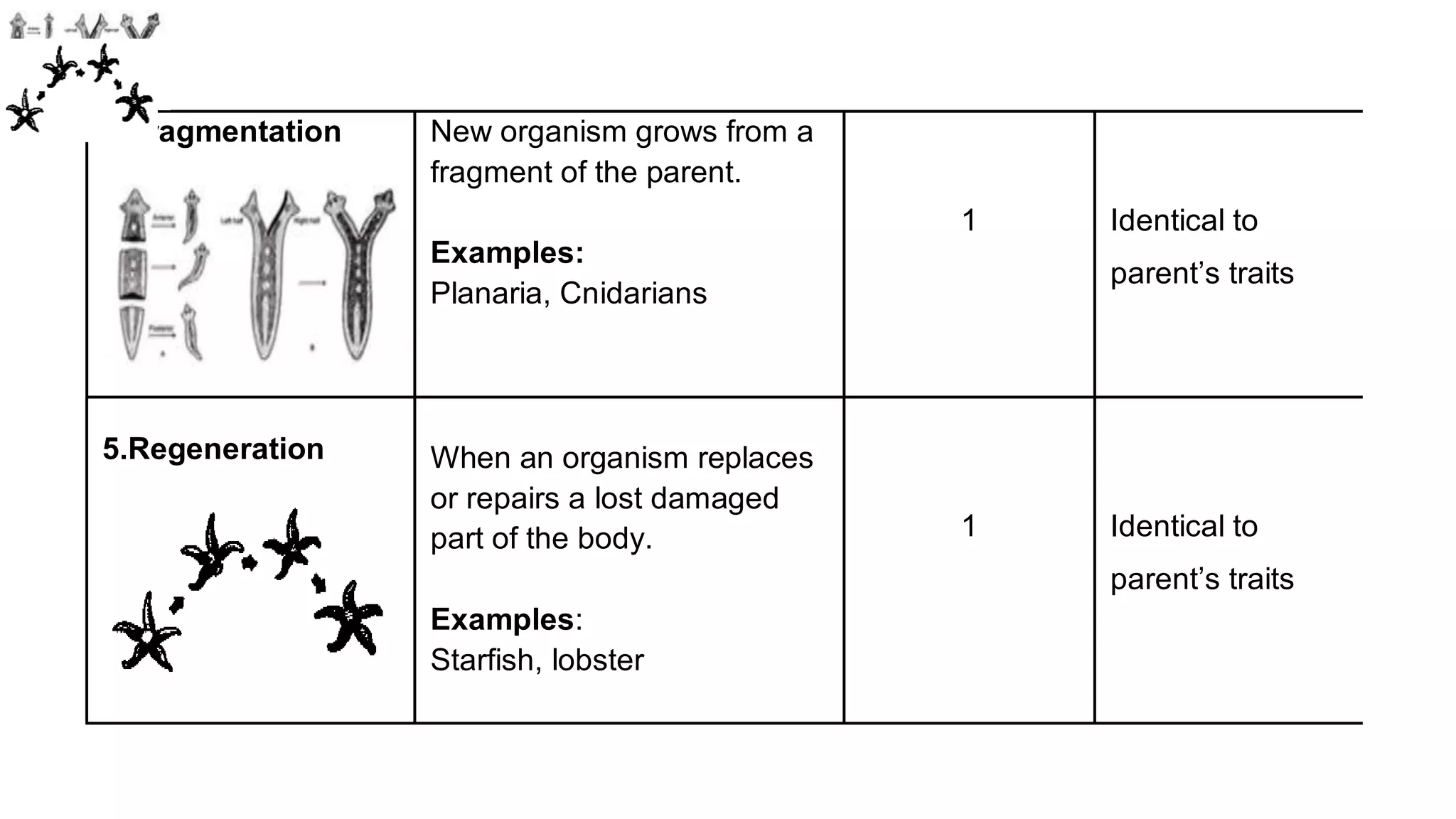
4.Fragmentation New organism grows from a
fragment of the parent.
Examples:
Planaria, Cnidarians
1 Identical to
parent’s traits
5.Regeneration When an organism replaces
or repairs a lost damaged
part of the body.
Examples:
Starfish, lobster
1 Identical to
parent’s traits
Vegetative Propagation
is a mode of asexual reproduction in plants where a new plant can
form from the root, stem or leaf of an existing plant.
Table 2. Plant Parts Used in Vegetative Propagation
Types Description No. of Parents
Involved
Characteristics
Of Offspring
1.Runners/ Stolon
An aboveground stem that
grows horizontally along
the surface when the stem
touches the ground; buds
from the stem forms roots
and leaves, and a new
plant develops.
EXAMPLES:
Bermuda Grass,
Strawberry
1 Identical to
parent’s traits
2.Rhizomes
An underground stem that
grows horizontally along
the surface; shoots from
buds at nodes of the stem
develop into a new plant.
EXAMPLES:
Ginger (Luy-a)
1 Identical to
parent’s traits
3.Tubers
A new plant is formed from
an enlarged and thickened
underground stem with
buds or eye.
EXAMPLES:
Potato (Patatas)
1 Identical to
parent’s traits
4.Bulb
A bulb is an underground
stem with thick and fleshy
colorless leaves; can
reproduce several smaller
bulbs, each of which can
grow into a new plant.
EXAMPLES:
Onion (Sibuyas)
1 Identical to
parent’s traits
5.Corm
A corm is an enlarged ,
short underground stem
that sores food; resembles
bulbs but does not have
thick, fleshy leaves. New
corms develop from the
stem of an old corm to
produce new plants.
EXAMPLES:
Taro (Gabi)
1 Identical to
parent’s traits
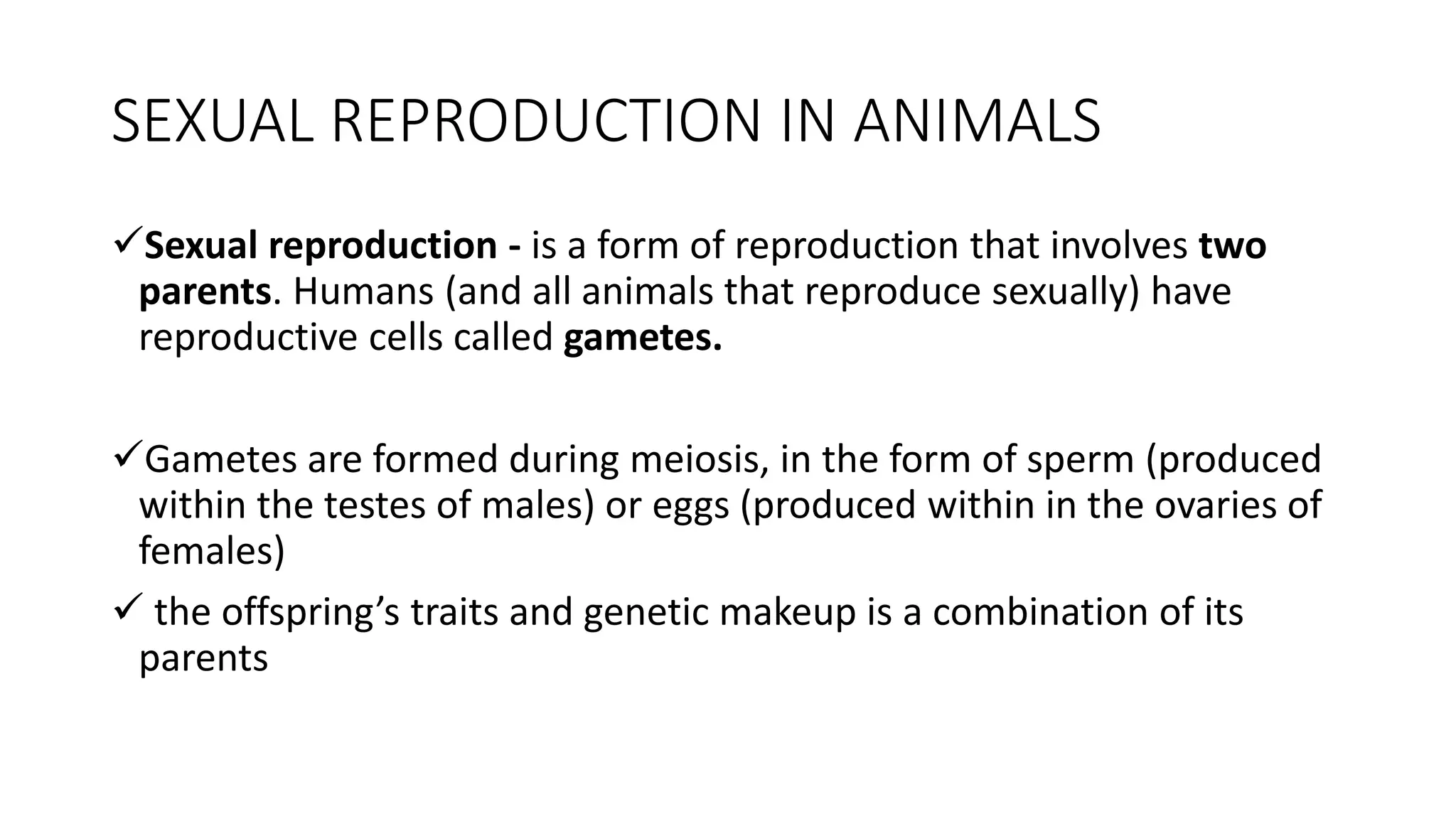
SEXUAL REPRODUCTION IN ANIMALS
Sexual reproduction - is a form of reproduction that involves two
parents. Humans (and all animals that reproduce sexually) have
reproductive cells called gametes.
Gametes are formed during meiosis, in the form of sperm (produced
within the testes of males) or eggs (produced within in the ovaries of
females)
 the offspring’s traits and genetic makeup is a combination of its
parents
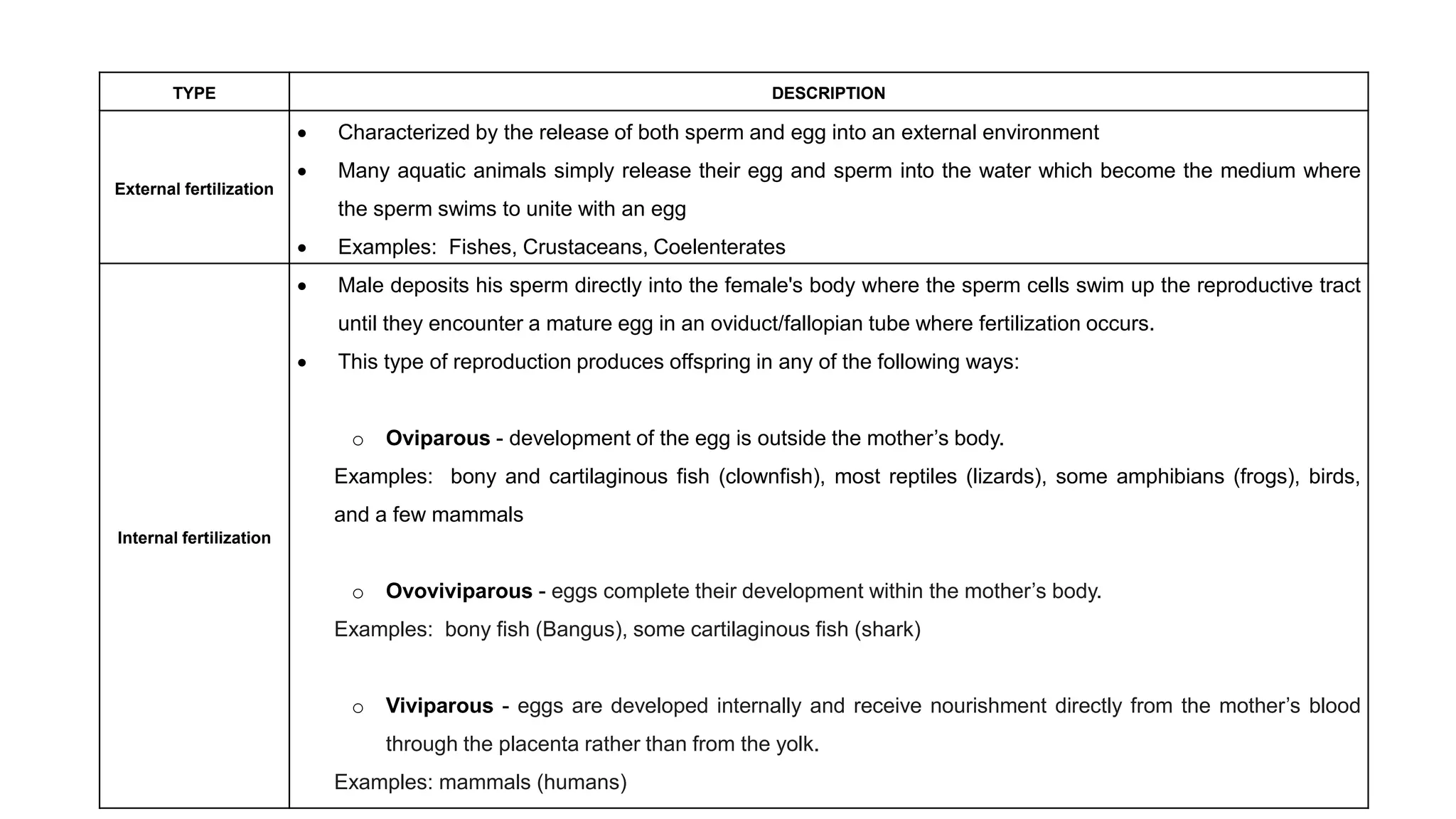
TYPE DESCRIPTION
External fertilization
 Characterized by the release of both sperm and egg into an external environment
 Many aquatic animals simply release their egg and sperm into the water which become the medium where
the sperm swims to unite with an egg
 Examples: Fishes, Crustaceans, Coelenterates
Internal fertilization
 Male deposits his sperm directly into the female's body where the sperm cells swim up the reproductive tract
until they encounter a mature egg in an oviduct/fallopian tube where fertilization occurs.
 This type of reproduction produces offspring in any of the following ways:
o Oviparous - development of the egg is outside the mother’s body.
Examples: bony and cartilaginous fish (clownfish), most reptiles (lizards), some amphibians (frogs), birds,
and a few mammals
o Ovoviviparous - eggs complete their development within the mother’s body.
Examples: bony fish (Bangus), some cartilaginous fish (shark)
o Viviparous - eggs are developed internally and receive nourishment directly from the mother’s blood
through the placenta rather than from the yolk.
Examples: mammals (humans)
Sexual Reproduction in Flowering Plants
Flower- is the reproductive organ in flowering plants. It has structures
that produce the gametes necessary for reproduction. It is a specialized
part of an angiosperm plant that occurs singly or in clusters, possesses
whorls of often colorful petals or sepals.
A typical complete flower and its reproductive structures
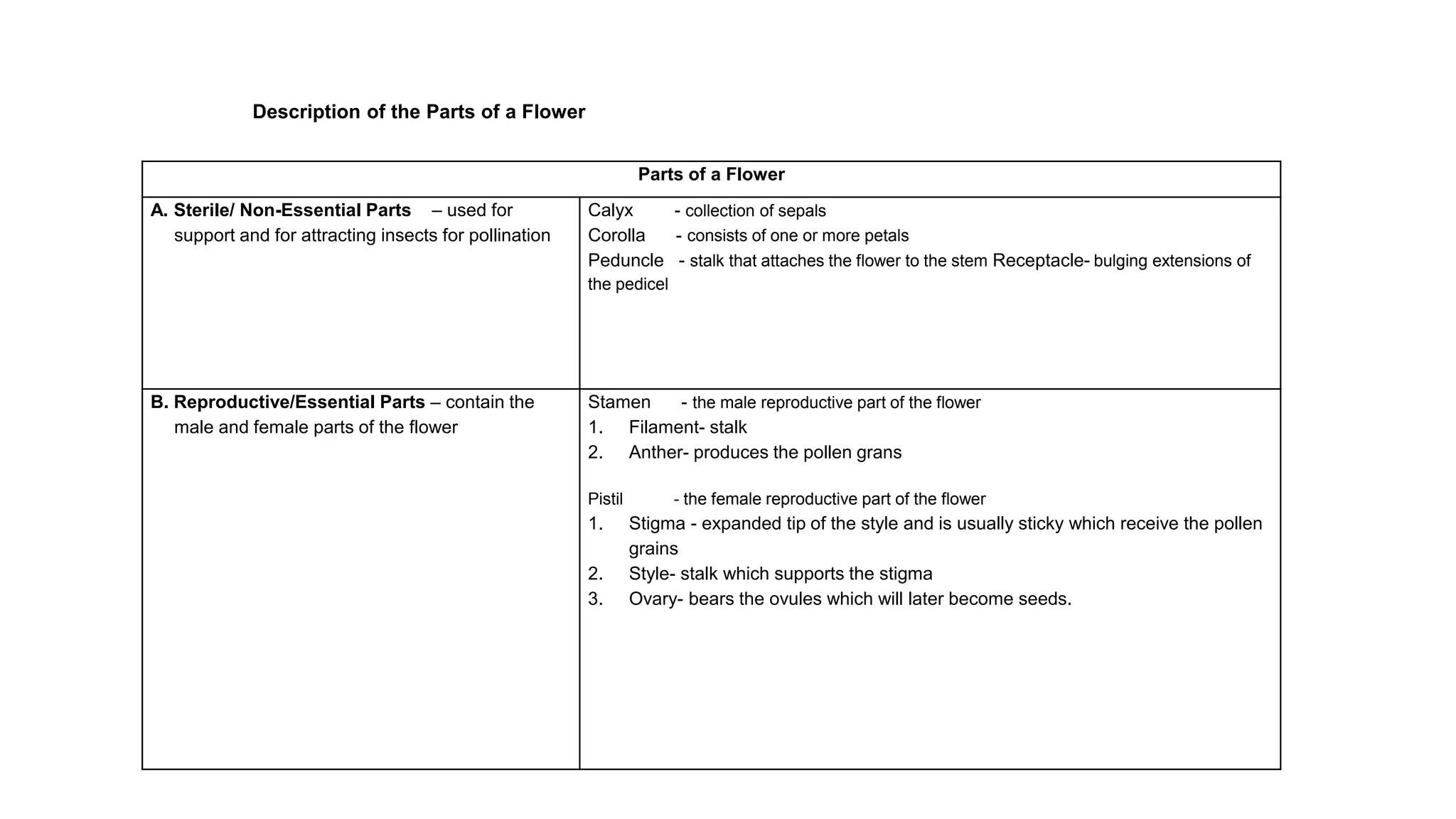
Parts of a Flower
A. Sterile/ Non-Essential Parts – used for
support and for attracting insects for pollination
Calyx - collection of sepals
Corolla - consists of one or more petals
Peduncle - stalk that attaches the flower to the stem Receptacle- bulging extensions of
the pedicel
B. Reproductive/Essential Parts – contain the
male and female parts of the flower
Stamen - the male reproductive part of the flower
1. Filament- stalk
2. Anther- produces the pollen grans
Pistil - the female reproductive part of the flower
1. Stigma - expanded tip of the style and is usually sticky which receive the pollen
grains
2. Style- stalk which supports the stigma
3. Ovary- bears the ovules which will later become seeds.
Description of the Parts of a Flower
Basis of Comparison Asexual Reproduction Sexual Reproduction
1. Number of parents involved One parent is involved. Two parents are involved.
2. Similarities of the offspring to the parents Offspring is genetically identical to the
parent.
Offspring is genetically
different from the parents.
3. Gamete or Sex Cell No gametes are needed. Gametes are needed.
4. Number of offspring produced Many offspring can be produced quickly. A minimum of one
offspring per reproductive
cycle is produced.
Asexual and Sexual Reproduction: A Comparison

TYPES OF REPRODUCTION.pptx

  • 1.
  • 3.
    Reproduction  is theprocess by which living organisms like humans, animals and plants form new individuals of the same kind.  “ Reproduction is to make a new life”, the ability of an organism to produce new individuals.
  • 4.
    TWO TYPES OFREPRODUCTION 1. Asexual reproduction 2. Sexual Reproduction
  • 5.
    Asexual reproduction  isthe creation of new organism from a single parent without the combination of gametes. Therefore, the parent and the resulting offspring have the same genes and this is the reason why they have the same traits. The genetic makeup of the offspring is the same as the parent.
  • 6.
    Asexual Reproduction ADVANTAGE  Theorganism does not need to search for a partner It requires less energy since no mating need. It takes only a short period of time Parent organism can produce many offspring at one reproductive cycle DISADVANTAGE no variation in the genetic makeup of the offspring
  • 7.
    Table 1. Modesof Asexual Reproduction in Organisms Modes of Asexual Reproduction Description No. of Parents Involved Characteristics Of Offspring 1. Spore formation Parent plant produces hundreds of tiny spores which can grow into new plants. Examples: Bread mold, Fern plants 1 Identical to parent’s traits 2.Budding An outgrowth called a bud grows and develops from the parent animal and would eventually separate to become a new individual. Examples: Coral, Hydra, Yeast 1 Identical to parent’s traits 3.Fission The parent divides in half forming two new individuals. Examples: Sea anemone, Bacteria, Amoeba 1 Identical to parent’s traits
  • 8.
    4.Fragmentation New organismgrows from a fragment of the parent. Examples: Planaria, Cnidarians 1 Identical to parent’s traits 5.Regeneration When an organism replaces or repairs a lost damaged part of the body. Examples: Starfish, lobster 1 Identical to parent’s traits
  • 9.
    Vegetative Propagation is amode of asexual reproduction in plants where a new plant can form from the root, stem or leaf of an existing plant.
  • 10.
    Table 2. PlantParts Used in Vegetative Propagation Types Description No. of Parents Involved Characteristics Of Offspring 1.Runners/ Stolon An aboveground stem that grows horizontally along the surface when the stem touches the ground; buds from the stem forms roots and leaves, and a new plant develops. EXAMPLES: Bermuda Grass, Strawberry 1 Identical to parent’s traits 2.Rhizomes An underground stem that grows horizontally along the surface; shoots from buds at nodes of the stem develop into a new plant. EXAMPLES: Ginger (Luy-a) 1 Identical to parent’s traits
  • 11.
    3.Tubers A new plantis formed from an enlarged and thickened underground stem with buds or eye. EXAMPLES: Potato (Patatas) 1 Identical to parent’s traits 4.Bulb A bulb is an underground stem with thick and fleshy colorless leaves; can reproduce several smaller bulbs, each of which can grow into a new plant. EXAMPLES: Onion (Sibuyas) 1 Identical to parent’s traits 5.Corm A corm is an enlarged , short underground stem that sores food; resembles bulbs but does not have thick, fleshy leaves. New corms develop from the stem of an old corm to produce new plants. EXAMPLES: Taro (Gabi) 1 Identical to parent’s traits
  • 12.
    SEXUAL REPRODUCTION INANIMALS Sexual reproduction - is a form of reproduction that involves two parents. Humans (and all animals that reproduce sexually) have reproductive cells called gametes. Gametes are formed during meiosis, in the form of sperm (produced within the testes of males) or eggs (produced within in the ovaries of females)  the offspring’s traits and genetic makeup is a combination of its parents
  • 13.
    TYPE DESCRIPTION External fertilization Characterized by the release of both sperm and egg into an external environment  Many aquatic animals simply release their egg and sperm into the water which become the medium where the sperm swims to unite with an egg  Examples: Fishes, Crustaceans, Coelenterates Internal fertilization  Male deposits his sperm directly into the female's body where the sperm cells swim up the reproductive tract until they encounter a mature egg in an oviduct/fallopian tube where fertilization occurs.  This type of reproduction produces offspring in any of the following ways: o Oviparous - development of the egg is outside the mother’s body. Examples: bony and cartilaginous fish (clownfish), most reptiles (lizards), some amphibians (frogs), birds, and a few mammals o Ovoviviparous - eggs complete their development within the mother’s body. Examples: bony fish (Bangus), some cartilaginous fish (shark) o Viviparous - eggs are developed internally and receive nourishment directly from the mother’s blood through the placenta rather than from the yolk. Examples: mammals (humans)
  • 14.
    Sexual Reproduction inFlowering Plants Flower- is the reproductive organ in flowering plants. It has structures that produce the gametes necessary for reproduction. It is a specialized part of an angiosperm plant that occurs singly or in clusters, possesses whorls of often colorful petals or sepals.
  • 15.
    A typical completeflower and its reproductive structures
  • 16.
    Parts of aFlower A. Sterile/ Non-Essential Parts – used for support and for attracting insects for pollination Calyx - collection of sepals Corolla - consists of one or more petals Peduncle - stalk that attaches the flower to the stem Receptacle- bulging extensions of the pedicel B. Reproductive/Essential Parts – contain the male and female parts of the flower Stamen - the male reproductive part of the flower 1. Filament- stalk 2. Anther- produces the pollen grans Pistil - the female reproductive part of the flower 1. Stigma - expanded tip of the style and is usually sticky which receive the pollen grains 2. Style- stalk which supports the stigma 3. Ovary- bears the ovules which will later become seeds. Description of the Parts of a Flower
  • 17.
    Basis of ComparisonAsexual Reproduction Sexual Reproduction 1. Number of parents involved One parent is involved. Two parents are involved. 2. Similarities of the offspring to the parents Offspring is genetically identical to the parent. Offspring is genetically different from the parents. 3. Gamete or Sex Cell No gametes are needed. Gametes are needed. 4. Number of offspring produced Many offspring can be produced quickly. A minimum of one offspring per reproductive cycle is produced. Asexual and Sexual Reproduction: A Comparison

Editor's Notes

  • #5 . Both of these forms of reproduction occur in plants, animals and microorganisms. However, the specific form of reproduction depends on the species.