Arya College of Engineering & IT.
Kukas-Jaipur
Patterns
Prepared By
Nikil Kumar Khandelwal
Department of Mechanical Engineering
Arya College of Engineering & IT.
Kukas-Jaipur
Patterns
• In Casting, a pattern is a replica of the object to be cast, used to prepare the
cavity into which molten material will be poured during the casting process.
• Except for the various allowances a pattern exactly resembles the casting to be
made.
• A pattern is required even if one object has to be cast.
• The quality of casting and the final product will be effected to a great extent by
the planning of pattern.
Arya College of Engineering & IT.
Kukas-Jaipur
Difference between pattern and casting
• The main difference between a pattern and the casting is their dimensions.
• A pattern is slightly larger in size as compared to the casting, because a pattern,
– carries Shrinkage allowance, it may be of the order of 1 to 2 mm/ 100 mm.
– is given a Machining allowance to clean and finish the required surfaces.
– carries a Draft allowance of the order of 1 and 3 degrees for external and internal surfaces
respectively
– carries core prints.
• A pattern may not have all holes and slots which a casting will have. Such holes and slots unnecessarily
complicate a pattern and therefore can be drilled in the casting after it has been made.
• A pattern may be in two or three pieces whereas a casting is in one piece.
• A pattern and the casting also differ as regards the material out of which they are made.
Arya College of Engineering & IT.
Kukas-Jaipur
Functions of a patterns
• A pattern prepares a Mould cavity for the purpose of making a casting.
• A pattern may contain projections known as core prints if the casting requires
a core and need to be made hollow.
• Runner, gates, and risers used for feeding molten metal in the Mould cavity
may form a part of the pattern.
• Patterns properly made and having finished and smooth surfaces reduce
casting defects.
• A properly constructed pattern minimizes the overall cost of the castings.
Arya College of Engineering & IT.
Kukas-Jaipur
TYPES OF
PATTERNS
Arya College of Engineering & IT.
Kukas-Jaipur
one may consider the following points:
– Quantity of castings to be produced.
– The size and the complexity of the shape of the casting to be produced.
– Type of molding method to be used (i.e., hand or machine molding).
– Problems associated with the molding operation such as
withdrawing the pattern from the mold etc.
– Other difficulties resulting from poor casting design or pattern design.
Selection Of Pattern
Arya College of Engineering & IT.
Kukas-Jaipur
• The different types of patterns commonly used are:
– One piece(Solid) pattern
– Split pattern
– Loose piece pattern
– Match plate pattern
– Cope and Drag pattern
– Sweep pattern
– Gated pattern
– Skeleton pattern
– Follow board pattern.
Arya College of Engineering & IT.
Kukas-Jaipur
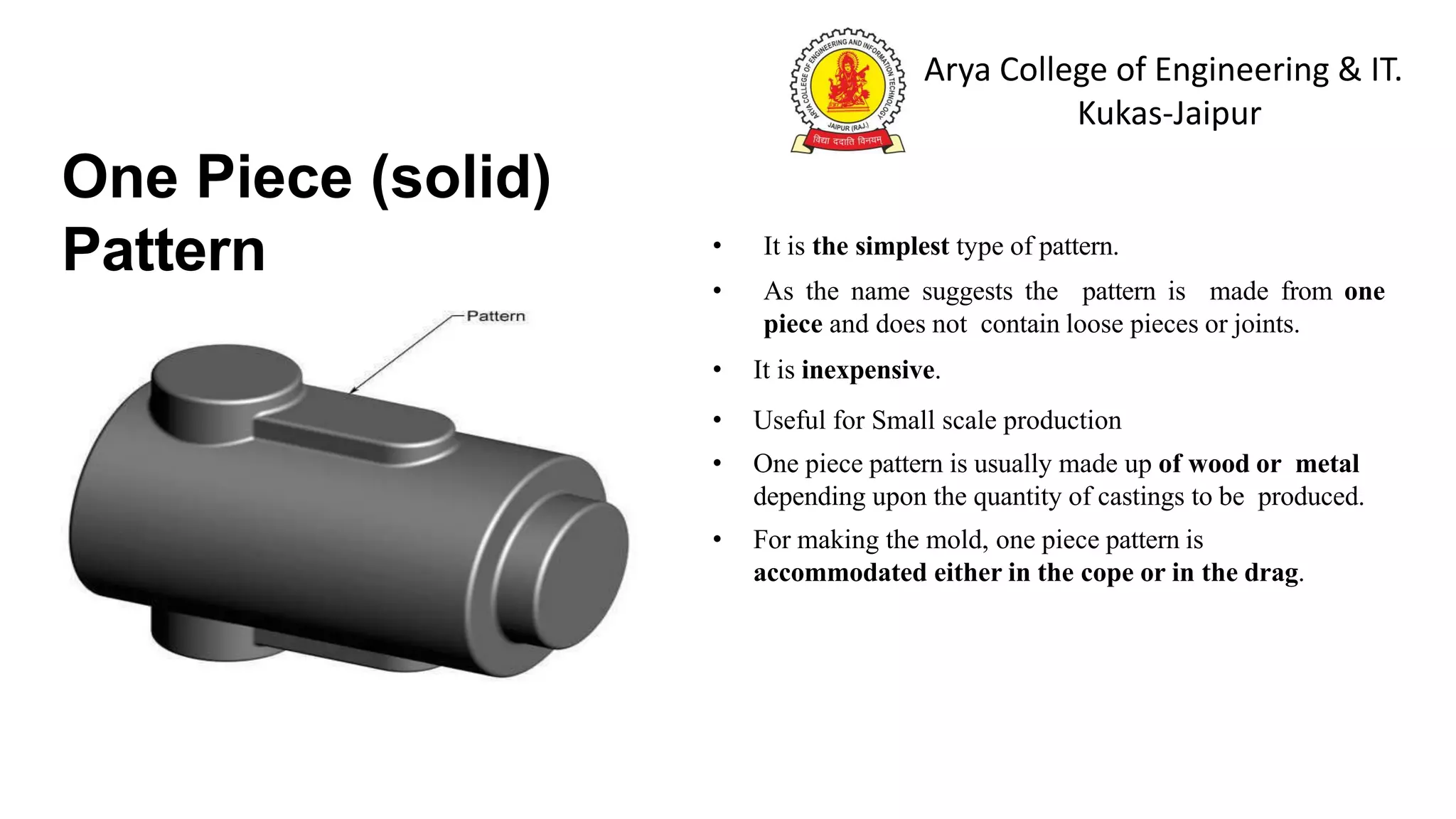
One Piece (solid)
Pattern • It is the simplest type of pattern.
• As the name suggests the pattern is made from one
piece and does not contain loose pieces or joints.
• It is inexpensive.
• Useful for Small scale production
• One piece pattern is usually made up of wood or metal
depending upon the quantity of castings to be produced.
• For making the mold, one piece pattern is
accommodated either in the cope or in the drag.
Arya College of Engineering & IT.
Kukas-Jaipur
Split Pattern
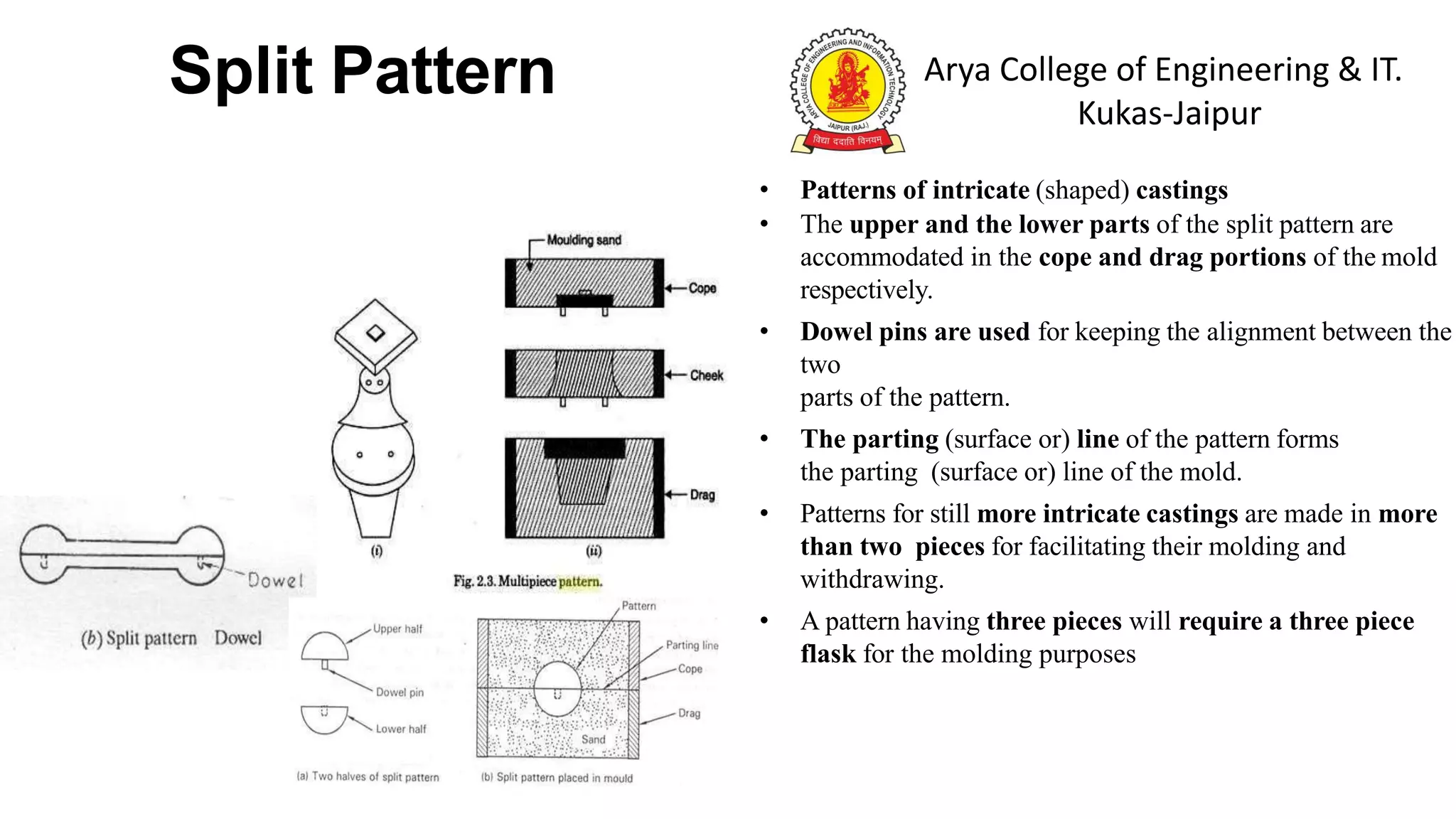
• Patterns of intricate (shaped) castings
• The upper and the lower parts of the split pattern are
accommodated in the cope and drag portions of the mold
respectively.
• Dowel pins are used for keeping the alignment between the
two
parts of the pattern.
• The parting (surface or) line of the pattern forms
the parting (surface or) line of the mold.
• Patterns for still more intricate castings are made in more
than two pieces for facilitating their molding and
withdrawing.
• A pattern having three pieces will require a three piece
flask for the molding purposes
Arya College of Engineering & IT.
Kukas-Jaipur
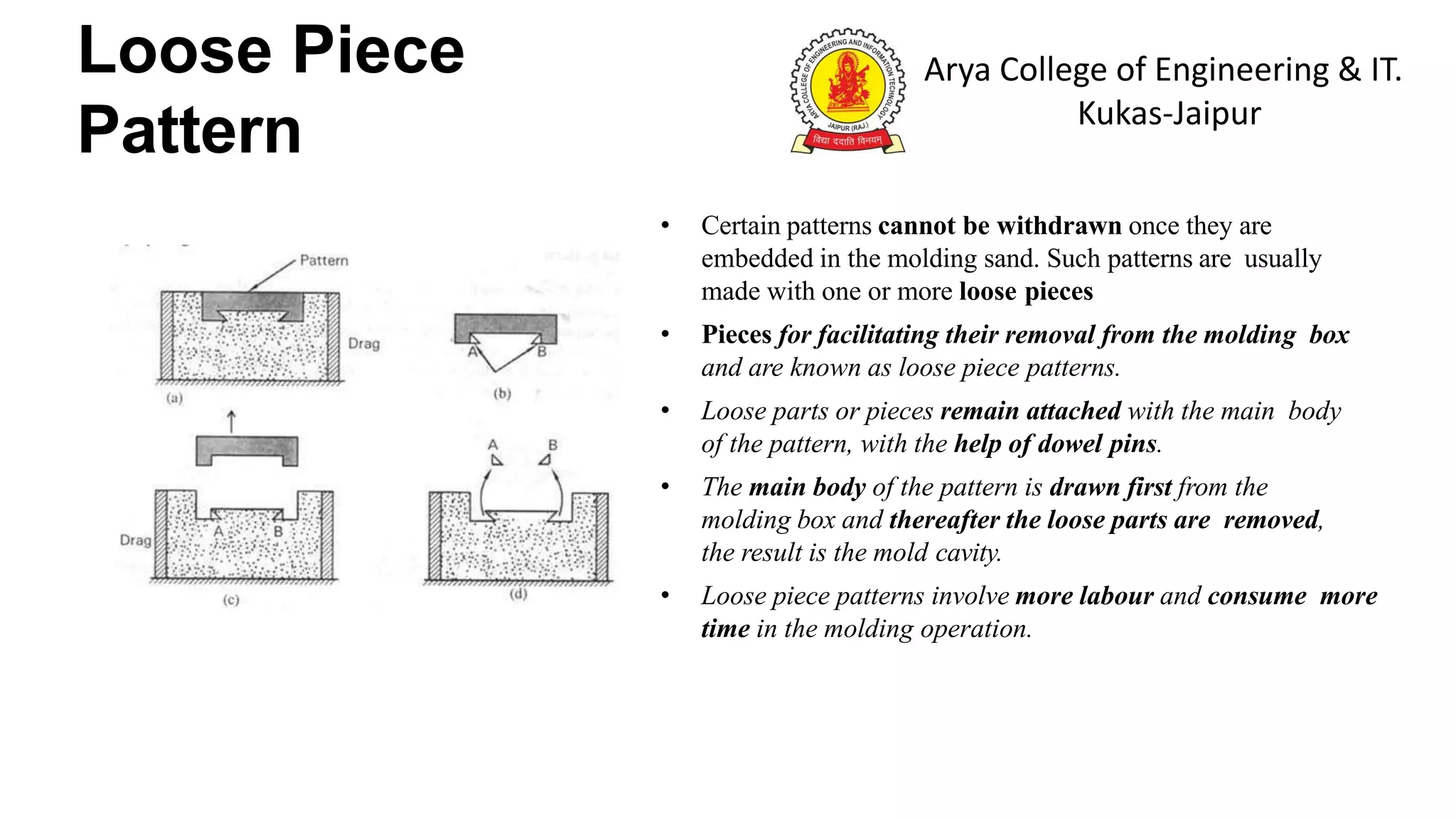
Loose Piece
Pattern
• Certain patterns cannot be withdrawn once they are
embedded in the molding sand. Such patterns are usually
made with one or more loose pieces
• Pieces for facilitating their removal from the molding box
and are known as loose piece patterns.
• Loose parts or pieces remain attached with the main body
of the pattern, with the help of dowel pins.
• The main body of the pattern is drawn first from the
molding box and thereafter the loose parts are removed,
the result is the mold cavity.
• Loose piece patterns involve more labour and consume more
time in the molding operation.
Arya College of Engineering & IT.
Kukas-Jaipur
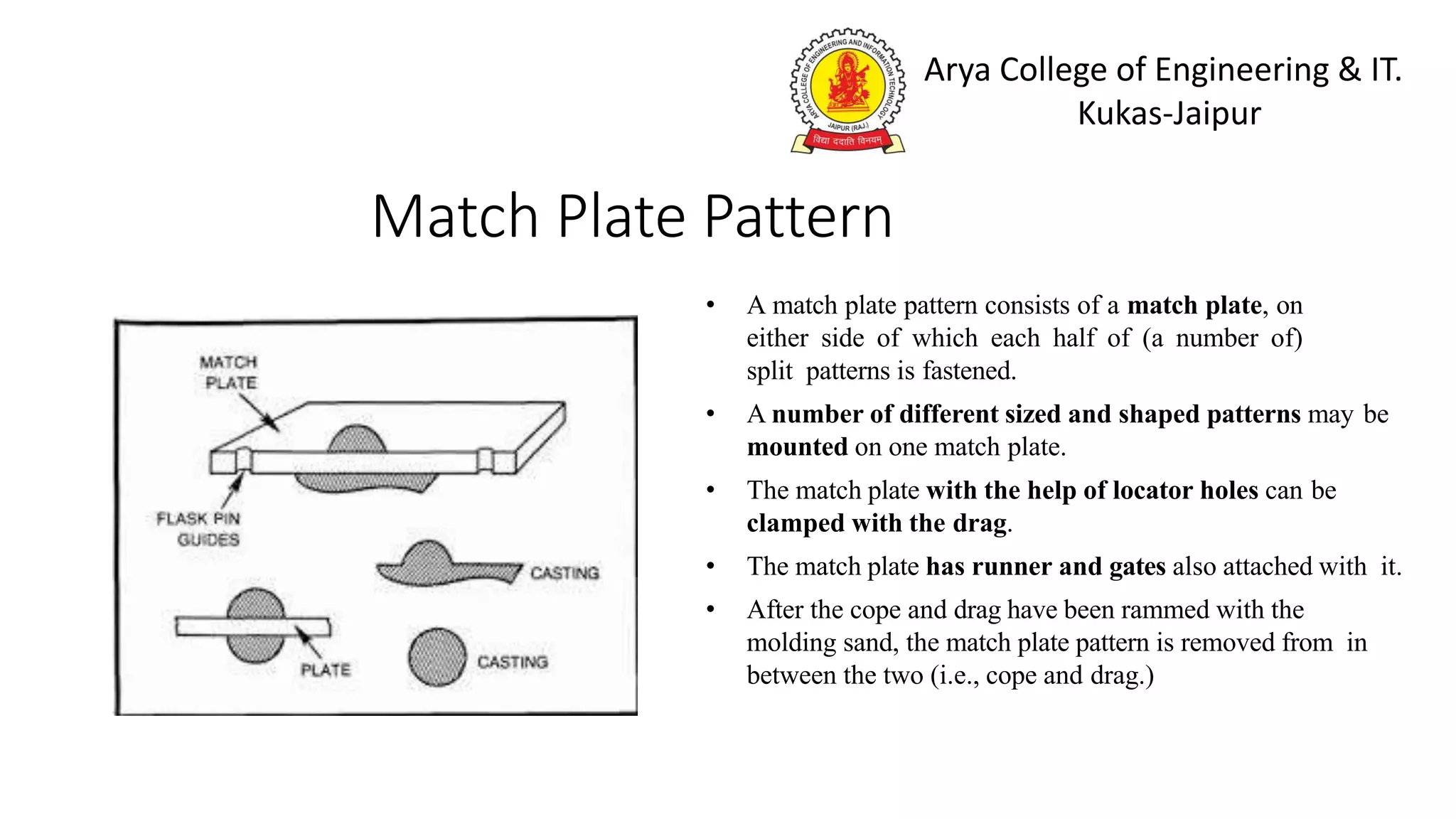
Match Plate Pattern
• A match plate pattern consists of a match plate, on
either side of which each half of (a number of)
split patterns is fastened.
• A number of different sized and shaped patterns may be
mounted on one match plate.
• The match plate with the help of locator holes can be
clamped with the drag.
• The match plate has runner and gates also attached with it.
• After the cope and drag have been rammed with the
molding sand, the match plate pattern is removed from in
between the two (i.e., cope and drag.)
Arya College of Engineering & IT.
Kukas-Jaipur
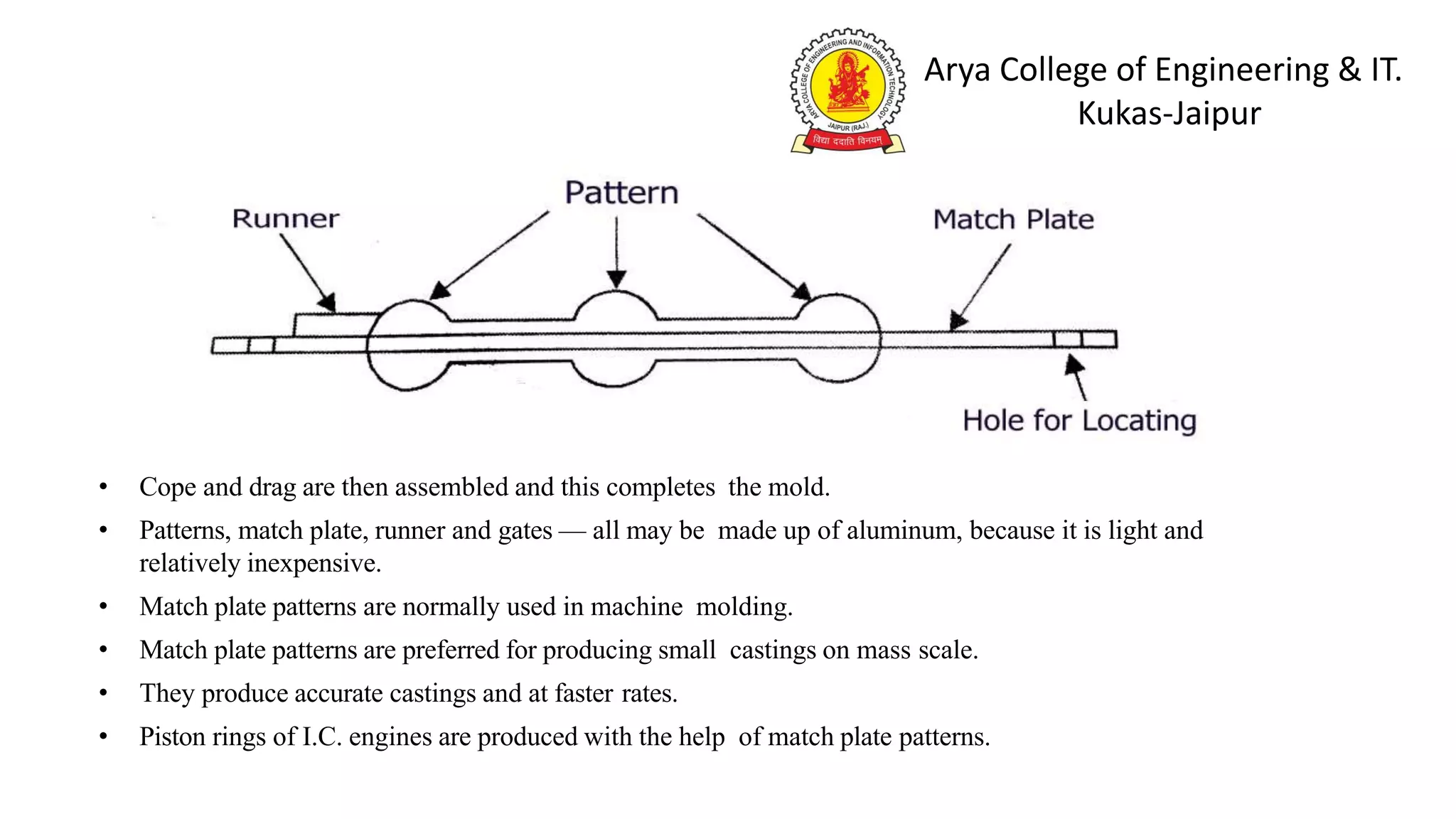
• Cope and drag are then assembled and this completes the mold.
• Patterns, match plate, runner and gates — all may be made up of aluminum, because it is light and
relatively inexpensive.
• Match plate patterns are normally used in machine molding.
• Match plate patterns are preferred for producing small castings on mass scale.
• They produce accurate castings and at faster rates.
• Piston rings of I.C. engines are produced with the help of match plate patterns.
Arya College of Engineering & IT.
Kukas-Jaipur
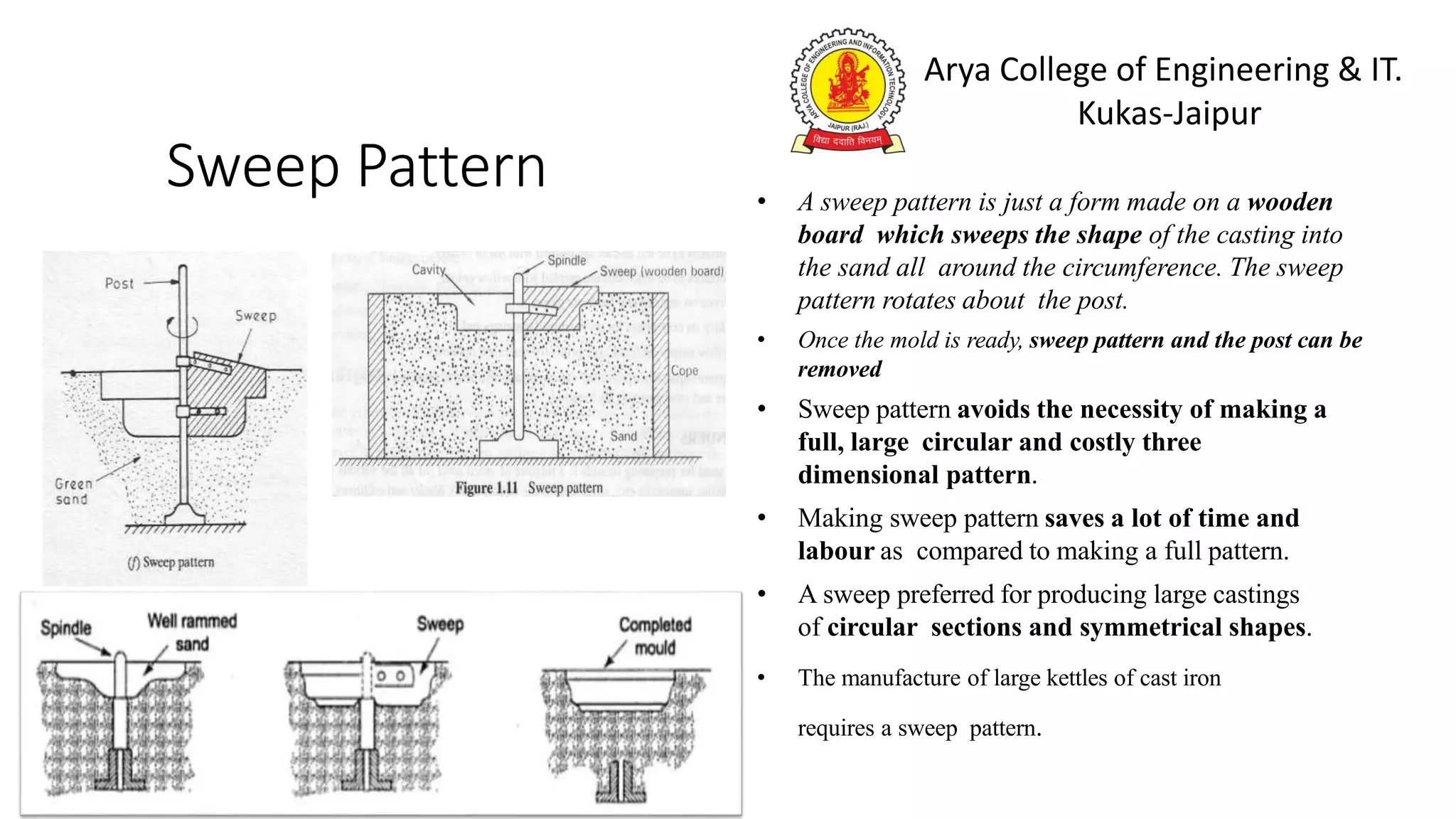
Sweep Pattern • A sweep pattern is just a form made on a wooden
board which sweeps the shape of the casting into
the sand all around the circumference. The sweep
pattern rotates about the post.
• Once the mold is ready, sweep pattern and the post can be
removed
• Sweep pattern avoids the necessity of making a
full, large circular and costly three
dimensional pattern.
• Making sweep pattern saves a lot of time and
labour as compared to making a full pattern.
• A sweep preferred for producing large castings
of circular sections and symmetrical shapes.
• The manufacture of large kettles of cast iron
requires a sweep pattern.
Arya College of Engineering & IT.
Kukas-Jaipur
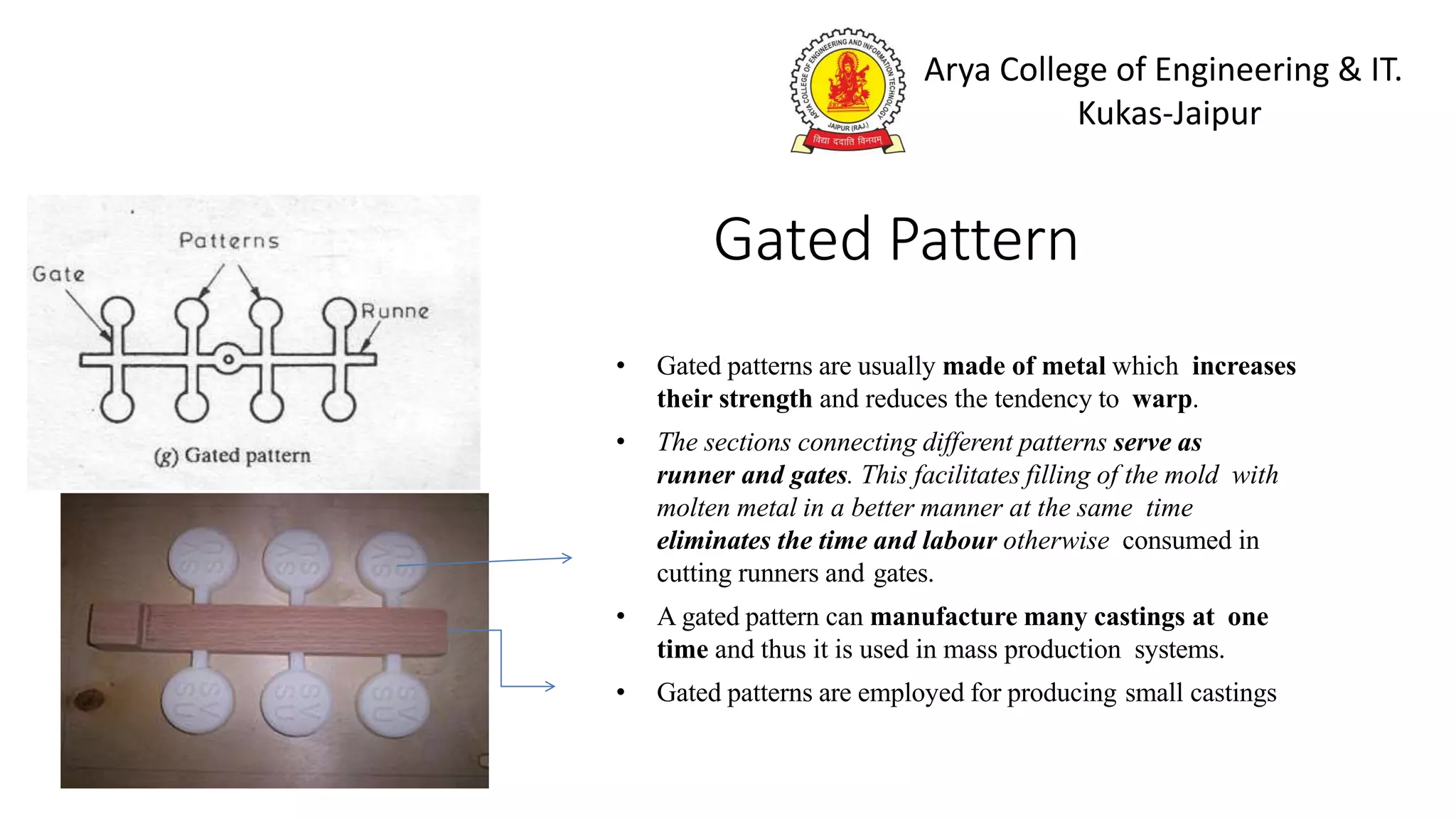
Gated Pattern
• Gated patterns are usually made of metal which increases
their strength and reduces the tendency to warp.
• The sections connecting different patterns serve as
runner and gates. This facilitates filling of the mold with
molten metal in a better manner at the same time
eliminates the time and labour otherwise consumed in
cutting runners and gates.
• A gated pattern can manufacture many castings at one
time and thus it is used in mass production systems.
• Gated patterns are employed for producing small castings
Arya College of Engineering & IT.
Kukas-Jaipur
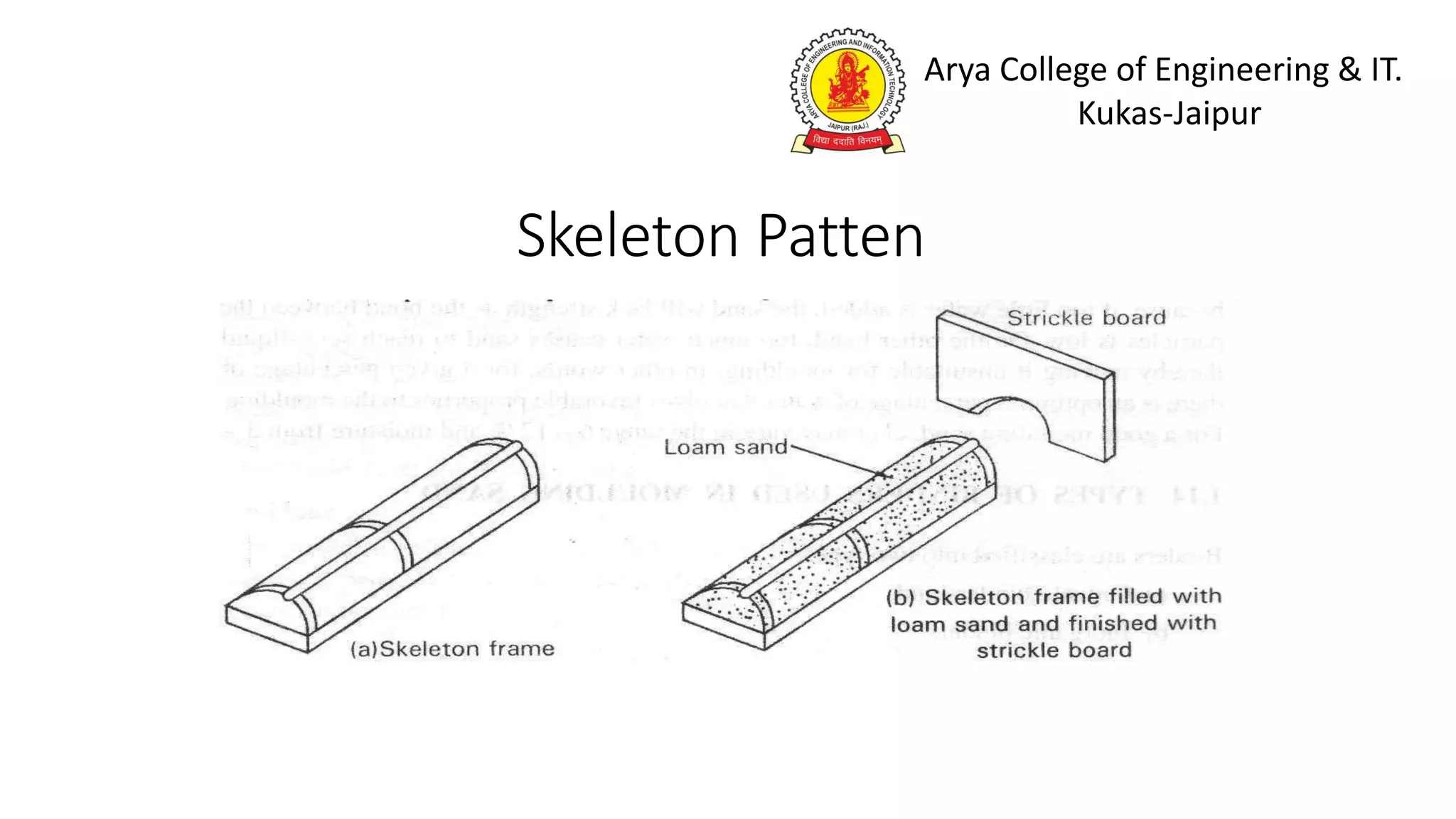
Skeleton Patten
Arya College of Engineering & IT.
Kukas-Jaipur
Skeleton Patten
• A skeleton pattern is the skeleton of a desired shape. The skeleton frame is mounted on a metal base.
• The skeleton is made from wooden strips and is thus a wooden framework.
• The skeleton pattern is filled with sand and is rammed.
• A strickle (board) assists in giving the desired shape to the sand and removes extra sand.
• If the object is symmetrical like a pipe, the two halves (of the pipe) can be molded by using the same pattern
and then the two molds can be assembled before pouring the molten metal.
• Skeleton patterns are employed for producing a few large castings.
• A skeleton pattern is very economical as compared to a solid pattern, because it involves less material
costs.
• Castings for turbine castings, water pipes, channels, etc., are made with the help of skeleton patterns
Arya College of Engineering & IT.
Kukas-Jaipur
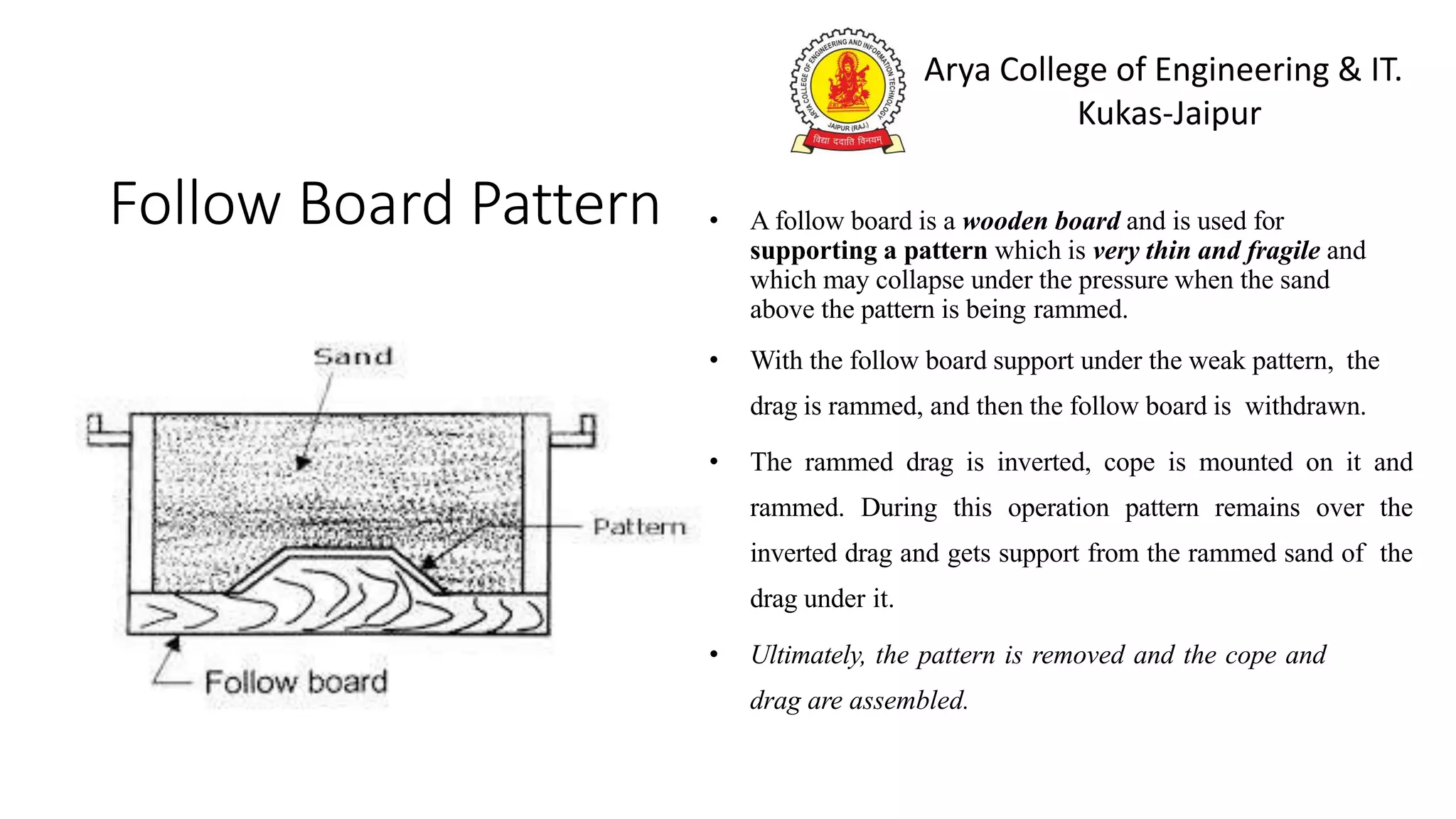
Follow Board Pattern • A follow board is a wooden board and is used for
supporting a pattern which is very thin and fragile and
which may collapse under the pressure when the sand
above the pattern is being rammed.
• With the follow board support under the weak pattern, the
drag is rammed, and then the follow board is withdrawn.
• The rammed drag is inverted, cope is mounted on it and
rammed. During this operation pattern remains over the
inverted drag and gets support from the rammed sand of the
drag under it.
• Ultimately, the pattern is removed and the cope and
drag are assembled.

Types of Patterns.pptx

  • 1.
    Arya College ofEngineering & IT. Kukas-Jaipur Patterns Prepared By Nikil Kumar Khandelwal Department of Mechanical Engineering
  • 2.
    Arya College ofEngineering & IT. Kukas-Jaipur Patterns • In Casting, a pattern is a replica of the object to be cast, used to prepare the cavity into which molten material will be poured during the casting process. • Except for the various allowances a pattern exactly resembles the casting to be made. • A pattern is required even if one object has to be cast. • The quality of casting and the final product will be effected to a great extent by the planning of pattern.
  • 3.
    Arya College ofEngineering & IT. Kukas-Jaipur Difference between pattern and casting • The main difference between a pattern and the casting is their dimensions. • A pattern is slightly larger in size as compared to the casting, because a pattern, – carries Shrinkage allowance, it may be of the order of 1 to 2 mm/ 100 mm. – is given a Machining allowance to clean and finish the required surfaces. – carries a Draft allowance of the order of 1 and 3 degrees for external and internal surfaces respectively – carries core prints. • A pattern may not have all holes and slots which a casting will have. Such holes and slots unnecessarily complicate a pattern and therefore can be drilled in the casting after it has been made. • A pattern may be in two or three pieces whereas a casting is in one piece. • A pattern and the casting also differ as regards the material out of which they are made.
  • 4.
    Arya College ofEngineering & IT. Kukas-Jaipur Functions of a patterns • A pattern prepares a Mould cavity for the purpose of making a casting. • A pattern may contain projections known as core prints if the casting requires a core and need to be made hollow. • Runner, gates, and risers used for feeding molten metal in the Mould cavity may form a part of the pattern. • Patterns properly made and having finished and smooth surfaces reduce casting defects. • A properly constructed pattern minimizes the overall cost of the castings.
  • 5.
    Arya College ofEngineering & IT. Kukas-Jaipur TYPES OF PATTERNS
  • 6.
    Arya College ofEngineering & IT. Kukas-Jaipur one may consider the following points: – Quantity of castings to be produced. – The size and the complexity of the shape of the casting to be produced. – Type of molding method to be used (i.e., hand or machine molding). – Problems associated with the molding operation such as withdrawing the pattern from the mold etc. – Other difficulties resulting from poor casting design or pattern design. Selection Of Pattern
  • 7.
    Arya College ofEngineering & IT. Kukas-Jaipur • The different types of patterns commonly used are: – One piece(Solid) pattern – Split pattern – Loose piece pattern – Match plate pattern – Cope and Drag pattern – Sweep pattern – Gated pattern – Skeleton pattern – Follow board pattern.
  • 8.
    Arya College ofEngineering & IT. Kukas-Jaipur One Piece (solid) Pattern • It is the simplest type of pattern. • As the name suggests the pattern is made from one piece and does not contain loose pieces or joints. • It is inexpensive. • Useful for Small scale production • One piece pattern is usually made up of wood or metal depending upon the quantity of castings to be produced. • For making the mold, one piece pattern is accommodated either in the cope or in the drag.
  • 9.
    Arya College ofEngineering & IT. Kukas-Jaipur Split Pattern • Patterns of intricate (shaped) castings • The upper and the lower parts of the split pattern are accommodated in the cope and drag portions of the mold respectively. • Dowel pins are used for keeping the alignment between the two parts of the pattern. • The parting (surface or) line of the pattern forms the parting (surface or) line of the mold. • Patterns for still more intricate castings are made in more than two pieces for facilitating their molding and withdrawing. • A pattern having three pieces will require a three piece flask for the molding purposes
  • 10.
    Arya College ofEngineering & IT. Kukas-Jaipur Loose Piece Pattern • Certain patterns cannot be withdrawn once they are embedded in the molding sand. Such patterns are usually made with one or more loose pieces • Pieces for facilitating their removal from the molding box and are known as loose piece patterns. • Loose parts or pieces remain attached with the main body of the pattern, with the help of dowel pins. • The main body of the pattern is drawn first from the molding box and thereafter the loose parts are removed, the result is the mold cavity. • Loose piece patterns involve more labour and consume more time in the molding operation.
  • 11.
    Arya College ofEngineering & IT. Kukas-Jaipur Match Plate Pattern • A match plate pattern consists of a match plate, on either side of which each half of (a number of) split patterns is fastened. • A number of different sized and shaped patterns may be mounted on one match plate. • The match plate with the help of locator holes can be clamped with the drag. • The match plate has runner and gates also attached with it. • After the cope and drag have been rammed with the molding sand, the match plate pattern is removed from in between the two (i.e., cope and drag.)
  • 12.
    Arya College ofEngineering & IT. Kukas-Jaipur • Cope and drag are then assembled and this completes the mold. • Patterns, match plate, runner and gates — all may be made up of aluminum, because it is light and relatively inexpensive. • Match plate patterns are normally used in machine molding. • Match plate patterns are preferred for producing small castings on mass scale. • They produce accurate castings and at faster rates. • Piston rings of I.C. engines are produced with the help of match plate patterns.
  • 13.
    Arya College ofEngineering & IT. Kukas-Jaipur Sweep Pattern • A sweep pattern is just a form made on a wooden board which sweeps the shape of the casting into the sand all around the circumference. The sweep pattern rotates about the post. • Once the mold is ready, sweep pattern and the post can be removed • Sweep pattern avoids the necessity of making a full, large circular and costly three dimensional pattern. • Making sweep pattern saves a lot of time and labour as compared to making a full pattern. • A sweep preferred for producing large castings of circular sections and symmetrical shapes. • The manufacture of large kettles of cast iron requires a sweep pattern.
  • 14.
    Arya College ofEngineering & IT. Kukas-Jaipur Gated Pattern • Gated patterns are usually made of metal which increases their strength and reduces the tendency to warp. • The sections connecting different patterns serve as runner and gates. This facilitates filling of the mold with molten metal in a better manner at the same time eliminates the time and labour otherwise consumed in cutting runners and gates. • A gated pattern can manufacture many castings at one time and thus it is used in mass production systems. • Gated patterns are employed for producing small castings
  • 15.
    Arya College ofEngineering & IT. Kukas-Jaipur Skeleton Patten
  • 16.
    Arya College ofEngineering & IT. Kukas-Jaipur Skeleton Patten • A skeleton pattern is the skeleton of a desired shape. The skeleton frame is mounted on a metal base. • The skeleton is made from wooden strips and is thus a wooden framework. • The skeleton pattern is filled with sand and is rammed. • A strickle (board) assists in giving the desired shape to the sand and removes extra sand. • If the object is symmetrical like a pipe, the two halves (of the pipe) can be molded by using the same pattern and then the two molds can be assembled before pouring the molten metal. • Skeleton patterns are employed for producing a few large castings. • A skeleton pattern is very economical as compared to a solid pattern, because it involves less material costs. • Castings for turbine castings, water pipes, channels, etc., are made with the help of skeleton patterns
  • 17.
    Arya College ofEngineering & IT. Kukas-Jaipur Follow Board Pattern • A follow board is a wooden board and is used for supporting a pattern which is very thin and fragile and which may collapse under the pressure when the sand above the pattern is being rammed. • With the follow board support under the weak pattern, the drag is rammed, and then the follow board is withdrawn. • The rammed drag is inverted, cope is mounted on it and rammed. During this operation pattern remains over the inverted drag and gets support from the rammed sand of the drag under it. • Ultimately, the pattern is removed and the cope and drag are assembled.