Types of elasticity
http://www.bized.ac.uk
Copyright 2005 – Biz/ed
Elasticity
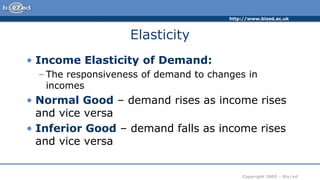
• Income Elasticity of Demand:
– The responsiveness of demand to changes in
incomes
• Normal Good – demand rises as income rises
and vice versa
• Inferior Good – demand falls as income rises
and vice versa
http://www.bized.ac.uk
Copyright 2005 – Biz/ed
Elasticity
• Income Elasticity of Demand:
• A positive sign denotes a normal good
• A negative sign denotes an inferior good
http://www.bized.ac.uk
Copyright 2005 – Biz/ed
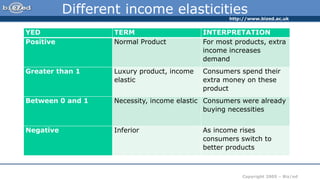
Different income elasticities
YED TERM INTERPRETATION
Positive Normal Product For most products, extra
income increases
demand
Greater than 1 Luxury product, income
elastic
Consumers spend their
extra money on these
product
Between 0 and 1 Necessity, income elastic Consumers were already
buying necessities
Negative Inferior As income rises
consumers switch to
better products
http://www.bized.ac.uk
Copyright 2005 – Biz/ed
Elasticity
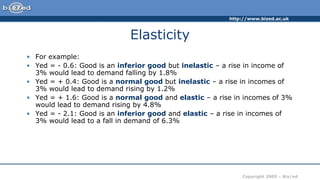
• For example:
• Yed = - 0.6: Good is an inferior good but inelastic – a rise in income of
3% would lead to demand falling by 1.8%
• Yed = + 0.4: Good is a normal good but inelastic – a rise in incomes of
3% would lead to demand rising by 1.2%
• Yed = + 1.6: Good is a normal good and elastic – a rise in incomes of 3%
would lead to demand rising by 4.8%
• Yed = - 2.1: Good is an inferior good and elastic – a rise in incomes of
3% would lead to a fall in demand of 6.3%
http://www.bized.ac.uk
Copyright 2005 – Biz/ed
Who is interested in the level of income
elasticity?
• Firms will be interested in how the demand for their products
is affected by changes in incomes, (the business cycle).
• Households maybe interested in how a change in income will
affect their budget.
• Income elasticity indicates the extent of the change in
budget share for a particular product.
• Governments will be interested in income elasticity.
• As incomes rise the pattern of spending changes.
• This will alter the relative sizes of sectors in the economy
and lead to structural changes.
http://www.bized.ac.uk
Copyright 2005 – Biz/ed
Complete student activity 3.5
http://www.bized.ac.uk
Copyright 2005 – Biz/ed
Elasticity
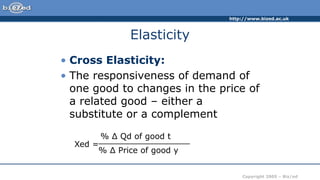
• Cross Elasticity:
• The responsiveness of demand of
one good to changes in the price of
a related good – either a
substitute or a complement
Xed =
% Δ Qd of good t
__________________
% Δ Price of good y
http://www.bized.ac.uk
Copyright 2005 – Biz/ed
Elasticity
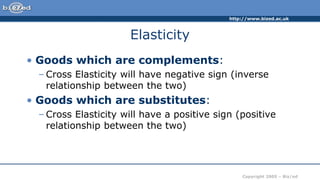
• Goods which are complements:
– Cross Elasticity will have negative sign (inverse
relationship between the two)
• Goods which are substitutes:
– Cross Elasticity will have a positive sign (positive
relationship between the two)
http://www.bized.ac.uk
Copyright 2005 – Biz/ed
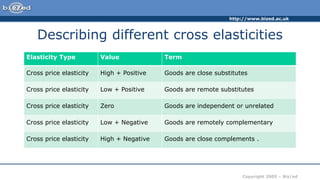
Describing different cross elasticities
Elasticity Type Value Term
Cross price elasticity High + Positive Goods are close substitutes
Cross price elasticity Low + Positive Goods are remote substitutes
Cross price elasticity Zero Goods are independent or unrelated
Cross price elasticity Low + Negative Goods are remotely complementary
Cross price elasticity High + Negative Goods are close complements .
http://www.bized.ac.uk
Copyright 2005 – Biz/ed
Is there smart way of remembering these
terms and values?
• If the price of beef fell and as a result the quantity
of chicken demanded fell there is a direct
relationship, so the items must be substitutes.
• For substitute products XED will be positive.
• A fall in the price of electricity means a rise in the,
demand for air-conditioning units.
• There is an inverse relationship suggesting the
products are compliments.
• For complementary products XED will be negative.
http://www.bized.ac.uk
Copyright 2005 – Biz/ed
Complete student activity 3.6
http://www.bized.ac.uk
Copyright 2005 – Biz/ed
Elasticity
• Price Elasticity of Supply:
– The responsiveness of supply to changes in
price
– If Pes is inelastic - it will be difficult for
suppliers to react swiftly to changes in price
– If Pes is elastic – supply can react quickly
to changes in price
Pes =
% Δ Quantity Supplied
____________________
% Δ Price
http://www.bized.ac.uk
Copyright 2005 – Biz/ed
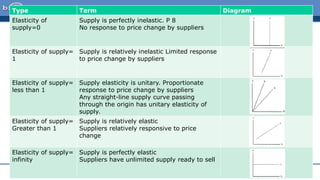
Type Term Diagram
Elasticity of
supply=0
Supply is perfectly inelastic. P 8
No response to price change by suppliers
Elasticity of supply=
1
Supply is relatively inelastic Limited response
to price change by suppliers
Elasticity of supply=
less than 1
Supply elasticity is unitary. Proportionate
response to price change by suppliers
Any straight-line supply curve passing
through the origin has unitary elasticity of
supply.
Elasticity of supply=
Greater than 1
Supply is relatively elastic
Suppliers relatively responsive to price
change
Elasticity of supply=
infinity
Supply is perfectly elastic
Suppliers have unlimited supply ready to sell
http://www.bized.ac.uk
Copyright 2005 – Biz/ed
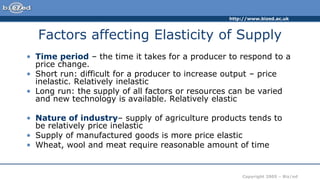
Factors affecting Elasticity of Supply
• Time period – the time it takes for a producer to respond to a
price change.
• Short run: difficult for a producer to increase output – price
inelastic. Relatively inelastic
• Long run: the supply of all factors or resources can be varied
and new technology is available. Relatively elastic
• Nature of industry– supply of agriculture products tends to
be relatively price inelastic
• Supply of manufactured goods is more price elastic
• Wheat, wool and meat require reasonable amount of time
http://www.bized.ac.uk
Copyright 2005 – Biz/ed
Importance of Elasticity
• Relationship between changes in price and total
revenue
• Importance in determining what goods to tax
(tax revenue)
• Importance in analysing time lags in production
• Influences the behaviour of a firm
http://www.bized.ac.uk
Copyright 2005 – Biz/ed
Complete Student Activity 3.7

Types of elasticity.pptx

  • 1.
  • 2.
    http://www.bized.ac.uk Copyright 2005 –Biz/ed Elasticity • Income Elasticity of Demand: – The responsiveness of demand to changes in incomes • Normal Good – demand rises as income rises and vice versa • Inferior Good – demand falls as income rises and vice versa
  • 3.
    http://www.bized.ac.uk Copyright 2005 –Biz/ed Elasticity • Income Elasticity of Demand: • A positive sign denotes a normal good • A negative sign denotes an inferior good
  • 4.
    http://www.bized.ac.uk Copyright 2005 –Biz/ed Different income elasticities YED TERM INTERPRETATION Positive Normal Product For most products, extra income increases demand Greater than 1 Luxury product, income elastic Consumers spend their extra money on these product Between 0 and 1 Necessity, income elastic Consumers were already buying necessities Negative Inferior As income rises consumers switch to better products
  • 5.
    http://www.bized.ac.uk Copyright 2005 –Biz/ed Elasticity • For example: • Yed = - 0.6: Good is an inferior good but inelastic – a rise in income of 3% would lead to demand falling by 1.8% • Yed = + 0.4: Good is a normal good but inelastic – a rise in incomes of 3% would lead to demand rising by 1.2% • Yed = + 1.6: Good is a normal good and elastic – a rise in incomes of 3% would lead to demand rising by 4.8% • Yed = - 2.1: Good is an inferior good and elastic – a rise in incomes of 3% would lead to a fall in demand of 6.3%
  • 6.
    http://www.bized.ac.uk Copyright 2005 –Biz/ed Who is interested in the level of income elasticity? • Firms will be interested in how the demand for their products is affected by changes in incomes, (the business cycle). • Households maybe interested in how a change in income will affect their budget. • Income elasticity indicates the extent of the change in budget share for a particular product. • Governments will be interested in income elasticity. • As incomes rise the pattern of spending changes. • This will alter the relative sizes of sectors in the economy and lead to structural changes.
  • 7.
    http://www.bized.ac.uk Copyright 2005 –Biz/ed Complete student activity 3.5
  • 8.
    http://www.bized.ac.uk Copyright 2005 –Biz/ed Elasticity • Cross Elasticity: • The responsiveness of demand of one good to changes in the price of a related good – either a substitute or a complement Xed = % Δ Qd of good t __________________ % Δ Price of good y
  • 9.
    http://www.bized.ac.uk Copyright 2005 –Biz/ed Elasticity • Goods which are complements: – Cross Elasticity will have negative sign (inverse relationship between the two) • Goods which are substitutes: – Cross Elasticity will have a positive sign (positive relationship between the two)
  • 10.
    http://www.bized.ac.uk Copyright 2005 –Biz/ed Describing different cross elasticities Elasticity Type Value Term Cross price elasticity High + Positive Goods are close substitutes Cross price elasticity Low + Positive Goods are remote substitutes Cross price elasticity Zero Goods are independent or unrelated Cross price elasticity Low + Negative Goods are remotely complementary Cross price elasticity High + Negative Goods are close complements .
  • 11.
    http://www.bized.ac.uk Copyright 2005 –Biz/ed Is there smart way of remembering these terms and values? • If the price of beef fell and as a result the quantity of chicken demanded fell there is a direct relationship, so the items must be substitutes. • For substitute products XED will be positive. • A fall in the price of electricity means a rise in the, demand for air-conditioning units. • There is an inverse relationship suggesting the products are compliments. • For complementary products XED will be negative.
  • 12.
    http://www.bized.ac.uk Copyright 2005 –Biz/ed Complete student activity 3.6
  • 13.
    http://www.bized.ac.uk Copyright 2005 –Biz/ed Elasticity • Price Elasticity of Supply: – The responsiveness of supply to changes in price – If Pes is inelastic - it will be difficult for suppliers to react swiftly to changes in price – If Pes is elastic – supply can react quickly to changes in price Pes = % Δ Quantity Supplied ____________________ % Δ Price
  • 14.
    http://www.bized.ac.uk Copyright 2005 –Biz/ed Type Term Diagram Elasticity of supply=0 Supply is perfectly inelastic. P 8 No response to price change by suppliers Elasticity of supply= 1 Supply is relatively inelastic Limited response to price change by suppliers Elasticity of supply= less than 1 Supply elasticity is unitary. Proportionate response to price change by suppliers Any straight-line supply curve passing through the origin has unitary elasticity of supply. Elasticity of supply= Greater than 1 Supply is relatively elastic Suppliers relatively responsive to price change Elasticity of supply= infinity Supply is perfectly elastic Suppliers have unlimited supply ready to sell
  • 15.
    http://www.bized.ac.uk Copyright 2005 –Biz/ed Factors affecting Elasticity of Supply • Time period – the time it takes for a producer to respond to a price change. • Short run: difficult for a producer to increase output – price inelastic. Relatively inelastic • Long run: the supply of all factors or resources can be varied and new technology is available. Relatively elastic • Nature of industry– supply of agriculture products tends to be relatively price inelastic • Supply of manufactured goods is more price elastic • Wheat, wool and meat require reasonable amount of time
  • 16.
    http://www.bized.ac.uk Copyright 2005 –Biz/ed Importance of Elasticity • Relationship between changes in price and total revenue • Importance in determining what goods to tax (tax revenue) • Importance in analysing time lags in production • Influences the behaviour of a firm
  • 17.
    http://www.bized.ac.uk Copyright 2005 –Biz/ed Complete Student Activity 3.7