

FORMAL
COMMUNICATION
AND
INFORMAL
COMMUNICATION
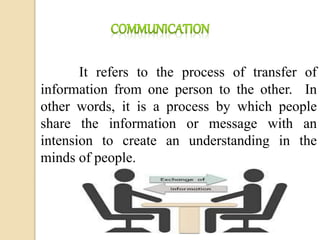
It refers to the process of transfer of
information from one person to the other. In
other words, it is a process by which people
share the information or message with an
intension to create an understanding in the
minds of people.
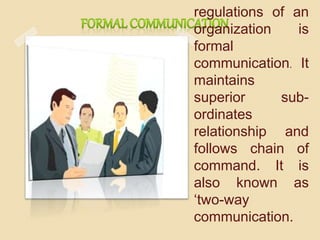
regulations of an
organization is
formal
communication. It
maintains
superior sub-
ordinates
relationship and
follows chain of
command. It is
also known as
‘two-way
communication.
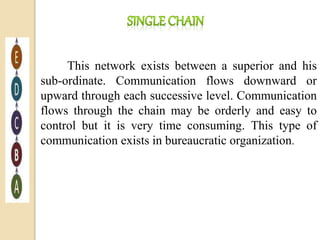
This network exists between a superior and his
sub-ordinate. Communication flows downward or
upward through each successive level. Communication
flows through the chain may be orderly and easy to
control but it is very time consuming. This type of
communication exists in bureaucratic organization.
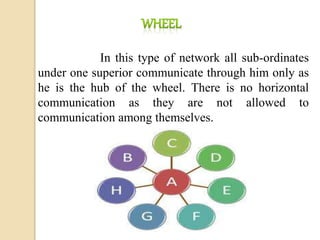
In this type of network all sub-ordinates
under one superior communicate through him only as
he is the hub of the wheel. There is no horizontal
communication as they are not allowed to
communication among themselves.
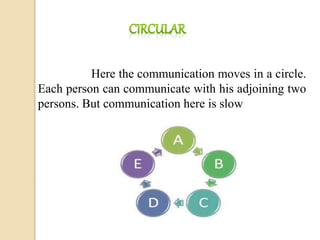
Here the communication moves in a circle.
Each person can communicate with his adjoining two
persons. But communication here is slow
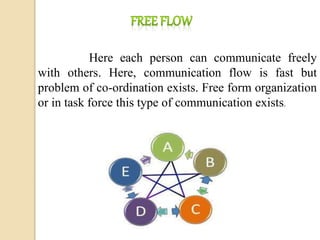
Here each person can communicate freely
with others. Here, communication flow is fast but
problem of co-ordination exists. Free form organization
or in task force this type of communication exists.
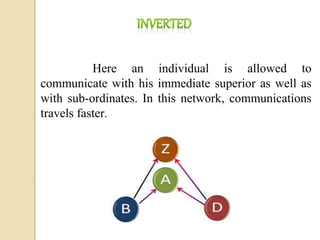
Here an individual is allowed to
communicate with his immediate superior as well as
with sub-ordinates. In this network, communications
travels faster.
1. Organization can fix the responsibilities easily.
2. The information is available to the right person.
3. The authority and respect of senior organizational
member/staff members are protected.
4. No one is allowed to bypass anybody while
communicating the information.
5. This form of communication helps the boss and the
sub-ordinates to understand each others attitude and
behavior well.
6. Discipline and good morle are maintained among
the employees.
1. This increase the work load of the line
officers.
2. This entails delay in communication as it
has to be passed through number of
persons to arrive at the right person.
3. Possibility of filtering of information
exists. Intention and attitude of the top
executive are not to the lower level workers
and vice-versa.
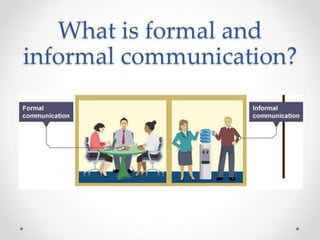
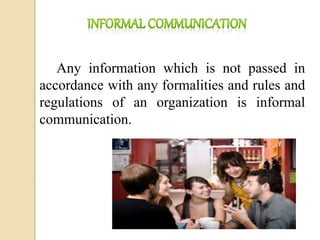
Any information which is not passed in
accordance with any formalities and rules and
regulations of an organization is informal
communication.
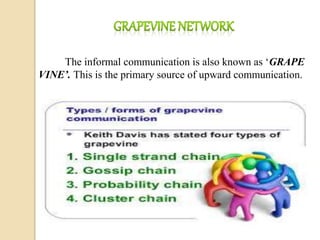
The informal communication is also known as ‘GRAPE
VINE’. This is the primary source of upward communication.
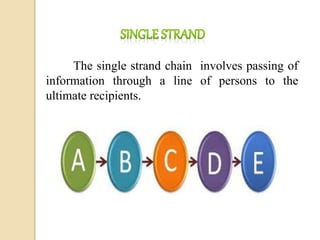
The single strand chain involves passing of
information through a line of persons to the
ultimate recipients.
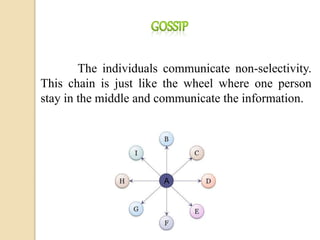
The individuals communicate non-selectivity.
This chain is just like the wheel where one person
stay in the middle and communicate the information.
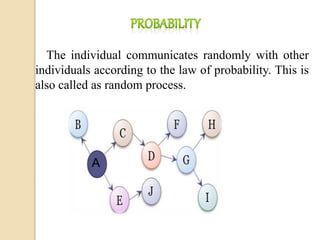
A
The individual communicates randomly with other
individuals according to the law of probability. This is
also called as random process.
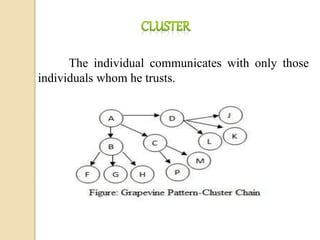
A
The individual communicates with only those
individuals whom he trusts.
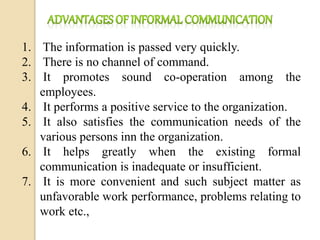
1. The information is passed very quickly.
2. There is no channel of command.
3. It promotes sound co-operation among the
employees.
4. It performs a positive service to the organization.
5. It also satisfies the communication needs of the
various persons inn the organization.
6. It helps greatly when the existing formal
communication is inadequate or insufficient.
7. It is more convenient and such subject matter as
unfavorable work performance, problems relating to
work etc.,
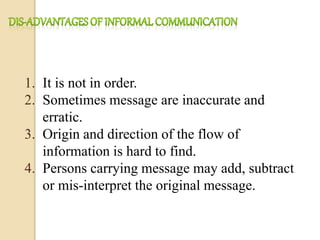
1. It is not in order.
2. Sometimes message are inaccurate and
erratic.
3. Origin and direction of the flow of
information is hard to find.
4. Persons carrying message may add, subtract
or mis-interpret the original message.
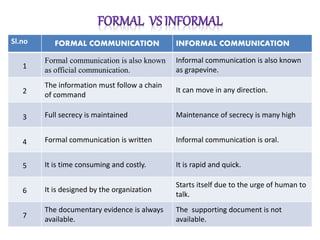
Sl.no FORMAL COMMUNICATION INFORMAL COMMUNICATION
1
Formal communication is also known
as official communication.
Informal communication is also known
as grapevine.
2
The information must follow a chain
of command
It can move in any direction.
3 Full secrecy is maintained Maintenance of secrecy is many high
4 Formal communication is written Informal communication is oral.
5 It is time consuming and costly. It is rapid and quick.
6 It is designed by the organization
Starts itself due to the urge of human to
talk.
7
The documentary evidence is always
available.
The supporting document is not
available.
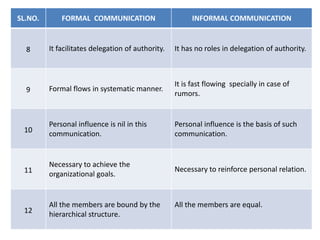
SL.NO. FORMAL COMMUNICATION INFORMAL COMMUNICATION
8 It facilitates delegation of authority. It has no roles in delegation of authority.
9 Formal flows in systematic manner.
It is fast flowing specially in case of
rumors.
10
Personal influence is nil in this
communication.
Personal influence is the basis of such
communication.
11
Necessary to achieve the
organizational goals.
Necessary to reinforce personal relation.
12
All the members are bound by the
hierarchical structure.
All the members are equal.
TYPES OF COMMUNICATION

TYPES OF COMMUNICATION

  • 1.
  • 2.
    It refers tothe process of transfer of information from one person to the other. In other words, it is a process by which people share the information or message with an intension to create an understanding in the minds of people.
  • 4.
    regulations of an organizationis formal communication. It maintains superior sub- ordinates relationship and follows chain of command. It is also known as ‘two-way communication.
  • 5.
    This network existsbetween a superior and his sub-ordinate. Communication flows downward or upward through each successive level. Communication flows through the chain may be orderly and easy to control but it is very time consuming. This type of communication exists in bureaucratic organization.
  • 6.
    In this typeof network all sub-ordinates under one superior communicate through him only as he is the hub of the wheel. There is no horizontal communication as they are not allowed to communication among themselves.
  • 7.
    Here the communicationmoves in a circle. Each person can communicate with his adjoining two persons. But communication here is slow
  • 8.
    Here each personcan communicate freely with others. Here, communication flow is fast but problem of co-ordination exists. Free form organization or in task force this type of communication exists.
  • 9.
    Here an individualis allowed to communicate with his immediate superior as well as with sub-ordinates. In this network, communications travels faster.
  • 10.
    1. Organization canfix the responsibilities easily. 2. The information is available to the right person. 3. The authority and respect of senior organizational member/staff members are protected. 4. No one is allowed to bypass anybody while communicating the information. 5. This form of communication helps the boss and the sub-ordinates to understand each others attitude and behavior well. 6. Discipline and good morle are maintained among the employees.
  • 11.
    1. This increasethe work load of the line officers. 2. This entails delay in communication as it has to be passed through number of persons to arrive at the right person. 3. Possibility of filtering of information exists. Intention and attitude of the top executive are not to the lower level workers and vice-versa.
  • 12.
    Any information whichis not passed in accordance with any formalities and rules and regulations of an organization is informal communication.
  • 13.
    The informal communicationis also known as ‘GRAPE VINE’. This is the primary source of upward communication.
  • 14.
    The single strandchain involves passing of information through a line of persons to the ultimate recipients.
  • 15.
    The individuals communicatenon-selectivity. This chain is just like the wheel where one person stay in the middle and communicate the information. A
  • 16.
    The individual communicatesrandomly with other individuals according to the law of probability. This is also called as random process. A
  • 17.
    The individual communicateswith only those individuals whom he trusts.
  • 18.
    1. The informationis passed very quickly. 2. There is no channel of command. 3. It promotes sound co-operation among the employees. 4. It performs a positive service to the organization. 5. It also satisfies the communication needs of the various persons inn the organization. 6. It helps greatly when the existing formal communication is inadequate or insufficient. 7. It is more convenient and such subject matter as unfavorable work performance, problems relating to work etc.,
  • 19.
    1. It isnot in order. 2. Sometimes message are inaccurate and erratic. 3. Origin and direction of the flow of information is hard to find. 4. Persons carrying message may add, subtract or mis-interpret the original message.
  • 21.
    Sl.no FORMAL COMMUNICATIONINFORMAL COMMUNICATION 1 Formal communication is also known as official communication. Informal communication is also known as grapevine. 2 The information must follow a chain of command It can move in any direction. 3 Full secrecy is maintained Maintenance of secrecy is many high 4 Formal communication is written Informal communication is oral. 5 It is time consuming and costly. It is rapid and quick. 6 It is designed by the organization Starts itself due to the urge of human to talk. 7 The documentary evidence is always available. The supporting document is not available.
  • 22.
    SL.NO. FORMAL COMMUNICATIONINFORMAL COMMUNICATION 8 It facilitates delegation of authority. It has no roles in delegation of authority. 9 Formal flows in systematic manner. It is fast flowing specially in case of rumors. 10 Personal influence is nil in this communication. Personal influence is the basis of such communication. 11 Necessary to achieve the organizational goals. Necessary to reinforce personal relation. 12 All the members are bound by the hierarchical structure. All the members are equal.