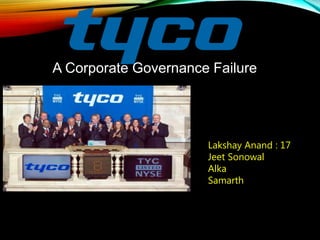
A Corporate Governance Failure
Lakshay Anand : 17
Jeet Sonowal
Alka
Samarth
Company History:
• Founded in 1960 by Arthur J. Rosenburg
•Initially supported by government research contracts
•In 1964 , it became a publicly owned company
•It was in control of 16 other companies by 1968.
•In 1974 , its stock was listed on the NYSE.
•Between 1982 and 2000 it undertook several subdivisions.
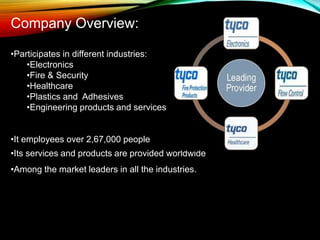
Company Overview:
•Participates in different industries:
•Electronics
•Fire & Security
•Healthcare
•Plastics and Adhesives
•Engineering products and services
•It employees over 2,67,000 people
•Its services and products are provided worldwide
•Among the market leaders in all the industries.
People involved in TYCO International scam
2002
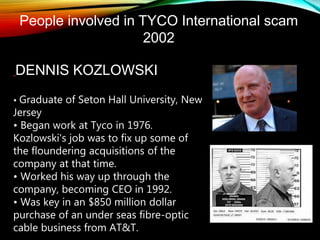
DENNIS KOZLOWSKI
• Graduate of Seton Hall University, New
Jersey
• Began work at Tyco in 1976.
Kozlowski's job was to fix up some of
the floundering acquisitions of the
company at that time.
• Worked his way up through the
company, becoming CEO in 1992.
• Was key in an $850 million dollar
purchase of an under seas fibre-optic
cable business from AT&T.
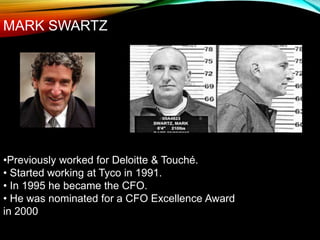
MARK SWARTZ
•Previously worked for Deloitte & Touché.
• Started working at Tyco in 1991.
• In 1995 he became the CFO.
• He was nominated for a CFO Excellence Award
in 2000
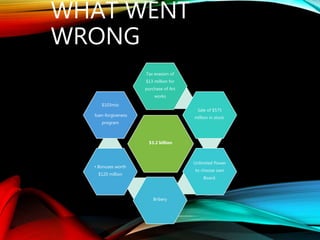
WHAT WENT
WRONG
$3.2 billion
Tax evasion of
$13 million for
purchase of Art
works
Sale of $575
million in stock.
Unlimited Power
to choose own
Board.
Bribery
• Bonuses worth
$120 million
$103mio
loan-forgiveness
program
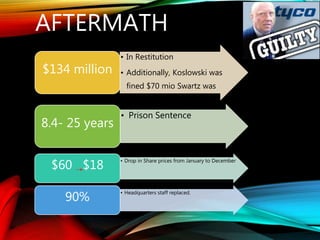
AFTERMATH
• In Restitution
• Additionally, Koslowski was
fined $70 mio Swartz was
fined $35 mio.
$134 million
• Prison Sentence
8.4- 25 years
• Drop in Share prices from January to December
$60 $18
• Headquarters staff replaced.
90%
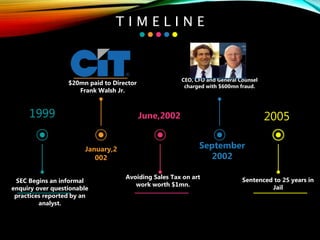
1999
SEC Begins an informal
enquiry over questionable
practices reported by an
analyst.
January,2
002
$20mn paid to Director
Frank Walsh Jr.
June,2002
Avoiding Sales Tax on art
work worth $1mn.
September
2002
CEO, CFO and General Counsel
charged with $600mn fraud.
2005
Sentenced to 25 years in
Jail
T I M E L I N E
RECOMMENDATIONS
Tyco international Scam
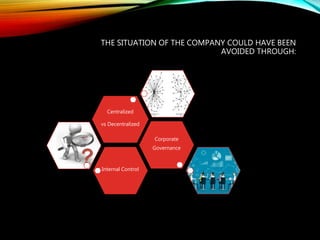
THE SITUATION OF THE COMPANY COULD HAVE BEEN
AVOIDED THROUGH:
Internal Control
Corporate
Governance
Centralized
vs Decentralized
MORAL QUESTIONS TO BE
CONSIDERED
Is it right to use corporate money for personal use?
Is it right to bribe board members?
Is it right to have unrevealed sales of stock?
Is it right to pay loans even the company didn’t approve the
seeker?
PRECAUTIONS/LESSONS/L
EARNING
Companies should more closely monitor their employees for
unethical conduct.
The government should monitor accounting practices of
companies more closely.
Any executive of companies who exhibit suspicious
behaviour should be closely watched.
Government should monitor the Financial Statements of
companies periodically.
This Photo by Unknown Author is licensed under CC BY-SA

Tyco

  • 1.
    A Corporate GovernanceFailure Lakshay Anand : 17 Jeet Sonowal Alka Samarth
  • 2.
    Company History: • Foundedin 1960 by Arthur J. Rosenburg •Initially supported by government research contracts •In 1964 , it became a publicly owned company •It was in control of 16 other companies by 1968. •In 1974 , its stock was listed on the NYSE. •Between 1982 and 2000 it undertook several subdivisions.
  • 3.
    Company Overview: •Participates indifferent industries: •Electronics •Fire & Security •Healthcare •Plastics and Adhesives •Engineering products and services •It employees over 2,67,000 people •Its services and products are provided worldwide •Among the market leaders in all the industries.
  • 4.
    People involved inTYCO International scam 2002 DENNIS KOZLOWSKI • Graduate of Seton Hall University, New Jersey • Began work at Tyco in 1976. Kozlowski's job was to fix up some of the floundering acquisitions of the company at that time. • Worked his way up through the company, becoming CEO in 1992. • Was key in an $850 million dollar purchase of an under seas fibre-optic cable business from AT&T.
  • 5.
    MARK SWARTZ •Previously workedfor Deloitte & Touché. • Started working at Tyco in 1991. • In 1995 he became the CFO. • He was nominated for a CFO Excellence Award in 2000
  • 6.
    WHAT WENT WRONG $3.2 billion Taxevasion of $13 million for purchase of Art works Sale of $575 million in stock. Unlimited Power to choose own Board. Bribery • Bonuses worth $120 million $103mio loan-forgiveness program
  • 7.
    AFTERMATH • In Restitution •Additionally, Koslowski was fined $70 mio Swartz was fined $35 mio. $134 million • Prison Sentence 8.4- 25 years • Drop in Share prices from January to December $60 $18 • Headquarters staff replaced. 90%
  • 9.
    1999 SEC Begins aninformal enquiry over questionable practices reported by an analyst. January,2 002 $20mn paid to Director Frank Walsh Jr. June,2002 Avoiding Sales Tax on art work worth $1mn. September 2002 CEO, CFO and General Counsel charged with $600mn fraud. 2005 Sentenced to 25 years in Jail T I M E L I N E
  • 11.
  • 12.
    THE SITUATION OFTHE COMPANY COULD HAVE BEEN AVOIDED THROUGH: Internal Control Corporate Governance Centralized vs Decentralized
  • 13.
    MORAL QUESTIONS TOBE CONSIDERED Is it right to use corporate money for personal use? Is it right to bribe board members? Is it right to have unrevealed sales of stock? Is it right to pay loans even the company didn’t approve the seeker?
  • 14.
    PRECAUTIONS/LESSONS/L EARNING Companies should moreclosely monitor their employees for unethical conduct. The government should monitor accounting practices of companies more closely. Any executive of companies who exhibit suspicious behaviour should be closely watched. Government should monitor the Financial Statements of companies periodically.
  • 15.
    This Photo byUnknown Author is licensed under CC BY-SA