PROJECT
OVERVIEW
LIFT’S   1. Provide technical assistance and
                 strategic support to USG agencies
OBJECTIVES       and their implementing partners
              2. Build an evidence base
              3. Improve access of NACS clients to
                 ES services through referrals


              CURRENT FOCUS COUNTRIES:
              Uganda, Tanzania, DRC, Malawi,
              Namibia, Kenya and Nigeria.

              PREVIOUS WORK IN: DRC, Namibia,
              Nigeria, Swaziland and Ethiopia
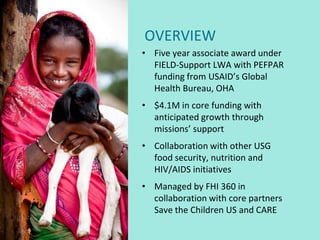
OVERVIEW
• Five year associate award under
  FIELD-Support LWA with PEFPAR
  funding from USAID’s Global
  Health Bureau, OHA
• $4.1M in core funding with
  anticipated growth through
  missions’ support
• Collaboration with other USG
  food security, nutrition and
  HIV/AIDS initiatives
• Managed by FHI 360 in
  collaboration with core partners
  Save the Children US and CARE
LIFT POTENTIAL   • NACS linkages to economic
                   strengthening services
     TECHNICAL   • Implementing partner ES capacity
    ASSISTANCE     building and TA

     INCLUDES:   • Program assessments and country
                   level portfolio
                   reviews/recommendations for
                   programming
                 • PEPFAR Global and Country
                   Operational Plan technical guidance
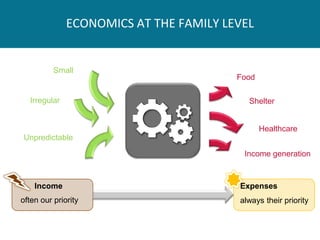
ECONOMICS AT THE FAMILY LEVEL


          Small
                                        Food

  Irregular                               Shelter


                                               Healthcare
Unpredictable

                                         Income generation


    Income                              Expenses
often our priority                      always their priority
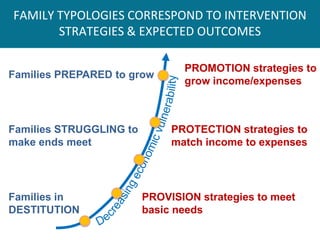
FAMILY TYPOLOGIES CORRESPOND TO INTERVENTION
       STRATEGIES & EXPECTED OUTCOMES

                                PROMOTION strategies to
Families PREPARED to grow
                                grow income/expenses


Families STRUGGLING to        PROTECTION strategies to
make ends meet                match income to expenses


Families in              PROVISION strategies to meet
DESTITUTION              basic needs
LINKING NACS   LIFT aims to integrate ES services
                  within NACS programs in order to:
WITH ECONOMIC
                  • Build the continuum of care for
STRENGTHENING       people living with HIV and other
                    vulnerable households

                  • Prevent malnutrition

                  • Prevent relapse into therapeutic
                    feeding

                  • Increase social wellbeing and
                    reduce stigma
LIFT RESEARCH IN
ETHIOPIA
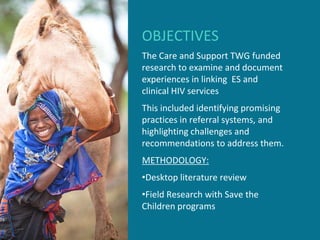
OBJECTIVES
The Care and Support TWG funded
research to examine and document
experiences in linking ES and
clinical HIV services
This included identifying promising
practices in referral systems, and
highlighting challenges and
recommendations to address them.
METHODOLOGY:
•Desktop literature review
•Field Research with Save the
Children programs
SAVE THE   Food by Prescription (FBP), USG PEPFAR-funded
              initiative (2009-2012) to improve the nutritional,
 CHILDREN’S   clinical and functional outcomes of malnourished
              PLHIV by strengthening NACS services.
PROJECTS IN
   ETHIOPIA   Save the Children was contracted by USAID (2007-
              2009) under the Home-based Care and Support
              Program (HCSP) to engage volunteer outreach
              workers to support family-focused HIV
              prevention, care and treatment services.


              TransACTION (2009-2014) aims at preventing new
              HIV and STI infections among at risk populations
              and strengthening linkages to care and support
              services in 120 towns and commercial hotspots
              along transportation corridors.
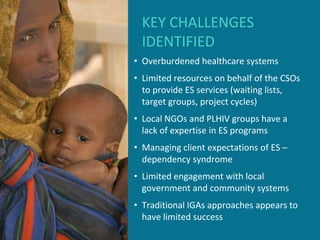
KEY CHALLENGES
 IDENTIFIED
• Overburdened healthcare systems
• Limited resources on behalf of the CSOs
  to provide ES services (waiting lists,
  target groups, project cycles)
• Local NGOs and PLHIV groups have a
  lack of expertise in ES programs
• Managing client expectations of ES –
  dependency syndrome
• Limited engagement with local
  government and community systems
• Traditional IGAs approaches appears to
  have limited success
PROMISING   DESIGNATED CASE MANAGERS
PRACTICES
            AND COMMUNITY VOLUNTEERS
            CAN MAKE A DIFFERENCE

            • Provide essential psychosocial support to PLHIV
              to continue to work or seek small enterprise
              opportunities
            • Volunteers relieve overburdened health
              facilities of tracking clients
            • Well positioned to follow-up with referrals but
              not ideally placed to assess Client’s livelihood
              needs/options
PROMISING   ESTABLISH A COORDINATING
PRACTICES
            COMMITTEE AT THE
            COMMUNITY LEVEL

            • In Ethiopia, coordinating committee is chaired by
              HIV/AIDS Prevention and Control Office (HAPCO)
              or the Bureau of Labor and Social Affairs (BOLSA)
            • Brings together a range of stakeholders including
              clincs, PLHIV support groups, private sector and ES
              providers
            • Referral forms are circulated through the
              committee, to ensure an appropriate and complete
              referral is made and data shared
• How do we integrate livelihoods and
  CRITICAL     economic strengthening into existing
QUESTIONS      clinic referral systems?
             • How do we effectively target
   RAISED      livelihoods assistance or clinical
               services?
             • How do we assess needs for
               livelihoods support or economic
               strengthening?
             • How do we encourage private
               sector engagement?
             • How can we ensure two-way
               referrals — from livelihoods and
               economic strengthening to clinic-
               based services and back?
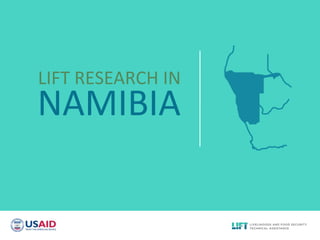
LIFT RESEARCH IN
NAMIBIA
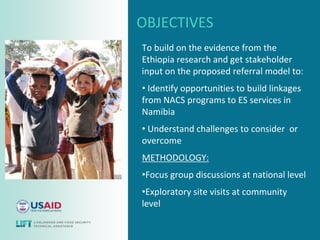
OBJECTIVES
To build on the evidence from the
Ethiopia research and get stakeholder
input on the proposed referral model to:
• Identify opportunities to build linkages
from NACS programs to ES services in
Namibia
• Understand challenges to consider or
overcome
METHODOLOGY:
•Focus group discussions at national level
•Exploratory site visits at community
level
CONSTRAINTS &   • Few formalized systems for
                   referrals and linkages between
CONSIDERATIONS     clinical sites and community-
                   based services.
                 • Lack of awareness among clinical
                   staff about other existing services
                   in their communities.
                 • Formalized referral systems create
                   additional paperwork and work
                   for clinical and CBO staff.
                 • Decreasing donor support
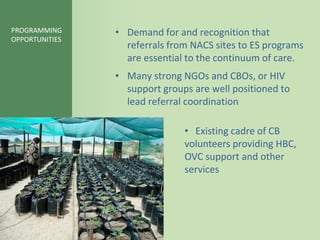
PROGRAMMING     • Demand for and recognition that
OPPORTUNITIES
                  referrals from NACS sites to ES programs
                  are essential to the continuum of care.
                • Many strong NGOs and CBOs, or HIV
                  support groups are well positioned to
                  lead referral coordination

                               • Existing cadre of CB
                               volunteers providing HBC,
                               OVC support and other
                               services
PROGRAMMING
OPPORTUNITIES   • Peace Corps volunteers could be
                  engaged in start-up
                • The Ministry of Health and Social
                  Services (MOHSS) is currently
                  training 3,500 health extension
                  workers, including basic social work
                  skills.
                • MOHSS is already in the process of
                  formalizing a bi-directional referral
                  system for HIV-related services
KEY COMPONENTS
OF NACS ES
REFERRAL SYSTEMS
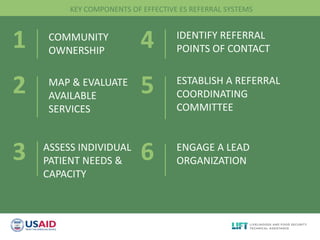
KEY COMPONENTS OF EFFECTIVE ES REFERRAL SYSTEMS


1    COMMUNITY
     OWNERSHIP
                           4        IDENTIFY REFERRAL
                                    POINTS OF CONTACT


2    MAP & EVALUATE
     AVAILABLE
                           5        ESTABLISH A REFERRAL
                                    COORDINATING
     SERVICES                       COMMITTEE


3   ASSESS INDIVIDUAL
    PATIENT NEEDS &        6        ENGAGE A LEAD
                                    ORGANIZATION
    CAPACITY
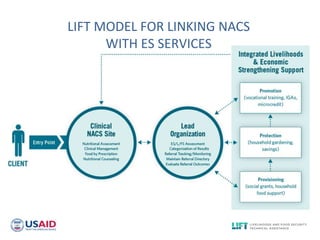
LIFT MODEL FOR LINKING NACS
      WITH ES SERVICES
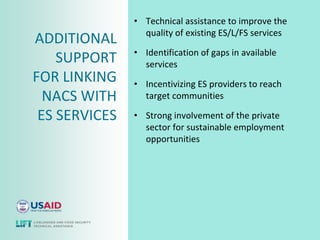
• Technical assistance to improve the
                 quality of existing ES/L/FS services
ADDITIONAL
               • Identification of gaps in available
    SUPPORT      services
FOR LINKING    • Incentivizing ES providers to reach
  NACS WITH      target communities

 ES SERVICES   • Strong involvement of the private
                 sector for sustainable employment
                 opportunities
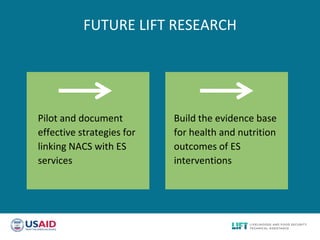
FUTURE LIFT RESEARCH


Pilot and document         Build the evidence base
effective strategies for   for health and nutrition
linking NACS with ES       outcomes of ES
services                   interventions
Gareth Evans & Mandy Swann

Gareth Evans & Mandy Swann

  • 1.
  • 2.
    LIFT’S 1. Provide technical assistance and strategic support to USG agencies OBJECTIVES and their implementing partners 2. Build an evidence base 3. Improve access of NACS clients to ES services through referrals CURRENT FOCUS COUNTRIES: Uganda, Tanzania, DRC, Malawi, Namibia, Kenya and Nigeria. PREVIOUS WORK IN: DRC, Namibia, Nigeria, Swaziland and Ethiopia
  • 3.
    OVERVIEW • Five yearassociate award under FIELD-Support LWA with PEFPAR funding from USAID’s Global Health Bureau, OHA • $4.1M in core funding with anticipated growth through missions’ support • Collaboration with other USG food security, nutrition and HIV/AIDS initiatives • Managed by FHI 360 in collaboration with core partners Save the Children US and CARE
  • 4.
    LIFT POTENTIAL • NACS linkages to economic strengthening services TECHNICAL • Implementing partner ES capacity ASSISTANCE building and TA INCLUDES: • Program assessments and country level portfolio reviews/recommendations for programming • PEPFAR Global and Country Operational Plan technical guidance
  • 5.
    ECONOMICS AT THEFAMILY LEVEL Small Food Irregular Shelter Healthcare Unpredictable Income generation Income Expenses often our priority always their priority
  • 6.
    FAMILY TYPOLOGIES CORRESPONDTO INTERVENTION STRATEGIES & EXPECTED OUTCOMES PROMOTION strategies to Families PREPARED to grow grow income/expenses Families STRUGGLING to PROTECTION strategies to make ends meet match income to expenses Families in PROVISION strategies to meet DESTITUTION basic needs
  • 7.
    LINKING NACS LIFT aims to integrate ES services within NACS programs in order to: WITH ECONOMIC • Build the continuum of care for STRENGTHENING people living with HIV and other vulnerable households • Prevent malnutrition • Prevent relapse into therapeutic feeding • Increase social wellbeing and reduce stigma
  • 8.
  • 9.
    OBJECTIVES The Care andSupport TWG funded research to examine and document experiences in linking ES and clinical HIV services This included identifying promising practices in referral systems, and highlighting challenges and recommendations to address them. METHODOLOGY: •Desktop literature review •Field Research with Save the Children programs
  • 10.
    SAVE THE Food by Prescription (FBP), USG PEPFAR-funded initiative (2009-2012) to improve the nutritional, CHILDREN’S clinical and functional outcomes of malnourished PLHIV by strengthening NACS services. PROJECTS IN ETHIOPIA Save the Children was contracted by USAID (2007- 2009) under the Home-based Care and Support Program (HCSP) to engage volunteer outreach workers to support family-focused HIV prevention, care and treatment services. TransACTION (2009-2014) aims at preventing new HIV and STI infections among at risk populations and strengthening linkages to care and support services in 120 towns and commercial hotspots along transportation corridors.
  • 11.
    KEY CHALLENGES IDENTIFIED •Overburdened healthcare systems • Limited resources on behalf of the CSOs to provide ES services (waiting lists, target groups, project cycles) • Local NGOs and PLHIV groups have a lack of expertise in ES programs • Managing client expectations of ES – dependency syndrome • Limited engagement with local government and community systems • Traditional IGAs approaches appears to have limited success
  • 12.
    PROMISING DESIGNATED CASE MANAGERS PRACTICES AND COMMUNITY VOLUNTEERS CAN MAKE A DIFFERENCE • Provide essential psychosocial support to PLHIV to continue to work or seek small enterprise opportunities • Volunteers relieve overburdened health facilities of tracking clients • Well positioned to follow-up with referrals but not ideally placed to assess Client’s livelihood needs/options
  • 13.
    PROMISING ESTABLISH A COORDINATING PRACTICES COMMITTEE AT THE COMMUNITY LEVEL • In Ethiopia, coordinating committee is chaired by HIV/AIDS Prevention and Control Office (HAPCO) or the Bureau of Labor and Social Affairs (BOLSA) • Brings together a range of stakeholders including clincs, PLHIV support groups, private sector and ES providers • Referral forms are circulated through the committee, to ensure an appropriate and complete referral is made and data shared
  • 14.
    • How dowe integrate livelihoods and CRITICAL economic strengthening into existing QUESTIONS clinic referral systems? • How do we effectively target RAISED livelihoods assistance or clinical services? • How do we assess needs for livelihoods support or economic strengthening? • How do we encourage private sector engagement? • How can we ensure two-way referrals — from livelihoods and economic strengthening to clinic- based services and back?
  • 15.
  • 16.
    OBJECTIVES To build onthe evidence from the Ethiopia research and get stakeholder input on the proposed referral model to: • Identify opportunities to build linkages from NACS programs to ES services in Namibia • Understand challenges to consider or overcome METHODOLOGY: •Focus group discussions at national level •Exploratory site visits at community level
  • 17.
    CONSTRAINTS & • Few formalized systems for referrals and linkages between CONSIDERATIONS clinical sites and community- based services. • Lack of awareness among clinical staff about other existing services in their communities. • Formalized referral systems create additional paperwork and work for clinical and CBO staff. • Decreasing donor support
  • 18.
    PROGRAMMING • Demand for and recognition that OPPORTUNITIES referrals from NACS sites to ES programs are essential to the continuum of care. • Many strong NGOs and CBOs, or HIV support groups are well positioned to lead referral coordination • Existing cadre of CB volunteers providing HBC, OVC support and other services
  • 19.
    PROGRAMMING OPPORTUNITIES • Peace Corps volunteers could be engaged in start-up • The Ministry of Health and Social Services (MOHSS) is currently training 3,500 health extension workers, including basic social work skills. • MOHSS is already in the process of formalizing a bi-directional referral system for HIV-related services
  • 20.
    KEY COMPONENTS OF NACSES REFERRAL SYSTEMS
  • 21.
    KEY COMPONENTS OFEFFECTIVE ES REFERRAL SYSTEMS 1 COMMUNITY OWNERSHIP 4 IDENTIFY REFERRAL POINTS OF CONTACT 2 MAP & EVALUATE AVAILABLE 5 ESTABLISH A REFERRAL COORDINATING SERVICES COMMITTEE 3 ASSESS INDIVIDUAL PATIENT NEEDS & 6 ENGAGE A LEAD ORGANIZATION CAPACITY
  • 22.
    LIFT MODEL FORLINKING NACS WITH ES SERVICES
  • 23.
    • Technical assistanceto improve the quality of existing ES/L/FS services ADDITIONAL • Identification of gaps in available SUPPORT services FOR LINKING • Incentivizing ES providers to reach NACS WITH target communities ES SERVICES • Strong involvement of the private sector for sustainable employment opportunities
  • 24.
    FUTURE LIFT RESEARCH Pilotand document Build the evidence base effective strategies for for health and nutrition linking NACS with ES outcomes of ES services interventions

Editor's Notes

  • #3 Provide technical assistance and strategic support to USG agencies and their implementing partners to improve the quality of ES programs and activities that support PEPFAR investments.Build an evidence base demonstrating health and nutrition outcomes of ES interventions.Improve access of NACS clients to ES services through referrals and other health systems strengthening activities.
  • #4 Collaboration….(FANTA-3, Feed the Future, AIDSTAR-II, MEASURE Evaluation)
  • #5 NACS linkages to economic strengthening servicesPEPFAR Global and Country Operational Plan technical guidanceProgram assessments and country level portfolio reviews/recommendations for programmingFood security and livelihood assessmentsRapid market analysesEnabling environment and policy developmentImplementingpartner capacity building and technical trainingProgram monitoring and evaluation support
  • #6 Training LIFT provides is based on Household Economic strengthening models.
  • #7 LIFT’s conceptual framework looks at the vulnerabilities of households and matches them with appropriate strategies based on household risk profiles and priorities.A lot of NACS clients will be families in destitution, however ES programming in this area should be short-term and should aim to build assets to decrease household vulnerability. Many NACS clients may benefit from protection strategies that help prevent malnutrition.Know your families and their vulnerabilitiesBuild on natural household behaviors and assetsAppropriate for people affected by HIV, including Care Givers and OVCMarket-orientatedWhen in doubt, strengthen money management – especially through savings
  • #10 Desktop Literature ReviewFindings revealed little published literature or data available on the impact of livelihoods and ES interventions offered through HIV referral networks Key documents identified from FHI and CRS focused on framework for general referral networksField research with Save the Children programs in EthiopiaConducted interviews and focus group discussions with project staff, clinical staff, partners and program participants and government counterparts across three programs that integrate ES referral systems
  • #13 Embedded in health facility or with PLHIV groups, supported by Ministry of Health
  • #14 The committee relieves the clinics of having to identify and coordinate referral network participants Brings together a range of stakeholders including, PLHIV organizations, private sector and ES providers --- to manage the referralsPromising practices from Ethiopia highlighted the need to move coordination and management to the community level away from overburdened health facilities.
  • #17 Critical questions raised in Ethiopia2 Site visits included:A review of ES services that could be linked to NACS sitesKey informant interviews with clinic and CBO staff
  • #18 NACS is already time consuming for clinical workers, adding to their burden.There may not be effective ES programs available to which patients could be linked.is resulting in scaling back of many community based programs (rather than expansion to take on additional NACS clients).
  • #19 1) NACS ES linkageswould address important structural needs, and increase the sustainability and impact of current investments in clinical care. Almost all NACS patients could benefit from this support.2) Such entities are currently providing some form of informal referral function, and PEPFAR funded organizations can play a critical role in strengthening the capacity of these agencies. 3) Volunteercould support the referral system by tracking and following up on referrals in their catchment areas.
  • #20 PCV: based at clinical sites or CBOs to get systems up and running and pass them on, provide cascade training, etc. Working with local leadership in communitiesHEW: Not enough social workers to handle the current case load.This group could be an important cadre to providecoordination and follow up in the referral system. BDR: If the ES referrals are institutionalized in the forms and training now in the pilot stage, it will avoid the need to re-print/re-train……………Unfortunately, current pilot system lacks a focus on non-clinical services and the feedback mechanism is not well developed;LIFT has provided technical input to strengthen the links to non-clinical services in this system………….limited over lap with NACS
  • #21 Pulling it all together, what have we learned?Formalized referral networks and systems within NACS programs are just beginning to emergeAdditional research is needed to develop and test adaptable and scalable models. Next phase is to pilot referral systems and document learnings – in April starting in NamibiaSeveral key components identified based on LIT REVIEW, examined existing programs in Ethiopia and formative research in Namibia
  • #24 In addition to supporting the development of referral pathways, effective NACS ES linkages require….and/or make them more appropriate for vulnerable populationsand support for advocacy to local NGOs, donors and government 4) Note mixed enthusiasm for private sector involvement in provision of supplemental feeding
  • #25 LIFT is developing a research agenda to systematically build the evidence base around health and ES/L/FS. Working with MEASURE Evaluation.Mandate to document learnings and share with the broader community