Partners In Health
Abwenzi Pa Za Umoyo (APZU)
 Improving HIV and Nutrition
  Outcomes in Rural Malawi
CASE STUDY – The power of an
           integrated approach


http://www.pih.org/blog/entry/a-healthy-child-in-just-two-weeks/
Three innovative components of an
integrated, community-based approach

          1. Village Health Workers
         2. Community Engagement
     3. Direct Nutritional Support At the
             Hospital/health Center
Community-based Integrated Model

                              NENO HOSPITAL
                         Direct Nutritional Support
                     -    Corn/soy blend (Likuni Phala) and Ready to
                                Use Therapeutic Food (RUTF)
                         - All HIV, TB, and malnourished patients
                          - Mothers on PMTCT, exposed infants

    Relies on                                                    Relies on for CE
    VHWs for                         Identify                    education, community
    monitoring                        Refer                      reinforced well-
    and follow up                                                being, prevention

 Village Health Workers                                  Community Engagement
- Case finding                                       - Health education and outreach
- Active follow-up and                               - Community reinforced emphasis
  monitoring of health                                 on positive living
  status                                             - Backbone of Support Groups
- One-on-one health                                    and Community-Based
  education                                            Organizations
Village Health Workers (VHWs)

                                 • Trained and supervised by
                                   Partners In Health to identify and
                                   report cases of malnutrition
                                   within community.
                                 • Assess all children for malnutrition
                                   and determine severity using
                                   MUAC and clinical indication
                                   (edema, etc.)
                                 • Trained to monitor health status
                                   of EVERY community member
                                   including-PLHIV with an emphasis
Janet, a village health worker     on nutrition.
 in remote Nsambe district.
VHWs and People Living With HIV (PLHIV)
• PLHIV identified at clinic –
  begin antiretroviral therapy
  (ART), VHW assigned.
• Visit from VHW every
  day, accompaniment to
  clinic
• Receive four months of
  direct nutritional support.
• Household Chart - a simple
  tool to monitor health status
  and track follow-up care.
• Data compiled quarterly for
  assessments of community        VHW visiting patients at home in
  health indicators.                        Lower Neno
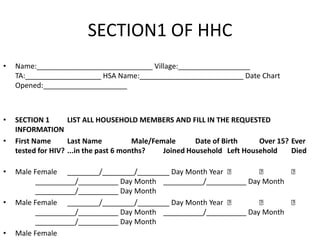
Household Chart
SECTION1 OF HHC
•   Name:_____________________________ Village:__________________
    TA:___________________ HSA Name:__________________________ Date Chart
    Opened:_____________________


•   SECTION 1       LIST ALL HOUSEHOLD MEMBERS AND FILL IN THE REQUESTED
    INFORMATION
•   First Name      Last Name           Male/Female      Date of Birth    Over 15? Ever
    tested for HIV? ...in the past 6 months?    Joined Household Left Household    Died

•   Male Female ________/________/________ Day Month Year              
         __________/__________ Day Month __________/__________ Day Month
         __________/__________ Day Month
•   Male Female ________/________/________ Day Month Year              
         __________/__________ Day Month __________/__________ Day Month
         __________/__________ Day Month
•   Male Female
Household Chart – Data Assessment
Community Engagement
• Nutrition Counseling
   • Community events
   • Outpatient clinics
   • Inpatient
• Nutrition Health Education
   • By VHWs, ART Clerks, Health
     Surveillance Assistants
                                             A Community Based Organization
   • Occurs at monthly patient
     meetings
   • Topics: causes of
     malnutrition, early/late signs, six
     food groups, etc.
• Biannual outreach campaigns
  assist case finding.
• Accompaniment to Community
  Based Organizations, Support             MUAC being measured at an outreach
  Groups.                                               event.
Community Engagement for PLHIV

                                               • Positive living education
                                                 specific to PLHIV:
                                                  • how to eat during different
                                                    malnutrition diagnoses
                                                  • Opportunistic infections and
Dramas, poetry, song, dance, and more are
used to emphasize lessons on positive living
                                                    preventable diseases
at community events                                 (malaria, diarrhea, cholera, et
                                                    c.)
                                                  • Water and
                                                    sanitation, prevention of
                                                    waterborne diseases
                                                  • Personal nutrition
                                                  • Crop diversification
Community members are trained to
recognize signs of malnutrition on a doll.
Direct Nutritional Support
• Malnutrition cases referred for Direct
  Nutritional Support
  • Moderate – Corn Soy Blend (called Likuni Phala)
  • Severe – Ready-to-Use Therapeutic Food (RUTF)
• All patients with HIV and/or TB are provided
  with nutritional supported for four months
  • Mothers on PMTCT program supported
    throughout and after pregnancy.
  • HIV-exposed children supported after six months
    old.
DIRECT NUTRITION SUPPORT CONT….
• Partnerships with Private Sector – Two
  Degrees assists with Likuni Phala
• Program on Social and Economic Rights
  (POSER) assists underserved patients with
  non-clinical needs
• After support reliance on VHW, Community
  Engagement, POSER to monitor health status
• Prevents graduated and malnutrition cases
  from coming back to Direct Nutrition Support.
Scale up of Model in Neno since 2006
• 1000x increase in   2500
                               ART Patients on Food Support

  patients on ART.
• 10x increase in     2000


  number of clinics   1500

  managed by APZU
                      1000


                       500


                         0
                             2006   2007   2008   2009   2010   2011
June 2006, Neno ART clinic opened with 5 patients
November 2011, 4016 patients across 12 sites
Challenges of Scale Up
• Logistics – complicated /uncertain supply chains
   – Solution: finding corporate local partners- Rab
     Processors.
• Funding – Budget cuts force reduced support
   – Solution: finding/strengthening partnerships
• Human Resources – finding versatile, capable
  staff to manage many health centers over
  large, rural area.
   – Solution: utilizing local ART clerks at health
     centers as food suppliers
• Changing ministry guidelines = changing demand
  on local resources
Looking forward
• Empowering local Likuni Phala production
• Maintaining nutritional support all the way to
  24 months for HIV-exposed children

Samson Njolomole

  • 1.
    Partners In Health AbwenziPa Za Umoyo (APZU) Improving HIV and Nutrition Outcomes in Rural Malawi
  • 2.
    CASE STUDY –The power of an integrated approach http://www.pih.org/blog/entry/a-healthy-child-in-just-two-weeks/
  • 3.
    Three innovative componentsof an integrated, community-based approach 1. Village Health Workers 2. Community Engagement 3. Direct Nutritional Support At the Hospital/health Center
  • 4.
    Community-based Integrated Model NENO HOSPITAL Direct Nutritional Support - Corn/soy blend (Likuni Phala) and Ready to Use Therapeutic Food (RUTF) - All HIV, TB, and malnourished patients - Mothers on PMTCT, exposed infants Relies on Relies on for CE VHWs for Identify education, community monitoring Refer reinforced well- and follow up being, prevention Village Health Workers Community Engagement - Case finding - Health education and outreach - Active follow-up and - Community reinforced emphasis monitoring of health on positive living status - Backbone of Support Groups - One-on-one health and Community-Based education Organizations
  • 5.
    Village Health Workers(VHWs) • Trained and supervised by Partners In Health to identify and report cases of malnutrition within community. • Assess all children for malnutrition and determine severity using MUAC and clinical indication (edema, etc.) • Trained to monitor health status of EVERY community member including-PLHIV with an emphasis Janet, a village health worker on nutrition. in remote Nsambe district.
  • 6.
    VHWs and PeopleLiving With HIV (PLHIV) • PLHIV identified at clinic – begin antiretroviral therapy (ART), VHW assigned. • Visit from VHW every day, accompaniment to clinic • Receive four months of direct nutritional support. • Household Chart - a simple tool to monitor health status and track follow-up care. • Data compiled quarterly for assessments of community VHW visiting patients at home in health indicators. Lower Neno
  • 7.
  • 8.
    SECTION1 OF HHC • Name:_____________________________ Village:__________________ TA:___________________ HSA Name:__________________________ Date Chart Opened:_____________________ • SECTION 1 LIST ALL HOUSEHOLD MEMBERS AND FILL IN THE REQUESTED INFORMATION • First Name Last Name Male/Female Date of Birth Over 15? Ever tested for HIV? ...in the past 6 months? Joined Household Left Household Died • Male Female ________/________/________ Day Month Year    __________/__________ Day Month __________/__________ Day Month __________/__________ Day Month • Male Female ________/________/________ Day Month Year    __________/__________ Day Month __________/__________ Day Month __________/__________ Day Month • Male Female
  • 9.
    Household Chart –Data Assessment
  • 10.
    Community Engagement • NutritionCounseling • Community events • Outpatient clinics • Inpatient • Nutrition Health Education • By VHWs, ART Clerks, Health Surveillance Assistants A Community Based Organization • Occurs at monthly patient meetings • Topics: causes of malnutrition, early/late signs, six food groups, etc. • Biannual outreach campaigns assist case finding. • Accompaniment to Community Based Organizations, Support MUAC being measured at an outreach Groups. event.
  • 11.
    Community Engagement forPLHIV • Positive living education specific to PLHIV: • how to eat during different malnutrition diagnoses • Opportunistic infections and Dramas, poetry, song, dance, and more are used to emphasize lessons on positive living preventable diseases at community events (malaria, diarrhea, cholera, et c.) • Water and sanitation, prevention of waterborne diseases • Personal nutrition • Crop diversification Community members are trained to recognize signs of malnutrition on a doll.
  • 12.
    Direct Nutritional Support •Malnutrition cases referred for Direct Nutritional Support • Moderate – Corn Soy Blend (called Likuni Phala) • Severe – Ready-to-Use Therapeutic Food (RUTF) • All patients with HIV and/or TB are provided with nutritional supported for four months • Mothers on PMTCT program supported throughout and after pregnancy. • HIV-exposed children supported after six months old.
  • 13.
    DIRECT NUTRITION SUPPORTCONT…. • Partnerships with Private Sector – Two Degrees assists with Likuni Phala • Program on Social and Economic Rights (POSER) assists underserved patients with non-clinical needs • After support reliance on VHW, Community Engagement, POSER to monitor health status • Prevents graduated and malnutrition cases from coming back to Direct Nutrition Support.
  • 14.
    Scale up ofModel in Neno since 2006 • 1000x increase in 2500 ART Patients on Food Support patients on ART. • 10x increase in 2000 number of clinics 1500 managed by APZU 1000 500 0 2006 2007 2008 2009 2010 2011
  • 15.
    June 2006, NenoART clinic opened with 5 patients
  • 16.
    November 2011, 4016patients across 12 sites
  • 17.
    Challenges of ScaleUp • Logistics – complicated /uncertain supply chains – Solution: finding corporate local partners- Rab Processors. • Funding – Budget cuts force reduced support – Solution: finding/strengthening partnerships • Human Resources – finding versatile, capable staff to manage many health centers over large, rural area. – Solution: utilizing local ART clerks at health centers as food suppliers • Changing ministry guidelines = changing demand on local resources
  • 18.
    Looking forward • Empoweringlocal Likuni Phala production • Maintaining nutritional support all the way to 24 months for HIV-exposed children

Editor's Notes

  • #3 A reminder of why we do this work and the results it can yield – story of how young girl was effectively diagnosed, treated, and discharged with appropriate management for HIV and malnutrition
  • #5 A foundation of community based work that manage patients, educate, prevent, etc. This foundation supports the direct nutritional support, to ensure that it happens and that people transition off of it. One cannot exist without the other!
  • #6 VHW visit Patients twice a Day every day to remind them taking the treatment as prescribed, conduct one on one conseling on Condom use, Family Planning methods as well as providing accompaniment during monthly appointments.
  • #7 Note - VHWs have catchment area averaging 20-40 households, fill out household chart 1/month. Am going to speak about the Direct nutrition support later in the presentation.
  • #8 Mention MUAC and referral sections.
  • #10 Sam. Just showing this to show how feedback loop works with household chart. How we use it rather than specific. information. In reference to yesterdays presentation on Data use PIH and MOH (DEHO, EHO and HAS’s) conducts Monthly and Quarterly meetings to analyze the Household Chart consolidated reports and use the outcomes as trigger points.
  • #12 In reference to what was asked yesterday about linking Agriculture to Nutrition we advice and train Support Groups of PLWHIV and CBO’s to practice Compost manure making in addition to the Permaculture practices in order to transition from using chemical fertilizer to Manure.
  • #13 Funds for TB patients come from unrestricted fundingHIV- patients with TB are supportedAnticipate question of why support HIV+ adults who are not malnourished
  • #14 POSER Program helps groups of vulnerable women with HIV by providing microfinance business to help them meet their needs. PIH in collaboration with the Ministry of Local Government public sector (DSWO) conducts Trainings and Orientations for such type of business interventions. Opening of Restaurant Business for commercial Sex workers.
  • #18 Solution to the Challenges: Rab Processors Company by discussing with them not to raise their prices for a longer business relationship. Two Degrees we provide Quarterly and monthly reports of how the Nutrition Donations has been used. Made a commitment to cover costs of Likuni Phala over II,160ml.
  • #19 -investing further in local community