Chemical Process Design and Simulation
 Introduction:
 Chemical process simulation aims to represent a process of chemical or physical transformation through a mathematic
model that involves the calculation of mass and energy balances coupled with phase equilibrium and with transport
and chemical kinetics equations.
 Mathematical model applied contains linear, non-linear & differential algebraic equations which represent equipment,
or process operations, physical-chemical properties, connections b/w equipment or process operations & their
specification.
 PFD is language of chemical process.
 Simulators are used for interpretation, analysis of information contained in PFD to foresee the failures and evaluate
process performance.
 Chemical Process Simulators:
 Process simulators used for modeling behavior of chemical process in steady state, by determination of pressures,
temperatures and flows.
 Nowadays, also used to perform equipment sizing, cost estimation, properties estimation and analysis, operability
analysis and process optimization.
 Process simulators allow;
a) Predict the behavior of a process.
b) Analyze in a simultaneous way different cases, changing the values of main operating variables.
c) Optimize the operating conditions of new or existing plants.
d) Track a chemical plant during its whole useful life, in order to foresee extensions for process improvements.
 Thermodynamic & Property Model:
 A thermodynamic model is set of equations permitting the estimation of pure component mixtures and properties.
 Four main groups of thermodynamic models available;
a) Ideal Model
b) Equations of State
i. Redlich-Kwong (RK)
ii. Soave–Redlich–Kwong (SRK)
iii. Peng–Robinson
c) Activity Coefficients Model
iv. Van Laar Model
v. Wilson Model
vi. NRTL (Nonrandom Two Liquids)
vii. UNIQUAC
viii. UNIFAC
d) Special Methods
 Applications of Process Simulators:
 It is a tool for process & chemical engineers used for applications of repetitive tasks or activities of high complexity
that should be solved within short time.
 Various applications of process simulations founded are the result of necessity of;
a) Making a better use of the energy resources.
b) Minimizing the operating costs and the emission of waste streams that may be contaminant.
c) Increasing the yield and process efficiency.
d) Improving the process controllability.
e) Propelling the teaching of process design.
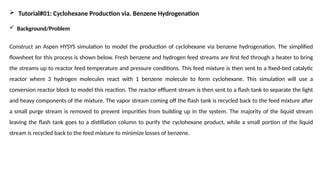
 Tutorial#01: Cyclohexane Production via. Benzene Hydrogenation
 Background/Problem
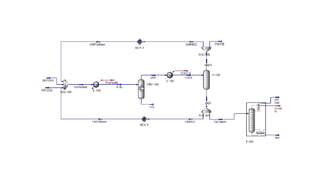
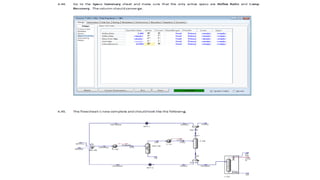
Construct an Aspen HYSYS simulation to model the production of cyclohexane via benzene hydrogenation. The simplified
flowsheet for this process is shown below. Fresh benzene and hydrogen feed streams are first fed through a heater to bring
the streams up to reactor feed temperature and pressure conditions. This feed mixture is then sent to a fixed-bed catalytic
reactor where 3 hydrogen molecules react with 1 benzene molecule to form cyclohexane. This simulation will use a
conversion reactor block to model this reaction. The reactor effluent stream is then sent to a flash tank to separate the light
and heavy components of the mixture. The vapor stream coming off the flash tank is recycled back to the feed mixture after
a small purge stream is removed to prevent impurities from building up in the system. The majority of the liquid stream
leaving the flash tank goes to a distillation column to purify the cyclohexane product, while a small portion of the liquid
stream is recycled back to the feed mixture to minimize losses of benzene.
Tutorial #0hdhrhhhdhdhhrhrhrhrhrrh1.pptx

Tutorial #0hdhrhhhdhdhhrhrhrhrhrrh1.pptx

  • 1.
    Chemical Process Designand Simulation  Introduction:  Chemical process simulation aims to represent a process of chemical or physical transformation through a mathematic model that involves the calculation of mass and energy balances coupled with phase equilibrium and with transport and chemical kinetics equations.  Mathematical model applied contains linear, non-linear & differential algebraic equations which represent equipment, or process operations, physical-chemical properties, connections b/w equipment or process operations & their specification.  PFD is language of chemical process.  Simulators are used for interpretation, analysis of information contained in PFD to foresee the failures and evaluate process performance.
  • 2.
     Chemical ProcessSimulators:  Process simulators used for modeling behavior of chemical process in steady state, by determination of pressures, temperatures and flows.  Nowadays, also used to perform equipment sizing, cost estimation, properties estimation and analysis, operability analysis and process optimization.  Process simulators allow; a) Predict the behavior of a process. b) Analyze in a simultaneous way different cases, changing the values of main operating variables. c) Optimize the operating conditions of new or existing plants. d) Track a chemical plant during its whole useful life, in order to foresee extensions for process improvements.
  • 3.
     Thermodynamic &Property Model:  A thermodynamic model is set of equations permitting the estimation of pure component mixtures and properties.  Four main groups of thermodynamic models available; a) Ideal Model b) Equations of State i. Redlich-Kwong (RK) ii. Soave–Redlich–Kwong (SRK) iii. Peng–Robinson c) Activity Coefficients Model iv. Van Laar Model v. Wilson Model vi. NRTL (Nonrandom Two Liquids) vii. UNIQUAC viii. UNIFAC d) Special Methods
  • 4.
     Applications ofProcess Simulators:  It is a tool for process & chemical engineers used for applications of repetitive tasks or activities of high complexity that should be solved within short time.  Various applications of process simulations founded are the result of necessity of; a) Making a better use of the energy resources. b) Minimizing the operating costs and the emission of waste streams that may be contaminant. c) Increasing the yield and process efficiency. d) Improving the process controllability. e) Propelling the teaching of process design.
  • 5.
     Tutorial#01: CyclohexaneProduction via. Benzene Hydrogenation  Background/Problem Construct an Aspen HYSYS simulation to model the production of cyclohexane via benzene hydrogenation. The simplified flowsheet for this process is shown below. Fresh benzene and hydrogen feed streams are first fed through a heater to bring the streams up to reactor feed temperature and pressure conditions. This feed mixture is then sent to a fixed-bed catalytic reactor where 3 hydrogen molecules react with 1 benzene molecule to form cyclohexane. This simulation will use a conversion reactor block to model this reaction. The reactor effluent stream is then sent to a flash tank to separate the light and heavy components of the mixture. The vapor stream coming off the flash tank is recycled back to the feed mixture after a small purge stream is removed to prevent impurities from building up in the system. The majority of the liquid stream leaving the flash tank goes to a distillation column to purify the cyclohexane product, while a small portion of the liquid stream is recycled back to the feed mixture to minimize losses of benzene.