Turkish Food
Martín, Joselu, Victor R., Victor V., Jaime y Tania
Doner Kebab
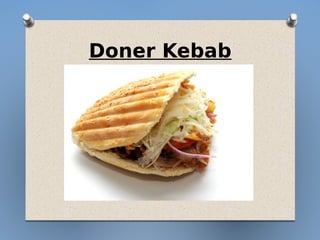
Doner Kebab
Doner Kebab is a Turkish dish made of meat cooked on a
vertical rotisserie, normally lamb but also a mixture
of veal or beef with these, or sometimes chicken. The
dish is also widely known by its Arabic name "shawarma"
(from Turkish çevirme) or the Greek name "gyros".
The sliced meat of a Doner kebab may be served
wrapped in a flatbread such as lavash or pita or as
a sandwich instead of being served on a plate. It is a
common fast food item not only in Turkey but also in the
Middle East, Europe, Canada and Australia. Seasoned
meat in the shape of an inverted cone is turned slowly
against a vertical rotisserie, then sliced vertically into
thin, crisp shavings. On the sandwich version, the meat is
generally served with tomato, onion with sumac, pickled
cucumber and chili.
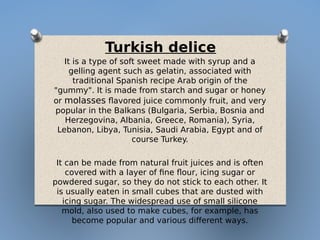
Turkish delice
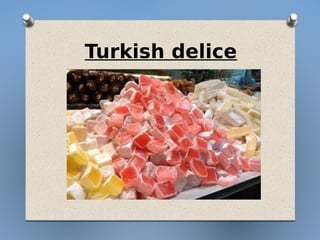
Turkish delice
It is a type of soft sweet made with syrup and a
gelling agent such as gelatin, associated with
traditional Spanish recipe Arab origin of the
"gummy". It is made from starch and sugar or honey
or molasses flavored juice commonly fruit, and very
popular in the Balkans (Bulgaria, Serbia, Bosnia and
Herzegovina, Albania, Greece, Romania), Syria,
Lebanon, Libya, Tunisia, Saudi Arabia, Egypt and of
course Turkey.
It can be made from natural fruit juices and is often
covered with a layer of fine flour, icing sugar or
powdered sugar, so they do not stick to each other. It
is usually eaten in small cubes that are dusted with
icing sugar. The widespread use of small silicone
mold, also used to make cubes, for example, has
become popular and various different ways.
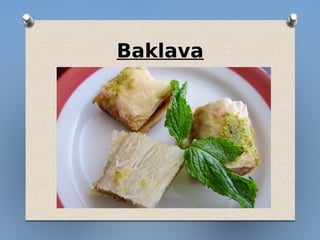
Baklava
Baklava
The baklava, baklava or baklava (Turkish baklava), is a
cake made with a paste of crushed nuts, distributed in
phyllo and drenched in syrup or honey syrup, existing
varieties that incorporate hazelnuts and almonds, among
other nuts and kaymak, from Turkish cuisine. It can be
found under different names in the cuisine of the Middle
East, Indian Subcontinent and the Balkans.
The history of baklava goes back to ancient Mesopotamia.
It is believed, however, that the Assyrians, near the
seventh century. C., were the first to put a few layers of
dough with crushed nuts between these layers, adding a
little honey and by baking in their primitive wood furnaces.
This early version of baklava is cooked only for special
occasions, being in fact historically considered a meal for
the upper classes until the mid nineteenth century.
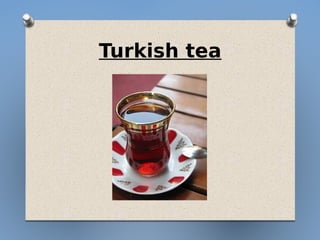
Turkish tea
Turkish Tea
The Turkish tea (In Turkish: çay) is a type of tea
drinking often people living in the Republic of Turkey
in Northern Cyprus and the Turkish diaspora. The
Turkish tea is as popular as Turkish coffee among the
population of Turkey.
The Turkish tea is called çay, and can be considered
a form of black tea, occurs primarily east of the Black
Sea coast, where wet weather due to heavy rainfall
provide a suitable environment for fertile soil. The
Turkish tea is prepared in a kind of stacked teapots
(çaydanlık) specially designed for the preparation of
this tea.

Turkish food

  • 1.
    Turkish Food Martín, Joselu,Victor R., Victor V., Jaime y Tania
  • 2.
  • 3.
    Doner Kebab Doner Kebabis a Turkish dish made of meat cooked on a vertical rotisserie, normally lamb but also a mixture of veal or beef with these, or sometimes chicken. The dish is also widely known by its Arabic name "shawarma" (from Turkish çevirme) or the Greek name "gyros". The sliced meat of a Doner kebab may be served wrapped in a flatbread such as lavash or pita or as a sandwich instead of being served on a plate. It is a common fast food item not only in Turkey but also in the Middle East, Europe, Canada and Australia. Seasoned meat in the shape of an inverted cone is turned slowly against a vertical rotisserie, then sliced vertically into thin, crisp shavings. On the sandwich version, the meat is generally served with tomato, onion with sumac, pickled cucumber and chili.
  • 4.
  • 5.
    Turkish delice It isa type of soft sweet made with syrup and a gelling agent such as gelatin, associated with traditional Spanish recipe Arab origin of the "gummy". It is made from starch and sugar or honey or molasses flavored juice commonly fruit, and very popular in the Balkans (Bulgaria, Serbia, Bosnia and Herzegovina, Albania, Greece, Romania), Syria, Lebanon, Libya, Tunisia, Saudi Arabia, Egypt and of course Turkey. It can be made from natural fruit juices and is often covered with a layer of fine flour, icing sugar or powdered sugar, so they do not stick to each other. It is usually eaten in small cubes that are dusted with icing sugar. The widespread use of small silicone mold, also used to make cubes, for example, has become popular and various different ways.
  • 6.
  • 7.
    Baklava The baklava, baklavaor baklava (Turkish baklava), is a cake made with a paste of crushed nuts, distributed in phyllo and drenched in syrup or honey syrup, existing varieties that incorporate hazelnuts and almonds, among other nuts and kaymak, from Turkish cuisine. It can be found under different names in the cuisine of the Middle East, Indian Subcontinent and the Balkans. The history of baklava goes back to ancient Mesopotamia. It is believed, however, that the Assyrians, near the seventh century. C., were the first to put a few layers of dough with crushed nuts between these layers, adding a little honey and by baking in their primitive wood furnaces. This early version of baklava is cooked only for special occasions, being in fact historically considered a meal for the upper classes until the mid nineteenth century.
  • 8.
  • 9.
    Turkish Tea The Turkishtea (In Turkish: çay) is a type of tea drinking often people living in the Republic of Turkey in Northern Cyprus and the Turkish diaspora. The Turkish tea is as popular as Turkish coffee among the population of Turkey. The Turkish tea is called çay, and can be considered a form of black tea, occurs primarily east of the Black Sea coast, where wet weather due to heavy rainfall provide a suitable environment for fertile soil. The Turkish tea is prepared in a kind of stacked teapots (çaydanlık) specially designed for the preparation of this tea.