Download to read offline
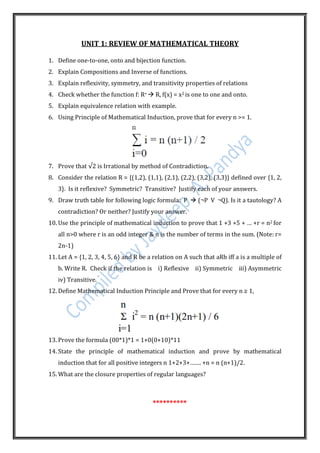

The document outlines topics in mathematical theory including: defining functions and relations; properties of functions such as composition, inverses, one-to-one and onto functions; properties of relations including reflexivity, symmetry and transitivity; using principles of mathematical induction to prove statements; proving statements using proof by contradiction; and closure properties of regular languages. Specific problems include proving square root of 2 is irrational, using induction to prove a summation formula, and analyzing relations.
![[Question Paper] Logic, Discrete Mathematical Structures (Old Course) [Januar...](https://cdn.slidesharecdn.com/ss_thumbnails/ldms-qpoldcoursejan-2014-170717052024-thumbnail.jpg?width=640&height=640&fit=bounds)

![[Question Paper] Logic and Discrete Mathematics (Revised Course) [January / 2...](https://cdn.slidesharecdn.com/ss_thumbnails/ldm-qprevisedcoursejan-2014-170717110124-thumbnail.jpg?width=640&height=640&fit=bounds)


![[Question Paper] Logic and Discrete Mathematics (Revised Course) [April / 2014]](https://cdn.slidesharecdn.com/ss_thumbnails/ldm-qprevisedcourseapr-2014-170717110113-thumbnail.jpg?width=640&height=640&fit=bounds)


![[Question Paper] Logic and Discrete Mathematics (Revised Course) [June / 2016]](https://cdn.slidesharecdn.com/ss_thumbnails/ldm-qprevisedcoursejun-2016-170717110110-thumbnail.jpg?width=640&height=640&fit=bounds)

![[Question Paper] Logic and Discrete Mathematics (Revised Course) [January / 2...](https://cdn.slidesharecdn.com/ss_thumbnails/ldm-qprevisedcoursejan-2017-170717110108-thumbnail.jpg?width=640&height=640&fit=bounds)


![[Question Paper] Logic and Discrete Mathematics (Revised Course) [April / 2015]](https://cdn.slidesharecdn.com/ss_thumbnails/ldm-qprevisedcourseapr-2015-170717110118-thumbnail.jpg?width=640&height=640&fit=bounds)


