PRINCIPLES AND RULES GOVERNING OIL & GAS:
A Focus on the Local Content in Tanzania
A: Meaning of Local Content and Principles
of LC
What is a Local Content?
•The added value brought to the country(URT) in
the activities of the oil and gas industry through
the participation and development of local
Tanzanians and local businesses through
national labour, technology, goods, services,
capital and research capability [Local Value
Addition].
•(It is) VALUE ADDITION leading to SUSTAINABLE DEVELOPMENT
and culminating also in JOB CREATION, ECONOMIC GROWTH,
ENVIRONMENTAL PROTECTION AND LONG TERM GAINS.“The degree of local ownership, control and
financing by citizens of a nation, in a
specific venture or entity that promotes
and enables the optimal use of in country‐
LC develops conditions between the EI and the
host country local economy through;
1.Vertical linkages: linkages between the EI and
companies that are not engaged in oil extraction
that include;
Backward Linkage: supplying input to the local
economy through transfer of technology, the
generation of value-added in domestic supply
sectors, the creation of local employment
opportunities, and increasing local ownership
and control
Forward Linkage: processing the sector’s
output prior to export through, for example,
A: Meaning of Local Content and Principles
of LC
2. Horizontal Linkage: linkage between foreign
investors and other extractive companies in
the same industry, e.g. technology agreements
with local or international natural resource
firms or joint venture collaborations with local
companies.
The Principles pertaining to Local Contents
encompass:
1. Competitiveness Principle: the ability of a
domestic supplier or contractor to supply
goods or services in an international market
which could be entirely within the domestic
economy, with foreign and local firms
competing against each other in open
A: Meaning of Local Content and Principles
of LC
2. Protectionism Principle: intended or
unintended economic policy of restraining
trade between countries through methods such
as tariffs (taxes) on imported goods, or
restrictive import quotas and regulations
designed to discourage imports. The setting of
Local Content targets would fall within the
category of restrictive import quotas. [Infant
industry, Market Power i.e Foreign coys are
uncompetitive on base price, Social Impact i.e
where local content regulations is as a form of
compensation for the adverse socio-economic
impacts of oil, and gas investment on local
communities and vulnerable groups]
A: Meaning of Local Content and Principles
of LC
3. Comparative Advantage Principle:
pervades key decisions and assures
contracts are awarded on a competitive
basis. This is the key principle of
procurement – The Golden Thread E.g.
Clause in PSA could reads;
“Give preference to local contractors and
locally manufactured materials and
equipment so long as their performance,
quality and time of delivery are
competitive with international
performance and prices”
A: Meaning of Local Content and Principles
of LC
The golden thread of
procurement is the
principle of contract award
on an ‘internationally
competitive’ basis
The Golden Thread: “local companies will
not be treated
differently with regard to quality, price,
delivery, HSE compliance”.
A: Meaning of Local Content and Principles
of LC
B:Why Local Content?
1. Monitor the project delivery: Local Content is
also becoming a strategic consideration in
project delivery.
2. Facilitate Commercial Or Public Policy
Objectives: Local Content regulations, such as
reporting requirements, may be fairly caring,
whilst others may facilitate commercial or
public policy objectives to be substantively
modified.
3. Rising Expectations: Due to new competitive
landscape of diminishing supply and
increasing demand for energy resources,
companies in the oil and gas industry face
rising expectations to do more than simply
C: Some Highlights of Local Content in
Tanzania
• Specific requirements for Local Content within
existing primary legislation in the petroleum
sector are weak
• Obligations in Production Sharing Contracts
(PSAs) on Local Content are stronger. However,
the PSAs
I. lack clear definitions around Local Content,
II. contain limited guidance on how
Contractors’ expenditure might align with
Government policy to build the domestic
industrial base so that Tanzania citizens
and suppliers can participate in the
petroleum industry, and
• The current laws and regulations lack
mechanisms for accountability to assure
implementation of Contractors’ and TPDC’s
commitments to Local Content
C: Some Highlights of Local Content in Tanzania
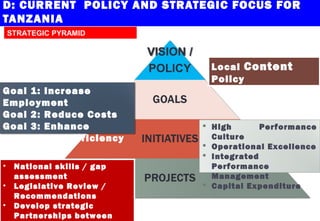
D: CURRENT POLICY AND STRATEGIC FOCUS FOR
TANZANIA
Local Content
Policy
Goal 1: Increase
Employment
Goal 2: Reduce Costs
Goal 3: Enhance
Operational Efficiency
 High Performance
Culture
 Operational Excellence
 Integrated
Performance
Management
 Capital Expenditure
• National skills / gap
assessment
• Legislative Review /
Recommendations
• Develop strategic
Partnerships between
STRATEGIC PYRAMID
E: Trade and Investment Treaties As
Prohibition for LC
Trade and Investment Treaties restrict
domestic local content policy discretion
through WTO which Aims at lowering
tariffs and non-tariff barriers by:
• Limiting performance requirements
related to trade in goods (TRIMs
Agreement in 1995): local content
measures are explicitly prohibited if
these oblige the purchase or use by an
enterprise of products of domestic origin
or from a domestic source, whether this
be specified in terms of particular
14
• Limiting performance requirements related to
trade in services (GATS Agreement in 1995) “all
WTO members should accord services and
service providers from other WTO members
treatment no less favourable than that provided
for under the common terms, limitations and
conditions mutually agreed within the WTO”.
• Limiting performance requirement related to
government procurement (The plurilateral
Agreement on Government Procurement (GPA
Agreement) in 1996) “intended to counter
internal political pressure to discriminate in
favour of domestic suppliers of goods and
E: Trade and Investment Treaties As
Prohibition for LC
E: Trade and Investment Treaties As
Prohibition for LC
• Exclusion to the Rule: under WTO, Special and
Differential Treatment (SDT) for developing
countries, allows for some discrimination, eg
transition countries, Least Developed Countries
F: Development of Industrial Clusters Can
Promote Increased Local Content [Local
Content Drivers]
Petrochemical
s
Power & Water
Exploration &
Developmen
t
Refining
&
Processing
Trainin
g
Researc
h
InfrastructureElectrical Maintenan
ce
Fabricatio
n
Services
F: Development of Industrial Clusters Can
Promote Increased Local Content [Local Content
Drivers]
1. Capacity Building and technology transfer;
2. Participation of Tanzanians and Tanzanian
owned entities [The Tanzania Mainland and its
people and Business which is incorporated
under the applicable laws of Tanzania and is
wholly owned by Tanzanians or with at least
51% of shares owned by Tanzanian Nationals
and is registered to offer goods or services in
the oil and gas industry];
3. Procurement and usage of locally produced
goods and services [goods obtained, produced
or manufactured and have after-sales services
in Tanzania Mainland and Services provided in
F: Development of Industrial Clusters Can
Promote Increased Local Content [Local
Content Drivers]
6. Research & Development
• Active government participation (facilitation,
funding etc.) proves effective in supporting
establishment of world class, leading edge
research institutions that contribute to more
efficient development of domestic resources
and capabilities
• Leadership by resource development
companies of applied research and
experimental development proves to be more
effective than by direct government
involvement
1. Lack of human capacity and education
skills,
Developing Countries’ Perspective: skills
shortages hinder the incorporation of local
workers into the extractive industries and the
development of an industrial base necessary
to spread the benefits of these sectors to
other areas.
Operating Companies’ Perspective: skills
shortages can cause the delay of new projects,
increase costs and even hamper the fulfilment
of local content requirements.
2. Poor infrastructure,
G: THE MAIN CHALLENGES
To address the lack infrastructure, host countries
must focus on:
I. building the appropriate legal, institutional
and regulatory framework,
II. managing different forms of private
involvement and financing,
III.looking for support in investment promotion
agencies for foreign investment, and,
IV. taking into consideration social factors
related to the investment in infrastructure.
3. Weak industrial base [Building Solid
IB],
EI must be based on existing domestic
capabilities in manufacturing and services.
However, in many countries the industrial
4. Poor governance and inadequate
business environment.
Rich natural resources countries lack an
enabling business environment to
stimulate local business creation.
H: HOW TO ADDRESS CHALLENGES
Lack of human capacity and education skills:
Enhance general educational base through
local capacity building (to support
development in the long run) including
designing primary, vocational, secondary and
university education syllabus suitable to
support the development in different areas
and levels of specialization.
Enhance vocational and technical training;
Ensure availability of school accreditation;
and Increasing demand for higher skilled
workers in the industry.
improving the direct participation of the
Poor infrastructure,
Governments should attract a greater
involvement of the private sector - including
local and transnational companies (TNC) - in
infrastructure financing, investment, ownership
and management, and concentrate their efforts
in providing a clear regulatory and legal
framework, as well as proper stimulus to private
participation. Govt should focus in
(i) building the appropriate legal,
institutional and regulatory framework,
(ii) managing different forms of private
involvement and financing,
(iii)looking for support in investment
H: HOW TO ADDRESS CHALLENGES
Poor governance and inadequate business
environment.
Provides an appropriate legal, regulatory and
institutional framework in which companies, local
and foreign, have the incentives to invest and
develop productive activities;
Gives enough guarantees to prevent corruption
and rent seeking behaviour;
In line with the international initiatives,
promotes transparency and accountability in the
extractive sector, with different treatment of
business confidentiality and government
sovereignty issues. Two well-known approaches
H: HOW TO ADDRESS CHALLENGES
Improving Workers participation in EI, Boost
local capabilities through:
Research and Development (R&D) programmes,
funds and specialized institutes.
The link between major companies and local
universities and training institutes is key to
design programmes with the proper syllabus to
meet the skills requirements of the industry, as
well as for the development of on-the-job training
programmes;
Introduction of local content provisions for
training and hiring national workforce at
different levels of the value chain; and
Creation of industry linkages and extensive
I: Role of regulatory and legal framework
Poor infrastructure
i.Before committing funds to any project,
investors consider whether laws and contracts
are likely to be properly enforced and whether
their rights and responsibilities are well defined
and likely to be respected.
ii.The legal and regulatory framework for issuing
licenses or concessions should define the rights
and obligations of utilities, clarify pricing
mechanisms and establish procedures for
dispute resolution.
iii.The establishment of a strong and
autonomous regulatory agency is essential to
implement laws and regulations in infrastructure
I: Role of regulatory and legal
framework
Poor governance and inadequate business
environment
i.Clear legal framework governing the exploration and
exploitation of extractive industries that establishes
clear ownership and property rights;
ii.Independent regulatory powers strictly separated from
operating activities. This is essential to ensure
transparency and to avoid creating a fertile ground for
rent-seeking and corruption;
iii.A clear legal framework on the fiscal and
administrative framework for the extraction of natural
resources. This involves, for example, stable and clear
taxation policies and efficient processes for the issue of
licenses; A system of revenue management governing the
sharing and distribution of the rents from extractive
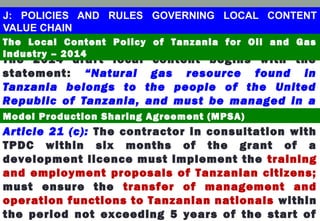
J: POLICIES AND RULES GOVERNING LOCAL CONTENT
VALUE CHAIN
The 2014 draft local content begins with the
statement: “Natural gas resource found in
Tanzania belongs to the people of the United
Republic of Tanzania, and must be managed in a
way that benefits the entire Tanzanian society.”
The Local Content Policy of Tanzania for Oil and Gas
Industry – 2014
Model Production Sharing Agreement (MPSA)
Article 21 (c): The contractor in consultation with
TPDC within six months of the grant of a
development licence must implement the training
and employment proposals of Tanzanian citizens;
must ensure the transfer of management and
operation functions to Tanzanian nationals within
the period not exceeding 5 years of the start of
ARTICLE 20(b): Give preference to the purchase of
Tanzanian goods, services and materials provided
such goods and materials are of certified standard
and quality in accordance with TBS, TFDA, or any
other relevant authority
ARTICLE 20(d): Make maximum use of Tanzanian
service companies and contractors at certified
standards and competitive prices and terms
ARTICLE 20(i): Ensure that sub-contracts are
scoped to match the capability of local
enterprises and manage risk to allow their
participation
ARTICLE 20 (j): Maximise the level of usage of
Model Production Sharing Agreement (MPSA)
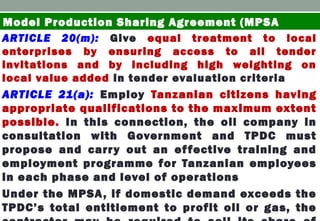
ARTICLE 20(m): Give equal treatment to local
enterprises by ensuring access to all tender
invitations and by including high weighting on
local value added in tender evaluation criteria
ARTICLE 21(a): Employ Tanzanian citizens having
appropriate qualifications to the maximum extent
possible. In this connection, the oil company in
consultation with Government and TPDC must
propose and carry out an effective training and
employment programme for Tanzanian employees
in each phase and level of operations
Under the MPSA, if domestic demand exceeds the
TPDC’s total entitlement to profit oil or gas, the
Model Production Sharing Agreement (MPSA
A development licence must include conditions requiring
registered holder to supply petrol to meet the local
needs of Tanzania. Applications for exploration or
development licences must be accompanied by proposals
with respect to the training and employment of Tanzanian
citizens.
The utilization of domestic resources
“should be utilized to build adaptive capacity for
promoting economic activities that enjoy comparative
and competitive advantages with a view to minimize the
impact of external economic shifts and shocks”
Transformation of the economy towards competitiveness
[The diversification of the economy must be based on a
dynamic industrialization programme focused on local
The Petroleum Act 1980
National Development Vision 2025, [Driving Forces For
Realization Of Vision]
GOOD GOVERNANCE AND THE RULE OF LAW
Promoting democratic and popular participation
[“Deliberate efforts must be made to empower the people
and catalyse their democratic and popular participation.
The strategy should entail empowering local governments
and communities and promoting broad-based grassroots
participation in the mobilization of resources, knowledge
and experience ………”.]The National Petroleum Policy of Tanzania 2014
One of its Specific Objectives [(viii) To maximize national
benefit by promoting local value addition and building
local competencies…….]
Sub-Article 3.1.2.4: Local Content and Capacity Building
i.Ensure that training needs assessment is carried out to
identify the capacity and competence required in the
upstream sub-sector.
iv.Ensure that contractors/operators prepare and
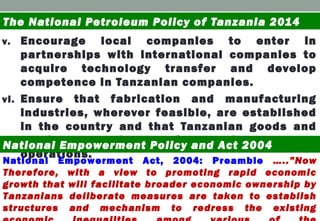
v. Encourage local companies to enter in
partnerships with international companies to
acquire technology transfer and develop
competence in Tanzanian companies.
vi. Ensure that fabrication and manufacturing
industries, wherever feasible, are established
in the country and that Tanzanian goods and
services are given preference in petroleum
operations.
The National Petroleum Policy of Tanzania 2014
National Empowerment Policy and Act 2004
National Empowerment Act, 2004: Preamble …..”Now
Therefore, with a view to promoting rapid economic
growth that will facilitate broader economic ownership by
Tanzanians deliberate measures are taken to establish
structures and mechanism to redress the existing
Definition of Economic Empowerment (Section 3)
“Economic empowerment” means deliberate and
affirmative actions and measures undertaken by
the Government for the purpose of promoting and
enhancing knowledge, skill, economic prowess
and financial prudence of Tanzanians to enable
them to meaningfully participate in economic
activities and includes all plans, strategies,
policies and measures taken to achieve the goal,
be it by public or private sector
National Empowerment Policy and Act 2004
National Empowerment Policy , 2004
Clause 3.3:“The primary objective of the policy is to
provide general guidelines which will ensure that the
majority of the citizens of Tanzania have access to
opportunities to participate effectively in economic
activities in all sectors of the economy……”
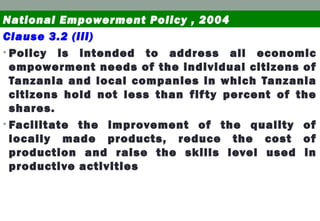
Clause 3.2 (iii)
• Policy is intended to address all economic
empowerment needs of the individual citizens of
Tanzania and local companies in which Tanzania
citizens hold not less than fifty percent of the
shares.
• Facilitate the improvement of the quality of
locally made products, reduce the cost of
production and raise the skills level used in
productive activities
National Empowerment Policy , 2004
Sub-Clause 4.4.3 (iii): Assisting learning
institutions and companies to render material
assistance that will encourage most Tanzanians
to undertake technical training in institutions
that meet their needs. Cost Sharing Approach
should apply with the objective of encouraging
more citizens of Tanzania to enhance their
technical skills
Sub-Clause 4.7.2: The Government will ensure
that market information is made available to
Tanzanian producers, develop local markets and
improve access of Tanzanian products in
neighbouring countries and in the global market.
Sub-Clause 4. 7.3 (i): Ensuring that local
Five Year Development Plan (2011/12 - 2015/16)
One of the Five Core Priorities of Plan’s strategy
to unleash Tanzania’s latent growth potentials:
“Industrial development specifically targeting
industries that use locally produced raw
materials such as textiles, fertiliser, cement,
coal, iron and steel, as well as development of
special economic zones, using public-private
partnerships”;
Natural Gas Policy, 2013
Clause 3.1.7: Local Content and Capacity Building : The
Government shall;
Ensure that the local communities benefit from the
natural gas activities in their respective localities.
Work with IOGCs to ensure opportunities for supply of
goods and services, employment and investments are
made available to Tanzanians; that the capacity of
Tanzanians is developed in the natural gas value chain
• Work with IOGCs to explore possibilities that
companies participating in natural gas value
chain are listed on the DSE
• Establish oil and natural gas centre of
excellence and strengthen capacity of the
training institutions to impart requisite
knowledge skills and innovations to Tanzanians.
2nd
NSGRP/MKUKUTA 2010/11 - 2014/15
(NSGRP/MKUKUTA II).
Balance of payments:
Addressing the import side prudently in order to
reduce the import bill. Interventions in this area
relate to promoting consumption of locally
produced goods and services to out-compete
imports, and curtailing dumping of imports, such
as counterfeits known to be of poor quality and
in some cases unfit for human consumption
www.mem.go.tz
THANK YOU
CONTACTS: mafwenga2000@yahoo.com; hmafwenga@tmaa.go.tz +255758888884;
+255754555666; +255766125125;+255767616868: +255713616868: +255768722222:
+255768622222

TUDARCO-Principles and rules governing Oil & Gas

  • 1.
    PRINCIPLES AND RULESGOVERNING OIL & GAS: A Focus on the Local Content in Tanzania
  • 2.
    A: Meaning ofLocal Content and Principles of LC What is a Local Content? •The added value brought to the country(URT) in the activities of the oil and gas industry through the participation and development of local Tanzanians and local businesses through national labour, technology, goods, services, capital and research capability [Local Value Addition]. •(It is) VALUE ADDITION leading to SUSTAINABLE DEVELOPMENT and culminating also in JOB CREATION, ECONOMIC GROWTH, ENVIRONMENTAL PROTECTION AND LONG TERM GAINS.“The degree of local ownership, control and financing by citizens of a nation, in a specific venture or entity that promotes and enables the optimal use of in country‐
  • 3.
    LC develops conditionsbetween the EI and the host country local economy through; 1.Vertical linkages: linkages between the EI and companies that are not engaged in oil extraction that include; Backward Linkage: supplying input to the local economy through transfer of technology, the generation of value-added in domestic supply sectors, the creation of local employment opportunities, and increasing local ownership and control Forward Linkage: processing the sector’s output prior to export through, for example, A: Meaning of Local Content and Principles of LC
  • 4.
    2. Horizontal Linkage:linkage between foreign investors and other extractive companies in the same industry, e.g. technology agreements with local or international natural resource firms or joint venture collaborations with local companies. The Principles pertaining to Local Contents encompass: 1. Competitiveness Principle: the ability of a domestic supplier or contractor to supply goods or services in an international market which could be entirely within the domestic economy, with foreign and local firms competing against each other in open A: Meaning of Local Content and Principles of LC
  • 5.
    2. Protectionism Principle:intended or unintended economic policy of restraining trade between countries through methods such as tariffs (taxes) on imported goods, or restrictive import quotas and regulations designed to discourage imports. The setting of Local Content targets would fall within the category of restrictive import quotas. [Infant industry, Market Power i.e Foreign coys are uncompetitive on base price, Social Impact i.e where local content regulations is as a form of compensation for the adverse socio-economic impacts of oil, and gas investment on local communities and vulnerable groups] A: Meaning of Local Content and Principles of LC
  • 6.
    3. Comparative AdvantagePrinciple: pervades key decisions and assures contracts are awarded on a competitive basis. This is the key principle of procurement – The Golden Thread E.g. Clause in PSA could reads; “Give preference to local contractors and locally manufactured materials and equipment so long as their performance, quality and time of delivery are competitive with international performance and prices” A: Meaning of Local Content and Principles of LC
  • 7.
    The golden threadof procurement is the principle of contract award on an ‘internationally competitive’ basis The Golden Thread: “local companies will not be treated differently with regard to quality, price, delivery, HSE compliance”. A: Meaning of Local Content and Principles of LC
  • 8.
    B:Why Local Content? 1.Monitor the project delivery: Local Content is also becoming a strategic consideration in project delivery. 2. Facilitate Commercial Or Public Policy Objectives: Local Content regulations, such as reporting requirements, may be fairly caring, whilst others may facilitate commercial or public policy objectives to be substantively modified. 3. Rising Expectations: Due to new competitive landscape of diminishing supply and increasing demand for energy resources, companies in the oil and gas industry face rising expectations to do more than simply
  • 11.
    C: Some Highlightsof Local Content in Tanzania • Specific requirements for Local Content within existing primary legislation in the petroleum sector are weak • Obligations in Production Sharing Contracts (PSAs) on Local Content are stronger. However, the PSAs I. lack clear definitions around Local Content, II. contain limited guidance on how Contractors’ expenditure might align with Government policy to build the domestic industrial base so that Tanzania citizens and suppliers can participate in the petroleum industry, and
  • 12.
    • The currentlaws and regulations lack mechanisms for accountability to assure implementation of Contractors’ and TPDC’s commitments to Local Content C: Some Highlights of Local Content in Tanzania
  • 13.
    D: CURRENT POLICYAND STRATEGIC FOCUS FOR TANZANIA Local Content Policy Goal 1: Increase Employment Goal 2: Reduce Costs Goal 3: Enhance Operational Efficiency  High Performance Culture  Operational Excellence  Integrated Performance Management  Capital Expenditure • National skills / gap assessment • Legislative Review / Recommendations • Develop strategic Partnerships between STRATEGIC PYRAMID
  • 14.
    E: Trade andInvestment Treaties As Prohibition for LC Trade and Investment Treaties restrict domestic local content policy discretion through WTO which Aims at lowering tariffs and non-tariff barriers by: • Limiting performance requirements related to trade in goods (TRIMs Agreement in 1995): local content measures are explicitly prohibited if these oblige the purchase or use by an enterprise of products of domestic origin or from a domestic source, whether this be specified in terms of particular 14
  • 15.
    • Limiting performancerequirements related to trade in services (GATS Agreement in 1995) “all WTO members should accord services and service providers from other WTO members treatment no less favourable than that provided for under the common terms, limitations and conditions mutually agreed within the WTO”. • Limiting performance requirement related to government procurement (The plurilateral Agreement on Government Procurement (GPA Agreement) in 1996) “intended to counter internal political pressure to discriminate in favour of domestic suppliers of goods and E: Trade and Investment Treaties As Prohibition for LC
  • 16.
    E: Trade andInvestment Treaties As Prohibition for LC • Exclusion to the Rule: under WTO, Special and Differential Treatment (SDT) for developing countries, allows for some discrimination, eg transition countries, Least Developed Countries
  • 17.
    F: Development ofIndustrial Clusters Can Promote Increased Local Content [Local Content Drivers] Petrochemical s Power & Water Exploration & Developmen t Refining & Processing Trainin g Researc h InfrastructureElectrical Maintenan ce Fabricatio n Services
  • 18.
    F: Development ofIndustrial Clusters Can Promote Increased Local Content [Local Content Drivers] 1. Capacity Building and technology transfer; 2. Participation of Tanzanians and Tanzanian owned entities [The Tanzania Mainland and its people and Business which is incorporated under the applicable laws of Tanzania and is wholly owned by Tanzanians or with at least 51% of shares owned by Tanzanian Nationals and is registered to offer goods or services in the oil and gas industry]; 3. Procurement and usage of locally produced goods and services [goods obtained, produced or manufactured and have after-sales services in Tanzania Mainland and Services provided in
  • 19.
    F: Development ofIndustrial Clusters Can Promote Increased Local Content [Local Content Drivers] 6. Research & Development • Active government participation (facilitation, funding etc.) proves effective in supporting establishment of world class, leading edge research institutions that contribute to more efficient development of domestic resources and capabilities • Leadership by resource development companies of applied research and experimental development proves to be more effective than by direct government involvement
  • 20.
    1. Lack ofhuman capacity and education skills, Developing Countries’ Perspective: skills shortages hinder the incorporation of local workers into the extractive industries and the development of an industrial base necessary to spread the benefits of these sectors to other areas. Operating Companies’ Perspective: skills shortages can cause the delay of new projects, increase costs and even hamper the fulfilment of local content requirements. 2. Poor infrastructure, G: THE MAIN CHALLENGES
  • 21.
    To address thelack infrastructure, host countries must focus on: I. building the appropriate legal, institutional and regulatory framework, II. managing different forms of private involvement and financing, III.looking for support in investment promotion agencies for foreign investment, and, IV. taking into consideration social factors related to the investment in infrastructure. 3. Weak industrial base [Building Solid IB], EI must be based on existing domestic capabilities in manufacturing and services. However, in many countries the industrial
  • 22.
    4. Poor governanceand inadequate business environment. Rich natural resources countries lack an enabling business environment to stimulate local business creation.
  • 23.
    H: HOW TOADDRESS CHALLENGES Lack of human capacity and education skills: Enhance general educational base through local capacity building (to support development in the long run) including designing primary, vocational, secondary and university education syllabus suitable to support the development in different areas and levels of specialization. Enhance vocational and technical training; Ensure availability of school accreditation; and Increasing demand for higher skilled workers in the industry. improving the direct participation of the
  • 24.
    Poor infrastructure, Governments shouldattract a greater involvement of the private sector - including local and transnational companies (TNC) - in infrastructure financing, investment, ownership and management, and concentrate their efforts in providing a clear regulatory and legal framework, as well as proper stimulus to private participation. Govt should focus in (i) building the appropriate legal, institutional and regulatory framework, (ii) managing different forms of private involvement and financing, (iii)looking for support in investment H: HOW TO ADDRESS CHALLENGES
  • 25.
    Poor governance andinadequate business environment. Provides an appropriate legal, regulatory and institutional framework in which companies, local and foreign, have the incentives to invest and develop productive activities; Gives enough guarantees to prevent corruption and rent seeking behaviour; In line with the international initiatives, promotes transparency and accountability in the extractive sector, with different treatment of business confidentiality and government sovereignty issues. Two well-known approaches H: HOW TO ADDRESS CHALLENGES
  • 26.
    H: HOW TOADDRESS CHALLENGES Improving Workers participation in EI, Boost local capabilities through: Research and Development (R&D) programmes, funds and specialized institutes. The link between major companies and local universities and training institutes is key to design programmes with the proper syllabus to meet the skills requirements of the industry, as well as for the development of on-the-job training programmes; Introduction of local content provisions for training and hiring national workforce at different levels of the value chain; and Creation of industry linkages and extensive
  • 27.
    I: Role ofregulatory and legal framework Poor infrastructure i.Before committing funds to any project, investors consider whether laws and contracts are likely to be properly enforced and whether their rights and responsibilities are well defined and likely to be respected. ii.The legal and regulatory framework for issuing licenses or concessions should define the rights and obligations of utilities, clarify pricing mechanisms and establish procedures for dispute resolution. iii.The establishment of a strong and autonomous regulatory agency is essential to implement laws and regulations in infrastructure
  • 28.
    I: Role ofregulatory and legal framework Poor governance and inadequate business environment i.Clear legal framework governing the exploration and exploitation of extractive industries that establishes clear ownership and property rights; ii.Independent regulatory powers strictly separated from operating activities. This is essential to ensure transparency and to avoid creating a fertile ground for rent-seeking and corruption; iii.A clear legal framework on the fiscal and administrative framework for the extraction of natural resources. This involves, for example, stable and clear taxation policies and efficient processes for the issue of licenses; A system of revenue management governing the sharing and distribution of the rents from extractive
  • 29.
    J: POLICIES ANDRULES GOVERNING LOCAL CONTENT VALUE CHAIN The 2014 draft local content begins with the statement: “Natural gas resource found in Tanzania belongs to the people of the United Republic of Tanzania, and must be managed in a way that benefits the entire Tanzanian society.” The Local Content Policy of Tanzania for Oil and Gas Industry – 2014 Model Production Sharing Agreement (MPSA) Article 21 (c): The contractor in consultation with TPDC within six months of the grant of a development licence must implement the training and employment proposals of Tanzanian citizens; must ensure the transfer of management and operation functions to Tanzanian nationals within the period not exceeding 5 years of the start of
  • 30.
    ARTICLE 20(b): Givepreference to the purchase of Tanzanian goods, services and materials provided such goods and materials are of certified standard and quality in accordance with TBS, TFDA, or any other relevant authority ARTICLE 20(d): Make maximum use of Tanzanian service companies and contractors at certified standards and competitive prices and terms ARTICLE 20(i): Ensure that sub-contracts are scoped to match the capability of local enterprises and manage risk to allow their participation ARTICLE 20 (j): Maximise the level of usage of Model Production Sharing Agreement (MPSA)
  • 31.
    ARTICLE 20(m): Giveequal treatment to local enterprises by ensuring access to all tender invitations and by including high weighting on local value added in tender evaluation criteria ARTICLE 21(a): Employ Tanzanian citizens having appropriate qualifications to the maximum extent possible. In this connection, the oil company in consultation with Government and TPDC must propose and carry out an effective training and employment programme for Tanzanian employees in each phase and level of operations Under the MPSA, if domestic demand exceeds the TPDC’s total entitlement to profit oil or gas, the Model Production Sharing Agreement (MPSA
  • 32.
    A development licencemust include conditions requiring registered holder to supply petrol to meet the local needs of Tanzania. Applications for exploration or development licences must be accompanied by proposals with respect to the training and employment of Tanzanian citizens. The utilization of domestic resources “should be utilized to build adaptive capacity for promoting economic activities that enjoy comparative and competitive advantages with a view to minimize the impact of external economic shifts and shocks” Transformation of the economy towards competitiveness [The diversification of the economy must be based on a dynamic industrialization programme focused on local The Petroleum Act 1980 National Development Vision 2025, [Driving Forces For Realization Of Vision]
  • 33.
    GOOD GOVERNANCE ANDTHE RULE OF LAW Promoting democratic and popular participation [“Deliberate efforts must be made to empower the people and catalyse their democratic and popular participation. The strategy should entail empowering local governments and communities and promoting broad-based grassroots participation in the mobilization of resources, knowledge and experience ………”.]The National Petroleum Policy of Tanzania 2014 One of its Specific Objectives [(viii) To maximize national benefit by promoting local value addition and building local competencies…….] Sub-Article 3.1.2.4: Local Content and Capacity Building i.Ensure that training needs assessment is carried out to identify the capacity and competence required in the upstream sub-sector. iv.Ensure that contractors/operators prepare and
  • 34.
    v. Encourage localcompanies to enter in partnerships with international companies to acquire technology transfer and develop competence in Tanzanian companies. vi. Ensure that fabrication and manufacturing industries, wherever feasible, are established in the country and that Tanzanian goods and services are given preference in petroleum operations. The National Petroleum Policy of Tanzania 2014 National Empowerment Policy and Act 2004 National Empowerment Act, 2004: Preamble …..”Now Therefore, with a view to promoting rapid economic growth that will facilitate broader economic ownership by Tanzanians deliberate measures are taken to establish structures and mechanism to redress the existing
  • 35.
    Definition of EconomicEmpowerment (Section 3) “Economic empowerment” means deliberate and affirmative actions and measures undertaken by the Government for the purpose of promoting and enhancing knowledge, skill, economic prowess and financial prudence of Tanzanians to enable them to meaningfully participate in economic activities and includes all plans, strategies, policies and measures taken to achieve the goal, be it by public or private sector National Empowerment Policy and Act 2004 National Empowerment Policy , 2004 Clause 3.3:“The primary objective of the policy is to provide general guidelines which will ensure that the majority of the citizens of Tanzania have access to opportunities to participate effectively in economic activities in all sectors of the economy……”
  • 36.
    Clause 3.2 (iii) •Policy is intended to address all economic empowerment needs of the individual citizens of Tanzania and local companies in which Tanzania citizens hold not less than fifty percent of the shares. • Facilitate the improvement of the quality of locally made products, reduce the cost of production and raise the skills level used in productive activities National Empowerment Policy , 2004
  • 37.
    Sub-Clause 4.4.3 (iii):Assisting learning institutions and companies to render material assistance that will encourage most Tanzanians to undertake technical training in institutions that meet their needs. Cost Sharing Approach should apply with the objective of encouraging more citizens of Tanzania to enhance their technical skills Sub-Clause 4.7.2: The Government will ensure that market information is made available to Tanzanian producers, develop local markets and improve access of Tanzanian products in neighbouring countries and in the global market. Sub-Clause 4. 7.3 (i): Ensuring that local
  • 38.
    Five Year DevelopmentPlan (2011/12 - 2015/16) One of the Five Core Priorities of Plan’s strategy to unleash Tanzania’s latent growth potentials: “Industrial development specifically targeting industries that use locally produced raw materials such as textiles, fertiliser, cement, coal, iron and steel, as well as development of special economic zones, using public-private partnerships”; Natural Gas Policy, 2013 Clause 3.1.7: Local Content and Capacity Building : The Government shall; Ensure that the local communities benefit from the natural gas activities in their respective localities. Work with IOGCs to ensure opportunities for supply of goods and services, employment and investments are made available to Tanzanians; that the capacity of Tanzanians is developed in the natural gas value chain
  • 39.
    • Work withIOGCs to explore possibilities that companies participating in natural gas value chain are listed on the DSE • Establish oil and natural gas centre of excellence and strengthen capacity of the training institutions to impart requisite knowledge skills and innovations to Tanzanians. 2nd NSGRP/MKUKUTA 2010/11 - 2014/15 (NSGRP/MKUKUTA II). Balance of payments: Addressing the import side prudently in order to reduce the import bill. Interventions in this area relate to promoting consumption of locally produced goods and services to out-compete imports, and curtailing dumping of imports, such as counterfeits known to be of poor quality and in some cases unfit for human consumption
  • 40.
    www.mem.go.tz THANK YOU CONTACTS: mafwenga2000@yahoo.com;hmafwenga@tmaa.go.tz +255758888884; +255754555666; +255766125125;+255767616868: +255713616868: +255768722222: +255768622222