乌敏岛佛山亭大伯公庙
Pulau Ubin Fo Shan Ting
Da Bo Gong Temple
A Brief Guide for the 2016 Tua Pek Kong Festival
Ubin’s Fo Shan Ting Da
Bo Gong Temple is the
temple of the island’s
main village. It has
been and continues to
be the centre of
community life since
at least the mid 1800s.
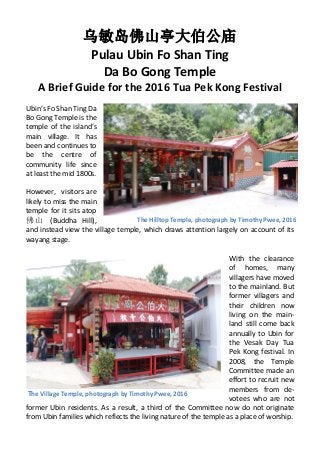
However, visitors are
likely to miss the main
temple for it sits atop
佛 山 (Buddha Hill),
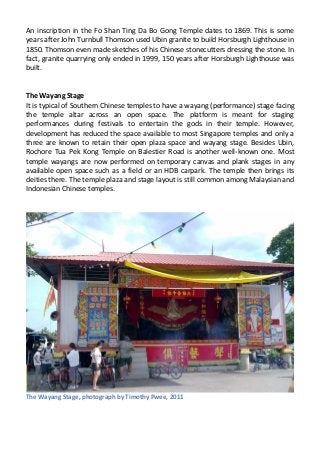
and instead view the village temple, which draws attention largely on account of its
wayang stage.
With the clearance
of homes, many
villagers have moved
to the mainland. But
former villagers and
their children now
living on the main-
land still come back
annually to Ubin for
the Vesak Day Tua
Pek Kong festival. In
2008, the Temple
Committee made an
effort to recruit new
members from de-
votees who are not
former Ubin residents. As a result, a third of the Committee now do not originate
from Ubin families which reflects the living nature of the temple as a place of worship.
The Hilltop Temple, photograph by Timothy Pwee, 2016
The Village Temple, photograph by Timothy Pwee, 2016
An inscription in the Fo Shan Ting Da Bo Gong Temple dates to 1869. This is some
years after John Turnbull Thomson used Ubin granite to build Horsburgh Lighthouse in
1850. Thomson even made sketches of his Chinese stonecutters dressing the stone. In
fact, granite quarrying only ended in 1999, 150 years after Horsburgh Lighthouse was
built.
The Wayang Stage
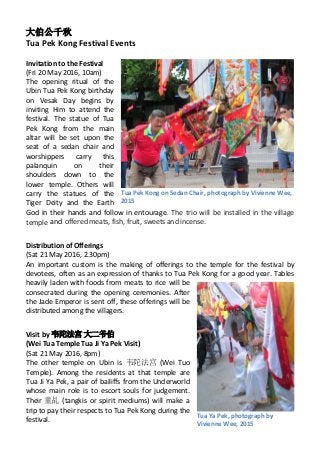
It is typical of Southern Chinese temples to have a wayang (performance) stage facing
the temple altar across an open space. The platform is meant for staging
performances during festivals to entertain the gods in their temple. However,
development has reduced the space available to most Singapore temples and only a
three are known to retain their open plaza space and wayang stage. Besides Ubin,
Rochore Tua Pek Kong Temple on Balestier Road is another well-known one. Most
temple wayangs are now performed on temporary canvas and plank stages in any
available open space such as a field or an HDB carpark. The temple then brings its
deities there. The temple plaza and stage layout is still common among Malaysian and
Indonesian Chinese temples.
The Wayang Stage, photograph by Timothy Pwee, 2011
大伯公 [Da Bo Gong in Mandarin]
Tua Pek Kong
Tua Pek Kong is the informal name for 福徳正
神 (Hock Teck Chia Sin), the local deity in
charge of prosperity. There is a Tua Pek Kong
for each location. For instance, the Ubin Tua
Pek Kong would be in charge of Pulau Ubin
while the Loyang Tua Pek Kong, another
famous Tua Pek Kong, is responsible for
Loyang.
The Tua Pek Kong 千秋 (birthday) is generally
celebrated on the second day of the second
lunar month. But the Ubin Tua Pek Kong
communicated his wish to have it on Vesak
Day instead. He gave the reason that since his
temple was on Ubin’s Buddha Hill, he would
strive to emulate the Buddha and become a
Boddhisatva. Hence the choice of Vesak Day,
Buddha’s birthday, as his festival day.
Besides Tua Pek Kong, there are two other deities enshrined in his temple: the Tiger
and Earth Gods.
虎爷 [Hu Ye in Mandarin]
Tiger Deity
The Hor Yeh or Tiger Deity is
commonly associated with
Tua Pek Kong and is a
protector against evil
influences and dark magic.
You will often see him
under the Tua Pek Kong
altar in other temples. At
Ubin, he has his own cave
beside the hilltop temple.
There, worshippers often
bring him offerings of meat
and eggs.
Ubin Tua Pek Kong, photograph by
Timothy Pwee, 2016
Tiger Deity, photograph by Timothy Pwee, 2016
玉皇上帝 [Yu Huang Shang Di in Mandarin]
The Jade Emperor
The ruler of the popular pantheon of
Chinese gods is the Jade Emperor. It is to His
court that the deities report. All temples
would have an urn at their entrance which
always faces south. All pay their respects
with incense to the Jade Emperor, putting
their joss sticks in the urn. Respects are paid
to him daily and also at the beginning and
end of every ceremonial occasion. That is
why ceremonies to Him open and close
festivals.
The Jade Emperor is more popularly called
天公 (ti kong) by the Hokkiens and often
worshipped daily in people’s homes. The Ti
Kong joss stick urn will be hung above the
main entrance or main window of their
homes. For shophouses, the urn is often
high on the wall or pillar by the entrance.
土地公 [Tu Di Gong in Mandarin]
Earth God
Much like the Tua Pek Kong, the Earth God or
Earth Deity is in charge of a local area but has a
specific focus on agricultural fertility. He is
common in agricultural villages across China.
There is also the Datuk Kong whose shrine is by
the village temple. Like his colleagues, the
Earth God and Tua Pek Kong, the Datuk Kong is
a locality deity.
Jade Emperor Tablet & Urn photograph by
Timothy Pwee, 2011
Earth God, photograph by Timothy
Pwee, 2016
大伯公千秋
Tua Pek Kong Festival Events
Invitation to the Festival
(Fri 20 May 2016, 10am)
The opening ritual of the
Ubin Tua Pek Kong birthday
on Vesak Day begins by
inviting Him to attend the
festival. The statue of Tua
Pek Kong from the main
altar will be set upon the
seat of a sedan chair and
worshippers carry this
palanquin on their
shoulders down to the
lower temple. Others will
carry the statues of the
Tiger Deity and the Earth
God in their hands and follow in entourage. The trio will be installed in the village
temple and offered meats, fish, fruit, sweets and incense.
Distribution of Offerings
(Sat 21 May 2016, 2.30pm)
An important custom is the making of offerings to the temple for the festival by
devotees, often as an expression of thanks to Tua Pek Kong for a good year. Tables
heavily laden with foods from meats to rice will be
consecrated during the opening ceremonies. After
the Jade Emperor is sent off, these offerings will be
distributed among the villagers.
Visit by 韦陀法宫 大二爷伯
(Wei Tua Temple Tua Ji Ya Pek Visit)
(Sat 21 May 2016, 8pm)
The other temple on Ubin is 韦陀法宫 (Wei Tuo
Temple). Among the residents at that temple are
Tua Ji Ya Pek, a pair of bailiffs from the Underworld
whose main role is to escort souls for judgement.
Their 童乩 (tangkis or spirit mediums) will make a
trip to pay their respects to Tua Pek Kong during the
festival.
1Tua Pek Kong on Sedan Chair, photograph by Vivienne Wee,
2015
Tua Ya Pek, photograph by
Vivienne Wee, 2015
Wayang
(Nightly Fri 20 to Tue 24 May 2016)
The traditional entertainment during
temple festivals is the wayang (Chinese
opera). The Pulau Ubin Tua Pek Kong
Temple traditionally engages a Teochew
troupe.新新荣和 (Sin Sin Yong Hwa) will be
performing this year. The performances
are from various operas and vary from year
to year but the final night (will be Tue 24
May this year) is always 葫芦收妖 (Gourd
Captures the Evil Spirits).
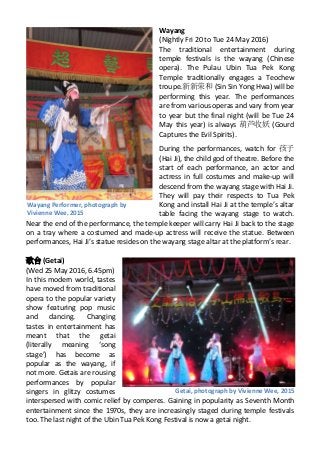
During the performances, watch for 孩子
(Hai Ji), the child god of theatre. Before the
start of each performance, an actor and
actress in full costumes and make-up will
descend from the wayang stage with Hai Ji.
They will pay their respects to Tua Pek
Kong and install Hai Ji at the temple’s altar
table facing the wayang stage to watch.
Near the end of the performance, the temple keeper will carry Hai Ji back to the stage
on a tray where a costumed and made-up actress will receive the statue. Between
performances, Hai Ji’s statue resides on the wayang stage altar at the platform’s rear.
歌台 (Getai)
(Wed 25 May 2016, 6.45pm)
In this modern world, tastes
have moved from traditional
opera to the popular variety
show featuring pop music
and dancing. Changing
tastes in entertainment has
meant that the getai
(literally meaning ‘song
stage’) has become as
popular as the wayang, if
not more. Getais are rousing
performances by popular
singers in glitzy costumes
interspersed with comic relief by comperes. Gaining in popularity as Seventh Month
entertainment since the 1970s, they are increasingly staged during temple festivals
too. The last night of the Ubin Tua Pek Kong Festival is now a getai night.
Wayang Performer, photograph by
Vivienne Wee, 2015
Getai, photograph by Vivienne Wee, 2015
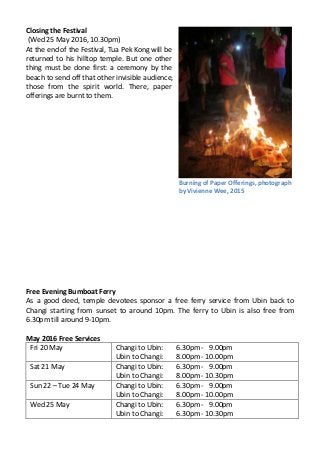
Closing the Festival
(Wed 25 May 2016, 10.30pm)
At the end of the Festival, Tua Pek Kong will be
returned to his hilltop temple. But one other
thing must be done first: a ceremony by the
beach to send off that other invisible audience,
those from the spirit world. There, paper
offerings are burnt to them.
Free Evening Bumboat Ferry
As a good deed, temple devotees sponsor a free ferry service from Ubin back to
Changi starting from sunset to around 10pm. The ferry to Ubin is also free from
6.30pm till around 9-10pm.
May 2016 Free Services
Fri 20 May Changi to Ubin:
Ubin to Changi:
6.30pm - 9.00pm
8.00pm - 10.00pm
Sat 21 May Changi to Ubin:
Ubin to Changi:
6.30pm - 9.00pm
8.00pm - 10.30pm
Sun 22 – Tue 24 May Changi to Ubin:
Ubin to Changi:
6.30pm - 9.00pm
8.00pm - 10.00pm
Wed 25 May Changi to Ubin:
Ubin to Changi:
6.30pm - 9.00pm
6.30pm - 10.30pm
Burning of Paper Offerings, photograph
by Vivienne Wee, 2015
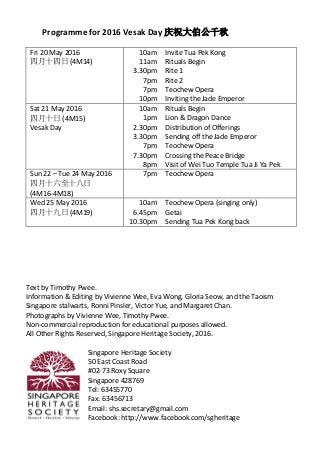
Programme for 2016 Vesak Day 庆祝大伯公千秋
Fri 20 May 2016
四月十四日 (4M14)
10am
11am
3.30pm
7pm
7pm
10pm
Invite Tua Pek Kong
Rituals Begin
Rite 1
Rite 2
Teochew Opera
Inviting the Jade Emperor
Sat 21 May 2016
四月十日 (4M15)
Vesak Day
10am
1pm
2.30pm
3.30pm
7pm
7.30pm
8pm
Rituals Begin
Lion & Dragon Dance
Distribution of Offerings
Sending off the Jade Emperor
Teochew Opera
Crossing the Peace Bridge
Visit of Wei Tuo Temple Tua Ji Ya Pek
Sun 22 – Tue 24 May 2016
四月十六至十八日
(4M16-4M18)
7pm Teochew Opera
Wed 25 May 2016
四月十九日 (4M19)
10am
6.45pm
10.30pm
Teochew Opera (singing only)
Getai
Sending Tua Pek Kong back
Text by Timothy Pwee.
Information & Editing by Vivienne Wee, Eva Wong, Gloria Seow, and the Taoism
Singapore stalwarts, Ronni Pinsler, Victor Yue, and Margaret Chan.
Photographs by Vivienne Wee, Timothy Pwee.
Non-commercial reproduction for educational purposes allowed.
All Other Rights Reserved, Singapore Heritage Society, 2016.
Singapore Heritage Society
50 East Coast Road
#02-73 Roxy Square
Singapore 428769
Tel: 63455770
Fax: 63456713
Email: shs.secretary@gmail.com
Facebook: http://www.facebook.com/sgheritage

Tua Pek Kong Festival: A Brief Guide by the Singapore Heritage Society

  • 1.
    乌敏岛佛山亭大伯公庙 Pulau Ubin FoShan Ting Da Bo Gong Temple A Brief Guide for the 2016 Tua Pek Kong Festival Ubin’s Fo Shan Ting Da Bo Gong Temple is the temple of the island’s main village. It has been and continues to be the centre of community life since at least the mid 1800s. However, visitors are likely to miss the main temple for it sits atop 佛 山 (Buddha Hill), and instead view the village temple, which draws attention largely on account of its wayang stage. With the clearance of homes, many villagers have moved to the mainland. But former villagers and their children now living on the main- land still come back annually to Ubin for the Vesak Day Tua Pek Kong festival. In 2008, the Temple Committee made an effort to recruit new members from de- votees who are not former Ubin residents. As a result, a third of the Committee now do not originate from Ubin families which reflects the living nature of the temple as a place of worship. The Hilltop Temple, photograph by Timothy Pwee, 2016 The Village Temple, photograph by Timothy Pwee, 2016
  • 2.
    An inscription inthe Fo Shan Ting Da Bo Gong Temple dates to 1869. This is some years after John Turnbull Thomson used Ubin granite to build Horsburgh Lighthouse in 1850. Thomson even made sketches of his Chinese stonecutters dressing the stone. In fact, granite quarrying only ended in 1999, 150 years after Horsburgh Lighthouse was built. The Wayang Stage It is typical of Southern Chinese temples to have a wayang (performance) stage facing the temple altar across an open space. The platform is meant for staging performances during festivals to entertain the gods in their temple. However, development has reduced the space available to most Singapore temples and only a three are known to retain their open plaza space and wayang stage. Besides Ubin, Rochore Tua Pek Kong Temple on Balestier Road is another well-known one. Most temple wayangs are now performed on temporary canvas and plank stages in any available open space such as a field or an HDB carpark. The temple then brings its deities there. The temple plaza and stage layout is still common among Malaysian and Indonesian Chinese temples. The Wayang Stage, photograph by Timothy Pwee, 2011
  • 3.
    大伯公 [Da BoGong in Mandarin] Tua Pek Kong Tua Pek Kong is the informal name for 福徳正 神 (Hock Teck Chia Sin), the local deity in charge of prosperity. There is a Tua Pek Kong for each location. For instance, the Ubin Tua Pek Kong would be in charge of Pulau Ubin while the Loyang Tua Pek Kong, another famous Tua Pek Kong, is responsible for Loyang. The Tua Pek Kong 千秋 (birthday) is generally celebrated on the second day of the second lunar month. But the Ubin Tua Pek Kong communicated his wish to have it on Vesak Day instead. He gave the reason that since his temple was on Ubin’s Buddha Hill, he would strive to emulate the Buddha and become a Boddhisatva. Hence the choice of Vesak Day, Buddha’s birthday, as his festival day. Besides Tua Pek Kong, there are two other deities enshrined in his temple: the Tiger and Earth Gods. 虎爷 [Hu Ye in Mandarin] Tiger Deity The Hor Yeh or Tiger Deity is commonly associated with Tua Pek Kong and is a protector against evil influences and dark magic. You will often see him under the Tua Pek Kong altar in other temples. At Ubin, he has his own cave beside the hilltop temple. There, worshippers often bring him offerings of meat and eggs. Ubin Tua Pek Kong, photograph by Timothy Pwee, 2016 Tiger Deity, photograph by Timothy Pwee, 2016
  • 4.
    玉皇上帝 [Yu HuangShang Di in Mandarin] The Jade Emperor The ruler of the popular pantheon of Chinese gods is the Jade Emperor. It is to His court that the deities report. All temples would have an urn at their entrance which always faces south. All pay their respects with incense to the Jade Emperor, putting their joss sticks in the urn. Respects are paid to him daily and also at the beginning and end of every ceremonial occasion. That is why ceremonies to Him open and close festivals. The Jade Emperor is more popularly called 天公 (ti kong) by the Hokkiens and often worshipped daily in people’s homes. The Ti Kong joss stick urn will be hung above the main entrance or main window of their homes. For shophouses, the urn is often high on the wall or pillar by the entrance. 土地公 [Tu Di Gong in Mandarin] Earth God Much like the Tua Pek Kong, the Earth God or Earth Deity is in charge of a local area but has a specific focus on agricultural fertility. He is common in agricultural villages across China. There is also the Datuk Kong whose shrine is by the village temple. Like his colleagues, the Earth God and Tua Pek Kong, the Datuk Kong is a locality deity. Jade Emperor Tablet & Urn photograph by Timothy Pwee, 2011 Earth God, photograph by Timothy Pwee, 2016
  • 5.
    大伯公千秋 Tua Pek KongFestival Events Invitation to the Festival (Fri 20 May 2016, 10am) The opening ritual of the Ubin Tua Pek Kong birthday on Vesak Day begins by inviting Him to attend the festival. The statue of Tua Pek Kong from the main altar will be set upon the seat of a sedan chair and worshippers carry this palanquin on their shoulders down to the lower temple. Others will carry the statues of the Tiger Deity and the Earth God in their hands and follow in entourage. The trio will be installed in the village temple and offered meats, fish, fruit, sweets and incense. Distribution of Offerings (Sat 21 May 2016, 2.30pm) An important custom is the making of offerings to the temple for the festival by devotees, often as an expression of thanks to Tua Pek Kong for a good year. Tables heavily laden with foods from meats to rice will be consecrated during the opening ceremonies. After the Jade Emperor is sent off, these offerings will be distributed among the villagers. Visit by 韦陀法宫 大二爷伯 (Wei Tua Temple Tua Ji Ya Pek Visit) (Sat 21 May 2016, 8pm) The other temple on Ubin is 韦陀法宫 (Wei Tuo Temple). Among the residents at that temple are Tua Ji Ya Pek, a pair of bailiffs from the Underworld whose main role is to escort souls for judgement. Their 童乩 (tangkis or spirit mediums) will make a trip to pay their respects to Tua Pek Kong during the festival. 1Tua Pek Kong on Sedan Chair, photograph by Vivienne Wee, 2015 Tua Ya Pek, photograph by Vivienne Wee, 2015
  • 6.
    Wayang (Nightly Fri 20to Tue 24 May 2016) The traditional entertainment during temple festivals is the wayang (Chinese opera). The Pulau Ubin Tua Pek Kong Temple traditionally engages a Teochew troupe.新新荣和 (Sin Sin Yong Hwa) will be performing this year. The performances are from various operas and vary from year to year but the final night (will be Tue 24 May this year) is always 葫芦收妖 (Gourd Captures the Evil Spirits). During the performances, watch for 孩子 (Hai Ji), the child god of theatre. Before the start of each performance, an actor and actress in full costumes and make-up will descend from the wayang stage with Hai Ji. They will pay their respects to Tua Pek Kong and install Hai Ji at the temple’s altar table facing the wayang stage to watch. Near the end of the performance, the temple keeper will carry Hai Ji back to the stage on a tray where a costumed and made-up actress will receive the statue. Between performances, Hai Ji’s statue resides on the wayang stage altar at the platform’s rear. 歌台 (Getai) (Wed 25 May 2016, 6.45pm) In this modern world, tastes have moved from traditional opera to the popular variety show featuring pop music and dancing. Changing tastes in entertainment has meant that the getai (literally meaning ‘song stage’) has become as popular as the wayang, if not more. Getais are rousing performances by popular singers in glitzy costumes interspersed with comic relief by comperes. Gaining in popularity as Seventh Month entertainment since the 1970s, they are increasingly staged during temple festivals too. The last night of the Ubin Tua Pek Kong Festival is now a getai night. Wayang Performer, photograph by Vivienne Wee, 2015 Getai, photograph by Vivienne Wee, 2015
  • 7.
    Closing the Festival (Wed25 May 2016, 10.30pm) At the end of the Festival, Tua Pek Kong will be returned to his hilltop temple. But one other thing must be done first: a ceremony by the beach to send off that other invisible audience, those from the spirit world. There, paper offerings are burnt to them. Free Evening Bumboat Ferry As a good deed, temple devotees sponsor a free ferry service from Ubin back to Changi starting from sunset to around 10pm. The ferry to Ubin is also free from 6.30pm till around 9-10pm. May 2016 Free Services Fri 20 May Changi to Ubin: Ubin to Changi: 6.30pm - 9.00pm 8.00pm - 10.00pm Sat 21 May Changi to Ubin: Ubin to Changi: 6.30pm - 9.00pm 8.00pm - 10.30pm Sun 22 – Tue 24 May Changi to Ubin: Ubin to Changi: 6.30pm - 9.00pm 8.00pm - 10.00pm Wed 25 May Changi to Ubin: Ubin to Changi: 6.30pm - 9.00pm 6.30pm - 10.30pm Burning of Paper Offerings, photograph by Vivienne Wee, 2015
  • 8.
    Programme for 2016Vesak Day 庆祝大伯公千秋 Fri 20 May 2016 四月十四日 (4M14) 10am 11am 3.30pm 7pm 7pm 10pm Invite Tua Pek Kong Rituals Begin Rite 1 Rite 2 Teochew Opera Inviting the Jade Emperor Sat 21 May 2016 四月十日 (4M15) Vesak Day 10am 1pm 2.30pm 3.30pm 7pm 7.30pm 8pm Rituals Begin Lion & Dragon Dance Distribution of Offerings Sending off the Jade Emperor Teochew Opera Crossing the Peace Bridge Visit of Wei Tuo Temple Tua Ji Ya Pek Sun 22 – Tue 24 May 2016 四月十六至十八日 (4M16-4M18) 7pm Teochew Opera Wed 25 May 2016 四月十九日 (4M19) 10am 6.45pm 10.30pm Teochew Opera (singing only) Getai Sending Tua Pek Kong back Text by Timothy Pwee. Information & Editing by Vivienne Wee, Eva Wong, Gloria Seow, and the Taoism Singapore stalwarts, Ronni Pinsler, Victor Yue, and Margaret Chan. Photographs by Vivienne Wee, Timothy Pwee. Non-commercial reproduction for educational purposes allowed. All Other Rights Reserved, Singapore Heritage Society, 2016. Singapore Heritage Society 50 East Coast Road #02-73 Roxy Square Singapore 428769 Tel: 63455770 Fax: 63456713 Email: shs.secretary@gmail.com Facebook: http://www.facebook.com/sgheritage