catalogolame
bladescatalogue
02
Techno Trade Group, che è una realtà giovane composta da professionisti della Distribuzione Industriale,
consolidati da moltissimi anni di storie di successo in Italia, si propone come fornitore di una selezione di prodotti
professionali di alta gamma, contenuti in numerosi cataloghi tecnici tematici di semplice ed immediato utilizzo.
I cataloghi Ttake sono dei veri e propri strumenti di lavoro per chi effettua acquisti in ambito
professionale.
Soluzioni per ogni specifica esigenza nel comparto industriale, prodotti unicamente europei, schede tecniche
aggiornate e sempre disponibili all’utenza più esigente, chiarezza di contenuti ed estrema flessibilità operativa:
sono questi gli elementi che contraddistinguono la filosofia commerciale dei prodotti Ttake.
Una gamma completa e di alta qualità gestita da una qualificata Rete Distributiva e caratterizzata dalla capacità
di proporre soluzioni tecniche sempre all’avanguardia.
Queste sono le vere armi di un marchio proiettato ai professionisti più esigenti di ogni settore industriale.
Ttake, al centro del tuo lavoro!
Techno Trade Group, che è una realtà giovane composta da professionisti della Distribuzione Industriale, consolidati da
moltissimi anni di storie di successo in Italia, si propone come fornitore di una selezione di prodotti professionali di alta
gamma, contenuti in numerosi cataloghi tecnici tematici di semplice ed immediato utilizzo.
I cataloghi Ttake sono dei veri e propri strumenti di lavoro per chi effettua acquisti in ambito professionale.
Soluzioni per ogni specifica esigenza nel comparto industriale, prodotti unicamente europei, schede tecniche aggiornate e
sempre disponibili all’utenza più esigente, chiarezza di contenuti ed estrema flessibilità operativa: sono questi gli elementi che
contraddistinguono la filosofia commerciale dei prodotti Ttake.
Una gamma completa e di alta qualità gestita da una qualificata Rete Distributiva e caratterizzata dalla capacità di proporre
soluzioni tecniche sempre all’avanguardia.
Queste sono le vere armi di un marchio proiettato ai professionisti più esigenti di ogni settore industriale.
Ttake, al centro del tuo lavoro!
Techno Trade is a young Group made up of several professional companies, operating in the Italian Industrial Distribution since
many years. Techno Trade Group introduces itself as a supplier of a selection of high quality professional products included in
several thematic catalogues easy to use.
The Ttake catalogues are proper work tools for the buyers operating in the professional sector.
Solutions for each specific requirement in the industrial sector, European products only, technical sheets always updated
and always available for the end users, high operating flexibility: these are the main features that represent the commercial
philosophy of the Ttake’s products.
A complete range of high quality products managed by a skilled Sales Network that can offer technical solutions in the forefront.
This is the real weapon of a brand dedicated to the demanding professionals in each industrial sector.
Ttake, in the core of your business!
Per ottenere la descrizione completa dei servizi offerti da Techno Trade Group, vi invitiamo a visitare il nostro sito web all’indirizzo:
www.ttgroup.it
Visit our web site www.ttgroup.it and you will discover all the services offered by Techno Trade Group.
catalogolame02
bladescatalogue02
Catalogo Lame Ttake
Un catalogo completo con prodotti di elevata qualità e
tecnologicamente avanzati, in grado di soddisfare le specifiche
esigenze di taglio degli operatori professionali nei vari settori:
manutenzione, officine meccaniche, edilizia, industria.
Il catalogo è suddiviso in 7 capitoli: lame per segatrici a
nastro, seghe e frese a tazza ed accessori, lame per macchine
alternative, lame per seghetti manuali, seghe circolari, fluidi
lubrorefrigeranti, accessori. All’interno del catalogo sono
presenti guide con tabelle e immagini che aiutano l’utente nella
scelta del prodotto più idoneo alle sue necessità.
Un’ampia scelta di lame e seghe di varie tipologie, dentature,
misure e una selezione di accessori per garantire una gamma
di prodotti completa.
Scoprite il mondo delle Lame Ttake:
una soluzione per ogni esigenza!
www.ttake.it
Ttake’s Blades Catalogue
A complete catalogue with high quality and technologically
advanced products, to meet the specific needs of cutting
of professional operators in various areas: maintenance,
automotive, construction, industry.
The catalogue is divided into 7 chapters: band saws blades,
hole saws and accessories, blades for alternative saw
machines, hacksaw blades, circular saw blades, coolant fluids
and accessories. Through the catalogue there are guides with
tables and graphics that help users to choose the product that
best suits their needs.
A wide choice of blades and saws of various types, teeth,
sizes and a selection of accessories to guarantee a full range
of products.
Discover the world of Ttake’s Blades:
a solution for every need!
www.ttake.it
1 	 Lame per segatrici a nastro | Band saw blades 	 pag. 	 6
1.1 	 Guida alla scelta della lama | Blade’s selection guide 	 pag. 	 8
1.2 	 Lame bimetalliche | Bimetal blades	 pag. 	20
1.3	 Lame con dentatura in metallo duro | Blades with carbide toothing	 pag. 	28
	 Suggerimenti per la soluzione dei principali problemi legati all’uso delle segatrici a nastro		 pag.	34	
	 Suggestions for the solution of the main problem while using band saw blades
	
	 Servizio consulenza tecnica | Technical advice service	 pag. 	40
2 	 Seghe e frese a tazza ed accessori | Hole saws and accessories	 pag. 	42
3 	 Lame per macchine alternative | Blades for alternative saw machines 	 pag. 	56
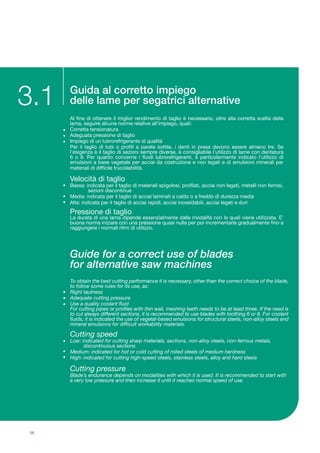
	 Guida al corretto impiego delle lame per segatrici alternative 	3.1		 pag. 	58	
	 Guide for a correct use of blades for alternative saw machines
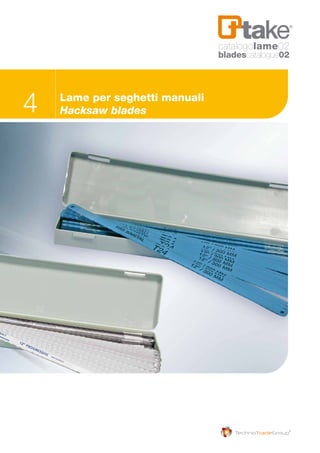
4 	 Lame per seghetti manuali | Hacksaw blades 	 pag.	 60
5	 Seghe circolari | Circular saw blades	 pag. 	64
6 	 Fluidi lubrorefrigeranti | Coolant fluids 	 pag. 	68
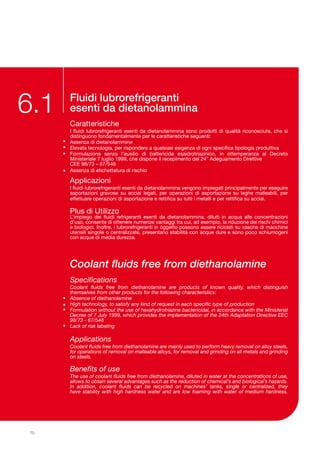
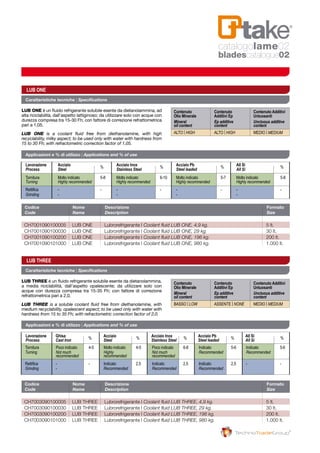
6.1 	 Fluidi lubrorefrigeranti esenti da dietanolammina | Coolant fluids free from diethanolamine 	 pag. 	70
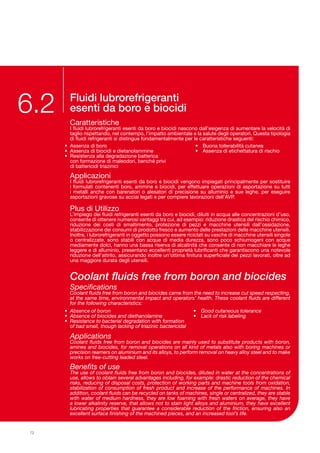
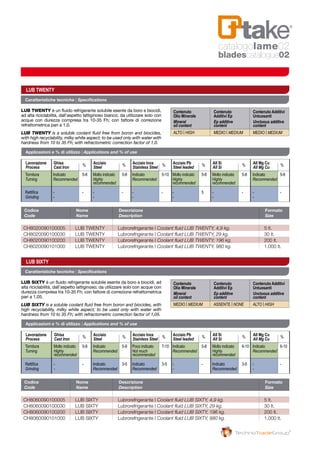
6.2	 Fluidi lubrorefrigeranti esenti da boro e biocidi | Coolant fluids free from boron and biocides 	 pag. 	72
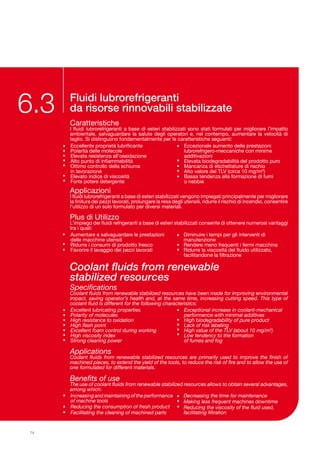
	 Fluidi lubrorefrigeranti da risorse rinnovabili stabilizzate			6.3		 pag. 	74
	 Coolant fluids from renewable stabilized resources 	
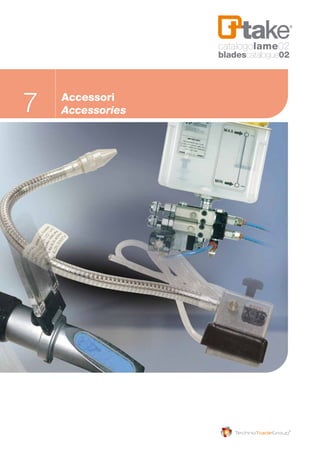
7 	 Accessori | Accessories 	 pag. 	76
Indice prodotti
Index
catalogolame02
bladescatalogue02
6
1 Lame per segatrici a nastro
Band saw blades
catalogolame02
bladescatalogue02
Guida alla scelta della lama
Blade’s selection guide
Sviluppo, altezza e spessore della lama
La dimensione della lama dipende dalla segatrice che si utilizza. Per una corretta selezione
della lama più adatta, è necessario consultare quindi il manuale tecnico di utilizzo della
segatrice stessa.
Qualità
Le lame a nastro Ttake vengono proposte con due tipi di materiali del tagliente: bimetallico
e metallo duro. La scelta della qualità del nastro da impiegare dipende principalmente dal
materiale che si intende tagliare. In particolare, le principali caratteristiche del materiale
da considerare sono la durezza (intesa come resistenza all’asportazione del truciolo) e la
configurazione.
Dentatura
La scelta della dentatura corretta è determinata dalla sezione e dalla configurazione del
pezzo da tagliare. Normalmente la dentatura costante (i denti presentano una geometria
uniforme e si susseguono con la medesima spaziatura) viene utilizzata per il taglio di sezioni
piene o, comunque, regolari (3, 4, 6, 8, 10, 14 denti x pollice).
La dentatura variabile (i denti presentano una geometria diversificata e si susseguono con
una differente spaziatura) è generalmente indicata per il taglio di profilati o di sezioni non
costanti (2/3, 3/4, 4/6, 5/8, 6/10, 8/12, 10/14 denti x pollice).
Per entrambe le tipologie di dentatura è comunque fondamentale che, in fase di taglio,
almeno 3 denti siano contemporaneamente in presa sul pezzo da tagliare.
Development, height and thickness of the blade
The size of the blade depends on the sawing machine that is used. For a correct selection
of the most suitable blade, you need to consult the technical manual of the sawing machine.
Quality
Ttake’s band saw blades are offered with two types of material of the cutting edge: bimetal
and carbide. The choice of the quality of the band to be used depends first of all on the
material to be cut. In particular, the main characteristics of the material to consider are the
hardness (as resistance to the removal of the chip) and the configuration.
Toothing
The choice of the correct toothing is determined by the section and the configuration of
the piece to be cut. Usually a constant toothing (teeth have a uniform geometry and follow
one another with the same spacing) is used to cut solid or regular sections (3, 4, 6, 8, 10,
14 teeth per inch).
The variable toothing (teeth have a diversified geometry and follow one another with a
different spacing) is generally indicated to cut shapes or non-constant sections (2/3, 3/4,
4/6, 5/8, 6/10, 8/12, 10/14 teeth per inch).
However, for both types of toothing is essential that, during the cutting phase, at least 3
teeth are simultaneously in mesh on the piece to be cut.
8
1.1
catalogolame02
bladescatalogue02
Caratteristiche tecniche | Specifications
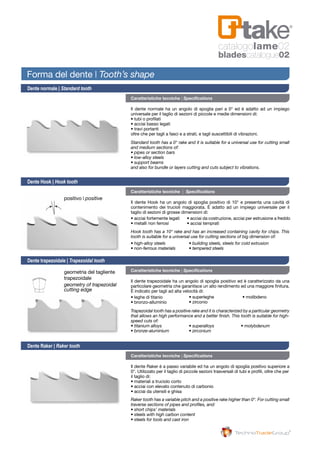
Il dente normale ha un angolo di spoglia pari a 0° ed è adatto ad un impiego
universale per il taglio di sezioni di piccole e medie dimensioni di:
• tubi o profilati
• acciai basso legati
• travi portanti
oltre che per tagli a fasci e a strati, e tagli suscettibili di vibrazioni.
Il dente Raker è a passo variabile ed ha un angolo di spoglia positivo superiore a
0°. Utilizzato per il taglio di piccole sezioni trasversali di tubi e profili, oltre che per
il taglio di:
• materiali a truciolo corto
• acciai con elevato contenuto di carbonio
• acciai da utensili e ghisa
Standard tooth has a 0° rake and it is suitable for a universal use for cutting small
and medium sections of:
• pipes or section bars
• low-alloy steels
• support beams
and also for bundle or layers cutting and cuts subject to vibrations.
Dente normale | Standard tooth
Dente Hook | Hook tooth
Dente trapezoidale | Trapezoidal tooth
Dente Raker | Raker tooth
Forma del dente | Tooth’s shape
Hook tooth has a 10° rake and has an increased containing cavity for chips. This
tooth is suitable for a universal use for cutting sections of big dimension of:
• high-alloy steels
• non-ferrous materials
• building steels, steels for cold extrusion
• tempered steels
Il dente Hook ha un angolo di spoglia positivo di 10° e presenta una cavità di
contenimento dei trucioli maggiorata. È adatto ad un impiego universale per il
taglio di sezioni di grosse dimensioni di:
• acciai fortemente legati
• metalli non ferrosi
• acciai da costruzione, acciai per estrusione a freddo
• acciai temprati
Il dente trapezoidale ha un angolo di spoglia positivo ed è caratterizzato da una
particolare geometria che garantisce un alto rendimento ed una maggiore finitura.
È indicato per tagli ad alta velocità di:
• leghe di titanio
• bronzo-alluminio
• superleghe
• zirconio
• molibdeno
Trapezoidal tooth has a positive rake and it is characterized by a particular geometry
that allows an high performance and a better finish. This tooth is suitable for high-
speed cuts of:
• titanium alloys
• bronze-aluminium
• superalloys
• zirconium
• molybdenum
Raker tooth has a variable pitch and a positive rake higher than 0°. For cutting small
traverse sections of pipes and profiles, and:
• short chips’ materials
• steels with high carbon content
• steels for tools and cast iron
positivo | positive
geometria del tagliente
trapezoidale
geometry of trapezoidal
cutting edge
10
Caratteristiche tecniche | Specifications
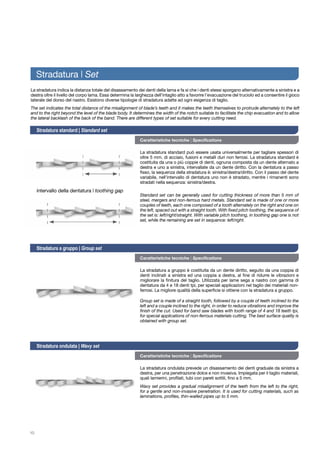
La stradatura standard può essere usata universalmente per tagliare spessori di
oltre 5 mm. di acciaio, fusioni e metalli duri non ferrosi. La stradatura standard è
costituita da una o più coppie di denti, ognuna composta da un dente alternato a
destra e uno a sinistra, intervallate da un dente diritto. Con la dentatura a passo
fisso, la sequenza della stradatura è: sinistra/destra/diritto. Con il passo del dente
variabile, nell’intervallo di dentatura uno non è stradato, mentre i rimanenti sono
stradati nella sequenza: sinistra/destra.
La stradatura a gruppo è costituita da un dente diritto, seguito da una coppia di
denti inclinati a sinistra ed una coppia a destra, al fine di ridurre le vibrazioni e
migliorare la finitura del taglio. Utilizzata per lame sega a nastro con gamma di
dentatura da 4 e 18 denti tpi, per speciali applicazioni nel taglio dei materiali non-
ferrosi. La migliore qualità della superficie si ottiene con la stradatura a gruppo.
La stradatura ondulata prevede un disassamento dei denti graduale da sinistra a
destra, per una penetrazione dolce e non invasiva. Impiegata per il taglio materiali,
quali lamierini, profilati, tubi con pareti sottili, fino a 5 mm.
La stradatura indica la distanza totale del disassamento dei denti della lama e fa sì che i denti stessi sporgano alternativamente a sinistra e a
destra oltre il livello del corpo lama. Essa determina la larghezza dell’intaglio atto a favorire l’evacuazione del truciolo ed a consentire il gioco
laterale del dorso del nastro. Esistono diverse tipologie di stradatura adatte ad ogni esigenza di taglio.
The set indicates the total distance of the misalignment of blade’s teeth and it makes the teeth themselves to protrude alternately to the left
and to the right beyond the level of the blade body. It determines the width of the notch suitable to facilitate the chip evacuation and to allow
the lateral backlash of the back of the band. There are different types of set suitable for every cutting need.
Standard set can be generally used for cutting thickness of more than 5 mm of
steel, mergers and non-ferrous hard metals. Standard set is made of one or more
couples of teeth, each one composed of a tooth alternately on the right and one on
the left, spaced out with a straight tooth. With fixed pitch toothing, the sequence of
the set is: left/right/straight. With variable pitch toothing, in toothing gap one is not
set, while the remaining are set in sequence: left/right.
Group set is made of a straight tooth, followed by a couple of teeth inclined to the
left and a couple inclined to the right, in order to reduce vibrations and improve the
finish of the cut. Used for band saw blades with tooth range of 4 and 18 teeth tpi,
for special applications of non-ferrous materials cutting. The best surface quality is
obtained with group set.
Wavy set provides a gradual misalignment of the teeth from the left to the right,
for a gentle and non-invasive penetration. It is used for cutting materials, such as
laminations, profiles, thin-walled pipes up to 5 mm.
Stradatura standard | Standard set
Stradatura a gruppo | Group set
Stradatura ondulata | Wavy set
Stradatura | Set
intervallo della dentatura | toothing gap
Passo dente costante (tpi)	 Lungh contatto dent.-pz (mm.)
	 Fixed pitch toothing (tpi) 	 Contact tooth-pc length (mm.)
	 Passo dente costante (tpi)	 Lungh contatto dent.-pz (mm.)
	Variable pitch toothing (tpi) 	 Contact tooth-pc length (mm.)
	 Passo dente costante (tpi)	 Lungh contatto dent.-pz (mm.)
	 Fixed pitch toothing (tpi) 	 Contact tooth-pc length (mm.)
	 Passo dente costante (tpi)	 Lungh contatto dent.-pz (mm.)
	Variable pitch toothing (tpi) 	 Contact tooth-pc length (mm.)
	 10 – 14 	
	 8 – 12 	
	 6 – 10 	
	 5 – 8 	
	 4 – 6 	
	 5 – 5 	
fino a 30 | until 30
20 ÷ 50
25 ÷ 60
35 ÷ 80
	 50 ÷ 100
70 ÷ 120
	24	
	 18 	
	14	
	 10 	
	 8 	
fino a 6 | until 6
fino a 10 | until 10
	 fino a 15 | until 15
15 ÷ 30
30 ÷ 50
	 3 – 4 	
	 2 – 3 	
1,4 – 2 	
1,0 – 1,4 	
	0,75 – 1,25 	
0,70 – 1,0 	
	 80 ÷ 150
	 120 ÷ 350
	 250 ÷ 600
	 400 ÷ 1.000
	 700 ÷ 1.400
	 900 ÷ 3.000
	 6 	
	 4 	
	 3 	 120 ÷ 200
	 2 	 200 ÷ 400
	 1,25 	 300 ÷ 800
Caratteristiche tecniche | Specifications
Questa tipologia di dentatura presenta una distanza costante tra dente e dente.
È particolarmente indicata per tagliare materiali solidi su segatrici con bloccaggio
ottimale del pezzo.
La dentatura a passo variabile consiste nella presenza di gruppi di denti alternati
ripetuti ad intervalli regolari su tutta la lama. L’utilizzo di questa tipologia di
dentatura consente una riduzione delle vibrazioni causate dalla risonanza durante
il taglio. È adatta al taglio di pezzi vuoti con pareti sottili e materiale in fasci o con
un bloccaggio debole.
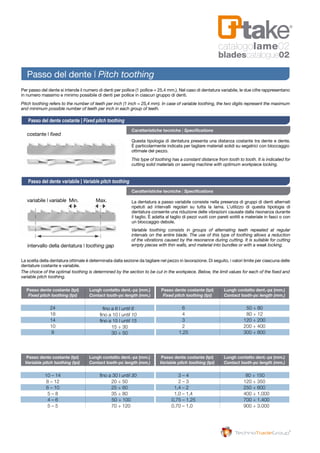
Per passo del dente si intende il numero di denti per pollice (1 pollice = 25,4 mm.). Nel caso di dentatura variabile, le due cifre rappresentano
in numero massimo e minimo possibile di denti per pollice in ciascun gruppo di denti.
La scelta della dentatura ottimale è determinata dalla sezione da tagliare nel pezzo in lavorazione. Di seguito, i valori limite per ciascuna delle
dentature costante e variabile.
The choice of the optimal toothing is determined by the section to be cut in the workpiece. Below, the limit values for each of the fixed and
variable pitch toothing.
Pitch toothing refers to the number of teeth per inch (1 inch = 25,4 mm). In case of variable toothing, the two digits represent the maximum
and minimum possible number of teeth per inch in each group of teeth.
This type of toothing has a constant distance from tooth to tooth. It is indicated for
cutting solid materials on sawing machine with optimum workpiece locking.
Variable toothing consists in groups of alternating teeth repeated at regular
intervals on the entire blade. The use of this type of toothing allows a reduction
of the vibrations caused by the resonance during cutting. It is suitable for cutting
empty pieces with thin walls, and material into bundles or with a weak locking.
Passo del dente costante | Fixed pitch toothing
Passo del dente variabile | Variable pitch toothing
Passo del dente | Pitch toothing
intervallo della dentatura | toothing gap
costante | fixed
variabile | variable	 Min.	Max.
50 ÷ 80
80 ÷ 12
catalogolame02
bladescatalogue02
12
	Spessore 							 Lunghezza di contatto (mm.)
	S (mm.)					 L Diametro esterno del tubo (mm.) / passo del dente in tpi	
	Thickness 								Contact length (mm.)
	S (mm.)					 L Pipe external diameter (mm.) / toothing pitch in tpi
		 20 	 40 	 60 	 80 	 100 	 120 	 150 	 200 	 300 	 400 	 500 	 600 	 700 	 800 	 900 	 1000 	 1500
2 	 14 	 14 	 10/14	 10/14 	10/14 	10/14	 10/14 	 8/12 	 8/12 	 8/12 	 6/10 	 6/10 	 5/8 	 5/8 	 5/8 	 5/8 	 5/8
3 	 10/14 	10/14 	10/14 	10/14 	 8/12 	 8/12 	 8/12 	 6/10 	 6/10 	 6/10 	 5/8 	 5/8 	 5/8 	 4/6 	 4/6 	 4/6 	 4/6
4 	 8/12 	 8/12 	 8/12 	 8/12 	 8/12 	 6/10 	 6/10 	 6/10 	 5/8 	 5/8 	 4/6 	 4/6 	 4/6 	 4/6 	 4/6 	 4/6 	 3/4
5 	 8/12 	 8/12 	 8/12 	 6/10 	 6/10 	 6/10 	 6/10 	 5/8 	 5/8 	 5/8 	 4/6 	 4/6 	 4/6 	 4/6 	 3/4 	 3/4 	 3/4
6 	 6/10 	 6/10 	 6/10 	 6/10 	 6/10 	 6/10 	 5/8 	 5/8 	 5/8 	 4/6 	 4/6 	 4/6 	 3/4 	 3/4 	 3/4 	 3/4 	 3/4
8 	 6/10 	 6/10 	 6/10 	 6/10 	 5/8 	 5/8 	 5/8 	 4/6 	 4/6 	 4/6 	 4/6 	 3/4 	 3/4 	 3/4 	 3/4 	 2/3 	 2/3
10 		 5/8 	 5/8 	 5/8 	 5/8 	 5/8 	 4/6 	 4/6 	 4/6 	 4/6 	 3/4 	 3/4 	 3/4 	 3/4 	 2/3 	 2/3 	 2/3
12 		 5/8 	 5/8 	 5/8 	 4/6 	 4/6 	 4/6 	 4/6 	 4/6 	 3/4 	 3/4 	 3/4 	 3/4 	 2/3 	 2/3 	 2/3 	 2/3
15 		 4/6 	 4/6 	 4/6 	 4/6 	 4/6 	 3/4 	 3/4 	 3/4 	 3/4 	 3/4 	 2/3 	 2/3 	 2/3 	 2/3 	 2/3 	 2/3
20 			 4/6 	 4/6 	 3/4 	 3/4 	 3/4 	 3/4 	 3/4 	 3/4 	 2/3 	 2/3 	 2/3 	 2/3 	 2/3 	 2/3 	 2/3
30 				 3/4 	 3/4 	 3/4 	 2/3 	 2/3 	 2/3 	 2/3 	 2/3 	 2/3 	 2/3 	 2/3 	 2/3 	 2/3 	 1,5/2
50 						 2/3 	 2/3 	 2/3 	 2/3 	 2/3 	 2/3 	 2/3 	 2/3 	 2/3 	 1,5/2 	 1,5/2 	 1,5/2
75 								 2/3 	 2/3 	 2/3 	 2/3 	 2/3 	 1,5/2 	 1,5/2 	 1,5/2 	 1,5/2 	 1,5/2
100 									 2/3 	 2/3 	 1,5/2 	 1,5/2 	1,5/2 	 1,5/2 	 1,5/2 	 1,5/2 	 0,75/1,25
150 										 2/3 	 1,5/2 	 1,5/2 	1,5/2 	 1,5/2 	 1,5/2 	 0,75/1,25 	0,75/1,25
200 											 1,5/2 	 1,5/2 	1,5/2 	 1,5/2 	 0,75/1,25 	0,75/1,25 	0,75/1,25
250 												 1,5/2 	1,5/2 	 0,75/1,25 	0,75/1,25 	0,75/1,25 	0,75/1,25
300 													1,5/2 	0,75/1,25 	0,75/1,25 	0,75/1,25 	0,75/1,25
350 														0,75/1,25 	0,75/1,25 	0,75/1,25 	0,75/1,25
400 															0,75/1,25 	0,75/1,25 	0,75/1,25
450 																0,75/1,25 	0,75/1,25
500 																	0,75/1,25
Caratteristiche tecniche | Specifications
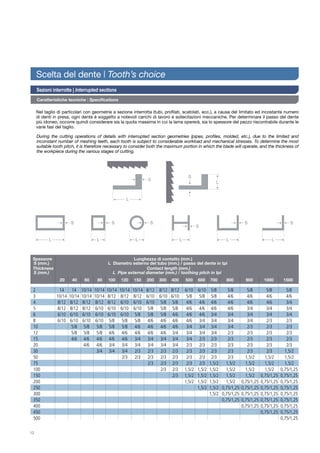
Nel taglio di particolari con geometrie a sezione interrotta (tubi, profilati, scatolati, ecc.), a causa del limitato ed incostante numero
di denti in presa, ogni dente è soggetto a notevoli carichi di lavoro e sollecitazioni meccaniche. Per determinare il passo del dente
più idoneo, occorre quindi considerare sia la quota massima in cui la lama opererà, sia lo spessore del pezzo riscontrabile durante le
varie fasi del taglio.
During the cutting operations of details with interrupted section geometries (pipes, profiles, molded, etc.), due to the limited and
inconstant number of meshing teeth, each tooth is subject to considerable workload and mechanical stresses. To determine the most
suitable tooth pitch, it is therefore necessary to consider both the maximum portion in which the blade will operate, and the thickness of
the workpiece during the various stages of cutting.
Sezioni interrotte | Interrupted sections
Scelta del dente | Tooth’s choice
catalogolame02
bladescatalogue02
Caratteristiche tecniche | Specifications
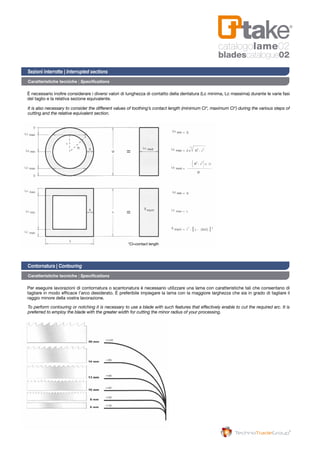
È necessario inoltre considerare i diversi valori di lunghezza di contatto della dentatura (Lc minima, Lc massima) durante le varie fasi
del taglio e la relativa sezione equivalente.
Per eseguire lavorazioni di contornatura o scantonatura è necessario utilizzare una lama con caratteristiche tali che consentano di
tagliare in modo efficace l’arco desiderato. È preferibile impiegare la lama con la maggiore larghezza che sia in grado di tagliare il
raggio minore della vostra lavorazione.
It is also necessary to consider the different values of toothing’s contact length (minimum Cl*, maximum Cl*) during the various steps of
cutting and the relative equivalent section.
To perform contouring or notching it is necessary to use a blade with such features that effectively enable to cut the required arc. It is
preferred to employ the blade with the greater width for cutting the minor radius of your processing.
Sezioni interrotte | Interrupted sections
Contornatura | Contouring
*Cl=contact length
14
Caratteristiche tecniche | Specifications
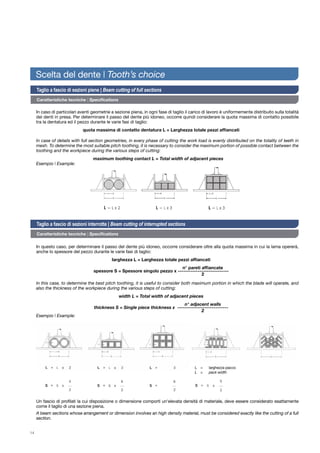
In caso di particolari aventi geometrie a sezione piena, in ogni fase di taglio il carico di lavoro è uniformemente distribuito sulla totalità
dei denti in presa. Per determinare il passo del dente più idoneo, occorre quindi considerare la quota massima di contatto possibile
tra la dentatura ed il pezzo durante le varie fasi di taglio:
	 quota massima di contatto dentatura L = Larghezza totale pezzi affiancati
In questo caso, per determinare il passo del dente più idoneo, occorre considerare oltre alla quota massima in cui la lama opererà,
anche lo spessore del pezzo durante le varie fasi di taglio:
	 larghezza L = Larghezza totale pezzi affiancati
	 	 n° pareti affiancate
	 spessore S = Spessore singolo pezzo x ----------------------------
		2
In this case, to determine the best pitch toothing, it is useful to consider both maximum portion in which the blade will operate, and
also the thickness of the workpiece during the various steps of cutting:
	 width L = Total width of adjacent pieces
		 n° adjacent walls
	 thickness S = Single piece thickness x ----------------------------
		2
Esempio | Example:
In case of details with full section geometries, in every phase of cutting the work load is evenly distributed on the totality of teeth in
mesh. To determine the most suitable pitch toothing, it is necessary to consider the maximum portion of possible contact between the
toothing and the workpiece during the various steps of cutting:
	 maximum toothing contact L = Total width of adjacent pieces
Esempio | Example:
Taglio a fascio di sezioni piene | Beam cutting of full sections
Taglio a fascio di sezioni interrotte | Beam cutting of interrupted sections
Un fascio di profilati la cui disposizione o dimensione comporti un'elevata densità di materiale, deve essere considerato esattamente
come il taglio di una sezione piena.
A beam sections whose arrangement or dimension involves an high density material, must be considered exactly like the cutting of a full
section.
L 	= 	pack width
L 	= 	larghezza pacco
Scelta del dente | Tooth’s choice
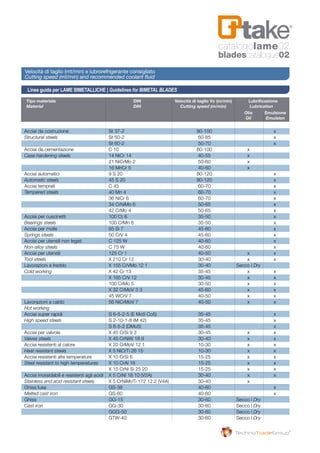
Tipo materiale 	 DIN 	 Velocità di taglio Vc (m/min) 		Lubrificazione
	 Material	 DIN	 Cutting speed (m/min)		Lubrication
								
				 Olio		 Emulsione
				 Oil		 Emulsion
	Acciai da costruzione	 St 37-2	 80-100		 x
	Structural steels	 St 50-2	 60-85		 x
		 St 60-2	 50-70		 x
	Acciai da cementazione	 C 10	 80-100	 x	
	Case hardening steels	 14 NiCr 14	 40-55	 x	
		 21 NiCrMo 2	 50-60	 x	
		 16 MnCr 5	 40-60	 x	
	Acciai automatici	 9 S 20	 80-120		 x
	Automatic steels	 45 S 20	 80-120		 x
	Acciai temprati	 C 45	 60-70		 x
	Tempered steels	 40 Mn 4	 60-70		 x
		 36 NiCr 6	 60-70		 x
		 34 CrNiMo 6	 50-65		 x
		 42 CrMo 4	 50-65		 x
	Acciai per cuscinetti	 100 Cr 6	 35-50		 x
	Bearings steels	 100 CrMn 6	 35-50		 x
	Acciai per molle	 65 Si 7	 45-60		 x
	Springs steels	 50 CrV 4	 45-60		 x
	Acciai per utensili non legati	 C 125 W	 40-60		 x
	Non-alloy steels	 C 75 W	 40-60		 x
	Acciai per utensili	 125 Cr 1	 40-50	 x	 x
	Tool steels	 X 210 Cr 12	 30-40	 x	 x
	Lavorazioni a freddo	 X 155 CrVMo 12 1	 30-40	 Secco | Dry	
	Cold working	 X 42 Cr 13	 35-45	 x	 x
		 X 165 CrV 12	 30-45	 x	 x
		 100 CrMo 5	 30-50	 x	 x
		 X 32 CrMoV 3 3	 45-60	 x	 x
		 45 WCrV 7	 40-50	 x	 x
	Lavorazioni a caldo	 56 NiCrMoV 7	 40-50	 x	 x
	Hot working				
	Acciai super rapidi	 S 6-5-2-5 (E Mo5 Co5)	 35-45		 x
	High speed steels	 S 2-10-1-8 (M 42)	 35-45		 x
		 S 6-5-2 (DMo5)	 35-45		 x
	Acciai per valvole	 X 45 CrSi 9 3	 30-45	 x	 x
	Valves steels	 X 45 CrNiW 18 9	 30-40	 x	 x
	Acciai resistenti al calore	 X 20 CrMoV 12 1	 10-30	 x	 x
	Heat resistant steels	 X 5 NiCrTi 26 15	 10-30	 x	 x
	Acciai resistenti alte temperature	 X 10 CrSi 6	 15-25	 x	 x
	Steel resistant to high temperatures	 X 10 CrAl 18	 15-25	 x	 x
		 X 15 CrNi Si 25 20	 15-25	 x	 x
	Acciai inossidabili e resistenti agli acidi	 X 5 CrNi 18 10 (V2A)	 30-40	 x	 x
	Stainless and acid resistant steels	 X 5 CrNiMoTi 172 12 2 (V4A)	 30-40	 x	
	Ghisa fusa	 GS-38	 40-60		 x
	Melted cast iron	 GS-60	 40-60		x
	Ghisa	 GG-15	 30-60	 Secco | Dry	
	Cast iron	 GG-30	 30-60	 Secco | Dry	
		 GGG-50	 30-60	 Secco | Dry	
		 GTW-40	 30-60	 Secco | Dry	
catalogolame02
bladescatalogue02
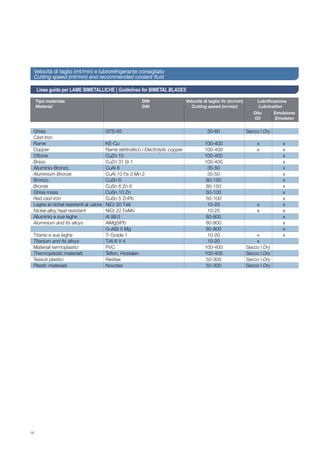
Linee guida per LAME BIMETALLICHE | Guidelines for BIMETAL BLADES
Velocità di taglio (mt/min) e lubrorefrigerante consigliato
Cutting speed (mt/min) and recommended coolant fluid
16
	 Tipo materiale 	 DIN 	 Velocità di taglio Vc (m/min) 		Lubrificazione
	 Material	 DIN	 Cutting speed (m/min)		Lubrication
								
				 Olio		 Emulsione
				 Oil		 Emulsion
	Ghisa	 GTS-65	 30-60	 Secco | Dry	
	Cast Iron
	Rame	 KE-Cu	 100-400	 x	 x
	Copper	 Rame elettrolitico | Electrolytic copper	100-400	 x	 x
	Ottone	 CuZn 10	 100-400		 x
	Brass	 CuZn 31 Si 1	 100-400		 x
	Alluminio-Bronzo	 CuAl 8	 35-50		 x
	Aluminium-Bronze	 CuAl 10 Fe 3 Mn 2	 35-50		 x
	Bronzo	 CuSn 6	 80-150		 x
	Bronze	 CuSn 6 Zn 6	 80-150		 x
	Ghisa rossa	 CuSn 10 Zn	 50-100		 x
	Red cast iron	 CuSn 5 ZnPb	 50-100		 x
	Leghe al nichel resistenti al calore	 NiCr 20 TiAl	 10-25	 x	 x
	Nickel alloy heat resistant	 NiCr 22 FeMo	 10-25	 x	 x
	Alluminio e sue leghe	 Al 99.5	 80-800		 x
	Aluminium and its alloys	AlMgSiPb	 80-800		 x
		 G-AlSi 5 Mg	 80-800		 x
	Titanio e sue leghe	 Ti Grade 1	 10-20	 x	 x
	Titanium and its alloys	 TiAl 6 V 4	 10-20	 x	
	Materiali termoplastici	 PVC	 100-400	 Secco | Dry	
	Thermoplastic materials	 Teflon, Hostalen	 100-400	 Secco | Dry	
	Tessuti plastici	 Resitex	 50-300	 Secco | Dry	
	Plastic materials	 Novotex	 50-300	 Secco | Dry	
Linee guida per LAME BIMETALLICHE | Guidelines for BIMETAL BLADES
Velocità di taglio (mt/min) e lubrorefrigerante consigliato
Cutting speed (mt/min) and recommended coolant fluid
catalogolame02
bladescatalogue02
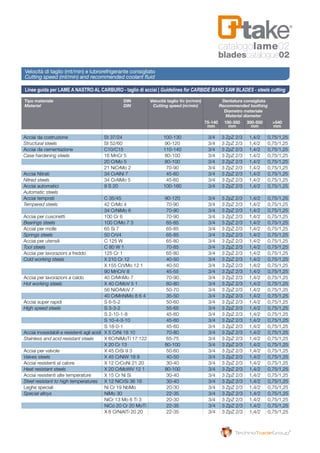
Tipo materiale 	 DIN 	 Velocità taglio Vc (m/min) 	 Dentatura consigliata
Material	 DIN	 Cutting speed (m/min)	 Recommended toothing
				 Diametro materiale
				 Material diameter	
	Acciai da costruzione	 St 37/24	 100-130	 3/4	 3 ZpZ 2/3	 1,4/2	 0,75/1,25
	Structural steels	 St 52/60	 90-120	 3/4	 3 ZpZ 2/3	 1,4/2	 0,75/1,25
	Acciai da cementazione	 C10/C15	 110-140	 3/4	 3 ZpZ 2/3	 1,4/2	 0,75/1,25
	Case hardening steels	 16 MnCr 5	 80-100	 3/4	 3 ZpZ 2/3	 1,4/2	 0,75/1,25
		 20 CrMo 5	 80-100	 3/4	 3 ZpZ 2/3	 1,4/2	 0,75/1,25
		 21 NiCrMo 2	 70-90	 3/4	 3 ZpZ 2/3	 1,4/2	 0,75/1,25
	Acciai Nitrati	 34 CrAlNi 7	 45-60	 3/4	 3 ZpZ 2/3	 1,4/2	 0,75/1,25
	Nitred steels	 34 CrAlMo 5	 45-60	 3/4	 3 ZpZ 2/3	 1,4/2	 0,75/1,25
	Acciai automatici	 9 S 20	 100-160	 3/4	 3 ZpZ 2/3	 1,4/2	 0,75/1,25
	Automatic steels						
	Acciai temprati	 C 35/45	 90-120	 3/4	 3 ZpZ 2/3	 1,4/2	 0,75/1,25
	Tempered steels	 42 CrMo 4	 70-90	 3/4	 3 ZpZ 2/3	 1,4/2	 0,75/1,25
		 34 CrNiMo 6	 70-90	 3/4	 3 ZpZ 2/3	 1,4/2	 0,75/1,25
	Acciai per cuscinetti	 100 Cr 6	 70-90	 3/4	 3 ZpZ 2/3	 1,4/2	 0,75/1,25
	Bearings steels	 100 CrMo 7 3	 65-85	 3/4	 3 ZpZ 2/3	 1,4/2	 0,75/1,25
	Acciai per molle	 65 Si 7	 65-85	 3/4	 3 ZpZ 2/3	 1,4/2	 0,75/1,25
	Springs steels	 50 CrV4	 65-85	 3/4	 3 ZpZ 2/3	 1,4/2	 0,75/1,25
	Acciai per utensili	 C 125 W	 65-80	 3/4	 3 ZpZ 2/3	 1,4/2	 0,75/1,25
	Tool steels	 C 80 W 1	 70-85	 3/4	 3 ZpZ 2/3	 1,4/2	 0,75/1,25
	Acciai per lavorazioni a freddo	 125 Cr 1	 65-80	 3/4	 3 ZpZ 2/3	 1,4/2	 0,75/1,25
	Cold working steels	 X 210 Cr 12	 40-50	 3/4	 3 ZpZ 2/3	 1,4/2	 0,75/1,25
		 X 155 CrVMo 12 1	 40-50	 3/4	 3 ZpZ 2/3	 1,4/2	 0,75/1,25
		 90 MnCrV 8	 45-55	 3/4	 3 ZpZ 2/3	 1,4/2	 0,75/1,25
	Acciai per lavorazioni a caldo	 40 CrMnMo 7	 70-90	 3/4	 3 ZpZ 2/3	 1,4/2	 0,75/1,25
	Hot working steels	 X 40 CrMoV 5 1 	 60-80	 3/4	 3 ZpZ 2/3	 1,4/2	 0,75/1,25
		 56 NiCrMoV 7	 50-70	 3/4	 3 ZpZ 2/3	 1,4/2	 0,75/1,25
		 40 CrMnNiMo 8 6 4	 35-50	 3/4	 3 ZpZ 2/3	 1,4/2	 0,75/1,25
	Acciai super rapidi	 S 6-5-2	 50-60	 3/4	 3 ZpZ 2/3	 1,4/2	 0,75/1,25
	High speed steels	 S 3-3-2	 55-65	 3/4	 3 ZpZ 2/3	 1,4/2	 0,75/1,25
		 S 2-10-1-8	 45-60	 3/4	 3 ZpZ 2/3	 1,4/2	 0,75/1,25
		 S 10-4-3-10	 45-60	 3/4	 3 ZpZ 2/3	 1,4/2	 0,75/1,25
		 S 18-0-1	 45-60	 3/4	 3 ZpZ 2/3	 1,4/2	 0,75/1,25
	Acciai inossidabili e resistenti agli acidi	 X 5 CrNi 18 10	 70-80	 3/4	 3 ZpZ 2/3	 1,4/2	 0,75/1,25
	Stainless and acid resistant steels	 X 6CrNiMoTi 17 122	 65-75	 3/4	 3 ZpZ 2/3	 1,4/2	 0,75/1,25
		 X 20 Cr 13	 80-100	 3/4	 3 ZpZ 2/3	 1,4/2	 0,75/1,25
	Acciai per valvole	 X 45 CrSi 9 3	 50-60	 3/4	 3 ZpZ 2/3	 1,4/2	 0,75/1,25
	Valves steels	 X 45 CrNiW 18 9	 40-50	 3/4	 3 ZpZ 2/3	 1,4/2	 0,75/1,25
	Acciai resistenti al calore	 X 12 CrCoNi 21 20	 30-40	 3/4	 3 ZpZ 2/3	 1,4/2	 0,75/1,25
	Heat resistant steels	 X 20 CrMoWV 12 1	 80-100	 3/4	 3 ZpZ 2/3	 1,4/2	 0,75/1,25
	Acciai resistenti alte temperature	 X 15 Cr Ni Si	 30-40	 3/4	 3 ZpZ 2/3	 1,4/2	 0,75/1,25
	Steel resistant to high temperatures	 X 12 NiCrSi 36 16	 30-40	 3/4	 3 ZpZ 2/3	 1,4/2	 0,75/1,25
	Leghe speciali	 Ni Cr 19 NbMo	 20-30	 3/4	 3 ZpZ 2/3	 1,4/2	 0,75/1,25
	Special alloys	 NiMo 30	 22-35	 3/4	 3 ZpZ 2/3	 1,4/2	 0,75/1,25
		 NiCr 13 Mo 6 Ti 3	 20-30	 3/4	 3 ZpZ 2/3	 1,4/2	 0,75/1,25
		 NiCo 20 Cr 20 MoTi	 22-35	 3/4	 3 ZpZ 2/3	 1,4/2	 0,75/1,25
		 X 8 CrNiAlTi 20 20	 22-35	 3/4	 3 ZpZ 2/3	 1,4/2	 0,75/1,25
Linee guida per LAME A NASTRO AL CARBURO - taglio di acciai | Guidelines for CARBIDE BAND SAW BLADES - steels cutting
Velocità di taglio (mt/min) e lubrorefrigerante consigliato
Cutting speed (mt/min) and recommended coolant fluid
	75-140	 100-350 	 300-550 	 >540
	mm	 mm	 mm	 mm
18
Tipo materiale 	 DIN 	 Velocità taglio Vc (m/min) 	 Dentatura consigliata
Material	 DIN	 Cutting speed (m/min)	 Recommended toothing
				 Diametro materiale
				 Material diameter	
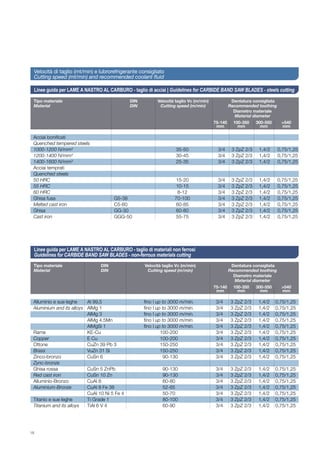
Linee guida per LAME A NASTRO AL CARBURO - taglio di acciai | Guidelines for CARBIDE BAND SAW BLADES - steels cutting
	75-140	 100-350 	 300-550 	 >540
	mm	 mm	 mm	 mm
	Acciai bonificati						
	Quenched tempered steels						
	1000-1200 N/mm²		 35-50	 3/4	 3 ZpZ 2/3	 1,4/2	 0,75/1,25
	1200-1400 N/mm²		 30-45	 3/4	 3 ZpZ 2/3	 1,4/2	 0,75/1,25
	1400-1600 N/mm²		 25-35	 3/4	 3 ZpZ 2/3	 1,4/2	 0,75/1,25
	Acciai temprati						
	Quenched steels						
	50 HRC		 15-20	 3/4	 3 ZpZ 2/3	 1,4/2	 0,75/1,25
	55 HRC		 10-15	 3/4	 3 ZpZ 2/3	 1,4/2	 0,75/1,25
	60 HRC		 8-12	 3/4	 3 ZpZ 2/3	 1,4/2	 0,75/1,25
	Ghisa fusa	 G5-38	 70-100	 3/4	 3 ZpZ 2/3	 1,4/2	 0,75/1,25
	Melted cast iron	 C5-60	 60-85	 3/4	 3 ZpZ 2/3	 1,4/2	 0,75/1,25
	Ghisa	 GG-30	 60-80	 3/4	 3 ZpZ 2/3	 1,4/2	 0,75/1,25
	Cast iron	 GGG-50	 55-75	 3/4	 3 ZpZ 2/3	 1,4/2	 0,75/1,25
	Alluminio e sue leghe	 Al 99,5	 fino | up to 3000 m/min.	 3/4	 3 ZpZ 2/3	 1,4/2	 0,75/1,25
	Aluminium and its alloys	 AlMg 1	 fino | up to 3000 m/min.	 3/4	 3 ZpZ 2/3	 1,4/2	 0,75/1,25
		 AlMg 3	 fino | up to 3000 m/min.	 3/4	 3 ZpZ 2/3	 1,4/2	 0,75/1,25
		 AlMg 4.5Mn	 fino | up to 3000 m/min.	 3/4	 3 ZpZ 2/3	 1,4/2	 0,75/1,25
		 AlMgSi 1	 fino | up to 3000 m/min.	 3/4	 3 ZpZ 2/3	 1,4/2	 0,75/1,25
	Rame	 KE-Cu	 100-200	 3/4	 3 ZpZ 2/3	 1,4/2	 0,75/1,25
	Copper	 E Cu	 100-200	 3/4	 3 ZpZ 2/3	 1,4/2	 0,75/1,25
	Ottone	 CuZn 39 Pb 3	 150-250	 3/4	 3 ZpZ 2/3	 1,4/2	 0,75/1,25
	Brass	 VuZn 31 Si	 150-250	 3/4	 3 ZpZ 2/3	 1,4/2	 0,75/1,25
	Zinco-bronzo	 CuSn 6	 90-130	 3/4	 3 ZpZ 2/3	 1,4/2	 0,75/1,25
	Zync-bronze						
	Ghisa rossa	 CuSn 5 ZnPb	 90-130	 3/4	 3 ZpZ 2/3	 1,4/2	 0,75/1,25
	Red cast iron	 CuSn 10 Zn	 90-130	 3/4	 3 ZpZ 2/3	 1,4/2	 0,75/1,25
	Alluminio-Bronzo	 CuAl 8	 60-80	 3/4	 3 ZpZ 2/3	 1,4/2	 0,75/1,25
	Aluminium-Bronze	 CuAl 8 Fe 38	 52-65	 3/4	 3 ZpZ 2/3	 1,4/2	 0,75/1,25
		 CuAl 10 Ni 5 Fe 4	 50-70	 3/4	 3 ZpZ 2/3	 1,4/2	 0,75/1,25
	Titanio e sue leghe	 Ti Grade 1	 80-100	 3/4	 3 ZpZ 2/3	 1,4/2	 0,75/1,25
	Titanium and its alloys	 TiAl 6 V 4	 60-90	 3/4	 3 ZpZ 2/3	 1,4/2	 0,75/1,25
Tipo materiale 	 DIN 	 Velocità taglio Vc (m/min) 	 Dentatura consigliata
Material	 DIN	 Cutting speed (m/min)	 Recommended toothing
				 Diametro materiale
				 Material diameter	
Linee guida per LAME A NASTRO AL CARBURO - taglio di materiali non ferrosi
Guidelines for CARBIDE BAND SAW BLADES - non-ferrous materials cutting
	75-140	 100-350 	 300-550 	 >540
	mm	 mm	 mm	 mm
Velocità di taglio (mt/min) e lubrorefrigerante consigliato
Cutting speed (mt/min) and recommended coolant fluid
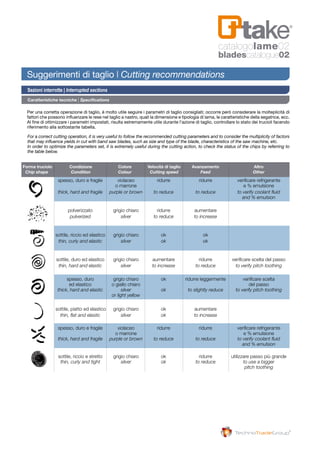
Forma truciolo 	 Condizione 	 Colore 	 Velocità di taglio 	 Avanzamento 	 Altro
	 Chip shape	 Condition	 Colour	 Cutting speed	 Feed	 Other
	 spesso, duro e fragile	 violaceo 	 ridurre 	 ridurre 	 verificare refrigerante 		
		 o marrone			 e % emulsione
	 thick, hard and fragile	 purple or brown	 to reduce	 to reduce	 to verify coolant fluid 		
					 and % emulsion
	 polverizzato 	 grigio chiaro 	 ridurre 	 aumentare
	 pulverized	 silver	 to reduce	 to increase
	sottile, riccio ed elastico 	 grigio chiaro 	 ok 	 ok
	 thin, curly and elastic	 silver	 ok	 ok
	sottile, duro ed elastico 	 grigio chiaro 	 aumentare 	 ridurre 	 verificare scelta del passo
	 thin, hard and elastic	 silver	 to increase	 to reduce	 to verify pitch toothing		
		
	 spesso, duro	 grigio chiaro 	 ok 	 ridurre leggermente	 verificare scelta 		
	 ed elastico	 o giallo chiaro			 del passo
	thick, hard and elastic	 silver	 ok	 to slightly reduce	 to verify pitch toothing		
		 or light yellow
	sottile, piatto ed elastico 	 grigio chiaro 	 ok 	 aumentare
	 thin, flat and elastic	 silver	 ok	 to increase
	 spesso, duro e fragile 	 violaceo 	 ridurre 	 ridurre 	 verificare refrigerante 		
		 o marrone			 e % emulsione
	 thick, hard and fragile	 purple or brown	 to reduce	 to reduce	 to verify coolant fluid 		
					 and % emulsion
	 sottile, riccio e stretto 	 grigio chiaro 	 ok 	 ridurre 	 utilizzare passo più grande
	 thin, curly and tight	 silver	 ok	 to reduce	 to use a bigger 		
					 pitch toothing
				
catalogolame02
bladescatalogue02
Caratteristiche tecniche | Specifications
Per una corretta operazione di taglio, è molto utile seguire i parametri di taglio consigliati; occorre però considerare la molteplicità di
fattori che possono influenzare le rese nel taglio a nastro, quali la dimensione e tipologia di lama, le caratteristiche della segatrice, ecc.
Al fine di ottimizzare i parametri impostati, risulta estremamente utile durante l’azione di taglio, controllare lo stato dei trucioli facendo
riferimento alla sottostante tabella.
For a correct cutting operation, it is very useful to follow the recommended cutting parameters and to consider the multiplicity of factors
that may influence yields in cut with band saw blades, such as size and type of the blade, characteristics of the saw machine, etc.
In order to optimize the parameters set, it is extremely useful during the cutting action, to check the status of the chips by referring to
the table below.
Sezioni interrotte | Interrupted sections
Suggerimenti di taglio | Cutting recommendations
Lame per segatrici a nastro1.2
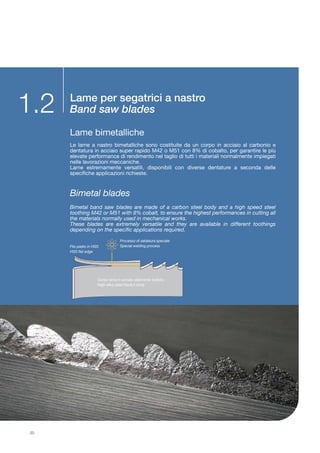
Lame bimetalliche
Le lame a nastro bimetalliche sono costituite da un corpo in acciaio al carbonio e
dentatura in acciaio super rapido M42 o M51 con 8% di cobalto, per garantire le più
elevate performance di rendimento nel taglio di tutti i materiali normalmente impiegati
nelle lavorazioni meccaniche.
Lame estremamente versatili, disponibili con diverse dentature a seconda delle
specifiche applicazioni richieste.
Lame per segatrici a nastro 	
Band saw blades
Lame bimetalliche
Le lame a nastro bimetalliche sono costituite da un corpo in acciaio al carbonio e
dentatura in acciaio super rapido M42 o M51 con 8% di cobalto, per garantire le più
elevate performance di rendimento nel taglio di tutti i materiali normalmente impiegati
nelle lavorazioni meccaniche.
Lame estremamente versatili, disponibili con diverse dentature a seconda delle
specifiche applicazioni richieste.
20
Bimetal blades
Bimetal band saw blades are made of a carbon steel body and a high speed steel
toothing M42 or M51 with 8% cobalt, to ensure the highest performances in cutting all
the materials normally used in mechanical works.
These blades are extremely versatile and they are available in different toothings
depending on the specific applications required.
1.2
Processo di saldatura speciale
Special welding process
Corpo lama in acciaio altamente trattato
High-alloy steel blade’s body
Filo piatto in HSS
HSS flat edge
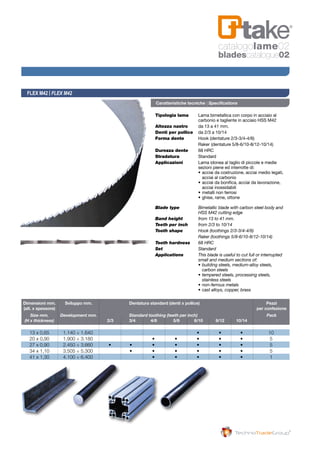
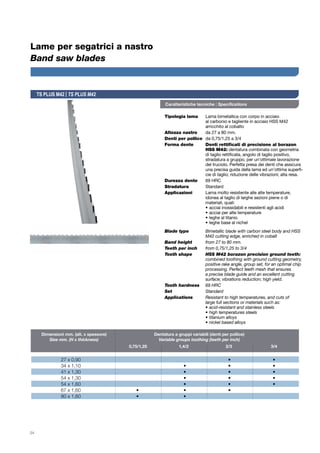
Tipologia lama 	 Lama bimetallica con corpo in acciaio al 	
	 carbonio e tagliente in acciaio HSS M42
Altezza nastro 	 da 13 a 41 mm.
Denti per pollice 	 da 2/3 a 10/14
Forma dente 	 Hook (dentature 2/3-3/4-4/6)
	 Raker (dentature 5/8-6/10-8/12-10/14)
Durezza dente 	 68 HRC
Stradatura 	 Standard
Applicazioni 	 Lama idonea al taglio di piccole e medie 	
	 sezioni piene ed interrotte di:
	 • 	acciai da costruzione, acciai medio legati, 	
		 acciai al carbonio
	 • 	acciai da bonifica, acciai da lavorazione, 	
		 acciai inossidabili
	 • 	metalli non ferrosi
	 • 	ghise, rame, ottone
Blade type	 Bimetallic blade with carbon steel body and 	
	 HSS M42 cutting edge
Band height	 from 13 to 41 mm.
Teeth per inch	 from 2/3 to 10/14
Tooth shape	 Hook (toothings 2/3-3/4-4/6)
	 Raker (toothings 5/8-6/10-8/12-10/14)
Tooth hardness	 68 HRC
Set	Standard
Applications	 This blade is useful to cut full or interrupted 	
	 small and medium sections of:
	 • 	building steels, medium-alloy steels, 	
		 carbon steels	
	 • 	tempered steels, processing steels, 	
		 stainless steels
	 • 	non-ferrous metals
	 • 	cast alloys, copper, brass
FLEX M42 | FLEX M42
Caratteristiche tecniche | Specifications
	Dimensioni mm. 	 Sviluppo mm. 			 Dentatura standard (denti x pollice) 			 Pezzi
	(alt. x spessore) 										 per confezione
	 Size mm.	 Development mm.			 Standard toothing (teeth per inch)			 Pack
	 (H x thickness)		 2/3 		 3/4 	 4/6 	 5/8 	 6/10 	 8/12 	 10/14
	 13 x 0,65	 1.140 ÷ 1.640	 	 	 	 	 • 	 • 	 •	 10
	 20 x 0,90 	 1.900 ÷ 3.180 	 	 	 • 	 • 	 • 	 • 	 • 	 5
	 27 x 0,90 	 2.450 ÷ 3.660 	 • 	 • 	 • 	 • 	 • 	 • 	 • 	 5
	 34 x 1,10 	 3.505 ÷ 5.300 	 	 • 	 • 	 • 	 • 	 • 	 • 	 5
	 41 x 1,30 	 4.100 ÷ 6.400 	 	 	 • 	 • 	 • 	 • 	 • 	 1
catalogolame02
bladescatalogue02
22
Lame per segatrici a nastro
Band saw blades
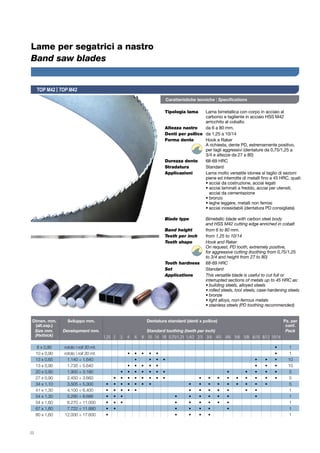
Tipologia lama 	 Lama bimetallica con corpo in acciaio al 	
	 carbonio e tagliente in acciaio HSS M42
	 arricchito al cobalto
Altezza nastro 	 da 6 a 80 mm.
Denti per pollice 	da 1,25 a 10/14
Forma dente 	 Hook e Raker
	 A richiesta, dente PD, estremamente positivo,
	 per tagli aggressivi (dentature da 0,75/1,25 a
	 3/4 e altezze da 27 a 80)
Durezza dente 	 68-69 HRC
Stradatura 	 Standard
Applicazioni 	 Lama molto versatile idonea al taglio di sezioni
	 piene ed interrotte di metalli fino a 45 HRC, quali:
	 •	acciai da costruzione, acciai legati
	 • acciai laminati a freddo, acciai per utensili,
		 acciai da cementazione
	 • bronzo
	 • leghe leggere, metalli non ferrosi
	 •	acciai inossidabili (dentatura PD consigliata)
Blade type	 Bimetallic blade with carbon steel body 	
	 and HSS M42 cutting edge enriched in cobalt
Band height	 from 6 to 80 mm.
Teeth per inch	 from 1,25 to 10/14
Tooth shape	 Hook and Raker
	 On request, PD tooth, extremely positive, 	
	 for aggressive cutting (toothing from 0,75/1,25 	
	 to 3/4 and height from 27 to 80)
Tooth hardness	 68-69 HRC
Set	Standard
Applications	 This versatile blade is useful to cut full or
	 interrupted sections of metals up to 45 HRC as:
	 •	building steels, alloyed steels
	 •	rolled steels, tool steels, case-hardening steels
	 •	bronze
	 •	light alloys, non-ferrous metals	
	 •	stainless steels (PD toothing recommended)
TOP M42 | TOP M42
Caratteristiche tecniche | Specifications
	Dimen. mm. 	 Sviluppo mm.	 						 Dentatura standard (denti x pollice) 							 Pz. per
	(alt.xsp.)																							 conf.
	 Size mm.	 Development mm.							 Standard toothing (teeth per inch)								 Pack
	(Hxthick)																							
	 6 x 0,90 	 rotolo | roll 30 mt. 	 	 	 	 	 	 	 	 	 	 	 	 	 	 	 	 	 	 	 	 • 	 1
	10 x 0,90 	 rotolo | roll 30 mt. 	 	 	 	 • 	 • 	 • 	 • 	 • 	 	 	 	 	 	 	 	 	 	 	 	 • 	 1
	13 x 0,65 	 1.140 ÷ 1.640 	 	 	 	 	 • 	 	 • 	 • 	 • 	 	 	 	 	 	 	 	 	 • 	 • 	 • 	 10
	13 x 0,90 	 1.735 ÷ 5.640 	 	 	 	 • 	 • 	 • 	 • 	 • 	 	 	 	 	 	 	 	 	 	 • 	 • 	 • 	 10
	20 x 0,90 	 1.900 ÷ 3.180 	 	 	 • 	 • 	 • 	 • 	 • 	 • 	 • 	 	 	 	 	 	 • 	 	 • 	 • 	 • 	 • 	 5
	27 x 0,90 	 2.450 ÷ 3.660 	 	 • 	 • 	 • 	 • 	 • 	 • 	 • 	 • 	 	 	 • 	 • 	 • 	 • 	 • 	 • 	 • 	 • 	 • 	 5
	34 x 1,10 	 3.505 ÷ 5.300 	 • 	 • 	 • 	 •	 • 	 • 	 • 	 	 	 	 • 	 • 	 • 	 • 	 • 	 • 	 • 	 • 	 • 	 	 5
	41 x 1,30 	 4.100 ÷ 6.400 	 • 	 • 	 • 	 • 	 • 	 	 	 	 	 	 • 	 •	 •	 •	 •	 	 • 	 • 	 	 	 1
	54 x 1,30 	 5.290 ÷ 8.686 	 • 	 • 	 • 	 	 	 	 	 	 	 • 	 • 	 • 	 • 	 • 	 • 	 	 	 • 	 	 	 1
	54 x 1,60 	   6.270 ÷ 11.000 	 • 	 • 	 • 	 	 	 	 	 	 	 • 	 • 	 • 	 • 	 • 	 •	 	 	 	 	 	 1
	67 x 1,60 	   7.722 ÷ 11.880 	 • 	 • 	 	 	 	 	 	 	 	 • 	 • 	 • 	 • 	 	 • 	 	 	 	 	 	 1
	80 x 1,60 	 12.000 ÷ 17.600 	 • 	 	 	 	 	 	 	 	 	 • 	 • 	 • 	 • 	 	 	 	 	 	 	 	 1
	1,25	 2 	 3 	 4 	 6 	 8 	 10 	 14 	 18 	 0,75/1,25 	1,4/2 	 2/3 	 3/4 	 4/5 	 4/6 	 5/6 	 5/8 	 6/10 	8/12 	10/14
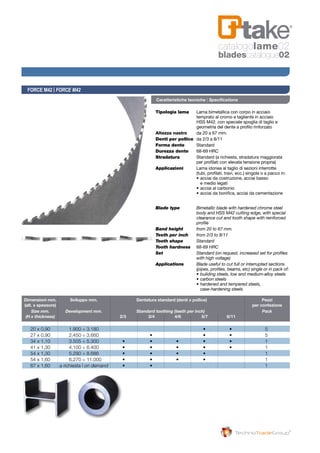
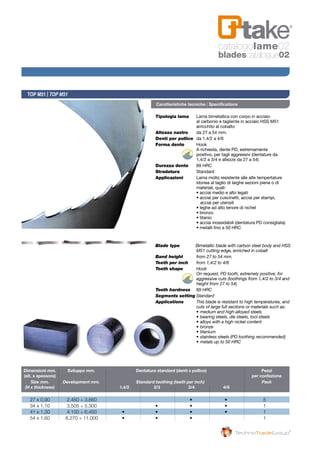
Tipologia lama 	 Lama bimetallica con corpo in acciaio 	
	 temprato al cromo e tagliente in acciaio 	
	 HSS M42, con speciale spoglia di taglio e 	
	 geometria del dente a profilo rinforzato
Altezza nastro 	 da 20 a 67 mm.
Denti per pollice 	da 2/3 a 8/11
Forma dente 	 Standard
Durezza dente 	 68-69 HRC
Stradatura 	 Standard (a richiesta, stradatura maggiorata 	
	 per profilati con elevata tensione propria)
Applicazioni 	 Lama idonea al taglio di sezioni interrotte
	 (tubi, profilati, travi, ecc.) singole o a pacco in:
	 • 	acciai da costruzione, acciai basso
			e medio legati
	 • 	acciai al carbonio
	 • 	acciai da bonifica, acciai da cementazione
Blade type	 Bimetallic blade with hardened chrome steel 	
	 body and HSS M42 cutting edge, with special 	
	 clearance cut and tooth shape with reinforced 	
	profile
Band height	 from 20 to 67 mm.
Teeth per inch	 from 2/3 to 8/11
Tooth shape	Standard
Tooth hardness	 68-69 HRC
Set	 Standard (on request, increased set for profiles 	
	 with high voltage)
Applications	 Blade useful to cut full or interrupted sections 	
	 (pipes, profiles, beams, etc) single or in pack of:
	 •	building steels, low and medium-alloy steels
	 •	carbon steels
	 •	hardened and tempered steels,
		 case-hardening steels
FORCE M42 | FORCE M42
Caratteristiche tecniche | Specifications
	Dimensioni mm. 	 Sviluppo mm. 			 Dentatura standard (denti x pollice) 			 Pezzi
	(alt. x spessore) 													 per confezione
	 Size mm.	 Development mm.			 Standard toothing (teeth per inch)			 Pack
	 (H x thickness)			 2/3 			 3/4 		 4/6 		 5/7 	 8/11
	 20 x 0,90 	 1.900 ÷ 3.180 	 	 	 	 • 	 • 	 5
	 27 x 0,90 	 2.450 ÷ 3.660 	 	 • 	 	 • 	 • 	 5
	 34 x 1,10 	 3.505 ÷ 5.300 	 • 	 • 	 • 	 • 	 • 	 1
	 41 x 1,30 	 4.100 ÷ 6.400 	 • 	 • 	 • 	 • 	 • 	 1
	 54 x 1,30 	 5.290 ÷ 8.686 	 • 	 • 	 • 	 • 	 	 1
	 54 x 1,60 	   6.270 ÷ 11.000 	 • 	 • 	 • 	 •	 	 1
	 67 x 1,60	 a richiesta | on demand	 • 	 •	 	 	 	 1
catalogolame02
bladescatalogue02
24
Tipologia lama	 Lama bimetallica con corpo in acciaio 	
	 al carbonio e tagliente in acciaio HSS M42 	
	 arricchito al cobalto
Altezza nastro	 da 27 a 80 mm.
Denti per pollice 	da 0,75/1,25 a 3/4
Forma dente	 Denti rettificati di precisione al borazon 	
	 HSS M42: dentatura combinata con geometria
	 di taglio rettificata, angolo di taglio positivo, 	
	 stradatura a gruppo, per un’ottimale lavorazione
	 del truciolo. Perfetta presa dei denti che assicura
	 una precisa guida della lama ed un’ottima superfi-	
	 cie di taglio; riduzione delle vibrazioni; alta resa.
Durezza dente	 69 HRC
Stradatura	 Standard
Applicazioni	 Lama molto resistente alle alte temperature,	
	 idonea al taglio di larghe sezioni piene o di 	
	 materiali, quali:
	 •	acciai inossidabili e resistenti agli acidi
	 •	acciai per alte temperature
	 •	leghe al titanio
	 •	leghe base al nichel
Blade type	 Bimetallic blade with carbon steel body and HSS 	
	 M42 cutting edge, enriched in cobalt
Band height	 from 27 to 80 mm.
Teeth per inch	 from 0,75/1,25 to 3/4
Tooth shape	 HSS M42 borazon precision ground teeth: 	
	 combined toothing with ground cutting geometry, 	
	 positive rake angle, group set, for an optimal chip 	
	 processing. Perfect teeth mesh that ensures 	
	 a precise blade guide and an excellent cutting 	
	 surface; vibrations reduction; high yield.
Tooth hardness	 69 HRC
Set	 Standard
Applications	 Resistant to high temperatures, and cuts of 	
	 large full sections or materials such as:
	 •	acid-resistant and stainless steels
	 •	high temperatures steels
	 •	titanium alloys
	 •	nickel based alloys
TS PLUS M42 | TS PLUS M42
Caratteristiche tecniche | Specifications
	 Dimensioni mm. (alt. x spessore) 	 	Dentatura a gruppi variabili (denti per pollice)
	 Size mm. (H x thickness)		 Variable groups toothing (teeth per inch)	
	 		 0,75/1,25	 1,4/2		 2/3 	 3/4	
	 27 x 0,90	 	 	 •	 •	
	 34 x 1,10	 	 •	 •	 •
	 41 x 1,30	 	 •	 •	 •	
	 54 x 1,30	 	 •	 •	 •	
	 54 x 1,60	 	 •	 •	 •	
	 67 x 1,60	 •	 •	 •
	 80 x 1,60	 •	 •
Lame per segatrici a nastro
Band saw blades
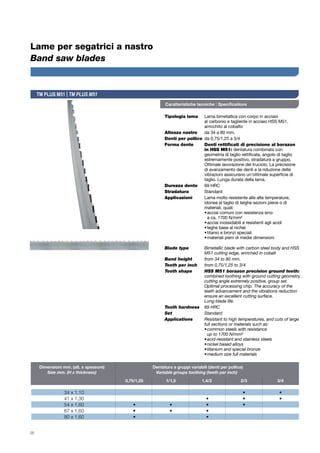
Tipologia lama 	 Lama bimetallica con corpo in acciaio
	 al carbonio e tagliente in acciaio HSS M51
	 arricchito al cobalto
Altezza nastro 	 da 27 a 54 mm.
Denti per pollice 	da 1,4/2 a 4/6
Forma dente 	 Hook
	 A richiesta, dente PD, estremamente 	
	 positivo, per tagli aggressivi (dentature da 	
	 1,4/2 a 3/4 e altezze da 27 a 54)
Durezza dente 	 69 HRC
Stradatura 	 Standard
Applicazioni 	 Lama molto resistente alle alte tempertature 	
	 idonea al taglio di larghe sezioni piene o di 	
	 materiali, quali:
	 • acciai medio e alto legati
	 • acciai per cuscinetti, acciai per stampi,
			acciai per utensili
	 • leghe ad alto tenore di nichel
	 • bronzo
	 • titanio
	 • acciai inossidabili (dentatura PD consigliata)
	 • metalli fino a 50 HRC
Blade type           Bimetallic blade with carbon steel body and HSS 	
	 M51 cutting edge, enriched in cobalt
Band height	 from 27 to 54 mm.
Teeth per inch	 from 1,4/2 to 4/6
Tooth shape	 Hook	
	 On request, PD tooth, extremely positive, for 	
	 aggressive cuts (toothings from 1,4/2 to 3/4 and 	
	 height from 27 to 54)
Tooth hardness	 69 HRC
Segments setting	Standard
Applications	 This blade is resistant to high temperatures, and	
	 cuts of large full sections or materials such as:
	 •	medium and high-alloyed steels	
	 •	bearing steels, die steels, tool steels	
	 •	alloys with a high nickel content	
	 •	bronze	
	 •	titanium	
	 •	stainless steels (PD toothing recommended)	
	 •	metals up to 50 HRC
TOP M51 | TOP M51
Caratteristiche tecniche | Specifications
	Dimensioni mm. 	 Sviluppo mm. 		 Dentatura standard (denti x pollice) 		 Pezzi
	(alt. x spessore) 							 per confezione
	 Size mm.	 Development mm.		 Standard toothing (teeth per inch)		 Pack
	 (H x thickness)		 1,4/2 		 2/3 	 3/4 	 4/6
	 27 x 0,90 	 2.450 ÷ 3.660 	 	 	 • 	 • 	 5
	 34 x 1,10 	 3.505 ÷ 5.300 	 	 • 	 • 	 • 	 1
	 41 x 1,30 	 4.100 ÷ 6.400 	 • 	 • 	 • 	 • 	 1
	 54 x 1,60 	 6.270 ÷ 11.000 	 •	 • 	 • 	 	 1
catalogolame02
bladescatalogue02
26
Tipologia lama	 Lama bimetallica con corpo in acciaio 	
	 al carbonio e tagliente in acciaio HSS M51, 	
	 arricchito al cobalto
Altezza nastro	 da 34 a 80 mm.
Denti per pollice 	da 0,75/1,25 a 3/4
Forma dente	 Denti rettificati di precisione al borazon
	 in HSS M51: dentatura combinata con 	
	 geometria di taglio rettificata, angolo di taglio 	
	 estremamente positivo, stradatura a gruppo. 	
	 Ottimale lavorazione del truciolo. La precisione 	
	 di avanzamento dei denti e la riduzione delle 	
	 vibrazioni assicurano un’ottimale superficie di 	
	 taglio. Lunga durata della lama.
Durezza dente	 69 HRC
Stradatura	 Standard
Applicazioni	 Lama molto resistente alle alte temperature, 	
	 idonea al taglio di larghe sezioni piene o di 	
	 materiali, quali:
	 •	acciai comuni con resistenza sino 	
		 a ca. 1700 N/mm²
	 •	acciai inossidabili e resistenti agli acidi
	 •	leghe base al nichel
	 •	titanio e bronzi speciali
	 •	materiali pieni di medie dimensioni
Blade type	 Bimetallic blade with carbon steel body and HSS 	
	 M51 cutting edge, enriched in cobalt
Band height	 from 34 to 80 mm.
Teeth per inch	 from 0,75/1,25 to 3/4
Tooth shape	 HSS M51 borazon precision ground teeth:	
	 combined toothing with ground cutting geometry, 	
	 cutting angle extremely positive, group set.
	 Optimal processing chip. The accuracy of the 	
	 teeth advancement and the vibrations reduction 	
	 ensure an excellent cutting surface.
	 Long blade life.
Tooth hardness	 69 HRC
Set	 Standard
Applications	 Resistant to high temperatures, and cuts of large 	
	 full sections or materials such as:
	 •	common steels with resistance 	
		 up to 1700 N/mm²
	 •	acid-resistant and stainless steels
	 •	nickel based alloys
	 •	titanium and special bronze
	 •	medium size full materials
TM PLUS M51 | TM PLUS M51
Caratteristiche tecniche | Specifications
		 Dimensioni mm. (alt. x spessore) 	 	Dentatura a gruppi variabili (denti per pollice)
		 Size mm. (H x thickness)		 Variable groups toothing (teeth per inch)	
	 			 0,75/1,25	 1/1,5	 1,4/2	 2/3	 3/4
	 34 x 1,10	 	 	 	 •	 •
	 41 x 1,30	 	 	 •	 •	 •
	 54 x 1,60	 •	 •	 •	 •
	 67 x 1,60	 •	 •	 •
	 80 x 1,60	 •	 	 •
Lame per segatrici a nastro
Band saw blades
catalogolame02
bladescatalogue02
Lame per segatrici a nastro1.3
Lame con dentatura in metallo duro
Queste lame sono costituite da un corpo in acciaio per molle e dentatura in MD (metallo
duro) per garantire un alto rendimento, garantendo una notevole velocità di taglio e
riducendo sensibilmente tempi e costi di produzione.
Lame per segatrici a nastro
Band saw blades
Lame con dentatura in metallo duro
Queste lame sono costituite da un corpo in acciaio per molle e dentatura in MD (metallo
duro) per garantire un alto rendimento, garantendo una notevole velocità di taglio e
riducendo sensibilmente tempi e costi di produzione.
Blades with carbide toothing
These blades are made of a steel body for springs and a carbide toothing to ensure an
high efficiency, guaranteeing a considerable cutting speed and a significant reduction
of time and production’s costs.
28
1.3
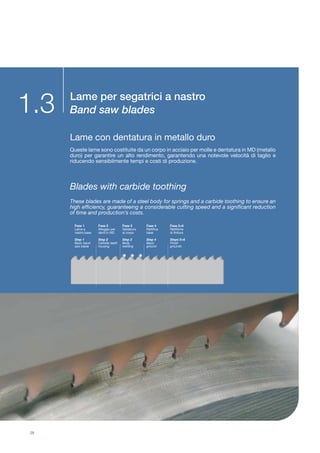
Fase 1
Lama a
nastro base
Step 1
Basic band
saw blade
Fase 2
Alloggio per
denti in MD
Step 2
Carbide teeth
housing
Fase 3
Saldatura
al corpo
Step 3
Body
welding
Fase 5+6
Rettifiche
di finitura
Steps 5+6
Finish
grounds
Fase 4
Rettifica
base
Step 4
Basic
ground
Tipologia lama 	 Lama con corpo in acciaio temprato
	 e dentatura in metallo duro antiusura
Altezza nastro 	 da 20 a 41 mm.
Denti per pollice 	 da 1,25 a 4
Forma dente 	 Hook
	Raker
Durezza dente 	 1.600 HV
Stradatura 	 Standard
Applicazioni 	 Lama idonea al taglio di:
	 • metalli da costruzione
	 • grafiti e ghise
	 • abrasivi
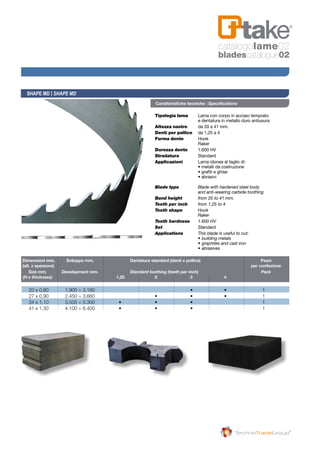
Blade type	 Blade with hardened steel body 	
	 and anti-wearing carbide toothing
Band height	 from 20 to 41 mm.
Teeth per inch	 from 1,25 to 4
Tooth shape	Hook
	Raker
Tooth hardness	 1.600 HV
Set	Standard
Applications	 This blade is useful to cut:
	 •	building metals
	 •	graphites and cast iron
	 •	abrasives
SHAPE MD | SHAPE MD
Caratteristiche tecniche | Specifications
	Dimensioni mm. 	 Sviluppo mm. 		 Dentatura standard (denti x pollice) 		 Pezzi
	(alt. x spessore) 							 per confezione
	 Size mm.	 Development mm.		 Standard toothing (teeth per inch)		 Pack
	(H x thickness)		 1,25 		 2 	 3 	 4 	
	 20 x 0,80 	 1.900 ÷ 3.180 	 	 	 •	 • 	 1
	 27 x 0,90 	 2.450 ÷ 3.660 	 	 • 	 • 	 • 	 1
	 34 x 1,10 	 3.505 ÷ 5.300 	 • 	 • 	 • 	 	 1
	 41 x 1,30 	 4.100 ÷ 6.400 	 • 	 • 	 • 	 	 1
catalogolame02
bladescatalogue02
30
Tipologia lama 	 Lama con corpo in acciaio temprato
	 e dentatura in metallo duro con geometria
	 standard su passo costante e geometria
	 trapezoidale su passo variabile
Altezza nastro 	 da 20 a 41 mm.
Denti per pollice 	 da 1,4/2 a 3/4
Forma dente 	 Hook
Durezza dente 	 1.600 HV
Stradatura 	 Standard
Applicazioni 	 Lama idonea al taglio di:
	 • acciai da costruzione
	 • metalli non ferrosi
	 • alluminio
	 • metalli fino a 62 HRC
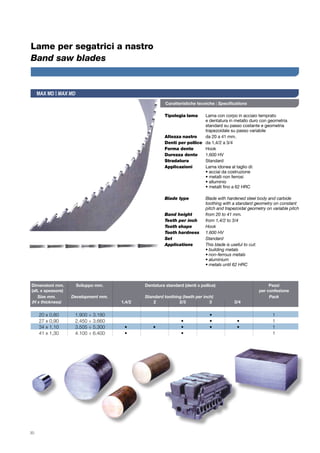
Blade type	 Blade with hardened steel body and carbide 	
	 toothing with a standard geometry on constant 	
	 pitch and trapezoidal geometry on variable pitch
Band height	 from 20 to 41 mm.
Teeth per inch	 from 1,4/2 to 3/4
Tooth shape	Hook
Tooth hardness	 1.600 HV
Set	Standard
Applications	 This blade is useful to cut:
	 •	building metals
	 •	non-ferrous metals
	 •	aluminium
	 •	metals until 62 HRC
MAX MD | MAX MD
Caratteristiche tecniche | Specifications
	Dimensioni mm. 	 Sviluppo mm. 		 Dentatura standard (denti x pollice) 		 Pezzi
	(alt. x spessore) 								 per confezione
	 Size mm.	 Development mm.		 Standard toothing (teeth per inch)		 Pack
	(H x thickness)		 1,4/2 		 2 	 2/3 	 3 	 3/4
	 20 x 0,80 	 1.900 ÷ 3.180 	 	 	 	 • 	 	 1
	 27 x 0,90 	 2.450 ÷ 3.660 	 	 	 •	 • 	 • 	 1
	 34 x 1,10 	 3.505 ÷ 5.300 	 • 	 • 	 • 	 • 	 • 	 1
	 41 x 1,30 	 4.100 ÷ 6.400 	 • 	 	 • 	 	 	 1
Lame per segatrici a nastro
Band saw blades
Tipologia lama 	 Lama con corpo in acciaio temprato e
	 dentatura in metallo duro ad elevate prestazioni
Altezza nastro 	 da 27 a 54 mm.
Denti per pollice 	 da 0,85/1,15 a 3/4
Forma dente 	 Trapezoidale
Durezza dente 	 1.600 HV
Stradatura 	 Senza stradatura
Applicazioni 	 Lama idonea a tagli ad alta velocità ed elevata
	 finitura. Adatta per:
	 • acciai da costruzione, acciai da bonifica
	 • superleghe
	 • zirconio, molibdeno
	 • bronzo-alluminio
	 • leghe di titanio
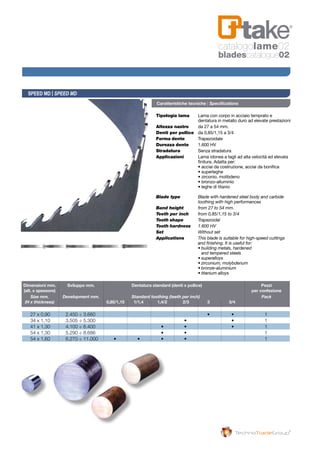
Blade type	 Blade with hardened steel body and carbide 	
	 toothing with high performances
Band height	 from 27 to 54 mm.
Teeth per inch	 from 0,85/1,15 to 3/4
Tooth shape	Trapezoidal
Tooth hardness	 1.600 HV
Set	 Without set
Applications	 This blade is suitable for high-speed cuttings 	
	 and finishing. It is useful for:
	 •	building metals, hardened 	
		 and tempered steels
	 •	superalloys
	 •	zirconium, molybdenum
	 •	bronze-aluminium
	 •	titanium alloys
SPEED MD | SPEED MD
Caratteristiche tecniche | Specifications
	Dimensioni mm. 	 Sviluppo mm. 		 Dentatura standard (denti x pollice) 			 Pezzi
	(alt. x spessore) 									 per confezione
	 Size mm.	 Development mm.		 Standard toothing (teeth per inch)			 Pack
	 (H x thickness)		 0,85/1,15 		 1/1,4 	 1,4/2 	 2/3	 3 	 3/4
	 27 x 0,90 	 2.450 ÷ 3.660 	 	 	 	 	 • 	 • 	 1
	 34 x 1,10 	 3.505 ÷ 5.300 	 	 	 	 • 	 	 • 	 1
	 41 x 1,30 	 4.100 ÷ 6.400 	 	 	 • 	 • 	 	 • 	 1
	 54 x 1,30 	 5.290 ÷ 8.686 	 	 	 • 	 • 	 	 	 1
	 54 x 1,60 	   6.270 ÷ 11.000 	 • 	 • 	 • 	 • 	 	 	 1
catalogolame02
bladescatalogue02
32
Tipologia lama	 Lama con corpo in acciaio temprato e dentatura 	
	 in metallo duro con stradatura maggiorata per la 	
	 lavorazione di metalli non ferrosi
Altezza nastro	 da 20 a 34 mm.
Denti per pollice 	2 e 3
Forma dente	 Hook
Durezza dente	 1.600 HV
Stradatura	 Maggiorata
Applicazioni	 Lama idonea al taglio di:
	 •		 metalli non ferrosi
	 •		 alluminio
	 •		 applicazioni manuali in fonderia
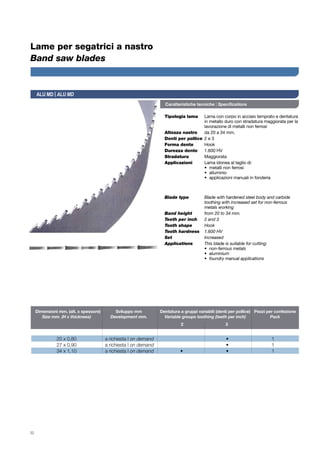
Blade type	 Blade with hardened steel body and carbide 	
	 toothing with increased set for non-ferrous 	
	 metals working
Band height	 from 20 to 34 mm.
Teeth per inch	 2 and 3
Tooth shape	 Hook
Tooth hardness	 1.600 HV
Set	 Increased
Applications	 This blade is suitable for cutting:
	 •		 non-ferrous metals
	 •		 aluminium
	 •		 foundry manual applications
ALU MD | ALU MD
Caratteristiche tecniche | Specifications
		Dimensioni mm. (alt. x spessore) 	 Sviluppo mm		Dentatura a gruppi variabili (denti per pollice)	 Pezzi per confezione
			 Size mm. (H x thickness)	 Development mm.		 Variable groups toothing (teeth per inch)	 Pack
											
						2		3	
	 20 x 0,80	 a richiesta | on demand	 	 •	 1
	 27 x 0,90	 a richiesta | on demand	 	 •	 1	
	 34 x 1,10	 a richiesta | on demand	 •	 •	 1
Lame per segatrici a nastro
Band saw blades
catalogolame02
bladescatalogue02
34
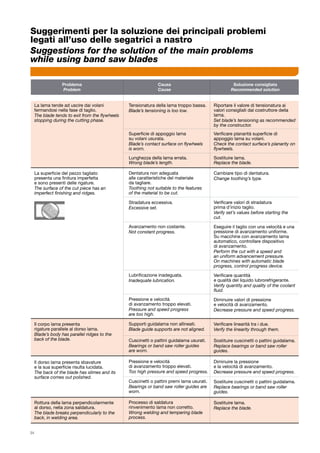
	 Problema 	 Causa 	 Soluzione consigliata	
	 Problem	 Cause	 Recommended solution	
La lama tende ad uscire dai volani
fermandosi nella fase di taglio.
The blade tends to exit from the flywheels
stopping during the cutting phase.
La superficie del pezzo tagliato 	
presenta una finitura imperfetta 		
e sono presenti delle rigature.
The surface of the cut piece has an
imperfect finishing and ridges.
Il corpo lama presenta 		
rigature parallele al dorso lama.
Blade’s body has parallel ridges to the
back of the blade.
Il dorso lama presenta sbavature 		
e la sua superficie risulta lucidata.
The back of the blade has slimes and its
surface comes out polished.
Rottura della lama perpendicolarmente 	
al dorso, nella zona saldatura.
The blade breaks perpendicularly to the
back, in welding area.
Tensionatura della lama troppo bassa.
Blade’s tensioning is too low.
Superficie di appoggio lama 	
su volani usurata.
Blade’s contact surface on flywheels
is worn.
Lunghezza della lama errata.
Wrong blade’s length.
Dentatura non adeguata 		
alle caratteristiche del materiale 	
da tagliare.
Toothing not suitable to the features 	
of the material to be cut.
Stradatura eccessiva.
Excessive set.
Avanzamento non costante.
Not constant progress.
Lubrificazione inadeguata.
Inadequate lubrication.
Pressione e velocità 		
di avanzamento troppo elevati.
Pressure and speed progress
are too high.
Supporti guidalama non allineati.
Blade guide supports are not aligned.
Cuscinetti o pattini guidalama usurati.
Bearings or band saw roller guides 	
are worn.
Pressione e velocità 		
di avanzamento troppo elevati.
Too high pressure and speed progress.
Cuscinetti o pattini premi lama usurati.
Bearings or band saw roller guides are
worn.
Processo di saldatura 	
rinvenimento lama non corretto.
Wrong welding and tempering blade
process.
Riportare il valore di tensionatura ai
valori consigliati dal costruttore della
lama.
Set blade’s tensioning as recommended
by the constructor.
Verificare planarità superficie di
appoggio lama su volani.
Check the contact surface’s planarity on
flywheels.
Sostituire lama.
Replace the blade.
Cambiare tipo di dentatura.
Change toothing’s type.
Verificare valori di stradatura 	
prima d’inizio taglio.
Verify set’s values before starting the
cut.
Eseguire il taglio con una velocità e una
pressione di avanzamento uniforme.
Su macchine con avanzamento lama
automatico, controllare dispositivo 		
di avanzamento.
Perform the cut with a speed and
an uniform advancement pressure.
On machines with automatic blade
progress, control progress device.
Verificare quantità 				
e qualità del liquido lubrorefrigerante.
Verify quantity and quality of the coolant
fluid.
Diminuire valori di pressione 		
e velocità di avanzamento.
Decrease pressure and speed progress.
Verificare linearità tra i due.
Verify the linearity through them.
Sostituire cuscinetti o pattini guidalama.
Replace bearings or band saw roller
guides.
Diminuire la pressione 			
e la velocità di avanzamento.
Decrease pressure and speed progress.
Sostituire cuscinetti o pattini guidalama.
Replace bearings or band saw roller
guides.
Sostituire lama.
Replace the blade.
Suggerimenti per la soluzione dei principali problemi
legati all’uso delle segatrici a nastro
Suggestions for the solution of the main problems 			
while using band saw blades
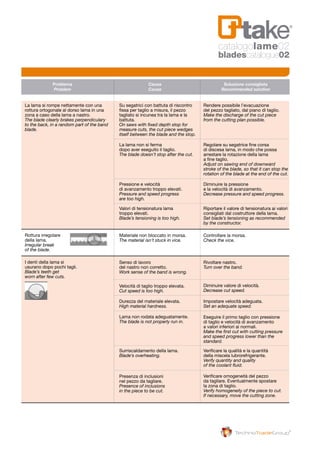
Problema 	 Causa 	 Soluzione consigliata	
	 Problem	 Cause	 Recommended solution	
La lama si rompe nettamente con una
rottura ortogonale al dorso lama in una
zona a caso della lama a nastro.
The blade clearly brakes perpendiculary
to the back, in a random part of the band
blade.
Su segatrici con battuta di riscontro
fissa per taglio a misura, il pezzo
tagliato si incunea tra la lama e la
battuta.
On saws with fixed depth stop for
measure cuts, the cut piece wedges
itself between the blade and the stop.
La lama non si ferma 		
dopo aver eseguito il taglio.
The blade doesn’t stop after the cut.
Pressione e velocità 		
di avanzamento troppo elevati.
Pressure and speed progress
are too high.
Valori di tensionatura lama 		
troppo elevati.
Blade’s tensioning is too high.
Materiale non bloccato in morsa.
The material isn’t stuck in vice.
Senso di lavoro 			
del nastro non corretto.
Work sense of the band is wrong.
Velocità di taglio troppo elevata.
Cut speed is too high.
Durezza del materiale elevata.
High material hardness.
Lama non rodata adeguatamente.
The blade is not properly run in.
Surriscaldamento della lama.
Blade’s overheating.
Presenza di inclusioni 		
nel pezzo da tagliare.
Presence of inclusions
in the piece to be cut.
Rendere possibile l’evacuazione 		
del pezzo tagliato, dal piano di taglio.
Make the discharge of the cut piece
from the cutting plan possible.
Regolare su segatrice fine corsa 	
di discesa lama, in modo che possa
arrestare la rotazione della lama 		
a fine taglio.
Adjust on sawing end of downward
stroke of the blade, so that it can stop the
rotation of the blade at the end of the cut.
Diminuire la pressione 			
e la velocità di avanzamento.
Decrease pressure and speed progress.
Riportare il valore di tensionatura ai valori
consigliati dal costruttore della lama.
Set blade’s tensioning as recommended
by the constructor.
Controllare la morsa.
Check the vice.
Rivoltare nastro.
Turn over the band.
Diminuire valore di velocità.
Decrease cut speed.
Impostare velocità adeguata.
Set an adequate speed.
Eseguire il primo taglio con pressione 	
di taglio e velocità di avanzamento 		
a valori inferiori ai normali.
Make the first cut with cutting pressure
and speed progress lower than the
standard.
Verificare la qualità e la quantità 	
della miscela lubrorefrigerante.
Verify quantity and quality
of the coolant fluid.
Verificare omogeneità del pezzo 		
da tagliare. Eventualmente spostare 		
la zona di taglio.
Verify homogeneity of the piece to cut.
If necessary, move the cutting zone.
Rottura irregolare
della lama.
Irregular break
of the blade.
I denti della lama si
usurano dopo pochi tagli.
Blade’s teeth get
worn after few cuts.
catalogolame02
bladescatalogue02
36
	 Problema 	 Causa 	 Soluzione consigliata	
	 Problem	 Cause	 Recommended solution	
Rottura netta dei denti sulla base di
ancoraggio del corpo, ad intervalli non
regolari.
Sharp break of teeth of the anchoring
base of the body, at not regular intervals.
Presenza di cricche ortogonali al dorso
del corpo lama.
Presence of cracks perpendicular to the
spine of the blade’s body.
Vibrazioni anormali durante
la fase di taglio.
Irregular vibrations during the cutting
phase.
Operazione di taglio iniziata su uno
spigolo in modo non costante.
The cutting operation has started on
an edge in a non-constant way.
Avanzamento non costante.
Not constant progress.
Dentatura non adeguata alla
configurazione della sezione da
tagliare.
Toothing not suitable to the
configuration of the section to be cut.
Velocità di taglio non adeguata alla
sezione da tagliare.
Cutting speed not adequate to the
section to be cut.
Valori di tensionatura lama
troppo elevati.
Blade’s tensioning values are too high.
Pressione e velocità di avanzamento
troppo elevati.
Pressure and speed progress
are too high.
Carico per dente eccessivo.
Excessive load per tooth.
Cuscinetti o pattini guidalama usurati 	
e perpendicolari alla base della morsa.
Bearings or blade guide skids worn
and perpendicular to the vice base.
Serrare accuratamente il pezzo
o i pezzi da tagliare. Su macchine con
serraggio idraulico, verificare pulizia
morse e pressione di esercizio.
Tighten the parts to be cut.
On machines with hydraulic clamping
jaws, verify vice cleaning and exercise
pressure.
Iniziare il taglio con una velocità e
pressione di avanzamento inferiore a
quella nominale di lavoro.
Start the cut with a speed and a progress
pressure lower than the nominal.
Regolare la velocità e la pressione di
avanzamento in relazione alla sezione
di taglio e alla durezza del materiale. Su
macchine con avanzamento automatico,
controllare la funzionalità del sistema di
avanzamento.
Set speed and progress pressure relating
to cut section and material hardness. On
machines with automatic progress, check
the functions of progress system.
Cambiare tipo di dentatura adeguandola
alla tipologia della sezione che si intende
tagliare.
Change toothing, adapting it to the type
of the section to be cut.
Diminuire la velocità di taglio.
Decrease cutting speed.
Riportare il valore di tensionatura ai valori
consigliati dal costruttore della lama.
Set blade’s tensioning as
recommended by the constructor.
Diminuire la pressionee la velocità di
avanzamento.
Decrease pressure and speed progress.
Sostituire tipo di dentatura con un
numero di denti maggiore in modo da
far diminuire il carico singolo per dente
durante la fase di asportazione truciolo.
Replace toothing with an higher number
of teeth, to decrease the single load per
tooth during the chip removal phase.
Sostituire cuscinetti o pattini guidalama.
Replace bearings or blade guide skids.
Suggerimenti per la soluzione dei principali problemi
legati all’uso delle segatrici a nastro
Suggestions for the solution of the main problems 			
while using band saw blades
Problema 	 Causa 	 Soluzione consigliata	
	 Problem	 Cause	 Recommended solution	
Il taglio non è perpendicolare 	
(taglio storto).
The cut is not perpendicular 	
(crooked cut).
Gruppo tensionatore 		
della segatrice starato.
Uncalibrated tensioning group 	
of the saw.
Presenza casuale di trucioli
tra i volani e lama.
Random presence of chips through
flywheels and blade.
Surriscaldamento eccessivo
del corpo lama.
Excessive overheating of the blade’s
body.
Gruppi guidalama troppo vicini
ai due volani.
Blade guide groups are too close to
the flywheels.
Posizionamento non corretto
del pezzo da tagliare.
Wrong placement
of the piece to be cut.
Tensionatura della lama troppo bassa.
Blade’s tensioning is too low.
Distanza dei supporti guidalama 	
troppo elevata.
Too long distance between blade
guide supports.
Supporti guidalama non allineati.
Blade guide supports are not aligned.
Cuscinetti o pattini guidalama usurati.
Bearings or band saw roller guides are
worn.
Intasamento dei trucioli
nelle gole dei denti.
Stoppage of the chips in teeth’s gorge
Dentatura non adeguata.
Not adequate toothing.
Verificare la funzionalità dei particolari
meccanici facenti parte del gruppo
tensionatore (manometro, fine corsa
di minima tensione, guide e molle se
meccanico; eventuali tenute, raschiatori
e livello olio se idraulico).
Verify the function of the mechanical
parts of the tensioning group (pressure
gauge, stroke end of minimum tension,
guides and springs if mechanic; seals,
scrapers an oil level if hydraulic).
Predisporre un adeguato sistema
per l’evacuazione dei trucioli.
Set an adequate system for chip
removing.
Aumentare la portata
del liquido lubrorefrigerante.
Increase the flow of the coolant fluid.
Avvicinare i gruppi guidalama
al pezzo da tagliare.
Put the blade guide groups and the piece
to cut close together.
Eliminare eventuali residui di truciolo
sul piano di appoggio della morsa.
Remove chip residues
on vice supporting surface.
Riportare il valore di tensionatura
ai valori consigliati dal costruttore
della lama.
Set blade’s tensioning as
recommended by the constructor.
Avvicinare i supporti guidalama
il più possibile al profilo esterno
del pezzo da tagliare.
Bring together blade guide supports to
the external profile of the piece to be cut.
Verificare linearità
tra i due supporti guidalama.
Verify linearity between
blade guide supports.
Sostituire cuscinetti o pattini guidalama.
Replace bearings or band saw roller
guides.
Verificare che l’evacuazione dei trucioli
avvenga correttamente.
Verify that the chip removal is correct.
Sostituire tipo di dentatura.
Replace toothing.
Presenza di cricche ortogonali 			
al dorso del corpo lama.
Presence of cracks perpendicular 			
to the spine of the blade’s body.
catalogolame02
bladescatalogue02
38
	 Problema 	 Causa 	 Soluzione consigliata	
	 Problem	 Cause	 Recommended solution	
Valori di pressione e velocità di
avanzamento troppo elevati.
Pressure and speed progress	
are too high.
Corpo lama deformato.
Blade’s body is deformed.
Morsa non perpendicolare alla lama.
Vice is not perpendicular to the blade.
Stradatura della lama non corretta.
Wrong blade’s set.
Caratteristiche meccaniche
del pezzo da tagliare non costanti
(presenza di inclusioni o incrudimenti
da laminazione o trafilatura).
Not constant mechanical features
of the piece to cut (inclusions or
hardenings from lamination or
drawing).
Sega a nastro con dentatura usurata.
Band saw blade with worn toothing.
Cuscinetti o pattini guidalama con
misura insufficiente per tenere in guida
la lama.
Bearings or blade guide skids with
inadequate measure to keep the blade
in guide.
Regolare la velocità e la pressione di
avanzamento in relazione alla sezione
di taglio e alla durezza del materiale. Su
macchine con avanzamento automatico,
controllare la funzionalità del sistema di
avanzamento.
Set speed and progress pressure relating
to the cut section and material hardness.
On machines with automatic progress,
check the functions of progress system.
Sostituire lama.
Replace the blade.
Verificare la perpendicolarità
e l’ortogonalità tra il gruppo morsa
e il gruppo taglio.
Verify perpendicularity and orthogonality
between vice group and cut group.
Verificare valori di stradatura della lama.
Si raccomanda che nella fase di salita
dell’arco porta lama dopo aver eseguito
la fase di taglio, la lama non deve essere
in movimento.
Verify blade’s set. The blade must not
be in motion during the rising bow door
blade phase, after performing the cutting
step.
Diminuire la pressione e la velocità di
avanzamento. Diminuire la velocità di
taglio. Spostare la zona di taglio.
Decrease pressure and speed progress.
Decrease cutting speed.
Move cutting section.
Sostituire sega a nastro.
Replace band saw blade.
Sostituire cuscinetti o i pattini 	
guidalama in modo che possano 	
tenere in guida la lama per min. 	
85% dell’altezza della lama.
Replace bearings or blade guide skids
to keep the blade in guide for minimum 	
85% of the blade’s height.
Suggerimenti per la soluzione dei principali problemi
legati all’uso delle segatrici a nastro
Suggestions for the solution of the main problems 			
while using band saw blades
Il taglio non è perpendicolare
(taglio storto).
The cut is not perpendicular
(crooked cut).
catalogolame02
bladescatalogue02
SERVIZIO CONSULENZA TECNICA 	 DATA / /
DATI RICHIEDENTE
RAG. SOCIALE
INDIRIZZO
TEL. 		 FAX 			 email
REFERENTE
DENOMINAZIONE MATERIALE DA TAGLIARE & NORMATIVA DI APPARTENENZA
o AFNOR 	 o BS 		 o GOST 			 o NS 			 o UNF
o AISI/SAE 	 o DIN 		 o JIS 				 o SS 			 o UNI
o ASTM 	 o EN 		 o NBN 			 o UNE 			 o WERKSTOFF-No.
ALTRE CARATTERISTICHE (DUREZZA, CONDIZIONE SUPERFICIE, ECC...)
CARATTERISTICHE DIMENSIONALI
					 o ALTRO ( disegnare )
IN CASO DI RICHIESTE VI INVITIAMO A FOTOCOPIARE LA SCHEDA E RITORNARCELA DEBITAMENTE COMPILATA IN TUTTE LE SUE PARTI. SARA’ NOSTRA PREMURA
FORNIRVI UNA RISPOSTA SOLLECITA.
L = 		 H =			 S =
NEL CASO DITAGLI MULTIPLI OLTREALLE DIMENSIONI DEL SINGOLO PEZZO, SPECIFICARE LA LARGHEZZA E L’ALTEZZATOTALI DEL PACCO, LA DISPOSIZIONE ED
IL NUMERO DI PEZZI CHE LO COMPONGONO
CARATTERISTICHE SEGATRICI
COSTRUTTORE 					 MODELLO
FUNZIONAMENTO 		 o MANUALE 			 o SEMI AUTOMATICO 		 o AUTOMATICO
AZIONE DEL TAGLIO 		 o INCLINATA 			 o ORIZZONTALE 		 o VERTICALE
DIMENSIONI LAMA ( LUNGHEZZA x ALTEZZA x SPESSORE x N° DENTI )
TECHNICAL ADVICE SERVICE 	 DATE / /
USER DATA
COMPANY NAME
ADDRESS
PHONE 		 FAX 			 email
CONTACT PERSON
NAME OF THE MATERIAL TO BE CUT & BELONGING LEGISLATION
o AFNOR 	 o BS 		 o GOST 			 o NS 			 o UNF
o AISI/SAE 	 o DIN 		 o JIS 				 o SS 			 o UNI
o ASTM 	 o EN 		 o NBN 			 o UNE 			 o WERKSTOFF-No.
OTHER FEATURES (STRENGTH, SURFACE CONDITION, ETC.)
DIMENSIONAL FEATURES
					 o OTHER (draw)
IN CASE OF REQUESTS PLEASE MAKE A COPY OF THIS FORM, FILL IT IN ALL PARTS AND RETURN IT BACK TO US. IT WILL BE OUR CARE TO PROVIDE ANSWER
YOU QUICKLY.
L = 		 H =			 S (thickness) =
IN CASE OF MULTIPLE CUTS BEYOND SINGLE PIECE SIZE, PLEASE SPECIFY TOTAL LENGTH AND HEIGHT OF THE PACK, DISPOSITION AND NUMBER OF PIECES
SAW BLADES FEATURES
CONSTRUCTOR 					 MODEL
OPERATION 		 o MANUAL 			 o SEMIAUTOMATIC 		 o AUTOMATIC
CUT ACTION 		 o INCLINED 			 o HORIZONTAL 		 o VERTICAL
BLADE SIZES (LENGTH x HEIGHT x THICKNESS x NUMBER OF TEETH)
42
Seghe e frese a tazza ed accessori
Hole saws and accessories2
catalogolame02
bladescatalogue02
Caratteristiche tecniche | Specifications
44
Seghe e frese a tazza ed accessori
Hole saws and accessories
Seghe a tazza bimetalliche ideali per realizzare fori su lamiere metalliche, utilizzabili
anche su plastica, resine, legno e materiali multistrato. Affilatura dei denti ottimizzata
per le massime prestazioni su metalli e multistrati, dentatura a passo variabile di
4/6 denti per pollice per facilitare l’evacuazione del truciolo, dentatura stradata per
agevolare lo scarico, nastro in acciaio super rapido HSS saldato ad un corpo in
acciaio speciale. Compatibile con tutti i tipi di attacchi per bimetalliche in commercio.
Altezza utile di taglio su lamiere 5 mm
Altezza utile del corpo 30 mm
Ø tazza < 30 mm foro filettato 1/2”
Ø tazza > 32 mm foro filettato 5/8”
Cartella 1,5 mm
Campi d’applicazione ferro, acciaio, ottone, bronzo, rame
Bimetal hole saws to drill metallic sheets, plastic, synthetic resins, wood and multilayer.
Tooth sharpening optimized for drilling metal and multilayer materials, variable pitch
toothing, 4/6 teeth per inch to favour chip relief, set toothing, band of HSS steel
welded on a body of special steel. Compatible with all standard bimetal hole saws
arbors on the market.
Max drilling thickness 5 mm
Cup length 30 mm
Cup Ø < 30 mm hole threaded 1/2”
Cup Ø > 32 mm hole threaded 5/8”
Tooth width 1,5 mm
Applications iron, steel, brass, bronze, copper
Codice	 Ø mm	 Ø inch.
Code	 Ø mm	 Ø inch.
Codice	 Ø mm	 Ø inch.
Code	 Ø mm	 Ø inch.
Codice	 Ø mm	 Ø inch.
Code	 Ø mm	 Ø inch.
LA1500020200014	14	 9/16
LA1500020200016	16	 5/8
LA1500020200017	17	 11/16
LA1500020200019	19	 3/4
LA1500020200020	20	 -
LA1500020200021	21	 13/16
LA1500020200022	22	 7/8
LA1500020200024	24	 15/16
LA1500020200025	25	 1
LA1500020200027	 27	 1 1/16
LA1500020200029	 29	 1 1/8
LA1500020200030	 30	 1 3/16
LA1500020200032	 32	 1 1/4
LA1500020200033	 33	 1 5/16
LA1500020200035	 35	 1 3/8
LA1500020200037	 37	 1 7/16
LA1500020200038	 38	 1 1/2
LA1500020200040	 40	 1 9/16
LA1500020200041	 41	 1 5/8
LA1500020200043	 43	 1 11/16
LA1500020200044	 44	 1 3/4
LA1500020200045	45	 -
LA1500020200046	 46	 1 13/16
LA1500020200048	 48	 1 7/8
LA1500020200050	50	 -
LA1500020200051	51	 2
LA1500020200052	 52	 2 1/16
LA1500020200054	 54	 2 1/8
LA1500020200055	55	 -
LA1500020200057	 57	 2 1/4
LA1500020200059	 59	 2 5/16
LA1500020200060	 60	 2 3/8
LA1500020200062	62	 -
LA1500020200064	 64	 2 1/2
LA1500020200065	 65	 2 9/16
LA1500020200067	 67	 2 5/8
LA1500020200068	68	 -
LA1500020200070	 70	 2 3/4
LA1500020200073	 73	 2 7/8
LA1500020200075	75	 -
LA1500020200076	76	 3
LA1500020200079	 79	 3 1/8
LA1500020200083	 83	 3 1/4
LA1500020200086	 86	 3 3/8
LA1500020200089	 89	 3 1/2
LA1500020200092	 92	 3 5/8
LA1500020200095	 95	 3 3/4
LA1500020200098	 98	 3 7/8
LA1500020200100	100	 -
LA1500020200102	102	 4
LA1500020200105	 105	 4 1/8
LA1500020200108	 108	 4 1/4
LA1500020200111	 111	 4 3/8
LA1500020200114	 114	 4 1/2
LA1500020200121	 121	 4 3/4
LA1500020200127	127	 5
LA1500020200133	 133	 5 1/4
LA1500020200140	 140	 5 1/2
LA1500020200146	 146	 5 3/4
LA1500020200152	152	 6
LA1500020200160	 160	 6 5/16
LA1500020200168	 168	 6 5/8
LA1500020200177	177	 7
LA1500020200185	185	 -
LA1500020200200	 200	 7 7/8
LA1500020200210	 210	 8 1/4
LA1500020200250	250	 -
Seghe a tazza bimetalliche | Bimetal Hole Saws
Caratteristiche tecniche | Specifications
Codice	 Ø mm	 Ø inch.
Code	 Ø mm	 Ø inch.
Codice	 Ø mm	 Ø inch.
Code	 Ø mm	 Ø inch.
Codice	 Ø mm	 Ø inch.
Code	 Ø mm	 Ø inch.
LA1500020100014 	 14	 9/16
LA1500020100016 	 16	 5/8
LA1500020100017 	 17	 11/16
LA1500020100019 	 19	 3/4
LA1500020100020 	 20	 -
LA1500020100021 	 21	 13/16
LA1500020100022 	 22	 7/8
LA1500020100024 	 24	 15/16
LA1500020100025 	 25	 1
LA1500020100027 	 27	 1 1/16
LA1500020100029 	 29	 1 1/8
LA1500020100030 	 30	 1 3/16
LA1500020100032 	 32	 1 1/4
LA1500020100033 	 33	 1 5/16
LA1500020100035 	 35	 1 3/8
LA1500020100037 	 37	 1 7/16
LA1500020100038 	 38	 1 1/2
LA1500020100040	 40	 1 9/16
LA1500020100041 	 41	 1 5/8
LA1500020100043 	 43	 1 11/16
LA1500020100044 	 44	 1 3/4
LA1500020100046 	 46	 1 13/16
LA1500020100048 	 48	 1 7/8
LA1500020100051 	 51	 2
LA1500020100052 	 52	 2 1/16
LA1500020100054 	 54	 2 1/8
LA1500020100055 	 55	 -
LA1500020100057 	 57	 2 1/4
LA1500020100059 	 59	 2 5/16
LA1500020100060 	 60	 2 3/8
LA1500020100064 	 64	 2 1/2
LA1500020100065 	 65	 2 9/16
LA1500020100067 	 67	 2 5/8
LA1500020100068 	 68	 -
LA1500020100070 	 70	 2 3/4
LA1500020100073	 73	 2 7/8
LA1500020100076 	 76	 3
LA1500020100079 	 79	 3 1/8
LA1500020100083 	 83	 3 1/4
LA1500020100086 	 86	 3 3/8
LA1500020100089 	 89	 3 1/2
LA1500020100092 	 92	 3 5/8
LA1500020100095 	 95	 3 3/4
LA1500020100098 	 98	 3 7/8
LA1500020100102 	 102	 4
LA1500020100105 	 105	 4 1/8
LA1500020100108 	 108	 4 1/4
LA1500020100111 	 111	 4 3/8
LA1500020100114 	 114	 4 1/2
LA1500020100121 	 121	 4 3/4
LA1500020100127 	 127	 5
LA1500020100133 	 133	 5 1/4
LA1500020100140 	 140	 5 1/2
LA1500020100152 	 152	 6
Seghe a tazza bimetalliche ideali per realizzare fori su lamiere metalliche, acciaio
inox e acciai alto legati. Affilatura dei denti ottimizzata per le massime prestazioni su
metalli e multistrati, dentatura a passo variabile di 4/6 denti per pollice per facilitare
l’evacuazione del truciolo, dentatura stradata per agevolare lo scarico, nastro in
acciaio super rapido HSS saldato ad un corpo in acciaio speciale. Compatibile con
tutti i tipi di attacchi per bimetalliche in commercio.
Altezza utile di taglio su lamiere 5 mm
Altezza utile del corpo 30 mm
Ø tazza < 30 mm foro filettato 1/2”
Ø tazza > 32 mm foro filettato 5/8”
Cartella 1,5 mm
Campi d’applicazione inox, ferro, acciaio, ottone, ghisa, bronzo, rame
Bimetal hole saws to drill metallic sheets, stainless steel and high-alloy steel. Tooth
sharpening optimized for drilling metal and multilayer, variable pitch toothing, 4/6 teeth
per inch to favour chip relief, set toothing, band of HSS steel welded on a body of
special steel. Compatible with all standard bimetal hole saws arbors on the market.
Max drilling thickness 5 mm
Cup length 30 mm
Cup Ø < 30 mm hole threaded 1/2”
Cup Ø > 32 mm hole threaded 5/8”
Tooth width 1,5 mm
Applications	stainless steel, iron, steel, brass, cast iron, bronze, copper
Seghe a tazza bimetalliche HSS – M42 Cobalto 8% | HSS Bimetal Hole Saws – M42 Cobalt 8%
catalogolame02
bladescatalogue02
46
Seghe e frese a tazza ed accessori
Hole saws and accessories
Caratteristiche tecniche | Specifications
Attacco ad innesto rapido compatibile con tutte le seghe bimetalliche in
commercioetazzesimili.Innestoprecisoerapido,puntaintercambiabile,
gambo sfaccettato Ø 10 mm, tampone di innesto disponibile nelle due
filettature: 1/2” per seghe Ø < 30 mm e 5/8” per seghe Ø > 32 mm.
Easy Quick arbor for all the bimetal and similar hole saws. Quick coupling,
changeable pilot drill, Ø 10 mm shank with 2 sides. Plugs: 1/2” (for saws
Ø < 30 mm) and 5/8” (for saws Ø > 32 mm).
Codice	Descrizione
Code	Description
LA150202020152P	 Attacco rapido Easy Quick per seghe Ø 14-152 mm
	 Easy Quick for hole saws ø 14-152 mm
LA150202020152T	 Tamponi per Easy Quick 6 pz 2xØ14-30, 4xØ32-152mm - blister
	 Easy Quick plugs 6 pcs 2xØ14-30, 4xØ32-152mm - blister
Attacco rapido Easy Quick | EASY QUICK ARBOR
Codice	Descrizione
Code	Description
la1520020200001	 L=80 mm – 1 sfaccettatura | L=80 mm – 1 side ground	
la1520020200002	 L=103 mm – 3 tacche | L=103 mm – 3 notches	
Punte guida Ø 1/4” per seghe bimetalliche | Pilot drills Ø 1/4” FOR BIMETAL HOLE SAWS
Codice	 Forma attacco	 Trascinatori	 Gambo	 Ø Seghe	 Punta
Code	 Shank shape	 Pins	 Shank	 Ø Saws	 Pilot drill
LA1501020203010	 esagonale pieno | hexagonal full	no | no	 10	 14-30	LA1520020200001
LA1501020203011	 esagonale forato | hexagonal perforated	no | no	 11,2	14-30	LA1520020200002
LA150102020030S	-	 no | no	 sds+	14-30	LA1520020200001
LA1501020202510	 esagonale pieno | hexagonal full	sì | yes	 10	 32-250	LA1520020200001
LA1501020202511	 esagonale forato | hexagonal perforated	sì | yes	 11,2	 32-250	LA1520020200002
LA150102020025S	-	 sì | yes	 sds+	 32-250	LA1520020200001
Alberi completi di punta per seghe bimetalliche | SHANKS WITH PILOT DRILL FOR BIMETAL HOLE SAWS
catalogolame02
bladescatalogue02
48
Seghe e frese a tazza ed accessori
Hole saws and accessories
Codice	 Descrizione 	 Contenuto
Code	 Description 	 Contents
LA15000202003KT	 Kit per meccanici	 7 pz | pcs: (gambo | shank 10, Øseghe | Øsaws 14-30, 				
	 Mechanics kit	 riduzione filettata | threaded adaptor 1/2”-5/8”, Ø22, 25, 29, 32, 38)
LA15000202002KT	 Kit per idraulici	 9 pz | pcs: (gambo | shank 6,5, Øseghe | Øsaws 14-30, gambo | shank 11,2,  
	 Plumbers kit	 Øseghe | Øsaws 32-250, riduzione filettata | threaded adaptor 1/2”-5/8”, 		
		 Ø19, 22, 32, 38, 44, 57)
LA15000202001KT	 Kit per elettricisti	 9 pz | pcs: (gambo | shank 6,5, Øseghe | Øsaws 14-30, gambo | shank 11,2,  
	 Electricians kit	 Øseghe | Øsaws 32-250, riduzione filettata | threaded adaptor 1/2”-5/8”,
		 Ø16, 20, 25, 32, 40, 51)
LA15000202005KT	 Kit per elettricisti	 9 pz | pcs: (gambo | shank 6,5, Øseghe | Øsaws 14-30, gambo | shank 11,2,
	 Electricians kit	 Øseghe | Øsaws 32-250, riduzione filettata | threaded adaptor 1/2”-5/8”,
		 Ø22, 29, 35, 44, 51, 64)
LA15000202004KT	 Kit per elettricisti	 15 pz | pcs: (gambo | shank 11,2, Øseghe | Øsaws 14-30, gambo | shank 11,2,  
	 Electricians kit	 Øseghe | Øsaws 32-250, prolunga | extension L 300 mm 				
		 gambo | shank 11,2, Ø20, 22, 29, 35, 38, 44, 51, 64, 76, 92, 105, 114)
LA15000202008KT	 Kit per manutentori	 12 pz | pcs: (gambo | shank 11,2, Øseghe | Øsaws 14-30, gambo | shank 11,2,  
	 Maintenance kit	 Øseghe | Øsaws 32-250, riduzione filettata | threaded adaptor 1/2”-5/8”,
		 Ø19, 22, 29, 35, 38, 44, 51, 57, 64)
LA15000202006KT	 Kit per fabbri	 9 pz | pcs: (gambo | shank 6,5, Øseghe | Øsaws 14-30, gambo | shank 11,2,  
	 Hammersmith kit	 Øseghe | Øsaws 32-250, riduzione filettata | threaded adaptor 1/2”-5/8”,
		 Ø22, 25, 32, 38, 44, 54)
LA15000202007KT	 Kit per industria	 19 pz | pcs: (gambo | shank 6,5, Øseghe | Øsaws 14-30, gambo | shank 11,2,  
	 Industrial kit	 Øseghe | Øsaws 14-30, gambo | shank 11,2,  Øseghe | Øsaws 32-250,
		 prolunga | extension L 300 mm gambo | shank 11,2, Ø19, 22, 29, 35, 38, 44, 	
			 51, 57, 64, 76, 83, 92, 95, 108, 114)
LA15000202009KT	 Kit espositore	 53 pz | pcs: 6 pz | pcs (gambo | shank 11,2,  Øseghe | Øsaws 32-250), 		
	 Display	 3 pz | pcs (gambo/shank 11,2, Øseghe | Øsaws 14-30), 2xø (20, 22, 24, 		
		 25, 27, 30, 32, 35, 38, 40, 43, 46, 48, 51, 54, 60, 65, 70, 79, 83, 89, 102)	
KIT SEGHE A TAZZA | HOLE SAWS KIT
Caratteristiche tecniche | Specifications
Fresa a tazza HSS con scarico laterale che agevola l’evacuazione del truciolo e
permette una migliore refrigerazione del dente. Corpo rettificato, marcatura laser,
profilo totalmente riaffilabile, molla per espulsione del dischetto di risulta, attacco
sfaccettato per non scivolare nel mandrino.
Diametro anello da 8 a 150 mm
Durezza dente 64/65 HRC
Altezza utile di taglio 8 mm
Altezza utile del corpo 12 mm
Campi d’applicazione ferro, acciaio, ottone, ghisa, bronzo
HSS hole saw with lateral chip relief that makes chip ejection easier and allows a
better teeth refrigeration. Milled body, laser marking, regrindable teeth, ejection
spring, faceted shank that doesn’t skid in the chuck.
Ring diameter from 8 to 150 mm
Tooth hardness 64/65 HRC
Max drilling thickness 8 mm
Cup length 12 mm
Applications iron, steel, brass, cast iron, bronze
Codice	 Ø mm
Code	 Ø mm
Codice	 Ø mm
Code	 Ø mm
Codice	 Ø mm
Code	 Ø mm
LA3600202000008	8
LA3600202000009	9
LA3600202000010	10
LA3600202000011	11
LA3600202000115	11,5
LA3600202000012	12
LA3600202000125	12,5
LA3600202000127	12,7
LA3600202000013	13
LA3600202000014	14
LA3600202000015	15
LA3600202000016	16
LA3600202000017	17
LA3600202000018	18
LA3600202000184	18,4
LA3600202000019	19
LA3600202000020	20
LA3600202000021	21
LA3600202000022	22
LA3600202000228	22,8
LA3600202000023	23
LA3600202000235	23,5
LA3600202000024	24
LA3600202000025	25
LA3600202000254	25,4
LA3600202000026	26
LA3600202000027	27
LA3600202000028	28
LA3600202000029	29
LA3600202000030	30
LA3600202000305	30,5
LA3600202000031	31
LA3600202000032	32
LA3600202000033	33
LA3600202000034	34
LA3600202000035	35
LA3600202000036	36
LA3600202000037	37
LA3600202000038	38
LA3600202000039	39
LA3600202000040	40
LA3600202000041	41
LA3600202000042	42
LA3600202000043	43
LA3600202000044	44
LA3600202000045	45
LA3600202000046	46
LA3600202000047	47
LA3600202000048	48
LA3600202000049	49
LA3600202000050	50
LA3600202000051	51
LA3600202000052	52
LA3600202000053	53
LA3600202000054 	 54
LA3600202000055	55
LA3600202000056	56
LA3600202000057	57
LA3600202000058	58
LA3600202000059	59
LA3600202000060	60
LA3600202000061	61
LA3600202000062	62
LA3600202000063	63
LA3600202000064	64
LA3600202000065	65
LA3600202000066	66
LA3600202000067	67
LA3600202000068	68
LA3600202000069	69
LA3600202000070	70
LA3600202000071	71
LA3600202000072	72
LA3600202000073	73
LA3600202000074	74
LA3600202000075	75
LA3600202000076	76
LA3600202000077	77
LA3600202000078	78
LA3600202000079	79
LA3600202000080	80
LA3600202000081	81
LA3600202000082	82
LA3600202000083	83
LA3600202000084	84
LA3600202000085	85
LA3600202000086	86
LA3600202000087	87
LA3600202000088	88
LA3600202000089	89
LA3600202000090	90
LA3600202000092	92
LA3600202000093	93
LA3600202000095	95
LA3600202000100	100
LA3600202000110	110
LA3600202000115	115
LA3600202000120	120
LA3600202000125	125
LA3600202000130	130
LA3600202000140	140
LA3600202000150	150
Fresaa tazza HSS con scarico laterale | HSS Hole Saw with lateral chip relief
catalogolame02
bladescatalogue02
50
Seghe e frese a tazza ed accessori
Hole saws and accessories
Fresa a tazza HSS con scarico laterale e rivestimento TiN specifico ed ottimizzato per
la foratura di metalli. Corpo rettificato, marcatura laser, profilo totalmente riaffilabile,
molla per espulsione del dischetto di risulta, attacco sfaccettato per non scivolare nel
mandrino. Il rivestimento in modalità “multistrato” assicura una maggiore durata del
tagliente, un aumento della durezza superficiale, una notevole riduzione degli attriti,
una maggiore capacità di evacuazione del truciolo e quindi migliore produttività.
Colore: giallo oro.
Diametro anello da 8 a 120 mm
Durezza dente 64/65 HRC
Altezza utile di taglio 8 mm
Altezza utile del corpo 12 mm
Campi d’applicazione ferro, acciaio, ottone, ghisa, bronzo
HSS hole saw, TiN coating, with lateral chip relief to drill metals. Milled body, laser
marking, regrindable teeth, ejection spring, faceted shank that doesn’t skid in the
chuck. Titanium nitride coating with “multilayer” technology that increases hardness
and greatly reduces attrition, improves durability of the cutting edge, offering a greater
chip relief capacity. Colour: golden yellow.
Ring diameter from 8 to 120 mm
Tooth hardness 64/65 HRC
Max drilling thickness 8 mm
Cup length 12 mm
Applications iron, steel, brass, cast iron, bronze
FRESAA TAZZA HSS CON RIVESTIMENTO TiN | HSS HOLE SAW TiN COATING
Caratteristiche tecniche | Specifications
Codice	 Ø mm
Code	 Ø mm
Codice	 Ø mm
Code	 Ø mm
Codice	 Ø mm
Code	 Ø mm
LA360020200008T	8
LA360020200009T	9
LA360020200010T	10
LA360020200011T	11
LA360020200012T	12
LA360020200013T	13
LA360020200014T	14
LA360020200015T	15
LA360020200016T	16
LA360020200017T	17
LA360020200018T	18
LA360020200019T	19
LA360020200020T	20
LA360020200021T	21
LA360020200022T	22
LA360020200023T	23
LA360020200024T	24
LA360020200025T	25
LA360020200026T	26
LA360020200027T	27
LA360020200028T	28
LA360020200029T	29
LA360020200030T	30
LA360020200031T	31
LA360020200032T	32
LA360020200033T	33
LA360020200034T	34
LA360020200035T	35
LA360020200036T	36
LA360020200037T	37
LA360020200038T	38
LA360020200039T	39
LA360020200040T	40
LA360020200041T 	 41
LA360020200042T	42
LA360020200043T	43
LA360020200044T	44
LA360020200045T	45
LA360020200046T	46
LA360020200047T	47
LA360020200048T	48
LA360020200049T	49
LA360020200050T	50
LA360020200052T 	 52
LA360020200055T	55
LA360020200056T	56
LA360020200060T	60
LA360020200062T	62
LA360020200065T	65
LA360020200070T	70
LA360020200075T	75
LA360020200080T	80
LA360020200085T	85
LA360020200090T	90
LA360020200095T	95
LA360020200100T	100
LA360020200110T	110
LA360020200120T	120
Fresa a tazza HSS con scarico laterale e rivestimento TiAlN specifico ed ottimizzato
per la foratura di metalli tenaci. Corpo rettificato, marcatura laser, profilo totalmente
riaffilabile, molla per espulsione del dischetto di risulta, attacco sfaccettato per non
scivolare nel mandrino. Lo specifico rivestimento migliora la produttività dell’utensile,
all’aumentare della temperatura il tagliente non subisce danni (fino a 900°C), permette
velocità più sostenute e/o correzione dell’eventuale errore dell’utilizzatore, consente
l’utilizzo a secco. Realizzato con 1500 microstrati di 2,5-3,5 micron. Colore: nero-
viola.
Diametro anello da 8 a 120 mm
Durezza dente 64/65 HRC
Altezza utile di taglio 8 mm
Altezza utile del corpo 12 mm
Campi d’applicazione ferro, acciaio inox, ottone, ghisa, bronzo
HSS hole saw, TiAlN coating, with lateral chip relief to drill tough metals. Milled body,
laser marking, regrindable teeth, ejection spring, faceted shank that doesn’t skid in
the chuck. The specific coating increases the productivity of the tool, the cutting edge
can sustain temperatures up to 900°C without damage, it allows to work at a higher
rotation speed. The coating is realized with 1500 microlayers of 2,5-3,5 micron each.
Colour: black-purple.
Ring diameter from 8 to 120 mm
Tooth hardness 64/65 HRC
Max drilling thickness 8 mm
Cup length 12 mm
Applications iron, stainless steel, brass, cast iron, bronze
FRESAA TAZZA HSS CON RIVESTIMENTO TiAlN | HSS HOLE SAW TiAlN COATING
Caratteristiche tecniche | Specifications
Codice	 Ø mm
Code	 Ø mm
Codice	 Ø mm
Code	 Ø mm
Codice	 Ø mm
Code	 Ø mm
LA36002020008TL	8
LA36002020009TL	9
LA36002020010TL	10
LA36002020011TL	11
LA36002020012TL	12
LA36002020013TL	13
LA36002020014TL	14
LA36002020015TL	15
LA36002020016TL	16
LA36002020017TL	17
LA36002020018TL	18
LA36002020019TL	19
LA36002020020TL	20
LA36002020021TL	21
LA36002020022TL	22
LA36002020023TL	23
LA36002020024TL	24
LA36002020025TL	25
LA36002020026TL	26
LA36002020027TL	27
LA36002020028TL	28
LA36002020029TL	29
LA36002020030TL	30
LA36002020031TL	31
LA36002020032TL	32
LA36002020033TL	33
LA36002020034TL	34
LA36002020035TL	35
LA36002020036TL	36
LA36002020037TL	37
LA36002020038TL	38
LA36002020039TL	39
LA36002020040TL	40
LA36002020041TL	41
LA36002020042TL	42
LA36002020043TL	43
LA36002020044TL	44
LA36002020045TL	45
LA36002020046TL	46
LA36002020047TL	47
LA36002020048TL	48
LA36002020049TL	49
LA36002020050TL	50
LA36002020052TL	52
LA36002020055TL	55
LA36002020060TL	60
LA36002020064TL	64
LA36002020065TL	65
LA36002020070TL	70
LA36002020075TL	75
LA36002020077TL	77
LA36002020080TL	80
LA36002020085TL	85
LA36002020090TL	90
LA36002020095TL	95
LA36002020100TL	100
LA36002020110TL	110
LA36002020120TL	120
catalogolame02
bladescatalogue02
52
Seghe e frese a tazza ed accessori
Hole saws and accessories
Codice	Descrizione
Code	Description
Codice	Descrizione
Code	Description
Codice	Descrizione
Code	Description
LA36002020070KT	 Valigetta | Case – 7 pz | pcs (18, 22, 25, 30, 35, 38, 50)
LA36002020018KT	 Espositore da banco | Display – 18 pz | pcs (18, 19, 20, 21, 22, …35)
LA36002020029KT	 Espositore da banco | Display – 29 pz | pcs (15, 16, 17, …39, 40, 42, 45, 50)
LA3600202007TKT	 Valigetta | Case – 7 pz | pcs (18, 22, 25, 30, 35, 38, 50)
LA3600202018TKT	 Espositore da banco | Display – 18 pz | pcs (18, 19, 20, 21, 22, …35)
LA3600202029TKT	 Espositore da banco | Display – 29 pz | pcs (15, 16, 17, …39, 40, 42, 45, 50)
LA360020207TLKT	 Valigetta | Case – 7 pz | pcs (18, 22, 25, 30, 35, 38, 50)
LA360020218TLKT	 Espositore da banco | Display – 18 pz | pcs (18, 19, 20, 21, 22, …35)
LA360020229TLKT	 Espositore da banco | Display – 29 pz | pcs (15, 16, 17, …39, 40, 42, 45, 50)
KIT FRESE A TAZZA HSS | HSS HOLE SAWS KIT
KIT FRESE A TAZZA HSS RIVESTIMENTO TiAlN | HSS HOLE SAWS TiAlN COATING KIT
KIT FRESE A TAZZA HSS RIVESTIMENTO TiN | HSS HOLE SAWS TiN COATING KIT
Fresa a tazza con denti in metallo duro dotata di una corona realizzata tramite
l’inserzione di denti in carburo di tungsteno su di un corpo di acciaio speciale, che ne
fa l’utensile ideale per la foratura di precisione degli acciai altamente legati, degli acciai
inossidabili e delle ghise dure. Molla per espulsione del dischetto di risulta, denti in
metallo duro micrograna K20 saldobrasati, attacco sfaccettato per non scivolare nel
mandrino, affilatura dei denti ideale per il taglio dell’acciaio inox. Questo tipo di fresa
può essere usata per forare materiali ceramici di elevata durezza; inoltre lavorando
nel rispetto delle prescrizioni circa le velocità di taglio e l’uso di lubrorefrigerante è un
prodotto che possiede una lunga durata.
Diametro anello da 15 a 200 mm
Altezza utile di taglio 8 mm
Altezza utile del corpo 14 mm
Dente 2,5 mm
Campi d’applicazione acciaio inox, ferro, acciaio, ottone, ghisa, bronzo, rame
T.C.T. hole saw is made of a tungsten carbide tipped toothing on a body of special
steel, that makes it the ideal tool for high precision drilling on high-alloy steels, stainless
steel and hard cast iron. Ejection spring, tungsten carbide teeth braze welded at high
temperatures, faceted shank that doesn’t skid in the chuck, tooth sharpening ideal
for drilling stainless steel. This type of saw can be used to drill very hard ceramic; if
recommended cutting speeds are respected and lubricating oil is used, T.C.T. hole
saw lasts very long.
Ring diameter from 15 to 200 mm
Max drilling thickness 8 mm
Cup length 14 mm
Tooth width 2,5 mm
Applications stainless steel, iron, steel, brass, cast iron, bronze, copper
FRESAA TAZZA T.C.T. PER INOX | T.C.T. HOLE SAW FOR STAINLESS STEEL
Caratteristiche tecniche | Specifications
Codice	 Ø mm
Code	 Ø mm
Codice	 Ø mm
Code	 Ø mm
Codice	 Ø mm
Code	 Ø mm
LA3900202000015	15
LA3900202000016	16
LA3900202000017	17
LA3900202000018	18
LA3900202000019	19
LA3900202000020	20
LA3900202000021	21
LA3900202000022	22
LA3900202000023	23
LA3900202000024	24
LA3900202000025	25
LA3900202000026	26
LA3900202000027	27
LA3900202000028	28
LA3900202000029	29
LA3900202000030	30
LA3900202000031	31
LA3900202000032	32
LA3900202000033	33
LA3900202000034	34
LA3900202000035	35
LA3900202000036	36
LA3900202000037	37
LA3900202000038	38
LA3900202000039	39
LA3900202000040	40
LA3900202000041	41
LA3900202000042	42
LA3900202000043	43
LA3900202000044	44
LA3900202000045	45
LA3900202000046	46
LA3900202000047	47
LA3900202000048	48
LA3900202000049	49
LA3900202000050	50
LA3900202000052	52
LA3900202000053	53
LA3900202000054	54
LA3900202000055	55
LA3900202000060	60
LA3900202000065	65
LA3900202000070	70
LA3900202000075	75
LA3900202000080	80
LA3900202000085	85
LA3900202000090	90
LA3900202000095	95
LA3900202000100	100
LA3900202000105	105
LA3900202000110	110
LA3900202000115	115
LA3900202000120	120
LA3900202000125	125
LA3900202000130	130
LA3900202000140	140
LA3900202000150	150
LA3900202000160	160
LA3900202000170	170
LA3900202000180	180
LA3900202000200	200
catalogolame02
bladescatalogue02
Caratteristiche tecniche | Specifications
Allargafori tradizionali senza gradini per eseguire ed allargare a misura fori su lamiere
in metallo, leghe leggere o laminati in plastica. Corpo in acciaio HSS M2 o HSS-E M35
(cobalto) fresato e rettificato, finitura lucida, conicità nella parte terminale per facilitare
l’estrazione dell’utensile dalle lamiere forate, punta dal profilo affilato per realizzare
fori dal pieno, angolo di spoglia 118°, marcatura laser dei diametri di riferimento.
Disponibile in acciaio al cobalto, indicato per lavorazioni su inox e metalli abrasivi.
Traditional conical drill bits to make and enlarge holes of the required diameter in thin
sheets of metals, light alloys, wood or plastic. Body of HSS M2 or HSS-E M35 (cobalt)
steel, milled and ground from the solid, conical end, to ease extraction of the bit from
the hole, sharpened point to make holes in the solid, rake angle 118°, laser marking of
diameters of reference. HSS-E cobalt steel available and recommended for stainless
steel cutting.
54
Allargafori
Drill bits
Codice	 Rivestimento	 Ø (mm)	 Gambo (mm)	
Code	 Covering	 Ø (mm)	 Shank (mm)	
Codice	 Rivestimento	 Ø (mm)	 Gambo (mm)	
Code	 Covering	 Ø (mm)	 Shank (mm)	
LA3000202000001	 non rivestito | none 	 0-14	 6
LA300020200001T	 TiN | TiN	 0-14	6
LA30002020001TL	 TiAlN | TiAlN	 0-14	6
LA3000202000002	 non rivestito | none	6-20	 8
LA300020200002T	 TiN | TiN	 6-20	8
LA30002020002TL	 TiAlN | TiAlN	 6-20	8
LA3000202000006	 non rivestito | none	6-30	 10
LA300020200006T	 TiN | TiN	 6-30	10
LA30002020006TL	 TiAlN | TiAlN	 6-30	10
LA3000202000003	 non rivestito | none	10-30	 10
LA300020200003T	 TiN | TiN	 10-30	10
LA30002020003TL	 TiAlN | TiAlN	 10-30	10
LA3000202000004	 non rivestito | none	20-40	 10
LA300020200004T	 TiN | TiN	 20-40	10
LA30002020004TL	 TiAlN | TiAlN	 20-40	10
LA3000202000005	 non rivestito | none	28-50	 10
LA300020200005T	 TiN | TiN	 28-50	10
LA30002020005TL	 TiAlN | TiAlN	 28-50	10
LA3010202000001	 non rivestito | none 	 0-14	 6
LA301020200001T	 TiN | TiN	 0-14	6
LA30102020001TL	 TiAlN | TiAlN	 0-14	6
LA3010202000002	 non rivestito | none 	 6-20	 8
LA301020200002T	 TiN | TiN	 6-20	8
LA30102020002TL	 TiAlN | TiAlN	 6-20	8
LA3010202000006	 non rivestito | none 	 6-30	 10
LA301020200006T	 TiN | TiN	 6-30	10
LA30102020006TL	 TiAlN | TiAlN	 6-30	10
LA3010202000003	 non rivestito | none 	 10-30	 10
LA301020200003T	 TiN | TiN	 10-30	10
LA30102020003TL	 TiAlN | TiAlN	 10-30	10
Allargafori | Drill bits
Allargafori in HSS | HSS CONICAL DRILL BITS
Allargafori in HSS-E Cobalto | HSS-E COBALT CONICAL DRILL BITS
Codice	 Rivestimento	 Ø (mm)	 Gambo (mm)	
Code	 Covering	 Ø (mm)	 Shank (mm)	
Codice	 Rivestimento	 Ø (mm)	 Gambo (mm)	
Code	 Covering	 Ø (mm)	 Shank (mm)	
LA3011202000011	 non rivestito | none 	 4-12	 6
LA301120200011T	 TiN | TiN	 4-12	6
LA30112020011TL	 TiAlN | TiAlN	 4-12	6
LA3011202000012	 non rivestito | none 	 6-20	 8
LA301120200012T	 TiN | TiN	 6-20	8
LA30112020012TL	 TiAlN | TiAlN	 6-20	8
LA3011202000013	 non rivestito | none 	 6-30	 10
LA301120200013T	 TiN | TiN	 6-30	10
LA30112020013TL	 TiAlN | TiAlN	 6-30	10
LA3011202000014	 non rivestito | none 	 8-38	 10
LA301120200014T	 TiN | TiN	 8-38	10
LA30112020014TL	 TiAlN | TiAlN	 8-38	10
LA3011202000111	 non rivestito | none 	 4-12	 6
LA301120200111T	 TiN | TiN	 4-12	6
LA30112020111TL	 TiAlN | TiAlN	 4-12	6
LA3011202000112	 non rivestito | none 	 6-20	 8
LA301120200112T	 TiN | TiN	 6-20	8
LA30112020112TL	 TiAlN | TiAlN	 6-20	8
LA3011202000113	 non rivestito | none 	 6-30	 10
LA301120200113T	 TiN | TiN	 6-30	10
LA30112020113TL	 TiAlN | TiAlN	 6-30	10
LA3011202000114	 non rivestito | none 	 8-38	 10
LA301120200114T	 TiN | TiN	 8-38	10
LA30112020114TL	 TiAlN | TiAlN	 8-38	10
Allargafori a gradino | Step Drill Bits
Allargafori in HSS | HSS STEP DRILL BITS
Allargafori in HSS-E Cobalto | HSS-E COBALT STEP DRILL BITS
Caratteristiche tecniche | Specifications
Allargafori a gradino per eseguire ed allargare a misura fori su lamiere in metallo, leghe
leggere o laminati in plastica. Corpo in acciaio HSS M2 o HSS-E M35 (cobalto) fresato
e rettificato, finitura lucida, conicità nella parte terminale per facilitare l’estrazione
dell’utensile dalle lamiere forate, punta dal profilo affilato per realizzare fori dal pieno,
marcatura laser dei diametri di riferimento. Disponibile in acciaio al cobalto HSS-E
suggerito per lavorazioni su inox e metalli abrasivi.
Step drill bits to make and enlarge holes of the required diameter in thin sheets of
metals, light alloys, wood or plastic. Body of HSS M2 or HSS-E M35 (cobalt) steel,
milled and ground from the solid, bright finishing, conical end to ease extraction of
the bit from the hole, sharpened point to make holes in the solid, laser marking of
diameters of reference. HSS-E cobalt steel available and recommended for stainless
steel cutting.
catalogolame02
bladescatalogue02
56
3 Lame per macchine alternative
Blades for alternative saw machines
catalogolame02
bladescatalogue02
Guida al corretto impiego
delle lame per segatrici alternative
To obtain the best cutting performance it is necessary, other than the correct choice of the blade,
to follow some rules for its use, as:
Right tautness
Adequate cutting pressure
Use a quality coolant fluid
For cutting pipes or profiles with thin wall, meshing teeth needs to be at least three. If the need is
to cut always different sections, it is recommended to use blades with toothing 6 or 8. For coolant
fluids, it is indicated the use of vegetal-based emulsions for structural steels, non-alloy steels and
mineral emulsions for difficult workability materials.
Cutting speed
Low: indicated for cutting sharp materials, sections, non-alloy steels, non-ferrous metals,
			 discontinuous sections
Medium: indicated for hot or cold cutting of rolled steels of medium hardness
High: indicated for cutting high-speed steels, stainless steels, alloy and hard steels
Cutting pressure
Blade’s endurance depends on modalities with which it is used. It is recommended to start with 	
a very low pressure and then increase it until it reaches normal speed of use.
3.1
•
•
•
Al fine di ottenere il miglior rendimento di taglio è necessario, oltre alla corretta scelta della
lama, seguire alcune norme relative all’impiego, quali:
Corretta tensionatura
Adeguata pressione di taglio
Impiego di un lubrorefrigerante di qualità
Per il taglio di tubi o profili a parete sottile, i denti in presa devono essere almeno tre. Se
l’esigenza è il taglio di sezioni sempre diverse, è consigliabile l’utilizzo di lame con dentatura
6 o 8. Per quanto concerne i fluidi lubrorefrigeranti, è particolarmente indicato l’utilizzo di
emulsioni a base vegetale per acciai da costruzione e non legati e di emulsioni minerali per
materiali di difficile truciolabilità.
Velocità di taglio
Bassa: indicata per il taglio di materiali spigolosi, profilati, acciai non legati, metalli non ferrosi,
				 sezioni discontinue
Media: indicata per il taglio di acciai laminati a caldo o a freddo di durezza media
Alta: indicata per il taglio di acciai rapidi, acciai inossidabili, acciai legati e duri
Pressione di taglio
La durata di una lama dipende essenzialmente dalle modalità con le quali viene utilizzata. E’
buona norma iniziare con una pressione quasi nulla per poi incrementarla gradualmente fino a
raggiungere i normali ritmi di utilizzo.
•
•
•
•
•
•
•
•
•
Guide for a correct use of blades
for alternative saw machines
58
Codice	 Dimensioni	Dentatura	 Pz.
		 LxHxSP (mm) 		 per conf.
	 Code	 Size 	 Toothing	 Pack	
		 LxHxTH (mm)		
	
	 Codice	 Dimensioni	Dentatura	 Pz.
		 LxHxSP (mm) 		 per conf.
	 Code	 Size 	 Toothing	 Pack	
		 LxHxTH (mm)		
	
LA1600030140004 	 400x38x2,00 	 4 	 10
LA1600030140006 	 400x38x2,00 	 6 	 10
LA1600030145004 	 450x40x2,00 	 4 	 10
LA1600030145006 	 450x40x2,00 	 6 	 10
LA1600030150004 	 500x40x2,00 	 4 	 10
LA1600030150006	 500x40x2,00	 6 	 10
LA1600030155004 	 550x50x2,50 	 4 	 10
LA1600030155006 	 550x50x2,50 	 6 	 10
LA1600030157504 	 575x50x2,50 	 4 	 10
LA1600030157506 	 575x50x2,50	 6 	 10
LA1600030157510 	 575x50x2,50 	 10 	 10
LA1600030160004 	 600x50x2,50 	 4 	 5
LA1600030160006 	 600x50x2,50 	 6 	 5
LA1600030160010 	 600x50x2,50 	 10 	 5
LA1600030165003 	 650x50x2,50 	 3 	 5
LA1600030165004 	 650x50x2,50 	 4 	 5
LA1600030165006 	 650x50x2,50 	 6 	 5
LA1600030170003 	 700x50x2,50 	 3 	 5
LA1600030170004 	 700x50x2,50 	 4 	 5
LA1600030170006 	 700x50x2,50 	 6 	 5
LA1600030175003	 750x60x3,00 	 3 	 5
LA1600030175004 	 750x60x3,00 	 4 	 5
LA1600030175006 	 750x60x3,00 	 6 	 5
LA1600030180002 	 800x70x3,00 	 2 	 5
LA1600030180003 	 800x70x3,00 	 3 	 5
LA1600030180004 	 800x70x3,00 	 4 	 5
LA1600030190003 	 900x70x3,00 	 3 	 5
LA1600030190004 	 900x70x3,00 	 4 	 5
LA1600030190006 	 900x70x3,00	 6 	 5
LA1600030195003	 950x70x3,00 	 3 	 5
LA1600030195004 	 950x70x3,00 	 4	 5
LAMAALTERNATIVA IN HSS | HSS ALTERNATIVE BLADE
Lama costruita in acciaio HSS, con speciale processo di trattamento termico a
tempra differenziata. Caratterizzata da un’eccellente resistenza all’usura e prolungata
vita operativa.
Altezza lama da 38 a 70 mm
Durezza dente 65 HRC
Stradatura Standard
Denti per pollice da 2 a 10
Applicazioni Lama particolarmente indicata per il taglio di materiali molto resistenti
e tenaci, quali:
• acciai da costruzione, acciai laminati a freddo, acciai al carbonio
• acciai da bonifica, acciai per cuscinetti
• acciai per utensili non legati, acciai per molle, acciai inossidabili
• ghise e metalli non ferrosi
• acciai aventi durezza / carico di rottura a trazione fino a 45 HRC / 1200 N/mm2
Caratteristiche tecniche | Specifications
HSS steel blade, with special thermical treatment with differentiated hardening.
Characterized by an excellent resistance to wearing and long operative life.
Blade height from 38 to 70 mm
Tooth hardness 65 HRC
Set Standard
Teeth per inch from 2 to 10
Applications This blade is suitable for cutting resistant materials as:
• building steels, cold rolled steels, carbon steels
• hardened and tempered steels, bearing steels
• steels for non-alloy tools, spring steels, stainless steels
• cast iron and non-ferrous materials
• steels with hardness / ultimate tensile strength in traction up to 45 HRC / 1200 N/mm2
catalogolame02
bladescatalogue02
60
4 Lame per seghetti manuali
Hacksaw blades
catalogolame02
bladescatalogue02
Caratteristiche tecniche | Specifications
Lama bimetallica superflessibile di elevata durezza. Particolarmente
indicata per il taglio di tutti i materiali metallici, ferrosi e non ferrosi.
Superflexible bimetal blade of high hardness. For cutting all metallic
materials, both ferrous and non-ferrous.
Codice	Dentatura
Code	Toothing
LA1700040230018	18
LA1700040230024	24
LA1700040230032	32
LAMA HSS BIMETALLICA | HSS BIMETAL BLADE
62
Lame per seghetti manuali
Hacksaw blades
Caratteristiche tecniche | Specifications
Lama bimetallica superflessibile di elevata durezza, dotata di denti con
passo progressivo che impediscono alla lama di incepparsi all’avvio
perché partono più ravvicinati. Mantengono elevate le performance
alla fine della passata. Particolarmente indicata per il taglio di tutti i
materiali metallici, ferrosi e non ferrosi.
Superflexible bimetal blade of high hardness, with progressive
toothing that will prevent the blade stuck at startup. High performance
at the end of the pass. For cutting all metallic materials, both ferrous
and non-ferrous.
Codice	Dentatura
Code	Toothing
LA170004023012P	 progressiva | progressive
LAMA HSS PROGRESSIVA | HSS BIMETAL PROGRESSIVE BLADE
catalogolame02
bladescatalogue02
64
5 Seghe circolari
Circular saw blades
catalogolame02
bladescatalogue02
Codice	 Taglio	 Ø (mm)	 Spessore (mm)	 Z (denti)
Code	 Cut	 Ø (mm)	 Thickness (mm)	 Z (teeth)
LA19005020200PR	 T4-profilato | T4-metal sections	 200	1,8	 160
LA19005020200PP	 T5-pieno/profilato | T5-solid/metal sections	 200	1,8	 130
LA19005020200PN	 T6-pieno | T6-metal	 200	1,8	 100
LA19005020225PR	 T4-profilato | T4-metal sections	 225	1,9	 180
LA19005020225PP	 T5-pieno/profilato | T5-solid/metal sections	 225	1,9	 140
LA19005020225PN	 T6-pieno | T6-metal	 225	1,9	 120
LA19005020250PR	 T4-profilato | T4-metal sections	 250	2,0	 200
LA19005020250PP	 T5-pieno/profilato | T5-solid/metal sections	 250	2,0	 160
LA19005020250PN	 T6-pieno | T6-metal	 250	2,0	 128
LA19005020252PR	 T4-profilato | T4-metal sections	 250	2,5	 200
LA19005020252PP	 T5-pieno/profilato | T5-solid/metal sections	 250	2,5	 160
LA19005020252PN	 T6-pieno | T6-metal	 250	2,5	 128
LA19005020275PR	 T4-profilato | T4-metal sections	 275	2,0	 220
LA19005020275PP	 T5-pieno/profilato | T5-solid/metal sections	 275	2,0	 180
LA19005020275PN	 T6-pieno | T6-metal	 275	2,0	 140
LA19005022752PR	 T4-profilato | T4-metal sections	 275	2,5	 220
LA19005022752PP	 T5-pieno/profilato | T5-solid/metal sections	 275	2,5	 180
LA19005022752PN	 T6-pieno | T6-metal	 275	2,5	 140
LA19005020300PR	 T4-profilato | T4-metal sections	 300	2,5	 220
LA19005020300PP	 T5-pieno/profilato | T5-solid/metal sections	 300	2,5	 180
LA19005020300PN	 T6-pieno | T6-metal	 300	2,5	 160
LA19005020315PR	 T4-profilato | T4-metal sections	 315	2,5	 240
LA19005020315PP	 T5-pieno/profilato | T5-solid/metal sections	 315	2,5	 200
LA19005020315PN	 T6-pieno | T6-metal	 315	2,5	 160
LA19005020350PR	 T4-profilato | T4-metal sections	 350	2,5	 264
LA19005020350PP	 T5-pieno/profilato | T5-solid/metal sections	 350	2,5	 220
LA19005020350PN	 T6-pieno | T6-metal	 350	2,5	 180
66
Seghe circolari
Circular saw blades
Caratteristiche tecniche | Specifications
Seghe circolari in HSS per troncatrici lente per il taglio di materiali ferrosi. Corpo
in acciaio HSS DM05 (Aisi M2), marcatura laser, trattamento superficiale di
vaporizzazione anti grippaggio. Foro Ø 32 mm + 2 fori trascinamento 8,5 x 45 mm +
2 fori di trascinamento 11 x 63 mm.
Durezza 63/65 HRC
Campi d’applicazione ferro, acciaio, acciaio inox, alluminio, bronzo, ghisa, rame,
pvc, policarbonato
HSS circular saw blades for cutting metals and steels with low speed parting machines.
Made of HSS DM05 (Aisi M2) steel, laser marking, antiseizing surface treatment that
reduces attrition and improves cooling. Central hole Ø 32 mm + 2 feed holes 8,5 x 45
mm + 2 feed holes 11 x 63 mm.
Hardness 63/65 HRC
Applications	iron, steel, stainless steel, aluminium, bronze, cast iron, copper, pvc,
polycarbonate
Seghe circolari in HSS | HSS CIRCULAR SAW BLADES
Versioni per macchine portatili | For portable parting machines
Versioni per macchine stazionarie | For stationary parting machines
Codice	 Ø (mm)	 Z (denti)	 Foro (mm)	 Spessore (mm)
Code	 Ø (mm)	 Z (teeth)	 Hole (mm)	 Thickness (mm)
Codice	 Ø (mm)	 Z (denti) 	 Foro (mm)	 Spessore (mm)
Code	 Ø (mm)	 Z (teeth)	 Hole (mm)	 Thickness (mm)
LA1901050210030	100	 30	 22,2	 3,2
LA1901050211530	115	 30	 22,2	 1,8
LA1901050212036	120	 36	 20	 2,1
LA1901050212530	125	 30	 22,2	 2,2
LA1901050220064	200	 64	 32	 3,0
LA1901050225060	250	 60	 32	 3,2
LA1901050225080	250	 80	 32	 3,2
LA1901050228064	280	 64	 32	 3,2
LA1901050230072	300	 72	 32	 3,3
LA1901050230084	300	 84	 32	 3,3
LA1901050230096	300	 96	 32	 3,3
LA1901050235084	350	 84	 32	 3,4
LA1901050235096	350	 96	 32	 3,4
LA1901050235010	350	 108	 32	 3,4
LA1901050240096	400	 96	 32	 3,6
LA1901050240012	400	 120	 32	 3,6
LA1901050242010	420	 108	 32	 4,0
LA1901050245096	450	 96	 32	 3,8
LA1901050245011	450	 112	 32	 3,8
LA1901050250012	500	 120	 32	 4,2
Caratteristiche tecniche | Specifications
Seghe circolari per alluminio e leghe leggere. Adatte per troncatrici rapide per il taglio
di metalli non ferrosi, leghe leggere, plastiche dure e resine. Corpo in acciaio speciale
perfettamente bilanciato, marcatura laser, denti riportati in metallo duro, alternanza di
denti sbozzatori e finitori che consente un taglio pulito e senza sbavature, foro Ø 32
mm, intagli per le dilatazioni termiche.
Campi d’applicazione metalli non ferrosi, alluminio, leghe leggere, plastiche dure,
resine
Circular saw blades to be used with high speed parting machines. For cutting non-
ferrous metals, light alloys, hard plastics and resins. Special steel body perfectly
balanced, laser marking, tungsten carbide teeth braze welded at high temperatures,
alternate toothing with rough and finishing cutting edges allows to obtain a fine and
clean cut, central hole Ø 32 mm, cuts for thermical expansion.
Applications non-ferrous metals, aluminium, light alloys, hard plastics, resins
Seghe circolari per alluminio e leghe leggere | Circular saw blades for aluminium and light alloys
catalogolame02
bladescatalogue02
68
6 Fluidi lubrorefrigeranti
Coolant fluids
catalogolame02
bladescatalogue02
Fluidi lubrorefrigeranti
esenti da dietanolammina
Caratteristiche
I fluidi lubrorefrigeranti esenti da dietanolammina sono prodotti di qualità riconosciuta, che si
distinguono fondamentalmente per le caratteristiche seguenti:
Assenza di dietanolammine
Elevata tecnologia, per rispondere a qualsiasi esigenza di ogni specifica tipologia produttiva
Formulazione senza l’ausilio di battericida esaidrotriazinico, in ottemperanza al Decreto
Ministeriale 7 luglio 1999, che dispone il recepimento del 24° Adeguamento Direttive	
CEE 98/73 – 67/548
Assenza di etichettatura di rischio
Applicazioni
I fluidi lubrorefrigeranti esenti da dietanolammina vengono impiegati principalmente per eseguire
asportazioni gravose su acciai legati, per operazioni di asportazione su leghe malleabili, per
effettuare operazioni di asportazione e rettifica su tutti i metalli e per rettifica su acciai.
Plus di Utilizzo
L’impiego dei fluidi refrigeranti esenti da dietanolammina, diluiti in acqua alle concentrazioni
d’uso, consente di ottenere numerosi vantaggi tra cui, ad esempio, la riduzione dei rischi chimici
e biologici. Inoltre, i lubrorefrigeranti in oggetto possono essere riciclati su vasche di macchine
utensili singole o centralizzate, presentano stabilità con acque dure e sono poco schiumogeni
con acque di media durezza.
Coolant fluids free from diethanolamine
Specifications
Coolant fluids free from diethanolamine are products of known quality, which distinguish
themselves from other products for the following characteristics:
Absence of diethanolamine
High technology, to satisfy any kind of request in each specific type of production
Formulation without the use of hexahydrotriazine bactericidal, in accordance with the Ministerial
Decree of 7 July 1999, which provides the implementation of the 24th Adaptation Directive EEC
98/73 - 67/548
Lack of risk labeling
Applications
Coolant fluids free from diethanolamine are mainly used to perform heavy removal on alloy steels,
for operations of removal on malleable alloys, for removal and grinding on all metals and grinding
on steels.
Benefits of use
The use of coolant fluids free from diethanolamine, diluted in water at the concentrations of use,
allows to obtain several advantages such as the reduction of chemical’s and biological’s hazards.
In addition, coolant fluids can be recycled on machines’ tanks, single or centralized, they
have stability with high hardness water and are low foaming with water of medium hardness.
6.1
•
•
•
•
•
•
•
•
70
Codice 	 Nome 	 Descrizione 	 Formato
Code	 Name	Description	 Size
Codice 	 Nome 	 Descrizione 	 Formato
Code	 Name	Description	 Size
CH7001090100005 	 LUB ONE 	 Lubrorefrigerante | Coolant fluid LUB ONE, 4,9 kg.	 5 lt.
CH7001090100030 	 LUB ONE 	 Lubrorefrigerante | Coolant fluid LUB ONE, 29 kg. 	 30 lt.
CH7001090100200 	 LUB ONE 	 Lubrorefrigerante | Coolant fluid LUB ONE, 196 kg. 	 200 lt.
CH7001090101000 	 LUB ONE 	 Lubrorefrigerante | Coolant fluid LUB ONE, 980 kg. 	 1.000 lt.
CH7003090100005 	 LUB THREE 	 Lubrorefrigerante | Coolant fluid LUB THREE, 4,9 kg.	 5 lt.
CH7003090100030 	 LUB THREE 	 Lubrorefrigerante | Coolant fluid LUB THREE, 29 kg. 	 30 lt.
CH7003090100200	 LUB THREE 	 Lubrorefrigerante | Coolant fluid LUB THREE, 196 kg. 	 200 lt.
CH7003090101000 	 LUB THREE 	 Lubrorefrigerante | Coolant fluid LUB THREE, 980 kg. 	 1.000 lt.
Caratteristiche tecniche | Specifications
LUB THREE è un fluido refrigerante solubile esente da dietanolammina,
a media riciclabilità, dall’aspetto opalescente; da utilizzare solo con
acque con durezza compresa tra 15-35 Fh; con fattore di correzione
refrattometrica pari a 2,0.
LUB THREE is a soluble coolant fluid free from diethanolamine, with
medium recyclability, opalescent aspect; to be used only with water with
hardness from 15 to 35 Fh; with refractometric correction factor of 2,0.
LUB THREE
Applicazioni e % di utilizzo | Applications and % of use
Lavorazione 	Ghisa 	 	 Acciaio		 Acciaio Inox 	 	 Acciaio Pb 	 	 All Si 			 %		 %		 %		 %		 %Process	 Cast Iron		Steel		Stainless Steel		 Steel leaded		 All Si	
Tornitura 	 Poco indicato 	 4-5 	 Molto indicato 	 4-5 	 Poco indicato 	 6-8 	 Indicato 	 5-6	 Indicato 	 5-6
Turning	 Not much 		 Highly		 Not much		 Recommended		 Recommended
	 recommended		 recommended		 recommended		
Rettifica 	 - 	 - 	 Indicato 	 2,5 	 Indicato 	 2,5 	 Indicato 	 2,5 	 - 	 -
Grinding	-		Recommended		 Recommended		 Recommended	
catalogolame02
bladescatalogue02
Caratteristiche tecniche | Specifications
Applicazioni e % di utilizzo | Applications and % of use
LUB ONE è un fluido refrigerante solubile esente da dietanolammina, ad
alta riciclabilità, dall’aspetto lattiginoso; da utilizzare solo con acque con
durezza compresa tra 15-30 Fh; con fattore di correzione refrattometrica
pari a 1,05.
LUB ONE is a coolant fluid free from diethanolamine, with high
recyclability, milky aspect; to be used only with water with hardness from
15 to 30 Fh; with refractometric correction factor of 1,05.
LUB ONE
Contenuto 	 Contenuto 	 Contenuto Additivi
Olio Minerale 	 Additivi Ep 	 Untuosanti
Contenuto 	 Contenuto 	 Contenuto Additivi
Olio Minerale 	 Additivi Ep 	 Untuosanti
Mineral	 Ep additive	 Unctuous additive 	
oil content	 content	 content
Mineral	 Ep additive	 Unctuous additive 	
oil content	 content	 content
Lavorazione 	 Acciaio 	 	 Acciaio Inox 	 	 Acciaio Pb 	 	 All Si 	
		 %		 %		 %		 %
Process	Steel		Stainless Steel		Steel leaded		All Si	
Tornitura 	 Molto indicato 	 5-8 	 Molto indicato 	 6-10 	 Molto indicato 	 5-7 	 Molto indicato 	 5-8
Turning	 Highly recommended		 Highly recommended		 Highly recommended		 Highly recommended
Rettifica 	 - 	 - 	 - 	 - 	 - 	 - 	 - 	 -
Grinding	 -		-		-		-	
ALTO | HIGH	ALTO | HIGH 	 MEDIO | MEDIUM
BASSO | LOW	ASSENTE | NONE 	 MEDIO | MEDIUM
Fluidi lubrorefrigeranti
esenti da boro e biocidi6.2 Caratteristiche
I fluidi lubrorefrigeranti esenti da boro e biocidi nascono dall’esigenza di aumentare la velocità di
taglio rispettando, nel contempo, l’impatto ambientale e la salute degli operatori. Questa tipologia
di fluidi refrigeranti si distingue fondamentalmente per le caratteristiche seguenti:
Applicazioni
I fluidi lubrorefrigeranti esenti da boro e biocidi vengono impiegati principalmente per sostituire
i formulati contenenti boro, ammine e biocidi, per effettuare operazioni di asportazione su tutti
i metalli anche con barenatori o alesatori di precisione su alluminio e sue leghe, per eseguire
asportazioni gravose su acciai legati e per compiere lavorazioni dell’AVP.
Plus di Utilizzo
L’impiego dei fluidi refrigeranti esenti da boro e biocidi, diluiti in acqua alle concentrazioni d’uso,
consente di ottenere numerosi vantaggi tra cui, ad esempio: riduzione drastica del rischio chimico,
riduzione dei costi di smaltimento, protezione di pezzi e macchine utensili dall’ossidazione,
stabilizzazione dei consumi di prodotto fresco e aumento delle prestazioni delle macchine utensili.
Inoltre, i lubrorefrigeranti in oggetto possono essere riciclati su vasche di macchine utensili singole
o centralizzate, sono stabili con acque di media durezza, sono poco schiumogeni con acque
mediamente dolci, hanno una bassa riserva di alcalinità che consente di non macchiare le leghe
leggere e di alluminio, presentano eccellenti proprietà lubrificanti che garantiscono una notevole
riduzione dell’attrito, assicurando inoltre un’ottima finitura superficiale dei pezzi lavorati, oltre ad
una maggiore durata degli utensili.
•
•
•
•
•
Assenza di boro
Assenza di biocidi e dietanolammine
Resistenza alla degradazione batterica
con formazione di maleodori, benché privi
di battericidi triazinici
Buona tollerabilità cutanea
Assenza di etichettatura di rischio
Specifications
Coolant fluids free from boron and biocides came from the need to increase cut speed respecting,
at the same time, environmental impact and operators’ health. These coolant fluids are different
for the following characteristics:
Applications
Coolant fluids free from boron and biocides are mainly used to substitute products with boron,
amines and biocides, for removal operations on all kind of metals also with boring machines or
precision reamers on aluminium and its alloys, to perform removal on heavy alloy steel and to make
works on free-cutting leaded steel.
Benefits of use
The use of coolant fluids free from boron and biocides, diluted in water at the concentrations of
use, allows to obtain several advantages including, for example: drastic reduction of the chemical
risks, reducing of disposal costs, protection of working parts and machine tools from oxidation,
stabilization of consumption of fresh product and increase of the performance of machines. In
addition, coolant fluids can be recycled on tanks of machines, single or centralized, they are stable
with water of medium hardness, they are low foaming with fresh waters on average, they have
a lower alkalinity reserve, that allows not to stain light alloys and aluminium, they have excellent
lubricating properties that guarantee a considerable reduction of the friction, ensuring also an
excellent surface finishing of the machined pieces, and an increased tool’s life.
•
•
•
•
•
Absence of boron
Absence of biocides and diethanolamine
Resistance to bacterial degradation with formation
of bad smell, though lacking of triazinic bactericidal
Good cutaneous tolerance
Lack of risk labeling
Coolant fluids free from boron and biocides
72
Applicazioni e % di utilizzo | Applications and % of use
Lavorazione 	Ghisa 	 	 Acciaio		 Acciaio Inox 	 	 Acciaio Pb 	 	 All Si 	 	 All Mg Cu			 %		 %		 %		 %		 %		 %Process	 Cast Iron		Steel		Stainless Steel		 Steel leaded		 All Si	 	 All Mg Cu	
Tornitura 	 Indicato 	 5-8 	 Molto indicato 	 5-8 	 Indicato 	 5-10 	 Molto indicato 	 5-8 	 Molto indicato 	 5-8 	 Indicato 	 5-8
Turning	 Recommended 		Highly		Recommended		Highly		Highly		Recommended
			recommended				recommended		recommended	
Rettifica 	 - 	 - 	 - 	 - 	 - 	 - 	 - 	 5 	 - 	 - 	 - 	 -
Grinding	 -		 - 		 - 		 - 		 - 		 -
Codice 	 Nome 	 Descrizione 	 Formato
Code	 Name	Description	 Size
CH8020090100005 	 LUB TWENTY	 Lubrorefrigerante | Coolant fluid LUB TWENTY, 4,9 kg. 	 5 lt.
CH8020090100030 	 LUB TWENTY 	 Lubrorefrigerante | Coolant fluid LUB TWENTY, 29 kg. 	 30 lt.
CH8020090100200	 LUB TWENTY 	 Lubrorefrigerante | Coolant fluid LUB TWENTY, 196 kg. 	 200 lt.
CH8020090101000 	 LUB TWENTY 	 Lubrorefrigerante | Coolant fluid LUB TWENTY, 980 kg.	 1.000 lt.
Codice 	 Nome 	 Descrizione 	 Formato
Code	 Name	Description	 Size
CH8060090100005 	 LUB SIXTY 	 Lubrorefrigerante | Coolant fluid LUB SIXTY, 4,9 kg. 	 5 lt.
CH8060090100030 	 LUB SIXTY 	 Lubrorefrigerante | Coolant fluid LUB SIXTY, 29 kg. 	 30 lt.
CH8060090100200 	 LUB SIXTY 	 Lubrorefrigerante | Coolant fluid LUB SIXTY, 196 kg. 	 200 lt.
CH8060090101000 	 LUB SIXTY 	 Lubrorefrigerante | Coolant fluid LUB SIXTY, 980 kg. 	 1.000 lt.
Caratteristiche tecniche | Specifications
LUB TWENTY è un fluido refrigerante solubile esente da boro e biocidi,
ad alta riciclabilità, dall’aspetto lattiginoso bianco; da utilizzare solo con
acque con durezza compresa tra 10-35 Fh; con fattore di correzione
refrattometrica pari a 1,0.
LUB SIXTY è un fluido refrigerante solubile esente da boro e biocidi, ad
alta riciclabilità, dall’aspetto lattiginoso; da utilizzare solo con acque con
durezza compresa tra 10-35 Fh; con fattore di correzione refrattometrica
pari a 1,05.
LUB TWENTY is a soluble coolant fluid free from boron and biocides,
with high recyclability, milky white aspect; to be used only with water with
hardness from 10 to 35 Fh; with refractometric correction factor of 1,0.
LUB SIXTY is a soluble coolant fluid free from boron and biocides, with
high recyclability, milky white aspect; to be used only with water with
hardness from 10 to 35 Fh; with refractometric correction factor of 1,05.
LUB TWENTY
LUB SIXTY
Contenuto 	 Contenuto 	 Contenuto Additivi
Olio Minerale 	 Additivi Ep 	 Untuosanti
Contenuto 	 Contenuto 	 Contenuto Additivi
Olio Minerale 	 Additivi Ep 	 Untuosanti
Mineral	 Ep additive	 Unctuous additive 	
oil content	 content	 content
Mineral	 Ep additive	 Unctuous additive 	
oil content	 content	 content
ALTO | HIGH	MEDIO | MEDIUM 	 MEDIO | MEDIUM
medio | MEDIUM	assente | NONE 	alto | HIGH
Applicazioni e % di utilizzo | Applications and % of use
Lavorazione 	Ghisa 	 	 Acciaio		 Acciaio Inox 	 	 Acciaio Pb 	 	 All Si 	 	 All Mg Cu			%		 %		 %		 %		 %		 %Process	 Cast Iron		Steel		Stainless Steel		 Steel leaded		 All Si	 	 All Mg Cu	
Tornitura 	 Molto indicato 	 5-8 	 Indicato 	 5-8 	 Poco indicato 	 7-10 	 Indicato 	 5-8 	 Molto indicato 	 6-10	 Indicato 	 6-10
Turning	 Highly 		Recommended		Not much 		Recommended		Highly		Recommended
	 recommended				recommended				recommended	
Rettifica 	 - 	 - 	 Indicato 	 3-5 	 Indicato 	 3-5 	 - 	 - 	 Indicato 	 3-5 	 - 	 -
Grinding	 - 	 	 Recommended 	 	 Recommended 	 	 - 	 	 Recommended 	 	 - 	
catalogolame02
bladescatalogue02
Fluidi lubrorefrigeranti
da risorse rinnovabili stabilizzate
Caratteristiche
I fluidi lubrorefrigeranti a base di esteri stabilizzati sono stati formulati per migliorare l’impatto
ambientale, salvaguardare la salute degli operatori e, nel contempo, aumentare la velocità di
taglio. Si distinguono fondamentalmente per le caratteristiche seguenti:
Applicazioni
I fluidi lubrorefrigeranti a base di esteri stabilizzati vengono impiegati principalmente per migliorare
la finitura dei pezzi lavorati, prolungare la resa degli utensili, ridurre il rischio di incendio, consentire
l’utilizzo di un solo formulato per diversi materiali.
Plus di Utilizzo
L’impiego dei fluidi refrigeranti a base di esteri stabilizzati consente di ottenere numerosi vantaggi
tra i quali:
6.3
•
•
•
•
•
•
•
•
•
•
•
•
Eccellente proprietà lubrificante
Polarità delle molecole
Elevata resistenza all’ossidazione
Alto punto di infiammabilità
Ottimo controllo della schiuma
in lavorazione
Elevato indice di viscosità
Forte potere detergente
Eccezionale aumento delle prestazioni
lubrorefrigero-meccaniche con minime
additivazioni
Elevata biodegradabilità del prodotto puro
Mancanza di etichettature di rischio
Alto valore del TLV (circa 10 mg/m3
)
Bassa tendenza alla formazione di fumi 	
o nebbie
Specifications
Coolant fluids from renewable stabilized resources have been made for improving environmental
impact, saving operator’s health and, at the same time, increasing cutting speed. This type of
coolant fluid is different for the following characteristics:
Applications
Coolant fluids from renewable stabilized resources are primarily used to improve the finish of
machined pieces, to extend the yield of the tools, to reduce the risk of fire and to allow the use of
one formulated for different materials.
Benefits of use
The use of coolant fluids from renewable stabilized resources allows to obtain several advantages,
among which:
•
•
•
•
•
•
•
•
•
•
•
•
Excellent lubricating properties
Polarity of molecules
High resistance to oxidation
High flash point
Excellent foam control during working
High viscosity index
Strong cleaning power
Exceptional increase in coolant-mechanical
performance with minimal additives
High biodegradability of pure product
Lack of risk labeling
High value of the TLV (about 10 mg/m3
)
Low tendency to the formation 	
of fumes and fog
•
•
•
Increasing and maintaining of the performance
of machine tools
Reducing the consumption of fresh product
Facilitating the cleaning of machined parts
Decreasing the time for maintenance
Making less frequent machines downtime
Reducing the viscosity of the fluid used,
facilitating filtration
•
•
•
Coolant fluids from renewable
stabilized resources
74
•
•
•
Aumentare e salvaguardare le prestazioni
delle macchine utensili
Ridurre i consumi di prodotto fresco
Favorire il lavaggio dei pezzi lavorati
Diminuire i tempi per gli interventi di
manutenzione
Rendere meno frequenti i fermi macchina
Ridurre la viscosità del fluido utilizzato,
facilitandone la filtrazione
•
•
•
Codice 	 Nome 	 Descrizione 	 Formato
Code	 Name	Description	 Size
CH8070090100005 	 LUB MINIMAL 	 Lubrorefrigerante | Coolant fluid LUB MINIMAL, 4,60 kg. 	 5 lt.
CH8070090100030 	 LUB MINIMAL 	 Lubrorefrigerante | Coolant fluid LUB MINIMAL, 27,90 kg.	 30 lt.
Caratteristiche tecniche | Specifications
LUB MINIMAL è un fluido refrigerante a base di risorse rinnovabili stabilizzate, ad alto potere lubrificante ed elevata biodegradabilità. Da
utilizzare puro, LUB MINIMAL è adatto solo per macchine predisposte per la lubrificazione minimale.
LUB MINIMAL is a coolant fluid from renewable stabilized resources, high lubricating power and high biodegradability. To be used pure,
LUB MINIMAL is useful only with machines for minimal quantity lubrication.
LUB MINIMAL
Applicazioni | Applications
Lavorazione 	Ghisa 		 Acciaio Pb 		 Acciaio Legato 		 Acciaio Inox 		 Titanio 	
Process	 Cast Iron		 Steel leaded 		 Alloy Steel		 Stainless Steel 		 Titanium	
Taglio 	 Molto indicato 		 Molto indicato 		 Molto indicato 		 Molto indicato 		 Molto indicato
Cutting	 Highly 		Highly		Highly		Highly		Highly
	 recommended		recommended		recommended		recommended 		recommended
catalogolame02
bladescatalogue02
76
7 Accessori
Accessories
catalogolame02
bladescatalogue02
78
Codice	Descrizione	
Code	Description	
CH5200140900000	 NEBULIZZATORE per lubrificanti | NEBULIZER for lubricants
Accessori
Accessories
Il NEBULIZZATORE per lubrificanti Ttake è dotato di una robusta
base magnetica facilmente applicabile su qualsiasi macchina utensile
e di un tubo di aspirazione del fluido da nebulizzare. Tubo di uscita
flessibile per un orientamento ottimale del getto. Valvola di regolazione
dell’aria e valvola di dosaggio del liquido per una nebulizzazione senza
dispersione nell’ambiente circostante.
Pressione di esercizio 50-100 psi
Volume di liquido in uscita 4 l/h
Viscosità massima cSt a 40°C 65-70
Il NEBULIZZATORE viene impiegato nelle operazioni di nebulizza-
zione del lubrificante; particolarmente indicato per le operazioni di
taglio con lame a nastro, foratura, maschiatura, rettifica e taglio con
disco ad alta velocità.
The NEBULIZER is used for spraying operations of the lubricant; it
is particularly suitable for cutting operations with band saw blades,
drilling, tapping, grinding and cutting with high-speed disk.
Ttake’s NEBULIZER for lubricants is equipped with a solid magnetic
base easily applicable on any machine and a suction pipe for the fluid
to be nebulized. It has a flexible output tube for optimal orientation of
the jet, an air regulating valve and a metering valve of the liquid for a
nebulization without dispersion in the surrounding environment.
Operating pressure 50-100 psi
Volume of output liquid 4 l/h
Maximum viscosity cSt at 40°C 65-70
NEBULIZZATORE per lubrificanti | NEBULIZER for lubricants
Caratteristiche tecniche | Specifications
Applicazioni | Applications
Codice	 Descrizione	 Larghezza (mm.)	 Voltaggio **	
Code	 Description	 Length (mm.)	 Voltage**	
CH5200140900034 	 Centralina di lubrificazione per segatrici a nastro 	 34 	 V ……
	 CONTROL UNIT for band saw blades lubrication
CH5200140900041 	 Centralina di lubrificazione per segatrici a nastro 	 41 	 V ……
	 CONTROL UNIT for band saw blades lubrication
CH5200140900054 	 Centralina di lubrificazione per segatrici a nastro 	 54 	 V ……
	 CONTROL UNIT for band saw blades lubrication
CH5200149000067 	 Centralina di lubrificazione per segatrici a nastro 	 67 	 V ……
	 CONTROL UNIT for band saw blades lubrication
CH5200149000080 	 Centralina di lubrificazione per segatrici a nastro 	 80 	 V ……		
	 CONTROL UNIT for band saw blades lubrication
Le CENTRALINE di lubrificazione minimale sono state progettate per
sostituire la tradizionale lubrificazione ad emulsione o olio intero nelle
lavorazioni con asportazione truciolo, stampaggio e deformazione a
freddo. Il lubrificante viene spruzzato con precisione, con un flusso
d’aria ed un ugello, verso il punto di contatto. L’utilizzo delle centraline
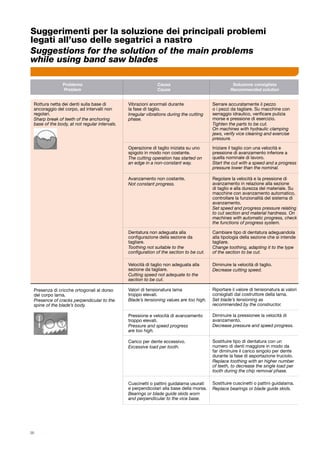
di lubrificazione consente un incremento della produzione, una
maggiore durata dell’utensile, l’eliminazione di fumi, il mantenimento
di pezzi puliti e trucioli asciutti. Le centraline sono complete di
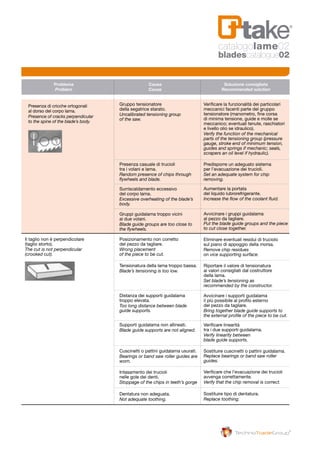
serbatoio, generatore di impulsi, elettrovalvola, ugello con 5 metri di
tubazione coassiale assemblata.
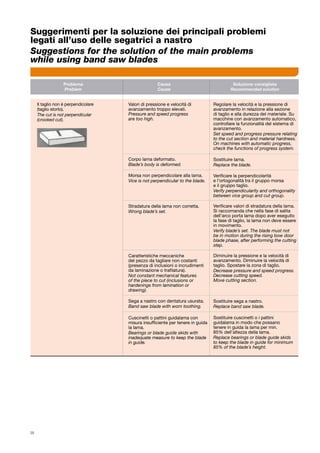

Le CENTRALINE di lubrificazione sono impiegate nelle operazioni
di taglio con lame a nastro, fresatura, filettatura, foratura, affilatura
utensili.
CONTROL UNITS for lubrication are used in cutting with band saw
blades, milling, threading, drilling and grinding tools.
CONTROL UNITS for minimal quantity lubrication are designed to
replace the traditional lubrication or oil emulsion when working with
metal cutting, stamping and cold forming. The lubricant is sprayed
with precision, with an air flow and a nozzle, towards the contact point.
The use of the lubricating control unit allows an increase in production,
a longer tool life, the elimination of fumes, the maintenance of pieces
clean and dry swarf. These control units are complete with tank, pulse
generator, solenoid valve and a nozzle with 5 meters coaxial pipe
assembly.
CENTRALINA di lubrificazione minimale | CONTROL UNIT for minimal quantity lubrication
Caratteristiche tecniche | Specifications
Applicazioni | Applications
** è importante comunicare la tensione di alimentazione dell’elettrovalvola per una corretta evasione dell’ordine
** It’s important to indicate the supply voltage of the solenoid valve to make a correct order
catalogolame02
bladescatalogue02
80
Codice	Descrizione	
Code	Description	
CH5000140600001 	 RIFRATTOMETRO per controllo della percentuale di concentrazione 		
	 dell’emulsione lubrorefrigerante 0-32%
	 REFRACTOMETER for coolant emulsions concentration control 0-32%
Accessori
Accessories
Il RIFRATTOMETRO Ttake è uno strumento ottico preciso e di facile
utilizzo, che consente il controllo della concentrazione delle emulsioni
lubrorefrigeranti. E’ sufficiente applicare una goccia di emulsione
sull’apposito specchietto e leggere la concentrazione attraverso
l’oculare. Viene fornito in custodia antiurto e astuccio in similpelle.
Scala di misura 0-32% Brix
Precisione ±0,2%
Dimensioni 30x40x160 mm.
Il RIFRATTOMETRO viene impiegato principalmente nelle industrie e,
più specificatamente, nelle officine meccaniche per tenere controllata
la concentrazione dei fluidi lubrorefrigeranti impiegati. La corretta
percentuale dell’emulsione acqua/olio consente una maggiore durata
degli utensili utilizzati, l’eliminazione della ruggine sulla macchina
utensile e sui pezzi, ed un risparmio sul consumo di olio.
REFRACTOMETER is mostly used in industries and, specifically, in
optical workshops to keep under control the concentration of coolant
fluids. The right percentage of water/oil emulsion allows a longer life
of tools used, the elimination of the rust on the working machine and
pieces, and a saving of oil consumption.
Ttake’s REFRACTOMETER is a precise optical instruments, easy to
use, which allows the control of coolant emulsions’ concentration.
Simply apply a small drop of the emulsion on the mirror and read the
concentration through the ocular. It comes in a shockproof casing and
leatherette pouch.
Measuring range 0-32% Brix
Accuracy ± 0,2%
Size 30x40x160 mm.
Caratteristiche tecniche | Specifications
Applicazioni | Applications
RIFRATTOMETRO per il controllo delle emulsioni lubrorefrigeranti | REFRACTOMETER for coolant emulsions control
catalogolame02
bladescatalogue02
Note | Notes
82
catalogolame02
bladescatalogue02
Techno Trade Group Srl
Passaggio Canonici Lateranensi, 1
24121 Bergamo
Tel. +39.0332.1852720
Fax +39.0363.1970217
www.ttake.it
www.ttgroup.it
info@ttgroup.it

Ttake Lame 02

  • 1.
  • 3.
    Techno Trade Group,che è una realtà giovane composta da professionisti della Distribuzione Industriale, consolidati da moltissimi anni di storie di successo in Italia, si propone come fornitore di una selezione di prodotti professionali di alta gamma, contenuti in numerosi cataloghi tecnici tematici di semplice ed immediato utilizzo. I cataloghi Ttake sono dei veri e propri strumenti di lavoro per chi effettua acquisti in ambito professionale. Soluzioni per ogni specifica esigenza nel comparto industriale, prodotti unicamente europei, schede tecniche aggiornate e sempre disponibili all’utenza più esigente, chiarezza di contenuti ed estrema flessibilità operativa: sono questi gli elementi che contraddistinguono la filosofia commerciale dei prodotti Ttake. Una gamma completa e di alta qualità gestita da una qualificata Rete Distributiva e caratterizzata dalla capacità di proporre soluzioni tecniche sempre all’avanguardia. Queste sono le vere armi di un marchio proiettato ai professionisti più esigenti di ogni settore industriale. Ttake, al centro del tuo lavoro! Techno Trade Group, che è una realtà giovane composta da professionisti della Distribuzione Industriale, consolidati da moltissimi anni di storie di successo in Italia, si propone come fornitore di una selezione di prodotti professionali di alta gamma, contenuti in numerosi cataloghi tecnici tematici di semplice ed immediato utilizzo. I cataloghi Ttake sono dei veri e propri strumenti di lavoro per chi effettua acquisti in ambito professionale. Soluzioni per ogni specifica esigenza nel comparto industriale, prodotti unicamente europei, schede tecniche aggiornate e sempre disponibili all’utenza più esigente, chiarezza di contenuti ed estrema flessibilità operativa: sono questi gli elementi che contraddistinguono la filosofia commerciale dei prodotti Ttake. Una gamma completa e di alta qualità gestita da una qualificata Rete Distributiva e caratterizzata dalla capacità di proporre soluzioni tecniche sempre all’avanguardia. Queste sono le vere armi di un marchio proiettato ai professionisti più esigenti di ogni settore industriale. Ttake, al centro del tuo lavoro! Techno Trade is a young Group made up of several professional companies, operating in the Italian Industrial Distribution since many years. Techno Trade Group introduces itself as a supplier of a selection of high quality professional products included in several thematic catalogues easy to use. The Ttake catalogues are proper work tools for the buyers operating in the professional sector. Solutions for each specific requirement in the industrial sector, European products only, technical sheets always updated and always available for the end users, high operating flexibility: these are the main features that represent the commercial philosophy of the Ttake’s products. A complete range of high quality products managed by a skilled Sales Network that can offer technical solutions in the forefront. This is the real weapon of a brand dedicated to the demanding professionals in each industrial sector. Ttake, in the core of your business! Per ottenere la descrizione completa dei servizi offerti da Techno Trade Group, vi invitiamo a visitare il nostro sito web all’indirizzo: www.ttgroup.it Visit our web site www.ttgroup.it and you will discover all the services offered by Techno Trade Group. catalogolame02 bladescatalogue02
  • 4.
    Catalogo Lame Ttake Uncatalogo completo con prodotti di elevata qualità e tecnologicamente avanzati, in grado di soddisfare le specifiche esigenze di taglio degli operatori professionali nei vari settori: manutenzione, officine meccaniche, edilizia, industria. Il catalogo è suddiviso in 7 capitoli: lame per segatrici a nastro, seghe e frese a tazza ed accessori, lame per macchine alternative, lame per seghetti manuali, seghe circolari, fluidi lubrorefrigeranti, accessori. All’interno del catalogo sono presenti guide con tabelle e immagini che aiutano l’utente nella scelta del prodotto più idoneo alle sue necessità. Un’ampia scelta di lame e seghe di varie tipologie, dentature, misure e una selezione di accessori per garantire una gamma di prodotti completa. Scoprite il mondo delle Lame Ttake: una soluzione per ogni esigenza! www.ttake.it Ttake’s Blades Catalogue A complete catalogue with high quality and technologically advanced products, to meet the specific needs of cutting of professional operators in various areas: maintenance, automotive, construction, industry. The catalogue is divided into 7 chapters: band saws blades, hole saws and accessories, blades for alternative saw machines, hacksaw blades, circular saw blades, coolant fluids and accessories. Through the catalogue there are guides with tables and graphics that help users to choose the product that best suits their needs. A wide choice of blades and saws of various types, teeth, sizes and a selection of accessories to guarantee a full range of products. Discover the world of Ttake’s Blades: a solution for every need! www.ttake.it
  • 5.
    1 Lameper segatrici a nastro | Band saw blades pag. 6 1.1 Guida alla scelta della lama | Blade’s selection guide pag. 8 1.2 Lame bimetalliche | Bimetal blades pag. 20 1.3 Lame con dentatura in metallo duro | Blades with carbide toothing pag. 28 Suggerimenti per la soluzione dei principali problemi legati all’uso delle segatrici a nastro pag. 34 Suggestions for the solution of the main problem while using band saw blades Servizio consulenza tecnica | Technical advice service pag. 40 2 Seghe e frese a tazza ed accessori | Hole saws and accessories pag. 42 3 Lame per macchine alternative | Blades for alternative saw machines pag. 56 Guida al corretto impiego delle lame per segatrici alternative 3.1 pag. 58 Guide for a correct use of blades for alternative saw machines 4 Lame per seghetti manuali | Hacksaw blades pag. 60 5 Seghe circolari | Circular saw blades pag. 64 6 Fluidi lubrorefrigeranti | Coolant fluids pag. 68 6.1 Fluidi lubrorefrigeranti esenti da dietanolammina | Coolant fluids free from diethanolamine pag. 70 6.2 Fluidi lubrorefrigeranti esenti da boro e biocidi | Coolant fluids free from boron and biocides pag. 72 Fluidi lubrorefrigeranti da risorse rinnovabili stabilizzate 6.3 pag. 74 Coolant fluids from renewable stabilized resources 7 Accessori | Accessories pag. 76 Indice prodotti Index catalogolame02 bladescatalogue02
  • 6.
  • 7.
    1 Lame persegatrici a nastro Band saw blades catalogolame02 bladescatalogue02
  • 8.
    Guida alla sceltadella lama Blade’s selection guide Sviluppo, altezza e spessore della lama La dimensione della lama dipende dalla segatrice che si utilizza. Per una corretta selezione della lama più adatta, è necessario consultare quindi il manuale tecnico di utilizzo della segatrice stessa. Qualità Le lame a nastro Ttake vengono proposte con due tipi di materiali del tagliente: bimetallico e metallo duro. La scelta della qualità del nastro da impiegare dipende principalmente dal materiale che si intende tagliare. In particolare, le principali caratteristiche del materiale da considerare sono la durezza (intesa come resistenza all’asportazione del truciolo) e la configurazione. Dentatura La scelta della dentatura corretta è determinata dalla sezione e dalla configurazione del pezzo da tagliare. Normalmente la dentatura costante (i denti presentano una geometria uniforme e si susseguono con la medesima spaziatura) viene utilizzata per il taglio di sezioni piene o, comunque, regolari (3, 4, 6, 8, 10, 14 denti x pollice). La dentatura variabile (i denti presentano una geometria diversificata e si susseguono con una differente spaziatura) è generalmente indicata per il taglio di profilati o di sezioni non costanti (2/3, 3/4, 4/6, 5/8, 6/10, 8/12, 10/14 denti x pollice). Per entrambe le tipologie di dentatura è comunque fondamentale che, in fase di taglio, almeno 3 denti siano contemporaneamente in presa sul pezzo da tagliare. Development, height and thickness of the blade The size of the blade depends on the sawing machine that is used. For a correct selection of the most suitable blade, you need to consult the technical manual of the sawing machine. Quality Ttake’s band saw blades are offered with two types of material of the cutting edge: bimetal and carbide. The choice of the quality of the band to be used depends first of all on the material to be cut. In particular, the main characteristics of the material to consider are the hardness (as resistance to the removal of the chip) and the configuration. Toothing The choice of the correct toothing is determined by the section and the configuration of the piece to be cut. Usually a constant toothing (teeth have a uniform geometry and follow one another with the same spacing) is used to cut solid or regular sections (3, 4, 6, 8, 10, 14 teeth per inch). The variable toothing (teeth have a diversified geometry and follow one another with a different spacing) is generally indicated to cut shapes or non-constant sections (2/3, 3/4, 4/6, 5/8, 6/10, 8/12, 10/14 teeth per inch). However, for both types of toothing is essential that, during the cutting phase, at least 3 teeth are simultaneously in mesh on the piece to be cut. 8 1.1
  • 9.
    catalogolame02 bladescatalogue02 Caratteristiche tecniche |Specifications Caratteristiche tecniche | Specifications Caratteristiche tecniche | Specifications Caratteristiche tecniche | Specifications Il dente normale ha un angolo di spoglia pari a 0° ed è adatto ad un impiego universale per il taglio di sezioni di piccole e medie dimensioni di: • tubi o profilati • acciai basso legati • travi portanti oltre che per tagli a fasci e a strati, e tagli suscettibili di vibrazioni. Il dente Raker è a passo variabile ed ha un angolo di spoglia positivo superiore a 0°. Utilizzato per il taglio di piccole sezioni trasversali di tubi e profili, oltre che per il taglio di: • materiali a truciolo corto • acciai con elevato contenuto di carbonio • acciai da utensili e ghisa Standard tooth has a 0° rake and it is suitable for a universal use for cutting small and medium sections of: • pipes or section bars • low-alloy steels • support beams and also for bundle or layers cutting and cuts subject to vibrations. Dente normale | Standard tooth Dente Hook | Hook tooth Dente trapezoidale | Trapezoidal tooth Dente Raker | Raker tooth Forma del dente | Tooth’s shape Hook tooth has a 10° rake and has an increased containing cavity for chips. This tooth is suitable for a universal use for cutting sections of big dimension of: • high-alloy steels • non-ferrous materials • building steels, steels for cold extrusion • tempered steels Il dente Hook ha un angolo di spoglia positivo di 10° e presenta una cavità di contenimento dei trucioli maggiorata. È adatto ad un impiego universale per il taglio di sezioni di grosse dimensioni di: • acciai fortemente legati • metalli non ferrosi • acciai da costruzione, acciai per estrusione a freddo • acciai temprati Il dente trapezoidale ha un angolo di spoglia positivo ed è caratterizzato da una particolare geometria che garantisce un alto rendimento ed una maggiore finitura. È indicato per tagli ad alta velocità di: • leghe di titanio • bronzo-alluminio • superleghe • zirconio • molibdeno Trapezoidal tooth has a positive rake and it is characterized by a particular geometry that allows an high performance and a better finish. This tooth is suitable for high- speed cuts of: • titanium alloys • bronze-aluminium • superalloys • zirconium • molybdenum Raker tooth has a variable pitch and a positive rake higher than 0°. For cutting small traverse sections of pipes and profiles, and: • short chips’ materials • steels with high carbon content • steels for tools and cast iron positivo | positive geometria del tagliente trapezoidale geometry of trapezoidal cutting edge
  • 10.
    10 Caratteristiche tecniche |Specifications Caratteristiche tecniche | Specifications Caratteristiche tecniche | Specifications La stradatura standard può essere usata universalmente per tagliare spessori di oltre 5 mm. di acciaio, fusioni e metalli duri non ferrosi. La stradatura standard è costituita da una o più coppie di denti, ognuna composta da un dente alternato a destra e uno a sinistra, intervallate da un dente diritto. Con la dentatura a passo fisso, la sequenza della stradatura è: sinistra/destra/diritto. Con il passo del dente variabile, nell’intervallo di dentatura uno non è stradato, mentre i rimanenti sono stradati nella sequenza: sinistra/destra. La stradatura a gruppo è costituita da un dente diritto, seguito da una coppia di denti inclinati a sinistra ed una coppia a destra, al fine di ridurre le vibrazioni e migliorare la finitura del taglio. Utilizzata per lame sega a nastro con gamma di dentatura da 4 e 18 denti tpi, per speciali applicazioni nel taglio dei materiali non- ferrosi. La migliore qualità della superficie si ottiene con la stradatura a gruppo. La stradatura ondulata prevede un disassamento dei denti graduale da sinistra a destra, per una penetrazione dolce e non invasiva. Impiegata per il taglio materiali, quali lamierini, profilati, tubi con pareti sottili, fino a 5 mm. La stradatura indica la distanza totale del disassamento dei denti della lama e fa sì che i denti stessi sporgano alternativamente a sinistra e a destra oltre il livello del corpo lama. Essa determina la larghezza dell’intaglio atto a favorire l’evacuazione del truciolo ed a consentire il gioco laterale del dorso del nastro. Esistono diverse tipologie di stradatura adatte ad ogni esigenza di taglio. The set indicates the total distance of the misalignment of blade’s teeth and it makes the teeth themselves to protrude alternately to the left and to the right beyond the level of the blade body. It determines the width of the notch suitable to facilitate the chip evacuation and to allow the lateral backlash of the back of the band. There are different types of set suitable for every cutting need. Standard set can be generally used for cutting thickness of more than 5 mm of steel, mergers and non-ferrous hard metals. Standard set is made of one or more couples of teeth, each one composed of a tooth alternately on the right and one on the left, spaced out with a straight tooth. With fixed pitch toothing, the sequence of the set is: left/right/straight. With variable pitch toothing, in toothing gap one is not set, while the remaining are set in sequence: left/right. Group set is made of a straight tooth, followed by a couple of teeth inclined to the left and a couple inclined to the right, in order to reduce vibrations and improve the finish of the cut. Used for band saw blades with tooth range of 4 and 18 teeth tpi, for special applications of non-ferrous materials cutting. The best surface quality is obtained with group set. Wavy set provides a gradual misalignment of the teeth from the left to the right, for a gentle and non-invasive penetration. It is used for cutting materials, such as laminations, profiles, thin-walled pipes up to 5 mm. Stradatura standard | Standard set Stradatura a gruppo | Group set Stradatura ondulata | Wavy set Stradatura | Set intervallo della dentatura | toothing gap
  • 11.
    Passo dente costante(tpi) Lungh contatto dent.-pz (mm.) Fixed pitch toothing (tpi) Contact tooth-pc length (mm.) Passo dente costante (tpi) Lungh contatto dent.-pz (mm.) Variable pitch toothing (tpi) Contact tooth-pc length (mm.) Passo dente costante (tpi) Lungh contatto dent.-pz (mm.) Fixed pitch toothing (tpi) Contact tooth-pc length (mm.) Passo dente costante (tpi) Lungh contatto dent.-pz (mm.) Variable pitch toothing (tpi) Contact tooth-pc length (mm.) 10 – 14 8 – 12 6 – 10 5 – 8 4 – 6 5 – 5 fino a 30 | until 30 20 ÷ 50 25 ÷ 60 35 ÷ 80 50 ÷ 100 70 ÷ 120 24 18 14 10 8 fino a 6 | until 6 fino a 10 | until 10 fino a 15 | until 15 15 ÷ 30 30 ÷ 50 3 – 4 2 – 3 1,4 – 2 1,0 – 1,4 0,75 – 1,25 0,70 – 1,0 80 ÷ 150 120 ÷ 350 250 ÷ 600 400 ÷ 1.000 700 ÷ 1.400 900 ÷ 3.000 6 4 3 120 ÷ 200 2 200 ÷ 400 1,25 300 ÷ 800 Caratteristiche tecniche | Specifications Caratteristiche tecniche | Specifications Questa tipologia di dentatura presenta una distanza costante tra dente e dente. È particolarmente indicata per tagliare materiali solidi su segatrici con bloccaggio ottimale del pezzo. La dentatura a passo variabile consiste nella presenza di gruppi di denti alternati ripetuti ad intervalli regolari su tutta la lama. L’utilizzo di questa tipologia di dentatura consente una riduzione delle vibrazioni causate dalla risonanza durante il taglio. È adatta al taglio di pezzi vuoti con pareti sottili e materiale in fasci o con un bloccaggio debole. Per passo del dente si intende il numero di denti per pollice (1 pollice = 25,4 mm.). Nel caso di dentatura variabile, le due cifre rappresentano in numero massimo e minimo possibile di denti per pollice in ciascun gruppo di denti. La scelta della dentatura ottimale è determinata dalla sezione da tagliare nel pezzo in lavorazione. Di seguito, i valori limite per ciascuna delle dentature costante e variabile. The choice of the optimal toothing is determined by the section to be cut in the workpiece. Below, the limit values for each of the fixed and variable pitch toothing. Pitch toothing refers to the number of teeth per inch (1 inch = 25,4 mm). In case of variable toothing, the two digits represent the maximum and minimum possible number of teeth per inch in each group of teeth. This type of toothing has a constant distance from tooth to tooth. It is indicated for cutting solid materials on sawing machine with optimum workpiece locking. Variable toothing consists in groups of alternating teeth repeated at regular intervals on the entire blade. The use of this type of toothing allows a reduction of the vibrations caused by the resonance during cutting. It is suitable for cutting empty pieces with thin walls, and material into bundles or with a weak locking. Passo del dente costante | Fixed pitch toothing Passo del dente variabile | Variable pitch toothing Passo del dente | Pitch toothing intervallo della dentatura | toothing gap costante | fixed variabile | variable Min. Max. 50 ÷ 80 80 ÷ 12 catalogolame02 bladescatalogue02
  • 12.
    12 Spessore Lunghezzadi contatto (mm.) S (mm.) L Diametro esterno del tubo (mm.) / passo del dente in tpi Thickness Contact length (mm.) S (mm.) L Pipe external diameter (mm.) / toothing pitch in tpi 20 40 60 80 100 120 150 200 300 400 500 600 700 800 900 1000 1500 2 14 14 10/14 10/14 10/14 10/14 10/14 8/12 8/12 8/12 6/10 6/10 5/8 5/8 5/8 5/8 5/8 3 10/14 10/14 10/14 10/14 8/12 8/12 8/12 6/10 6/10 6/10 5/8 5/8 5/8 4/6 4/6 4/6 4/6 4 8/12 8/12 8/12 8/12 8/12 6/10 6/10 6/10 5/8 5/8 4/6 4/6 4/6 4/6 4/6 4/6 3/4 5 8/12 8/12 8/12 6/10 6/10 6/10 6/10 5/8 5/8 5/8 4/6 4/6 4/6 4/6 3/4 3/4 3/4 6 6/10 6/10 6/10 6/10 6/10 6/10 5/8 5/8 5/8 4/6 4/6 4/6 3/4 3/4 3/4 3/4 3/4 8 6/10 6/10 6/10 6/10 5/8 5/8 5/8 4/6 4/6 4/6 4/6 3/4 3/4 3/4 3/4 2/3 2/3 10 5/8 5/8 5/8 5/8 5/8 4/6 4/6 4/6 4/6 3/4 3/4 3/4 3/4 2/3 2/3 2/3 12 5/8 5/8 5/8 4/6 4/6 4/6 4/6 4/6 3/4 3/4 3/4 3/4 2/3 2/3 2/3 2/3 15 4/6 4/6 4/6 4/6 4/6 3/4 3/4 3/4 3/4 3/4 2/3 2/3 2/3 2/3 2/3 2/3 20 4/6 4/6 3/4 3/4 3/4 3/4 3/4 3/4 2/3 2/3 2/3 2/3 2/3 2/3 2/3 30 3/4 3/4 3/4 2/3 2/3 2/3 2/3 2/3 2/3 2/3 2/3 2/3 2/3 1,5/2 50 2/3 2/3 2/3 2/3 2/3 2/3 2/3 2/3 2/3 1,5/2 1,5/2 1,5/2 75 2/3 2/3 2/3 2/3 2/3 1,5/2 1,5/2 1,5/2 1,5/2 1,5/2 100 2/3 2/3 1,5/2 1,5/2 1,5/2 1,5/2 1,5/2 1,5/2 0,75/1,25 150 2/3 1,5/2 1,5/2 1,5/2 1,5/2 1,5/2 0,75/1,25 0,75/1,25 200 1,5/2 1,5/2 1,5/2 1,5/2 0,75/1,25 0,75/1,25 0,75/1,25 250 1,5/2 1,5/2 0,75/1,25 0,75/1,25 0,75/1,25 0,75/1,25 300 1,5/2 0,75/1,25 0,75/1,25 0,75/1,25 0,75/1,25 350 0,75/1,25 0,75/1,25 0,75/1,25 0,75/1,25 400 0,75/1,25 0,75/1,25 0,75/1,25 450 0,75/1,25 0,75/1,25 500 0,75/1,25 Caratteristiche tecniche | Specifications Nel taglio di particolari con geometrie a sezione interrotta (tubi, profilati, scatolati, ecc.), a causa del limitato ed incostante numero di denti in presa, ogni dente è soggetto a notevoli carichi di lavoro e sollecitazioni meccaniche. Per determinare il passo del dente più idoneo, occorre quindi considerare sia la quota massima in cui la lama opererà, sia lo spessore del pezzo riscontrabile durante le varie fasi del taglio. During the cutting operations of details with interrupted section geometries (pipes, profiles, molded, etc.), due to the limited and inconstant number of meshing teeth, each tooth is subject to considerable workload and mechanical stresses. To determine the most suitable tooth pitch, it is therefore necessary to consider both the maximum portion in which the blade will operate, and the thickness of the workpiece during the various stages of cutting. Sezioni interrotte | Interrupted sections Scelta del dente | Tooth’s choice
  • 13.
    catalogolame02 bladescatalogue02 Caratteristiche tecniche |Specifications Caratteristiche tecniche | Specifications È necessario inoltre considerare i diversi valori di lunghezza di contatto della dentatura (Lc minima, Lc massima) durante le varie fasi del taglio e la relativa sezione equivalente. Per eseguire lavorazioni di contornatura o scantonatura è necessario utilizzare una lama con caratteristiche tali che consentano di tagliare in modo efficace l’arco desiderato. È preferibile impiegare la lama con la maggiore larghezza che sia in grado di tagliare il raggio minore della vostra lavorazione. It is also necessary to consider the different values of toothing’s contact length (minimum Cl*, maximum Cl*) during the various steps of cutting and the relative equivalent section. To perform contouring or notching it is necessary to use a blade with such features that effectively enable to cut the required arc. It is preferred to employ the blade with the greater width for cutting the minor radius of your processing. Sezioni interrotte | Interrupted sections Contornatura | Contouring *Cl=contact length
  • 14.
    14 Caratteristiche tecniche |Specifications Caratteristiche tecniche | Specifications In caso di particolari aventi geometrie a sezione piena, in ogni fase di taglio il carico di lavoro è uniformemente distribuito sulla totalità dei denti in presa. Per determinare il passo del dente più idoneo, occorre quindi considerare la quota massima di contatto possibile tra la dentatura ed il pezzo durante le varie fasi di taglio: quota massima di contatto dentatura L = Larghezza totale pezzi affiancati In questo caso, per determinare il passo del dente più idoneo, occorre considerare oltre alla quota massima in cui la lama opererà, anche lo spessore del pezzo durante le varie fasi di taglio: larghezza L = Larghezza totale pezzi affiancati n° pareti affiancate spessore S = Spessore singolo pezzo x ---------------------------- 2 In this case, to determine the best pitch toothing, it is useful to consider both maximum portion in which the blade will operate, and also the thickness of the workpiece during the various steps of cutting: width L = Total width of adjacent pieces n° adjacent walls thickness S = Single piece thickness x ---------------------------- 2 Esempio | Example: In case of details with full section geometries, in every phase of cutting the work load is evenly distributed on the totality of teeth in mesh. To determine the most suitable pitch toothing, it is necessary to consider the maximum portion of possible contact between the toothing and the workpiece during the various steps of cutting: maximum toothing contact L = Total width of adjacent pieces Esempio | Example: Taglio a fascio di sezioni piene | Beam cutting of full sections Taglio a fascio di sezioni interrotte | Beam cutting of interrupted sections Un fascio di profilati la cui disposizione o dimensione comporti un'elevata densità di materiale, deve essere considerato esattamente come il taglio di una sezione piena. A beam sections whose arrangement or dimension involves an high density material, must be considered exactly like the cutting of a full section. L = pack width L = larghezza pacco Scelta del dente | Tooth’s choice
  • 15.
    Tipo materiale DIN Velocità di taglio Vc (m/min) Lubrificazione Material DIN Cutting speed (m/min) Lubrication Olio Emulsione Oil Emulsion Acciai da costruzione St 37-2 80-100 x Structural steels St 50-2 60-85 x St 60-2 50-70 x Acciai da cementazione C 10 80-100 x Case hardening steels 14 NiCr 14 40-55 x 21 NiCrMo 2 50-60 x 16 MnCr 5 40-60 x Acciai automatici 9 S 20 80-120 x Automatic steels 45 S 20 80-120 x Acciai temprati C 45 60-70 x Tempered steels 40 Mn 4 60-70 x 36 NiCr 6 60-70 x 34 CrNiMo 6 50-65 x 42 CrMo 4 50-65 x Acciai per cuscinetti 100 Cr 6 35-50 x Bearings steels 100 CrMn 6 35-50 x Acciai per molle 65 Si 7 45-60 x Springs steels 50 CrV 4 45-60 x Acciai per utensili non legati C 125 W 40-60 x Non-alloy steels C 75 W 40-60 x Acciai per utensili 125 Cr 1 40-50 x x Tool steels X 210 Cr 12 30-40 x x Lavorazioni a freddo X 155 CrVMo 12 1 30-40 Secco | Dry Cold working X 42 Cr 13 35-45 x x X 165 CrV 12 30-45 x x 100 CrMo 5 30-50 x x X 32 CrMoV 3 3 45-60 x x 45 WCrV 7 40-50 x x Lavorazioni a caldo 56 NiCrMoV 7 40-50 x x Hot working Acciai super rapidi S 6-5-2-5 (E Mo5 Co5) 35-45 x High speed steels S 2-10-1-8 (M 42) 35-45 x S 6-5-2 (DMo5) 35-45 x Acciai per valvole X 45 CrSi 9 3 30-45 x x Valves steels X 45 CrNiW 18 9 30-40 x x Acciai resistenti al calore X 20 CrMoV 12 1 10-30 x x Heat resistant steels X 5 NiCrTi 26 15 10-30 x x Acciai resistenti alte temperature X 10 CrSi 6 15-25 x x Steel resistant to high temperatures X 10 CrAl 18 15-25 x x X 15 CrNi Si 25 20 15-25 x x Acciai inossidabili e resistenti agli acidi X 5 CrNi 18 10 (V2A) 30-40 x x Stainless and acid resistant steels X 5 CrNiMoTi 172 12 2 (V4A) 30-40 x Ghisa fusa GS-38 40-60 x Melted cast iron GS-60 40-60 x Ghisa GG-15 30-60 Secco | Dry Cast iron GG-30 30-60 Secco | Dry GGG-50 30-60 Secco | Dry GTW-40 30-60 Secco | Dry catalogolame02 bladescatalogue02 Linee guida per LAME BIMETALLICHE | Guidelines for BIMETAL BLADES Velocità di taglio (mt/min) e lubrorefrigerante consigliato Cutting speed (mt/min) and recommended coolant fluid
  • 16.
    16 Tipo materiale DIN Velocità di taglio Vc (m/min) Lubrificazione Material DIN Cutting speed (m/min) Lubrication Olio Emulsione Oil Emulsion Ghisa GTS-65 30-60 Secco | Dry Cast Iron Rame KE-Cu 100-400 x x Copper Rame elettrolitico | Electrolytic copper 100-400 x x Ottone CuZn 10 100-400 x Brass CuZn 31 Si 1 100-400 x Alluminio-Bronzo CuAl 8 35-50 x Aluminium-Bronze CuAl 10 Fe 3 Mn 2 35-50 x Bronzo CuSn 6 80-150 x Bronze CuSn 6 Zn 6 80-150 x Ghisa rossa CuSn 10 Zn 50-100 x Red cast iron CuSn 5 ZnPb 50-100 x Leghe al nichel resistenti al calore NiCr 20 TiAl 10-25 x x Nickel alloy heat resistant NiCr 22 FeMo 10-25 x x Alluminio e sue leghe Al 99.5 80-800 x Aluminium and its alloys AlMgSiPb 80-800 x G-AlSi 5 Mg 80-800 x Titanio e sue leghe Ti Grade 1 10-20 x x Titanium and its alloys TiAl 6 V 4 10-20 x Materiali termoplastici PVC 100-400 Secco | Dry Thermoplastic materials Teflon, Hostalen 100-400 Secco | Dry Tessuti plastici Resitex 50-300 Secco | Dry Plastic materials Novotex 50-300 Secco | Dry Linee guida per LAME BIMETALLICHE | Guidelines for BIMETAL BLADES Velocità di taglio (mt/min) e lubrorefrigerante consigliato Cutting speed (mt/min) and recommended coolant fluid
  • 17.
    catalogolame02 bladescatalogue02 Tipo materiale DIN Velocità taglio Vc (m/min) Dentatura consigliata Material DIN Cutting speed (m/min) Recommended toothing Diametro materiale Material diameter Acciai da costruzione St 37/24 100-130 3/4 3 ZpZ 2/3 1,4/2 0,75/1,25 Structural steels St 52/60 90-120 3/4 3 ZpZ 2/3 1,4/2 0,75/1,25 Acciai da cementazione C10/C15 110-140 3/4 3 ZpZ 2/3 1,4/2 0,75/1,25 Case hardening steels 16 MnCr 5 80-100 3/4 3 ZpZ 2/3 1,4/2 0,75/1,25 20 CrMo 5 80-100 3/4 3 ZpZ 2/3 1,4/2 0,75/1,25 21 NiCrMo 2 70-90 3/4 3 ZpZ 2/3 1,4/2 0,75/1,25 Acciai Nitrati 34 CrAlNi 7 45-60 3/4 3 ZpZ 2/3 1,4/2 0,75/1,25 Nitred steels 34 CrAlMo 5 45-60 3/4 3 ZpZ 2/3 1,4/2 0,75/1,25 Acciai automatici 9 S 20 100-160 3/4 3 ZpZ 2/3 1,4/2 0,75/1,25 Automatic steels Acciai temprati C 35/45 90-120 3/4 3 ZpZ 2/3 1,4/2 0,75/1,25 Tempered steels 42 CrMo 4 70-90 3/4 3 ZpZ 2/3 1,4/2 0,75/1,25 34 CrNiMo 6 70-90 3/4 3 ZpZ 2/3 1,4/2 0,75/1,25 Acciai per cuscinetti 100 Cr 6 70-90 3/4 3 ZpZ 2/3 1,4/2 0,75/1,25 Bearings steels 100 CrMo 7 3 65-85 3/4 3 ZpZ 2/3 1,4/2 0,75/1,25 Acciai per molle 65 Si 7 65-85 3/4 3 ZpZ 2/3 1,4/2 0,75/1,25 Springs steels 50 CrV4 65-85 3/4 3 ZpZ 2/3 1,4/2 0,75/1,25 Acciai per utensili C 125 W 65-80 3/4 3 ZpZ 2/3 1,4/2 0,75/1,25 Tool steels C 80 W 1 70-85 3/4 3 ZpZ 2/3 1,4/2 0,75/1,25 Acciai per lavorazioni a freddo 125 Cr 1 65-80 3/4 3 ZpZ 2/3 1,4/2 0,75/1,25 Cold working steels X 210 Cr 12 40-50 3/4 3 ZpZ 2/3 1,4/2 0,75/1,25 X 155 CrVMo 12 1 40-50 3/4 3 ZpZ 2/3 1,4/2 0,75/1,25 90 MnCrV 8 45-55 3/4 3 ZpZ 2/3 1,4/2 0,75/1,25 Acciai per lavorazioni a caldo 40 CrMnMo 7 70-90 3/4 3 ZpZ 2/3 1,4/2 0,75/1,25 Hot working steels X 40 CrMoV 5 1 60-80 3/4 3 ZpZ 2/3 1,4/2 0,75/1,25 56 NiCrMoV 7 50-70 3/4 3 ZpZ 2/3 1,4/2 0,75/1,25 40 CrMnNiMo 8 6 4 35-50 3/4 3 ZpZ 2/3 1,4/2 0,75/1,25 Acciai super rapidi S 6-5-2 50-60 3/4 3 ZpZ 2/3 1,4/2 0,75/1,25 High speed steels S 3-3-2 55-65 3/4 3 ZpZ 2/3 1,4/2 0,75/1,25 S 2-10-1-8 45-60 3/4 3 ZpZ 2/3 1,4/2 0,75/1,25 S 10-4-3-10 45-60 3/4 3 ZpZ 2/3 1,4/2 0,75/1,25 S 18-0-1 45-60 3/4 3 ZpZ 2/3 1,4/2 0,75/1,25 Acciai inossidabili e resistenti agli acidi X 5 CrNi 18 10 70-80 3/4 3 ZpZ 2/3 1,4/2 0,75/1,25 Stainless and acid resistant steels X 6CrNiMoTi 17 122 65-75 3/4 3 ZpZ 2/3 1,4/2 0,75/1,25 X 20 Cr 13 80-100 3/4 3 ZpZ 2/3 1,4/2 0,75/1,25 Acciai per valvole X 45 CrSi 9 3 50-60 3/4 3 ZpZ 2/3 1,4/2 0,75/1,25 Valves steels X 45 CrNiW 18 9 40-50 3/4 3 ZpZ 2/3 1,4/2 0,75/1,25 Acciai resistenti al calore X 12 CrCoNi 21 20 30-40 3/4 3 ZpZ 2/3 1,4/2 0,75/1,25 Heat resistant steels X 20 CrMoWV 12 1 80-100 3/4 3 ZpZ 2/3 1,4/2 0,75/1,25 Acciai resistenti alte temperature X 15 Cr Ni Si 30-40 3/4 3 ZpZ 2/3 1,4/2 0,75/1,25 Steel resistant to high temperatures X 12 NiCrSi 36 16 30-40 3/4 3 ZpZ 2/3 1,4/2 0,75/1,25 Leghe speciali Ni Cr 19 NbMo 20-30 3/4 3 ZpZ 2/3 1,4/2 0,75/1,25 Special alloys NiMo 30 22-35 3/4 3 ZpZ 2/3 1,4/2 0,75/1,25 NiCr 13 Mo 6 Ti 3 20-30 3/4 3 ZpZ 2/3 1,4/2 0,75/1,25 NiCo 20 Cr 20 MoTi 22-35 3/4 3 ZpZ 2/3 1,4/2 0,75/1,25 X 8 CrNiAlTi 20 20 22-35 3/4 3 ZpZ 2/3 1,4/2 0,75/1,25 Linee guida per LAME A NASTRO AL CARBURO - taglio di acciai | Guidelines for CARBIDE BAND SAW BLADES - steels cutting Velocità di taglio (mt/min) e lubrorefrigerante consigliato Cutting speed (mt/min) and recommended coolant fluid 75-140 100-350 300-550 >540 mm mm mm mm
  • 18.
    18 Tipo materiale DIN Velocità taglio Vc (m/min) Dentatura consigliata Material DIN Cutting speed (m/min) Recommended toothing Diametro materiale Material diameter Linee guida per LAME A NASTRO AL CARBURO - taglio di acciai | Guidelines for CARBIDE BAND SAW BLADES - steels cutting 75-140 100-350 300-550 >540 mm mm mm mm Acciai bonificati Quenched tempered steels 1000-1200 N/mm² 35-50 3/4 3 ZpZ 2/3 1,4/2 0,75/1,25 1200-1400 N/mm² 30-45 3/4 3 ZpZ 2/3 1,4/2 0,75/1,25 1400-1600 N/mm² 25-35 3/4 3 ZpZ 2/3 1,4/2 0,75/1,25 Acciai temprati Quenched steels 50 HRC 15-20 3/4 3 ZpZ 2/3 1,4/2 0,75/1,25 55 HRC 10-15 3/4 3 ZpZ 2/3 1,4/2 0,75/1,25 60 HRC 8-12 3/4 3 ZpZ 2/3 1,4/2 0,75/1,25 Ghisa fusa G5-38 70-100 3/4 3 ZpZ 2/3 1,4/2 0,75/1,25 Melted cast iron C5-60 60-85 3/4 3 ZpZ 2/3 1,4/2 0,75/1,25 Ghisa GG-30 60-80 3/4 3 ZpZ 2/3 1,4/2 0,75/1,25 Cast iron GGG-50 55-75 3/4 3 ZpZ 2/3 1,4/2 0,75/1,25 Alluminio e sue leghe Al 99,5 fino | up to 3000 m/min. 3/4 3 ZpZ 2/3 1,4/2 0,75/1,25 Aluminium and its alloys AlMg 1 fino | up to 3000 m/min. 3/4 3 ZpZ 2/3 1,4/2 0,75/1,25 AlMg 3 fino | up to 3000 m/min. 3/4 3 ZpZ 2/3 1,4/2 0,75/1,25 AlMg 4.5Mn fino | up to 3000 m/min. 3/4 3 ZpZ 2/3 1,4/2 0,75/1,25 AlMgSi 1 fino | up to 3000 m/min. 3/4 3 ZpZ 2/3 1,4/2 0,75/1,25 Rame KE-Cu 100-200 3/4 3 ZpZ 2/3 1,4/2 0,75/1,25 Copper E Cu 100-200 3/4 3 ZpZ 2/3 1,4/2 0,75/1,25 Ottone CuZn 39 Pb 3 150-250 3/4 3 ZpZ 2/3 1,4/2 0,75/1,25 Brass VuZn 31 Si 150-250 3/4 3 ZpZ 2/3 1,4/2 0,75/1,25 Zinco-bronzo CuSn 6 90-130 3/4 3 ZpZ 2/3 1,4/2 0,75/1,25 Zync-bronze Ghisa rossa CuSn 5 ZnPb 90-130 3/4 3 ZpZ 2/3 1,4/2 0,75/1,25 Red cast iron CuSn 10 Zn 90-130 3/4 3 ZpZ 2/3 1,4/2 0,75/1,25 Alluminio-Bronzo CuAl 8 60-80 3/4 3 ZpZ 2/3 1,4/2 0,75/1,25 Aluminium-Bronze CuAl 8 Fe 38 52-65 3/4 3 ZpZ 2/3 1,4/2 0,75/1,25 CuAl 10 Ni 5 Fe 4 50-70 3/4 3 ZpZ 2/3 1,4/2 0,75/1,25 Titanio e sue leghe Ti Grade 1 80-100 3/4 3 ZpZ 2/3 1,4/2 0,75/1,25 Titanium and its alloys TiAl 6 V 4 60-90 3/4 3 ZpZ 2/3 1,4/2 0,75/1,25 Tipo materiale DIN Velocità taglio Vc (m/min) Dentatura consigliata Material DIN Cutting speed (m/min) Recommended toothing Diametro materiale Material diameter Linee guida per LAME A NASTRO AL CARBURO - taglio di materiali non ferrosi Guidelines for CARBIDE BAND SAW BLADES - non-ferrous materials cutting 75-140 100-350 300-550 >540 mm mm mm mm Velocità di taglio (mt/min) e lubrorefrigerante consigliato Cutting speed (mt/min) and recommended coolant fluid
  • 19.
    Forma truciolo Condizione Colore Velocità di taglio Avanzamento Altro Chip shape Condition Colour Cutting speed Feed Other spesso, duro e fragile violaceo ridurre ridurre verificare refrigerante o marrone e % emulsione thick, hard and fragile purple or brown to reduce to reduce to verify coolant fluid and % emulsion polverizzato grigio chiaro ridurre aumentare pulverized silver to reduce to increase sottile, riccio ed elastico grigio chiaro ok ok thin, curly and elastic silver ok ok sottile, duro ed elastico grigio chiaro aumentare ridurre verificare scelta del passo thin, hard and elastic silver to increase to reduce to verify pitch toothing spesso, duro grigio chiaro ok ridurre leggermente verificare scelta ed elastico o giallo chiaro del passo thick, hard and elastic silver ok to slightly reduce to verify pitch toothing or light yellow sottile, piatto ed elastico grigio chiaro ok aumentare thin, flat and elastic silver ok to increase spesso, duro e fragile violaceo ridurre ridurre verificare refrigerante o marrone e % emulsione thick, hard and fragile purple or brown to reduce to reduce to verify coolant fluid and % emulsion sottile, riccio e stretto grigio chiaro ok ridurre utilizzare passo più grande thin, curly and tight silver ok to reduce to use a bigger pitch toothing catalogolame02 bladescatalogue02 Caratteristiche tecniche | Specifications Per una corretta operazione di taglio, è molto utile seguire i parametri di taglio consigliati; occorre però considerare la molteplicità di fattori che possono influenzare le rese nel taglio a nastro, quali la dimensione e tipologia di lama, le caratteristiche della segatrice, ecc. Al fine di ottimizzare i parametri impostati, risulta estremamente utile durante l’azione di taglio, controllare lo stato dei trucioli facendo riferimento alla sottostante tabella. For a correct cutting operation, it is very useful to follow the recommended cutting parameters and to consider the multiplicity of factors that may influence yields in cut with band saw blades, such as size and type of the blade, characteristics of the saw machine, etc. In order to optimize the parameters set, it is extremely useful during the cutting action, to check the status of the chips by referring to the table below. Sezioni interrotte | Interrupted sections Suggerimenti di taglio | Cutting recommendations
  • 20.
    Lame per segatricia nastro1.2 Lame bimetalliche Le lame a nastro bimetalliche sono costituite da un corpo in acciaio al carbonio e dentatura in acciaio super rapido M42 o M51 con 8% di cobalto, per garantire le più elevate performance di rendimento nel taglio di tutti i materiali normalmente impiegati nelle lavorazioni meccaniche. Lame estremamente versatili, disponibili con diverse dentature a seconda delle specifiche applicazioni richieste. Lame per segatrici a nastro Band saw blades Lame bimetalliche Le lame a nastro bimetalliche sono costituite da un corpo in acciaio al carbonio e dentatura in acciaio super rapido M42 o M51 con 8% di cobalto, per garantire le più elevate performance di rendimento nel taglio di tutti i materiali normalmente impiegati nelle lavorazioni meccaniche. Lame estremamente versatili, disponibili con diverse dentature a seconda delle specifiche applicazioni richieste. 20 Bimetal blades Bimetal band saw blades are made of a carbon steel body and a high speed steel toothing M42 or M51 with 8% cobalt, to ensure the highest performances in cutting all the materials normally used in mechanical works. These blades are extremely versatile and they are available in different toothings depending on the specific applications required. 1.2 Processo di saldatura speciale Special welding process Corpo lama in acciaio altamente trattato High-alloy steel blade’s body Filo piatto in HSS HSS flat edge
  • 21.
    Tipologia lama Lama bimetallica con corpo in acciaio al carbonio e tagliente in acciaio HSS M42 Altezza nastro da 13 a 41 mm. Denti per pollice da 2/3 a 10/14 Forma dente Hook (dentature 2/3-3/4-4/6) Raker (dentature 5/8-6/10-8/12-10/14) Durezza dente 68 HRC Stradatura Standard Applicazioni Lama idonea al taglio di piccole e medie sezioni piene ed interrotte di: • acciai da costruzione, acciai medio legati, acciai al carbonio • acciai da bonifica, acciai da lavorazione, acciai inossidabili • metalli non ferrosi • ghise, rame, ottone Blade type Bimetallic blade with carbon steel body and HSS M42 cutting edge Band height from 13 to 41 mm. Teeth per inch from 2/3 to 10/14 Tooth shape Hook (toothings 2/3-3/4-4/6) Raker (toothings 5/8-6/10-8/12-10/14) Tooth hardness 68 HRC Set Standard Applications This blade is useful to cut full or interrupted small and medium sections of: • building steels, medium-alloy steels, carbon steels • tempered steels, processing steels, stainless steels • non-ferrous metals • cast alloys, copper, brass FLEX M42 | FLEX M42 Caratteristiche tecniche | Specifications Dimensioni mm. Sviluppo mm. Dentatura standard (denti x pollice) Pezzi (alt. x spessore) per confezione Size mm. Development mm. Standard toothing (teeth per inch) Pack (H x thickness) 2/3 3/4 4/6 5/8 6/10 8/12 10/14 13 x 0,65 1.140 ÷ 1.640 • • • 10 20 x 0,90 1.900 ÷ 3.180 • • • • • 5 27 x 0,90 2.450 ÷ 3.660 • • • • • • • 5 34 x 1,10 3.505 ÷ 5.300 • • • • • • 5 41 x 1,30 4.100 ÷ 6.400 • • • • • 1 catalogolame02 bladescatalogue02
  • 22.
    22 Lame per segatricia nastro Band saw blades Tipologia lama Lama bimetallica con corpo in acciaio al carbonio e tagliente in acciaio HSS M42 arricchito al cobalto Altezza nastro da 6 a 80 mm. Denti per pollice da 1,25 a 10/14 Forma dente Hook e Raker A richiesta, dente PD, estremamente positivo, per tagli aggressivi (dentature da 0,75/1,25 a 3/4 e altezze da 27 a 80) Durezza dente 68-69 HRC Stradatura Standard Applicazioni Lama molto versatile idonea al taglio di sezioni piene ed interrotte di metalli fino a 45 HRC, quali: • acciai da costruzione, acciai legati • acciai laminati a freddo, acciai per utensili, acciai da cementazione • bronzo • leghe leggere, metalli non ferrosi • acciai inossidabili (dentatura PD consigliata) Blade type Bimetallic blade with carbon steel body and HSS M42 cutting edge enriched in cobalt Band height from 6 to 80 mm. Teeth per inch from 1,25 to 10/14 Tooth shape Hook and Raker On request, PD tooth, extremely positive, for aggressive cutting (toothing from 0,75/1,25 to 3/4 and height from 27 to 80) Tooth hardness 68-69 HRC Set Standard Applications This versatile blade is useful to cut full or interrupted sections of metals up to 45 HRC as: • building steels, alloyed steels • rolled steels, tool steels, case-hardening steels • bronze • light alloys, non-ferrous metals • stainless steels (PD toothing recommended) TOP M42 | TOP M42 Caratteristiche tecniche | Specifications Dimen. mm. Sviluppo mm. Dentatura standard (denti x pollice) Pz. per (alt.xsp.) conf. Size mm. Development mm. Standard toothing (teeth per inch) Pack (Hxthick) 6 x 0,90 rotolo | roll 30 mt. • 1 10 x 0,90 rotolo | roll 30 mt. • • • • • • 1 13 x 0,65 1.140 ÷ 1.640 • • • • • • • 10 13 x 0,90 1.735 ÷ 5.640 • • • • • • • • 10 20 x 0,90 1.900 ÷ 3.180 • • • • • • • • • • • • 5 27 x 0,90 2.450 ÷ 3.660 • • • • • • • • • • • • • • • • • 5 34 x 1,10 3.505 ÷ 5.300 • • • • • • • • • • • • • • • • 5 41 x 1,30 4.100 ÷ 6.400 • • • • • • • • • • • • 1 54 x 1,30 5.290 ÷ 8.686 • • • • • • • • • • 1 54 x 1,60 6.270 ÷ 11.000 • • • • • • • • • 1 67 x 1,60 7.722 ÷ 11.880 • • • • • • • 1 80 x 1,60 12.000 ÷ 17.600 • • • • • 1 1,25 2 3 4 6 8 10 14 18 0,75/1,25 1,4/2 2/3 3/4 4/5 4/6 5/6 5/8 6/10 8/12 10/14
  • 23.
    Tipologia lama Lama bimetallica con corpo in acciaio temprato al cromo e tagliente in acciaio HSS M42, con speciale spoglia di taglio e geometria del dente a profilo rinforzato Altezza nastro da 20 a 67 mm. Denti per pollice da 2/3 a 8/11 Forma dente Standard Durezza dente 68-69 HRC Stradatura Standard (a richiesta, stradatura maggiorata per profilati con elevata tensione propria) Applicazioni Lama idonea al taglio di sezioni interrotte (tubi, profilati, travi, ecc.) singole o a pacco in: • acciai da costruzione, acciai basso e medio legati • acciai al carbonio • acciai da bonifica, acciai da cementazione Blade type Bimetallic blade with hardened chrome steel body and HSS M42 cutting edge, with special clearance cut and tooth shape with reinforced profile Band height from 20 to 67 mm. Teeth per inch from 2/3 to 8/11 Tooth shape Standard Tooth hardness 68-69 HRC Set Standard (on request, increased set for profiles with high voltage) Applications Blade useful to cut full or interrupted sections (pipes, profiles, beams, etc) single or in pack of: • building steels, low and medium-alloy steels • carbon steels • hardened and tempered steels, case-hardening steels FORCE M42 | FORCE M42 Caratteristiche tecniche | Specifications Dimensioni mm. Sviluppo mm. Dentatura standard (denti x pollice) Pezzi (alt. x spessore) per confezione Size mm. Development mm. Standard toothing (teeth per inch) Pack (H x thickness) 2/3 3/4 4/6 5/7 8/11 20 x 0,90 1.900 ÷ 3.180 • • 5 27 x 0,90 2.450 ÷ 3.660 • • • 5 34 x 1,10 3.505 ÷ 5.300 • • • • • 1 41 x 1,30 4.100 ÷ 6.400 • • • • • 1 54 x 1,30 5.290 ÷ 8.686 • • • • 1 54 x 1,60 6.270 ÷ 11.000 • • • • 1 67 x 1,60 a richiesta | on demand • • 1 catalogolame02 bladescatalogue02
  • 24.
    24 Tipologia lama Lamabimetallica con corpo in acciaio al carbonio e tagliente in acciaio HSS M42 arricchito al cobalto Altezza nastro da 27 a 80 mm. Denti per pollice da 0,75/1,25 a 3/4 Forma dente Denti rettificati di precisione al borazon HSS M42: dentatura combinata con geometria di taglio rettificata, angolo di taglio positivo, stradatura a gruppo, per un’ottimale lavorazione del truciolo. Perfetta presa dei denti che assicura una precisa guida della lama ed un’ottima superfi- cie di taglio; riduzione delle vibrazioni; alta resa. Durezza dente 69 HRC Stradatura Standard Applicazioni Lama molto resistente alle alte temperature, idonea al taglio di larghe sezioni piene o di materiali, quali: • acciai inossidabili e resistenti agli acidi • acciai per alte temperature • leghe al titanio • leghe base al nichel Blade type Bimetallic blade with carbon steel body and HSS M42 cutting edge, enriched in cobalt Band height from 27 to 80 mm. Teeth per inch from 0,75/1,25 to 3/4 Tooth shape HSS M42 borazon precision ground teeth: combined toothing with ground cutting geometry, positive rake angle, group set, for an optimal chip processing. Perfect teeth mesh that ensures a precise blade guide and an excellent cutting surface; vibrations reduction; high yield. Tooth hardness 69 HRC Set Standard Applications Resistant to high temperatures, and cuts of large full sections or materials such as: • acid-resistant and stainless steels • high temperatures steels • titanium alloys • nickel based alloys TS PLUS M42 | TS PLUS M42 Caratteristiche tecniche | Specifications Dimensioni mm. (alt. x spessore) Dentatura a gruppi variabili (denti per pollice) Size mm. (H x thickness) Variable groups toothing (teeth per inch) 0,75/1,25 1,4/2 2/3 3/4 27 x 0,90 • • 34 x 1,10 • • • 41 x 1,30 • • • 54 x 1,30 • • • 54 x 1,60 • • • 67 x 1,60 • • • 80 x 1,60 • • Lame per segatrici a nastro Band saw blades
  • 25.
    Tipologia lama Lama bimetallica con corpo in acciaio al carbonio e tagliente in acciaio HSS M51 arricchito al cobalto Altezza nastro da 27 a 54 mm. Denti per pollice da 1,4/2 a 4/6 Forma dente Hook A richiesta, dente PD, estremamente positivo, per tagli aggressivi (dentature da 1,4/2 a 3/4 e altezze da 27 a 54) Durezza dente 69 HRC Stradatura Standard Applicazioni Lama molto resistente alle alte tempertature idonea al taglio di larghe sezioni piene o di materiali, quali: • acciai medio e alto legati • acciai per cuscinetti, acciai per stampi, acciai per utensili • leghe ad alto tenore di nichel • bronzo • titanio • acciai inossidabili (dentatura PD consigliata) • metalli fino a 50 HRC Blade type           Bimetallic blade with carbon steel body and HSS M51 cutting edge, enriched in cobalt Band height from 27 to 54 mm. Teeth per inch from 1,4/2 to 4/6 Tooth shape Hook On request, PD tooth, extremely positive, for aggressive cuts (toothings from 1,4/2 to 3/4 and height from 27 to 54) Tooth hardness 69 HRC Segments setting Standard Applications This blade is resistant to high temperatures, and cuts of large full sections or materials such as: • medium and high-alloyed steels • bearing steels, die steels, tool steels • alloys with a high nickel content • bronze • titanium • stainless steels (PD toothing recommended) • metals up to 50 HRC TOP M51 | TOP M51 Caratteristiche tecniche | Specifications Dimensioni mm. Sviluppo mm. Dentatura standard (denti x pollice) Pezzi (alt. x spessore) per confezione Size mm. Development mm. Standard toothing (teeth per inch) Pack (H x thickness) 1,4/2 2/3 3/4 4/6 27 x 0,90 2.450 ÷ 3.660 • • 5 34 x 1,10 3.505 ÷ 5.300 • • • 1 41 x 1,30 4.100 ÷ 6.400 • • • • 1 54 x 1,60 6.270 ÷ 11.000 • • • 1 catalogolame02 bladescatalogue02
  • 26.
    26 Tipologia lama Lamabimetallica con corpo in acciaio al carbonio e tagliente in acciaio HSS M51, arricchito al cobalto Altezza nastro da 34 a 80 mm. Denti per pollice da 0,75/1,25 a 3/4 Forma dente Denti rettificati di precisione al borazon in HSS M51: dentatura combinata con geometria di taglio rettificata, angolo di taglio estremamente positivo, stradatura a gruppo. Ottimale lavorazione del truciolo. La precisione di avanzamento dei denti e la riduzione delle vibrazioni assicurano un’ottimale superficie di taglio. Lunga durata della lama. Durezza dente 69 HRC Stradatura Standard Applicazioni Lama molto resistente alle alte temperature, idonea al taglio di larghe sezioni piene o di materiali, quali: • acciai comuni con resistenza sino a ca. 1700 N/mm² • acciai inossidabili e resistenti agli acidi • leghe base al nichel • titanio e bronzi speciali • materiali pieni di medie dimensioni Blade type Bimetallic blade with carbon steel body and HSS M51 cutting edge, enriched in cobalt Band height from 34 to 80 mm. Teeth per inch from 0,75/1,25 to 3/4 Tooth shape HSS M51 borazon precision ground teeth: combined toothing with ground cutting geometry, cutting angle extremely positive, group set. Optimal processing chip. The accuracy of the teeth advancement and the vibrations reduction ensure an excellent cutting surface. Long blade life. Tooth hardness 69 HRC Set Standard Applications Resistant to high temperatures, and cuts of large full sections or materials such as: • common steels with resistance up to 1700 N/mm² • acid-resistant and stainless steels • nickel based alloys • titanium and special bronze • medium size full materials TM PLUS M51 | TM PLUS M51 Caratteristiche tecniche | Specifications Dimensioni mm. (alt. x spessore) Dentatura a gruppi variabili (denti per pollice) Size mm. (H x thickness) Variable groups toothing (teeth per inch) 0,75/1,25 1/1,5 1,4/2 2/3 3/4 34 x 1,10 • • 41 x 1,30 • • • 54 x 1,60 • • • • 67 x 1,60 • • • 80 x 1,60 • • Lame per segatrici a nastro Band saw blades
  • 27.
  • 28.
    Lame per segatricia nastro1.3 Lame con dentatura in metallo duro Queste lame sono costituite da un corpo in acciaio per molle e dentatura in MD (metallo duro) per garantire un alto rendimento, garantendo una notevole velocità di taglio e riducendo sensibilmente tempi e costi di produzione. Lame per segatrici a nastro Band saw blades Lame con dentatura in metallo duro Queste lame sono costituite da un corpo in acciaio per molle e dentatura in MD (metallo duro) per garantire un alto rendimento, garantendo una notevole velocità di taglio e riducendo sensibilmente tempi e costi di produzione. Blades with carbide toothing These blades are made of a steel body for springs and a carbide toothing to ensure an high efficiency, guaranteeing a considerable cutting speed and a significant reduction of time and production’s costs. 28 1.3 Fase 1 Lama a nastro base Step 1 Basic band saw blade Fase 2 Alloggio per denti in MD Step 2 Carbide teeth housing Fase 3 Saldatura al corpo Step 3 Body welding Fase 5+6 Rettifiche di finitura Steps 5+6 Finish grounds Fase 4 Rettifica base Step 4 Basic ground
  • 29.
    Tipologia lama Lama con corpo in acciaio temprato e dentatura in metallo duro antiusura Altezza nastro da 20 a 41 mm. Denti per pollice da 1,25 a 4 Forma dente Hook Raker Durezza dente 1.600 HV Stradatura Standard Applicazioni Lama idonea al taglio di: • metalli da costruzione • grafiti e ghise • abrasivi Blade type Blade with hardened steel body and anti-wearing carbide toothing Band height from 20 to 41 mm. Teeth per inch from 1,25 to 4 Tooth shape Hook Raker Tooth hardness 1.600 HV Set Standard Applications This blade is useful to cut: • building metals • graphites and cast iron • abrasives SHAPE MD | SHAPE MD Caratteristiche tecniche | Specifications Dimensioni mm. Sviluppo mm. Dentatura standard (denti x pollice) Pezzi (alt. x spessore) per confezione Size mm. Development mm. Standard toothing (teeth per inch) Pack (H x thickness) 1,25 2 3 4 20 x 0,80 1.900 ÷ 3.180 • • 1 27 x 0,90 2.450 ÷ 3.660 • • • 1 34 x 1,10 3.505 ÷ 5.300 • • • 1 41 x 1,30 4.100 ÷ 6.400 • • • 1 catalogolame02 bladescatalogue02
  • 30.
    30 Tipologia lama Lama con corpo in acciaio temprato e dentatura in metallo duro con geometria standard su passo costante e geometria trapezoidale su passo variabile Altezza nastro da 20 a 41 mm. Denti per pollice da 1,4/2 a 3/4 Forma dente Hook Durezza dente 1.600 HV Stradatura Standard Applicazioni Lama idonea al taglio di: • acciai da costruzione • metalli non ferrosi • alluminio • metalli fino a 62 HRC Blade type Blade with hardened steel body and carbide toothing with a standard geometry on constant pitch and trapezoidal geometry on variable pitch Band height from 20 to 41 mm. Teeth per inch from 1,4/2 to 3/4 Tooth shape Hook Tooth hardness 1.600 HV Set Standard Applications This blade is useful to cut: • building metals • non-ferrous metals • aluminium • metals until 62 HRC MAX MD | MAX MD Caratteristiche tecniche | Specifications Dimensioni mm. Sviluppo mm. Dentatura standard (denti x pollice) Pezzi (alt. x spessore) per confezione Size mm. Development mm. Standard toothing (teeth per inch) Pack (H x thickness) 1,4/2 2 2/3 3 3/4 20 x 0,80 1.900 ÷ 3.180 • 1 27 x 0,90 2.450 ÷ 3.660 • • • 1 34 x 1,10 3.505 ÷ 5.300 • • • • • 1 41 x 1,30 4.100 ÷ 6.400 • • 1 Lame per segatrici a nastro Band saw blades
  • 31.
    Tipologia lama Lama con corpo in acciaio temprato e dentatura in metallo duro ad elevate prestazioni Altezza nastro da 27 a 54 mm. Denti per pollice da 0,85/1,15 a 3/4 Forma dente Trapezoidale Durezza dente 1.600 HV Stradatura Senza stradatura Applicazioni Lama idonea a tagli ad alta velocità ed elevata finitura. Adatta per: • acciai da costruzione, acciai da bonifica • superleghe • zirconio, molibdeno • bronzo-alluminio • leghe di titanio Blade type Blade with hardened steel body and carbide toothing with high performances Band height from 27 to 54 mm. Teeth per inch from 0,85/1,15 to 3/4 Tooth shape Trapezoidal Tooth hardness 1.600 HV Set Without set Applications This blade is suitable for high-speed cuttings and finishing. It is useful for: • building metals, hardened and tempered steels • superalloys • zirconium, molybdenum • bronze-aluminium • titanium alloys SPEED MD | SPEED MD Caratteristiche tecniche | Specifications Dimensioni mm. Sviluppo mm. Dentatura standard (denti x pollice) Pezzi (alt. x spessore) per confezione Size mm. Development mm. Standard toothing (teeth per inch) Pack (H x thickness) 0,85/1,15 1/1,4 1,4/2 2/3 3 3/4 27 x 0,90 2.450 ÷ 3.660 • • 1 34 x 1,10 3.505 ÷ 5.300 • • 1 41 x 1,30 4.100 ÷ 6.400 • • • 1 54 x 1,30 5.290 ÷ 8.686 • • 1 54 x 1,60 6.270 ÷ 11.000 • • • • 1 catalogolame02 bladescatalogue02
  • 32.
    32 Tipologia lama Lamacon corpo in acciaio temprato e dentatura in metallo duro con stradatura maggiorata per la lavorazione di metalli non ferrosi Altezza nastro da 20 a 34 mm. Denti per pollice 2 e 3 Forma dente Hook Durezza dente 1.600 HV Stradatura Maggiorata Applicazioni Lama idonea al taglio di: • metalli non ferrosi • alluminio • applicazioni manuali in fonderia Blade type Blade with hardened steel body and carbide toothing with increased set for non-ferrous metals working Band height from 20 to 34 mm. Teeth per inch 2 and 3 Tooth shape Hook Tooth hardness 1.600 HV Set Increased Applications This blade is suitable for cutting: • non-ferrous metals • aluminium • foundry manual applications ALU MD | ALU MD Caratteristiche tecniche | Specifications Dimensioni mm. (alt. x spessore) Sviluppo mm Dentatura a gruppi variabili (denti per pollice) Pezzi per confezione Size mm. (H x thickness) Development mm. Variable groups toothing (teeth per inch) Pack 2 3 20 x 0,80 a richiesta | on demand • 1 27 x 0,90 a richiesta | on demand • 1 34 x 1,10 a richiesta | on demand • • 1 Lame per segatrici a nastro Band saw blades
  • 33.
  • 34.
    34 Problema Causa Soluzione consigliata Problem Cause Recommended solution La lama tende ad uscire dai volani fermandosi nella fase di taglio. The blade tends to exit from the flywheels stopping during the cutting phase. La superficie del pezzo tagliato presenta una finitura imperfetta e sono presenti delle rigature. The surface of the cut piece has an imperfect finishing and ridges. Il corpo lama presenta rigature parallele al dorso lama. Blade’s body has parallel ridges to the back of the blade. Il dorso lama presenta sbavature e la sua superficie risulta lucidata. The back of the blade has slimes and its surface comes out polished. Rottura della lama perpendicolarmente al dorso, nella zona saldatura. The blade breaks perpendicularly to the back, in welding area. Tensionatura della lama troppo bassa. Blade’s tensioning is too low. Superficie di appoggio lama su volani usurata. Blade’s contact surface on flywheels is worn. Lunghezza della lama errata. Wrong blade’s length. Dentatura non adeguata alle caratteristiche del materiale da tagliare. Toothing not suitable to the features of the material to be cut. Stradatura eccessiva. Excessive set. Avanzamento non costante. Not constant progress. Lubrificazione inadeguata. Inadequate lubrication. Pressione e velocità di avanzamento troppo elevati. Pressure and speed progress are too high. Supporti guidalama non allineati. Blade guide supports are not aligned. Cuscinetti o pattini guidalama usurati. Bearings or band saw roller guides are worn. Pressione e velocità di avanzamento troppo elevati. Too high pressure and speed progress. Cuscinetti o pattini premi lama usurati. Bearings or band saw roller guides are worn. Processo di saldatura rinvenimento lama non corretto. Wrong welding and tempering blade process. Riportare il valore di tensionatura ai valori consigliati dal costruttore della lama. Set blade’s tensioning as recommended by the constructor. Verificare planarità superficie di appoggio lama su volani. Check the contact surface’s planarity on flywheels. Sostituire lama. Replace the blade. Cambiare tipo di dentatura. Change toothing’s type. Verificare valori di stradatura prima d’inizio taglio. Verify set’s values before starting the cut. Eseguire il taglio con una velocità e una pressione di avanzamento uniforme. Su macchine con avanzamento lama automatico, controllare dispositivo di avanzamento. Perform the cut with a speed and an uniform advancement pressure. On machines with automatic blade progress, control progress device. Verificare quantità e qualità del liquido lubrorefrigerante. Verify quantity and quality of the coolant fluid. Diminuire valori di pressione e velocità di avanzamento. Decrease pressure and speed progress. Verificare linearità tra i due. Verify the linearity through them. Sostituire cuscinetti o pattini guidalama. Replace bearings or band saw roller guides. Diminuire la pressione e la velocità di avanzamento. Decrease pressure and speed progress. Sostituire cuscinetti o pattini guidalama. Replace bearings or band saw roller guides. Sostituire lama. Replace the blade. Suggerimenti per la soluzione dei principali problemi legati all’uso delle segatrici a nastro Suggestions for the solution of the main problems while using band saw blades
  • 35.
    Problema Causa Soluzione consigliata Problem Cause Recommended solution La lama si rompe nettamente con una rottura ortogonale al dorso lama in una zona a caso della lama a nastro. The blade clearly brakes perpendiculary to the back, in a random part of the band blade. Su segatrici con battuta di riscontro fissa per taglio a misura, il pezzo tagliato si incunea tra la lama e la battuta. On saws with fixed depth stop for measure cuts, the cut piece wedges itself between the blade and the stop. La lama non si ferma dopo aver eseguito il taglio. The blade doesn’t stop after the cut. Pressione e velocità di avanzamento troppo elevati. Pressure and speed progress are too high. Valori di tensionatura lama troppo elevati. Blade’s tensioning is too high. Materiale non bloccato in morsa. The material isn’t stuck in vice. Senso di lavoro del nastro non corretto. Work sense of the band is wrong. Velocità di taglio troppo elevata. Cut speed is too high. Durezza del materiale elevata. High material hardness. Lama non rodata adeguatamente. The blade is not properly run in. Surriscaldamento della lama. Blade’s overheating. Presenza di inclusioni nel pezzo da tagliare. Presence of inclusions in the piece to be cut. Rendere possibile l’evacuazione del pezzo tagliato, dal piano di taglio. Make the discharge of the cut piece from the cutting plan possible. Regolare su segatrice fine corsa di discesa lama, in modo che possa arrestare la rotazione della lama a fine taglio. Adjust on sawing end of downward stroke of the blade, so that it can stop the rotation of the blade at the end of the cut. Diminuire la pressione e la velocità di avanzamento. Decrease pressure and speed progress. Riportare il valore di tensionatura ai valori consigliati dal costruttore della lama. Set blade’s tensioning as recommended by the constructor. Controllare la morsa. Check the vice. Rivoltare nastro. Turn over the band. Diminuire valore di velocità. Decrease cut speed. Impostare velocità adeguata. Set an adequate speed. Eseguire il primo taglio con pressione di taglio e velocità di avanzamento a valori inferiori ai normali. Make the first cut with cutting pressure and speed progress lower than the standard. Verificare la qualità e la quantità della miscela lubrorefrigerante. Verify quantity and quality of the coolant fluid. Verificare omogeneità del pezzo da tagliare. Eventualmente spostare la zona di taglio. Verify homogeneity of the piece to cut. If necessary, move the cutting zone. Rottura irregolare della lama. Irregular break of the blade. I denti della lama si usurano dopo pochi tagli. Blade’s teeth get worn after few cuts. catalogolame02 bladescatalogue02
  • 36.
    36 Problema Causa Soluzione consigliata Problem Cause Recommended solution Rottura netta dei denti sulla base di ancoraggio del corpo, ad intervalli non regolari. Sharp break of teeth of the anchoring base of the body, at not regular intervals. Presenza di cricche ortogonali al dorso del corpo lama. Presence of cracks perpendicular to the spine of the blade’s body. Vibrazioni anormali durante la fase di taglio. Irregular vibrations during the cutting phase. Operazione di taglio iniziata su uno spigolo in modo non costante. The cutting operation has started on an edge in a non-constant way. Avanzamento non costante. Not constant progress. Dentatura non adeguata alla configurazione della sezione da tagliare. Toothing not suitable to the configuration of the section to be cut. Velocità di taglio non adeguata alla sezione da tagliare. Cutting speed not adequate to the section to be cut. Valori di tensionatura lama troppo elevati. Blade’s tensioning values are too high. Pressione e velocità di avanzamento troppo elevati. Pressure and speed progress are too high. Carico per dente eccessivo. Excessive load per tooth. Cuscinetti o pattini guidalama usurati e perpendicolari alla base della morsa. Bearings or blade guide skids worn and perpendicular to the vice base. Serrare accuratamente il pezzo o i pezzi da tagliare. Su macchine con serraggio idraulico, verificare pulizia morse e pressione di esercizio. Tighten the parts to be cut. On machines with hydraulic clamping jaws, verify vice cleaning and exercise pressure. Iniziare il taglio con una velocità e pressione di avanzamento inferiore a quella nominale di lavoro. Start the cut with a speed and a progress pressure lower than the nominal. Regolare la velocità e la pressione di avanzamento in relazione alla sezione di taglio e alla durezza del materiale. Su macchine con avanzamento automatico, controllare la funzionalità del sistema di avanzamento. Set speed and progress pressure relating to cut section and material hardness. On machines with automatic progress, check the functions of progress system. Cambiare tipo di dentatura adeguandola alla tipologia della sezione che si intende tagliare. Change toothing, adapting it to the type of the section to be cut. Diminuire la velocità di taglio. Decrease cutting speed. Riportare il valore di tensionatura ai valori consigliati dal costruttore della lama. Set blade’s tensioning as recommended by the constructor. Diminuire la pressionee la velocità di avanzamento. Decrease pressure and speed progress. Sostituire tipo di dentatura con un numero di denti maggiore in modo da far diminuire il carico singolo per dente durante la fase di asportazione truciolo. Replace toothing with an higher number of teeth, to decrease the single load per tooth during the chip removal phase. Sostituire cuscinetti o pattini guidalama. Replace bearings or blade guide skids. Suggerimenti per la soluzione dei principali problemi legati all’uso delle segatrici a nastro Suggestions for the solution of the main problems while using band saw blades
  • 37.
    Problema Causa Soluzione consigliata Problem Cause Recommended solution Il taglio non è perpendicolare (taglio storto). The cut is not perpendicular (crooked cut). Gruppo tensionatore della segatrice starato. Uncalibrated tensioning group of the saw. Presenza casuale di trucioli tra i volani e lama. Random presence of chips through flywheels and blade. Surriscaldamento eccessivo del corpo lama. Excessive overheating of the blade’s body. Gruppi guidalama troppo vicini ai due volani. Blade guide groups are too close to the flywheels. Posizionamento non corretto del pezzo da tagliare. Wrong placement of the piece to be cut. Tensionatura della lama troppo bassa. Blade’s tensioning is too low. Distanza dei supporti guidalama troppo elevata. Too long distance between blade guide supports. Supporti guidalama non allineati. Blade guide supports are not aligned. Cuscinetti o pattini guidalama usurati. Bearings or band saw roller guides are worn. Intasamento dei trucioli nelle gole dei denti. Stoppage of the chips in teeth’s gorge Dentatura non adeguata. Not adequate toothing. Verificare la funzionalità dei particolari meccanici facenti parte del gruppo tensionatore (manometro, fine corsa di minima tensione, guide e molle se meccanico; eventuali tenute, raschiatori e livello olio se idraulico). Verify the function of the mechanical parts of the tensioning group (pressure gauge, stroke end of minimum tension, guides and springs if mechanic; seals, scrapers an oil level if hydraulic). Predisporre un adeguato sistema per l’evacuazione dei trucioli. Set an adequate system for chip removing. Aumentare la portata del liquido lubrorefrigerante. Increase the flow of the coolant fluid. Avvicinare i gruppi guidalama al pezzo da tagliare. Put the blade guide groups and the piece to cut close together. Eliminare eventuali residui di truciolo sul piano di appoggio della morsa. Remove chip residues on vice supporting surface. Riportare il valore di tensionatura ai valori consigliati dal costruttore della lama. Set blade’s tensioning as recommended by the constructor. Avvicinare i supporti guidalama il più possibile al profilo esterno del pezzo da tagliare. Bring together blade guide supports to the external profile of the piece to be cut. Verificare linearità tra i due supporti guidalama. Verify linearity between blade guide supports. Sostituire cuscinetti o pattini guidalama. Replace bearings or band saw roller guides. Verificare che l’evacuazione dei trucioli avvenga correttamente. Verify that the chip removal is correct. Sostituire tipo di dentatura. Replace toothing. Presenza di cricche ortogonali al dorso del corpo lama. Presence of cracks perpendicular to the spine of the blade’s body. catalogolame02 bladescatalogue02
  • 38.
    38 Problema Causa Soluzione consigliata Problem Cause Recommended solution Valori di pressione e velocità di avanzamento troppo elevati. Pressure and speed progress are too high. Corpo lama deformato. Blade’s body is deformed. Morsa non perpendicolare alla lama. Vice is not perpendicular to the blade. Stradatura della lama non corretta. Wrong blade’s set. Caratteristiche meccaniche del pezzo da tagliare non costanti (presenza di inclusioni o incrudimenti da laminazione o trafilatura). Not constant mechanical features of the piece to cut (inclusions or hardenings from lamination or drawing). Sega a nastro con dentatura usurata. Band saw blade with worn toothing. Cuscinetti o pattini guidalama con misura insufficiente per tenere in guida la lama. Bearings or blade guide skids with inadequate measure to keep the blade in guide. Regolare la velocità e la pressione di avanzamento in relazione alla sezione di taglio e alla durezza del materiale. Su macchine con avanzamento automatico, controllare la funzionalità del sistema di avanzamento. Set speed and progress pressure relating to the cut section and material hardness. On machines with automatic progress, check the functions of progress system. Sostituire lama. Replace the blade. Verificare la perpendicolarità e l’ortogonalità tra il gruppo morsa e il gruppo taglio. Verify perpendicularity and orthogonality between vice group and cut group. Verificare valori di stradatura della lama. Si raccomanda che nella fase di salita dell’arco porta lama dopo aver eseguito la fase di taglio, la lama non deve essere in movimento. Verify blade’s set. The blade must not be in motion during the rising bow door blade phase, after performing the cutting step. Diminuire la pressione e la velocità di avanzamento. Diminuire la velocità di taglio. Spostare la zona di taglio. Decrease pressure and speed progress. Decrease cutting speed. Move cutting section. Sostituire sega a nastro. Replace band saw blade. Sostituire cuscinetti o i pattini guidalama in modo che possano tenere in guida la lama per min. 85% dell’altezza della lama. Replace bearings or blade guide skids to keep the blade in guide for minimum 85% of the blade’s height. Suggerimenti per la soluzione dei principali problemi legati all’uso delle segatrici a nastro Suggestions for the solution of the main problems while using band saw blades Il taglio non è perpendicolare (taglio storto). The cut is not perpendicular (crooked cut).
  • 39.
  • 40.
    SERVIZIO CONSULENZA TECNICA DATA / / DATI RICHIEDENTE RAG. SOCIALE INDIRIZZO TEL. FAX email REFERENTE DENOMINAZIONE MATERIALE DA TAGLIARE & NORMATIVA DI APPARTENENZA o AFNOR o BS o GOST o NS o UNF o AISI/SAE o DIN o JIS o SS o UNI o ASTM o EN o NBN o UNE o WERKSTOFF-No. ALTRE CARATTERISTICHE (DUREZZA, CONDIZIONE SUPERFICIE, ECC...) CARATTERISTICHE DIMENSIONALI o ALTRO ( disegnare ) IN CASO DI RICHIESTE VI INVITIAMO A FOTOCOPIARE LA SCHEDA E RITORNARCELA DEBITAMENTE COMPILATA IN TUTTE LE SUE PARTI. SARA’ NOSTRA PREMURA FORNIRVI UNA RISPOSTA SOLLECITA. L = H = S = NEL CASO DITAGLI MULTIPLI OLTREALLE DIMENSIONI DEL SINGOLO PEZZO, SPECIFICARE LA LARGHEZZA E L’ALTEZZATOTALI DEL PACCO, LA DISPOSIZIONE ED IL NUMERO DI PEZZI CHE LO COMPONGONO CARATTERISTICHE SEGATRICI COSTRUTTORE MODELLO FUNZIONAMENTO o MANUALE o SEMI AUTOMATICO o AUTOMATICO AZIONE DEL TAGLIO o INCLINATA o ORIZZONTALE o VERTICALE DIMENSIONI LAMA ( LUNGHEZZA x ALTEZZA x SPESSORE x N° DENTI )
  • 41.
    TECHNICAL ADVICE SERVICE DATE / / USER DATA COMPANY NAME ADDRESS PHONE FAX email CONTACT PERSON NAME OF THE MATERIAL TO BE CUT & BELONGING LEGISLATION o AFNOR o BS o GOST o NS o UNF o AISI/SAE o DIN o JIS o SS o UNI o ASTM o EN o NBN o UNE o WERKSTOFF-No. OTHER FEATURES (STRENGTH, SURFACE CONDITION, ETC.) DIMENSIONAL FEATURES o OTHER (draw) IN CASE OF REQUESTS PLEASE MAKE A COPY OF THIS FORM, FILL IT IN ALL PARTS AND RETURN IT BACK TO US. IT WILL BE OUR CARE TO PROVIDE ANSWER YOU QUICKLY. L = H = S (thickness) = IN CASE OF MULTIPLE CUTS BEYOND SINGLE PIECE SIZE, PLEASE SPECIFY TOTAL LENGTH AND HEIGHT OF THE PACK, DISPOSITION AND NUMBER OF PIECES SAW BLADES FEATURES CONSTRUCTOR MODEL OPERATION o MANUAL o SEMIAUTOMATIC o AUTOMATIC CUT ACTION o INCLINED o HORIZONTAL o VERTICAL BLADE SIZES (LENGTH x HEIGHT x THICKNESS x NUMBER OF TEETH)
  • 42.
  • 43.
    Seghe e fresea tazza ed accessori Hole saws and accessories2 catalogolame02 bladescatalogue02
  • 44.
    Caratteristiche tecniche |Specifications 44 Seghe e frese a tazza ed accessori Hole saws and accessories Seghe a tazza bimetalliche ideali per realizzare fori su lamiere metalliche, utilizzabili anche su plastica, resine, legno e materiali multistrato. Affilatura dei denti ottimizzata per le massime prestazioni su metalli e multistrati, dentatura a passo variabile di 4/6 denti per pollice per facilitare l’evacuazione del truciolo, dentatura stradata per agevolare lo scarico, nastro in acciaio super rapido HSS saldato ad un corpo in acciaio speciale. Compatibile con tutti i tipi di attacchi per bimetalliche in commercio. Altezza utile di taglio su lamiere 5 mm Altezza utile del corpo 30 mm Ø tazza < 30 mm foro filettato 1/2” Ø tazza > 32 mm foro filettato 5/8” Cartella 1,5 mm Campi d’applicazione ferro, acciaio, ottone, bronzo, rame Bimetal hole saws to drill metallic sheets, plastic, synthetic resins, wood and multilayer. Tooth sharpening optimized for drilling metal and multilayer materials, variable pitch toothing, 4/6 teeth per inch to favour chip relief, set toothing, band of HSS steel welded on a body of special steel. Compatible with all standard bimetal hole saws arbors on the market. Max drilling thickness 5 mm Cup length 30 mm Cup Ø < 30 mm hole threaded 1/2” Cup Ø > 32 mm hole threaded 5/8” Tooth width 1,5 mm Applications iron, steel, brass, bronze, copper Codice Ø mm Ø inch. Code Ø mm Ø inch. Codice Ø mm Ø inch. Code Ø mm Ø inch. Codice Ø mm Ø inch. Code Ø mm Ø inch. LA1500020200014 14 9/16 LA1500020200016 16 5/8 LA1500020200017 17 11/16 LA1500020200019 19 3/4 LA1500020200020 20 - LA1500020200021 21 13/16 LA1500020200022 22 7/8 LA1500020200024 24 15/16 LA1500020200025 25 1 LA1500020200027 27 1 1/16 LA1500020200029 29 1 1/8 LA1500020200030 30 1 3/16 LA1500020200032 32 1 1/4 LA1500020200033 33 1 5/16 LA1500020200035 35 1 3/8 LA1500020200037 37 1 7/16 LA1500020200038 38 1 1/2 LA1500020200040 40 1 9/16 LA1500020200041 41 1 5/8 LA1500020200043 43 1 11/16 LA1500020200044 44 1 3/4 LA1500020200045 45 - LA1500020200046 46 1 13/16 LA1500020200048 48 1 7/8 LA1500020200050 50 - LA1500020200051 51 2 LA1500020200052 52 2 1/16 LA1500020200054 54 2 1/8 LA1500020200055 55 - LA1500020200057 57 2 1/4 LA1500020200059 59 2 5/16 LA1500020200060 60 2 3/8 LA1500020200062 62 - LA1500020200064 64 2 1/2 LA1500020200065 65 2 9/16 LA1500020200067 67 2 5/8 LA1500020200068 68 - LA1500020200070 70 2 3/4 LA1500020200073 73 2 7/8 LA1500020200075 75 - LA1500020200076 76 3 LA1500020200079 79 3 1/8 LA1500020200083 83 3 1/4 LA1500020200086 86 3 3/8 LA1500020200089 89 3 1/2 LA1500020200092 92 3 5/8 LA1500020200095 95 3 3/4 LA1500020200098 98 3 7/8 LA1500020200100 100 - LA1500020200102 102 4 LA1500020200105 105 4 1/8 LA1500020200108 108 4 1/4 LA1500020200111 111 4 3/8 LA1500020200114 114 4 1/2 LA1500020200121 121 4 3/4 LA1500020200127 127 5 LA1500020200133 133 5 1/4 LA1500020200140 140 5 1/2 LA1500020200146 146 5 3/4 LA1500020200152 152 6 LA1500020200160 160 6 5/16 LA1500020200168 168 6 5/8 LA1500020200177 177 7 LA1500020200185 185 - LA1500020200200 200 7 7/8 LA1500020200210 210 8 1/4 LA1500020200250 250 - Seghe a tazza bimetalliche | Bimetal Hole Saws
  • 45.
    Caratteristiche tecniche |Specifications Codice Ø mm Ø inch. Code Ø mm Ø inch. Codice Ø mm Ø inch. Code Ø mm Ø inch. Codice Ø mm Ø inch. Code Ø mm Ø inch. LA1500020100014 14 9/16 LA1500020100016 16 5/8 LA1500020100017 17 11/16 LA1500020100019 19 3/4 LA1500020100020 20 - LA1500020100021 21 13/16 LA1500020100022 22 7/8 LA1500020100024 24 15/16 LA1500020100025 25 1 LA1500020100027 27 1 1/16 LA1500020100029 29 1 1/8 LA1500020100030 30 1 3/16 LA1500020100032 32 1 1/4 LA1500020100033 33 1 5/16 LA1500020100035 35 1 3/8 LA1500020100037 37 1 7/16 LA1500020100038 38 1 1/2 LA1500020100040 40 1 9/16 LA1500020100041 41 1 5/8 LA1500020100043 43 1 11/16 LA1500020100044 44 1 3/4 LA1500020100046 46 1 13/16 LA1500020100048 48 1 7/8 LA1500020100051 51 2 LA1500020100052 52 2 1/16 LA1500020100054 54 2 1/8 LA1500020100055 55 - LA1500020100057 57 2 1/4 LA1500020100059 59 2 5/16 LA1500020100060 60 2 3/8 LA1500020100064 64 2 1/2 LA1500020100065 65 2 9/16 LA1500020100067 67 2 5/8 LA1500020100068 68 - LA1500020100070 70 2 3/4 LA1500020100073 73 2 7/8 LA1500020100076 76 3 LA1500020100079 79 3 1/8 LA1500020100083 83 3 1/4 LA1500020100086 86 3 3/8 LA1500020100089 89 3 1/2 LA1500020100092 92 3 5/8 LA1500020100095 95 3 3/4 LA1500020100098 98 3 7/8 LA1500020100102 102 4 LA1500020100105 105 4 1/8 LA1500020100108 108 4 1/4 LA1500020100111 111 4 3/8 LA1500020100114 114 4 1/2 LA1500020100121 121 4 3/4 LA1500020100127 127 5 LA1500020100133 133 5 1/4 LA1500020100140 140 5 1/2 LA1500020100152 152 6 Seghe a tazza bimetalliche ideali per realizzare fori su lamiere metalliche, acciaio inox e acciai alto legati. Affilatura dei denti ottimizzata per le massime prestazioni su metalli e multistrati, dentatura a passo variabile di 4/6 denti per pollice per facilitare l’evacuazione del truciolo, dentatura stradata per agevolare lo scarico, nastro in acciaio super rapido HSS saldato ad un corpo in acciaio speciale. Compatibile con tutti i tipi di attacchi per bimetalliche in commercio. Altezza utile di taglio su lamiere 5 mm Altezza utile del corpo 30 mm Ø tazza < 30 mm foro filettato 1/2” Ø tazza > 32 mm foro filettato 5/8” Cartella 1,5 mm Campi d’applicazione inox, ferro, acciaio, ottone, ghisa, bronzo, rame Bimetal hole saws to drill metallic sheets, stainless steel and high-alloy steel. Tooth sharpening optimized for drilling metal and multilayer, variable pitch toothing, 4/6 teeth per inch to favour chip relief, set toothing, band of HSS steel welded on a body of special steel. Compatible with all standard bimetal hole saws arbors on the market. Max drilling thickness 5 mm Cup length 30 mm Cup Ø < 30 mm hole threaded 1/2” Cup Ø > 32 mm hole threaded 5/8” Tooth width 1,5 mm Applications stainless steel, iron, steel, brass, cast iron, bronze, copper Seghe a tazza bimetalliche HSS – M42 Cobalto 8% | HSS Bimetal Hole Saws – M42 Cobalt 8% catalogolame02 bladescatalogue02
  • 46.
    46 Seghe e fresea tazza ed accessori Hole saws and accessories Caratteristiche tecniche | Specifications Attacco ad innesto rapido compatibile con tutte le seghe bimetalliche in commercioetazzesimili.Innestoprecisoerapido,puntaintercambiabile, gambo sfaccettato Ø 10 mm, tampone di innesto disponibile nelle due filettature: 1/2” per seghe Ø < 30 mm e 5/8” per seghe Ø > 32 mm. Easy Quick arbor for all the bimetal and similar hole saws. Quick coupling, changeable pilot drill, Ø 10 mm shank with 2 sides. Plugs: 1/2” (for saws Ø < 30 mm) and 5/8” (for saws Ø > 32 mm). Codice Descrizione Code Description LA150202020152P Attacco rapido Easy Quick per seghe Ø 14-152 mm Easy Quick for hole saws ø 14-152 mm LA150202020152T Tamponi per Easy Quick 6 pz 2xØ14-30, 4xØ32-152mm - blister Easy Quick plugs 6 pcs 2xØ14-30, 4xØ32-152mm - blister Attacco rapido Easy Quick | EASY QUICK ARBOR Codice Descrizione Code Description la1520020200001 L=80 mm – 1 sfaccettatura | L=80 mm – 1 side ground la1520020200002 L=103 mm – 3 tacche | L=103 mm – 3 notches Punte guida Ø 1/4” per seghe bimetalliche | Pilot drills Ø 1/4” FOR BIMETAL HOLE SAWS
  • 47.
    Codice Forma attacco Trascinatori Gambo Ø Seghe Punta Code Shank shape Pins Shank Ø Saws Pilot drill LA1501020203010 esagonale pieno | hexagonal full no | no 10 14-30 LA1520020200001 LA1501020203011 esagonale forato | hexagonal perforated no | no 11,2 14-30 LA1520020200002 LA150102020030S - no | no sds+ 14-30 LA1520020200001 LA1501020202510 esagonale pieno | hexagonal full sì | yes 10 32-250 LA1520020200001 LA1501020202511 esagonale forato | hexagonal perforated sì | yes 11,2 32-250 LA1520020200002 LA150102020025S - sì | yes sds+ 32-250 LA1520020200001 Alberi completi di punta per seghe bimetalliche | SHANKS WITH PILOT DRILL FOR BIMETAL HOLE SAWS catalogolame02 bladescatalogue02
  • 48.
    48 Seghe e fresea tazza ed accessori Hole saws and accessories Codice Descrizione Contenuto Code Description Contents LA15000202003KT Kit per meccanici 7 pz | pcs: (gambo | shank 10, Øseghe | Øsaws 14-30, Mechanics kit riduzione filettata | threaded adaptor 1/2”-5/8”, Ø22, 25, 29, 32, 38) LA15000202002KT Kit per idraulici 9 pz | pcs: (gambo | shank 6,5, Øseghe | Øsaws 14-30, gambo | shank 11,2,   Plumbers kit Øseghe | Øsaws 32-250, riduzione filettata | threaded adaptor 1/2”-5/8”, Ø19, 22, 32, 38, 44, 57) LA15000202001KT Kit per elettricisti 9 pz | pcs: (gambo | shank 6,5, Øseghe | Øsaws 14-30, gambo | shank 11,2,   Electricians kit Øseghe | Øsaws 32-250, riduzione filettata | threaded adaptor 1/2”-5/8”, Ø16, 20, 25, 32, 40, 51) LA15000202005KT Kit per elettricisti 9 pz | pcs: (gambo | shank 6,5, Øseghe | Øsaws 14-30, gambo | shank 11,2, Electricians kit Øseghe | Øsaws 32-250, riduzione filettata | threaded adaptor 1/2”-5/8”, Ø22, 29, 35, 44, 51, 64) LA15000202004KT Kit per elettricisti 15 pz | pcs: (gambo | shank 11,2, Øseghe | Øsaws 14-30, gambo | shank 11,2,   Electricians kit Øseghe | Øsaws 32-250, prolunga | extension L 300 mm gambo | shank 11,2, Ø20, 22, 29, 35, 38, 44, 51, 64, 76, 92, 105, 114) LA15000202008KT Kit per manutentori 12 pz | pcs: (gambo | shank 11,2, Øseghe | Øsaws 14-30, gambo | shank 11,2,   Maintenance kit Øseghe | Øsaws 32-250, riduzione filettata | threaded adaptor 1/2”-5/8”, Ø19, 22, 29, 35, 38, 44, 51, 57, 64) LA15000202006KT Kit per fabbri 9 pz | pcs: (gambo | shank 6,5, Øseghe | Øsaws 14-30, gambo | shank 11,2,   Hammersmith kit Øseghe | Øsaws 32-250, riduzione filettata | threaded adaptor 1/2”-5/8”, Ø22, 25, 32, 38, 44, 54) LA15000202007KT Kit per industria 19 pz | pcs: (gambo | shank 6,5, Øseghe | Øsaws 14-30, gambo | shank 11,2,   Industrial kit Øseghe | Øsaws 14-30, gambo | shank 11,2,  Øseghe | Øsaws 32-250, prolunga | extension L 300 mm gambo | shank 11,2, Ø19, 22, 29, 35, 38, 44, 51, 57, 64, 76, 83, 92, 95, 108, 114) LA15000202009KT Kit espositore 53 pz | pcs: 6 pz | pcs (gambo | shank 11,2,  Øseghe | Øsaws 32-250), Display 3 pz | pcs (gambo/shank 11,2, Øseghe | Øsaws 14-30), 2xø (20, 22, 24, 25, 27, 30, 32, 35, 38, 40, 43, 46, 48, 51, 54, 60, 65, 70, 79, 83, 89, 102) KIT SEGHE A TAZZA | HOLE SAWS KIT
  • 49.
    Caratteristiche tecniche |Specifications Fresa a tazza HSS con scarico laterale che agevola l’evacuazione del truciolo e permette una migliore refrigerazione del dente. Corpo rettificato, marcatura laser, profilo totalmente riaffilabile, molla per espulsione del dischetto di risulta, attacco sfaccettato per non scivolare nel mandrino. Diametro anello da 8 a 150 mm Durezza dente 64/65 HRC Altezza utile di taglio 8 mm Altezza utile del corpo 12 mm Campi d’applicazione ferro, acciaio, ottone, ghisa, bronzo HSS hole saw with lateral chip relief that makes chip ejection easier and allows a better teeth refrigeration. Milled body, laser marking, regrindable teeth, ejection spring, faceted shank that doesn’t skid in the chuck. Ring diameter from 8 to 150 mm Tooth hardness 64/65 HRC Max drilling thickness 8 mm Cup length 12 mm Applications iron, steel, brass, cast iron, bronze Codice Ø mm Code Ø mm Codice Ø mm Code Ø mm Codice Ø mm Code Ø mm LA3600202000008 8 LA3600202000009 9 LA3600202000010 10 LA3600202000011 11 LA3600202000115 11,5 LA3600202000012 12 LA3600202000125 12,5 LA3600202000127 12,7 LA3600202000013 13 LA3600202000014 14 LA3600202000015 15 LA3600202000016 16 LA3600202000017 17 LA3600202000018 18 LA3600202000184 18,4 LA3600202000019 19 LA3600202000020 20 LA3600202000021 21 LA3600202000022 22 LA3600202000228 22,8 LA3600202000023 23 LA3600202000235 23,5 LA3600202000024 24 LA3600202000025 25 LA3600202000254 25,4 LA3600202000026 26 LA3600202000027 27 LA3600202000028 28 LA3600202000029 29 LA3600202000030 30 LA3600202000305 30,5 LA3600202000031 31 LA3600202000032 32 LA3600202000033 33 LA3600202000034 34 LA3600202000035 35 LA3600202000036 36 LA3600202000037 37 LA3600202000038 38 LA3600202000039 39 LA3600202000040 40 LA3600202000041 41 LA3600202000042 42 LA3600202000043 43 LA3600202000044 44 LA3600202000045 45 LA3600202000046 46 LA3600202000047 47 LA3600202000048 48 LA3600202000049 49 LA3600202000050 50 LA3600202000051 51 LA3600202000052 52 LA3600202000053 53 LA3600202000054 54 LA3600202000055 55 LA3600202000056 56 LA3600202000057 57 LA3600202000058 58 LA3600202000059 59 LA3600202000060 60 LA3600202000061 61 LA3600202000062 62 LA3600202000063 63 LA3600202000064 64 LA3600202000065 65 LA3600202000066 66 LA3600202000067 67 LA3600202000068 68 LA3600202000069 69 LA3600202000070 70 LA3600202000071 71 LA3600202000072 72 LA3600202000073 73 LA3600202000074 74 LA3600202000075 75 LA3600202000076 76 LA3600202000077 77 LA3600202000078 78 LA3600202000079 79 LA3600202000080 80 LA3600202000081 81 LA3600202000082 82 LA3600202000083 83 LA3600202000084 84 LA3600202000085 85 LA3600202000086 86 LA3600202000087 87 LA3600202000088 88 LA3600202000089 89 LA3600202000090 90 LA3600202000092 92 LA3600202000093 93 LA3600202000095 95 LA3600202000100 100 LA3600202000110 110 LA3600202000115 115 LA3600202000120 120 LA3600202000125 125 LA3600202000130 130 LA3600202000140 140 LA3600202000150 150 Fresaa tazza HSS con scarico laterale | HSS Hole Saw with lateral chip relief catalogolame02 bladescatalogue02
  • 50.
    50 Seghe e fresea tazza ed accessori Hole saws and accessories Fresa a tazza HSS con scarico laterale e rivestimento TiN specifico ed ottimizzato per la foratura di metalli. Corpo rettificato, marcatura laser, profilo totalmente riaffilabile, molla per espulsione del dischetto di risulta, attacco sfaccettato per non scivolare nel mandrino. Il rivestimento in modalità “multistrato” assicura una maggiore durata del tagliente, un aumento della durezza superficiale, una notevole riduzione degli attriti, una maggiore capacità di evacuazione del truciolo e quindi migliore produttività. Colore: giallo oro. Diametro anello da 8 a 120 mm Durezza dente 64/65 HRC Altezza utile di taglio 8 mm Altezza utile del corpo 12 mm Campi d’applicazione ferro, acciaio, ottone, ghisa, bronzo HSS hole saw, TiN coating, with lateral chip relief to drill metals. Milled body, laser marking, regrindable teeth, ejection spring, faceted shank that doesn’t skid in the chuck. Titanium nitride coating with “multilayer” technology that increases hardness and greatly reduces attrition, improves durability of the cutting edge, offering a greater chip relief capacity. Colour: golden yellow. Ring diameter from 8 to 120 mm Tooth hardness 64/65 HRC Max drilling thickness 8 mm Cup length 12 mm Applications iron, steel, brass, cast iron, bronze FRESAA TAZZA HSS CON RIVESTIMENTO TiN | HSS HOLE SAW TiN COATING Caratteristiche tecniche | Specifications Codice Ø mm Code Ø mm Codice Ø mm Code Ø mm Codice Ø mm Code Ø mm LA360020200008T 8 LA360020200009T 9 LA360020200010T 10 LA360020200011T 11 LA360020200012T 12 LA360020200013T 13 LA360020200014T 14 LA360020200015T 15 LA360020200016T 16 LA360020200017T 17 LA360020200018T 18 LA360020200019T 19 LA360020200020T 20 LA360020200021T 21 LA360020200022T 22 LA360020200023T 23 LA360020200024T 24 LA360020200025T 25 LA360020200026T 26 LA360020200027T 27 LA360020200028T 28 LA360020200029T 29 LA360020200030T 30 LA360020200031T 31 LA360020200032T 32 LA360020200033T 33 LA360020200034T 34 LA360020200035T 35 LA360020200036T 36 LA360020200037T 37 LA360020200038T 38 LA360020200039T 39 LA360020200040T 40 LA360020200041T 41 LA360020200042T 42 LA360020200043T 43 LA360020200044T 44 LA360020200045T 45 LA360020200046T 46 LA360020200047T 47 LA360020200048T 48 LA360020200049T 49 LA360020200050T 50 LA360020200052T 52 LA360020200055T 55 LA360020200056T 56 LA360020200060T 60 LA360020200062T 62 LA360020200065T 65 LA360020200070T 70 LA360020200075T 75 LA360020200080T 80 LA360020200085T 85 LA360020200090T 90 LA360020200095T 95 LA360020200100T 100 LA360020200110T 110 LA360020200120T 120
  • 51.
    Fresa a tazzaHSS con scarico laterale e rivestimento TiAlN specifico ed ottimizzato per la foratura di metalli tenaci. Corpo rettificato, marcatura laser, profilo totalmente riaffilabile, molla per espulsione del dischetto di risulta, attacco sfaccettato per non scivolare nel mandrino. Lo specifico rivestimento migliora la produttività dell’utensile, all’aumentare della temperatura il tagliente non subisce danni (fino a 900°C), permette velocità più sostenute e/o correzione dell’eventuale errore dell’utilizzatore, consente l’utilizzo a secco. Realizzato con 1500 microstrati di 2,5-3,5 micron. Colore: nero- viola. Diametro anello da 8 a 120 mm Durezza dente 64/65 HRC Altezza utile di taglio 8 mm Altezza utile del corpo 12 mm Campi d’applicazione ferro, acciaio inox, ottone, ghisa, bronzo HSS hole saw, TiAlN coating, with lateral chip relief to drill tough metals. Milled body, laser marking, regrindable teeth, ejection spring, faceted shank that doesn’t skid in the chuck. The specific coating increases the productivity of the tool, the cutting edge can sustain temperatures up to 900°C without damage, it allows to work at a higher rotation speed. The coating is realized with 1500 microlayers of 2,5-3,5 micron each. Colour: black-purple. Ring diameter from 8 to 120 mm Tooth hardness 64/65 HRC Max drilling thickness 8 mm Cup length 12 mm Applications iron, stainless steel, brass, cast iron, bronze FRESAA TAZZA HSS CON RIVESTIMENTO TiAlN | HSS HOLE SAW TiAlN COATING Caratteristiche tecniche | Specifications Codice Ø mm Code Ø mm Codice Ø mm Code Ø mm Codice Ø mm Code Ø mm LA36002020008TL 8 LA36002020009TL 9 LA36002020010TL 10 LA36002020011TL 11 LA36002020012TL 12 LA36002020013TL 13 LA36002020014TL 14 LA36002020015TL 15 LA36002020016TL 16 LA36002020017TL 17 LA36002020018TL 18 LA36002020019TL 19 LA36002020020TL 20 LA36002020021TL 21 LA36002020022TL 22 LA36002020023TL 23 LA36002020024TL 24 LA36002020025TL 25 LA36002020026TL 26 LA36002020027TL 27 LA36002020028TL 28 LA36002020029TL 29 LA36002020030TL 30 LA36002020031TL 31 LA36002020032TL 32 LA36002020033TL 33 LA36002020034TL 34 LA36002020035TL 35 LA36002020036TL 36 LA36002020037TL 37 LA36002020038TL 38 LA36002020039TL 39 LA36002020040TL 40 LA36002020041TL 41 LA36002020042TL 42 LA36002020043TL 43 LA36002020044TL 44 LA36002020045TL 45 LA36002020046TL 46 LA36002020047TL 47 LA36002020048TL 48 LA36002020049TL 49 LA36002020050TL 50 LA36002020052TL 52 LA36002020055TL 55 LA36002020060TL 60 LA36002020064TL 64 LA36002020065TL 65 LA36002020070TL 70 LA36002020075TL 75 LA36002020077TL 77 LA36002020080TL 80 LA36002020085TL 85 LA36002020090TL 90 LA36002020095TL 95 LA36002020100TL 100 LA36002020110TL 110 LA36002020120TL 120 catalogolame02 bladescatalogue02
  • 52.
    52 Seghe e fresea tazza ed accessori Hole saws and accessories Codice Descrizione Code Description Codice Descrizione Code Description Codice Descrizione Code Description LA36002020070KT Valigetta | Case – 7 pz | pcs (18, 22, 25, 30, 35, 38, 50) LA36002020018KT Espositore da banco | Display – 18 pz | pcs (18, 19, 20, 21, 22, …35) LA36002020029KT Espositore da banco | Display – 29 pz | pcs (15, 16, 17, …39, 40, 42, 45, 50) LA3600202007TKT Valigetta | Case – 7 pz | pcs (18, 22, 25, 30, 35, 38, 50) LA3600202018TKT Espositore da banco | Display – 18 pz | pcs (18, 19, 20, 21, 22, …35) LA3600202029TKT Espositore da banco | Display – 29 pz | pcs (15, 16, 17, …39, 40, 42, 45, 50) LA360020207TLKT Valigetta | Case – 7 pz | pcs (18, 22, 25, 30, 35, 38, 50) LA360020218TLKT Espositore da banco | Display – 18 pz | pcs (18, 19, 20, 21, 22, …35) LA360020229TLKT Espositore da banco | Display – 29 pz | pcs (15, 16, 17, …39, 40, 42, 45, 50) KIT FRESE A TAZZA HSS | HSS HOLE SAWS KIT KIT FRESE A TAZZA HSS RIVESTIMENTO TiAlN | HSS HOLE SAWS TiAlN COATING KIT KIT FRESE A TAZZA HSS RIVESTIMENTO TiN | HSS HOLE SAWS TiN COATING KIT
  • 53.
    Fresa a tazzacon denti in metallo duro dotata di una corona realizzata tramite l’inserzione di denti in carburo di tungsteno su di un corpo di acciaio speciale, che ne fa l’utensile ideale per la foratura di precisione degli acciai altamente legati, degli acciai inossidabili e delle ghise dure. Molla per espulsione del dischetto di risulta, denti in metallo duro micrograna K20 saldobrasati, attacco sfaccettato per non scivolare nel mandrino, affilatura dei denti ideale per il taglio dell’acciaio inox. Questo tipo di fresa può essere usata per forare materiali ceramici di elevata durezza; inoltre lavorando nel rispetto delle prescrizioni circa le velocità di taglio e l’uso di lubrorefrigerante è un prodotto che possiede una lunga durata. Diametro anello da 15 a 200 mm Altezza utile di taglio 8 mm Altezza utile del corpo 14 mm Dente 2,5 mm Campi d’applicazione acciaio inox, ferro, acciaio, ottone, ghisa, bronzo, rame T.C.T. hole saw is made of a tungsten carbide tipped toothing on a body of special steel, that makes it the ideal tool for high precision drilling on high-alloy steels, stainless steel and hard cast iron. Ejection spring, tungsten carbide teeth braze welded at high temperatures, faceted shank that doesn’t skid in the chuck, tooth sharpening ideal for drilling stainless steel. This type of saw can be used to drill very hard ceramic; if recommended cutting speeds are respected and lubricating oil is used, T.C.T. hole saw lasts very long. Ring diameter from 15 to 200 mm Max drilling thickness 8 mm Cup length 14 mm Tooth width 2,5 mm Applications stainless steel, iron, steel, brass, cast iron, bronze, copper FRESAA TAZZA T.C.T. PER INOX | T.C.T. HOLE SAW FOR STAINLESS STEEL Caratteristiche tecniche | Specifications Codice Ø mm Code Ø mm Codice Ø mm Code Ø mm Codice Ø mm Code Ø mm LA3900202000015 15 LA3900202000016 16 LA3900202000017 17 LA3900202000018 18 LA3900202000019 19 LA3900202000020 20 LA3900202000021 21 LA3900202000022 22 LA3900202000023 23 LA3900202000024 24 LA3900202000025 25 LA3900202000026 26 LA3900202000027 27 LA3900202000028 28 LA3900202000029 29 LA3900202000030 30 LA3900202000031 31 LA3900202000032 32 LA3900202000033 33 LA3900202000034 34 LA3900202000035 35 LA3900202000036 36 LA3900202000037 37 LA3900202000038 38 LA3900202000039 39 LA3900202000040 40 LA3900202000041 41 LA3900202000042 42 LA3900202000043 43 LA3900202000044 44 LA3900202000045 45 LA3900202000046 46 LA3900202000047 47 LA3900202000048 48 LA3900202000049 49 LA3900202000050 50 LA3900202000052 52 LA3900202000053 53 LA3900202000054 54 LA3900202000055 55 LA3900202000060 60 LA3900202000065 65 LA3900202000070 70 LA3900202000075 75 LA3900202000080 80 LA3900202000085 85 LA3900202000090 90 LA3900202000095 95 LA3900202000100 100 LA3900202000105 105 LA3900202000110 110 LA3900202000115 115 LA3900202000120 120 LA3900202000125 125 LA3900202000130 130 LA3900202000140 140 LA3900202000150 150 LA3900202000160 160 LA3900202000170 170 LA3900202000180 180 LA3900202000200 200 catalogolame02 bladescatalogue02
  • 54.
    Caratteristiche tecniche |Specifications Allargafori tradizionali senza gradini per eseguire ed allargare a misura fori su lamiere in metallo, leghe leggere o laminati in plastica. Corpo in acciaio HSS M2 o HSS-E M35 (cobalto) fresato e rettificato, finitura lucida, conicità nella parte terminale per facilitare l’estrazione dell’utensile dalle lamiere forate, punta dal profilo affilato per realizzare fori dal pieno, angolo di spoglia 118°, marcatura laser dei diametri di riferimento. Disponibile in acciaio al cobalto, indicato per lavorazioni su inox e metalli abrasivi. Traditional conical drill bits to make and enlarge holes of the required diameter in thin sheets of metals, light alloys, wood or plastic. Body of HSS M2 or HSS-E M35 (cobalt) steel, milled and ground from the solid, conical end, to ease extraction of the bit from the hole, sharpened point to make holes in the solid, rake angle 118°, laser marking of diameters of reference. HSS-E cobalt steel available and recommended for stainless steel cutting. 54 Allargafori Drill bits Codice Rivestimento Ø (mm) Gambo (mm) Code Covering Ø (mm) Shank (mm) Codice Rivestimento Ø (mm) Gambo (mm) Code Covering Ø (mm) Shank (mm) LA3000202000001 non rivestito | none 0-14 6 LA300020200001T TiN | TiN 0-14 6 LA30002020001TL TiAlN | TiAlN 0-14 6 LA3000202000002 non rivestito | none 6-20 8 LA300020200002T TiN | TiN 6-20 8 LA30002020002TL TiAlN | TiAlN 6-20 8 LA3000202000006 non rivestito | none 6-30 10 LA300020200006T TiN | TiN 6-30 10 LA30002020006TL TiAlN | TiAlN 6-30 10 LA3000202000003 non rivestito | none 10-30 10 LA300020200003T TiN | TiN 10-30 10 LA30002020003TL TiAlN | TiAlN 10-30 10 LA3000202000004 non rivestito | none 20-40 10 LA300020200004T TiN | TiN 20-40 10 LA30002020004TL TiAlN | TiAlN 20-40 10 LA3000202000005 non rivestito | none 28-50 10 LA300020200005T TiN | TiN 28-50 10 LA30002020005TL TiAlN | TiAlN 28-50 10 LA3010202000001 non rivestito | none 0-14 6 LA301020200001T TiN | TiN 0-14 6 LA30102020001TL TiAlN | TiAlN 0-14 6 LA3010202000002 non rivestito | none 6-20 8 LA301020200002T TiN | TiN 6-20 8 LA30102020002TL TiAlN | TiAlN 6-20 8 LA3010202000006 non rivestito | none 6-30 10 LA301020200006T TiN | TiN 6-30 10 LA30102020006TL TiAlN | TiAlN 6-30 10 LA3010202000003 non rivestito | none 10-30 10 LA301020200003T TiN | TiN 10-30 10 LA30102020003TL TiAlN | TiAlN 10-30 10 Allargafori | Drill bits Allargafori in HSS | HSS CONICAL DRILL BITS Allargafori in HSS-E Cobalto | HSS-E COBALT CONICAL DRILL BITS
  • 55.
    Codice Rivestimento Ø(mm) Gambo (mm) Code Covering Ø (mm) Shank (mm) Codice Rivestimento Ø (mm) Gambo (mm) Code Covering Ø (mm) Shank (mm) LA3011202000011 non rivestito | none 4-12 6 LA301120200011T TiN | TiN 4-12 6 LA30112020011TL TiAlN | TiAlN 4-12 6 LA3011202000012 non rivestito | none 6-20 8 LA301120200012T TiN | TiN 6-20 8 LA30112020012TL TiAlN | TiAlN 6-20 8 LA3011202000013 non rivestito | none 6-30 10 LA301120200013T TiN | TiN 6-30 10 LA30112020013TL TiAlN | TiAlN 6-30 10 LA3011202000014 non rivestito | none 8-38 10 LA301120200014T TiN | TiN 8-38 10 LA30112020014TL TiAlN | TiAlN 8-38 10 LA3011202000111 non rivestito | none 4-12 6 LA301120200111T TiN | TiN 4-12 6 LA30112020111TL TiAlN | TiAlN 4-12 6 LA3011202000112 non rivestito | none 6-20 8 LA301120200112T TiN | TiN 6-20 8 LA30112020112TL TiAlN | TiAlN 6-20 8 LA3011202000113 non rivestito | none 6-30 10 LA301120200113T TiN | TiN 6-30 10 LA30112020113TL TiAlN | TiAlN 6-30 10 LA3011202000114 non rivestito | none 8-38 10 LA301120200114T TiN | TiN 8-38 10 LA30112020114TL TiAlN | TiAlN 8-38 10 Allargafori a gradino | Step Drill Bits Allargafori in HSS | HSS STEP DRILL BITS Allargafori in HSS-E Cobalto | HSS-E COBALT STEP DRILL BITS Caratteristiche tecniche | Specifications Allargafori a gradino per eseguire ed allargare a misura fori su lamiere in metallo, leghe leggere o laminati in plastica. Corpo in acciaio HSS M2 o HSS-E M35 (cobalto) fresato e rettificato, finitura lucida, conicità nella parte terminale per facilitare l’estrazione dell’utensile dalle lamiere forate, punta dal profilo affilato per realizzare fori dal pieno, marcatura laser dei diametri di riferimento. Disponibile in acciaio al cobalto HSS-E suggerito per lavorazioni su inox e metalli abrasivi. Step drill bits to make and enlarge holes of the required diameter in thin sheets of metals, light alloys, wood or plastic. Body of HSS M2 or HSS-E M35 (cobalt) steel, milled and ground from the solid, bright finishing, conical end to ease extraction of the bit from the hole, sharpened point to make holes in the solid, laser marking of diameters of reference. HSS-E cobalt steel available and recommended for stainless steel cutting. catalogolame02 bladescatalogue02
  • 56.
  • 57.
    3 Lame permacchine alternative Blades for alternative saw machines catalogolame02 bladescatalogue02
  • 58.
    Guida al correttoimpiego delle lame per segatrici alternative To obtain the best cutting performance it is necessary, other than the correct choice of the blade, to follow some rules for its use, as: Right tautness Adequate cutting pressure Use a quality coolant fluid For cutting pipes or profiles with thin wall, meshing teeth needs to be at least three. If the need is to cut always different sections, it is recommended to use blades with toothing 6 or 8. For coolant fluids, it is indicated the use of vegetal-based emulsions for structural steels, non-alloy steels and mineral emulsions for difficult workability materials. Cutting speed Low: indicated for cutting sharp materials, sections, non-alloy steels, non-ferrous metals, discontinuous sections Medium: indicated for hot or cold cutting of rolled steels of medium hardness High: indicated for cutting high-speed steels, stainless steels, alloy and hard steels Cutting pressure Blade’s endurance depends on modalities with which it is used. It is recommended to start with a very low pressure and then increase it until it reaches normal speed of use. 3.1 • • • Al fine di ottenere il miglior rendimento di taglio è necessario, oltre alla corretta scelta della lama, seguire alcune norme relative all’impiego, quali: Corretta tensionatura Adeguata pressione di taglio Impiego di un lubrorefrigerante di qualità Per il taglio di tubi o profili a parete sottile, i denti in presa devono essere almeno tre. Se l’esigenza è il taglio di sezioni sempre diverse, è consigliabile l’utilizzo di lame con dentatura 6 o 8. Per quanto concerne i fluidi lubrorefrigeranti, è particolarmente indicato l’utilizzo di emulsioni a base vegetale per acciai da costruzione e non legati e di emulsioni minerali per materiali di difficile truciolabilità. Velocità di taglio Bassa: indicata per il taglio di materiali spigolosi, profilati, acciai non legati, metalli non ferrosi, sezioni discontinue Media: indicata per il taglio di acciai laminati a caldo o a freddo di durezza media Alta: indicata per il taglio di acciai rapidi, acciai inossidabili, acciai legati e duri Pressione di taglio La durata di una lama dipende essenzialmente dalle modalità con le quali viene utilizzata. E’ buona norma iniziare con una pressione quasi nulla per poi incrementarla gradualmente fino a raggiungere i normali ritmi di utilizzo. • • • • • • • • • Guide for a correct use of blades for alternative saw machines 58
  • 59.
    Codice Dimensioni Dentatura Pz. LxHxSP (mm) per conf. Code Size Toothing Pack LxHxTH (mm) Codice Dimensioni Dentatura Pz. LxHxSP (mm) per conf. Code Size Toothing Pack LxHxTH (mm) LA1600030140004 400x38x2,00 4 10 LA1600030140006 400x38x2,00 6 10 LA1600030145004 450x40x2,00 4 10 LA1600030145006 450x40x2,00 6 10 LA1600030150004 500x40x2,00 4 10 LA1600030150006 500x40x2,00 6 10 LA1600030155004 550x50x2,50 4 10 LA1600030155006 550x50x2,50 6 10 LA1600030157504 575x50x2,50 4 10 LA1600030157506 575x50x2,50 6 10 LA1600030157510 575x50x2,50 10 10 LA1600030160004 600x50x2,50 4 5 LA1600030160006 600x50x2,50 6 5 LA1600030160010 600x50x2,50 10 5 LA1600030165003 650x50x2,50 3 5 LA1600030165004 650x50x2,50 4 5 LA1600030165006 650x50x2,50 6 5 LA1600030170003 700x50x2,50 3 5 LA1600030170004 700x50x2,50 4 5 LA1600030170006 700x50x2,50 6 5 LA1600030175003 750x60x3,00 3 5 LA1600030175004 750x60x3,00 4 5 LA1600030175006 750x60x3,00 6 5 LA1600030180002 800x70x3,00 2 5 LA1600030180003 800x70x3,00 3 5 LA1600030180004 800x70x3,00 4 5 LA1600030190003 900x70x3,00 3 5 LA1600030190004 900x70x3,00 4 5 LA1600030190006 900x70x3,00 6 5 LA1600030195003 950x70x3,00 3 5 LA1600030195004 950x70x3,00 4 5 LAMAALTERNATIVA IN HSS | HSS ALTERNATIVE BLADE Lama costruita in acciaio HSS, con speciale processo di trattamento termico a tempra differenziata. Caratterizzata da un’eccellente resistenza all’usura e prolungata vita operativa. Altezza lama da 38 a 70 mm Durezza dente 65 HRC Stradatura Standard Denti per pollice da 2 a 10 Applicazioni Lama particolarmente indicata per il taglio di materiali molto resistenti e tenaci, quali: • acciai da costruzione, acciai laminati a freddo, acciai al carbonio • acciai da bonifica, acciai per cuscinetti • acciai per utensili non legati, acciai per molle, acciai inossidabili • ghise e metalli non ferrosi • acciai aventi durezza / carico di rottura a trazione fino a 45 HRC / 1200 N/mm2 Caratteristiche tecniche | Specifications HSS steel blade, with special thermical treatment with differentiated hardening. Characterized by an excellent resistance to wearing and long operative life. Blade height from 38 to 70 mm Tooth hardness 65 HRC Set Standard Teeth per inch from 2 to 10 Applications This blade is suitable for cutting resistant materials as: • building steels, cold rolled steels, carbon steels • hardened and tempered steels, bearing steels • steels for non-alloy tools, spring steels, stainless steels • cast iron and non-ferrous materials • steels with hardness / ultimate tensile strength in traction up to 45 HRC / 1200 N/mm2 catalogolame02 bladescatalogue02
  • 60.
  • 61.
    4 Lame perseghetti manuali Hacksaw blades catalogolame02 bladescatalogue02
  • 62.
    Caratteristiche tecniche |Specifications Lama bimetallica superflessibile di elevata durezza. Particolarmente indicata per il taglio di tutti i materiali metallici, ferrosi e non ferrosi. Superflexible bimetal blade of high hardness. For cutting all metallic materials, both ferrous and non-ferrous. Codice Dentatura Code Toothing LA1700040230018 18 LA1700040230024 24 LA1700040230032 32 LAMA HSS BIMETALLICA | HSS BIMETAL BLADE 62 Lame per seghetti manuali Hacksaw blades
  • 63.
    Caratteristiche tecniche |Specifications Lama bimetallica superflessibile di elevata durezza, dotata di denti con passo progressivo che impediscono alla lama di incepparsi all’avvio perché partono più ravvicinati. Mantengono elevate le performance alla fine della passata. Particolarmente indicata per il taglio di tutti i materiali metallici, ferrosi e non ferrosi. Superflexible bimetal blade of high hardness, with progressive toothing that will prevent the blade stuck at startup. High performance at the end of the pass. For cutting all metallic materials, both ferrous and non-ferrous. Codice Dentatura Code Toothing LA170004023012P progressiva | progressive LAMA HSS PROGRESSIVA | HSS BIMETAL PROGRESSIVE BLADE catalogolame02 bladescatalogue02
  • 64.
  • 65.
    5 Seghe circolari Circularsaw blades catalogolame02 bladescatalogue02
  • 66.
    Codice Taglio Ø(mm) Spessore (mm) Z (denti) Code Cut Ø (mm) Thickness (mm) Z (teeth) LA19005020200PR T4-profilato | T4-metal sections 200 1,8 160 LA19005020200PP T5-pieno/profilato | T5-solid/metal sections 200 1,8 130 LA19005020200PN T6-pieno | T6-metal 200 1,8 100 LA19005020225PR T4-profilato | T4-metal sections 225 1,9 180 LA19005020225PP T5-pieno/profilato | T5-solid/metal sections 225 1,9 140 LA19005020225PN T6-pieno | T6-metal 225 1,9 120 LA19005020250PR T4-profilato | T4-metal sections 250 2,0 200 LA19005020250PP T5-pieno/profilato | T5-solid/metal sections 250 2,0 160 LA19005020250PN T6-pieno | T6-metal 250 2,0 128 LA19005020252PR T4-profilato | T4-metal sections 250 2,5 200 LA19005020252PP T5-pieno/profilato | T5-solid/metal sections 250 2,5 160 LA19005020252PN T6-pieno | T6-metal 250 2,5 128 LA19005020275PR T4-profilato | T4-metal sections 275 2,0 220 LA19005020275PP T5-pieno/profilato | T5-solid/metal sections 275 2,0 180 LA19005020275PN T6-pieno | T6-metal 275 2,0 140 LA19005022752PR T4-profilato | T4-metal sections 275 2,5 220 LA19005022752PP T5-pieno/profilato | T5-solid/metal sections 275 2,5 180 LA19005022752PN T6-pieno | T6-metal 275 2,5 140 LA19005020300PR T4-profilato | T4-metal sections 300 2,5 220 LA19005020300PP T5-pieno/profilato | T5-solid/metal sections 300 2,5 180 LA19005020300PN T6-pieno | T6-metal 300 2,5 160 LA19005020315PR T4-profilato | T4-metal sections 315 2,5 240 LA19005020315PP T5-pieno/profilato | T5-solid/metal sections 315 2,5 200 LA19005020315PN T6-pieno | T6-metal 315 2,5 160 LA19005020350PR T4-profilato | T4-metal sections 350 2,5 264 LA19005020350PP T5-pieno/profilato | T5-solid/metal sections 350 2,5 220 LA19005020350PN T6-pieno | T6-metal 350 2,5 180 66 Seghe circolari Circular saw blades Caratteristiche tecniche | Specifications Seghe circolari in HSS per troncatrici lente per il taglio di materiali ferrosi. Corpo in acciaio HSS DM05 (Aisi M2), marcatura laser, trattamento superficiale di vaporizzazione anti grippaggio. Foro Ø 32 mm + 2 fori trascinamento 8,5 x 45 mm + 2 fori di trascinamento 11 x 63 mm. Durezza 63/65 HRC Campi d’applicazione ferro, acciaio, acciaio inox, alluminio, bronzo, ghisa, rame, pvc, policarbonato HSS circular saw blades for cutting metals and steels with low speed parting machines. Made of HSS DM05 (Aisi M2) steel, laser marking, antiseizing surface treatment that reduces attrition and improves cooling. Central hole Ø 32 mm + 2 feed holes 8,5 x 45 mm + 2 feed holes 11 x 63 mm. Hardness 63/65 HRC Applications iron, steel, stainless steel, aluminium, bronze, cast iron, copper, pvc, polycarbonate Seghe circolari in HSS | HSS CIRCULAR SAW BLADES
  • 67.
    Versioni per macchineportatili | For portable parting machines Versioni per macchine stazionarie | For stationary parting machines Codice Ø (mm) Z (denti) Foro (mm) Spessore (mm) Code Ø (mm) Z (teeth) Hole (mm) Thickness (mm) Codice Ø (mm) Z (denti) Foro (mm) Spessore (mm) Code Ø (mm) Z (teeth) Hole (mm) Thickness (mm) LA1901050210030 100 30 22,2 3,2 LA1901050211530 115 30 22,2 1,8 LA1901050212036 120 36 20 2,1 LA1901050212530 125 30 22,2 2,2 LA1901050220064 200 64 32 3,0 LA1901050225060 250 60 32 3,2 LA1901050225080 250 80 32 3,2 LA1901050228064 280 64 32 3,2 LA1901050230072 300 72 32 3,3 LA1901050230084 300 84 32 3,3 LA1901050230096 300 96 32 3,3 LA1901050235084 350 84 32 3,4 LA1901050235096 350 96 32 3,4 LA1901050235010 350 108 32 3,4 LA1901050240096 400 96 32 3,6 LA1901050240012 400 120 32 3,6 LA1901050242010 420 108 32 4,0 LA1901050245096 450 96 32 3,8 LA1901050245011 450 112 32 3,8 LA1901050250012 500 120 32 4,2 Caratteristiche tecniche | Specifications Seghe circolari per alluminio e leghe leggere. Adatte per troncatrici rapide per il taglio di metalli non ferrosi, leghe leggere, plastiche dure e resine. Corpo in acciaio speciale perfettamente bilanciato, marcatura laser, denti riportati in metallo duro, alternanza di denti sbozzatori e finitori che consente un taglio pulito e senza sbavature, foro Ø 32 mm, intagli per le dilatazioni termiche. Campi d’applicazione metalli non ferrosi, alluminio, leghe leggere, plastiche dure, resine Circular saw blades to be used with high speed parting machines. For cutting non- ferrous metals, light alloys, hard plastics and resins. Special steel body perfectly balanced, laser marking, tungsten carbide teeth braze welded at high temperatures, alternate toothing with rough and finishing cutting edges allows to obtain a fine and clean cut, central hole Ø 32 mm, cuts for thermical expansion. Applications non-ferrous metals, aluminium, light alloys, hard plastics, resins Seghe circolari per alluminio e leghe leggere | Circular saw blades for aluminium and light alloys catalogolame02 bladescatalogue02
  • 68.
  • 69.
    6 Fluidi lubrorefrigeranti Coolantfluids catalogolame02 bladescatalogue02
  • 70.
    Fluidi lubrorefrigeranti esenti dadietanolammina Caratteristiche I fluidi lubrorefrigeranti esenti da dietanolammina sono prodotti di qualità riconosciuta, che si distinguono fondamentalmente per le caratteristiche seguenti: Assenza di dietanolammine Elevata tecnologia, per rispondere a qualsiasi esigenza di ogni specifica tipologia produttiva Formulazione senza l’ausilio di battericida esaidrotriazinico, in ottemperanza al Decreto Ministeriale 7 luglio 1999, che dispone il recepimento del 24° Adeguamento Direttive CEE 98/73 – 67/548 Assenza di etichettatura di rischio Applicazioni I fluidi lubrorefrigeranti esenti da dietanolammina vengono impiegati principalmente per eseguire asportazioni gravose su acciai legati, per operazioni di asportazione su leghe malleabili, per effettuare operazioni di asportazione e rettifica su tutti i metalli e per rettifica su acciai. Plus di Utilizzo L’impiego dei fluidi refrigeranti esenti da dietanolammina, diluiti in acqua alle concentrazioni d’uso, consente di ottenere numerosi vantaggi tra cui, ad esempio, la riduzione dei rischi chimici e biologici. Inoltre, i lubrorefrigeranti in oggetto possono essere riciclati su vasche di macchine utensili singole o centralizzate, presentano stabilità con acque dure e sono poco schiumogeni con acque di media durezza. Coolant fluids free from diethanolamine Specifications Coolant fluids free from diethanolamine are products of known quality, which distinguish themselves from other products for the following characteristics: Absence of diethanolamine High technology, to satisfy any kind of request in each specific type of production Formulation without the use of hexahydrotriazine bactericidal, in accordance with the Ministerial Decree of 7 July 1999, which provides the implementation of the 24th Adaptation Directive EEC 98/73 - 67/548 Lack of risk labeling Applications Coolant fluids free from diethanolamine are mainly used to perform heavy removal on alloy steels, for operations of removal on malleable alloys, for removal and grinding on all metals and grinding on steels. Benefits of use The use of coolant fluids free from diethanolamine, diluted in water at the concentrations of use, allows to obtain several advantages such as the reduction of chemical’s and biological’s hazards. In addition, coolant fluids can be recycled on machines’ tanks, single or centralized, they have stability with high hardness water and are low foaming with water of medium hardness. 6.1 • • • • • • • • 70
  • 71.
    Codice Nome Descrizione Formato Code Name Description Size Codice Nome Descrizione Formato Code Name Description Size CH7001090100005 LUB ONE Lubrorefrigerante | Coolant fluid LUB ONE, 4,9 kg. 5 lt. CH7001090100030 LUB ONE Lubrorefrigerante | Coolant fluid LUB ONE, 29 kg. 30 lt. CH7001090100200 LUB ONE Lubrorefrigerante | Coolant fluid LUB ONE, 196 kg. 200 lt. CH7001090101000 LUB ONE Lubrorefrigerante | Coolant fluid LUB ONE, 980 kg. 1.000 lt. CH7003090100005 LUB THREE Lubrorefrigerante | Coolant fluid LUB THREE, 4,9 kg. 5 lt. CH7003090100030 LUB THREE Lubrorefrigerante | Coolant fluid LUB THREE, 29 kg. 30 lt. CH7003090100200 LUB THREE Lubrorefrigerante | Coolant fluid LUB THREE, 196 kg. 200 lt. CH7003090101000 LUB THREE Lubrorefrigerante | Coolant fluid LUB THREE, 980 kg. 1.000 lt. Caratteristiche tecniche | Specifications LUB THREE è un fluido refrigerante solubile esente da dietanolammina, a media riciclabilità, dall’aspetto opalescente; da utilizzare solo con acque con durezza compresa tra 15-35 Fh; con fattore di correzione refrattometrica pari a 2,0. LUB THREE is a soluble coolant fluid free from diethanolamine, with medium recyclability, opalescent aspect; to be used only with water with hardness from 15 to 35 Fh; with refractometric correction factor of 2,0. LUB THREE Applicazioni e % di utilizzo | Applications and % of use Lavorazione Ghisa Acciaio Acciaio Inox Acciaio Pb All Si % % % % %Process Cast Iron Steel Stainless Steel Steel leaded All Si Tornitura Poco indicato 4-5 Molto indicato 4-5 Poco indicato 6-8 Indicato 5-6 Indicato 5-6 Turning Not much Highly Not much Recommended Recommended recommended recommended recommended Rettifica - - Indicato 2,5 Indicato 2,5 Indicato 2,5 - - Grinding - Recommended Recommended Recommended catalogolame02 bladescatalogue02 Caratteristiche tecniche | Specifications Applicazioni e % di utilizzo | Applications and % of use LUB ONE è un fluido refrigerante solubile esente da dietanolammina, ad alta riciclabilità, dall’aspetto lattiginoso; da utilizzare solo con acque con durezza compresa tra 15-30 Fh; con fattore di correzione refrattometrica pari a 1,05. LUB ONE is a coolant fluid free from diethanolamine, with high recyclability, milky aspect; to be used only with water with hardness from 15 to 30 Fh; with refractometric correction factor of 1,05. LUB ONE Contenuto Contenuto Contenuto Additivi Olio Minerale Additivi Ep Untuosanti Contenuto Contenuto Contenuto Additivi Olio Minerale Additivi Ep Untuosanti Mineral Ep additive Unctuous additive oil content content content Mineral Ep additive Unctuous additive oil content content content Lavorazione Acciaio Acciaio Inox Acciaio Pb All Si % % % % Process Steel Stainless Steel Steel leaded All Si Tornitura Molto indicato 5-8 Molto indicato 6-10 Molto indicato 5-7 Molto indicato 5-8 Turning Highly recommended Highly recommended Highly recommended Highly recommended Rettifica - - - - - - - - Grinding - - - - ALTO | HIGH ALTO | HIGH MEDIO | MEDIUM BASSO | LOW ASSENTE | NONE MEDIO | MEDIUM
  • 72.
    Fluidi lubrorefrigeranti esenti daboro e biocidi6.2 Caratteristiche I fluidi lubrorefrigeranti esenti da boro e biocidi nascono dall’esigenza di aumentare la velocità di taglio rispettando, nel contempo, l’impatto ambientale e la salute degli operatori. Questa tipologia di fluidi refrigeranti si distingue fondamentalmente per le caratteristiche seguenti: Applicazioni I fluidi lubrorefrigeranti esenti da boro e biocidi vengono impiegati principalmente per sostituire i formulati contenenti boro, ammine e biocidi, per effettuare operazioni di asportazione su tutti i metalli anche con barenatori o alesatori di precisione su alluminio e sue leghe, per eseguire asportazioni gravose su acciai legati e per compiere lavorazioni dell’AVP. Plus di Utilizzo L’impiego dei fluidi refrigeranti esenti da boro e biocidi, diluiti in acqua alle concentrazioni d’uso, consente di ottenere numerosi vantaggi tra cui, ad esempio: riduzione drastica del rischio chimico, riduzione dei costi di smaltimento, protezione di pezzi e macchine utensili dall’ossidazione, stabilizzazione dei consumi di prodotto fresco e aumento delle prestazioni delle macchine utensili. Inoltre, i lubrorefrigeranti in oggetto possono essere riciclati su vasche di macchine utensili singole o centralizzate, sono stabili con acque di media durezza, sono poco schiumogeni con acque mediamente dolci, hanno una bassa riserva di alcalinità che consente di non macchiare le leghe leggere e di alluminio, presentano eccellenti proprietà lubrificanti che garantiscono una notevole riduzione dell’attrito, assicurando inoltre un’ottima finitura superficiale dei pezzi lavorati, oltre ad una maggiore durata degli utensili. • • • • • Assenza di boro Assenza di biocidi e dietanolammine Resistenza alla degradazione batterica con formazione di maleodori, benché privi di battericidi triazinici Buona tollerabilità cutanea Assenza di etichettatura di rischio Specifications Coolant fluids free from boron and biocides came from the need to increase cut speed respecting, at the same time, environmental impact and operators’ health. These coolant fluids are different for the following characteristics: Applications Coolant fluids free from boron and biocides are mainly used to substitute products with boron, amines and biocides, for removal operations on all kind of metals also with boring machines or precision reamers on aluminium and its alloys, to perform removal on heavy alloy steel and to make works on free-cutting leaded steel. Benefits of use The use of coolant fluids free from boron and biocides, diluted in water at the concentrations of use, allows to obtain several advantages including, for example: drastic reduction of the chemical risks, reducing of disposal costs, protection of working parts and machine tools from oxidation, stabilization of consumption of fresh product and increase of the performance of machines. In addition, coolant fluids can be recycled on tanks of machines, single or centralized, they are stable with water of medium hardness, they are low foaming with fresh waters on average, they have a lower alkalinity reserve, that allows not to stain light alloys and aluminium, they have excellent lubricating properties that guarantee a considerable reduction of the friction, ensuring also an excellent surface finishing of the machined pieces, and an increased tool’s life. • • • • • Absence of boron Absence of biocides and diethanolamine Resistance to bacterial degradation with formation of bad smell, though lacking of triazinic bactericidal Good cutaneous tolerance Lack of risk labeling Coolant fluids free from boron and biocides 72
  • 73.
    Applicazioni e %di utilizzo | Applications and % of use Lavorazione Ghisa Acciaio Acciaio Inox Acciaio Pb All Si All Mg Cu % % % % % %Process Cast Iron Steel Stainless Steel Steel leaded All Si All Mg Cu Tornitura Indicato 5-8 Molto indicato 5-8 Indicato 5-10 Molto indicato 5-8 Molto indicato 5-8 Indicato 5-8 Turning Recommended Highly Recommended Highly Highly Recommended recommended recommended recommended Rettifica - - - - - - - 5 - - - - Grinding - - - - - - Codice Nome Descrizione Formato Code Name Description Size CH8020090100005 LUB TWENTY Lubrorefrigerante | Coolant fluid LUB TWENTY, 4,9 kg. 5 lt. CH8020090100030 LUB TWENTY Lubrorefrigerante | Coolant fluid LUB TWENTY, 29 kg. 30 lt. CH8020090100200 LUB TWENTY Lubrorefrigerante | Coolant fluid LUB TWENTY, 196 kg. 200 lt. CH8020090101000 LUB TWENTY Lubrorefrigerante | Coolant fluid LUB TWENTY, 980 kg. 1.000 lt. Codice Nome Descrizione Formato Code Name Description Size CH8060090100005 LUB SIXTY Lubrorefrigerante | Coolant fluid LUB SIXTY, 4,9 kg. 5 lt. CH8060090100030 LUB SIXTY Lubrorefrigerante | Coolant fluid LUB SIXTY, 29 kg. 30 lt. CH8060090100200 LUB SIXTY Lubrorefrigerante | Coolant fluid LUB SIXTY, 196 kg. 200 lt. CH8060090101000 LUB SIXTY Lubrorefrigerante | Coolant fluid LUB SIXTY, 980 kg. 1.000 lt. Caratteristiche tecniche | Specifications Caratteristiche tecniche | Specifications LUB TWENTY è un fluido refrigerante solubile esente da boro e biocidi, ad alta riciclabilità, dall’aspetto lattiginoso bianco; da utilizzare solo con acque con durezza compresa tra 10-35 Fh; con fattore di correzione refrattometrica pari a 1,0. LUB SIXTY è un fluido refrigerante solubile esente da boro e biocidi, ad alta riciclabilità, dall’aspetto lattiginoso; da utilizzare solo con acque con durezza compresa tra 10-35 Fh; con fattore di correzione refrattometrica pari a 1,05. LUB TWENTY is a soluble coolant fluid free from boron and biocides, with high recyclability, milky white aspect; to be used only with water with hardness from 10 to 35 Fh; with refractometric correction factor of 1,0. LUB SIXTY is a soluble coolant fluid free from boron and biocides, with high recyclability, milky white aspect; to be used only with water with hardness from 10 to 35 Fh; with refractometric correction factor of 1,05. LUB TWENTY LUB SIXTY Contenuto Contenuto Contenuto Additivi Olio Minerale Additivi Ep Untuosanti Contenuto Contenuto Contenuto Additivi Olio Minerale Additivi Ep Untuosanti Mineral Ep additive Unctuous additive oil content content content Mineral Ep additive Unctuous additive oil content content content ALTO | HIGH MEDIO | MEDIUM MEDIO | MEDIUM medio | MEDIUM assente | NONE alto | HIGH Applicazioni e % di utilizzo | Applications and % of use Lavorazione Ghisa Acciaio Acciaio Inox Acciaio Pb All Si All Mg Cu % % % % % %Process Cast Iron Steel Stainless Steel Steel leaded All Si All Mg Cu Tornitura Molto indicato 5-8 Indicato 5-8 Poco indicato 7-10 Indicato 5-8 Molto indicato 6-10 Indicato 6-10 Turning Highly Recommended Not much Recommended Highly Recommended recommended recommended recommended Rettifica - - Indicato 3-5 Indicato 3-5 - - Indicato 3-5 - - Grinding - Recommended Recommended - Recommended - catalogolame02 bladescatalogue02
  • 74.
    Fluidi lubrorefrigeranti da risorserinnovabili stabilizzate Caratteristiche I fluidi lubrorefrigeranti a base di esteri stabilizzati sono stati formulati per migliorare l’impatto ambientale, salvaguardare la salute degli operatori e, nel contempo, aumentare la velocità di taglio. Si distinguono fondamentalmente per le caratteristiche seguenti: Applicazioni I fluidi lubrorefrigeranti a base di esteri stabilizzati vengono impiegati principalmente per migliorare la finitura dei pezzi lavorati, prolungare la resa degli utensili, ridurre il rischio di incendio, consentire l’utilizzo di un solo formulato per diversi materiali. Plus di Utilizzo L’impiego dei fluidi refrigeranti a base di esteri stabilizzati consente di ottenere numerosi vantaggi tra i quali: 6.3 • • • • • • • • • • • • Eccellente proprietà lubrificante Polarità delle molecole Elevata resistenza all’ossidazione Alto punto di infiammabilità Ottimo controllo della schiuma in lavorazione Elevato indice di viscosità Forte potere detergente Eccezionale aumento delle prestazioni lubrorefrigero-meccaniche con minime additivazioni Elevata biodegradabilità del prodotto puro Mancanza di etichettature di rischio Alto valore del TLV (circa 10 mg/m3 ) Bassa tendenza alla formazione di fumi o nebbie Specifications Coolant fluids from renewable stabilized resources have been made for improving environmental impact, saving operator’s health and, at the same time, increasing cutting speed. This type of coolant fluid is different for the following characteristics: Applications Coolant fluids from renewable stabilized resources are primarily used to improve the finish of machined pieces, to extend the yield of the tools, to reduce the risk of fire and to allow the use of one formulated for different materials. Benefits of use The use of coolant fluids from renewable stabilized resources allows to obtain several advantages, among which: • • • • • • • • • • • • Excellent lubricating properties Polarity of molecules High resistance to oxidation High flash point Excellent foam control during working High viscosity index Strong cleaning power Exceptional increase in coolant-mechanical performance with minimal additives High biodegradability of pure product Lack of risk labeling High value of the TLV (about 10 mg/m3 ) Low tendency to the formation of fumes and fog • • • Increasing and maintaining of the performance of machine tools Reducing the consumption of fresh product Facilitating the cleaning of machined parts Decreasing the time for maintenance Making less frequent machines downtime Reducing the viscosity of the fluid used, facilitating filtration • • • Coolant fluids from renewable stabilized resources 74 • • • Aumentare e salvaguardare le prestazioni delle macchine utensili Ridurre i consumi di prodotto fresco Favorire il lavaggio dei pezzi lavorati Diminuire i tempi per gli interventi di manutenzione Rendere meno frequenti i fermi macchina Ridurre la viscosità del fluido utilizzato, facilitandone la filtrazione • • •
  • 75.
    Codice Nome Descrizione Formato Code Name Description Size CH8070090100005 LUB MINIMAL Lubrorefrigerante | Coolant fluid LUB MINIMAL, 4,60 kg. 5 lt. CH8070090100030 LUB MINIMAL Lubrorefrigerante | Coolant fluid LUB MINIMAL, 27,90 kg. 30 lt. Caratteristiche tecniche | Specifications LUB MINIMAL è un fluido refrigerante a base di risorse rinnovabili stabilizzate, ad alto potere lubrificante ed elevata biodegradabilità. Da utilizzare puro, LUB MINIMAL è adatto solo per macchine predisposte per la lubrificazione minimale. LUB MINIMAL is a coolant fluid from renewable stabilized resources, high lubricating power and high biodegradability. To be used pure, LUB MINIMAL is useful only with machines for minimal quantity lubrication. LUB MINIMAL Applicazioni | Applications Lavorazione Ghisa Acciaio Pb Acciaio Legato Acciaio Inox Titanio Process Cast Iron Steel leaded Alloy Steel Stainless Steel Titanium Taglio Molto indicato Molto indicato Molto indicato Molto indicato Molto indicato Cutting Highly Highly Highly Highly Highly recommended recommended recommended recommended recommended catalogolame02 bladescatalogue02
  • 76.
  • 77.
  • 78.
    78 Codice Descrizione Code Description CH5200140900000 NEBULIZZATORE perlubrificanti | NEBULIZER for lubricants Accessori Accessories Il NEBULIZZATORE per lubrificanti Ttake è dotato di una robusta base magnetica facilmente applicabile su qualsiasi macchina utensile e di un tubo di aspirazione del fluido da nebulizzare. Tubo di uscita flessibile per un orientamento ottimale del getto. Valvola di regolazione dell’aria e valvola di dosaggio del liquido per una nebulizzazione senza dispersione nell’ambiente circostante. Pressione di esercizio 50-100 psi Volume di liquido in uscita 4 l/h Viscosità massima cSt a 40°C 65-70 Il NEBULIZZATORE viene impiegato nelle operazioni di nebulizza- zione del lubrificante; particolarmente indicato per le operazioni di taglio con lame a nastro, foratura, maschiatura, rettifica e taglio con disco ad alta velocità. The NEBULIZER is used for spraying operations of the lubricant; it is particularly suitable for cutting operations with band saw blades, drilling, tapping, grinding and cutting with high-speed disk. Ttake’s NEBULIZER for lubricants is equipped with a solid magnetic base easily applicable on any machine and a suction pipe for the fluid to be nebulized. It has a flexible output tube for optimal orientation of the jet, an air regulating valve and a metering valve of the liquid for a nebulization without dispersion in the surrounding environment. Operating pressure 50-100 psi Volume of output liquid 4 l/h Maximum viscosity cSt at 40°C 65-70 NEBULIZZATORE per lubrificanti | NEBULIZER for lubricants Caratteristiche tecniche | Specifications Applicazioni | Applications
  • 79.
    Codice Descrizione Larghezza(mm.) Voltaggio ** Code Description Length (mm.) Voltage** CH5200140900034 Centralina di lubrificazione per segatrici a nastro 34 V …… CONTROL UNIT for band saw blades lubrication CH5200140900041 Centralina di lubrificazione per segatrici a nastro 41 V …… CONTROL UNIT for band saw blades lubrication CH5200140900054 Centralina di lubrificazione per segatrici a nastro 54 V …… CONTROL UNIT for band saw blades lubrication CH5200149000067 Centralina di lubrificazione per segatrici a nastro 67 V …… CONTROL UNIT for band saw blades lubrication CH5200149000080 Centralina di lubrificazione per segatrici a nastro 80 V …… CONTROL UNIT for band saw blades lubrication Le CENTRALINE di lubrificazione minimale sono state progettate per sostituire la tradizionale lubrificazione ad emulsione o olio intero nelle lavorazioni con asportazione truciolo, stampaggio e deformazione a freddo. Il lubrificante viene spruzzato con precisione, con un flusso d’aria ed un ugello, verso il punto di contatto. L’utilizzo delle centraline di lubrificazione consente un incremento della produzione, una maggiore durata dell’utensile, l’eliminazione di fumi, il mantenimento di pezzi puliti e trucioli asciutti. Le centraline sono complete di serbatoio, generatore di impulsi, elettrovalvola, ugello con 5 metri di tubazione coassiale assemblata. Le CENTRALINE di lubrificazione sono impiegate nelle operazioni di taglio con lame a nastro, fresatura, filettatura, foratura, affilatura utensili. CONTROL UNITS for lubrication are used in cutting with band saw blades, milling, threading, drilling and grinding tools. CONTROL UNITS for minimal quantity lubrication are designed to replace the traditional lubrication or oil emulsion when working with metal cutting, stamping and cold forming. The lubricant is sprayed with precision, with an air flow and a nozzle, towards the contact point. The use of the lubricating control unit allows an increase in production, a longer tool life, the elimination of fumes, the maintenance of pieces clean and dry swarf. These control units are complete with tank, pulse generator, solenoid valve and a nozzle with 5 meters coaxial pipe assembly. CENTRALINA di lubrificazione minimale | CONTROL UNIT for minimal quantity lubrication Caratteristiche tecniche | Specifications Applicazioni | Applications ** è importante comunicare la tensione di alimentazione dell’elettrovalvola per una corretta evasione dell’ordine ** It’s important to indicate the supply voltage of the solenoid valve to make a correct order catalogolame02 bladescatalogue02
  • 80.
    80 Codice Descrizione Code Description CH5000140600001 RIFRATTOMETROper controllo della percentuale di concentrazione dell’emulsione lubrorefrigerante 0-32% REFRACTOMETER for coolant emulsions concentration control 0-32% Accessori Accessories Il RIFRATTOMETRO Ttake è uno strumento ottico preciso e di facile utilizzo, che consente il controllo della concentrazione delle emulsioni lubrorefrigeranti. E’ sufficiente applicare una goccia di emulsione sull’apposito specchietto e leggere la concentrazione attraverso l’oculare. Viene fornito in custodia antiurto e astuccio in similpelle. Scala di misura 0-32% Brix Precisione ±0,2% Dimensioni 30x40x160 mm. Il RIFRATTOMETRO viene impiegato principalmente nelle industrie e, più specificatamente, nelle officine meccaniche per tenere controllata la concentrazione dei fluidi lubrorefrigeranti impiegati. La corretta percentuale dell’emulsione acqua/olio consente una maggiore durata degli utensili utilizzati, l’eliminazione della ruggine sulla macchina utensile e sui pezzi, ed un risparmio sul consumo di olio. REFRACTOMETER is mostly used in industries and, specifically, in optical workshops to keep under control the concentration of coolant fluids. The right percentage of water/oil emulsion allows a longer life of tools used, the elimination of the rust on the working machine and pieces, and a saving of oil consumption. Ttake’s REFRACTOMETER is a precise optical instruments, easy to use, which allows the control of coolant emulsions’ concentration. Simply apply a small drop of the emulsion on the mirror and read the concentration through the ocular. It comes in a shockproof casing and leatherette pouch. Measuring range 0-32% Brix Accuracy ± 0,2% Size 30x40x160 mm. Caratteristiche tecniche | Specifications Applicazioni | Applications RIFRATTOMETRO per il controllo delle emulsioni lubrorefrigeranti | REFRACTOMETER for coolant emulsions control
  • 81.
  • 82.
  • 83.
  • 84.
    Techno Trade GroupSrl Passaggio Canonici Lateranensi, 1 24121 Bergamo Tel. +39.0332.1852720 Fax +39.0363.1970217 www.ttake.it www.ttgroup.it info@ttgroup.it