Term Report Outline
for
Technical Report Writing, Fall 2016
Introduction
 What is Technical Report Writing (TRW)?
“A technical report is a document that elaborates and
illustrates the process, progress or outcomes of a technical o
scientific research.”
It is an integral part of every industry and may include
recommendations or conclusions as well.
 Why do we need a Software for TRW?
 To address the problems and issues in a cost-effective
manner.
 Facilitation of users involved
Issues & Background
What problems, Issues and stakeholders are involved?
Issues:
 Inaccurate facts and figures
 Plagiarism
 Administrative Delays
 Lack of Collaboration among Stakeholders
 Lack of Information Tracking, etc.
Stakeholders:
 Report Requester
 Report Writer
 Report Assessor
 Surveyor
 Audience
Schedule & Project Phases
 Initiation: Our focus will be on “WHAT” and “WHY”. The team
will consider core objectives of the project.
 Planning: Team’s focus will be on “HOW”. Resources and time,
with alternate plans will be allocated as per the scope of the
project. Feasibility report will be completed by this phase.
Deadline: 14th Dec. 2016
 Execution: During this phase, solution architecture and technology
factors will be considered and implemented.
 Monitoring and Controlling: Major part of all project phases.
During this phase “QUALITY” will be ensured via rigorous testing.
 Pilot Launch: Software will be functional and stable for feedback.
 Final Implementation and Launch: Software will be functional
,fully tested and stable for market.
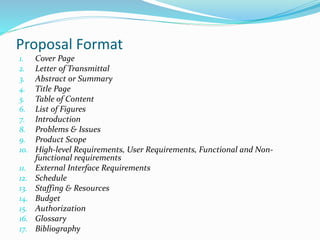
Proposal Format
1. Cover Page
2. Letter of Transmittal
3. Abstract or Summary
4. Title Page
5. Table of Content
6. List of Figures
7. Introduction
8. Problems & Issues
9. Product Scope
10. High-level Requirements, User Requirements, Functional and Non-
functional requirements
11. External Interface Requirements
12. Schedule
13. Staffing & Resources
14. Budget
15. Authorization
16. Glossary
17. Bibliography
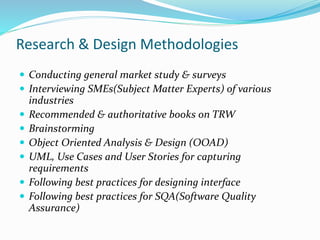
Research & Design Methodologies
 Conducting general market study & surveys
 Interviewing SMEs(Subject Matter Experts) of various
industries
 Recommended & authoritative books on TRW
 Brainstorming
 Object Oriented Analysis & Design (OOAD)
 UML, Use Cases and User Stories for capturing
requirements
 Following best practices for designing interface
 Following best practices for SQA(Software Quality
Assurance)
Thank you!

TRW Software Feasibility Proposal Presentation

  • 1.
    Term Report Outline for TechnicalReport Writing, Fall 2016
  • 2.
    Introduction  What isTechnical Report Writing (TRW)? “A technical report is a document that elaborates and illustrates the process, progress or outcomes of a technical o scientific research.” It is an integral part of every industry and may include recommendations or conclusions as well.  Why do we need a Software for TRW?  To address the problems and issues in a cost-effective manner.  Facilitation of users involved
  • 3.
    Issues & Background Whatproblems, Issues and stakeholders are involved? Issues:  Inaccurate facts and figures  Plagiarism  Administrative Delays  Lack of Collaboration among Stakeholders  Lack of Information Tracking, etc. Stakeholders:  Report Requester  Report Writer  Report Assessor  Surveyor  Audience
  • 4.
    Schedule & ProjectPhases  Initiation: Our focus will be on “WHAT” and “WHY”. The team will consider core objectives of the project.  Planning: Team’s focus will be on “HOW”. Resources and time, with alternate plans will be allocated as per the scope of the project. Feasibility report will be completed by this phase. Deadline: 14th Dec. 2016  Execution: During this phase, solution architecture and technology factors will be considered and implemented.  Monitoring and Controlling: Major part of all project phases. During this phase “QUALITY” will be ensured via rigorous testing.  Pilot Launch: Software will be functional and stable for feedback.  Final Implementation and Launch: Software will be functional ,fully tested and stable for market.
  • 5.
    Proposal Format 1. CoverPage 2. Letter of Transmittal 3. Abstract or Summary 4. Title Page 5. Table of Content 6. List of Figures 7. Introduction 8. Problems & Issues 9. Product Scope 10. High-level Requirements, User Requirements, Functional and Non- functional requirements 11. External Interface Requirements 12. Schedule 13. Staffing & Resources 14. Budget 15. Authorization 16. Glossary 17. Bibliography
  • 6.
    Research & DesignMethodologies  Conducting general market study & surveys  Interviewing SMEs(Subject Matter Experts) of various industries  Recommended & authoritative books on TRW  Brainstorming  Object Oriented Analysis & Design (OOAD)  UML, Use Cases and User Stories for capturing requirements  Following best practices for designing interface  Following best practices for SQA(Software Quality Assurance)
  • 7.