Problem based learning assignments using a wiki learning environment Bert Mulder | IJsbrand Hoetjes The Hague University
TRIAS telematica project education in eGovernment great challenge problems ‘messy’ solutions need to reflect reality new learning necessary new tools and methods for  teaching and learning eGovernment research in new methods of teaching and learning: Problem Based Learning (PBL)
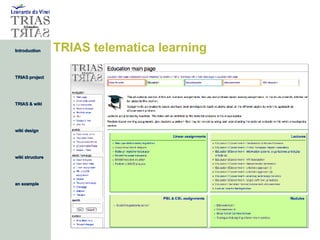
TRIAS telematica learning
problem based learning (PBL) students get problem before learning  real world problems develop active learning strategies develop reasoning skills knowledge construction
PBL: design goals Learning goals concern realistic problem solving behavior Problems are generated Problems are encountered before any prep/study Facilitator interacts with students at metacognitive level Cooperative learning is critical component of PBL
PBL: new roles students  engaged problem solvers identifying root of problem conditions for good solution proposing good solutions teachers problem solving colleagues cognitive coaches creating interest and enthousiasm for learning
PBL: history 1960’s McMaster University, Canada 1980’s Netherlands: Maastricht University The Hague University Academy of public management
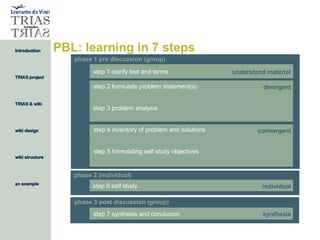
PBL: learning in 7 steps phase 1 pre discussion (group) phase 2 (individual) phase 3 post discussion (group) understand material divergent convergent individual synthesis step 1 clarify text and terms step 2 formulate problem statement(s) step 3 problem analysis step 4 inventory of problem and solutions step 5 formulating self study objectives step 6 self study step 7 synthesis and conclusion
step 1 clarify the material Explain the meaning of difficult phrases and words in the text ask for clarification yourself After this phase every group member should be able to read the material in the same way - which is not the same as fully understanding everything!
step 2 formulate problem statement(s) a crucial stage ask yourselves " What's the real problem here? "  one central problem, or several (seemingly?) unrelated problems...  (group members') may propose different problem definitions you'll need as much input from all group members as possible formulate problems in an 'answerable' format (listing  questions  is a good start in this step).  Make good use of the whiteboard and/or flipover sheets! Don't forget: This is a 'questions-only' step, there will be room for answers in the next step! i.e. asking questions everyone already knows the answers to is rather futile, and a waste of valuable time - look for the real (underlying) problems!
step 3 problem analysis time to get inspired try to get as many possible explanations relevant to the formulated problem(s) allow everyone to add to the discussion is important the whiteboard/flipover sheet is an invaluable tool ' brainstorming'  is the method used here to generate relevant notions, ideas, hints etc.
step 4 inventory problems and solutions time to assess the results of the analysis so far let's add structure to the insights find what pieces of the puzzle are still missing what problems have been solved, and what is still unclear?  Often problem statements have been partially addressed agree whether proposed solutions and/or explanations are satisfactory.  Of course awareness of the level of the students and the educational objectives is important here; sometimes a thorough understanding of a theoretical explanation suffices, sometimes solutions need to be implementation-ready!
step 5 formulate self study objectives formulate a clear set of  objectives for the individual self-study activities rephrase unanswered problem statements such that they reflect the 'missing knowledge' determined in step 4.  self-study-objectives should make clear  what needs to be done  (researched/measured/understood etc.),  should provide an indication of  when to be satisfied  and stop studying!  S.M.A.R.T. formulation could be useful here.  add an indication of sources to use as a starting point Make sure the set of objectives is  complete  (i.e. they ensure a solution of the problem in the final step).
step 6 self study group members individually get to work.  Each sets out to pursue  all  study objectives to guarantee a full understanding of the problem and to ensure a fruitful 'comparing of notes' in the last step.  Planning  and devising an effective  study strategy  (especially w.r.t. use of  sources ) are important skills during this step!  Do not lose sight of the main goal (solving the problem(s) from step 2)!
step 7 conclusion Each member presents his/her findings for each of the objectives.  a moment for asking each other in-depth questions and testing gained insights by explaining them to the group. Discussing inconsistencies and solving confusion takes most time  To conclude the group asks itself " Have we found a satisfactory solution to our problem? ” aim is to agree on explanations/answers found, and on detail and depth of understanding.  When unsatisfied, the group may of course reformulate further study objectives instead of concluding the PBL task!
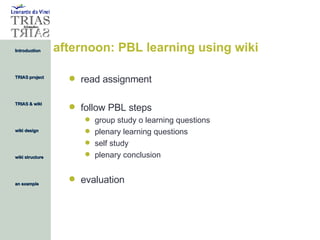
afternoon: PBL learning using wiki read assignment follow PBL steps group study o learning questions plenary learning questions self study plenary conclusion evaluation
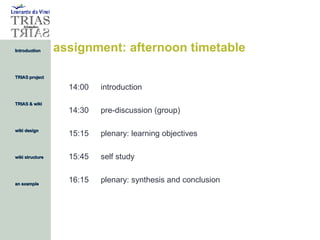
assignment: afternoon timetable 14:00 introduction 14:30 pre-discussion (group) 15:15 plenary: learning objectives 15:45 self study 16:15 plenary: synthesis and conclusion
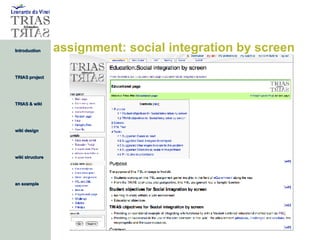
assignment: social integration by screen
Bert Mulder | Drs. IJsbrand Hoetjes The Hague University Public Management www.thehagueuniversity.nl

Trias PBL Asignment

  • 1.
    Problem based learningassignments using a wiki learning environment Bert Mulder | IJsbrand Hoetjes The Hague University
  • 2.
    TRIAS telematica projecteducation in eGovernment great challenge problems ‘messy’ solutions need to reflect reality new learning necessary new tools and methods for teaching and learning eGovernment research in new methods of teaching and learning: Problem Based Learning (PBL)
  • 3.
  • 4.
    problem based learning(PBL) students get problem before learning real world problems develop active learning strategies develop reasoning skills knowledge construction
  • 5.
    PBL: design goalsLearning goals concern realistic problem solving behavior Problems are generated Problems are encountered before any prep/study Facilitator interacts with students at metacognitive level Cooperative learning is critical component of PBL
  • 6.
    PBL: new rolesstudents engaged problem solvers identifying root of problem conditions for good solution proposing good solutions teachers problem solving colleagues cognitive coaches creating interest and enthousiasm for learning
  • 7.
    PBL: history 1960’sMcMaster University, Canada 1980’s Netherlands: Maastricht University The Hague University Academy of public management
  • 8.
    PBL: learning in7 steps phase 1 pre discussion (group) phase 2 (individual) phase 3 post discussion (group) understand material divergent convergent individual synthesis step 1 clarify text and terms step 2 formulate problem statement(s) step 3 problem analysis step 4 inventory of problem and solutions step 5 formulating self study objectives step 6 self study step 7 synthesis and conclusion
  • 9.
    step 1 clarifythe material Explain the meaning of difficult phrases and words in the text ask for clarification yourself After this phase every group member should be able to read the material in the same way - which is not the same as fully understanding everything!
  • 10.
    step 2 formulateproblem statement(s) a crucial stage ask yourselves " What's the real problem here? " one central problem, or several (seemingly?) unrelated problems... (group members') may propose different problem definitions you'll need as much input from all group members as possible formulate problems in an 'answerable' format (listing questions is a good start in this step). Make good use of the whiteboard and/or flipover sheets! Don't forget: This is a 'questions-only' step, there will be room for answers in the next step! i.e. asking questions everyone already knows the answers to is rather futile, and a waste of valuable time - look for the real (underlying) problems!
  • 11.
    step 3 problemanalysis time to get inspired try to get as many possible explanations relevant to the formulated problem(s) allow everyone to add to the discussion is important the whiteboard/flipover sheet is an invaluable tool ' brainstorming' is the method used here to generate relevant notions, ideas, hints etc.
  • 12.
    step 4 inventoryproblems and solutions time to assess the results of the analysis so far let's add structure to the insights find what pieces of the puzzle are still missing what problems have been solved, and what is still unclear? Often problem statements have been partially addressed agree whether proposed solutions and/or explanations are satisfactory. Of course awareness of the level of the students and the educational objectives is important here; sometimes a thorough understanding of a theoretical explanation suffices, sometimes solutions need to be implementation-ready!
  • 13.
    step 5 formulateself study objectives formulate a clear set of objectives for the individual self-study activities rephrase unanswered problem statements such that they reflect the 'missing knowledge' determined in step 4. self-study-objectives should make clear what needs to be done (researched/measured/understood etc.), should provide an indication of when to be satisfied and stop studying! S.M.A.R.T. formulation could be useful here. add an indication of sources to use as a starting point Make sure the set of objectives is complete (i.e. they ensure a solution of the problem in the final step).
  • 14.
    step 6 selfstudy group members individually get to work. Each sets out to pursue all study objectives to guarantee a full understanding of the problem and to ensure a fruitful 'comparing of notes' in the last step. Planning and devising an effective study strategy (especially w.r.t. use of sources ) are important skills during this step! Do not lose sight of the main goal (solving the problem(s) from step 2)!
  • 15.
    step 7 conclusionEach member presents his/her findings for each of the objectives. a moment for asking each other in-depth questions and testing gained insights by explaining them to the group. Discussing inconsistencies and solving confusion takes most time To conclude the group asks itself " Have we found a satisfactory solution to our problem? ” aim is to agree on explanations/answers found, and on detail and depth of understanding. When unsatisfied, the group may of course reformulate further study objectives instead of concluding the PBL task!
  • 16.
    afternoon: PBL learningusing wiki read assignment follow PBL steps group study o learning questions plenary learning questions self study plenary conclusion evaluation
  • 17.
    assignment: afternoon timetable14:00 introduction 14:30 pre-discussion (group) 15:15 plenary: learning objectives 15:45 self study 16:15 plenary: synthesis and conclusion
  • 18.
  • 19.
    Bert Mulder |Drs. IJsbrand Hoetjes The Hague University Public Management www.thehagueuniversity.nl