Trends in Analytics
Rahul Saxena
February 2019
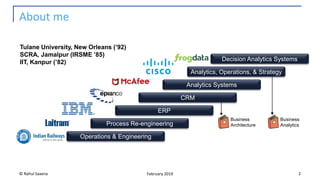
About me
© Rahul Saxena 2February 2019
Process Re-engineering
Operations & Engineering
ERP
CRM
Analytics Systems
Analytics, Operations, & Strategy
Decision Analytics Systems
Business
Analytics
Tulane University, New Orleans (’92)
SCRA, Jamalpur (IRSME ’85)
IIT, Kanpur (’82)
Business
Architecture
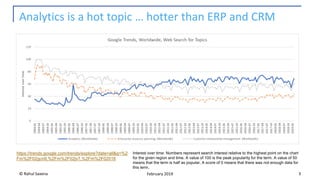
Analytics is a hot topic … hotter than ERP and CRM
© Rahul Saxena 3February 2019
https://trends.google.com/trends/explore?date=all&q=%2
Fm%2F02gcn9,%2Fm%2F02jv7,%2Fm%2F02016
Interest over time: Numbers represent search interest relative to the highest point on the chart
for the given region and time. A value of 100 is the peak popularity for the term. A value of 50
means that the term is half as popular. A score of 0 means that there was not enough data for
this term.
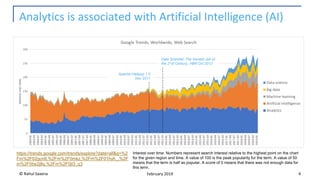
Analytics is associated with Artificial Intelligence (AI)
© Rahul Saxena 4February 2019
https://trends.google.com/trends/explore?date=all&q=%2
Fm%2F02gcn9,%2Fm%2F0mkz,%2Fm%2F01hyh_,%2F
m%2F0bs2j8q,%2Fm%2F0jt3_q3
Interest over time: Numbers represent search interest relative to the highest point on the chart
for the given region and time. A value of 100 is the peak popularity for the term. A value of 50
means that the term is half as popular. A score of 0 means that there was not enough data for
this term.
Data Scientist: The Sexiest Job of
the 21st Century, HBR Oct 2012
Apache Hadoop 1.0
Nov 2011
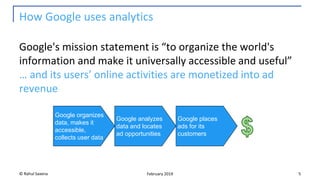
How Google uses analytics
Google's mission statement is “to organize the world's
information and make it universally accessible and useful”
… and its users’ online activities are monetized into ad
revenue
© Rahul Saxena 5February 2019
Google organizes
data, makes it
accessible,
collects user data
Google analyzes
data and locates
ad opportunities
Google places
ads for its
customers
TRADITIONAL BUSINESSES
• Advertising
• Marketing
• Sales
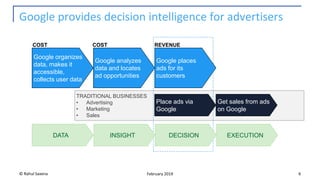
Google provides decision intelligence for advertisers
© Rahul Saxena 6February 2019
COST
Place ads via
Google
Get sales from ads
on Google
Google organizes
data, makes it
accessible,
collects user data
Google analyzes
data and locates
ad opportunities
Google places
ads for its
customers
COST REVENUE
DATA INSIGHT DECISION EXECUTION
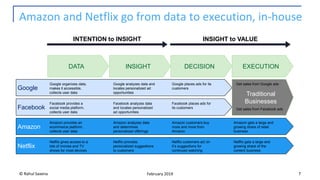
Amazon and Netflix go from data to execution, in-house
© Rahul Saxena 7February 2019
DATA INSIGHT DECISION EXECUTION
Google
Facebook
Amazon
Netflix
Traditional
Businesses
INTENTION to INSIGHT INSIGHT to VALUE
Google organizes data,
makes it accessible,
collects user data
Google analyzes data and
locates personalized ad
opportunities
Google places ads for its
customers
Get sales from Google ads
Facebook provides a
social media platform,
collects user data
Facebook analyzes data
and locates personalized
ad opportunities
Facebook places ads for
its customers Get sales from Facebook ads
Amazon provides an
ecommerce platform,
collects user data
Amazon analyzes data
and determines
personalized offerings
Amazon customers buy
more and more from
Amazon
Amazon gets a large and
growing share of retail
business
Netflix gives access to a
lots of movies and TV
shows for most devices
Netflix provides
personalized suggestions
to customers
Netflix customers act on
it’s suggestions for
continued watching
Netflix gets a large and
growing share of the
content business
Google
Facebook
Amazon
Netflix
Traditional
Businesses
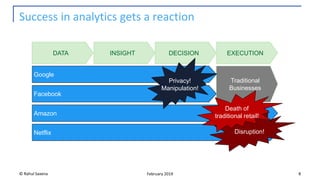
Success in analytics gets a reaction
© Rahul Saxena 8February 2019
DATA INSIGHT DECISION EXECUTION
Privacy!
Manipulation!
Disruption!
Death of
traditional retail!
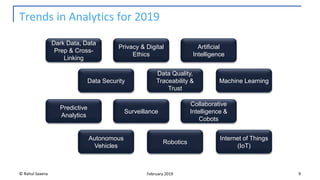
Trends in Analytics for 2019
© Rahul Saxena 9February 2019
Data Security
Privacy & Digital
Ethics
Collaborative
Intelligence &
Cobots
Autonomous
Vehicles
Robotics
Dark Data, Data
Prep & Cross-
Linking
Predictive
Analytics
Artificial
Intelligence
Internet of Things
(IoT)
Data Quality,
Traceability &
Trust
Surveillance
Machine Learning
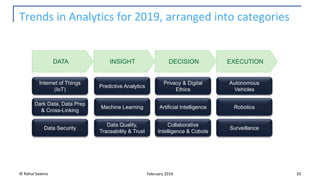
DATA INSIGHT DECISION EXECUTION
Trends in Analytics for 2019, arranged into categories
© Rahul Saxena 10February 2019
Data Security
Privacy & Digital
Ethics
Collaborative
Intelligence & Cobots
Autonomous
Vehicles
Robotics
Internet of Things
(IoT)
Surveillance
Predictive Analytics
Artificial IntelligenceMachine Learning
Data Quality,
Traceability & Trust
Dark Data, Data Prep
& Cross-Linking
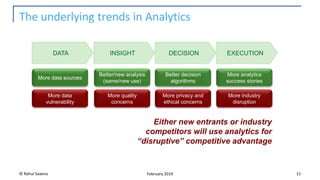
DATA INSIGHT DECISION EXECUTION
The underlying trends in Analytics
© Rahul Saxena 11February 2019
Better decision
algorithms
More analytics
success stories
More industry
disruption
More data sources
Better/new analysis
(same/new use)
More privacy and
ethical concerns
More quality
concerns
More data
vulnerability
Either new entrants or industry
competitors will use analytics for
“disruptive” competitive advantage
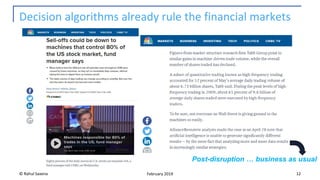
Decision algorithms already rule the financial markets
© Rahul Saxena 12February 2019
Post-disruption … business as usual
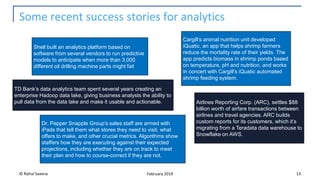
Some recent success stories for analytics
© Rahul Saxena 13February 2019
Shell built an analytics platform based on
software from several vendors to run predictive
models to anticipate when more than 3,000
different oil drilling machine parts might fail
Airlines Reporting Corp. (ARC), settles $88
billion worth of airfare transactions between
airlines and travel agencies. ARC builds
custom reports for its customers, which it’s
migrating from a Teradata data warehouse to
Snowflake on AWS.
TD Bank’s data analytics team spent several years creating an
enterprise Hadoop data lake, giving business analysts the ability to
pull data from the data lake and make it usable and actionable.
Cargill’s animal nutrition unit developed
iQuatic, an app that helps shrimp farmers
reduce the mortality rate of their yields. The
app predicts biomass in shrimp ponds based
on temperature, pH and nutrition, and works
in concert with Cargill’s iQuatic automated
shrimp feeding system.
Dr. Pepper Snapple Group’s sales staff are armed with
iPads that tell them what stores they need to visit, what
offers to make, and other crucial metrics. Algorithms show
staffers how they are executing against their expected
projections, including whether they are on track to meet
their plan and how to course-correct if they are not.
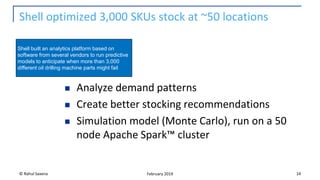
Shell optimized 3,000 SKUs stock at ~50 locations
◼ Analyze demand patterns
◼ Create better stocking recommendations
◼ Simulation model (Monte Carlo), run on a 50
node Apache Spark™ cluster
© Rahul Saxena 14February 2019
Shell built an analytics platform based on
software from several vendors to run predictive
models to anticipate when more than 3,000
different oil drilling machine parts might fail
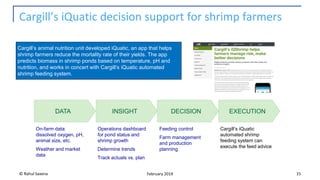
Cargill’s iQuatic decision support for shrimp farmers
© Rahul Saxena 15February 2019
Cargill’s animal nutrition unit developed iQuatic, an app that helps
shrimp farmers reduce the mortality rate of their yields. The app
predicts biomass in shrimp ponds based on temperature, pH and
nutrition, and works in concert with Cargill’s iQuatic automated
shrimp feeding system.
DATA INSIGHT DECISION EXECUTION
Cargill’s iQuatic
automated shrimp
feeding system can
execute the feed advice
On-farm data:
dissolved oxygen, pH,
animal size, etc.
Weather and market
data
Operations dashboard
for pond status and
shrimp growth
Determine trends
Track actuals vs. plan
Feeding control
Farm management
and production
planning
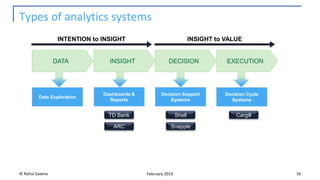
Types of analytics systems
© Rahul Saxena 16February 2019
ARC Snapple
Shell CargillTD Bank
DATA INSIGHT DECISION EXECUTION
Data Exploration
Dashboards &
Reports
Decision Support
Systems
Decision Cycle
Systems
INTENTION to INSIGHT INSIGHT to VALUE
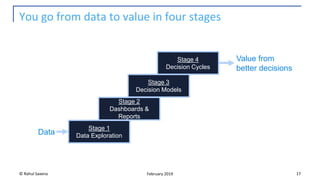
You go from data to value in four stages
© Rahul Saxena 17February 2019
Stage 1
Data Exploration
Stage 2
Dashboards &
Reports
Stage 3
Decision Models
Stage 4
Decision Cycles
Data
Value from
better decisions
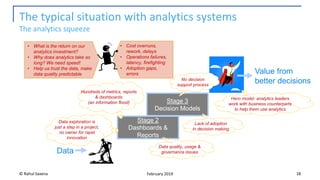
The typical situation with analytics systems
The analytics squeeze
© Rahul Saxena 18February 2019
Stage 2
Dashboards &
Reports
Stage 3
Decision Models
Data
Value from
better decisions
Data exploration is
just a step in a project,
no owner for rapid
innovation
Data quality, usage &
governance issues
No decision
support process
Hundreds of metrics, reports
& dashboards
(an information flood)
• Cost overruns,
rework, delays
• Operations failures,
latency, firefighting
• Adoption gaps,
errors
• What is the return on our
analytics investment?
• Why does analytics take so
long? We need speed!
• Help us trust the data, make
data quality predictable
Hero model: analytics leaders
work with business counterparts
to help them use analytics
Lack of adoption
in decision making
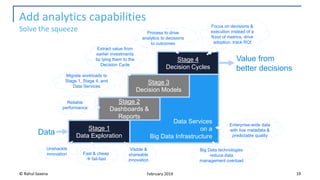
Add analytics capabilities
Solve the squeeze
© Rahul Saxena 19February 2019
Fast & cheap
→ fail-fast
Data Services
on a
Big Data Infrastructure
Stage 1
Data Exploration
Stage 2
Dashboards &
Reports
Stage 3
Decision Models
Stage 4
Decision Cycles
Data
Value from
better decisions
Fast & cheap
→ fail-fast
Unshackle
innovation
Process to drive
analytics to decisions
to outcomes
Enterprise-wide data
with live metadata &
predictable quality
Focus on decisions &
execution instead of a
flood of metrics, drive
adoption, track ROI
Migrate workloads to
Stage 1, Stage 4, and
Data Services
Big Data technologies
reduce data
management overload
Reliable
performance
Visible &
shareable
innovation
Extract value from
earlier investments
by tying them to the
Decision Cycle
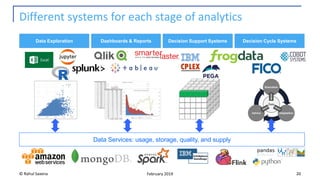
Different systems for each stage of analytics
© Rahul Saxena 20February 2019
Data Services: usage, storage, quality, and supply
Data Exploration Dashboards & Reports Decision Support Systems Decision Cycle Systems
DATA INSIGHT DECISION EXECUTION
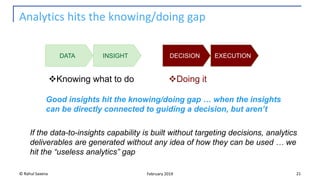
Analytics hits the knowing/doing gap
© Rahul Saxena 21February 2019
❖Knowing what to do ❖Doing it
Good insights hit the knowing/doing gap … when the insights
can be directly connected to guiding a decision, but aren’t
If the data-to-insights capability is built without targeting decisions, analytics
deliverables are generated without any idea of how they can be used … we
hit the “useless analytics” gap
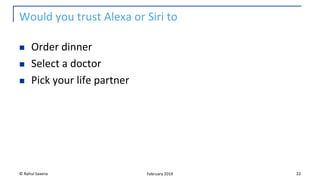
Would you trust Alexa or Siri to
◼ Order dinner
◼ Select a doctor
◼ Pick your life partner
© Rahul Saxena 22February 2019
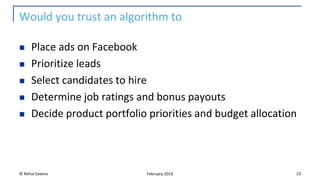
Would you trust an algorithm to
◼ Place ads on Facebook
◼ Prioritize leads
◼ Select candidates to hire
◼ Determine job ratings and bonus payouts
◼ Decide product portfolio priorities and budget allocation
© Rahul Saxena 23February 2019
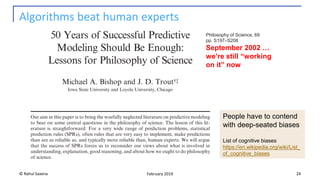
Algorithms beat human experts
© Rahul Saxena 24February 2019
Philosophy of Science, 69
pp. S197–S208
September 2002 …
we’re still “working
on it” now
People have to contend
with deep-seated biases
List of cognitive biases
https://en.wikipedia.org/wiki/List_
of_cognitive_biases
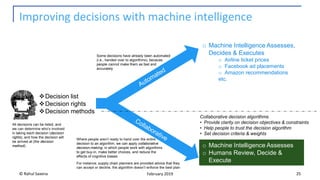
Improving decisions with machine intelligence
© Rahul Saxena 25February 2019
❖Decision list
❖Decision rights
❖Decision methods
o Machine Intelligence Assesses,
Decides & Executes
o Airline ticket prices
o Facebook ad placements
o Amazon recommendations
etc.
o Machine Intelligence Assesses
o Humans Review, Decide &
Execute
Collaborative decision algorithms
• Provide clarity on decision objectives & constraints
• Help people to trust the decision algorithm
• Set decision criteria & weights
Where people aren’t ready to hand over the entire
decision to an algorithm, we can apply collaborative
decision-making, in which people work with algorithms
to get buy-in, make better choices, and reduce the
effects of cognitive biases
Some decisions have already been automated
(i.e., handed over to algorithms), because
people cannot make them as fast and
accurately
All decisions can be listed, and
we can determine who’s involved
in taking each decision (decision
rights), and how the decision will
be arrived at (the decision
method).
For instance, supply chain planners are provided advice that they
can accept or decline, the algorithm doesn’t enforce the best plan
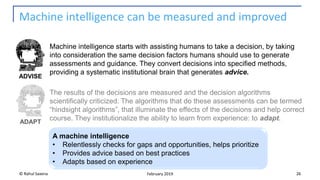
Machine intelligence can be measured and improved
© Rahul Saxena 26February 2019
ADVISE
ADAPT
Machine intelligence starts with assisting humans to take a decision, by taking
into consideration the same decision factors humans should use to generate
assessments and guidance. They convert decisions into specified methods,
providing a systematic institutional brain that generates advice.
The results of the decisions are measured and the decision algorithms
scientifically criticized. The algorithms that do these assessments can be termed
“hindsight algorithms”, that illuminate the effects of the decisions and help correct
course. They institutionalize the ability to learn from experience: to adapt.
A machine intelligence
• Relentlessly checks for gaps and opportunities, helps prioritize
• Provides advice based on best practices
• Adapts based on experience
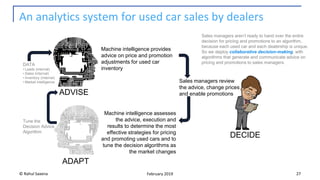
An analytics system for used car sales by dealers
© Rahul Saxena 27February 2019
ADVISE
ADAPT
Machine intelligence assesses
the advice, execution and
results to determine the most
effective strategies for pricing
and promoting used cars and to
tune the decision algorithms as
the market changes
Machine intelligence provides
advice on price and promotion
adjustments for used car
inventory
Sales managers review
the advice, change prices
and enable promotions
DECIDE
Sales managers aren’t ready to hand over the entire
decision for pricing and promotions to an algorithm,
because each used car and each dealership is unique.
So we deploy collaborative decision-making, with
algorithms that generate and communicate advice on
pricing and promotions to sales managers.DATA
• Leads (internal)
• Sales (internal)
• Inventory (internal)
• Market intelligence
Tune the
Decision Advice
Algorithm
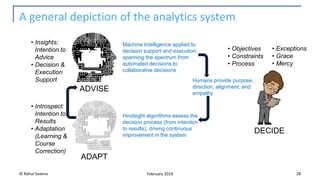
A general depiction of the analytics system
© Rahul Saxena 28February 2019
ADVISE
ADAPT
• Exceptions
• Grace
• Mercy
• Insights:
Intention to
Advice
• Decision &
Execution
Support
• Introspect:
Intention to
Results
• Adaptation
(Learning &
Course
Correction)
• Objectives
• Constraints
• Process
Hindsight algorithms assess the
decision process (from intention
to results), driving continuous
improvement in the system
Machine Intelligence applied to
decision support and execution,
spanning the spectrum from
automated decisions to
collaborative decisions
Humans provide purpose,
direction, alignment, and
empathy
DECIDE
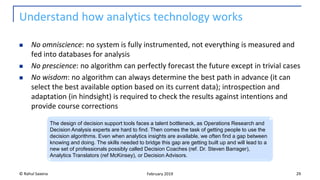
Understand how analytics technology works
◼ No omniscience: no system is fully instrumented, not everything is measured and
fed into databases for analysis
◼ No prescience: no algorithm can perfectly forecast the future except in trivial cases
◼ No wisdom: no algorithm can always determine the best path in advance (it can
select the best available option based on its current data); introspection and
adaptation (in hindsight) is required to check the results against intentions and
provide course corrections
© Rahul Saxena 29February 2019
The design of decision support tools faces a talent bottleneck, as Operations Research and
Decision Analysis experts are hard to find. Then comes the task of getting people to use the
decision algorithms. Even when analytics insights are available, we often find a gap between
knowing and doing. The skills needed to bridge this gap are getting built up and will lead to a
new set of professionals possibly called Decision Coaches (ref. Dr. Steven Barrager),
Analytics Translators (ref McKinsey), or Decision Advisors.
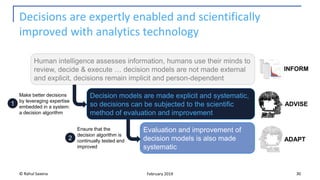
Decisions are expertly enabled and scientifically
improved with analytics technology
© Rahul Saxena 30February 2019
Human intelligence assesses information, humans use their minds to
review, decide & execute … decision models are not made external
and explicit, decisions remain implicit and person-dependent
Decision models are made explicit and systematic,
so decisions can be subjected to the scientific
method of evaluation and improvement
Evaluation and improvement of
decision models is also made
systematic
ADVISE
ADAPT
INFORM
Make better decisions
by leveraging expertise
embedded in a system:
a decision algorithm
Ensure that the
decision algorithm is
continually tested and
improved
1
2
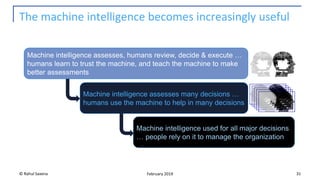
The machine intelligence becomes increasingly useful
© Rahul Saxena 31February 2019
Machine intelligence assesses, humans review, decide & execute …
humans learn to trust the machine, and teach the machine to make
better assessments
Machine intelligence assesses many decisions …
humans use the machine to help in many decisions
Machine intelligence used for all major decisions
… people rely on it to manage the organization
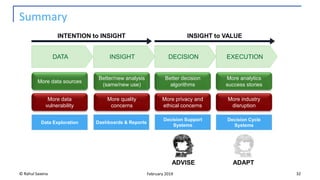
Summary
© Rahul Saxena 32February 2019
DATA INSIGHT DECISION EXECUTION
Better decision
algorithms
More analytics
success stories
More industry
disruption
More data sources
Better/new analysis
(same/new use)
More privacy and
ethical concerns
More quality
concerns
More data
vulnerability
Data Exploration Dashboards & Reports
Decision Support
Systems
Decision Cycle
Systems
ADVISE ADAPT
INTENTION to INSIGHT INSIGHT to VALUE

Trends in analytics - Feb 2019

  • 1.
    Trends in Analytics RahulSaxena February 2019
  • 2.
    About me © RahulSaxena 2February 2019 Process Re-engineering Operations & Engineering ERP CRM Analytics Systems Analytics, Operations, & Strategy Decision Analytics Systems Business Analytics Tulane University, New Orleans (’92) SCRA, Jamalpur (IRSME ’85) IIT, Kanpur (’82) Business Architecture
  • 3.
    Analytics is ahot topic … hotter than ERP and CRM © Rahul Saxena 3February 2019 https://trends.google.com/trends/explore?date=all&q=%2 Fm%2F02gcn9,%2Fm%2F02jv7,%2Fm%2F02016 Interest over time: Numbers represent search interest relative to the highest point on the chart for the given region and time. A value of 100 is the peak popularity for the term. A value of 50 means that the term is half as popular. A score of 0 means that there was not enough data for this term.
  • 4.
    Analytics is associatedwith Artificial Intelligence (AI) © Rahul Saxena 4February 2019 https://trends.google.com/trends/explore?date=all&q=%2 Fm%2F02gcn9,%2Fm%2F0mkz,%2Fm%2F01hyh_,%2F m%2F0bs2j8q,%2Fm%2F0jt3_q3 Interest over time: Numbers represent search interest relative to the highest point on the chart for the given region and time. A value of 100 is the peak popularity for the term. A value of 50 means that the term is half as popular. A score of 0 means that there was not enough data for this term. Data Scientist: The Sexiest Job of the 21st Century, HBR Oct 2012 Apache Hadoop 1.0 Nov 2011
  • 5.
    How Google usesanalytics Google's mission statement is “to organize the world's information and make it universally accessible and useful” … and its users’ online activities are monetized into ad revenue © Rahul Saxena 5February 2019 Google organizes data, makes it accessible, collects user data Google analyzes data and locates ad opportunities Google places ads for its customers
  • 6.
    TRADITIONAL BUSINESSES • Advertising •Marketing • Sales Google provides decision intelligence for advertisers © Rahul Saxena 6February 2019 COST Place ads via Google Get sales from ads on Google Google organizes data, makes it accessible, collects user data Google analyzes data and locates ad opportunities Google places ads for its customers COST REVENUE DATA INSIGHT DECISION EXECUTION
  • 7.
    Amazon and Netflixgo from data to execution, in-house © Rahul Saxena 7February 2019 DATA INSIGHT DECISION EXECUTION Google Facebook Amazon Netflix Traditional Businesses INTENTION to INSIGHT INSIGHT to VALUE Google organizes data, makes it accessible, collects user data Google analyzes data and locates personalized ad opportunities Google places ads for its customers Get sales from Google ads Facebook provides a social media platform, collects user data Facebook analyzes data and locates personalized ad opportunities Facebook places ads for its customers Get sales from Facebook ads Amazon provides an ecommerce platform, collects user data Amazon analyzes data and determines personalized offerings Amazon customers buy more and more from Amazon Amazon gets a large and growing share of retail business Netflix gives access to a lots of movies and TV shows for most devices Netflix provides personalized suggestions to customers Netflix customers act on it’s suggestions for continued watching Netflix gets a large and growing share of the content business
  • 8.
    Google Facebook Amazon Netflix Traditional Businesses Success in analyticsgets a reaction © Rahul Saxena 8February 2019 DATA INSIGHT DECISION EXECUTION Privacy! Manipulation! Disruption! Death of traditional retail!
  • 9.
    Trends in Analyticsfor 2019 © Rahul Saxena 9February 2019 Data Security Privacy & Digital Ethics Collaborative Intelligence & Cobots Autonomous Vehicles Robotics Dark Data, Data Prep & Cross- Linking Predictive Analytics Artificial Intelligence Internet of Things (IoT) Data Quality, Traceability & Trust Surveillance Machine Learning
  • 10.
    DATA INSIGHT DECISIONEXECUTION Trends in Analytics for 2019, arranged into categories © Rahul Saxena 10February 2019 Data Security Privacy & Digital Ethics Collaborative Intelligence & Cobots Autonomous Vehicles Robotics Internet of Things (IoT) Surveillance Predictive Analytics Artificial IntelligenceMachine Learning Data Quality, Traceability & Trust Dark Data, Data Prep & Cross-Linking
  • 11.
    DATA INSIGHT DECISIONEXECUTION The underlying trends in Analytics © Rahul Saxena 11February 2019 Better decision algorithms More analytics success stories More industry disruption More data sources Better/new analysis (same/new use) More privacy and ethical concerns More quality concerns More data vulnerability Either new entrants or industry competitors will use analytics for “disruptive” competitive advantage
  • 12.
    Decision algorithms alreadyrule the financial markets © Rahul Saxena 12February 2019 Post-disruption … business as usual
  • 13.
    Some recent successstories for analytics © Rahul Saxena 13February 2019 Shell built an analytics platform based on software from several vendors to run predictive models to anticipate when more than 3,000 different oil drilling machine parts might fail Airlines Reporting Corp. (ARC), settles $88 billion worth of airfare transactions between airlines and travel agencies. ARC builds custom reports for its customers, which it’s migrating from a Teradata data warehouse to Snowflake on AWS. TD Bank’s data analytics team spent several years creating an enterprise Hadoop data lake, giving business analysts the ability to pull data from the data lake and make it usable and actionable. Cargill’s animal nutrition unit developed iQuatic, an app that helps shrimp farmers reduce the mortality rate of their yields. The app predicts biomass in shrimp ponds based on temperature, pH and nutrition, and works in concert with Cargill’s iQuatic automated shrimp feeding system. Dr. Pepper Snapple Group’s sales staff are armed with iPads that tell them what stores they need to visit, what offers to make, and other crucial metrics. Algorithms show staffers how they are executing against their expected projections, including whether they are on track to meet their plan and how to course-correct if they are not.
  • 14.
    Shell optimized 3,000SKUs stock at ~50 locations ◼ Analyze demand patterns ◼ Create better stocking recommendations ◼ Simulation model (Monte Carlo), run on a 50 node Apache Spark™ cluster © Rahul Saxena 14February 2019 Shell built an analytics platform based on software from several vendors to run predictive models to anticipate when more than 3,000 different oil drilling machine parts might fail
  • 15.
    Cargill’s iQuatic decisionsupport for shrimp farmers © Rahul Saxena 15February 2019 Cargill’s animal nutrition unit developed iQuatic, an app that helps shrimp farmers reduce the mortality rate of their yields. The app predicts biomass in shrimp ponds based on temperature, pH and nutrition, and works in concert with Cargill’s iQuatic automated shrimp feeding system. DATA INSIGHT DECISION EXECUTION Cargill’s iQuatic automated shrimp feeding system can execute the feed advice On-farm data: dissolved oxygen, pH, animal size, etc. Weather and market data Operations dashboard for pond status and shrimp growth Determine trends Track actuals vs. plan Feeding control Farm management and production planning
  • 16.
    Types of analyticssystems © Rahul Saxena 16February 2019 ARC Snapple Shell CargillTD Bank DATA INSIGHT DECISION EXECUTION Data Exploration Dashboards & Reports Decision Support Systems Decision Cycle Systems INTENTION to INSIGHT INSIGHT to VALUE
  • 17.
    You go fromdata to value in four stages © Rahul Saxena 17February 2019 Stage 1 Data Exploration Stage 2 Dashboards & Reports Stage 3 Decision Models Stage 4 Decision Cycles Data Value from better decisions
  • 18.
    The typical situationwith analytics systems The analytics squeeze © Rahul Saxena 18February 2019 Stage 2 Dashboards & Reports Stage 3 Decision Models Data Value from better decisions Data exploration is just a step in a project, no owner for rapid innovation Data quality, usage & governance issues No decision support process Hundreds of metrics, reports & dashboards (an information flood) • Cost overruns, rework, delays • Operations failures, latency, firefighting • Adoption gaps, errors • What is the return on our analytics investment? • Why does analytics take so long? We need speed! • Help us trust the data, make data quality predictable Hero model: analytics leaders work with business counterparts to help them use analytics Lack of adoption in decision making
  • 19.
    Add analytics capabilities Solvethe squeeze © Rahul Saxena 19February 2019 Fast & cheap → fail-fast Data Services on a Big Data Infrastructure Stage 1 Data Exploration Stage 2 Dashboards & Reports Stage 3 Decision Models Stage 4 Decision Cycles Data Value from better decisions Fast & cheap → fail-fast Unshackle innovation Process to drive analytics to decisions to outcomes Enterprise-wide data with live metadata & predictable quality Focus on decisions & execution instead of a flood of metrics, drive adoption, track ROI Migrate workloads to Stage 1, Stage 4, and Data Services Big Data technologies reduce data management overload Reliable performance Visible & shareable innovation Extract value from earlier investments by tying them to the Decision Cycle
  • 20.
    Different systems foreach stage of analytics © Rahul Saxena 20February 2019 Data Services: usage, storage, quality, and supply Data Exploration Dashboards & Reports Decision Support Systems Decision Cycle Systems
  • 21.
    DATA INSIGHT DECISIONEXECUTION Analytics hits the knowing/doing gap © Rahul Saxena 21February 2019 ❖Knowing what to do ❖Doing it Good insights hit the knowing/doing gap … when the insights can be directly connected to guiding a decision, but aren’t If the data-to-insights capability is built without targeting decisions, analytics deliverables are generated without any idea of how they can be used … we hit the “useless analytics” gap
  • 22.
    Would you trustAlexa or Siri to ◼ Order dinner ◼ Select a doctor ◼ Pick your life partner © Rahul Saxena 22February 2019
  • 23.
    Would you trustan algorithm to ◼ Place ads on Facebook ◼ Prioritize leads ◼ Select candidates to hire ◼ Determine job ratings and bonus payouts ◼ Decide product portfolio priorities and budget allocation © Rahul Saxena 23February 2019
  • 24.
    Algorithms beat humanexperts © Rahul Saxena 24February 2019 Philosophy of Science, 69 pp. S197–S208 September 2002 … we’re still “working on it” now People have to contend with deep-seated biases List of cognitive biases https://en.wikipedia.org/wiki/List_ of_cognitive_biases
  • 25.
    Improving decisions withmachine intelligence © Rahul Saxena 25February 2019 ❖Decision list ❖Decision rights ❖Decision methods o Machine Intelligence Assesses, Decides & Executes o Airline ticket prices o Facebook ad placements o Amazon recommendations etc. o Machine Intelligence Assesses o Humans Review, Decide & Execute Collaborative decision algorithms • Provide clarity on decision objectives & constraints • Help people to trust the decision algorithm • Set decision criteria & weights Where people aren’t ready to hand over the entire decision to an algorithm, we can apply collaborative decision-making, in which people work with algorithms to get buy-in, make better choices, and reduce the effects of cognitive biases Some decisions have already been automated (i.e., handed over to algorithms), because people cannot make them as fast and accurately All decisions can be listed, and we can determine who’s involved in taking each decision (decision rights), and how the decision will be arrived at (the decision method). For instance, supply chain planners are provided advice that they can accept or decline, the algorithm doesn’t enforce the best plan
  • 26.
    Machine intelligence canbe measured and improved © Rahul Saxena 26February 2019 ADVISE ADAPT Machine intelligence starts with assisting humans to take a decision, by taking into consideration the same decision factors humans should use to generate assessments and guidance. They convert decisions into specified methods, providing a systematic institutional brain that generates advice. The results of the decisions are measured and the decision algorithms scientifically criticized. The algorithms that do these assessments can be termed “hindsight algorithms”, that illuminate the effects of the decisions and help correct course. They institutionalize the ability to learn from experience: to adapt. A machine intelligence • Relentlessly checks for gaps and opportunities, helps prioritize • Provides advice based on best practices • Adapts based on experience
  • 27.
    An analytics systemfor used car sales by dealers © Rahul Saxena 27February 2019 ADVISE ADAPT Machine intelligence assesses the advice, execution and results to determine the most effective strategies for pricing and promoting used cars and to tune the decision algorithms as the market changes Machine intelligence provides advice on price and promotion adjustments for used car inventory Sales managers review the advice, change prices and enable promotions DECIDE Sales managers aren’t ready to hand over the entire decision for pricing and promotions to an algorithm, because each used car and each dealership is unique. So we deploy collaborative decision-making, with algorithms that generate and communicate advice on pricing and promotions to sales managers.DATA • Leads (internal) • Sales (internal) • Inventory (internal) • Market intelligence Tune the Decision Advice Algorithm
  • 28.
    A general depictionof the analytics system © Rahul Saxena 28February 2019 ADVISE ADAPT • Exceptions • Grace • Mercy • Insights: Intention to Advice • Decision & Execution Support • Introspect: Intention to Results • Adaptation (Learning & Course Correction) • Objectives • Constraints • Process Hindsight algorithms assess the decision process (from intention to results), driving continuous improvement in the system Machine Intelligence applied to decision support and execution, spanning the spectrum from automated decisions to collaborative decisions Humans provide purpose, direction, alignment, and empathy DECIDE
  • 29.
    Understand how analyticstechnology works ◼ No omniscience: no system is fully instrumented, not everything is measured and fed into databases for analysis ◼ No prescience: no algorithm can perfectly forecast the future except in trivial cases ◼ No wisdom: no algorithm can always determine the best path in advance (it can select the best available option based on its current data); introspection and adaptation (in hindsight) is required to check the results against intentions and provide course corrections © Rahul Saxena 29February 2019 The design of decision support tools faces a talent bottleneck, as Operations Research and Decision Analysis experts are hard to find. Then comes the task of getting people to use the decision algorithms. Even when analytics insights are available, we often find a gap between knowing and doing. The skills needed to bridge this gap are getting built up and will lead to a new set of professionals possibly called Decision Coaches (ref. Dr. Steven Barrager), Analytics Translators (ref McKinsey), or Decision Advisors.
  • 30.
    Decisions are expertlyenabled and scientifically improved with analytics technology © Rahul Saxena 30February 2019 Human intelligence assesses information, humans use their minds to review, decide & execute … decision models are not made external and explicit, decisions remain implicit and person-dependent Decision models are made explicit and systematic, so decisions can be subjected to the scientific method of evaluation and improvement Evaluation and improvement of decision models is also made systematic ADVISE ADAPT INFORM Make better decisions by leveraging expertise embedded in a system: a decision algorithm Ensure that the decision algorithm is continually tested and improved 1 2
  • 31.
    The machine intelligencebecomes increasingly useful © Rahul Saxena 31February 2019 Machine intelligence assesses, humans review, decide & execute … humans learn to trust the machine, and teach the machine to make better assessments Machine intelligence assesses many decisions … humans use the machine to help in many decisions Machine intelligence used for all major decisions … people rely on it to manage the organization
  • 32.
    Summary © Rahul Saxena32February 2019 DATA INSIGHT DECISION EXECUTION Better decision algorithms More analytics success stories More industry disruption More data sources Better/new analysis (same/new use) More privacy and ethical concerns More quality concerns More data vulnerability Data Exploration Dashboards & Reports Decision Support Systems Decision Cycle Systems ADVISE ADAPT INTENTION to INSIGHT INSIGHT to VALUE