Formerly UMS Advisory, Inc.
George Bouri, Global Board Member and Managing Principal - Americas
Trascent Management Consulting, LLC
Beyond the Back Office:
The Strategic Opportunity for RE/FM
Six High-Impact Areas Where RE/FM Leaders Can Add Value Now
TRASCENT PERSPECTIVES
TRASCENT.COM | © Trascent Management Consulting, LLC, 2014, All Rights Reserved 2
INTRODUCTION: MAPPING THE STRATEGIC AGENDA
Nearly every business executive on the planet today is expected to do more with less, to innovate and cut
costs simultaneously, while producing more value for the business. The pressure is especially intense on so-
called “back-office” functions, like human resources, finance, procurement, IT and real estate and facilities
management (RE/FM).
For senior leaders in these areas, the challenge remains – How to best engage with key business
stakeholders to help them achieve their core objectives? It’s about becoming a true “thought partner” –
able to understand the major challenges and opportunities faced by the business and designing solutions
that lead to improved performance in both the top and bottom lines.
For those of us in the RE/FM community, the good news is that RE/FM leaders are well positioned to
engage with their peers and the full range of decision makers across the enterprise. This is true because
many of the critical issues and daily challenges faced by RE/FM teams have become more prominent within
the broader business agenda.
The Conference Board 2013 CEO Survey confirms this view. The results highlight the direct points of
alignment among the top ten issues cited by CEOs. Among those with immediate, near-term relevance to
RE/FM pros:
1.	 Human Capital/Talent Management
2.	 Operational Excellence
3.	 Innovation
4.	 Global Expansion
5.	 Sustainability
6.	 Technology, Risk Management & Collaboration
Beyond the research, the experience of Trascent confirms that these are all “sweet-spot” areas where skilled
RE/FM executives can serve as thought partners and even transformation leaders. But they aren’t the only
areas; technology, risk mitigation and collaboration are other high-value areas where RE/FM teams can
make profound contributions.
This paper examines how RE/FM pros can better apply their knowledge and experience to help navigate
complex challenges and seize the most promising opportunities to benefit the business. As highlighted
in the sections below, we have helped our clients and colleagues at many companies exercise leadership
across these dimensions by thinking of the strategic big-picture and apply specific, high-impact tactics.
For example, we’ve helped shape and align RE/FM strategies for companies greatly expanding their
geographic footprints to the broader growth agenda. Further, in structuring vendor management and
governance programs through global RE/FM contracts, we know how to instill the proper metrics and
incentives for operational excellence, innovation and/or sustainability targets so that they support the
broader corporate agenda.
TRASCENT.COM | © Trascent Management Consulting, LLC, 2014, All Rights Reserved 3
My “Back to the Future”
moment occurred when I
realized just how far the
pendulum of conventional
wisdom had swung in favor
of remote working, even
though many in the RE/FM
community were initially
opposed to and even
threatened by the advent
of telecommuting a few
years ago.
1. Human Capital/Talent Management
Human capital/talent management is among the top issues
on the CEO agenda, thanks to dramatic demographic shifts
and technology advancements. Combined, these forces are
redefining the nature of the workforce and presenting clear
and significant implications for the discipline. Consider the
uproar when Marissa Mayer, Yahoo CEO, endorsed a policy
limiting telecommuting. This created dissension across the
RE/FM community, and many colleagues viewed this as a
retrograde decision. If employees are required to work in
an office workspace, aren’t we reverting back from our
recent progress of the alternative, “work anywhere” virtual
office environment?
In my view, Mayer’s higher-order motives were to reignite a
“teamwork” based culture fostering human interaction. Her
company sorely needed earnings. Profitability and market share
were in serious decline when compared to Google. My “Back
to the Future” moment occurred when I realized just how far
the pendulum of conventional wisdom had swung in favor of
remote working, even though many in the RE/FM community
were initially opposed to and even threatened by the advent of
telecommuting a few years ago.
The point is CEOs don’t think purely in terms of bricks-and-mortar and neither should RE/FM leaders. Yes,
we have technology to work productively and cost-effectively from anywhere, but the real issue is the value
and quality of that work and creating a connectedness that contributes to a strong corporate culture. We
must devise environments, systems and capabilities so workers can enhance the quality and value of their
work no matter where they are located.
2. Operational Excellence
Operational excellence is a perennial priority for CEOs. Why? Because they are the engines of sustained
business success in any industry, not just the fast-moving, new industries like technology or bio-tech. For
RE/FM leaders, the opportunity lies in finding new ways to drive that success. Remember: it’s about more
than just eliminating costs. For internal customers, innovation assumes other forms. It’s about anticipating
and filling customer demands, and striving to create a new set of demands and experiences.
A basic example is “the sushi” story. In the cafeteria at one of my former employers, the line for sushi (the
premium, high-cost offering) was always much longer than those for the hot meals, salad or sandwich bars.
That variance had opportunity – with a capital “O” – written all over it. Could we hire delivery people to
bring sushi orders directly to employees’ desks, rather than having them wait in line or risk them leaving
the building? Could we add more sushi stations in unused areas of the cafeteria to meet peak demand?
Were there other “sushi-like” offerings to be offered? From the customer’s perspective (i.e., our employees
at lunchtime), there were many options to increase satisfaction. And from a business perspective, offering
more sushi in less time would ultimately boost employee productivity and collaboration by keeping folks in
the building and talking to each other. But if you only considered cost in this equation, you would only see
that more sushi means higher investments – ultimately missing the bigger picture of expanding your ability
to offer greater value, enhance the employee experience and drive innovation out of a basic food offering in
your cafeteria.
TRASCENT.COM | © Trascent Management Consulting, LLC, 2014, All Rights Reserved 4
Yes, cost pressures are real. But, when you can deliver what people want (the sushi and a better, healthier
dining experience) and greater value (higher productivity and more collaboration), the upside of operational
excellence significantly outweighs the downside of incrementally higher costs. That’s a winning business case
for RE/FM, especially when RE/FM leaders start asking themselves about other parts of the dining experience
that could be disrupted or reinvented.
3. Innovation
Innovation in the RE/FM community needs to be rethought comprehensively. We need to expand our view
of what innovation really means to business stakeholders. Some obvious improvements have happened, but
there’s a long road ahead. Innovation must be broader than creating alternative workplace environments,
getting faster Wi-Fi and expanding bandwidth capacity across the corporate campus. Mobile workforces
sprout up so quickly making innovation imperative if not critical.
In return, what we define as immediate has to upgrade to urgent when it comes to identifying the right
opportunities and shaping the right plans. If we’re to call ourselves innovators, we have to shift our
thinking to truly reflect it. Much of the innovation action to come in RE/FM is likely to be in the technology,
collaboration and risk management space. There’s ample opportunity for RE/FM leaders who are inclined
and motivated to accept the invitation to innovate.
Answering the Eternal Question in RE/FM
For decades, RE/FM leaders have been asking themselves “How do we ‘level the playing
field’ with other senior business leaders?” Sometimes the question takes on a more colloquial
tone: “How do we earn a seat at the table at the Board meeting, rather than delivering the
table to the meeting?”
While many industry observers consider it a stale formulation, it actually reveals some fundamental
truths about the current state of RE/FM. And it sets up the more important questions, which are
“Why don’t we have a seat at the table today?” and “How do we earn one?”
As for the “why,” the unvarnished truth is we simply haven’t yet earned it. Or, rather, not
enough of us have done so. For the majority of RE/FM execs, annual or quarterly meetings
with business units or senior management team to review RE/FM plans represent the main
way we engage with the business. So it’s no surprise that many in the business view RE/FM
teams as order-takers.
To some extent, we’re victims of our own success. Certainly, a great deal of value has occurred
and produced significant cost savings – in fact, maybe more than from any other functional
area of the enterprise. But RE/FM must define its performance less like a back-office function,
and more like a business-facing value creator. We are capable of innovating and producing
more value, and we must be proactive in articulating the business case for these efforts.
The areas outlined in this paper are high-priority areas where RE/FM leaders are uniquely
positioned to connect the dots and break free from “siloed” back-office perceptions.
Looking at the “how” question, a larger strategic role requires both a redirection of our
energy and a refinement of our thinking. Our priorities should be rigorously aligned to
the C-suite, which presupposes a full knowledge of the top priorities and a grasp of the
most important details. Continuing to produce immediate, tangible results is a big part of
the equation, too. That’s how RE/FM’s value contribution to the enterprise can increase
significantly. Value contribution has always been the key to gaining a seat at the table and –
perhaps more importantly – a voice in the discussion.
TRASCENT.COM | © Trascent Management Consulting, LLC, 2014, All Rights Reserved 5
4. Global Expansion
Global expansion remains a top item for CEOs, and
RE/FM teams are well positioned to facilitate it. Ensuring
the organization can quickly and efficiently scale up
operations in new geographies (not to mention the ability
to simultaneously scale down in others) should be a “sweet
spot” capability for RE/FM teams. Certainly, it’s one with
direct alignment to C-suite concerns.
Beyond simply procuring and standing up space, forward-
thinkers are crafting plans for the creative reuse and
repurposing of buildings to support mixed-use campuses or
environments. RE/FM leaders with strong communications
capability can possibly play quasi-ambassadorial roles – both
educating local suppliers about company operations and
culture and informing internal audiences about business
practices in the new markets.
So how can RE/FM leaders shape – rather than react to –
global expansion plans? Being proactive is key. For example,
a high-technology company where I once worked had to
establish a global presence for many reasons. The company
was growing so fast that an infrastructure-focused RE/FM
strategy would never keep pace with the demand – both for
space and skilled resources. Plus, we were headquartered in
an earthquake-friendly region, which meant a Big One was an
existential threat. Our response was strategic and proactive
–using Monte-Carlo and other risk simulation analysis models,
as well as other advanced planning techniques to project near-,
mid- and long-term flexibility into our portfolios. We engaged
with the Business Units to map global labor pools for advanced
engineering skills and get ahead of the labor demand curve.
We partnered with academic institutions and governments
to tap into their scientific and technology programs. We
developed a 10-15 year roadmap of our global footprint to drive
competitive advantage to the company.
In the end, the company invested billions of dollars in new facilities in multiple regions of the globe, including within
the U.S. But more significant than supporting the construction of high-end LEED-certified facilities, the RE/FM
team demonstrated its ability to truly serve as a business partner (out in the forefront not on the sidelines), helping
the company chart a smart course to global growth, taking into account the risk management, business operations
and human resource implications. We even counseled senior leaders on the value proposition of distributing the
C-suite. In other words, the RE/FM team played a crucial role that enabled the company to become and operate as
a true global enterprise, not a California-based international company. Success of the expansion was measured not
just geographically, but also by skills, capability, culture and all the usual business metrics.
5. Sustainability
The strategic potential of RE/FM groups can be clearly seen in how our industry has embraced the
challenges and opportunities relative to sustainability and green initiatives. Fortuitously in some cases and
by design in others, RE/FM was assigned this role. We deserve high marks for our performance in this area,
especially as it has become embedded into the organization’s DNA and is no longer a separate “agenda
item” for most RE/FM organizations. Examples of our success in the sustainability area abound, including
better energy management initiatives, the consolidation of spend for utilities, etc.
Branding RE/FM?
Looking across these strategic areas, it’s
easy to see communication and branding
as the one common denominator for top
performers in our space. It’s a premium
in any management field and successful
senior leaders recognize that they are in
the communications business. Speaking
the language of the business instead of
functional dialect is critical. It’s absolutely
okay to toot our own horns and tout our
capabilities. Our clients need to know,
understand and be excited about our value
proposition and what we can offer them.
Regular, formal communications – like brief
e-mail newsletters, internal news articles or
blogs – are a great way to highlight current
service offerings and deliver strategic
perspective on key issues.
Based on my experience, many internal
clients are still unclear of exactly what
RE/FM can do for them. They just don’t
get the overall value and still see us as the
function that supplies toilet paper and light
bulbs to buildings. Naming a department
“Workplace Solutions” just doesn’t cut
it. Marketing communications, even
internally, can go a long way to raising your
organization’s visibility and perceived value.
TRASCENT.COM | © Trascent Management Consulting, LLC, 2014, All Rights Reserved 6
Of course, there’s still plenty of opportunity beyond the achievement of LEED-certification and platinum-
status building. I believe there are many breakthrough innovations to come, and that we’ve only just formed
the stepping-stones for RE/FM’s value proposition relative to sustainability. Those gains will come in forms
big (like collaborating with manufacturing plants to devise ever more energy-efficient and intelligent
systems) to small (the finding the optimal mix of recyclable materials).
6. Technology, Risk Management & Collaboration
Looking beyond the areas identified by the Conference Board survey, we as an industry must continue to
identify and embrace technology to transform how we run and manage our operations. ERP, IWMS and
other technology solutions continue to offer challenges and opportunities to RE/FM organizations. But how
do we harness these technologies for improved decision-making, integration into the broader enterprise
systems and to measure the success of each and every initiative we undertake? RE/FM leaders must fully
understand their range of choices and not abdicate this responsibility to their IT organizations.
More broadly, technology should be viewed as a continuous, creative disruptive force. A technology
upgrade is never a final destination. Even the most futuristic data centers continue to face near-term
extinction given rapid advancements in cloud computing and the move to smaller and more efficient
hardware and storage systems. Thus, our value doesn’t come strictly from facilitating and sourcing all
the materials and services to designing, building and maintaining physical centers. Rather, it’s about
understanding the technology trends that shape how we work. End-users are playing a hugely influential
– even decisive – role in selecting tools needed to do their jobs effectively. These trends create more
opportunities for RE/FM teams to have more dialogue and collaborative discussions with CIOs and HR
leaders. Discussions should focus on helping senior leaders navigate the workplace implications and
achieve ultimate outcomes (like productivity) that remain aligned to big-picture business goals.
Beyond IT and HR, RE/FM leaders should synchronize their efforts with procurement, finance and legal.
The sourcing realm is the most obvious area where RE/FM leaders can ensure invested dollars produce
bottom-line results. The more strategic view incorporates value-oriented metrics, of course. RE/FM leaders
can and should share their success stories and lessons learned in areas such as supplier relationship
management and governance, performance management, and contracting structures. Best practices from
within the RE/FM realm are relevant across the enterprise, particularly when you recall that this area is
generally the second or third largest spend behind labor costs and IT.
Enterprise risk management, business continuity, and physical and virtual security are still other areas
where integrated, cross-functional collaboration will yield better outcomes for the corporation as a whole.
There is no reason why RE/FM leaders can’t start or catalyze these necessary conversations. From super
storms and natural disasters to terrorism to competitive espionage and cybercrime (much of which involves
physical plant breaches and rogue vendors), many of the most serious threats to large enterprises have
dimensions in the purview of RE/FM. And of course, these are the very items keeping CEOs up at night.
THE BOTTOM LINE:
THE OPPORTUNITY IS HERE, THE TIME IS NOW
The RE/FM agenda clearly intersects and overlaps with that of business leaders. As result, RE/FM executives
will need to adopt a broader, bigger-picture view of the business and reconceive their role within it. We need
to, as another great company once put it, to think and act differently. Cultural transformation. Organizational
change management. Business enablement. Innovation strategies. That’s what CEOs think about and act on
everyday. And there’s no reason RE/FM leaders can’t join them in those endeavors and, ultimately, unite in
driving toward improved performance in the most critical areas of the business.
TRASCENT.COM | © Trascent Management Consulting, LLC, 2014, All Rights Reserved 7
ABOUT THE AUTHOR
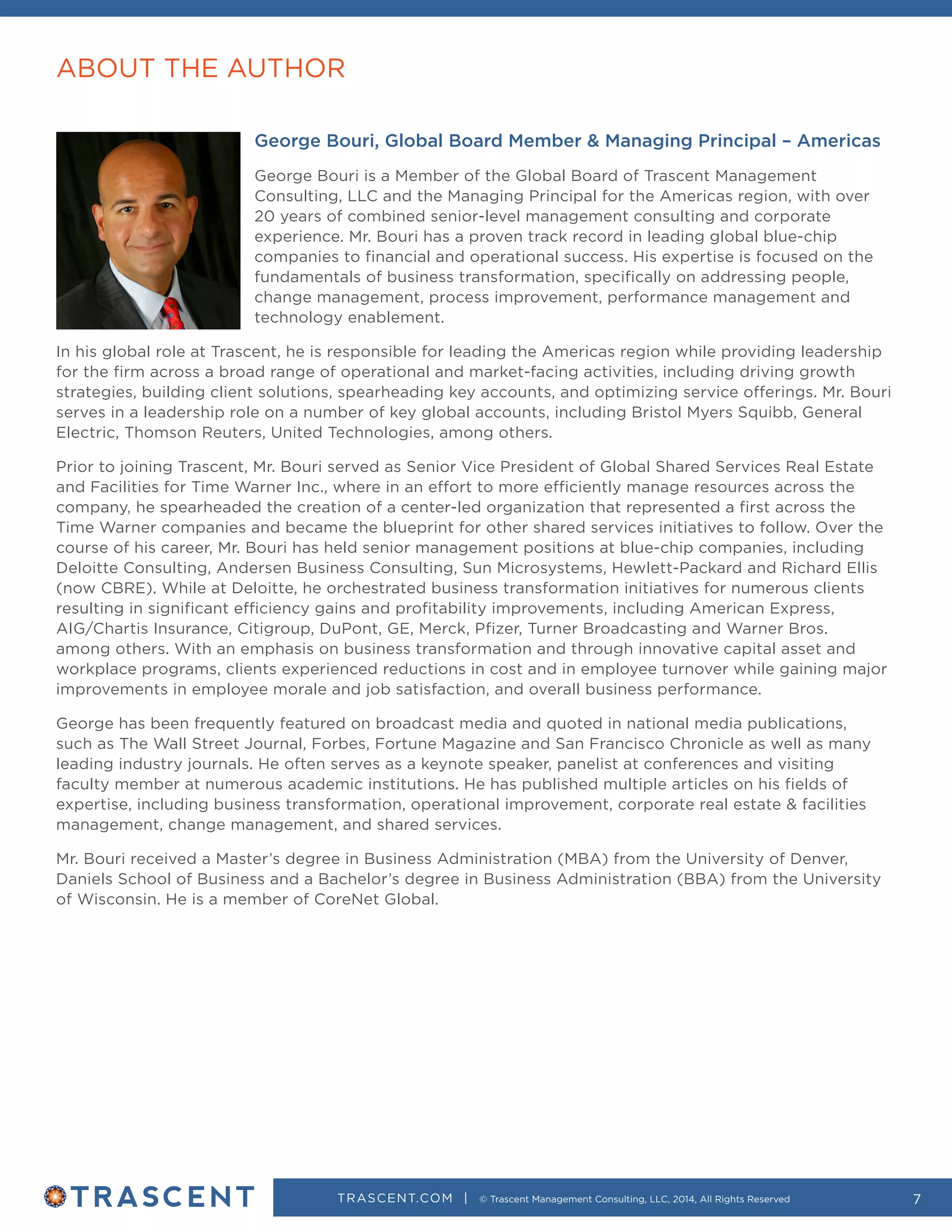
George Bouri, Global Board Member & Managing Principal – Americas
George Bouri is a Member of the Global Board of Trascent Management
Consulting, LLC and the Managing Principal for the Americas region, with over
20 years of combined senior-level management consulting and corporate
experience. Mr. Bouri has a proven track record in leading global blue-chip
companies to financial and operational success. His expertise is focused on the
fundamentals of business transformation, specifically on addressing people,
change management, process improvement, performance management and
technology enablement.
In his global role at Trascent, he is responsible for leading the Americas region while providing leadership
for the firm across a broad range of operational and market-facing activities, including driving growth
strategies, building client solutions, spearheading key accounts, and optimizing service offerings. Mr. Bouri
serves in a leadership role on a number of key global accounts, including Bristol Myers Squibb, General
Electric, Thomson Reuters, United Technologies, among others.
Prior to joining Trascent, Mr. Bouri served as Senior Vice President of Global Shared Services Real Estate
and Facilities for Time Warner Inc., where in an effort to more efficiently manage resources across the
company, he spearheaded the creation of a center-led organization that represented a first across the
Time Warner companies and became the blueprint for other shared services initiatives to follow. Over the
course of his career, Mr. Bouri has held senior management positions at blue-chip companies, including
Deloitte Consulting, Andersen Business Consulting, Sun Microsystems, Hewlett-Packard and Richard Ellis
(now CBRE). While at Deloitte, he orchestrated business transformation initiatives for numerous clients
resulting in significant efficiency gains and profitability improvements, including American Express,
AIG/Chartis Insurance, Citigroup, DuPont, GE, Merck, Pfizer, Turner Broadcasting and Warner Bros.
among others. With an emphasis on business transformation and through innovative capital asset and
workplace programs, clients experienced reductions in cost and in employee turnover while gaining major
improvements in employee morale and job satisfaction, and overall business performance.
George has been frequently featured on broadcast media and quoted in national media publications,
such as The Wall Street Journal, Forbes, Fortune Magazine and San Francisco Chronicle as well as many
leading industry journals. He often serves as a keynote speaker, panelist at conferences and visiting
faculty member at numerous academic institutions. He has published multiple articles on his fields of
expertise, including business transformation, operational improvement, corporate real estate & facilities
management, change management, and shared services.
Mr. Bouri received a Master’s degree in Business Administration (MBA) from the University of Denver,
Daniels School of Business and a Bachelor’s degree in Business Administration (BBA) from the University
of Wisconsin. He is a member of CoreNet Global.
ABOUT TRASCENT MANAGEMENT
CONSULTING
Trascent, a premier global management consulting firm,
drives measurable performance improvements in Real Estate
and Facilities Management (RE/FM). The firm partners with
leading companies in biopharmaceuticals, consumer
packaged goods, diversified industrials, financial services,
high technology and other sectors to develop breakthrough
solutions and generate quantifiable results. Trascent’s top-rated
industry conferences have been attended by senior RE/FM and
business leaders from more than 80 companies in the United
States, Europe and Asia.
Our services include:
•	Sourcing Strategy
•	Outsourcing Implementation
•	Technology Strategy
•	Supplier Governance Solutions
•	Performance Benchmarking
•	Operational Excellence
•	Market Intelligence
•	Real Estate Transformation
Yvonne Liu, Director, Marketing
+1 (646) 295-4299
yliu@Trascent.com
www.Trascent.com
To learn more about Trascent and our
breakthrough performance solutions
in RE/FM, please contact:

Trascent perspectives - Beyond Back Office

  • 1.
    Formerly UMS Advisory,Inc. George Bouri, Global Board Member and Managing Principal - Americas Trascent Management Consulting, LLC Beyond the Back Office: The Strategic Opportunity for RE/FM Six High-Impact Areas Where RE/FM Leaders Can Add Value Now TRASCENT PERSPECTIVES
  • 2.
    TRASCENT.COM | ©Trascent Management Consulting, LLC, 2014, All Rights Reserved 2 INTRODUCTION: MAPPING THE STRATEGIC AGENDA Nearly every business executive on the planet today is expected to do more with less, to innovate and cut costs simultaneously, while producing more value for the business. The pressure is especially intense on so- called “back-office” functions, like human resources, finance, procurement, IT and real estate and facilities management (RE/FM). For senior leaders in these areas, the challenge remains – How to best engage with key business stakeholders to help them achieve their core objectives? It’s about becoming a true “thought partner” – able to understand the major challenges and opportunities faced by the business and designing solutions that lead to improved performance in both the top and bottom lines. For those of us in the RE/FM community, the good news is that RE/FM leaders are well positioned to engage with their peers and the full range of decision makers across the enterprise. This is true because many of the critical issues and daily challenges faced by RE/FM teams have become more prominent within the broader business agenda. The Conference Board 2013 CEO Survey confirms this view. The results highlight the direct points of alignment among the top ten issues cited by CEOs. Among those with immediate, near-term relevance to RE/FM pros: 1. Human Capital/Talent Management 2. Operational Excellence 3. Innovation 4. Global Expansion 5. Sustainability 6. Technology, Risk Management & Collaboration Beyond the research, the experience of Trascent confirms that these are all “sweet-spot” areas where skilled RE/FM executives can serve as thought partners and even transformation leaders. But they aren’t the only areas; technology, risk mitigation and collaboration are other high-value areas where RE/FM teams can make profound contributions. This paper examines how RE/FM pros can better apply their knowledge and experience to help navigate complex challenges and seize the most promising opportunities to benefit the business. As highlighted in the sections below, we have helped our clients and colleagues at many companies exercise leadership across these dimensions by thinking of the strategic big-picture and apply specific, high-impact tactics. For example, we’ve helped shape and align RE/FM strategies for companies greatly expanding their geographic footprints to the broader growth agenda. Further, in structuring vendor management and governance programs through global RE/FM contracts, we know how to instill the proper metrics and incentives for operational excellence, innovation and/or sustainability targets so that they support the broader corporate agenda.
  • 3.
    TRASCENT.COM | ©Trascent Management Consulting, LLC, 2014, All Rights Reserved 3 My “Back to the Future” moment occurred when I realized just how far the pendulum of conventional wisdom had swung in favor of remote working, even though many in the RE/FM community were initially opposed to and even threatened by the advent of telecommuting a few years ago. 1. Human Capital/Talent Management Human capital/talent management is among the top issues on the CEO agenda, thanks to dramatic demographic shifts and technology advancements. Combined, these forces are redefining the nature of the workforce and presenting clear and significant implications for the discipline. Consider the uproar when Marissa Mayer, Yahoo CEO, endorsed a policy limiting telecommuting. This created dissension across the RE/FM community, and many colleagues viewed this as a retrograde decision. If employees are required to work in an office workspace, aren’t we reverting back from our recent progress of the alternative, “work anywhere” virtual office environment? In my view, Mayer’s higher-order motives were to reignite a “teamwork” based culture fostering human interaction. Her company sorely needed earnings. Profitability and market share were in serious decline when compared to Google. My “Back to the Future” moment occurred when I realized just how far the pendulum of conventional wisdom had swung in favor of remote working, even though many in the RE/FM community were initially opposed to and even threatened by the advent of telecommuting a few years ago. The point is CEOs don’t think purely in terms of bricks-and-mortar and neither should RE/FM leaders. Yes, we have technology to work productively and cost-effectively from anywhere, but the real issue is the value and quality of that work and creating a connectedness that contributes to a strong corporate culture. We must devise environments, systems and capabilities so workers can enhance the quality and value of their work no matter where they are located. 2. Operational Excellence Operational excellence is a perennial priority for CEOs. Why? Because they are the engines of sustained business success in any industry, not just the fast-moving, new industries like technology or bio-tech. For RE/FM leaders, the opportunity lies in finding new ways to drive that success. Remember: it’s about more than just eliminating costs. For internal customers, innovation assumes other forms. It’s about anticipating and filling customer demands, and striving to create a new set of demands and experiences. A basic example is “the sushi” story. In the cafeteria at one of my former employers, the line for sushi (the premium, high-cost offering) was always much longer than those for the hot meals, salad or sandwich bars. That variance had opportunity – with a capital “O” – written all over it. Could we hire delivery people to bring sushi orders directly to employees’ desks, rather than having them wait in line or risk them leaving the building? Could we add more sushi stations in unused areas of the cafeteria to meet peak demand? Were there other “sushi-like” offerings to be offered? From the customer’s perspective (i.e., our employees at lunchtime), there were many options to increase satisfaction. And from a business perspective, offering more sushi in less time would ultimately boost employee productivity and collaboration by keeping folks in the building and talking to each other. But if you only considered cost in this equation, you would only see that more sushi means higher investments – ultimately missing the bigger picture of expanding your ability to offer greater value, enhance the employee experience and drive innovation out of a basic food offering in your cafeteria.
  • 4.
    TRASCENT.COM | ©Trascent Management Consulting, LLC, 2014, All Rights Reserved 4 Yes, cost pressures are real. But, when you can deliver what people want (the sushi and a better, healthier dining experience) and greater value (higher productivity and more collaboration), the upside of operational excellence significantly outweighs the downside of incrementally higher costs. That’s a winning business case for RE/FM, especially when RE/FM leaders start asking themselves about other parts of the dining experience that could be disrupted or reinvented. 3. Innovation Innovation in the RE/FM community needs to be rethought comprehensively. We need to expand our view of what innovation really means to business stakeholders. Some obvious improvements have happened, but there’s a long road ahead. Innovation must be broader than creating alternative workplace environments, getting faster Wi-Fi and expanding bandwidth capacity across the corporate campus. Mobile workforces sprout up so quickly making innovation imperative if not critical. In return, what we define as immediate has to upgrade to urgent when it comes to identifying the right opportunities and shaping the right plans. If we’re to call ourselves innovators, we have to shift our thinking to truly reflect it. Much of the innovation action to come in RE/FM is likely to be in the technology, collaboration and risk management space. There’s ample opportunity for RE/FM leaders who are inclined and motivated to accept the invitation to innovate. Answering the Eternal Question in RE/FM For decades, RE/FM leaders have been asking themselves “How do we ‘level the playing field’ with other senior business leaders?” Sometimes the question takes on a more colloquial tone: “How do we earn a seat at the table at the Board meeting, rather than delivering the table to the meeting?” While many industry observers consider it a stale formulation, it actually reveals some fundamental truths about the current state of RE/FM. And it sets up the more important questions, which are “Why don’t we have a seat at the table today?” and “How do we earn one?” As for the “why,” the unvarnished truth is we simply haven’t yet earned it. Or, rather, not enough of us have done so. For the majority of RE/FM execs, annual or quarterly meetings with business units or senior management team to review RE/FM plans represent the main way we engage with the business. So it’s no surprise that many in the business view RE/FM teams as order-takers. To some extent, we’re victims of our own success. Certainly, a great deal of value has occurred and produced significant cost savings – in fact, maybe more than from any other functional area of the enterprise. But RE/FM must define its performance less like a back-office function, and more like a business-facing value creator. We are capable of innovating and producing more value, and we must be proactive in articulating the business case for these efforts. The areas outlined in this paper are high-priority areas where RE/FM leaders are uniquely positioned to connect the dots and break free from “siloed” back-office perceptions. Looking at the “how” question, a larger strategic role requires both a redirection of our energy and a refinement of our thinking. Our priorities should be rigorously aligned to the C-suite, which presupposes a full knowledge of the top priorities and a grasp of the most important details. Continuing to produce immediate, tangible results is a big part of the equation, too. That’s how RE/FM’s value contribution to the enterprise can increase significantly. Value contribution has always been the key to gaining a seat at the table and – perhaps more importantly – a voice in the discussion.
  • 5.
    TRASCENT.COM | ©Trascent Management Consulting, LLC, 2014, All Rights Reserved 5 4. Global Expansion Global expansion remains a top item for CEOs, and RE/FM teams are well positioned to facilitate it. Ensuring the organization can quickly and efficiently scale up operations in new geographies (not to mention the ability to simultaneously scale down in others) should be a “sweet spot” capability for RE/FM teams. Certainly, it’s one with direct alignment to C-suite concerns. Beyond simply procuring and standing up space, forward- thinkers are crafting plans for the creative reuse and repurposing of buildings to support mixed-use campuses or environments. RE/FM leaders with strong communications capability can possibly play quasi-ambassadorial roles – both educating local suppliers about company operations and culture and informing internal audiences about business practices in the new markets. So how can RE/FM leaders shape – rather than react to – global expansion plans? Being proactive is key. For example, a high-technology company where I once worked had to establish a global presence for many reasons. The company was growing so fast that an infrastructure-focused RE/FM strategy would never keep pace with the demand – both for space and skilled resources. Plus, we were headquartered in an earthquake-friendly region, which meant a Big One was an existential threat. Our response was strategic and proactive –using Monte-Carlo and other risk simulation analysis models, as well as other advanced planning techniques to project near-, mid- and long-term flexibility into our portfolios. We engaged with the Business Units to map global labor pools for advanced engineering skills and get ahead of the labor demand curve. We partnered with academic institutions and governments to tap into their scientific and technology programs. We developed a 10-15 year roadmap of our global footprint to drive competitive advantage to the company. In the end, the company invested billions of dollars in new facilities in multiple regions of the globe, including within the U.S. But more significant than supporting the construction of high-end LEED-certified facilities, the RE/FM team demonstrated its ability to truly serve as a business partner (out in the forefront not on the sidelines), helping the company chart a smart course to global growth, taking into account the risk management, business operations and human resource implications. We even counseled senior leaders on the value proposition of distributing the C-suite. In other words, the RE/FM team played a crucial role that enabled the company to become and operate as a true global enterprise, not a California-based international company. Success of the expansion was measured not just geographically, but also by skills, capability, culture and all the usual business metrics. 5. Sustainability The strategic potential of RE/FM groups can be clearly seen in how our industry has embraced the challenges and opportunities relative to sustainability and green initiatives. Fortuitously in some cases and by design in others, RE/FM was assigned this role. We deserve high marks for our performance in this area, especially as it has become embedded into the organization’s DNA and is no longer a separate “agenda item” for most RE/FM organizations. Examples of our success in the sustainability area abound, including better energy management initiatives, the consolidation of spend for utilities, etc. Branding RE/FM? Looking across these strategic areas, it’s easy to see communication and branding as the one common denominator for top performers in our space. It’s a premium in any management field and successful senior leaders recognize that they are in the communications business. Speaking the language of the business instead of functional dialect is critical. It’s absolutely okay to toot our own horns and tout our capabilities. Our clients need to know, understand and be excited about our value proposition and what we can offer them. Regular, formal communications – like brief e-mail newsletters, internal news articles or blogs – are a great way to highlight current service offerings and deliver strategic perspective on key issues. Based on my experience, many internal clients are still unclear of exactly what RE/FM can do for them. They just don’t get the overall value and still see us as the function that supplies toilet paper and light bulbs to buildings. Naming a department “Workplace Solutions” just doesn’t cut it. Marketing communications, even internally, can go a long way to raising your organization’s visibility and perceived value.
  • 6.
    TRASCENT.COM | ©Trascent Management Consulting, LLC, 2014, All Rights Reserved 6 Of course, there’s still plenty of opportunity beyond the achievement of LEED-certification and platinum- status building. I believe there are many breakthrough innovations to come, and that we’ve only just formed the stepping-stones for RE/FM’s value proposition relative to sustainability. Those gains will come in forms big (like collaborating with manufacturing plants to devise ever more energy-efficient and intelligent systems) to small (the finding the optimal mix of recyclable materials). 6. Technology, Risk Management & Collaboration Looking beyond the areas identified by the Conference Board survey, we as an industry must continue to identify and embrace technology to transform how we run and manage our operations. ERP, IWMS and other technology solutions continue to offer challenges and opportunities to RE/FM organizations. But how do we harness these technologies for improved decision-making, integration into the broader enterprise systems and to measure the success of each and every initiative we undertake? RE/FM leaders must fully understand their range of choices and not abdicate this responsibility to their IT organizations. More broadly, technology should be viewed as a continuous, creative disruptive force. A technology upgrade is never a final destination. Even the most futuristic data centers continue to face near-term extinction given rapid advancements in cloud computing and the move to smaller and more efficient hardware and storage systems. Thus, our value doesn’t come strictly from facilitating and sourcing all the materials and services to designing, building and maintaining physical centers. Rather, it’s about understanding the technology trends that shape how we work. End-users are playing a hugely influential – even decisive – role in selecting tools needed to do their jobs effectively. These trends create more opportunities for RE/FM teams to have more dialogue and collaborative discussions with CIOs and HR leaders. Discussions should focus on helping senior leaders navigate the workplace implications and achieve ultimate outcomes (like productivity) that remain aligned to big-picture business goals. Beyond IT and HR, RE/FM leaders should synchronize their efforts with procurement, finance and legal. The sourcing realm is the most obvious area where RE/FM leaders can ensure invested dollars produce bottom-line results. The more strategic view incorporates value-oriented metrics, of course. RE/FM leaders can and should share their success stories and lessons learned in areas such as supplier relationship management and governance, performance management, and contracting structures. Best practices from within the RE/FM realm are relevant across the enterprise, particularly when you recall that this area is generally the second or third largest spend behind labor costs and IT. Enterprise risk management, business continuity, and physical and virtual security are still other areas where integrated, cross-functional collaboration will yield better outcomes for the corporation as a whole. There is no reason why RE/FM leaders can’t start or catalyze these necessary conversations. From super storms and natural disasters to terrorism to competitive espionage and cybercrime (much of which involves physical plant breaches and rogue vendors), many of the most serious threats to large enterprises have dimensions in the purview of RE/FM. And of course, these are the very items keeping CEOs up at night. THE BOTTOM LINE: THE OPPORTUNITY IS HERE, THE TIME IS NOW The RE/FM agenda clearly intersects and overlaps with that of business leaders. As result, RE/FM executives will need to adopt a broader, bigger-picture view of the business and reconceive their role within it. We need to, as another great company once put it, to think and act differently. Cultural transformation. Organizational change management. Business enablement. Innovation strategies. That’s what CEOs think about and act on everyday. And there’s no reason RE/FM leaders can’t join them in those endeavors and, ultimately, unite in driving toward improved performance in the most critical areas of the business.
  • 7.
    TRASCENT.COM | ©Trascent Management Consulting, LLC, 2014, All Rights Reserved 7 ABOUT THE AUTHOR George Bouri, Global Board Member & Managing Principal – Americas George Bouri is a Member of the Global Board of Trascent Management Consulting, LLC and the Managing Principal for the Americas region, with over 20 years of combined senior-level management consulting and corporate experience. Mr. Bouri has a proven track record in leading global blue-chip companies to financial and operational success. His expertise is focused on the fundamentals of business transformation, specifically on addressing people, change management, process improvement, performance management and technology enablement. In his global role at Trascent, he is responsible for leading the Americas region while providing leadership for the firm across a broad range of operational and market-facing activities, including driving growth strategies, building client solutions, spearheading key accounts, and optimizing service offerings. Mr. Bouri serves in a leadership role on a number of key global accounts, including Bristol Myers Squibb, General Electric, Thomson Reuters, United Technologies, among others. Prior to joining Trascent, Mr. Bouri served as Senior Vice President of Global Shared Services Real Estate and Facilities for Time Warner Inc., where in an effort to more efficiently manage resources across the company, he spearheaded the creation of a center-led organization that represented a first across the Time Warner companies and became the blueprint for other shared services initiatives to follow. Over the course of his career, Mr. Bouri has held senior management positions at blue-chip companies, including Deloitte Consulting, Andersen Business Consulting, Sun Microsystems, Hewlett-Packard and Richard Ellis (now CBRE). While at Deloitte, he orchestrated business transformation initiatives for numerous clients resulting in significant efficiency gains and profitability improvements, including American Express, AIG/Chartis Insurance, Citigroup, DuPont, GE, Merck, Pfizer, Turner Broadcasting and Warner Bros. among others. With an emphasis on business transformation and through innovative capital asset and workplace programs, clients experienced reductions in cost and in employee turnover while gaining major improvements in employee morale and job satisfaction, and overall business performance. George has been frequently featured on broadcast media and quoted in national media publications, such as The Wall Street Journal, Forbes, Fortune Magazine and San Francisco Chronicle as well as many leading industry journals. He often serves as a keynote speaker, panelist at conferences and visiting faculty member at numerous academic institutions. He has published multiple articles on his fields of expertise, including business transformation, operational improvement, corporate real estate & facilities management, change management, and shared services. Mr. Bouri received a Master’s degree in Business Administration (MBA) from the University of Denver, Daniels School of Business and a Bachelor’s degree in Business Administration (BBA) from the University of Wisconsin. He is a member of CoreNet Global.
  • 8.
    ABOUT TRASCENT MANAGEMENT CONSULTING Trascent,a premier global management consulting firm, drives measurable performance improvements in Real Estate and Facilities Management (RE/FM). The firm partners with leading companies in biopharmaceuticals, consumer packaged goods, diversified industrials, financial services, high technology and other sectors to develop breakthrough solutions and generate quantifiable results. Trascent’s top-rated industry conferences have been attended by senior RE/FM and business leaders from more than 80 companies in the United States, Europe and Asia. Our services include: • Sourcing Strategy • Outsourcing Implementation • Technology Strategy • Supplier Governance Solutions • Performance Benchmarking • Operational Excellence • Market Intelligence • Real Estate Transformation Yvonne Liu, Director, Marketing +1 (646) 295-4299 yliu@Trascent.com www.Trascent.com To learn more about Trascent and our breakthrough performance solutions in RE/FM, please contact: