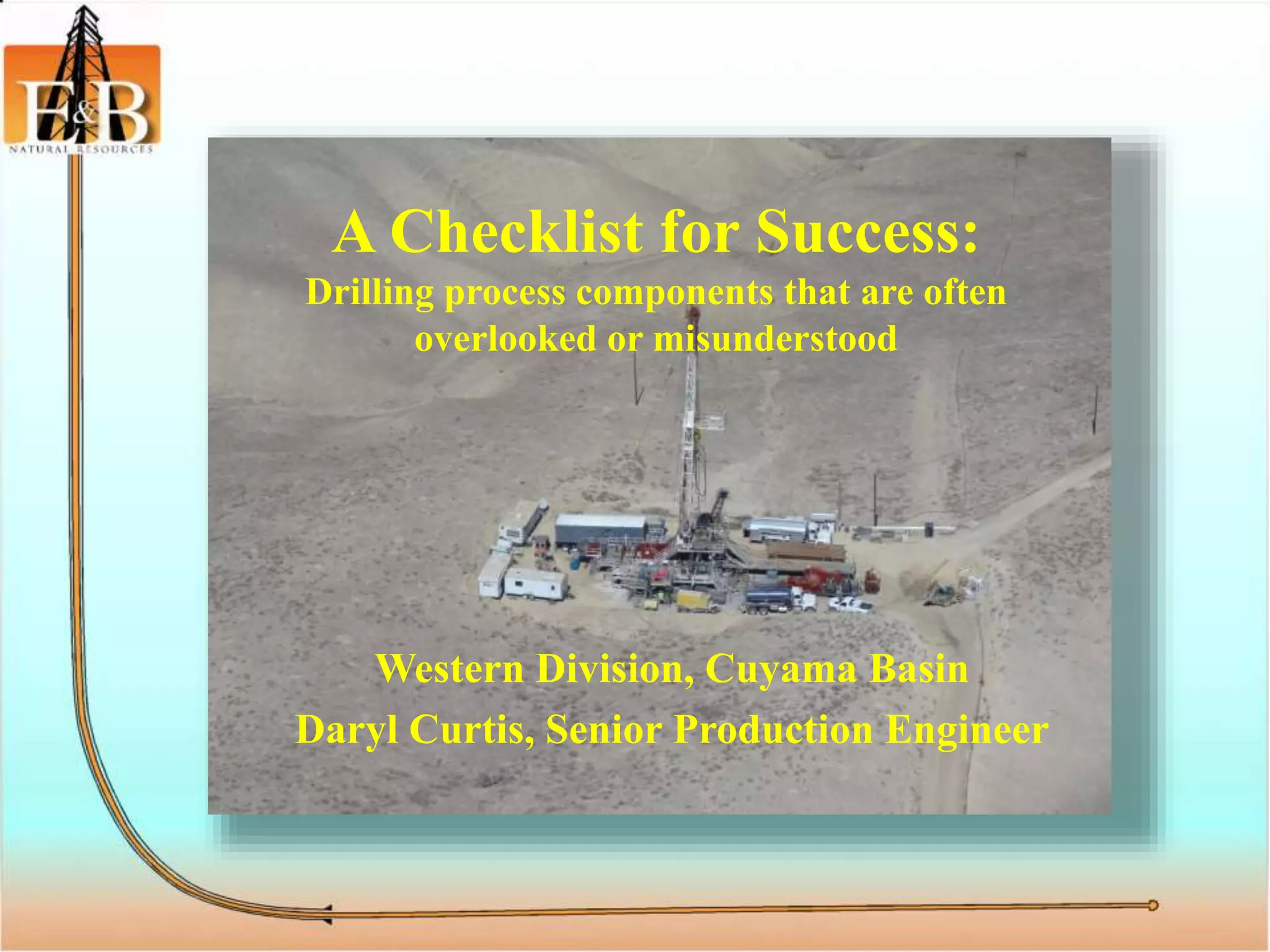
A Checklist for Success:
Drilling process components that are often
overlooked or misunderstood
Western Division, Cuyama Basin
Daryl Curtis, Senior Production Engineer
To Drill, or Not To Drill?
(H-wells, that is)
• Just because it is the popular thing to do, it isn’t
necessarily the right thing to do
• There are questions that have to be addressed
before it is decided that a horizontal well is the
right well for you
• If the answer is “Yes…Drill, baby, drill!” then
you have to decide if you can afford to drill an H-
well
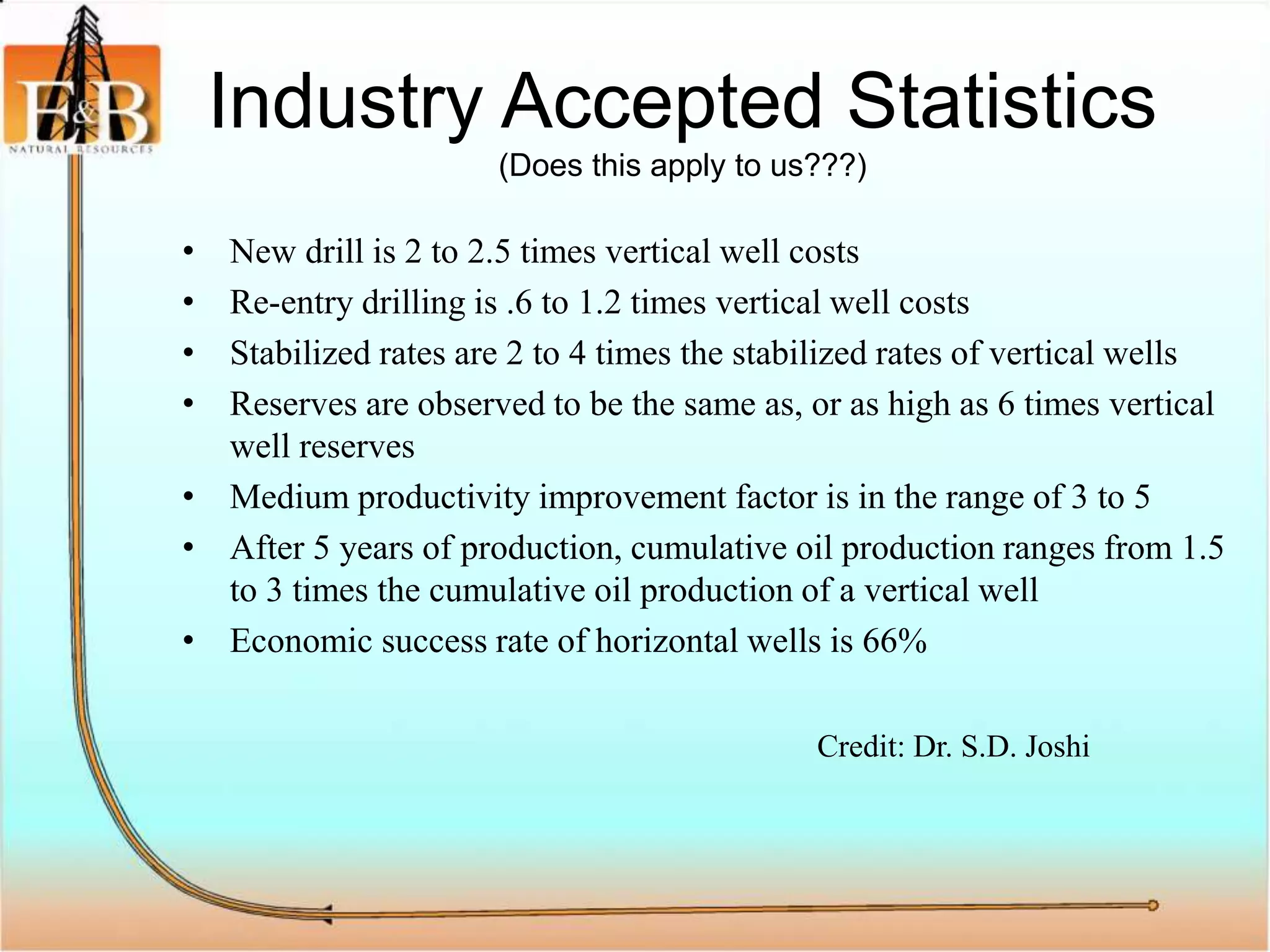
Industry Accepted Statistics
(Does this apply to us???)
• New drill is 2 to 2.5 times vertical well costs
• Re-entry drilling is .6 to 1.2 times vertical well costs
• Stabilized rates are 2 to 4 times the stabilized rates of vertical wells
• Reserves are observed to be the same as, or as high as 6 times vertical
well reserves
• Medium productivity improvement factor is in the range of 3 to 5
• After 5 years of production, cumulative oil production ranges from 1.5
to 3 times the cumulative oil production of a vertical well
• Economic success rate of horizontal wells is 66%
Credit: Dr. S.D. Joshi
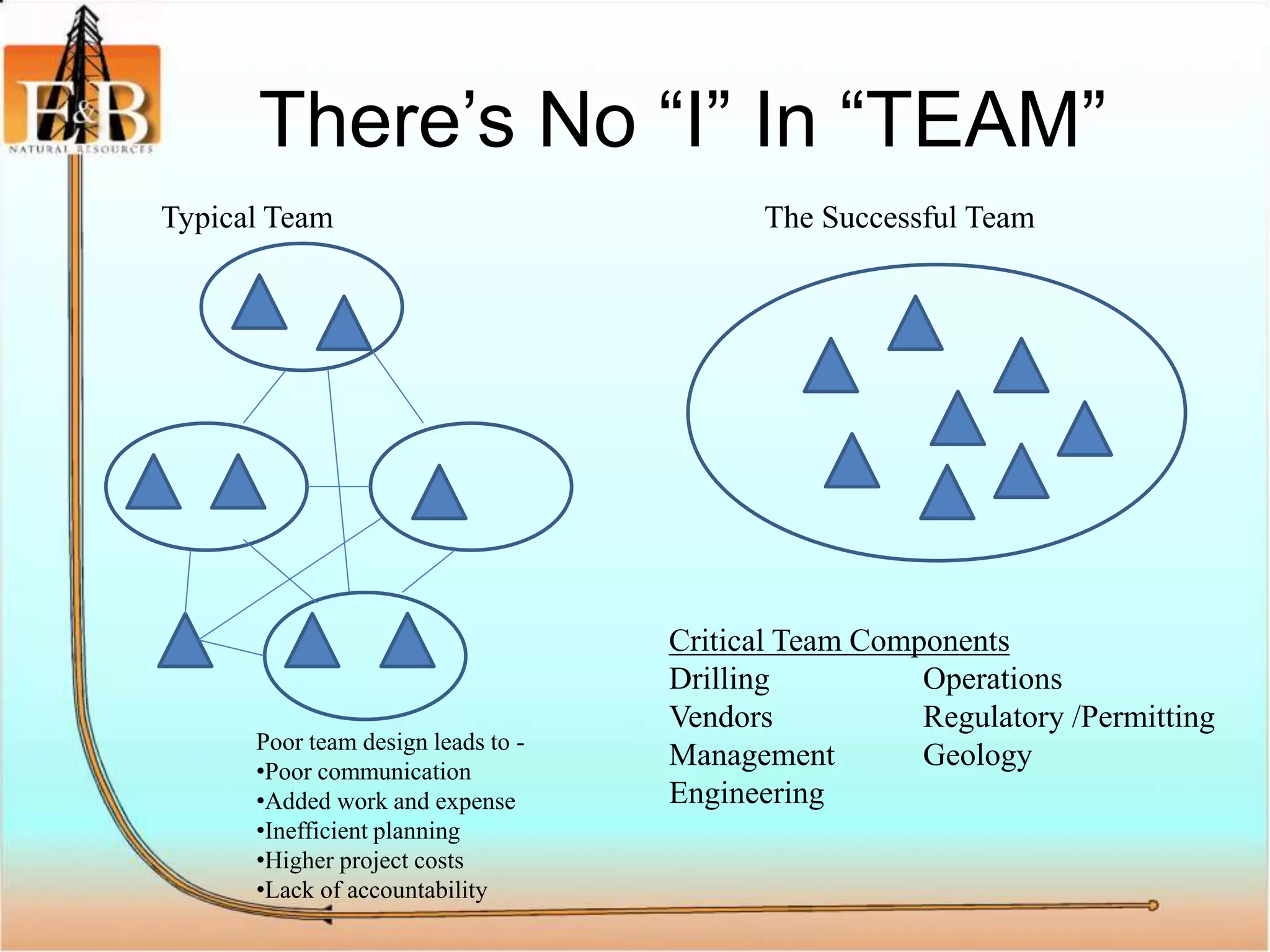
There’s No “I” In “TEAM”
Critical Team Components
Drilling Operations
Vendors Regulatory /Permitting
Management Geology
Engineering
Typical Team The Successful Team
Poor team design leads to -
•Poor communication
•Added work and expense
•Inefficient planning
•Higher project costs
•Lack of accountability
The Checklist
 Project Scope – Do we know what it is we are trying to achieve with drilling an H-well?
 Technical Analysis - Have you done your homework on the geologic, reservoir, and cost
analysis side? Are H-wells the right fit for the project?
 Risk Analysis – Do you truly understand the risks? This includes reservoir, drilling,
completion, and production / operations.
 Well Defined Team – Who is on your team? What are their roles and responsibilities? How
will you hold people accountable?
 Complete Drilling Program – Do you have a detailed drilling program that incorporates all
the proper steps, includes contingency plans, and is distributed to all the team members
 Drilling Schedule – Do you have a well defined and detailed drilling schedule that includes
each step, task, resource, cost and milestone?
 Communication Plan – Do you know how you will effectively communicate to your team?
 Managing the Process – How (and Who) will the process be managed? What are the key item
expenditures to be focused on?
 Post Mortem Analysis – What worked, what didn’t? How would you improve the process?
Would you do this again in this area? Was this a technical and/or economic success?
The above components of the drilling process are critical to ensuring a
successful program – whether drilling H-wells or vertical wells.
Industry Observations
Seem Familiar???
“Sometimes, competing divergent drivers, and inherent personality
differences within the asset team and other well-operations
participants, can create obvious conflict and ultimately result in a
dysfunctional group. The outcome can be a breakdown of the team,
due to many factors, including individual incentives, personalities or,
very simply, personal motivation. The ultimate outcome may be
significant conflict between otherwise closely aligned team members
and service company participants.”
Credit: K.C. Oren, Horizontal Solutions International
Conclusion
Things we need to do that we don’t do well…
• With the low oil prices, now is the time to re-evaluate how we conduct our drilling programs.
• Understand that everything we do is a process. We must understand that and then define what
our drilling process is. From there we need to understand how to implement and manage the
drilling process.
• Define the team and who is on that team. This includes defining / assigning roles and
responsibilities, as well as understanding who is accountable for what and holding them
accountable.
• In order to function like a team, you must first think like a team member. Every member of a
team is not only a customer, but a supplier. The quicker team members understand that and
embrace it, the quicker successes will be achieved through effective communication.
• We can barely drill vertical wells efficiently and cost effectively. Why would we think we
could drill H-wells any more successfully? See above conclusions…
• Stop relying on experience, old school technology, and reputations. Instead, rely on good,
sound technical work, realistic economics with uncertainties built-in, effective leadership, and
solid team work.
• Let the data drive the decision – not the other way around!
Informational Sources
• Candidate Reservoirs for Horizontal Wells (Joshi)
• Drilling the perfect horizontal well requires trade-offs

Horizontal Symposium - Checklist for Success

  • 1.
    A Checklist forSuccess: Drilling process components that are often overlooked or misunderstood Western Division, Cuyama Basin Daryl Curtis, Senior Production Engineer
  • 2.
    To Drill, orNot To Drill? (H-wells, that is) • Just because it is the popular thing to do, it isn’t necessarily the right thing to do • There are questions that have to be addressed before it is decided that a horizontal well is the right well for you • If the answer is “Yes…Drill, baby, drill!” then you have to decide if you can afford to drill an H- well
  • 3.
    Industry Accepted Statistics (Doesthis apply to us???) • New drill is 2 to 2.5 times vertical well costs • Re-entry drilling is .6 to 1.2 times vertical well costs • Stabilized rates are 2 to 4 times the stabilized rates of vertical wells • Reserves are observed to be the same as, or as high as 6 times vertical well reserves • Medium productivity improvement factor is in the range of 3 to 5 • After 5 years of production, cumulative oil production ranges from 1.5 to 3 times the cumulative oil production of a vertical well • Economic success rate of horizontal wells is 66% Credit: Dr. S.D. Joshi
  • 4.
    There’s No “I”In “TEAM” Critical Team Components Drilling Operations Vendors Regulatory /Permitting Management Geology Engineering Typical Team The Successful Team Poor team design leads to - •Poor communication •Added work and expense •Inefficient planning •Higher project costs •Lack of accountability
  • 5.
    The Checklist  ProjectScope – Do we know what it is we are trying to achieve with drilling an H-well?  Technical Analysis - Have you done your homework on the geologic, reservoir, and cost analysis side? Are H-wells the right fit for the project?  Risk Analysis – Do you truly understand the risks? This includes reservoir, drilling, completion, and production / operations.  Well Defined Team – Who is on your team? What are their roles and responsibilities? How will you hold people accountable?  Complete Drilling Program – Do you have a detailed drilling program that incorporates all the proper steps, includes contingency plans, and is distributed to all the team members  Drilling Schedule – Do you have a well defined and detailed drilling schedule that includes each step, task, resource, cost and milestone?  Communication Plan – Do you know how you will effectively communicate to your team?  Managing the Process – How (and Who) will the process be managed? What are the key item expenditures to be focused on?  Post Mortem Analysis – What worked, what didn’t? How would you improve the process? Would you do this again in this area? Was this a technical and/or economic success? The above components of the drilling process are critical to ensuring a successful program – whether drilling H-wells or vertical wells.
  • 6.
    Industry Observations Seem Familiar??? “Sometimes,competing divergent drivers, and inherent personality differences within the asset team and other well-operations participants, can create obvious conflict and ultimately result in a dysfunctional group. The outcome can be a breakdown of the team, due to many factors, including individual incentives, personalities or, very simply, personal motivation. The ultimate outcome may be significant conflict between otherwise closely aligned team members and service company participants.” Credit: K.C. Oren, Horizontal Solutions International
  • 7.
    Conclusion Things we needto do that we don’t do well… • With the low oil prices, now is the time to re-evaluate how we conduct our drilling programs. • Understand that everything we do is a process. We must understand that and then define what our drilling process is. From there we need to understand how to implement and manage the drilling process. • Define the team and who is on that team. This includes defining / assigning roles and responsibilities, as well as understanding who is accountable for what and holding them accountable. • In order to function like a team, you must first think like a team member. Every member of a team is not only a customer, but a supplier. The quicker team members understand that and embrace it, the quicker successes will be achieved through effective communication. • We can barely drill vertical wells efficiently and cost effectively. Why would we think we could drill H-wells any more successfully? See above conclusions… • Stop relying on experience, old school technology, and reputations. Instead, rely on good, sound technical work, realistic economics with uncertainties built-in, effective leadership, and solid team work. • Let the data drive the decision – not the other way around!
  • 8.
    Informational Sources • CandidateReservoirs for Horizontal Wells (Joshi) • Drilling the perfect horizontal well requires trade-offs