IDS Transportation Services | 3100 Reeves Rd. Plainfield, IN 46168 | www.idstransportation.com
Transportation Management Programs – A Game Changer

Year-after-year companies send out RFP’s looking to find reductions in transportation cost needed for the
coming year. While many companies go through this annual RFP process, an Aberdeen Group study found
others have taken a more holistic approach for bigger savings and better operational results. The Aberdeen
study found 83% of companies interviewed have become keenly aware of the cost and service impact
transportation has on the overall supply chain performance of their company and see transportation as more
than just an isolated budget line item to be monitored, but a critical component of overall supply chain
excellence that can be leveraged for a strategic advantage. So, while rising freight rates, higher fuel costs
and constrained capacity may be the more obvious drivers of why executives are concerned with their
transportation spend there are larger issues at hand.


The competitive need to contain transportation costs, while managing uncertainty in today’s volatile
economic and carrier market is providing reason for the C-level of organizations to re-examine various
supply chain options and push transportation buyers to contemplate the use of logistics services providers
(LSP’s). More aggressive carrier rate negotiations no longer yield double digit savings and have no effect in
controlling supply chain needs, yet all are possible under LSP solutions.


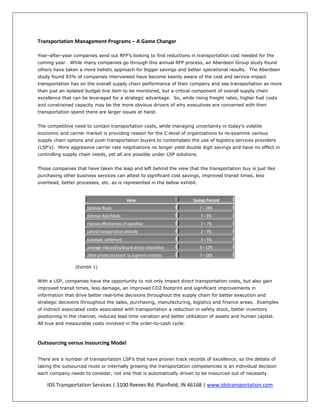
Those companies that have taken the leap and left behind the view that the transportation buy is just like
purchasing other business services can attest to significant cost savings, improved transit times, less
overhead, better processes, etc. as is represented in the below exhibit.


                 (Exhibit 1)


With a LSP, companies have the opportunity to not only impact direct transportation costs, but also gain
improved transit times, less damage, an improved CO2 footprint and significant improvements in
information that drive better real-time decisions throughout the supply chain for better execution and
strategic decisions throughout the sales, purchasing, manufacturing, logistics and finance areas. Examples
of indirect associated costs associated with transportation a reduction in safety stock, better inventory
positioning in the channel, reduced lead time variation and better utilization of assets and human capital.
All true and measurable costs involved in the order-to-cash cycle.


Outsourcing versus Insourcing Model

There are a number of transportation LSP’s that have proven track records of excellence, so the debate of
taking the outsourced route or internally growing the transportation competencies is an individual decision
each company needs to consider, not one that is automatically driven to be insourced out of necessity.

    IDS Transportation Services | 3100 Reeves Rd. Plainfield, IN 46168 | www.idstransportation.com
One of the simplest approaches when trying to decide whether to
outsource versus insource comes through defining core competencies.
In-house core competencies are those a company would assemble a
strategic team around and want to constantly see forward progression,
while all other activities would be a candidate for outsourcing.


The thinking used to be that once a company outsourced, they never
took the activity back in house. This thinking is undeniably not the case
in today’s business environment. As companies grow and mature, and
management teams come and go, there is always an evaluation at the
C-level as to what the company’s core competencies are or should be.


At the same time, an outsourced partner will grow and adapt to market
changes and what they are doing with their client in five years will likely be different than what they are
doing today. Companies might bring some functions back in house because they now believe they should be
internal core competencies, and they might outsource other functions that were once managed in-house.


Also, outsourcing was traditionally considered an all or nothing approach, meaning companies either handed
over the keys to the operation or they kept it all in-house. Until recently a middle-of-the-road option was
not available. Today the LSP market offers a hybrid solution, such as managed transportation services
where companies typically keep procurement and carrier management in-house, while outsourcing daily
execution tasks to a LSP that is more suited to efficiently and effectively manage the vast number of
transactions through its technology and industry connections.


Below is a list of additional reasons why many companies choose the outsourced model with a LSP:


    Financial and strategic benefits


       Minimal capital investment
       Rapid implementation, which provides a quicker ROI realization
       Scalable solution for the future
       Low cost pay-as-you go variable cost operations model
       Collaborative environment for multiple users in various disciplines to communicate
       Through the business intelligence tools move transportation from cost center to strategic advantage
       Reduce resources required to maintain
       Reduce resources needed to implement
       Outsource non-core competencies


    Industry benefits


       Full access to dedicated experts in the industry
       Standardize the handling of goods
       Leverage best practices in 3PL transportation industry
       Leverage carrier base and rates for significant cost reductions, while improving service


    IDS Transportation Services | 3100 Reeves Rd. Plainfield, IN 46168 | www.idstransportation.com
Software benefits


       System is already tied in with key trading partners
       Automate manual processes
       Tier one open architecture web platform that quickly and easily links with various platforms
       Software platform could be moved in-house, as a company’s needs changed


The Cloud Based Technology of Today’s LSP’s

Cloud based transportation management systems connect
real-time with supply chain partners. The new breed of cloud-
based TMS systems leverage the internet’s collaborative
power and eliminate the exhaustive and expensive
integrations associated with their ERP counterpart solutions.

Streamlined communications through the cloud brings a
collaborative execution model that drives unforeseen
improvements within the overall supply chain. In the cloud
based TMS systems, supply chain partners collaborate real-
time to resolve their issues through web portals that are configured to each user’s needs. This real-time
business intelligence expands awareness and provides for better decision making. Supply chain managers
connect to arrange and track shipments, optimize both the inbound and outbound daily transportation
needs, identify delays for quick resolution. Users can instantly look at metrics from many sources, which
can then be extracted from any web hosted device.

Capacity, mode selection, consolidations, pooling and specialty niches each carrier excels in contribute to the
overall KPI’s of a company’s transportation strategy. Today’s technology utilizes all of these considerations
to assemble daily transportation plans that come up with the best routed cost to meet the delivery
schedules required by the customer.


                        Taking Transportation to a Higher Level

                        There is a tremendous value LSP’s deliver beyond controlling a single cost line on a
                        P&L. Analyzing transportation activities from a strategic, tactical and operational
                        level helps in the analysis of the overall value of transportation management
                        program.

                        Strategic

                        Sourcing: The vast industry experience of a LSP, allows them to bring in the right
                        combination of current carriers and niche players to maximize performance and cost.
                        KPI’s are then instituted into the program to ensure the performance of each carrier
                        in the mix is working throughout the year. Another component of sourcing is
network design, which is the analysis of deciding the strategic distribution points for the best service and
price. The last component in the sourcing area includes contract management, which ensures contracts are
in compliance and carriers are current with their insurance.

Tactical: Capacity Management and Resource Management are critical in today’s ever changing
transportation marketplace. LSP’s are in the market every day buying and selling logistics services, which
provides them a constant barometer of the ever changing price and balance issues. A key tactical

    IDS Transportation Services | 3100 Reeves Rd. Plainfield, IN 46168 | www.idstransportation.com
component also includes rate and tariff management, which requires careful review and updating for proper
routing and rating. Monitoring insurance and key safety ratings of the carriers, within the client’s portfolio,
are extremely important in order to avoid liability issues.

Operations: Planning, execution, monitoring, auditing and payment are the critical final pieces to an
optimized transportation solution. Indispensable to planning is the rating engine that optimizes rate and
route decisions for the best price and service available. EDI is a key component to automating much of the
transactions with carriers from tender to payment, which then allows the operations team to monitor for
exceptions around on-time delivery and cost. An additional value of a LSP is that these EDI connections are
available out of the box making for a much quicker and less costly implementation.

The last piece of a LSP solution is an automated and accurate freight bill processing. EDI files are passed for
auditing to allow for quick and easy three way matching for accuracy. Costs are then allocated based
account code, sku, etc. The customer is in complete control as to how they want the costs to be allocated
within their business.

Evaluation: Measurements and real time information power overall improvement. As the saying goes, if it’s
measured it will improve. With a LSP, beginning day one, companies have information available through
web portals, reports, which can be pushed to them or run ad-hoc and cover the key components within their
supply chain. This data also brings power to negotiations. Many times carriers play the tariff game of
providing savings on some zones and breaks, then offset those against other zones and breaks with the net
being zero. All the information within the LSP’s TMS allows for what-if scenarios to be run against new
ideas, new rates and new processes. so the real impact can be analyzed for a particular change versus
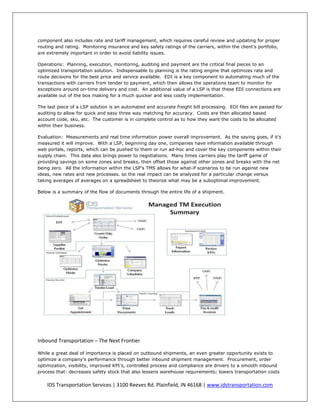
taking averages of averages on a spreadsheet to theorize what may be a suboptimal improvement.

Below is a summary of the flow of documents through the entire life of a shipment.


Inbound Transportation – The Next Frontier

While a great deal of importance is placed on outbound shipments, an even greater opportunity exists to
optimize a company's performance through better inbound shipment management. Procurement, order
optimization, visibility, improved KPI’s, controlled process and compliance are drivers to a smooth inbound
process that: decreases safety stock that also lessens warehouse requirements; lowers transportation costs

    IDS Transportation Services | 3100 Reeves Rd. Plainfield, IN 46168 | www.idstransportation.com
through a dynamic inbound compliance routing guide; reduces transportation expense from volume
discounts, consolidation and pooling opportunities; increases revenue and customer satisfaction with less
stock outs; decreases overhead; and increases productivity.

No one would consider driving a car with a blindfold, but that is exactly what many
companies do today with their inbound process. It is much easier to measure and
control the outbound process, which is simple in comparison to the numerous moving
parts, players, compliance and synchronization challenges involved
with the inbound movement of freight. Inbound product is the
lifeblood of any organization and vendors try to make it easy by
providing a landed cost for their products, which typically means they
are adding a substantial profit margin for freight and burying it in the
total cost of the product. Some companies try to address their inbound
challenges through routing guides, but these static guides are not well followed by
the vendor community. A LSP's inbound management provides a dynamic
platform where vendors call directly into the team, which books and
optimizes the freight movements for the day based on lane volumes and the
most current carrier agreements. Through the optimization process,
consolidation opportunities are found to further improve cost and transit.

Through a LSP’s inbound solution, all stakeholders have the information at their fingertips via a single
platform and can communicate in a collaborative environment. Purchasing, Vendors, Carriers, Accounting,
Receiving and Traffic can exchange information collaboratively to optimize how product enters into your
operation and is transferred into a saleable state to quickly improve the order to cash cycle.


Implementation

Unless there are significant issues around a client’s carrier base, the suggested path of implementation
would be to start with the client’s current carrier base. As shown previously in Exhibit 1, the greatest
savings come through consolidations, private bid boards, better visibility and control, not through squeezing
the carriers a little tighter, so why introduce more complexity coming out of the gate. Additional savings in
rates will come later, once the LSP has collected enough actual information so that the LSP and the client
can be armed with critical data as they enter negotiations. Good carrier relationships are invaluable, in that,
their institutional knowledge cannot be communicated through a spreadsheet. The incumbent carriers know
their client’s business inside and out, which should not be discounted in a full start-up. Using the incumbent
carriers for the first 60 days, not only provides for a smooth transition but it also allows time to capture the
data that will be used to build a strong bid package that the what-if analysis will be run off of to evaluate
actual savings, not averages of averages through spreadsheet analysis.

With that in mind, the implementation strategy is focused on executing the business for the first 60 days
under the client’s carrier base, while bringing in a few new carrier relationships that address immediate
needs brought on by consolidations, pools or modal switches from OTR to intermodal. After the first 60
days, the LSP then takes the business out for a full bid using the actual data captured during
implementation.

After the new bids are awarded, an internal private bid board for qualified carriers will be assembled for
daily operation spot bid opportunities that may exist on any given day. This approach helps to drive prices
down further, as carriers work to better balance their fleets on a daily basis.


    IDS Transportation Services | 3100 Reeves Rd. Plainfield, IN 46168 | www.idstransportation.com

Transportation Management White Paper

  • 1.
    IDS Transportation Services| 3100 Reeves Rd. Plainfield, IN 46168 | www.idstransportation.com
  • 2.
    Transportation Management Programs– A Game Changer Year-after-year companies send out RFP’s looking to find reductions in transportation cost needed for the coming year. While many companies go through this annual RFP process, an Aberdeen Group study found others have taken a more holistic approach for bigger savings and better operational results. The Aberdeen study found 83% of companies interviewed have become keenly aware of the cost and service impact transportation has on the overall supply chain performance of their company and see transportation as more than just an isolated budget line item to be monitored, but a critical component of overall supply chain excellence that can be leveraged for a strategic advantage. So, while rising freight rates, higher fuel costs and constrained capacity may be the more obvious drivers of why executives are concerned with their transportation spend there are larger issues at hand. The competitive need to contain transportation costs, while managing uncertainty in today’s volatile economic and carrier market is providing reason for the C-level of organizations to re-examine various supply chain options and push transportation buyers to contemplate the use of logistics services providers (LSP’s). More aggressive carrier rate negotiations no longer yield double digit savings and have no effect in controlling supply chain needs, yet all are possible under LSP solutions. Those companies that have taken the leap and left behind the view that the transportation buy is just like purchasing other business services can attest to significant cost savings, improved transit times, less overhead, better processes, etc. as is represented in the below exhibit. (Exhibit 1) With a LSP, companies have the opportunity to not only impact direct transportation costs, but also gain improved transit times, less damage, an improved CO2 footprint and significant improvements in information that drive better real-time decisions throughout the supply chain for better execution and strategic decisions throughout the sales, purchasing, manufacturing, logistics and finance areas. Examples of indirect associated costs associated with transportation a reduction in safety stock, better inventory positioning in the channel, reduced lead time variation and better utilization of assets and human capital. All true and measurable costs involved in the order-to-cash cycle. Outsourcing versus Insourcing Model There are a number of transportation LSP’s that have proven track records of excellence, so the debate of taking the outsourced route or internally growing the transportation competencies is an individual decision each company needs to consider, not one that is automatically driven to be insourced out of necessity. IDS Transportation Services | 3100 Reeves Rd. Plainfield, IN 46168 | www.idstransportation.com
  • 3.
    One of thesimplest approaches when trying to decide whether to outsource versus insource comes through defining core competencies. In-house core competencies are those a company would assemble a strategic team around and want to constantly see forward progression, while all other activities would be a candidate for outsourcing. The thinking used to be that once a company outsourced, they never took the activity back in house. This thinking is undeniably not the case in today’s business environment. As companies grow and mature, and management teams come and go, there is always an evaluation at the C-level as to what the company’s core competencies are or should be. At the same time, an outsourced partner will grow and adapt to market changes and what they are doing with their client in five years will likely be different than what they are doing today. Companies might bring some functions back in house because they now believe they should be internal core competencies, and they might outsource other functions that were once managed in-house. Also, outsourcing was traditionally considered an all or nothing approach, meaning companies either handed over the keys to the operation or they kept it all in-house. Until recently a middle-of-the-road option was not available. Today the LSP market offers a hybrid solution, such as managed transportation services where companies typically keep procurement and carrier management in-house, while outsourcing daily execution tasks to a LSP that is more suited to efficiently and effectively manage the vast number of transactions through its technology and industry connections. Below is a list of additional reasons why many companies choose the outsourced model with a LSP: Financial and strategic benefits  Minimal capital investment  Rapid implementation, which provides a quicker ROI realization  Scalable solution for the future  Low cost pay-as-you go variable cost operations model  Collaborative environment for multiple users in various disciplines to communicate  Through the business intelligence tools move transportation from cost center to strategic advantage  Reduce resources required to maintain  Reduce resources needed to implement  Outsource non-core competencies Industry benefits  Full access to dedicated experts in the industry  Standardize the handling of goods  Leverage best practices in 3PL transportation industry  Leverage carrier base and rates for significant cost reductions, while improving service IDS Transportation Services | 3100 Reeves Rd. Plainfield, IN 46168 | www.idstransportation.com
  • 4.
    Software benefits  System is already tied in with key trading partners  Automate manual processes  Tier one open architecture web platform that quickly and easily links with various platforms  Software platform could be moved in-house, as a company’s needs changed The Cloud Based Technology of Today’s LSP’s Cloud based transportation management systems connect real-time with supply chain partners. The new breed of cloud- based TMS systems leverage the internet’s collaborative power and eliminate the exhaustive and expensive integrations associated with their ERP counterpart solutions. Streamlined communications through the cloud brings a collaborative execution model that drives unforeseen improvements within the overall supply chain. In the cloud based TMS systems, supply chain partners collaborate real- time to resolve their issues through web portals that are configured to each user’s needs. This real-time business intelligence expands awareness and provides for better decision making. Supply chain managers connect to arrange and track shipments, optimize both the inbound and outbound daily transportation needs, identify delays for quick resolution. Users can instantly look at metrics from many sources, which can then be extracted from any web hosted device. Capacity, mode selection, consolidations, pooling and specialty niches each carrier excels in contribute to the overall KPI’s of a company’s transportation strategy. Today’s technology utilizes all of these considerations to assemble daily transportation plans that come up with the best routed cost to meet the delivery schedules required by the customer. Taking Transportation to a Higher Level There is a tremendous value LSP’s deliver beyond controlling a single cost line on a P&L. Analyzing transportation activities from a strategic, tactical and operational level helps in the analysis of the overall value of transportation management program. Strategic Sourcing: The vast industry experience of a LSP, allows them to bring in the right combination of current carriers and niche players to maximize performance and cost. KPI’s are then instituted into the program to ensure the performance of each carrier in the mix is working throughout the year. Another component of sourcing is network design, which is the analysis of deciding the strategic distribution points for the best service and price. The last component in the sourcing area includes contract management, which ensures contracts are in compliance and carriers are current with their insurance. Tactical: Capacity Management and Resource Management are critical in today’s ever changing transportation marketplace. LSP’s are in the market every day buying and selling logistics services, which provides them a constant barometer of the ever changing price and balance issues. A key tactical IDS Transportation Services | 3100 Reeves Rd. Plainfield, IN 46168 | www.idstransportation.com
  • 5.
    component also includesrate and tariff management, which requires careful review and updating for proper routing and rating. Monitoring insurance and key safety ratings of the carriers, within the client’s portfolio, are extremely important in order to avoid liability issues. Operations: Planning, execution, monitoring, auditing and payment are the critical final pieces to an optimized transportation solution. Indispensable to planning is the rating engine that optimizes rate and route decisions for the best price and service available. EDI is a key component to automating much of the transactions with carriers from tender to payment, which then allows the operations team to monitor for exceptions around on-time delivery and cost. An additional value of a LSP is that these EDI connections are available out of the box making for a much quicker and less costly implementation. The last piece of a LSP solution is an automated and accurate freight bill processing. EDI files are passed for auditing to allow for quick and easy three way matching for accuracy. Costs are then allocated based account code, sku, etc. The customer is in complete control as to how they want the costs to be allocated within their business. Evaluation: Measurements and real time information power overall improvement. As the saying goes, if it’s measured it will improve. With a LSP, beginning day one, companies have information available through web portals, reports, which can be pushed to them or run ad-hoc and cover the key components within their supply chain. This data also brings power to negotiations. Many times carriers play the tariff game of providing savings on some zones and breaks, then offset those against other zones and breaks with the net being zero. All the information within the LSP’s TMS allows for what-if scenarios to be run against new ideas, new rates and new processes. so the real impact can be analyzed for a particular change versus taking averages of averages on a spreadsheet to theorize what may be a suboptimal improvement. Below is a summary of the flow of documents through the entire life of a shipment. Inbound Transportation – The Next Frontier While a great deal of importance is placed on outbound shipments, an even greater opportunity exists to optimize a company's performance through better inbound shipment management. Procurement, order optimization, visibility, improved KPI’s, controlled process and compliance are drivers to a smooth inbound process that: decreases safety stock that also lessens warehouse requirements; lowers transportation costs IDS Transportation Services | 3100 Reeves Rd. Plainfield, IN 46168 | www.idstransportation.com
  • 6.
    through a dynamicinbound compliance routing guide; reduces transportation expense from volume discounts, consolidation and pooling opportunities; increases revenue and customer satisfaction with less stock outs; decreases overhead; and increases productivity. No one would consider driving a car with a blindfold, but that is exactly what many companies do today with their inbound process. It is much easier to measure and control the outbound process, which is simple in comparison to the numerous moving parts, players, compliance and synchronization challenges involved with the inbound movement of freight. Inbound product is the lifeblood of any organization and vendors try to make it easy by providing a landed cost for their products, which typically means they are adding a substantial profit margin for freight and burying it in the total cost of the product. Some companies try to address their inbound challenges through routing guides, but these static guides are not well followed by the vendor community. A LSP's inbound management provides a dynamic platform where vendors call directly into the team, which books and optimizes the freight movements for the day based on lane volumes and the most current carrier agreements. Through the optimization process, consolidation opportunities are found to further improve cost and transit. Through a LSP’s inbound solution, all stakeholders have the information at their fingertips via a single platform and can communicate in a collaborative environment. Purchasing, Vendors, Carriers, Accounting, Receiving and Traffic can exchange information collaboratively to optimize how product enters into your operation and is transferred into a saleable state to quickly improve the order to cash cycle. Implementation Unless there are significant issues around a client’s carrier base, the suggested path of implementation would be to start with the client’s current carrier base. As shown previously in Exhibit 1, the greatest savings come through consolidations, private bid boards, better visibility and control, not through squeezing the carriers a little tighter, so why introduce more complexity coming out of the gate. Additional savings in rates will come later, once the LSP has collected enough actual information so that the LSP and the client can be armed with critical data as they enter negotiations. Good carrier relationships are invaluable, in that, their institutional knowledge cannot be communicated through a spreadsheet. The incumbent carriers know their client’s business inside and out, which should not be discounted in a full start-up. Using the incumbent carriers for the first 60 days, not only provides for a smooth transition but it also allows time to capture the data that will be used to build a strong bid package that the what-if analysis will be run off of to evaluate actual savings, not averages of averages through spreadsheet analysis. With that in mind, the implementation strategy is focused on executing the business for the first 60 days under the client’s carrier base, while bringing in a few new carrier relationships that address immediate needs brought on by consolidations, pools or modal switches from OTR to intermodal. After the first 60 days, the LSP then takes the business out for a full bid using the actual data captured during implementation. After the new bids are awarded, an internal private bid board for qualified carriers will be assembled for daily operation spot bid opportunities that may exist on any given day. This approach helps to drive prices down further, as carriers work to better balance their fleets on a daily basis. IDS Transportation Services | 3100 Reeves Rd. Plainfield, IN 46168 | www.idstransportation.com