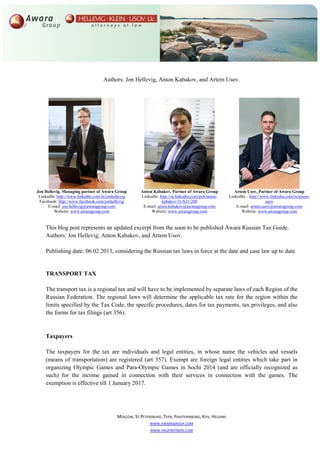
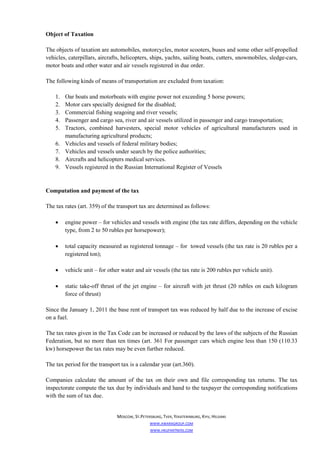
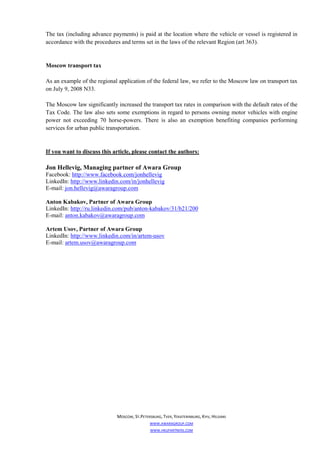
Authors: Jon Hellevig, Anton Kabakov, and Artem Usov.


Jon Hellevig, Managing partner of Awara Group          Anton Kabakov, Partner of Awara Group               Artem Usov, Partner of Awara Group
 LinkedIn: http://www.linkedin.com/in/jonhellevig      LinkedIn: http://ru.linkedin.com/pub/anton-      LinkedIn: : http://www.linkedin.com/in/artem-
 Facebook: http://www.facebook.com/jonhellevig                    kabakov/31/b21/200                                         usov
      E-mail: jon.hellevig@awaragroup.com               E-mail: anton.kabakov@awaragroup.com                E-mail: artem.usov@awaragroup.com
         Website: www.awaragroup.com                        Website: www.awaragroup.com                       Website: www.awaragroup.com


     This blog post represents an updated excerpt from the soon to be published Awara Russian Tax Guide.
     Authors: Jon Hellevig, Anton Kabakov, and Artem Usov.

     Publishing date: 06.02.2013, considering the Russian tax laws in force at the date and case law up to date.


     TRANSPORT TAX

     The transport tax is a regional tax and will have to be implemented by separate laws of each Region of the
     Russian Federation. The regional laws will determine the applicable tax rate for the region within the
     limits specified by the Tax Code, the specific procedures, dates for tax payments, tax privileges, and also
     the forms for tax filings (art 356).


     Taxpayers

     The taxpayers for the tax are individuals and legal entities, in whose name the vehicles and vessels
     (means of transportation) are registered (art 357). Exempt are foreign legal entities which take part in
     organizing Olympic Games and Para-Olympic Games in Sochi 2014 (and are officially recognized as
     such) for the income gained in connection with their services in connection with the games. The
     exemption is effective till 1 January 2017.


                                           MOSCOW, ST.PETERSBURG, TVER, YEKATERINBURG, KYIV, HELSINKI
                                                           WWW.AWARAGROUP.COM
                                                           WWW.HKUPARTNERS.COM
Object of Taxation

The objects of taxation are automobiles, motorcycles, motor scooters, buses and some other self-propelled
vehicles, caterpillars, aircrafts, helicopters, ships, yachts, sailing boats, cutters, snowmobiles, sledge-cars,
motor boats and other water and air vessels registered in due order.

The following kinds of means of transportation are excluded from taxation:

    1.   Oar boats and motorboats with engine power not exceeding 5 horse powers;
    2.   Motor cars specially designed for the disabled;
    3.   Commercial fishing seagoing and river vessels;
    4.   Passenger and cargo sea, river and air vessels utilized in passenger and cargo transportation;
    5.   Tractors, combined harvesters, special motor vehicles of agricultural manufacturers used in
         manufacturing agricultural products;
    6.   Vehicles and vessels of federal military bodies;
    7.   Vehicles and vessels under search by the police authorities;
    8.   Aircrafts and helicopters medical services.
    9.   Vessels registered in the Russian International Register of Vessels


Computation and payment of the tax

The tax rates (art. 359) of the transport tax are determined as follows:

    •    engine power – for vehicles and vessels with engine (the tax rate differs, depending on the vehicle
         type, from 2 to 50 rubles per horsepower);

    •    total capacity measured as registered tonnage – for towed vessels (the tax rate is 20 rubles per a
         registered ton);

    •    vehicle unit – for other water and air vessels (the tax rate is 200 rubles per vehicle unit).

    •    static take-off thrust of the jet engine – for aircraft with jet thrust (20 rubles on each kilogram
         force of thrust)

Since the January 1, 2011 the base rent of transport tax was reduced by half due to the increase of excise
on a fuel.

The tax rates given in the Tax Code can be increased or reduced by the laws of the subjects of the Russian
Federation, but no more than ten times (art. 361 For passenger cars which engine less than 150 (110.33
kw) horsepower the tax rates may be even further reduced.

The tax period for the transport tax is a calendar year (art.360).

Companies calculate the amount of the tax on their own and file corresponding tax returns. The tax
inspectorate compute the tax due by individuals and hand to the taxpayer the corresponding notifications
with the sum of tax due.


                                MOSCOW, ST.PETERSBURG, TVER, YEKATERINBURG, KYIV, HELSINKI
                                                WWW.AWARAGROUP.COM
                                                WWW.HKUPARTNERS.COM
The tax (including advance payments) is paid at the location where the vehicle or vessel is registered in
accordance with the procedures and terms set in the laws of the relevant Region (art 363).


Moscow transport tax

As an example of the regional application of the federal law, we refer to the Moscow law on transport tax
on July 9, 2008 N33.

The Moscow law significantly increased the transport tax rates in comparison with the default rates of the
Tax Code. The law also sets some exemptions in regard to persons owning motor vehicles with engine
power not exceeding 70 horse-powers. There is also an exemption benefiting companies performing
services for urban public transportation.


If you want to discuss this article, please contact the authors:

Jon Hellevig, Managing partner of Awara Group
Facebook: http://www.facebook.com/jonhellevig
LinkedIn: http://www.linkedin.com/in/jonhellevig
E-mail: jon.hellevig@awaragroup.com

Anton Kabakov, Partner of Awara Group
LinkedIn: http://ru.linkedin.com/pub/anton-kabakov/31/b21/200
E-mail: anton.kabakov@awaragroup.com

Artem Usov, Partner of Awara Group
LinkedIn: http://www.linkedin.com/in/artem-usov
E-mail: artem.usov@awaragroup.com


                              MOSCOW, ST.PETERSBURG, TVER, YEKATERINBURG, KYIV, HELSINKI
                                              WWW.AWARAGROUP.COM
                                              WWW.HKUPARTNERS.COM

Transport Tax in Russia

  • 1.
    Authors: Jon Hellevig,Anton Kabakov, and Artem Usov. Jon Hellevig, Managing partner of Awara Group Anton Kabakov, Partner of Awara Group Artem Usov, Partner of Awara Group LinkedIn: http://www.linkedin.com/in/jonhellevig LinkedIn: http://ru.linkedin.com/pub/anton- LinkedIn: : http://www.linkedin.com/in/artem- Facebook: http://www.facebook.com/jonhellevig kabakov/31/b21/200 usov E-mail: jon.hellevig@awaragroup.com E-mail: anton.kabakov@awaragroup.com E-mail: artem.usov@awaragroup.com Website: www.awaragroup.com Website: www.awaragroup.com Website: www.awaragroup.com This blog post represents an updated excerpt from the soon to be published Awara Russian Tax Guide. Authors: Jon Hellevig, Anton Kabakov, and Artem Usov. Publishing date: 06.02.2013, considering the Russian tax laws in force at the date and case law up to date. TRANSPORT TAX The transport tax is a regional tax and will have to be implemented by separate laws of each Region of the Russian Federation. The regional laws will determine the applicable tax rate for the region within the limits specified by the Tax Code, the specific procedures, dates for tax payments, tax privileges, and also the forms for tax filings (art 356). Taxpayers The taxpayers for the tax are individuals and legal entities, in whose name the vehicles and vessels (means of transportation) are registered (art 357). Exempt are foreign legal entities which take part in organizing Olympic Games and Para-Olympic Games in Sochi 2014 (and are officially recognized as such) for the income gained in connection with their services in connection with the games. The exemption is effective till 1 January 2017. MOSCOW, ST.PETERSBURG, TVER, YEKATERINBURG, KYIV, HELSINKI WWW.AWARAGROUP.COM WWW.HKUPARTNERS.COM
  • 2.
    Object of Taxation Theobjects of taxation are automobiles, motorcycles, motor scooters, buses and some other self-propelled vehicles, caterpillars, aircrafts, helicopters, ships, yachts, sailing boats, cutters, snowmobiles, sledge-cars, motor boats and other water and air vessels registered in due order. The following kinds of means of transportation are excluded from taxation: 1. Oar boats and motorboats with engine power not exceeding 5 horse powers; 2. Motor cars specially designed for the disabled; 3. Commercial fishing seagoing and river vessels; 4. Passenger and cargo sea, river and air vessels utilized in passenger and cargo transportation; 5. Tractors, combined harvesters, special motor vehicles of agricultural manufacturers used in manufacturing agricultural products; 6. Vehicles and vessels of federal military bodies; 7. Vehicles and vessels under search by the police authorities; 8. Aircrafts and helicopters medical services. 9. Vessels registered in the Russian International Register of Vessels Computation and payment of the tax The tax rates (art. 359) of the transport tax are determined as follows: • engine power – for vehicles and vessels with engine (the tax rate differs, depending on the vehicle type, from 2 to 50 rubles per horsepower); • total capacity measured as registered tonnage – for towed vessels (the tax rate is 20 rubles per a registered ton); • vehicle unit – for other water and air vessels (the tax rate is 200 rubles per vehicle unit). • static take-off thrust of the jet engine – for aircraft with jet thrust (20 rubles on each kilogram force of thrust) Since the January 1, 2011 the base rent of transport tax was reduced by half due to the increase of excise on a fuel. The tax rates given in the Tax Code can be increased or reduced by the laws of the subjects of the Russian Federation, but no more than ten times (art. 361 For passenger cars which engine less than 150 (110.33 kw) horsepower the tax rates may be even further reduced. The tax period for the transport tax is a calendar year (art.360). Companies calculate the amount of the tax on their own and file corresponding tax returns. The tax inspectorate compute the tax due by individuals and hand to the taxpayer the corresponding notifications with the sum of tax due. MOSCOW, ST.PETERSBURG, TVER, YEKATERINBURG, KYIV, HELSINKI WWW.AWARAGROUP.COM WWW.HKUPARTNERS.COM
  • 3.
    The tax (includingadvance payments) is paid at the location where the vehicle or vessel is registered in accordance with the procedures and terms set in the laws of the relevant Region (art 363). Moscow transport tax As an example of the regional application of the federal law, we refer to the Moscow law on transport tax on July 9, 2008 N33. The Moscow law significantly increased the transport tax rates in comparison with the default rates of the Tax Code. The law also sets some exemptions in regard to persons owning motor vehicles with engine power not exceeding 70 horse-powers. There is also an exemption benefiting companies performing services for urban public transportation. If you want to discuss this article, please contact the authors: Jon Hellevig, Managing partner of Awara Group Facebook: http://www.facebook.com/jonhellevig LinkedIn: http://www.linkedin.com/in/jonhellevig E-mail: jon.hellevig@awaragroup.com Anton Kabakov, Partner of Awara Group LinkedIn: http://ru.linkedin.com/pub/anton-kabakov/31/b21/200 E-mail: anton.kabakov@awaragroup.com Artem Usov, Partner of Awara Group LinkedIn: http://www.linkedin.com/in/artem-usov E-mail: artem.usov@awaragroup.com MOSCOW, ST.PETERSBURG, TVER, YEKATERINBURG, KYIV, HELSINKI WWW.AWARAGROUP.COM WWW.HKUPARTNERS.COM