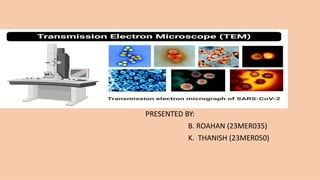
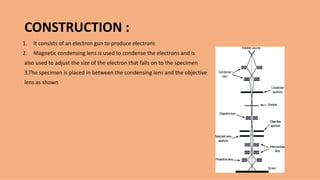
The document discusses the principle, construction, working, uses, and limitations of a transmission electron microscope (TEM). A TEM works by transmitting a beam of electrons through a specimen, producing a magnified image on a screen. It consists of an electron gun, magnetic condensing lenses to focus the electrons, and an objective lens where the specimen is placed. TEMs are used in fields like biology, material science, and nanotechnology to study cell structures, crystal properties, and nanostructures. However, TEMs also have limitations such as requiring thin sample layers and long analysis times.