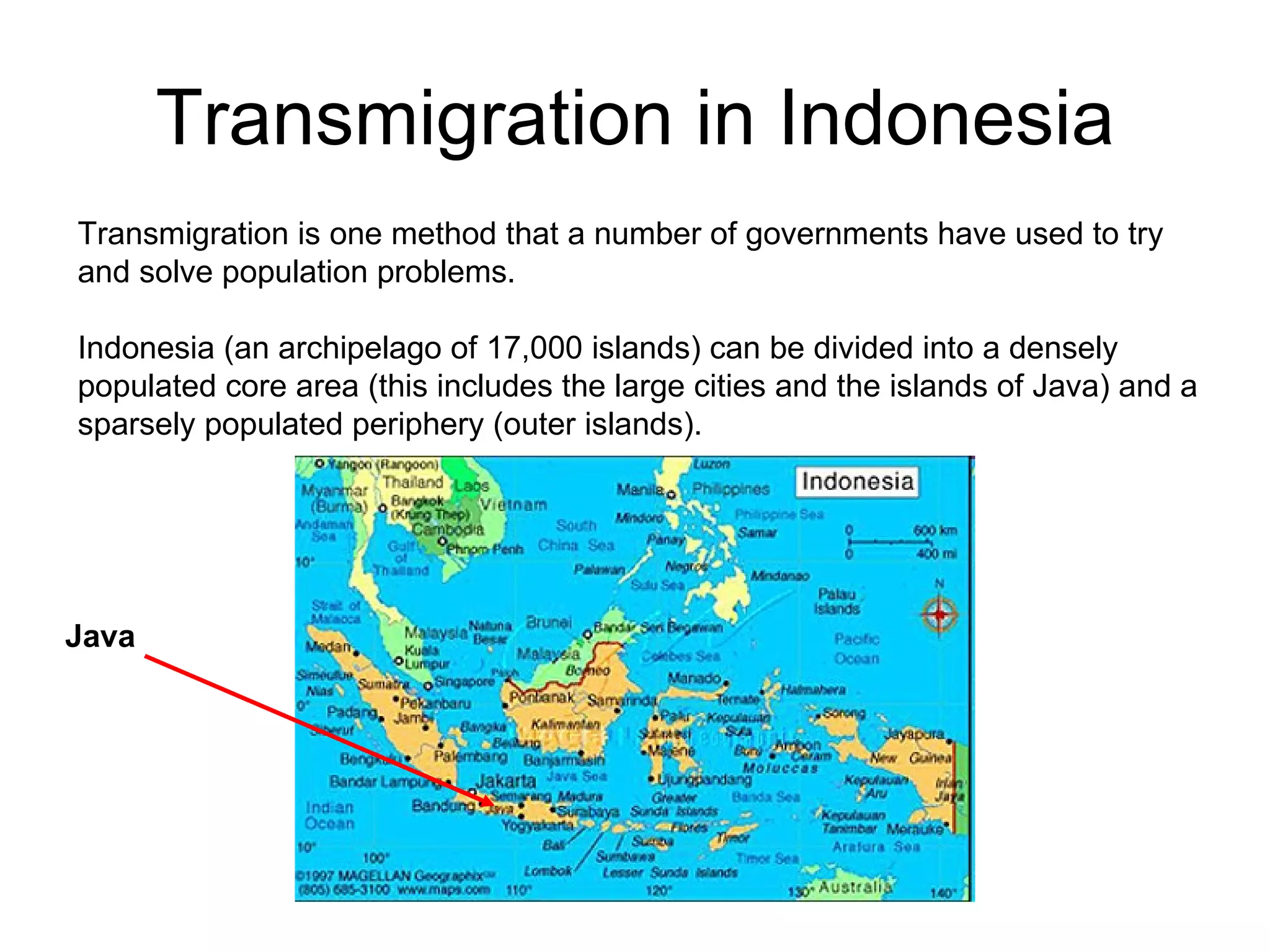
Transmigration in Indonesia Transmigration is one method that a number of governments have used to try and solve population problems.  Indonesia (an archipelago of 17,000 islands) can be divided into a densely populated core area (this includes the large cities and the islands of Java) and a sparsely populated periphery (outer islands). Java
Background 60% of Indonesia’s population live on Java itself- making the population density very high- especially in Jakarta.  The government needed to stop Jakarta’s urban growth.  People migrate to Jakarta in large numbers to find work.
The Transmigration Programme The Government introduced a transmigration policy.  This aims to move people from the core area (Java/Jakarta) to the periphery- to new farming areas set up by the government.  The migrants are given free transport, free land and housing and other assistance such as food and fertiliser for the first 12 months.  Even though many have migrated the scheme has not been entirely successful.
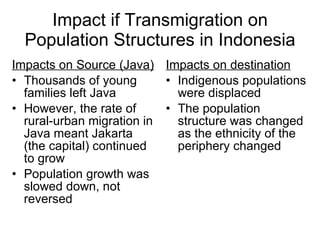
Impact if Transmigration on Population Structures in Indonesia Impacts on Source (Java) Thousands of young families left Java However, the rate of rural-urban migration in Java meant Jakarta (the capital) continued to grow Population growth was slowed down, not reversed Impacts on destination Indigenous populations were displaced The population structure was changed as the ethnicity of the periphery changed

Transmigration in Indonesia - Impact on Population Structures

  • 1.
    Transmigration in IndonesiaTransmigration is one method that a number of governments have used to try and solve population problems. Indonesia (an archipelago of 17,000 islands) can be divided into a densely populated core area (this includes the large cities and the islands of Java) and a sparsely populated periphery (outer islands). Java
  • 2.
    Background 60% ofIndonesia’s population live on Java itself- making the population density very high- especially in Jakarta. The government needed to stop Jakarta’s urban growth. People migrate to Jakarta in large numbers to find work.
  • 3.
    The Transmigration ProgrammeThe Government introduced a transmigration policy. This aims to move people from the core area (Java/Jakarta) to the periphery- to new farming areas set up by the government. The migrants are given free transport, free land and housing and other assistance such as food and fertiliser for the first 12 months. Even though many have migrated the scheme has not been entirely successful.
  • 4.
    Impact if Transmigrationon Population Structures in Indonesia Impacts on Source (Java) Thousands of young families left Java However, the rate of rural-urban migration in Java meant Jakarta (the capital) continued to grow Population growth was slowed down, not reversed Impacts on destination Indigenous populations were displaced The population structure was changed as the ethnicity of the periphery changed