International Research Journal of Engineering and Technology (IRJET) e-ISSN: 2395-0056
Volume: 10 Issue: 04 | Apr 2023 www.irjet.net p-ISSN: 2395-0072
© 2023, IRJET | Impact Factor value: 8.226 | ISO 9001:2008 Certified Journal | Page 305
Transient state thermal analysis of a 4 stroke CI engine Piston
Harsh Vardhan1, Gaurav Kumar Netam2, Jayant3, Pushpendra Singh4
1Student, B. Tech (Mechanical Engineering), Delhi Technological University, New Delhi, India
2 Student, B. Tech (Mechanical Engineering), Delhi Technological University, New Delhi, India
3 Student, B. Tech (Mechanical Engineering), Delhi Technological University, Rohtak, Haryana, India
4Associate Professor, Dept. of Mechanical Engineering, Delhi Technological University, New Delhi, India
---------------------------------------------------------------------***---------------------------------------------------------------------
Abstract - This study employs ANSYS software to conduct
a comparative investigation of the thermal behavior of an
internal combustion (IC) engine piston made of four
different materials, Aluminium Alloy, AlSi10Mg, Titanium
Alloy (Ti-6Al-4V) and Gray Cast Iron. The goal is to examine
the thermal behavior of the piston built of each material
under various operating circumstances. The temperature
distribution and heat flux within the piston for each
material are the main topics of the simulations, which also
consider a variety of boundary conditions. Results are given,
compared, and their implications for choosing materials for
IC engine piston applications are examined. This study
illustrates the capability of ANSYS in simulating and
comparing the thermal behavior of intricate mechanical
systems and offers insightful information about the
comparative thermal behavior of an IC engine piston
constructed of four different materials.
Key Words: IC Engine, Heat flux, Temperature
Distribution
1.INTRODUCTION
The design and material choices used for internal
combustion (IC) engine parts like pistons have a
significant impact on the engine's overall effectiveness and
performance. Thermal behavior of IC engine pistons is one
of the crucial elements that might have a considerable
impact on their performance. The engine's overall
performance and dependability may be impacted by the
high temperatures and pressures the piston is subjected to
during operation. These conditions can also lead to
material degradation and thermal strains. The thermal
behavior of an IC engine piston made of four different
materials—Aluminum alloy, AlSi10Mg, Titanium Alloy (Ti-
6Al-4V) and Gray Cast Iron—is compared in this research
using the ANSYS program. The goal is to examine the
thermal response of the piston made of each material and
offer details on how an IC engine piston made of various
materials compares thermally. The study focuses on the
temperature and thermal stresses within the piston for
each material, while the simulations consider various
thermal loads and boundary conditions.
The findings of this study offer useful knowledge for
engineers engaged in IC engine design and optimization.
This study can assist engineers in making the best material
choice for the piston to achieve the desired performance
and dependability of the engine by evaluating the thermal
behavior of the piston constructed of various materials.
The thermal behavior of the pistons in IC engines may be
studied using the ANSYS simulations in an economical and
effective manner, which is crucial as engine efficiency and
environmental restrictions become more stringent.
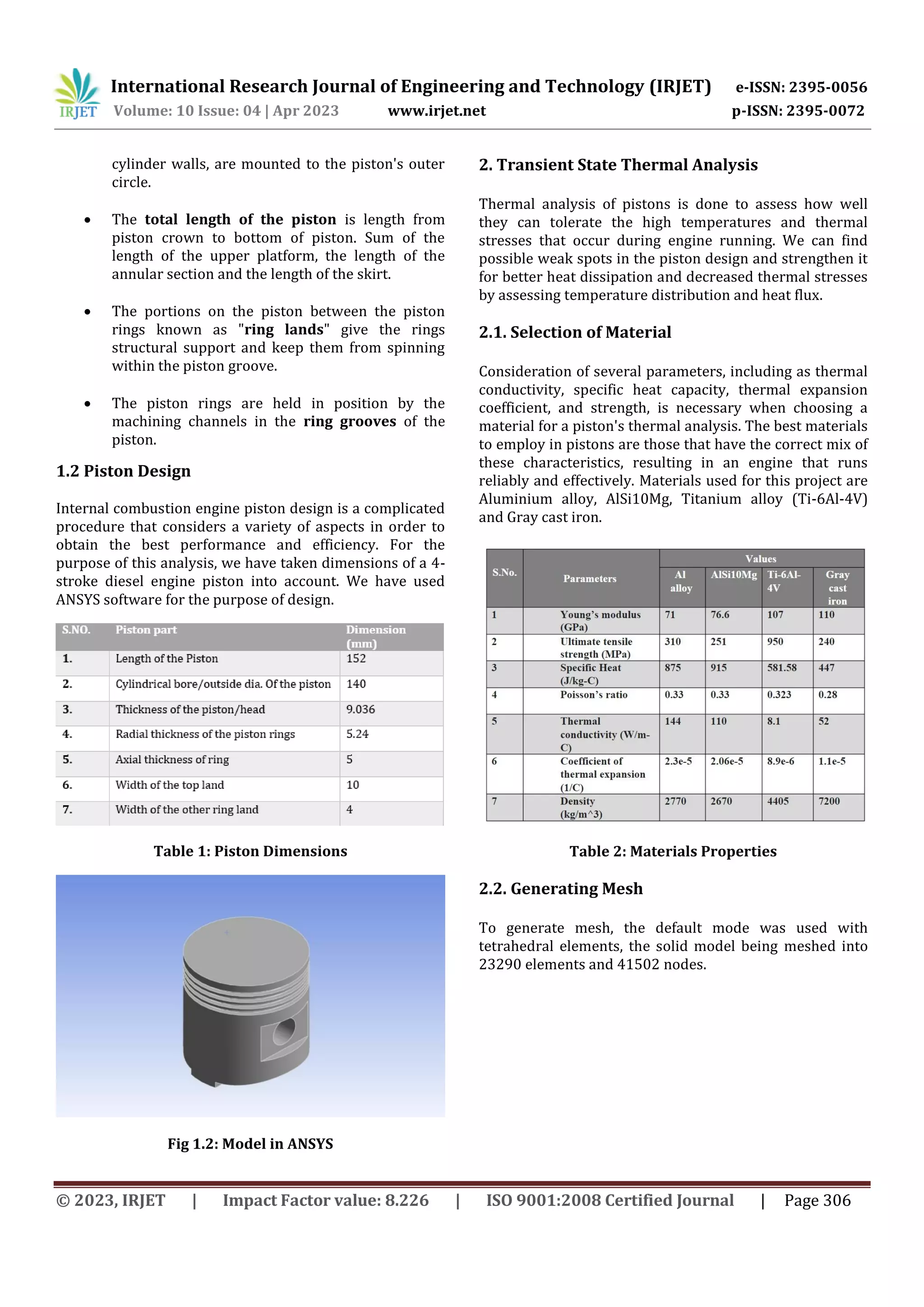
1.1 Piston Terminology
Fig 1.1: Piston Terminology
 The crown, which is the top of the piston, is made
to resist the high pressure and high temperature
of the combustion chamber.
 The lower part of the piston, called the skirt, acts
as a guide to make sure the piston goes straight
and stays in the right alignment with the cylinder
bore.
 The wrist pin, which is another name for the
piston pin, joins the piston to the connecting rod
and enables reciprocating movement of the
piston.
 Piston rings, which are used to seal the
combustion chamber and transport heat to the
International Research Journal of Engineering and Technology (IRJET) e-ISSN: 2395-0056
Volume: 10 Issue: 04 | Apr 2023 www.irjet.net p-ISSN: 2395-0072
© 2023, IRJET | Impact Factor value: 8.226 | ISO 9001:2008 Certified Journal | Page 306
cylinder walls, are mounted to the piston's outer
circle.
 The total length of the piston is length from
piston crown to bottom of piston. Sum of the
length of the upper platform, the length of the
annular section and the length of the skirt.
 The portions on the piston between the piston
rings known as "ring lands" give the rings
structural support and keep them from spinning
within the piston groove.
 The piston rings are held in position by the
machining channels in the ring grooves of the
piston.
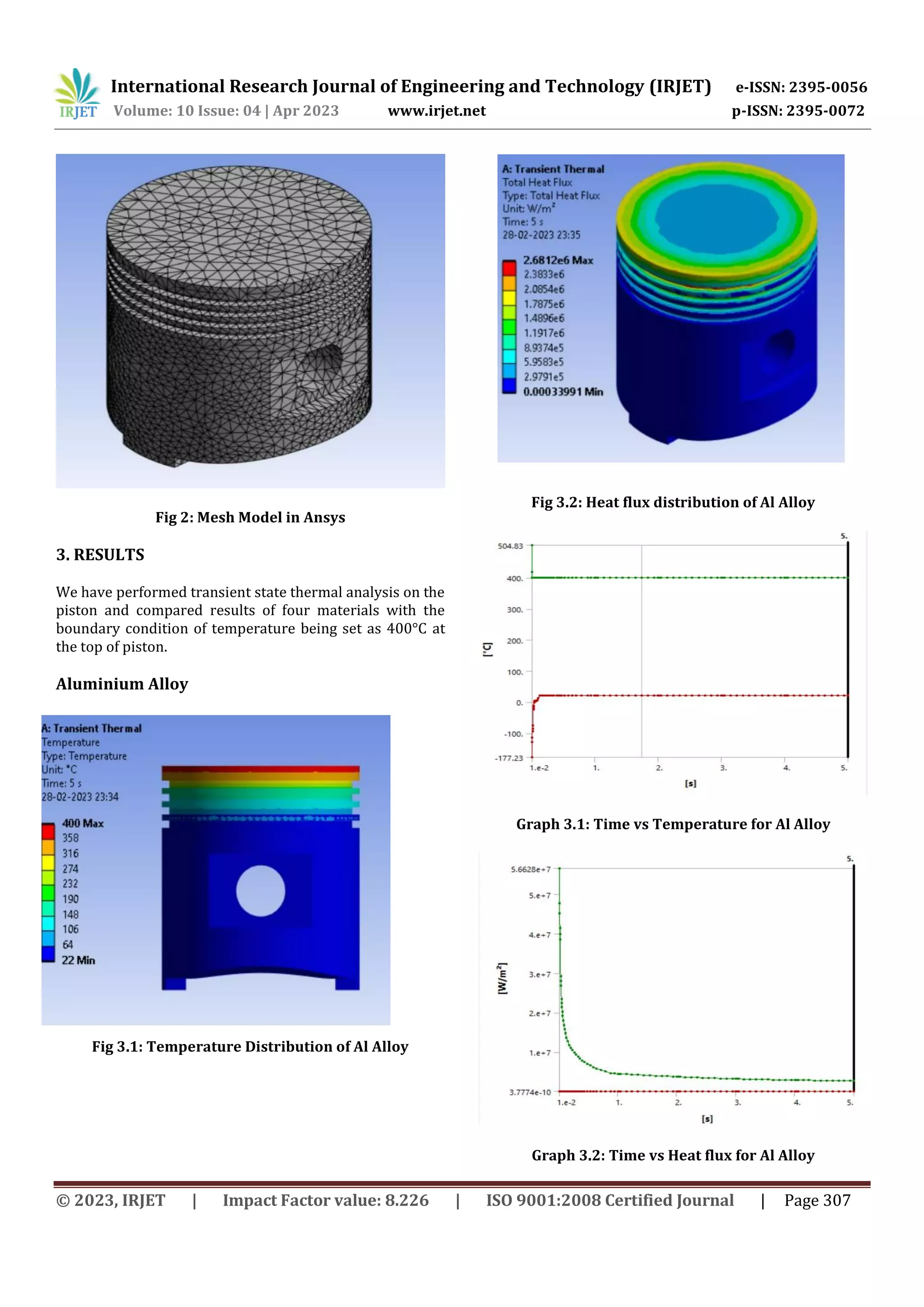
1.2 Piston Design
Internal combustion engine piston design is a complicated
procedure that considers a variety of aspects in order to
obtain the best performance and efficiency. For the
purpose of this analysis, we have taken dimensions of a 4-
stroke diesel engine piston into account. We have used
ANSYS software for the purpose of design.
Table 1: Piston Dimensions
Fig 1.2: Model in ANSYS
2. Transient State Thermal Analysis
Thermal analysis of pistons is done to assess how well
they can tolerate the high temperatures and thermal
stresses that occur during engine running. We can find
possible weak spots in the piston design and strengthen it
for better heat dissipation and decreased thermal stresses
by assessing temperature distribution and heat flux.
2.1. Selection of Material
Consideration of several parameters, including as thermal
conductivity, specific heat capacity, thermal expansion
coefficient, and strength, is necessary when choosing a
material for a piston's thermal analysis. The best materials
to employ in pistons are those that have the correct mix of
these characteristics, resulting in an engine that runs
reliably and effectively. Materials used for this project are
Aluminium alloy, AlSi10Mg, Titanium alloy (Ti-6Al-4V)
and Gray cast iron.
Table 2: Materials Properties
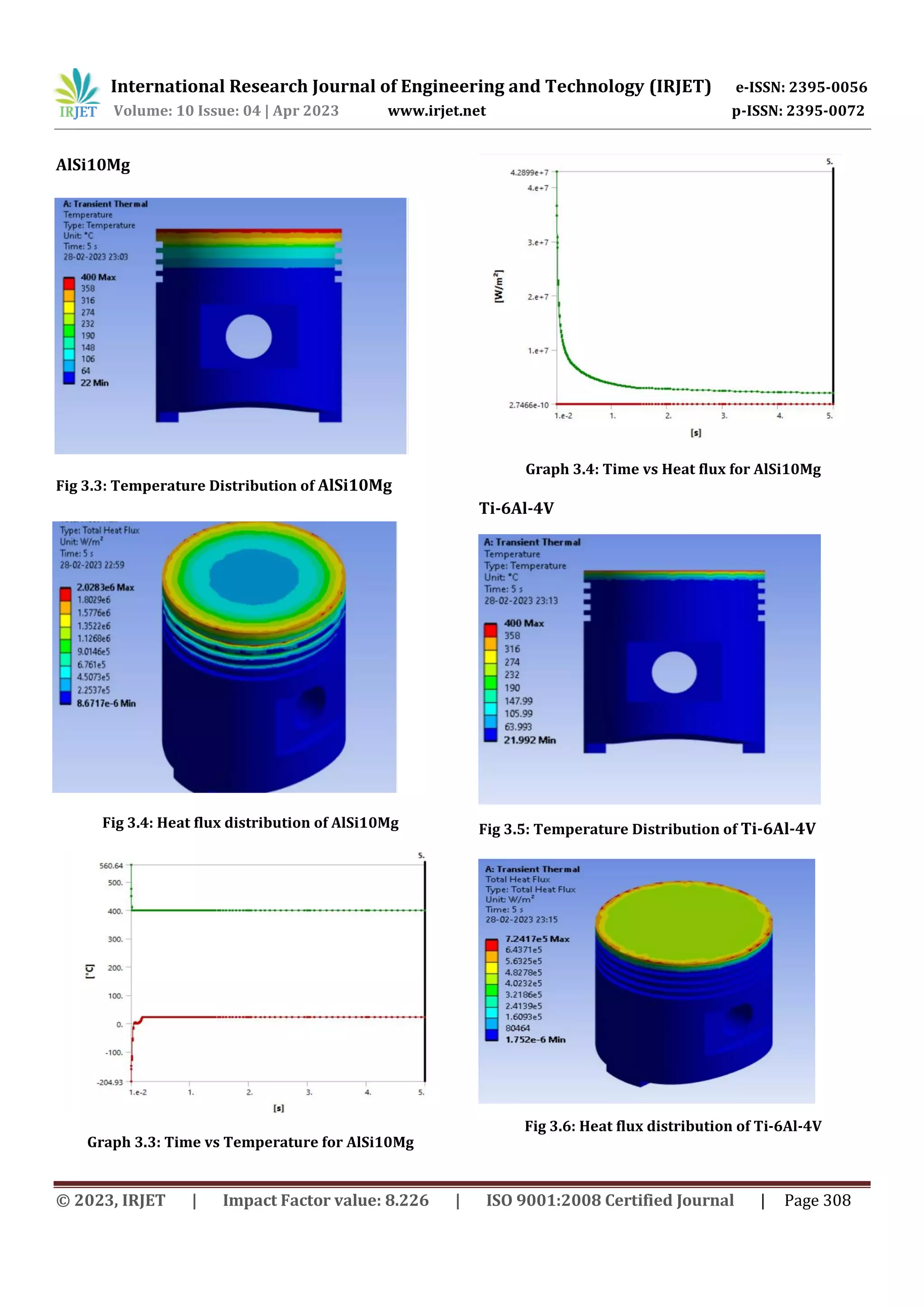
2.2. Generating Mesh
To generate mesh, the default mode was used with
tetrahedral elements, the solid model being meshed into
23290 elements and 41502 nodes.
International Research Journal of Engineering and Technology (IRJET) e-ISSN: 2395-0056
Volume: 10 Issue: 04 | Apr 2023 www.irjet.net p-ISSN: 2395-0072
© 2023, IRJET | Impact Factor value: 8.226 | ISO 9001:2008 Certified Journal | Page 307
Fig 2: Mesh Model in Ansys
3. RESULTS
We have performed transient state thermal analysis on the
piston and compared results of four materials with the
boundary condition of temperature being set as 400°C at
the top of piston.
Aluminium Alloy
Fig 3.1: Temperature Distribution of Al Alloy
Fig 3.2: Heat flux distribution of Al Alloy
Graph 3.1: Time vs Temperature for Al Alloy
Graph 3.2: Time vs Heat flux for Al Alloy
International Research Journal of Engineering and Technology (IRJET) e-ISSN: 2395-0056
Volume: 10 Issue: 04 | Apr 2023 www.irjet.net p-ISSN: 2395-0072
© 2023, IRJET | Impact Factor value: 8.226 | ISO 9001:2008 Certified Journal | Page 308
AlSi10Mg
Fig 3.3: Temperature Distribution of AlSi10Mg
Fig 3.4: Heat flux distribution of AlSi10Mg
Graph 3.3: Time vs Temperature for AlSi10Mg
Graph 3.4: Time vs Heat flux for AlSi10Mg
Ti-6Al-4V
Fig 3.5: Temperature Distribution of Ti-6Al-4V
Fig 3.6: Heat flux distribution of Ti-6Al-4V
International Research Journal of Engineering and Technology (IRJET) e-ISSN: 2395-0056
Volume: 10 Issue: 04 | Apr 2023 www.irjet.net p-ISSN: 2395-0072
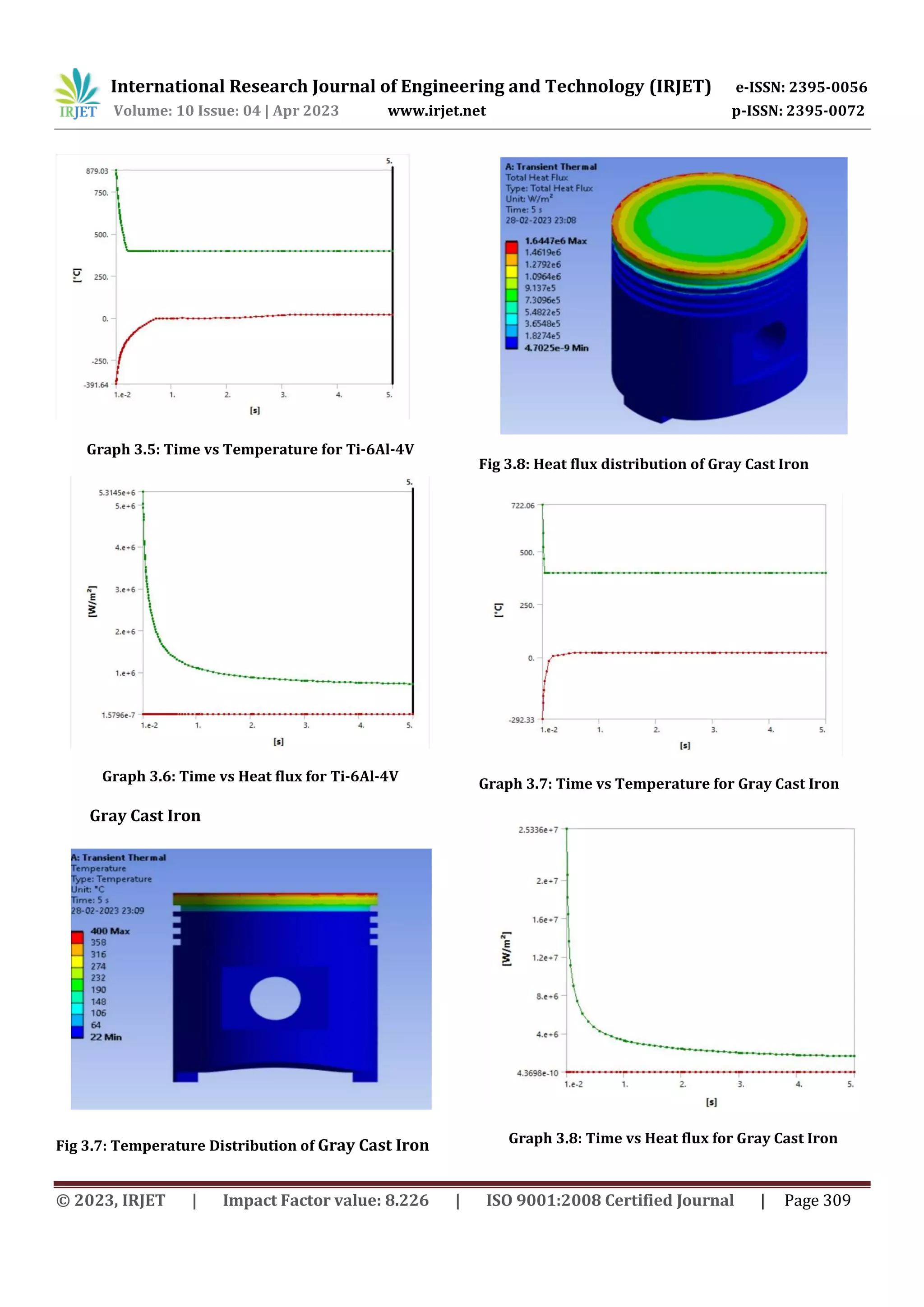
© 2023, IRJET | Impact Factor value: 8.226 | ISO 9001:2008 Certified Journal | Page 309
Graph 3.5: Time vs Temperature for Ti-6Al-4V
Graph 3.6: Time vs Heat flux for Ti-6Al-4V
Gray Cast Iron
Fig 3.7: Temperature Distribution of Gray Cast Iron
Fig 3.8: Heat flux distribution of Gray Cast Iron
Graph 3.7: Time vs Temperature for Gray Cast Iron
Graph 3.8: Time vs Heat flux for Gray Cast Iron
International Research Journal of Engineering and Technology (IRJET) e-ISSN: 2395-0056
Volume: 10 Issue: 04 | Apr 2023 www.irjet.net p-ISSN: 2395-0072
© 2023, IRJET | Impact Factor value: 8.226 | ISO 9001:2008 Certified Journal | Page 310
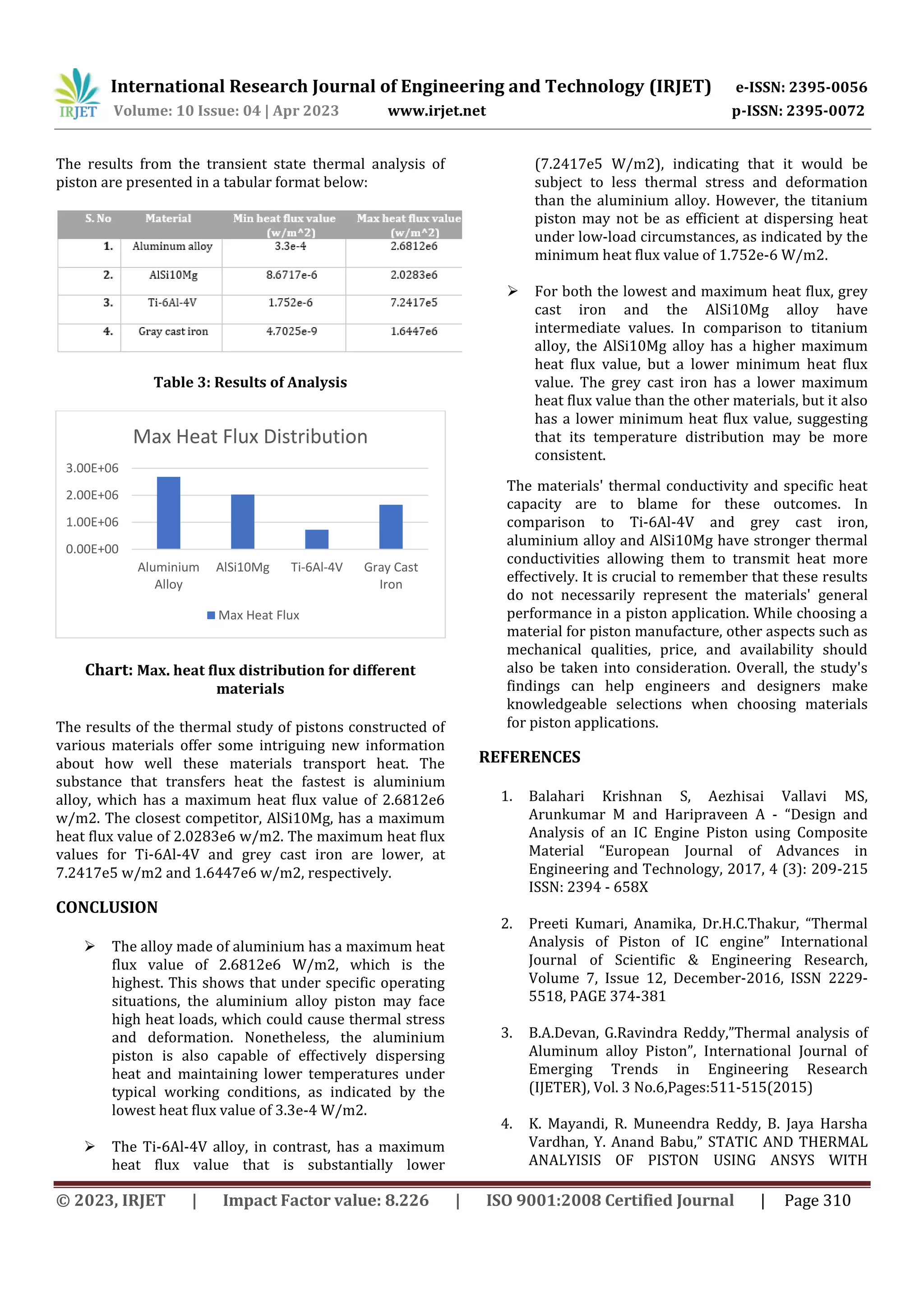
The results from the transient state thermal analysis of
piston are presented in a tabular format below:
Table 3: Results of Analysis
Chart: Max. heat flux distribution for different
materials
The results of the thermal study of pistons constructed of
various materials offer some intriguing new information
about how well these materials transport heat. The
substance that transfers heat the fastest is aluminium
alloy, which has a maximum heat flux value of 2.6812e6
w/m2. The closest competitor, AlSi10Mg, has a maximum
heat flux value of 2.0283e6 w/m2. The maximum heat flux
values for Ti-6Al-4V and grey cast iron are lower, at
7.2417e5 w/m2 and 1.6447e6 w/m2, respectively.
CONCLUSION
 The alloy made of aluminium has a maximum heat
flux value of 2.6812e6 W/m2, which is the
highest. This shows that under specific operating
situations, the aluminium alloy piston may face
high heat loads, which could cause thermal stress
and deformation. Nonetheless, the aluminium
piston is also capable of effectively dispersing
heat and maintaining lower temperatures under
typical working conditions, as indicated by the
lowest heat flux value of 3.3e-4 W/m2.
 The Ti-6Al-4V alloy, in contrast, has a maximum
heat flux value that is substantially lower
(7.2417e5 W/m2), indicating that it would be
subject to less thermal stress and deformation
than the aluminium alloy. However, the titanium
piston may not be as efficient at dispersing heat
under low-load circumstances, as indicated by the
minimum heat flux value of 1.752e-6 W/m2.
 For both the lowest and maximum heat flux, grey
cast iron and the AlSi10Mg alloy have
intermediate values. In comparison to titanium
alloy, the AlSi10Mg alloy has a higher maximum
heat flux value, but a lower minimum heat flux
value. The grey cast iron has a lower maximum
heat flux value than the other materials, but it also
has a lower minimum heat flux value, suggesting
that its temperature distribution may be more
consistent.
The materials' thermal conductivity and specific heat
capacity are to blame for these outcomes. In
comparison to Ti-6Al-4V and grey cast iron,
aluminium alloy and AlSi10Mg have stronger thermal
conductivities allowing them to transmit heat more
effectively. It is crucial to remember that these results
do not necessarily represent the materials' general
performance in a piston application. While choosing a
material for piston manufacture, other aspects such as
mechanical qualities, price, and availability should
also be taken into consideration. Overall, the study's
findings can help engineers and designers make
knowledgeable selections when choosing materials
for piston applications.
REFERENCES
1. Balahari Krishnan S, Aezhisai Vallavi MS,
Arunkumar M and Haripraveen A - “Design and
Analysis of an IC Engine Piston using Composite
Material “European Journal of Advances in
Engineering and Technology, 2017, 4 (3): 209-215
ISSN: 2394 - 658X
2. Preeti Kumari, Anamika, Dr.H.C.Thakur, “Thermal
Analysis of Piston of IC engine” International
Journal of Scientific & Engineering Research,
Volume 7, Issue 12, December-2016, ISSN 2229-
5518, PAGE 374-381
3. B.A.Devan, G.Ravindra Reddy,”Thermal analysis of
Aluminum alloy Piston”, International Journal of
Emerging Trends in Engineering Research
(IJETER), Vol. 3 No.6,Pages:511-515(2015)
4. K. Mayandi, R. Muneendra Reddy, B. Jaya Harsha
Vardhan, Y. Anand Babu,” STATIC AND THERMAL
ANALYISIS OF PISTON USING ANSYS WITH
0.00E+00
1.00E+06
2.00E+06
3.00E+06
Aluminium
Alloy
AlSi10Mg Ti-6Al-4V Gray Cast
Iron
Max Heat Flux Distribution
Max Heat Flux
International Research Journal of Engineering and Technology (IRJET) e-ISSN: 2395-0056
Volume: 10 Issue: 04 | Apr 2023 www.irjet.net p-ISSN: 2395-0072
© 2023, IRJET | Impact Factor value: 8.226 | ISO 9001:2008 Certified Journal | Page 311
VARIOUS MATERIALS” International Research
Journal of Modernization in Engineering
Technology and Science,
Volume:03/Issue:05/May-2021, Impact Factor-
5.354, PAGE 3035-3044
5. Prashant Kumar, PG Scholar, Abhishek Bhandari,
Sunil Kumar Chaturvedi,” Design and thermal
analysis of ic engine piston design using catia and
Ansys software” SSRG International Journal of
Mechanical Engineering Volume 6 Issue 10, 12-19,
October 2019 ISSN: 2348 – 8360
6. Atthuru Kalyan , Dr. D. R. Srinivasan,” Static and
Thermal Analysis of a Piston with Different
Thermal Barrier Coatings”, International Journal of
Scientific Engineering and Research (IJSER) ISSN
(Online): 2347-3878 Impact Factor (2020): 6.733
7. Thirakavinod Kumar, B. Ravisekhar,“Thermal &
Static Analysis On IC Engine Piston Using Fea”,
IJATES,Issn2348-7550,Volume 4, Issue No.
12,December-2016, Page. No. 225-231
8. Yash Dhamecha, Vaibhav Saptarshi, Shubham
Parikh, Tejasve Parnami,” Design and Analysis of
Piston using Different Materials”, International
Research Journal of Engineering and Technology
(IRJET) e-ISSN: 2395-0056 Volume: 07 Issue: 12 |
Dec 2020 p-ISSN: 2395-0072
9. Ajay Raj Singh*, Dr. Pushpendra Kumar Sharma,
Design, Analysis and Optimization of Three
Aluminium Piston Alloys Using FEA “Journal of
Engineering Research and Applications
www.ijera.com ISSN : 2248-9622, Vol. 4, Issue 1(
Version 3, January 2014, pp.94-102
10. A.R. Bhagat , Y.M.Jibhakate “Thermal Analysis And
Optimization of I.C. Engine Piston Using finite
Element Method “International Journal of Modern
Engineering Research (IJMER) vol.2, Issue.4, July-
Aug 2012 pp-2919-2919 ISSN: 2249-6645
11. Mr.Jadhav Vishal, Dr. R.K. Jain, Mr. Yoge A.ndra
S.Chauhan,” DESIGN AND ANALYSIS OF
ALUMINUM ALLOY PISTON USING CAE TOOLS”,
“INTERNATIONAL JOURNAL OF ENGINEERING
SCIENCES & RESEARCH TECHNOLOGY, ISSN:
2277-9655 Impact Factor: 4.116 [Vishal*et al.,
5(7): July, 2016] ISSN: 2277-9655 IC™ Value: 3.00
12. PAGADALA SIDDIRAJU, KOPPULA
VENKATESWARAREDDY “DESIGN AND ANALYSIS
OF THE PISTON BY USING FIVE DIFFERENT
MATERIALS”, INTERNATIONAL JOURNAL OF
ADVANCE SCIENTIFIC RESEARCH AND
ENGINEERING TRENDS || Volume 6 || Issue 2 ||
February 2021 || ISSN (Online) 2456-0774
13. Subodh Kumar , SRCEM, Banmore M.P. India; C. S.
Koli, SRCEM, Banmore M.P. India “A Review Paper
on Thermal Analysis of Piston by Finite Element
Analysis” IJSRD - International Journal for
Scientific Research & Development| Vol. 5, Issue
12, 2018 | ISSN (online): 2321-0613
14. Pathipati Vasu, Dr.M.Sri Rama Murthy,
P.S.Amarnadh, “Design and Analysis of IC Engine
Piston with Different Materials”, International
Journal of Research e-ISSN: 2348-6848 p-ISSN:
2348-795X Volume 05 Issue 07 March 2018
15. V G Cioată, I Kiss, V Alexa and S A Rațiu,
“Mechanical and thermal analysis of the internal
combustion engine piston using Ansys”
International Conference on Applied Sciences
(ICAS2016), V G Cioată et al 2017 IOP Conf. Ser.:
Mater. Sci. Eng. 163 012043
16. Valentin Mereuta,” Static and Thermal Analysis of
Piston using FEM Analysis” International Journal
for Research in Applied Science & Engineering
Technology (IJRASET) ISSN: 2321-9653; IC Value:
45.98; SJ Impact Factor :6.887 Volume 6 Issue I,
January 2018
17. J. Srikanth, Mr. A. Jithendra Kumar, “Modeling and
Static Thermal Analysis of IC Engine Piston by
using Different Materials”, International Journal of
Applied Sciences, Engineering and Management
ISSN 2320 – 3439, Vol. 06, No. 02, April 2017, pp.
265 – 272
18. Kunal Saurabh1*, Saurabh Kumar Rai1, Shravan
Yadav1, Sanjay Kumar Yadav1 , AkhandPratap
Singh1, “A Review Paper on Design Analysis of
Internal Combustion Component, International
journal of adavance research in science and
engineering vol no.6 Special issue no.2, december
2017,ISSIN 2319-8354
19. Satish Sharma, P.S. Dhakar,” A Review Study of
Steady State Thermal Analysis of Piston by Finite
Element Method (FEM)” International Journal of
I.C. Engines and Gas Turbines Vol. 3: Issue 1

Transient state thermal analysis of a 4 stroke CI engine Piston

  • 1.
    International Research Journalof Engineering and Technology (IRJET) e-ISSN: 2395-0056 Volume: 10 Issue: 04 | Apr 2023 www.irjet.net p-ISSN: 2395-0072 © 2023, IRJET | Impact Factor value: 8.226 | ISO 9001:2008 Certified Journal | Page 305 Transient state thermal analysis of a 4 stroke CI engine Piston Harsh Vardhan1, Gaurav Kumar Netam2, Jayant3, Pushpendra Singh4 1Student, B. Tech (Mechanical Engineering), Delhi Technological University, New Delhi, India 2 Student, B. Tech (Mechanical Engineering), Delhi Technological University, New Delhi, India 3 Student, B. Tech (Mechanical Engineering), Delhi Technological University, Rohtak, Haryana, India 4Associate Professor, Dept. of Mechanical Engineering, Delhi Technological University, New Delhi, India ---------------------------------------------------------------------***--------------------------------------------------------------------- Abstract - This study employs ANSYS software to conduct a comparative investigation of the thermal behavior of an internal combustion (IC) engine piston made of four different materials, Aluminium Alloy, AlSi10Mg, Titanium Alloy (Ti-6Al-4V) and Gray Cast Iron. The goal is to examine the thermal behavior of the piston built of each material under various operating circumstances. The temperature distribution and heat flux within the piston for each material are the main topics of the simulations, which also consider a variety of boundary conditions. Results are given, compared, and their implications for choosing materials for IC engine piston applications are examined. This study illustrates the capability of ANSYS in simulating and comparing the thermal behavior of intricate mechanical systems and offers insightful information about the comparative thermal behavior of an IC engine piston constructed of four different materials. Key Words: IC Engine, Heat flux, Temperature Distribution 1.INTRODUCTION The design and material choices used for internal combustion (IC) engine parts like pistons have a significant impact on the engine's overall effectiveness and performance. Thermal behavior of IC engine pistons is one of the crucial elements that might have a considerable impact on their performance. The engine's overall performance and dependability may be impacted by the high temperatures and pressures the piston is subjected to during operation. These conditions can also lead to material degradation and thermal strains. The thermal behavior of an IC engine piston made of four different materials—Aluminum alloy, AlSi10Mg, Titanium Alloy (Ti- 6Al-4V) and Gray Cast Iron—is compared in this research using the ANSYS program. The goal is to examine the thermal response of the piston made of each material and offer details on how an IC engine piston made of various materials compares thermally. The study focuses on the temperature and thermal stresses within the piston for each material, while the simulations consider various thermal loads and boundary conditions. The findings of this study offer useful knowledge for engineers engaged in IC engine design and optimization. This study can assist engineers in making the best material choice for the piston to achieve the desired performance and dependability of the engine by evaluating the thermal behavior of the piston constructed of various materials. The thermal behavior of the pistons in IC engines may be studied using the ANSYS simulations in an economical and effective manner, which is crucial as engine efficiency and environmental restrictions become more stringent. 1.1 Piston Terminology Fig 1.1: Piston Terminology  The crown, which is the top of the piston, is made to resist the high pressure and high temperature of the combustion chamber.  The lower part of the piston, called the skirt, acts as a guide to make sure the piston goes straight and stays in the right alignment with the cylinder bore.  The wrist pin, which is another name for the piston pin, joins the piston to the connecting rod and enables reciprocating movement of the piston.  Piston rings, which are used to seal the combustion chamber and transport heat to the
  • 2.
    International Research Journalof Engineering and Technology (IRJET) e-ISSN: 2395-0056 Volume: 10 Issue: 04 | Apr 2023 www.irjet.net p-ISSN: 2395-0072 © 2023, IRJET | Impact Factor value: 8.226 | ISO 9001:2008 Certified Journal | Page 306 cylinder walls, are mounted to the piston's outer circle.  The total length of the piston is length from piston crown to bottom of piston. Sum of the length of the upper platform, the length of the annular section and the length of the skirt.  The portions on the piston between the piston rings known as "ring lands" give the rings structural support and keep them from spinning within the piston groove.  The piston rings are held in position by the machining channels in the ring grooves of the piston. 1.2 Piston Design Internal combustion engine piston design is a complicated procedure that considers a variety of aspects in order to obtain the best performance and efficiency. For the purpose of this analysis, we have taken dimensions of a 4- stroke diesel engine piston into account. We have used ANSYS software for the purpose of design. Table 1: Piston Dimensions Fig 1.2: Model in ANSYS 2. Transient State Thermal Analysis Thermal analysis of pistons is done to assess how well they can tolerate the high temperatures and thermal stresses that occur during engine running. We can find possible weak spots in the piston design and strengthen it for better heat dissipation and decreased thermal stresses by assessing temperature distribution and heat flux. 2.1. Selection of Material Consideration of several parameters, including as thermal conductivity, specific heat capacity, thermal expansion coefficient, and strength, is necessary when choosing a material for a piston's thermal analysis. The best materials to employ in pistons are those that have the correct mix of these characteristics, resulting in an engine that runs reliably and effectively. Materials used for this project are Aluminium alloy, AlSi10Mg, Titanium alloy (Ti-6Al-4V) and Gray cast iron. Table 2: Materials Properties 2.2. Generating Mesh To generate mesh, the default mode was used with tetrahedral elements, the solid model being meshed into 23290 elements and 41502 nodes.
  • 3.
    International Research Journalof Engineering and Technology (IRJET) e-ISSN: 2395-0056 Volume: 10 Issue: 04 | Apr 2023 www.irjet.net p-ISSN: 2395-0072 © 2023, IRJET | Impact Factor value: 8.226 | ISO 9001:2008 Certified Journal | Page 307 Fig 2: Mesh Model in Ansys 3. RESULTS We have performed transient state thermal analysis on the piston and compared results of four materials with the boundary condition of temperature being set as 400°C at the top of piston. Aluminium Alloy Fig 3.1: Temperature Distribution of Al Alloy Fig 3.2: Heat flux distribution of Al Alloy Graph 3.1: Time vs Temperature for Al Alloy Graph 3.2: Time vs Heat flux for Al Alloy
  • 4.
    International Research Journalof Engineering and Technology (IRJET) e-ISSN: 2395-0056 Volume: 10 Issue: 04 | Apr 2023 www.irjet.net p-ISSN: 2395-0072 © 2023, IRJET | Impact Factor value: 8.226 | ISO 9001:2008 Certified Journal | Page 308 AlSi10Mg Fig 3.3: Temperature Distribution of AlSi10Mg Fig 3.4: Heat flux distribution of AlSi10Mg Graph 3.3: Time vs Temperature for AlSi10Mg Graph 3.4: Time vs Heat flux for AlSi10Mg Ti-6Al-4V Fig 3.5: Temperature Distribution of Ti-6Al-4V Fig 3.6: Heat flux distribution of Ti-6Al-4V
  • 5.
    International Research Journalof Engineering and Technology (IRJET) e-ISSN: 2395-0056 Volume: 10 Issue: 04 | Apr 2023 www.irjet.net p-ISSN: 2395-0072 © 2023, IRJET | Impact Factor value: 8.226 | ISO 9001:2008 Certified Journal | Page 309 Graph 3.5: Time vs Temperature for Ti-6Al-4V Graph 3.6: Time vs Heat flux for Ti-6Al-4V Gray Cast Iron Fig 3.7: Temperature Distribution of Gray Cast Iron Fig 3.8: Heat flux distribution of Gray Cast Iron Graph 3.7: Time vs Temperature for Gray Cast Iron Graph 3.8: Time vs Heat flux for Gray Cast Iron
  • 6.
    International Research Journalof Engineering and Technology (IRJET) e-ISSN: 2395-0056 Volume: 10 Issue: 04 | Apr 2023 www.irjet.net p-ISSN: 2395-0072 © 2023, IRJET | Impact Factor value: 8.226 | ISO 9001:2008 Certified Journal | Page 310 The results from the transient state thermal analysis of piston are presented in a tabular format below: Table 3: Results of Analysis Chart: Max. heat flux distribution for different materials The results of the thermal study of pistons constructed of various materials offer some intriguing new information about how well these materials transport heat. The substance that transfers heat the fastest is aluminium alloy, which has a maximum heat flux value of 2.6812e6 w/m2. The closest competitor, AlSi10Mg, has a maximum heat flux value of 2.0283e6 w/m2. The maximum heat flux values for Ti-6Al-4V and grey cast iron are lower, at 7.2417e5 w/m2 and 1.6447e6 w/m2, respectively. CONCLUSION  The alloy made of aluminium has a maximum heat flux value of 2.6812e6 W/m2, which is the highest. This shows that under specific operating situations, the aluminium alloy piston may face high heat loads, which could cause thermal stress and deformation. Nonetheless, the aluminium piston is also capable of effectively dispersing heat and maintaining lower temperatures under typical working conditions, as indicated by the lowest heat flux value of 3.3e-4 W/m2.  The Ti-6Al-4V alloy, in contrast, has a maximum heat flux value that is substantially lower (7.2417e5 W/m2), indicating that it would be subject to less thermal stress and deformation than the aluminium alloy. However, the titanium piston may not be as efficient at dispersing heat under low-load circumstances, as indicated by the minimum heat flux value of 1.752e-6 W/m2.  For both the lowest and maximum heat flux, grey cast iron and the AlSi10Mg alloy have intermediate values. In comparison to titanium alloy, the AlSi10Mg alloy has a higher maximum heat flux value, but a lower minimum heat flux value. The grey cast iron has a lower maximum heat flux value than the other materials, but it also has a lower minimum heat flux value, suggesting that its temperature distribution may be more consistent. The materials' thermal conductivity and specific heat capacity are to blame for these outcomes. In comparison to Ti-6Al-4V and grey cast iron, aluminium alloy and AlSi10Mg have stronger thermal conductivities allowing them to transmit heat more effectively. It is crucial to remember that these results do not necessarily represent the materials' general performance in a piston application. While choosing a material for piston manufacture, other aspects such as mechanical qualities, price, and availability should also be taken into consideration. Overall, the study's findings can help engineers and designers make knowledgeable selections when choosing materials for piston applications. REFERENCES 1. Balahari Krishnan S, Aezhisai Vallavi MS, Arunkumar M and Haripraveen A - “Design and Analysis of an IC Engine Piston using Composite Material “European Journal of Advances in Engineering and Technology, 2017, 4 (3): 209-215 ISSN: 2394 - 658X 2. Preeti Kumari, Anamika, Dr.H.C.Thakur, “Thermal Analysis of Piston of IC engine” International Journal of Scientific & Engineering Research, Volume 7, Issue 12, December-2016, ISSN 2229- 5518, PAGE 374-381 3. B.A.Devan, G.Ravindra Reddy,”Thermal analysis of Aluminum alloy Piston”, International Journal of Emerging Trends in Engineering Research (IJETER), Vol. 3 No.6,Pages:511-515(2015) 4. K. Mayandi, R. Muneendra Reddy, B. Jaya Harsha Vardhan, Y. Anand Babu,” STATIC AND THERMAL ANALYISIS OF PISTON USING ANSYS WITH 0.00E+00 1.00E+06 2.00E+06 3.00E+06 Aluminium Alloy AlSi10Mg Ti-6Al-4V Gray Cast Iron Max Heat Flux Distribution Max Heat Flux
  • 7.
    International Research Journalof Engineering and Technology (IRJET) e-ISSN: 2395-0056 Volume: 10 Issue: 04 | Apr 2023 www.irjet.net p-ISSN: 2395-0072 © 2023, IRJET | Impact Factor value: 8.226 | ISO 9001:2008 Certified Journal | Page 311 VARIOUS MATERIALS” International Research Journal of Modernization in Engineering Technology and Science, Volume:03/Issue:05/May-2021, Impact Factor- 5.354, PAGE 3035-3044 5. Prashant Kumar, PG Scholar, Abhishek Bhandari, Sunil Kumar Chaturvedi,” Design and thermal analysis of ic engine piston design using catia and Ansys software” SSRG International Journal of Mechanical Engineering Volume 6 Issue 10, 12-19, October 2019 ISSN: 2348 – 8360 6. Atthuru Kalyan , Dr. D. R. Srinivasan,” Static and Thermal Analysis of a Piston with Different Thermal Barrier Coatings”, International Journal of Scientific Engineering and Research (IJSER) ISSN (Online): 2347-3878 Impact Factor (2020): 6.733 7. Thirakavinod Kumar, B. Ravisekhar,“Thermal & Static Analysis On IC Engine Piston Using Fea”, IJATES,Issn2348-7550,Volume 4, Issue No. 12,December-2016, Page. No. 225-231 8. Yash Dhamecha, Vaibhav Saptarshi, Shubham Parikh, Tejasve Parnami,” Design and Analysis of Piston using Different Materials”, International Research Journal of Engineering and Technology (IRJET) e-ISSN: 2395-0056 Volume: 07 Issue: 12 | Dec 2020 p-ISSN: 2395-0072 9. Ajay Raj Singh*, Dr. Pushpendra Kumar Sharma, Design, Analysis and Optimization of Three Aluminium Piston Alloys Using FEA “Journal of Engineering Research and Applications www.ijera.com ISSN : 2248-9622, Vol. 4, Issue 1( Version 3, January 2014, pp.94-102 10. A.R. Bhagat , Y.M.Jibhakate “Thermal Analysis And Optimization of I.C. Engine Piston Using finite Element Method “International Journal of Modern Engineering Research (IJMER) vol.2, Issue.4, July- Aug 2012 pp-2919-2919 ISSN: 2249-6645 11. Mr.Jadhav Vishal, Dr. R.K. Jain, Mr. Yoge A.ndra S.Chauhan,” DESIGN AND ANALYSIS OF ALUMINUM ALLOY PISTON USING CAE TOOLS”, “INTERNATIONAL JOURNAL OF ENGINEERING SCIENCES & RESEARCH TECHNOLOGY, ISSN: 2277-9655 Impact Factor: 4.116 [Vishal*et al., 5(7): July, 2016] ISSN: 2277-9655 IC™ Value: 3.00 12. PAGADALA SIDDIRAJU, KOPPULA VENKATESWARAREDDY “DESIGN AND ANALYSIS OF THE PISTON BY USING FIVE DIFFERENT MATERIALS”, INTERNATIONAL JOURNAL OF ADVANCE SCIENTIFIC RESEARCH AND ENGINEERING TRENDS || Volume 6 || Issue 2 || February 2021 || ISSN (Online) 2456-0774 13. Subodh Kumar , SRCEM, Banmore M.P. India; C. S. Koli, SRCEM, Banmore M.P. India “A Review Paper on Thermal Analysis of Piston by Finite Element Analysis” IJSRD - International Journal for Scientific Research & Development| Vol. 5, Issue 12, 2018 | ISSN (online): 2321-0613 14. Pathipati Vasu, Dr.M.Sri Rama Murthy, P.S.Amarnadh, “Design and Analysis of IC Engine Piston with Different Materials”, International Journal of Research e-ISSN: 2348-6848 p-ISSN: 2348-795X Volume 05 Issue 07 March 2018 15. V G Cioată, I Kiss, V Alexa and S A Rațiu, “Mechanical and thermal analysis of the internal combustion engine piston using Ansys” International Conference on Applied Sciences (ICAS2016), V G Cioată et al 2017 IOP Conf. Ser.: Mater. Sci. Eng. 163 012043 16. Valentin Mereuta,” Static and Thermal Analysis of Piston using FEM Analysis” International Journal for Research in Applied Science & Engineering Technology (IJRASET) ISSN: 2321-9653; IC Value: 45.98; SJ Impact Factor :6.887 Volume 6 Issue I, January 2018 17. J. Srikanth, Mr. A. Jithendra Kumar, “Modeling and Static Thermal Analysis of IC Engine Piston by using Different Materials”, International Journal of Applied Sciences, Engineering and Management ISSN 2320 – 3439, Vol. 06, No. 02, April 2017, pp. 265 – 272 18. Kunal Saurabh1*, Saurabh Kumar Rai1, Shravan Yadav1, Sanjay Kumar Yadav1 , AkhandPratap Singh1, “A Review Paper on Design Analysis of Internal Combustion Component, International journal of adavance research in science and engineering vol no.6 Special issue no.2, december 2017,ISSIN 2319-8354 19. Satish Sharma, P.S. Dhakar,” A Review Study of Steady State Thermal Analysis of Piston by Finite Element Method (FEM)” International Journal of I.C. Engines and Gas Turbines Vol. 3: Issue 1