Transforming Your Business
With Serverless
presented by Josh Carlisle
for the Technology Leaders of Nashville
About Me
• Raleigh, North Carolina
• Developer, Consultant, Trusted Advisor for 20+ years
• Technical Community Contributor for 15+ years
• Microsoft MVP (Azure)
• Sales Engineer w/ AppDynamics (Cisco)
@joshcarlisle
Thank-you!
@joshcarlisle
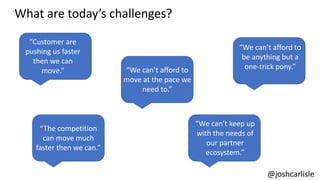
What are today’s challenges?
”Customer are
pushing us faster
then we can
move.”
“The competition
can move much
faster then we can.”
“We can’t afford to
be anything but a
one-trick pony.”
“We can’t keep up
with the needs of
our partner
ecosystem.”
“We can’t afford to
move at the pace we
need to.”
@joshcarlisle
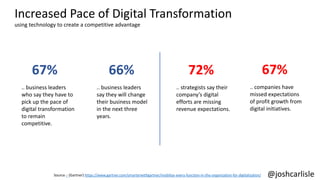
67%
.. business leaders
who say they have to
pick up the pace of
digital transformation
to remain
competitive.
72%
.. strategists say their
company’s digital
efforts are missing
revenue expectations.
66%
.. business leaders
say they will change
their business model
in the next three
years.
67%
.. companies have
missed expectations
of profit growth from
digital initiatives.
Source – (Gartner) https://www.gartner.com/smarterwithgartner/mobilize-every-function-in-the-organization-for-digitalization/
Increased Pace of Digital Transformation
using technology to create a competitive advantage
@joshcarlisle
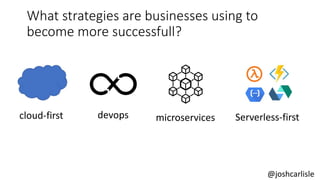
What strategies are businesses using to
become more successfull?
cloud-first microservicesdevops
@joshcarlisle
Serverless-first
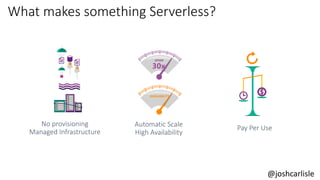
What makes something Serverless?
Automatic Scale
High Availability
Pay Per Use
No provisioning
Managed Infrastructure
@joshcarlisle
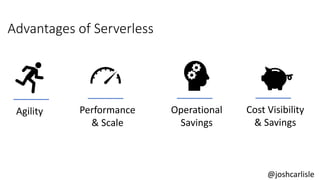
Advantages of Serverless
Agility Cost Visibility
& Savings
Operational
Savings
Performance
& Scale
@joshcarlisle
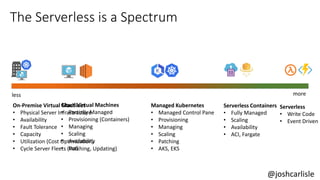
The Serverless is a Spectrum
less more
On-Premise Virtual Machines
• Physical Server Infrastructure
• Availability
• Fault Tolerance
• Capacity
• Utilization (Cost Optimization)
• Cycle Server Fleets (Patching, Updating)
Managed Kubernetes
• Managed Control Pane
• Provisioning
• Managing
• Scaling
• Patching
• AKS, EKS
Cloud Virtual Machines
• Partially Managed
• Provisioning (Containers)
• Managing
• Scaling
• Availability
• IaaS
Serverless Containers
• Fully Managed
• Scaling
• Availability
• ACI, Fargate
Serverless
• Write Code
• Event Driven
@joshcarlisle
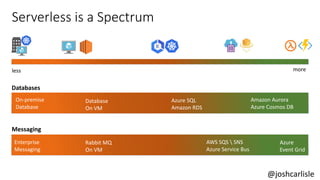
Serverless is a Spectrum
less more
Databases
On-premise
Database
Azure SQL
Amazon RDS
Database
On VM
Amazon Aurora
Azure Cosmos DB
Messaging
Enterprise
Messaging
AWS SQS  SNS
Azure Service Bus
Rabbit MQ
On VM
@joshcarlisle
Azure
Event Grid
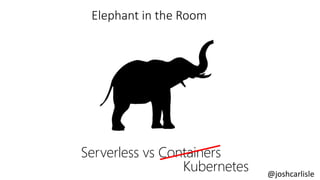
Elephant in the Room
Serverless vs Containers
Kubernetes @joshcarlisle
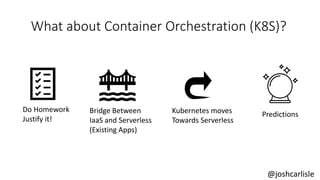
What about Container Orchestration (K8S)?
Do Homework
Justify it!
Bridge Between
IaaS and Serverless
(Existing Apps)
Kubernetes moves
Towards Serverless
Predictions
@joshcarlisle
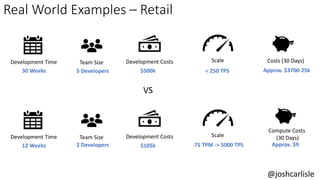
Real World Examples – Retail
Development Time
12 Weeks
Scale
75 TPM -> 5000 TPS
Development Costs
$105k
Compute Costs
(30 Days)
Approx. $9
Team Size
2 Developers
Development Time
30 Weeks
Scale
< 250 TPS
Development Costs
$500k
Costs (30 Days)
Approx. $3700-25k
Team Size
5 Developers
@joshcarlisle
VS
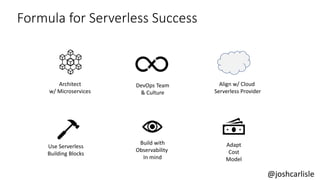
Formula for Serverless Success
Architect
w/ Microservices
DevOps Team
& Culture
Align w/ Cloud
Serverless Provider
Use Serverless
Building Blocks
Build with
Observability
In mind
Adapt
Cost
Model
@joshcarlisle
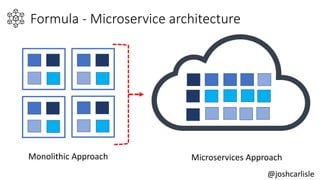
Formula - Microservice architecture
Monolithic Approach Microservices Approach
@joshcarlisle
@joshcarlisle
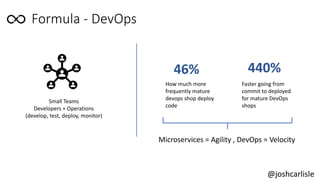
Formula - DevOps
Small Teams
Developers + Operations
(develop, test, deploy, monitor)
46%
How much more
frequently mature
devops shop deploy
code
440%
Faster going from
commit to deployed
for mature DevOps
shops
Microservices = Agility , DevOps = Velocity
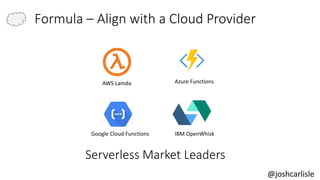
Serverless Market Leaders
AWS Lamda
IBM OpenWhiskGoogle Cloud Functions
@joshcarlisle
Formula – Align with a Cloud Provider
Azure Functions
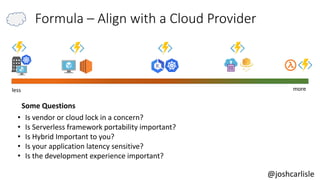
less more
• Is vendor or cloud lock in a concern?
• Is Serverless framework portability important?
• Is Hybrid Important to you?
• Is your application latency sensitive?
• Is the development experience important?
Some Questions
@joshcarlisle
Formula – Align with a Cloud Provider
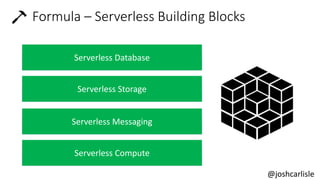
Serverless Compute
Serverless Messaging
Serverless Database
Serverless Storage
@joshcarlisle
Formula – Serverless Building Blocks
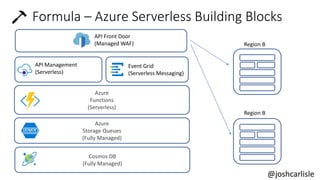
Azure
Functions
(Serverless)
Part Request Micro Service
API Management
(Serverless) Part Request Micro Service
Event Grid
(Serverless Messaging)
Part Request Micro Service
API Front Door
(Managed WAF)
Azure
Storage Queues
(Fully Managed)
Cosmos DB
(Fully Managed)
Part Request
Micro Service
Part Request
Micro Service
Region B
Region B
@joshcarlisle
Formula – Azure Serverless Building Blocks
@joshcarlisle
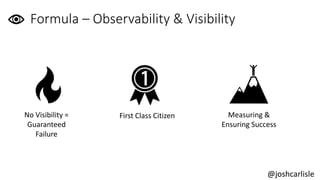
Formula – Observability & Visibility
First Class Citizen Measuring &
Ensuring Success
No Visibility =
Guaranteed
Failure
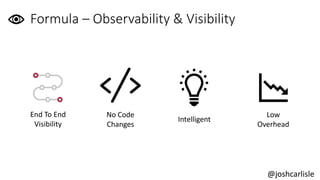
Formula – Observability & Visibility
End To End
Visibility
No Code
Changes
Intelligent
Low
Overhead
@joshcarlisle
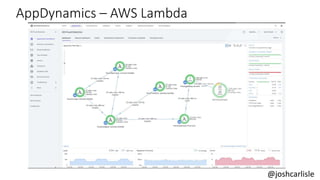
AppDynamics – AWS Lambda
@joshcarlisle
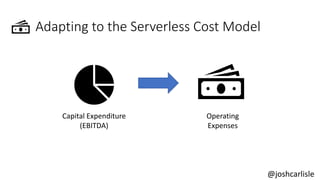
Adapting to the Serverless Cost Model
@joshcarlisle
Capital Expenditure
(EBITDA)
Operating
Expenses
@joshcarlisle
No Free Lunch
@joshcarlisle
Thank-you!
joshcarlisle

Transforming Your Business with Serverless

  • 1.
    Transforming Your Business WithServerless presented by Josh Carlisle for the Technology Leaders of Nashville
  • 2.
    About Me • Raleigh,North Carolina • Developer, Consultant, Trusted Advisor for 20+ years • Technical Community Contributor for 15+ years • Microsoft MVP (Azure) • Sales Engineer w/ AppDynamics (Cisco) @joshcarlisle
  • 3.
  • 4.
    What are today’schallenges? ”Customer are pushing us faster then we can move.” “The competition can move much faster then we can.” “We can’t afford to be anything but a one-trick pony.” “We can’t keep up with the needs of our partner ecosystem.” “We can’t afford to move at the pace we need to.” @joshcarlisle
  • 5.
    67% .. business leaders whosay they have to pick up the pace of digital transformation to remain competitive. 72% .. strategists say their company’s digital efforts are missing revenue expectations. 66% .. business leaders say they will change their business model in the next three years. 67% .. companies have missed expectations of profit growth from digital initiatives. Source – (Gartner) https://www.gartner.com/smarterwithgartner/mobilize-every-function-in-the-organization-for-digitalization/ Increased Pace of Digital Transformation using technology to create a competitive advantage @joshcarlisle
  • 6.
    What strategies arebusinesses using to become more successfull? cloud-first microservicesdevops @joshcarlisle Serverless-first
  • 7.
    What makes somethingServerless? Automatic Scale High Availability Pay Per Use No provisioning Managed Infrastructure @joshcarlisle
  • 8.
    Advantages of Serverless AgilityCost Visibility & Savings Operational Savings Performance & Scale @joshcarlisle
  • 9.
    The Serverless isa Spectrum less more On-Premise Virtual Machines • Physical Server Infrastructure • Availability • Fault Tolerance • Capacity • Utilization (Cost Optimization) • Cycle Server Fleets (Patching, Updating) Managed Kubernetes • Managed Control Pane • Provisioning • Managing • Scaling • Patching • AKS, EKS Cloud Virtual Machines • Partially Managed • Provisioning (Containers) • Managing • Scaling • Availability • IaaS Serverless Containers • Fully Managed • Scaling • Availability • ACI, Fargate Serverless • Write Code • Event Driven @joshcarlisle
  • 10.
    Serverless is aSpectrum less more Databases On-premise Database Azure SQL Amazon RDS Database On VM Amazon Aurora Azure Cosmos DB Messaging Enterprise Messaging AWS SQS SNS Azure Service Bus Rabbit MQ On VM @joshcarlisle Azure Event Grid
  • 11.
    Elephant in theRoom Serverless vs Containers Kubernetes @joshcarlisle
  • 12.
    What about ContainerOrchestration (K8S)? Do Homework Justify it! Bridge Between IaaS and Serverless (Existing Apps) Kubernetes moves Towards Serverless Predictions @joshcarlisle
  • 13.
    Real World Examples– Retail Development Time 12 Weeks Scale 75 TPM -> 5000 TPS Development Costs $105k Compute Costs (30 Days) Approx. $9 Team Size 2 Developers Development Time 30 Weeks Scale < 250 TPS Development Costs $500k Costs (30 Days) Approx. $3700-25k Team Size 5 Developers @joshcarlisle VS
  • 14.
    Formula for ServerlessSuccess Architect w/ Microservices DevOps Team & Culture Align w/ Cloud Serverless Provider Use Serverless Building Blocks Build with Observability In mind Adapt Cost Model @joshcarlisle
  • 15.
    Formula - Microservicearchitecture Monolithic Approach Microservices Approach @joshcarlisle
  • 16.
    @joshcarlisle Formula - DevOps SmallTeams Developers + Operations (develop, test, deploy, monitor) 46% How much more frequently mature devops shop deploy code 440% Faster going from commit to deployed for mature DevOps shops Microservices = Agility , DevOps = Velocity
  • 17.
    Serverless Market Leaders AWSLamda IBM OpenWhiskGoogle Cloud Functions @joshcarlisle Formula – Align with a Cloud Provider Azure Functions
  • 18.
    less more • Isvendor or cloud lock in a concern? • Is Serverless framework portability important? • Is Hybrid Important to you? • Is your application latency sensitive? • Is the development experience important? Some Questions @joshcarlisle Formula – Align with a Cloud Provider
  • 19.
    Serverless Compute Serverless Messaging ServerlessDatabase Serverless Storage @joshcarlisle Formula – Serverless Building Blocks
  • 20.
    Azure Functions (Serverless) Part Request MicroService API Management (Serverless) Part Request Micro Service Event Grid (Serverless Messaging) Part Request Micro Service API Front Door (Managed WAF) Azure Storage Queues (Fully Managed) Cosmos DB (Fully Managed) Part Request Micro Service Part Request Micro Service Region B Region B @joshcarlisle Formula – Azure Serverless Building Blocks
  • 21.
    @joshcarlisle Formula – Observability& Visibility First Class Citizen Measuring & Ensuring Success No Visibility = Guaranteed Failure
  • 22.
    Formula – Observability& Visibility End To End Visibility No Code Changes Intelligent Low Overhead @joshcarlisle
  • 23.
    AppDynamics – AWSLambda @joshcarlisle
  • 24.
    Adapting to theServerless Cost Model @joshcarlisle Capital Expenditure (EBITDA) Operating Expenses
  • 25.
  • 26.

Editor's Notes

  • #5 - Challenges that exist today to be more agile and competitive
  • #6 We see it in big architecture shifts on how we build applications with microservices and the numerous prevalence for mobile and web back ends
  • #7 - Microservices have allowed us to focus more on the application and not as much on the infrastracture
  • #8 Don’t focus on infrastructure as a critical differentiator A lot of time, effort goes into installing, configurating, managing compute infrastructure Microservices
  • #9 Agility Time to Market Speed up Development Reduced Risk – MVP -> Production Combination of Operation Eliminated Operational challenges associated with managing \ automating scale, fault tolerance Eliminated many standard operations activities Cost Efficiency Teams we’re much smaller Overall Costs No Cost to keep the lights on
  • #10 Serverless is really the natural evalution of the cloud that’s able to both support proven agile architectures but also addresses the operation and cost challenges - Serverless spectrum
  • #11 Serverless is really the natural evalution of the cloud that’s able to both support proven agile architectures but also addresses the operation and cost challenges - Serverless spectrum
  • #13 Homework – Move existing workloads w/o re-architectures Bridge – Move Existing workloads w/o re-architecture K8S to Serverless – Knative\Keda Prediction – K8S will go behind the scenes and more serverless
  • #15 DevOps is half of the equation Serverless = Agility , DevOps = Velocity How can you measure and guage success without observability (even more critical now) - Earning Before Interest Taxes Depreciation Amortisation - Depreciate Server hardware costs over time - Server hardware costs are centrally managed (how do you assign centrally managed costs to a single project) - Profit & Loss (P&L) as Operating Expenditure (OpEx) - Individual Business Unit and Projects are bearing more costs - Long term it’s better because once you start using it you can get really granular costs lets you know precisely what it takes to run (service, micro-service, nano-service, function) Build your applications with the design tenants of microservices (decoupled services)
  • #16 Operational Challenges Tenants of Serverless line up very nicely with Microservices Microservices provide the agility and Serverless provides the agility without the Operational Burdens and Overhead
  • #17 Serverless is at the heart of devops policy. No incremental you pretty much have to have a DevOps mentality When your developing your code you have to think about how it’s going to run As a Serverless developer you don’t have the luxary of developing in isolation- you have to think about how it will run at the beginning. Automate everything Microservices = Agility , DevOps = Velocity Serverless Almost Demands DevOps Combination of Developers & Operations (No more Siloes) Engineers own the entire lifecycle (dev -> test -> deploy -> monitor) Mature DevOps shops deploy code 46x more frequently 440x faster going from commit -> deployed Just because you have CI\CD doesn’t mean you are DevOps
  • #18 - Very few organization can
  • #22 Observability is a property of your application. Low observability directly impacts visibility
  • #25 Earning Before Interest Taxes Depreciation Amortisation - Depreciate Server hardware costs over time - Server hardware costs are centrally managed (how do you assign centrally managed costs to a single project) - Profit & Loss (P&L) as Operating Expenditure (OpEx) - Individual Business Unit and Projects are bearing more costs - Long term it’s better because once you start using it you can get really granular costs lets you know precisely what it takes to run (service, micro-service, nano-service, function)