TRANSFORMING L&D
Expansion, Acceleration, Innovation
How Artificial Intelligence is
revolutionizing training and development,
offering new ways to scale, personalize,
and innovate
Sean Bengry: CLO, Sablethorn Consulting
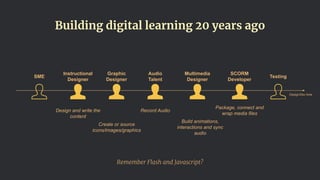
Instructional
Designer
Graphic
Designer
Multimedia
Designer
SCORM
Developer
Design and write the
content
Create or source
icons/images/graphics
Build animations,
interactions and sync
audio
Audio
Talent
Record Audio
Package, connect and
wrap media files
SME Testing
Design/Dev time
Building digital learning 20 years ago
Remember Flash and Javascript?
The “Good Old Days”
20 years ago - I remember
“eLearning”
10 years ago - I remember
“mLearning”
3 years ago - I remember
“zoomLearning”
Mobile computing
Cloud computing
Presenter
Storyline
Rise
LMS
LRS
LXP
Zoom
Youtube
WIFI
3 years ago
10 years ago
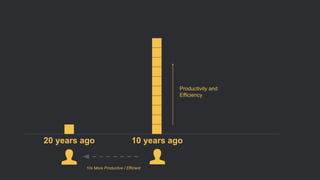
10x More Productive / Efficient
Productivity and
Efficiency
10x More Productive / Efficient
Productivity and
Efficiency
10 years ago
20 years ago
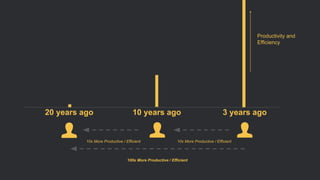
3 years ago
10 years ago
20 years ago
10x More Productive / Efficient 10x More Productive / Efficient
100x More Productive / Efficient
Productivity and
Efficiency
Zoom out, and it looks like this…
Why is this happening now?
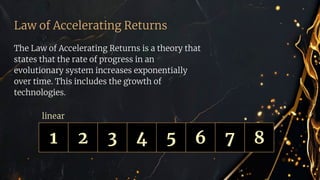
Law of Accelerating Returns
The Law of Accelerating Returns is a theory that
states that the rate of progress in an
evolutionary system increases exponentially
over time. This includes the growth of
technologies.
1 2 3 4 5 6 7 8
linear
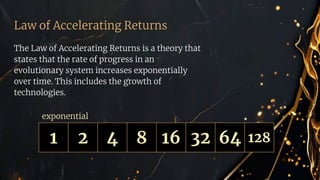
Law of Accelerating Returns
The Law of Accelerating Returns is a theory that
states that the rate of progress in an
evolutionary system increases exponentially
over time. This includes the growth of
technologies.
1 2 4 8 16 32 64 128
exponential
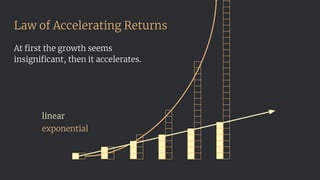
At first the growth seems
insignificant, then it accelerates.
Law of Accelerating Returns
linear
exponential
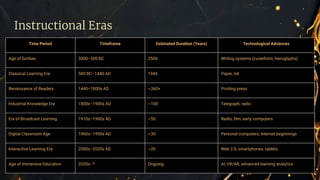
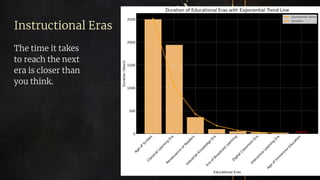
Instructional Eras
Time Period Timeframe Estimated Duration (Years) Technological Advances
Age of Scribes 3000–500 BC 2500 Writing systems (cuneiform, hieroglyphs)
Classical Learning Era 500 BC–1440 AD 1940 Paper, ink
Renaissance of Readers 1440–1800s AD ~360+ Printing press
Industrial Knowledge Era 1800s–1900s AD ~100 Telegraph, radio
Era of Broadcast Learning 1910s–1960s AD ~50 Radio, film, early computers
Digital Classroom Age 1960s–1990s AD ~30 Personal computers, Internet beginnings
Interactive Learning Era 2000s–2020s AD ~20 Web 2.0, smartphones, tablets
Age of Immersive Education 2020s–? Ongoing AI, VR/AR, advanced learning analytics
Instructional Eras
The time it takes
to reach the next
era is closer than
you think.
Rising Tide Raises All Ships
Everything has changed in the last 20 years
● How you communicate
● How you share
● Where you work
Recognize that we now live in a world of perpetual change, and so
we’re never going to be fully caught up ever again.
It’s the journey, not the destination.
Why is this Different?
For the first time in history, automation takes
the form of creation
(what we call “generation”)
Let’s Go
What’s Next?
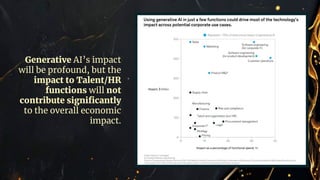
Generative AI’s impact
will be profound, but the
impact to Talent/HR
functions will not
contribute significantly
to the overall economic
impact.
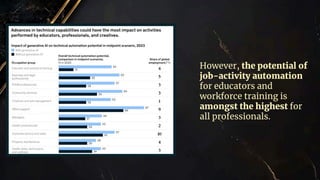
However, the potential of
job-activity automation
for educators and
workforce training is
amongst the highest for
all professionals.
GenAI will soon be “features” in
every popular tool
Near Future Potential
(already available to test)
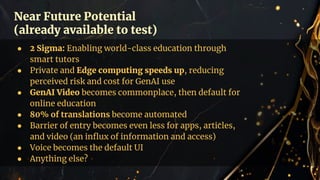
● 2 Sigma: Enabling world-class education through
smart tutors
● Private and Edge computing speeds up, reducing
perceived risk and cost for GenAI use
● GenAI Video becomes commonplace, then default for
online education
● 80% of translations become automated
● Barrier of entry becomes even less for apps, articles,
and video (an influx of information and access)
● Voice becomes the default UI
● Anything else?
Don’t wait for your organization…
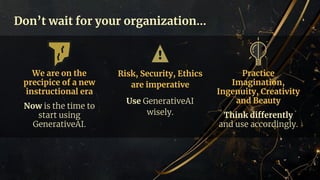
We are on the
precipice of a new
instructional era
Now is the time to
start using
GenerativeAI.
Risk, Security, Ethics
are imperative
Use GenerativeAI
wisely.
Practice
Imagination,
Ingenuity, Creativity
and Beauty
Think differently
and use accordingly.
Remember, these are the ‘Good Old Days’
Appendix
3 Body Problem
https://youtube.com/clip/UgkxeAKrt9to-ifmDPl1Pkb_PmgGq-z1Qs9g?si=
w3YdBp9RgKM5R2gh
Theory of Disruptive Technology
As companies tend to innovate faster than their customers’ needs evolve, most
organizations eventually end up producing products or services that are actually too
sophisticated, too expensive, and too complicated for many customers in their market.
Companies pursue these “sustaining innovations” at the higher tiers of their markets
because this is what has historically helped them succeed: by charging the highest
prices to their most demanding and sophisticated customers at the top of the market,
companies will achieve the greatest profitability.
However, by doing so, companies unwittingly open the door to “disruptive
innovations” at the bottom of the market. An innovation that is disruptive allows a
whole new population of consumers at the bottom of a market access to a product or
service that was historically only accessible to consumers with a lot of money or a lot of
skill.
Systems Design for Instruction
Show Limits to Growth Diagram

Transforming L&D: Rochester ATD Summit 2024

  • 1.
    TRANSFORMING L&D Expansion, Acceleration,Innovation How Artificial Intelligence is revolutionizing training and development, offering new ways to scale, personalize, and innovate Sean Bengry: CLO, Sablethorn Consulting
  • 2.
    Instructional Designer Graphic Designer Multimedia Designer SCORM Developer Design and writethe content Create or source icons/images/graphics Build animations, interactions and sync audio Audio Talent Record Audio Package, connect and wrap media files SME Testing Design/Dev time Building digital learning 20 years ago Remember Flash and Javascript?
  • 3.
    The “Good OldDays” 20 years ago - I remember “eLearning” 10 years ago - I remember “mLearning” 3 years ago - I remember “zoomLearning” Mobile computing Cloud computing Presenter Storyline Rise LMS LRS LXP Zoom Youtube WIFI
  • 4.
    3 years ago 10years ago 10x More Productive / Efficient Productivity and Efficiency
  • 5.
    10x More Productive/ Efficient Productivity and Efficiency 10 years ago 20 years ago
  • 6.
    3 years ago 10years ago 20 years ago 10x More Productive / Efficient 10x More Productive / Efficient 100x More Productive / Efficient Productivity and Efficiency
  • 7.
    Zoom out, andit looks like this…
  • 8.
    Why is thishappening now?
  • 9.
    Law of AcceleratingReturns The Law of Accelerating Returns is a theory that states that the rate of progress in an evolutionary system increases exponentially over time. This includes the growth of technologies. 1 2 3 4 5 6 7 8 linear
  • 10.
    Law of AcceleratingReturns The Law of Accelerating Returns is a theory that states that the rate of progress in an evolutionary system increases exponentially over time. This includes the growth of technologies. 1 2 4 8 16 32 64 128 exponential
  • 11.
    At first thegrowth seems insignificant, then it accelerates. Law of Accelerating Returns linear exponential
  • 12.
    Instructional Eras Time PeriodTimeframe Estimated Duration (Years) Technological Advances Age of Scribes 3000–500 BC 2500 Writing systems (cuneiform, hieroglyphs) Classical Learning Era 500 BC–1440 AD 1940 Paper, ink Renaissance of Readers 1440–1800s AD ~360+ Printing press Industrial Knowledge Era 1800s–1900s AD ~100 Telegraph, radio Era of Broadcast Learning 1910s–1960s AD ~50 Radio, film, early computers Digital Classroom Age 1960s–1990s AD ~30 Personal computers, Internet beginnings Interactive Learning Era 2000s–2020s AD ~20 Web 2.0, smartphones, tablets Age of Immersive Education 2020s–? Ongoing AI, VR/AR, advanced learning analytics
  • 13.
    Instructional Eras The timeit takes to reach the next era is closer than you think.
  • 14.
    Rising Tide RaisesAll Ships Everything has changed in the last 20 years ● How you communicate ● How you share ● Where you work
  • 15.
    Recognize that wenow live in a world of perpetual change, and so we’re never going to be fully caught up ever again. It’s the journey, not the destination.
  • 16.
    Why is thisDifferent?
  • 17.
    For the firsttime in history, automation takes the form of creation (what we call “generation”) Let’s Go
  • 18.
  • 19.
    Generative AI’s impact willbe profound, but the impact to Talent/HR functions will not contribute significantly to the overall economic impact.
  • 20.
    However, the potentialof job-activity automation for educators and workforce training is amongst the highest for all professionals.
  • 21.
    GenAI will soonbe “features” in every popular tool
  • 22.
    Near Future Potential (alreadyavailable to test) ● 2 Sigma: Enabling world-class education through smart tutors ● Private and Edge computing speeds up, reducing perceived risk and cost for GenAI use ● GenAI Video becomes commonplace, then default for online education ● 80% of translations become automated ● Barrier of entry becomes even less for apps, articles, and video (an influx of information and access) ● Voice becomes the default UI ● Anything else?
  • 23.
    Don’t wait foryour organization… We are on the precipice of a new instructional era Now is the time to start using GenerativeAI. Risk, Security, Ethics are imperative Use GenerativeAI wisely. Practice Imagination, Ingenuity, Creativity and Beauty Think differently and use accordingly.
  • 24.
    Remember, these arethe ‘Good Old Days’
  • 25.
  • 26.
  • 27.
    Theory of DisruptiveTechnology As companies tend to innovate faster than their customers’ needs evolve, most organizations eventually end up producing products or services that are actually too sophisticated, too expensive, and too complicated for many customers in their market. Companies pursue these “sustaining innovations” at the higher tiers of their markets because this is what has historically helped them succeed: by charging the highest prices to their most demanding and sophisticated customers at the top of the market, companies will achieve the greatest profitability. However, by doing so, companies unwittingly open the door to “disruptive innovations” at the bottom of the market. An innovation that is disruptive allows a whole new population of consumers at the bottom of a market access to a product or service that was historically only accessible to consumers with a lot of money or a lot of skill.
  • 28.
    Systems Design forInstruction Show Limits to Growth Diagram