Transforming EMR
To improve patient and provider interactions
Alyssa Peachey
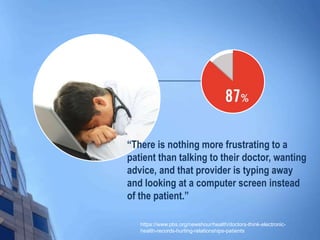
“There is nothing more frustrating to a
patient than talking to their doctor, wanting
advice, and that provider is typing away
and looking at a computer screen instead
of the patient.”
https://www.pbs.org/newshour/health/doctors-think-electronic-
health-records-hurting-relationships-patients
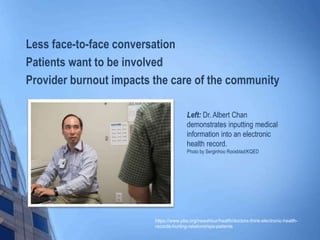
Left: Dr. Albert Chan
demonstrates inputting medical
information into an electronic
health record.
Photo by Serginhoo Roosblad/KQED
https://www.pbs.org/newshour/health/doctors-think-electronic-health-
records-hurting-relationships-patients
Less face-to-face conversation
Patients want to be involved
Provider burnout impacts the care of the community
Goal: Successfully integrate EMR in the visit
 Found that physicians spend 54% of total visit time
in EMR
 Reviews of effect of EMR are mixed
 Small effects on quality
 Decreased clinicians productivity
A Time-Motion Study
Young RA, Burge SK, Kumar KA, Wilson JM, Ortiz DF. A Time-
Motion Study of Primary Care Physicians’ Work in the Electronic
Health Record Era. Fam Med. 2018;50(2):91-99
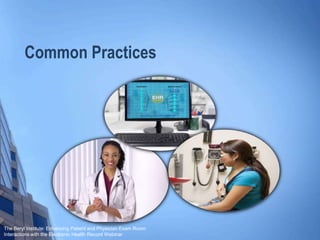
Common Practices
The Beryl Institute: Enhancing Patient and Physician Exam Room
Interactions with the Electronic Health Record Webinar
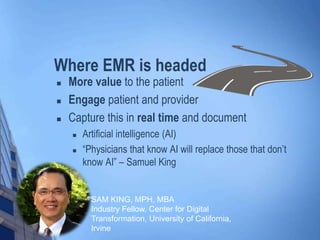
Where EMR is headed
 More value to the patient
 Engage patient and provider
 Capture this in real time and document
 Artificial intelligence (AI)
 “Physicians that know AI will replace those that don’t
know AI” – Samuel King
SAM KING, MPH, MBA
Industry Fellow, Center for Digital
Transformation, University of California,
Irvine
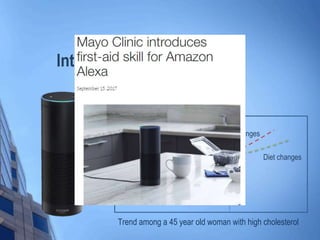
Interactive Model
 Predictive modeling
 Voice Assistant
No changes
Diet changes
Trend among a 45 year old woman with high cholesterol
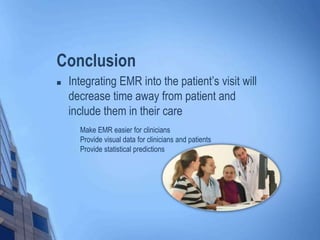
Conclusion
 Integrating EMR into the patient’s visit will
decrease time away from patient and
include them in their care
Make EMR easier for clinicians
Provide visual data for clinicians and patients
Provide statistical predictions
Sources
 Young RA, Burge SK, Kumar KA, Wilson JM, Ortiz DF. A Time-Motion Study of Primary
Care Physicians’ Work in the Electronic Health Record Era. Fam Med. 2018;50(2):91-99.
https://doi.org/10.22454/FamMed.2018.184803.
 https://ehrintelligence.com/news/family-physician-ehr-use-outweighs-provider-patient-
interaction
 Samuel King Biography http://aimed-mi3.com/speaker/sam-king/
 The Beryl Institute: Enhancing Patient and Physician Exam Room Interactions with the
Electronic Health Record Webinar
 https://www.pbs.org/newshour/health/doctors-think-electronic-health-records-hurting-
relationships-patients

Transforming EMR

  • 1.
    Transforming EMR To improvepatient and provider interactions Alyssa Peachey
  • 2.
    “There is nothingmore frustrating to a patient than talking to their doctor, wanting advice, and that provider is typing away and looking at a computer screen instead of the patient.” https://www.pbs.org/newshour/health/doctors-think-electronic- health-records-hurting-relationships-patients
  • 3.
    Left: Dr. AlbertChan demonstrates inputting medical information into an electronic health record. Photo by Serginhoo Roosblad/KQED https://www.pbs.org/newshour/health/doctors-think-electronic-health- records-hurting-relationships-patients Less face-to-face conversation Patients want to be involved Provider burnout impacts the care of the community
  • 4.
    Goal: Successfully integrateEMR in the visit  Found that physicians spend 54% of total visit time in EMR  Reviews of effect of EMR are mixed  Small effects on quality  Decreased clinicians productivity A Time-Motion Study Young RA, Burge SK, Kumar KA, Wilson JM, Ortiz DF. A Time- Motion Study of Primary Care Physicians’ Work in the Electronic Health Record Era. Fam Med. 2018;50(2):91-99
  • 5.
    Common Practices The BerylInstitute: Enhancing Patient and Physician Exam Room Interactions with the Electronic Health Record Webinar
  • 6.
    Where EMR isheaded  More value to the patient  Engage patient and provider  Capture this in real time and document  Artificial intelligence (AI)  “Physicians that know AI will replace those that don’t know AI” – Samuel King SAM KING, MPH, MBA Industry Fellow, Center for Digital Transformation, University of California, Irvine
  • 7.
    Interactive Model  Predictivemodeling  Voice Assistant No changes Diet changes Trend among a 45 year old woman with high cholesterol
  • 8.
    Conclusion  Integrating EMRinto the patient’s visit will decrease time away from patient and include them in their care Make EMR easier for clinicians Provide visual data for clinicians and patients Provide statistical predictions
  • 9.
    Sources  Young RA,Burge SK, Kumar KA, Wilson JM, Ortiz DF. A Time-Motion Study of Primary Care Physicians’ Work in the Electronic Health Record Era. Fam Med. 2018;50(2):91-99. https://doi.org/10.22454/FamMed.2018.184803.  https://ehrintelligence.com/news/family-physician-ehr-use-outweighs-provider-patient- interaction  Samuel King Biography http://aimed-mi3.com/speaker/sam-king/  The Beryl Institute: Enhancing Patient and Physician Exam Room Interactions with the Electronic Health Record Webinar  https://www.pbs.org/newshour/health/doctors-think-electronic-health-records-hurting- relationships-patients

Editor's Notes

  • #2 My name is Alyssa Peachey. I am a graduate student of health administration at Penn State Harrisburg and today we are going to explore options for transforming the electronic medical record or (EMR) as we know it, to improve patient and provider interactions. A patient’s experience in the clinic becomes more important as we shift towards a value-based reimbursement system. In my 5 minute presentation, I will show you some current problems and best practices within the EMR and how the future might look very different for clinicians.
  • #3 It’s no surprise to any healthcare worker today that 87% of primary physicians use EMR and that number is higher in specialties. But for the most part, EMR is not set up for efficient work flows. We’re behind in healthcare with technology. Many physicians report that the EMR is cluttered and creates additional steps that ultimately take away from the care they provide to their patients. With that being said, studies have shown that EMR leads to burnout among clinicians. There is nothing more frustrating to a patient than talking to their doctor, wanting advice, and that provider is typing away and looking at a computer screen instead of the patient.”
  • #4 There are studies out there that look at the effects of EMR on hospital staff. In general, these studies showed that providers spend more time in the patient’s electronic chart than having a face-to-face conversation. It’s known that patients are happier when they have direct input in their care as well. Many doctors are fed up with how time-consuming EHRs have become, and how they can impede the doctor-patient relationship during exams. EMR distracts from the patient instead of including them. Difficult use of EMR leads to provider burnout which ultimately impacts the care of the community.
  • #5 A Time Motion study published this February 2018 in Family Medicine Journal concluded that primary care physicians spent more time working in the EHR than they spent in face-to-face time with patients in clinic visits. On average, family doctors spend about 54% of the clinic visit using EMR rather than interacting with their patients. That’s over half! While the reviews of EMR are mixed, many agree that EMR has slightly improved the quality of care while others feel EMR interferes with office work flow and decreases productivity. To overcome this problem, EMR interfaces must be easy to maneuver, reduce number of clicking, and be successfully integrated into the patient’s visit.
  • #6 Until disruption occurs in EMR interfaces, some of the best practices to improve the patient and provider interaction are as follows: Engage the patient in their chart, let them see what you can see. Explain what you are doing while talking or typing…. Print important documents in the room for quick and easy transitions so the patient can follow along and leave with documentation. Lastly, set the clinic rooms up in the triangle so both provider and patient can see the computer.
  • #7 There is room for improvement within EMR that all hospital staff should be excited about. A better EMR would provide even more value to the patient, it would sync records to their phone, it would make predictions of the future and it would be done instantaneously. The new EMR will engage the patient and provider at the same time. Requiring patients to press buttons or make their own selections within their EMR. And it would capture this all in real time and document and possibly consent in the background using artificial intelligence. A known healthcare consultant Sam King said, “physicians that know AI will replace those that don’t know AI” this is similar to the physicians that didn’t want EMR, simply retired or were replaced by physicians that were learning EMR
  • #8 A better EMR will have dual views. The patient view – what the patient and provider see when they are in the room. And the provider view – what the provider looks at before going to see the patient to quickly capture the patient’s med record in list or bullet form The patient view will have predictive modeling to show the patient where they are headed in 5, 10 years with and without medication and predict stats. And the better EMR will present this information in a way that all patients can understand. Touchscreen, videos, visualized data that is color coded.
  • #9 Learning ways to integrate EMR into the patient’s visit is important because it will decrease the time the provider spends away from the patient in EMR and include the patient in their own care. A more visualized way to present data will make workflow easier for clinicians and reduce burnout. Providing statistical predictions for care will improve the quality of care and instill trust between the provider and the patient. I thank you all for listening and watching. I hope you’re excited for the future of EMRs.