TITLE:
TABLE FOR THEMATICANALYSIS
1. Motivators of Grit
Participants
Significant Statements as Answer to Questions
Formulated
meanings
Theme
Clusters
Themes
What motivates
Muslim
educational
leaders to exhibit
grit in their daily
tasks?
What role does
personal belief in
Allah play in
sustaining
motivation and
determination?
How do family
and social
support systems
contribute to
fostering grit in
Muslim
educational
leaders?
Are there any
specific events or
experiences that
significantly
influenced your
commitment to
demonstrating
grit?
Participant 1
The impact of their
efforts on student
success serves as
a powerful
motivator.
Witnessing
students thrive
inspires leaders to
remain determined
despite any
challenges they
encounter.
Believers are often
motivated by the
desire to serve
others as an
expression of their
faith. This
commitment can
drive them to work
diligently towards
goals that benefit
not only
themselves but
also their
communities.
Families teach
resilience by
encouraging
members to face
challenges head-
on, instilling a
sense of
determination
that is crucial for
leadership roles.
Reading about or
meeting
individuals who
have
demonstrated
extraordinary grit
in their lives can
inspire others to
adopt similar
attitudes toward
their own
challenges.
Faith, family,
and inspirational
role models
collectively
foster a strong
sense of
purpose and
resilience.
Empowering
through
inspiration and
community.
Empowering
through
resilience and
community
service
Participant 2
Understanding the
importance of
being a role model
for students
motivates leaders
to exhibit grit.
They recognize
that their
perseverance sets
an example for the
Belief in Allah
often connects
individuals to a
supportive
community. This
network can
provide
encouragement
and motivation,
making it easier
Social support
systems within
the Muslim
community offer
resources and
networking
opportunities,
enhancing
leaders' ability to
tackle challenges
Having a mentor
who encourages
perseverance can
significantly
influence one’s
commitment to
grit. Their
guidance and
belief in one’s
potential can
Belief in Allah
serves as a
foundation for
connecting
individuals with
a supportive
community,
which provide
essential
encouragement
Belief in Allah
connects
individuals to a
supportive
community that
provides
motivation and
resources.
Community
Support and
resilience
2.
next generation. forindividuals to
remain determined
in their pursuits.
effectively. motivate
individuals to push
through obstacles.
and motivation.
Participant 3
The pursuit of
excellence (Ihsan)
in education drives
leaders to push
through
challenges. This
motivation stems
from the Islamic
teaching that
encourages
striving for the
best in all
endeavors.
In times of
hardship, belief in
Allah can serve as
a powerful source
of strength. This
faith encourages
individuals to
persevere,
knowing that they
are supported by a
higher power,
which can
significantly boost
their
determination.
Parents and
family members
often serve as
role models,
demonstrating
perseverance
and hard work.
This modeling
instills similar
values in
educational
leaders, fostering
their grit.
Experiencing the
loss of a loved one
often forces
individuals to
confront their
vulnerabilities.
This profound
experience can
foster
determination to
honor the memory
of the deceased
by pursuing goals
with greater
tenacity.
Motivates
leaders to
overcome
challenges,
inspired by
Islamic teaching
that emphasizes
striving for
perfection in all
pursuits.
Integration of
spiritual growth,
intellectual
development,
ethical values,
leadership, and
community
engagement.
Holistic
Development
Excellence in
Education
Leadership
Development
Participant 4
Engaging in work
that aligns with
their values brings
spiritual fulfillment,
motivating leaders
to persist through
difficulties while
maintaining a
sense of purpose.
Belief in Allah
encourages
regular self-
reflection and
assessment of
one’s actions. This
practice helps
individuals stay
aligned with their
goals, enhancing
motivation through
continuous
improvement.
Support systems
celebrate
milestones and
achievements,
boosting
confidence and
reinforcing the
value of hard
work and
persistence.
Taking on
leadership roles
within community
organizations
often involves
navigating
challenges that
require grit,
fostering a deeper
commitment to
overcoming
obstacles for the
greater good.
Belief in Allah,
supportive
networks, and
leadership roles
in community
organizations
collectively
foster personal
growth,
resilience, and
motivation.
Focuses on
cultivating
resilience as a
dynamic
process to
navigate
challenges and
foster personal
growth.
Fostering inner
strength and
leveraging
support
system.
Participant 5
Supportive
relationships with
fellow educators
provide
motivation. The
encouragement
from peers helps
leaders remain
determined when
Living with the
intention of
fulfilling one’s
duties to Allah can
motivate
individuals to
strive for
excellence in all
areas of life,
A strong sense of
cultural identity
within families
reinforces the
importance of
perseverance in
achieving
personal and
communal goals,
Dealing with
personal health
issues or
supporting a loved
one through
illness can
cultivate a
profound sense of
grit, as individuals
Living with
purpose,
whether through
spiritual duties,
cultural identity,
or overcoming
personal
challenges.
Spiritual
motivation
cultural identity,
and
overcoming
personal
challenges.
Resilience and
Purpose
3.
facing challenges
together.
fostering
determination to
achieveboth
personal and
spiritual goals.
fostering grit. learn to navigate
adversity with
strength and
determination.
Participant 6
A strong sense of
duty towards
students and the
educational
institution drives
leaders to exhibit
grit, as they feel
responsible for
fostering a positive
learning
environment.
Belief in Allah
encourages
gratitude for one’s
blessings, which
can shift focus
away from
obstacles. This
positive
perspective helps
maintain
motivation by
highlighting what
is achievable
rather than what is
lacking.
Family and
community
members hold
educational
leaders
accountable for
their goals,
motivating them
to persist despite
difficulties.
The journey of
parenting, with its
inherent
challenges, often
teaches patience,
determination, and
the ability to
overcome
obstacles for the
sake of one’s
children.
Combines the
concepts of
faith, community
support, and
personal growth
through
parenting.
Overcoming life
challenges.
Faith,
community,
and parenting
Participant 7
High emotional
intelligence, which
is often nurtured
through Islamic
teachings, enables
leaders to manage
stress and
maintain focus,
reinforcing their
determination in
challenging
situations.
A belief in Allah
instills hope and
optimism about
the future. This
hopeful outlook
motivates
individuals to work
towards their
dreams, believing
that positive
outcomes are
possible.
Families often
encourage
spiritual practices
that build inner
strength and
determination,
essential
components of
grit for Muslim
educational
leaders.
Working in
challenging
environments,
such as disaster
relief or
community service
projects, exposes
individuals to
adversity while
fostering a strong
sense of
commitment and
grit.
Collectively
foster hope,
inner strength,
and grit.
Harnessing
faith, family,
and service to
foster grit and
overcome
challenges.
Service for a
stronger future
Participant 8
The Islamic
principle of
seeking
knowledge
motivates
educational
leaders to
Pursuing goals
that align with
one’s faith can
lead to spiritual
fulfillment. This
connection
between personal
Supportive social
networks foster
collaborative
environments
where
educational
leaders can
Experiencing
different cultures
and facing the
challenges of
navigating
unfamiliar
environments can
Engaging in
activities that
align with
personal values.
Broader
categories to
identify
common
patterns.
Personal
growth and
resilience
4.
continuously
improve
themselves. This
commitment helps
themnavigate
difficulties with a
growth mindset.
aspirations and
spiritual beliefs
can enhance
motivation and
determination.
brainstorm
solutions to
challenges,
enhancing their
resilience.
build adaptability
and resilience,
reinforcing one’s
commitment to
persevere in
various situations.
Participant 9
Cultural values
that emphasize
perseverance and
hard work
motivate Muslim
educational
leaders to embody
grit, as these traits
are highly
regarded within
their communities.
Believers often
view setbacks as
tests from Allah
rather than
failures. This
perspective
fosters resilience,
encouraging them
to bounce back
and remain
determined in the
face of challenges.
During crises,
strong family ties
provide practical
support, enabling
educational
leaders to
maintain focus on
their goals and
cultivate grit
through
adversity.
Engaging in
sports, especially
at competitive
levels, often
requires
overcoming
physical and
mental challenges.
The discipline and
resilience
developed through
training and
competition can
translate into other
areas of life.
Believers often
view setbacks
as tests from
Allah rather than
failure.
Fostered
through a
combination of
spiritual beliefs,
strong social
support
system, and
engaging in
challenging
activities.
Resilience
through
transformation
and support
Participant 10
The support
derived from faith,
including prayer
and reliance on
Allah (Tawakkul),
provides Muslim
leaders with the
strength and
resilience needed
to face daily
challenges with
determination.
Faith provides a
moral framework
that guides
decision-making.
This clarity helps
individuals stay
focused on their
goals while
aligning their
actions with their
values, thereby
enhancing
motivation.
Family and social
networks often
share Islamic
values that
emphasize
resilience and
perseverance,
reinforcing the
importance of grit
in educational
leadership.
Participating in
cultural or
religious
ceremonies that
emphasize
perseverance and
community
support can
reinforce the
importance of grit
in personal and
professional
contexts.
Faith, family,
and cultural
practices
collectively
provide a robust
framework that
emphasizes
moral clarity,
resilience, and
perseverance.
Organized
groups of ideas
or activities that
share commo
Resilience and
purpose
Participant 11
Muslim
educational
leaders are often
motivated by the
desire to positively
Regular prayer
can enhance
motivation by
allowing believers
to reflect on their
Supportive
families
encourage
continuous
education and
Facing a setback,
such as being
passed over for a
promotion or
dealing with a
Personal and
professional
motivation is
significantly
enhanced
Leveraging
family support
for continuous
growth, and
learning from
Resilience and
motivation
through support
5.
impact their
communities. This
senseof
responsibility fuels
their determination
to overcome
obstacles in their
roles.
goals and seek
guidance. This
practice fosters a
sense of
accountability and
commitment to
personal
aspirations.
professional
development,
motivating
leaders to
overcome
obstacles and
pursue
excellence.
failed project, can
be a pivotal
moment. Learning
to bounce back
from
disappointment
strengthens
resolve and
commitment to
future endeavors.
through
practices that
foster reflection,
support, and
resilience.
setbacks to
enhance
resilience and
commitment to
personal and
professional
aspirations.
Participant 12
A clear vision for
improving
education within
their communities
motivates Muslim
leaders to push
through obstacles,
as they are driven
by the potential for
meaningful
change.
Many believers
look up to
prophets and
religious figures
who exemplify
perseverance and
determination.
These role models
inspire individuals
to emulate their
qualities in
pursuing their own
goals.
Families often
share resources
financial,
emotional, or
informational that
help educational
leaders pursue
their ambitions
more effectively.
Returning to
education after an
initial failure, such
as dropping out or
receiving poor
grades, can lead
to a renewed
commitment to
succeed,
highlighting the
importance of
perseverance.
Perseverance,
inspired by role
models and
supported by
family
resources, is
crucial for
overcoming
setbacks and
achieving
success.
Fostered
through a
combination of
inspirational
role models,
supportive
networks like
family and the
ability to learn
from setbacks.
Empowered
resilience
Participant 13
The desire to lead
ethically according
to Islamic
principles
motivates
educational
leaders to
overcome
challenges with
integrity and
resilience,
reinforcing their
commitment to
their roles.
Faith often
emphasizes the
importance of
knowledge and
learning. This
pursuit of
knowledge can
motivate
individuals to seek
personal growth
and development,
reinforcing their
determination.
Family members
or community
elders can act as
mentors,
providing
guidance and
advice that
encourages
educational
leaders to
develop their grit.
Experiencing or
witnessing a crisis
whether personal
or communal can
be a turning point
that instills the
importance of
resilience and
determination in
addressing life’s
challenges.
Personal growth
and resilience
are fostered
through a
combination of
faith,
mentorship, and
life experiences.
Cultivated
through a
combination of
faith,
mentorship,
and
transformative
life
experiences.
Personal
growth and
resilience
The deep-rooted
commitment to
Islamic principles
Belief in Allah
provides
individuals with a
Family provides
emotional
backing, helping
Struggling through
a particularly
difficult course or
Having a strong
foundation,
whether through
Spiritual
beliefs, family
backing, and
Resilience and
motivation
through
6.
Participant 14
motivates Muslim
educational
leadersto
demonstrate grit,
as they believe
their work
contributes to
fulfilling a divine
purpose and
serving their
community.
profound sense of
purpose. When
people feel that
their actions align
with a divine plan,
they are more
motivated to
pursue their goals
with determination
and focus.
educational
leaders navigate
challenges with
confidence and
resilience, which
is essential for
developing grit.
subject can teach
resilience. The
experience of
studying hard and
eventually
succeeding instills
a sense of grit that
carries over into
future challenges.
spiritual beliefs,
family support,
or overcoming
personal
challenges,
enhances
resilience and
motivation.
personal
experiences of
overcoming
challenges
contribute to
building
resilience and
motivation.
foundational
support
Participant 15
Strong community
support systems
provide
encouragement
and resources,
motivating Muslim
educational
leaders to exhibit
grit as they
navigate the
complexities of
their roles.
The belief that
Allah provides
guidance through
intuition or signs
can motivate
individuals to take
action towards
their goals.
Trusting this divine
guidance fosters
confidence and
determination in
decision-making.
The integration of
faith into family
dynamics
provides a
spiritual
foundation that
motivates
educational
leaders to remain
steadfast in their
pursuits,
enhancing their
overall grit.
Making significant
career changes
often involves
uncertainty and
risk. Successfully
navigating this
transition
reinforces one’s
commitment to
perseverance and
adaptability in
pursuing
professional goals.
Trusting in
divine guidance
and integrating
faith into
personal and
professional life
fosters
resilience,
confidence, and
adaptability.
Focuses on
spiritual beliefs
and practices
enhance
personal
resilience,
foster a sense
of purpose and
motivates
individuals.
Spiritual
resilience and
purpose
2. Influence of Islamic Principles
Participants
Significant Statements as Answer to Questions
Formulated
meanings
Theme Clusters Themes
How do Islamic
principles influence
the manifestation of
grit in Muslim
Educational
leaders?
Can you elaborate
on how Quranic
verses and
Hadiths inspire
your leadership
style and
demonstrate grit?
In what ways do
Islamic values
such as patience
(Sabr) and self-
control (Taqwa)
manifest in your
day-to-day
operations as an
educator?
Do you find that
adhering to
Islamic principles
enhances your
Problem-solving
abilities and
overall
performance
under pressure? If
7.
yes, please
explain.
Participant 1
Islamicteachings
encourage
visionary
leadership focused
on long-term goals,
inspiring
educational leaders
to remain
committed and
gritty in pursuing
their vision for
education.
The Quran
emphasizes unity
among believers
(Surah Al-Hujurat,
49:10). This
inspires me to
cultivate a
collaborative
atmosphere where
we support each
other’s growth and
demonstrate
collective grit.
Patience helps
foster a sense of
community
among students,
encouraging
collaboration and
mutual support
as they learn
from one
another’s
experiences and
perspectives.
Regular prayer
serves as a form
of mindfulness
that helps clear
my mind and
refocus during
stressful times.
This practice
enhances my
ability to think
clearly and solve
problems
effectively.
Embracing
unity, patience,
and
mindfulness
inspired by
spiritual
practices like
prayer.
Cultivating unity,
patience, and
mindfulness
creates a holistic
community.
Holistic
Community
Building
Participant 2
Belief in
accountability to
Allah instills a
sense of
responsibility in
educational
leaders, pushing
them to maintain
determination and
resilience in their
endeavors.
Verses like Surah
Al-Baqarah
(2:286) highlight
the concept of
collective
responsibility. This
inspires me to
foster teamwork
and collaboration,
demonstrating grit
through shared
commitment to our
goals.
Self-control
(Taqwa) helps
me manage my
emotions
effectively,
especially in
stressful
situations. This
emotional
regulation sets a
positive example
for students,
teaching them
how to handle
their feelings.
Islamic teachings
emphasize ethical
behavior, guiding
me to consider the
moral implications
of my decisions.
This ethical
framework
enhances my
problem-solving
by ensuring that
solutions align
with my values.
Collective
responsibility,
self-control
(Taqwa), and
ethical
behavior,
inspire a
holistic
approach to
personal and
professional
development.
Ethical decision-
making,
highlighting how
these Islamic
values can
enhance
teamwork,
emotional
intelligence, and
moral integrity.
Empowering
Personal and
Professional
Excellence
through Islamic
values
Participant 3
The Quran
emphasizes
perseverance
(Sabr), motivating
leaders to persist
through difficulties,
fostering a strong
sense of grit in their
leadership roles.
The Quran
frequently
mentions the
virtue of patience
(Sabr). This
principle motivates
me to remain
steadfast in the
face of adversity,
allowing me to
When faced with
disruptive
behavior or
challenges, I rely
on patience to
respond
thoughtfully
rather than react
impulsively. This
approach
The principle of
Sabr (patience)
allows me to
remain calm
during stressful
situations. This
calmness enables
clearer thinking
and better
problem-solving,
The principle of
patience
(Sabr), as
emphasized in
the Quran,
inspires
resilience,
calmness, and
thoughtful
responses to
Patience (Sabr)
is a
transformative
virtue that
fosters
resilience, and
calmness, and
thoughtful
decision-
making,
The Power of
Patience (Sabr)
8.
lead with
resilience and
determination.
encouragesa
more constructive
resolution.
as I can focus on
solutions rather
than getting
overwhelmed.
challenges. enabling
individuals to
navigate
challenges
effectively.
Participant 4
Islamic principles
instill a commitment
to ethical practices
in leadership,
motivating
educators to
persistently uphold
these values even
when faced with
adversity.
The Quran
encourages
guiding others
toward good
(Surah Al-Imran,
3:104). This
principle inspires
me to mentor my
team, helping
them develop their
own grit and
resilience as they
face challenges.
Taqwa guides my
actions as an
educator,
encouraging me
to model ethical
behavior in all
interactions. This
commitment
instills similar
values in my
students.
Adhering to
Islamic values
helps me set
realistic and
achievable goals
when addressing
challenges. This
focus prevents
overwhelm and
allows for
systematic
progress under
pressure.
Involves
integrating
Islamic
principles such
as guiding
others toward
good,
practicing
Taqwa, and
adhering to
Islamic values.
Explore how
Islamic
principles and
applied in
professional
settings to
enhace
leadership,
mentorship, and
goal-setting.
Islamic Values
in Professional
Leadership
Participant 5
Islamic teachings
promote collective
leadership,
encouraging
educational leaders
to work together
and support one
another in
demonstrating grit
through shared
efforts.
Hadiths
emphasize the
importance of
good character
and ethics in
leadership.
Upholding these
values instills trust
within my team,
motivating them to
persevere
alongside me.
Taqwa inspires
me to maintain a
balanced
workload,
prioritizing tasks
while avoiding
burnout. This
balance allows
me to be more
present and
effective in my
role as an
educator.
Islamic principles
encourage a
holistic view of
problems,
considering
spiritual,
emotional, and
social dimensions.
This
comprehensive
approach leads to
more effective and
sustainable
solutions.
Islamic
principles,
including
Hadiths and
concepts like
Taqwa, guide
leaders to
cultivate strong
character and
ethics.
Provide a
framework for
effective
leadership and
personal
development.
Islamic
Principles for
Effective
Leadership and
Personal
Growth
Faith provides
spiritual resilience,
enabling
educational leaders
to draw strength
from their beliefs
during difficult
times, fostering a
The story of
Prophet Job
(Ayyub) in the
Quran exemplifies
unwavering faith
during trials. His
example inspires
me to remain
Recognizing that
each student
learns differently
requires patience
and self-control. I
adapt my
teaching methods
to accommodate
Quranic teachings
emphasize hope
and optimism,
which help me
maintain a positive
outlook even in
difficult situations.
This positivity
Teaching from
the Quran such
as the
unwavering
faith of Prophet
Job (Ayyub)
and the
emphasis on
Combine the
elements of
resilience
inspired by faith,
the importance
of adapting to
diverse needs,
and the role of
Resilience and
Adaptability
through Faith
and Inclusivity
9.
Participant 6 grittyattitude
toward challenges.
resilient as a
leader when faced
with setbacks or
difficulties.
various learning
styles, ensuring
all students have
the opportunity to
succeed.
fosters creativity in
problem-solving
and encourages
innovative
solutions.
hope and
optimism,
inspire leaders
to remain
resilient during
challenges.
positivity in
fostering
creativity and
effective
solutions.
Participant 7
Islamic principles
encourage strong
community ties,
providing
educational leaders
with social support
that reinforces their
commitment to
overcoming
obstacles.
The Hadith
"Seeking
knowledge is an
obligation upon
every Muslim"
drives my
commitment to
lifelong learning.
This pursuit of
knowledge
enhances my
leadership
capabilities and
fosters resilience
in overcoming
challenges.
With Sabr, I
approach
discipline with
fairness and
consistency,
ensuring that
students
understand the
reasons behind
rules and
consequences,
which fosters
respect and
accountability.
The value of
Taqwa (self-
control) helps me
manage my
emotions during
high-pressure
situations. By
staying composed,
I can think
critically and make
informed decisions
rather than
reacting
impulsively.
The
commitment to
lifelong
learning,
inspired by
Hadith,
enhances the
leadership
capabilities and
resilience.
Lifelong
learning,
discipline with
patience (Sabr),
and self-control
(Taqwa), all of
which contribute
to developing
resilience and
leadership
capabilities.
Embracing
Islamic Values
to Foster
Resilience and
Leadership
Participant 8
Islam encourages
continuous learning
and self-
improvement,
motivating
educational leaders
to embrace
challenges as
opportunities for
growth, thus
enhancing their grit.
Quranic teachings
emphasize
compassion
(Rahmah).
Leading with
empathy allows
me to connect with
my team, inspiring
them to
demonstrate their
own grit in
pursuing our
shared objectives.
Patience enables
me to give
students the time
they need to think
critically about
their responses
and ideas,
promoting deeper
understanding
rather than
rushing through
lessons.
Islam promotes
the pursuit of
knowledge and
self-improvement,
encouraging me to
learn from past
experiences. This
commitment
enhances my
problem-solving
skills over time as
I apply lessons
learned to new
challenges.
Embracing
Islamic values
such as
compassion,
patience, and
the pursuit of
knowledge
empowers
individuals to
lead with
empathy, foster
deeper
understanding,
and
continuously
improve their
skills.
Integrating
Islamic values of
compassion,
patience, and
the pursuit of
knowledge into
leadership
fosters
empathetic
connections,
encourages
critical thinking,
and enhances
problem-solving.
Empowered
Leadership
through Islamic
Values
The lives of Quranic guidance Practicing Taqwa Islamic narratives Quranic Integrates the Islamic Values
10.
Participant 9
prophets and
historicalIslamic
figures serve as
examples of
perseverance and
grit, inspiring
contemporary
educational leaders
to emulate these
qualities.
encourages long-
term vision (Surah
Al-Imran, 3:139).
This inspires me
to set ambitious
goals for my team,
demonstrating grit
by working
tirelessly toward
achieving them
despite obstacles.
encourages me
to communicate
openly and
honestly with
students and
parents. This
transparency
builds trust and
strengthens
relationships
within the
educational
community.
of perseverance in
the face of
adversity inspire
me to approach
challenges with
resilience. This
mindset helps me
remain focused
and determined
when solving
complex
problems.
guidance and
Islamic
principles
inspire a
leadership
approach that
combines long-
term vision,
transparent
communication,
and resilience
in the face of
adversity and
determined
educational
community.
long-term vision,
transparent
communication,
and
perseverance
inspired by
Islamic
teachings.
as a
Foundation for
Resilient
Leadership and
Community
Building
Participant 10
Islam promotes the
development of the
whole person
spiritually,
intellectually, and
morall encouraging
leaders to cultivate
grit as they strive
for personal and
professional
growth.
The Quran
teaches reliance
on Allah
(Tawakkul), which
empowers me to
face challenges
with confidence.
This trust fuels my
determination to
persist through
difficulties while
leading others.
Patience allows
me to set realistic
expectations for
student progress.
Understanding
that learning is a
gradual process
helps me support
each student’s
unique journey
without undue
pressure.
Islam encourages
seeking counsel
from others
(Shura). When
faced with difficult
decisions, I often
consult colleagues
or mentors,
leading to more
well-rounded
solutions and
reducing the
pressure I feel.
Trust in Allah,
patience, and
seeking
counsel
empowers me
to approach
challenges with
confidence,
support
students
effectively and
make informed
decision.
Spiritual
resilience,
fostered by trust
in a higher
power, patience,
and
collaborative
decision-
making, enables
effective
leadership and
teaching by
promoting
confidence.
Spiritual
Resilience and
Collaborative
Leadership
Participant 11
Islamic principles
highlight the
importance of
serving the
community, driving
educational leaders
to demonstrate grit
as they work
towards the
betterment of their
The Hadiths of the
Prophet
Muhammad
(peace be upon
him) provide
numerous
examples of
perseverance in
leadership. His
ability to navigate
By modeling
Sabr, I teach my
students the
importance of
perseverance in
their studies. I
share stories of
overcoming
difficulties,
inspiring them to
Belief in Tawakkul
(trust in Allah)
reassures me that
I am not alone in
facing challenges.
This trust
empowers me to
tackle problems
with confidence,
knowing that my
Prophet
Muhammad
(peace be upon
him) inspire
perseverance
and trust in a
higher purpose,
guiding leaders
and educators
to model and
Captures the
essence of
perseverance,
trust in a higher
purpose, and
the role of faith
in inspiring
resilience in
both leadership
and educational
Faith Inspired
Resilience in
Leadership and
Education
11.
institutions and
society.
challenges
inspires meto
embody similar
grit in my own
leadership
journey.
persist through
their own
challenges.
efforts are
supported by a
higher purpose.
teach
resilience,
empowering
individuals.
context.
Participant 12
Commitment to
justice as
emphasized in
Islamic teachings
drives educational
leaders to advocate
for fairness in their
institutions,
requiring grit to
confront injustices
effectively.
Surah Ibrahim
(14:7) highlights
gratitude as a key
principle.
Practicing
gratitude in
leadership fosters
a positive
environment,
encouraging my
team to stay
motivated and
gritty in their
efforts.
By practicing
patience in
building
relationships with
students, I create
an environment
where they feel
valued and
understood,
which enhances
their engagement
and motivation.
Islam promotes
teamwork and
collaboration,
which enhances
my ability to solve
problems
collectively.
Working with
others brings
diverse
perspectives that
enrich the
problem-solving
process.
Embracing
principles like
gratitude,
patience, and
teamwork, as
inspired by
Islamic values,
fosters a
positive and
collaborative
environment.
Emphasizes
how values like
gratitude,
patience, and
teamwork,
rooted in Islamic
principles.
Cultivating
Resilience
through
Values-Based
Leadreship
Participant 13
Islam teaches
effective crisis
management
through patience
and strategic
thinking, equipping
educational leaders
with the skills
needed to navigate
challenges with grit.
Verses like Surah
Al-Baqarah
(2:155-157)
remind us that
trials are part of
life. Embracing
this perspective
helps me lead with
strength and
determination,
showing grit even
during tough
times.
I encourage
students to
practice self-
reflection as part
of their learning
process. By
promoting
patience in this
practice, they
develop greater
self-awareness
and critical
thinking skills.
. Recognizing
challenges as
opportunities for
growth (as
emphasized in
Islamic teachings)
allows me to
approach
problems with
gratitude rather
than frustration,
enhancing my
overall
performance.
Recognizing
that trials are a
natural part of
life, as
emphasized in
Islamic
teaching like
Surah Al-
Baqarah,
encourages a
mindset of
resilience and
determination.
Emphasizes the
importance of
viewing life’s
challenges as
opportunities for
personal
development
and growth.
Embracing
Challenges for
Personal
Growth
Islamic teachings
stress the
importance of
integrity, which
encourages
educational leaders
Quranic verses
such as Surah An-
Nisa (4:58)
emphasize the
importance of
justice. This
Practicing
patience (Sabr)
allows me to
create a calm
and supportive
classroom
Islamic principles
provide a
structured
approach to
decision-making,
which helps me
Embracing
Islamic values
such justice,
and structured
decision-
making,
Embracing
Islamic
principles such
as justice,
patience, and
structured
Islamic Values
in Leadership
and Education
12.
Participant 14
to remainsteadfast
in their
commitments and
overcome
challenges with
honesty and ethical
behavior.
inspires me to
lead fairly and
equitably,
demonstrating grit
by standing up for
what is right, even
when it is
challenging.
environment.
This helps
students feel safe
to express
themselves and
fosters a positive
learning
atmosphere.
assess problems
methodically. This
clarity enhances
my ability to solve
issues efficiently,
especially under
pressure.
inspired to lead
with fairness,
create a
supportive
learning
environment,
and approach
challenges.
decision-making
to foster a fair,
supportive, and
efficient
educational
environment.
Participant 15
Belief in Allah
empowers
educational leaders
by providing them
with confidence
and determination,
essential traits for
demonstrating grit
in their leadership
roles.
Quranic verses
instill hope (Surah
Ash-Sharh, 94:5-
6), reminding us
that after hardship
comes ease. This
hopeful outlook
encourages me as
a leader to
maintain
perseverance and
inspire my team to
do the same.
By embodying
Sabr and Taqwa
in my teaching
practices, I aim to
instill these
values in my
students,
preparing them
not only for
academic
success but also
for personal
growth
throughout their
lives.
The emphasis on
justice in Islam
motivates me to
seek fair solutions
that benefit all
parties involved.
This commitment
not only improves
outcomes but also
reduces conflict
during problem-
solving processes.
Integrating
Quranic
principles such
as hope,
perseverance,
patience, piety,
and justice into
leadership and
educational
practices,
individuals can
foster
resilience,
inspire
personal
growth and
promote fair
solutions.
Islamic values
can empower
individuals to
face challenges
with resilience
and promote
fairness in all
aspects of life.
Empowering
Resilience and
Fairness
through Islamic
Values
3. Instances of Exhibiting Grit
Participants
Significant Statements as Answer to Questions
Formulated
meanings
Theme Clusters Themes
Can you describe
instances where
exhibiting grit
helped you
overcome
significant
challenges in your
career?
Describe a time
when you had to
deal with
resistance or
criticism from
colleagues or
students. How did
you handle it using
your grit?
Were there times
when you felt
overwhelmed by
responsibilities,
yet managed to
push forward
thanks to your
determination?
Can you share
Did participating in
professional
development
courses or
workshops help
reinforce your
resolve to stay
determined
despite
13.
those stories? challenges?If so,
why?
Participant 1
When our
organization faced
a crisis that
required immediate
action, I stepped up
as a leader. My
ability to remain
calm under
pressure enabled
me to guide my
team through
uncertainty while
implementing
effective solutions.
When proposing
innovative
programs that
required funding
approval from
administration,
initial resistance
was strong. By
preparing
thorough
presentations that
outlined potential
benefits and
aligning them with
institutional goals,
I eventually
secured the
necessary
support.
When several
colleagues faced
personal crises
simultaneously, I
felt overwhelmed
by the additional
emotional
support required
from me.
Nevertheless, my
determination to
be there for them
helped me
manage my own
stress while
providing the
necessary
support they
needed.
Professional
development often
aligned with my
core values as an
educator,
reminding me of
why I chose this
profession in the
first place. This
alignment
strengthened my
resolve to
overcome
challenges in
pursuit of those
values.
Through the
determination
and strategic
alignment,
successfully
navigated
professional
challenges
whether
securing
support for
innovative
programs,
providing
emotional
support to
colleagues.
Captures the
essence of
navigating
obstacles,
aligning actions
with core values
and goals, and
maintaining
resilience in the
face of
professional
challenges.
Resilience and
Alignment in
Professional
Challenges
Participant 2
After a failed
initiative that I led, I
felt disheartened.
However, I
reflected on the
experience, learned
from my mistakes,
and applied those
lessons to future
projects. This
perseverance
eventually led to a
successful initiative
that exceeded
expectations.
I faced criticism
from students who
felt my classroom
management style
was too strict.
Rather than
changing my
approach entirely,
I engaged them in
a discussion about
expectations and
boundaries,
reinforcing the
importance of
maintaining a
conducive learning
environment.
Facing budget
cuts that
threatened
essential
programs was
overwhelming as
it added stress on
top of regular
duties. My
determination
drove me to seek
alternative
funding sources
and advocate for
our programs
passionately,
ultimately leading
to successful
fundraising
Workshops often
discussed the
value of learning
from failure.
Hearing how
others turned
setbacks into
opportunities
reinforced my
resilience and
encouraged me to
view challenges
as stepping stones
rather than
roadblocks.
Demonstrates
resilience and
proactive
problem-
solving by
addressing
challenges
such as
criticism,
budget
constraints,
and setbacks.
Speaker’s ability
to face
challenges
head-on,
whether it’s
addressing
criticism,
overcoming
budget
constraints, or
learning from
setbacks.
Resilience and
Proactive
Problem-
Solving
14.
efforts.
Participant 3
During a
presentation,I
received harsh
feedback from
senior
management.
Instead of being
discouraged, I took
it as an opportunity
to improve. I
worked diligently on
my presentation
skills and sought
mentorship,
ultimately leading
to a successful
follow-up
presentation.
After receiving
critical feedback
on my teaching
methods from
students, I took it
to heart. Instead of
becoming
defensive, I
sought clarification
and made
adjustments
based on their
suggestions,
demonstrating my
commitment to
improvement and
resilience.
I was tasked with
leading a major
project while
simultaneously
managing my
regular teaching
duties. The
workload felt
daunting, but I
broke the project
into smaller,
manageable
tasks and set
daily goals. This
determination
allowed me to
make steady
progress and
ultimately
complete the
project
successfully.
Participating in
professional
development
courses equipped
me with new skills
and strategies that
I could
immediately apply
in my work. This
practical
knowledge
reinforced my
determination to
tackle challenges
head-on, knowing
I had the tools to
succeed.
Consistently
demonstrate a
proactive
approach to
challenges by
embracing
feedback,
managing
complex
workloads
effectively, and
enhancing my
skills through
professional
development.
Embracing
constructive
feedback,
effectively
managing
complex
workloads, and
actively
enhancing
professional
skills.
Proactive
Growth and
Resilience in
Professional
Development
Participant 4
During a period of
personal health
challenges, I
maintained my
professional
responsibilities by
prioritizing self-care
while remaining
committed to my
work goals. This
perseverance
allowed me to
continue
contributing
effectively.
In meetings where
my ideas were
dismissed by
peers, I continued
to advocate for
them by providing
research-based
evidence and
examples of
success from
other institutions.
My persistence
eventually led to
broader
acceptance of my
proposals.
While dealing
with personal
health issues, I
felt overwhelmed
by my
responsibilities at
work. Despite
feeling fatigued, I
committed to
maintaining my
professional
duties by seeking
support from
colleagues and
prioritizing my
tasks, which
helped me push
Workshops often
included hands-on
activities that
allowed me to
practice new
techniques in real-
time. This practical
application
reinforced my
commitment to
implementing what
I learned, even
when faced with
resistance.
Demonstrating
resilience,
adaptability,
and a proactive
approach in
challenging
situations by
leveraging
evidence based
strategies,
teamwork, and
experiential
learning to
overcome
obstacles and
achieve
professional
Ability to
navigate
adversity,
advocate for
ideas, manage
personal
challenges, and
apply new skills
effectively, all
while
maintaining a
commitment to
professional
excellence and
growth.
Resilience and
Proactive
Leadership in
Challenging
Situations
15.
through this
challenging
period.
goals.
Participant 5
Introducingnew
technology in our
department faced
resistance from
staff. By patiently
providing training
and support while
demonstrating the
benefits of the
change, I was able
to foster
acceptance and
improve overall
efficiency.
When I introduced
new technology
tools, some
colleagues were
hesitant to adopt
them. I organized
training sessions
and shared
success stories
from early
adopters,
demonstrating grit
by remaining
patient and
persistent in
encouraging
adoption.
Transitioning to
remote learning
during the
pandemic was
overwhelming
due to the
sudden shift in
teaching
methods. My
determination to
provide quality
education led me
to invest time in
learning new
technologies and
adapting my
lesson plans,
ultimately
enhancing my
students’ learning
experience.
Workshops
provided
opportunities to
connect with other
educators facing
similar challenges.
Sharing
experiences and
solutions with
peers
strengthened my
resolve, as I
realized I was not
alone in my
struggles.
Consistently
demonstrated
resilience and
determination
by adapting to
challenges,
whether
introducing new
technology,
transitioning to
remote
learning, or
connecting with
peers,
ultimately
enhancing
outcomes
through
persistence
and
collaboration.
Adapting to new
technologies,
transitioning to
remote learning,
and finding
support through
collaboration.
Adaptability
and Resilience
in the Face of
Challenges
Participant 6
During an
economic downturn
that affected our
organization’s
funding, I worked
tirelessly to identify
alternative funding
sources and
streamline
operations. My
determination
helped stabilize the
team during
uncertain times.
In an environment
where competition
was prevalent
among
colleagues, some
resisted
collaborative
efforts. I initiated
team-building
activities that
emphasized
shared goals and
mutual support,
demonstrating grit
by fostering a
culture of
As the academic
year progressed,
administrative
tasks began to
accumulate
alongside
teaching
responsibilities.
Rather than
succumbing to
stress, I tackled
these tasks
systematically
each week, using
my determination
to stay organized
Many professional
development
sessions featured
inspirational
speakers who
shared their
success stories
despite adversity.
Their journeys
motivated me to
persist through my
own challenges,
reinforcing my
commitment to
growth.
Though
determination
and resilience,
fostered a
collaborative
environment,
effectively
managed
increasing
responsibilities,
and drew
inspiration from
other’s success
stories to
persist through
challenges.
Demonstrating
resilience and
determination,
successfully
navigated
challenges by
promoting
teamwork,
managing
responsibilities
efficiently, and
drawing
motivation.
Resilience and
Determination
in Overcoming
Challenges
16.
cooperation
despite initial
reluctance.
and ensure
nothingfell
through the
cracks.
Participant 7
While leading a
diverse team with
varying
perspectives and
communication
styles posed
challenges, I
remained
committed to
fostering inclusivity.
Through patience
and perseverance,
we developed
strong collaboration
and achieved our
goals.
As a leader, I had
to address a
conflict between
team members
who were resistant
to working
together. I
facilitated a
meeting where
each person could
voice their
concerns,
demonstrating grit
by navigating the
tension and
guiding them
toward resolution.
The weeks
leading up to
standardize
testing were
intense and
overwhelming for
both me and my
students. My
determination to
help them
succeed
motivated me to
create engaging
review sessions
that alleviated
some of the
pressure while
ensuring they felt
prepared.
Participating in
these courses
helped cultivate a
growth mindset,
emphasizing that
challenges are
part of the learning
process. This
perspective
reinforced my
resolve to
embrace
difficulties as
opportunities for
growth.
Through
leadership
teaching, and
personal
development, it
have cultivated
a resilient
approach to
challenges.
This involves
effectively
managing
conflicts,
supporting
others under
pressure, and
embracing
difficulties as
opportunities
for growth.
Navigate difficult
situations,
whether it’s
resolving team
conflicts,
supporting
students under
pressure, or
adopting a
growth mindset
to view
challenges as
opportunities for
growth.
Embracing
Challenges
with Resilience
and
Determination
Participant 8
When conflicts
arose between
team members, I
took the initiative to
mediate
discussions. My
commitment to
resolving issues
through open
communication and
understanding
demonstrated grit
in maintaining team
cohesion.
When our
department
underwent
structural
changes, many
colleagues were
resistant. I took
the initiative to
hold open forums
where everyone
could express
their concerns and
collaboratively
brainstorm
solutions,
showcasing
When
transitioning into
a leadership role
within my
institution, I felt
overwhelmed by
new
responsibilities
and expectations.
My determination
to succeed in this
role motivated
me to seek
mentorship and
professional
development
Professional
development
courses often
encouraged goal-
setting. By setting
specific,
achievable goals
during these
workshops, I felt
more focused and
determined to
overcome
obstacles in my
professional
journey.
Through
determination
and proactive
strategies, it
successfully
navigated
organizational
changes,
leadership
transitions, and
professional
challenges by
fostering unity,
seeking
mentorship,
and setting
Embodying
determination to
adapt and thrive
in changing
environments by
engaging in
collaborative
problem-solving,
seeking
professional
development,
and setting
focused goals.
Empowered
Adaptation
through
Determination
17.
determination in
fostering unity.
opportunitiesthat
helped me adapt
effectively.
achievable
goals.
Participant 9
Deciding to pursue
a graduate degree
while working full-
time was daunting.
The workload was
intense, but my
determination to
succeed drove me
to manage my time
effectively and
complete my
studies while
maintaining my job
performance.
During a peer
review session,
one colleague
criticized my
project approach
harshly. Instead of
reacting
defensively, I
thanked them for
their feedback and
asked for specific
suggestions for
improvement,
showing my
commitment to
growth.
While pursuing
an advanced
degree alongside
full-time work,
there were
moments when
the workload felt
insurmountable.
My determination
to achieve this
goal kept me
motivated; I
created a study
schedule that
allowed me to
balance both
responsibilities
effectively.
Many courses
encouraged
forming
accountability
partnerships with
peers. Having
someone to share
goals and
progress with kept
me motivated and
determined to stay
on track despite
any obstacles.
Demonstrating
the ability to
navigate
difficult
situations with
resilience,
whether it
involves
accepting
criticism,
managing
heavy
workloads, or
staying
motivated
through peer
support.
Embodying the
ability to adapt
to challenges,
maintain
motivation, and
foster growth
through
resilience,
strategic
planning, and
supportive
networks.
Resilience and
Adaptability in
Achieving
Goals
Participant 10
As a working
parent, balancing
my job with family
responsibilities was
challenging. By
prioritizing tasks
and staying
organized, I
managed to excel
in both areas,
demonstrating grit
through effective
time management
and dedication.
After receiving
negative feedback
from parents
regarding my
teaching style, I
invited them for a
meeting to discuss
their concerns
openly. By actively
listening and
showing
willingness to
adapt, I turned the
situation into an
opportunity for
collaboration.
In preparation for
an upcoming
educational
conference, I was
overwhelmed
with the amount
of research and
presentation
material needed.
By dedicating
specific hours
each day to focus
solely on this
task, I pushed
through the
pressure and
delivered a
presentation that
received positive
These courses
provided access to
valuable
resources and
materials that I
could use in my
practice. Knowing
I had these
resources at my
disposal boosted
my confidence
and determination
to implement new
ideas despite
challenges.
Proactively
addressing
feedback,
managing
pressure, and
leveraging new
resources, it
consistently
turn potential
obstacles into
opportunities
for growth and
collaboration.
Transform
challenges into
opportunities for
professional
development,
collaboration,
and innovation.
Embracing
Challenges as
Catalysts for
Growth and
Innovation
18.
feedback.
Participant 11
When my
organization
underwent
significant
restructuring,many
colleagues
struggled to adapt.
I embraced the
change, took on
new
responsibilities, and
helped others
navigate the
transition,
showcasing
resilience and
determination.
During a team
project, one
colleague was
openly resistant to
my leadership
style. I scheduled
one-on-one
discussions to
understand their
perspective and
incorporated their
ideas into our
plan, showing that
I valued
collaboration and
was willing to
adapt.
Coordinating
extracurricular
activities while
managing
classroom
responsibilities
became
overwhelming at
times. However,
my determination
to provide
enriching
experiences for
students led me
to streamline
processes and
involve student
leaders in
planning, easing
some of the
burden.
The collaborative
environment of
workshops
fostered a sense
of motivation
among
participants. This
collective energy
inspired me to
stay determined
and committed to
applying what I
learned, even
when faced with
difficulties.
Through open
communication,
adaptability,
and
empowering
others, it foster
collaborative
environments
that enhance
productivity,
motivation, and
resilience in
both team
settings and
educational
contexts.
Lead effectively
through
collaboration,
adapt to
challenges, and
foster
environments
that inspire
motivation and
resilience,
whether in term
projects,
educational
setting, or
workshops.
Collaborative
Leadership and
Resilience
Participant 12
Establishing
connections in a
competitive
industry was
challenging at first.
Through consistent
networking efforts
and follow-ups, I
built valuable
relationships that
ultimately led to
collaborative
opportunities.
While working with
a diverse group of
students, some
expressed
resistance due to
cultural
misunderstanding
s. I organized
cultural sensitivity
workshops that
encouraged open
dialogue,
demonstrating grit
by addressing the
issue head-on.
During a
particularly
challenging
semester, many
students faced
personal issues
affecting their
performance.
Feeling
overwhelmed by
their needs, I
dedicated extra
hours for one-on-
one support
sessions, driven
by my
commitment to
their success
As I gained new
knowledge and
skills through
professional
development, my
confidence grew.
This newfound
confidence
empowered me to
face challenges
with a determined
mindset, believing
in my ability to
succeed.
Commitment to
overcoming
challenges
through
resilience,
empathy, and
personal
growth.
Whether
addressing
cultural
misunderstandi
ngs by
organizing
sensitivity
workshops,
dedicating
extra time to
Combines the
elements of
addressing
cultural
misunderstandin
gs, supporting
students through
personal
challenges, and
growing
professionally to
face obstacles
with confidence.
Proactive
Resilience and
Empathetic
Leadership
19.
despite the
added pressure
onmy time.
support
students during
personal
struggles.
Participant 13
Receiving negative
feedback from a
performance review
was tough but
motivated me to
seek improvement
actively. I set
specific goals for
myself and worked
diligently toward
them, resulting in
significant growth in
my performance
metrics.
After implementing
new assessment
methods, I
received criticism
from both students
and faculty.
Instead of
becoming
discouraged, I
gathered data on
student
performance and
satisfaction to
present evidence
of the methods'
effectiveness in
subsequent
meetings.
After receiving
critical feedback
on a teaching
evaluation that
left me feeling
discouraged, I
pushed forward
with
determination by
seeking
constructive
criticism from
peers and
implementing
their suggestions
into my practice
for improvement.
Workshops
frequently
included
opportunities for
participants to
share their
successes and
progress.
Celebrating these
achievements
reinforced my
determination by
highlighting the
positive impact of
perseverance.
Consistently
face challenges
and criticism
head-on,
whether from
students,
faculty, or
evaluations.
Instead of
becoming
discouraged, it
proactive
criticism to
improve and
adapt.
Face criticism
and challenges
with resilience,
using them as
opportunities for
growth.
Resilience and
Continuous
Improvement in
the Face of
Challenges
Participant 14
In my early career,
I was assigned to
lead a project with
tight deadlines and
limited resources.
By maintaining
focus and working
long hours, I was
able to rally my
team and
successfully deliver
the project on time,
demonstrating grit
in the face of
adversity.
When I proposed
a new curriculum,
several colleagues
expressed
skepticism. I
organized a series
of workshops to
demonstrate its
benefits and
gathered
feedback. By
persistently
addressing their
concerns and
showcasing
positive outcomes,
I eventually gained
their support.
During a
particularly busy
semester, I found
myself
overwhelmed
with teaching
responsibilities
and family
commitments. By
prioritizing tasks
and creating a
detailed
schedule, I
managed to
allocate time for
both my work and
family, pushing
through the
Many professional
development
sessions
emphasized the
importance of
reflective practice.
Engaging in self-
reflection helped
me identify areas
for improvement,
reinforcing my
determination to
grow and
overcome
challenges.
Effectively
navigating
complex
situations by
proactively
addressing
skepticism,
managing
multiple
responsibilities,
and engaging
in reflective
practices to
drive personal
and
professional
growth.
Demonstrating
leadership by
proactively
addressing
challenges,
fostering
support,
managing
responsibilities,
and engaging in
reflective
practice to drive
personal.
Proactive
Leadership and
Personal
Growth
20.
stress with
determination to
maintainbalance.
Participant 15
Experiencing
burnout after an
intense project
cycle was
challenging;
however, instead of
giving up, I sought
support from
colleagues and
took necessary
breaks while
gradually re-
engaging with my
work
responsibilities.
Some students
resisted
participating in
group activities,
preferring
individual work. I
addressed this by
creating engaging
group projects that
highlighted their
strengths and
interests,
demonstrating grit
by adapting my
approach until
they felt
comfortable.
During a time
when I was
involved in
multiple
committees and
projects, the
responsibilities
began to pile up.
I focused on my
determination to
contribute
meaningfully by
setting clear
priorities and
delegating tasks
where possible,
allowing me to
manage my
workload
effectively.
Being part of a
supportive
community during
workshops made
a significant
difference in my
outlook. The
encouragement
from fellow
educators
reinforced my
determination to
push through
challenges
together.
Speaker
demonstrates
resilience and
determination
by adapting to
challenges in
different
context,
whether it’s
motivating
students,
managing
multiple
responsibilities,
or benefiting
from
community
support.
Adapt teaching
methods to
engage
students,
manage
complex
responsibilities
effectively, and
leverage
community
support to
navigate
challenges.
Resilience and
Adaptability in
Overcoming
Challenges

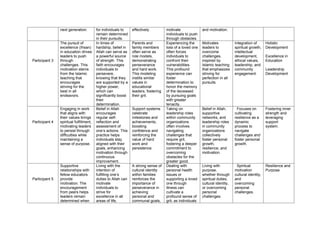
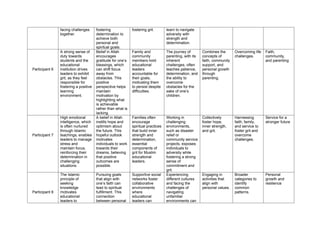
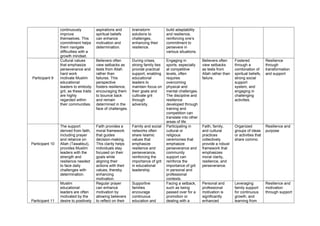


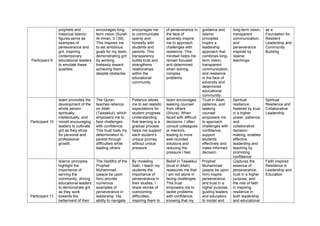

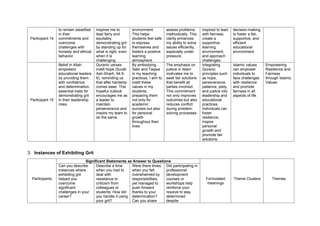
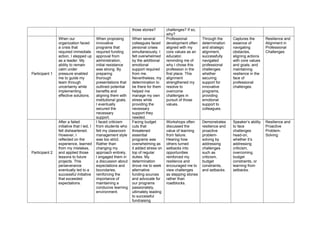

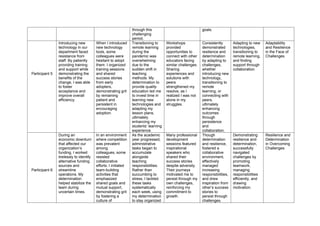

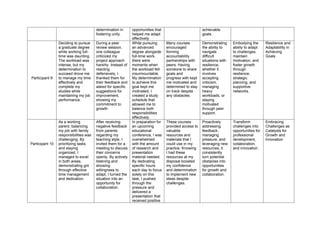
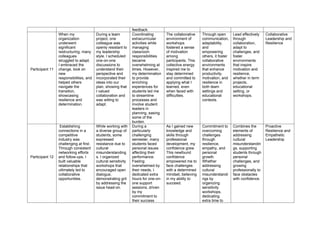
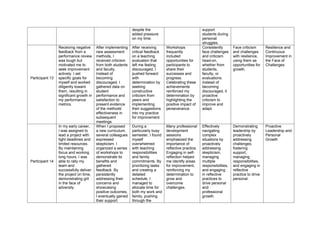


![Notre Dame Cath_Leadership_July 2014 [Repaired]](https://cdn.slidesharecdn.com/ss_thumbnails/b1a8f6f2-a222-4439-878b-12d21b723322-170109160926-thumbnail.jpg?width=640&height=640&fit=bounds)


