CUTZONE(NOPRINTINGALLOWED)
TRALI	
  
By:	
  Will	
  Engberg	
  UW	
  Hospital	
  and	
  Clinics	
  
What	
  is	
  TRALI?	
  
TRALI	
  is	
  short	
  for	
  Transfusion	
  Related	
  Acute	
  Lung	
  Injury.	
  As	
  
the	
  name	
  suggests,	
  it	
  is	
  an	
  acute	
  immune	
  response	
  due	
  to	
  
transfused	
   blood	
   products.	
   It	
   causes	
   severe	
   respiratory	
  
distress	
  and	
  hypoxemia.	
  
TRALI	
   is	
   considered	
   to	
   be	
   the	
   number	
   one	
   cause	
   of	
  
transfusion-­‐associated	
   fataliBes,	
   now	
   surpassing	
   ABO	
  
incompaBbility	
  and	
  bacterial	
  contaminaBon.	
  TRALI	
  has	
  a	
  
6%	
  to	
  20%	
  fatality	
  rate.	
  
TRALI	
  Pathogenesis	
  
One	
   theory	
   for	
   the	
   TRALI	
   pathway	
   is	
   “immune	
   TRALI”.	
  
AnBbodies	
   against	
   human	
   leukocyte	
   anBgen	
   (HLA)	
   or	
  
human	
  neutrophil	
  anBgens	
  (HNA)	
  in	
  the	
  transfused	
  blood	
  
component	
   react	
   with	
   recipient	
   leukocytes.	
   This	
   causes	
  
aggregates	
  that	
  occlude	
  the	
  pulmonary	
  circulaBon.	
  Studies	
  
have	
  shown	
  that	
  HLA	
  class	
  II	
  anBgens	
  and	
  HNA-­‐3a	
  anBgens	
  
are	
  most	
  frequently	
  associated	
  with	
  severe	
  immune	
  TRALI.	
  
Up	
  to	
  80%	
  of	
  TRALI	
  cases	
  react	
  in	
  this	
  manner.	
  
The	
  other	
  pathway	
  is	
  known	
  as	
  “nonimmune	
  TRALI”.	
  Non-­‐
immune	
  TRALI	
  consists	
  of	
  a	
  “two-­‐hit”	
  event.	
  The	
  first	
  “hit”	
  
consists	
   of	
   some	
   type	
   of	
   lung	
   trauma,	
   or	
   an	
   infecBous/
inflammatory	
  disease	
  in	
  the	
  paBent	
  that	
  affects	
  the	
  lungs.	
  
This	
   results	
   with	
   the	
   priming	
   of	
   neutrophils.	
   The	
   second	
  
“hit”	
  involves	
  transfusion	
  of	
  biologically	
  acBve	
  substances	
  
accumulated	
  during	
  storage	
  of	
  the	
  blood	
  product.	
  	
  
Immune	
  and	
  Non-­‐immune	
  TRALI	
  both	
  lead	
  to	
  the	
  same	
  outcome,	
  which	
  is	
  an	
  influx	
  of	
  leukocytes	
  into	
  the	
  lungs,	
  followed	
  by	
  
leukocyte	
  acBvaBon	
  and	
  release	
  of	
  cytotoxic	
  agents,	
  with	
  subsequent	
  endothelial	
  damage	
  and	
  capillary	
  permeability.	
  This	
  
increased	
  capillary	
  permeability	
  leads	
  to	
  leakage	
  of	
  fluid	
  into	
  alveolar	
  spaces,	
  resulBng	
  in	
  pulmonary	
  edema	
  and	
  respiratory	
  
distress.	
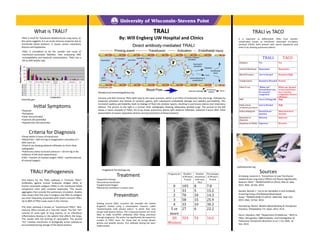
  The	
  picture	
  to	
  the	
  right	
  is	
  a	
  normal	
  chest	
  radiography	
  showing	
  adequately	
  aerated	
  lungs.	
  The	
  picture	
  to	
  the	
  le[	
  
shows	
  a	
  classic	
  example	
  of	
  TRALI;	
  the	
  X-­‐ray	
  shows	
  pulmonary	
  edema	
  with	
  bilateral	
  infiltrates,	
  obtained	
  4	
  hours	
  a[er	
  iniBal	
  
presentaBon	
  of	
  severe	
  respiratory	
  distress	
  during	
  transfusion	
  of	
  blood	
  products.	
  	
  
IniBal	
  Symptoms	
  
• Dyspnea	
  
• Tachypnea	
  
• Fever	
  (Occasionally)	
  
• Cyanosis	
  (Occasionally)	
  
• Hypotension	
  (Occasionally)	
  
Criteria	
  for	
  Diagnosis	
  
• Onset	
  within	
  6	
  hours	
  of	
  transfusion	
  
• PAO2/FiO2	
  <	
  300	
  mm	
  Hg	
  or	
  OxygenaBon	
  saturaBon	
  of	
  <	
  
90%	
  room	
  air	
  
• Chest	
  X-­‐ray	
  showing	
  bilateral	
  infiltrates	
  on	
  front	
  chest	
  
radiography	
  
• Pulmonary	
  artery	
  occlusion	
  pressure	
  <	
  18	
  mm	
  Hg	
  or	
  No	
  
evidence	
  of	
  le[	
  atrial	
  hypertension	
  
(FiO2	
  =	
  fracBon	
  of	
  inspired	
  oxygen;	
  PAO2	
  =	
  parBal	
  pressure	
  
of	
  arterial	
  oxygen)	
  
TRALI	
  vs	
  TACO	
  
It	
   is	
   important	
   to	
   differenBate	
   TRALI	
   from	
   another	
  
complicaBon	
   known	
   as	
   transfusion	
   associated	
   circulatory	
  
overload	
   (TACO).	
   Both	
   present	
   with	
   severe	
   hypoxemia	
   and	
  
chest	
  X-­‐ray	
  showing	
  pulmonary	
  edema.	
  	
  
Treatment	
  
• SupporBve	
  therapy	
  
• DisconBnue	
  transfusion	
  
• Supplemental	
  Oxygen	
  
• Mechanical	
  venBlaBon	
  in	
  severe	
  cases	
  
PrevenBon	
  
StarBng	
   around	
   2003,	
   countries	
   (for	
   example	
   the	
   United	
  
Kingdom)	
   started	
   using	
   a	
   preventaBve	
   measure	
   called	
  
“predominantly	
   male	
   plasma	
   policy”,	
   in	
   which	
   they	
   only	
  
accept	
  male	
  plasma	
  donors.	
  This	
  is	
  because	
  women	
  are	
  more	
  
likely	
   to	
   make	
   HLA/HNA	
   anBbodies	
   a[er	
   being	
   sensiBzed	
  
through	
  pregnancy.	
  This	
  policy	
  has	
  significantly	
  decreased	
  the	
  
number	
   of	
   TRALI	
   cases.	
   For	
   those	
   that	
   do	
   accept	
   female	
  
plasma	
   and	
   platelet	
   donors,	
   HLA	
   anBbody	
   tesBng	
   has	
   been	
  
implemented.	
  
Sources	
  
Arinsburg,	
  Suzanne	
  A.	
  "Conversion	
  to	
  Low	
  Transfusion-­‐
related	
  Acute	
  Lung	
  Injury	
  (TRALI)-­‐risk	
  Plasma	
  Significantly	
  
Reduces	
  TRALI."	
  TRANSFUSION	
  53	
  (2012):	
  946-­‐52.	
  May	
  
2012.	
  Web.	
  16	
  Feb.	
  2014.	
  
Gandhi,	
  Manish	
  J.	
  "Lot-­‐to-­‐lot	
  Variability	
  in	
  HLA	
  AnBbody	
  
Screening	
  Using	
  a	
  MulBplexed	
  Bead-­‐based	
  
Assay."	
  TRANSFUSION	
  53	
  (2013):	
  1940-­‐946.	
  Sept.-­‐Oct.	
  
2013.	
  Web.	
  16	
  Feb.	
  2014.	
  
Harmening,	
  Denise.	
  Modern	
  Blood	
  Banking	
  &	
  Transfusion	
  
Prac=ces.	
  Philadelphia:	
  F.A.	
  Davis,	
  2012.	
  Print.	
  
Harris,	
  Shealynn,	
  MD.	
  "Department	
  of	
  Medicine."	
  TACO	
  vs.	
  
TRALI:	
  Recogni=on,	
  Differen=a=on,	
  and	
  Inves=ga=on	
  of	
  
Pulmonary	
  Transfusion	
  Reac=ons	
  (n.d.):	
  1-­‐41.	
  Web.	
  16	
  
Feb.	
  2014.	
  	
  
www.fda.gov	
  
Bloodjournal.hematologylibrary.org	
  
imagebank.hematology.org	
  
nybloodcenter.org	
  

TRALI

  • 1.
    CUTZONE(NOPRINTINGALLOWED) CUTZONE(NOPRINTINGALLOWED) TRALI   By:  Will  Engberg  UW  Hospital  and  Clinics   What  is  TRALI?   TRALI  is  short  for  Transfusion  Related  Acute  Lung  Injury.  As   the  name  suggests,  it  is  an  acute  immune  response  due  to   transfused   blood   products.   It   causes   severe   respiratory   distress  and  hypoxemia.   TRALI   is   considered   to   be   the   number   one   cause   of   transfusion-­‐associated   fataliBes,   now   surpassing   ABO   incompaBbility  and  bacterial  contaminaBon.  TRALI  has  a   6%  to  20%  fatality  rate.   TRALI  Pathogenesis   One   theory   for   the   TRALI   pathway   is   “immune   TRALI”.   AnBbodies   against   human   leukocyte   anBgen   (HLA)   or   human  neutrophil  anBgens  (HNA)  in  the  transfused  blood   component   react   with   recipient   leukocytes.   This   causes   aggregates  that  occlude  the  pulmonary  circulaBon.  Studies   have  shown  that  HLA  class  II  anBgens  and  HNA-­‐3a  anBgens   are  most  frequently  associated  with  severe  immune  TRALI.   Up  to  80%  of  TRALI  cases  react  in  this  manner.   The  other  pathway  is  known  as  “nonimmune  TRALI”.  Non-­‐ immune  TRALI  consists  of  a  “two-­‐hit”  event.  The  first  “hit”   consists   of   some   type   of   lung   trauma,   or   an   infecBous/ inflammatory  disease  in  the  paBent  that  affects  the  lungs.   This   results   with   the   priming   of   neutrophils.   The   second   “hit”  involves  transfusion  of  biologically  acBve  substances   accumulated  during  storage  of  the  blood  product.     Immune  and  Non-­‐immune  TRALI  both  lead  to  the  same  outcome,  which  is  an  influx  of  leukocytes  into  the  lungs,  followed  by   leukocyte  acBvaBon  and  release  of  cytotoxic  agents,  with  subsequent  endothelial  damage  and  capillary  permeability.  This   increased  capillary  permeability  leads  to  leakage  of  fluid  into  alveolar  spaces,  resulBng  in  pulmonary  edema  and  respiratory   distress.  The  picture  to  the  right  is  a  normal  chest  radiography  showing  adequately  aerated  lungs.  The  picture  to  the  le[   shows  a  classic  example  of  TRALI;  the  X-­‐ray  shows  pulmonary  edema  with  bilateral  infiltrates,  obtained  4  hours  a[er  iniBal   presentaBon  of  severe  respiratory  distress  during  transfusion  of  blood  products.     IniBal  Symptoms   • Dyspnea   • Tachypnea   • Fever  (Occasionally)   • Cyanosis  (Occasionally)   • Hypotension  (Occasionally)   Criteria  for  Diagnosis   • Onset  within  6  hours  of  transfusion   • PAO2/FiO2  <  300  mm  Hg  or  OxygenaBon  saturaBon  of  <   90%  room  air   • Chest  X-­‐ray  showing  bilateral  infiltrates  on  front  chest   radiography   • Pulmonary  artery  occlusion  pressure  <  18  mm  Hg  or  No   evidence  of  le[  atrial  hypertension   (FiO2  =  fracBon  of  inspired  oxygen;  PAO2  =  parBal  pressure   of  arterial  oxygen)   TRALI  vs  TACO   It   is   important   to   differenBate   TRALI   from   another   complicaBon   known   as   transfusion   associated   circulatory   overload   (TACO).   Both   present   with   severe   hypoxemia   and   chest  X-­‐ray  showing  pulmonary  edema.     Treatment   • SupporBve  therapy   • DisconBnue  transfusion   • Supplemental  Oxygen   • Mechanical  venBlaBon  in  severe  cases   PrevenBon   StarBng   around   2003,   countries   (for   example   the   United   Kingdom)   started   using   a   preventaBve   measure   called   “predominantly   male   plasma   policy”,   in   which   they   only   accept  male  plasma  donors.  This  is  because  women  are  more   likely   to   make   HLA/HNA   anBbodies   a[er   being   sensiBzed   through  pregnancy.  This  policy  has  significantly  decreased  the   number   of   TRALI   cases.   For   those   that   do   accept   female   plasma   and   platelet   donors,   HLA   anBbody   tesBng   has   been   implemented.   Sources   Arinsburg,  Suzanne  A.  "Conversion  to  Low  Transfusion-­‐ related  Acute  Lung  Injury  (TRALI)-­‐risk  Plasma  Significantly   Reduces  TRALI."  TRANSFUSION  53  (2012):  946-­‐52.  May   2012.  Web.  16  Feb.  2014.   Gandhi,  Manish  J.  "Lot-­‐to-­‐lot  Variability  in  HLA  AnBbody   Screening  Using  a  MulBplexed  Bead-­‐based   Assay."  TRANSFUSION  53  (2013):  1940-­‐946.  Sept.-­‐Oct.   2013.  Web.  16  Feb.  2014.   Harmening,  Denise.  Modern  Blood  Banking  &  Transfusion   Prac=ces.  Philadelphia:  F.A.  Davis,  2012.  Print.   Harris,  Shealynn,  MD.  "Department  of  Medicine."  TACO  vs.   TRALI:  Recogni=on,  Differen=a=on,  and  Inves=ga=on  of   Pulmonary  Transfusion  Reac=ons  (n.d.):  1-­‐41.  Web.  16   Feb.  2014.     www.fda.gov   Bloodjournal.hematologylibrary.org   imagebank.hematology.org   nybloodcenter.org