Adam Andrade Task 1 Units 25,26
Training day
Training Day (2001) is a crime thriller directed by Antoine Fuqua. It is based around Jake, a
narcotics officer, who is undergoing his first day of training. He is paired with Alonso, corrupt
cop, who needs to I million dollars in order to survive. The film has many obstacles in which
get in order to keep Alonso alive. Training day Jake must tell linear story which helps to drive
the action forward and to keep the audience in suspense. essay, I will be on the scene
where they raid house in order to search for his drug money to keep Alonso alive. I will be
focussing on 4 elements of media, including: Camera work, Editing, Mise en Scene and
sound.
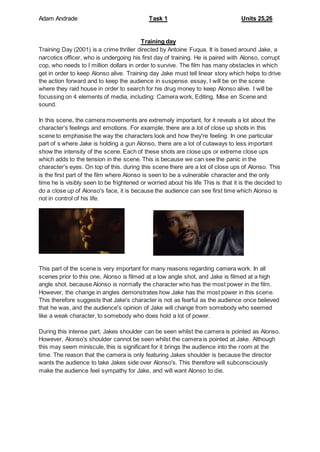
In this scene, the camera movements are extremely important, for it reveals a lot about the
character’s feelings and emotions. For example, there are a lot of close up shots in this
scene to emphasise the way the characters look and how they're feeling. In one particular
part of s where Jake is holding a gun Alonso, there are a lot of cutaways to less important
show the intensity of the scene. Each of these shots are close ups or extreme close ups
which adds to the tension in the scene. This is because we can see the panic in the
character’s eyes. On top of this. during this scene there are a lot of close ups of Alonso. This
is the first part of the film where Alonso is seen to be a vulnerable character and the only
time he is visibly seen to be frightened or worried about his life This is that it is the decided to
do a close up of Alonso's face, it is because the audience can see first time which Alonso is
not in control of his life.
This part of the scene is very important for many reasons regarding camera work. In all
scenes prior to this one, Alonso is filmed at a low angle shot, and Jake is filmed at a high
angle shot. because Alonso is normally the character who has the most power in the film.
However, the change in angles demonstrates how Jake has the most power in this scene.
This therefore suggests that Jake's character is not as fearful as the audience once believed
that he was, and the audience's opinion of Jake will change from somebody who seemed
like a weak character, to somebody who does hold a lot of power.
During this intense part, Jakes shoulder can be seen whilst the camera is pointed as Alonso.
However, Alonso's shoulder cannot be seen whilst the camera is pointed at Jake. Although
this may seem miniscule, this is significant for it brings the audience into the room at the
time. The reason that the camera is only featuring Jakes shoulder is because the director
wants the audience to take Jakes side over Alonso's. This therefore will subconsciously
make the audience feel sympathy for Jake, and will want Alonso to die.
Adam Andrade Task 1 Units 25,26
Just before the characters enter Rogers's house, the
camera is tracking the movement of the characters as are
preparing to raid the house. The director did this in order
to represent the panic and the urgency that the characters
were feeling at that On top of this, the tracking
movements of the for the audience to believe that they are also a part of the camera allowed
the audience to become drawn in. and as as a enable the characters come closer to the
house, the tension increases and the audience will wonder what is going to happen next.
During one part of the scene, there is a very slow zoom into Alonso's face, from a close up,
to an extreme close up. This therefore forces the audience to concentrate on Alonso's
emotion at the time. The movement of the zoom is important to not only make the part more
interesting, but also to show how Alonzo does not do anything in regards to getting the
money for himself, he makes other people do it for him. Therefore, making the audience hate
him even more. His emotion in this part is extremely nervous, for his time to get his money is
running out, and if he does not get it, then he will die.
The editing during Training Day also plays a big role in making the action scenes more
intense, and also making the film less boring to watch. As the characters are kicking down
the door to Roger's house, there is a match on action. This is so that the audience are able
to see the action from both the point of view of Alonso, and also from Rogers's point of view
inside the house. The different view of the action also makes the action less boring, another
benefit of using a match cut in this is that it creates sense of panic within the audience's
mind. This is because the audience know that something bad will happen, but they are
unsure when
Adam Andrade Task 1 Units 25,26
Shot reverse shot is a common way that the
editors piece together conversations within the scene. This shot type is used to show
dialogue between all of the characters during a conversation. Sometimes, the camera
pointed at a character whilst the other said. This is
talking. This is done in order to
show that person's reaction as to what is being is going will then give away the character’s
feelings and give the audience a clue about what to happen next.
During this specific scene, Alonso is looking very calm and confident when blaming Jake for
killing Roger, and Jake is looking angry and annoyed. The audience is able to see how tense
that this and it will leave them wondering what is scene is, going to happen next. During the
most intense part of the scene, where Jake is holding a gun to Alonso we are shown many
cutaways of Alonso's men holding guns to Jake. These cutaways are essential in order to
show the reactions of the other characters to what lake is doing. Everybody is on Alonso's
side apart from the audience and Jake The cuts made to other men's faces show what is
happening around the main focus of the action, and also enforces the danger in which both
Jake Alonzo are in. In the same part of the scene, the pace of cuts is guns at fast, and this
represents the tension of the house. This is for everybody is aiming each other, and nobody
is safe. The fast cutting is also used in this scene to show the dialogue of the characters in
the room. The use of doing this is to change the perspective to focus on what each person
saying, and to also show the non- verbal actions of the characters who are holding the guns.
Adam Andrade Task 1 Units 25,26
However, at other times in the scene, the cuts are a lot slower. However, using slow cuts
also creates tension in scene, but for different reasons than the fast paced cuts. When The
men are running through the woods before to raid Rogers house, the cuts are not as quick
paced this is so that the audience are able to establish the setting of the forest outside
Rogers house. As most of these shots are tracking shots, the cuts are slow in order to allow
the camera to show all the details in the background. Another reason for the slow cuts is to
match the slow, tension building music in the background. This therefore maximises the
tenseness in the scene before they enter the home, therefore making the audience feel
drawn into what is going to happen next.
Although the ellipsis in the scene may not be
noticeable on the first view of the film, it is essential for keeping the audience intrigued about
the action. When the men are digging a hole in Rogers house, we are shown the drill touch
the ground, but then it cuts away to another piece of action. However, a minute later the hole
appears to be wider, lt would be impossible to drill that much land in that short amount of
time, but the reason this is done is so that the audience do not lose interest and turn off of
fast forward the film.
The Mise En Scene is incredibly important throughout this film for many reasons. In the very
first part of the scene where the characters are preparing to raid Rogers house, the audience
will notice the secluded location of Rogers house. The reason for this is because Roger is a
drug dealer who wants to stay as hidden as possible in order not to get caught by the police
inside his house, there are lots of books on the shelf, which symbolises to the audience that
Roger is a clever man s is also shown through Rogers's clothes, hair, and glasses. To the
audience, it seems as if Roger is purposely wearing dull grey clothes, and living in a
secluded area in order to not make himself noticed by anybody in the neighbourhood.
Adam Andrade Task 1 Units 25,26
Alonso on the other hand is a complete juxtaposition to Roger. Alonso is shown in an
oversized black jacket to symbolise how he believes that he is bigger, and more powerful
than he truly is. He is wearing dark colours to represent how he is an evil character who is
mysterious. The colour black is often related to death. This is something in which the
audience are able to see when looking at Alonso, for he is the reason behind two people’s
death, as well as him dying himself. The use of Alonso's oversized black coat will make the
audience think of Alonso as a less powerful character than he may have been in previous
scenes.
Whilst all other characters are seen to be wearing
bulletproof vests to protect themselves from a
potential danger, Alonso isn’t wearing one. This is
because Alonso has the mentality that he does not need to wear protection, for he is
invisible and cannot be killed. The reason for Alonso doing this is so that everybody on the
room fears him, as he believes that he is so powerful that he doesn’t need saving by a vest.
Another reason for this is that he lets other people do the dirty work whilst he sits down and
smokes a cigarette. This does not give Alonso the type of effect he would have liked with the
audience and it instead makes him look like a weak and fragile character.
Within the scene the person who is holding Alonso's gun is the person who holds the is
power at the time. For example, Alonso is holding the big gun at the beginning, and this
Adam Andrade Task 1 Units 25,26
when he shoots Roger. To many of the audience, the gun could represent that the gun
represents the level of control that the person holding it has. Alonso has the power when he
shoots Roger, yet the power is transferred over when Alonso attempted to frame him. This is
important because the audience are able to direct their attention to the person that is holding
the big gun, for the main action will focus and occur when a character is holding the gun.
Alonso is often seen in dark lighting with only certain aspects of him in lighting. In one part of
the scene Alonso is fully in the dark apart from his eyes, which are in and the light, the effect
that this has on the audience is that it makes Alonso seem very mysterious, the audience
know exactly what he is about to do, yet due to the lighting and the audience's knowledge of
the character, they know that he is not up to no good. When Alonso introduces himself to
Roger, he enters from a dark lighting which fades to lighter lighting. The main reason why
the director did this to increase the fear that roger will feel at the time. The dramatic entrance
will help build the tension in the scene as a whole.
The
use of
sound
in the
film is essential in order to create realism and make the film more entertaining. There are a
l9ot of diegetic sound in the film, which is a noise that comes from the text and the
characters can hear. For example, this is used when the door slams shut, when the
chainsaw drills into the ground and the cocking of the bullet which kills Roger. The purpose
of using diegetic sound is to create a believable world, which the audience can relate to.
The sound of the main character gun is always the loudest, and in the actual film this is no
different. Alonso’s gun is the most powerful, and this is because the director wants the
audience to feel fear when they hear the gunshot. It also focuses the audience's attention to
Alonso each time they hear the gunshot. For example, when Alonso kills Roger, the gunshot
comes as a surprise to the audience, yet due to the loud sound of the gun the audience
know who has shot it.
Adam Andrade Task 1 Units 25,26
Another type of diegetic sound is the dialogue between the characters. In previous scenes,
Alonso has always spoken with an instructive tone to his voice in order to make other
characters fear him. The use of the attractive language is to make the audience realise who
was in control of the action in the movie. However, in this scene where Jake is holding a gun
to Alonso's face, Alonso has to change his tone of voice in order to remain alive. Whereas
before he had the power to tell Jake what to do or where to go at any point. The role has
been reversed. In order to get himself out of the situation, Alonso uses emotive and
convincing language to get him out of that situation: He seduces Jake by calling him "A quiet
boy with a kind heart” and further seduces him by telling him to think about his actions and
how it would destroy his career if he kills Alonso. By using this language, it allows for Jake to
put away the gun, and hands back the power to Alonso.
The
non-
diegetic sound is essential in order to build tension and to engage the audience with what
the audience with what they are watching. At the beginning there is a low “Hum” which is
builds into a more intense music as they are about to enter the home. The effect that this
has on the audience is that it builds up tension and mystery, for the audience is unaware hoe
the scene will end.
When the gun is first pointed at Alonso, there is no music and the room is completely silent,
Gradually, this music gets louder and more intense in order to focus the audience’s attention
on what Alonso is saying to Jake. The music builds as the scene becomes more intense,
showing that there will be a dramatic climax. However, the audience are surprised when
Jake backed down and handed the gun back to Alonso.
Adam Andrade Task 1 Units 25,26
Lastly, the music is representative of a heartbeat when the camera is focussed on Alonso as
digging takes place. This is an effective way of creating suspense, for it shows the anxiety
that Alonso feels. The heartbeat type music tells the audience that the following shots are
extremely significant in regard to action in the film.
Bulmer and Katz' uses
and Gratification
Theory (1974) states that an individual will watch specific text in order to satisfy a
personal need. The theory gives four categories as to why a person will watch a
specific film. The categories are split into; Diversion, personal identity, and
surveillance need.
Diversion is when a person watches a specific text as an escape from their everyday
problems and routines. This reason for watching a film is usually for entertainment
purposes, and will not make much difference to a person's life after watching that
film. Another person may watch a specific text for personal relationship reasons. This
is where an individual uses the media in order to fulfil their emotional and interaction
needs. A person will use this film as a substitute for something that they do not have
and want. For example, an individual who has just come out of relationship may
watch a love story in order to satisfy their desire for love. The third reason is for
personal identity, which is when somebody watches a film in order to find a sense of
self. The last category is for a surveillance need. This is when somebody watches
something in order to gain knowledge or information. This could be information about
our geographical or social world, including the or documentaries
Adam Andrade Task 1 Units 25,26
Most audiences would watch Training Day for a surveillance need in order to get an
inside look into the world of corruption. People who abuse their position of power are
an extremely relevant and real problem in our society today with unarmed people
being and killed by police. This film highlights these problems in a slightly
exaggerated way, which is exciting and engaging for the audience to watch. This film
leaves an individual to feel annoyed by the real life examples people who abuse their
power
Stuart Hall's encoding/Decoding theory (1973) states that the producer will encode a
certain message into the text, and it is the job of the job of the audience to decode
the message in order to get something out of it. There are three ways that an
audience member may read the message film, they could have a preferred reading
where the audience will agree to the message of the oppositional reading where
person understands the message but disagrees with what it is saying, A negotiated
reading is when somebody will both agree and disagree with the message of the
film.
I have a preferred reading of the film, as I believe that when put in a position of
power, people will abuse it and will commit some atrocities simply because they can.
Although the film was hugely exaggerated, I believe that the message was very
strong, and too difficult to ignore. Some people may have a negotiated reading of the
film because whilst they believe that there are police corruptions, the film overly
exaggerated to an extent which doesn't mirror a real life situation,

Training day

  • 1.
    Adam Andrade Task1 Units 25,26 Training day Training Day (2001) is a crime thriller directed by Antoine Fuqua. It is based around Jake, a narcotics officer, who is undergoing his first day of training. He is paired with Alonso, corrupt cop, who needs to I million dollars in order to survive. The film has many obstacles in which get in order to keep Alonso alive. Training day Jake must tell linear story which helps to drive the action forward and to keep the audience in suspense. essay, I will be on the scene where they raid house in order to search for his drug money to keep Alonso alive. I will be focussing on 4 elements of media, including: Camera work, Editing, Mise en Scene and sound. In this scene, the camera movements are extremely important, for it reveals a lot about the character’s feelings and emotions. For example, there are a lot of close up shots in this scene to emphasise the way the characters look and how they're feeling. In one particular part of s where Jake is holding a gun Alonso, there are a lot of cutaways to less important show the intensity of the scene. Each of these shots are close ups or extreme close ups which adds to the tension in the scene. This is because we can see the panic in the character’s eyes. On top of this. during this scene there are a lot of close ups of Alonso. This is the first part of the film where Alonso is seen to be a vulnerable character and the only time he is visibly seen to be frightened or worried about his life This is that it is the decided to do a close up of Alonso's face, it is because the audience can see first time which Alonso is not in control of his life. This part of the scene is very important for many reasons regarding camera work. In all scenes prior to this one, Alonso is filmed at a low angle shot, and Jake is filmed at a high angle shot. because Alonso is normally the character who has the most power in the film. However, the change in angles demonstrates how Jake has the most power in this scene. This therefore suggests that Jake's character is not as fearful as the audience once believed that he was, and the audience's opinion of Jake will change from somebody who seemed like a weak character, to somebody who does hold a lot of power. During this intense part, Jakes shoulder can be seen whilst the camera is pointed as Alonso. However, Alonso's shoulder cannot be seen whilst the camera is pointed at Jake. Although this may seem miniscule, this is significant for it brings the audience into the room at the time. The reason that the camera is only featuring Jakes shoulder is because the director wants the audience to take Jakes side over Alonso's. This therefore will subconsciously make the audience feel sympathy for Jake, and will want Alonso to die.
  • 2.
    Adam Andrade Task1 Units 25,26 Just before the characters enter Rogers's house, the camera is tracking the movement of the characters as are preparing to raid the house. The director did this in order to represent the panic and the urgency that the characters were feeling at that On top of this, the tracking movements of the for the audience to believe that they are also a part of the camera allowed the audience to become drawn in. and as as a enable the characters come closer to the house, the tension increases and the audience will wonder what is going to happen next. During one part of the scene, there is a very slow zoom into Alonso's face, from a close up, to an extreme close up. This therefore forces the audience to concentrate on Alonso's emotion at the time. The movement of the zoom is important to not only make the part more interesting, but also to show how Alonzo does not do anything in regards to getting the money for himself, he makes other people do it for him. Therefore, making the audience hate him even more. His emotion in this part is extremely nervous, for his time to get his money is running out, and if he does not get it, then he will die. The editing during Training Day also plays a big role in making the action scenes more intense, and also making the film less boring to watch. As the characters are kicking down the door to Roger's house, there is a match on action. This is so that the audience are able to see the action from both the point of view of Alonso, and also from Rogers's point of view inside the house. The different view of the action also makes the action less boring, another benefit of using a match cut in this is that it creates sense of panic within the audience's mind. This is because the audience know that something bad will happen, but they are unsure when
  • 3.
    Adam Andrade Task1 Units 25,26 Shot reverse shot is a common way that the editors piece together conversations within the scene. This shot type is used to show dialogue between all of the characters during a conversation. Sometimes, the camera pointed at a character whilst the other said. This is talking. This is done in order to show that person's reaction as to what is being is going will then give away the character’s feelings and give the audience a clue about what to happen next. During this specific scene, Alonso is looking very calm and confident when blaming Jake for killing Roger, and Jake is looking angry and annoyed. The audience is able to see how tense that this and it will leave them wondering what is scene is, going to happen next. During the most intense part of the scene, where Jake is holding a gun to Alonso we are shown many cutaways of Alonso's men holding guns to Jake. These cutaways are essential in order to show the reactions of the other characters to what lake is doing. Everybody is on Alonso's side apart from the audience and Jake The cuts made to other men's faces show what is happening around the main focus of the action, and also enforces the danger in which both Jake Alonzo are in. In the same part of the scene, the pace of cuts is guns at fast, and this represents the tension of the house. This is for everybody is aiming each other, and nobody is safe. The fast cutting is also used in this scene to show the dialogue of the characters in the room. The use of doing this is to change the perspective to focus on what each person saying, and to also show the non- verbal actions of the characters who are holding the guns.
  • 4.
    Adam Andrade Task1 Units 25,26 However, at other times in the scene, the cuts are a lot slower. However, using slow cuts also creates tension in scene, but for different reasons than the fast paced cuts. When The men are running through the woods before to raid Rogers house, the cuts are not as quick paced this is so that the audience are able to establish the setting of the forest outside Rogers house. As most of these shots are tracking shots, the cuts are slow in order to allow the camera to show all the details in the background. Another reason for the slow cuts is to match the slow, tension building music in the background. This therefore maximises the tenseness in the scene before they enter the home, therefore making the audience feel drawn into what is going to happen next. Although the ellipsis in the scene may not be noticeable on the first view of the film, it is essential for keeping the audience intrigued about the action. When the men are digging a hole in Rogers house, we are shown the drill touch the ground, but then it cuts away to another piece of action. However, a minute later the hole appears to be wider, lt would be impossible to drill that much land in that short amount of time, but the reason this is done is so that the audience do not lose interest and turn off of fast forward the film. The Mise En Scene is incredibly important throughout this film for many reasons. In the very first part of the scene where the characters are preparing to raid Rogers house, the audience will notice the secluded location of Rogers house. The reason for this is because Roger is a drug dealer who wants to stay as hidden as possible in order not to get caught by the police inside his house, there are lots of books on the shelf, which symbolises to the audience that Roger is a clever man s is also shown through Rogers's clothes, hair, and glasses. To the audience, it seems as if Roger is purposely wearing dull grey clothes, and living in a secluded area in order to not make himself noticed by anybody in the neighbourhood.
  • 5.
    Adam Andrade Task1 Units 25,26 Alonso on the other hand is a complete juxtaposition to Roger. Alonso is shown in an oversized black jacket to symbolise how he believes that he is bigger, and more powerful than he truly is. He is wearing dark colours to represent how he is an evil character who is mysterious. The colour black is often related to death. This is something in which the audience are able to see when looking at Alonso, for he is the reason behind two people’s death, as well as him dying himself. The use of Alonso's oversized black coat will make the audience think of Alonso as a less powerful character than he may have been in previous scenes. Whilst all other characters are seen to be wearing bulletproof vests to protect themselves from a potential danger, Alonso isn’t wearing one. This is because Alonso has the mentality that he does not need to wear protection, for he is invisible and cannot be killed. The reason for Alonso doing this is so that everybody on the room fears him, as he believes that he is so powerful that he doesn’t need saving by a vest. Another reason for this is that he lets other people do the dirty work whilst he sits down and smokes a cigarette. This does not give Alonso the type of effect he would have liked with the audience and it instead makes him look like a weak and fragile character. Within the scene the person who is holding Alonso's gun is the person who holds the is power at the time. For example, Alonso is holding the big gun at the beginning, and this
  • 6.
    Adam Andrade Task1 Units 25,26 when he shoots Roger. To many of the audience, the gun could represent that the gun represents the level of control that the person holding it has. Alonso has the power when he shoots Roger, yet the power is transferred over when Alonso attempted to frame him. This is important because the audience are able to direct their attention to the person that is holding the big gun, for the main action will focus and occur when a character is holding the gun. Alonso is often seen in dark lighting with only certain aspects of him in lighting. In one part of the scene Alonso is fully in the dark apart from his eyes, which are in and the light, the effect that this has on the audience is that it makes Alonso seem very mysterious, the audience know exactly what he is about to do, yet due to the lighting and the audience's knowledge of the character, they know that he is not up to no good. When Alonso introduces himself to Roger, he enters from a dark lighting which fades to lighter lighting. The main reason why the director did this to increase the fear that roger will feel at the time. The dramatic entrance will help build the tension in the scene as a whole. The use of sound in the film is essential in order to create realism and make the film more entertaining. There are a l9ot of diegetic sound in the film, which is a noise that comes from the text and the characters can hear. For example, this is used when the door slams shut, when the chainsaw drills into the ground and the cocking of the bullet which kills Roger. The purpose of using diegetic sound is to create a believable world, which the audience can relate to. The sound of the main character gun is always the loudest, and in the actual film this is no different. Alonso’s gun is the most powerful, and this is because the director wants the audience to feel fear when they hear the gunshot. It also focuses the audience's attention to Alonso each time they hear the gunshot. For example, when Alonso kills Roger, the gunshot comes as a surprise to the audience, yet due to the loud sound of the gun the audience know who has shot it.
  • 7.
    Adam Andrade Task1 Units 25,26 Another type of diegetic sound is the dialogue between the characters. In previous scenes, Alonso has always spoken with an instructive tone to his voice in order to make other characters fear him. The use of the attractive language is to make the audience realise who was in control of the action in the movie. However, in this scene where Jake is holding a gun to Alonso's face, Alonso has to change his tone of voice in order to remain alive. Whereas before he had the power to tell Jake what to do or where to go at any point. The role has been reversed. In order to get himself out of the situation, Alonso uses emotive and convincing language to get him out of that situation: He seduces Jake by calling him "A quiet boy with a kind heart” and further seduces him by telling him to think about his actions and how it would destroy his career if he kills Alonso. By using this language, it allows for Jake to put away the gun, and hands back the power to Alonso. The non- diegetic sound is essential in order to build tension and to engage the audience with what the audience with what they are watching. At the beginning there is a low “Hum” which is builds into a more intense music as they are about to enter the home. The effect that this has on the audience is that it builds up tension and mystery, for the audience is unaware hoe the scene will end. When the gun is first pointed at Alonso, there is no music and the room is completely silent, Gradually, this music gets louder and more intense in order to focus the audience’s attention on what Alonso is saying to Jake. The music builds as the scene becomes more intense, showing that there will be a dramatic climax. However, the audience are surprised when Jake backed down and handed the gun back to Alonso.
  • 8.
    Adam Andrade Task1 Units 25,26 Lastly, the music is representative of a heartbeat when the camera is focussed on Alonso as digging takes place. This is an effective way of creating suspense, for it shows the anxiety that Alonso feels. The heartbeat type music tells the audience that the following shots are extremely significant in regard to action in the film. Bulmer and Katz' uses and Gratification Theory (1974) states that an individual will watch specific text in order to satisfy a personal need. The theory gives four categories as to why a person will watch a specific film. The categories are split into; Diversion, personal identity, and surveillance need. Diversion is when a person watches a specific text as an escape from their everyday problems and routines. This reason for watching a film is usually for entertainment purposes, and will not make much difference to a person's life after watching that film. Another person may watch a specific text for personal relationship reasons. This is where an individual uses the media in order to fulfil their emotional and interaction needs. A person will use this film as a substitute for something that they do not have and want. For example, an individual who has just come out of relationship may watch a love story in order to satisfy their desire for love. The third reason is for personal identity, which is when somebody watches a film in order to find a sense of self. The last category is for a surveillance need. This is when somebody watches something in order to gain knowledge or information. This could be information about our geographical or social world, including the or documentaries
  • 9.
    Adam Andrade Task1 Units 25,26 Most audiences would watch Training Day for a surveillance need in order to get an inside look into the world of corruption. People who abuse their position of power are an extremely relevant and real problem in our society today with unarmed people being and killed by police. This film highlights these problems in a slightly exaggerated way, which is exciting and engaging for the audience to watch. This film leaves an individual to feel annoyed by the real life examples people who abuse their power Stuart Hall's encoding/Decoding theory (1973) states that the producer will encode a certain message into the text, and it is the job of the job of the audience to decode the message in order to get something out of it. There are three ways that an audience member may read the message film, they could have a preferred reading where the audience will agree to the message of the oppositional reading where person understands the message but disagrees with what it is saying, A negotiated reading is when somebody will both agree and disagree with the message of the film. I have a preferred reading of the film, as I believe that when put in a position of power, people will abuse it and will commit some atrocities simply because they can. Although the film was hugely exaggerated, I believe that the message was very strong, and too difficult to ignore. Some people may have a negotiated reading of the film because whilst they believe that there are police corruptions, the film overly exaggerated to an extent which doesn't mirror a real life situation,