1
ONLINE VS TRADITIONAL FORM OF
TEACHING
Prepared by : Dr. Shabana Naz Shah
Online
Teaching
• Online teaching is the process of educating others via the internet.
• Various methods can be used, such as one-on-one video calls, group video calls,
zoom meeting, team meeting and webinars.
• We can start teaching from any location (home, coffee shop, co-working space).
• Through online teaching delivers the content through text, images or videos.
• In this method we can enroll students from various backgrounds and
geographical areas.
2
Traditional
Method of
Teaching
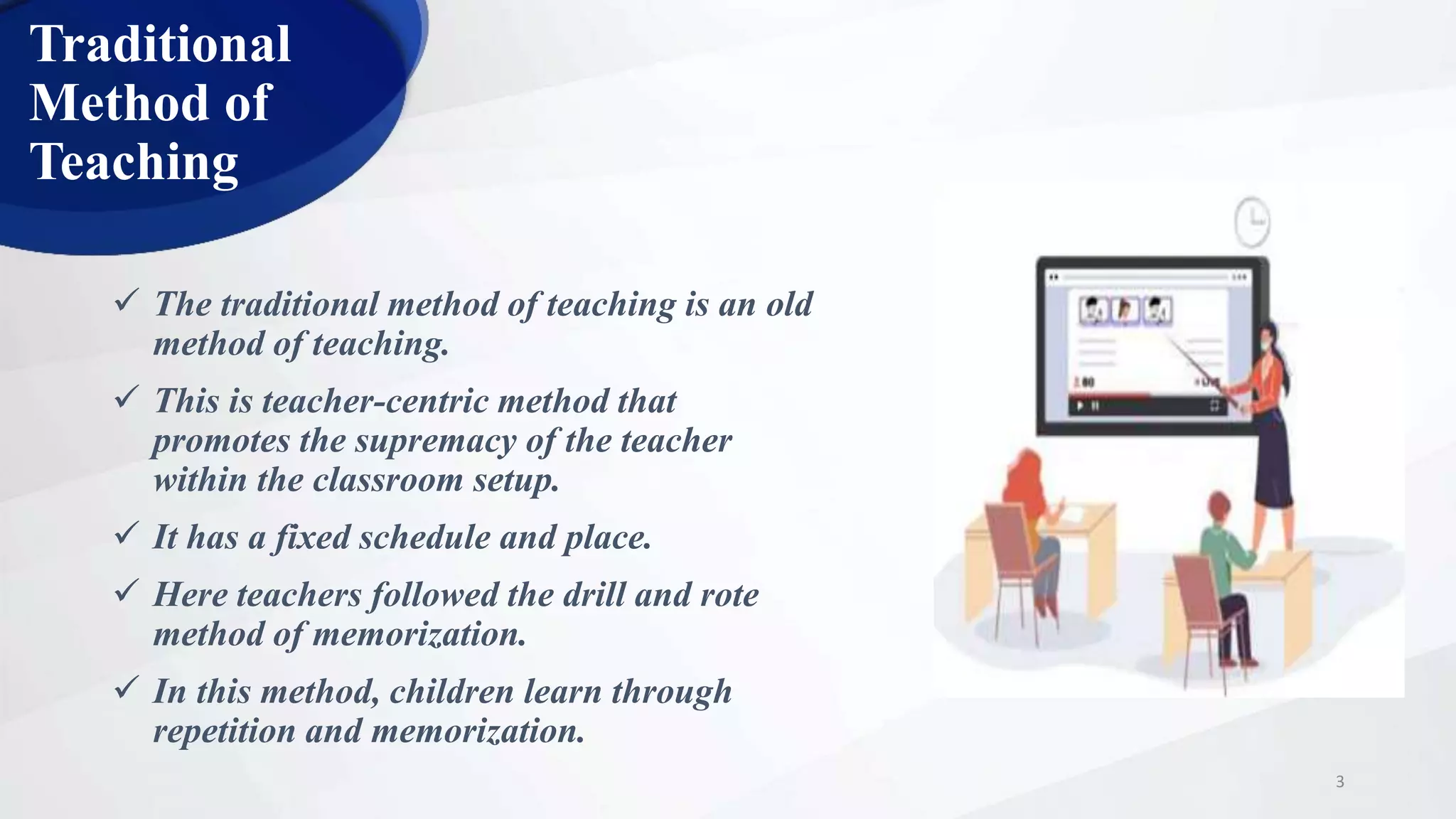
 The traditional method of teaching is an old
method of teaching.
 This is teacher-centric method that
promotes the supremacy of the teacher
within the classroom setup.
 It has a fixed schedule and place.
 Here teachers followed the drill and rote
method of memorization.
 In this method, children learn through
repetition and memorization.
3
Difference between Online
Teaching and Traditional
Teaching
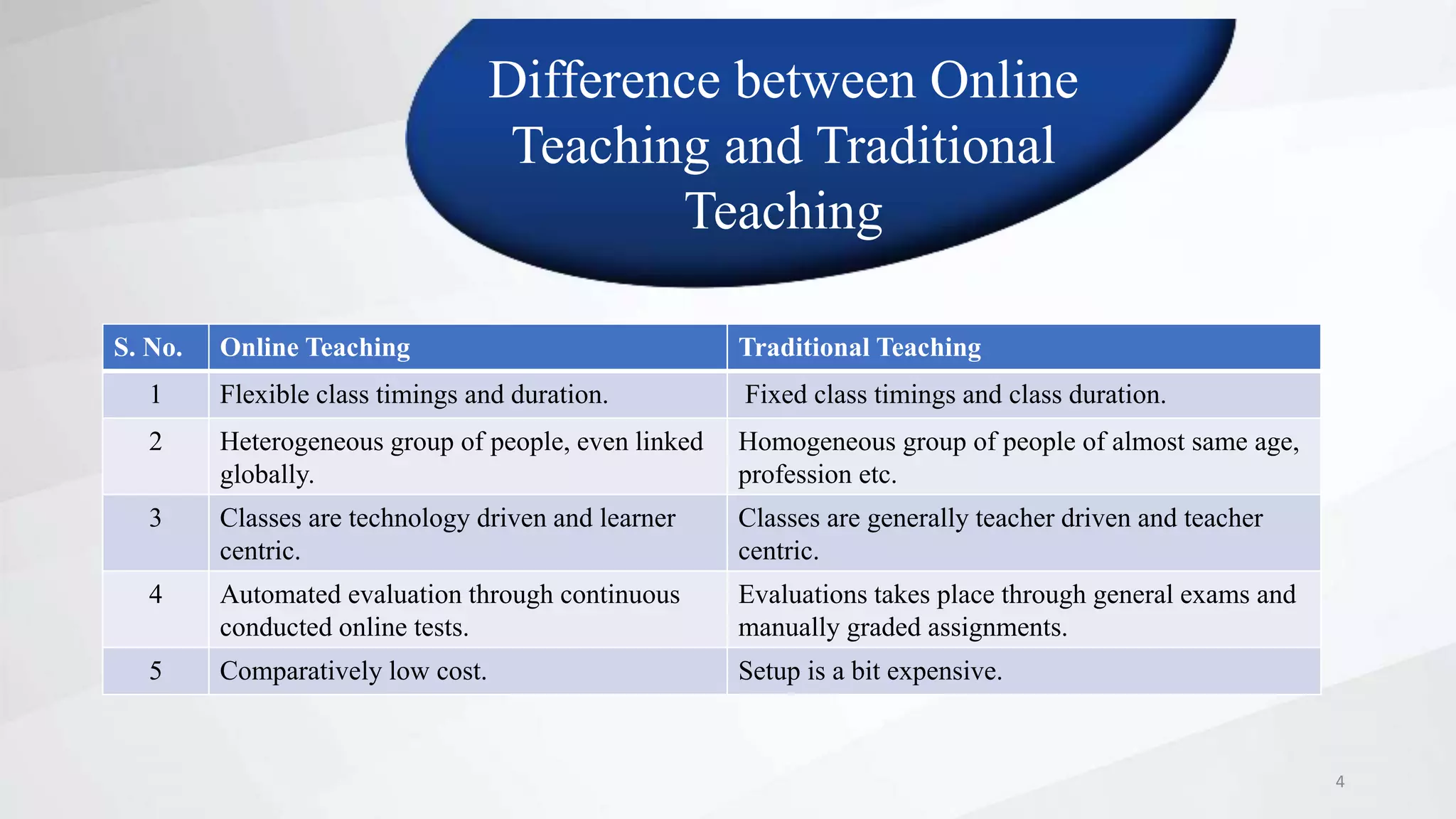
S. No. Online Teaching Traditional Teaching
1 Flexible class timings and duration. Fixed class timings and class duration.
2 Heterogeneous group of people, even linked
globally.
Homogeneous group of people of almost same age,
profession etc.
3 Classes are technology driven and learner
centric.
Classes are generally teacher driven and teacher
centric.
4 Automated evaluation through continuous
conducted online tests.
Evaluations takes place through general exams and
manually graded assignments.
5 Comparatively low cost. Setup is a bit expensive.
4
Merits of
Traditional
Teaching Methods
 These methods are easy to use.
 Regular attendance in classes helps them interact with other individuals of their
own age, be better disciplined, follow a regular schedule, and improve their
physical fitness and mental alertness.
 Students can directly share their views and clarify their own queries with the
teacher, thus getting their questions answered right away.
 The chances of technical glitches are really less.
 No need to learn about the usage of computer-based teaching aids.
 This allows teachers to know the students and evaluate their strengths and
weaknesses better, act as mentors, and guide students in their career possibilities.
 Lastly, interactions with good teachers help motivate students to achieve higher
marks.
5
Demerits of Traditional
Teaching Methods
-WEAK LEARNERS SUFFER THE MOST
AS THEY DON’T FEEL MOTIVATED.
-EVALUATION OF LEARNERS CAN BE
FAULTY BASED ON TRADITIONAL
TEACHING METHODS.
LACK OF COOPERATIVENESS AND
COLLABORATION.
6
Merits of Online Teaching
 One of the most significant advantages of online teaching is flexibility.
 Enhanced Time Management Skills.
 Career Advancement Opportunities.
 Online teaching allows students to work independently without interacting
with the teacher or other peers.
 This is ideal for those students who have social anxiety or tend to learn
better alone.
 Increased Collaboration.
 Personalized Education. 7
Demerits of Online
Teaching
• Online teaching may Create a Sense of Isolation.
• Online teaching means more screen-time.
• Lack of face-to-face interaction.
• Technical difficulties.
• Internet connection problems and computer skills.
• In online teaching, the learner is not directly interacting with the faculty.
• So, in case of having any questions, they may find it difficult to ask their online instructor.
• Does not work on social skills.
• Some teachers do not have skills to run an online class.
8
Perks of Online Teaching
Over Traditional Teaching
Online Teaching
• We can teach while sitting at
home.
• Less expensive.
• No specific timings.
• Missed classes can be delivered
at time.
• Detailed explanations.
Traditinal Teaching
• Knowledge is delivered at a
particular center.
• Bit costlier.
• Done on a specific time.
• Missed classes are difficult to
deliver.
• Less explanations.
9
Perks of Traditional
Teaching Over
OnlineTeaching
Traditinal Teaching
• Face to face communication
with students.
• Doubts and questions can be
asked easily.
• It can be completed in less
duration.
OnlineTeaching
• No face-to-face communication
with students.
• Bit difficult to know the doubts
and the questions arise.
• It takes more duration than
traditional teaching.
10
Conclusion
 We should know that the teaching environment can vary in online and
traditional classes based on many factors.
 It usually depends on our priorities and how flexible we’re willing to be for
our classes.
 Ultimately, the choice is ours and depends on our preferences, but both
teaching approaches have pros and cons, so make sure we weigh them out
equally.
 There’s no right or wrong answer regarding online vs. traditional form of
teaching.
 We can choose the best according to our convenience and suitability.
11
12

Traditional VS Online Teaching 2.pptx

  • 1.
    1 ONLINE VS TRADITIONALFORM OF TEACHING Prepared by : Dr. Shabana Naz Shah
  • 2.
    Online Teaching • Online teachingis the process of educating others via the internet. • Various methods can be used, such as one-on-one video calls, group video calls, zoom meeting, team meeting and webinars. • We can start teaching from any location (home, coffee shop, co-working space). • Through online teaching delivers the content through text, images or videos. • In this method we can enroll students from various backgrounds and geographical areas. 2
  • 3.
    Traditional Method of Teaching  Thetraditional method of teaching is an old method of teaching.  This is teacher-centric method that promotes the supremacy of the teacher within the classroom setup.  It has a fixed schedule and place.  Here teachers followed the drill and rote method of memorization.  In this method, children learn through repetition and memorization. 3
  • 4.
    Difference between Online Teachingand Traditional Teaching S. No. Online Teaching Traditional Teaching 1 Flexible class timings and duration. Fixed class timings and class duration. 2 Heterogeneous group of people, even linked globally. Homogeneous group of people of almost same age, profession etc. 3 Classes are technology driven and learner centric. Classes are generally teacher driven and teacher centric. 4 Automated evaluation through continuous conducted online tests. Evaluations takes place through general exams and manually graded assignments. 5 Comparatively low cost. Setup is a bit expensive. 4
  • 5.
    Merits of Traditional Teaching Methods These methods are easy to use.  Regular attendance in classes helps them interact with other individuals of their own age, be better disciplined, follow a regular schedule, and improve their physical fitness and mental alertness.  Students can directly share their views and clarify their own queries with the teacher, thus getting their questions answered right away.  The chances of technical glitches are really less.  No need to learn about the usage of computer-based teaching aids.  This allows teachers to know the students and evaluate their strengths and weaknesses better, act as mentors, and guide students in their career possibilities.  Lastly, interactions with good teachers help motivate students to achieve higher marks. 5
  • 6.
    Demerits of Traditional TeachingMethods -WEAK LEARNERS SUFFER THE MOST AS THEY DON’T FEEL MOTIVATED. -EVALUATION OF LEARNERS CAN BE FAULTY BASED ON TRADITIONAL TEACHING METHODS. LACK OF COOPERATIVENESS AND COLLABORATION. 6
  • 7.
    Merits of OnlineTeaching  One of the most significant advantages of online teaching is flexibility.  Enhanced Time Management Skills.  Career Advancement Opportunities.  Online teaching allows students to work independently without interacting with the teacher or other peers.  This is ideal for those students who have social anxiety or tend to learn better alone.  Increased Collaboration.  Personalized Education. 7
  • 8.
    Demerits of Online Teaching •Online teaching may Create a Sense of Isolation. • Online teaching means more screen-time. • Lack of face-to-face interaction. • Technical difficulties. • Internet connection problems and computer skills. • In online teaching, the learner is not directly interacting with the faculty. • So, in case of having any questions, they may find it difficult to ask their online instructor. • Does not work on social skills. • Some teachers do not have skills to run an online class. 8
  • 9.
    Perks of OnlineTeaching Over Traditional Teaching Online Teaching • We can teach while sitting at home. • Less expensive. • No specific timings. • Missed classes can be delivered at time. • Detailed explanations. Traditinal Teaching • Knowledge is delivered at a particular center. • Bit costlier. • Done on a specific time. • Missed classes are difficult to deliver. • Less explanations. 9
  • 10.
    Perks of Traditional TeachingOver OnlineTeaching Traditinal Teaching • Face to face communication with students. • Doubts and questions can be asked easily. • It can be completed in less duration. OnlineTeaching • No face-to-face communication with students. • Bit difficult to know the doubts and the questions arise. • It takes more duration than traditional teaching. 10
  • 11.
    Conclusion  We shouldknow that the teaching environment can vary in online and traditional classes based on many factors.  It usually depends on our priorities and how flexible we’re willing to be for our classes.  Ultimately, the choice is ours and depends on our preferences, but both teaching approaches have pros and cons, so make sure we weigh them out equally.  There’s no right or wrong answer regarding online vs. traditional form of teaching.  We can choose the best according to our convenience and suitability. 11
  • 12.