December 9, 2020, 12:00 pm PST
Welcome
Unless otherwise indicated, this
presentation is licensed CC-BY 4.0
Tracking Key
Program Indicators
(KPIs) for OER
Agenda
• Introductions
• Overview of Projects
• Panel Discussion
• Q & A
• Upcoming events
Previous slide image credit:
Browser, Graphic, Flat Design by janjf93 from Pixabay
Speakers
Michael Daly
Director of Operations,
SUNY OER Services
State University of New
York
Michael Mills
Vice President of the
Office of E-Learning,
Innovation and
Teaching Excellence
Montgomery College
Richard Sebastian
Director, Open and
Digital Learning
Achieving the Dream
Judith Sebesta
Executive Director
Digital Higher
Education Consortium
of Texas (DigiTex)
Moderator:
Nathan Smith, OER Faculty-in-Residence and Philosophy Professor, Houston Community College
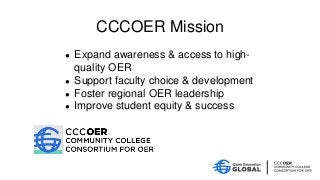
● Expand awareness & access to high-
quality OER
● Support faculty choice & development
● Foster regional OER leadership
● Improve student equity & success
CCCOER Mission
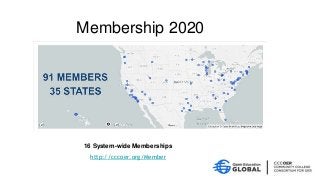
Membership 2020
http://cccoer.org/Member
16 System-wide Memberships
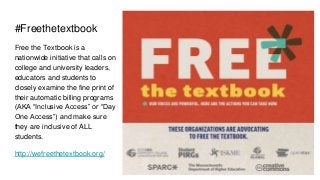
#Freethetextbook
Free the Textbook is a
nationwide initiative that calls on
college and university leaders,
educators and students to
closely examine the fine print of
their automatic billing programs
(AKA “Inclusive Access” or “Day
One Access”) and make sure
they are inclusive of ALL
students.
http://wefreethetextbook.org/
Judith Sebesta, PhD, is the Executive Director of
the Digital Higher Education Consortium of Texas,
which provides consortium support for Texas
Community Colleges. She co-authored a 2019
survey of OER in the state of Texas.
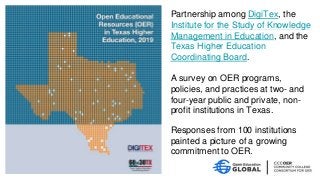
Partnership among DigiTex, the
Institute for the Study of Knowledge
Management in Education, and the
Texas Higher Education
Coordinating Board.
A survey on OER programs,
policies, and practices at two- and
four-year public and private, non-
profit institutions in Texas.
Responses from 100 institutions
painted a picture of a growing
commitment to OER.
OER in Texas Higher Education, 2019
Key finding: data
collection on the
pedagogical and financial
impacts of OER is
nascent, yet promising.
Approximately 20% of
institutions are collecting
data on the financial or
teaching and learning
impacts of OER.
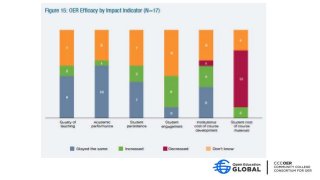
KPI:
Quality of teaching
Student academic performance
Student persistence in courses or programs
Student engagement in courses or
materials
Availability of high quality materials
Cost of course development for the
institution
Cost of course materials for learners
Richard Sebastian, Ph.D. is the Director of Open and Digital
Learning at Achieving the Dream, a nonprofit that supports a
national network of community colleges in achieving
sustainable institutional transformation through sharing
knowledge, innovative solutions, and effective practices and
policies that lead to improved outcomes for all students. He led
the ATD’s OER Degree Initiative, and is currently managing a
follow-up grant project investigating innovative uses of OER in
the college classroom.
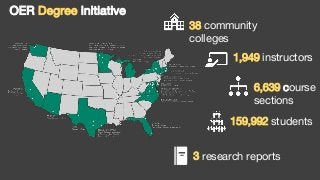
3 research reports
OER Degree Initiative
1,949 instructors
6,639 course
sections
159,992 students
38 community
colleges
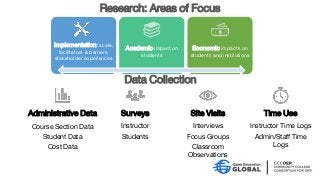
Administrative Data
Course Section Data
Student Data
Cost Data
Surveys
Instructor
Students
Site Visits
Interviews
Focus Groups
Classroom
Observations
Time Use
Instructor Time Logs
Admin/Staff Time
Logs
Implementation: scale,
facilitators & barriers,
stakeholder experiences
Academic impact on
students
Economic impacts on
students and institutions
Research: Areas of Focus
Data Collection
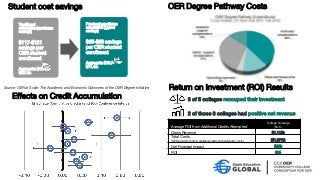
Student cost savings
Source: OER at Scale: The Academic and Economic Outcomes of the OER Degree Initiative
Traditional
calculation (maximum
savings)
$117-$121
savings per
OER student
enrollment
Aggregate: $19.4m-
$20.1m
Purchasing patterns
calculation (typical
savings)
$65-$69 savings
per OER student
enrollment
Aggregate: $10.7-
$11.4m
OER Degree Pathway Costs
Effects on Credit Accumulation
Return on Investment (ROI) Results
Average ROI from Additional Credits Attempted
College Average
(N=5)
Gross Revenue $1,115k
Total Costs
(OER program costs & additional instructional delivery costs) ($1,077k)
Net Financial Impact $38k
ROI 3%
3 of 5 colleges recouped their investment
2 of those 3 colleges had positive net revenue
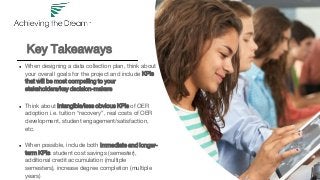
Key Takeaways
● When designing a data collection plan, think about
your overall goals for the project and include KPIs
that will be most compelling to your
stakeholders/key decision-makers
● Think about intangible/less obvious KPIs of OER
adoption i.e. tuition “recovery”, real costs of OER
development, student engagement/satisfaction,
etc.
● When possible, include both immediate and longer-
term KPIs: student cost savings (semester),
additional credit accumulation (multiple
semesters), increase degree completion (multiple
years)
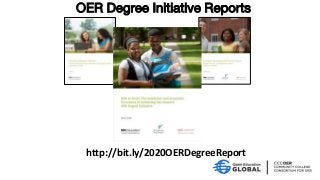
OER Degree Initiative Reports
http://bit.ly/2020OERDegreeReport
Michael Daly is the Director of Operations at SUNY OER
Services (SOS). SOS operates as part of the State
University of New York’s Office of Library and Information
Services. In his role he works with SUNY campuses, faculty,
and students to drive large-scale adoption of open
educational resources (OER) as a strategy for increasing
student success and empowering faculty's pedagogy.He
also facilitates the active participation and engagement with
SUNY's external partners in OER, including rpk GROUP, as
campuses develop sustainability plans that reflect local
values and cultures. Prior to joining SOS, he spent ten years
as the instruction/public services librarian at Fulton-
Montgomery Community College (SUNY), where he
developed and lead a robust campus-wide OER program
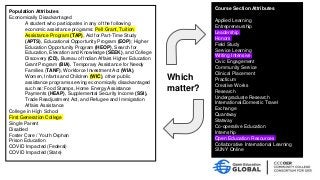
Population Attributes
Economically Disadvantaged
A student who participates in any of the following
economic assistance programs: Pell Grant, Tuition
Assistance Program (TAP), Aid for Part-Time Study
(APTS), Educational Opportunity Program (EOP); Higher
Education Opportunity Program (HEOP), Search for
Education, Elevation and Knowledge (SEEK), and College
Discovery (CD), Bureau of Indian Affairs Higher Education
Grant Program (BIA), Temporary Assistance for Needy
Families (TANF), Workforce Investment Act (WIA),
Women, Infants and Children (WIC), other public
assistance programs serving economically disadvantaged
such as: Food Stamps, Home Energy Assistance
Payments (HEAP), Supplemental Security Income (SSI),
Trade Readjustment Act, and Refugee and Immigration
Affairs Assistance
College in High School
First Generation College
Single Parent
Disabled
Foster Care / Youth Orphan
Prison Education
COVID Impacted (Federal)
COVID Impacted (State)
Course Section Attributes
Applied Learning
Entrepreneurship
Leadership
Honors
Field Study
Service Learning
Writing Intensive
Civic Engagement
Community Service
Clinical Placement
Practicum
Creative Works
Research
Undergraduate Research
International/Domestic Travel
Exchange
Quantway
Statway
Co-operative Education
Internship
Open Education Resources
Collaborative International Learning
SUNY Online
Which
matter?
External
partnerships
System-level
partnerships
Campus
partnerships
https://oer.suny.edu/oer-
sustainability
Lessons from SUNY’s OER Sustainability Cohorts
“To thine own self
[program, college] be
true….”
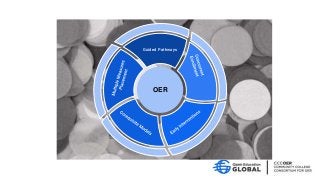
OER
Guided Pathways
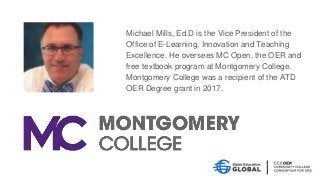
Michael Mills, Ed.D is the Vice President of the
Office of E-Learning, Innovation and Teaching
Excellence. He oversees MC Open, the OER and
free textbook program at Montgomery College.
Montgomery College was a recipient of the ATD
OER Degree grant in 2017.
Panel Discussion
Questions?
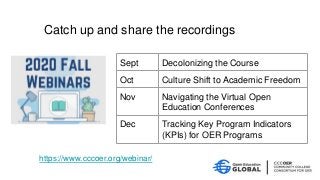
Catch up and share the recordings
Sept Decolonizing the Course
Oct Culture Shift to Academic Freedom
Nov Navigating the Virtual Open
Education Conferences
Dec Tracking Key Program Indicators
(KPIs) for OER Programs
https://www.cccoer.org/webinar/
Stay in the Loop
● Upcoming Conferences
See our website under “Get-Involved”
● Join our Community Email
○ https://www.cccoer.org/community-email/
● Read our EDI blog posts & Student
OER Impact Stories
○ https://www.cccoer.org
Image by Paul Brennan from Pixabay
Webinars resume in Feb 2021
Contact Info:
@unatdaly -- unatdaly@oeglobal.org
@CCCOER Liz Yata -- lizyata@oeglobal.org
Lisa Young -- lisa.young@scottsdalecc.edu
@suetash Sue Tashjian -- stashjian@necc.mass.edu
Thank you!

Tracking Key Program Indicators (KPIs) for OER

  • 1.
    December 9, 2020,12:00 pm PST Welcome Unless otherwise indicated, this presentation is licensed CC-BY 4.0 Tracking Key Program Indicators (KPIs) for OER
  • 2.
    Agenda • Introductions • Overviewof Projects • Panel Discussion • Q & A • Upcoming events Previous slide image credit: Browser, Graphic, Flat Design by janjf93 from Pixabay
  • 3.
    Speakers Michael Daly Director ofOperations, SUNY OER Services State University of New York Michael Mills Vice President of the Office of E-Learning, Innovation and Teaching Excellence Montgomery College Richard Sebastian Director, Open and Digital Learning Achieving the Dream Judith Sebesta Executive Director Digital Higher Education Consortium of Texas (DigiTex) Moderator: Nathan Smith, OER Faculty-in-Residence and Philosophy Professor, Houston Community College
  • 4.
    ● Expand awareness& access to high- quality OER ● Support faculty choice & development ● Foster regional OER leadership ● Improve student equity & success CCCOER Mission
  • 5.
  • 6.
    #Freethetextbook Free the Textbookis a nationwide initiative that calls on college and university leaders, educators and students to closely examine the fine print of their automatic billing programs (AKA “Inclusive Access” or “Day One Access”) and make sure they are inclusive of ALL students. http://wefreethetextbook.org/
  • 7.
    Judith Sebesta, PhD,is the Executive Director of the Digital Higher Education Consortium of Texas, which provides consortium support for Texas Community Colleges. She co-authored a 2019 survey of OER in the state of Texas.
  • 8.
    Partnership among DigiTex,the Institute for the Study of Knowledge Management in Education, and the Texas Higher Education Coordinating Board. A survey on OER programs, policies, and practices at two- and four-year public and private, non- profit institutions in Texas. Responses from 100 institutions painted a picture of a growing commitment to OER.
  • 9.
    OER in TexasHigher Education, 2019 Key finding: data collection on the pedagogical and financial impacts of OER is nascent, yet promising. Approximately 20% of institutions are collecting data on the financial or teaching and learning impacts of OER. KPI: Quality of teaching Student academic performance Student persistence in courses or programs Student engagement in courses or materials Availability of high quality materials Cost of course development for the institution Cost of course materials for learners
  • 11.
    Richard Sebastian, Ph.D.is the Director of Open and Digital Learning at Achieving the Dream, a nonprofit that supports a national network of community colleges in achieving sustainable institutional transformation through sharing knowledge, innovative solutions, and effective practices and policies that lead to improved outcomes for all students. He led the ATD’s OER Degree Initiative, and is currently managing a follow-up grant project investigating innovative uses of OER in the college classroom.
  • 12.
    3 research reports OERDegree Initiative 1,949 instructors 6,639 course sections 159,992 students 38 community colleges
  • 13.
    Administrative Data Course SectionData Student Data Cost Data Surveys Instructor Students Site Visits Interviews Focus Groups Classroom Observations Time Use Instructor Time Logs Admin/Staff Time Logs Implementation: scale, facilitators & barriers, stakeholder experiences Academic impact on students Economic impacts on students and institutions Research: Areas of Focus Data Collection
  • 14.
    Student cost savings Source:OER at Scale: The Academic and Economic Outcomes of the OER Degree Initiative Traditional calculation (maximum savings) $117-$121 savings per OER student enrollment Aggregate: $19.4m- $20.1m Purchasing patterns calculation (typical savings) $65-$69 savings per OER student enrollment Aggregate: $10.7- $11.4m OER Degree Pathway Costs Effects on Credit Accumulation Return on Investment (ROI) Results Average ROI from Additional Credits Attempted College Average (N=5) Gross Revenue $1,115k Total Costs (OER program costs & additional instructional delivery costs) ($1,077k) Net Financial Impact $38k ROI 3% 3 of 5 colleges recouped their investment 2 of those 3 colleges had positive net revenue
  • 15.
    Key Takeaways ● Whendesigning a data collection plan, think about your overall goals for the project and include KPIs that will be most compelling to your stakeholders/key decision-makers ● Think about intangible/less obvious KPIs of OER adoption i.e. tuition “recovery”, real costs of OER development, student engagement/satisfaction, etc. ● When possible, include both immediate and longer- term KPIs: student cost savings (semester), additional credit accumulation (multiple semesters), increase degree completion (multiple years)
  • 16.
    OER Degree InitiativeReports http://bit.ly/2020OERDegreeReport
  • 17.
    Michael Daly isthe Director of Operations at SUNY OER Services (SOS). SOS operates as part of the State University of New York’s Office of Library and Information Services. In his role he works with SUNY campuses, faculty, and students to drive large-scale adoption of open educational resources (OER) as a strategy for increasing student success and empowering faculty's pedagogy.He also facilitates the active participation and engagement with SUNY's external partners in OER, including rpk GROUP, as campuses develop sustainability plans that reflect local values and cultures. Prior to joining SOS, he spent ten years as the instruction/public services librarian at Fulton- Montgomery Community College (SUNY), where he developed and lead a robust campus-wide OER program
  • 18.
    Population Attributes Economically Disadvantaged Astudent who participates in any of the following economic assistance programs: Pell Grant, Tuition Assistance Program (TAP), Aid for Part-Time Study (APTS), Educational Opportunity Program (EOP); Higher Education Opportunity Program (HEOP), Search for Education, Elevation and Knowledge (SEEK), and College Discovery (CD), Bureau of Indian Affairs Higher Education Grant Program (BIA), Temporary Assistance for Needy Families (TANF), Workforce Investment Act (WIA), Women, Infants and Children (WIC), other public assistance programs serving economically disadvantaged such as: Food Stamps, Home Energy Assistance Payments (HEAP), Supplemental Security Income (SSI), Trade Readjustment Act, and Refugee and Immigration Affairs Assistance College in High School First Generation College Single Parent Disabled Foster Care / Youth Orphan Prison Education COVID Impacted (Federal) COVID Impacted (State) Course Section Attributes Applied Learning Entrepreneurship Leadership Honors Field Study Service Learning Writing Intensive Civic Engagement Community Service Clinical Placement Practicum Creative Works Research Undergraduate Research International/Domestic Travel Exchange Quantway Statway Co-operative Education Internship Open Education Resources Collaborative International Learning SUNY Online Which matter?
  • 19.
  • 20.
  • 21.
    Michael Mills, Ed.Dis the Vice President of the Office of E-Learning, Innovation and Teaching Excellence. He oversees MC Open, the OER and free textbook program at Montgomery College. Montgomery College was a recipient of the ATD OER Degree grant in 2017.
  • 26.
  • 27.
  • 28.
    Catch up andshare the recordings Sept Decolonizing the Course Oct Culture Shift to Academic Freedom Nov Navigating the Virtual Open Education Conferences Dec Tracking Key Program Indicators (KPIs) for OER Programs https://www.cccoer.org/webinar/
  • 29.
    Stay in theLoop ● Upcoming Conferences See our website under “Get-Involved” ● Join our Community Email ○ https://www.cccoer.org/community-email/ ● Read our EDI blog posts & Student OER Impact Stories ○ https://www.cccoer.org Image by Paul Brennan from Pixabay
  • 30.
    Webinars resume inFeb 2021 Contact Info: @unatdaly -- unatdaly@oeglobal.org @CCCOER Liz Yata -- lizyata@oeglobal.org Lisa Young -- lisa.young@scottsdalecc.edu @suetash Sue Tashjian -- stashjian@necc.mass.edu Thank you!