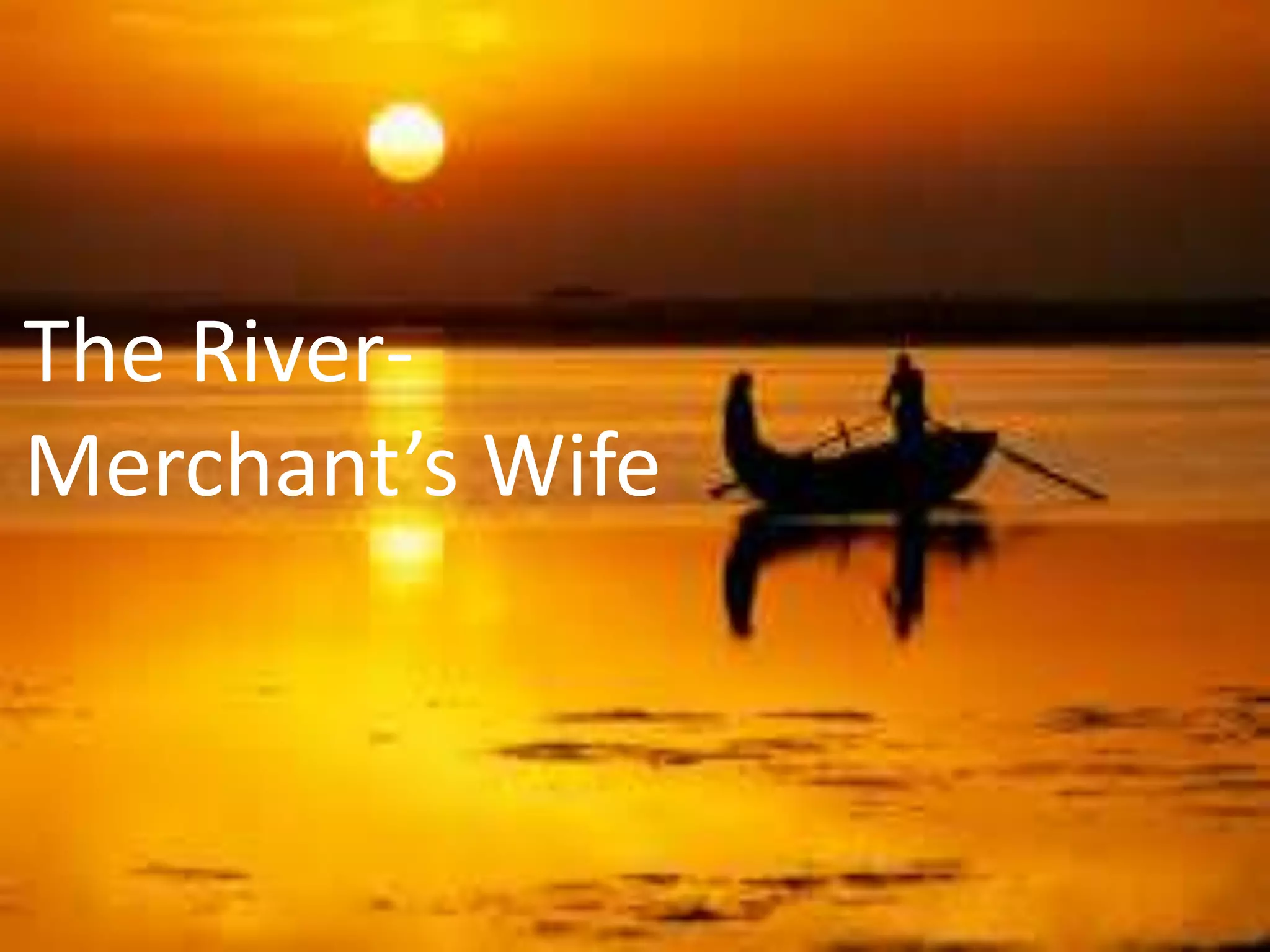
The River- 
Merchant’s Wife
The River-Merchant’s Wife: A Letter 
Ezra Pound, 1885 - 1972 
While my hair was still cut straight across my forehead 
I played about the front gate, pulling flowers. 
You came by on bamboo stilts, playing horse, 
You walked about my seat, playing with blue plums. 
And we went on living in the village of Chokan: 
Two small people, without dislike or suspicion. 
At fourteen I married My Lord you. 
I never laughed, being bashful. 
Lowering my head, I looked at the wall. 
Called to, a thousand times, I never looked back. 
At fifteen I stopped scowling, 
I desired my dust to be mingled with yours 
Forever and forever and forever. 
Why should I climb the look out? 
At sixteen you departed, 
You went into far Ku-to-yen, by the river of swirling eddies, 
And you have been gone five months. 
The monkeys make sorrowful noise overhead. 
You dragged your feet when you went out. 
By the gate now, the moss is grown, the different mosses, 
Too deep to clear them away! 
The leaves fall early this autumn, in wind. 
The paired butterflies are already yellow with August 
Over the grass in the West garden; 
They hurt me. I grow older. 
If you are coming down through the narrows of the river Kiang, 
Please let me know beforehand, 
And I will come out to meet you 
As far as Cho-fu-Sa.
“At fourteen I married My Lord you. 
I never laughed, being bashful. 
Lowering my head, I looked at the wall.” 
During the 20th century and especially ancient cultures women married much younger. 
Even in modern China women are expected to marry early or else they are seen as 
“undesirable”. The girl addresses he husband as “Lord” which would be a respectful 
term to use. Also in 20th century Chinese culture, women were expected to act a 
certain way. She is very much so inferior to her husband, lowering her head and 
controlling her emotions.
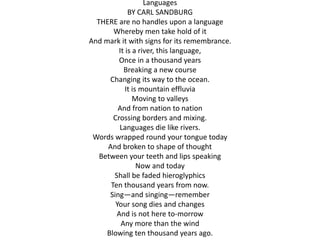
Languages
Languages 
BY CARL SANDBURG 
THERE are no handles upon a language 
Whereby men take hold of it 
And mark it with signs for its remembrance. 
It is a river, this language, 
Once in a thousand years 
Breaking a new course 
Changing its way to the ocean. 
It is mountain effluvia 
Moving to valleys 
And from nation to nation 
Crossing borders and mixing. 
Languages die like rivers. 
Words wrapped round your tongue today 
And broken to shape of thought 
Between your teeth and lips speaking 
Now and today 
Shall be faded hieroglyphics 
Ten thousand years from now. 
Sing—and singing—remember 
Your song dies and changes 
And is not here to-morrow 
Any more than the wind 
Blowing ten thousand years ago.
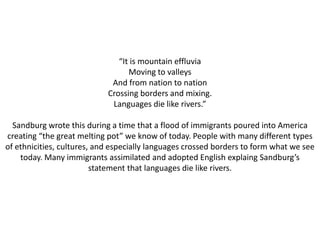
“It is mountain effluvia 
Moving to valleys 
And from nation to nation 
Crossing borders and mixing. 
Languages die like rivers.” 
Sandburg wrote this during a time that a flood of immigrants poured into America 
creating “the great melting pot” we know of today. People with many different types 
of ethnicities, cultures, and especially languages crossed borders to form what we see 
today. Many immigrants assimilated and adopted English explaing Sandburg’s 
statement that languages die like rivers.

Trace 5.05

  • 1.
  • 2.
    The River-Merchant’s Wife:A Letter Ezra Pound, 1885 - 1972 While my hair was still cut straight across my forehead I played about the front gate, pulling flowers. You came by on bamboo stilts, playing horse, You walked about my seat, playing with blue plums. And we went on living in the village of Chokan: Two small people, without dislike or suspicion. At fourteen I married My Lord you. I never laughed, being bashful. Lowering my head, I looked at the wall. Called to, a thousand times, I never looked back. At fifteen I stopped scowling, I desired my dust to be mingled with yours Forever and forever and forever. Why should I climb the look out? At sixteen you departed, You went into far Ku-to-yen, by the river of swirling eddies, And you have been gone five months. The monkeys make sorrowful noise overhead. You dragged your feet when you went out. By the gate now, the moss is grown, the different mosses, Too deep to clear them away! The leaves fall early this autumn, in wind. The paired butterflies are already yellow with August Over the grass in the West garden; They hurt me. I grow older. If you are coming down through the narrows of the river Kiang, Please let me know beforehand, And I will come out to meet you As far as Cho-fu-Sa.
  • 3.
    “At fourteen Imarried My Lord you. I never laughed, being bashful. Lowering my head, I looked at the wall.” During the 20th century and especially ancient cultures women married much younger. Even in modern China women are expected to marry early or else they are seen as “undesirable”. The girl addresses he husband as “Lord” which would be a respectful term to use. Also in 20th century Chinese culture, women were expected to act a certain way. She is very much so inferior to her husband, lowering her head and controlling her emotions.
  • 4.
  • 5.
    Languages BY CARLSANDBURG THERE are no handles upon a language Whereby men take hold of it And mark it with signs for its remembrance. It is a river, this language, Once in a thousand years Breaking a new course Changing its way to the ocean. It is mountain effluvia Moving to valleys And from nation to nation Crossing borders and mixing. Languages die like rivers. Words wrapped round your tongue today And broken to shape of thought Between your teeth and lips speaking Now and today Shall be faded hieroglyphics Ten thousand years from now. Sing—and singing—remember Your song dies and changes And is not here to-morrow Any more than the wind Blowing ten thousand years ago.
  • 6.
    “It is mountaineffluvia Moving to valleys And from nation to nation Crossing borders and mixing. Languages die like rivers.” Sandburg wrote this during a time that a flood of immigrants poured into America creating “the great melting pot” we know of today. People with many different types of ethnicities, cultures, and especially languages crossed borders to form what we see today. Many immigrants assimilated and adopted English explaing Sandburg’s statement that languages die like rivers.